
A complete issue · 16 pages · 1895
Judge — August 24, 1895
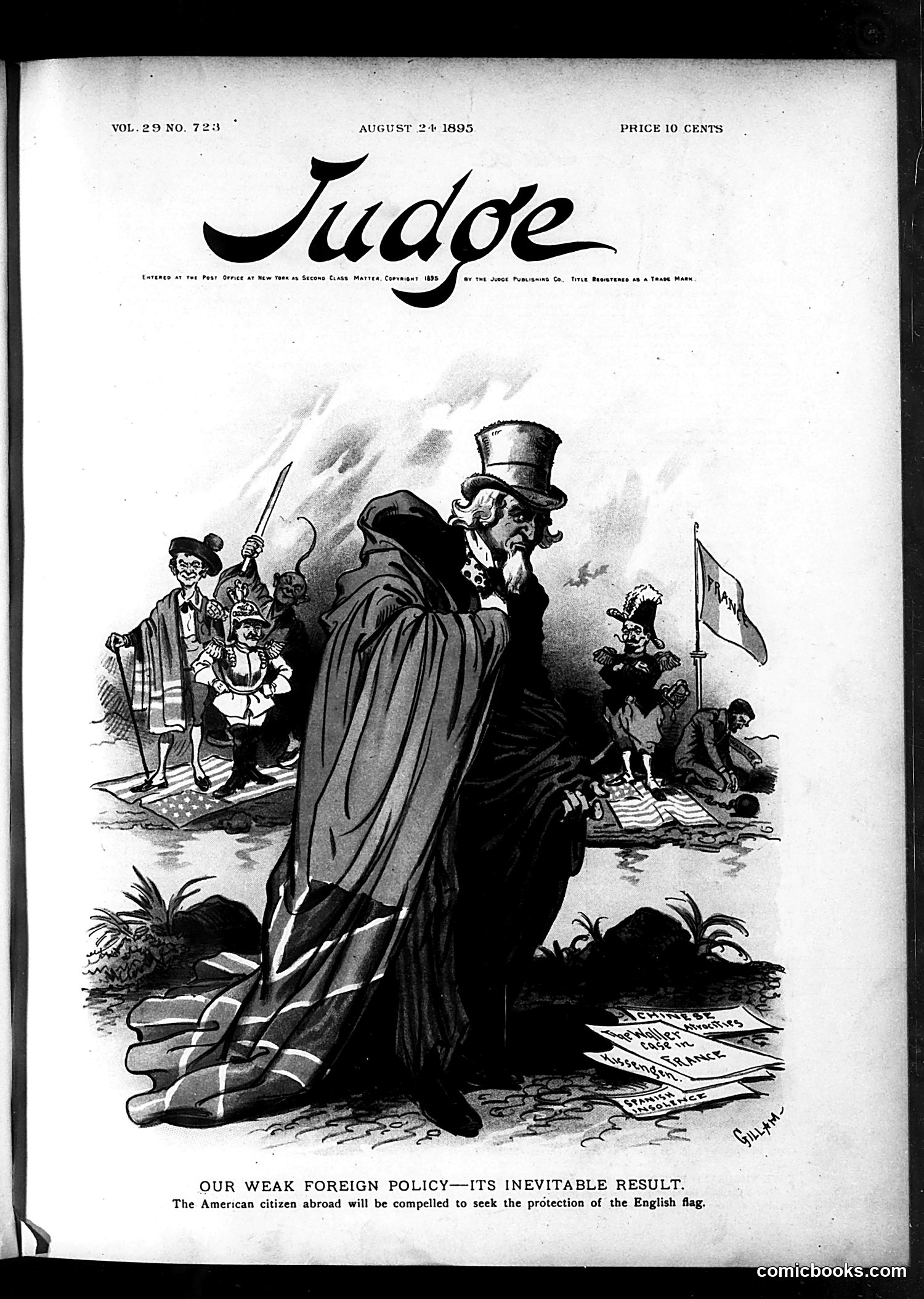
**Title and Subject:** "Our Weak Foreign Policy—Its Inevitable Result" **The Satire:** This political cartoon criticizes American foreign policy as inadequate or timid. The central figure—an American gentleman in a top hat and cape—appears distressed or defeated, surrounded by various international figures and flags (including what appears to be the British flag). **The Point:** The caption states "The American citizen abroad will be compelled to seek the protection of the English flag," suggesting that weak American diplomacy leaves American citizens vulnerable overseas and dependent on British protection. **Context:** This reflects 1890s anxieties about American prestige and power on the world stage, when the U.S. was still establishing itself as a major international player. The cartoon advocates for stronger, more assertive foreign policy.
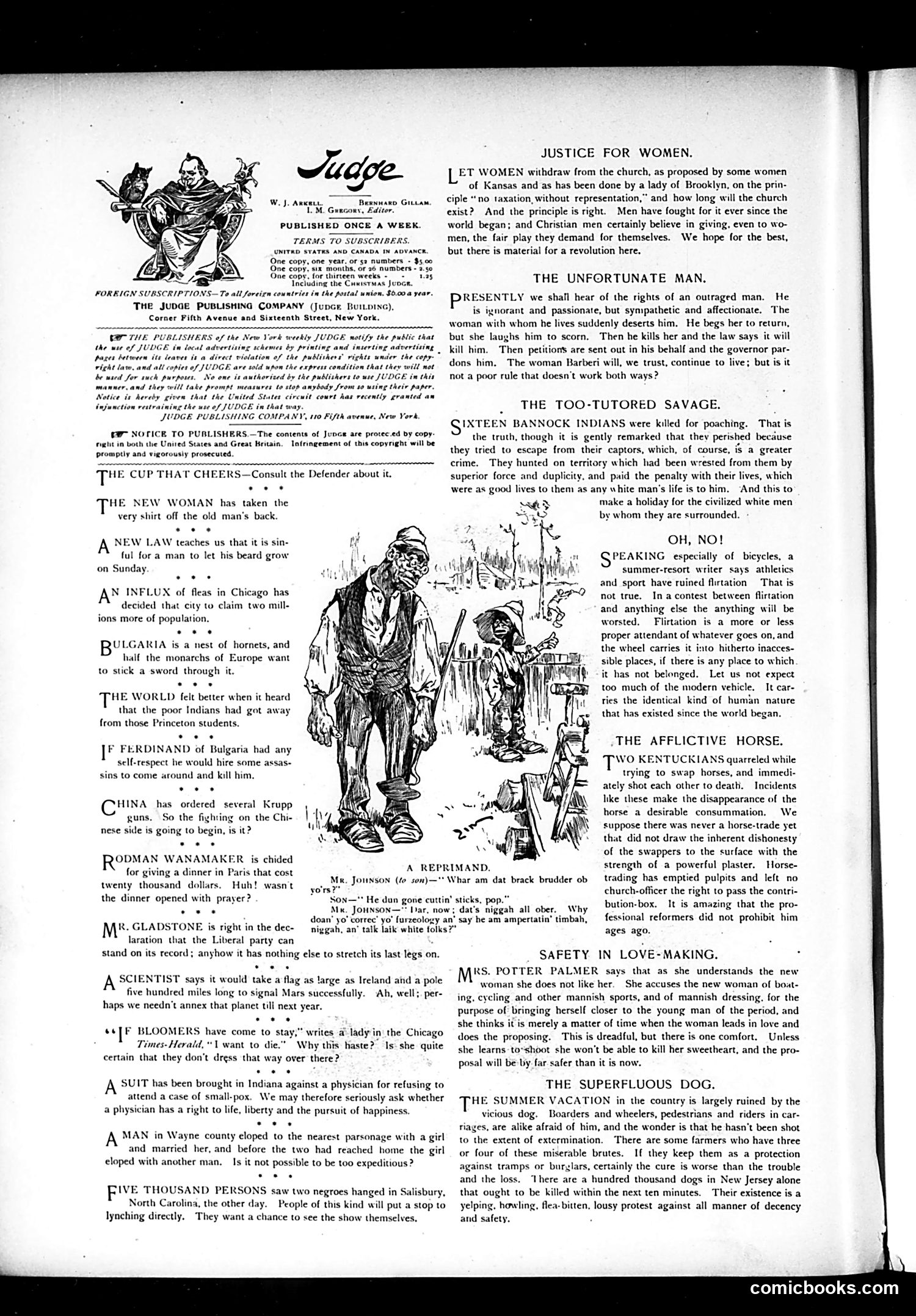
The central cartoon titled "Reprimand" depicts an adult (likely a parent or authority figure) scolding two children. The dialogue shows the adult correcting a child's dialect or speech pattern—the child says "nigger, an' talk like white folks?" suggesting the cartoon addresses racial speech and class-based language differences. The page contains multiple brief satirical items addressing contemporary social issues: women's rights ("Justice for Women"), Native American treatment ("The Too-Tutored Savage"), and various humorous observations on modern life. **Key context**: Without the specific publication date visible, the content appears to reflect late 19th or early 20th-century American social anxieties about race, gender, and "proper" social behavior—typical Judge magazine territory of satirizing progressive reforms and social change.
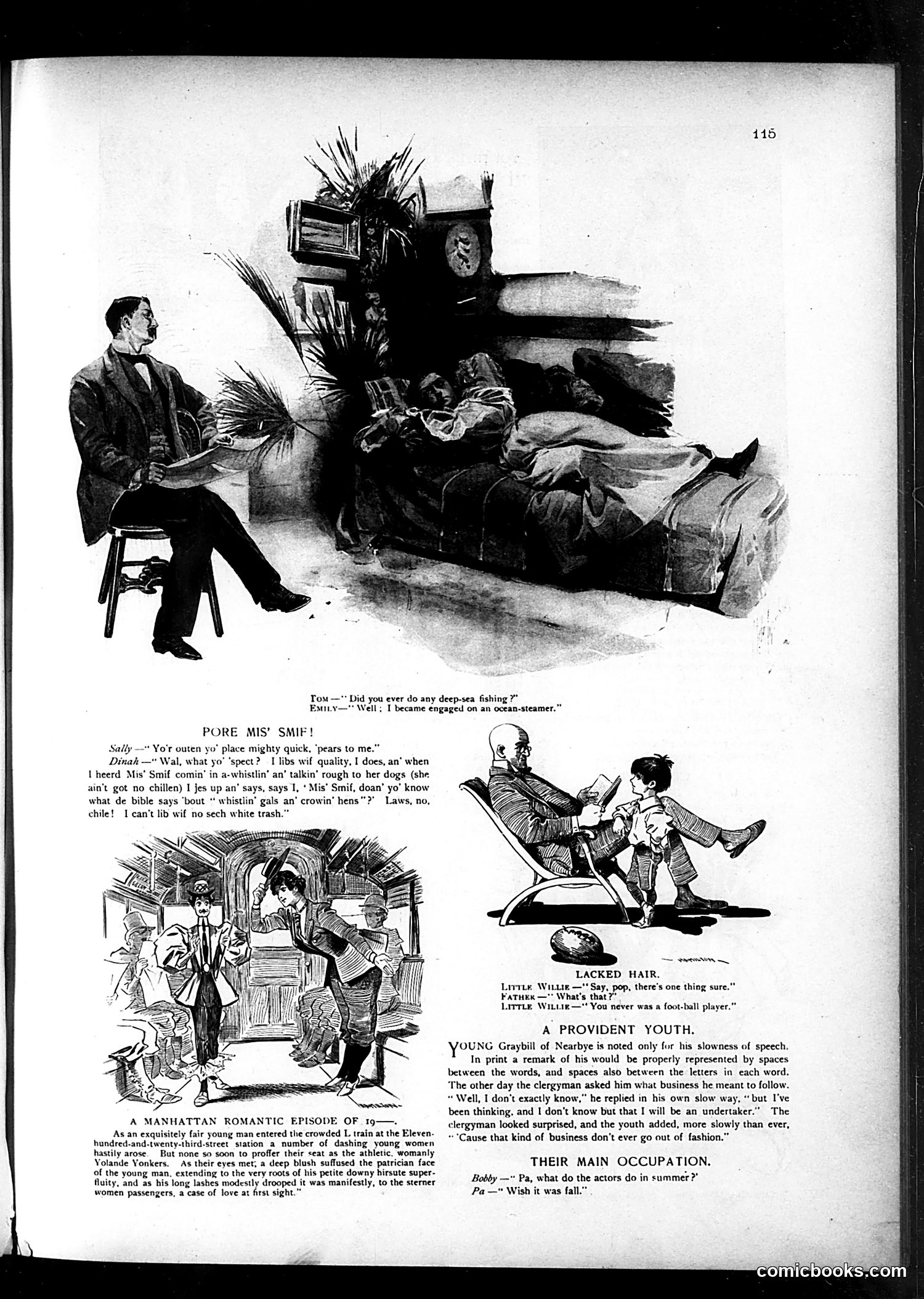
This page contains three separate comic sketches satirizing social behavior and class differences: 1. **"Pore Mis' Smif!"** - A humorous dialect piece mocking lower-class speech patterns, depicting working-class characters discussing propriety and social pretension. 2. **"A Manhattan Romantic Episode"** - Shows a young man entering a crowded train, which triggers comically exaggerated swooning among female passengers, satirizing melodramatic romantic behavior. 3. **"Lacked Hair"** and **"A Provident Youth"** - Brief comic vignettes about hair and football, using wordplay and physical humor. The overall theme appears to be satire of class pretensions, exaggerated romantic sensibilities, and working-class speech patterns—typical Judge magazine content targeting middle-class anxieties and social climbing. The crude dialect humor reflects period attitudes toward immigrants and working classes.
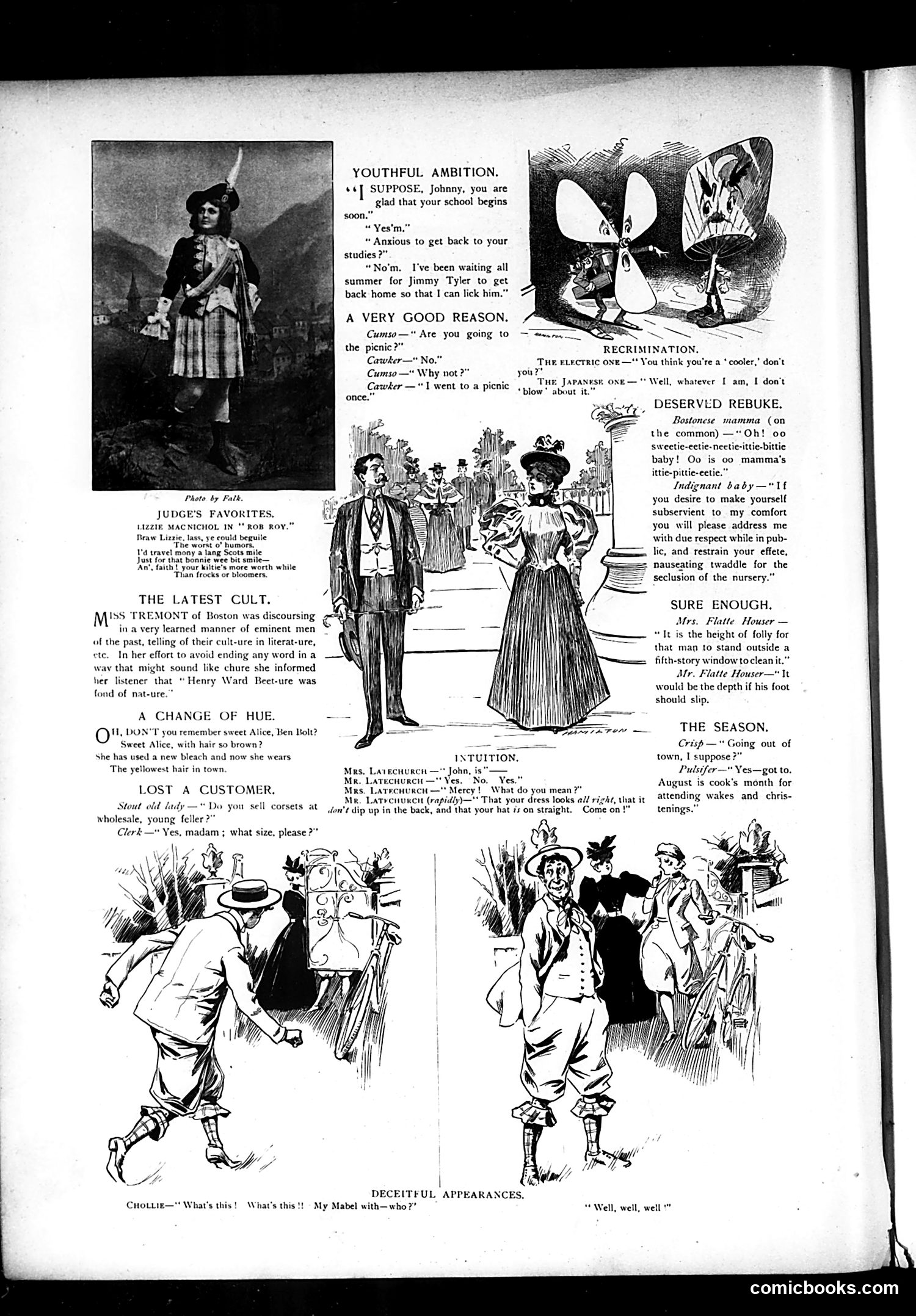
This page collects brief humorous sketches mocking late-19th-century American social affectations and manners: **"The Latest Cult"** ridicules affected Boston intellectuals, specifically a woman (Miss Tremont) who artificially avoids ending words with "-ure" sounds while discussing culture—a pretentious speech affectation. **"A Change of Hue"** jokes about women using hair bleach to follow beauty trends, referencing the popular poem "Ben Bolt." **"Youthful Ambition"** presents a boy eager for school so he can fight a rival—inverting expected academic enthusiasm. **"Deserved Rebuke"** satirizes Boston mothers using excessively cutesy "baby talk" in public, with the infant responding in comically formal language, mocking both the mother's affected behavior and the child's precocious formality. Other sketches target corset sizing, affectations in dress, and servants' vacation habits. The humor relies on observing contemporary social pretensions and class anxieties about proper behavior, appearance, and speech.
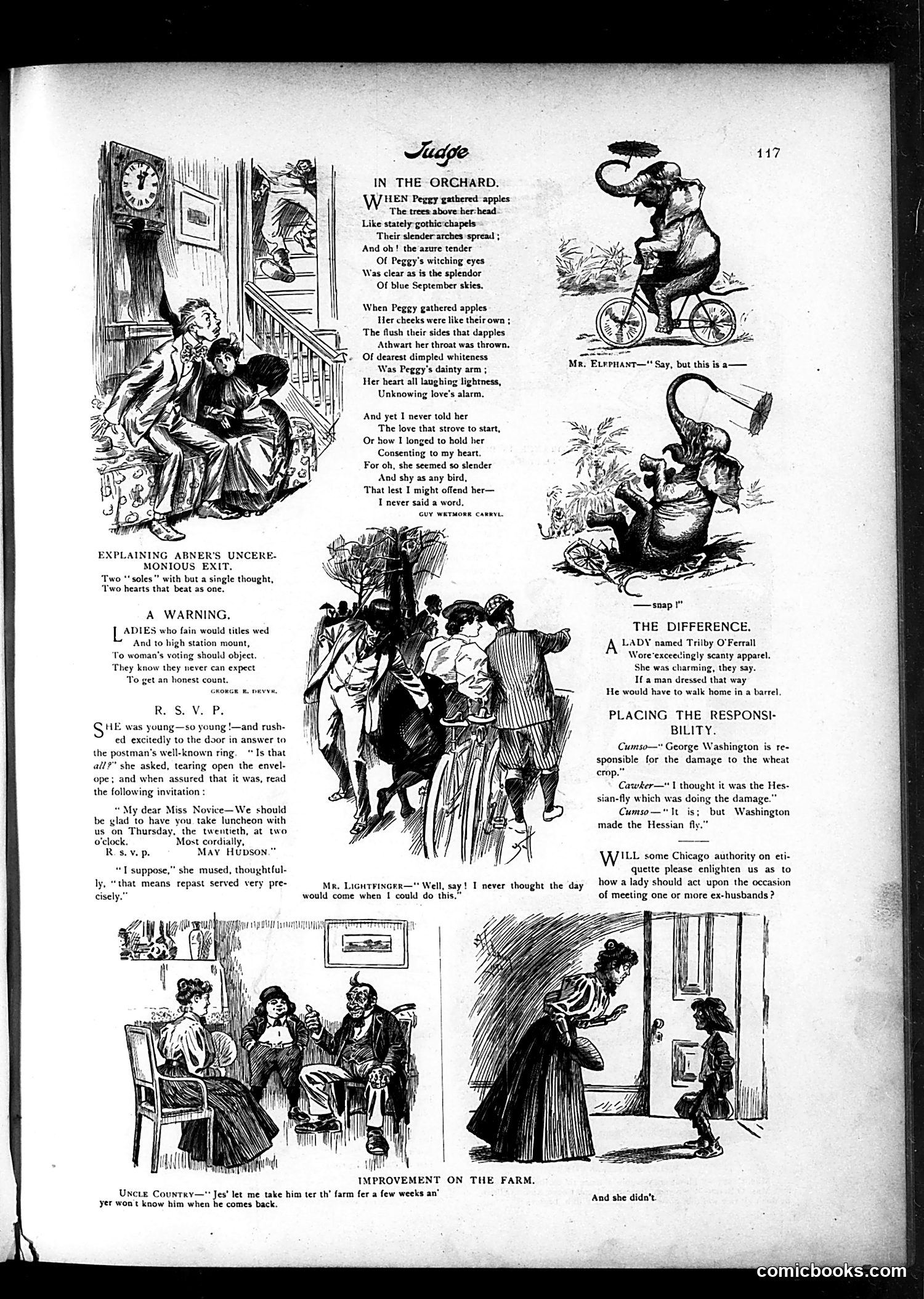
This page from the satirical magazine **Judge** contains multiple unrelated cartoons and humorous pieces typical of late 19th/early 20th-century American humor. **Key content:** - **"In the Orchard"**: A romantic poem by Guy Wetmore Carryl about unrequited love—a man's hesitation to confess feelings to a girl named Peggy. - **"A Warning"**: Political satire mocking women's suffrage, suggesting female voters cannot be trusted with accurate ballot counts—reflecting anti-suffrage sentiment of the era. - **"R.S.V.P."**: A young woman misunderstands formal invitation language, thinking "repast" means something else entirely—a joke about social pretension and class confusion. - **"The Difference"**: A limerick mocking women's scanty fashionable clothing while implying men couldn't get away with the same. - **"Placing the Responsibility"**: A joke blaming George Washington (the cherry tree fable reference) for crop damage caused by Hessian flies. The overall tone reflects period attitudes toward women, fashion, voting, and rural life.
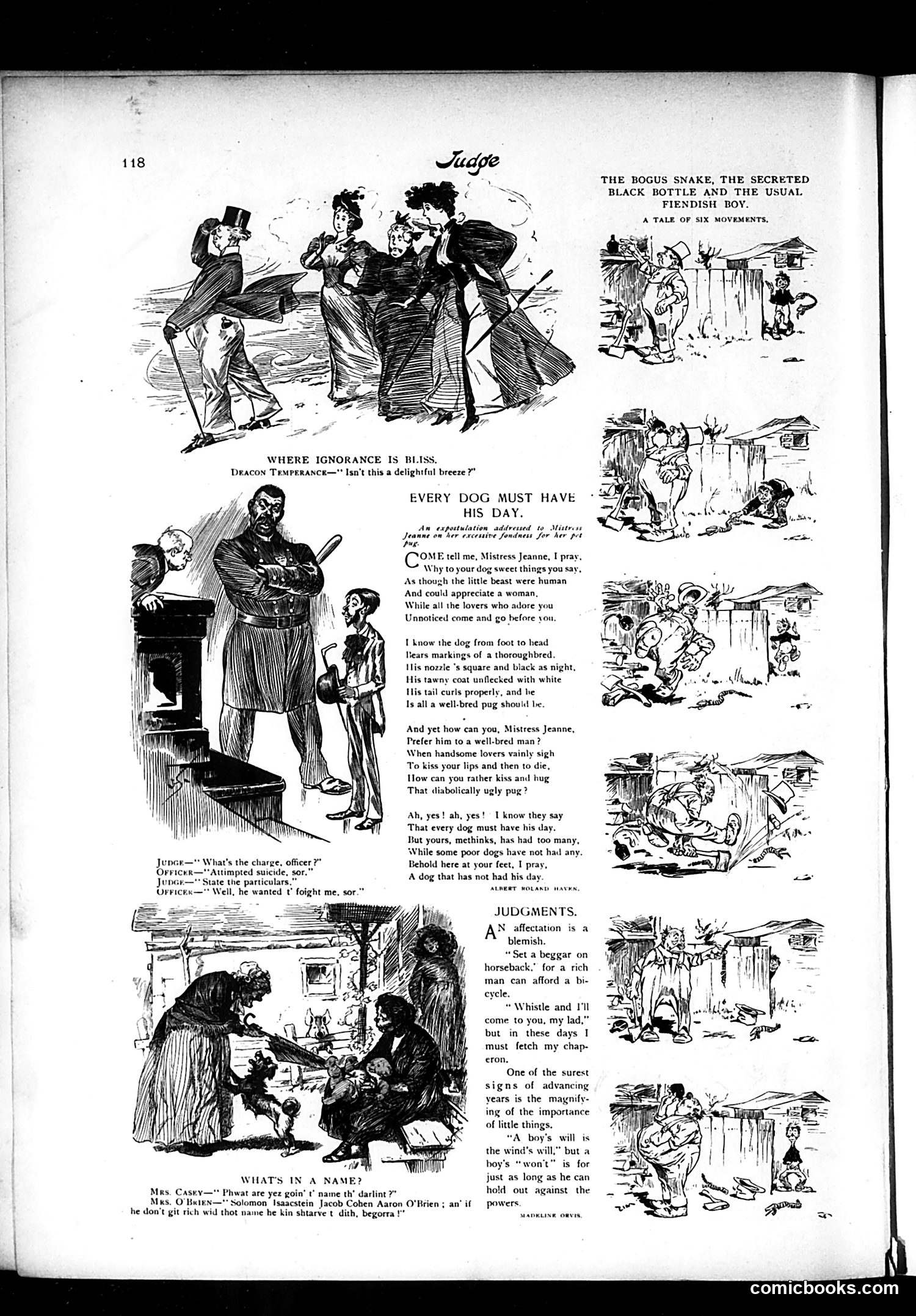
This page contains multiple satirical pieces: **"Where Ignorance Is Bliss"** mocks a temperance advocate (Deacon Temperance) obliviously praising a "delightful breeze" while apparently inebriated or naive. **"Every Dog Must Have His Day"** is a humorous poem criticizing a woman named Jeanne for lavishing affection on her pug while ignoring human suitors. The speaker compares the dog's pedigree favorably to its appearance, then ironically claims to be an unloved "dog" deserving her attention. The satire targets both female pet-obsession and rejected male romantic pursuit. **"Judgments"** offers brief witticisms on social behavior—affectation, class mobility (beggars on horseback), changing technology (bicycles), aging, and childhood stubbornness. **"What's in a Name?"** presents an Irish immigrant mother comically naming her child with an absurdly long string of ethnic names (Jewish, Irish, Christian), betting the name itself will ensure wealth. The right column illustrates "The Bogus Snake" story in sequential panels, apparently depicting childhood mischief or deception.
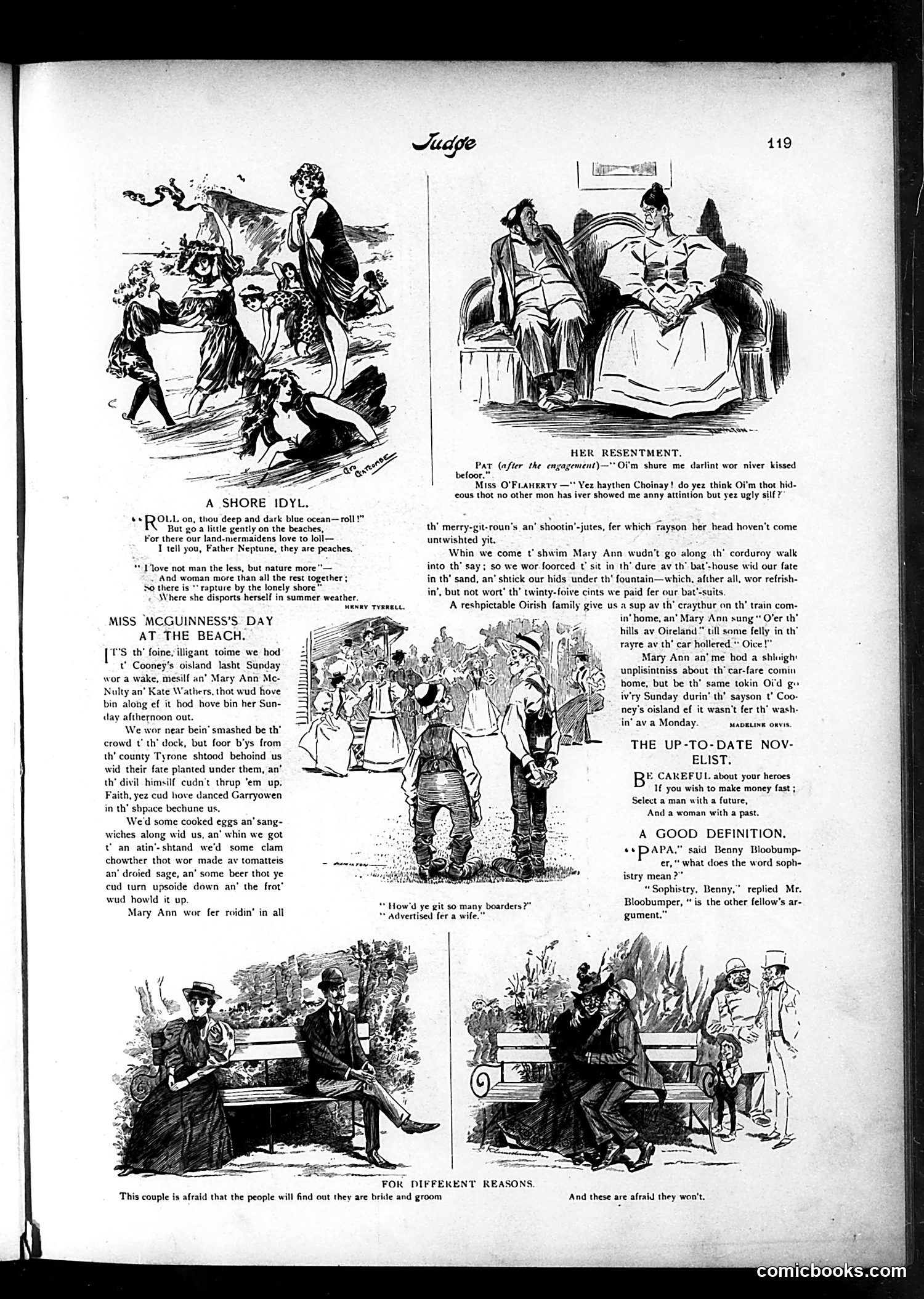
This page from *Judge* contains several pieces of period satire targeting Irish-American immigrants and contemporary social anxieties. **"A Shore Idyl"** and **"Miss McGuinness's Day at the Beach"** mock Irish-American dialect and vacation behavior. The heavily phonetic Irish brogue (rendered as "th' foine," "Oirish") was standard ethnic caricature of the era, portraying working-class Irish as uncouth and comical. **"Her Resentment"** satirizes attitudes about courtship and female sexuality—the fiancée resents her suitor's assumption she hadn't been romantically pursued before. **"The Up-to-Date Novelist"** mocks literary trends, suggesting marketable fiction requires morally compromised protagonists. **"A Good Definition"** plays on masculine argumentation—the joke being men dismiss opposing views as mere "sophistry." **"For Different Reasons"** shows couples with opposite anxieties about their marriage being publicly known, satirizing social pretense. The page exemplifies *Judge's* formula: ethnic humor targeting Irish immigrants, gender-based comedy, and gentle mockery of middle-class social conventions.
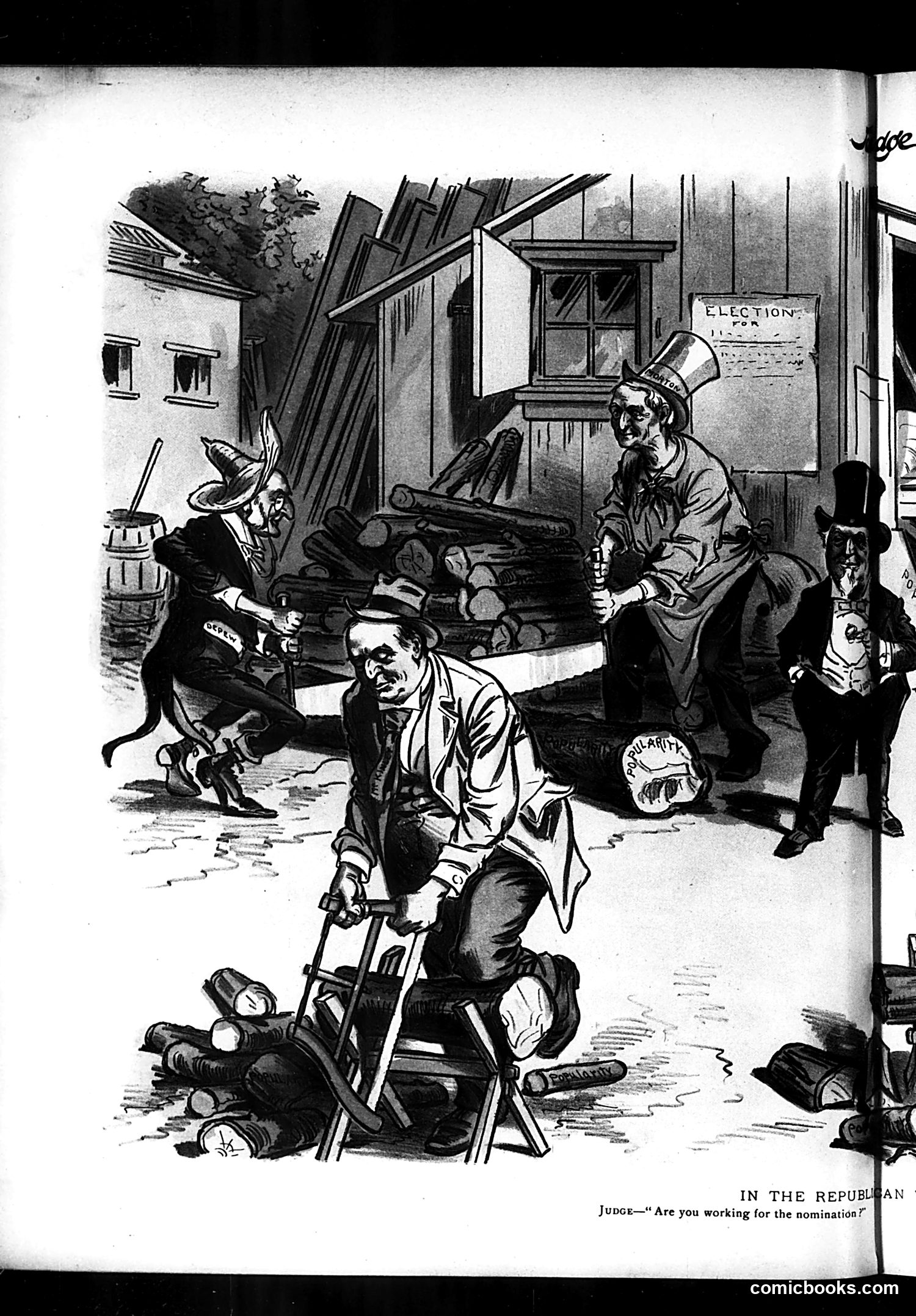
This satirical cartoon from *Judge* magazine depicts chaos inside the Republican Party, with the caption asking "Are you working for the nomination?" The scene shows multiple figures engaged in destructive activity—sawing down a building (labeled "ELECTION FOR..."), surrounded by debris and tools of destruction. The figures appear to be caricatured politicians or party operatives. The satire critiques infighting within the Republican Party during a nomination contest. Rather than constructively building their platform, the figures are literally dismantling their own political house—suggesting that internal competition for the nomination is destructive to the party itself. This reflects a common theme in Gilded Age political cartooning: that partisan ambition undermines collective party interests.
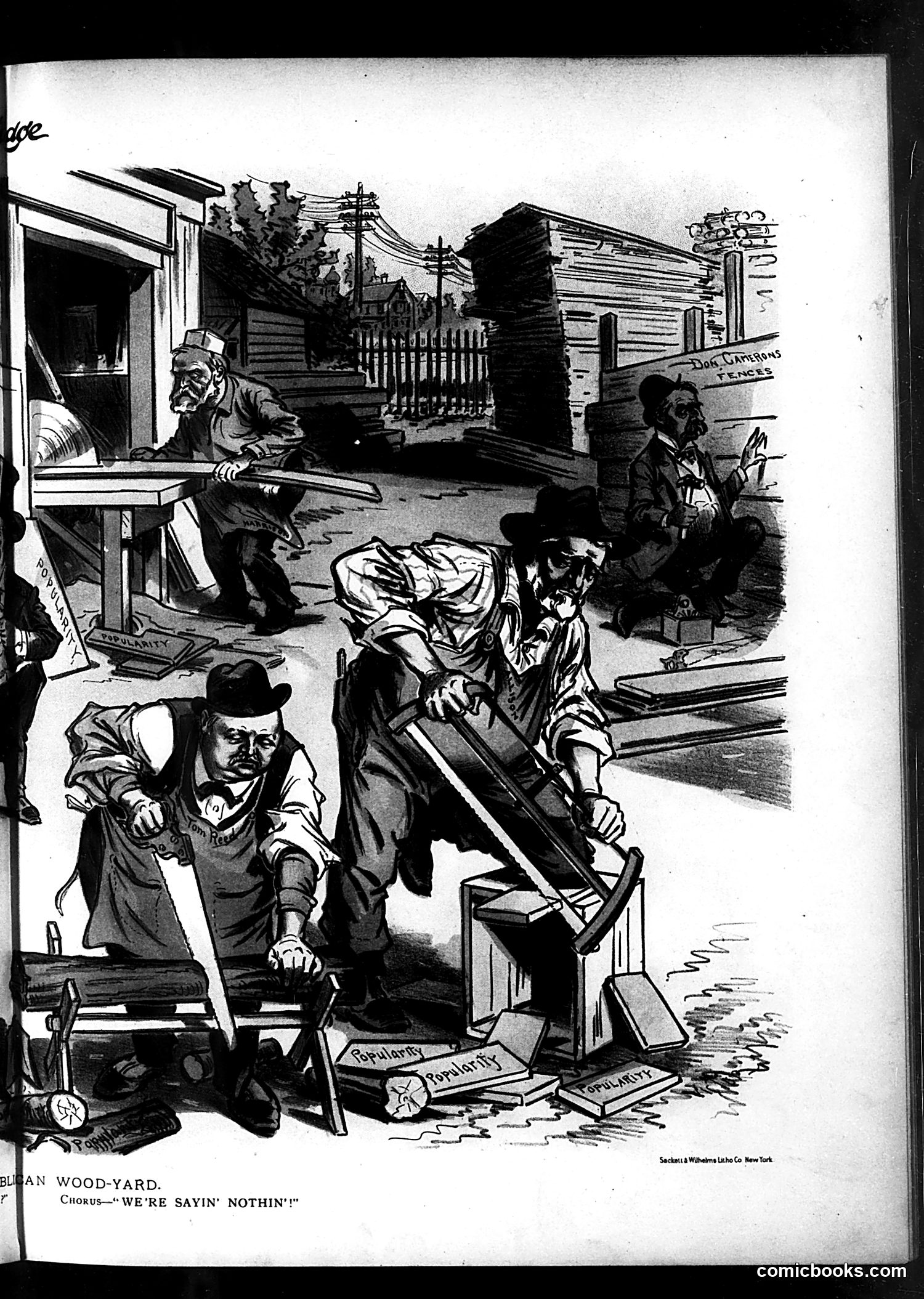
This satirical cartoon depicts working-class men in a wood-yard setting, labeled with the chorus "We're sayin' nothin'!" The figures appear to represent laborers or urban workers, drawn in caricatured style typical of early Judge magazine satire. The satire likely comments on labor silence or worker suppression—possibly mocking workers' reluctance to speak up about poor conditions, wages, or treatment. The "saying nothing" refrain suggests either enforced silence, intimidation, or workers' resignation to their circumstances. The detailed rendering of tools, lumber, and the modest urban setting emphasizes the working-class context. Without clearer dating or additional context, the specific political moment remains unclear, though the cartoon appears critical of labor conditions or worker passivity in the urban industrial economy.
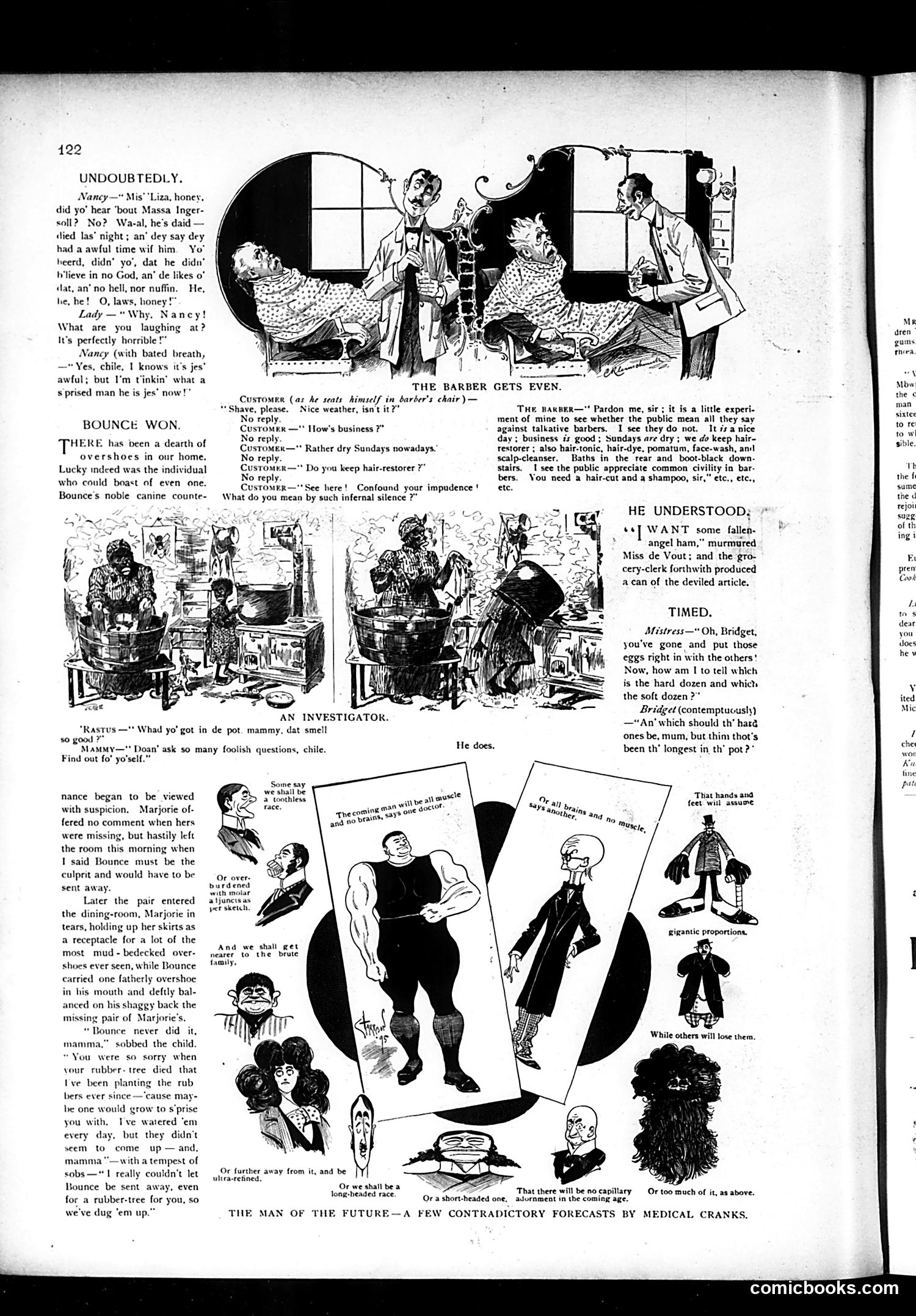
This page contains several satirical sketches mocking contemporary social issues and public figures: **"Undoubtedly"** ridicules Robert Ingersoll, a famous 19th-century atheist lecturer. The joke plays on racist dialect humor: an enslaved woman finds dark humor in Ingersoll's presumed shock upon death, given his public disbelief in God or the afterlife. **"The Barber Gets Even"** satirizes talkative customers by depicting a barber who deliberately maintains silence, teaching patrons that incessant chatter isn't appreciated. **"Bounce Won"** presents sentimental humor: a dog that disappeared is revealed to have been burying the family's missing overshoes in a "garden," which the child had been secretly watering, believing they'd grow back. **"The Man of the Future"** mocks medical pseudoscience and wild evolutionary predictions—competing theories about whether humans will become toothless, develop gigantic proportions, lose hair, or grow elongated heads. This satirizes the period's pseudoscientific speculation about human evolution. The page employs typical Judge-era humor: class-based comedy, racial caricature, and mockery of contemporary scientific pretensions.
This page is primarily **advertising and light humor**, not political satire. The content includes: **Humorous Short Items:** - A potato-bug courtship joke playing on "Paris green" (an insecticide) - A "missing brains" joke about a man obsessed with the "sixteen to one" currency debate (likely 1890s-era free silver controversy) - A tenderfoot witnessing a lynching, conflating horse theft with bicycles as symbols of progress - Domestic humor about smoking and marriage **Advertisements:** Dominant ads include Evans' Ale, Columbia Bicycles, Sohmer Pianos, and Packer's Tar Soap—typical period products. A prominent Ozodont toothpaste ad features an ornate portrait. **No Major Political Cartoon:** The page lacks a significant central political cartoon. The "sixteen to one" reference is the closest to political content, obliquely referencing monetary policy debates of that era, but presented as casual humor rather than sharp satire. Overall, this represents Judge's lighter, commercial-heavy content rather than its more famous hard-hitting editorial cartooning.
This is primarily an **advertising and editorial page** from Judge magazine, with one notable satirical cartoon dialogue. ## The Main Cartoon The featured piece is a **dialogue between the shades of Napoleon and the Duke of Wellington in the afterlife**. Napoleon confronts Wellington, claiming he could have conquered the world but for Wellington's military opposition (referencing their famous antagonism during the Napoleonic Wars). However, Wellington gets the last laugh: looking down at Earth, Napoleon observes that while thousands of books and portraits celebrate him, Wellington barely receives footnotes. Wellington replies that he'd rather be forgotten than responsible for Napoleon's enduring fame. **The joke**: This reverses expectations—military defeat becomes a badge of honor compared to being eternally associated with Napoleon's legacy. For 1893 readers, this references the contemporary resurgence of Napoleon worship in popular culture, positioning Wellington's obscurity as preferable to unwanted historical notoriety. The rest of the page consists of **advertisements** (Anheuser-Busch beer, Beecham's pills, pianos, Judge Publishing) and brief **humorous quotes** on marriage, politics, and social behavior typical of Judge's satirical commentary.
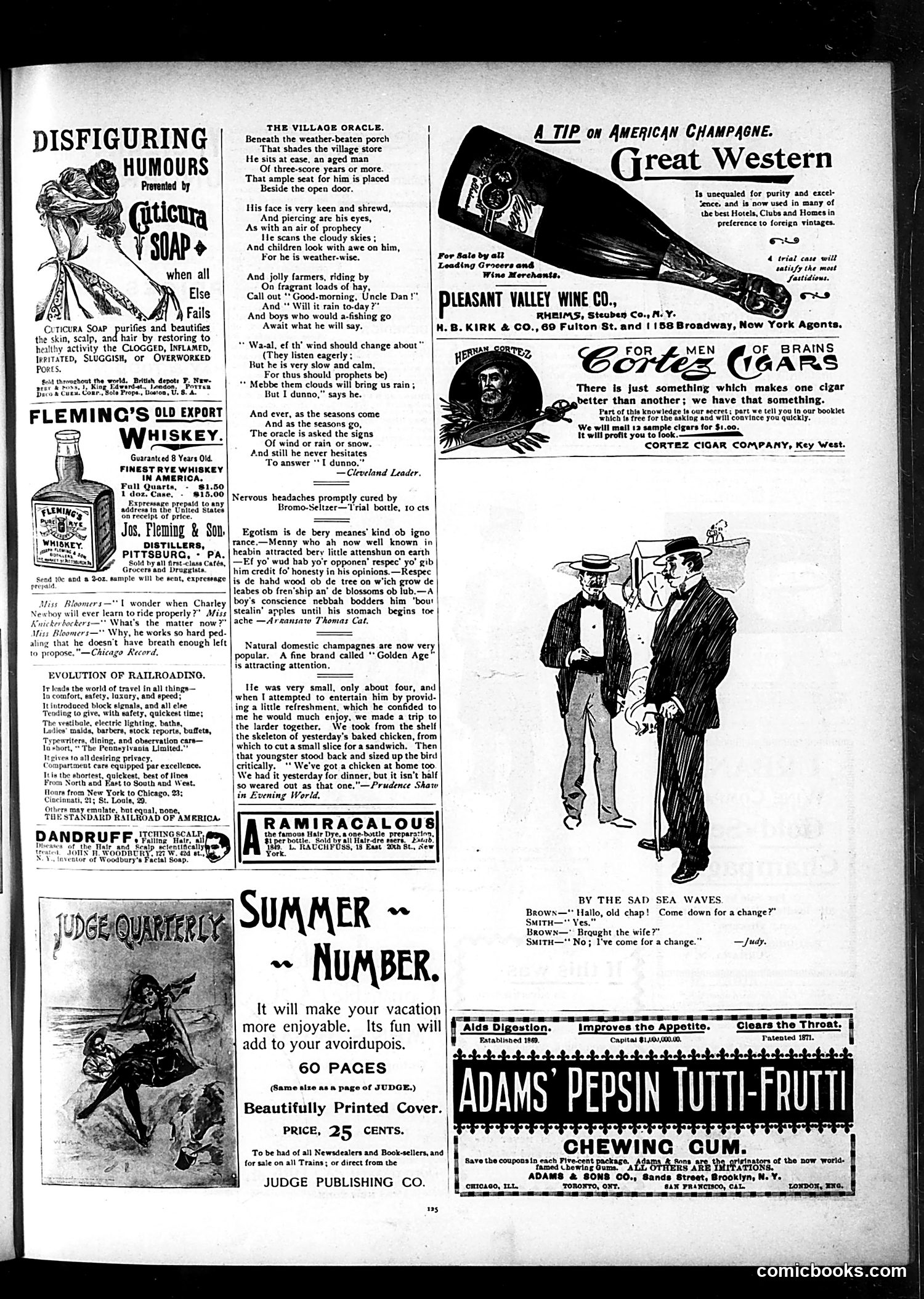
This is primarily an **advertising page** from Judge magazine with minimal editorial content. The few cartoons present are brief jokes: **"The Village Oracle"** (text poem with no illustration): A nostalgic sketch of an old rural fortune-teller who frustrates curious farmers and boys by always answering "I dunno" about weather predictions—satirizing the uselessness of supposed weather wisdom. **Two small captioned cartoons**: - A bicycle joke about a suitor unable to propose because he's breathless from pedaling - A domestic humor piece about a child comparing yesterday's leftover chicken to fresh poultry The page is dominated by **period advertising**: Cuticura Soap, Fleming's whiskey, Cortes cigars, Adams' Pepsin chewing gum, and railroad/publication promotions. These ads reflect late 19th-century consumer culture and product claims (soap "restoring" skin health, whiskey quality guarantees). The content suggests this is a middle-class, male-oriented publication mixing light humor with commercial appeals to urban and rural readers.
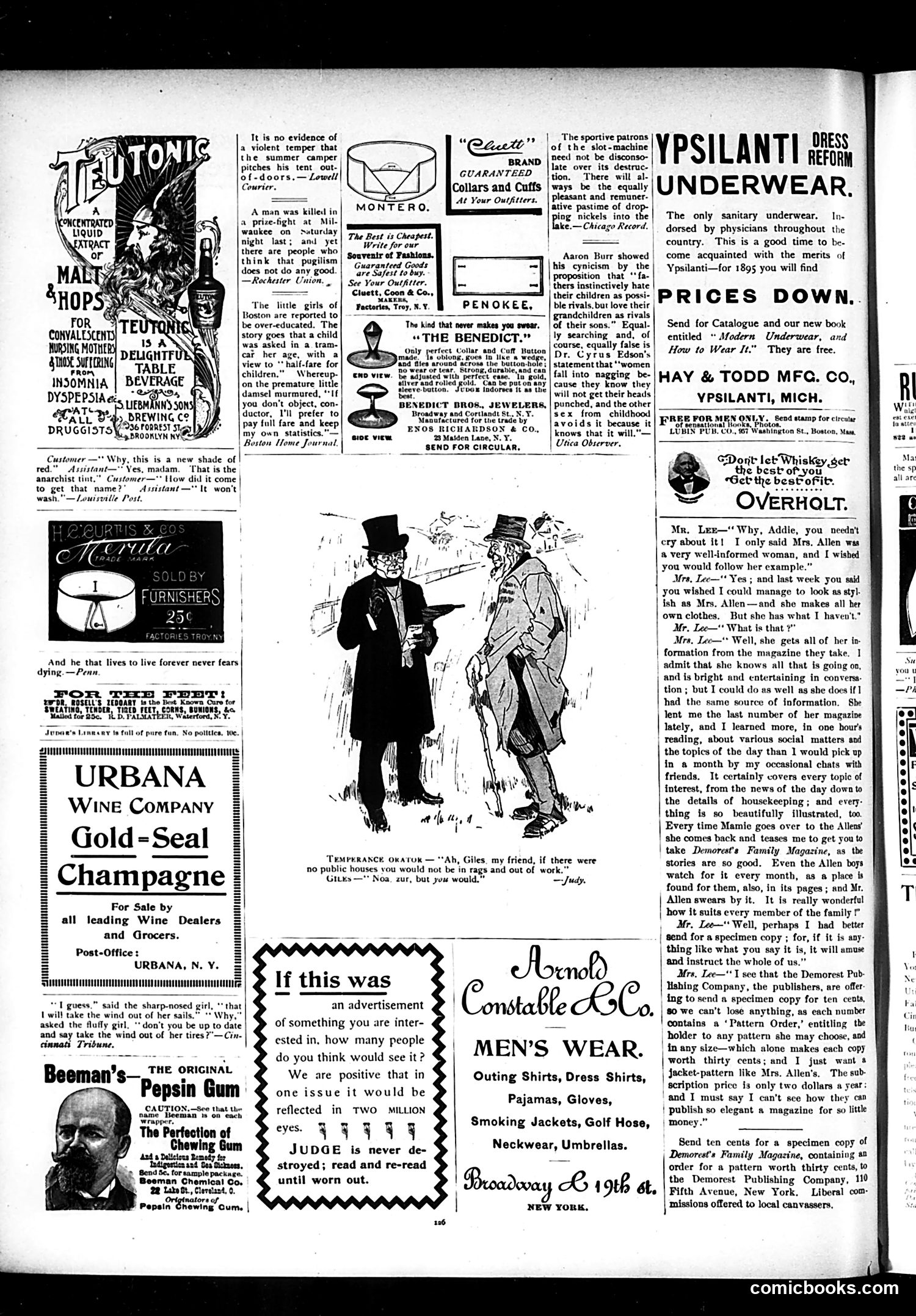
This Judge magazine page primarily contains **advertisements and humor pieces** rather than a focused political cartoon. The main visual cartoon shows two figures—a formally dressed gentleman and what appears to be a working-class man—discussing temperance ("raggs and out of work"). The caption credits this to "Judy," suggesting it's commentary on poverty and drinking culture. Other content includes small domestic humor pieces (the "Lee" couple discussing women's magazines and self-improvement), a joke about Boston schoolgirls being "over-educated," and a snide reference to Aaron Burr's cynicism about family relationships. The page mostly advertises underwear, collars, champagne, and patent medicine (Teutonic as a digestive aid). The advertisements occupy more space than editorial content, which was typical for Judge magazine. **The satire is mild and scattered**—mainly targeting women's vanity, working-class drinking, and outdated social assumptions rather than focused political critique.
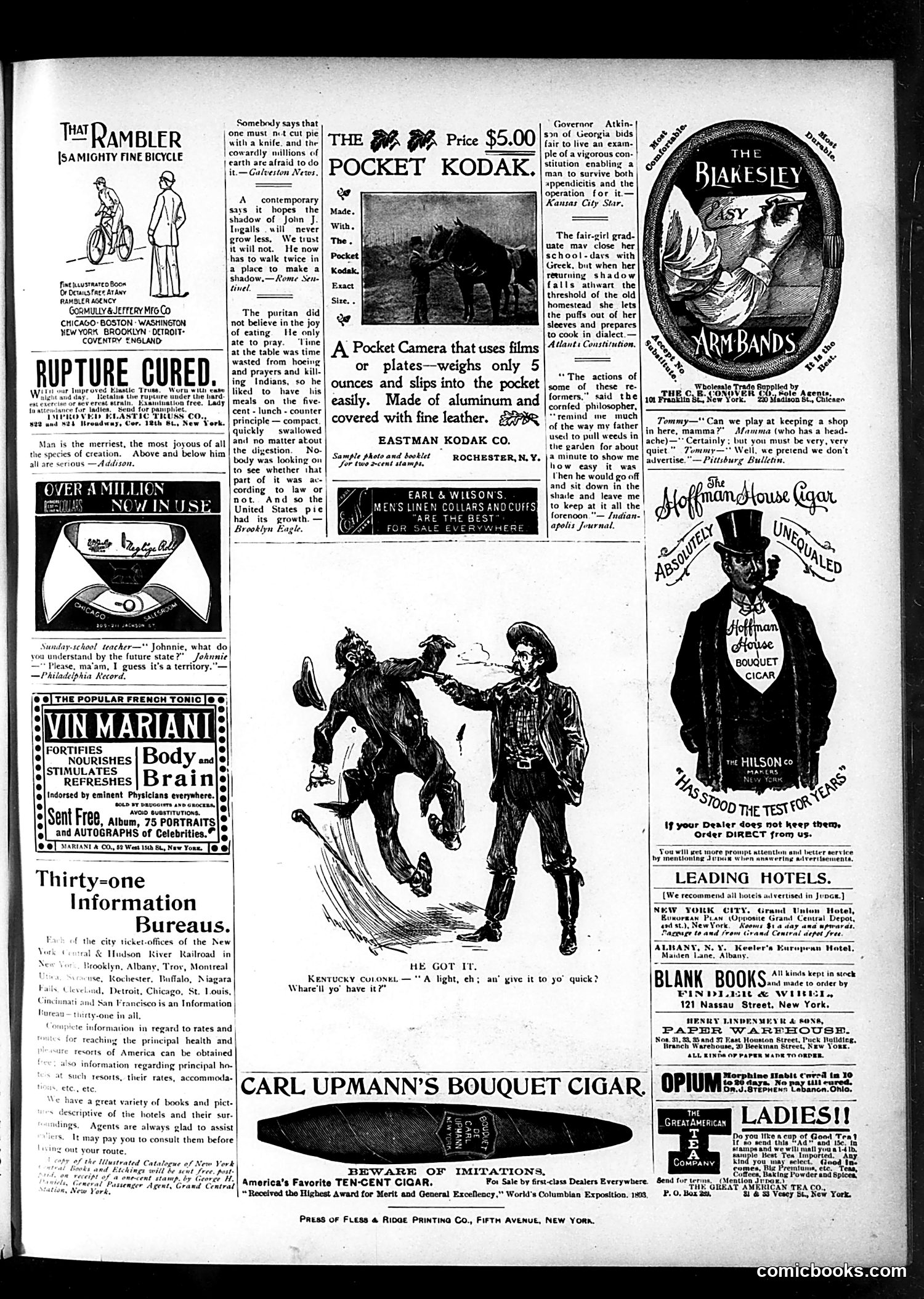
This page is primarily **advertising**, typical of Judge magazine's era. The satirical content is minimal and scattered: **Main Cartoon:** "He Got It" depicts a Kentucky Colonel (identifiable by the regional dialect and top hat) in a transaction, likely satirizing Southern stereotypes or commercial dealings. The humor appears to be based on crude dialect humor common to the period. **Satirical Snippets:** - Brief commentary on Governor Atkinson of Georgia and appendicitis operations - A quip about John J. Ingalls (a Kansas politician) and his "shadow" in political influence - Jokes contrasting Puritan restraint with modern eating habits **Bulk Content:** The page is dominated by product advertisements—Kodak cameras, Vin Mariani tonic, cigars, collars, and hotels—interspersed with small humorous anecdotes about children and shopkeepers. The satire reflects turn-of-the-century American concerns: political figures, regional stereotypes, and modern conveniences. However, without identified cartoonists or dated publication info visible, specific political references remain unclear.
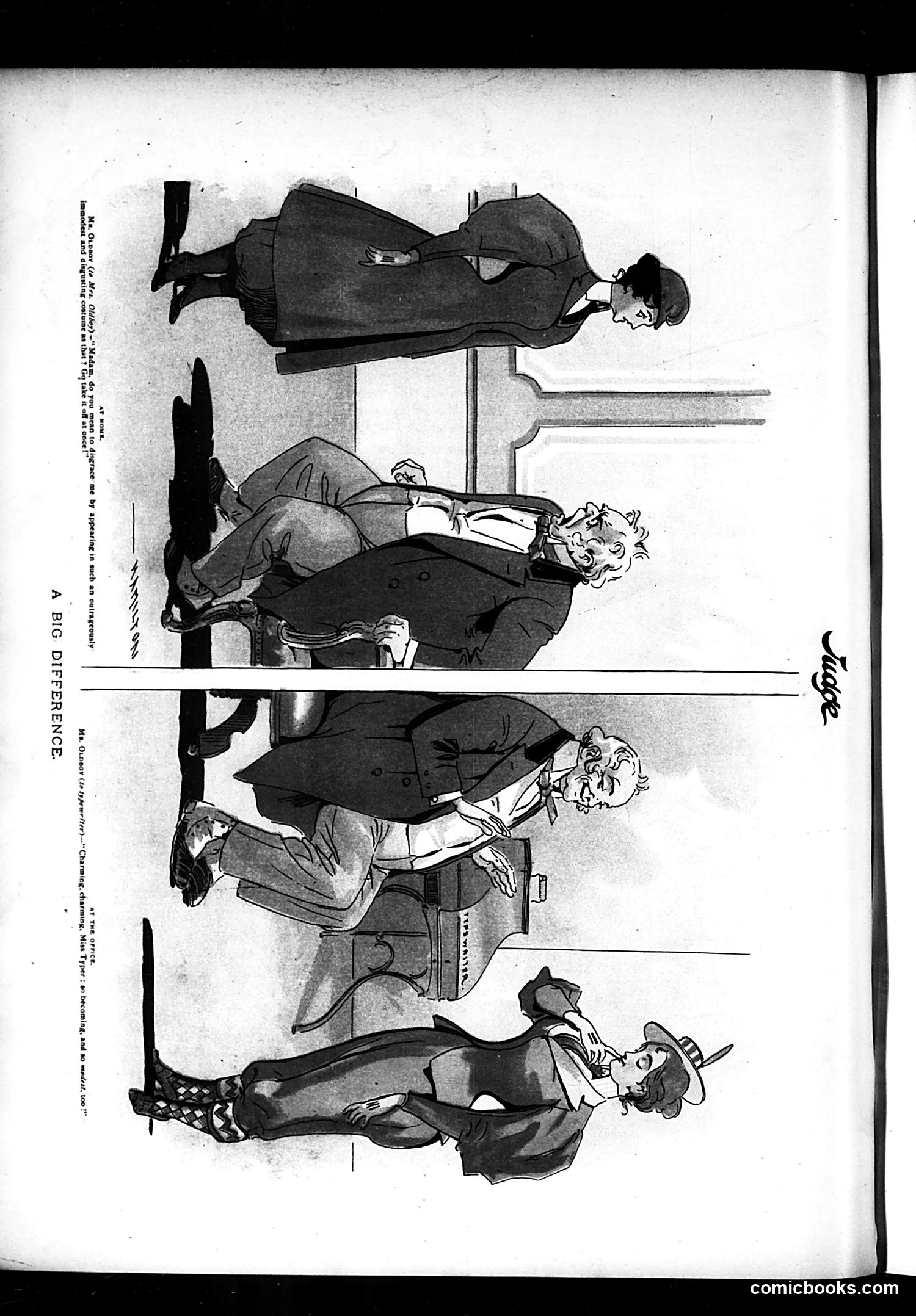
This satirical cartoon contrasts a husband's behavior at home versus at the office, highlighting Victorian hypocrisy about women's clothing and morality. **The scene:** Mr. Oldboy scolds his wife at home for wearing an "immodest" costume, demanding she remove it immediately. At the office, the same man encounters a typist (secretary) in similar attire and compliments her effusively as "charming" and "modest." **The satire:** The cartoon mocks the double standard of respectable Victorian gentlemen—they enforce rigid modesty standards on their wives while simultaneously flirting with and approving of the same styles on younger, unmarried working women. The "big difference" is not the clothing, but the social context and the man's transparent hypocrisy based on age, marital status, and workplace dynamics. This reflects progressive concerns about workplace propriety and male inconsistency in enforcing social codes.