
A complete issue · 16 pages · 1895
Judge — August 3, 1895
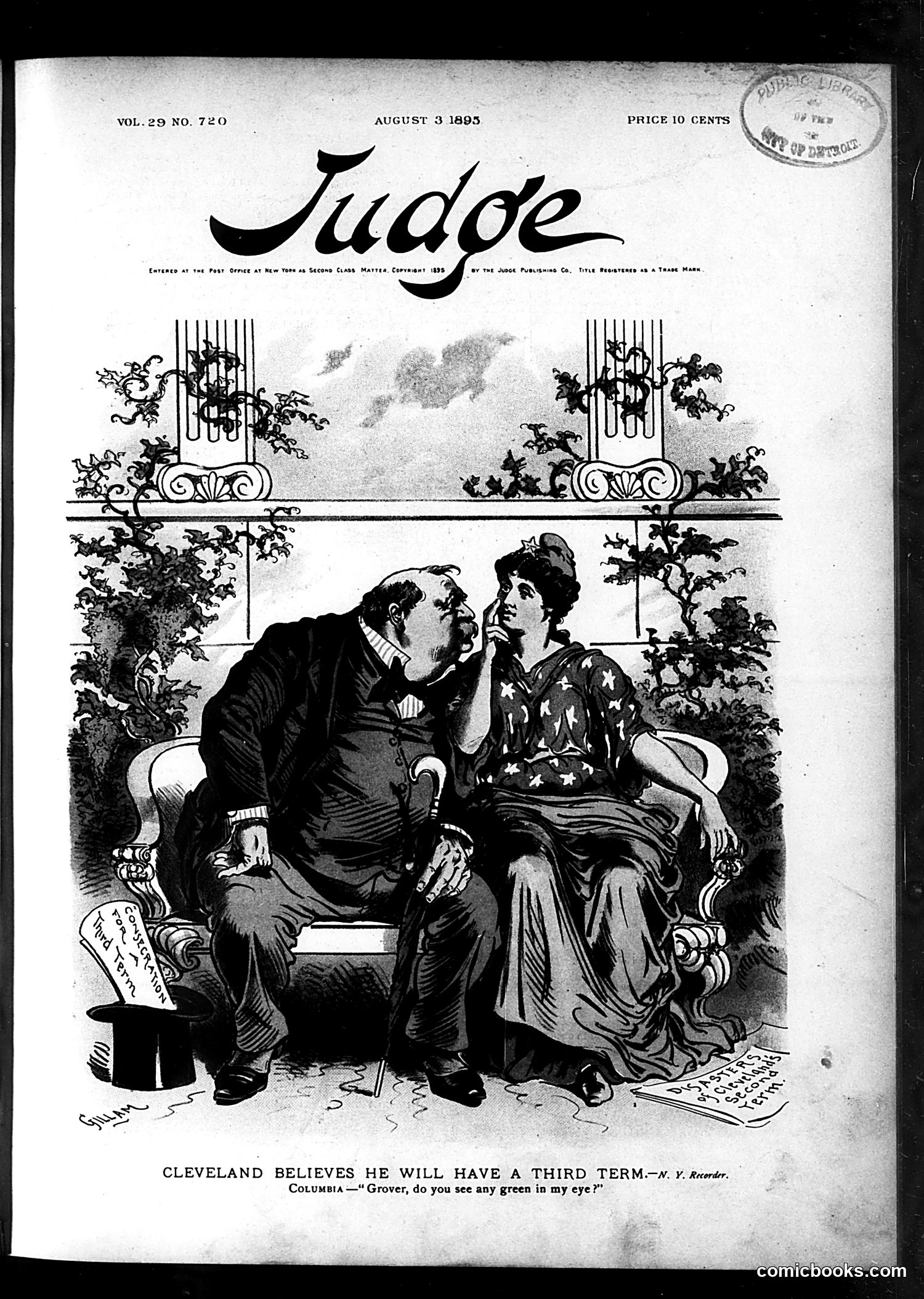
This August 3, 1893 *Judge* cartoon satirizes President Grover Cleveland's political ambitions. The caption "Cleveland Believes He Will Have a Third Term" references the then-controversial idea of Cleveland serving another presidential term (he'd previously served 1885-1889). The cartoon depicts Columbia (female personification of America, identifiable by her starred dress) conversing with Cleveland in an ornate garden setting. Cleveland appears confident about his prospects, while Columbia responds skeptically: "Grover, do you see any green in my eye?"—a period idiom meaning "Do you think I'm gullible/foolish?" The satire mocks Cleveland's political aspirations as unrealistic. The lush garden and formal setting create ironic contrast with Columbia's dismissive tone, suggesting his third-term ambitions are delusional.
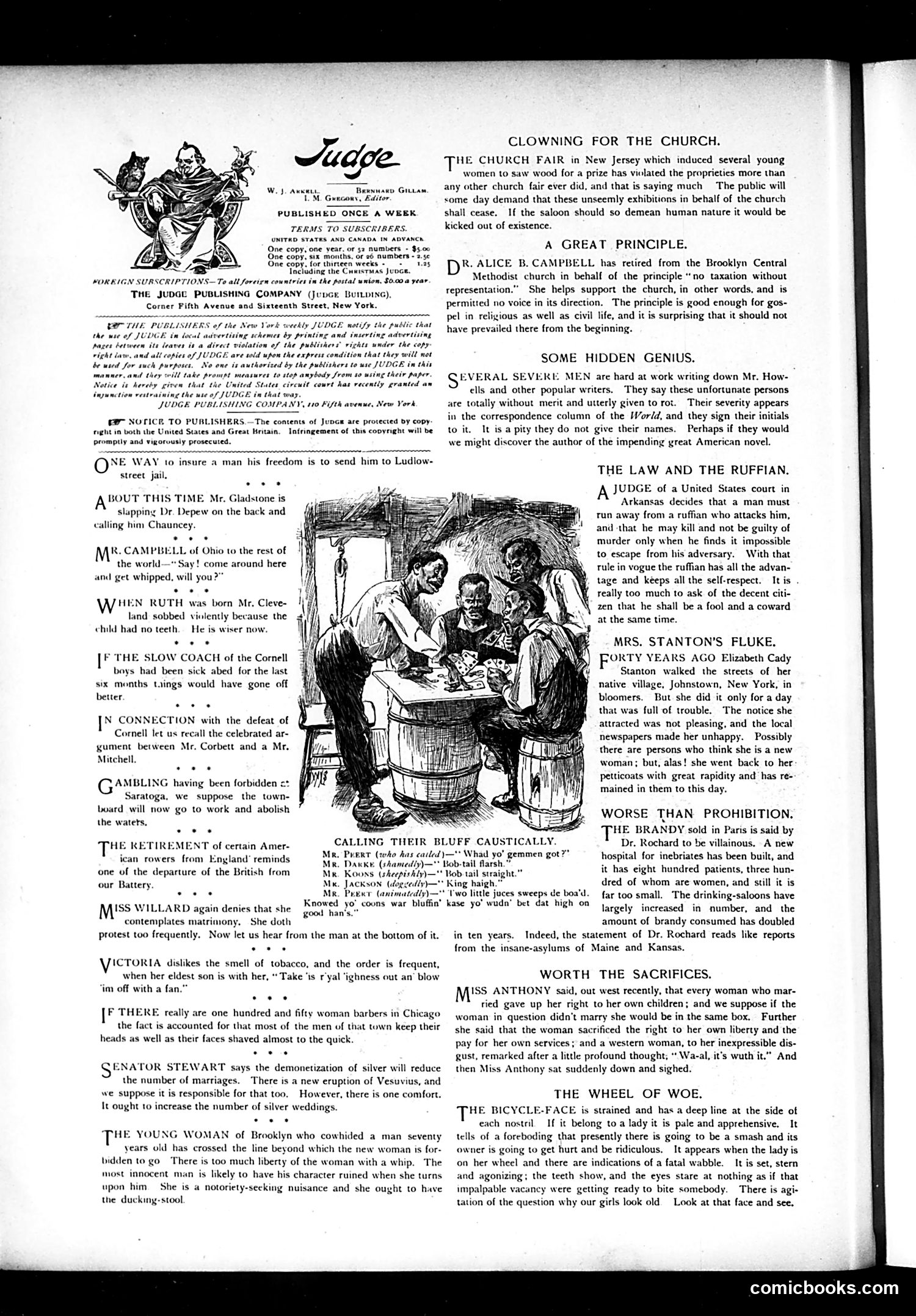
The main cartoon, titled "CALLING THEIR BLUFF CAUSTICALLY," depicts men around a barrel in what appears to be a speakeasy or illegal drinking establishment. The accompanying text references various characters (Mr. Knoss, Mr. Knowd) making boastful claims about their connections and abilities—"Bob jilt straight," "King high," etc.—in a mocking tone. The satire targets Prohibition-era speakeasy culture, ridiculing men who frequented illegal drinking establishments and made exaggerated boasts about their status or connections. The cartoon mocks the pretensions of speakeasy patrons during the Prohibition period, suggesting they were engaged in bluffing and empty braggadocio while participating in illegal activities.
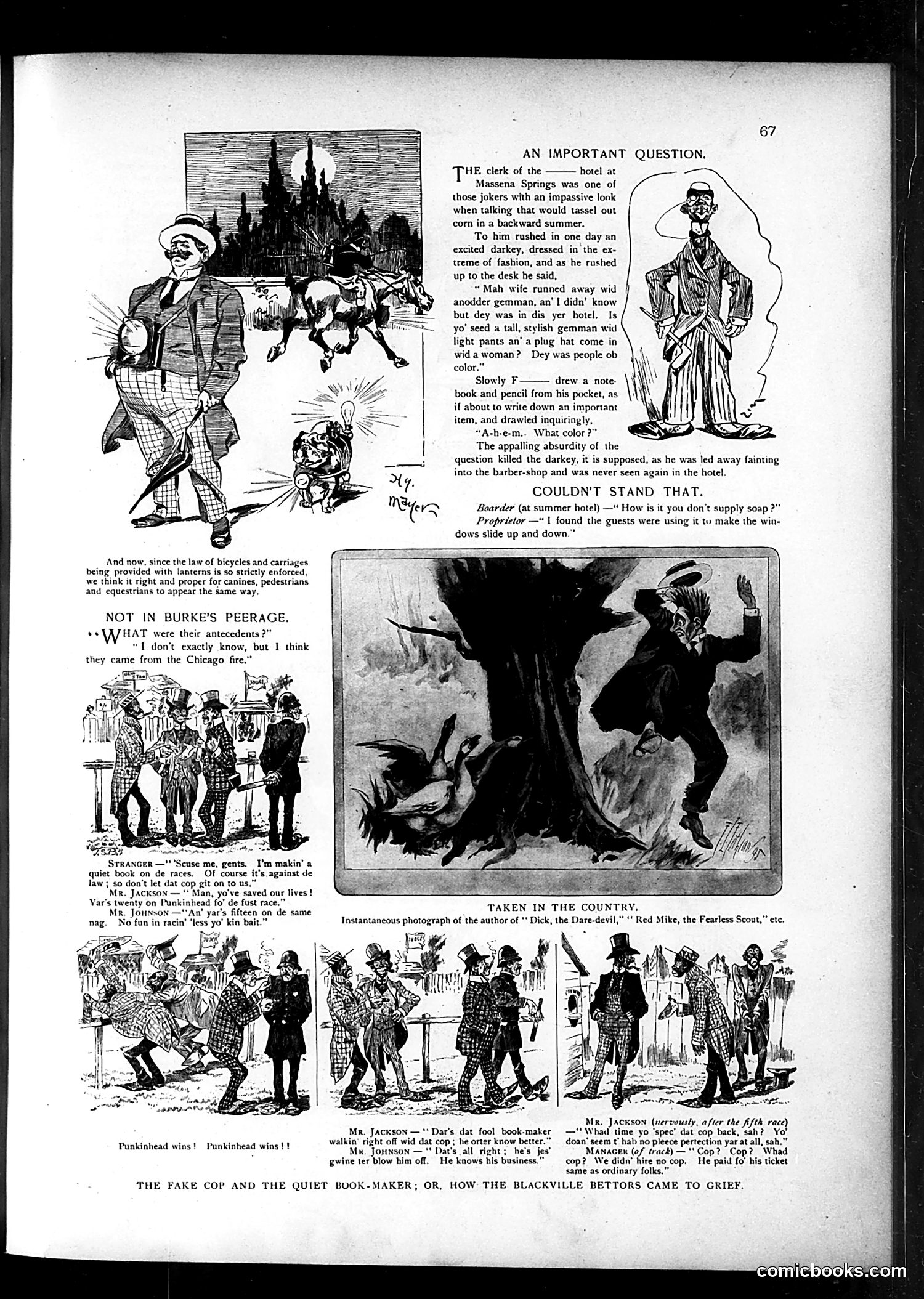
This Judge magazine page contains three separate satirical pieces: **"An Important Question"** mocks a hotel clerk's pretentious explanation for why his wife ran away with another guest—claiming she merely wanted to see "a tall, stylish gentleman" in fashionable clothing. The satire targets affected social posturing and absurd excuses for infidelity. **"Not in Burke's Peerage"** appears to reference Burke's Peerage (a British aristocratic registry), satirizing claims about ancestry. Strangers dispute the origins of someone's family, with references to Chicago's reputation and horse racing scandals. **"The Fake Cop and the Quiet Book-Maker"** (bottom) depicts characters named Jackson and Johnson in what appears to be a police corruption scenario involving illegal gambling operations—a common Judge subject reflecting early 20th-century urban vice concerns. All pieces use caricature and dialogue-based humor typical of the era.
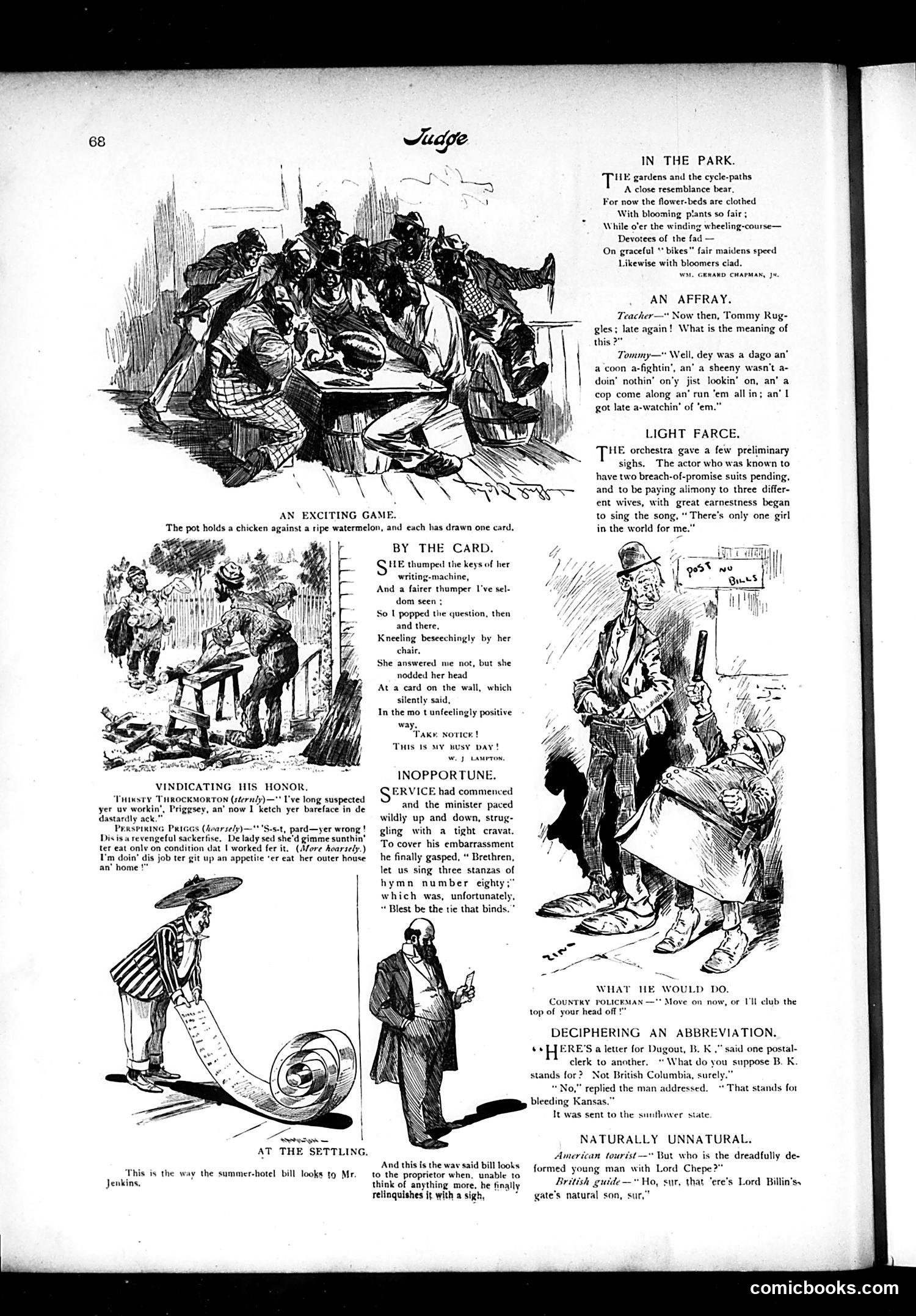
This page contains multiple brief satirical pieces typical of late 19th-century American humor: **"An Exciting Game"** mocks rural/working-class gambling culture through exaggerated dialect. **"Vindicating His Honor"** satirizes domestic servitude and class relations—a poor man claims he's working as revenge against his employer, reversing expected power dynamics for comic effect. **"By the Card"** jokes about a marriage proposal rejected via posted sign—commentary on impersonal modern communication and female independence (the woman's autonomy to refuse). **"Light Farce"** ridicules theatrical hypocrisy: an actor singing "There's only one girl in the world for me" while allegedly paying alimony to three wives. **"An Affray"** uses offensive ethnic stereotypes (common to the era) to mock urban diversity and child mischief. **"Naturally Unnatural"** offers a class joke: a British aristocrat's illegitimate son appears deformed to American tourists, playing on British social pretension. The page reflects Gilded Age concerns: immigration, class mobility, women's changing roles, and American attitudes toward British hierarchy.
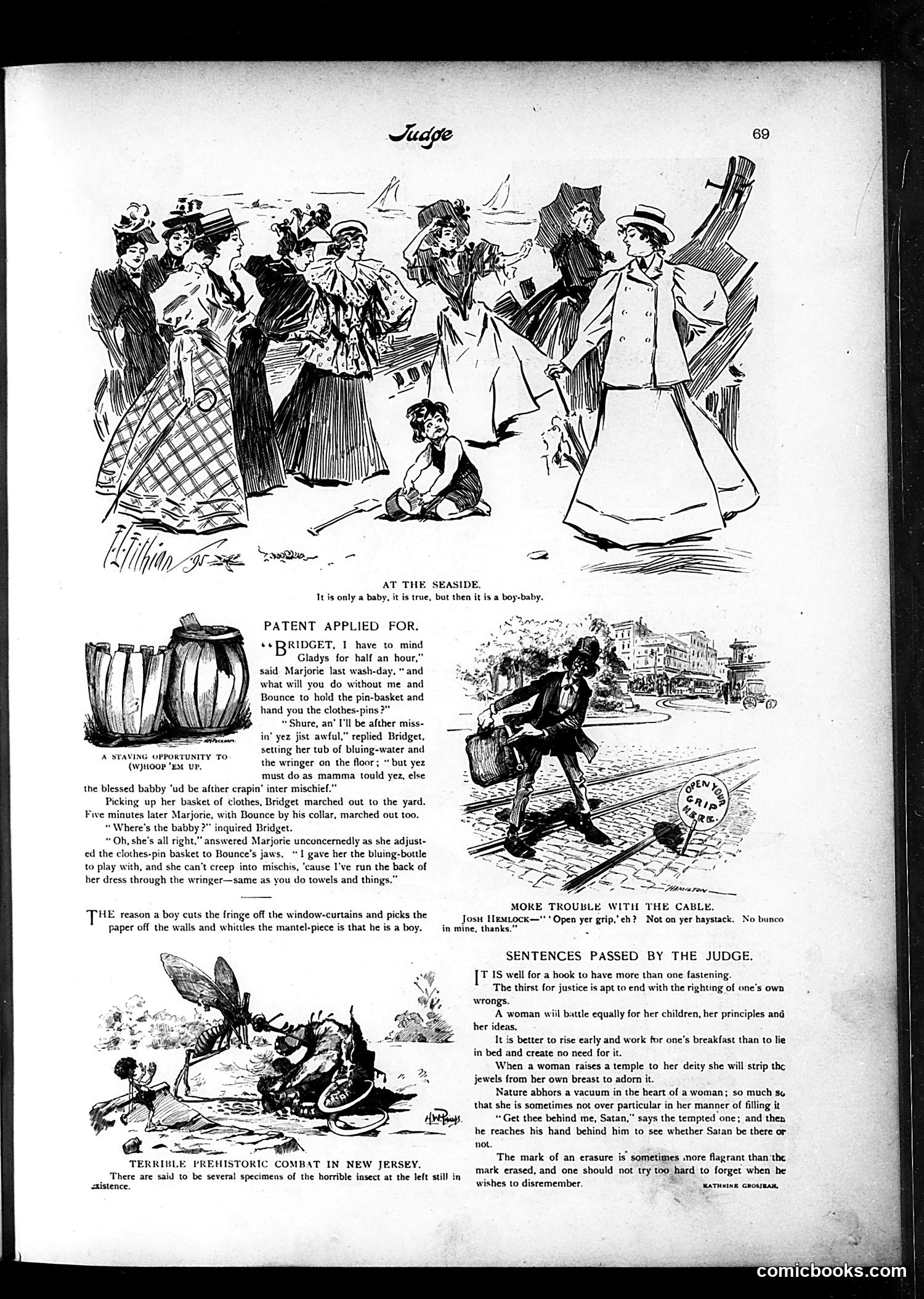
This page contains several satirical sketches about domestic life and gender roles, typical of Judge magazine's social commentary. **"At the Seaside"** mocks the casual sexism of the era—the caption jokes that a baby boy is inherently more valuable than a baby girl. The accompanying story depicts Irish immigrant domestic servants (Bridget and Marjorie), using exaggerated dialect to show their working-class status. The humor derives from their supposedly ingenious (actually dangerous) solution of using a clothes wringer to restrain a baby—presenting domestic caregiving as chaotic and incompetent. **"Patent Applied For"** sarcastically suggests boys' destructive behavior is innate and worthy of patent protection, critiquing how society excuses boys' misbehavior as natural rather than requiring discipline. The bottom section includes unrelated items: a humorous insect illustration, a cable-company joke, and philosophical "sentences" attributed to "the Judge"—moral aphorisms that were common filler content. The overall tone reflects early 20th-century attitudes toward class, gender, and child-rearing through gentle ridicule rather than sharp political critique.
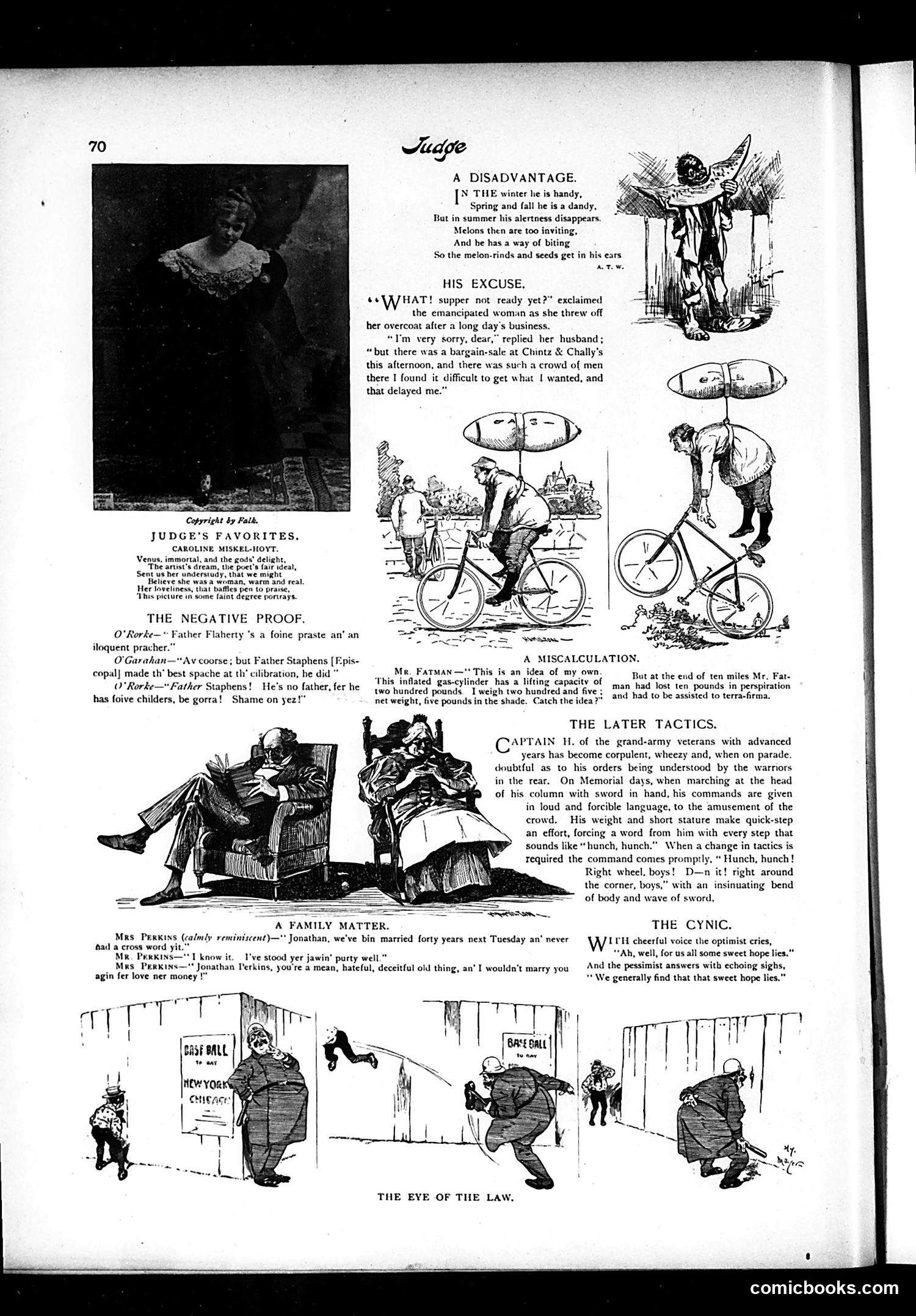
This page from Judge presents several satirical sketches mocking contemporary American life: **"A Disadvantage"** jokes about a dog's seasonal behavior—useful in winter but distracted by melons in summer, getting seeds in his ears. **"His Excuse"** satirizes gender role reversal: an "emancipated woman" returns home demanding supper, but her husband claims he was delayed at a bargain sale shopping with crowds of men—inverting traditional domestic expectations. **"The Later Tactics"** mocks an overweight Civil War veteran (Grand Army commander) leading parades. His weight makes marching difficult, causing him to grunt "hunch, hunch" with each step, which subordinates mistake for actual tactical commands. **"A Family Matter"** presents ironic domestic humor: after forty years of marriage, the wife claims they've never had cross words—then immediately berates her husband, revealing marital discord beneath surface civility. **"A Miscalculation"** depicts a fat man's failed weight-loss scheme involving cycling; despite losing ten pounds in perspiration, he still requires assistance. These sketches target vanity, gender confusion, military pretension, and domestic hypocrisy—typical Judge satire of the era.
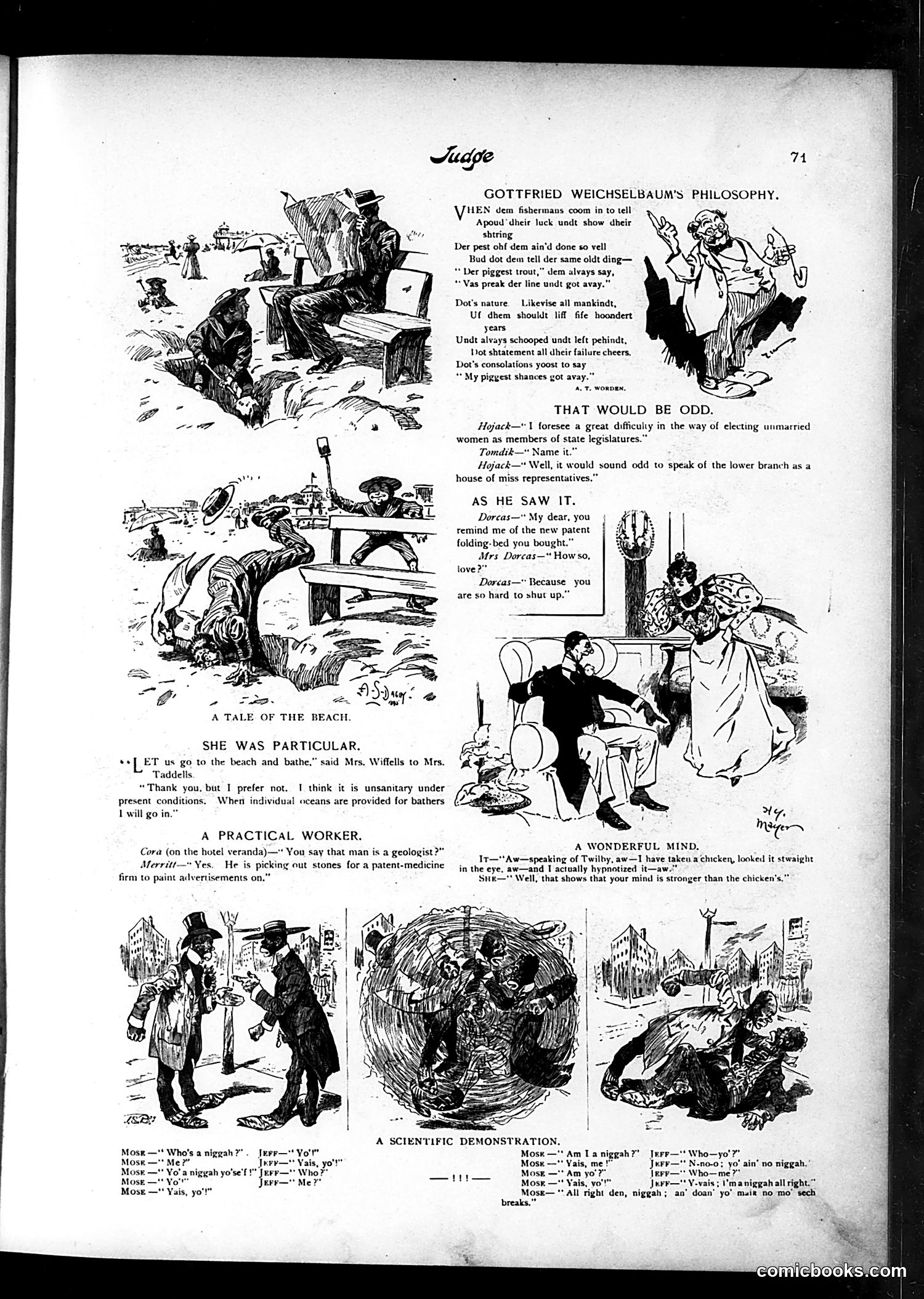
This page contains several unrelated humorous sketches typical of Judge's format: **"She Was Particular"** mocks fastidious women, with Mrs. Taddells refusing beach bathing under current conditions, sarcastically suggesting she'd only swim if given individual private oceans. **"A Practical Worker"** jokes that a geologist is merely painting advertisements on stones for a patent-medicine company—satirizing both commercial exploitation and pseudo-scientific hucksterism. **"Gottfried Weichselbaum's Philosophy"** presents a German-accented character philosophizing that fishermen, like all humans, always blame "the one that got away," using dialect humor common to period comedy. **"That Would Be Odd"** is a pun: electing unmarried women to legislatures would be odd because calling the lower legislative chamber a "house of miss representatives" sounds peculiar. **"As He Saw It"** presents marital humor about a wife being difficult to silence, compared to a folding bed. The page also includes racist dialect humor typical of the era, which modern readers should understand as reflective of period attitudes, not editorial endorsement.
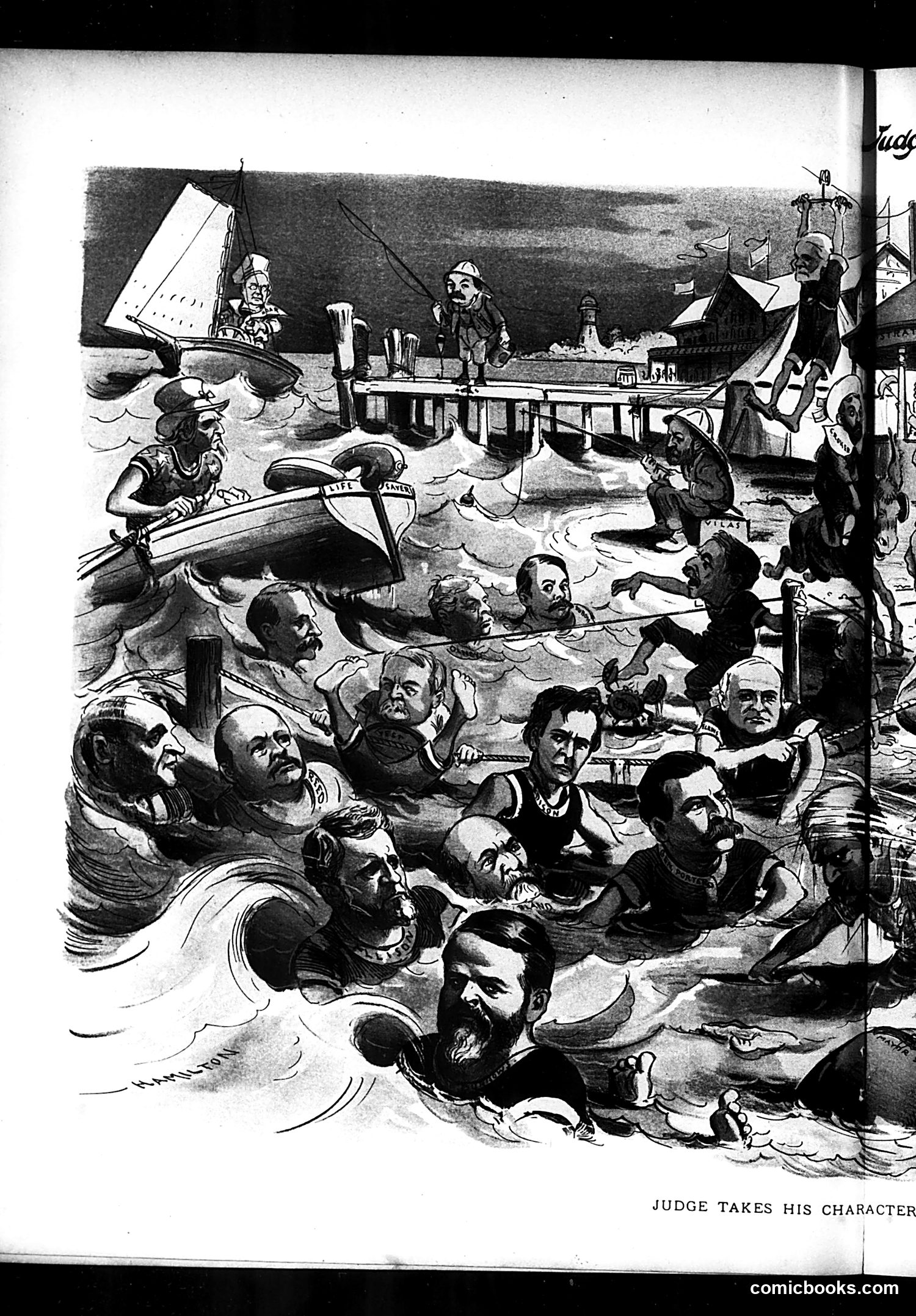
This cartoon depicts a drowning scene with multiple men in water struggling to stay afloat, while figures on a dock and in boats observe. The caption "JUDGE TAKES HIS CHARACTER" suggests this is satirical commentary on the magazine *Judge* itself or a public figure associated with it. The overcrowded water scene—with many desperate faces—appears to criticize someone or something for abandoning principles or allowing a situation to deteriorate. The nautical setting and the emphasis on multiple drowning figures suggests either a shipping disaster, financial collapse, or moral/political failure. Without additional context or visible dates, the specific historical event or individual being satirized remains unclear, though the image conveys critique of leadership or institutional failure through the drowning metaphor.
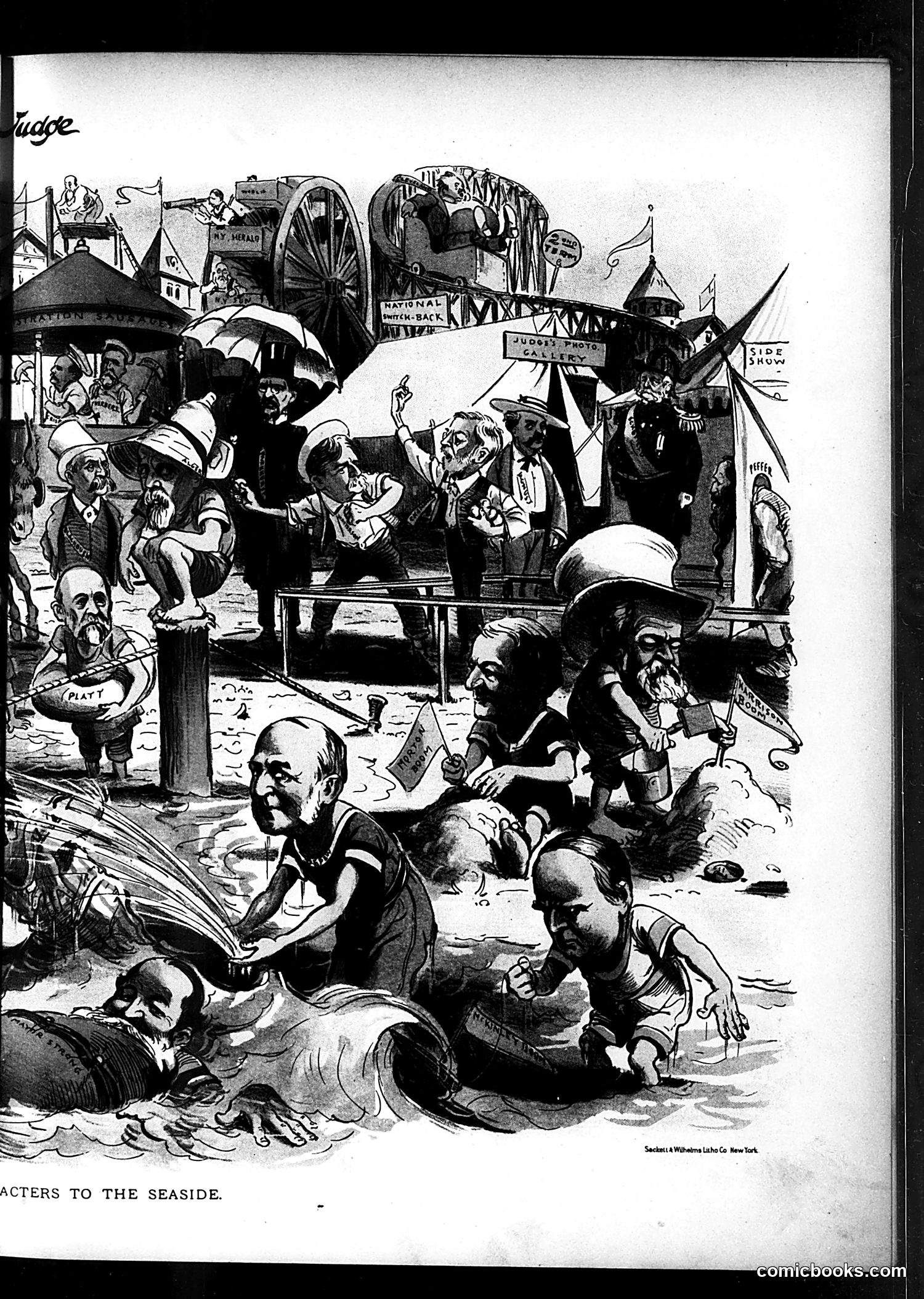
This satirical cartoon depicts theatrical performers at a beach resort, likely mocking the entertainment industry's social pretensions or behavior during leisure time. The exaggerated facial features and caricatured poses typical of Judge magazine's style suggest ridicule of the actors' vanity or affectations. The crowded, chaotic scene shows various figures in period dress (appearing to be late 19th century) engaged in beach activities. Several men display prominent noses and exaggerated expressions characteristic of period caricature conventions. The elaborate beach apparatus and various amusements suggest wealthy tourists. Without clearer identification of specific individuals or a visible date, the precise political or social targets remain uncertain, though the overall tone mocks theatrical personalities' conduct or pretensions at leisure.
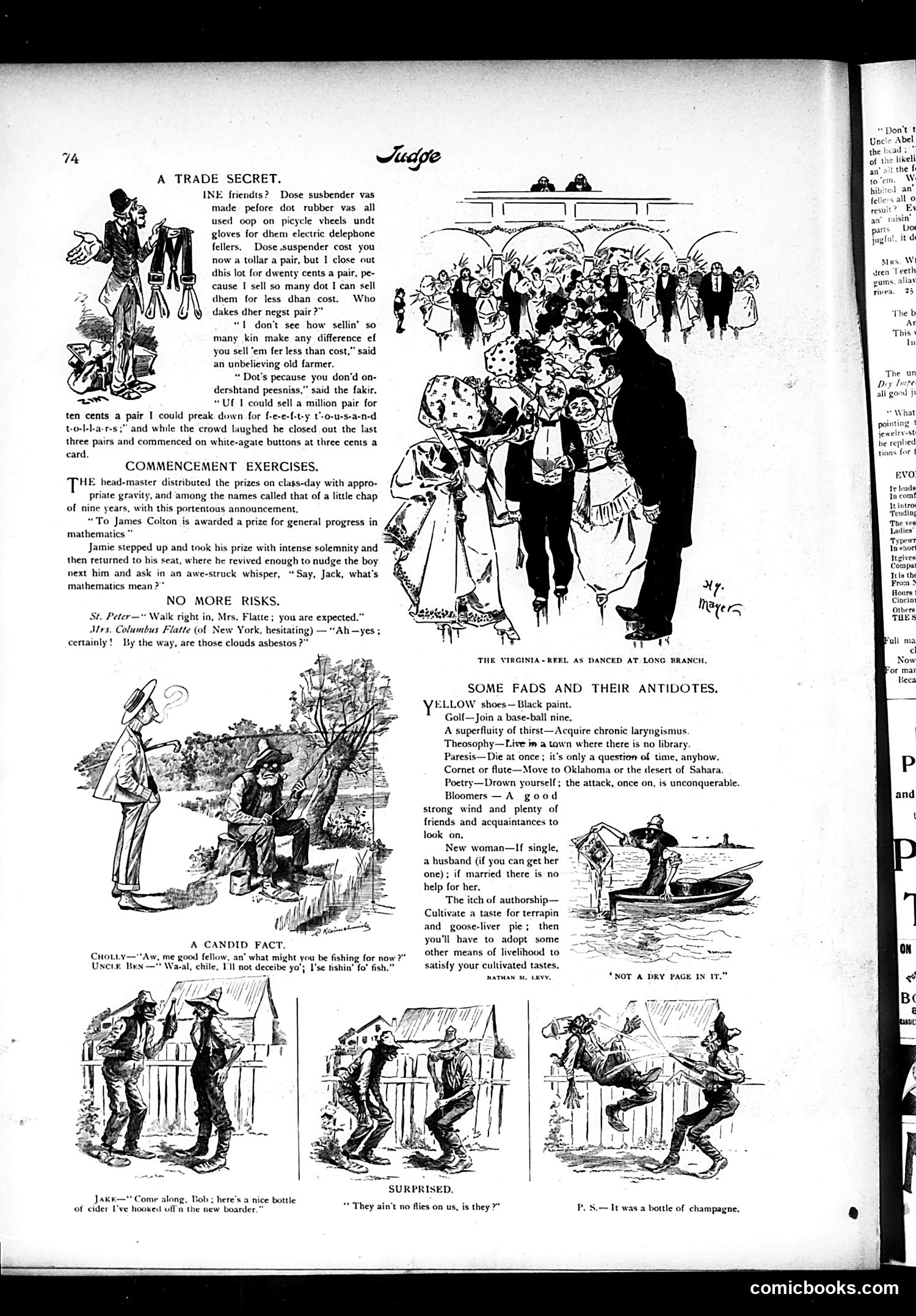
This page from the satirical magazine *Judge* contains several humor pieces mocking contemporary fads and social pretensions of the Gilded Age: **"A Trade Secret"** ridicules a con artist peddling suspenders at discounted prices while claiming to make profit through volume—a transparent business scam that dupes a credulous farmer. **"Commencement Exercises"** jokes about a nine-year-old receiving a mathematics prize but not understanding what "mathematics" means, satirizing either the child's lack of comprehension or the meaninglessness of academic honors. **"No More Risks"** depicts St. Peter questioning Mrs. Columbus Flatte about cloud composition, suggesting wealthy New York society women are so detached from reality they worry about mundane practical matters even in heaven. **"The Virginia-Reel at Long Branch"** and **"Some Fads and Their Antidotes"** mock contemporary fashions and affectations—yellow shoes, golf, theosophism, poetry, "bloomers," and the "New Woman"—treating them as absurd social trends requiring satirical "cures." The tone throughout is mockingly condescending toward both con men and gullible society figures.
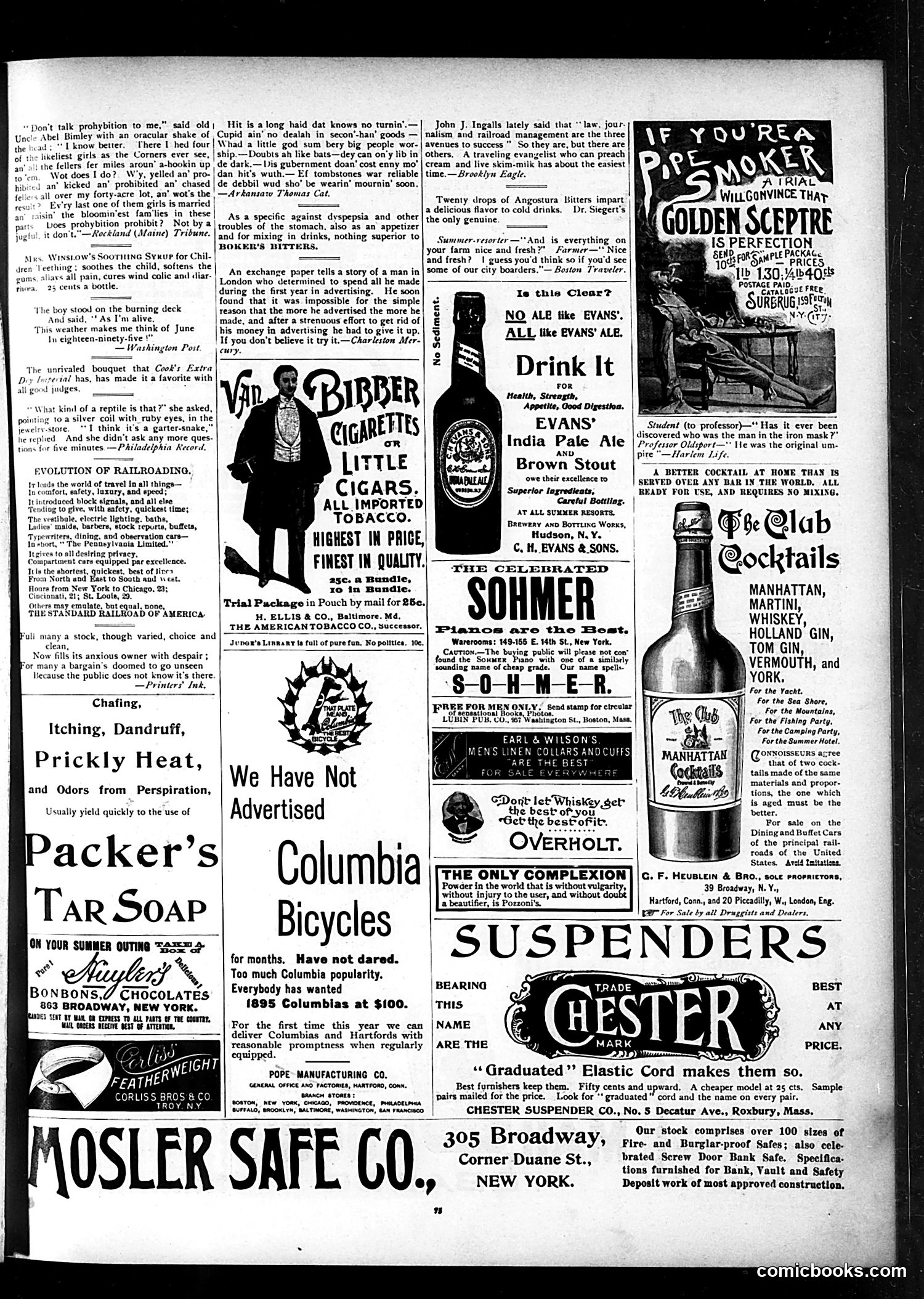
This page is primarily **advertisements and humorous filler content** rather than political satire. The visible cartoons and jokes are minor: **Text humor** includes folksy dialect pieces mocking prohibition's ineffectiveness (a rural man noting it didn't stop courtship), and anecdotes about advertising's paradoxical success. These reflect early 1890s concerns about regulatory overreach and commercial promotion. **The advertisements** dominate—promoting bicycles (Columbia brand claiming popularity), cigars, soap, whiskey, ale, suspenders, and safes. The bicycle ad is notably self-promotional, claiming they've stopped advertising because demand exceeds supply. **No major political figures or caricatures** are identifiable on this page. The content reflects *Judge* magazine's typical mix of mild social commentary, product promotion, and genteel humor aimed at middle-class readers. The satire is gentle: mocking rural speech patterns, poking fun at prohibition enforcement, and celebrating American consumer culture rather than targeting specific politicians or movements.
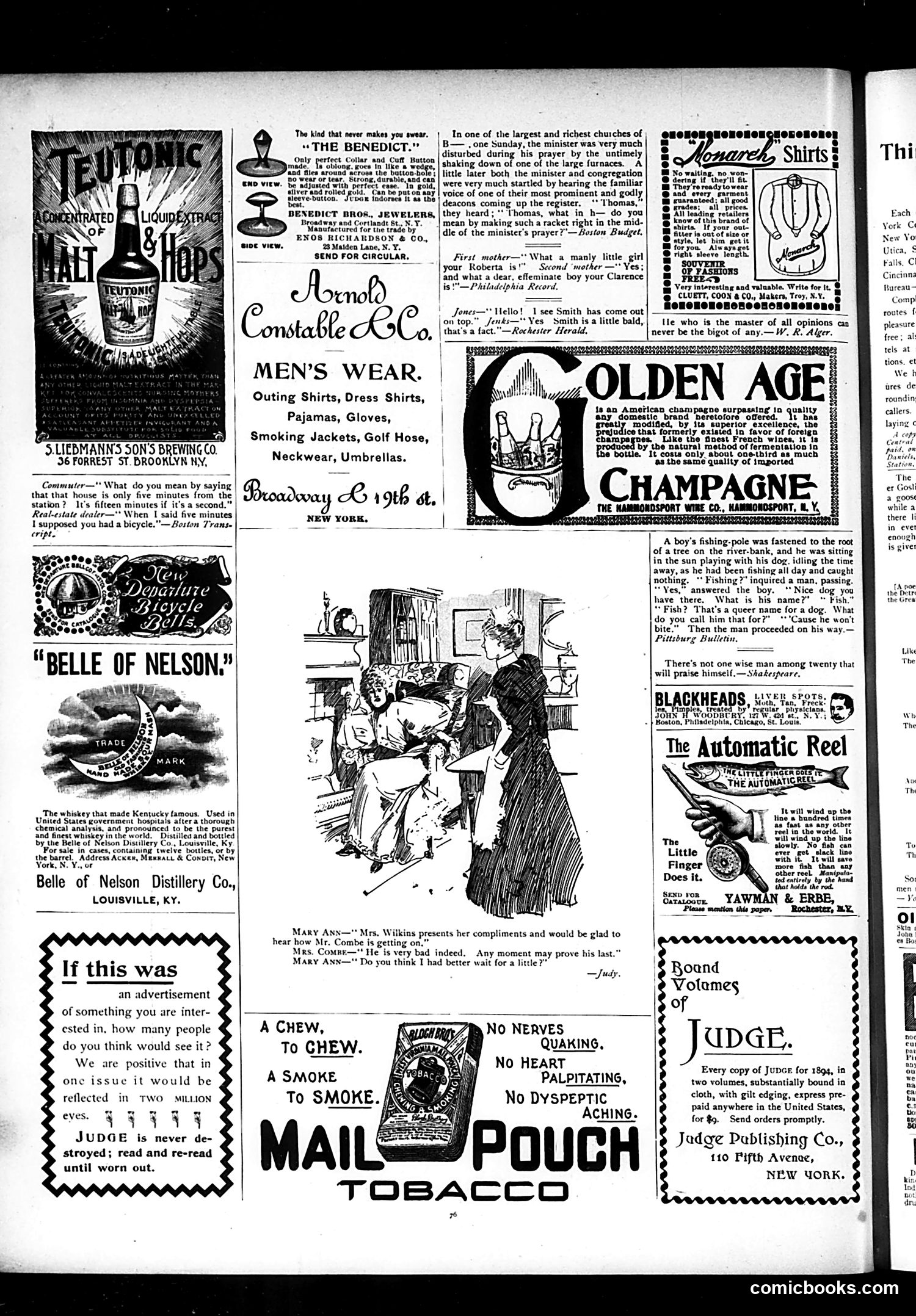
This page is primarily **advertisements and filler content** rather than a unified satirical cartoon. The main elements are: **The Central Cartoon:** Shows a domestic scene where a woman (appearing to be a wife or servant) confronts a man, likely depicting a humorous domestic mishap or marital quarrel. The sketch style suggests everyday domestic comedy. **The Jokes/Filler Items:** Several brief anecdotes mock: - A real estate agent's misleading claims about commute times (a bicycle is required) - Church disruption when a furnace malfunctions during prayer, with a deacon's profane outburst - Gender role reversals (a "manly" girl and "effeminate" boy) - A man going bald **Advertisements** dominate: brewing supplies, men's clothing (Arnold Constable & Co.), champagne, tobacco, fishing reels, and Judge magazine itself—typical turn-of-20th-century commercial content. The humor reflects period conventions: domestic squabbles, class anxieties, and gentle social observation rather than pointed political satire.
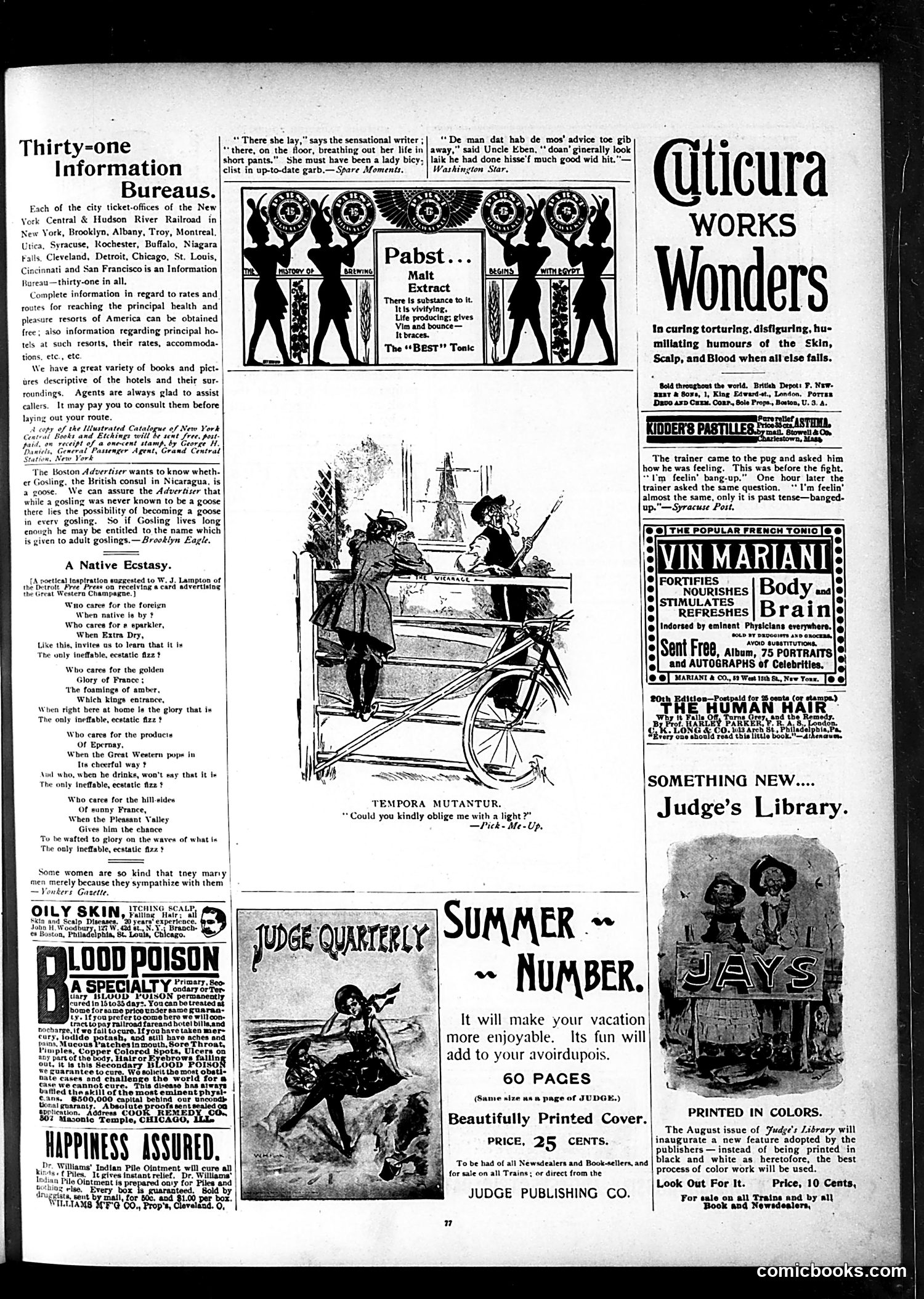
This page is primarily **advertising and announcements** rather than political satire. The main content includes: **"Tempora Mutantur" cartoon**: A small sketch showing a person asking another for a light, illustrating the Latin phrase meaning "times change"—a mild observation about social interaction. **Central content**: Information about Judge Quarterly's Summer Number—a 60-page publication costing 25 cents with a color cover, promoted as vacation reading. **Advertisements**: The page is dominated by product ads (Cuticura skin treatment, blood poison remedies, hair products, Judge's Library) and railroad information bureaus. **Filler content**: Humorous poetry and brief jokes about champagne ("A Native Ecstasy") and gender relations, typical of the magazine's light satirical tone. There is **no significant political commentary** visible. The page reflects the magazine's mixed business model: combining light humor with paid advertising to sustain publication.
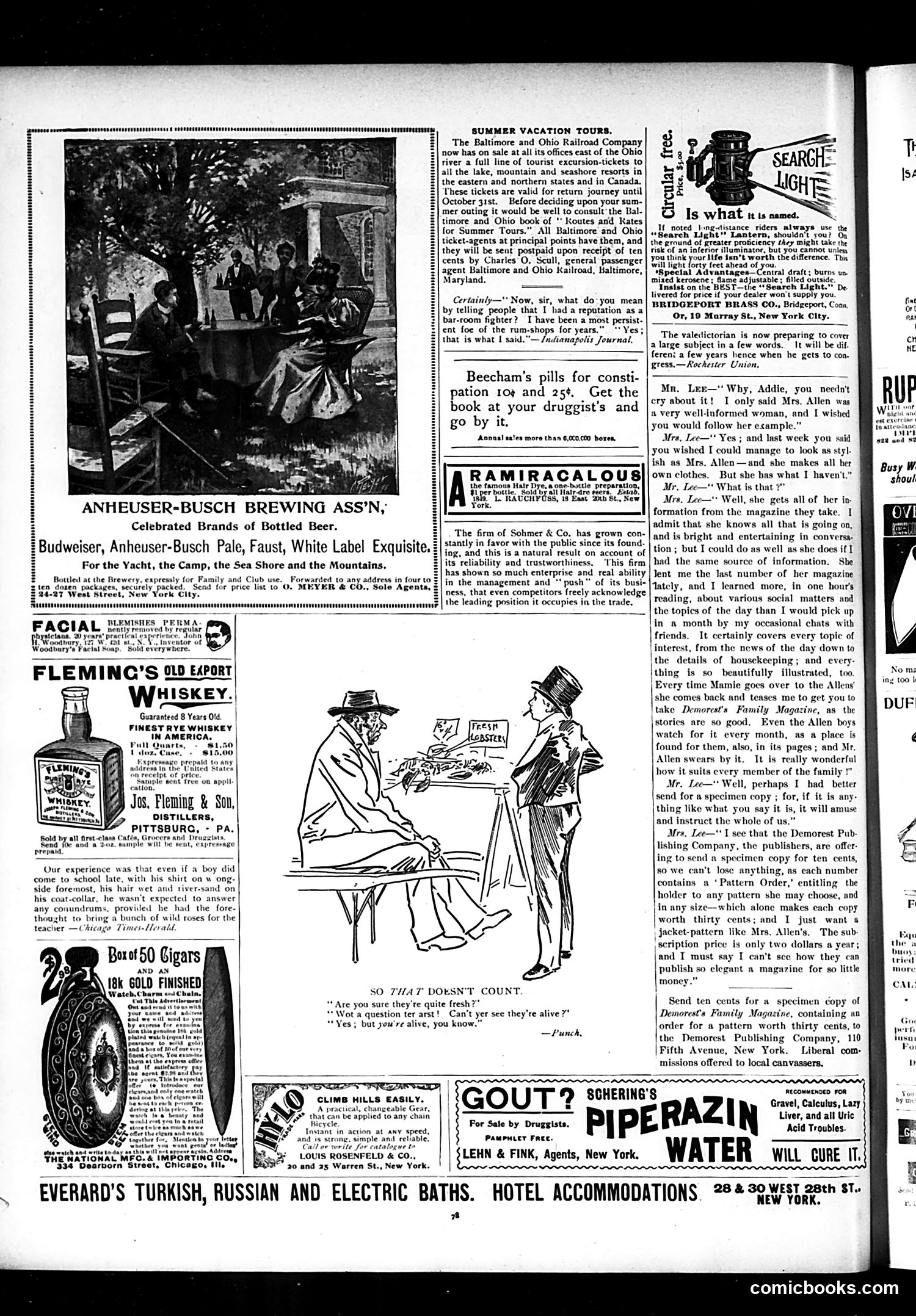
This page is primarily **advertising**, featuring multiple commercial endorsements typical of late 19th/early 20th-century publications: Anheuser-Busch beer, Fleming's whiskey, Beecham's pills, and various other products. The single cartoon, titled **"So That Doesn't Count,"** depicts a fishmonger and customer in a humorous exchange about freshness. The vendor claims fish are fresh, the customer questions whether they're alive, and the vendor retorts that being alive is what matters—the joke being an absurdist non-sequitur about the definition of "fresh." A sidebar feature titled **"Summer Vacation Tours"** advertises Baltimore and Ohio Railroad excursion tickets. The page also includes several brief satirical dialogues (common Judge features), including one mocking a husband's compliments to his wife by comparing her unfavorably to a neighbor, played for humor about marital dynamics. **No significant political or historical references appear**—this is primarily a commercial/entertainment page from what appears to be an ordinary issue of the magazine.
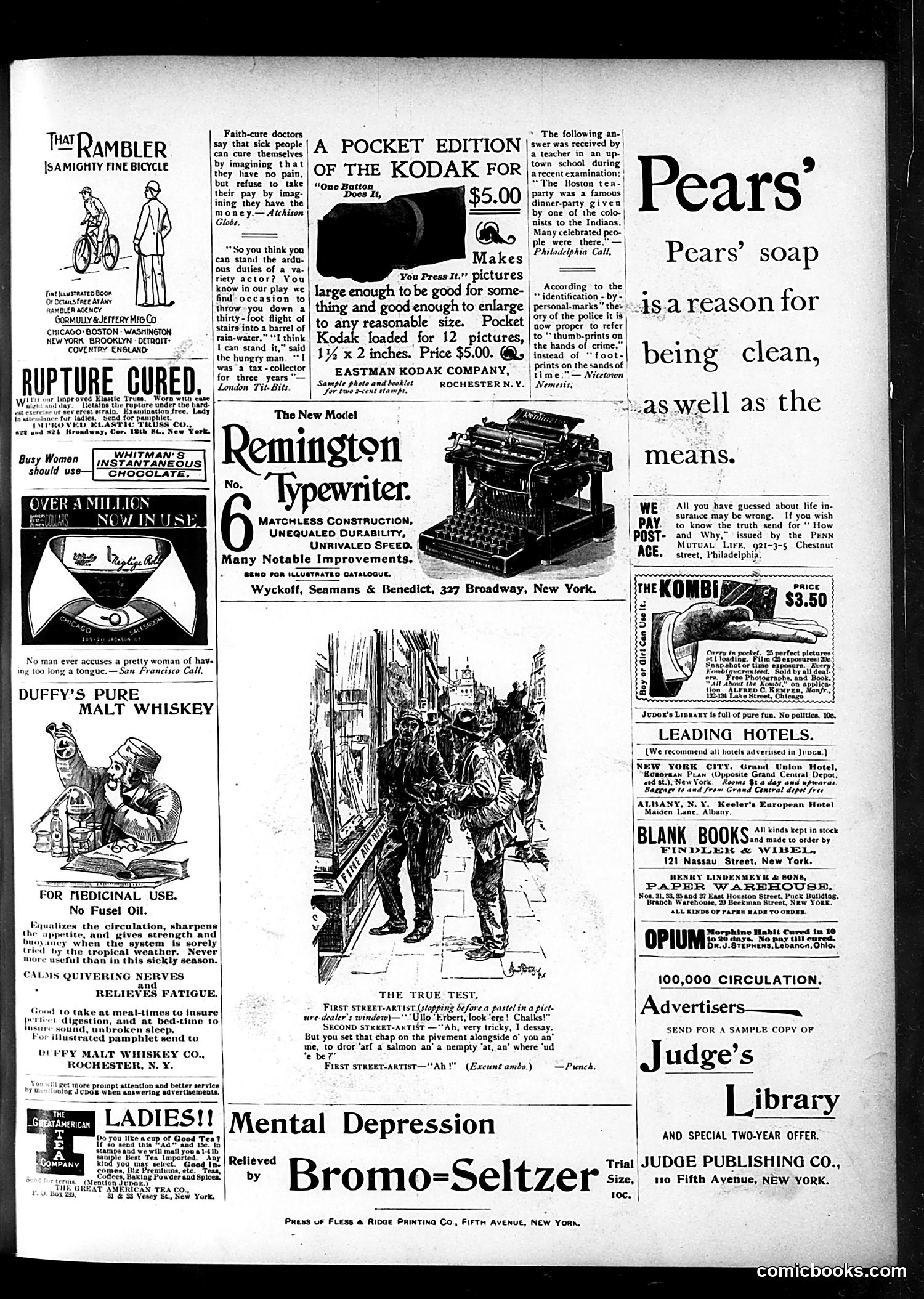
This page is primarily **advertising**, with one notable cartoon. The main satirical cartoon is titled "THE TRUE TEST," credited to Punch magazine. It depicts two street artists discussing their work: one shows a fellow artist a picture and asks him to judge its quality by comparing it to real objects (a chap on the pavement, a salmon, and an empty hat). The joke suggests that true artistic merit lies in faithful representation of reality—a common 19th-century aesthetic debate about realism versus stylization in art. The surrounding advertisements promote various products (Kodak cameras, Remington typewriters, Duffy's whiskey, Bromo-Seltzer) and services typical of the early 1900s. Notable is the "faith-cure doctors" quote mocking medical quackery—a satirical jab at pseudo-scientific practitioners claiming to cure illness through imagination rather than actual medicine. The page reflects contemporary concerns: medical fraud, artistic standards, and consumer products marketed to educated urban readers.
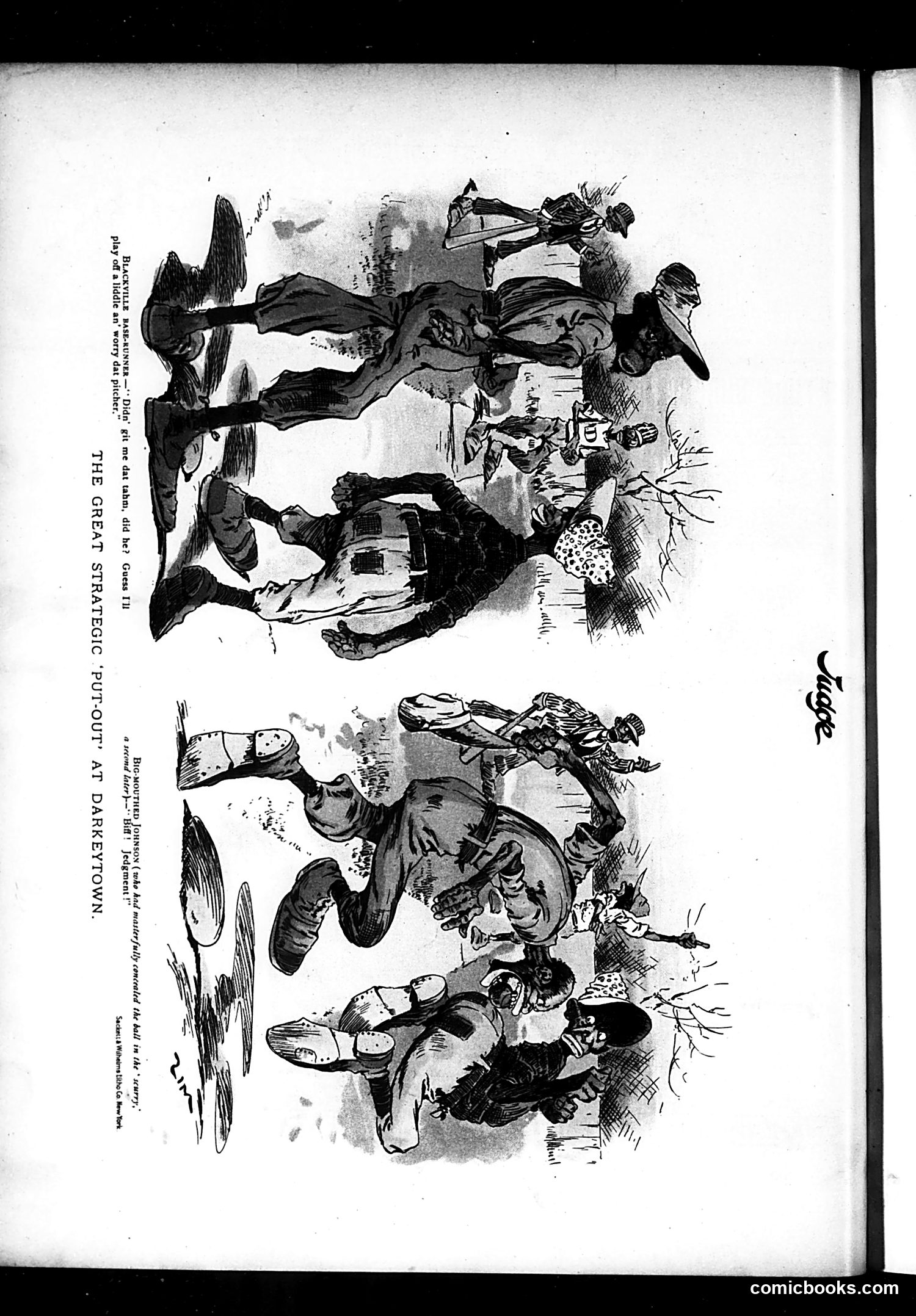
This is a racist baseball cartoon from Judge magazine using caricatured African American figures and dialect. The title and scene depict a baseball play at what appears to be a segregated Black community ("Darkeytown"). The cartoon shows figures with exaggerated features labeled with names like "Big-Mouthed Johnson" engaging in a baseball "put-out" play. The dialogue uses offensive dialect ("Didn' git me," "Jedgment") typical of minstrel-show stereotyping common in late 19th/early 20th-century American satire. The satire appears to mock both the players' abilities and their speech patterns simultaneously. This represents the casual, normalized racism of the era, when such caricatures were considered acceptable entertainment for white audiences in publications like Judge.