
A complete issue · 16 pages · 1895
Judge — July 27, 1895
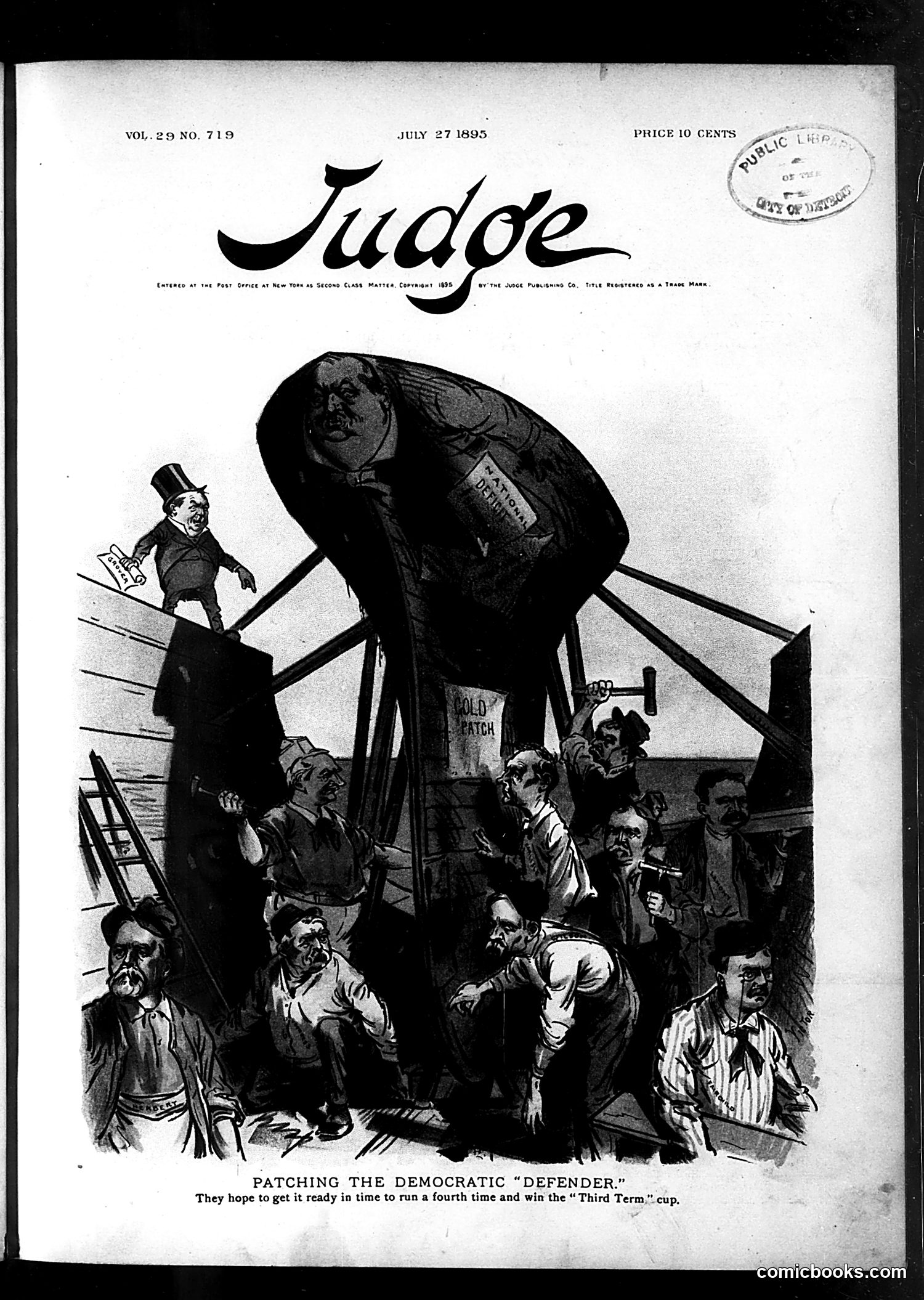
This political cartoon satirizes Democratic efforts to maintain party viability heading into the 1896 presidential election. The large figure labeled "Democratic Defender" represents the Democratic Party itself, depicted as a patched-up vessel requiring constant repair. A small figure in a top hat (likely representing party leadership or a specific politician) stands atop attempting repairs, while workers below hammer and patch the structure. The caption—"They hope to get it ready in time to run a fourth time and win the 'Third Term' cup"—mocks Democratic hopes of winning after losses, with sarcastic reference to the "third term" controversy surrounding presidential succession. The cartoon suggests the party is in such disrepair that fixing it in time for the upcoming election seems nearly impossible.
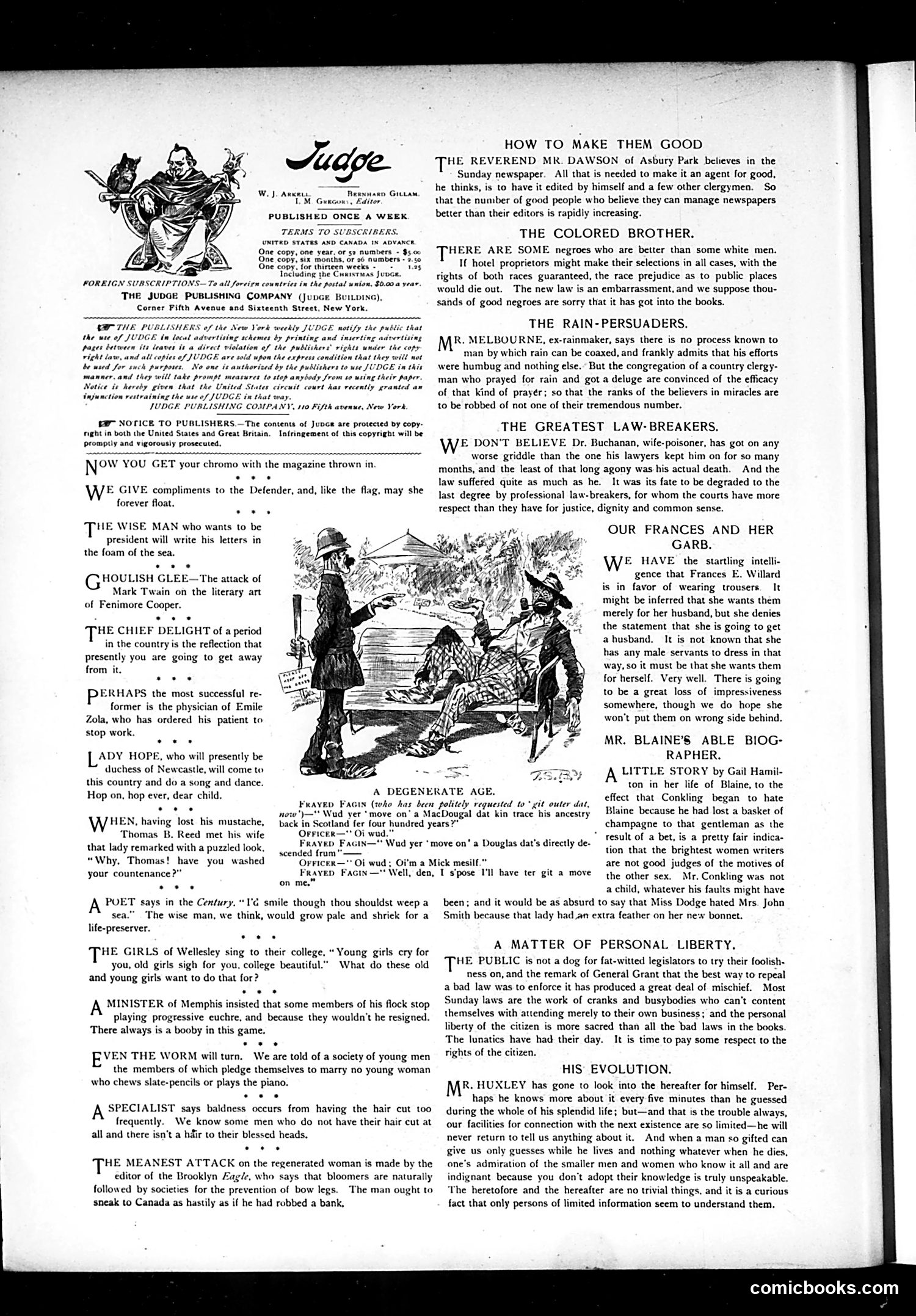
The main cartoon titled "A DEGENERATE AGE" depicts a poorly dressed man attempting to trace his ancestry to Scottish nobility. The humor relies on class pretension—the figure tries to claim ancestral status (a "MacDougal" or "Douglas" lineage) to elevate his social standing, despite his shabby appearance suggesting he's anything but aristocratic. The accompanying text snippets are editorial commentary on various social issues: women wearing trousers, literary criticism of Frances E. Willard, legal reform failures, and evolutionary theory (Huxley). The overall theme critiques social pretension, failed reforms, and questionable intellectual trends of the era. This represents typical Judge magazine content: satirizing middle and lower-class aspirations while mocking progressive movements and scientific theories.
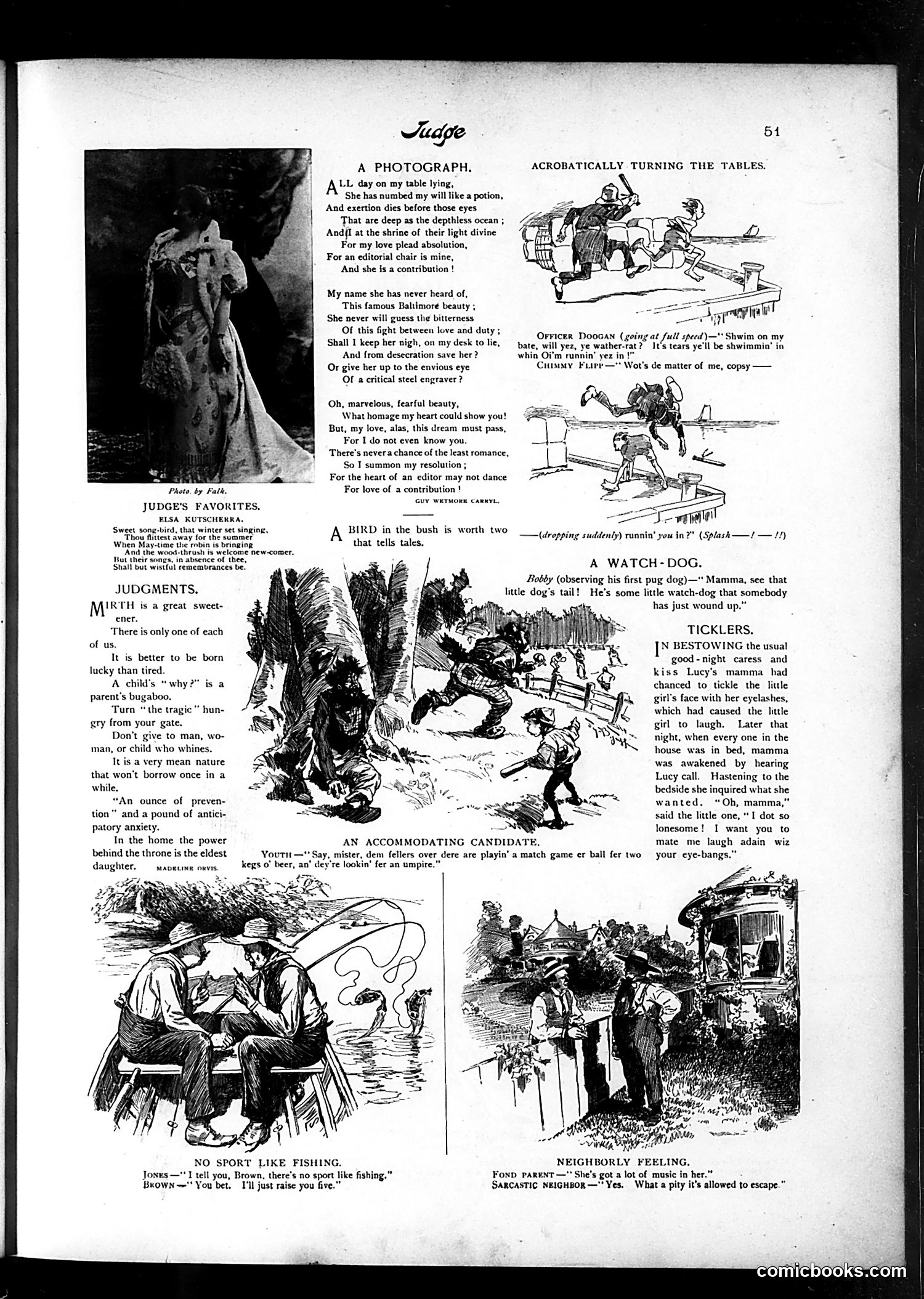
This page contains several humorous short pieces and illustrations rather than political cartoons: **"A Photograph"** is a romantic poem about an unrequited love for a Baltimore beauty—likely a society figure from the period. **"Judges' Favorites"** and **"Judgments"** are brief witty observations on human nature and parenting. The remaining items are illustrated comic scenarios: "Acrobatically Turning the Tables" (children playing), "A Bird in the Bush" (a folk saying illustration), "A Watch-Dog" (a child's misunderstanding), "Ticklers" (a bedtime anecdote), "An Accommodating Candidate" (men fishing), "No Sport Like Fishing" (a joke), and "Neighborly Feeling" (a domestic dispute about music). These are general humor pieces reflecting late 19th/early 20th-century domestic and social situations, not partisan satire.
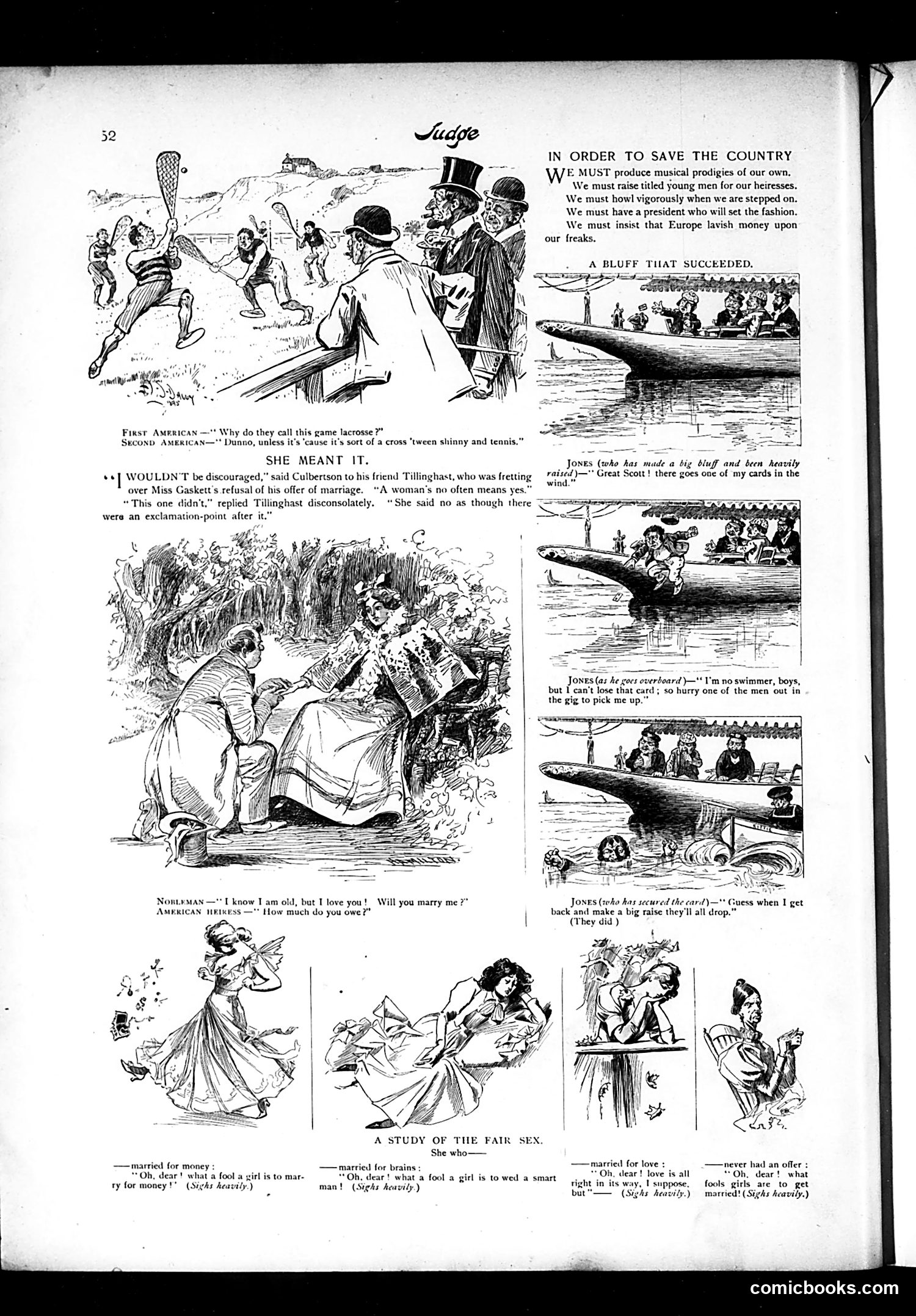
This page satirizes American social anxieties and class pretensions of the Gilded Age era. The opening "In Order to Save the Country" section mocks American insecurity about cultural inferiority to Europe—the demand to produce "musical prodigies" and "titled young men" reflects anxiety that wealthy Americans must import European refinement and aristocratic credentials through marriage. "A Bluff That Succeeded" shows Jones successfully bluffing at cards by risking a valuable card, satirizing American business culture's reliance on bold deception. "She Meant It" jokes about courtship miscommunication—a woman's "no" actually means no, contrary to social convention. The bottom section "A Study of the Fair Sex" presents cynical takes on women's marriage motivations: marrying for money, intelligence, love, or never receiving offers at all—reflecting period skepticism about women's agency and romantic authenticity. The lacrosse dialogue appears incidental, mocking American unfamiliarity with the sport. Overall, the page critiques American wealth-chasing, European cultural inferiority complex, and gender relations.
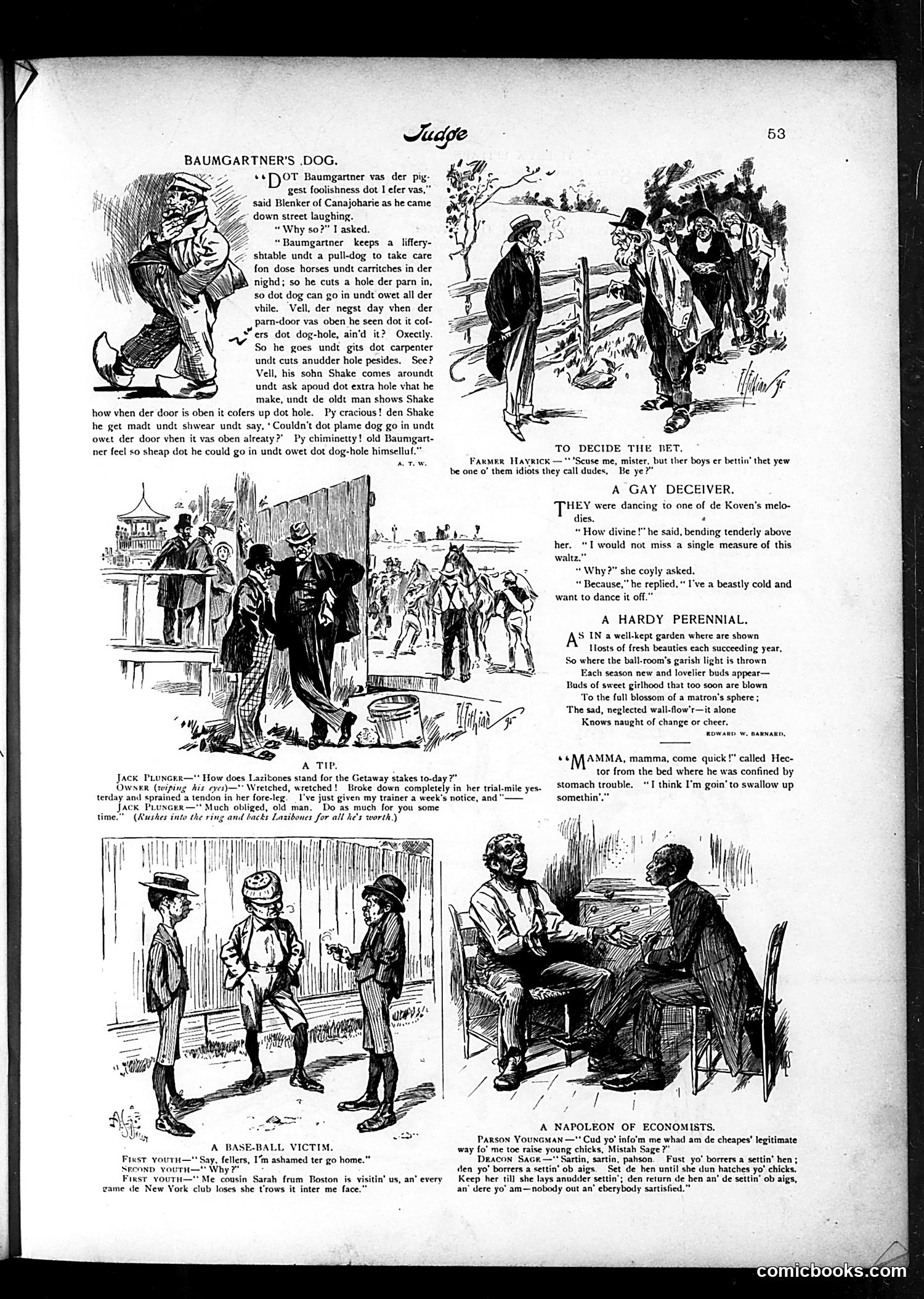
This page from *Judge* (an American satirical weekly) contains several short humor pieces targeting 1890s-era social foibles: **"Baumgartner's Dog"**: A dialect comedy mocking German-American immigrants. The joke depends on thick "Dutch" accent humor—Baumgartner foolishly cuts multiple holes in his barn door for a dog, creating absurd complications. The satire reflects period ethnic stereotyping common in American humor magazines. **"A Gay Deceiver"**: A man uses a cold as an excuse to dance with a woman, feigning romantic interest while actually just wanting exercise. Light satire of male romantic deception. **"A Hardy Perennial"**: Melancholic verse about wallflowers at balls—young women who never marry and remain perpetually overlooked, contrasting with fresh debutantes yearly. **"A Napoleon of Economists"**: Rural dialect humor where a parson asks a deacon about cheaply raising chickens. The "economy" involves borrowing repeatedly in a circular scheme—poking fun at poor farmers' schemes. These pieces represent typical *Judge* content: ethnic caricature, romantic comedy, and rural/urban social observation.
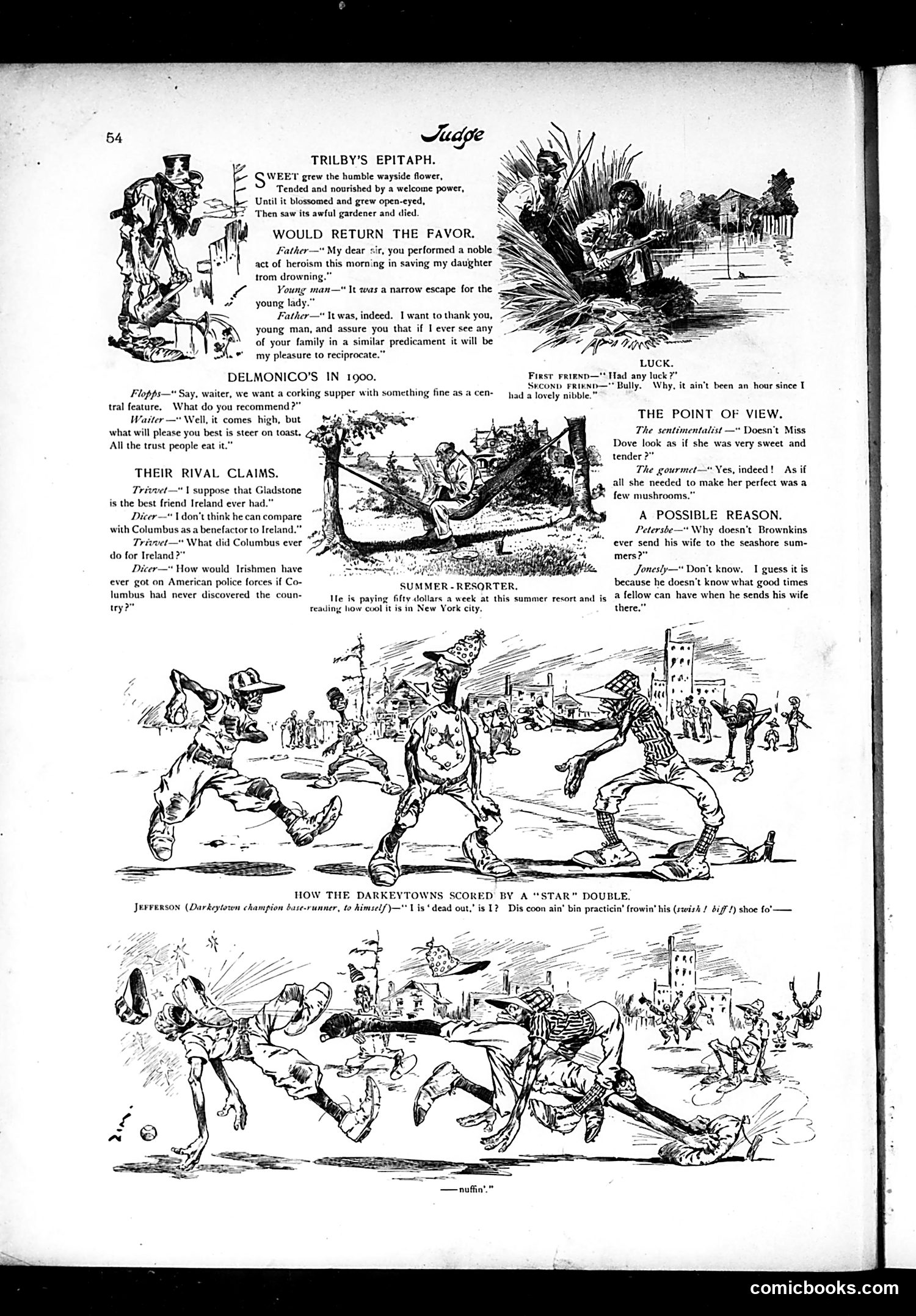
This page contains several satirical pieces typical of Judge's social humor circa 1900: **"Trilby's Epitaph"** references the 1894 novel *Trilby* by George du Maurier, which became a sensation. The poem suggests the titular character was corrupted or destroyed by society's attention. **"Would Return the Favor"** mocks upper-class politeness through a father's absurdly formal response to a drowning rescue—he offers to reciprocate if the young man's family ever drowns. **"Delmonico's in 1900"** jokes about New York's famous restaurant serving "steer on toast" as upscale cuisine—satirizing pretentious diners. **"Their Rival Claims"** presents an Irish-American joke debating whether Goldstone or Columbus was Ireland's "best friend." The punchline: Columbus "discovered" America, enabling Irish immigration and police force participation—a backhanded compliment about Irish-American social status. The cartoons mock class pretensions, consumer culture, and ethnic stereotypes typical of the era's satirical magazine humor.
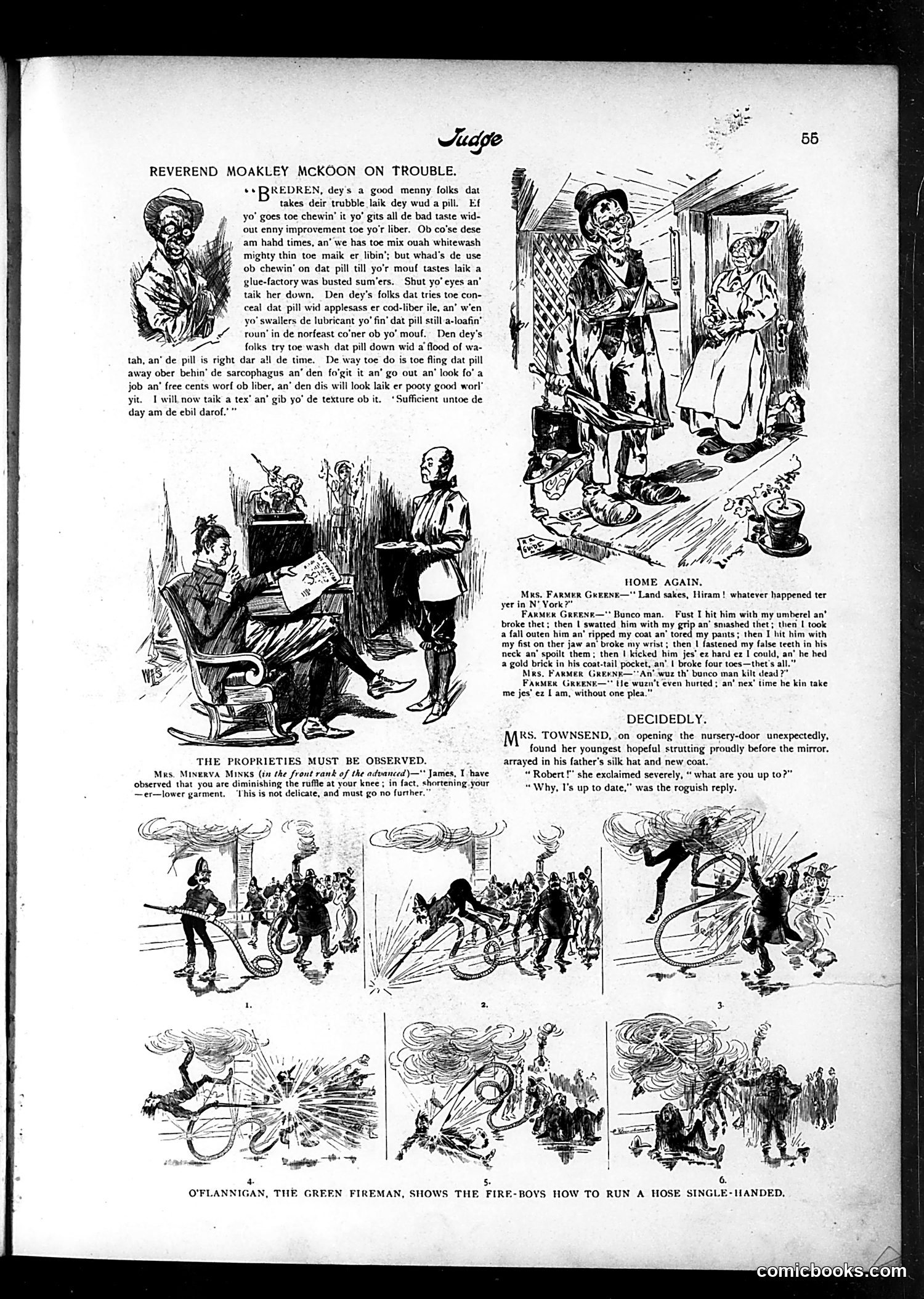
This page contains several satirical pieces typical of late-19th-century American humor: **"Reverend Moakley McKoon on Trouble"** mocks both religious sermon-giving and hard economic times through a dialect character. The reverend advises against dwelling on troubles (represented as a bitter pill), instead advocating acceptance and job-seeking—likely commentary on economic hardship and the ineffectiveness of both religion and avoidance in solving real problems. **"The Proprieties Must Be Observed"** satirizes rigid Victorian social conventions, showing a woman criticizing her husband for shortening his knee ruffle and lowering his garment—absurd concern with minor fashion details. **"Home Again"** depicts a farmer recounting his violent encounter with a con artist in New York, humorously emphasizing rural naïveté versus urban deception. **"Decidedly"** jokes about a child mimicking adult fashion as being "up to date." **"O'Flannigan, the Green Fireman"** appears to show comedic fire-fighting mishaps, likely ethnic humor common to the era.
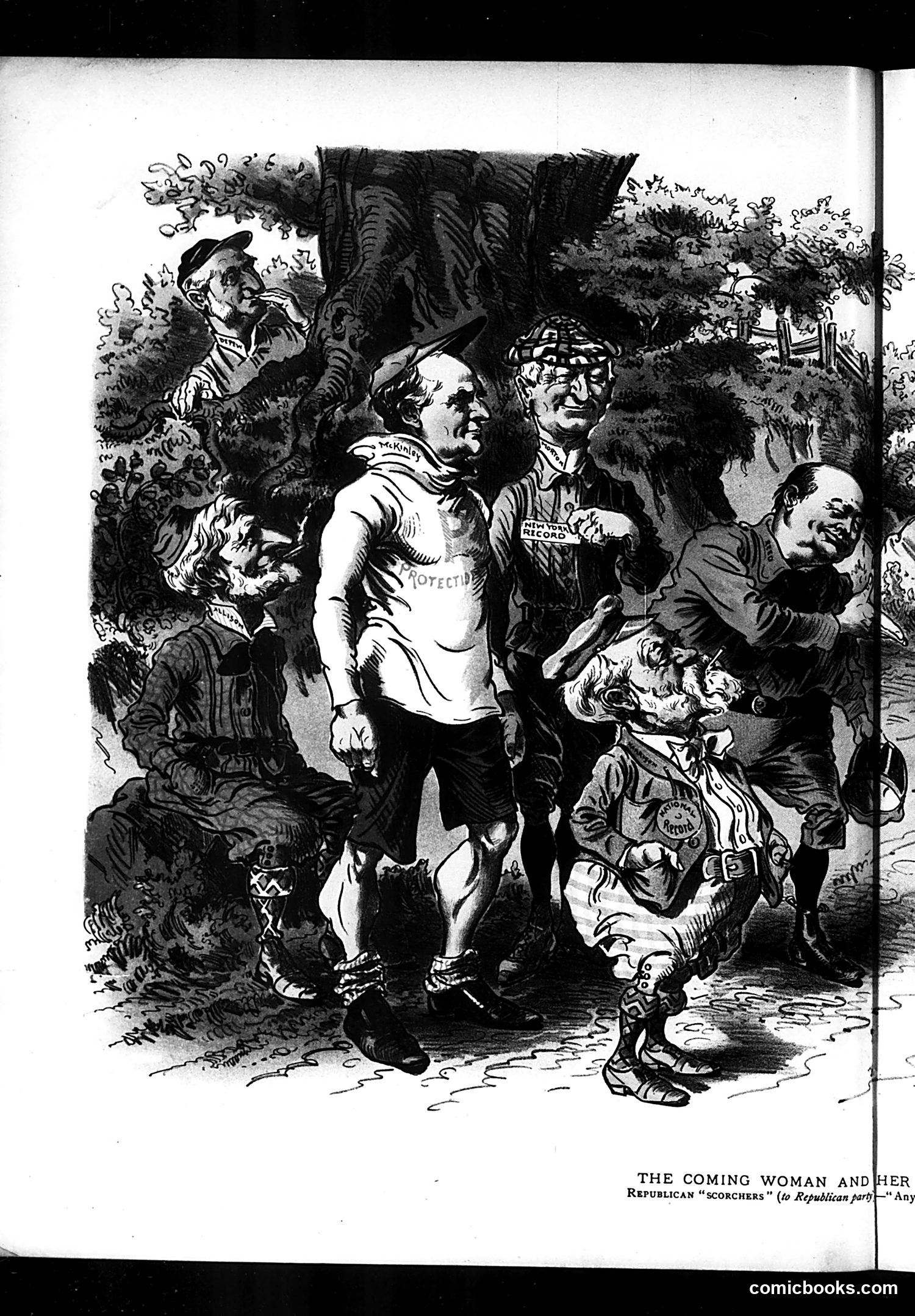
This is a political cartoon satirizing the Republican Party through the metaphor of "scorchers" (reckless, extreme figures). The central figure appears to be a woman representing "the coming woman"—likely referring to women's suffrage or women's political involvement, a contentious issue of the era. She's surrounded by caricatured Republican Party members depicted as wild, uncontrolled characters in an anarchic scene. The satire suggests Republicans are chaotic "scorchers" who will be consumed or led astray by women's political participation, or conversely, that women voters represent a dangerous, uncontrollable force the party cannot manage. The Democratic cartoonist (Judge was Democratic-leaning) uses grotesque imagery and chaos to mock Republican anxieties about women's political power and the party's inability to control its more extreme elements.
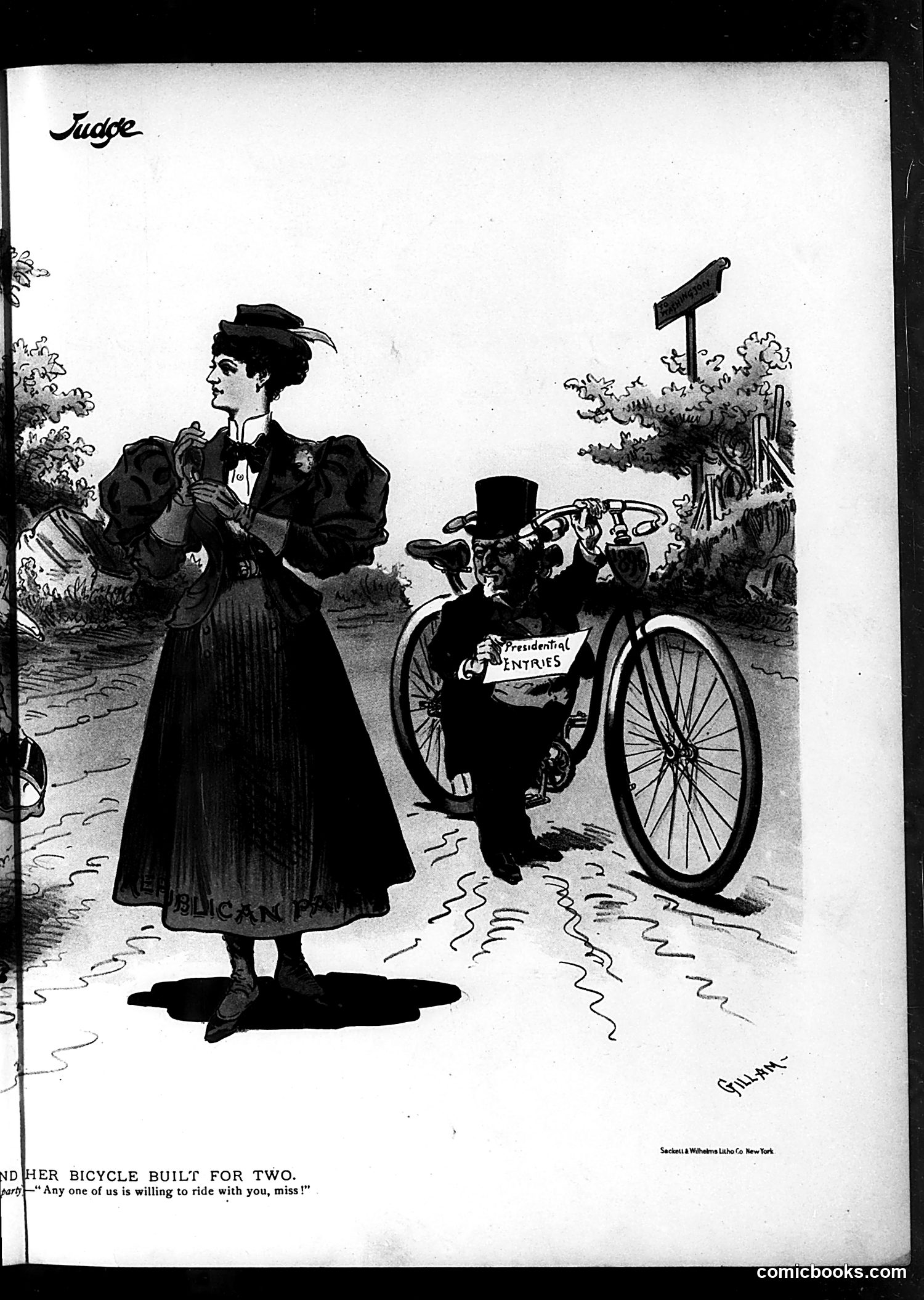
This Judge cartoon satirizes presidential politics through a romantic metaphor. A well-dressed woman ("American People," indicated by her garment label) stands at a crossroads, approached by a small figure on a tandem bicycle labeled "Presidential Entries." The caption—"Any one of us is willing to ride with you, miss!"—suggests multiple political candidates courting voters before an election. The humor lies in treating electoral competition as romantic pursuit: candidates offering themselves as partners, each hoping to "ride with" (metaphorically, lead) the nation. The woman's dignified posture and distant gaze suggest she holds the power to choose among suitors. This reflects Progressive Era attitudes about expanding voting participation and the competitive nature of presidential campaigns, where candidates literally campaigned for public support and favor.
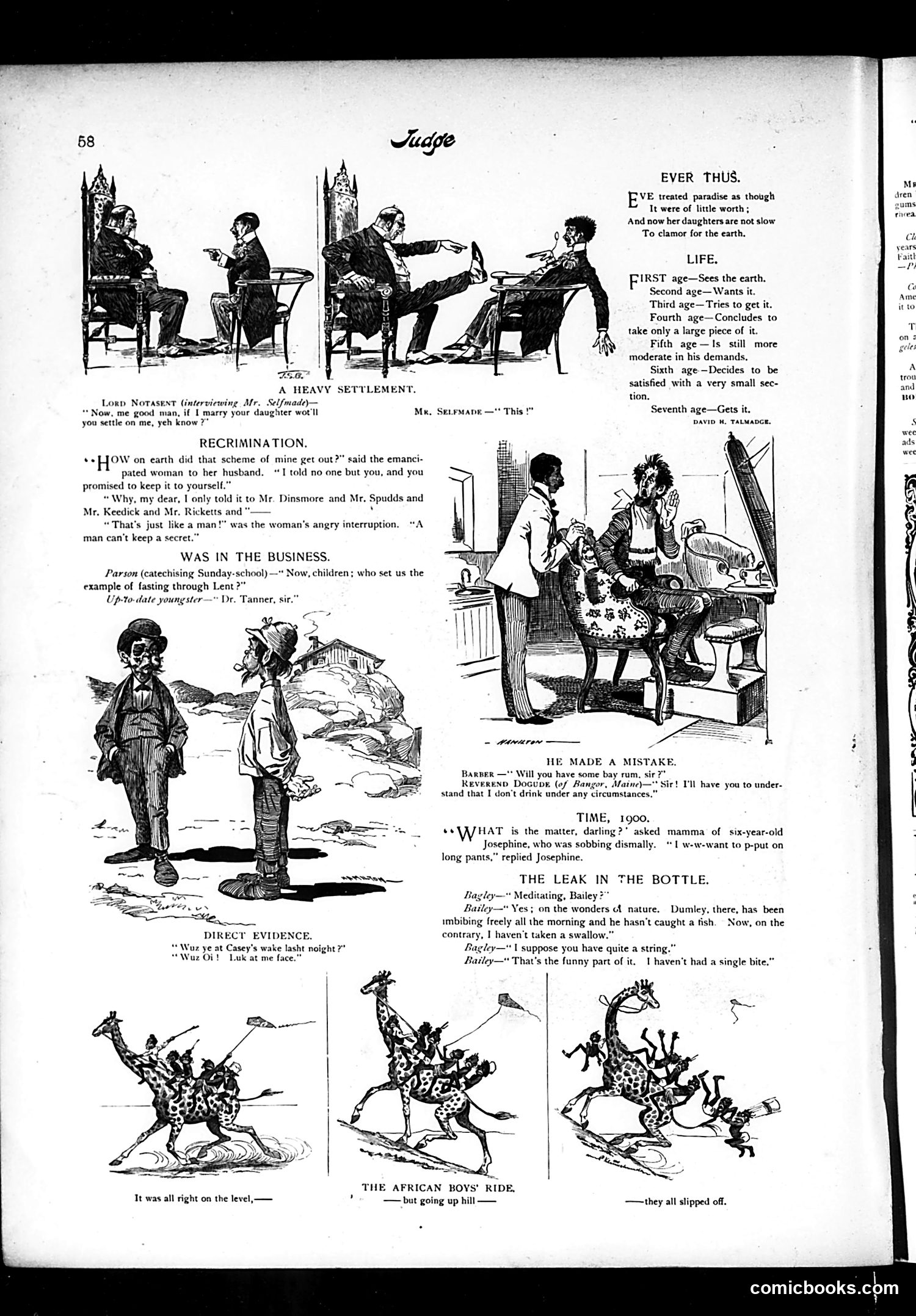
This page contains multiple satirical vignettes typical of Judge's humor circa 1900: **"Ever Thus"** critiques women's expanding demands—a poem suggesting Eve's descendants, having gained paradise, now want earthly possessions too. This reflects anxieties about women's rights movements of the era. **"A Heavy Settlement"** jokes about marriage negotiations, with Lord Notascent negotiating a dowry from "Mr. Selfmade"—likely satirizing nouveau riche businessmen and class-conscious marriage arrangements. **"Recrimination"** mocks the "emancipated woman" who blames her husband for spreading secrets, reinforcing stereotypes about female gossip. **"Was in the Business"** uses a clergyman and modern youth to suggest contemporary children lack proper religious discipline. **"The African Boys' Ride"** presents a crude racial joke about Black boys losing control of a camel going uphill—typical of period racist caricature and "humor." The page overall reflects early 1900s anxieties: women's liberation, class mobility, declining morality, and casual racial mockery common to contemporary American satire.
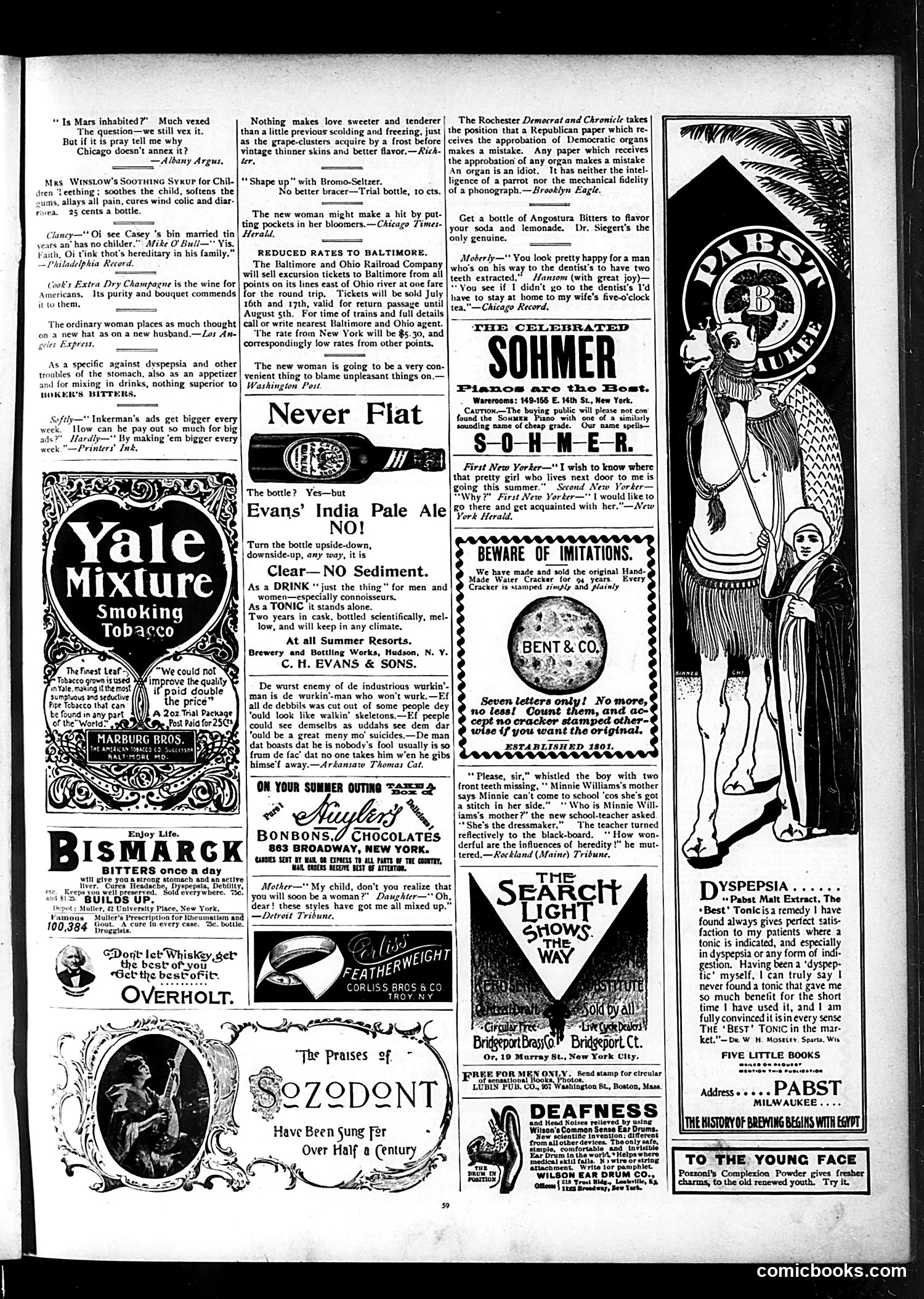
This is primarily an **advertising page** from Judge magazine, with scattered short humorous items typical of the era. The notable satirical content includes: **Chicago annexation joke**: A quip suggesting Chicago's expansionist ambitions are so voracious it should annex Mars—mocking the city's rapid growth and aggressive municipal ambitions during the Gilded Age. **"New Woman" references**: Multiple brief jokes about the emerging "New Woman" of the 1890s—the independent, increasingly liberated female figure. One suggests she should add pockets to her bloomers (practical clothing); another jokes she'll conveniently "blame unpleasant things on." These reflect contemporary anxieties about changing gender roles. **Working-class dialect humor**: Pseudo-phonetic "Arkansaw" speech attributed to "Thomas Cat" offers folksy philosophy about industriousness and self-deception—standard period working-class caricature. Otherwise, the page is dominated by **patent medicine and beverage advertisements** (bitters, ale, champagne, tooth powder), representing the magazine's primary revenue source.
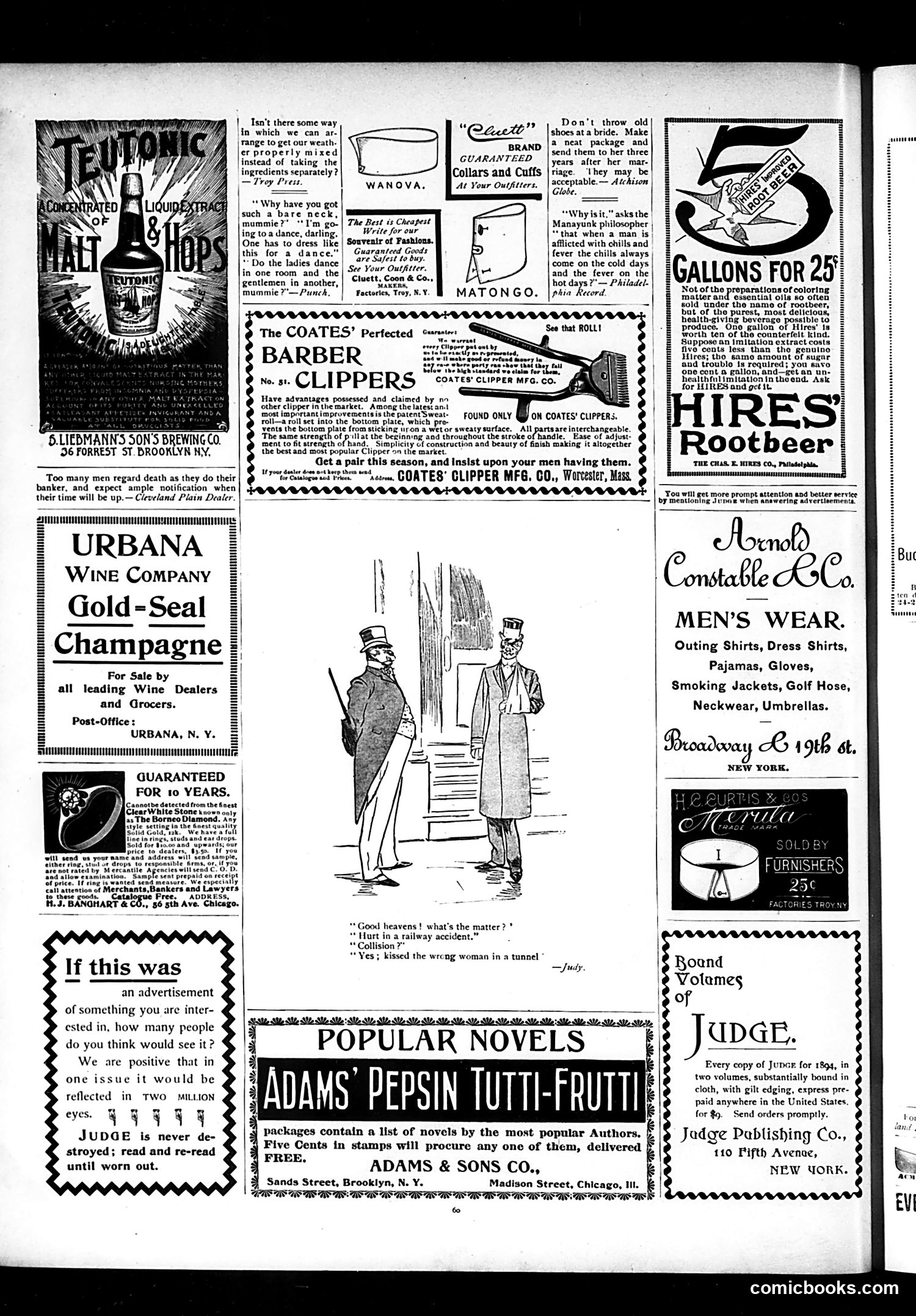
This page is primarily **advertisements and filler content** rather than political satire. The bulk consists of period product ads (champagne, barber clippers, men's clothing, rootbeer) interspersed with small humorous anecdotes and jokes. The only cartoon shows two **well-dressed men in formal attire** with the caption explaining one kissed "the wrong woman in a tunnel" during a railway accident—a mild joke about mistaken identity during a train collision. The page includes editorial quips typical of Judge's satirical tone: one jabs at people who expect advance notice of death "like their banker," another mocks the weather being served in unmixed "ingredients." Most content reflects early 1900s consumer culture and advertising practices rather than commentary on specific political events or figures. The **"Judge is never destroyed"** self-promotion emphasizes the magazine's reusable, widely-circulated nature—a circulation argument to advertisers.
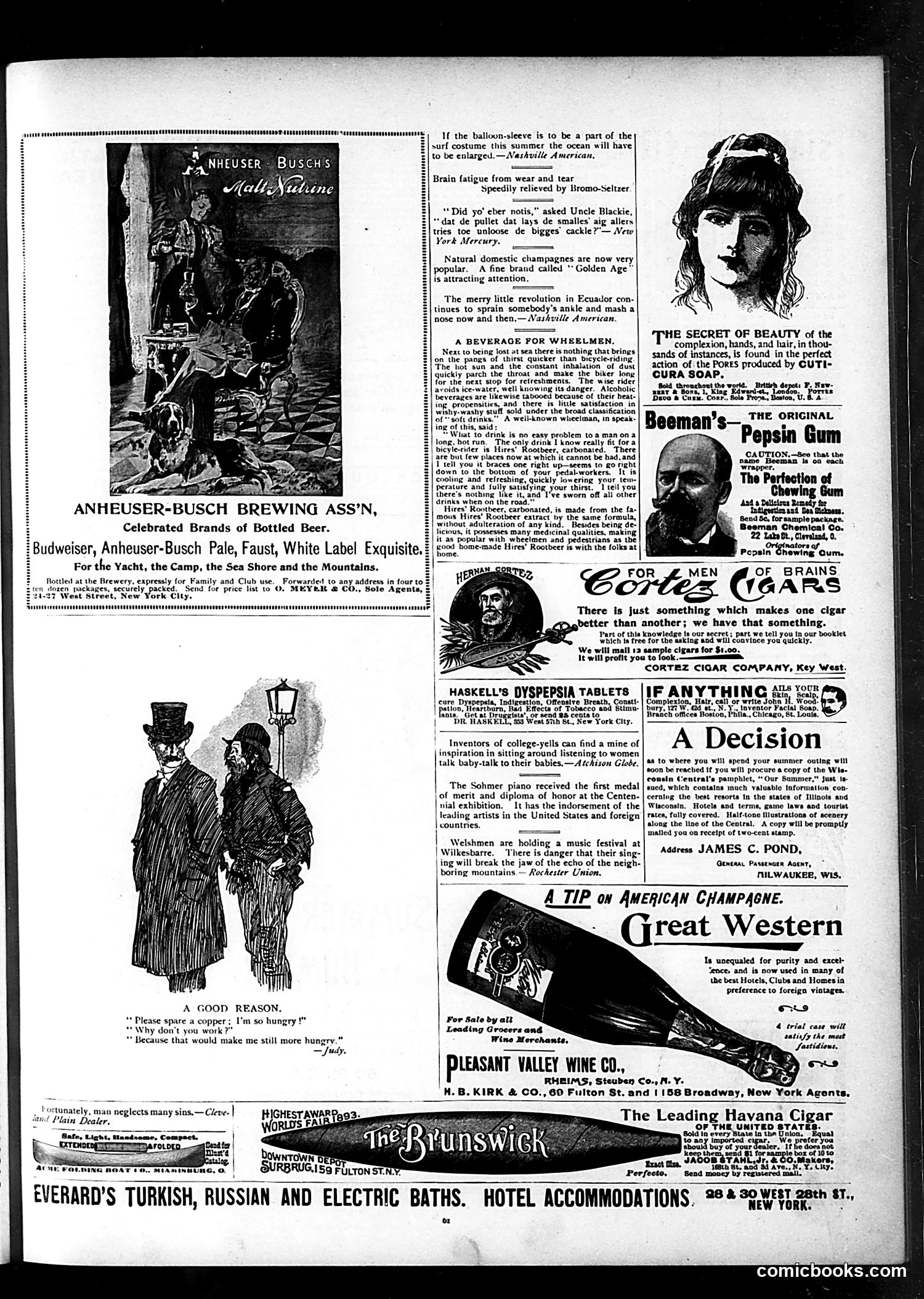
This page is primarily **advertising**, not political satire. It contains multiple commercial advertisements from the 1890s-early 1900s era, interspersed with brief humorous quotations typical of the period. The only cartoon present is a small sketch labeled "A Good Reason"—showing a beggar asking for money, claiming he's hungry. When asked why he doesn't work, he replies that working would make him "still more hungry." The joke reflects contemporary attitudes toward poverty and labor: it's a cynical jab at either the beggar's laziness or a dark commentary on wages so low that working provides no relief. The advertisements include beer, root beer, cigars, champagne, piano, dental products, and medicinal tablets—all pitched with period-typical health claims. Notable is "Hires' Rootbeer," marketed specifically to bicycle riders as a refreshing alternative to alcohol or water. The humor snippets scattered throughout (about balloon sleeves, piano merit medals, baby-talk) are unrelated jokes unconnected to political events or figures.
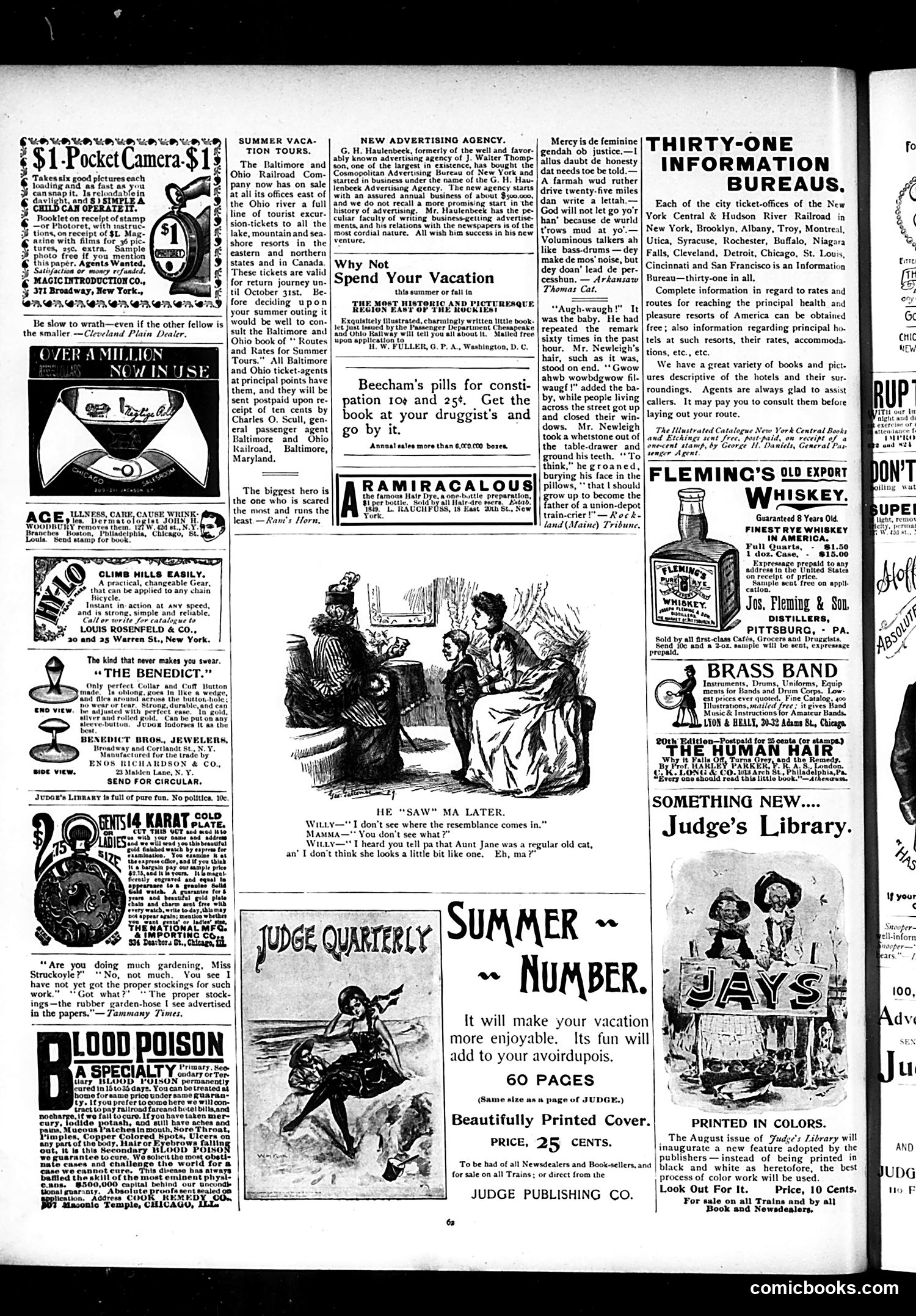
This page is primarily **advertising and announcements** rather than political satire. The main content includes: **The Central Cartoon** depicts a domestic scene with two figures and a dog, captioned "HE SAID—SHE SAID A LATER." The dialogue suggests a marital disagreement about whether "Aunt Jane" is "a regular old cat"—a mild domestic humor joke without clear political meaning. **The Advertisements** dominate the page: pocket cameras, bicycles with changeable gears, jewelry, blood poison "cures" (a common quack medicine claim), railroad tourism packages, and Judge's own Summer issue promotion. **Notable Context**: The blood poison advertisement is particularly jarring to modern readers—it advertised mercury treatments for syphilis, a real but dangerous "cure" of the era. This reflects the magazine's willingness to accept medical ads we'd now recognize as fraudulent. The page demonstrates Judge's dual nature: satirical magazine by day, advertising vehicle by necessity. No specific political figures or events are referenced here.
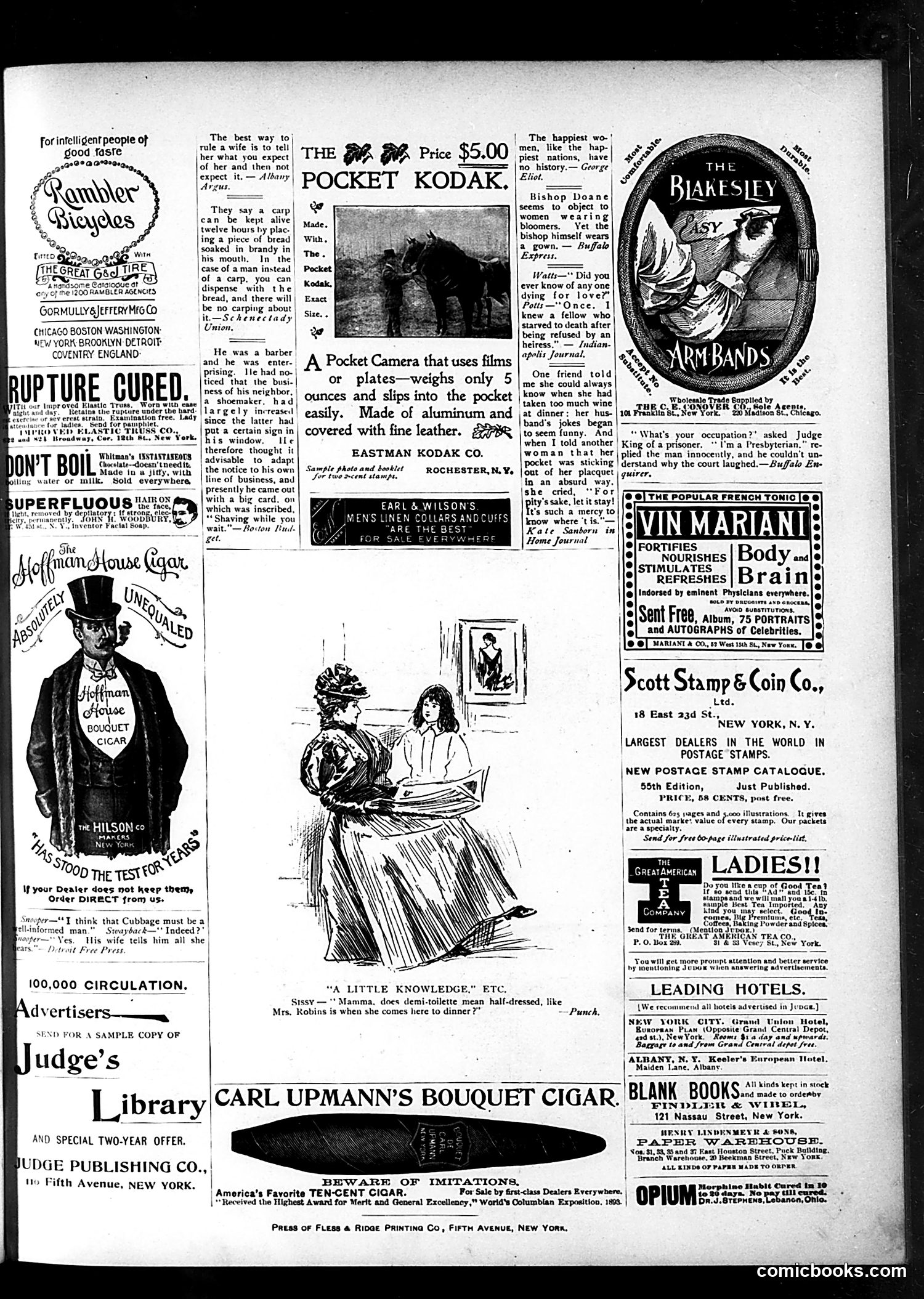
This page features **satirical commentary on gender dynamics** common to early-1900s Judge magazine: **Top section jokes** lampoon Victorian marriage customs—men are advised to dominate wives through unclear expectations; bishops are mocked for condemning women's bloomers while wearing long robes themselves. **"A Little Knowledge" cartoon** depicts a naïve young girl (Sissy) asking her mother whether "demi-toilette" means "half-dressed," referencing Mrs. Robins's scanty dinner attire. The satire targets both the girl's innocence and Mrs. Robins's loose morality. **Other jokes** include wordplay about professions ("Presbyterian" prisoner), women's fashions, and domestic absurdities. **The remainder is advertising**—cameras, cigars, hotels, and stamps—typical of Judge's commercial content. The page reflects period anxieties about women's independence (bloomers), respectability, and changing social norms, with satire directed primarily at women's behavior and appearance.
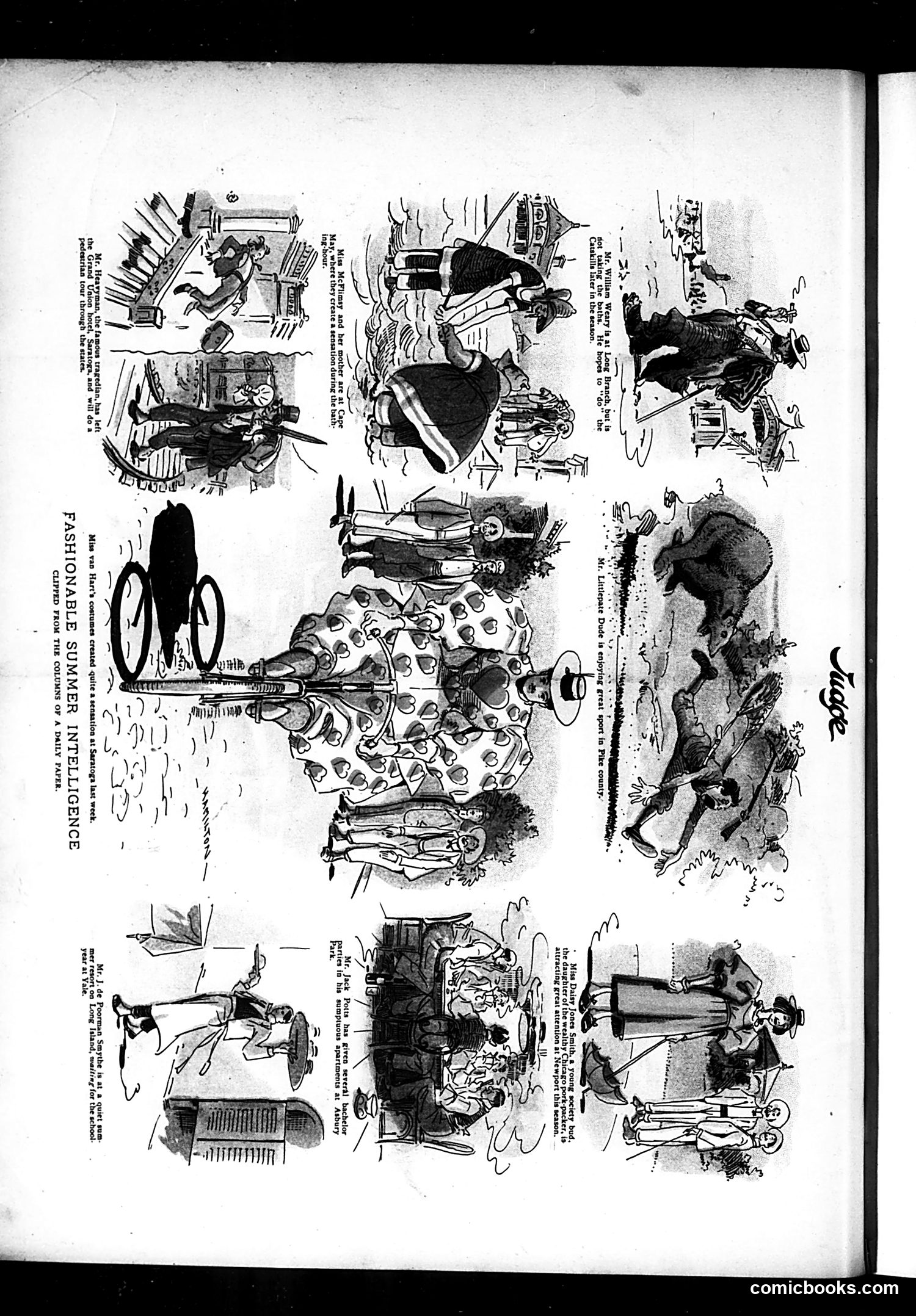
This appears to be a **fashion satire page** from Judge magazine, likely from the late 19th or early 20th century, based on the style and printing quality. The OCR text is heavily corrupted and largely unreadable, making precise interpretation difficult. However, the visible illustrations show **women in various fashionable poses and settings**—appearing to satirize contemporary women's fashion, particularly the exaggerated silhouettes and impractical clothing styles of the era (likely the "Gibson Girl" period or similar). The repeated images of women in elaborate dress, combined with the magazine's satirical mission, suggest the page mocks either: - The absurdity of fashionable women's wear - Social pretensions of fashionable society - The physical discomfort or impracticality of period fashion Without legible text or clearer context, I cannot identify specific figures, social references, or the precise joke intended. The page appears primarily illustrative rather than containing substantive political commentary.