
A complete issue · 16 pages · 1894
Judge — September 29, 1894
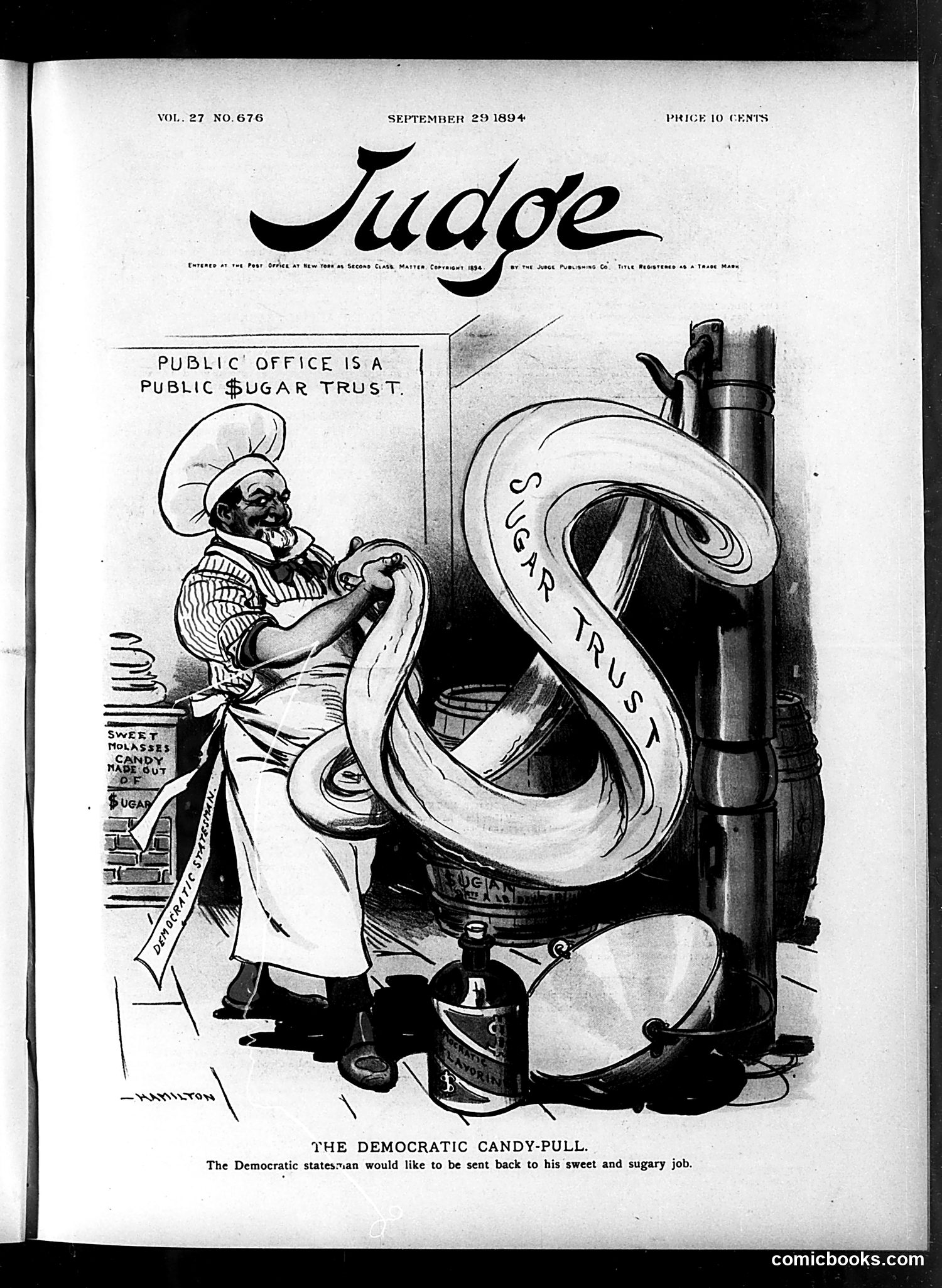
This 1894 *Judge* cartoon satirizes the Democratic Party's relationship with public office during the Gilded Age. The caricatured figure (likely representing Democratic leadership) is depicted as a chef or cook managing a large industrial "sugar trust" machine—a reference to monopolistic sugar cartels that controlled prices and markets. The cartoon's title and caption—"The Democratic statesman would like to be sent back to his sweet and sugary job"—suggests Democrats were overly cozy with corporate trusts and monopolies, prioritizing business interests over public welfare. The "sugar trust" apparatus represents corrupting influence, implying Democratic politicians were essentially "candy" for corporations rather than serving genuine public interests. This reflects late-19th-century Progressive Era criticism of machine politics and corporate influence.
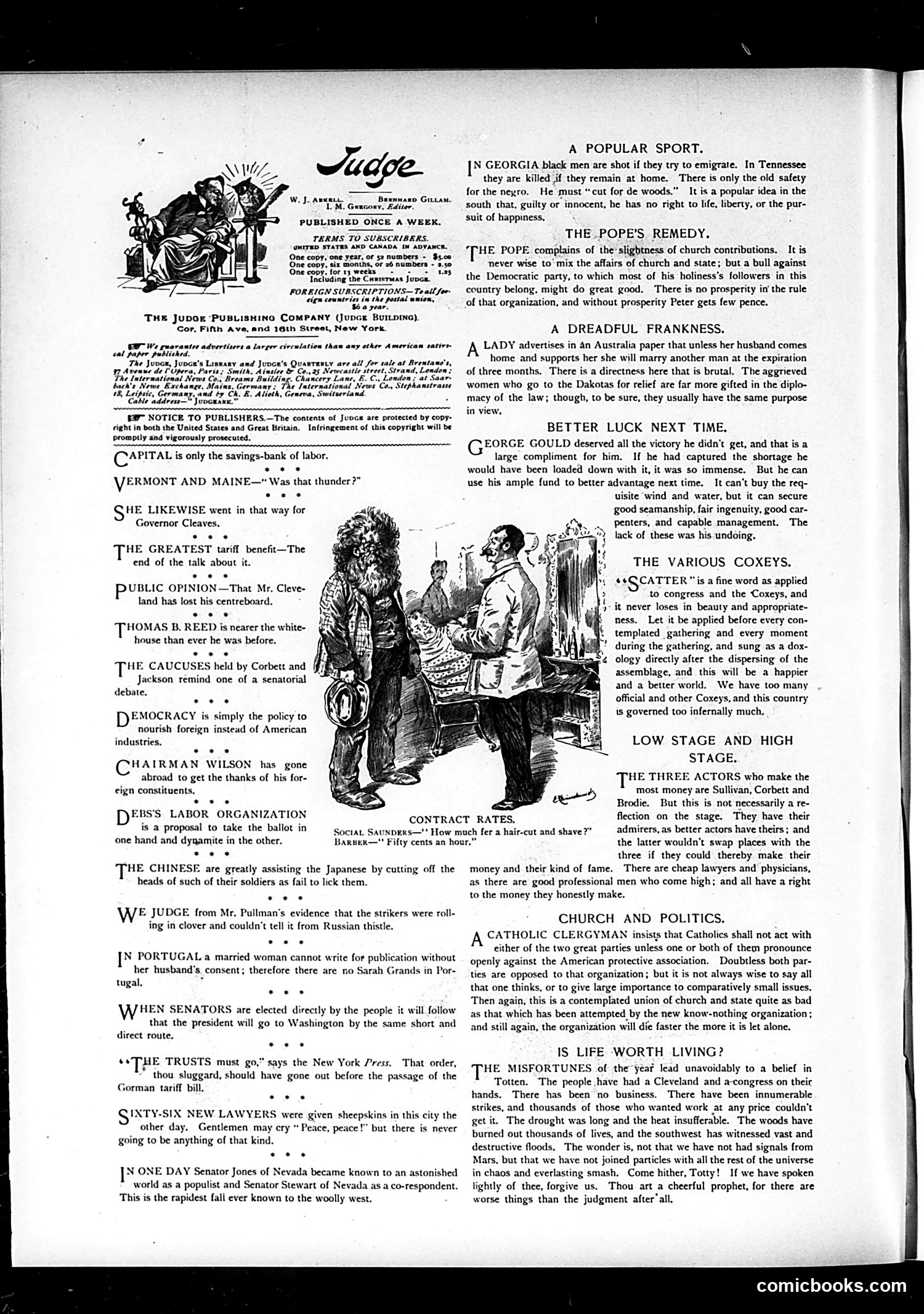
The main cartoon depicts two men in what appears to be a barroom or business setting, with the caption "CONTRACT RATES" and dialogue: "How much for a hair-cut and shave?" "Fifty cents an hour." This is a joke about pricing by the hour rather than by the job. The humor relies on the absurdity of charging for personal services on an hourly basis—suggesting either that the barber is unusually slow or deliberately inefficient to maximize payment. The cartoon satirizes emerging labor practices and pricing models of the era, likely mocking concerns about unions or workers organizing to charge hourly rates rather than accepting flat fees for completed work. The surrounding text column discusses labor organization and working-class issues, reinforcing this theme.
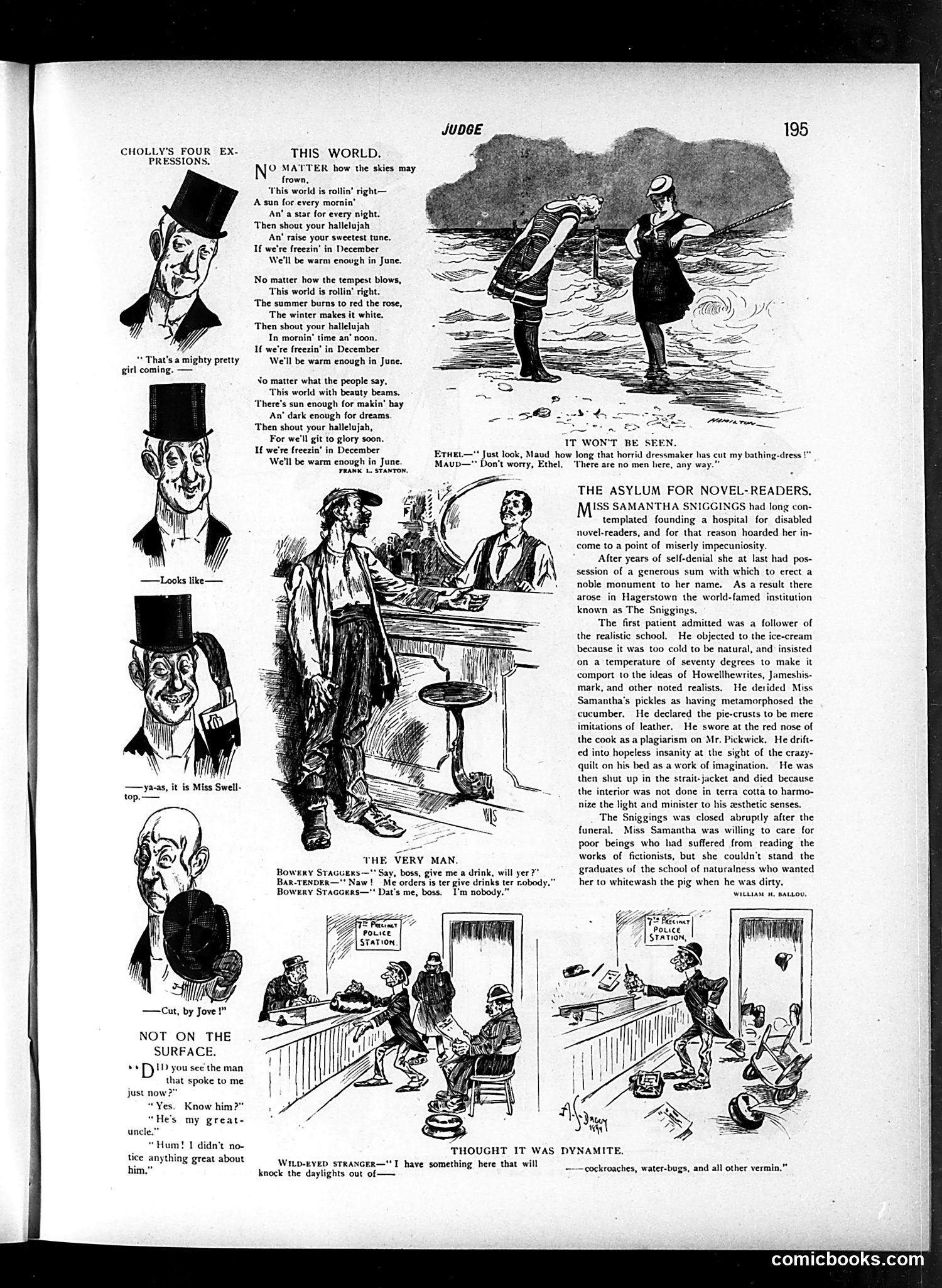
This page contains multiple satirical pieces typical of Judge's style: **"Cholly's Four Expressions"** features caricatured facial studies of a character named Cholly, likely mocking a specific social type or public figure (unclear who specifically). **"It Won't Be Seen"** depicts a seaside scene where a character complains about a dressmaker, using a bathing scenario as setup for humor about fashion. **"The Asylum for Novel-Readers"** satirizes excessive fiction reading, describing Miss Samantha Swiggings's hospital for "disabled novel-readers." The piece mocks realistic school fiction advocates and their complaints about implausible literary conventions. **"The Very Man"** and **"Not on the Surface"** are brief joke pieces with minimal context visible. **"Thought It Was Dynamite"** shows a police station scene where someone reports finding suspicious items—likely physical comedy rather than political satire. The page is primarily humorous rather than overtly political.
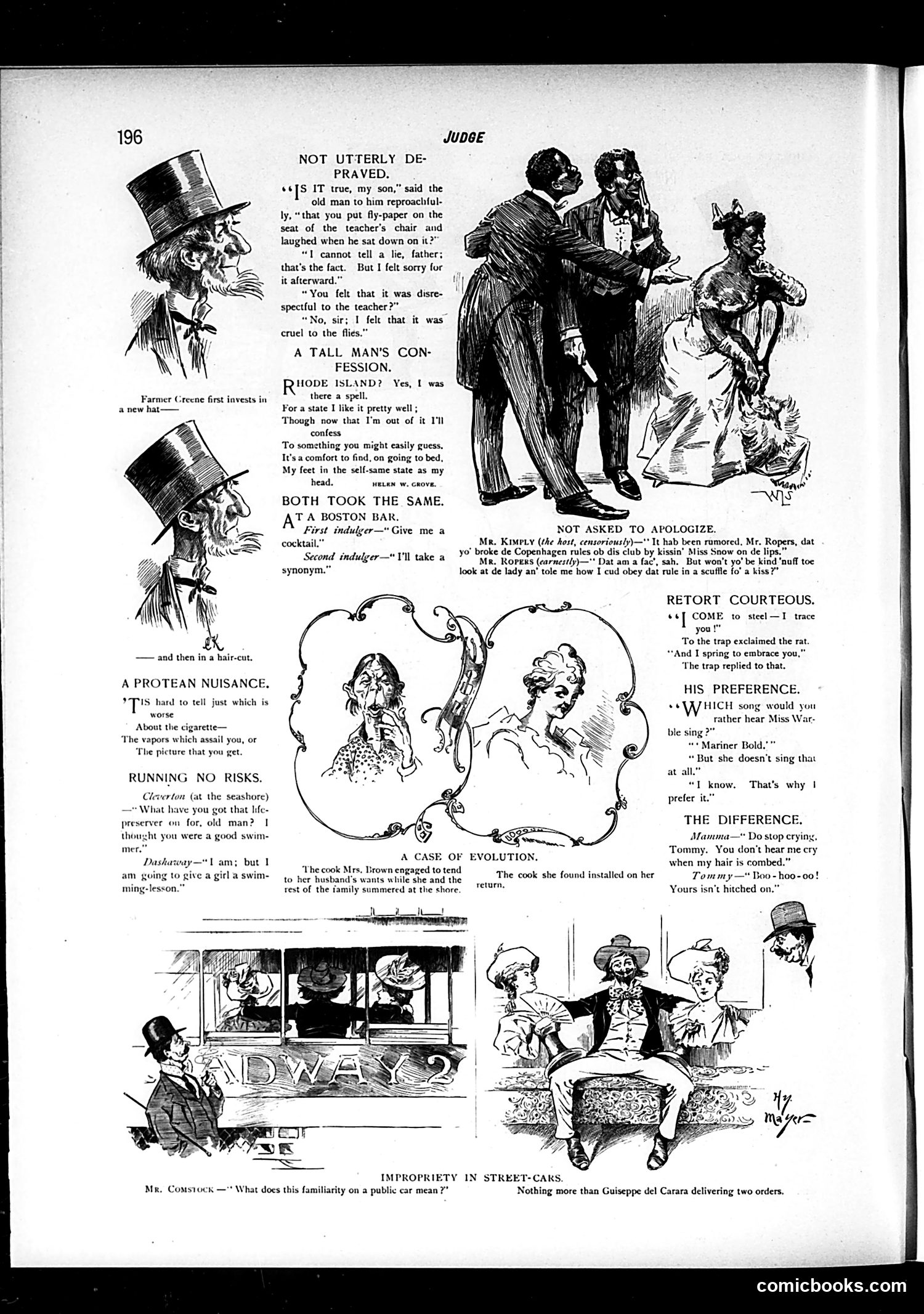
This page from *Judge* contains multiple short jokes and cartoons typical of late 19th/early 20th-century American humor: **Key content includes:** - **"Not Utterly Depraved"**: A boy admits to putting fly-paper on his teacher's chair, showing moral nuance—he regrets cruelty to flies more than disrespect to the teacher. - **"A Tall Man's Confession"**: A Rhode Island visitor admits relief at fitting properly in bed, poking fun at the state's small size. - **Social commentary**: Several pieces satirize class interactions—a street-car scene references Mr. Comstock (likely Anthony Comstock, the moral crusader), suggesting suspicion of immigrant behavior; a final cartoon shows racial caricatures with dialect, reflecting the era's casual racism. - **General humor**: Includes puns, observations about cigarette advertising, and domestic situations typical of period satire. The page reflects *Judge*'s formula: mixing political/social observation with slapstick and wordplay, often targeting immigrants, reformers, and social pretension.
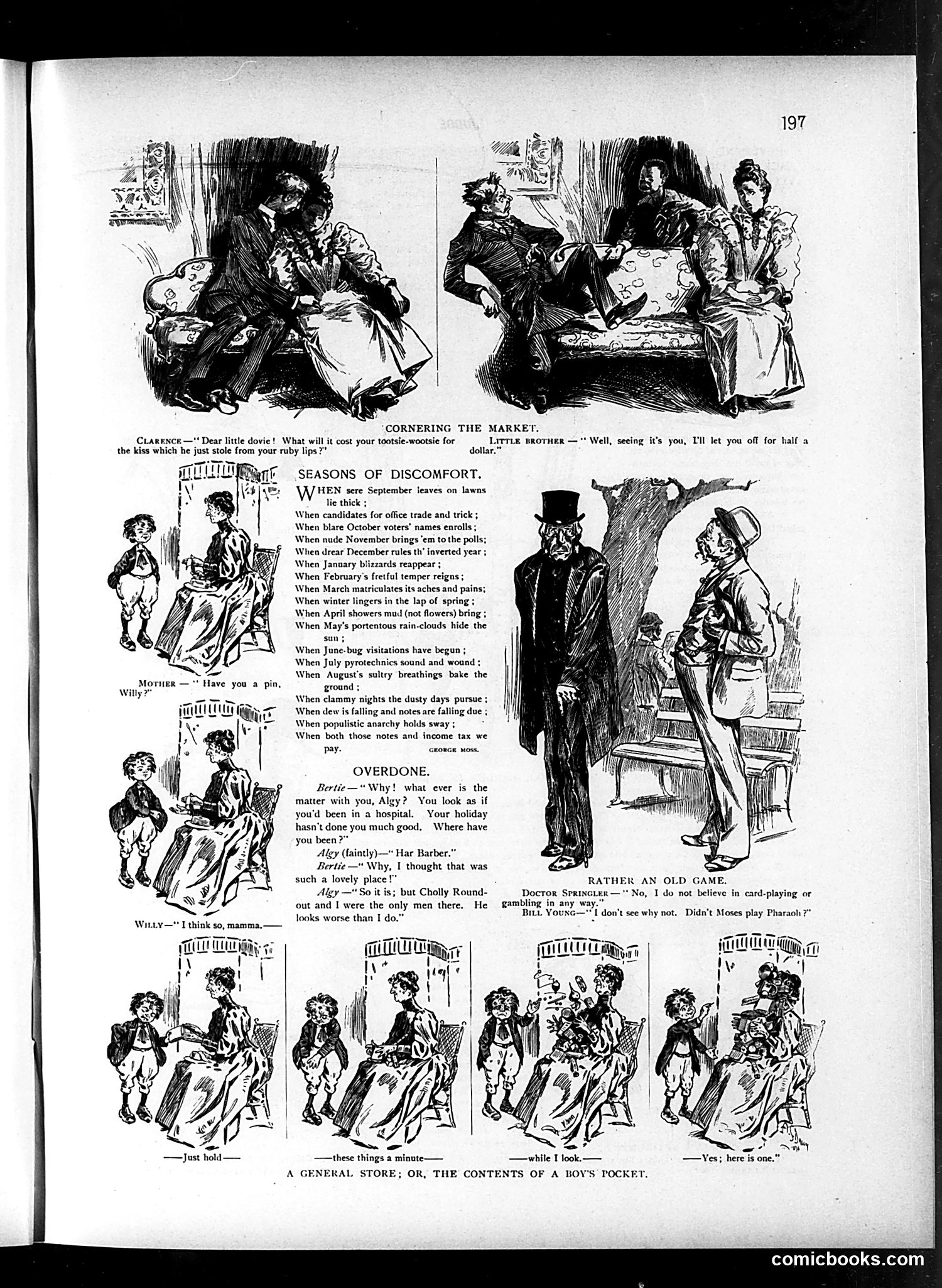
This page from *Judge* magazine contains several satirical sketches with Victorian-era humor: **"Cornering the Market"** depicts young people negotiating over romantic favors—a boy asking what a kiss costs, the girl jokingly offering a reduced rate. The satire mocks commercialization of romance and flirtation among the wealthy. **"Seasons of Discomfort"** is a humorous poem listing perpetual annoyances throughout the year—from weather to politics ("candidates for office trade and trick," "populistic anarchy"). It satirizes American life's constant irritations, notably referencing populist political movements of the era. **"Overdone"** shows upper-class men discussing an exhausting holiday, suggesting overindulgence in leisure activities. **"Rather an Old Game"** features a doctor opposing gambling, countered by someone claiming even biblical Moses gambled (playing Pharaoh). The satire mocks selective morality. **"A General Store"** depicts a mother and boy examining pocket contents—likely satirizing childhood mischief and the random items boys collect. The overall tone is lighthearted social commentary on American manners and morals.
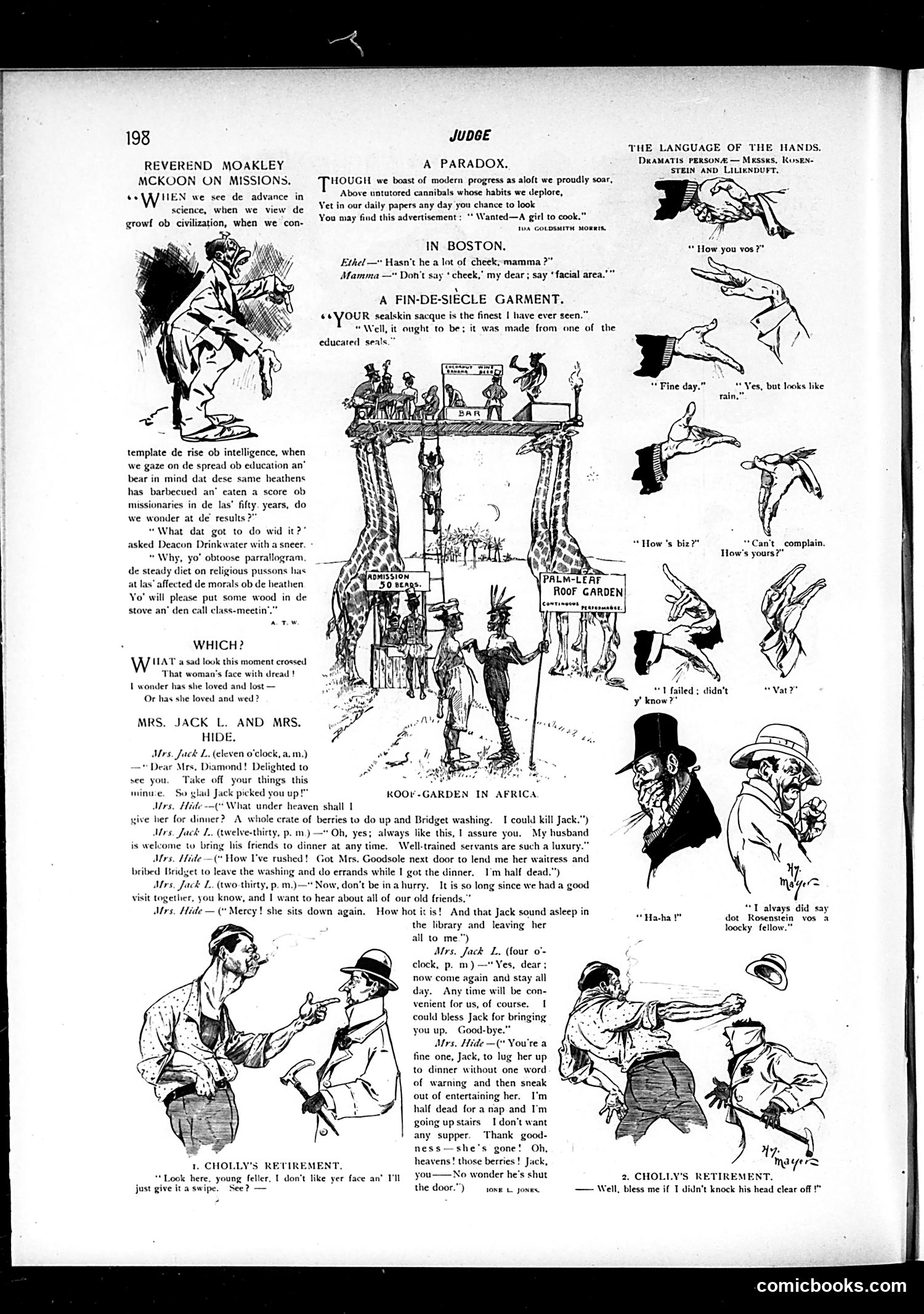
This page contains several satirical pieces typical of late 19th-century American humor: **"A Paradox"** critiques the contradiction between Western claims of civilization and the want ads seeking domestic servants—suggesting exploitative labor practices undermine moral superiority over "uncivilized" peoples. **"A Fin-de-Siècle Garment"** mocks wealthy women's fashion obsession, joking that a sealskin coat was made from "educated seals"—satire on both conspicuous consumption and the absurdity of attributing human qualities to animals. **"Mrs. Jack L. and Mrs. Hide"** depicts class hypocrisy: a wealthy visitor claims effortless entertaining while her exhausted hostess secretly struggles with domestic demands, exposing the performance of upper-class leisure. **"The Language of the Hands"** shows immigrant characters (Rosenstein and Lilienduft, identified by their names and accents) communicating through hand gestures—ethnic humor playing on stereotypes of immigrant communication styles. **"Cholly's Retirement"** appears to show a physical altercation, likely domestic or romantic discord played for comic effect. The overall tone reflects Gilded Age anxieties about class, immigration, and women's domestic roles.
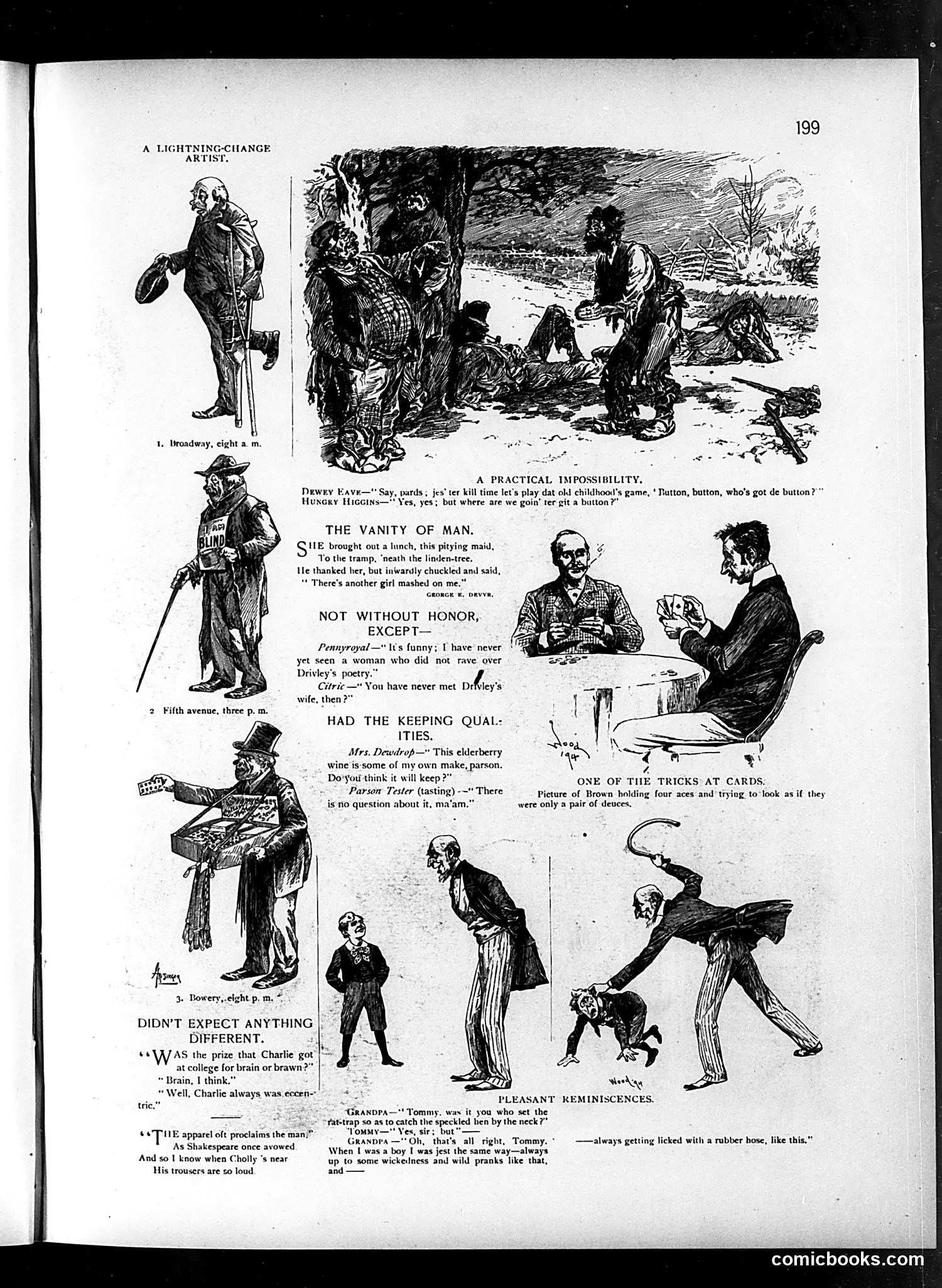
This page contains multiple unrelated comic sketches and jokes typical of Judge's satirical format. Key pieces include: **"A Practical Impossibility"**: Depicts homeless or destitute men attempting to play the children's game "Button, Button" but lacking even a button—satirizing extreme poverty. **"The Vanity of Man"**: A tramp cynically misinterprets a poor woman's charity, assuming she's romantically interested rather than pitying. The joke mocks male vanity and self-deception. **Various social vignettes** mock pretension: a man claiming poetry won't impress his own wife; a parson's polite lie about homemade wine; card cheating; and college accomplishments. **"Pleasant Reminiscences"**: Grandfather nostalgically recalls childhood mischief and corporal punishment, normalizing harsh discipline—reflecting period attitudes toward child-rearing. The overall theme is social hypocrisy, vanity, and the gap between appearance and reality. The sketches use working-class and rural characters to satirize human nature rather than targeting specific political figures or events.
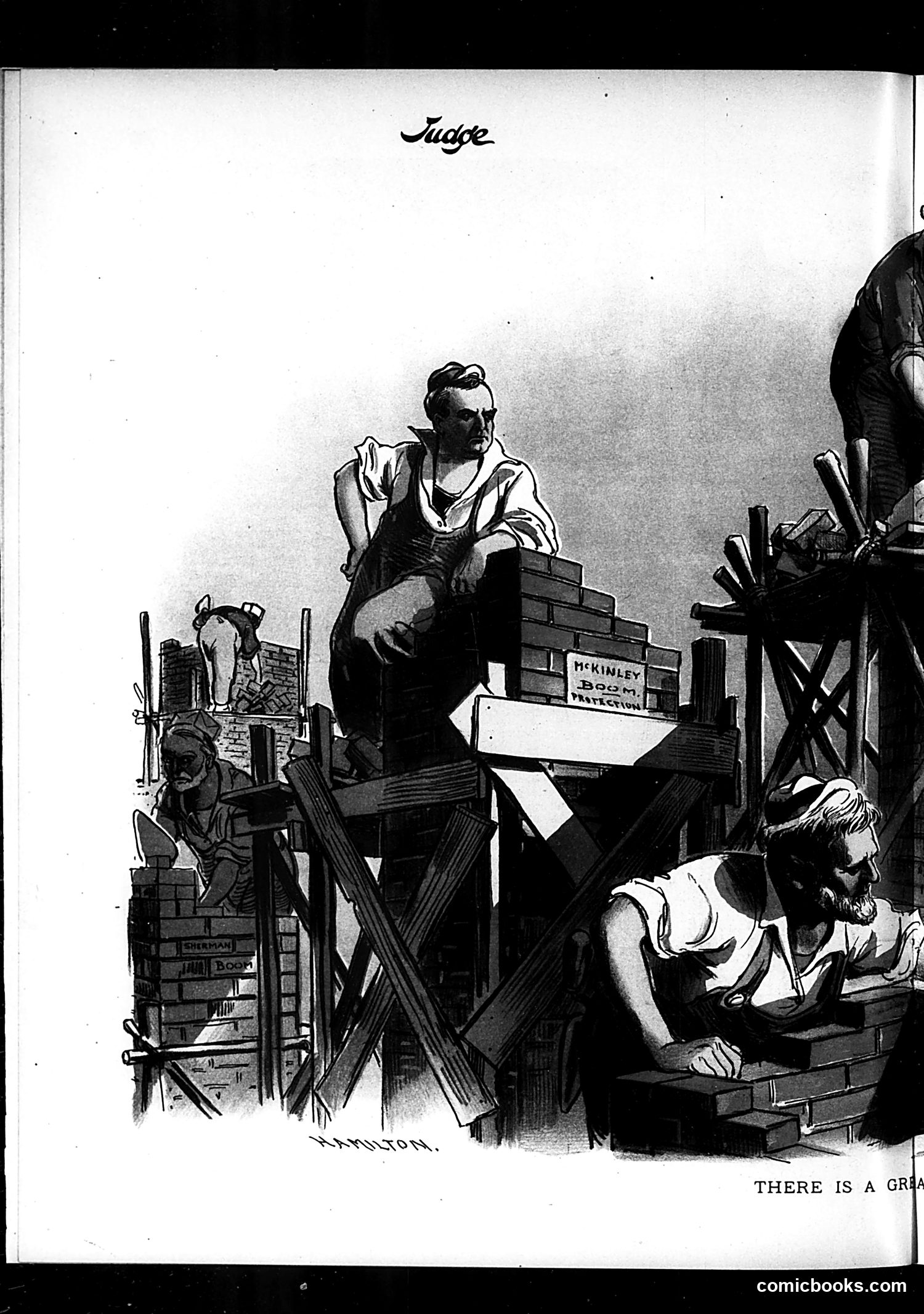
This appears to be a Judge magazine cartoon titled "There Is a Cry" (text partially visible). The image depicts a figure perched on a platform labeled "McKINLEY" and "PROTECTION," overlooking a scene below where people appear to be working or laboring among bricks and construction materials. The cartoon likely critiques McKinley's protective tariff policies, suggesting they burden working people. The elevated position of the figure (possibly representing McKinley or a supporter) contrasts with the laborers below, implying disparity between political leadership and ordinary workers affected by tariff legislation. Without the complete caption, the full satirical argument remains unclear, but the composition suggests commentary on economic inequality or the costs of protectionist trade policy on the working class.
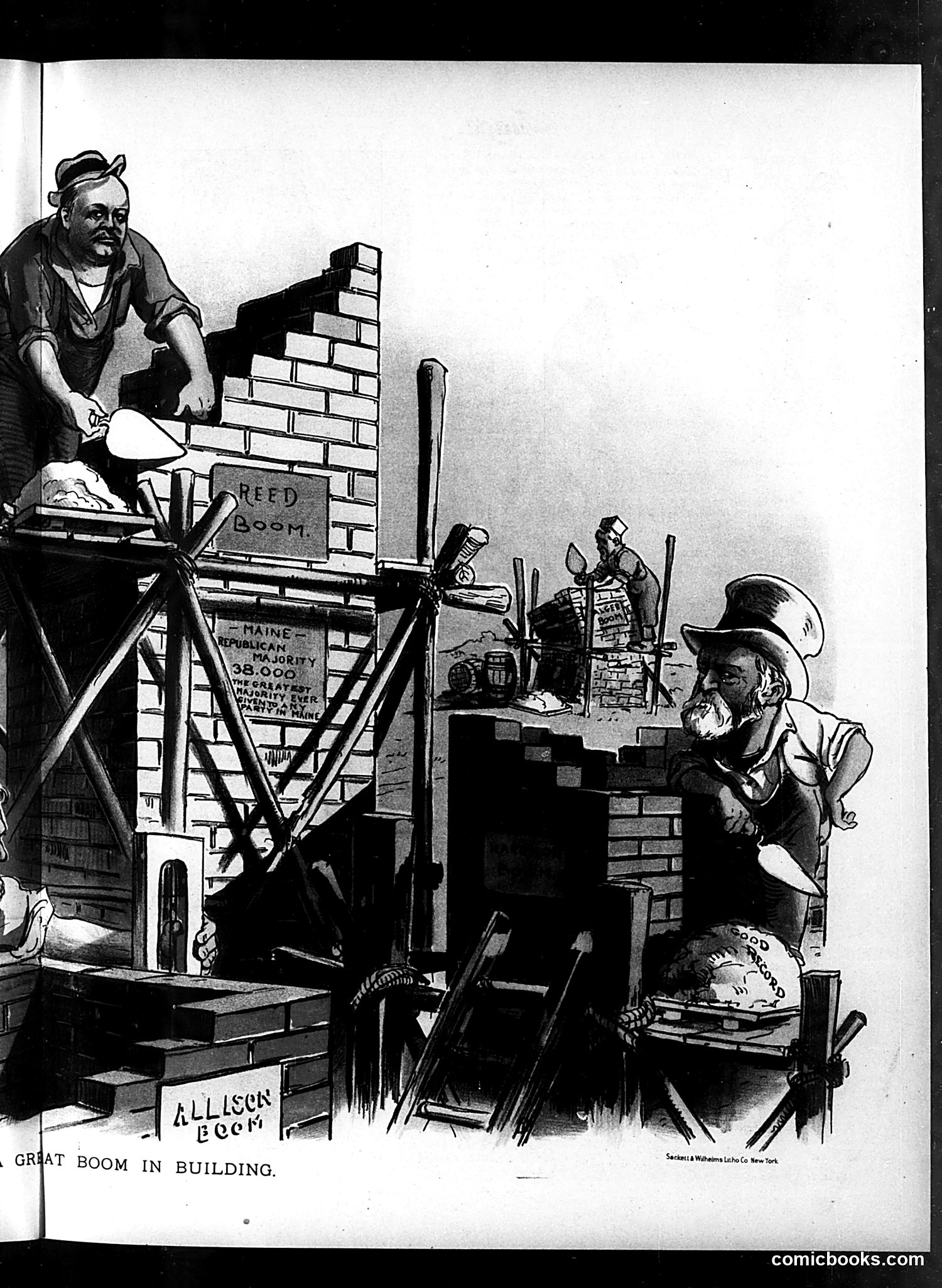
This cartoon satirizes Maine's Republican Party leadership during a construction boom. The visible labels reference "REED BOOM," "MAINE REPUBLICAN PROSPERITY," and "ALLISON BOOM," likely alluding to prominent Republican politicians (possibly Speaker Thomas B. Reed). The image depicts two figures at different levels: one man elevated on scaffolding above, appearing to direct or profit from construction, while another figure below looks up from ground level. This compositional choice suggests economic inequality—one group benefits from the building boom while workers or ordinary citizens remain subordinate. The satire critiques how Republican political leaders capitalized on or claimed credit for Maine's economic growth, potentially at the expense of working-class laborers, who appear relegated to lesser positions in the scene.
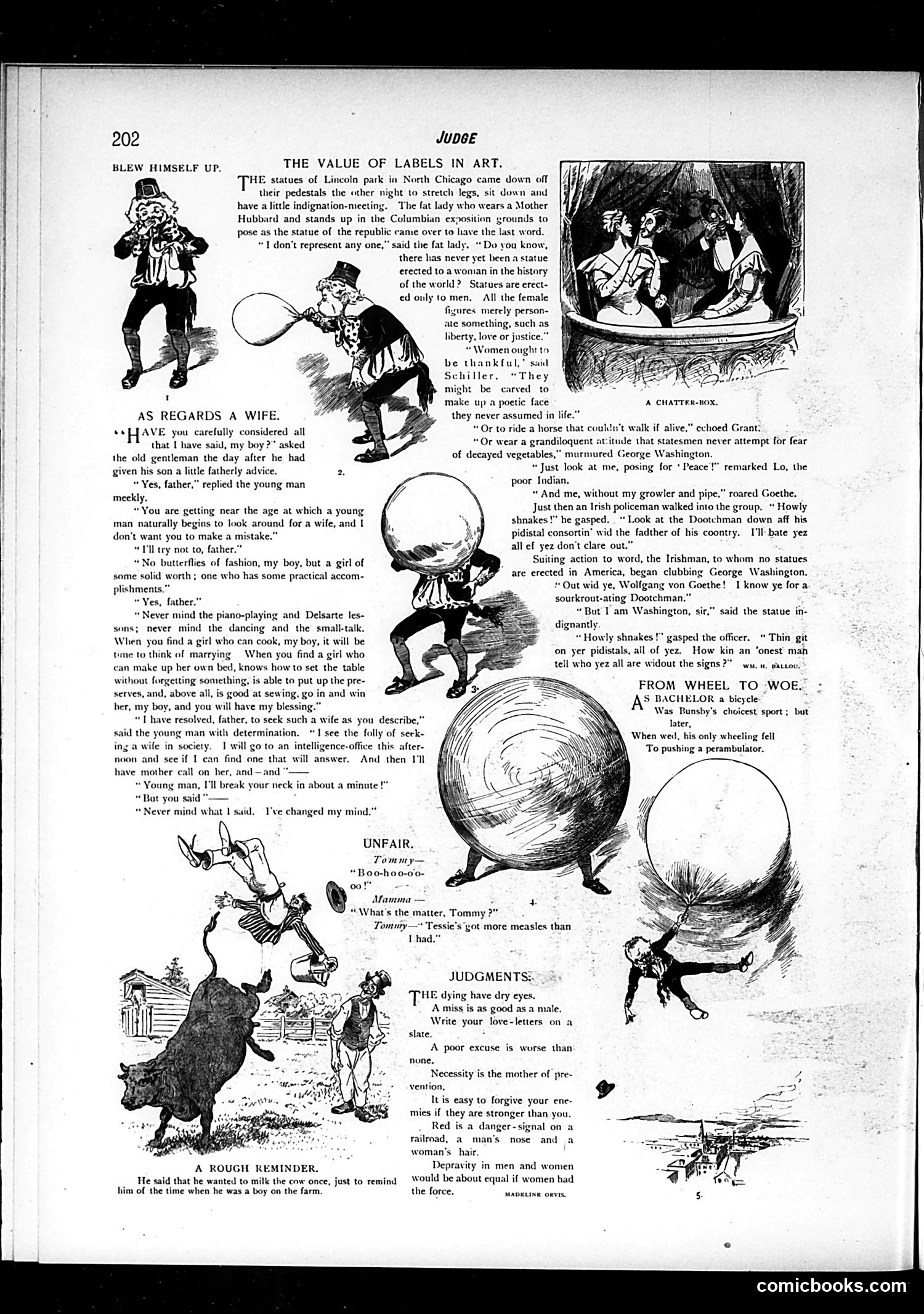
This page from *Judge* magazine contains several satirical pieces: **"The Value of Labels in Art"** mocks the Columbian Exposition's statue of the Republic by having statues debate why no monuments honor actual women—only abstract concepts like Liberty. The fat lady statue argues female figures are merely personifications, not representations of real people, highlighting the era's exclusion of women from commemorative art. **"As Regards a Wife"** satirizes courtship advice: a father instructs his son to seek a practical housewife (cooking, sewing, bed-making), not a fashionable society woman. When the son takes the advice literally and visits an employment agency, the father angrily rejects his own counsel—the joke being that fathers expect sons to marry *within* their social class, not hire domestic help as a bride. The remaining items are brief humorous observations and anecdotes typical of the magazine's format, including complaints about measles and nostalgia for farm life.
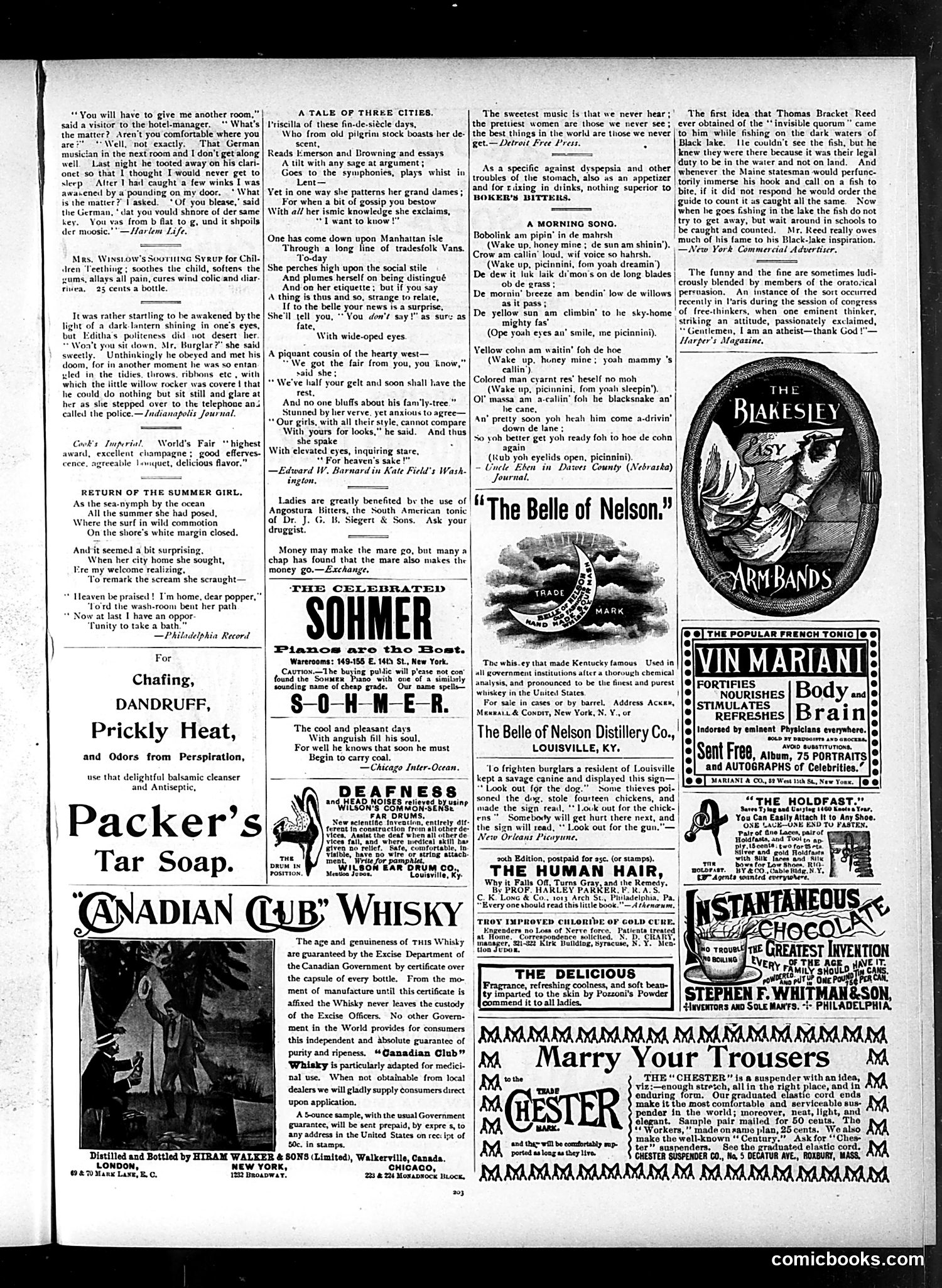
This page is primarily **advertising**, with several short humorous anecdotes scattered throughout. The satirical content is minimal: **The humor pieces** mock everyday frustrations: a German musician's fastidiousness about musical keys; a burglar comically tangled in decorative furniture; and three female stereotypes representing different American cities—the intellectual New Yorker, the socially-conscious descendant of Dutch traders, and the brash, wealthy Westerner. Each woman responds to gossip with exaggerated exclamations ("You don't say!" "For heaven's sake!"), satirizing women's purported superficiality despite their education or sophistication. **The advertisements** dominate—for Sohmer pianos, whisky, chocolate, soap, and various patent medicines. These reflect Gilded Age consumer culture. Notably, "Mrs. Winslow's Soothing Syrup" and similar tonics were common patent medicines of this era, many containing questionable ingredients. No identifiable political figures or events appear on this page. The satire is social commentary on gender stereotypes and consumer behavior rather than political critique.
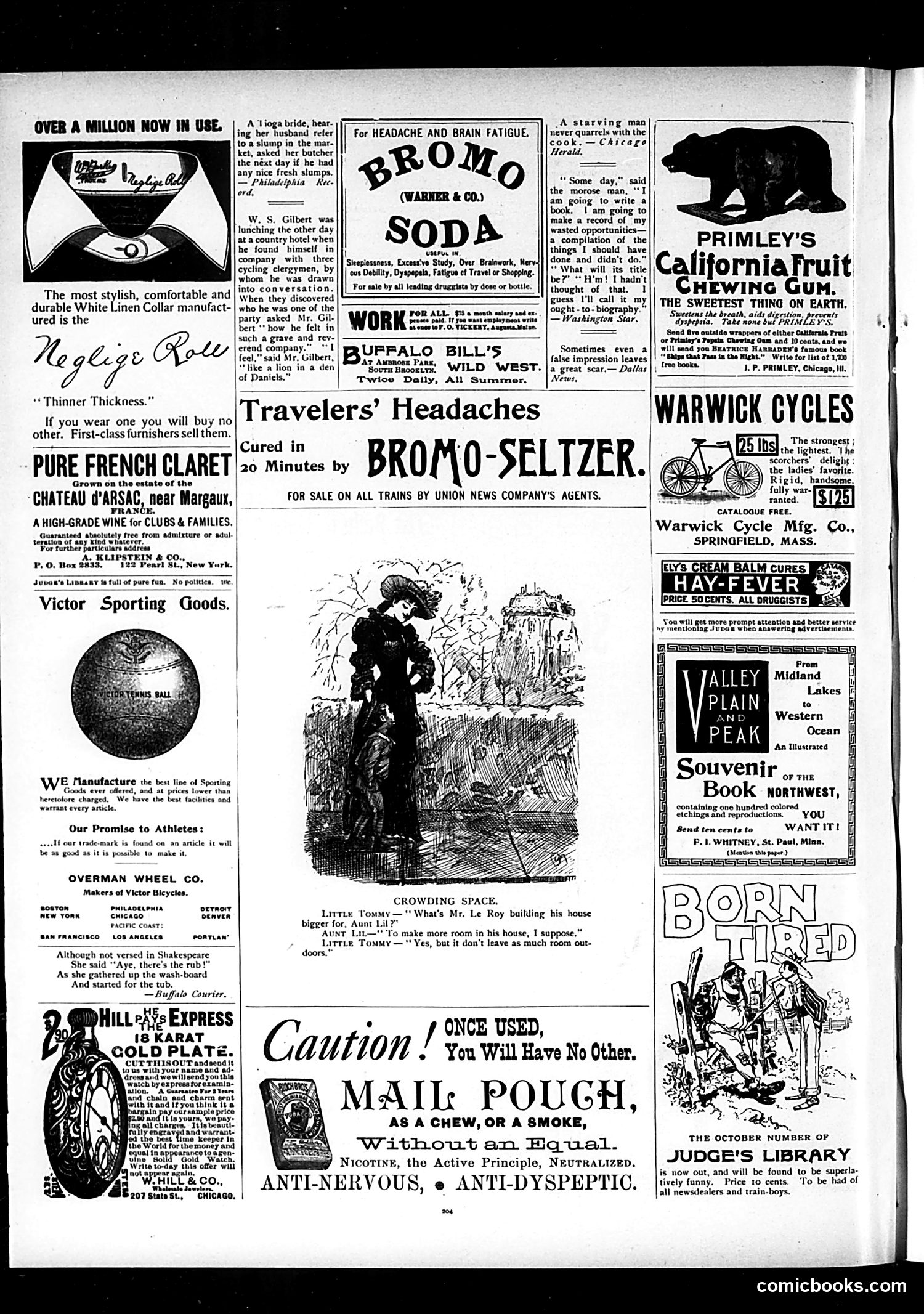
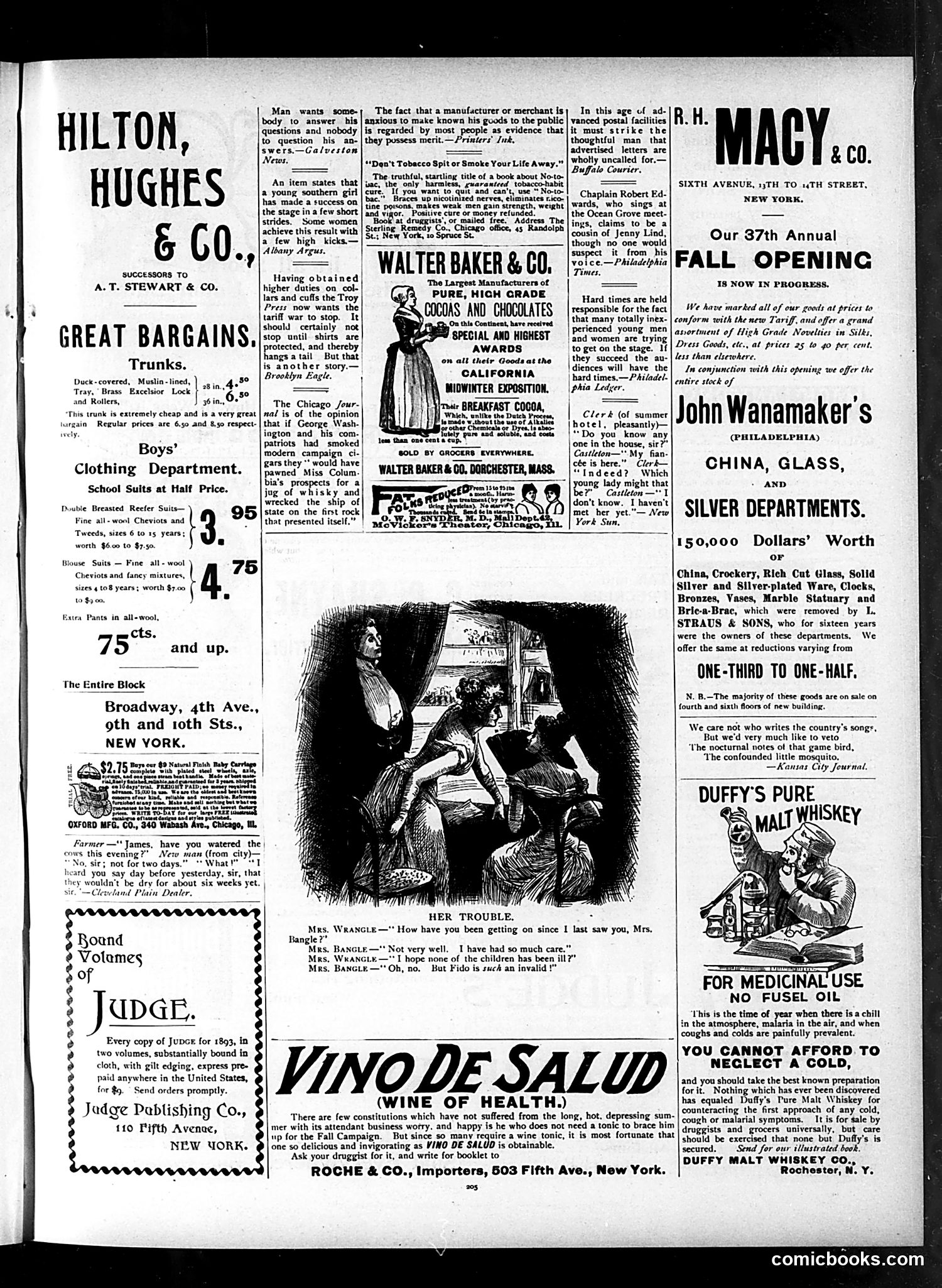
This page is primarily **advertising**, not editorial content or political cartoons. The dominant features are commercial ads for department stores (Macy's, Hilton Hughes & Co., John Wanamaker's) and consumer products (Walter Baker cocoa, Duffy's Malt Whiskey, Vino de Salud wine). The small illustrative cartoon titled "HER TROUBLE" depicts a domestic scene with a woman and dog—likely a humorous anecdote about pets or household management, though the joke is unclear without fuller context. The page's editorial snippets are **light social commentary** rather than political satire: brief jokes about manufacturers' advertisements, tariff protection for shirt collars, and young performers' prospects on stage. One item references "Jenny Lind," the famous 19th-century singer, suggesting period context. The overall tone reflects Judge's function as both satirical magazine and advertising vehicle, mixing mild social humor with commercial promotion aimed at upper-middle-class readers.
This page is primarily **advertising and filler content**, with no prominent political cartoons or satirical commentary evident. The page contains: - **Health/beauty ads**: Cuticura skin treatment (top left) and dermatological institute services - **Product promotions**: Piano and knife giveaways, bicycles, and other merchandise - **Humor fillers**: Brief jokes about schoolboys and bald men (typical of period humor magazines) - **Travel/railroad advertising**: The Pennsylvania Limited train service - **One clear cartoon reference**: A decorative satirical heading about "The Ypsilanti Union Suits" in sports wear, with small illustrated figures, though the actual satirical point is unclear from available context The page functions more as a commercial vehicle than as social satire. Judge magazine clearly relied heavily on paid advertisements to fund publication. The scattered jokes and "filler" are standard period humor—light, domestic, and non-political in nature.
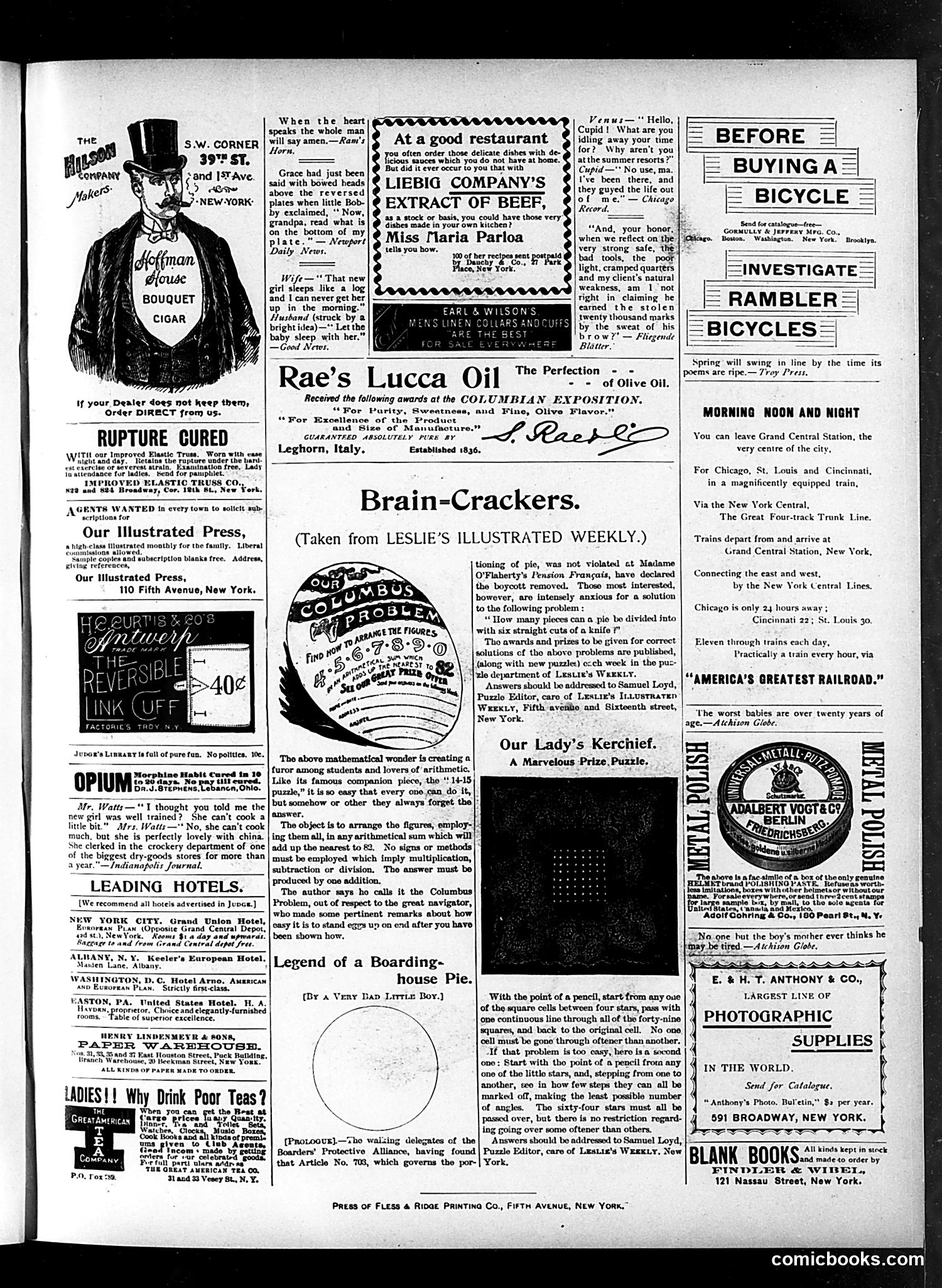
This is primarily an **advertising and miscellaneous content page** from Judge magazine rather than a political cartoon page. The main notable item is the **"Brain-Crackers"** puzzle section, which presents a mathematical riddle from *Leslie's Illustrated Weekly*. It references a famous puzzle phenomenon—the "1415 puzzle"—that was creating public fascination among students and arithmetic enthusiasts. These viral math puzzles were popular parlor games of the era. The rest of the page consists of **period advertisements and classified listings**: patent medicines (rupture trusses, opium/morphine addiction cures), hotel recommendations, tea companies, and office supply businesses. There are also brief humorous anecdotes typical of Judge's lighter content—domestic comedy bits about servants and family situations. No political satire or significant caricatures appear here. The page reflects the magazine's mixed content model: satirical cartoons on some pages, practical advertising and amusement content on others, appealing to broad readership across social classes.
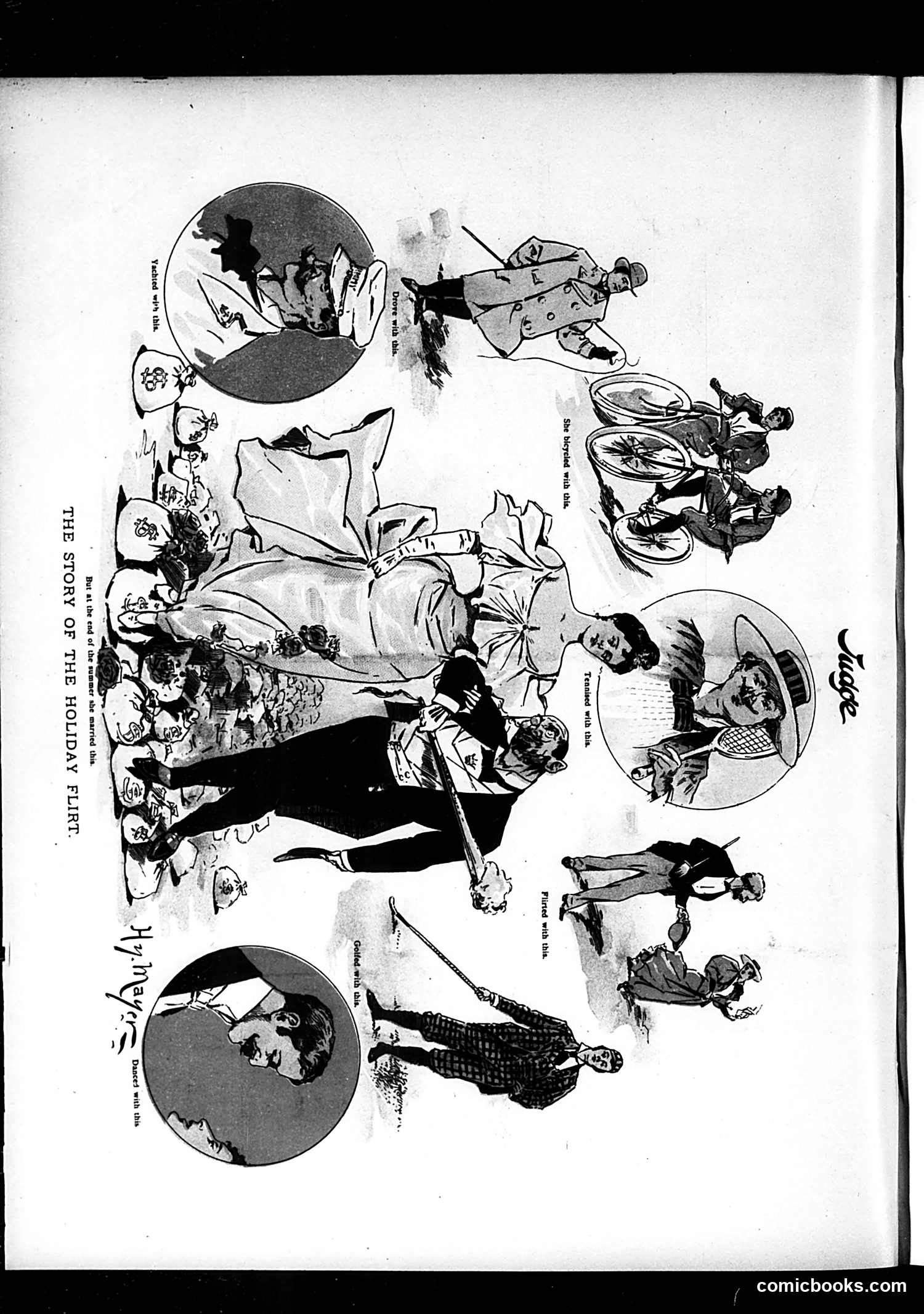
This Judge magazine page satirizes summer romance fickleness. The central narrative shows a young woman who flirts with an athletic, well-dressed man during vacation (depicted in circular vignettes and full scenes), but ultimately marries a plain, ordinary-looking fellow instead. The satire mocks the disconnect between holiday romance ideals and practical married life—the glamorous vacation suitor doesn't translate into real-world partner material. Additional vignettes show various leisure activities (bicycling, boating, outdoor pursuits) typical of well-to-do summer holiday scenes. The joke targets both genders: women's fickle romantic choices and men's illusions about vacation relationships. It's a commentary on class, appearances, and the gap between romantic fantasy and domestic reality in turn-of-the-century American society.