
A complete issue · 16 pages · 1894
Judge — September 15, 1894
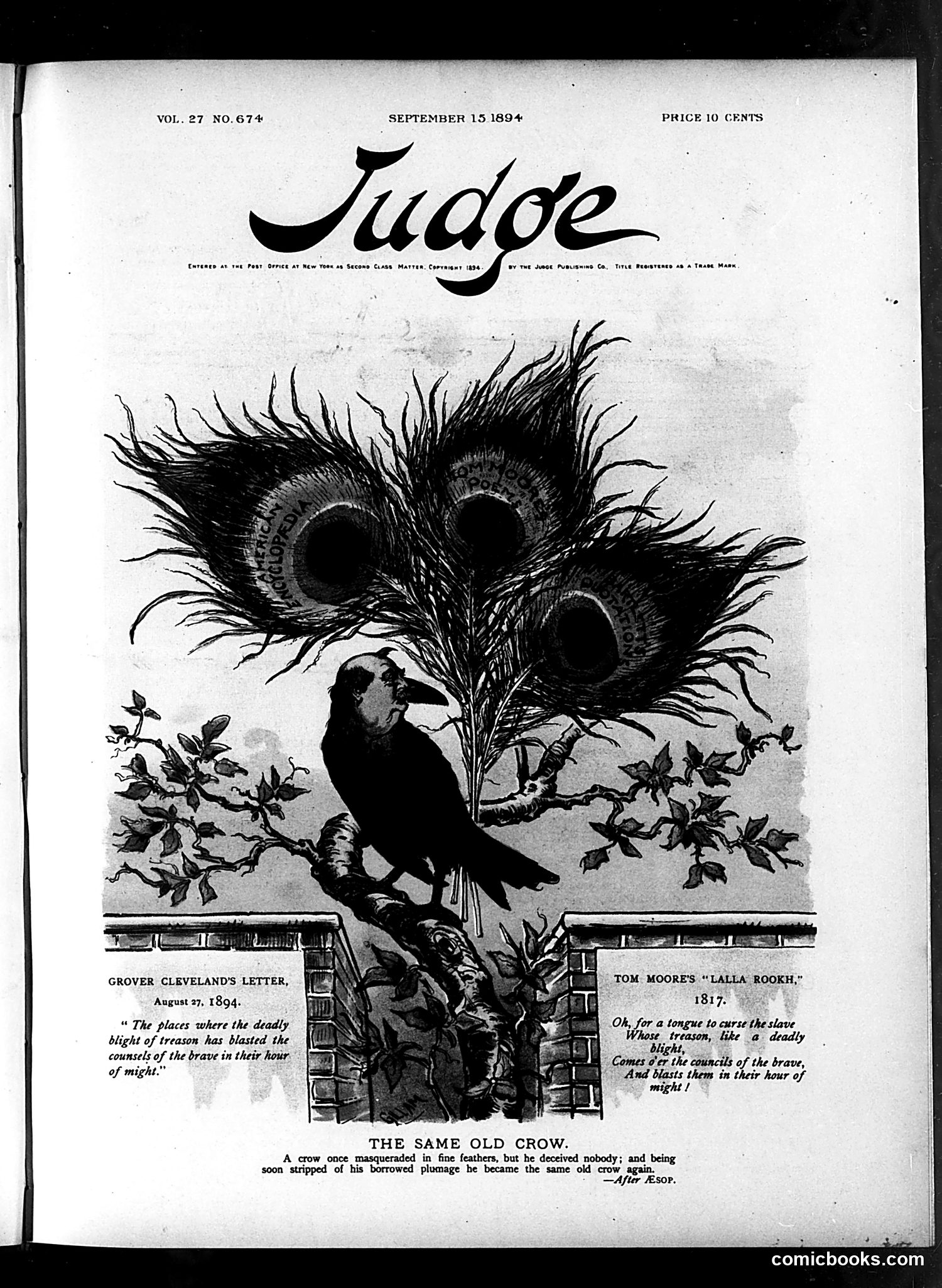
This political cartoon uses the fable of "The Crow in Fine Feathers" as satire. A crow dressed in borrowed peacock feathers represents a political figure—likely someone in the Cleveland administration, given the reference to "Grover Cleveland's Letter" (August 1894). The accompanying quotations criticize treason and political deception. The fable's moral—that stripped of borrowed plumage, the crow remains unchanged—suggests the cartoon attacks a politician as fundamentally dishonest or unchanged despite outward pretenses of reform or respectability. The "deadly blight of treason" reference indicates serious political scandal, though the specific figure and incident require additional historical context beyond what the image alone conveys.
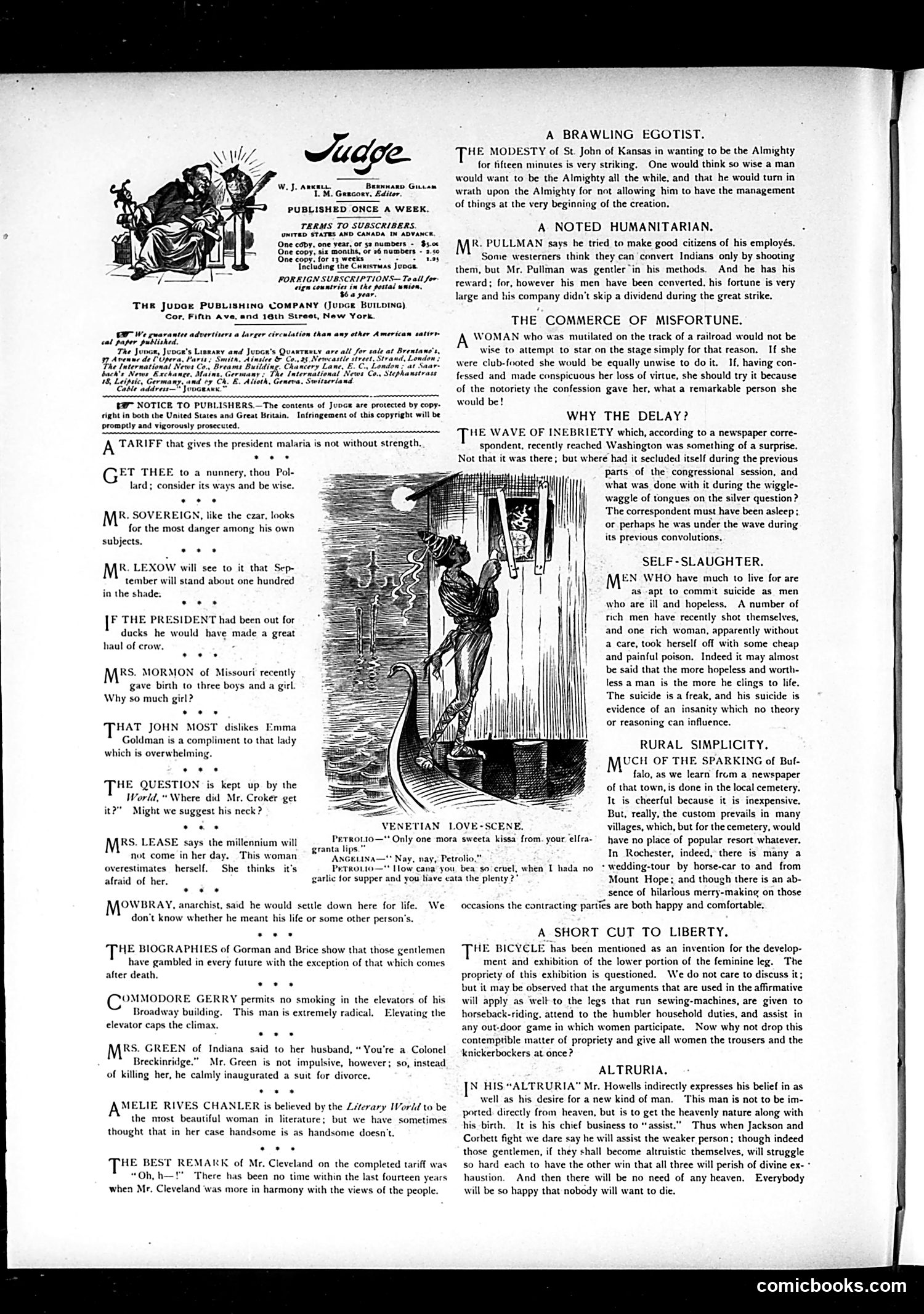
The central cartoon depicts a romantic scene between two figures at a Venetian window. The dialogue—"Only one more sweets kiss from your elfin-grant lips" / "Nay, say, Petroni—" / "How can you beg so cruel, when I had no guide for aught and you have cats the plenty?"—satirizes overwrought Victorian romantic melodrama and Italian opera conventions. The humor lies in the absurd juxtaposition: the male character invokes passionate, poetic language ("elfin-grant lips"), while the female character responds with mundane practicality about lacking guidance and having cats. This mocks the gap between theatrical romantic idealization and unglamorous reality—typical of Judge magazine's satirical approach to contemporary social pretensions and sentimental excess.
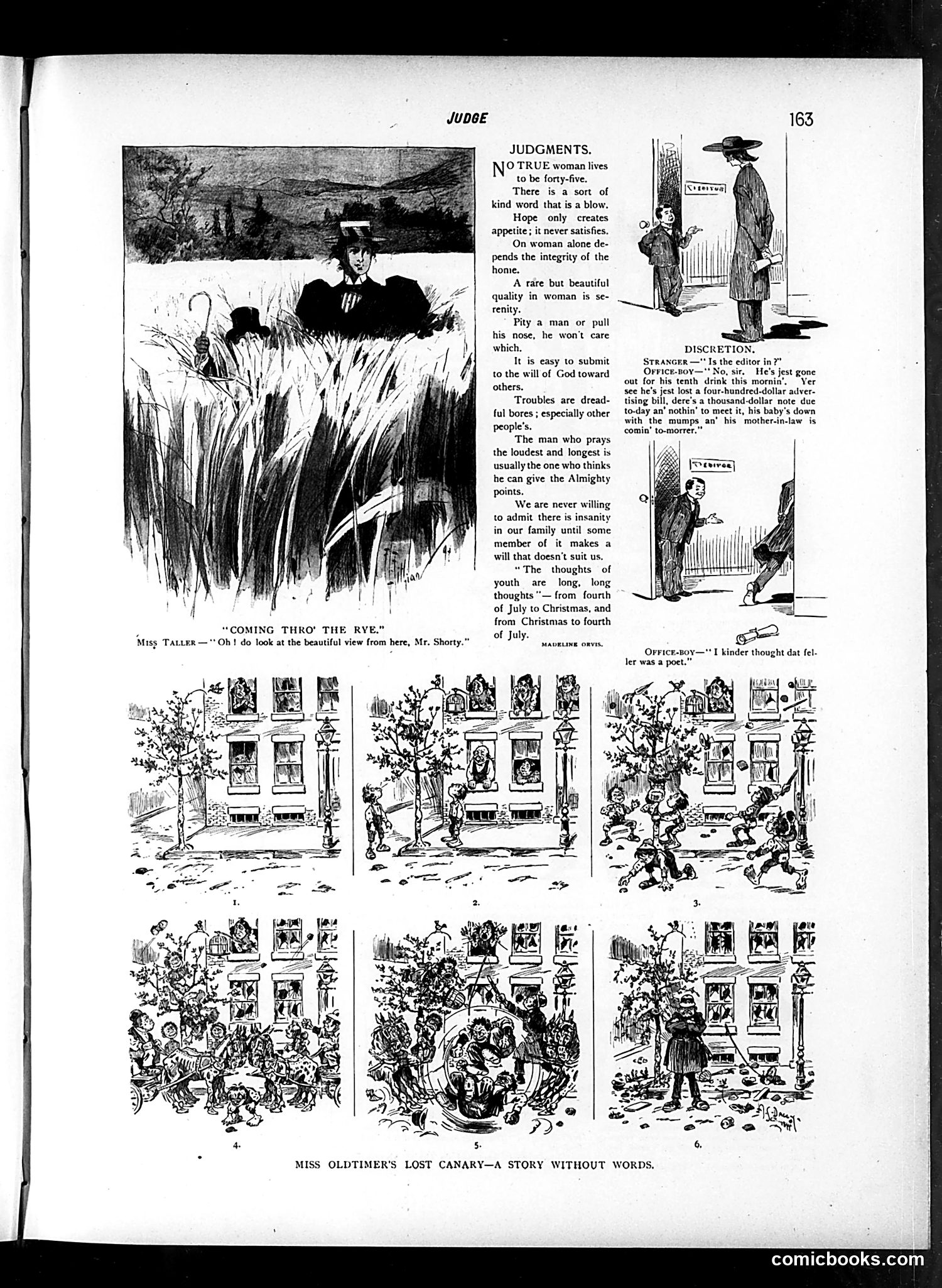
The page contains three distinct satirical pieces: **"Coming Thro' the Rye"** (top): A sketch mocking a woman admiring scenery while sitting in tall grass, with commentary on female vanity and shallow judgment. **"Judgments"** (center): Philosophical aphorisms about human nature—criticizing empty hope, women's role in family integrity, and the tendency of loud prayer-givers to lack true piety. These reflect period attitudes about gender and morality. **"Discretion"** (right): A brief comic dialogue about an office boy's claim that a thousand-dollar note disappeared, suggesting workplace petty theft or dishonesty. **"Miss Oldtimer's Lost Canary"** (bottom): A six-panel wordless comic strip depicting the escalating chaos when a canary escapes from a building, showing period middle-class domestic life disrupted by a small animal.
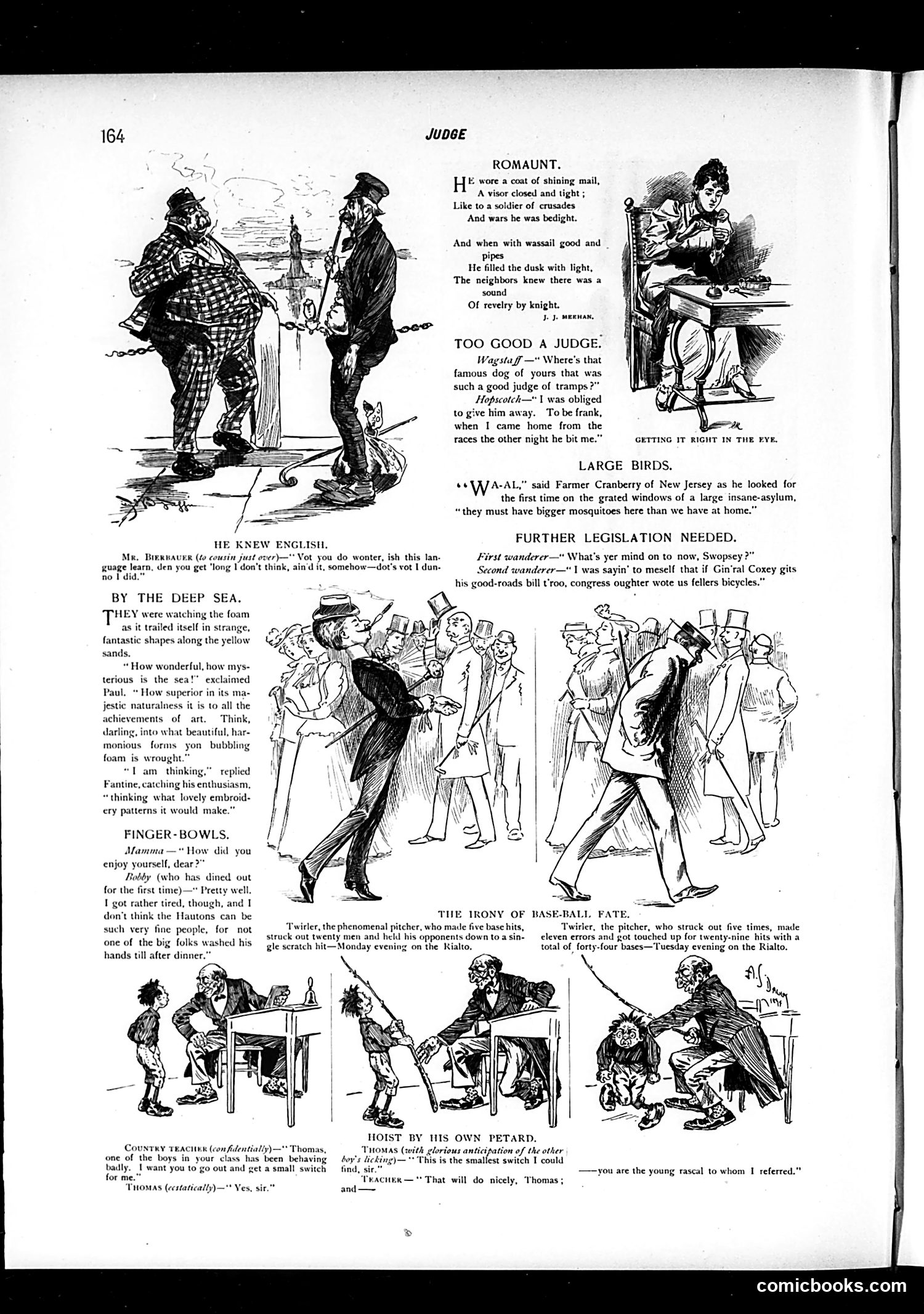
This page contains several short satirical pieces typical of Judge's humor: **"Too Good a Judge"** mocks a man whose dog was supposedly an excellent judge of character (particularly "tramps"), but the dog bit him after the races—suggesting the dog's judgment failed, or the man himself is disreputable. **"He Knew English"** features a German immigrant ("Mr. Bierkmauer") mangling English grammar, a common ethnic stereotype of the era used for comedy. **"By the Deep Sea"** contrasts a romantic man's poetic musings about ocean foam with his companion's practical thought—she sees it as embroidery patterns, deflating his sentimentality. **"Finger-Bowls"** jokes about a child's first fancy dinner; he judges the hosts as "not very fine people" because wealthy guests didn't wash hands until after dinner—showing innocent misunderstanding of etiquette. **Baseball humor** references pitcher performances at "the Rialto" (appears to be a venue). **"Further Legislation Needed"** references "General Coxey," likely Coxey's Army (1894 unemployment protest), with homeless men discussing road-building bills. The page is primarily light social satire and domestic humor.
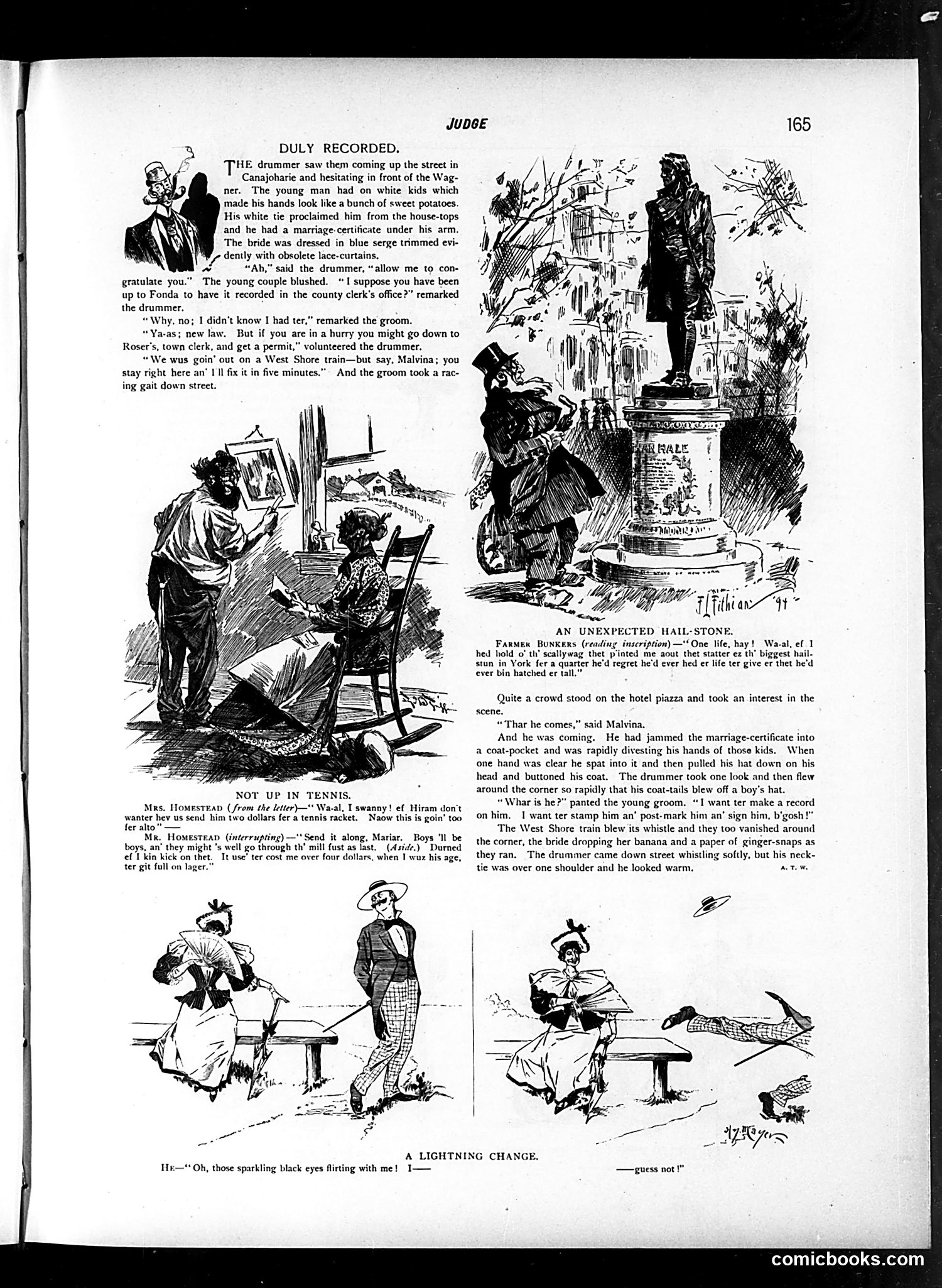
This page contains three separate humorous sketches satirizing rural/small-town American life circa early 1900s. **"Duly Recorded"** mocks a naive groom who doesn't know marriage licenses must be registered. A drummer (traveling salesman) tricks him into leaving his bride to obtain a permit, then flees when the angry groom returns, having learned he was duped. **"Not Up in Tennis"** jokes about rural parents' confusion over modern sports equipment—a father reluctantly pays for his son's tennis racket, grumbling it's expensive compared to his youth. **"An Unexpected Hail-Stone"** features a farmer who boasted his size was larger than York's famous hailstone; the drummer apparently made a record of this claim, prompting the furious farmer to chase him. **"A Lightning Change"** appears a brief romantic sketch about sudden emotional shifts. The satire targets rural naiveté, generational gaps regarding modern conveniences, and the traveling salesman as a figure of deception—common Judge themes mocking unsophisticated provincial Americans.
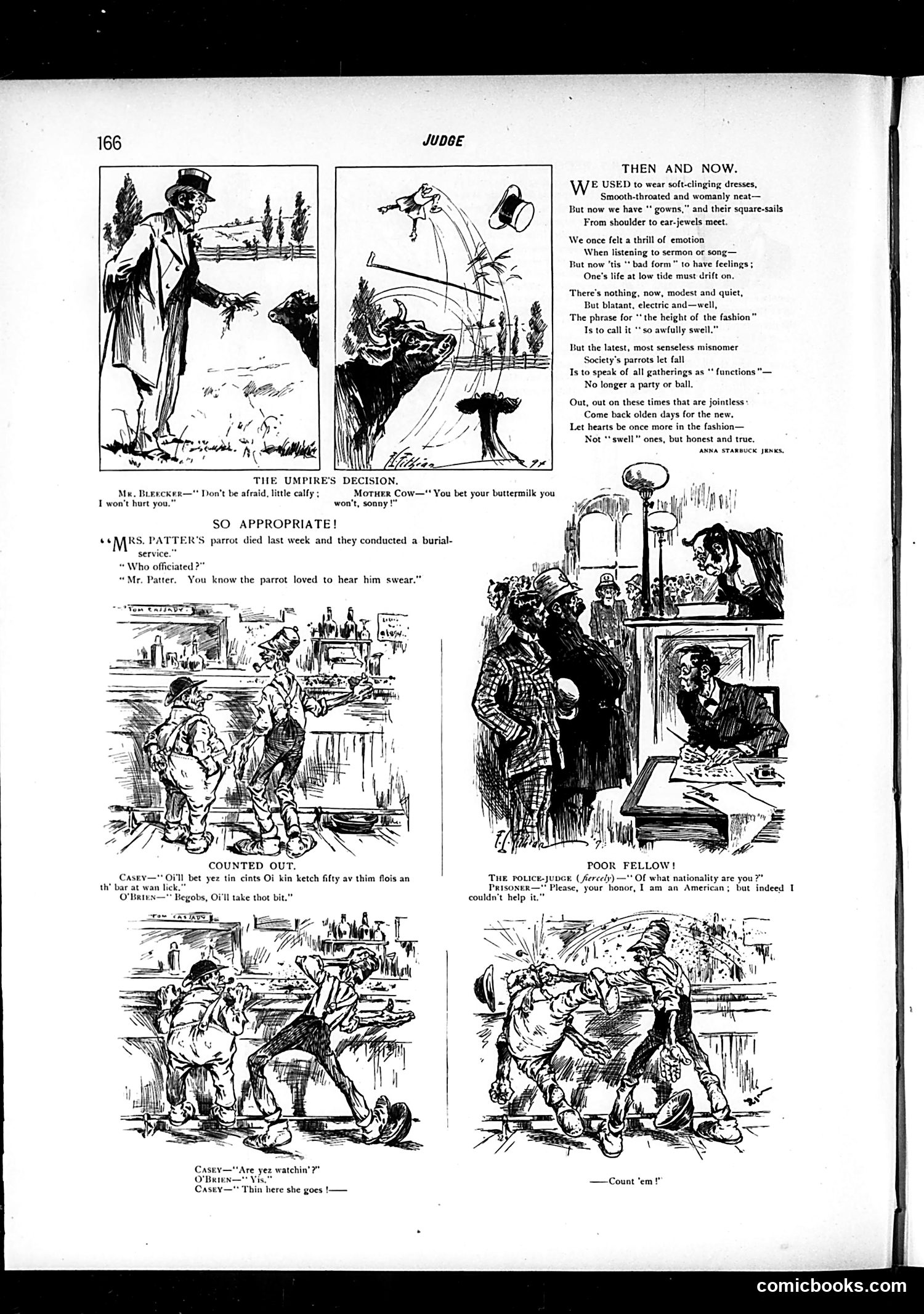
This page contains several satirical pieces typical of early 20th-century American humor: **"Then and Now"** (top right): A poem criticizing modern women's fashion and social behavior. It laments the shift from modest, emotionally responsive women wearing fitted dresses to contemporary women in loose, boxy "gowns" who affect emotional detachment. The satire targets modern slang ("so awfully swell," "functions" instead of "parties"), suggesting society has become superficial and inauthentic. **"The Umpire's Decision"** and **"So Appropriate!"**: Brief comic anecdotes—one about a calf, another about a parrot's funeral service conducted by its owner who "loved to hear him swear." **"Counted Out," "Poor Fellow," and "Count 'em!"**: These appear to be vignettes featuring working-class Irish characters (suggested by dialect like "Oi" for "I"), depicting physical comedy and street interactions, likely reflecting period ethnic stereotypes common in American humor publications. The page reflects Judge's focus on satirizing modern social pretensions alongside crude comedic scenarios.
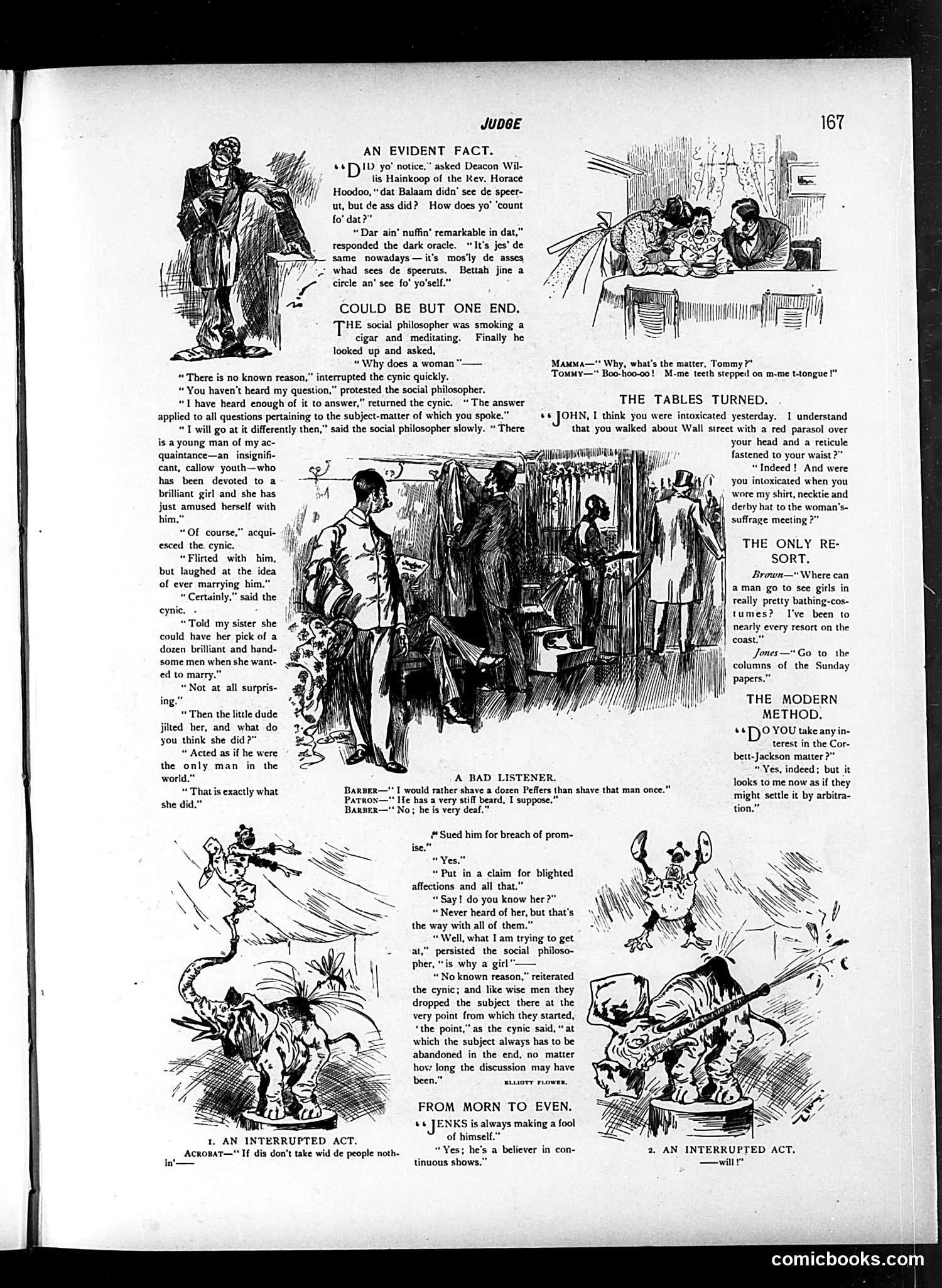
This page from *Judge* contains multiple short satirical pieces mocking various social types and gender relations: **"An Evident Fact"** jokes about a Black preacher's view that only "asses" see spiritual truths—a crude racial stereotype common to the era's humor. **"Could Be But One End"** depicts a social philosopher and cynic debating why women act illogically, concluding women are inherently irrational—typical Victorian-era misogyny presented as wit. **"The Tables Turned"** inverts gender expectations: a woman confronts her husband about cross-dressing in public, then reveals *she* wore his clothes to a suffrage meeting. This satirizes both intoxication and women's suffrage activism as equally absurd. **"The Only Resort"** and **"A Bad Listener"** are brief quips about bathing beauties and a deaf barber. **"From Morn to Even"** mocks a man named Jenks for being a fool. Overall, the page reflects Gilded Age humor: crude racial caricature, anti-feminist jokes treating women's equality as ridiculous, and mockery of working-class types—typical of *Judge's* conservative satirical stance.
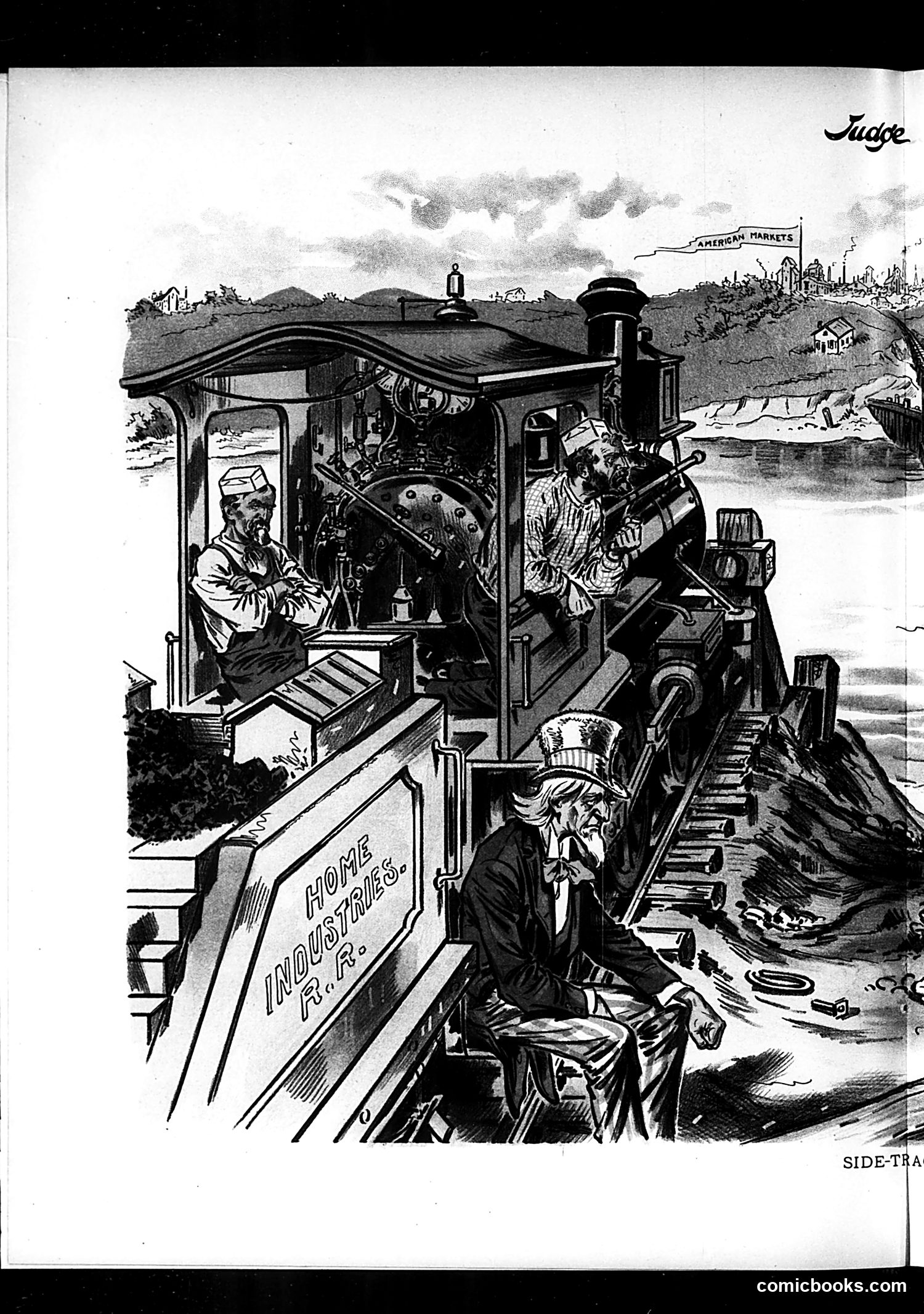
This Judge magazine cartoon satirizes industrial labor conditions, specifically targeting the "Home Industries" movement (visible on the train car). The illustration depicts a cramped, dangerous factory train car where workers are crammed together amid machinery, with an overseer or capitalist figure lounging outside smoking. The satire critiques how "home industries"—work done in workers' homes or makeshift facilities—were often unregulated, exploitative alternatives to factory work. The crowded, unsafe conditions and the contrast between the comfortable supervisor and the laboring workers emphasize the cartoon's message about worker exploitation. The hillside landscape with "American Markets" suggests domestic rather than foreign production, making the satire about American labor practices specifically.
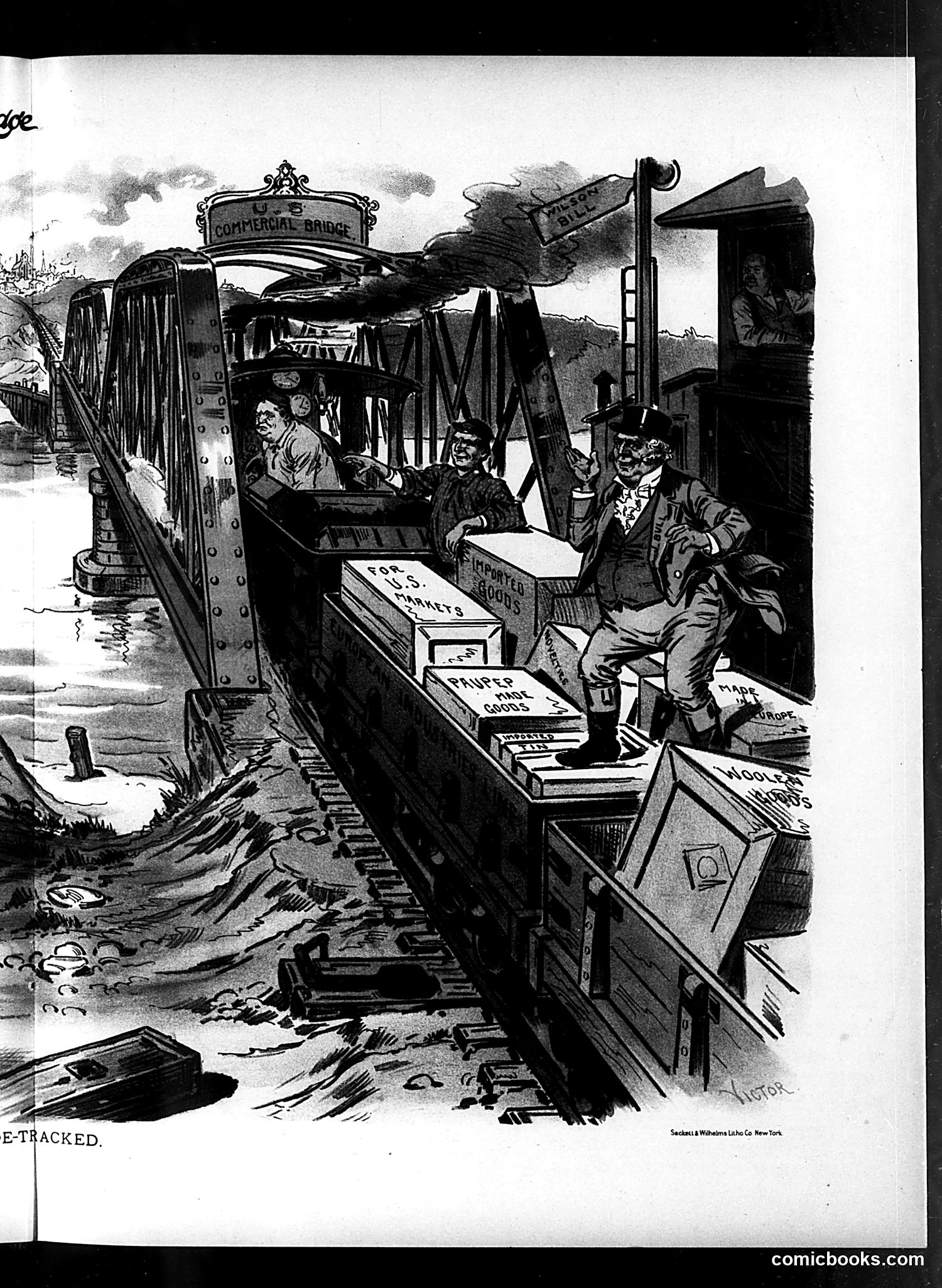
This cartoon depicts a commercial bridge spanning what appears to be a harbor or waterway, labeled "U.S. COMMERCIAL BRIDGE." A train car loaded with various goods (marked "PROTECTED GOODS," "WOOL," and other items) crosses the bridge while figures on the right—appearing to be foreign traders or competitors—watch from a platform. The satire likely criticizes American **protectionist tariff policies** of the late 19th/early 20th century. The "protected goods" suggests the U.S. government shields domestic industries through tariffs, while the bridge itself represents government-sponsored infrastructure benefiting American commerce. The foreign figures' excluded position implies they're locked out of American markets—a commentary on whether protectionism genuinely benefits the nation or creates barriers that harm international trade. The exact historical moment remains unclear without a date.
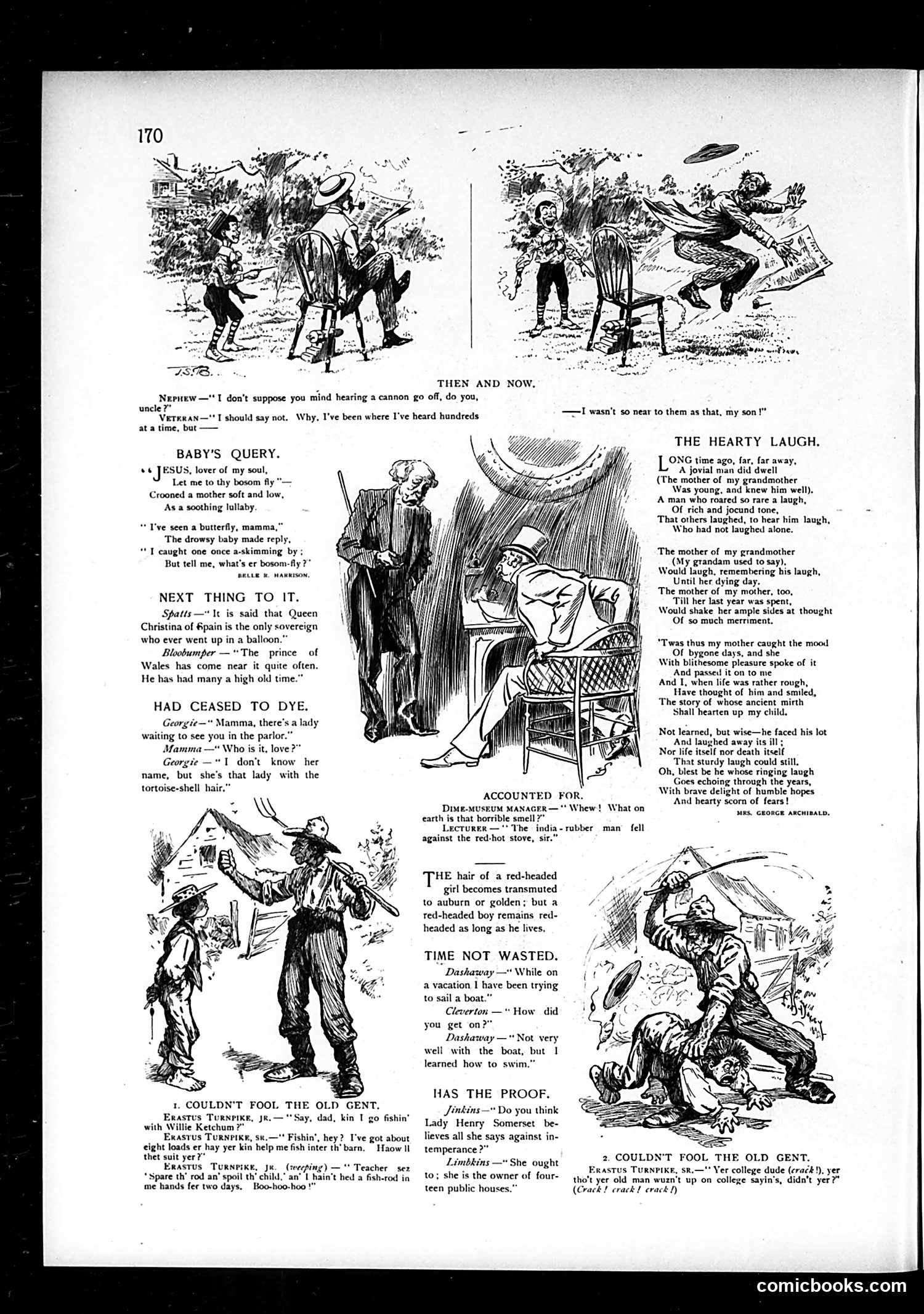
This page collects humorous anecdotes and satirical sketches typical of Judge's format. Key content includes: **"Then and Now"**: Contrasts a Civil War veteran's bravado about hearing cannon fire with his cowardice when exposed to actual noise—satirizing nostalgic war romanticization. **"The Hearty Laugh"**: A sentimental poem praising inherited good humor across generations, celebrating laughter's psychological value. **Social Commentary Sketches**: Brief jokes targeting contemporary figures and behaviors—including a dig at Queen Christina of Spain (unclear reference), observations about red-headed boys' unchanging hair color, and rural/working-class characters (Erastus Turnpike) outwitting pretentious city folk. **"Lady Henry Somerset"**: References the temperance advocate and likely critiques her credibility regarding alcohol reform. The page exemplifies Judge's mix of gentle social satire, family humor, and class-based comedy typical of 1880s-90s American periodicals—mixing sentiment with mockery of both high society and rural simplicity.
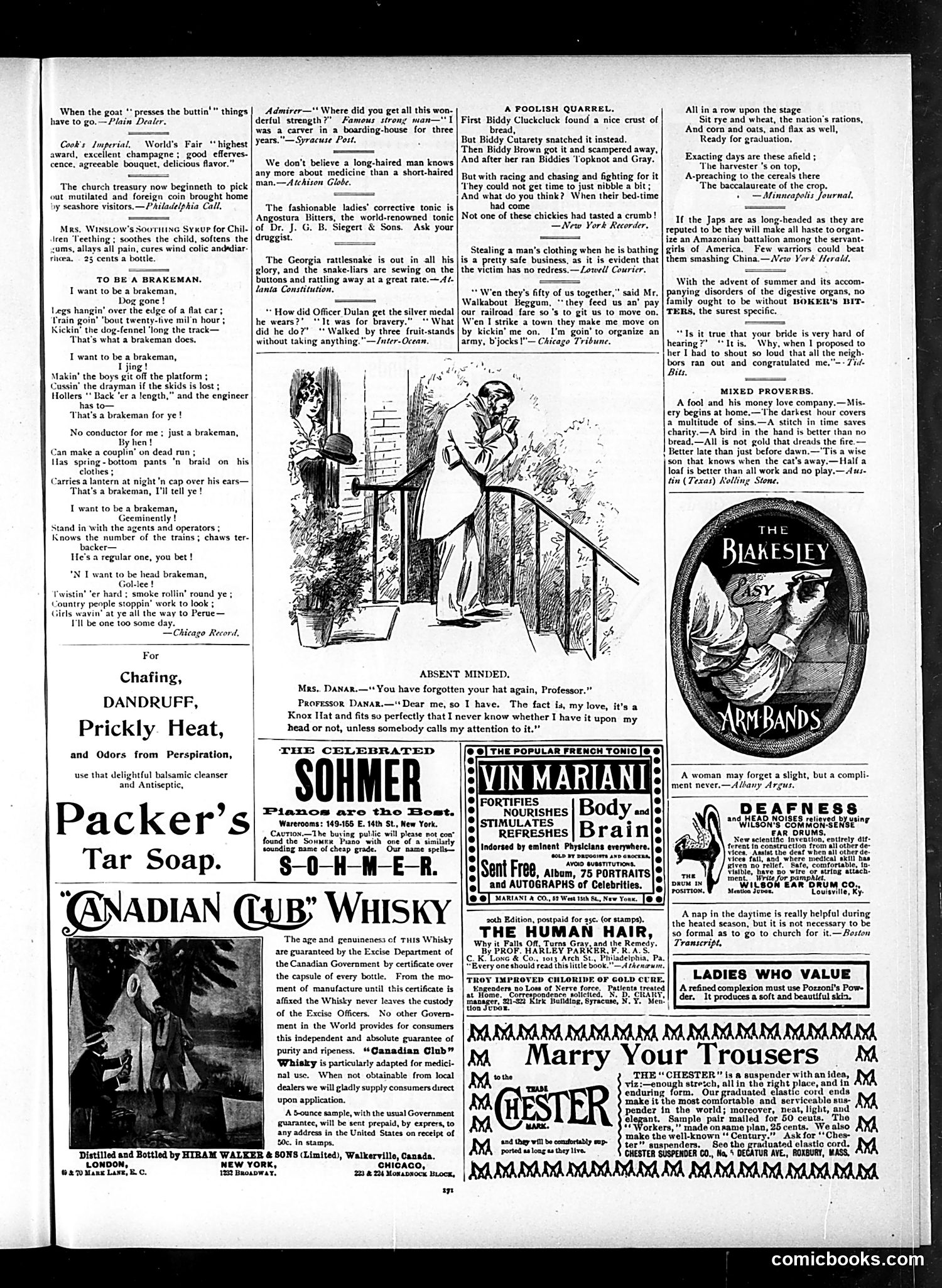
This page is primarily **advertising** with some satirical humor pieces scattered throughout. The main content includes: **Key Satire:** - A poem about wanting to be a railroad brakeman—romanticizing a dangerous, poorly-paid job with false glamour (getting noticed by girls, wearing fancy clothes) - "A Foolish Quarrel"—chickens fighting over bread so intensely they never eat it, seemingly mocking human conflicts over trivial matters - "Absent Minded"—Professor Danar can't distinguish wearing his hat from not wearing it, satirizing absent-minded academics **Social Commentary:** - A quip about stealing clothes from bathers having "no redress" (legal consequences)—satirizing the powerlessness of victims - References to begging as organized labor ("organize an army") **The Cartoon:** The illustration labeled "Absent Minded" shows the Professor and Mrs. Danar discussing his forgotten hat—visual humor about intellectual absent-mindedness, a common period stereotype. **Dominant Content:** The page is overwhelmingly filled with product advertisements (Packer's Tar Soap, Canadian Club Whisky, Sohmer Pianos, etc.), typical of Judge's revenue model.
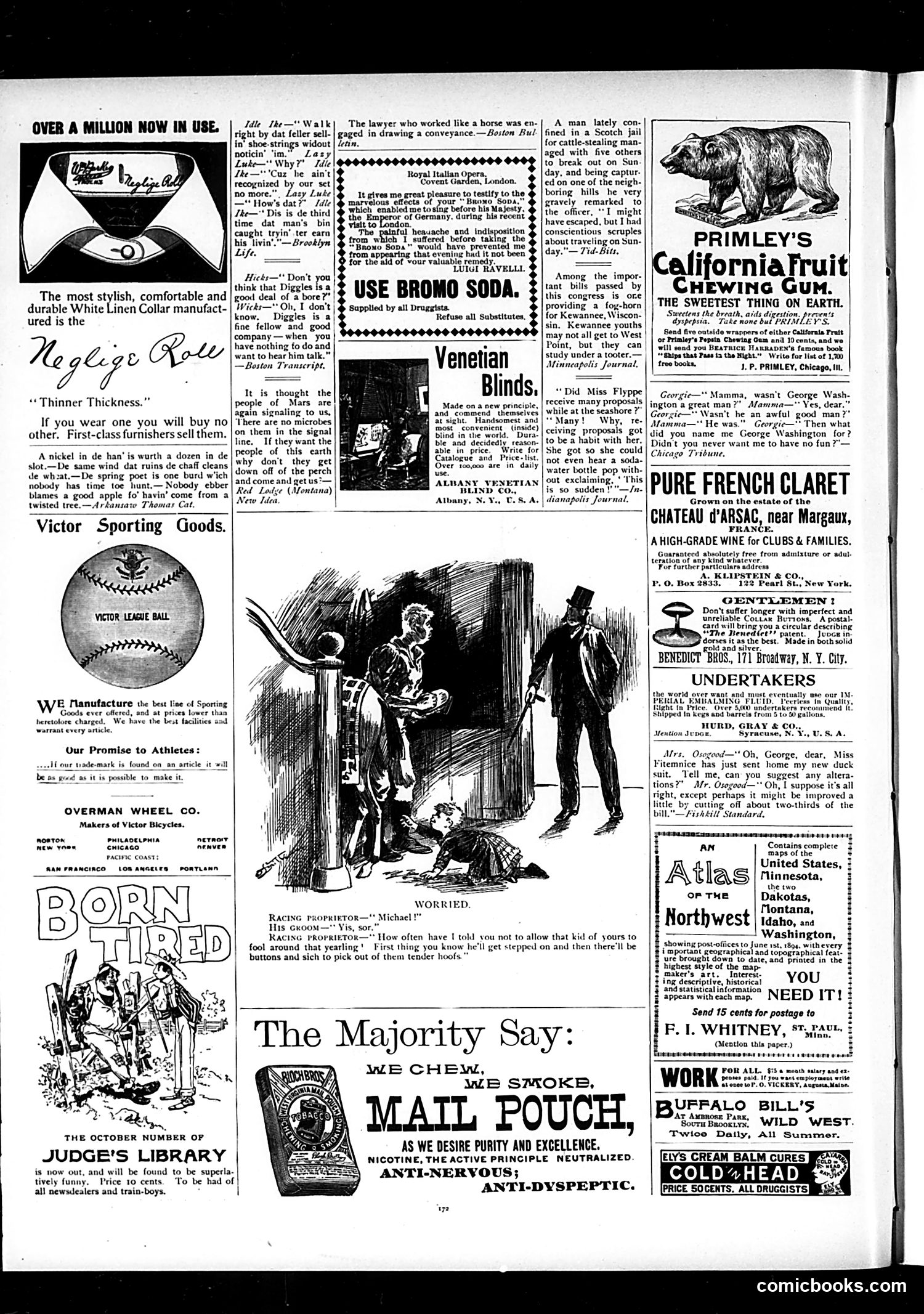
This page is primarily **advertising**, with one notable cartoon titled "Worried" depicting a racing proprietor scolding his groom about the groom's shabby appearance—specifically his "tender hoofs" and worn buttons—which apparently reflect poorly on the establishment's reputation. The advertisements showcase typical turn-of-the-century consumer goods: collar manufacturers, sporting equipment, wine, chewing gum, blinds, and patent medicines (notably "Bromo Soda," prominently featured). Interspersed are brief humorous quotations and anecdotes—the magazine's signature format—touching on everyday absurdities: a lawyer "drawing a conveyance," a Scottish jail-breaker's scruples about Sunday travel, and a woman so accustomed to marriage proposals she cannot react naturally to mundane sounds. The "Born Tired" comic strip reference and Judge's Library promotion appear at the bottom. Overall, this represents a typical Judge issue: lighthearted social satire mixed with period advertising, targeting educated middle-class readers amused by gentle mockery of modern life and consumer culture.
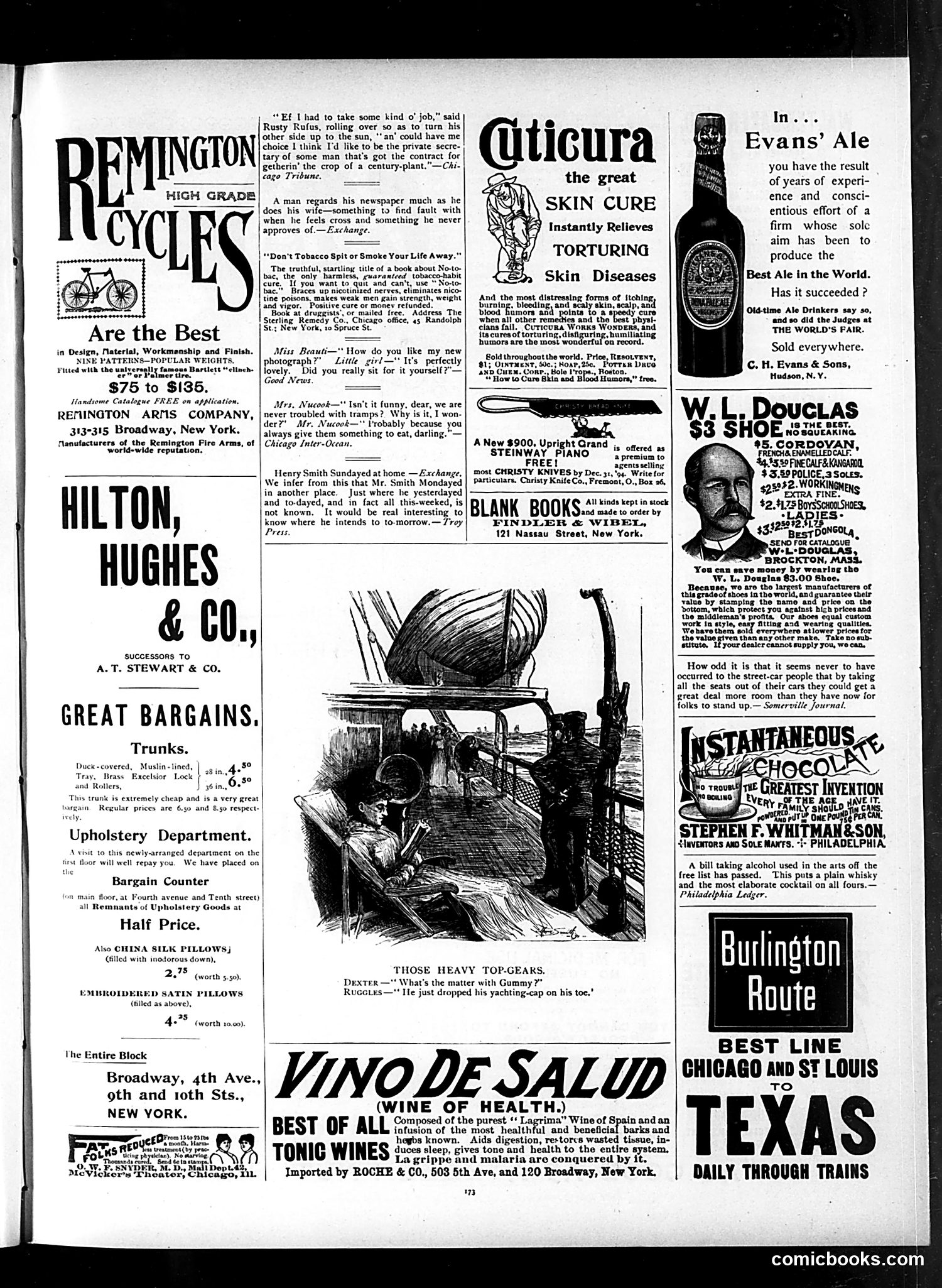
This page is primarily **advertising**, with one prominent cartoon titled "Those Heavy Top-Gears." ## The Main Cartoon The illustration shows two figures with a broken-down vehicle or machinery. The dialogue reads: - **Dexter**: "What's the matter with Gummy?" - **Ruggles**: "He just dropped his yachting-cap on his toe." **The satire**: This is a joke about wealthy, leisure-class idleness. "Gummy" (likely a nickname for a rich man) is so unaccustomed to physical exertion that dropping a hat on his foot causes him serious distress—a humorous commentary on the delicate, pampered lifestyle of the wealthy elite. The term "top-gears" in the title reinforces this, suggesting the machinery of upper-class pretension. ## Supporting Content The page includes several short humorous quips about life, marriage, and social habits—typical filler material for Judge's satirical commentary on American society and manners. The advertisements (Remington bicycles, Evans' Ale, Cuticura skin cure, etc.) represent period consumer goods marketed to middle and upper-class readers.
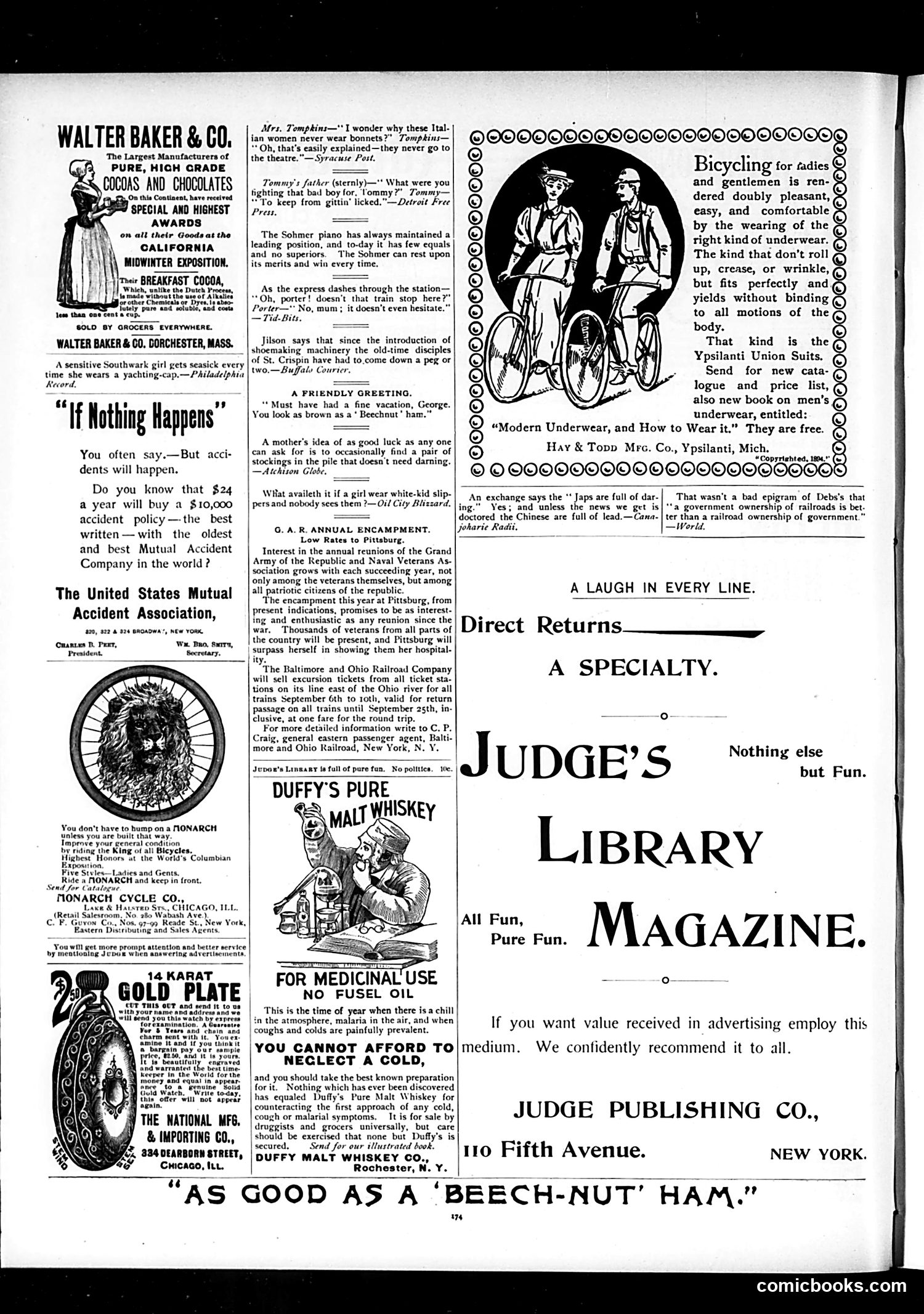
This is primarily an **advertising page** from Judge magazine with scattered brief humor items and jokes in the margins. The main content consists of advertisements for products like Walter Baker cocoa, accident insurance, Monarch bicycles, and Duffy's Pure Malt Whiskey (marketed for "medicinal use"). **The humor items** are brief, typical of the era: - Jokes about Italian women and theaters - A child fighting to avoid being beaten - Seasickness from wearing a yachting cap - Wordplay about express trains and hesitation **The one substantive piece** is a notice about **G.A.R. (Grand Army of the Republic) reunions at Pittsburgh**—Civil War veterans' gatherings that were major civic events in the 1890s. The Baltimore and Ohio Railroad advertised special excursion fares for these patriotic gatherings. **Modern context**: Duffy's whiskey's "medicinal use" claim reflects pre-Prohibition-era marketing, when alcohol was sold partly as patent medicine. The emphasis on veterans' patriotism and railroad accessibility reflects post-Civil War American identity-building.
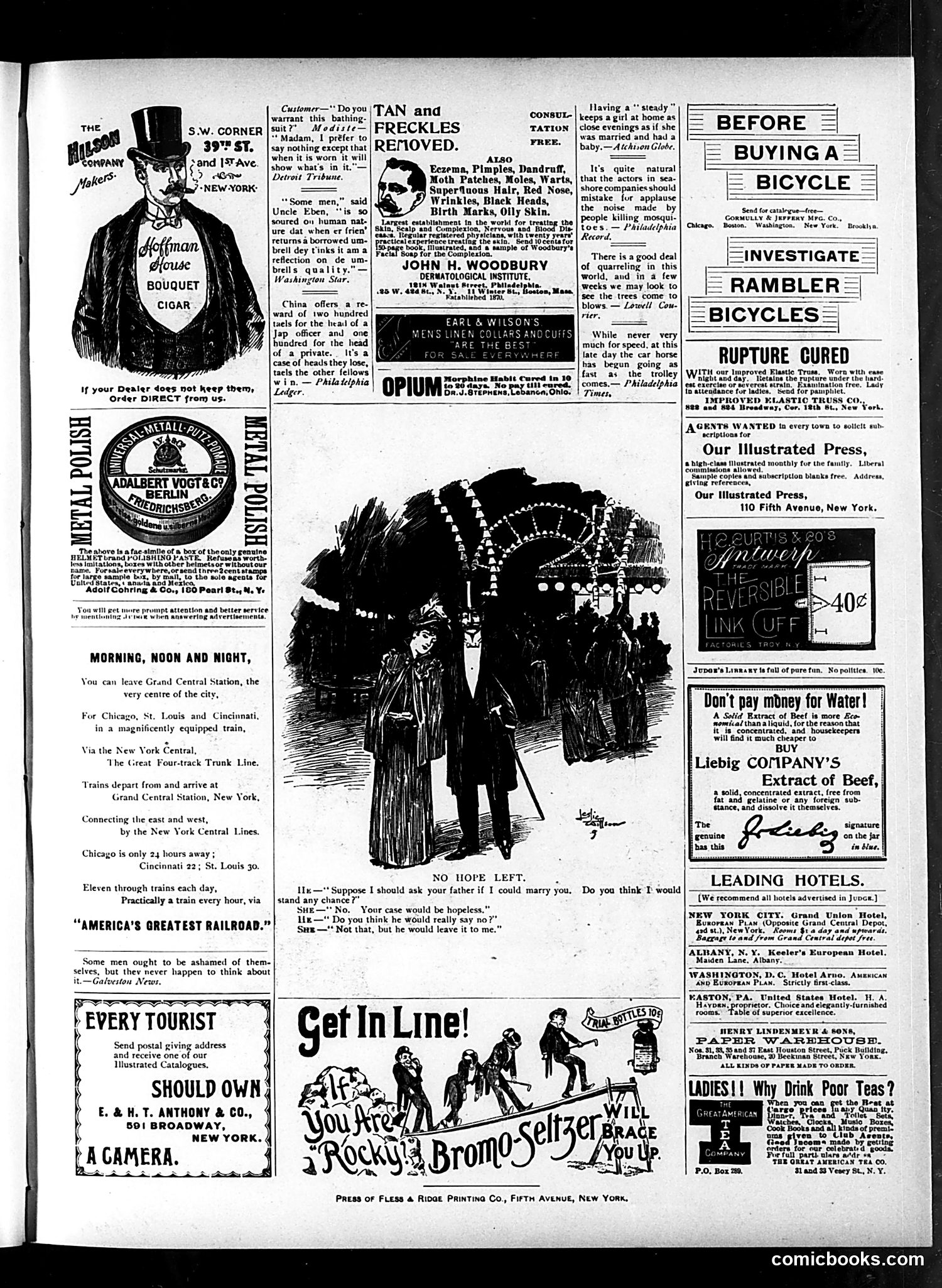
This is primarily an **advertising page** with scattered humor items typical of Judge magazine's format. The main cartoon ("NO HOPE LEFT") depicts a romantic dialogue: a man asks a woman if her father would approve of marriage. She replies her father would say no—but worse, he'd "leave it to me," meaning she'd have to decide, removing the convenient excuse of parental refusal. The humor lies in the woman's reluctance to commit, playing on period anxieties about courtship and female agency. The page also contains: - Medical/beauty product ads (skin treatments, "rupture cured" devices) - Railroad advertising (New York Central) - A joke about China's Russo-Japanese War bounties for Japanese officer heads - Various brief quips about human nature The **context**: This appears to be early 1900s Judge, when the magazine mixed high-minded satire with commercial advertising and light domestic humor. The cartoon's joke about female hesitation to marry reflects contemporary anxieties about changing gender roles and courtship customs of that era.
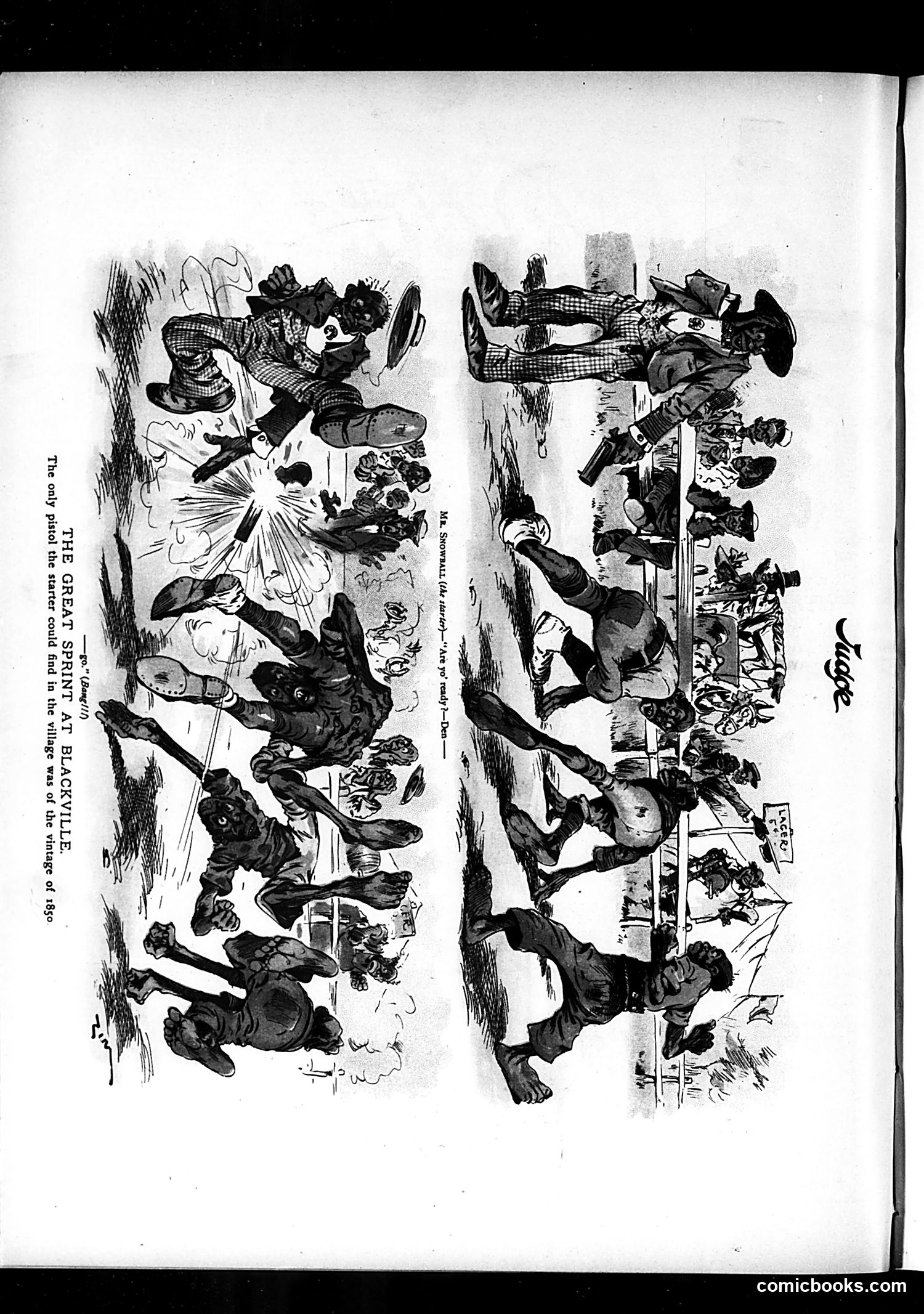
This satirical cartoon depicts a chaotic footrace in a rural village. The humor centers on the starter firing an ancient pistol from 1850 to begin the race—the gun's massive recoil and explosion create pandemonium among the runners, who are knocked about by the blast rather than racing normally. The satire appears to mock small-town incompetence and lack of proper infrastructure. "Blackville" suggests a rural or underdeveloped community so poorly equipped that they cannot find a modern starter's pistol, forcing them to use dangerously obsolete equipment. The resulting disaster—runners airborne, chaos ensuing—illustrates the consequences of such backwardness and lack of resources, typical of Judge magazine's urban-centered ridicule of rural America in the late 19th/early 20th century.