
A complete issue · 16 pages · 1894
Judge — September 8, 1894
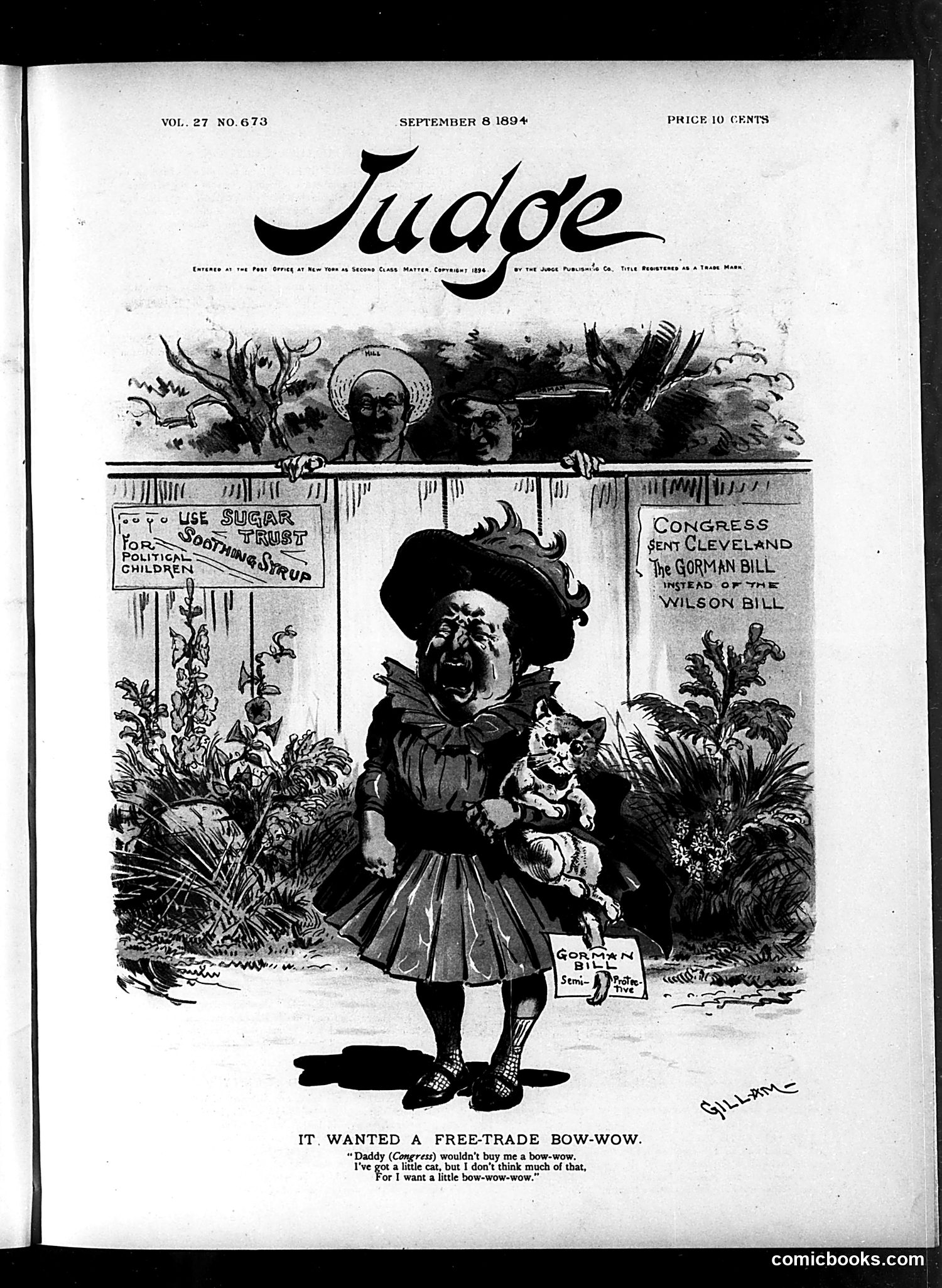
This 1894 Judge magazine cartoon satirizes President Cleveland's trade policy through a nursery-rhyme format. The central figure appears to be a woman representing either a political opponent or the nation, holding a cat labeled "Gorman Bill" (referring to the Wilson-Gorman Tariff). The cartoon critiques Cleveland for sending Congress the Gorman Bill instead of his preferred Wilson Bill—both concerning tariff/trade policy. The signs reference the "Sugar Trust" and mention Cleveland receiving the Gorman Bill from Congress. The rhyming verse mocks the situation as a child demanding a "free-trade bow-wow" (free trade) but getting a cat instead—suggesting the legislation disappointed those seeking Cleveland's promised trade policies.
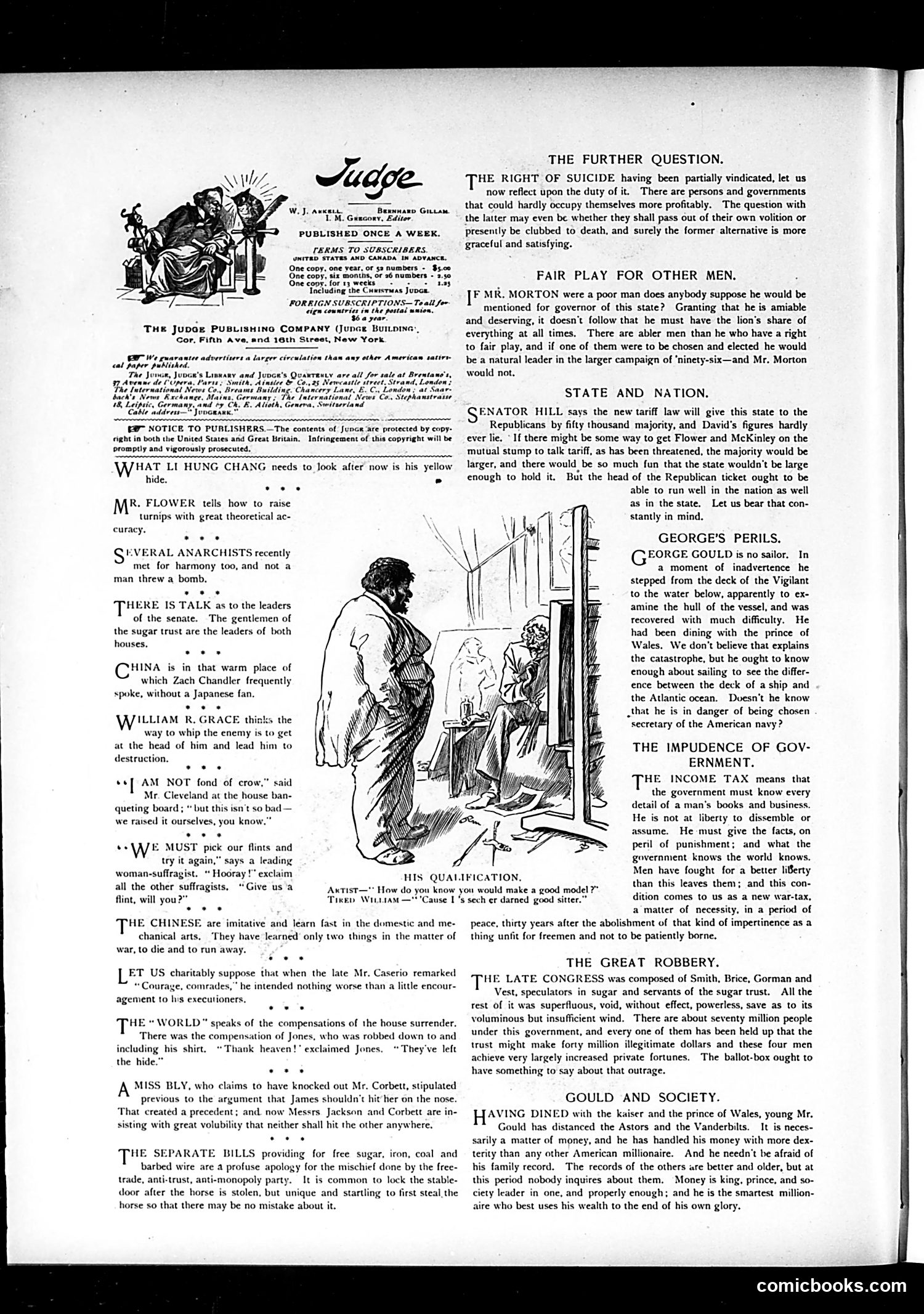
This page contains multiple brief satirical pieces rather than a single cartoon. The main illustration shows two men at a doorway, with a caption about qualifications for being a "good model." The text pieces mock various political and social targets: - **"State and Nation"** criticizes Senator Hill regarding tariff policy and Republican ticket prospects - **"George's Perils"** appears to satirize someone (possibly George Gould) who nearly drowned, mocking his nautical inexperience - **"The Impudence of Government"** attacks income tax as governmental overreach - **"The Great Robbery"** references a congressional scandal involving sugar speculation and profiteering The pieces reflect late 19th-century Progressive-era concerns: tariffs, government intervention, and wealthy corruption. Without clearer dating or context, specific figures remain uncertain, but the satire targets political hypocrisy and economic malfeasance typical of the period.
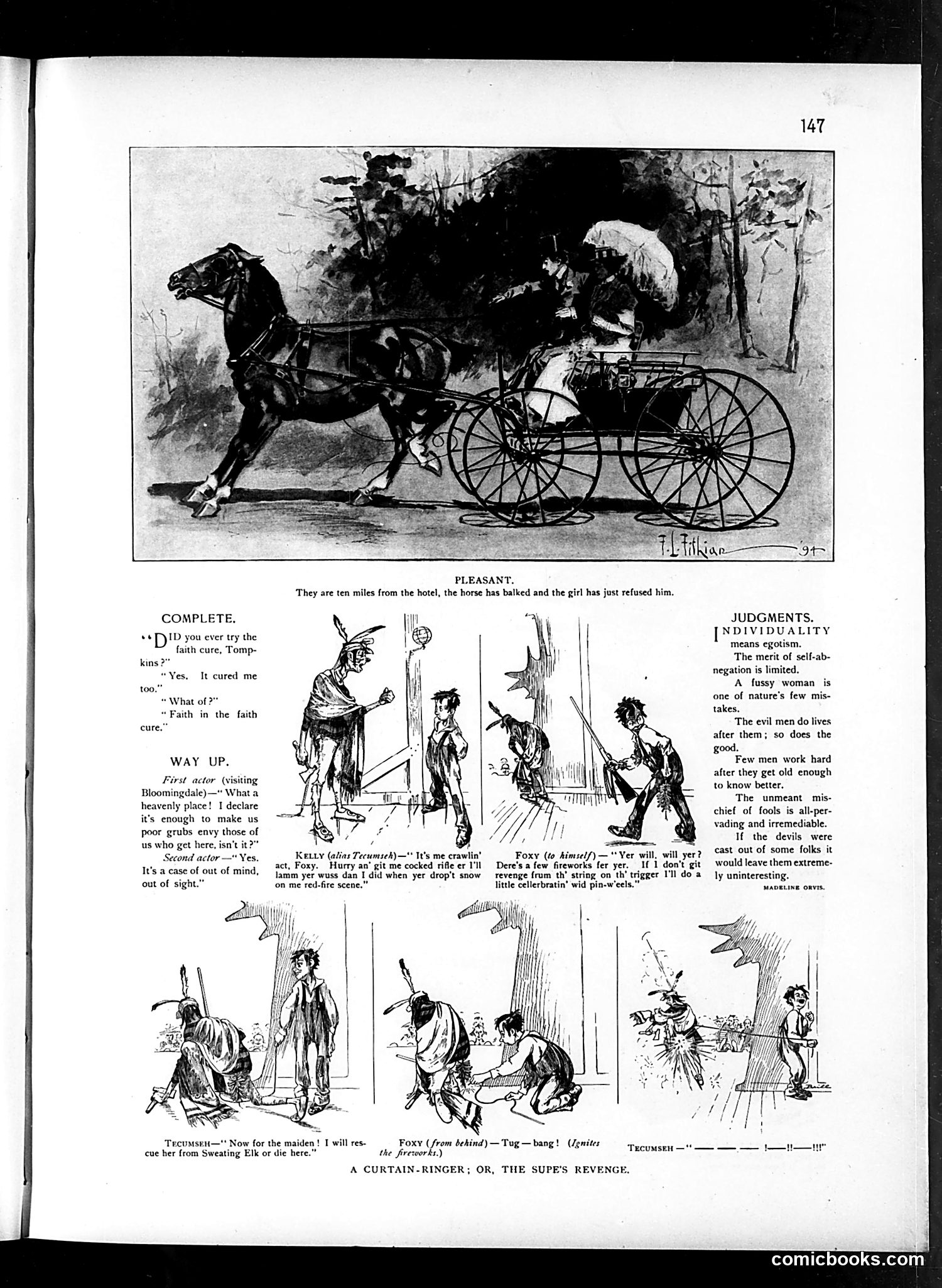
This page presents humorous domestic and romantic sketches rather than political satire. The main illustration shows a horse-drawn carriage with a couple; the caption "Pleasant" indicates the girl has refused the boy's romantic advances. Below are several comic vignettes depicting courtship scenarios and marital discord, featuring characters with exaggerated features typical of period humor. The sketches appear to ridicule both male persistence in romance and female manipulation tactics. On the right, "Judgments" offers aphoristic commentary on human nature—cynical observations about egotism, fussy women, evil men, and workplace foolishness. This was a common Judge feature offering social commentary through witty maxims. The overall content targets universal human foibles rather than specific political figures or events, using stereotyped character types common to late 19th/early 20th-century humor.
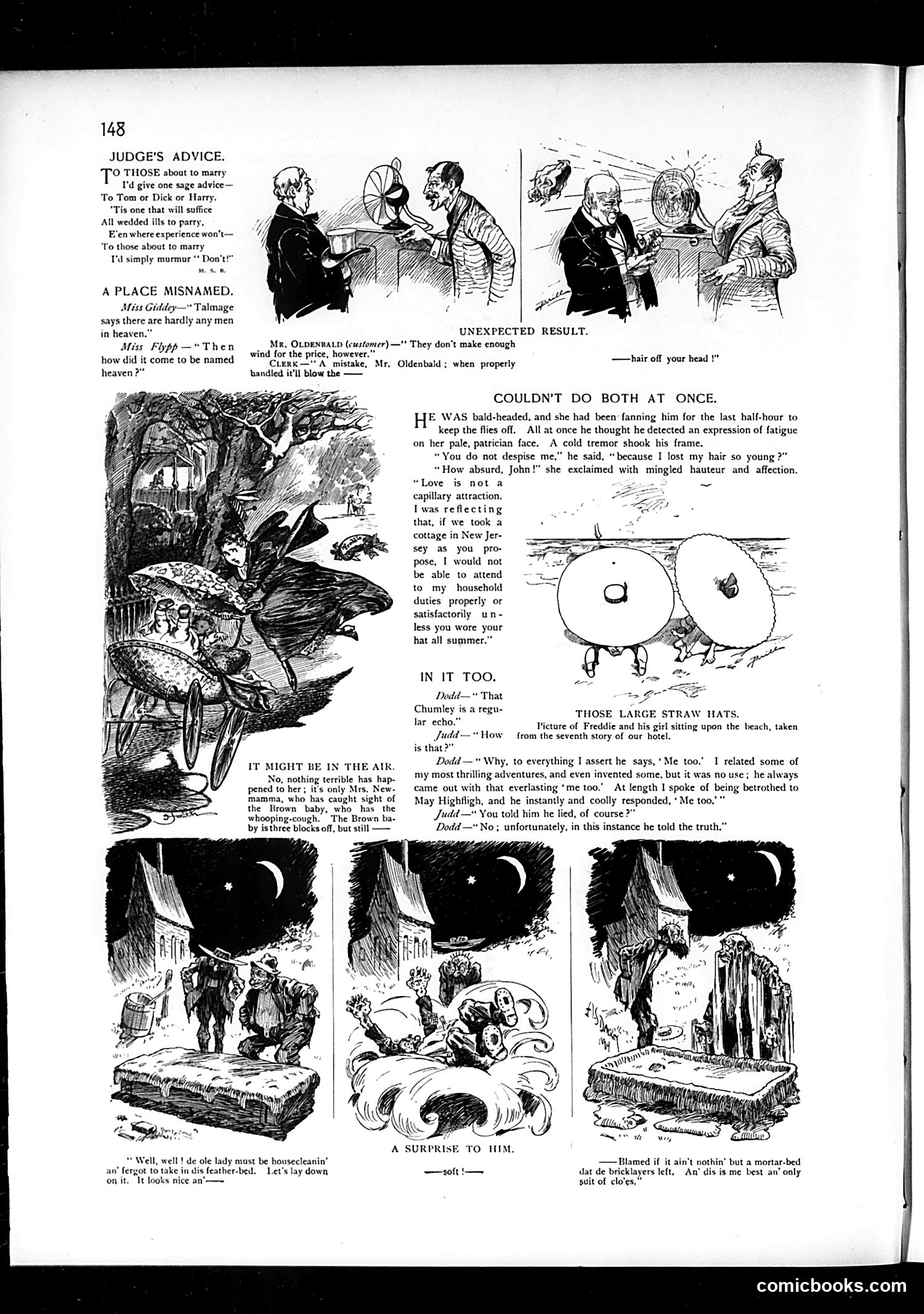
This page collects brief satirical pieces typical of Judge magazine's humor: **"Judge's Advice"** mocks marriage by suggesting unmarried men simply say "Don't!" to avoid the institution's supposed inevitable miseries. **"A Place Misnamed"** jokes that heaven can't actually exist since there are hardly any men there—implying women dominate the afterlife, a dig at gender relations. **"Unexpected Result"** plays on a barber's mishap: a customer complains a fan doesn't generate enough wind for the price; the barber threatens to make it work properly by using it to blow away the customer's remaining hair. **"Couldn't Do Both at Once"** satirizes a bald man's insecurity and his wife's mercenary pragmatism: she reassures him love isn't about hair ("capillary attraction"), but immediately reveals she needs him to wear a hat all summer to manage household duties in their New Jersey cottage. **"In It Too"** ridicules an annoying "yes-man" who echoes everything, even claiming he's engaged to the same woman—then admitting he actually is. The remaining pieces are brief visual gags about everyday absurdities.
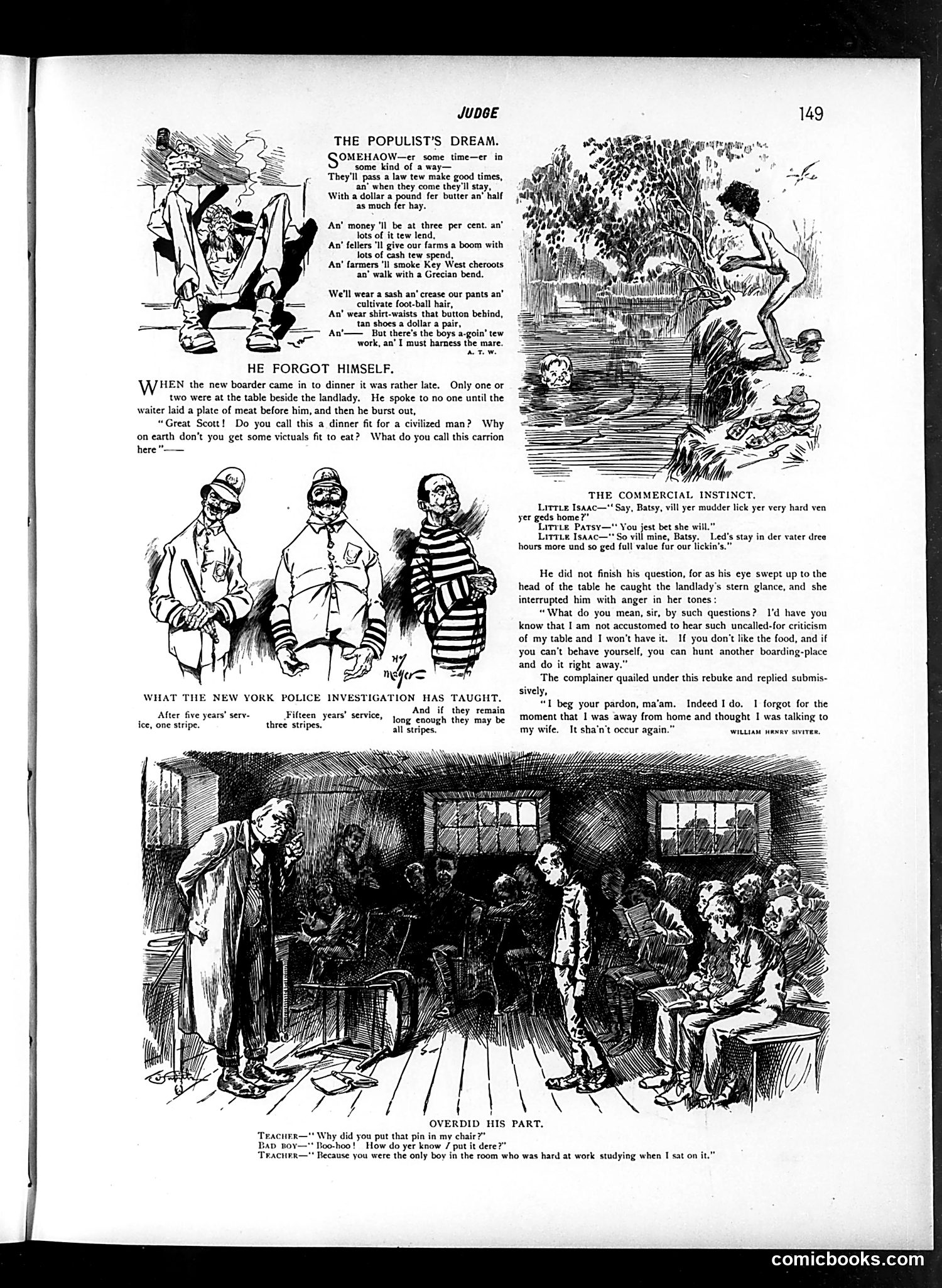
This page contains several satirical pieces mocking Populist political movements and social pretensions of the 1890s. **"The Populist's Dream"** ridicules Populist Party promises of economic reform—cheap money, regulated interest rates, agricultural prosperity. The poem shows a farmer fantasizing about wealth and leisure (wearing fashionable clothes, playing football) while reality intrudes: he must still work and harness the mare. The satire suggests Populist reforms are naive fantasies disconnected from actual labor. **"He Forgot Himself"** depicts a rude boarder criticizing the landlady's food until he sees her stern expression, then claims he mistook her for his wife—a joke about domestic henpecking. **"The Commercial Instinct"** shows two poor immigrant children (appearing to be Jewish, based on dialect) calculating how to maximize beatings from their mothers by staying in water longer—dark humor about immigrant poverty and parental discipline. **"The New York Police Investigation"** is a brief visual gag about police uniform stripes and rank. **"Overdid His Part"** shows a schoolboy caught pretending to study to avoid blame for putting a pin in a chair.
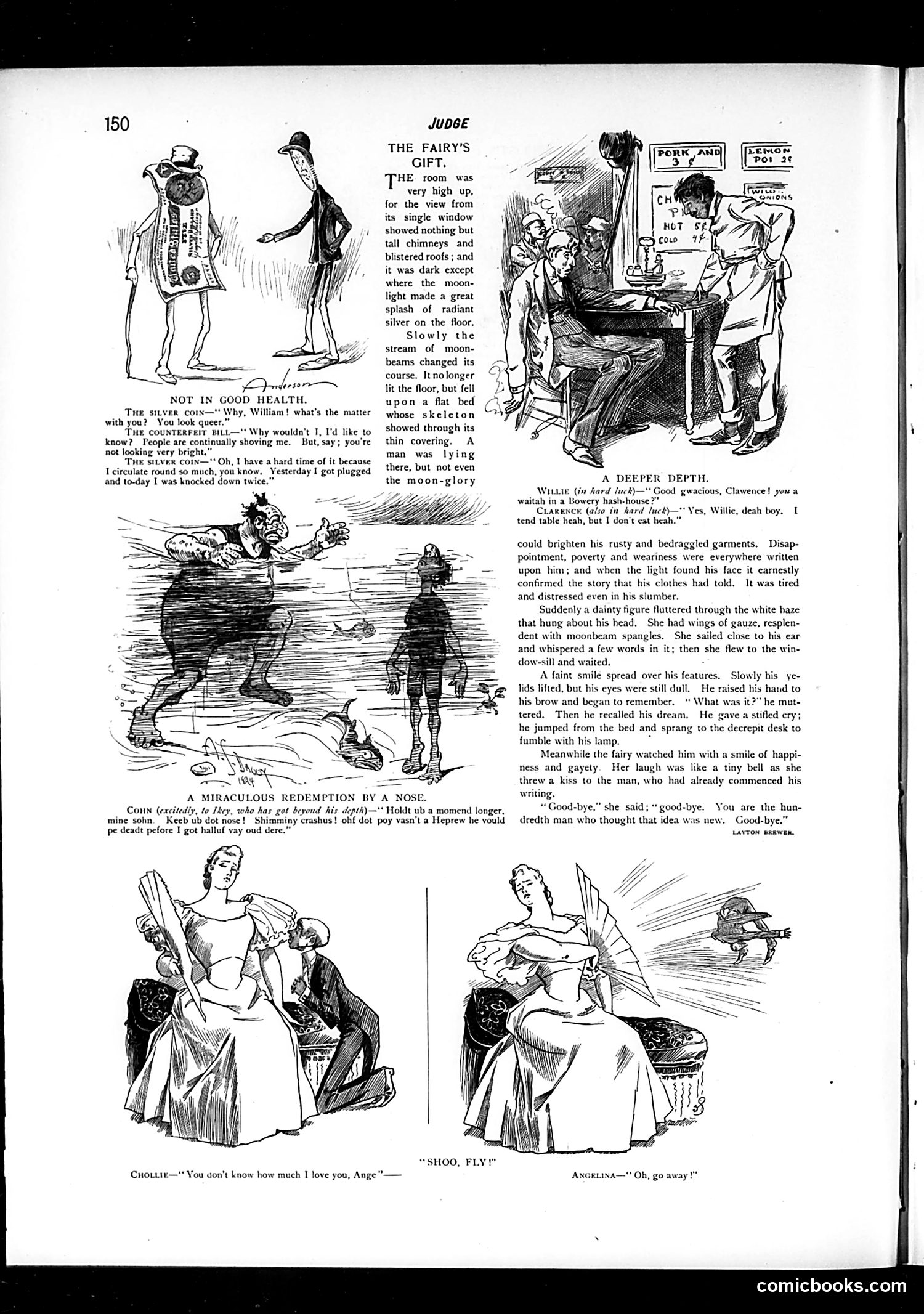
This page contains several short satirical pieces typical of Judge's humor: **"Not in Good Health"** depicts a conversation between a silver coin and counterfeit bill, both complaining about rough treatment in circulation. The satire mocks monetary concerns of the era—silver coins versus paper currency reliability. **"A Miraculous Redemption by a Nose"** shows a Jewish father (indicated by Yiddish dialect spelling) holding his drowning son's nose above water, joking that if the boy weren't Jewish, he'd let him drown. This reflects the period's prevalent ethnic stereotyping and antisemitic humor common in American magazines. **"The Fairy's Gift"** is a sentimental story about a fairy visiting a poor, sick man, inspiring him to write—apparently a new idea, mocked in the closing line. **"Shoo, Fly"** shows two men in poverty greeting each other; one works as a waiter in a cheap restaurant but can't afford to eat there himself. The cartoons reflect Judge's blend of social commentary, ethnic caricature, and sentimentality typical of late 19th/early 20th-century American satire.
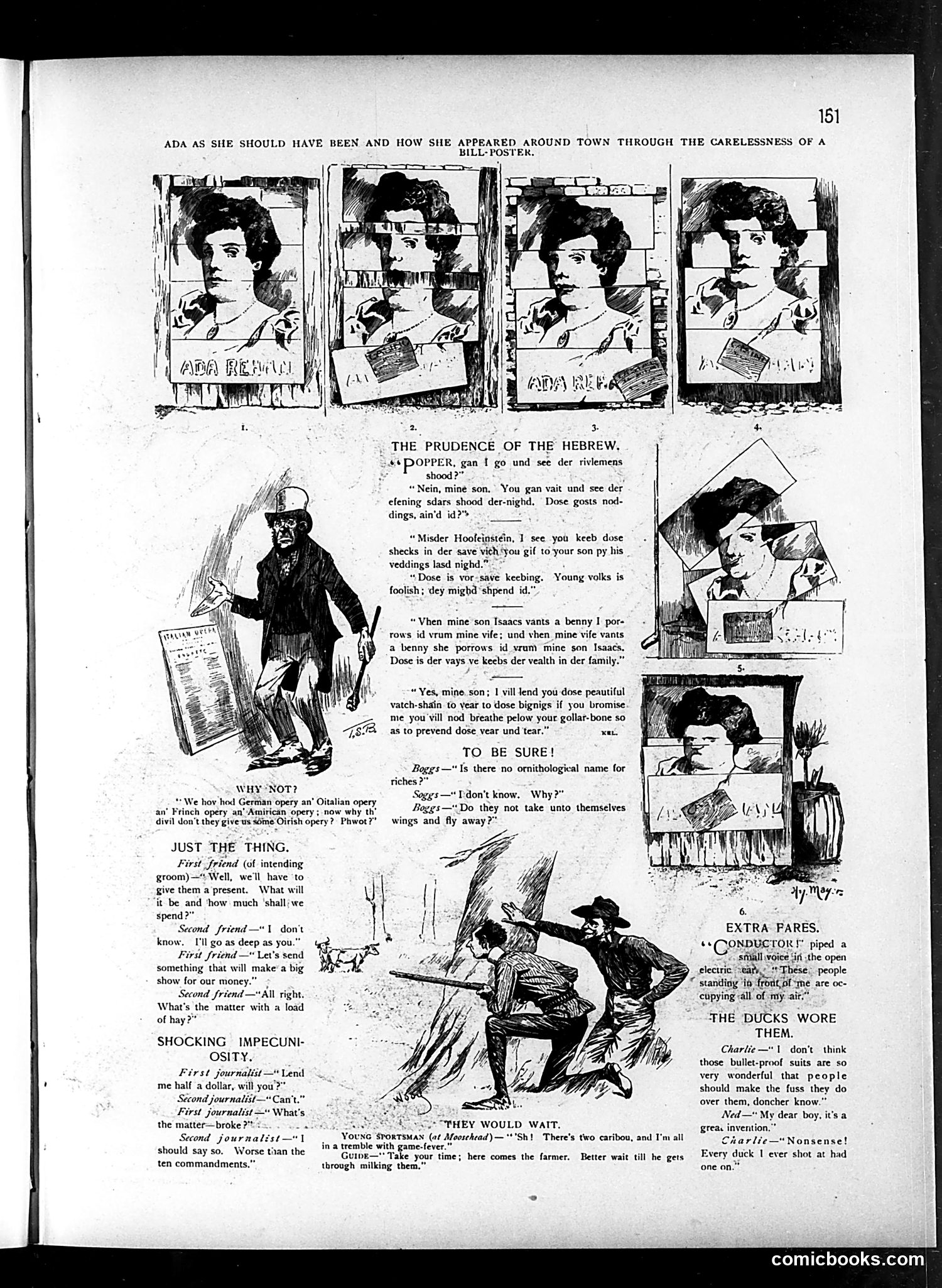
This page contains multiple satirical vignettes typical of early 20th-century American humor: **"Ada as She Should Have Been"** (top): Four panels showing actress Ada Rehan in increasingly disheveled states, satirizing how careless bill-posters displayed theatrical advertisements around town, damaging her dignified image. **"Irish Opera" joke**: Mocks the prevalence of European opera while Irish-American audiences remain excluded—a dig at ethnic hierarchies in entertainment. **"The Prudence of the Hebrew"**: Stereotypical Jewish dialect humor depicting a father explaining to another man how he keeps family wealth circulating through loans between wife and son, portraying Jews as financially shrewd. **Other brief jokes** cover: broke journalists, engagement gift-giving, hunting mishaps, streetcar etiquette, and "bullet-proof suits" (likely referencing contemporary armor innovations). The humor relies heavily on ethnic stereotyping, class commentary, and wordplay typical of Judge's satirical approach. Most references are general social observations rather than specific political events.
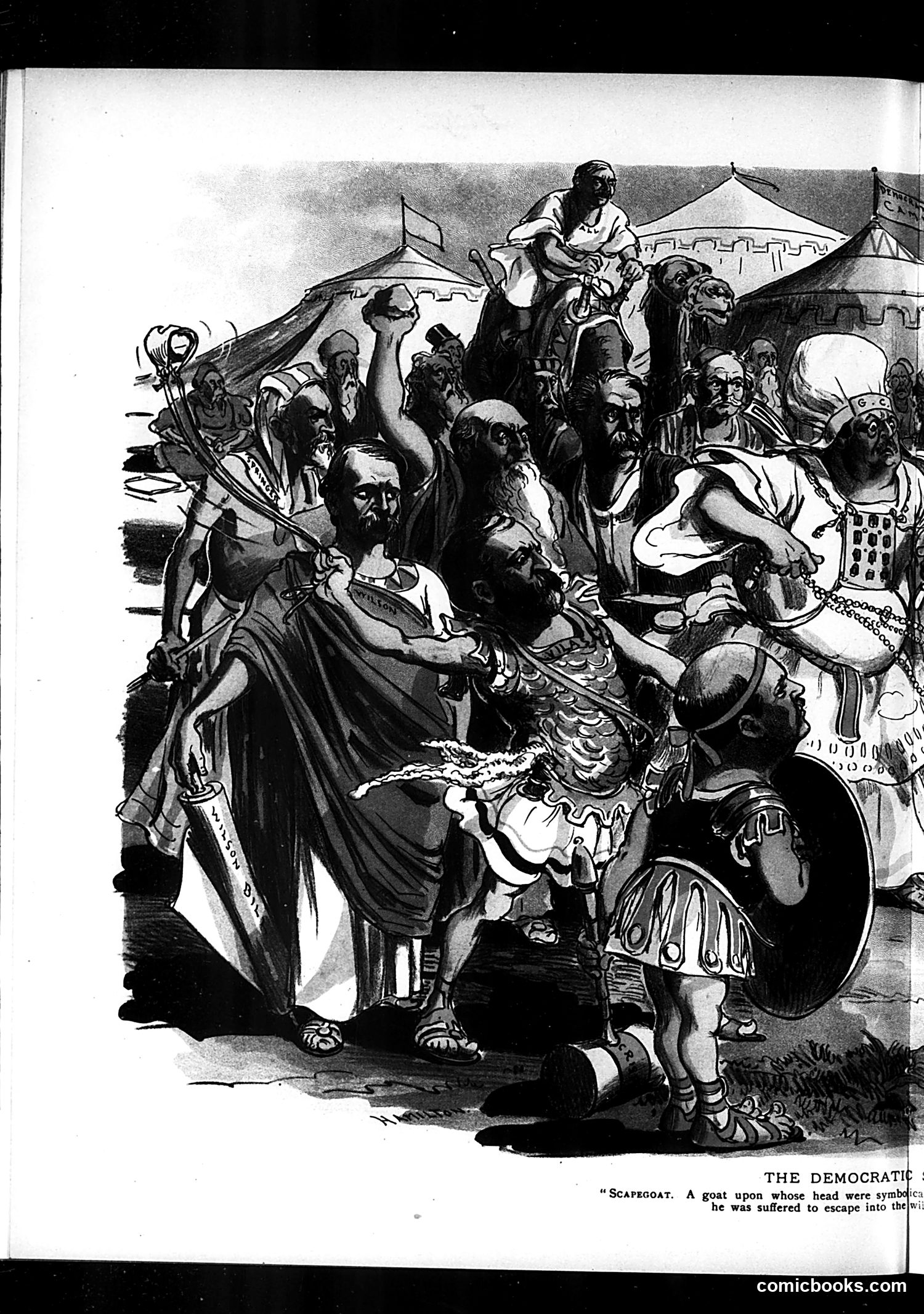
This political cartoon uses the biblical scapegoat metaphor to satirize Democratic Party strategy. The image depicts a goat being driven into the wilderness by a crowd of figures—likely representing Democratic leadership or the party apparatus. The caption references the ancient Jewish ritual where sins were symbolically placed upon a goat's head before it was released into the desert. The cartoon suggests Democrats are using a figurative "scapegoat"—possibly a person or policy—to deflect blame or controversy from themselves. The crowded, chaotic scene with various dressed figures implies party infighting or the collective effort to expel blame. Without a visible date, the specific target remains unclear, but the satire criticizes Democratic tactics of deflection rather than accountability.
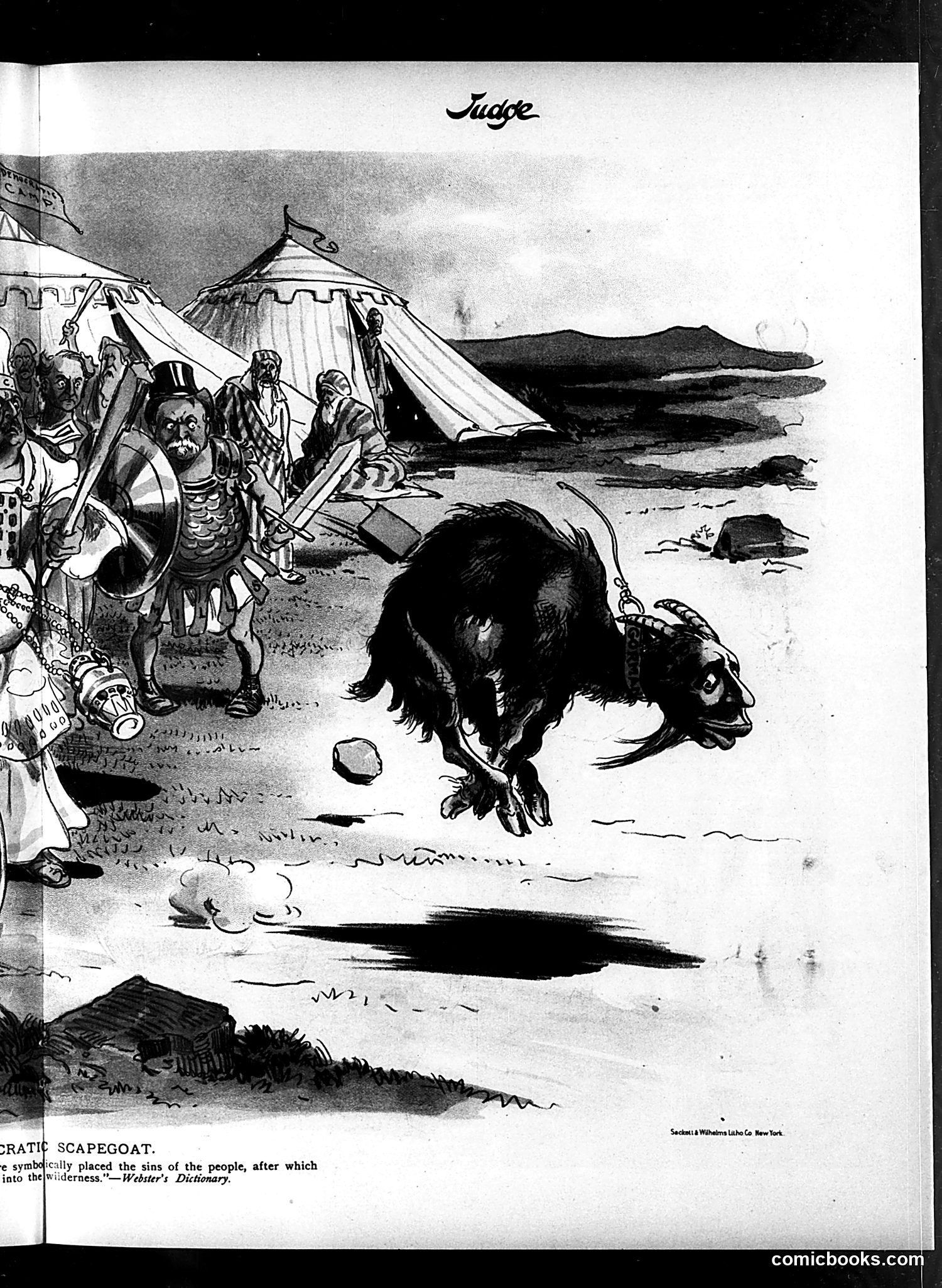
This political cartoon illustrates the biblical concept of the scapegoat—a figure onto which society projects its problems before casting them out. The image shows a goat being driven away from a gathered crowd near a military encampment, with tents and soldiers visible in the background. The satirical point appears to be commentary on how societies (or governments) identify and blame a single entity for widespread problems, then exile or punish that figure to cleanse themselves symbolically. The Webster's Dictionary definition quoted reinforces this interpretation: the scapegoat historically carried "the sins of the people" into the wilderness. Without additional context about Judge magazine's publication date or specific political events, the exact target of this satire remains unclear—it could reference any contemporary political or military figure serving as a convenient blame-bearer for national troubles.
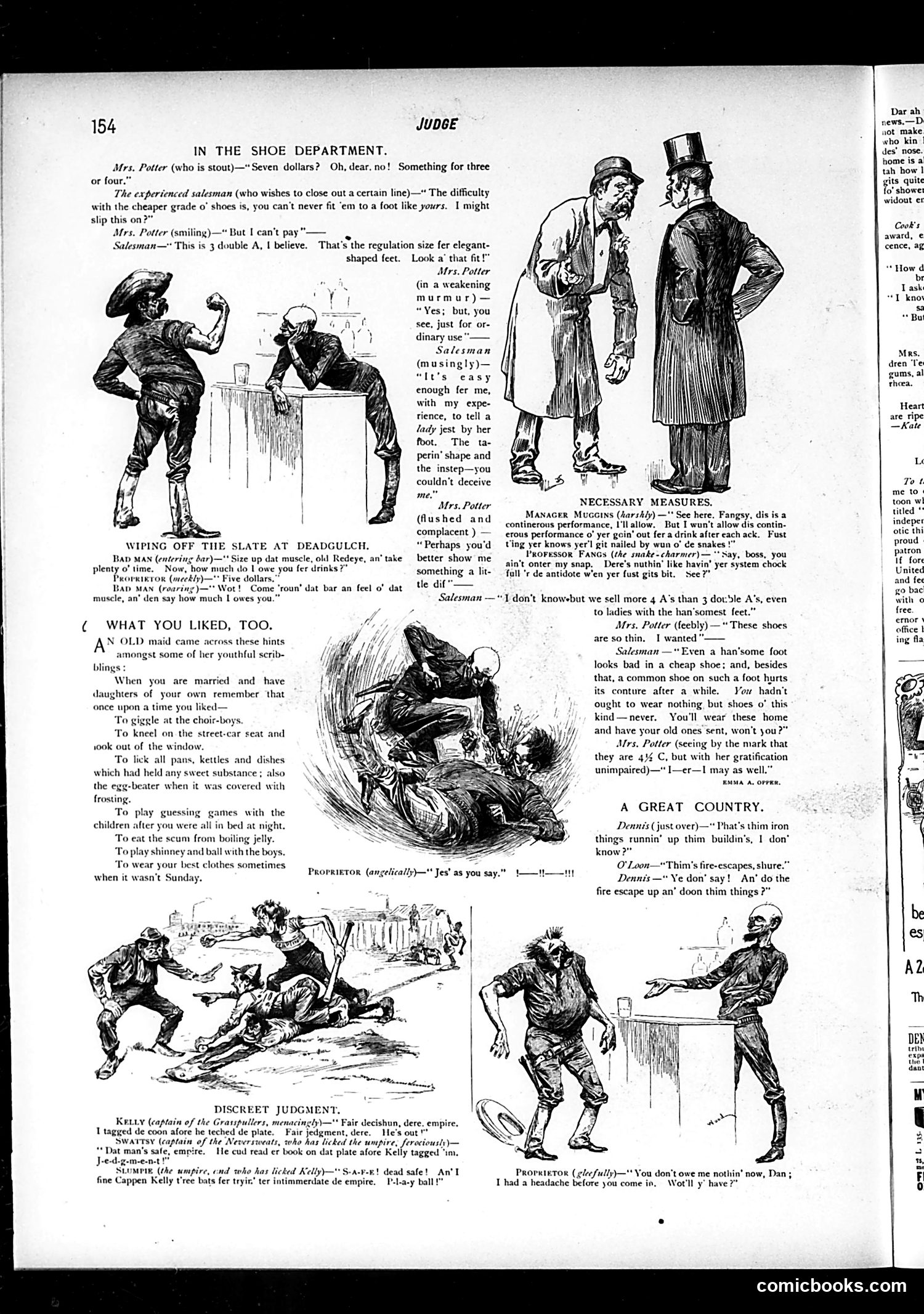
This page from *Judge* contains several satirical sketches about American life, likely from the late 19th century: **"In the Shoe Department"**: A salesman manipulates a vain, overweight customer (Mrs. Potter) into buying expensive shoes by flattering her foot as "elegant-shaped" when she clearly wears a larger size. The satire targets both consumer vanity and deceptive retail sales tactics. **"Discreet Judgment"**: Baseball umpires argue over a play call while pretending to maintain authority—satirizing both the sport's competitive chaos and officials who lack confidence in their own decisions. **"A Great Country"**: Irish immigrants (Dennis and O'Loon) discuss fire escapes, with one humorously confused about their function. This gently mocks immigrant unfamiliarity with modern urban infrastructure. **"Necessary Measures"**: A circus manager warns a snake-charmer against leaving his post, fearing accidents. Dark humor about workplace safety. The sketches use exaggerated dialect and character types common to period satire, targeting consumer culture, sports absurdity, and social stereotypes.
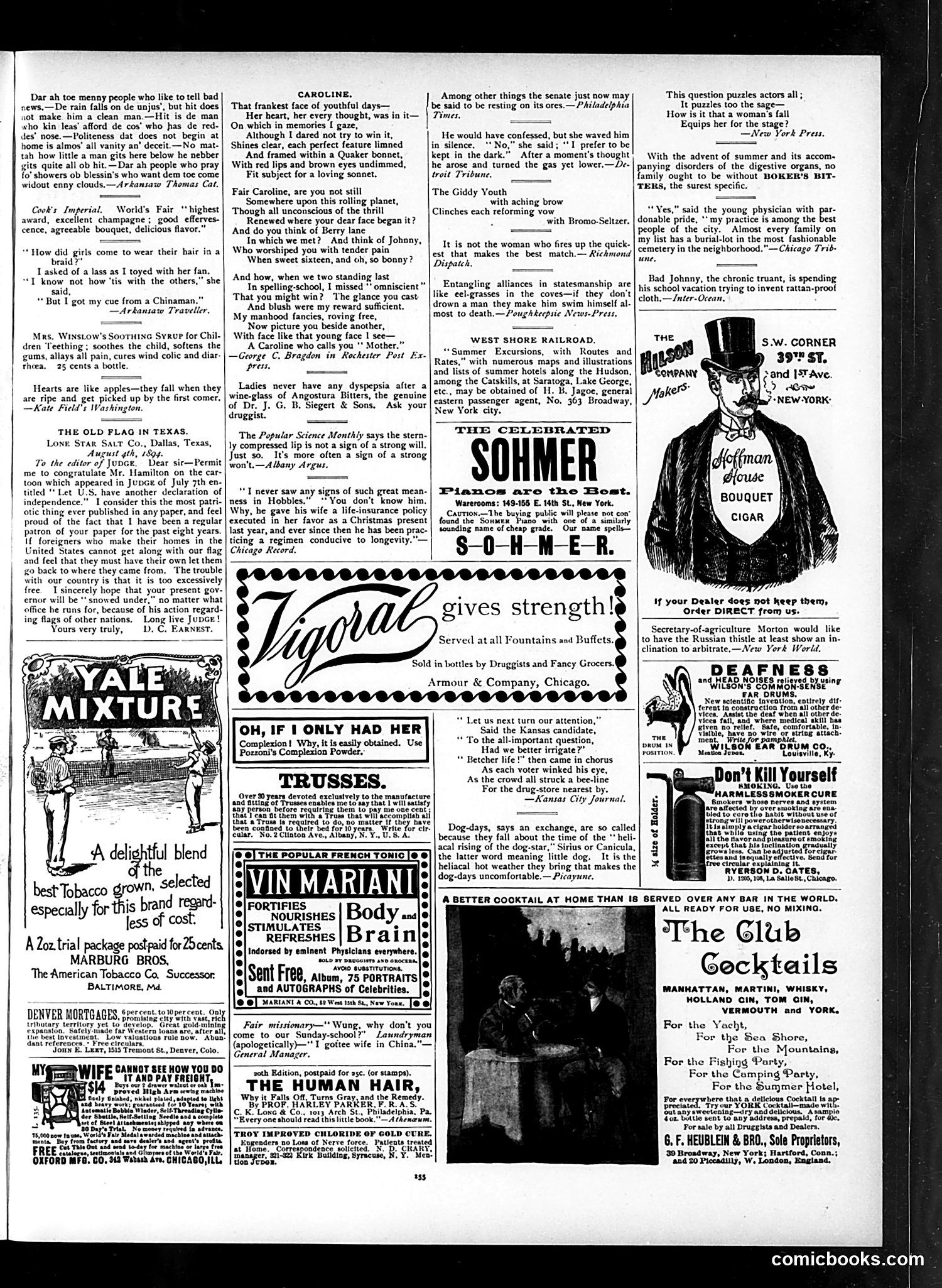
This is primarily an **advertising and miscellaneous content page** rather than a political cartoon page. The page contains various short humorous pieces, product advertisements, and personal letters to the editor. **Notable content includes:** - **"The Old Flag in Texas"** letter praising Judge's earlier anti-immigrant cartoon criticizing foreign nationals who won't adopt American flags - Various **product ads** (alcohol, tobacco, medicines, farm equipment) typical of 1890s publications - **Humorous poetry and quips** about relationships and daily life - An **ad for Vigoral tonic** claiming to give "strength" - **Club Cocktails advertisement** listing mixed drinks The letter writer explicitly endorses a prior Judge cartoon opposing immigrants who maintain their national symbols, reflecting late-19th-century nativist sentiment. The overall page reflects Judge's mix of political opinion, satire, and commercial content serving middle-class readers of the 1890s.
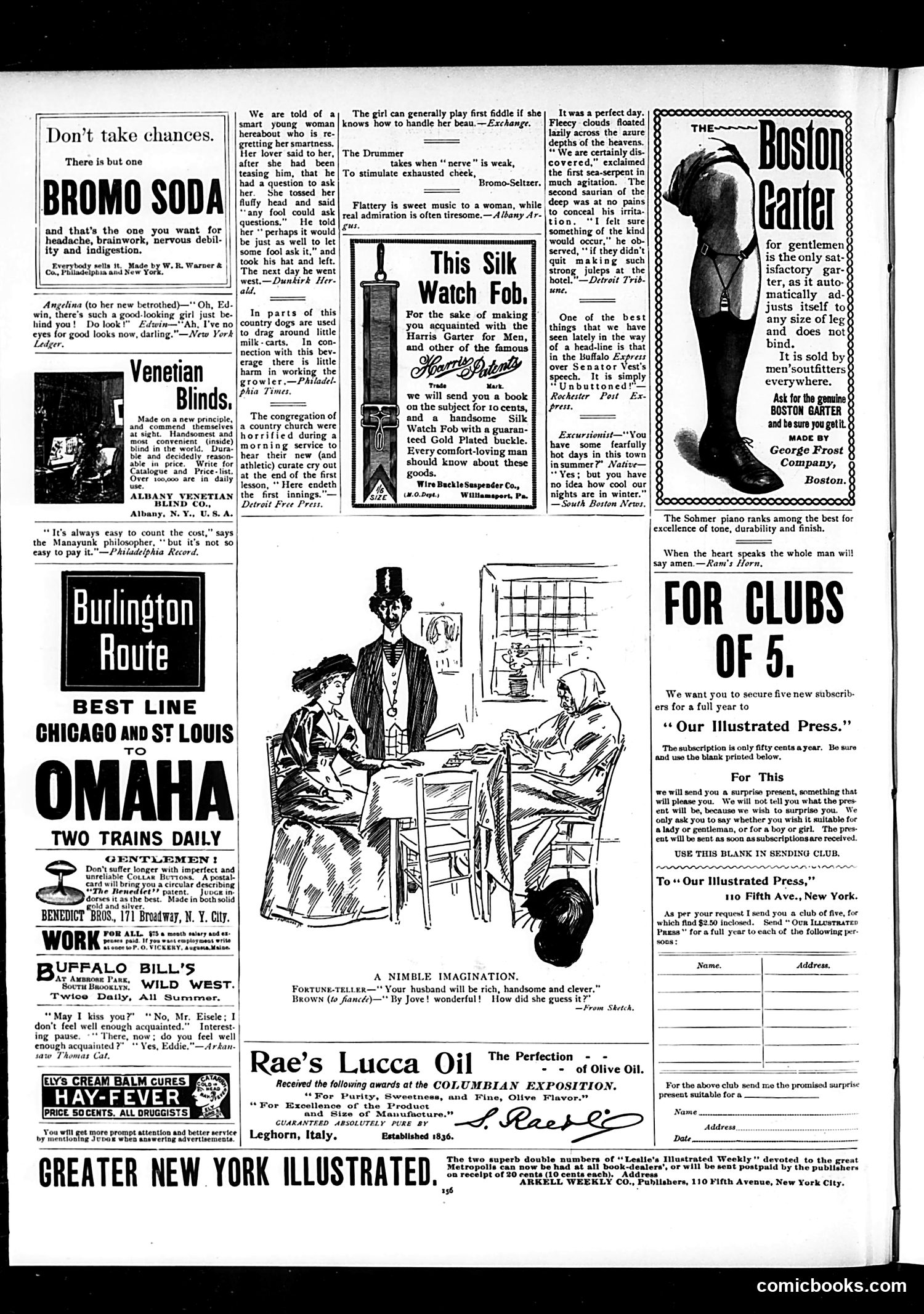
This is primarily an **advertising page** with minimal editorial cartoon content. The main visual humor appears in the small illustrated anecdotes scattered among ads. The central cartoon labeled "A NIMBLE IMAGINATION" depicts a fortune-teller scene—a common Judge trope mocking spiritualism and fortune-telling fraud. A con artist "fortune-teller" tells a woman her husband will be "rich, handsome and clever," to which the woman responds "By Jove! wonderful! How did she do it?"—the joke being that the fortune-teller has made an absurdly false or impossible prediction, satirizing both gullible clients and fraudulent psychics. Other small jokes scattered throughout mock contemporary social awkwardness: a suitor's deflection when his fiancée points out another attractive woman, and a man's persistence in courting despite being told he knows the woman insufficiently. The page is dominated by period advertisements for Bromo Soda, Venetian blinds, the Burlington railroad, Harris garters, Rae's Lucca Oil, and Buffalo Bill's Wild West show—typical early 20th-century Judge advertising.
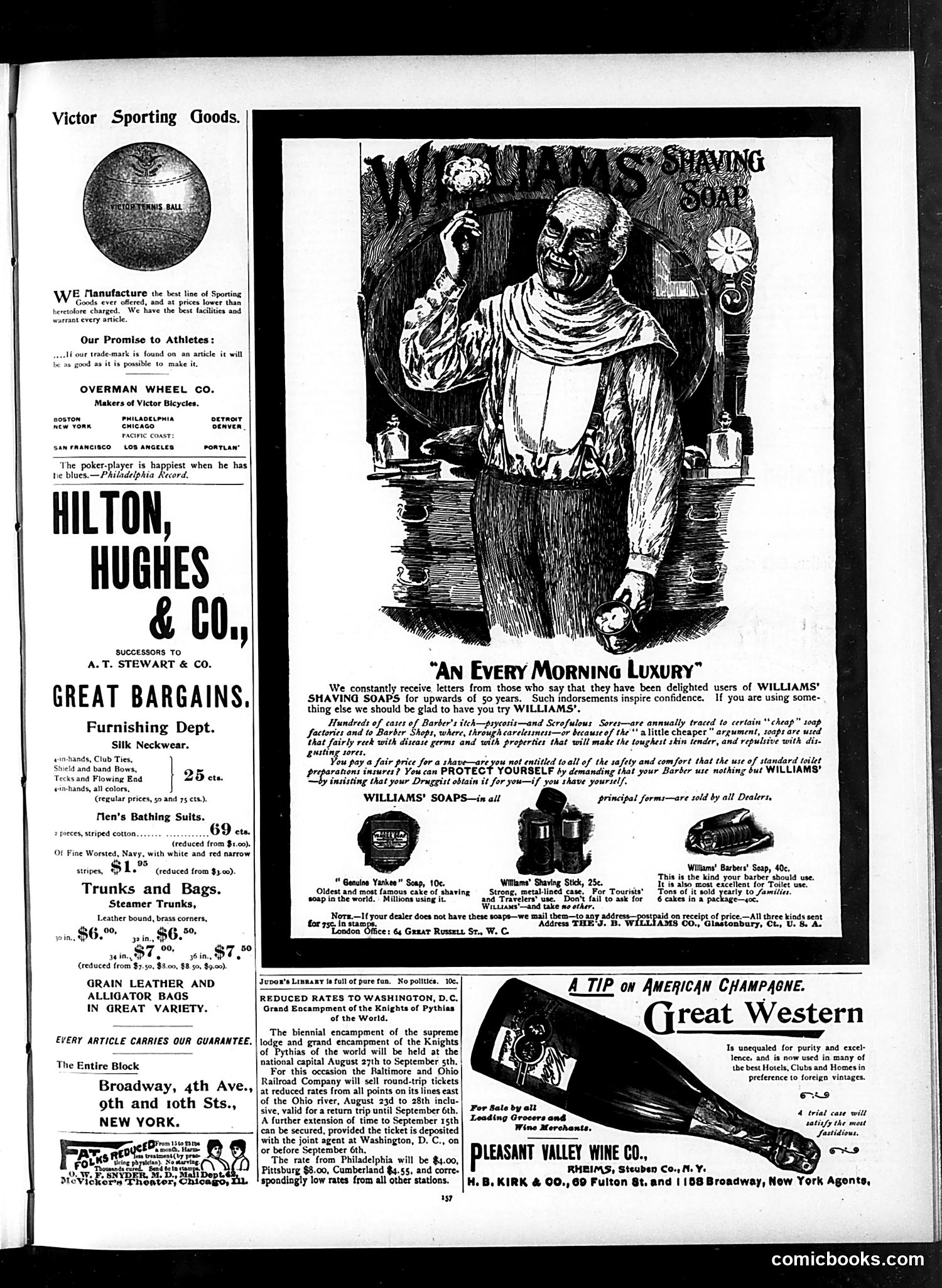
This page is primarily **advertising**, not political satire. The dominant image is a large advertisement for Williams' Shaving Soap, depicting a satisfied, beaming man at his shaving mirror, holding a brush aloft. The ad's pitch exploits **health anxieties of the era**: it warns that cheap soaps from barber shops spread disease ("disease germs") and cause conditions like "Barber's itch" and scrofulous sores. By contrast, Williams' products—used for "upwards of 50 years"—offer safety and quality. The page also contains typical period advertising for Victor Sporting Goods bicycles, Hilton Hughes & Co. furnishings, and a Great Western champagne endorsement. A small note mentions reduced railroad rates to a Knights of Pythias convention in Washington, D.C. There is no significant political cartoon or satire visible on this page.
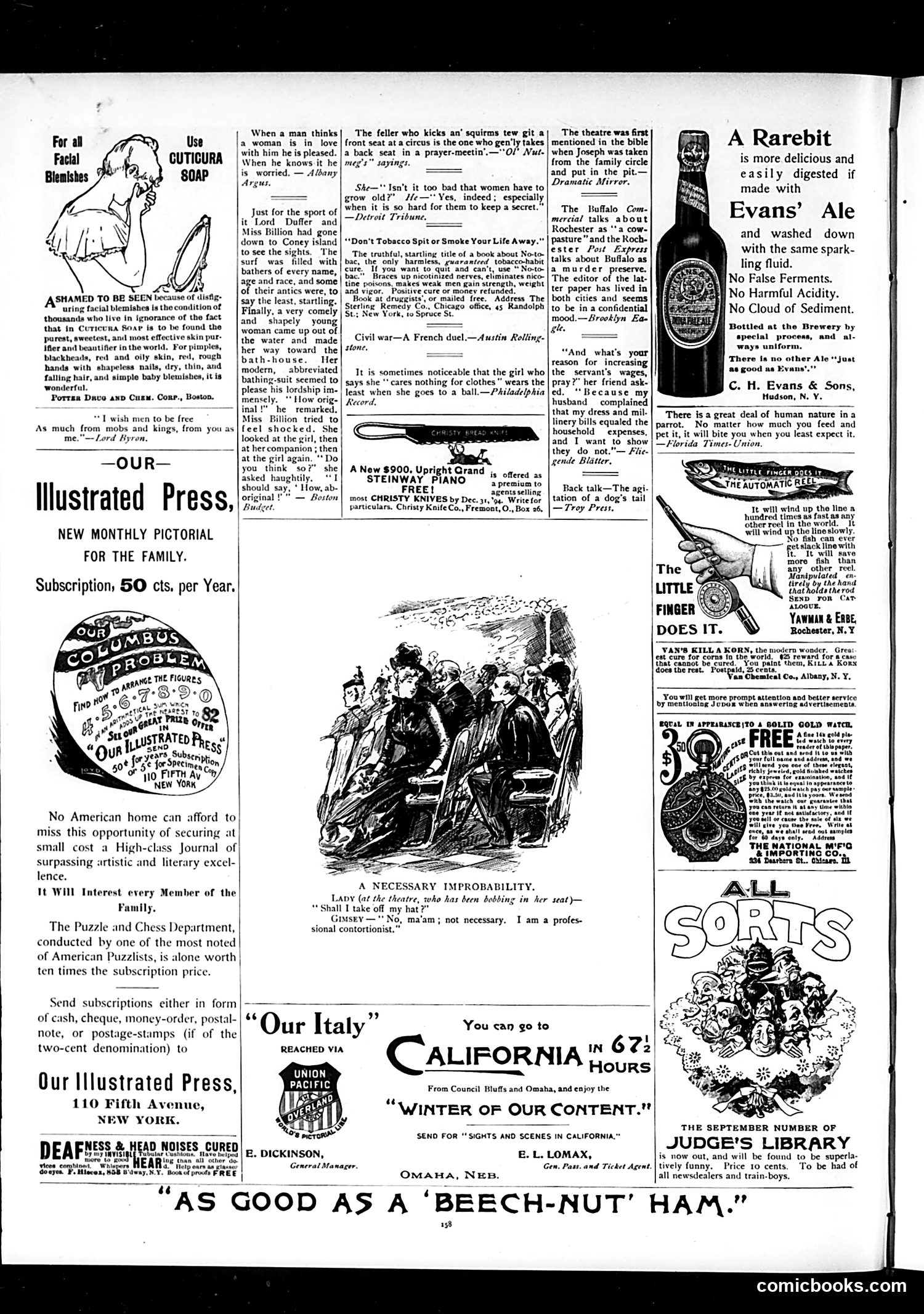
This page from the satirical magazine *Judge* contains multiple short jokes and advertisements typical of early 20th-century American humor publications. The main cartoon, "A Necessary Impropriety," depicts a fashionable woman at the theater making an indecent proposal to a man—she offers to "take off my hat" during the performance. The joke plays on contemporary social anxieties: women's large, elaborate hats were notorious for blocking theater audiences' views, yet removing one's hat in public was considered scandalous behavior. The satire mocks both the absurdity of hat fashion and rigid social propriety. The surrounding text contains brief, cynical observations about gender relations—jokes about women's vanity, aging, and financial extravagance. These reflect *Judge*'s typical editorial stance: conservative, male-oriented humor targeting women's perceived frivolousness and expense. The page is predominantly advertisements for products (Cuticura Soap, Steinway pianos, tobacco cessation aids) interspersed with these short comic bits—standard *Judge* format.
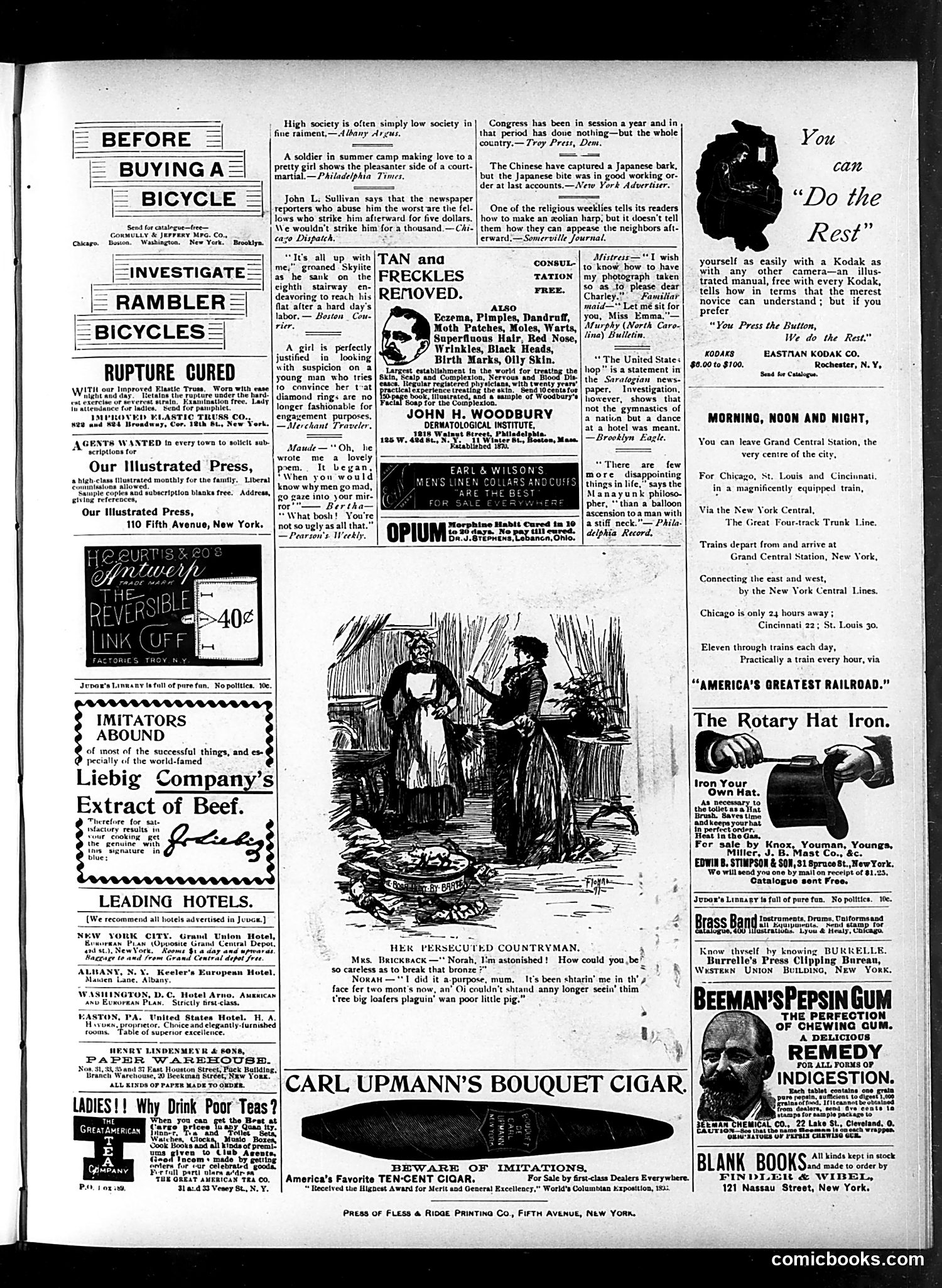
This page from *Judge* is primarily **advertising** with brief satirical commentary scattered throughout. The main cartoon depicts "Her Persecuted Countryman"—a woman confronting what appears to be an Irish immigrant ("Noah"), humorously capturing anti-Irish sentiment common in late 19th-century America. The joke concerns domestic labor disputes and ethnic tension in American households. The text snippets are short, topical jabs: one mocks Congress's ineffectiveness; another ridicules newspaper reporters who criticized boxer John L. Sullivan; a third jokes about religious advice columns offering impractical domestic solutions. Most of the page consists of advertisements for bicycles, dermatological treatments, Kodak cameras, hotels, and other consumer products—typical of *Judge*'s mixed editorial and commercial content. The Kodak ad's famous slogan "You Press the Button, We do the Rest" is prominently featured, reflecting turn-of-the-century marketing strategies.
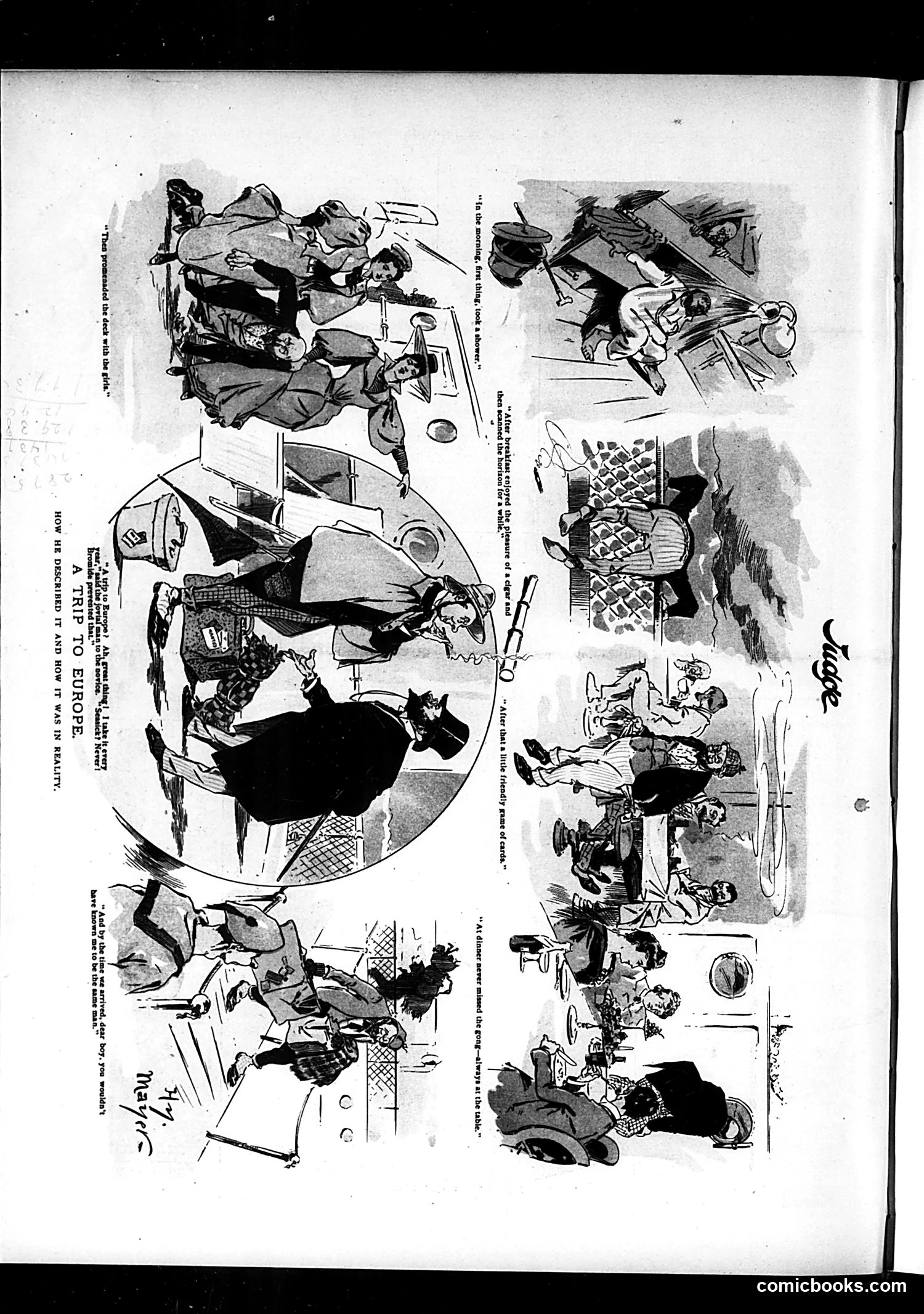
This page presents a satirical "before and after" comparison of a wealthy man's account of a European voyage. The left circular panel shows his romanticized version: leisurely cigar-smoking, scanning horizons, promenading with young women on deck, and boasting about never getting seasick. The right panels depict reality: the man appears disheveled and miserable, surrounded by chaos—seasickness, cramped conditions, and undignified suffering. The satire targets the pretentious exaggeration common among wealthy travelers who embellished their experiences to appear more cultured and refined than their actual circumstances warranted. This reflects Gilded Age social anxiety about leisure travel as a status marker, mocking how the affluent constructed false narratives of elegant European tourism while enduring the unglamorous reality of ocean voyages.