
A complete issue · 16 pages · 1894
Judge — July 21, 1894
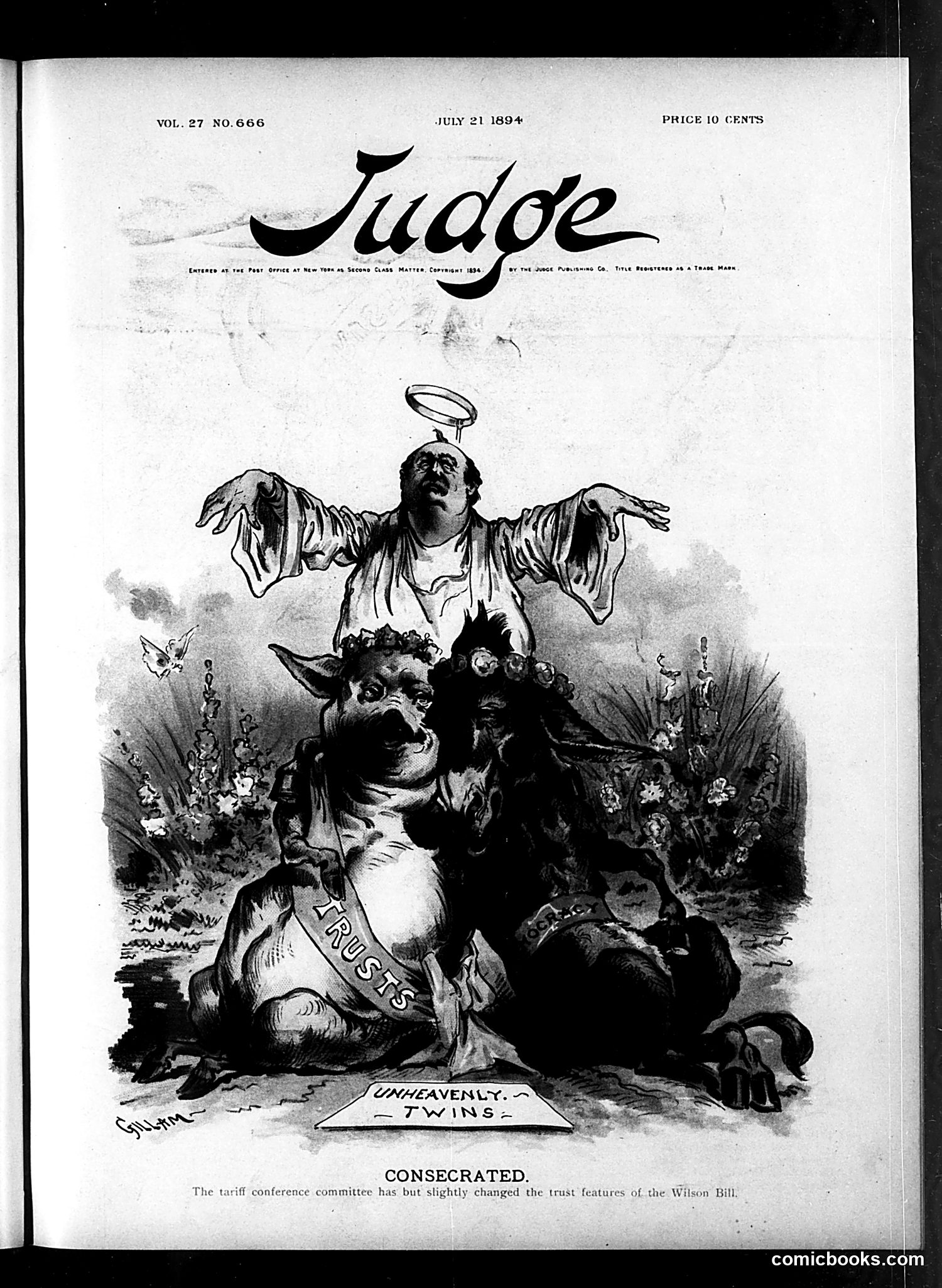
**The Cartoon: "Unheavenly Twins - Consecrated"** This political satire depicts an angel figure hovering above two demonic creatures labeled "Trusts." The angel wears robes and a halo, while the demons below are labeled with "TRUSTS." The caption reads: "The tariff conference committee has but slightly changed the trust features of the Wilson Bill." **Meaning:** The cartoon criticizes the tariff conference committee for failing to adequately address corporate monopolies (trusts). Despite legislative efforts through the Wilson Bill to regulate these business combinations, the committee's revisions appear ineffective—the "trusts" remain essentially unchanged, portrayed as unholy demons. The satire suggests that political maneuvering produced cosmetic changes rather than substantive reform, leaving dangerous monopolistic practices intact.
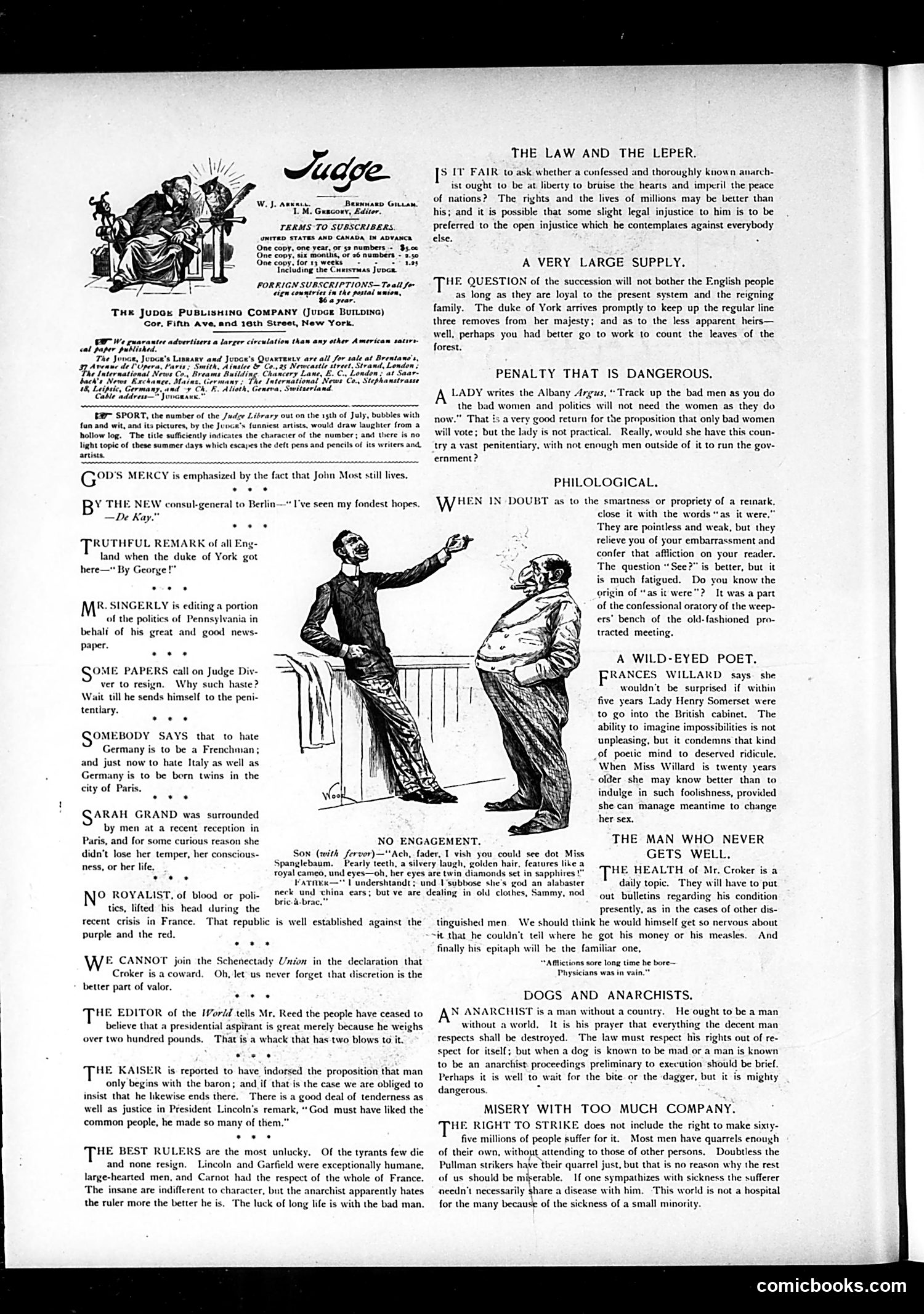
This page from Judge presents a satirical column format rather than a single political cartoon. The main illustrated piece shows two figures in conversation at what appears to be a formal setting, though the specific identities remain unclear from the image alone. The text snippets employ Judge's typical format: brief, punchy satirical commentaries on contemporary politics and society. Topics include anarchism ("an anarchist is a man without a country"), labor strikes, German-Italian relations, and judicial matters. The writing style is characteristically sardonic, using rhetorical questions and paradoxes to mock public figures and political movements. Without clearer identification of specific figures or dated references in the visible text, the precise satirical targets are difficult to pinpoint, though the content appears to address fin-de-siècle political anxieties common to Judge's audience.
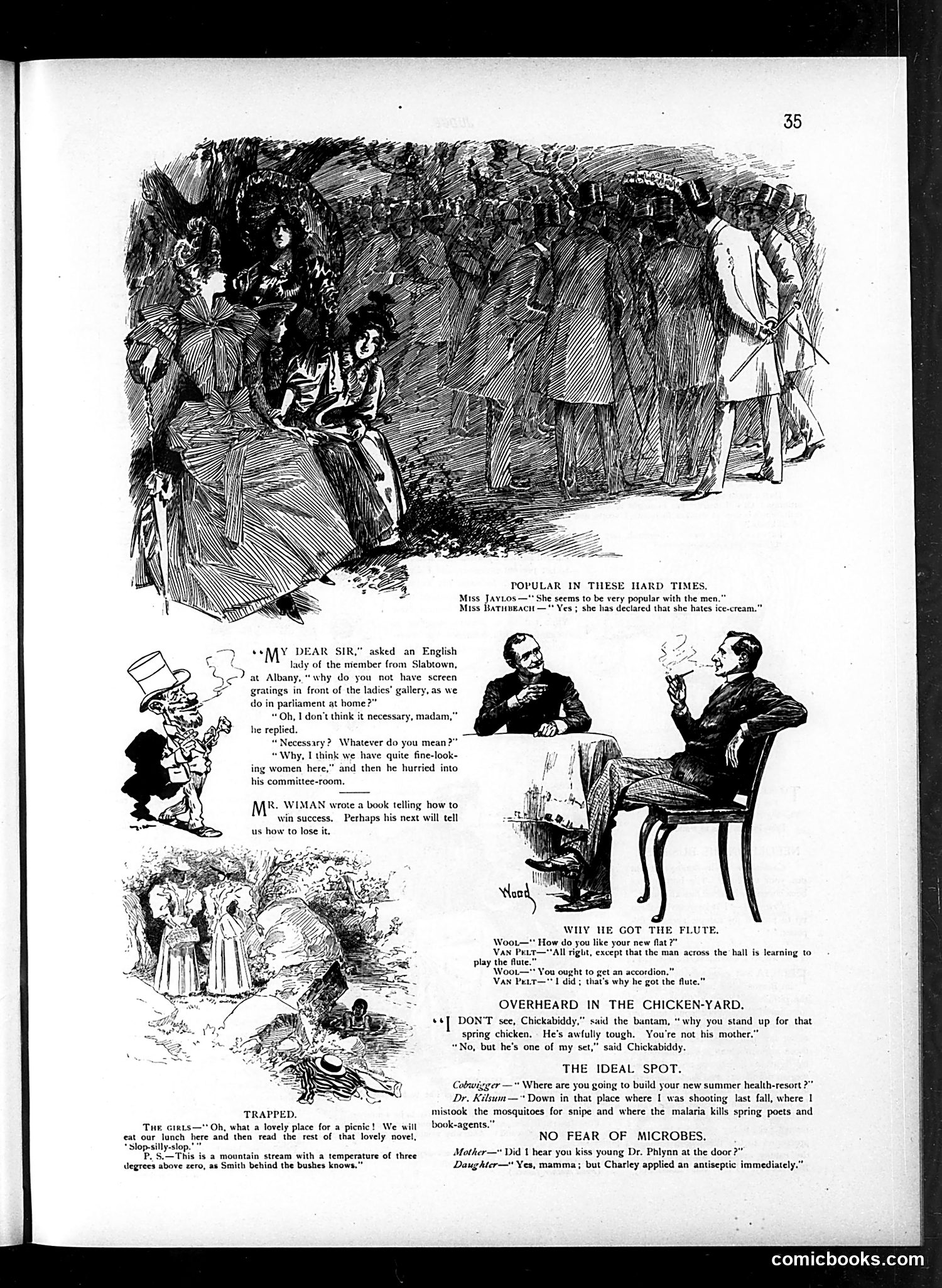
This page contains multiple satirical vignettes mocking contemporary social situations. The top cartoon shows "Popular in These Hard Times," contrasting Miss Jaylors's success with men against Miss Batherson's declaration that "she has ice cream." Other sketches humorously address middle-class concerns: a discussion about parliamentary seating arrangements, a book about achieving success, and marital dynamics around learning the flute. The "Overheard in the Chicken-Yard" and "No Fear of Microbes" sections use anthropomorphized characters and domestic situations for social commentary. The "Trapped" vignette satirizes young women eager for outdoor recreation. Overall, these interconnected jokes target Victorian-era social pretensions, gender relations, and the anxieties of respectable society—typical of Judge's satirical approach to American life.
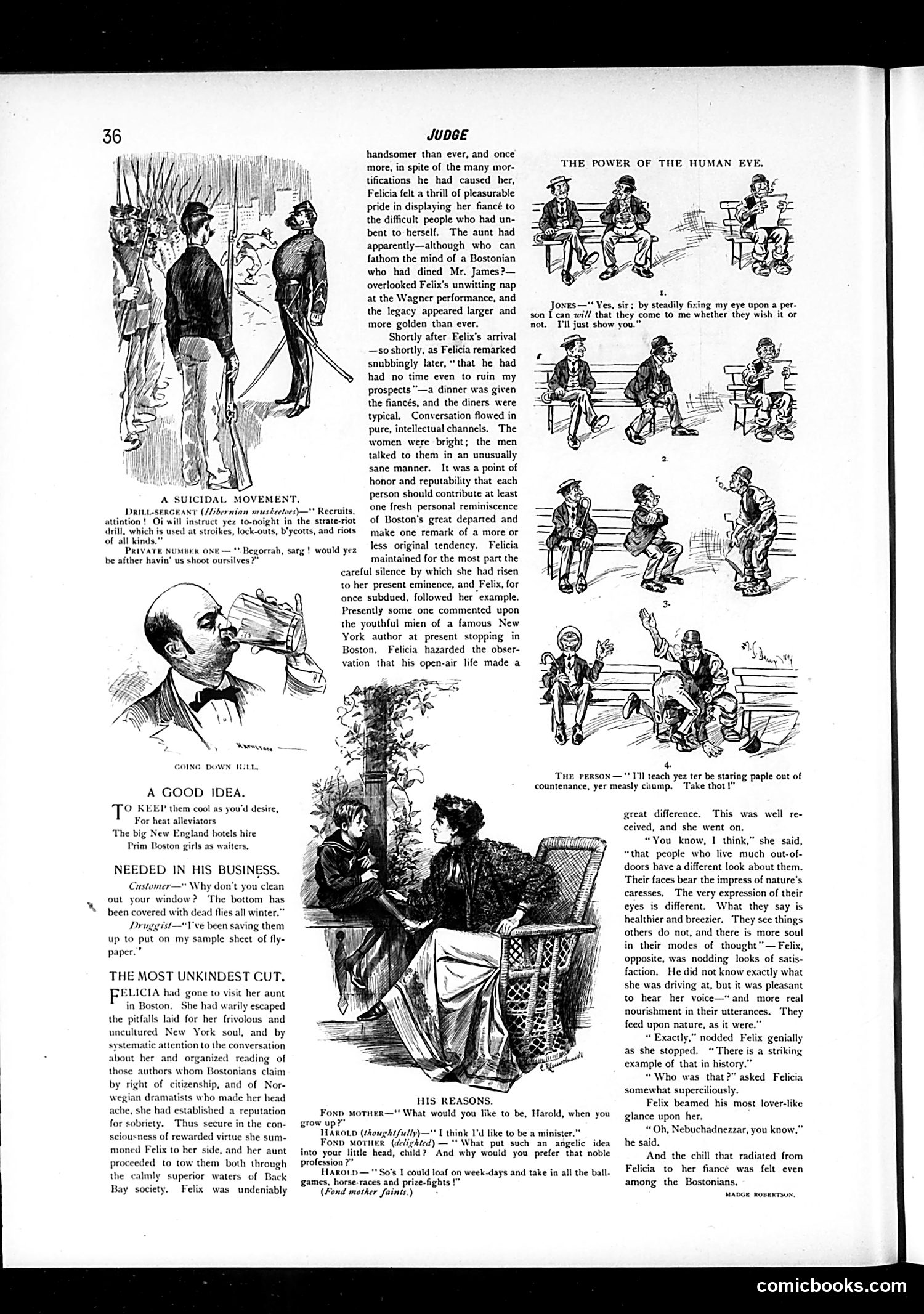
This Judge magazine page contains several unrelated satirical items typical of the era: **Main narrative**: "A Suicidal Movement" follows Felicia, a New York woman who visits Boston society. She's established herself as intellectually serious to impress her aunt, then summons her fiancé Felix. At a dinner, Felicia makes an observation about outdoor living giving people a healthier appearance and "more soul"—a pretentious comment typical of Boston's intellectual circles. Felix nods approvingly though he doesn't understand. **The satire**: Mocks both New York frivolousness and Boston's self-conscious intellectualism. Felicia's adoption of "serious" Boston manners is presented as amusing affectation. **Side items**: Brief jokes about Irish immigrant drill sergeants, Boston hotel waiters, a druggist's fly-paper samples, and a child's career aspirations—standard period humor with ethnic and class stereotypes. **Context**: This reflects turn-of-century American regional tensions and class anxieties about displaying cultural sophistication.
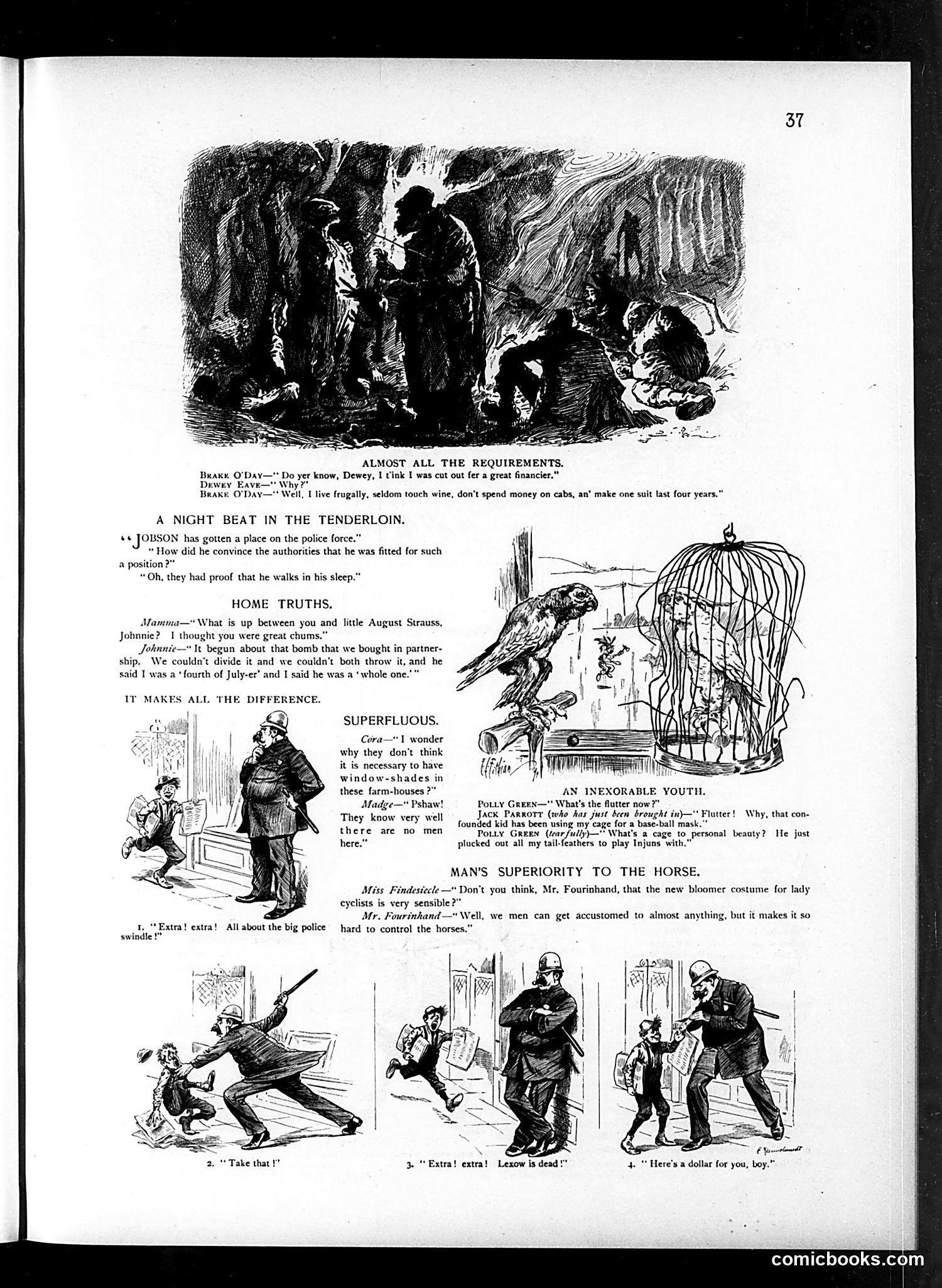
This page contains several satirical sketches mocking contemporary social types and behaviors circa early 1900s. **"Almost All the Requirements"** ridicules a man claiming financial aptitude while describing penny-pinching habits—the joke being that frugality alone doesn't make a financier. **"A Night Beat in the Tenderloin"** (the Tenderloin being NYC's vice district) jokes that a sleepwalker was hired as a police officer, suggesting corruption or incompetence in police recruitment. **"Home Truths"** depicts children arguing over a toy bomb, with one calling the other a "fourth of July-er"—likely referencing dangerous fireworks behavior on Independence Day. **"Man's Superiority to the Horse"** presents a conversation between a woman in bloomers (scandalizing new bicycle attire) and a man claiming men's superiority, then undermining himself by admitting he struggles controlling horses—the satire mocking male vanity. The bottom comic strip shows a policeman cuffing a child, suggesting brutal law enforcement, with captions about police corruption ("big police swindle").
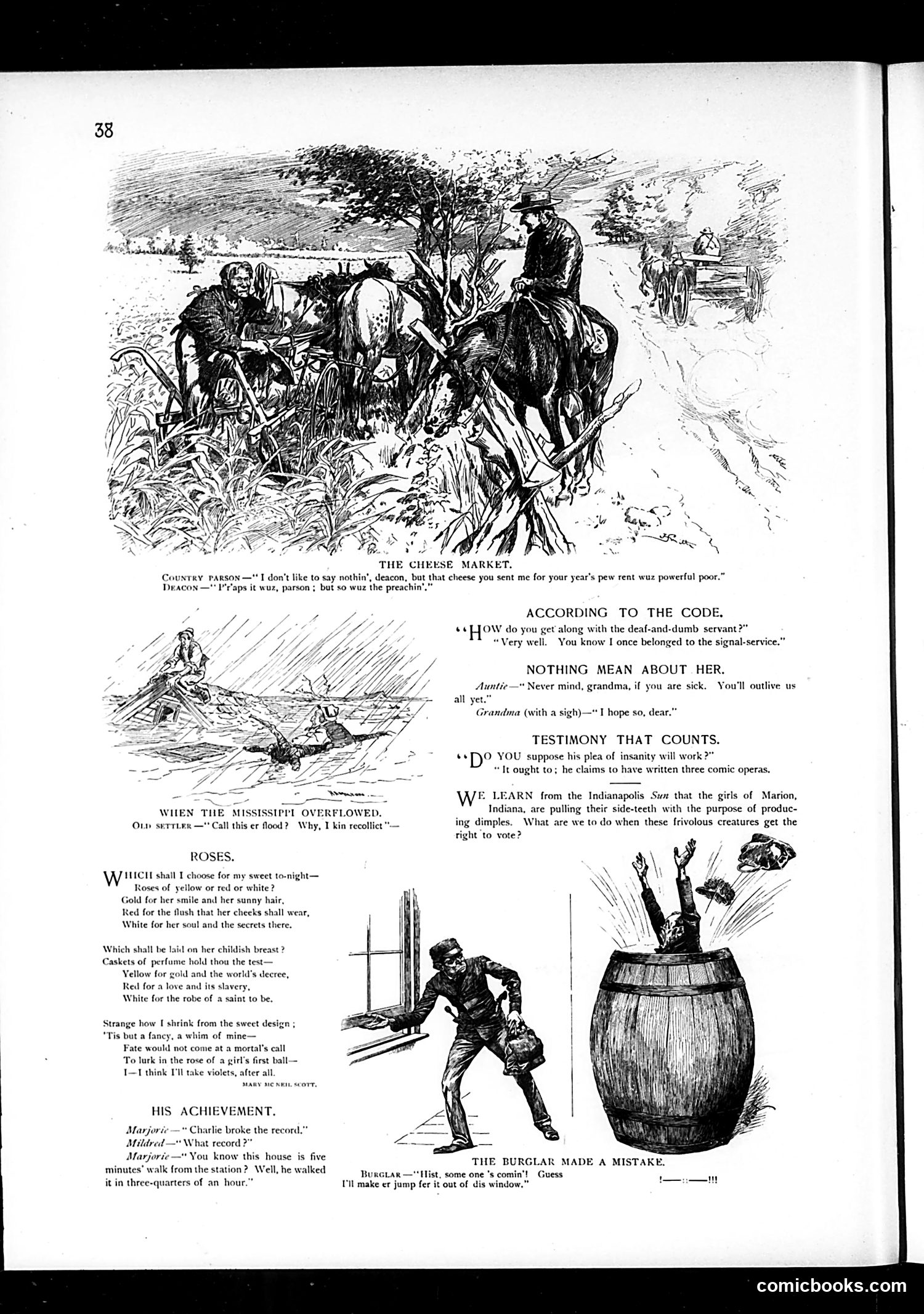
This page contains six separate satirical pieces typical of late-19th-century American humor: **"The Cheese Market"** mocks rural clergy—a parson complains the deacon's cheese rent payment was poor quality, mirroring the parson's own weak preaching. **"According to the Code"** jokes about hiring deaf-and-dumb servants, with a man claiming expertise from prior "signal-service" work (military signaling). **"Nothing Mean About Her"** presents dark humor about elderly relatives, with a grandmother hoping to outlive younger family members. **"Testimony That Counts"** satirizes insanity pleas in court, suggesting writing comic operas proves mental illness. **"We Learn..."** expresses anxiety about women's suffrage, mocking an Indiana newspaper report that girls are extracting teeth to create dimples—questioning whether such "frivolous creatures" deserve voting rights. **"Roses"** is sentimental poetry about choosing flowers for a sweetheart. **"His Achievement"** and **"The Burglar Made a Mistake"** are brief humorous anecdotes. The page reflects period anxieties about women's rights, rural-urban divides, and class distinctions.
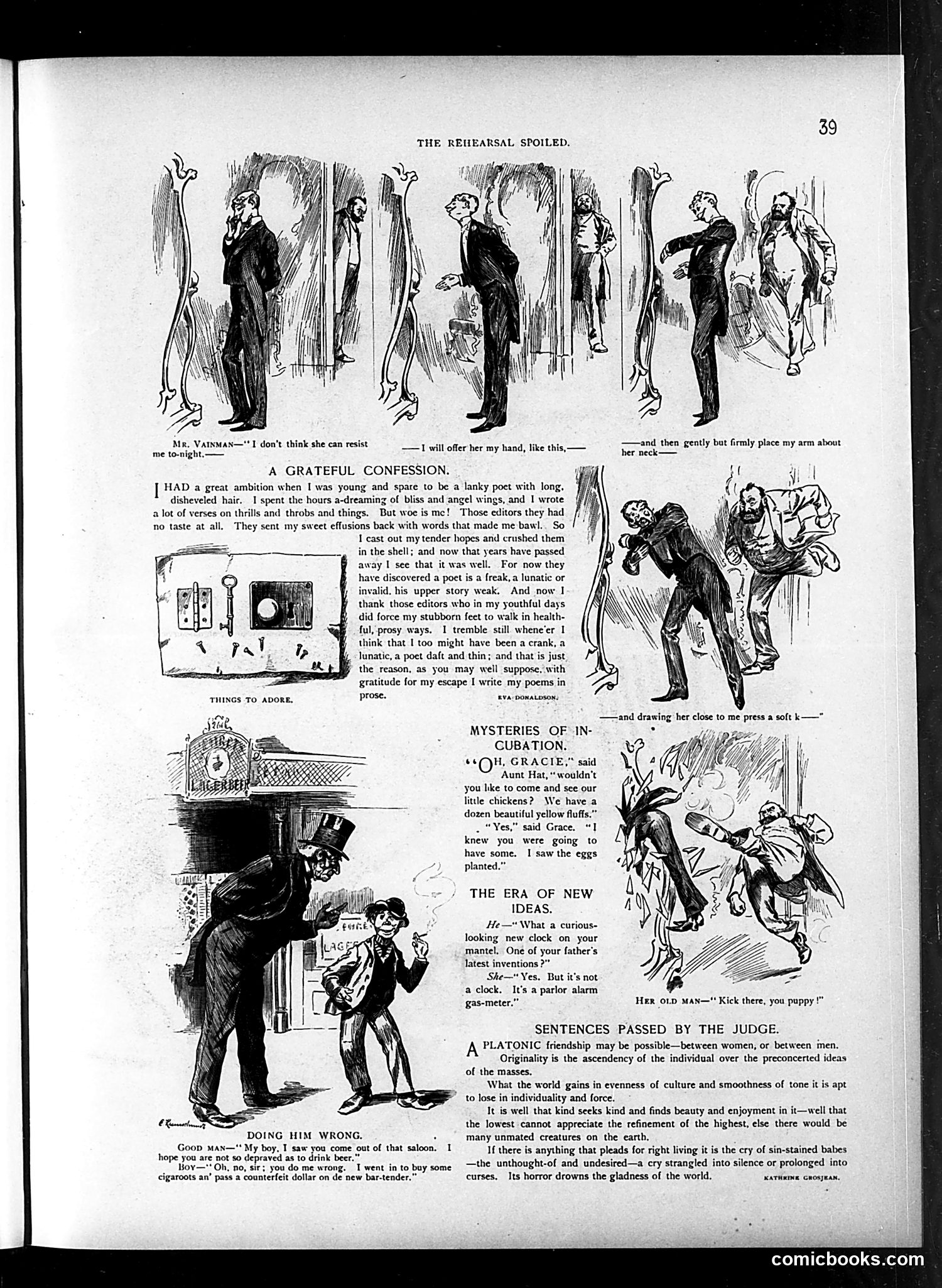
This page contains multiple satirical pieces typical of late 19th/early 20th-century American humor: **"The Rehearsal Spoiled"** depicts men rehearsing romantic gestures—offering hands and embracing—suggesting theatrical artificiality in courtship rituals that were likely already becoming dated or ridiculous. **"A Grateful Confession"** is an ironic essay where a failed young poet thanks editors for rejecting his work, claiming their dismissal saved him from becoming a "crank" or "lunatic"—satirizing contemporary attitudes that viewed sensitive poets and artists as mentally unstable or socially unfit. **"Mysteries of Incubation"** jokes that a child believes eggs must be "planted" like seeds, playing on rural/urban knowledge gaps. **"The Era of New Ideas"** mocks overly complicated modern inventions—a "parlor alarm gas-meter" disguised as a clock. **"Doing Him Wrong"** depicts class comedy: an Irish immigrant boy caught with a counterfeit dollar, using dialect humor common to period satire. The page emphasizes Judge's recurring themes: courtship pretense, artistic failure, technological absurdity, and ethnic stereotyping.
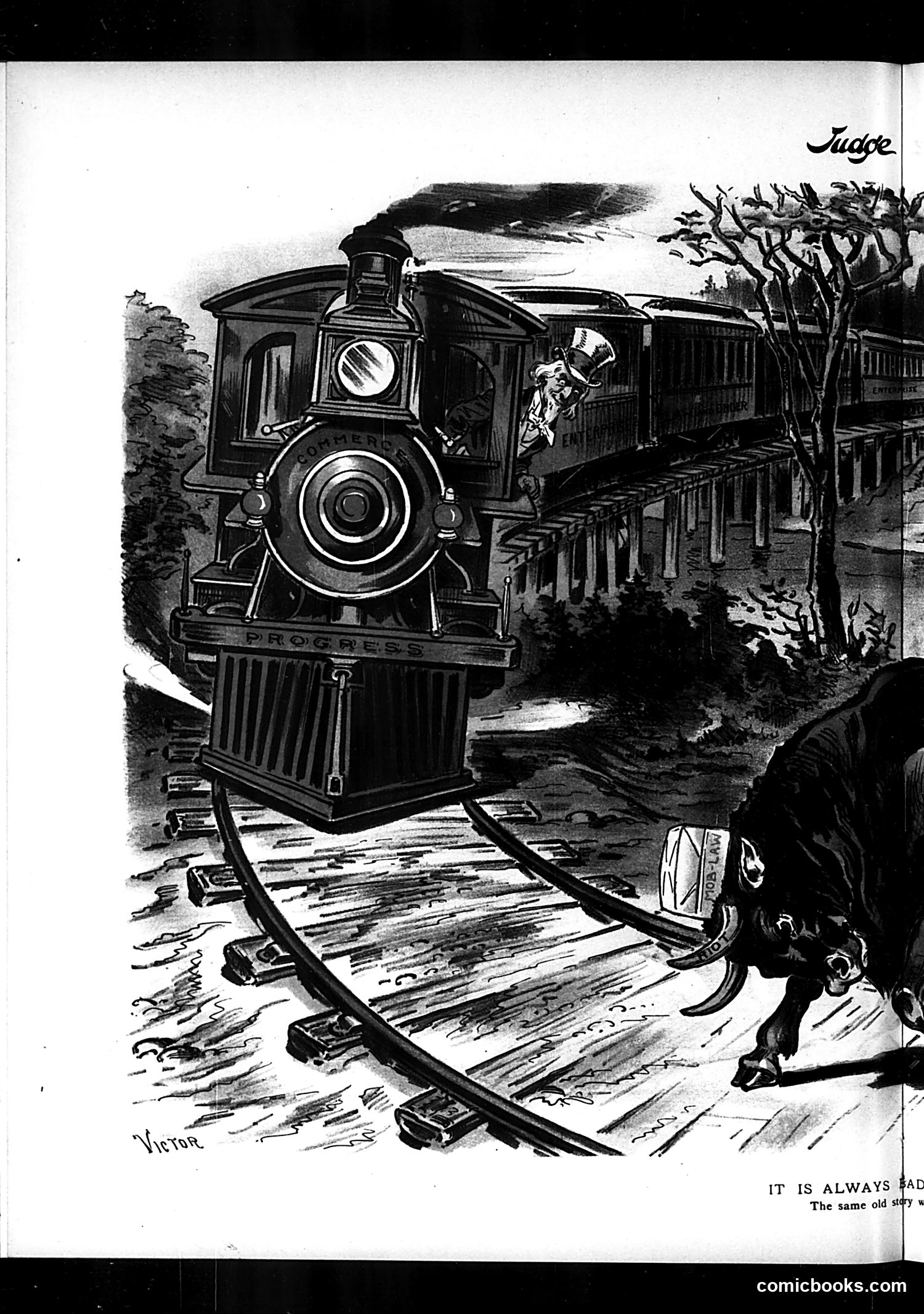
This appears to be a political cartoon by Victor (the artist's signature visible lower left) depicting a steam locomotive labeled "PROGRESS" on railroad tracks. A figure leans from the locomotive cab while a dog stands on the tracks ahead. The incomplete caption reads "IT IS ALWAYS BAD / The same old..." suggesting commentary on recurring problems or cyclical issues. The cartoon likely critiques how progress or reform efforts repeatedly encounter the same obstacles or resistance—symbolized by the dog blocking the tracks. The locomotive represents forward momentum, while the dog may represent entrenched opposition, public apathy, or institutional inertia. Without the complete caption text, the specific political target remains unclear, though the theme suggests commentary on failed or repeatedly-stalled reform efforts common to early 20th-century American politics.
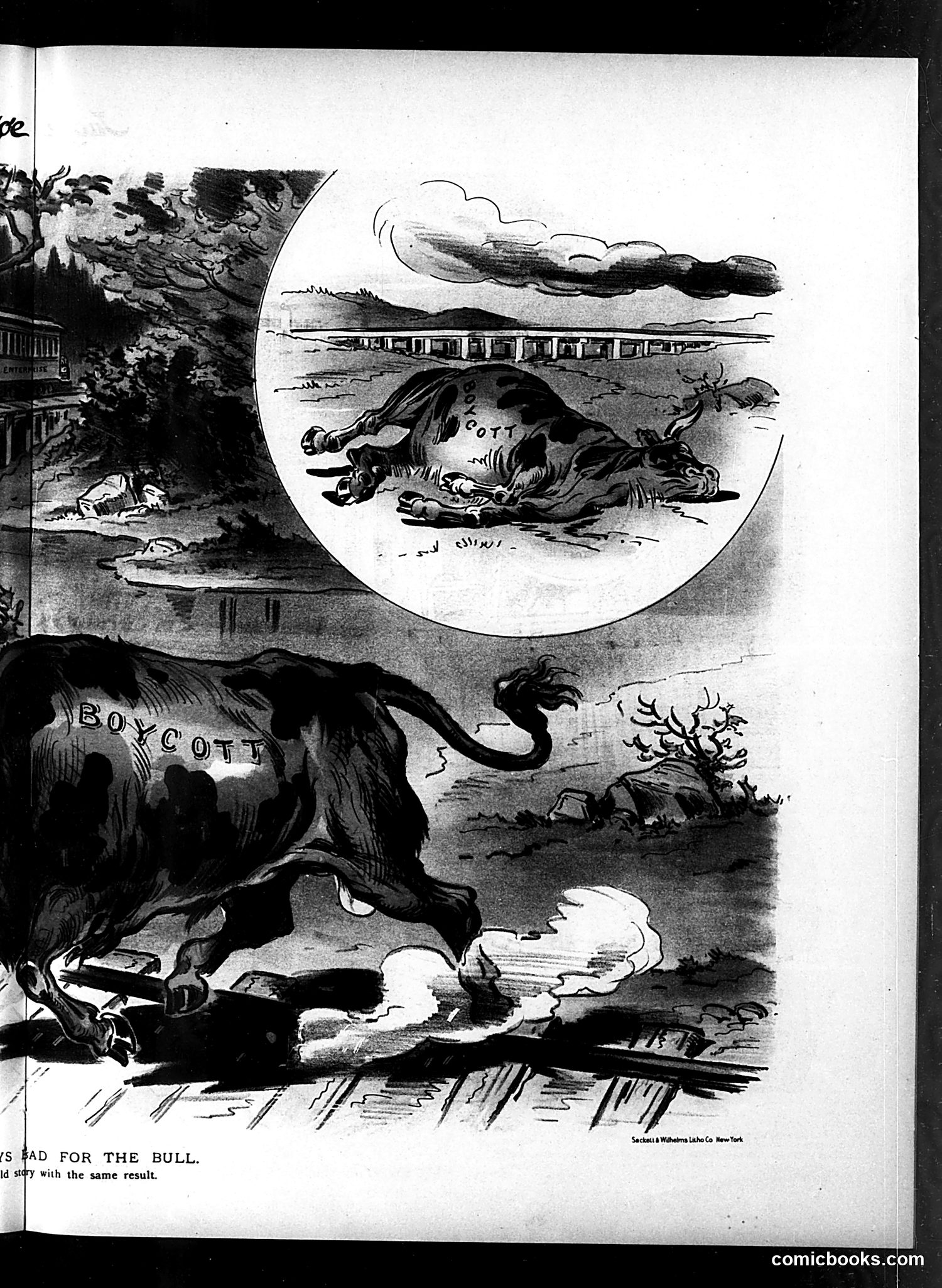
This appears to be a satirical cartoon from *Judge* magazine depicting a scenario labeled "BAD FOR THE BULL." The image shows a bull labeled "COTT" (likely referring to a political or business figure of the era) in two scenes: one imagined/dreamed (in the circular vignette showing a train) and one actual, where the bull appears injured or defeated on the ground. The text references the bull meeting "the same result," suggesting parallel outcomes—perhaps commenting on inevitably negative consequences for whoever "Cott" represents. Without the full article context or date, the specific political reference remains unclear, though the bull is a common symbol for aggressive or bullish behavior/policies in editorial cartoons. The satire appears to mock someone's failed strategy or misguided confidence.
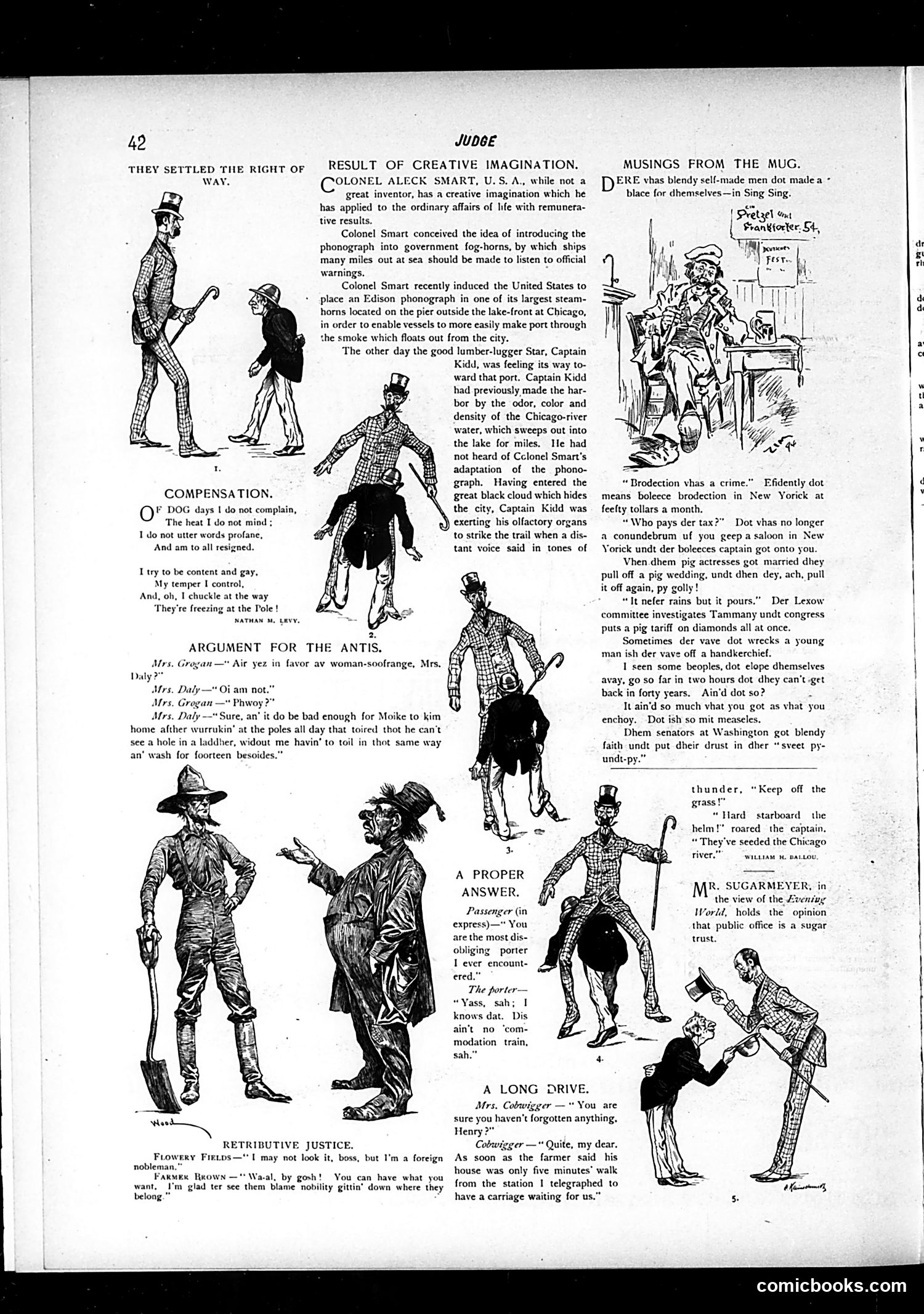
This page from Judge (a satirical weekly) contains multiple unrelated humor pieces typical of the era: **"Result of Creative Imagination"** mocks Colonel Aleck Smart's impractical invention: installing phonographs in Chicago's fog-horns to guide ships. The satire highlights the absurdity when Captain Kidd's ship receives only a phonograph recording of someone saying "Protection is a crime"—likely referencing Chicago's notorious police corruption. **"Argument for the Antis"** features Irish-immigrant characters (Mrs. Daly and Mrs. Grogan) opposing women's suffrage, with Mrs. Daly arguing women shouldn't vote because they're already overworked at home. **"Musings from the Mug"** contains brief jokes about Sing Sing prison, police protection rackets, Tammany Hall corruption, and the Lexow Committee (which investigated NYC political corruption). Other pieces mock foreign noblemen, porter etiquette, and marital life. The humor relies on ethnic stereotypes, contemporary scandals, and social commentary typical of 1890s Judge magazine.
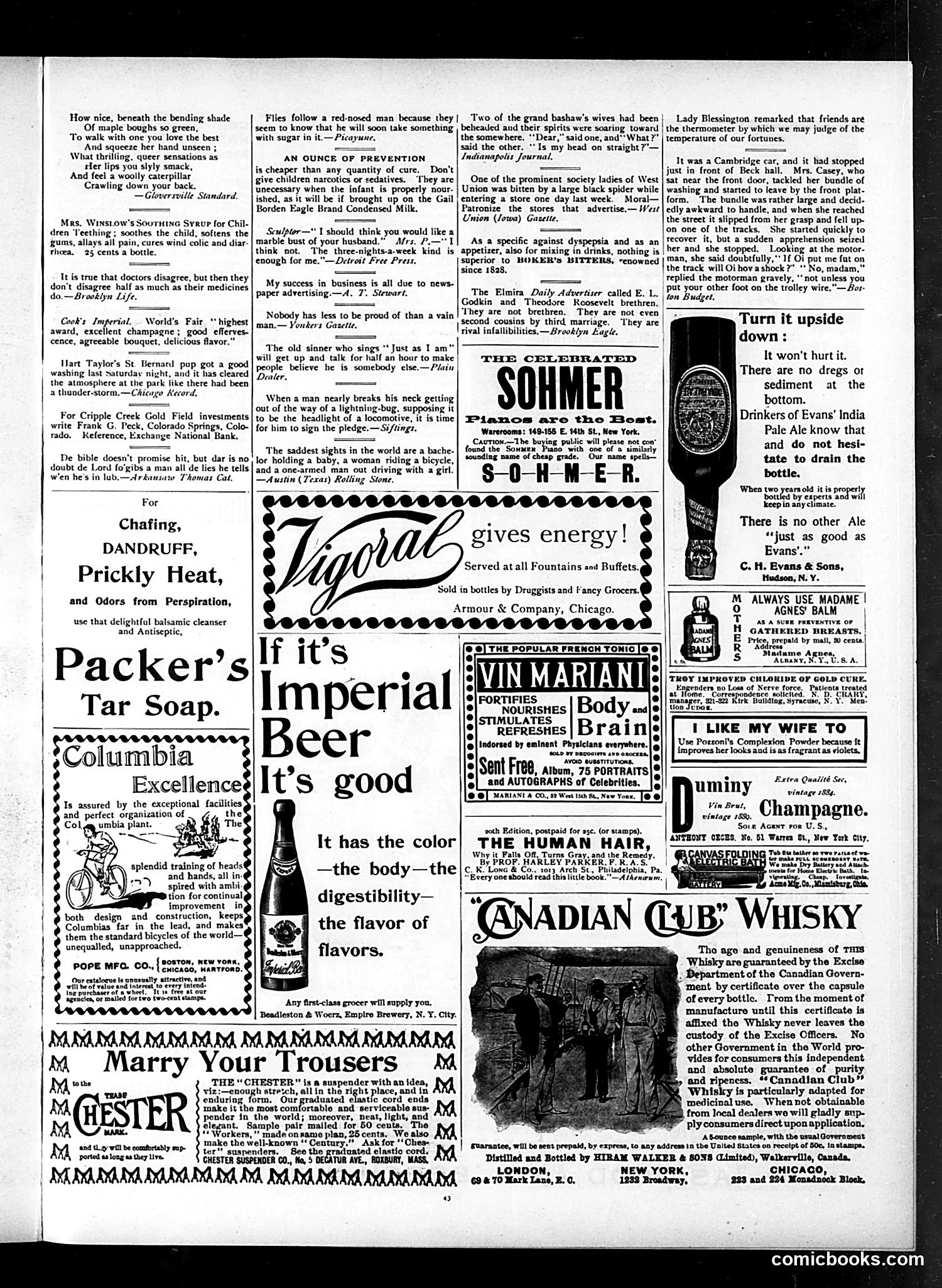
This is primarily an **advertising page** from Judge magazine, not a political cartoon. The page consists almost entirely of commercial advertisements interspersed with brief humorous quotes and anecdotes—typical filler content for late 19th-century publications. The text snippets are **short, unrelated jokes** about courtship, flies, medical remedies, and human nature—generic humor with no political dimension. References include period products (Gail Borden condensed milk, Mrs. Winslow's soothing syrup for teething, Boker's Bitters) and services (Colorado gold field investments). The notable advertisements include Sohmer Pianos, Vigorol (an energy drink), Imperial Beer, Vin Mariani (a cocaine-containing tonic), Canadian Club Whisky, and Packer's Tar Soap. These ads reflect **turn-of-century consumer culture** and unregulated patent medicines. There is **no satirical political content** visible on this page—it's simply a commercial product page typical of Judge's revenue model.
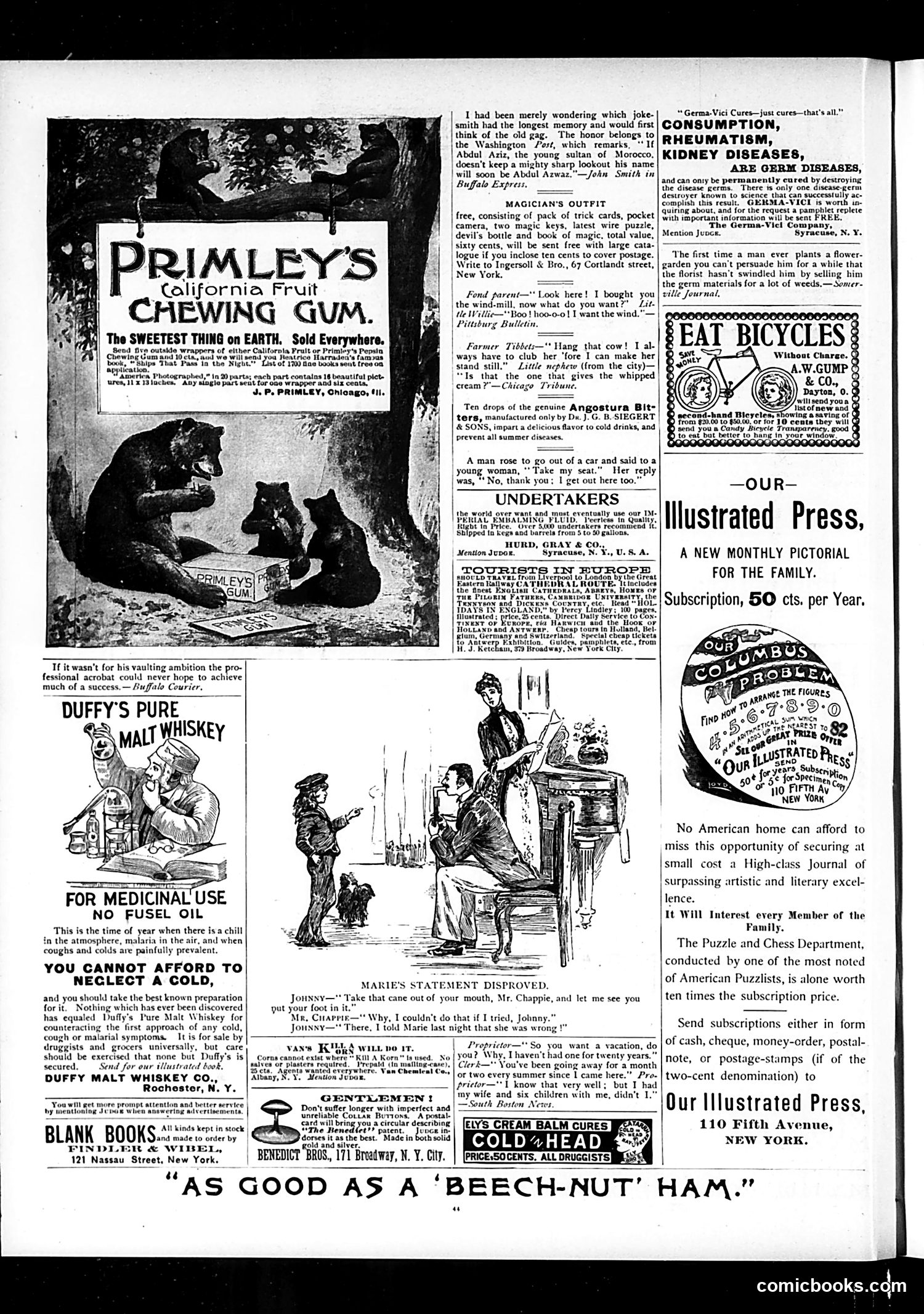
This is primarily an **advertising page** from Judge magazine, with minimal editorial cartoon content. The few jokes present are mild period humor: - A quip about Abdul Aziz (Morocco's sultan) and a pun on his name - A child's misunderstanding about a cow producing "whipped cream" - Standard domestic comedy scenarios **The page's real purpose** is showcasing advertisements for consumer products typical of the era: Primley's chewing gum, Duffy's malt whiskey (marketed as medicinal), blank books, magician kits, and undertaking supplies. These ads reflect turn-of-century commerce and consumer culture. The only narrative illustration shows a domestic scene captioned "Marie's Statement Disproved"—a husband-wife disagreement—representing typical light domestic satire Judge published. This page demonstrates how satirical magazines of this period supported themselves through extensive advertising rather than editorial content alone.
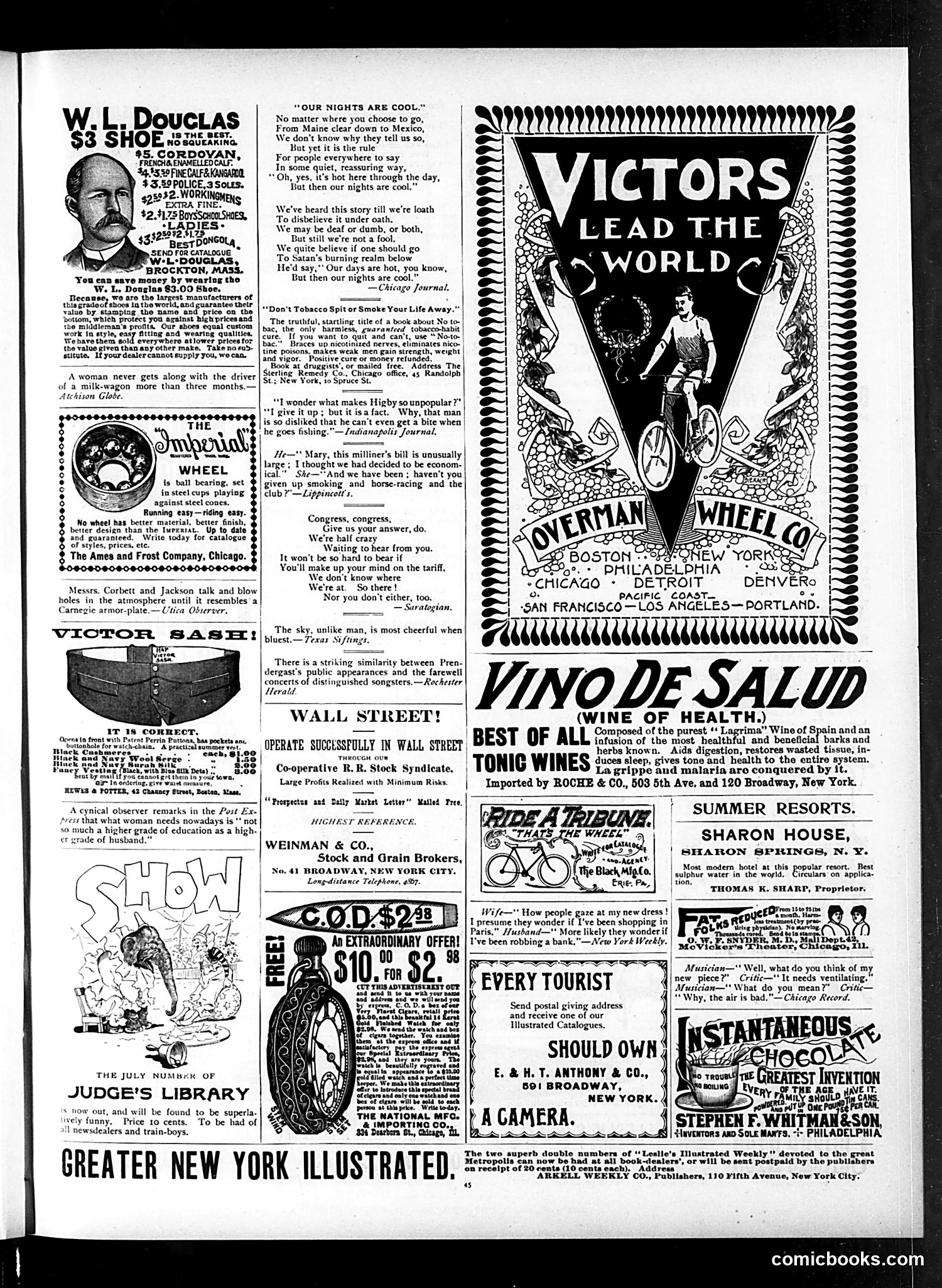
This is primarily an **advertising page** from Judge magazine, with minimal satirical content. The page consists almost entirely of product advertisements interspersed with brief humorous filler items. The main cartoons/jokes are short, generic quips about everyday life: - A recurring joke about people claiming "our nights are cool" despite heat - Husband-and-wife banter about spending and vice-giving - Brief one-liners about unpopular characters and fishing **Notable advertisements:** - W.L. Douglas shoes ($3.00) - The Tureniat bicycle wheel - "Notobac" tobacco-cessation product - Vino de Salud tonic wine - Overman Wheel Company bicycles - Various grain brokers and camera dealers The **political reference** is minimal: one poem addresses Congress and tariff debates, reflecting turn-of-century trade policy concerns. Overall, this appears to be a standard Judge issue mixing light humor with commercial advertisements rather than sustained political satire.
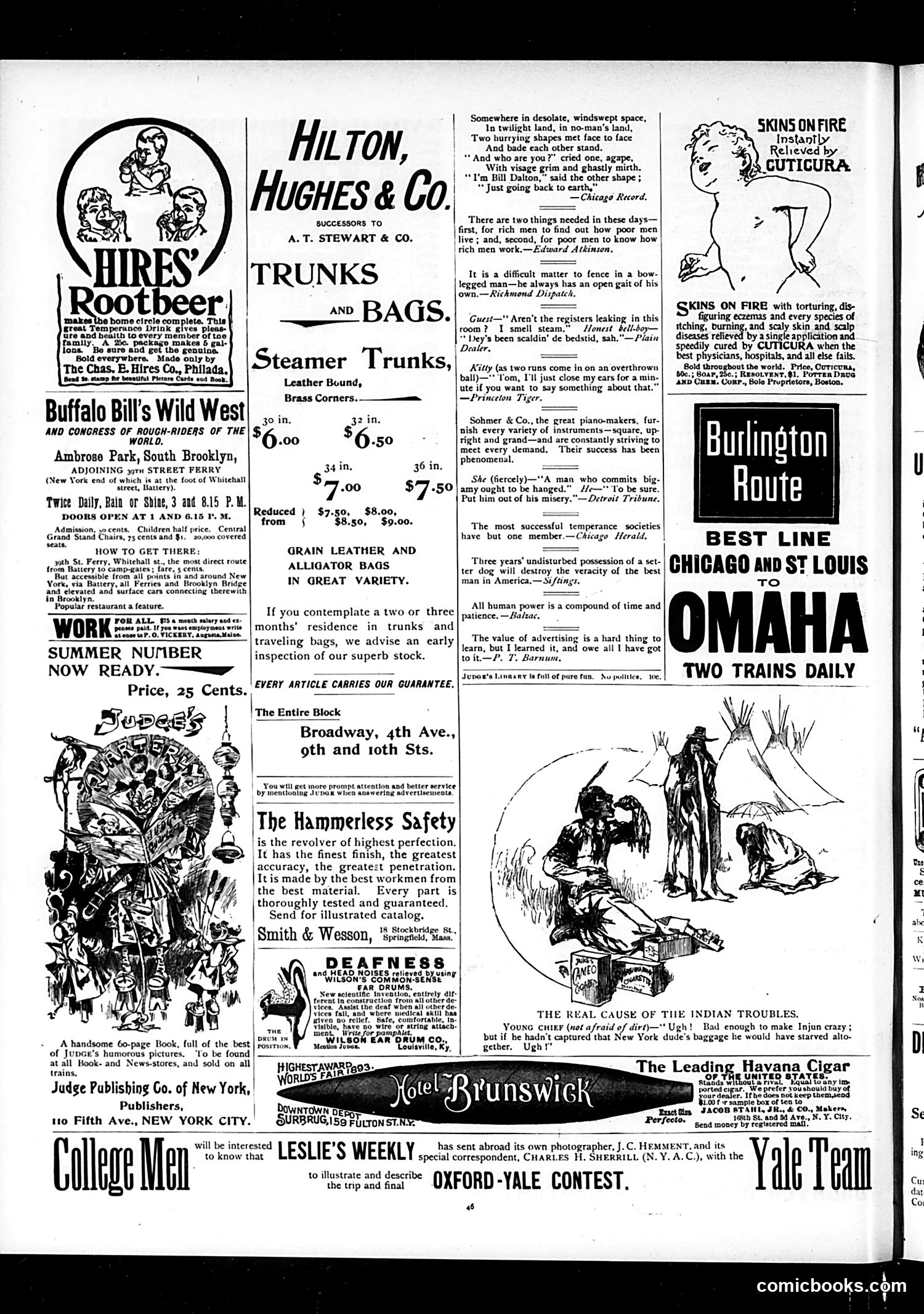
This page from Judge magazine is primarily **advertising**, with one notable satirical element. The main cartoon appears at top: two ghostly figures meeting in "desolate, windswept space" identify themselves as "Bill Dalton" and "Hughes & Co."—likely referencing the Dalton Gang (notorious outlaws of the 1890s) and a prominent business figure or company. The joke seems to equate criminal outlaws with unethical business practices, suggesting they're morally equivalent threats in different spheres. The surrounding content is overwhelmingly **product advertisements**: trunks and traveling bags, revolvers, deafness remedies, the Burlington Route railroad, and Cuticura skin treatments. The page includes small humorous quotations and snippets (likely from other Judge sections) scattered between ads. The satirical intent is minimal here—this is primarily a commercial vehicle. The "Bill Dalton/Hughes" cartoon provides light social commentary on business ethics, but the page's real purpose is selling products to Judge's middle and upper-class readership.
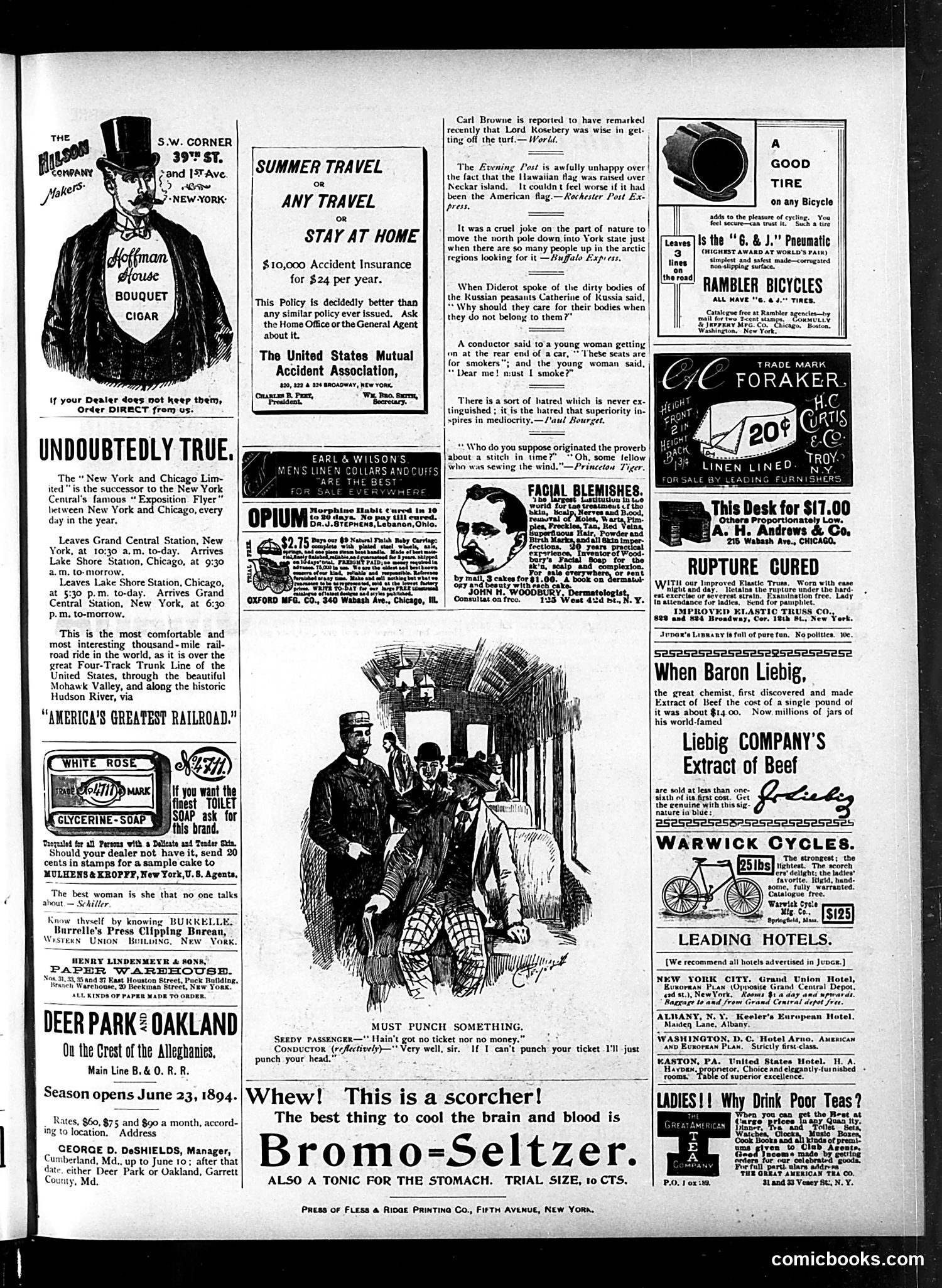
This page from Judge magazine (appearing to be from the 1890s) is primarily **advertising**, with a few brief satirical items interspersed. The main cartoon shows a conductor confronting a young woman about smoking in a reserved section, with the caption "MUST PUNCH SOMETHING." It's a mild joke about the conductor's frustration. The short satirical comments mock contemporary figures and events: Carl Browne reportedly quitting politics; newspapers' outrage over Hawaiian flag-raising; and nature's cruel joke moving the North Pole to New York. These are lighthearted jabs at current news rather than political cartoons. The dominant content is advertisements for bicycles (Rambler, Warwick), patent medicines (Bromo-Seltzer, treatments for facial blemishes and ruptures), soap, railroads, hotels, and beef extract. The ads reflect 1890s consumer culture and the period's dubious medical claims. One ad notably plays on anti-Irish sentiment ("no one talks about—Schiller"). No major political figures or movements are caricatured here.
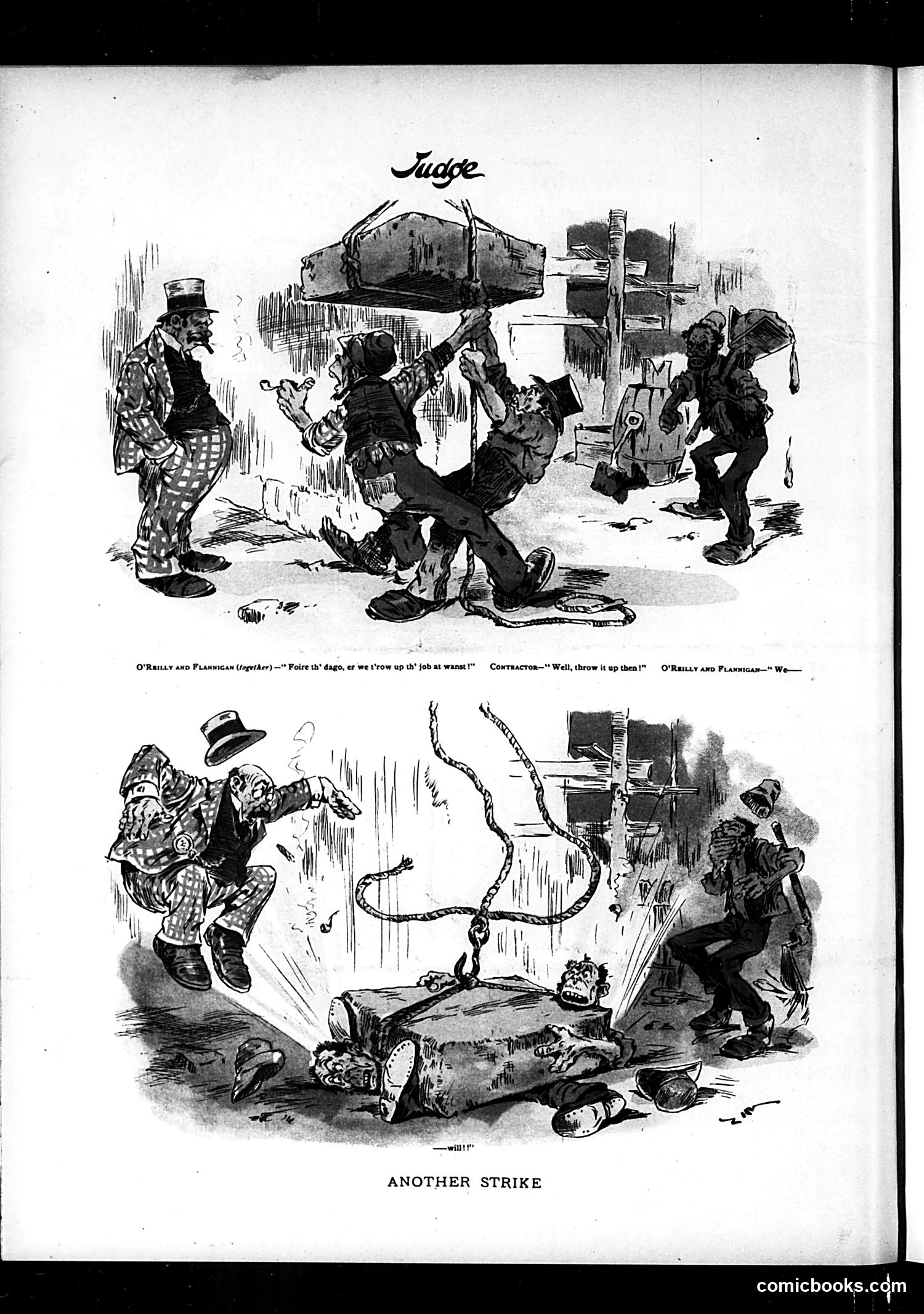
This two-panel political cartoon satirizes labor strikes. The top panel shows workers and a contractor in dispute over construction work—the dialogue references a wage disagreement ("Fair di' days, or we 'row up th' job at wance!" vs. "Well, throw it up then!"). The bottom panel depicts the violent consequences: workers are literally thrown from a scaffold, with one appearing dead or severely injured on the ground below. The satire's point appears to be criticizing strikes as self-destructive—workers demanding better conditions only injure or kill themselves through workplace accidents. This reflects Judge magazine's typically anti-labor stance, suggesting strikes harm workers more than employers. The grim humor underscores the cartoon's message that labor disputes lead to literal catastrophe for workers themselves.