
Judge, 1894-07-21 · page 4 of 16
Judge — July 21, 1894 — page 4: what you’re looking at
What you’re looking at
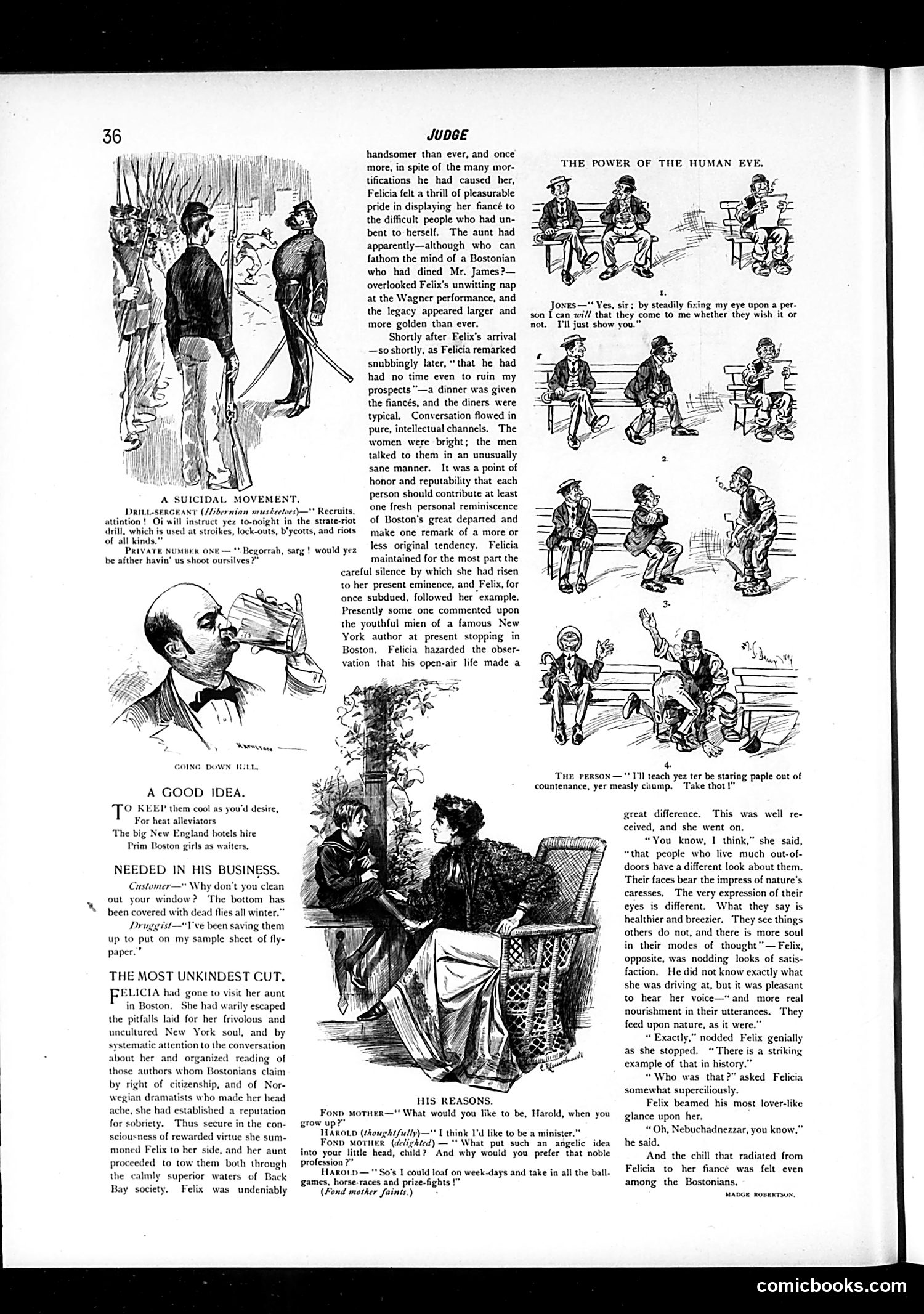
This Judge magazine page contains several unrelated satirical items typical of the era: **Main narrative**: "A Suicidal Movement" follows Felicia, a New York woman who visits Boston society. She's established herself as intellectually serious to impress her aunt, then summons her fiancé Felix. At a dinner, Felicia makes an observation about outdoor living giving people a healthier appearance and "more soul"—a pretentious comment typical of Boston's intellectual circles. Felix nods approvingly though he doesn't understand. **The satire**: Mocks both New York frivolousness and Boston's self-conscious intellectualism. Felicia's adoption of "serious" Boston manners is presented as amusing affectation. **Side items**: Brief jokes about Irish immigrant drill sergeants, Boston hotel waiters, a druggist's fly-paper samples, and a child's career aspirations—standard period humor with ethnic and class stereotypes. **Context**: This reflects turn-of-century American regional tensions and class anxieties about displaying cultural sophistication.
📄 Transcribed text from this page (OCR, searchable)
Machine-transcribed from the original scan — historical spelling and the odd misread are preserved.
A SUICIDAL MOVEMENT. JUDGE handsomer than ever, and once’ more, in spite of the many mor- tifications he had caused her, Felicia felt a thrill of pleasurable pride in displaying her fiancé to the difficult people who had un- bent to herself. The aunt had apparently—although who can fathom the mind of a Bostonian who had dined Mr. James ?— overlooked Felix’s unwitting nap at the Wagner performance, and the legacy appeared larger and more golden than ever. Shortly after Felix's arrival —so shortly, as Felicia remarked snubbingly later, “that he had had no time even to ruin my prospects"—a dinner was given the fiancés, and the diners were typical. Conversation flowed in pure, intellectual channels. The women were bright; the men talked to them in an unusually sane manner. It was a point of honor and reputability that each person should contribute at least DRIt-serceant (/ibernian muskectoes)—" Recruits, one fresh personal reminiscence attintion ! Oi will instruct yez to-noight in the strate-riot of Boston's great departed and drill, which is used at stroikes, lock-outs, b'ycotts, and riots of all kinds. Private be afther havin’ us shoot oursilves?” ye = G DOWN HLL, A GOOD IDEA. ‘O KEEP them cool as you'd desire, For heat alleviators The big New England hotels hire Prim Roston girls as waiters, NEEDED IN HIS BUSINESS. Customer—* Why don't you clean out your window? The bottom has been covered with dead flies all winter.” Druggist—"V've been saving them up to put on my sample sheet of fly- paper.” THE MOST UNKINDEST CUT. FELICIA had gone to visit her aunt in Boston, She had warily escaped the pitfalls laid for her frivolous and uncultured New York soul, and by systematic attention to the conversation about her and organized reading of those authors whom Bostonians claim by right of citizenship, and of Nor- wegian dramatists who made her head ache, she had established a reputation for sobriety. Thus secure in the con- sciousness of rewarded virtue she sum- moned Felix to her side, and her aunt proceeded to tow them both through the calmly superior waters of 1B Bay soci Felix was undeniably grow y Haroun (thought/ully)—"* L think I'd like to be a minister.” make one remark of a more or Jstuex ONE—" Begorrah, sarg! would yez I6S8 original tendency. Felicia maintained for the most part the careful silence by which she had risen to her present eminence, and Felix, for ‘once subdued, followed her example. Presently some one commented upon the youthful mien of a famous New York author at present stopping in Boston. Felicia hazarded the obser- vation that his open-air life made a HIS REASONS. MoTHER—'' What would you like to be, Harold, when you THE POWER OF THE HUMAN EYE. Joxes—"* Yes, sir; by steadily fixing my eye upon a per- son ican will that they come to me whether they wish it or not. T'll just show you.” Tu PeRsoN—"*T'll teach yez ter be staring paple out of countenance, yer measly chump. ‘Take thot !” great difference. This was well re- ceived, and she went on. “You know, I think,” she said, “that people who live much out-of- doors have a different look about them. Their faces bear the impress of nature's caresses. The very expression of their eyes is different. What they say is healthier and breezier.. They see things others do not, and there is more soul in their modes of thought” — Felix, opposite, was nodding looks of satis- faction. He did not know exactly what she was driving at, but it was pleasant to hear her voice—“and more real nourishment in their utterances. They feed upon nature, as it were.’ “Exactly,” nodded Felix genially as she stopped. “There is a striking example of that in histo Who was that ? somewhat superciliously. Felix beamed his most lover-like glance upon her. “Oh, Nebuchadnezzar, you know,” asked Felicia Fonp moruer (delighted) —‘** What put such an angelic idea he said. into your little head, child? And why would you prefer that noble profession?” And the chill that radiated from Harorn—"* So's I could loaf on week-days and take in all the ball. Felicia to her fiancé was felt even games, horse-races and prize-fights !" (Fond mother faints.) among the Bostonians, MADGE ROMEKTSUN. comicbooks.com