
Judge, 1894-07-21 · page 2 of 16
Judge — July 21, 1894 — page 2: what you’re looking at
What you’re looking at
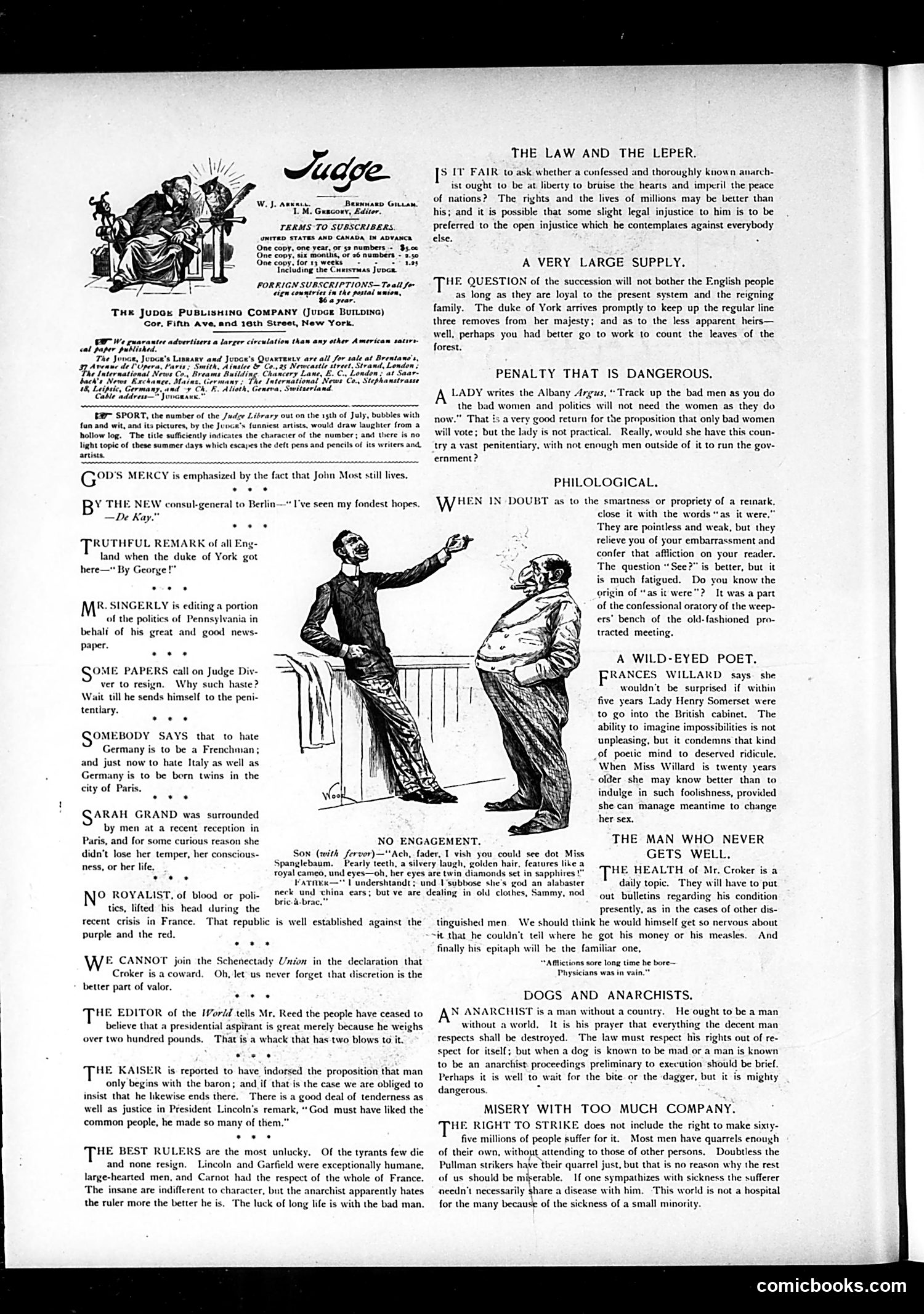
This page from Judge presents a satirical column format rather than a single political cartoon. The main illustrated piece shows two figures in conversation at what appears to be a formal setting, though the specific identities remain unclear from the image alone. The text snippets employ Judge's typical format: brief, punchy satirical commentaries on contemporary politics and society. Topics include anarchism ("an anarchist is a man without a country"), labor strikes, German-Italian relations, and judicial matters. The writing style is characteristically sardonic, using rhetorical questions and paradoxes to mock public figures and political movements. Without clearer identification of specific figures or dated references in the visible text, the precise satirical targets are difficult to pinpoint, though the content appears to address fin-de-siècle political anxieties common to Judge's audience.
📄 Transcribed text from this page (OCR, searchable)
Machine-transcribed from the original scan — historical spelling and the odd misread are preserved.
W. J. Annie. 1. M. Gexcor TERMS°TO SUBSCRIBERS. UNETRD STATES AMD CANADA IN ADVANCE, One copy, one year, or s2 numbers - $5.00 One copy, six months, or 26 numbers One copy. for 13 weeks = == Including the Cnmrstsas Jupca. FOREIGN SUBSCRIPTIONS—To alt for ign countries im the portal union, $6.0 year, THe JuDox PUBLISHING COMPANY (JupcE BurpiNc) Cor, Fifth Ave, and 16th Street, New York. Baunnano Grin 9 We puarantee advertivers a larger circulation than any other American satire. cal paper pul The Je Avense de lUpera, Fai fermational News inden at Saar> ‘Stephanstrasse E97 SPORT, the number of the Judge Library out on the 1sth of July, bubbles with fan and wit, and its pictures, by the Ju funniest artists, would draw laughter from a hollow log. The title sufficiently indicates the character of the number; and there is no light topic of these summer days which escapes the deft pens and pencils of its writers and. artists, Gos MERCY is emphasized by the fact that John Most still lives. BY THE NEW consul-general to Berlin—" I've seen my fondest hopes. —De Kay.” TRUTHFUL REMARK of g- land when the duke of York got here—" By George!” R. SINGERLY is editing a portion of the politics of Pennsylvania in behali of his gi paper. and good news- PAPERS call on Judge Div- ver to resign, Why such haste? Wait till he sends himself to the peni- tentiary. SOMEBODY SAYS that to hate Germany is to be a Frenchman; and just now to hate Italy Germany is to be bern t city of Paris. well as s in the SARAH GRAND was surrounded by men at a recent reception in Paris, and for some curious reason she didn’t lose her temper, her conscious ness, or her life, NO Spanglebaum. N° ROYALIST, of blood or poli- tics, lifted his head during the recent crisis in France. ‘That republic is well established against the purple and the red. Karn bric-a-brac, = CANNOT Croker is a cow: better part of valor. the Schenecta d, ly Union in the declaration that Oh, let us never forget that discretion is the THE EDITOR of the Morld tells Mr. Reed the people have ceased to believe that a presidential aspitant is great merely because he weighs over two hundred pounds. That is a whack that has.two blows to it. THE KAISER is reported to have indorsed the proposition that man only begins with the baron; and if that is the case we are obliged to insist that he kewise ends there. There is a good deal of tenderness as well as justice in President Lincoln's remark, “God must have liked the common people, he made so many of them.” THE BEST RUL S are the most unlucky. Of the tyrants few die and none resign. Li coln and Garfield were exceptionally humane, large-hearted men, and Carnot had the respect of the whole of France. The insane are indifferent to character, but the anarchist apparently hates the ruler more the better he is, The luck of long life is with the bad man. ENGAGEMENT. Son (with fervor)—"'Ach, fader, I vish you could see dot Miss Pearly teeth, a silvery laugh, golden hair, features lik royal cameo, und eyes—oh, her eyes are twin diamonds set in sapphires !" *Lundershtandt; und Usubbose she’s god an alabaster neck und china ears; but ve are dealing in old clothes, Sammy, nod THE LAW AND THE LEPER. [8 17 FAIR to ask whether a confessed and thoroughly known anarch- ist ought to be at liberty to bruise the hearts and imperil the peace of nations? The rights and the lives of millions may be better than his; and it is possible that some slight legal injustice to him is to be preferred to the open injustice which he contemplates against everybody else. A VERY LARGE SUPPLY. HE QUESTION of the succession will not bother the English people as long as they are loyal to the present system and the reigning family. The duke of York arrives promptly to keep up the regular line three removes from her majesty; and as to the less apparent heirs— well, perhaps you had better go to work to count the leaves of the forest. PENALTY THAT IS DANGEROUS. A EADY writes the Albany Argus, “Track up the bad men as you do the bad women and politics will not need the women as they do now.” That is a very good return for the proposition that only bad women will vote; but the lady is not practical. Really, would she have this coun- try a vast penitentiary, with not enough men outside of it to run the gov- ‘ernment? PHILOLOGICAL, WHEN IN DOUBT as to the smartness or propriety of a remark, close it with the words “as it were.” They are pointless and weak, but they relieve you of your embarrassment and confer that affliction on your reader. The question “See?” is better, but it is much fatigued. Do you know the origin of “as it were"? It was a part of the confessional oratory of the weep- ers’ bench of the old-fashioned pro- tracted meeting. A WILD-EYED POET. RANCES WILLARD. says. she wouldn't be surprised if within five years Lady Henry Somerset were to go into the British cabinet. The ability to imagine impossibilities is not unpleasing, but it condemns that kind _of poetic mind to deserved ridicule. When Miss Willard is twenty years older she may know better than to indulge in such foolishness, provided she can manage meantime to change her sex. THE MAN WHO NEVER GETS WELL. HE HEALTH of Mr, Croker is a daily topic. They will have to put out bulletins regarding his condition presently, as in the cases of other dis- We should think he would himself get so nervous about ~it that he couldn't tell where he got his money or his measles. And finally his epitaph will be the familiar one, tinguished men “Afftictions sore long Physicians was i ye he bore~ DOGS AND ANARCHISTS. AN ANARCHIST is a man without a country. He ought to be a man without a world, It is his prayer that everything the decent man respects shall be destroyed. The law must respect his rights out of re- spect for itself; but when a dog is known to be mad or a man is known to be an anarchist proceedings preliminary to execution should be brief. Perhaps it is well to wait for the bite or the dagger, but it is mighty dangerous. se MISERY WITH TOO MUCH COMPANY. HE RIGHT TO STRIKE does not include the right to make sixty- five millions of people suffer for it. Most men have quarrels enough of their own, without attending to those of other persons. Doubtless the Pullman strikers have their quarrel just, but that is no reason why the rest of us should be miserable. If one sympathizes with sickness the sufferer needn't necessarily Share a disease with him. “This world is not a hospital for the many because of the sickness of a small minority. comicbooks.com