
A complete issue · 16 pages · 1894
Judge — June 16, 1894
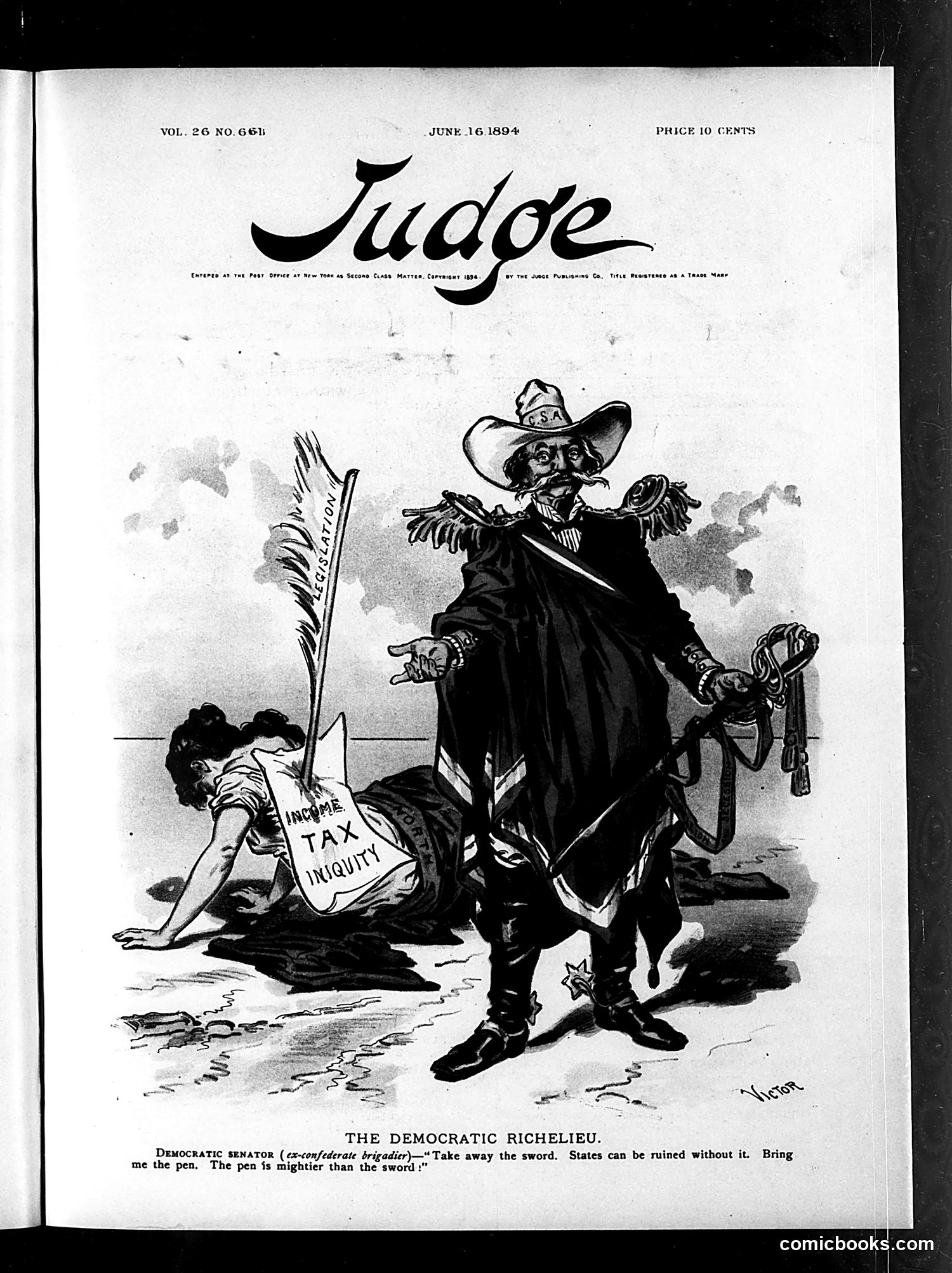
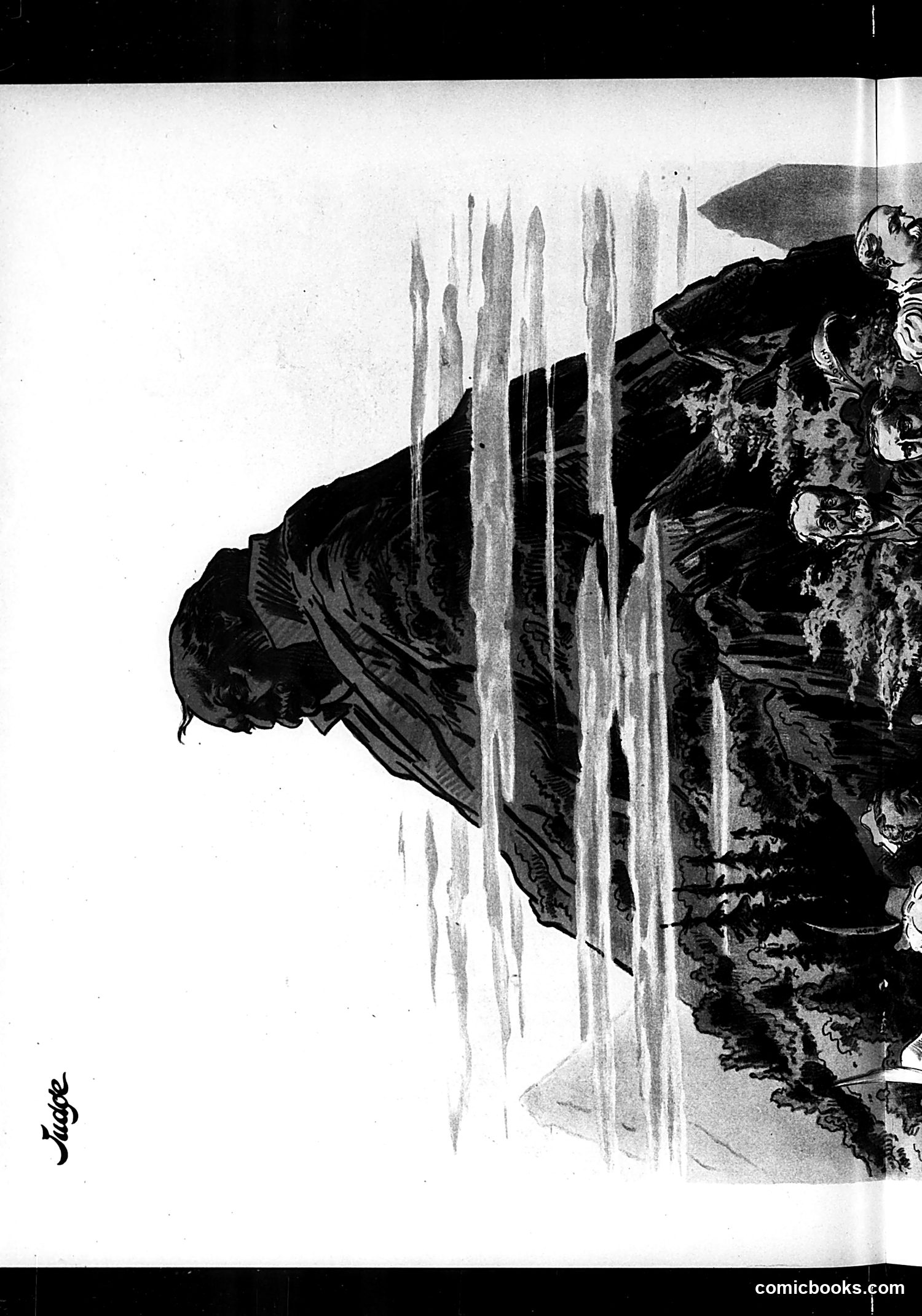
This June 16, 1894 cartoon satirizes a Democratic senator (likely a Confederate brigadier based on the uniform) as Cardinal Richelieu, the powerful French minister. The figure towers over a prone female figure labeled "Income Tax Injustice," whom he's trampling. The satire critiques the senator's opposition to income tax legislation, portraying him as autocratic and tyrannical—wielding a sword while dismissing democratic tools. His quoted statement, "Take away the sword. States can be ruined without it. Bring me the pen"—references Richelieu's famous line but inverts it to suggest the senator prefers legislative manipulation over military force to control the nation. The cartoon likely responds to contemporary debates over federal income tax policy and Democratic resistance to new taxation.
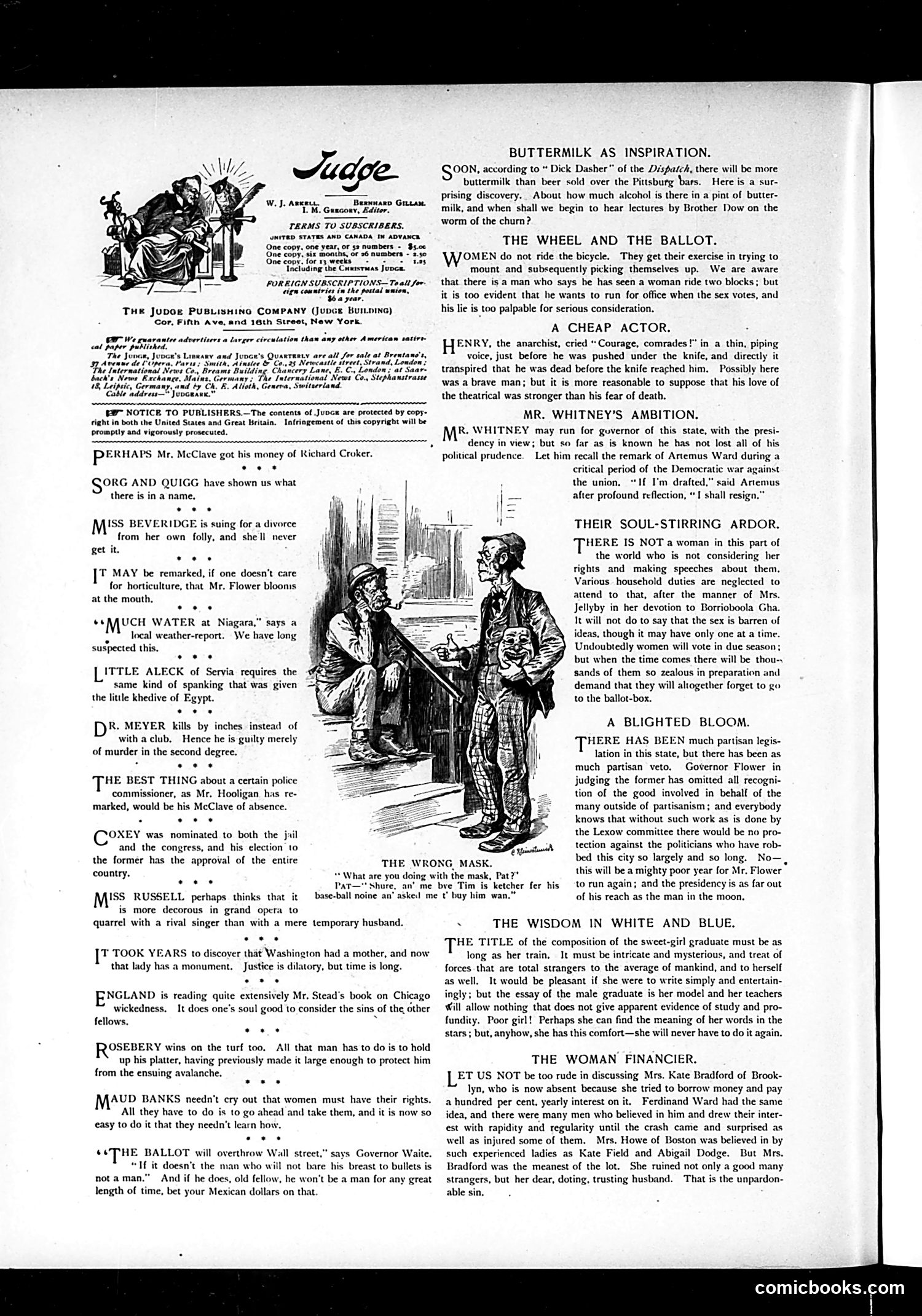
This page from Judge magazine contains political commentary and social satire typical of the publication's style. The main cartoon, titled "The Wrong Mask," depicts two figures in conversation, with one asking "What are you doing with the mask, Pat?" The other responds "Share, an' me live Tim is ketcher for his base-ball nine an' asked me t' buy him wan." The cartoon appears to satirize Irish immigrants (suggested by the dialect and names "Pat" and "Tim"), likely mocking their social practices or economic circumstances. The accompanying text pieces critique various political and social figures—references to Governor Flower, Mrs. Jellyby's charitable work, and women's suffrage suggest this addresses late 19th-century American politics and reform movements. The overall tone reflects Judge's characteristic blend of class-conscious humor and political commentary targeting contemporary American society.
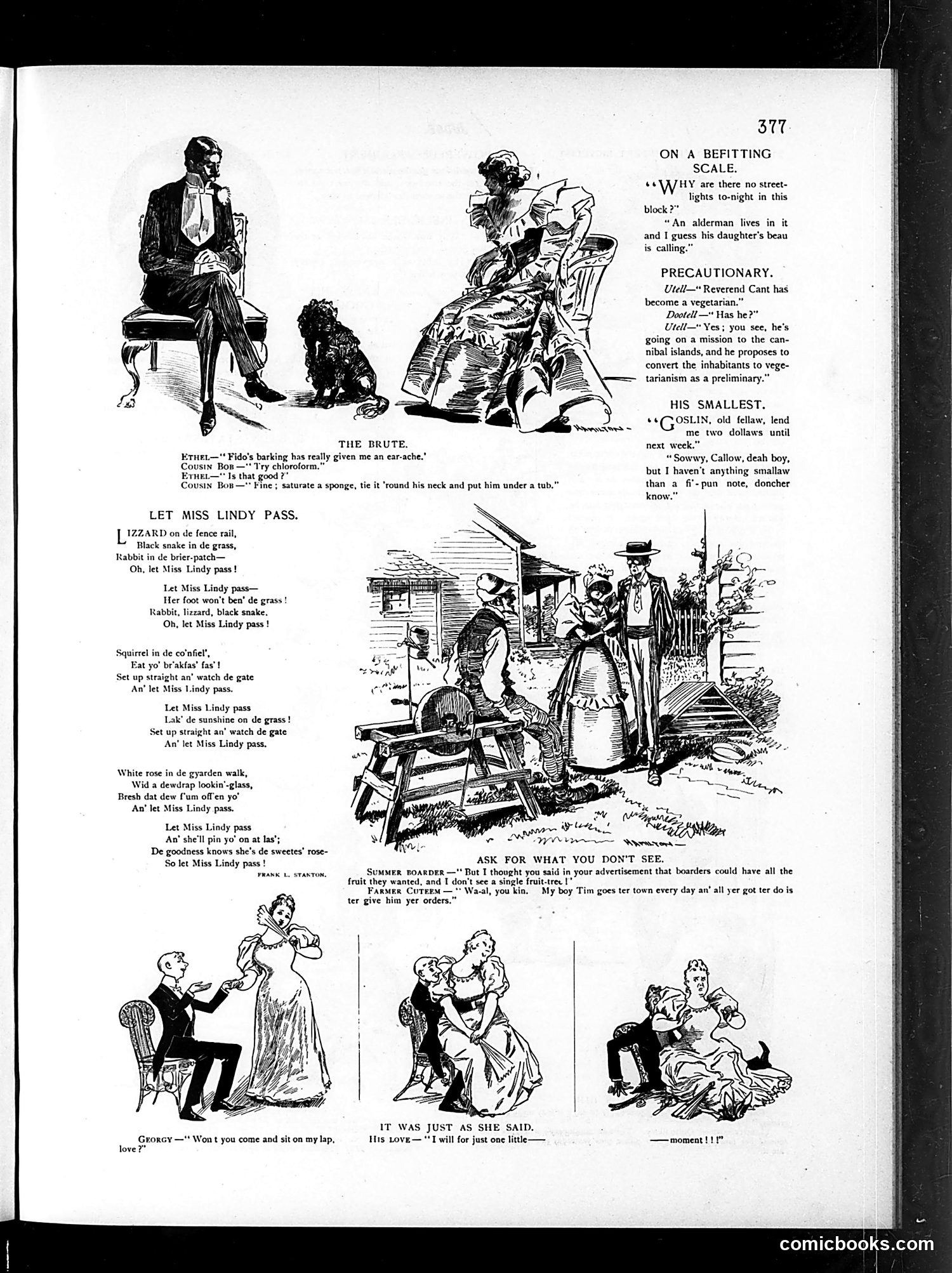
This page contains several unrelated satirical pieces typical of Judge magazine's format: **"The Brute"** mocks a man whose dog's barking has given him an earache, with suggestions to use chloroform or a sponge as remedies—simple domestic humor. **"Let Miss Lindy Pass"** is a song/poem about a woman jumping a fence, likely referencing popular culture or a specific incident, though the reference is unclear today. **"On a Befitting Scale"** appears to satirize a street-lights proposal, with characters discussing an alderman's plan to convert cannibal-island inhabitants to vegetarianism as a "preliminary" step—absurdist humor mocking colonial/missionary rhetoric. **"His Smallest"** and **"Ask for What You Don't See"** contain brief comedic dialogues about small denominations and boarding-house complaints respectively. The bottom section features romantic vignettes with typical period courtship humor. The overall content reflects Judge's mix of domestic comedy, social satire, and absurdist jokes.
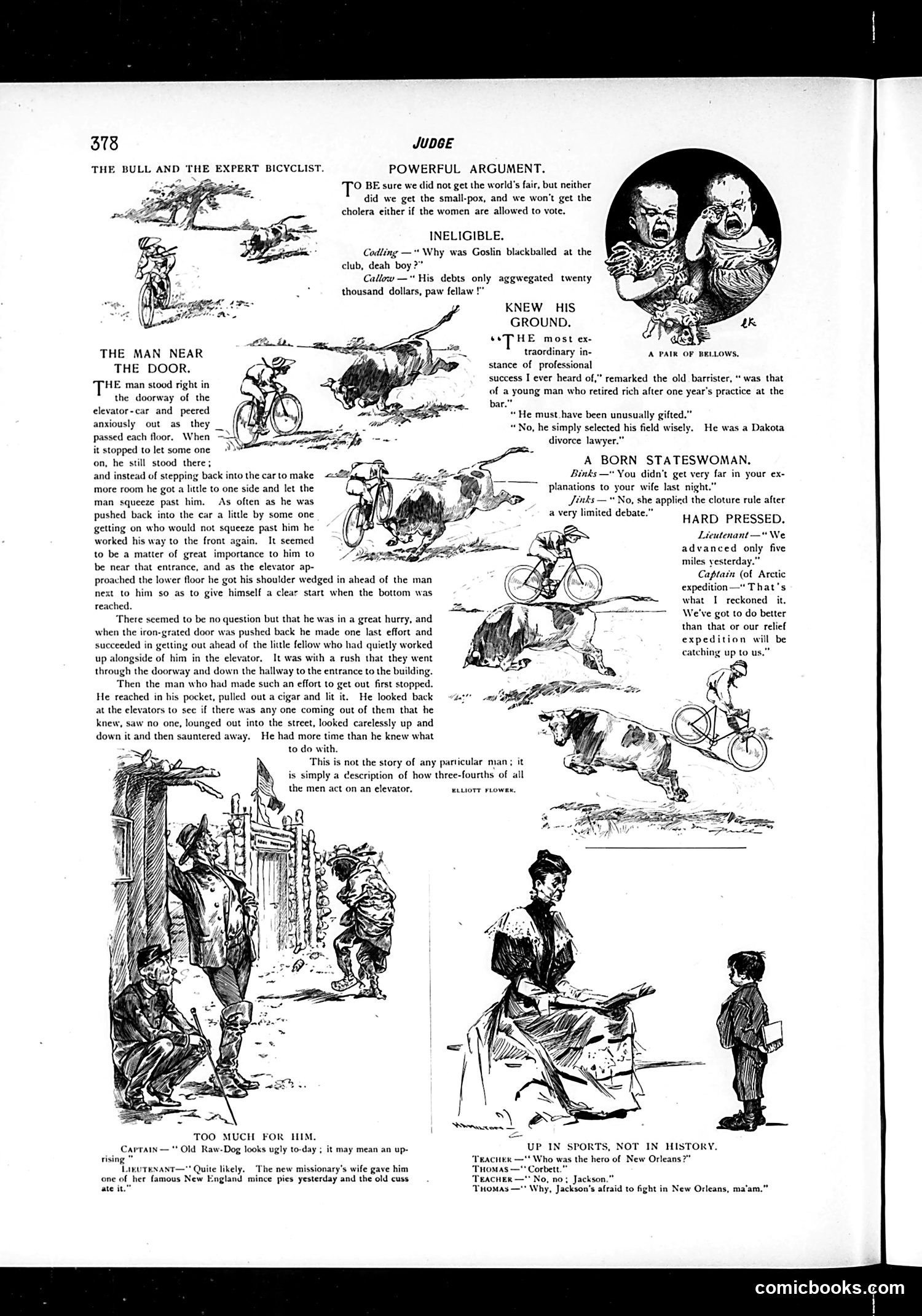
This page contains several satirical cartoons and jokes typical of Judge's late 19th/early 20th-century humor: **"The Man Near the Door"**: A lengthy anecdote mocking the absurdity of urban rushing—a man desperately pushes to exit an elevator first, only to leisurely smoke a cigar afterward, wasting the time he frantically saved. It satirizes pointless competitive behavior. **"Powerful Argument"**: A women's suffrage debate joke. The speaker argues women shouldn't vote because "we didn't get small-pox or cholera" without female voters—sarcastically undermining anti-suffrage logic. **"A Born Stateswoman"**: Mocks married life by comparing a wife's argument-stopping technique to parliamentary "cloture rule" (legislative procedure limiting debate). **"Up in Sports, Not in History"**: Students confuse Andrew Jackson (historical figure, Battle of New Orleans) with boxer James J. Corbett, reflecting contemporary priorities. The cartoons use everyday situations and dialogue to satirize modern manners, women's rights debates, and cultural ignorance—typical Judge fare aimed at educated, urban readers.
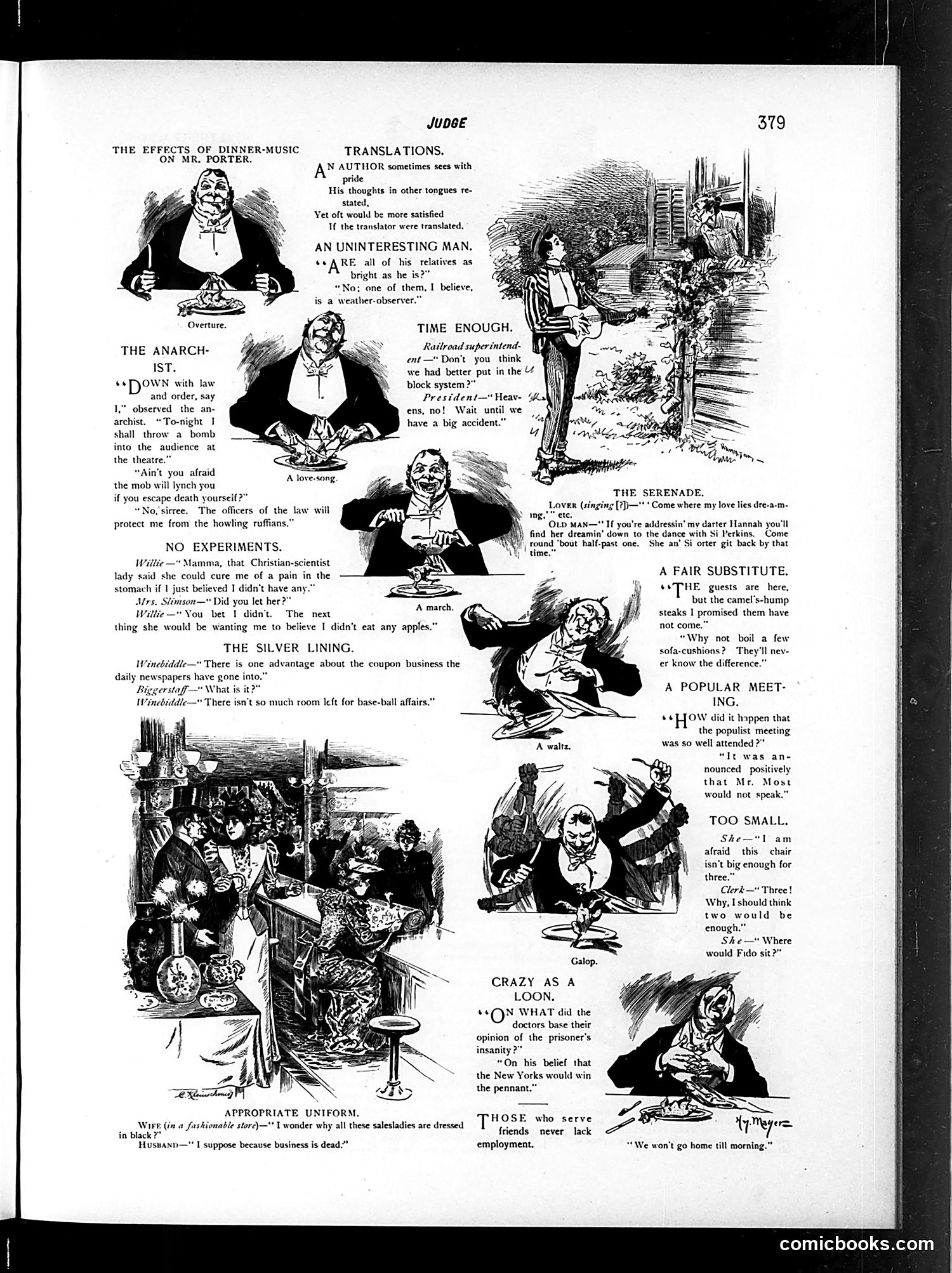
This page collects short satirical pieces typical of Judge's humor circa late 1880s-1890s. Key targets include: **"The Anarchist"** mocks radical anarchists (referencing contemporary bomb threats in theaters) by having an anarchist express faith that police will protect him from lynch mobs—absurd since anarchists opposed law enforcement. **"Crazy as a Loon"** jokes that believing the New York baseball team could win the pennant demonstrates insanity—a dig at the team's poor performance. **"A Popular Meeting"** satirizes the Populist political movement by suggesting its meeting drew crowds only because radical agitator Johann Most (a famous anarchist speaker) *wasn't* attending—implying Populism had no genuine appeal. **"Time Enough"** criticizes railroad safety negligence: a president refuses implementing safety systems until a fatal accident forces his hand. Other pieces mock translators, Christian Science, and consumer fraud. The cartoon style and targets suggest this is from the 1890s Progressive Era, when Judge frequently attacked labor radicalism, pseudoscience, and political movements threatening establishment interests.
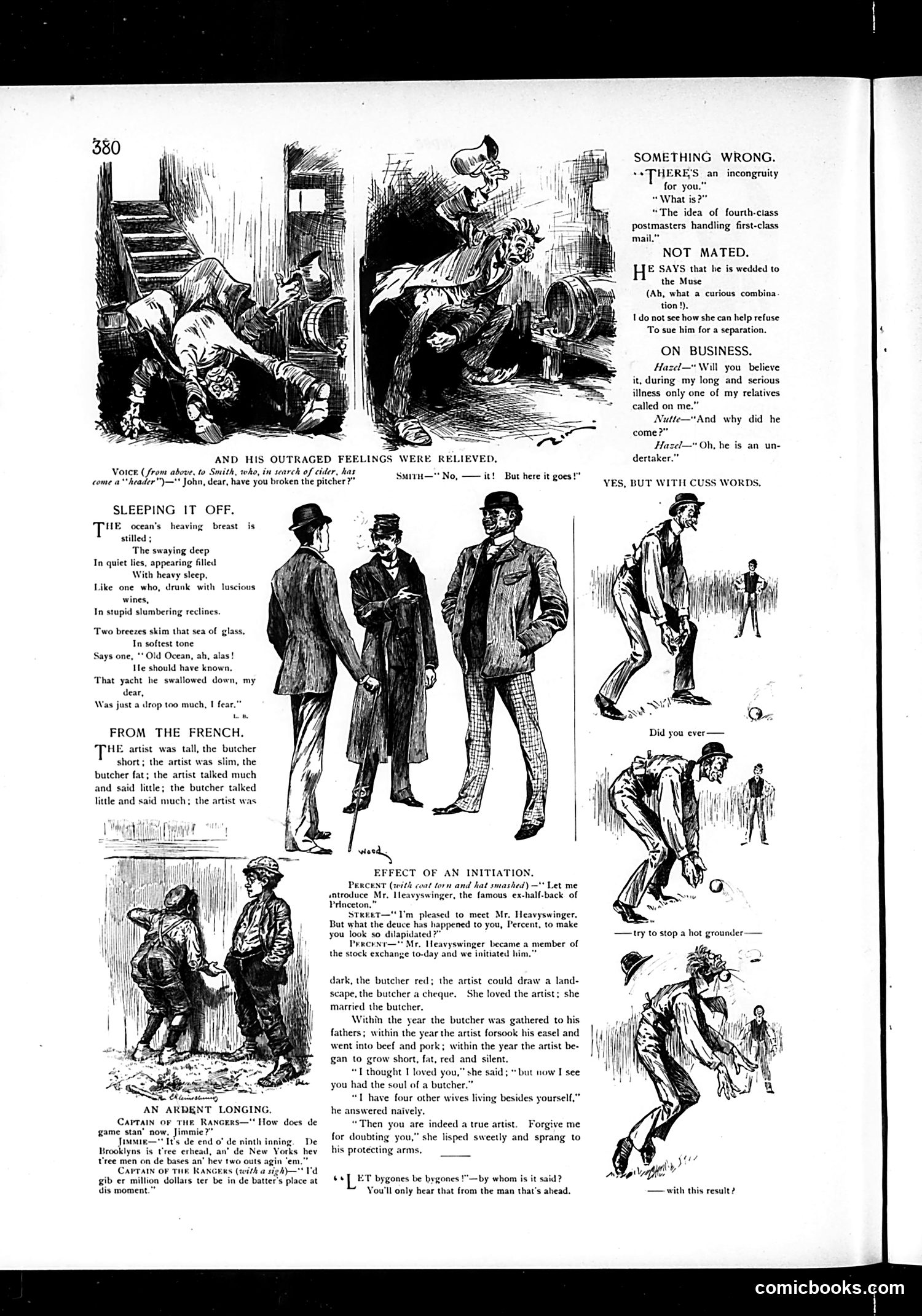
This page from Judge contains several brief satirical pieces targeting American society circa late 1800s/early 1900s: **"Something Wrong"** mocks the postal service for employing fourth-class postmasters to handle first-class mail—a jab at civil service incompetence. **"Not Mated"** jokes about a poet "wedded to the Muse" marrying an actual woman—suggesting artistic pretension creates poor real-world relationships. **The sketches on the right** appear to depict a man attempting to stop a "hot grounder" (baseball reference), with comedic results. **"From the French"** tells of an artist marrying a butcher; after his death, the artist becomes fat, silent, and butcher-like—satirizing how marriage and business corrupt artistic souls. He reveals he has four other wives, mocking both infidelity and the artist's hypocrisy. **"Effect of an Initiation"** shows a stock exchange initiation hazing, where Mr. Heavyswinger gets beaten up upon joining—commentary on Wall Street brutality or exclusionary practices. The overall tone targets postal incompetence, artistic pretense, marital discord, and financial institutions.
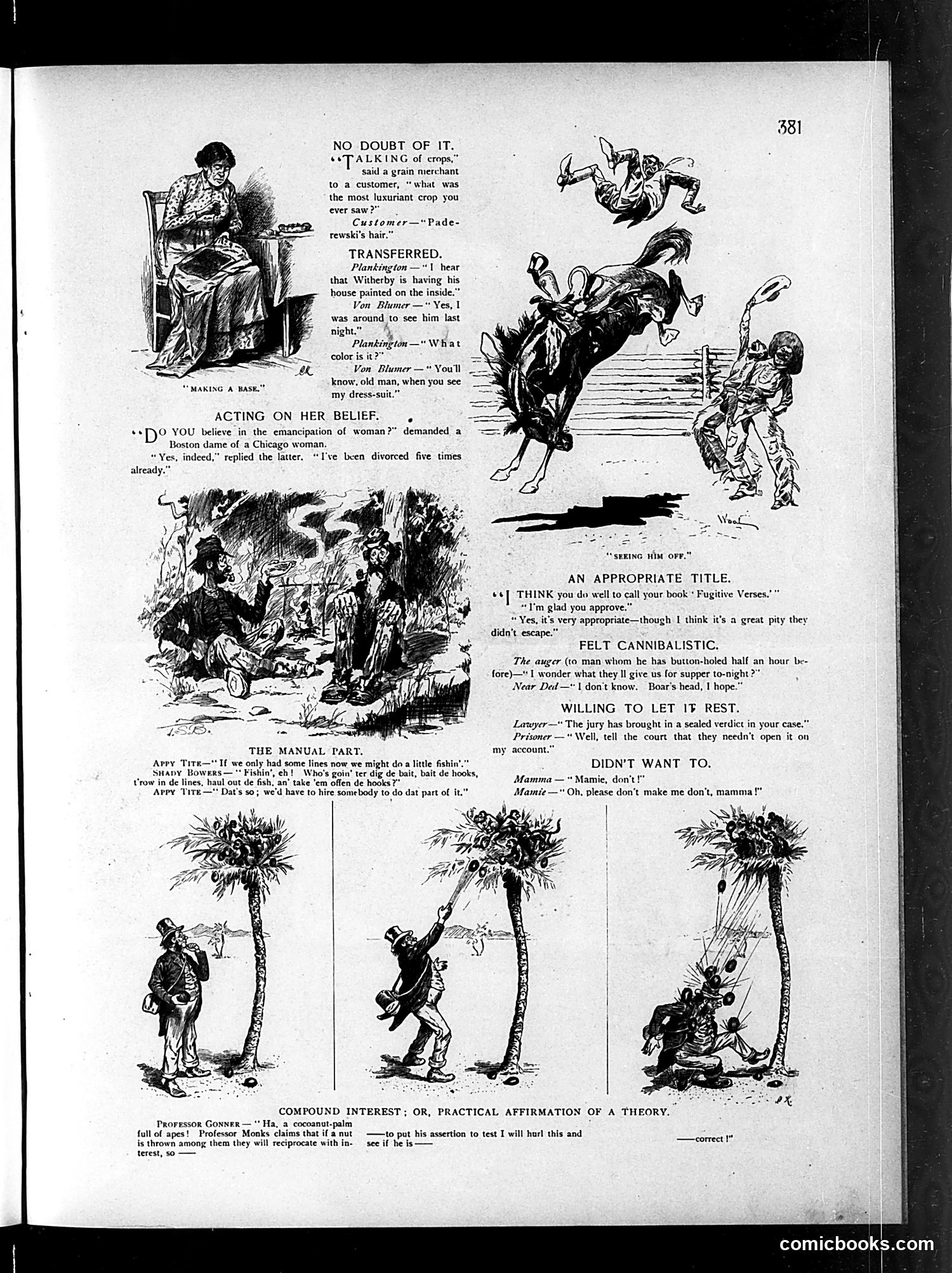
This 1890s-era satirical page contains multiple short jokes and cartoon vignettes typical of Judge's humor: **Notable items:** - **"No Doubt of It"**: A pun on pianist Ignacy Jan Paderewski's famously luxuriant hair - **"Acting on Her Belief"**: Satirizes women's emancipation advocates by having a woman claim she's liberated herself through five divorces—mocking both feminist rhetoric and women's divorce rates as markers of "freedom" - **"Appropriate Title"**: A book titled "Fugitive Verses" is praised as fitting because the poems themselves "didn't escape" (are poor quality) - **"Feeling Cannibalistic"**: A dark joke about a man who's been cornered by a bore, hoping for cannibalism at dinner - **"Compound Interest"**: Scientists test whether apes "reciprocate interest" by throwing coconuts at them—a crude pun on financial terminology The humor is period-typical: wordplay, domestic situations, social commentary on divorce and women's rights (presented mockingly), and slapstick. The drawings are small character sketches illustrating brief gags rather than developed narratives.
The OCR text is largely illegible, containing only formatting characters and no readable content. Based on the **image alone**: This appears to be a political cartoon rendered in black and white, rotated 90 degrees. It depicts figures in what looks like formal or military dress on the right side, with tall vertical forms (possibly cypress trees or flames) in the center. The composition suggests a dramatic scene, possibly depicting conflict, mourning, or political upheaval, but **without legible text or clear identifying details, I cannot definitively determine the specific political figures, historical event, or satirical message** this cartoon conveys. To accurately explain the satire and historical context, readable OCR text or caption information would be essential.
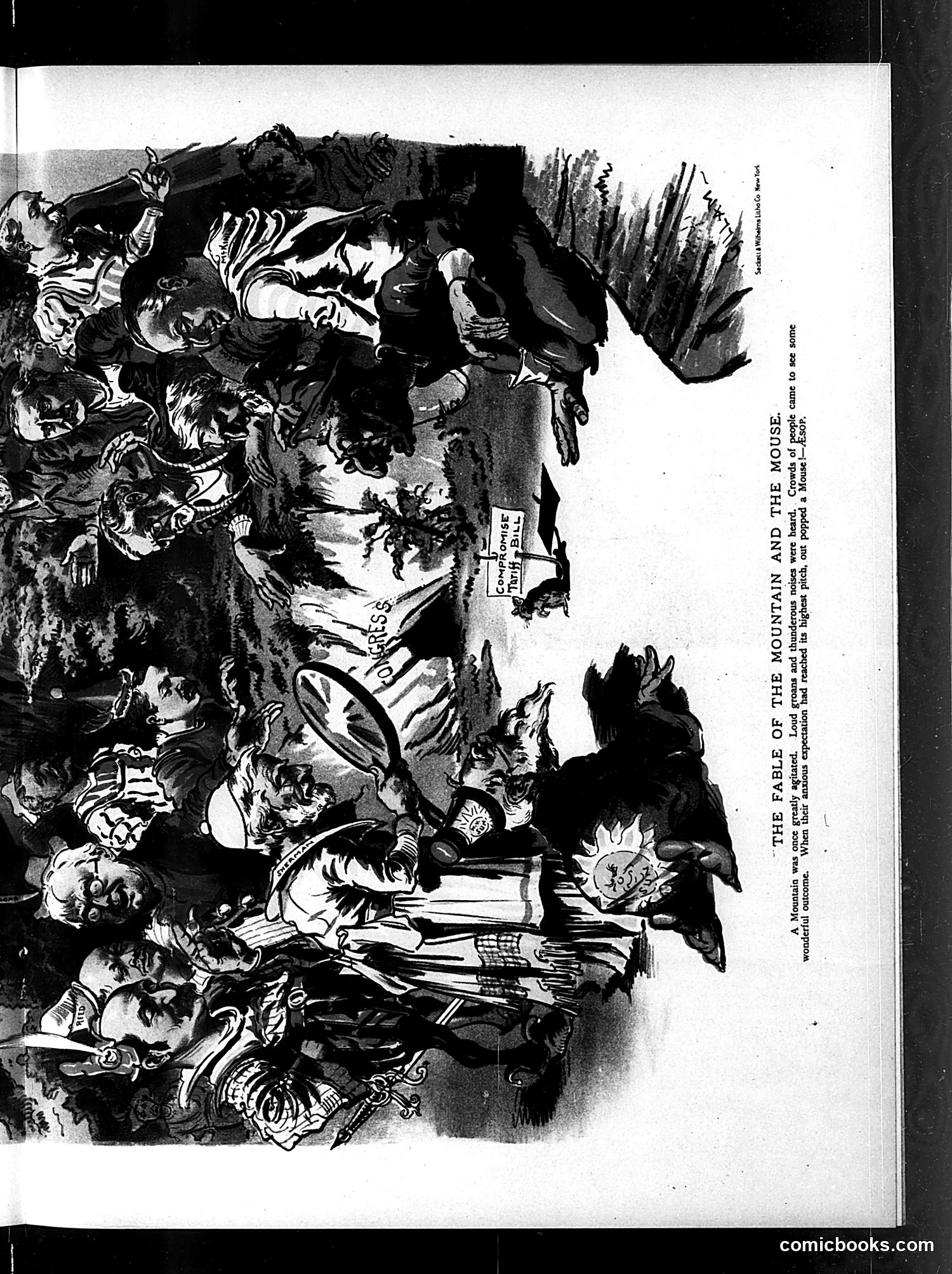
This appears to be a satirical illustration titled "The Fable of the Mountain and the Mouse," presenting a political or social commentary through an Aesop's-fable framework. The image shows numerous figures engaged in chaotic activity—some appear to be politicians, military or government officials (suggested by uniforms and formal dress), and common citizens, all swirling around what seems to be a central mountain or large structure. The satire likely critiques how significant political effort or fanfare produces minimal results—the classic fable teaches that grand preparations can yield disappointing outcomes. Without clearer OCR text or visible date, the specific historical event referenced remains unclear, but the cartoon appears to mock either government inefficiency, political theater, or a failed policy initiative that generated much activity but little consequence.
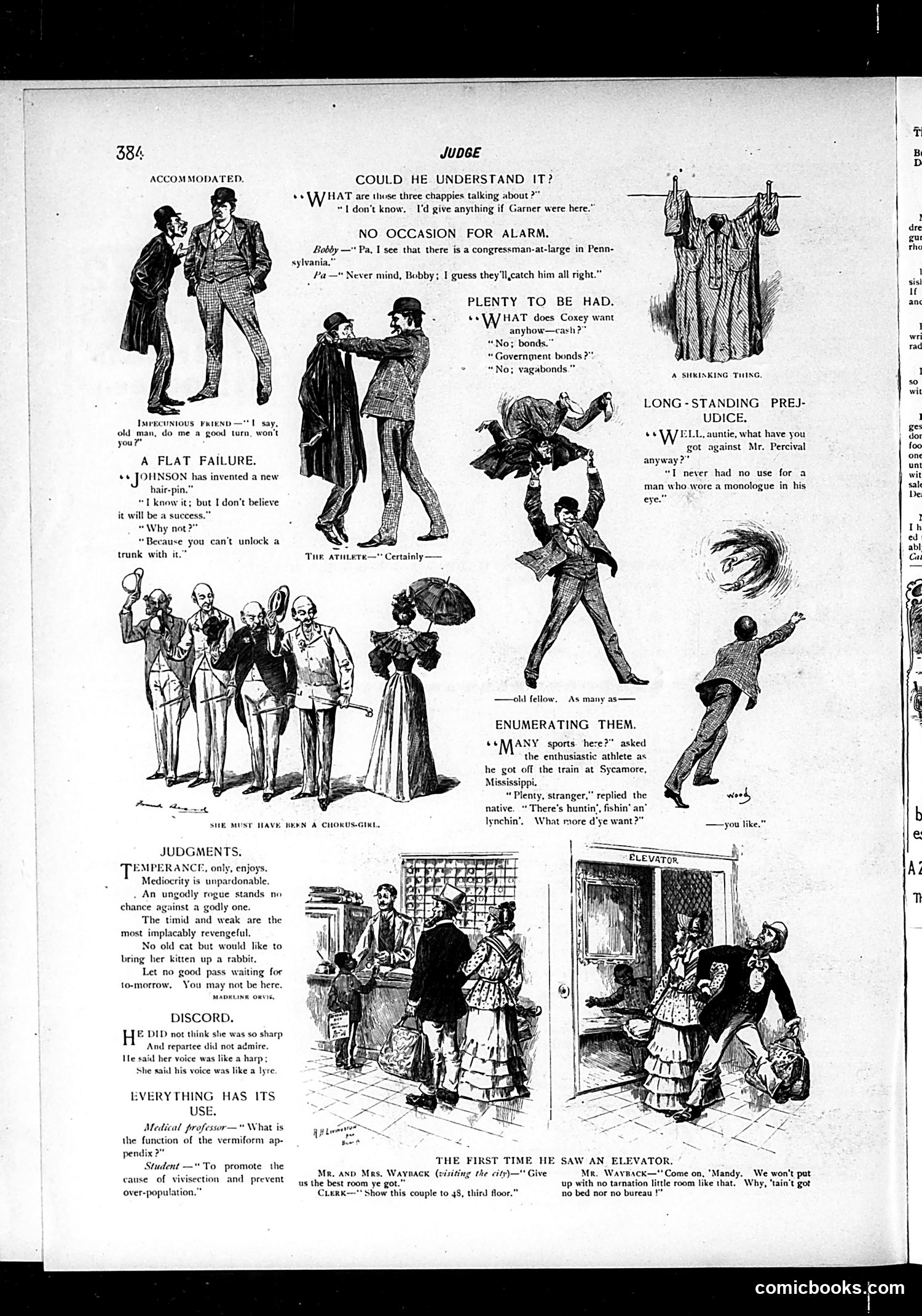
This page from Judge magazine contains multiple short satirical cartoons and jokes targeting late 19th-century American society and politics. Notable references include: - **"Coxey"** likely refers to Jacob Coxey, who led an 1894 march of unemployed workers demanding government relief—the joke mocks confusion about whether he wants "bonds" or "vagabonds" - **Congressman-at-large in Pennsylvania**: satirizes political confusion or absurdity in representation - **The elevator cartoon**: mocks rural/unsophisticated visitors unfamiliar with urban technology, a common Judge theme - **"Chokus-girl"**: references chorus girls, suggesting a woman with a dubious past - **Lynching reference**: shockingly casual mention reflects the era's normalized racial violence The cartoons employ humor based on class anxiety, technological bewilderment, political incompetence, and ethnic/regional stereotypes. The "judgments" section offers moralistic commentary. Overall, the page reflects Judge's satirical approach to Gilded Age America's social tensions and modernization anxieties.
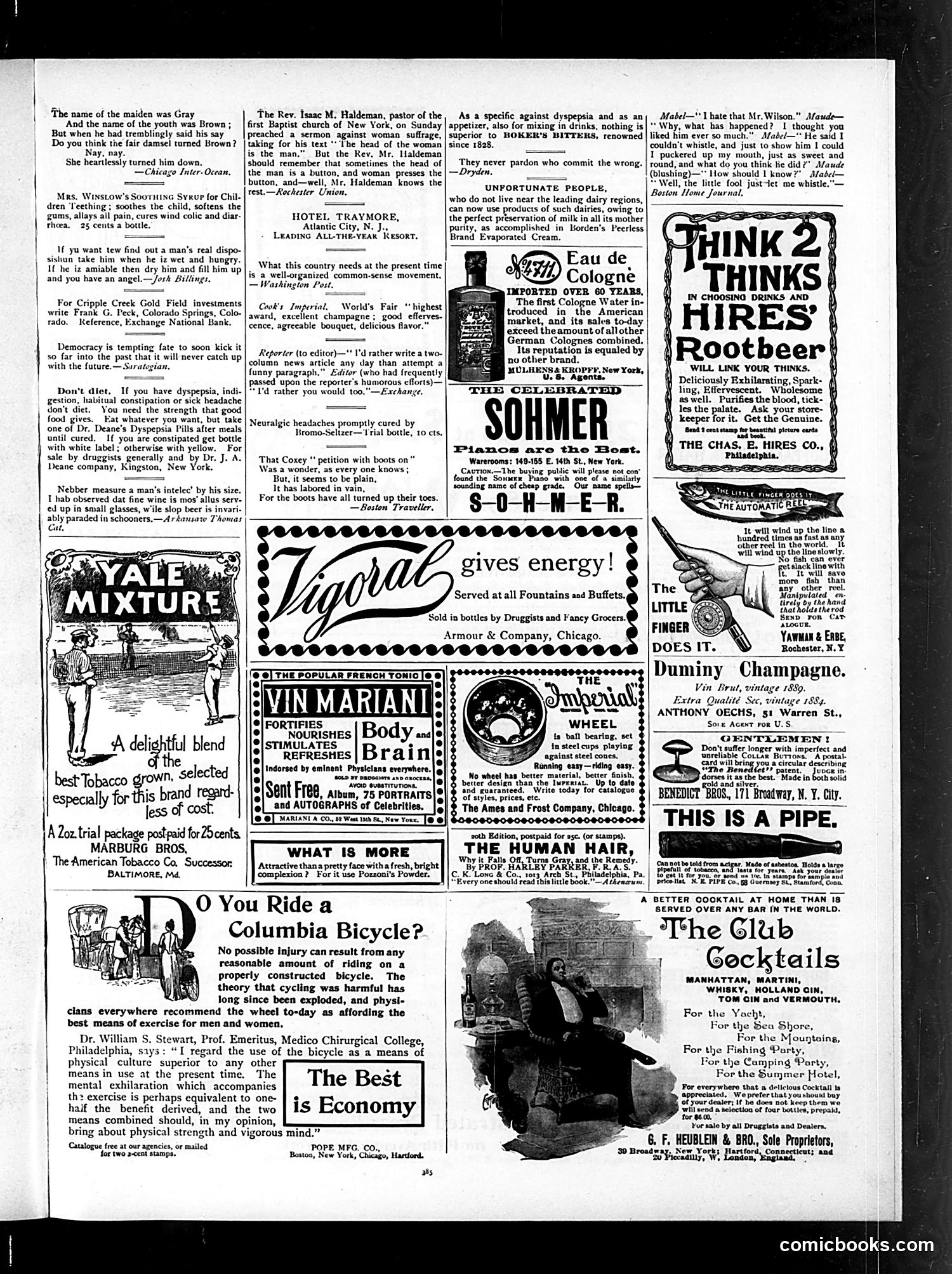
This is primarily an **advertising and humor page** from Judge magazine, a satirical weekly. The content is mostly filler material—short jokes, advertisements, and product endorsements typical of late 19th-century publications. The few topical references include: **"That Coxey petition with boots on"** — This alludes to **Coxey's Army**, the 1894 march of unemployed workers on Washington led by Jacob Coxey. The joke mocks the movement's apparent failure, suggesting the marchers' boots have "turned up their toes" (worn out/defeated). **Rev. Haldeman's sermon against women's suffrage** — A contemporary religious figure opposed women voting; the editor's counter-joke sarcastically suggests women already control men ("woman presses the button"). The remainder consists of period advertisements for medicines (dyspepsia pills, Bromo-Seltzer), bicycles, champagne, and pianos—reflecting consumer culture and patent medicine marketing of the era. The racial dialect humor ("Nebber measure...") reflects offensive but common editorial conventions of the time.
This page is primarily **advertisements**, not political satire. It features testimonials and product endorsements from the 1890s. The dominant content includes: - **Buffalo Lithia Water**: Medical testimonials from prestigious doctors (U.S. Surgeon-General William Hammond and others) claiming the water cures Bright's Disease (kidney disease). This reflects the era's patent medicine marketing, where doctors endorsed products with claims we'd now recognize as unsubstantiated. - **Warwick Bicycles and Hartford Bicycles**: Competing bicycle advertisements, reflecting the 1890s bicycle craze. - **Other products**: Rupture treatments, "No-to-Bac" tobacco-cessation products, and subscription offers to "Our Illustrated Press." The only humor appears in a brief joke from the Buffalo Courier about tears rolling down cheeks—likely a pun about sorrow. The page demonstrates how advertisers used celebrity endorsements and pseudoscientific claims to sell products, a common practice before modern FDA regulations.
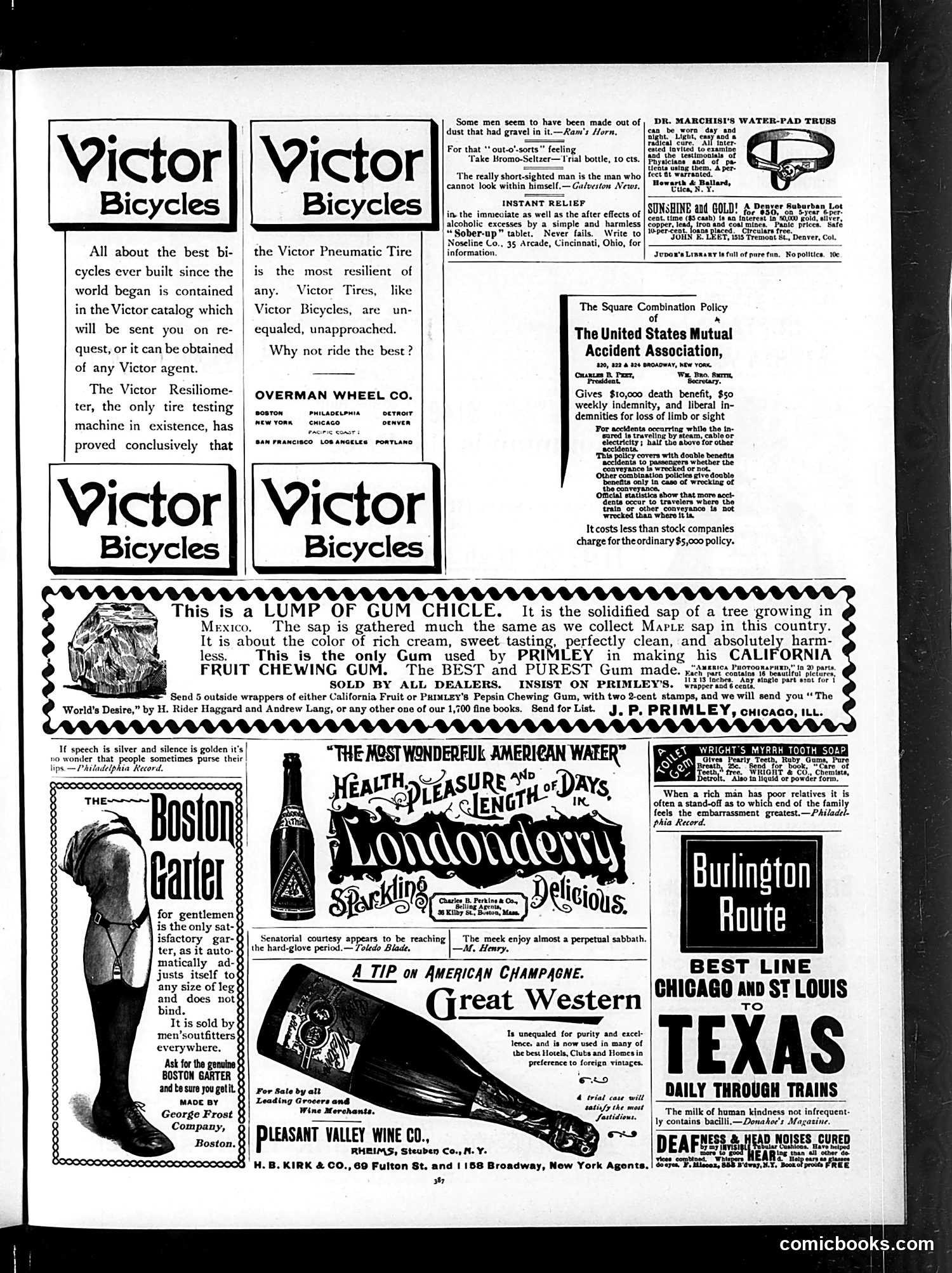
This page is primarily **advertising**, not satirical content. It contains product advertisements typical of early 20th-century publications, including Victor Bicycles, Primley's Chewing Gum, Londonderry Sparkling Water, and various patent medicines. The only satirical elements are brief **quoted aphorisms** scattered throughout: - "Some men seem to have been made out of dust that had gravel in it" - Commentary on short-sighted men who "cannot look within himself" - Observations about silence being "golden" and the "meek" enjoying "perpetual sabbath" These appear to be filler humor rather than focused satire. The page lacks identifiable caricatures or political commentary. Instead, it reflects period advertising practices: dubious medical claims ("Sober-up" tablets, water-pad trusses), product endorsements, and travel promotions (Burlington Route to Texas). The content reveals early 1900s consumer culture and marketing rather than satirical social critique.
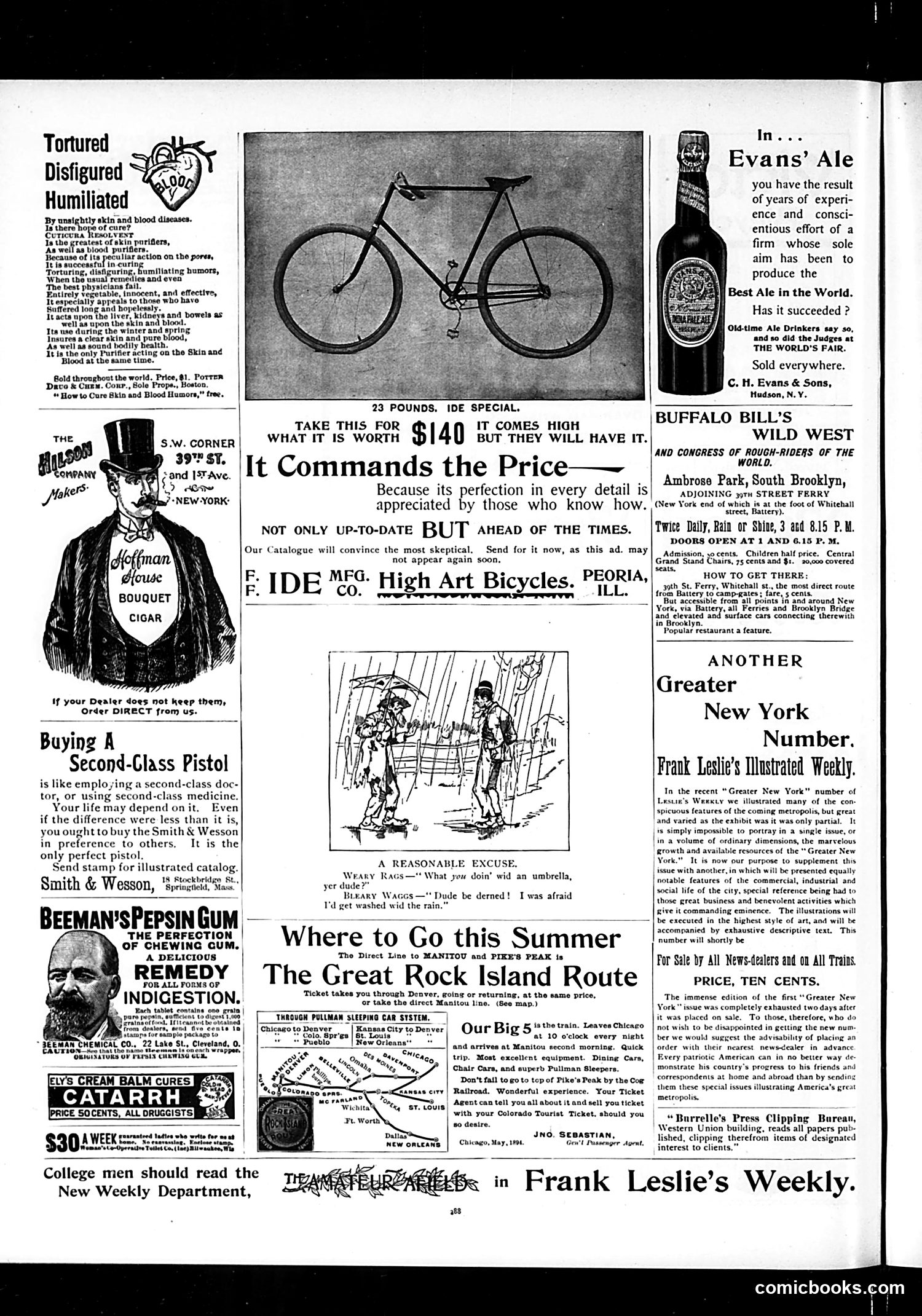
This page is primarily **advertising**, typical of Judge's revenue model. The content mixes patent medicine ads, consumer products, and entertainment promotions with minimal editorial cartoons. The one clear cartoon is "A REASONABLE EXCUSE" (bottom left): two figures in heavy rain—one asks why the other has an umbrella, and he replies he feared getting washed away in the rain. It's a simple visual pun playing on the phrase "washed out." The page otherwise advertises: - **Cuticura** (skin treatment), **Smith & Wesson pistols**, **Beeman's Pepsin Gum**, and **Hoffman House cigars** (consumer goods) - **Buffalo Bill's Wild West show** performing in Brooklyn - **Great Rock Island Route** train service to Colorado's Pike's Peak - **Evans' Ale** (which won at the World's Fair) - **Frank Leslie's Illustrated Weekly** magazine The advertisements reflect 1890s concerns: patent medicines for skin disease, weapons, tourism, and entertainment. No political satire appears on this page.
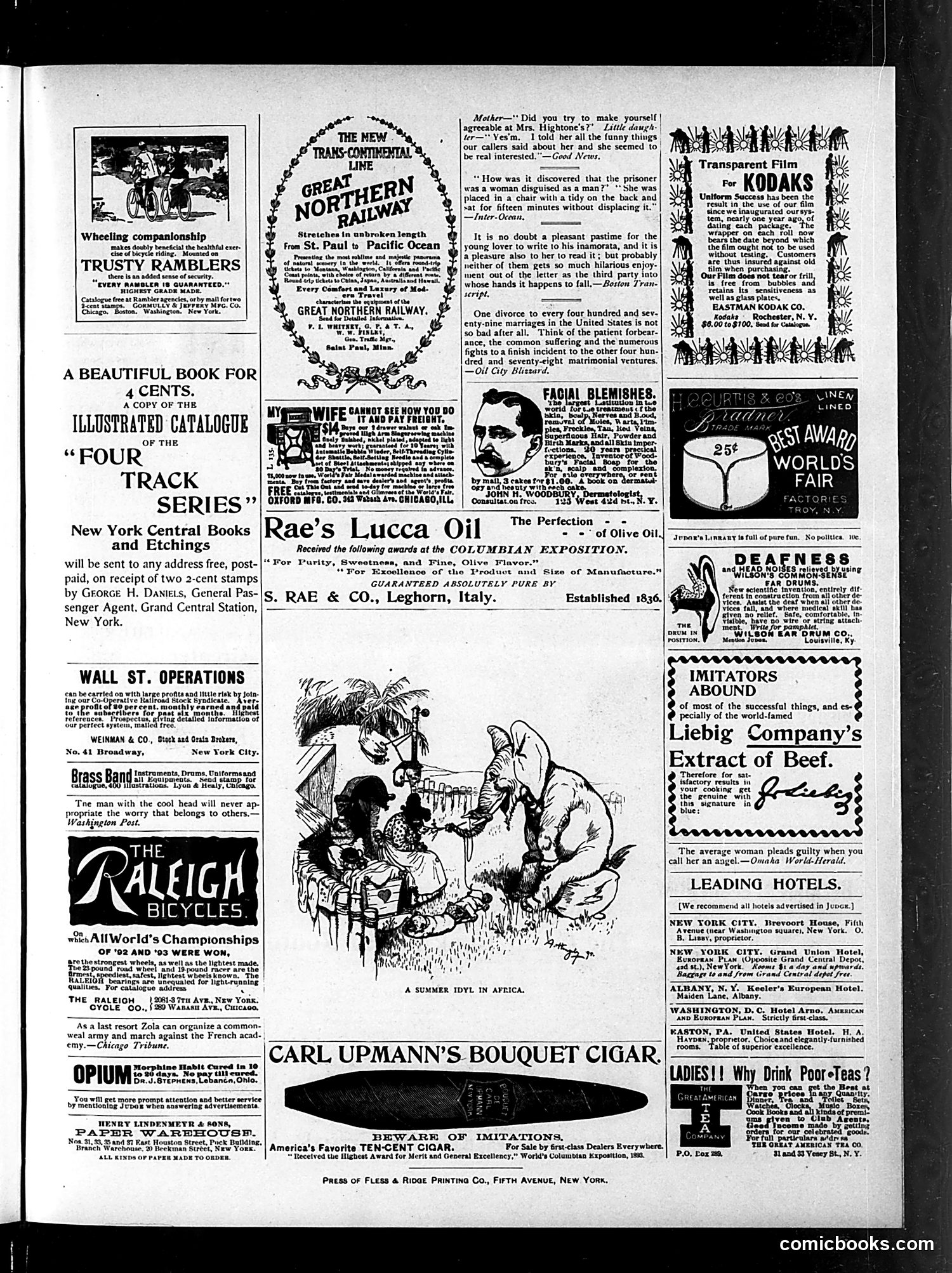
This page is primarily **advertising**, typical of Judge magazine's back pages. The dominant content includes ads for bicycles (Ramblers, Raleigh), olive oil, cigars, hotels, and various other products. The only actual cartoon appears mid-page: "A Summer Idyl in Africa" depicts what appear to be **caricatured African figures** in a colonial-era stereotype style—likely reflecting late-19th/early-20th-century attitudes about Africa as exotic or primitive. The humor was likely intended as lighthearted exoticism for contemporary readers. The scattered short jokes touch on domestic life ("Mother" and daughter at social calls) and marriage statistics, representing typical magazine humor of the era—mild observations about courtship, divorce, and social propriety rather than hard satire. The page overall reflects Judge's status as a commercial publication balancing advertising revenue with light humor and satire targeting educated, urban audiences of the period.
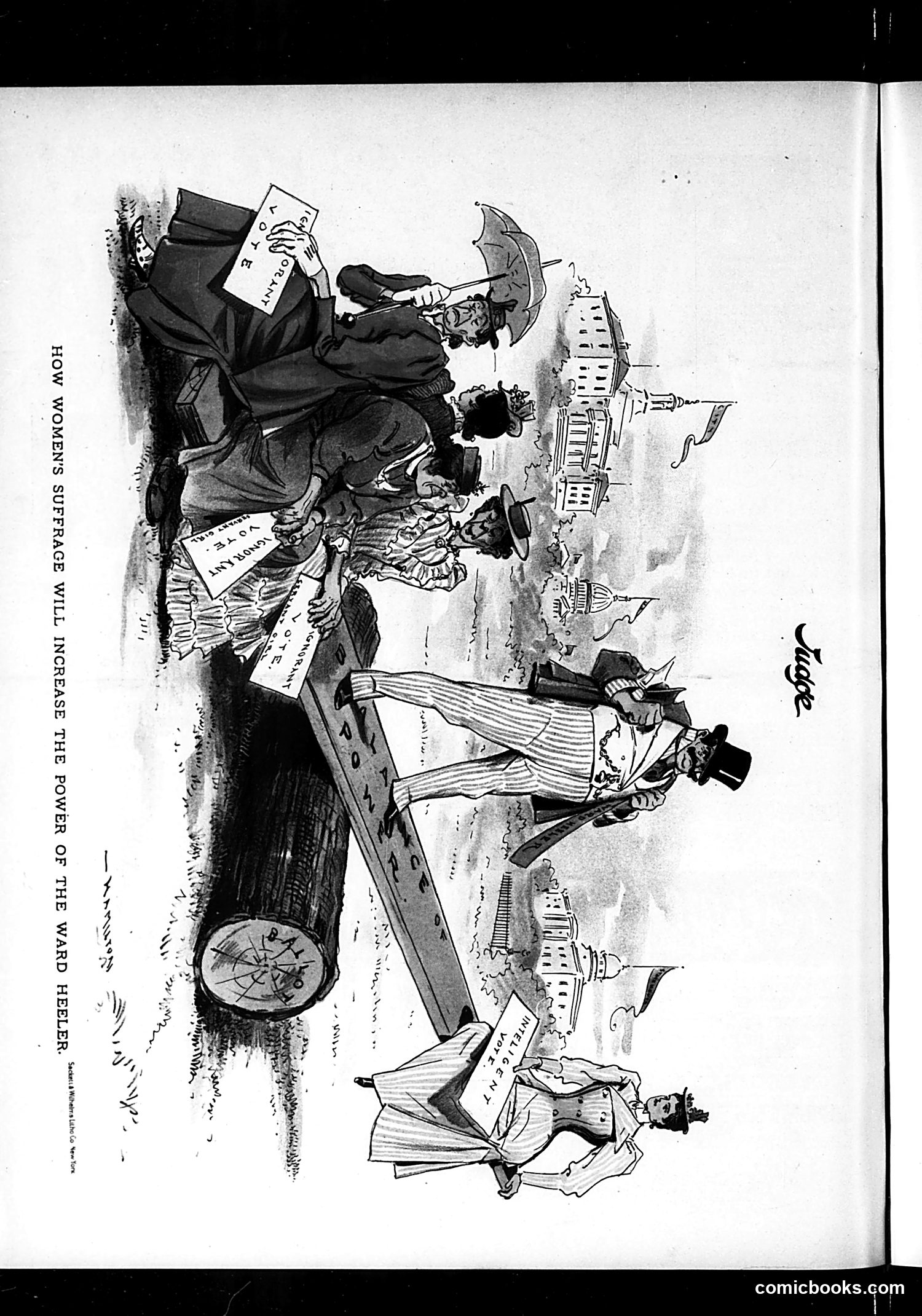
This cartoon satirizes opposition to women's suffrage by depicting a "ward heeler" (a political machine operative who controlled votes through patronage and corruption) celebrating how women voters would amplify his power. The image shows the ward heeler as a grotesque, manipulative figure with an umbrella and documents, surrounded by what appear to be tenement buildings and poor urban residents. The satire works by reversing the suffragists' argument: rather than showing women's voting as empowering citizens, it suggests that corrupt political machines would simply expand their control to include female voters. The cartoon implies that without genuine political reform, giving women the vote merely means doubling the electorate available for exploitation by established political corruption—a cynical critique suggesting suffrage alone, without addressing machine politics, wouldn't achieve true democratic improvement.