
A complete issue · 17 pages · 1893
Judge — December 30, 1893
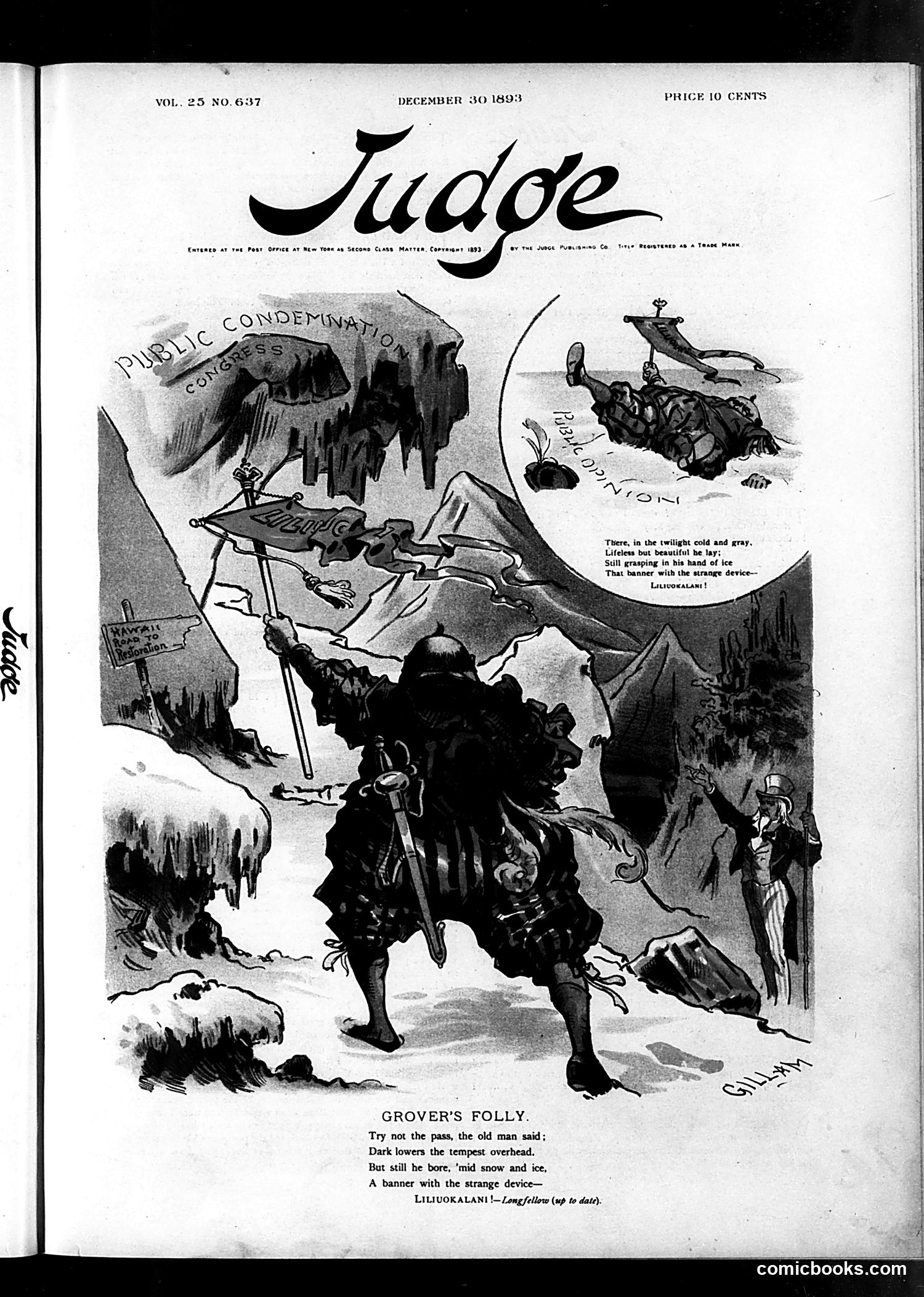
This political cartoon satirizes President Grover Cleveland's handling of winter conditions and governance challenges. The central figure, a demon-like creature labeled "Public Condemnation," wields a banner with "strange device" while struggling through harsh snow and ice. The imagery suggests Cleveland is beleaguered by multiple crises simultaneously—depicted as swirling difficulties in the surrounding vignettes. The verse references "dark towers" and "tempest overhead," implying Cleveland faces both literal (winter) and metaphorical (political) storms. The "Liluokalani" reference in the caption likely alludes to the Hawaiian queen's deposition (1893), a controversial event during Cleveland's administration. The cartoon criticizes his apparent helplessness against combined natural and political disasters, portraying his presidency as hapless and ineffectual.
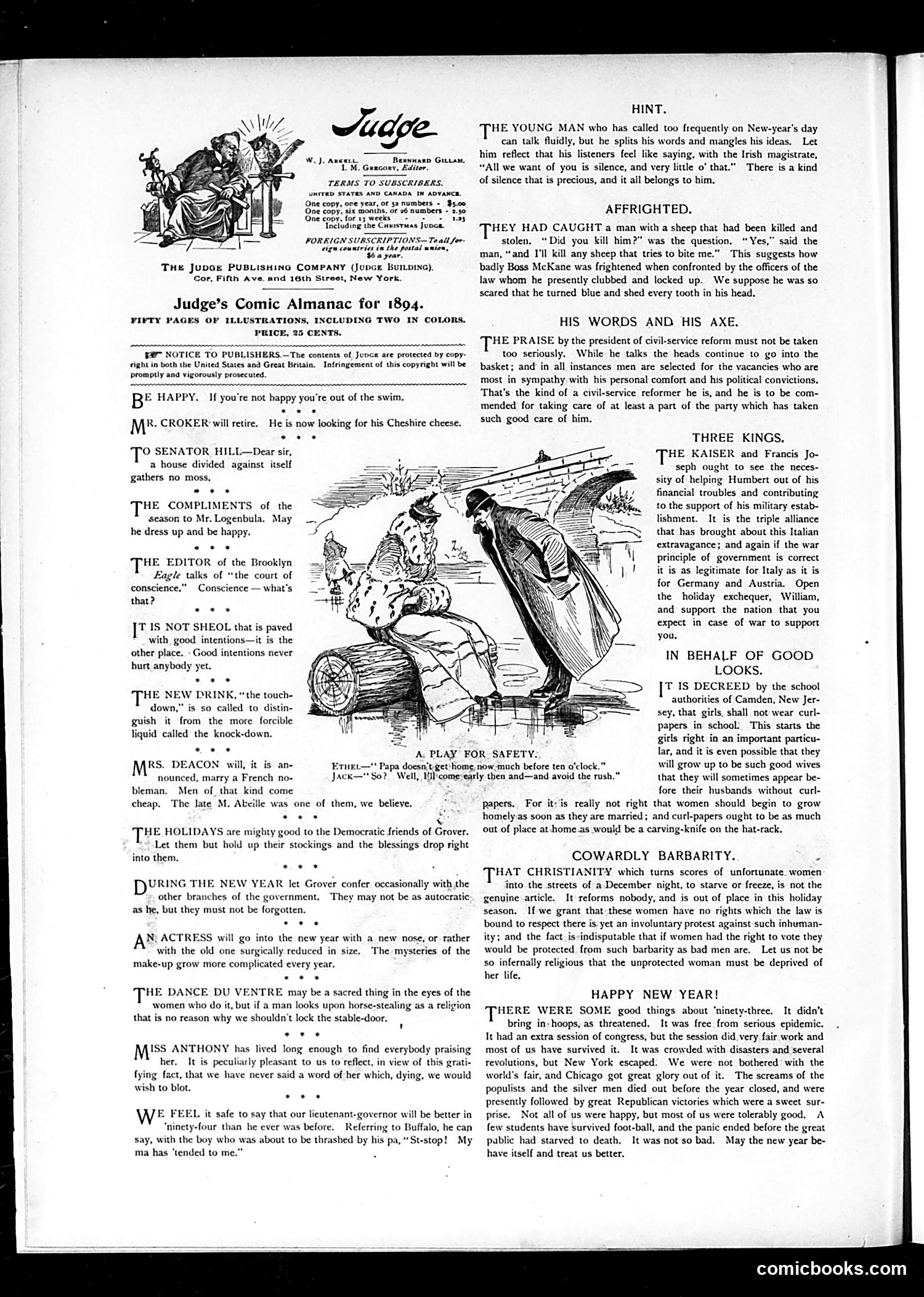
The main cartoon depicts two men in a boat labeled "Kruel" with what appears to be a barrel or log, captioned "Papa doesn't get home now much before ten o'clock" and "Well, I'll come early then and—avoid the rush." The humor seems to reference domestic life and marital obligations during the holiday season. The "rush" likely alludes to New Year's celebrations and social obligations. The surrounding text contains brief satirical commentary on contemporary issues: civil-service reform, women's fashion (particularly corsets and appearance standards), and moral concerns about women's behavior. The pieces critique both societal hypocrisy and reform efforts. Without clearer identification of specific political figures or dated references in the visible text, the precise targets remain unclear, though the tone suggests general social satire typical of Judge magazine's editorial stance.
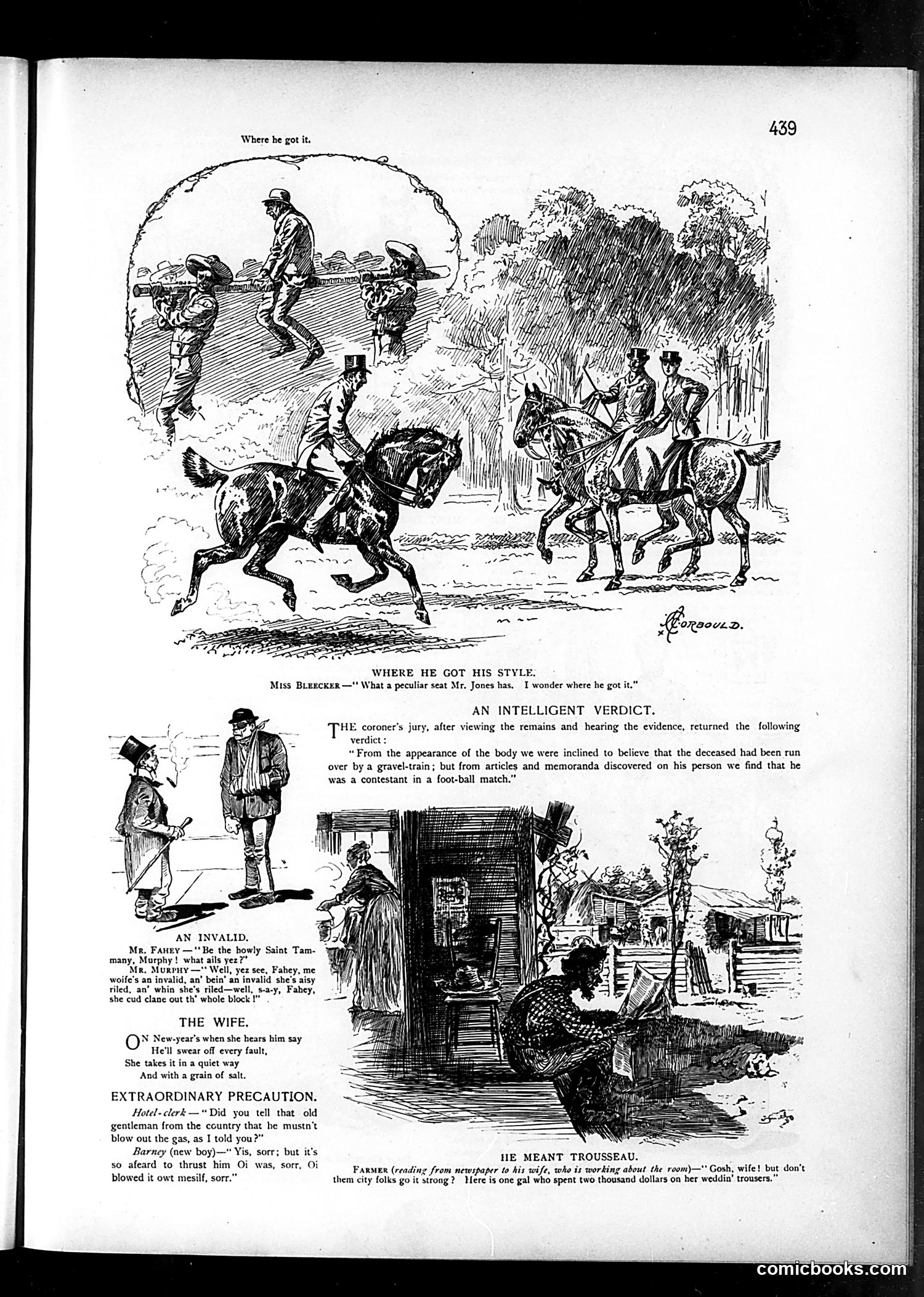
This page contains several unrelated satirical sketches and humorous anecdotes rather than a unified political cartoon. **"Where He Got It"** depicts a polo match, satirizing upper-class sporting pretensions—the caption suggests someone acquired an unusual riding style. **"An Intelligent Verdict"** mocks a coroner's jury that attributed a death to a gravel-train accident, though evidence suggested the deceased was a football contestant—likely satirizing incompetent official investigations. The remaining sections—"An Invalid," "The Wife," "Extraordinarily Precaution," and "He Meant Trousseaus"—are brief humorous anecdotes about domestic life and misunderstandings, typical of Judge's general-interest comedy content. The page targets common middle-class foibles and institutional absurdities rather than specific contemporary political events.
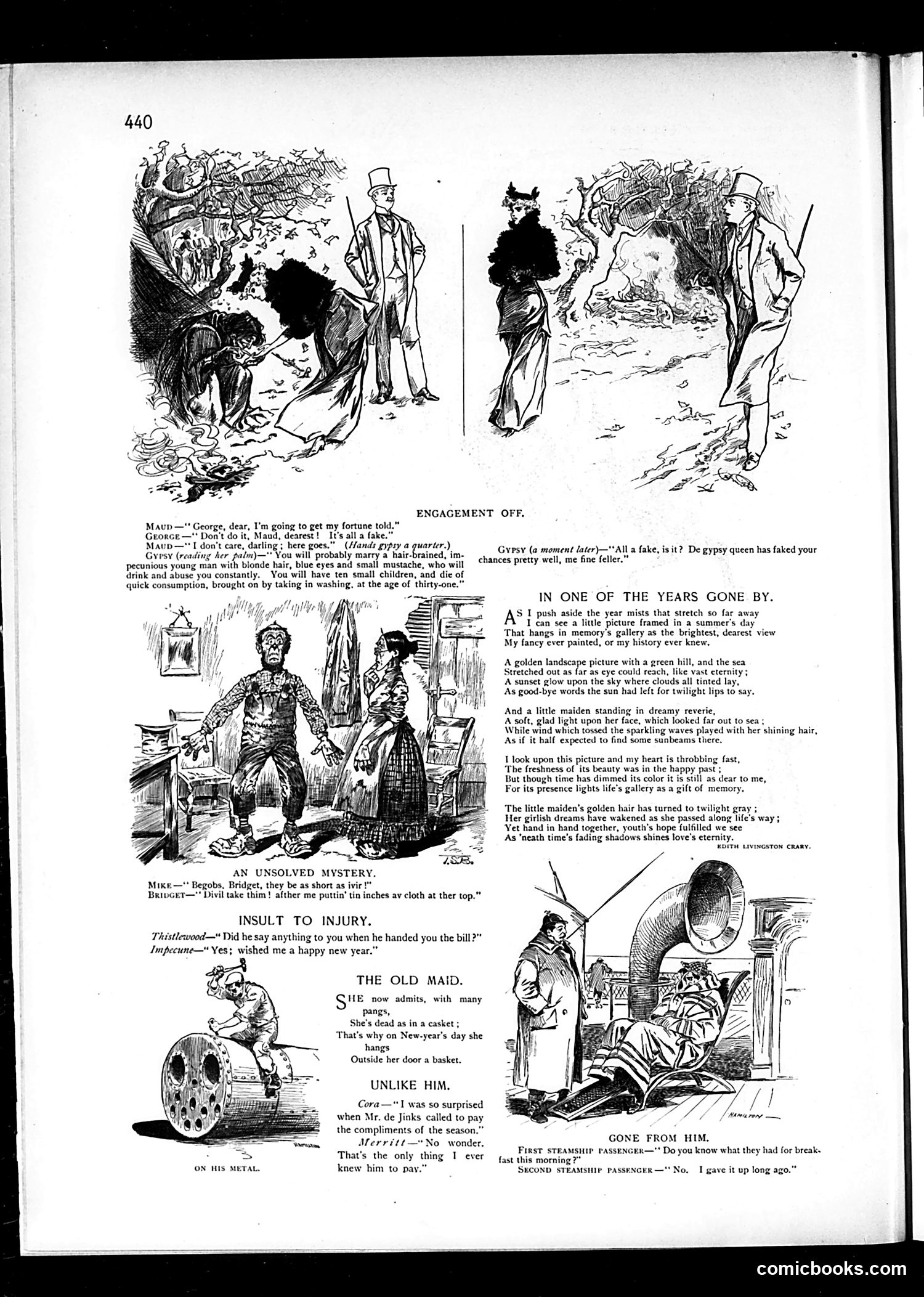
This page contains multiple brief satirical sketches typical of Judge's format: **"Engagement Off"**: A woman consults a fortune teller who predicts a grim future with a dissolute husband—heavy drinking, abuse, ten children, and early death from washing-induced consumption. The fiancé calls it fake, but the fortune's specificity creates dark comedy about matrimonial risks. **"In One of the Years Gone By"**: A sentimental poem (by Edith Livingston Crary) about a cherished memory of a maiden by the sea, now aged and married. It's nostalgic verse, not satire. **"An Unsolved Mystery"**: Irish domestic humor about a maid's mysteriously short pants despite adding cloth. **"Insult to Injury"**: A debtor receives a bill with holiday wishes—compounding financial distress with forced pleasantries. **"The Old Maid"**: Dark humor about unmarried women hanging baskets outside on New Year's (unclear significance; possibly a superstition or desperation signal). **Minor jokes**: Brief exchanges mocking penny-pinching wealthy men and steamship passengers. The page emphasizes marital anxieties, class commentary, and domestic humor typical of late-Victorian American satire.
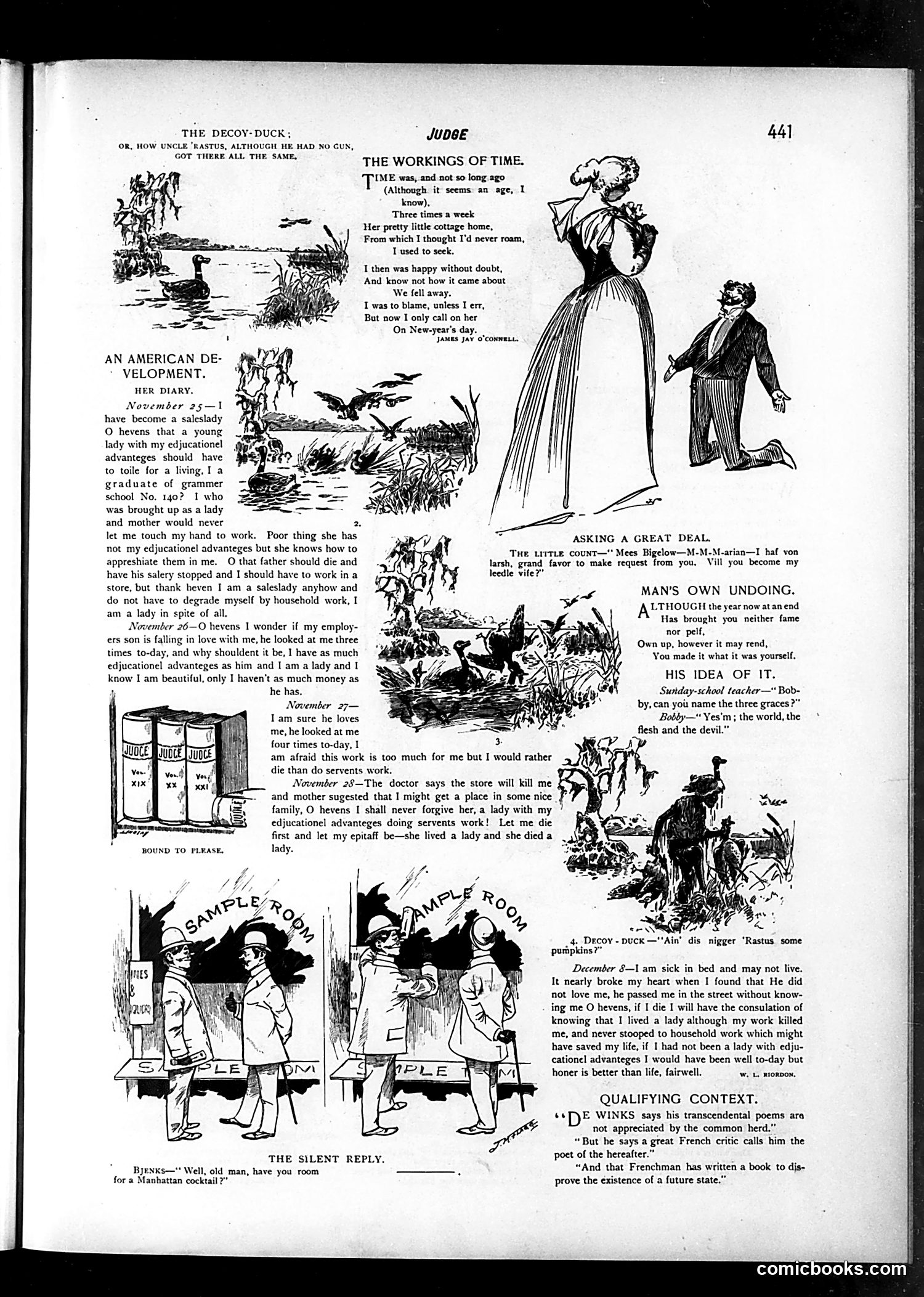
This page satirizes **class pretension and snobbery** among young American women of modest means who aspire to gentility. The main feature, "Her Diary," mocks a salesgirl who considers herself a "lady" because she graduated grammar school and refuses domestic work—despite her family's poverty. The humor lies in her pretentious misspellings ("edjucationel," "hevens"), her desperate hope that her employer's son loves her, and her tragic death from exhaustion at retail work rather than accepting "degrading" household employment. The satire targets how she clings to social status markers while her actual circumstances deteriorate. The other comic pieces are brief one-liners: a foreign suitor's proposal, a poem about romantic estrangement, and a child's irreverent answer about "graces." The "Decoy Duck" story appears to reference hunting exploits. Overall, Judge ridicules American working-class women's aspirational class consciousness and their misguided rejection of practical work in favor of maintaining false dignity.
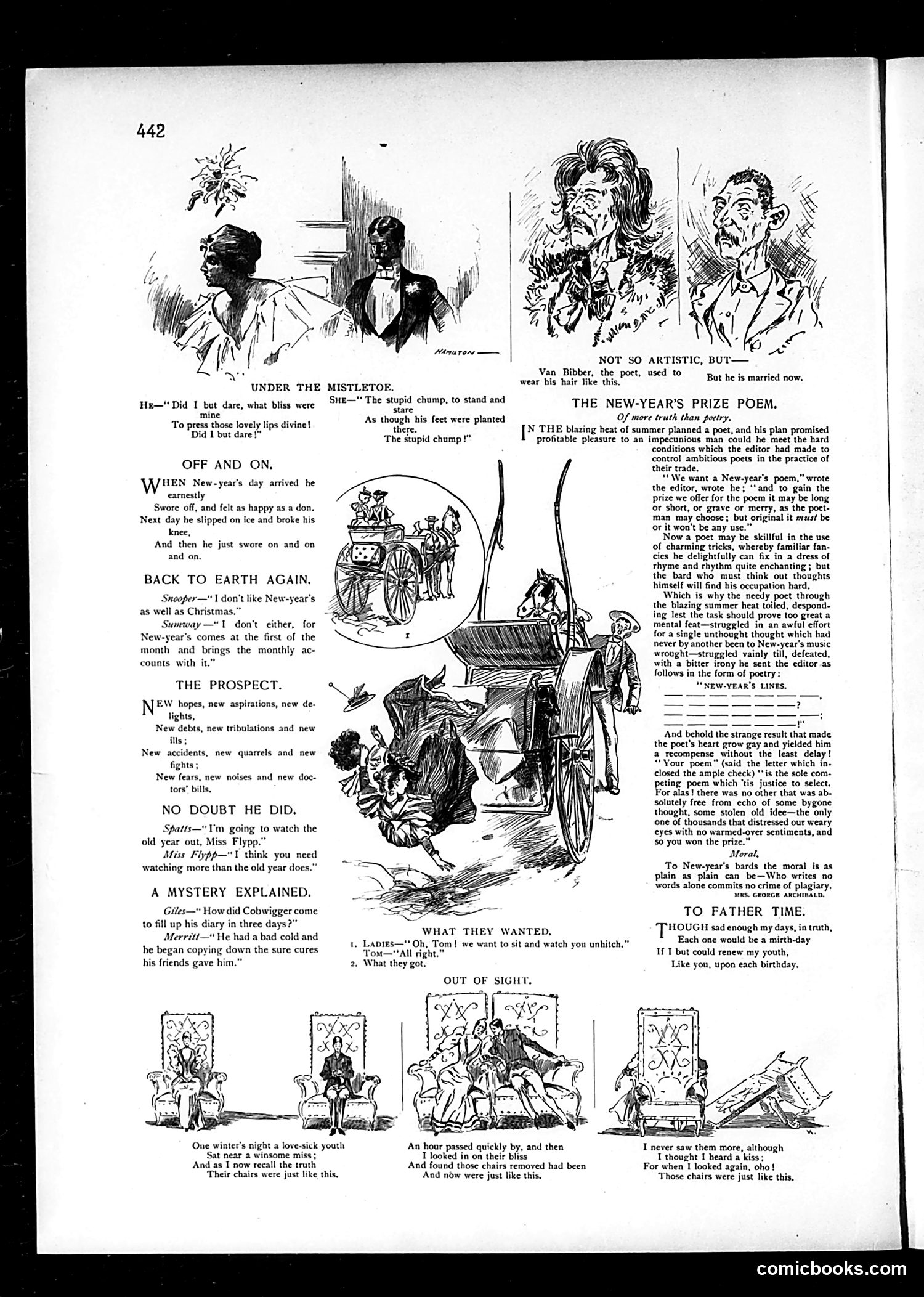
This page contains several satirical pieces typical of late 19th-century American humor: **"The New-Year's Prize Poem"** (main feature): Satirizes struggling poets and magazine editors. The joke: an impoverished poet, after agonizing all summer to create original work, wins the prize simply by submitting a blank page—the only submission genuinely free from plagiarism or clichés. The moral mocks both pretentious literary ambitions and the epidemic of derivative verse. **"Under the Mistletoe"** and related shorts: Mild romantic/social humor about New Year's resolutions and courtship customs. **"Out of Sight"** (bottom): A visual gag using repeating chair imagery to show how furniture appears different depending on context—likely poking fun at sentimental nostalgia or perception. The page reflects Judge's satirical focus on contemporary American society: literary pretension, romantic conventions, and the absurdities of modern life. The cartoons assume reader familiarity with salon poetry competitions and Victorian courtship rituals.
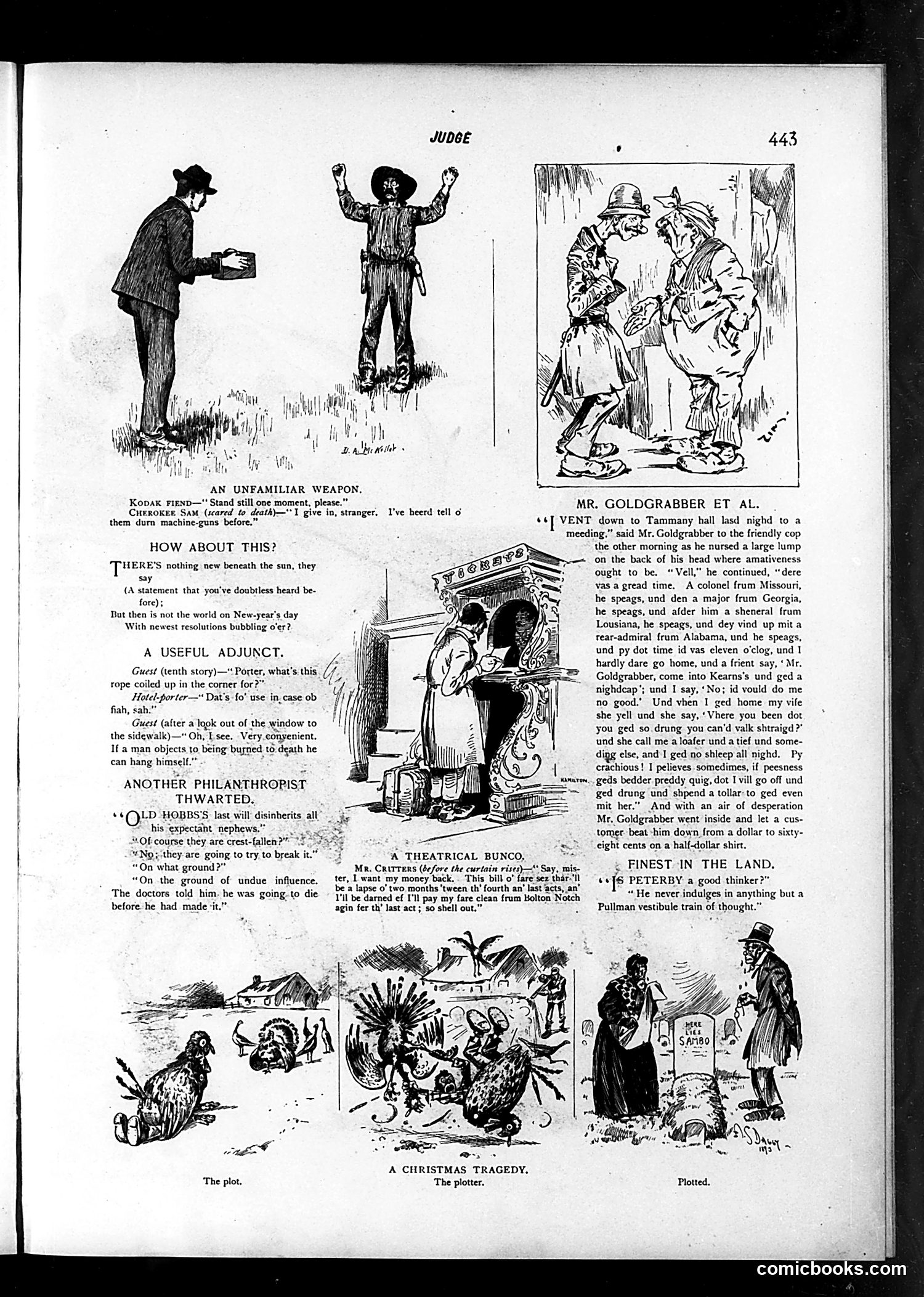
This page contains several humor pieces satirizing late 19th-century American life: **"An Unfamiliar Weapon"** mocks frontier violence—a cowboy surrenders to a camera rather than a gun, suggesting photography's growing power and the "taming" of the Wild West. **"A Useful Adjunct"** is dark humor about hotel fire safety: a guest notices a rope in a tenth-story room meant for escaping fires, then cynically observes it's convenient for suicide instead. **"Mr. Goldgrabber et al."** stereotypes German-American immigrants through dialect humor. Goldgrabber attends a Tammany Hall political meeting where various military officers bore him with speeches until midnight. When his wife scolds him for staying out drinking, he comically threatens to get drunk just to spite her—satirizing both marital discord and ethnic caricature. The bottom panels mock Christmas sentimentality and theatrical fraud. The satire targets urban American society: immigrant communities, corrupt city politics (Tammany Hall), domestic conflict, and commercialism—typical Judge magazine concerns of the era.
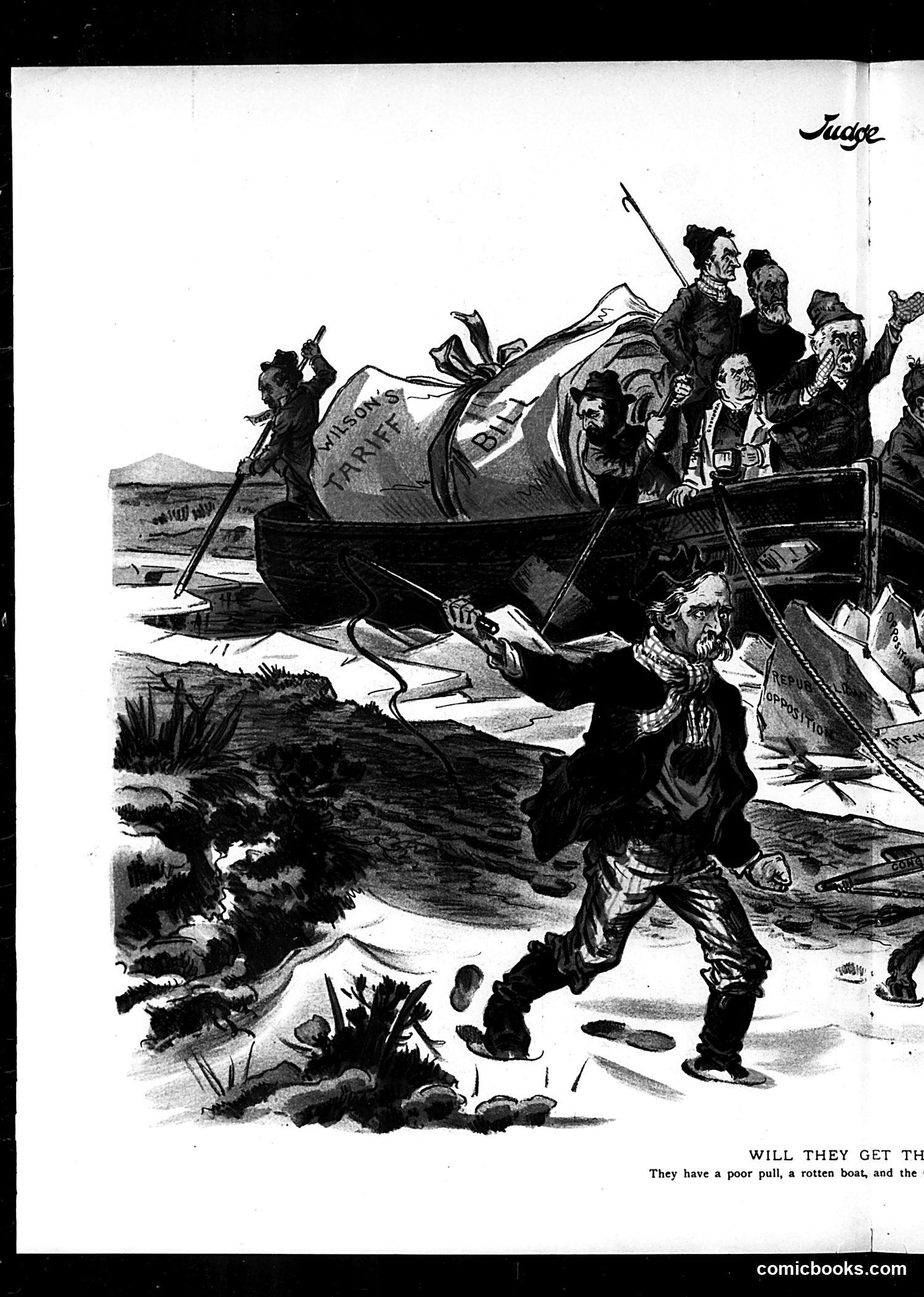
This **Judge** cartoon depicts a boat in distress with multiple figures aboard struggling to navigate. The vessel appears labeled with text referencing "Wilson's" (likely President Woodrow Wilson) and carries what appear to be caricatured political figures or government representatives. The caption "WILL THEY GET TH[ERE]" (incomplete) combined with "They have a poor pull, a rotten boat" suggests satirical commentary on a failing political endeavor or administration—the boat serving as metaphor for a ship of state in trouble. The figures' exaggerated features and desperate postures suggest incompetence or corruption among those steering policy. Without the complete text, the specific political situation remains unclear, but this appears to criticize either Wilson-era policies or particular government officials' ability to successfully manage national affairs.
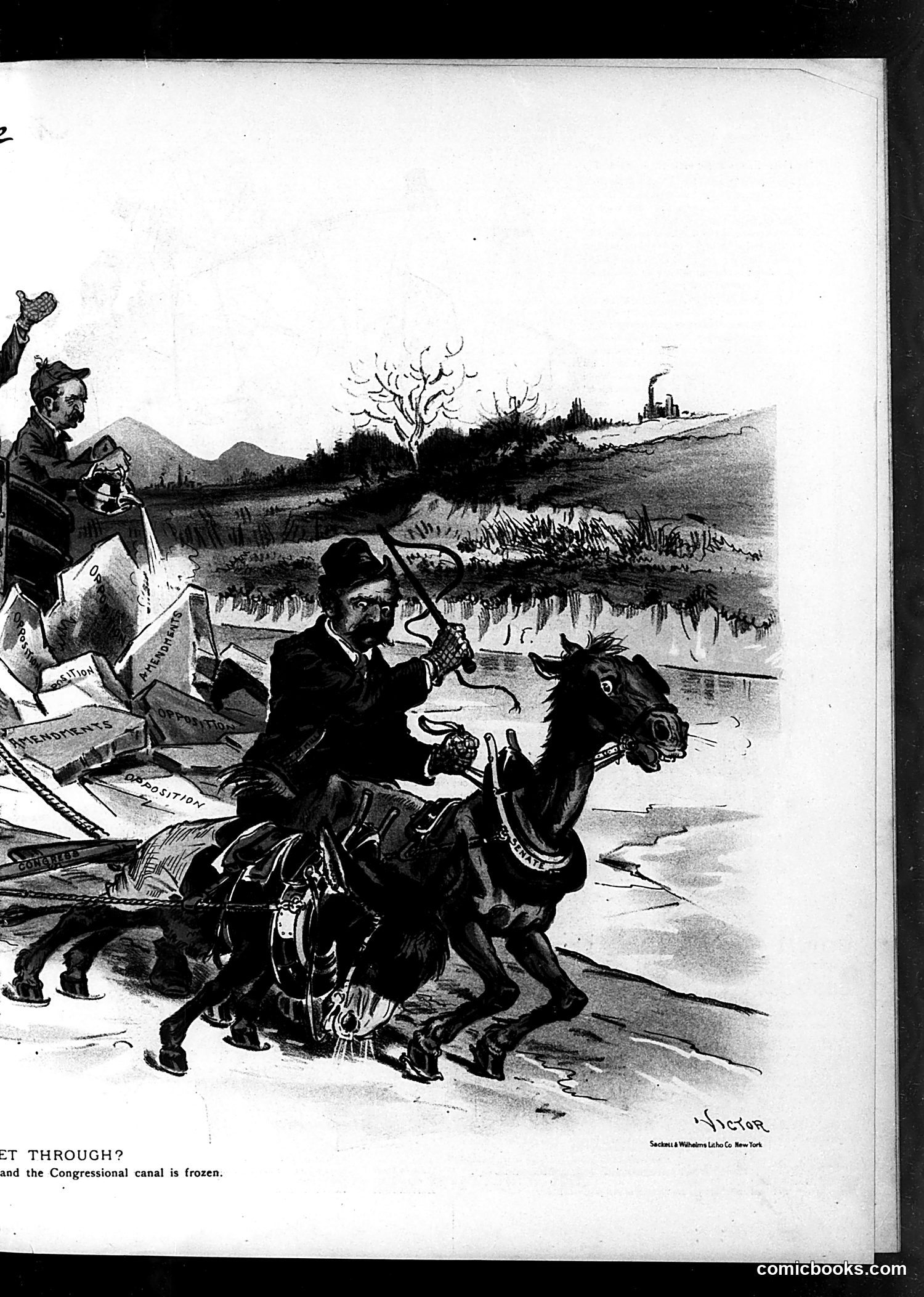
This cartoon by Weeder depicts a figure on horseback struggling through frozen terrain, appearing stuck or unable to progress. The caption references "the Congressional canal is frozen," suggesting the cartoon satirizes legislative gridlock—specifically, a stalled Congressional project or initiative that has become immobilized, like a frozen canal blocking passage. The figure's difficulty traversing the landscape represents the obstruction facing this Congressional effort. The frozen canal serves as a metaphor for legislative paralysis, where necessary progress has halted due to political resistance or lack of movement. Without additional context about the specific date and Congressional debate, the precise project remains unclear, but the satire clearly targets Congressional inability or unwillingness to advance a particular agenda or infrastructure initiative.
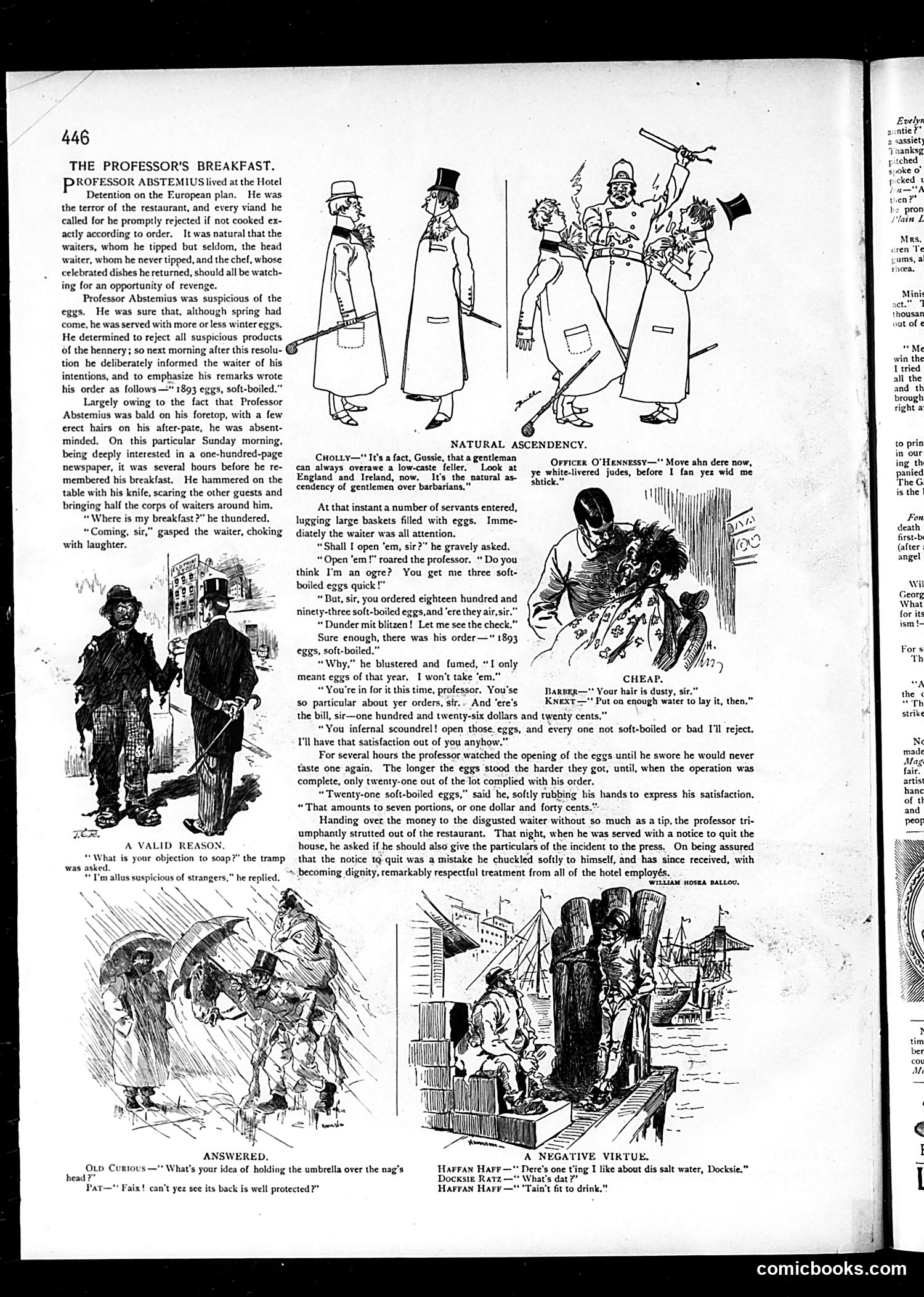
This multi-panel story mocks a fastidious, demanding hotel guest ("Professor Abstemius") who mistreats waitstaff with constant complaints and poor tipping. The satire works through ironic comeuppance: the professor meticulously orders "1893 eggs, soft-boiled" intending fresh spring eggs, but staff deliberately misinterpret this as literally 1,893 eggs from the year 1893—now stale and hardened. When forced to inspect them all, only 21 meet his exacting standards. He pays grudgingly without tipping, then receives an eviction notice. The subplot cartoons ("Natural Ascendency," "Answered," "Valid Reason," "Cheap") offer unrelated social commentary: one mocks British superiority over Irish people; others joke about tramps and poverty. The humor targets both snobbish customers and the working-class' clever revenge through literal interpretation of unreasonable demands—reflecting Gilded Age class tensions common to Judge's satirical agenda.
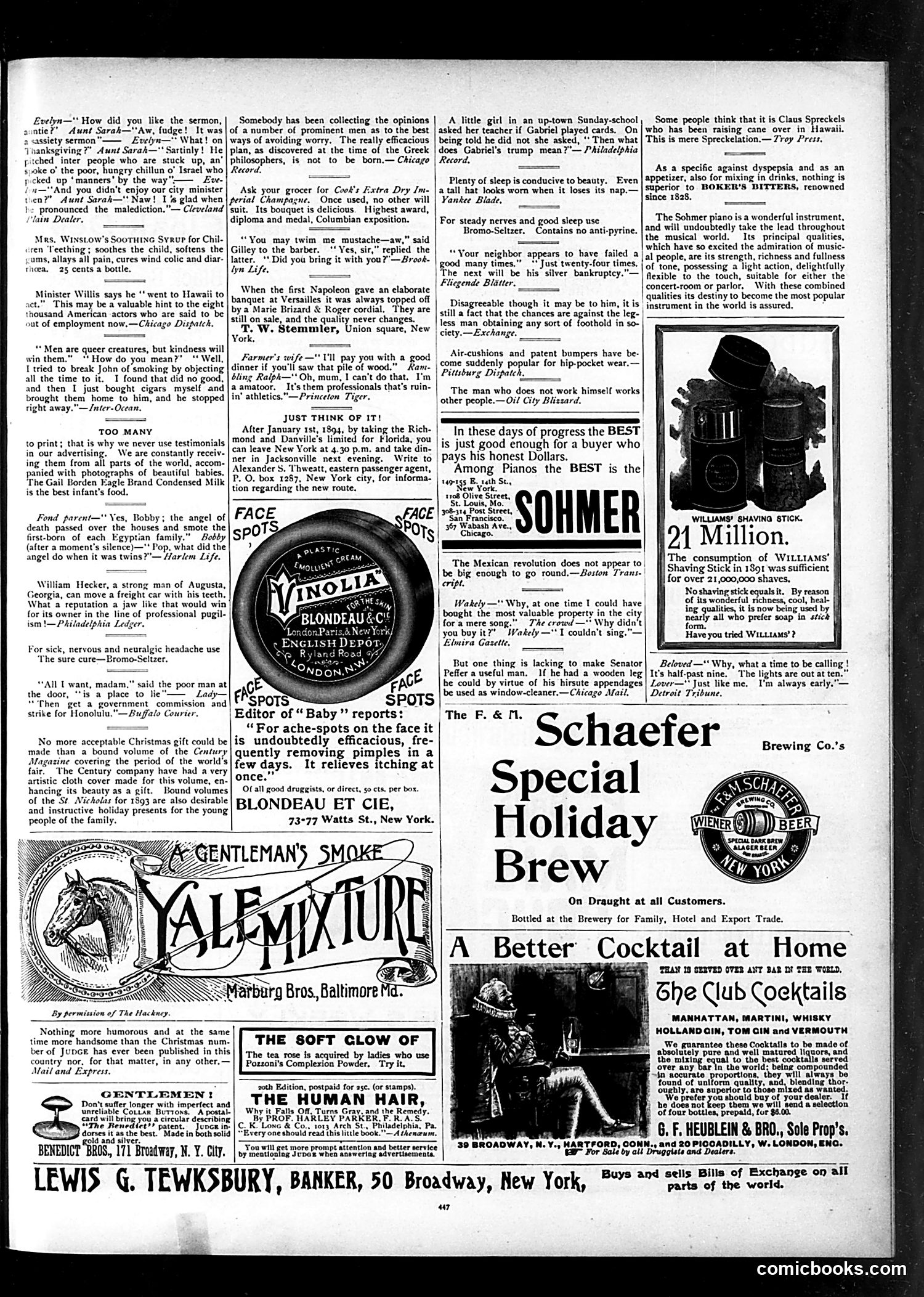
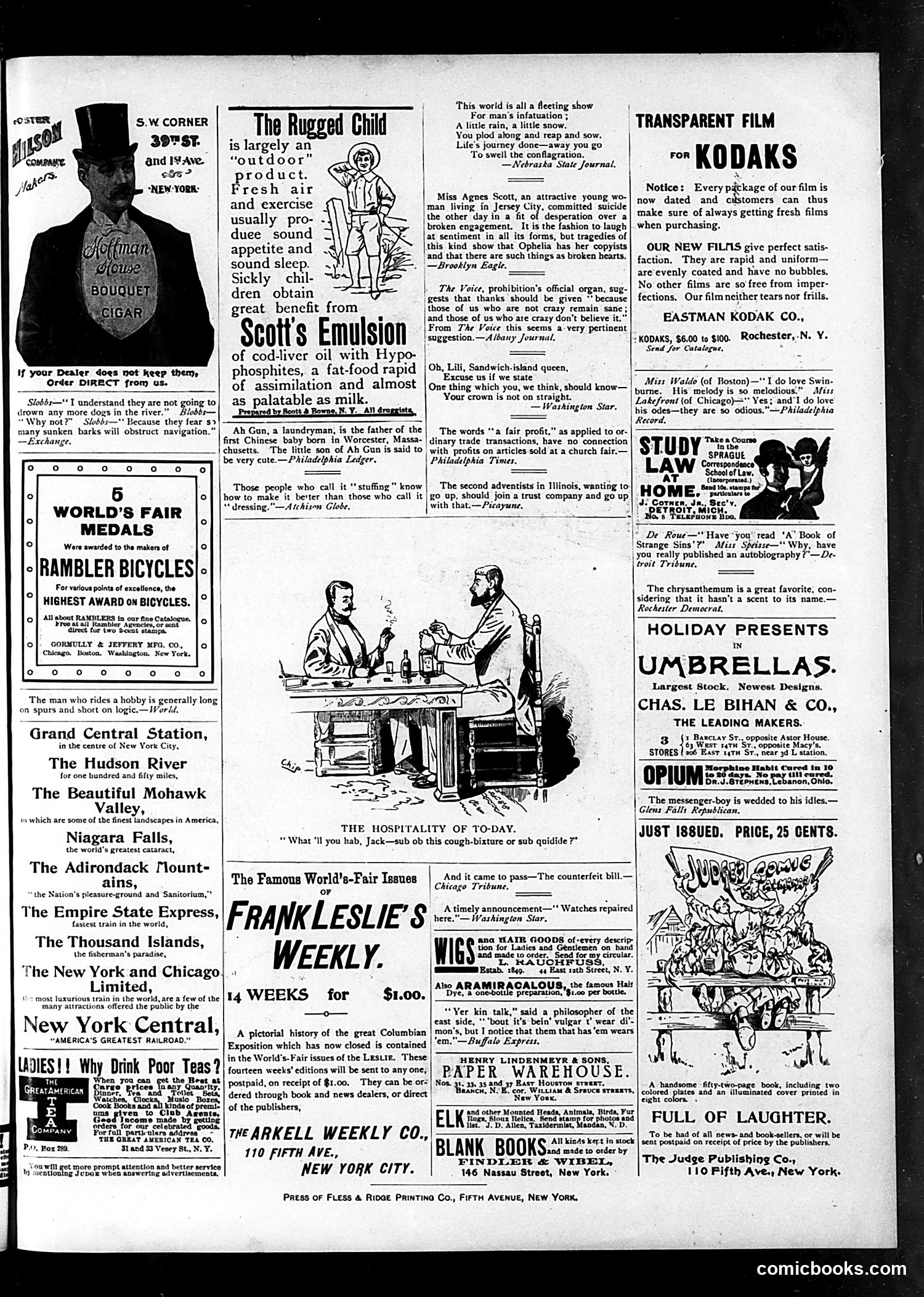
This page from *Judge* magazine is primarily **advertising with minimal cartoons**. The visual content consists of several product advertisements, not political satire. The brief text segments are humorous anecdotes mocking everyday situations: a woman criticizing a sermon for attacking snobbish people while herself being dismissive of it; a man trying unsuccessfully to stop a friend's smoking habit; a child's literal interpretation of the Passover story. These are gentle domestic humor pieces common to the era. The advertisements promote consumer goods: milk, champagne, cognac, beer, patent medicine (Bromo-Seltzer), and shaving products—reflective of 1890s consumer culture. A notable ad features a "Vino Tinta" wine product with a "Face Spots" label, selling anti-pimple remedies. The page lacks substantive political or social commentary; it's representative of *Judge*'s business model: satirical magazine format carrying commercial advertising revenue.
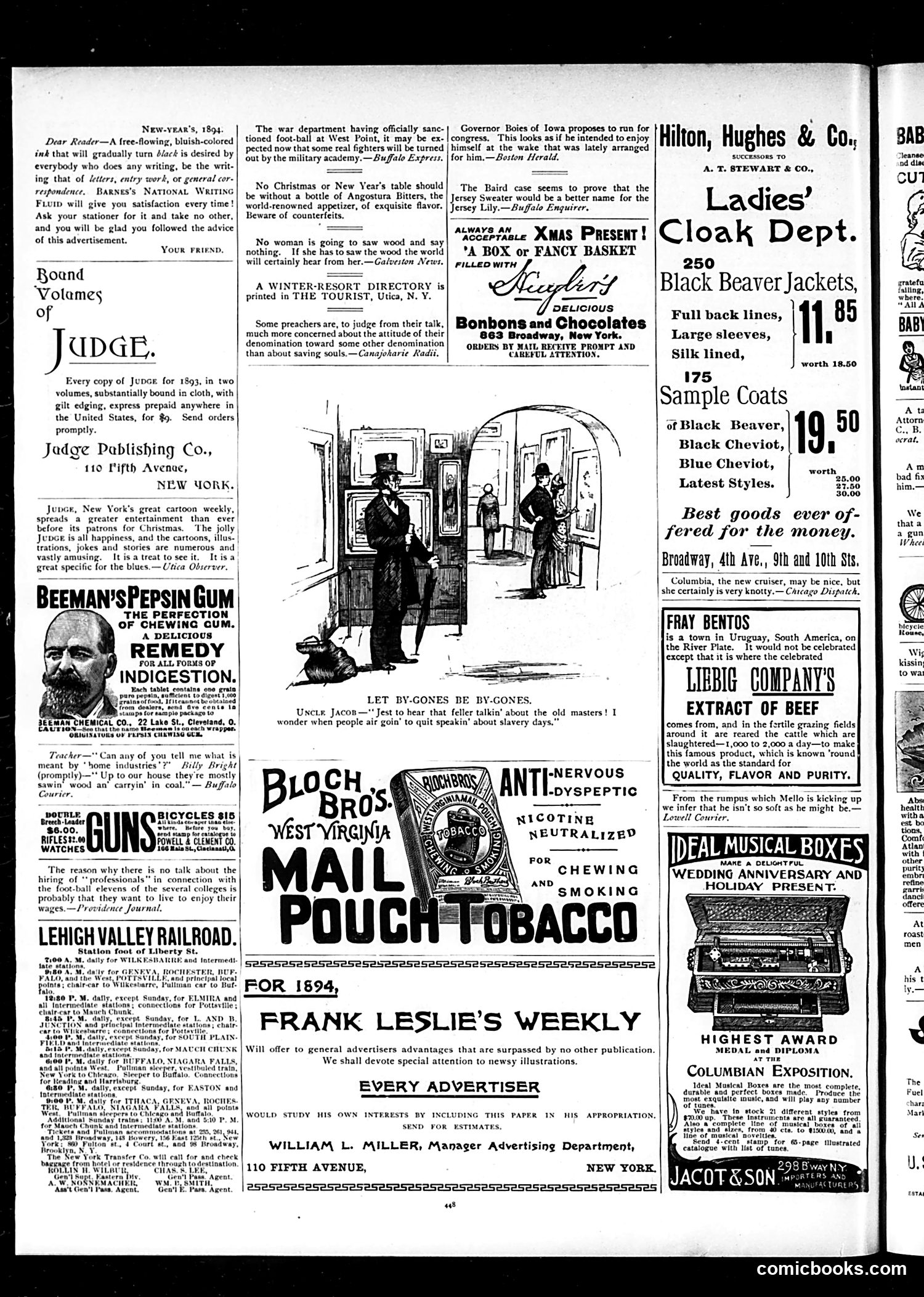
This page is primarily **advertisements and brief humor** rather than a coherent satirical cartoon narrative. The main cartoon depicts an elevator scene labeled "LET BY-GONES BE BY-GONES," showing Uncle Jacob dismissing an old man's praise of "the old masters," saying he wonders when people will "quit speakin' about slavery days." This references post-Civil War tensions: the joke mocks those still dwelling on antebellum Southern traditions, with Jacob representing forward-thinking sentiment. The page otherwise contains scattered one-liners and ads. One notes the War Department approved football at West Point, joking it will "turn out some real fighters." Another quips that Iowa Governor Boies running for Congress seems like he's "enjoying himself at the wake" for his political career. Most content is commercial: Judge Publishing advertising bound volumes, tobacco products, railroads, and patent medicines—typical of 1890s publications. The text footer promotes Frank Leslie's Weekly for 1894 advertising opportunities.
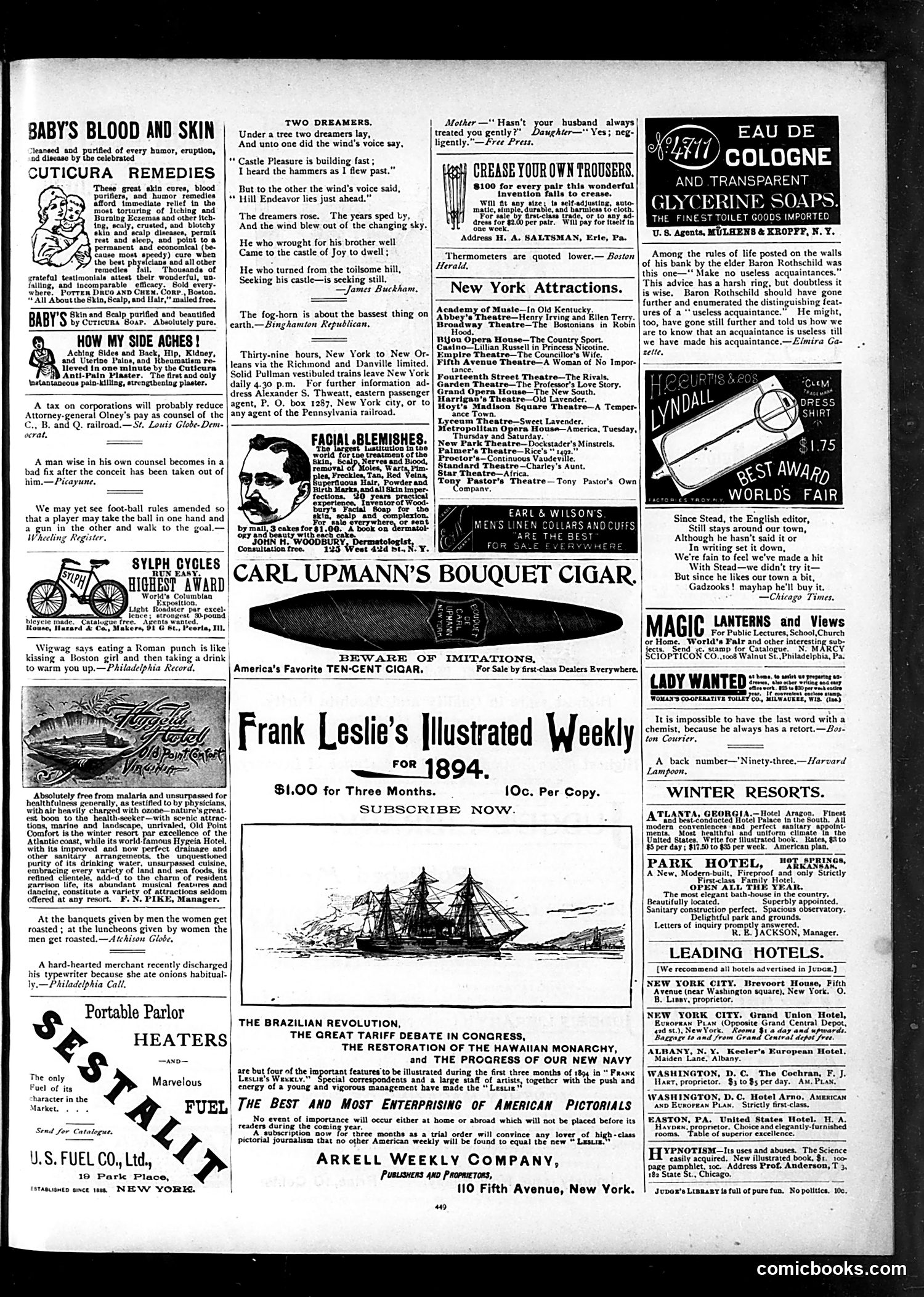
This is primarily an **advertising and content page** rather than a political cartoon page. The main elements are: **Central Content:** - "Two Dreamers" — a sentimental poem about ambition and contentment, with moral undertones typical of 1890s middlebrow literature - **New York Attractions** — theater listings for Broadway shows - The Brazilian Revolution and tariff debate announcements (serious editorial content) **Advertisements** dominate: Cuticura remedies (skin treatments), Carl Upmann cigars, Frank Leslie's Illustrated Weekly subscription, winter resort hotels, and heating fuel. **Social context:** The Baron Rothschild anecdote about "useless acquaintances" reflects Gilded Age anxieties about social climbing and authentic relationships. The theatrical listings reflect New York's robust entertainment culture in the 1890s. The page contains **no identifiable political cartoons or caricatures** — it's a typical turn-of-century magazine mix of advertising, light literary content, and entertainment information aimed at middle-class readers.
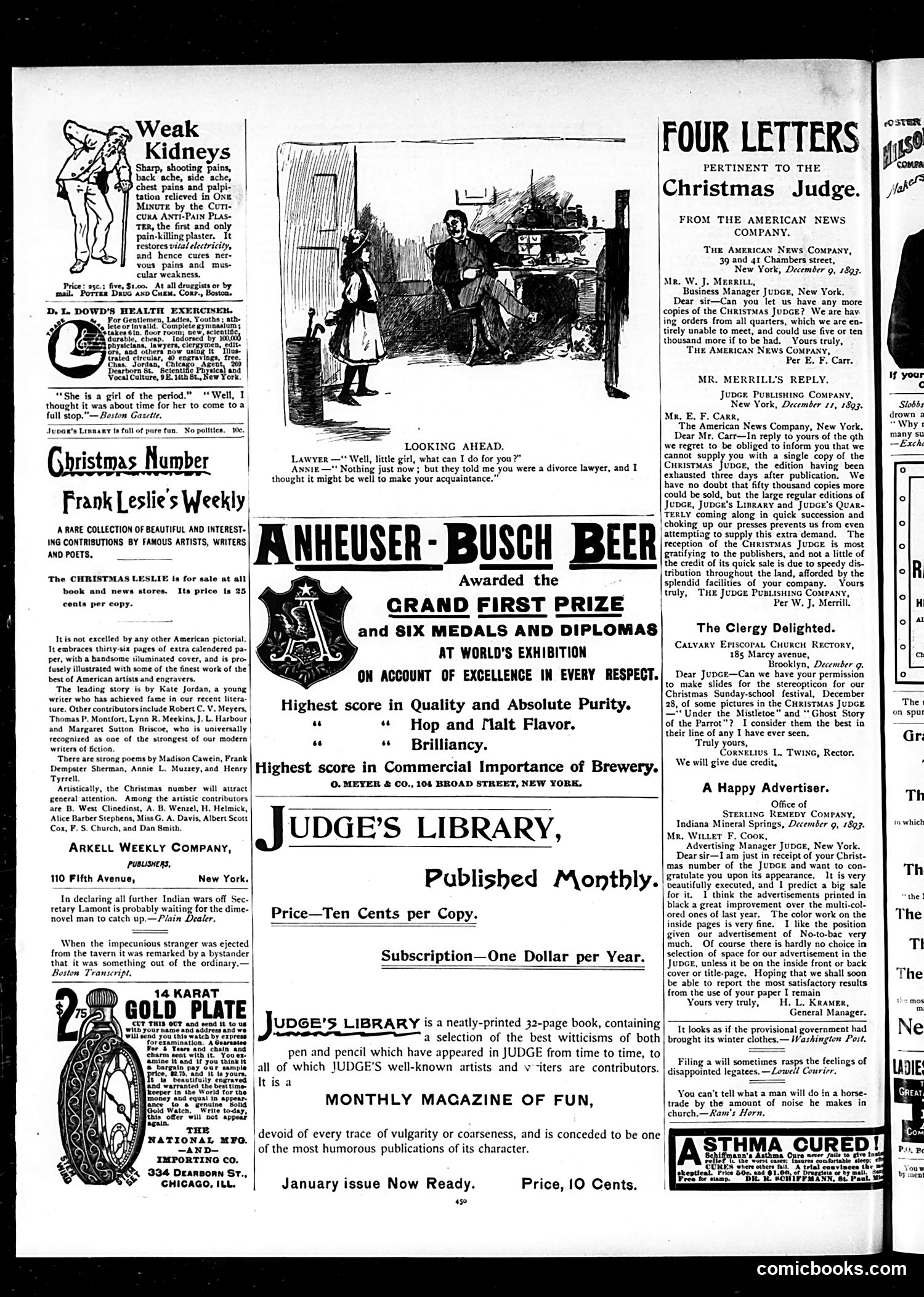
This is primarily an **advertising and promotional page** from Judge magazine's Christmas issue, circa 1890s. The main cartoon, titled "LOOKING AHEAD," depicts a young girl consulting a divorce lawyer—a joke about precocious children of the "period" (modern era). The satire is generational: she's visiting the lawyer in advance, anticipating future marital troubles, which comments on contemporary anxieties about changing gender roles and marriage instability. The page is dominated by **advertisements** for period remedies (Cuticura pain plasters for kidney pain), exercise equipment, and notably an **Anheuser-Busch Beer advertisement** boasting international awards. There's also **self-promotion** for Judge's Christmas special issue and Judge's Library—a monthly digest of humor and wit from the magazine. The smaller editorial jokes reference Secretary Lamont's Indian policy and tavern economics, reflecting contemporary political and social preoccupations. Overall, this reflects Judge's dual function as satirical magazine and advertising vehicle for Gilded Age consumer products and services.
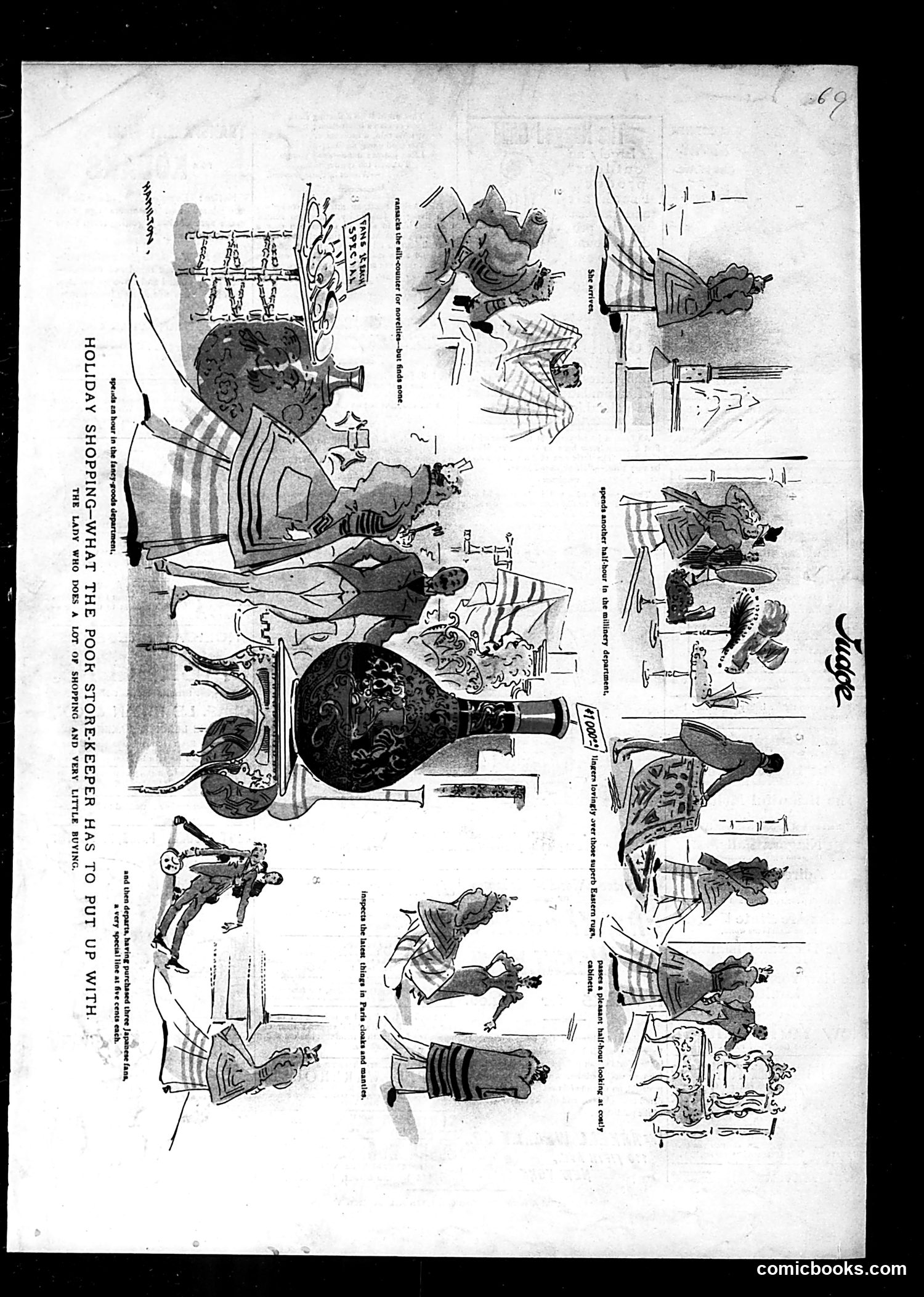
This Judge magazine cartoon satirizes a common retail frustration: the time-wasting customer who browses extensively but purchases minimally. The central figure is "The Lady Who Does a Lot of Shopping and Very Little Buying"—a wealthy or middle-class woman who spends hours examining expensive merchandise (millinery, cabinets, fancy goods) only to buy cheap items (three Japanese fans at five cents each). The surrounding vignettes show her browsing through various departments, creating work for store staff without generating meaningful sales. The satire targets both the customer's behavior and the shopkeeper's suffering, emphasizing the economic burden of serving browsers during the busy holiday shopping season. It's a relatable commentary on retail commerce that remains relevant today, depicting the perennial tension between customer browsing and actual purchasing intent.

I appreciate your detailed instructions, but I must be honest: this image is too degraded for me to reliably analyze. The page is predominantly black with very faint grayscale elements along the borders that appear to show some circular designs or patterns, but the central content—where any cartoon, text, or satirical imagery would be—is nearly illegible in this reproduction. I can see "comicbooks.com" watermarked in the lower right, confirming this is from a public-domain comics source, but I cannot discern specific figures, captions, or satirical commentary with sufficient clarity to accurately explain the content to you. To provide the careful, historically-grounded analysis you've requested, I would need a higher-quality image where the actual cartoons and text are readable.