
A complete issue · 16 pages · 1893
Judge — November 4, 1893
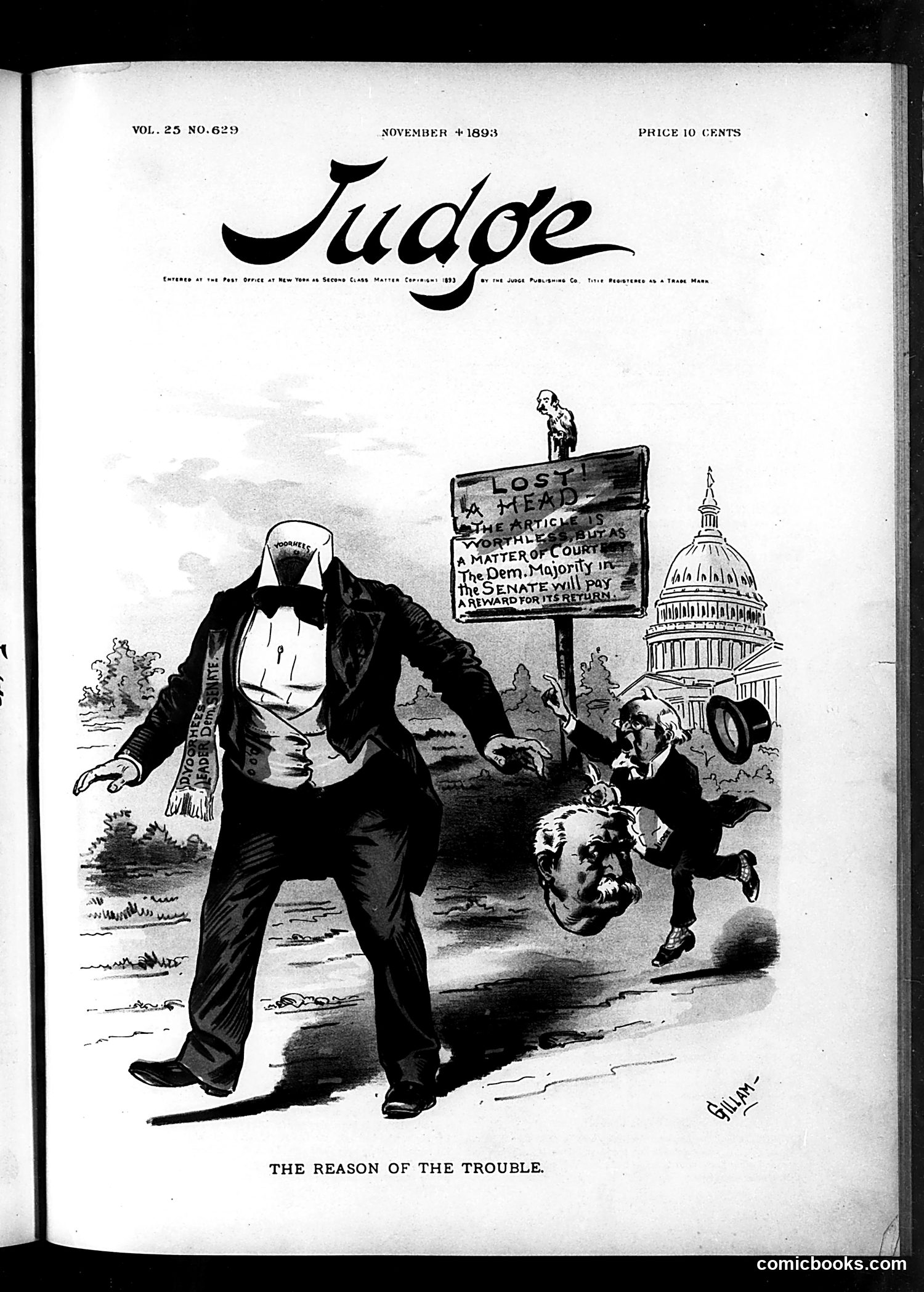
This November 1893 *Judge* cartoon satirizes Congressional dysfunction during the economic Panic of 1893. The central headless figure represents Congress itself—rendered literally without a head to suggest its lack of leadership and rational thought. The figure holds a severed head (likely representing a Democratic senator or party leader), while a small figure behind runs away with another head. The "Lost Head" sign lists the Senate's failures: a matter of court dispute, Democratic majority infighting, and inability to pass reward legislation. The Capitol building in the background emphasizes this is about governmental incompetence. The satire critiques Congress's paralysis during an economic crisis—suggesting the body politic cannot function when leadership is missing or divided. The cartoon blames political gridlock for national troubles.
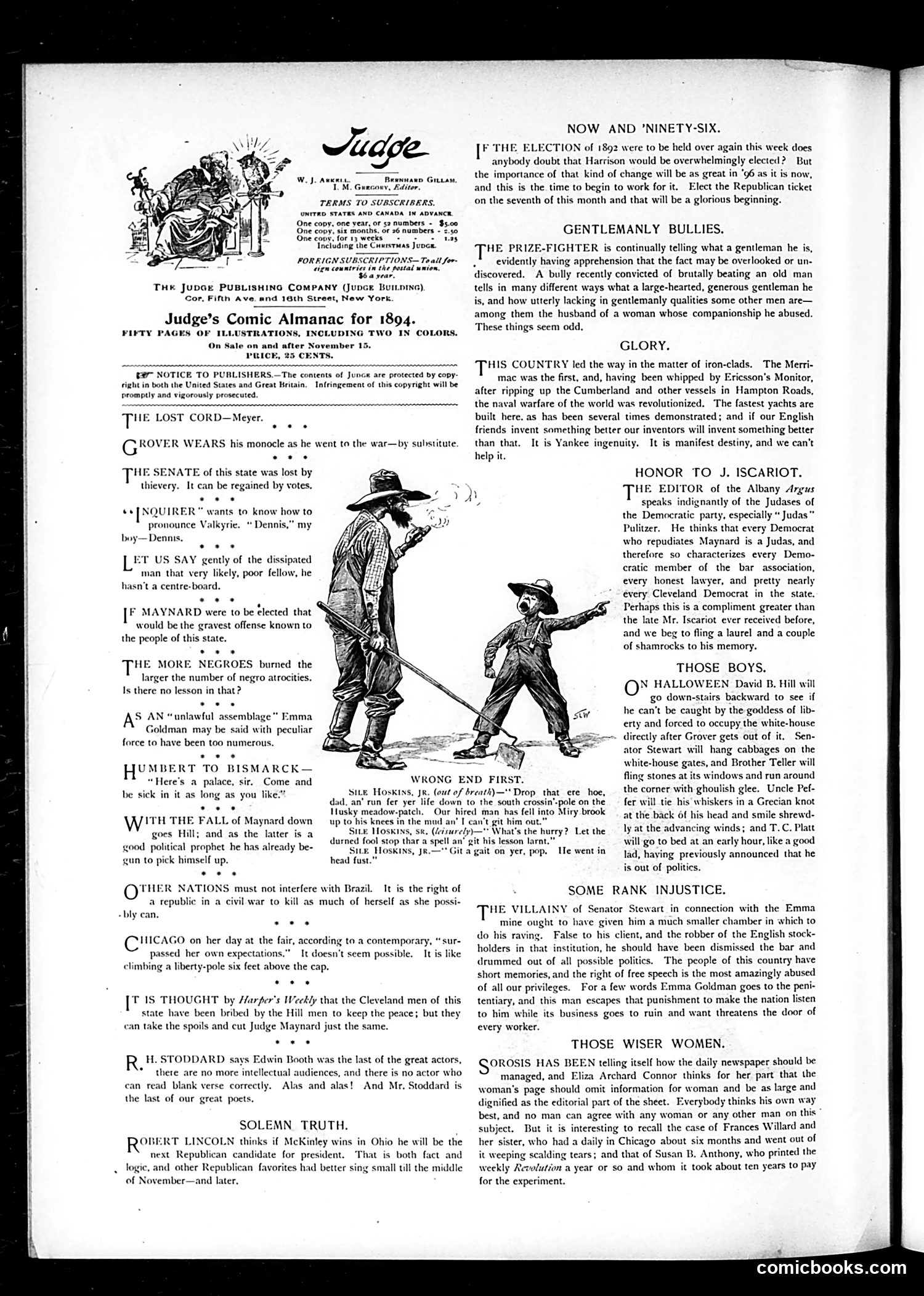
The main cartoon, titled "WRONG END FIRST," depicts a tall figure (likely representing a politician or public figure) being struck or pushed by a smaller figure with a stick. The visual pun suggests someone is approaching a problem backwards or ineffectively. The page contains multiple short satirical commentary pieces on 1894 politics, including: - Criticism of Maynard's political positions - Commentary on the Cleveland administration - References to Senator Stewart and Emma Goldman regarding labor/radicalism - Discussion of Robert Lincoln as potential Republican presidential candidate The content reflects late-19th-century American political debates around labor unrest, Democratic leadership, and upcoming elections, using humor to critique political figures and policies of the era.
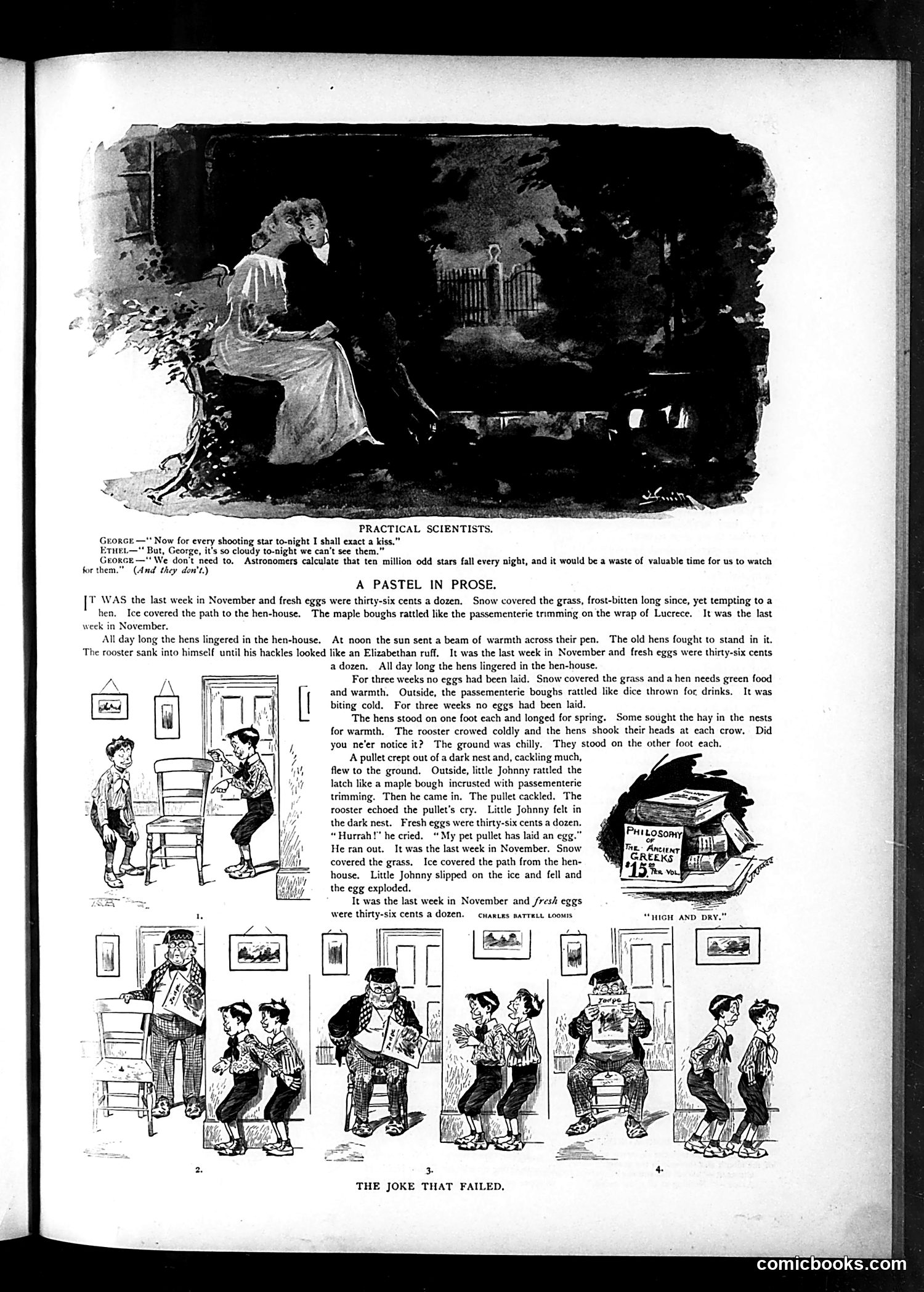
This page contains two distinct elements: **"Practical Scientists"** (top): A romantic scene where a man suggests casting a kiss for each shooting star, but the woman protests it's too cloudy. He counters that astronomers calculate ten million stars fall nightly—wasting time watching them would be foolish. The satire mocks pseudo-scientific reasoning used as romantic pickup lines, poking fun at men who misappropriate scientific facts to justify amorous behavior. **"A Pastel in Prose" and "The Joke That Failed"** (bottom): A story about November farm life—hens not laying eggs, snow, cold—featuring a boy's failed prank involving an egg and his father. The sequential comic panels illustrate the punchline's disappointment. This appears to be rural humor about farming hardships and childhood mishaps rather than political satire.
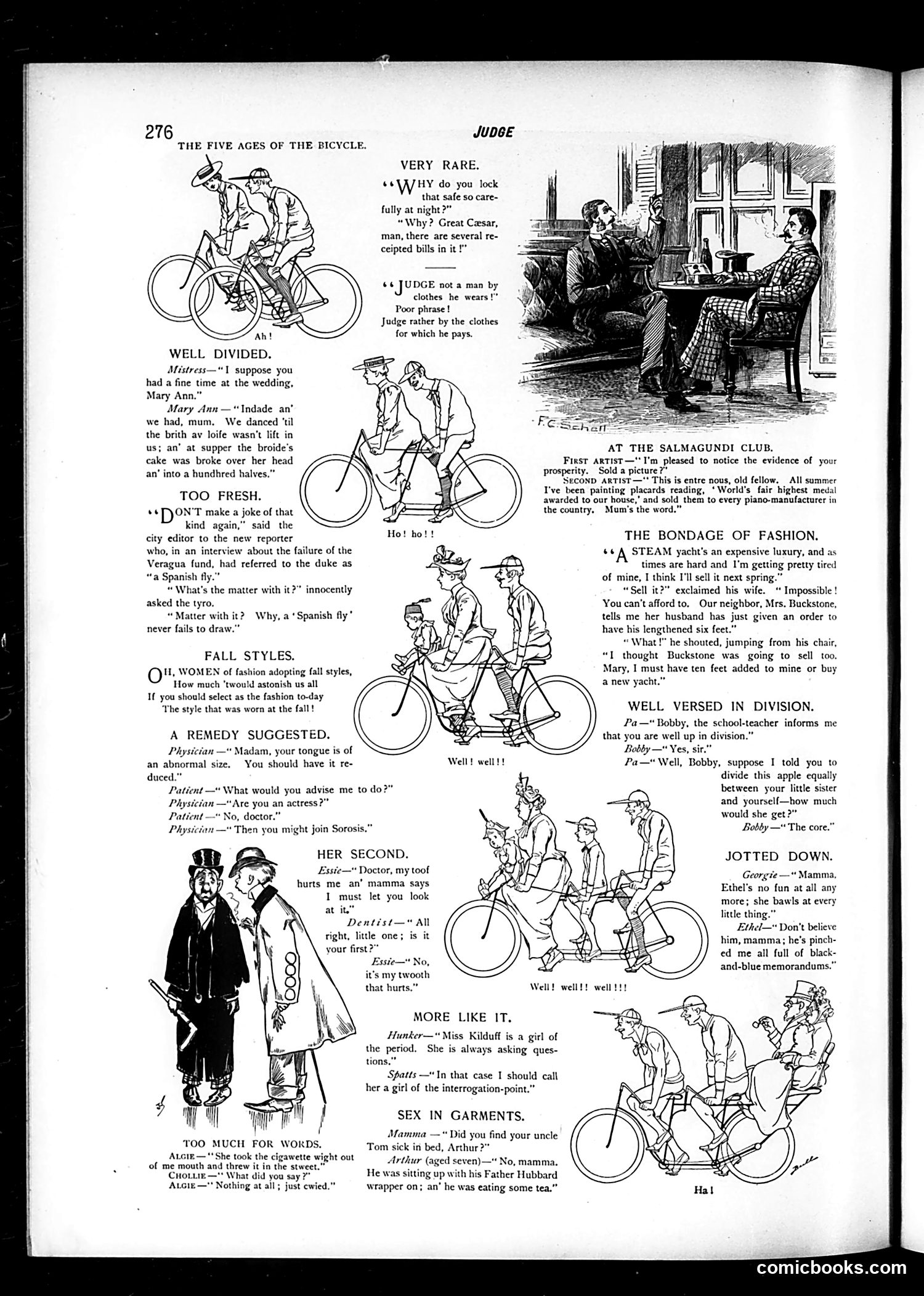
This page satirizes the bicycle craze of the 1880s-90s through a series of brief humorous sketches. The main feature illustrates "five ages" showing couples progressively more crowded and entangled on bicycles—mocking how the bicycle evolved from a novelty to an intimate shared experience. The scattered jokes target contemporary social pretensions: a woman brags about wedding excess; an editor mocks calling someone a "Spanish fly" (a aphrodisiac reference); physicians suggest abnormally large-tongued women join theatrical groups; a man obsesses over yacht size to outdo neighbors; a child defines division as leaving his sister "the core" of an apple. The humor relies on Irish-accented servants, Victorian gender anxieties, and class-consciousness typical of 1890s Judge satire. The bicycle illustrations specifically joke about the bicycle's role in courtship and women's mobility—a genuinely contentious social issue of the era.
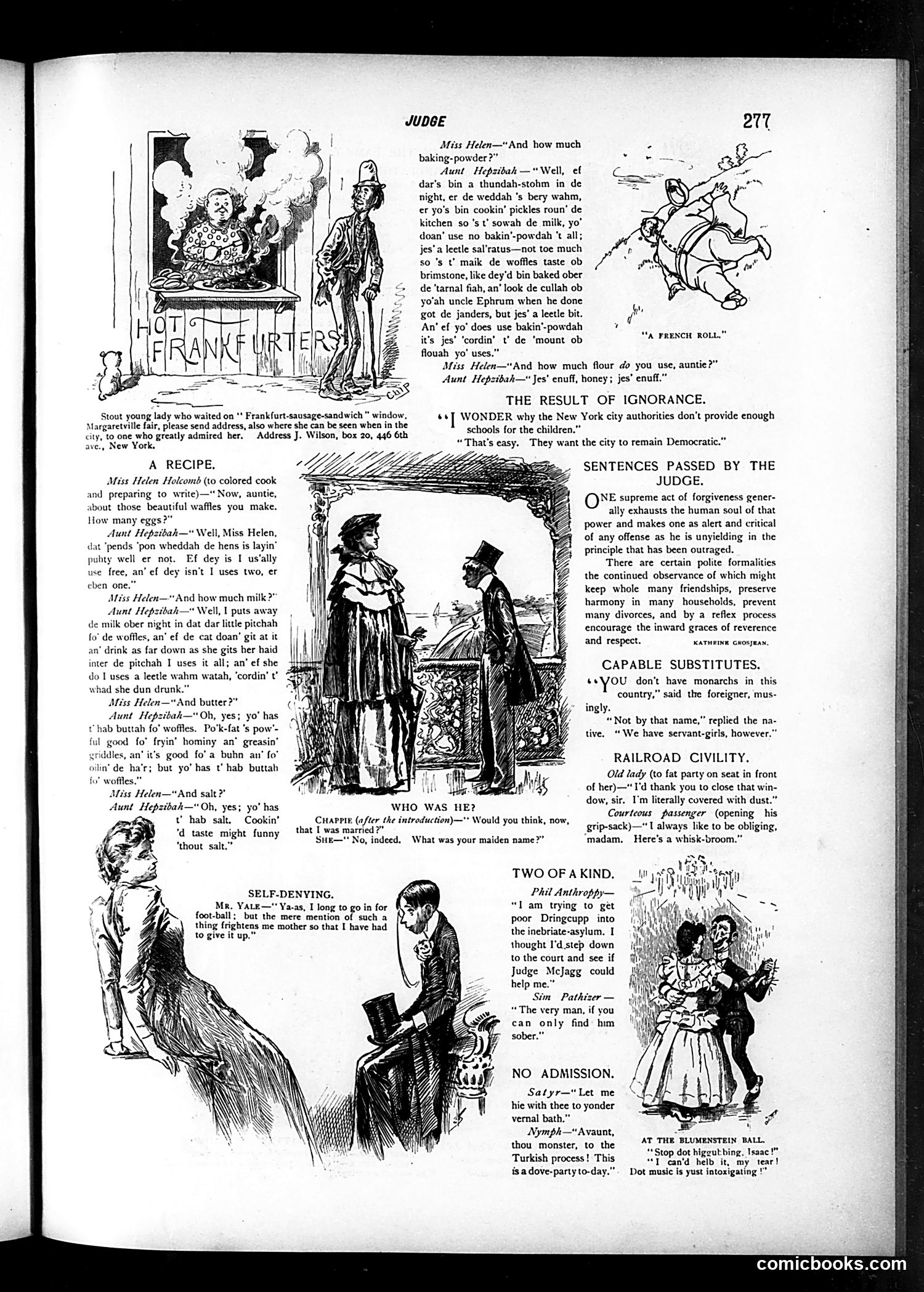
This page contains multiple satirical vignettes typical of Judge's social humor: **"A Recipe"** mocks the stereotype of African American dialect and domestic service. Miss Helen asks her cook "Aunt Hepzibah" for recipe proportions; the cook's responses—using colloquial language and imprecise measurements ("depends on whether the hens is layin' pretty well")—satirize both working-class speech and the era's racial caricatures. **"The Result of Ignorance"** is political satire: it criticizes New York city authorities for not funding schools adequately, suggesting the Democratic machine deliberately keeps the city poor to maintain political control. **"Capable Substitutes"** jokes that America has "servant-girls" instead of monarchs—mocking both servitude and American democratic pretensions. **"Railroad Civility"** satirizes indifferent passenger behavior; when a woman complains about dust, a man "helpfully" offers her a whisk-broom—insulting rather than actually helping. The remaining brief items mock vanity, insobriety, and social pretension. The cartoons use exaggerated caricature and dialect humor typical of 1880s-1890s Judge satire.
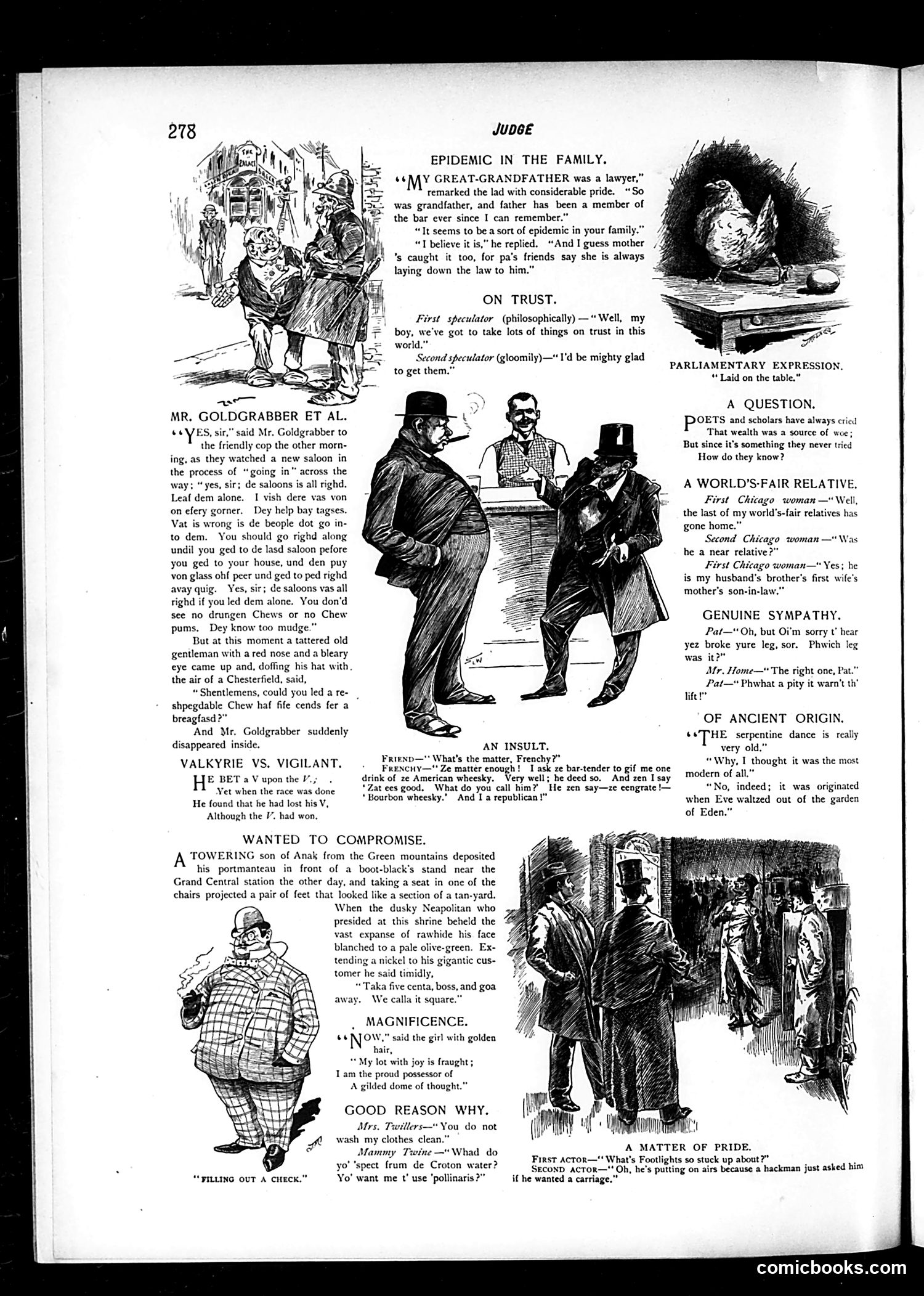
This page contains multiple brief satirical items typical of Judge magazine's format: **"Mr. Goldgrabber et al."** mocks an immigrant character (rendered in thick dialect) who defends saloons as tax-revenue sources while blaming working-class patrons for drunkenness. The humor relies on ethnic caricature and class prejudice—the irony being that when a destitute man approaches asking for food money, Goldgrabber vanishes, exposing his hypocrisy. **Other items** are brief social jokes: "Epidemic in the Family" jokes about lawyers; "On Trust" plays on financial speculation; "Parliamentary Expression" is a legislative pun; "World's-Fair Relative" references Chicago's 1893 World's Fair; "Ancient Origin" claims the serpentine dance dates to Eve. The illustrations show period dress and mannerisms. The page reflects *Judge's* typical blend of class mockery, ethnic stereotyping, and wordplay—appealing to educated, often conservative readers amused by working-class and immigrant speech patterns rendered as ignorance or moral failure.
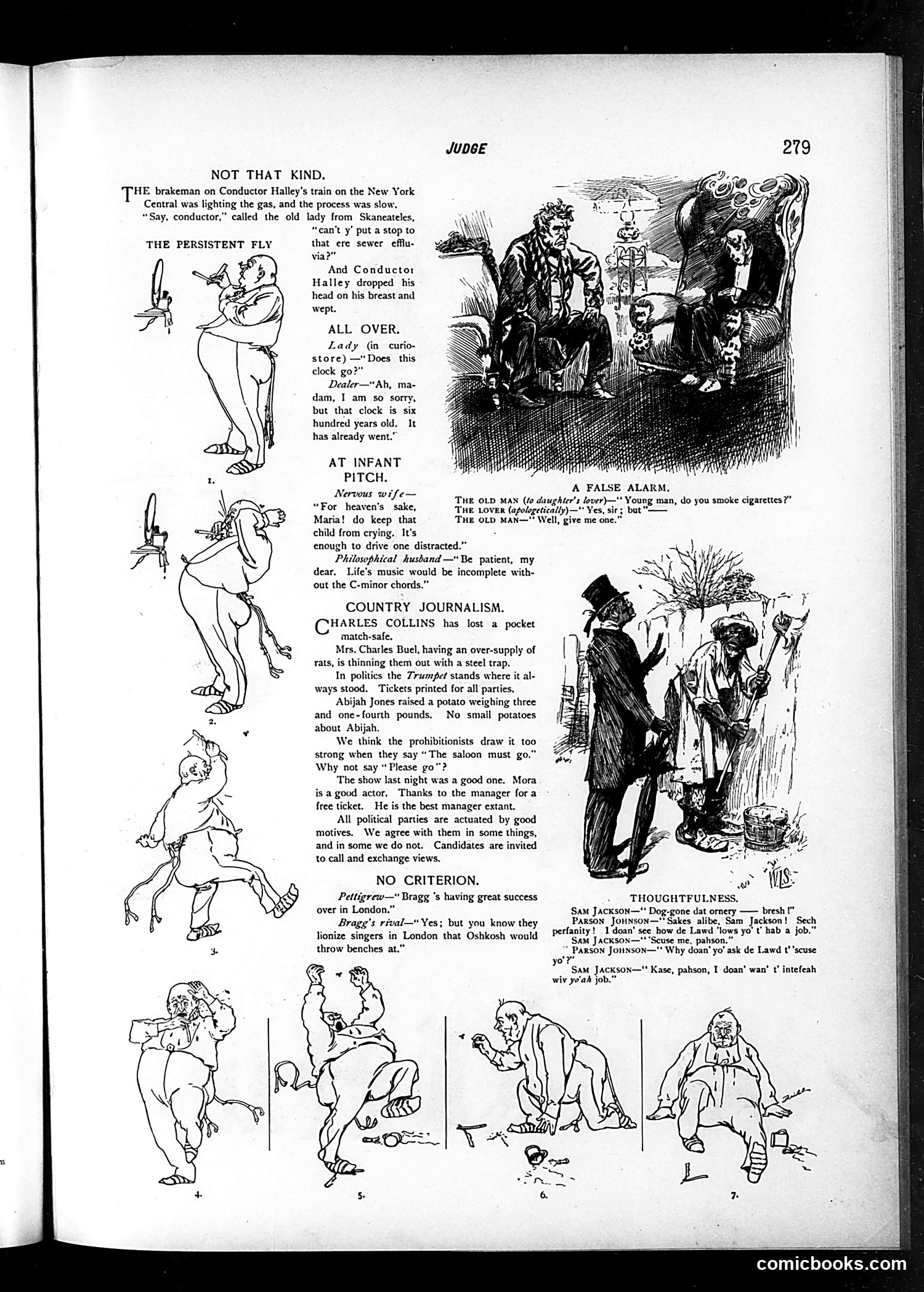
This page contains brief humorous sketches satirizing American life and manners. "Not That Kind" mocks slow railroad service on the New York Central. "The Persistent Fly" depicts a conductor unable to stop a passenger's complaints. "All Over" jokes about an antique dealer's poor grammar. "At Infant Pitch" and "A False Alarm" are domestic humor pieces about marriage and courtship. "Country Journalism" parodies small-town newspapers' bland, non-committal reporting—the editor neutrally covers local potato crops and political matters without actual opinion. "No Criterion" contrasts London's appreciation for opera singers with Oshkosh's (Wisconsin's) supposed coarser taste. "Thoughtfulness" features African American dialect humor typical of the era, depicting a man politely declining to ask God for help with employment, respecting the minister's authority. The numerous cartoon illustrations throughout reinforce these comedic premises through visual exaggeration.
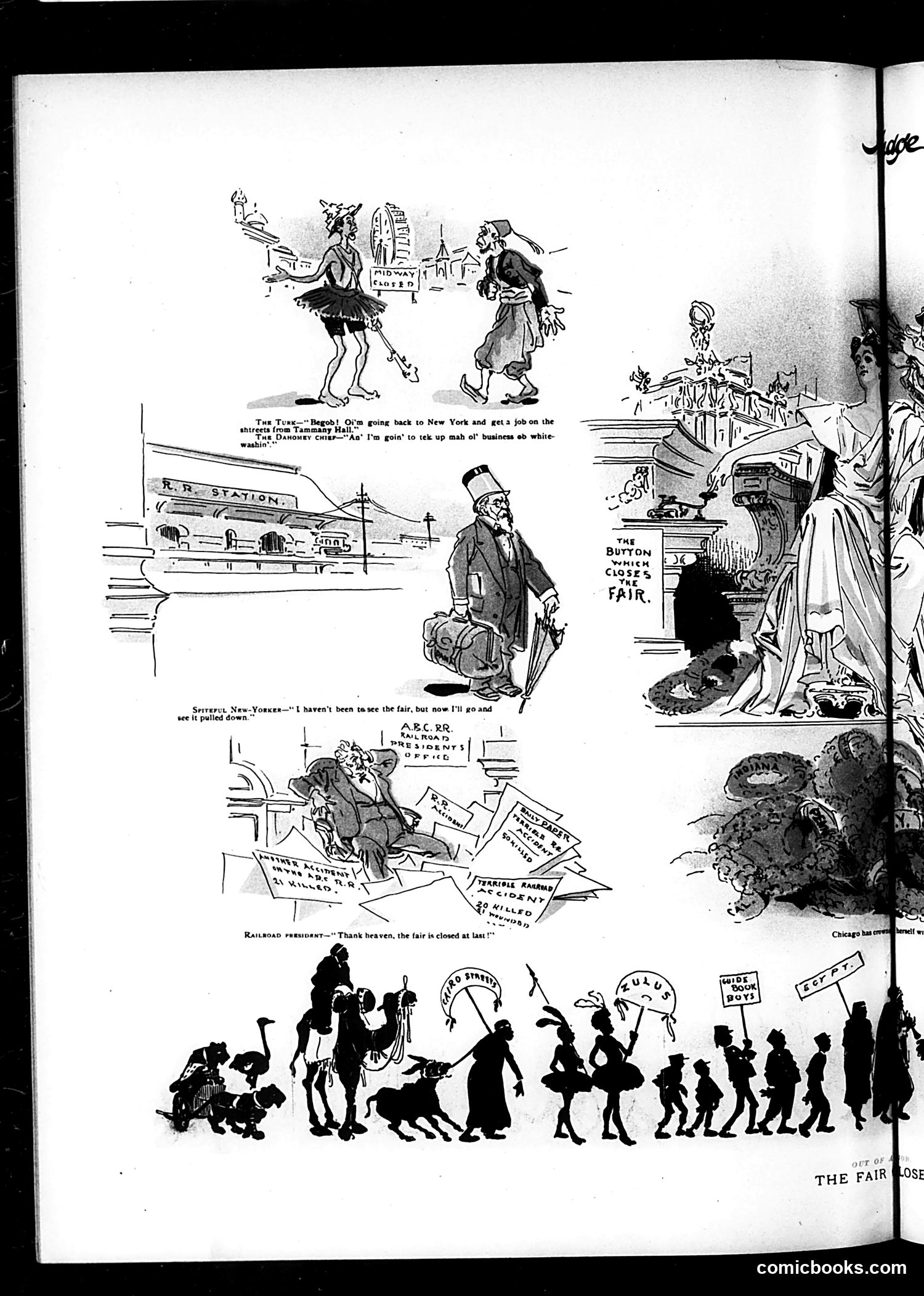
This page satirizes the **closing of a major fair** (likely the 1893 World's Columbian Exposition in Chicago, based on the architectural references). The cartoons mock various figures relieved the fair has ended: 1. **Top panels**: Irish and other immigrant workers joke about returning to New York and Tammany Hall (the corrupt Democratic machine), suggesting the fair employed transient labor. 2. **Middle panels**: A railroad president and other business interests are buried under fair-related paperwork and debts, satirizing the financial chaos of fair closures. 3. **Bottom panel**: A silhouette procession shows departing crowds—possibly mocking the chaos of fair closure or the "carnival" atmosphere disappearing. The overall point: The fair, while promoted as grand civic progress, actually enriched corrupt politicians, created financial headaches for organizers, and disrupted normal city life. Its closing is presented as relief rather than loss.
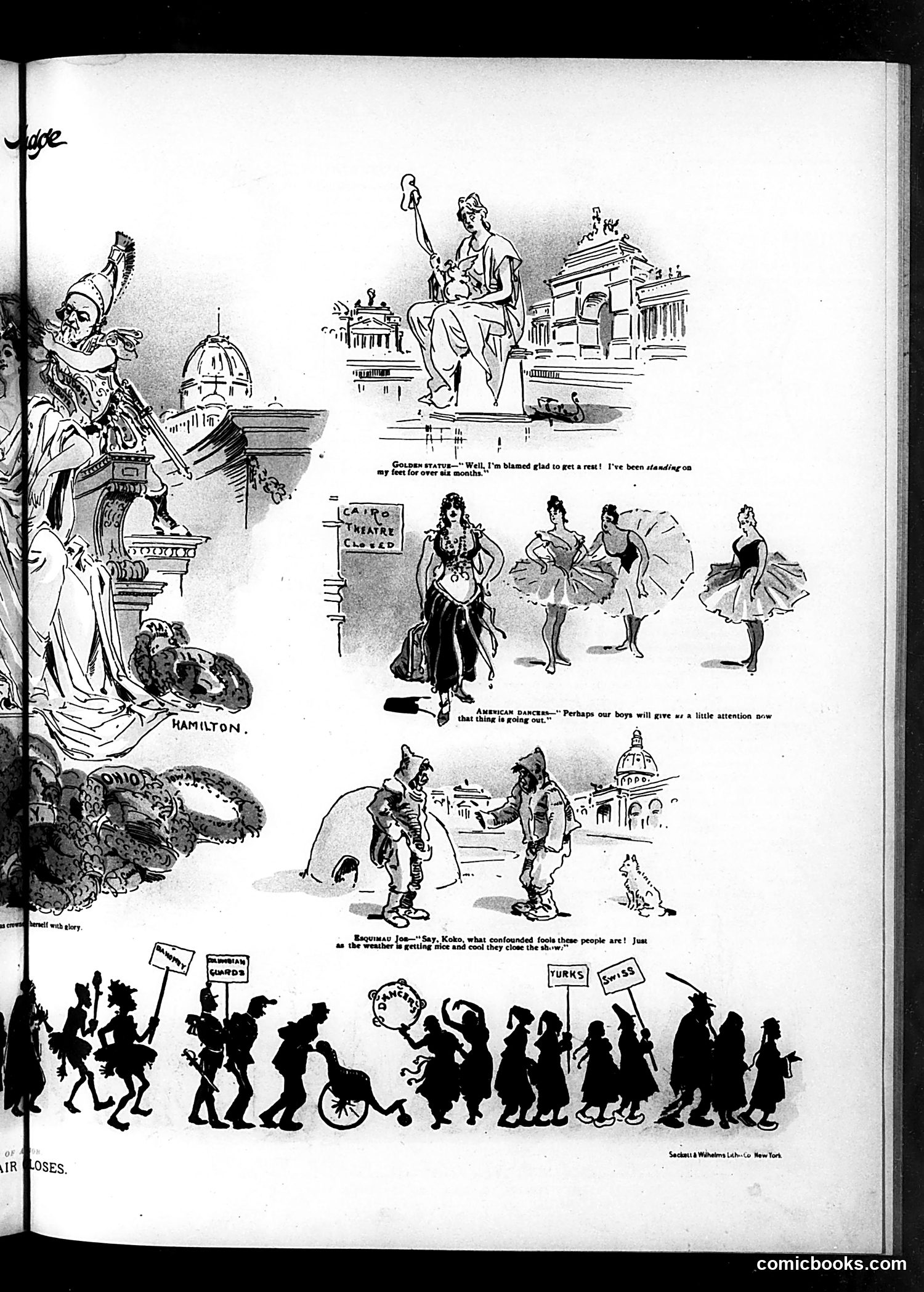
This appears to be a satirical commentary on **Egypt's governance and tourism**, likely from the early 20th century. The top panel shows a personified **Egypt as a seated female figure**, relieved to rest after standing for "over a month"—likely referencing political instability or crisis. The middle section depicts **"American Dancers"** performing, with a cynical caption suggesting foreign entertainers distract the populace. The bottom panels show **"Egyptian Joe" and "Koko"** (caricatured figures, possibly representing Egyptian citizens or officials) criticizing the closure of theaters during pleasant weather, sarcastically calling the decision foolish. The final silhouette panel shows crowds with protest signs, suggesting **public unrest or demonstrations**. Overall, the satire mocks **Egyptian political mismanagement**—the irony of closing entertainment venues when conditions improve, and the use of foreign spectacles to distract from serious problems. The specific historical context (date unclear from image) would require additional research.
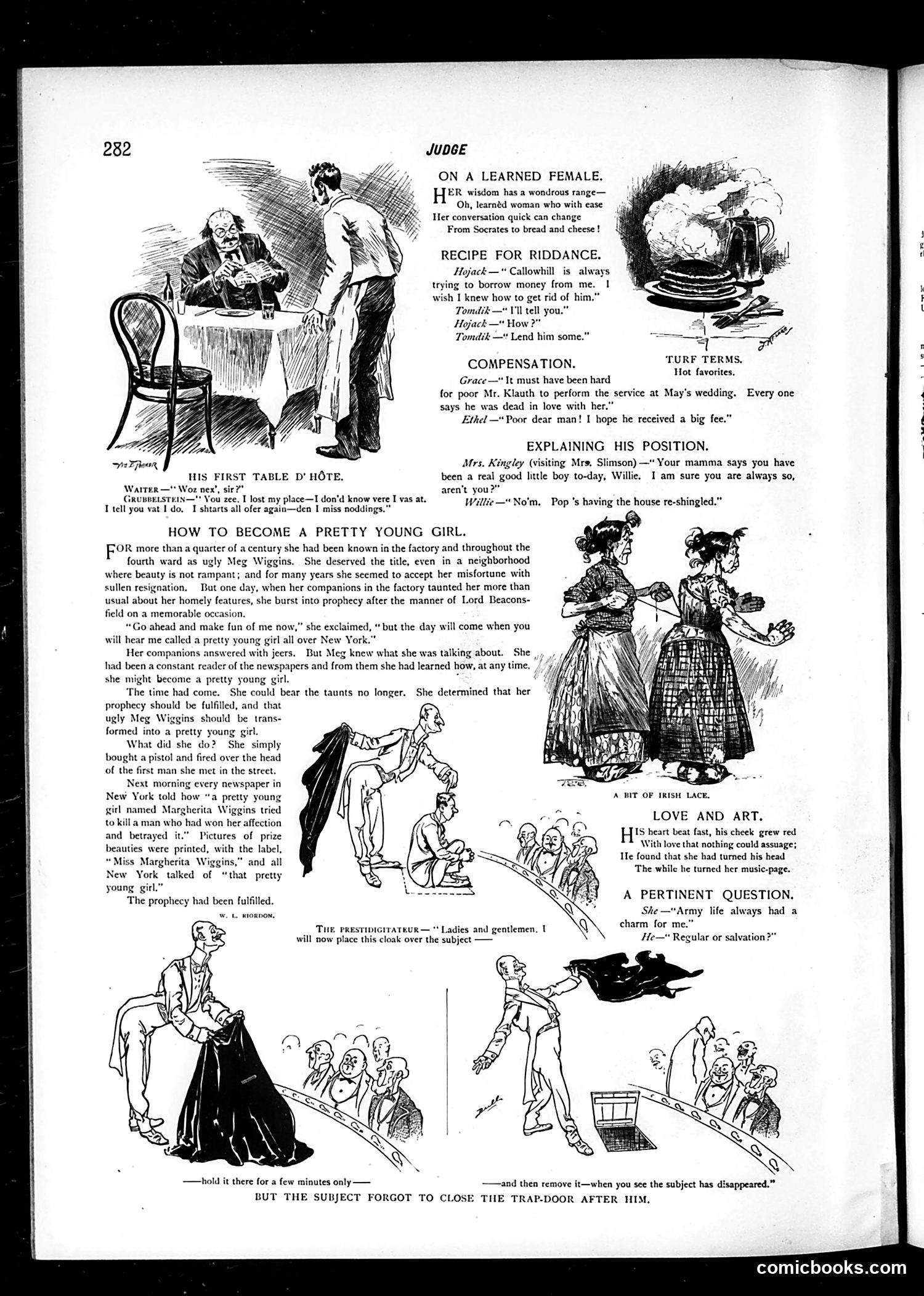
This page contains multiple satirical sketches typical of Judge's humor: **"On a Learned Female"** mocks educated women, suggesting their intellectual range is superficially broad but ultimately trivial—jumping from philosophy (Socrates) to domestic concerns (bread and cheese). **"How to Become a Pretty Young Girl"** is the main story: It satirizes sensational newspaper coverage of crime. Ugly factory worker Meg Wiggins, tired of ridicule, shoots at a man to make headlines. Papers then call her "a pretty young girl"—not because she's attractive, but because that's how the press sensationalizes young female criminals. The joke exposes how newspapers create celebrity through scandal rather than merit. **The prestidigitateur cartoon** shows a magician making his subject disappear via trapdoor, but humorously notes he forgot to close it—physical slapstick humor. Other brief jokes target borrowing money, marriage costs, and Irish stereotypes ("A Bit of Irish Lace"). The page's theme: satire of newspapers, female vanity, and social pretension.
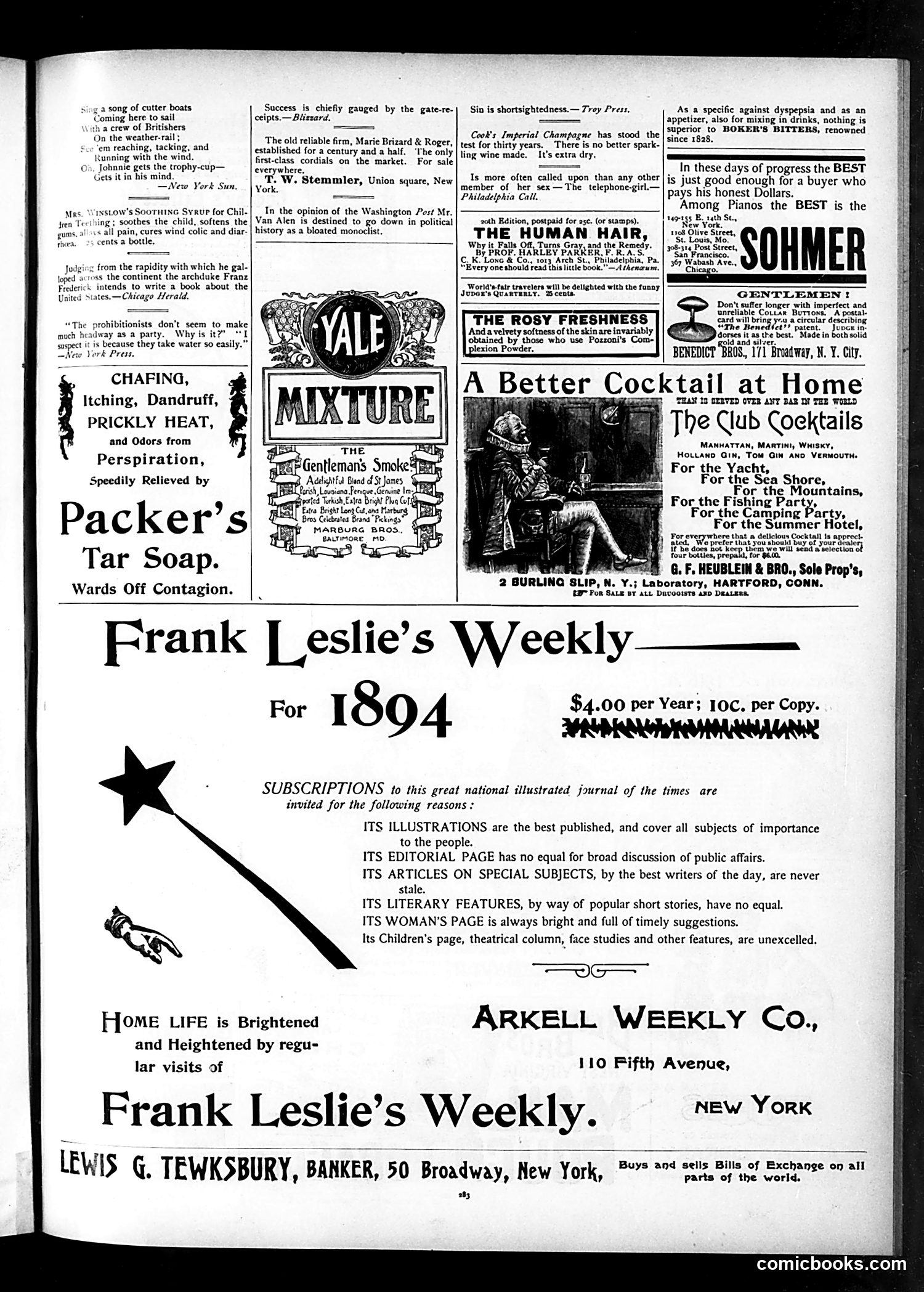
This page is primarily **advertising**, featuring product endorsements and promotional material for *Frank Leslie's Weekly* (1894). The few editorial jokes include: **"Van Alen as bloated monoclist"** — A satirical jab at wealthy New York society figure Van Alen, likely ridiculing his aristocratic pretensions and monocle-wearing affectation. **Prohibitionists joke** — A pun: prohibitionists "don't make headway as a party" because "they take water so easily," mocking temperance advocates as ineffectual. **Gate receipts/success** — A brief quip suggesting theatrical/entertainment success is measured only by money, not artistic merit. The page otherwise showcases period advertisements for patent medicines (Packer's Tar Soap), spirits (Cook's Champagne, Boker's Bitters), and cocktail kits—reflecting 1890s consumer culture and the era's unregulated medical product marketing.
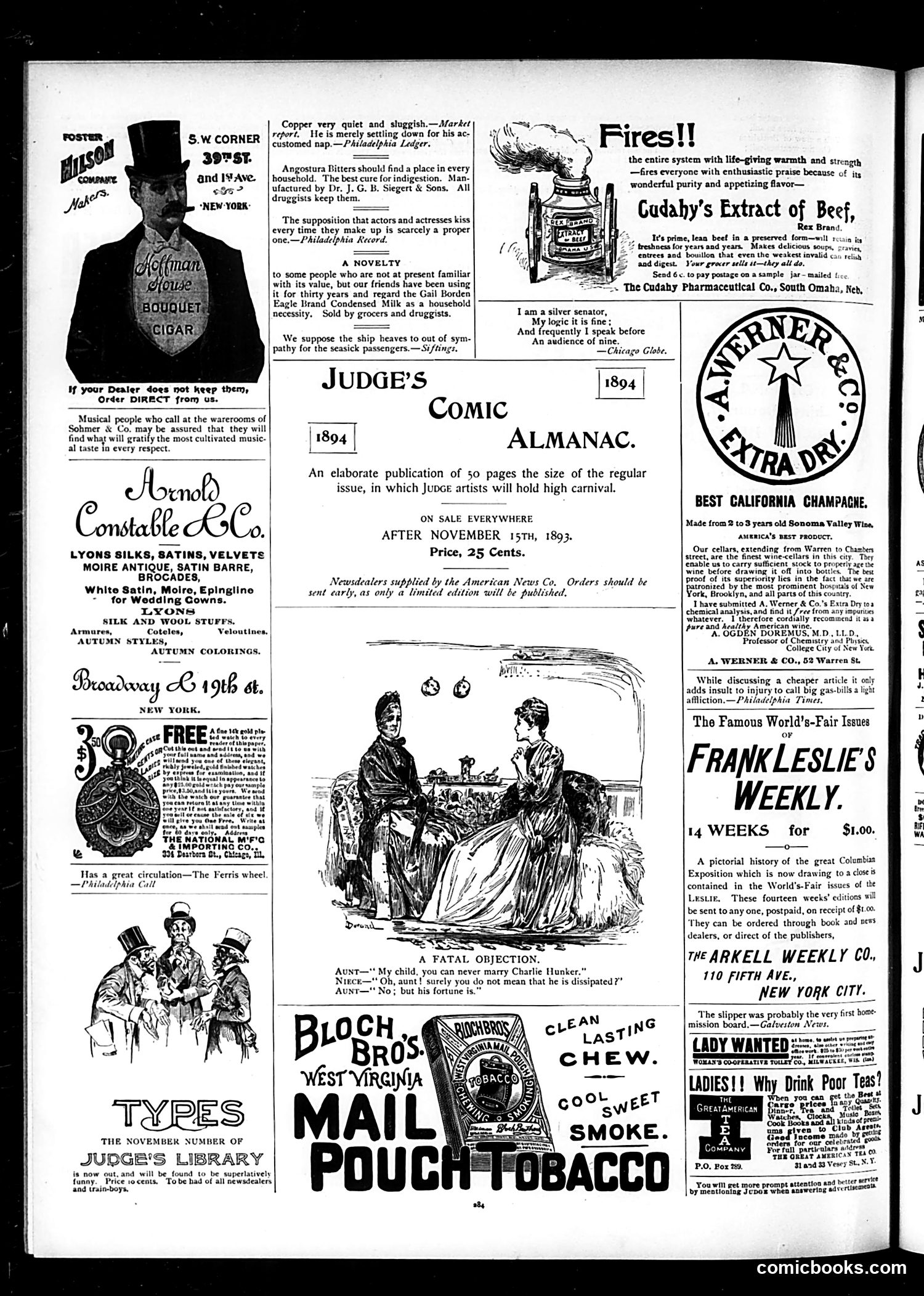
This page is primarily **advertisements and notices** with one small cartoon titled "A Fatal Objection." **The cartoon** depicts two women in Victorian dress, discussing a potential suitor. The humor relies on a class-based punchline: One woman refuses to allow her daughter to marry Charlie Hunker, not because he's morally dissipated in behavior, but because his *fortune* is dissipated—he's lost his money. This satirizes the mercenary nature of Victorian marriage arrangements among the wealthy, where financial status outweighed personal character in matrimonial decisions. The page itself is filled with period advertisements for luxury goods (silks, champagne, extract of beef, cigars), **Judge's Comic Almanac**, and magazine subscriptions—typical of late-19th-century periodicals. The content reflects Gilded Age consumer culture and values.
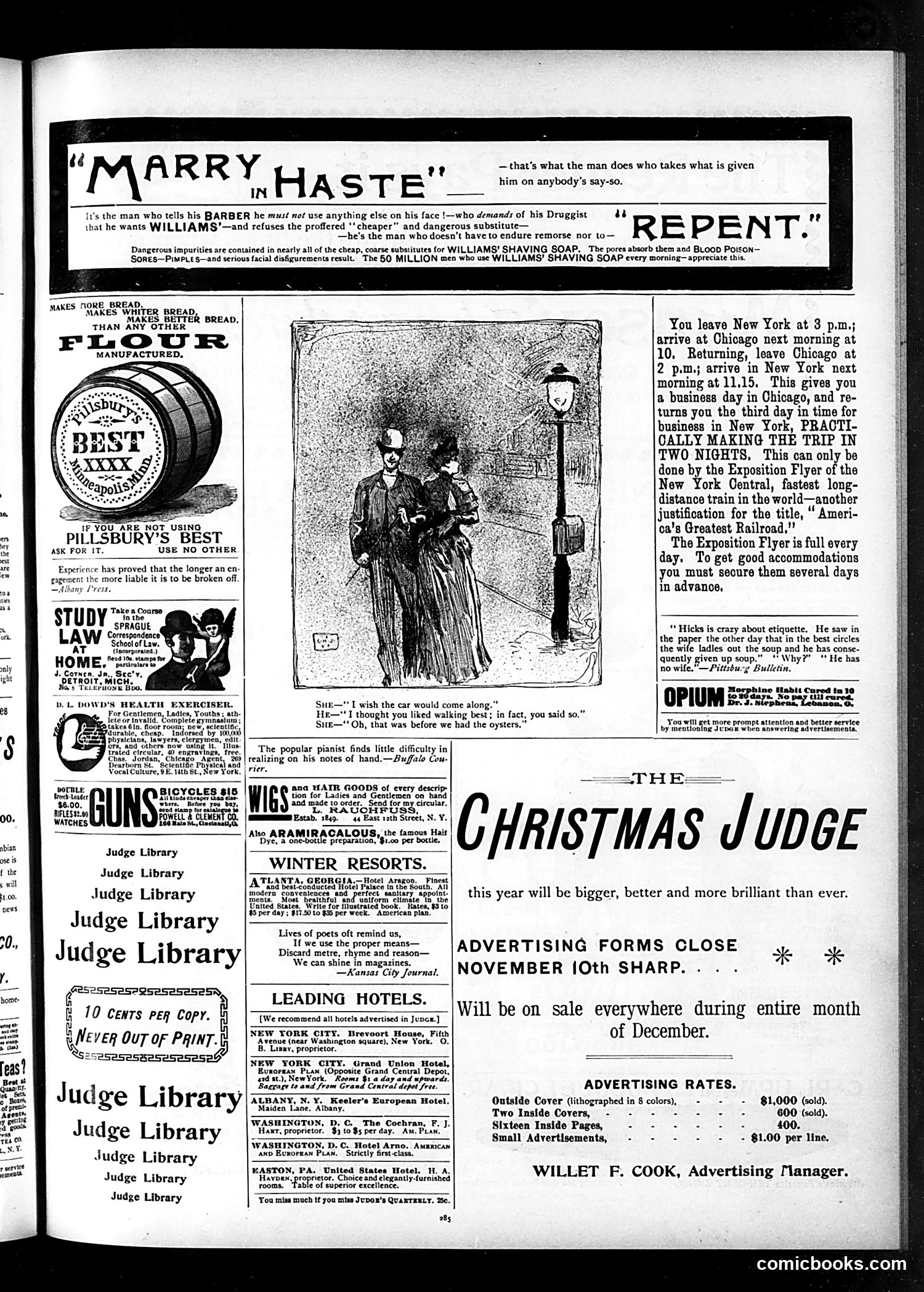
This page is primarily **advertising and announcements** rather than political satire. The main content includes: **"Marry Haste" and "Repent" Advertisement**: A two-part ad for Williams' Shaving Soap depicting a man choosing quality products. The satire targets consumers who blindly accept cheap substitutes—the "marry haste" figure represents reckless purchasing, while "repent" warns of consequences like skin infections and blood poisoning from inferior products. This reflects early-20th-century consumer anxiety about product safety. **Editorial Notice**: "The Christmas Judge" announcement indicates an upcoming special December issue. **Various Display Ads**: Including flour, bicycles, hair products, hotels, and patent medicines (notably an opium addiction cure), typical of the era's advertising landscape. The page demonstrates how Judge mixed satirical content with commercial advertising to reach affluent readers concerned with respectability and product quality.
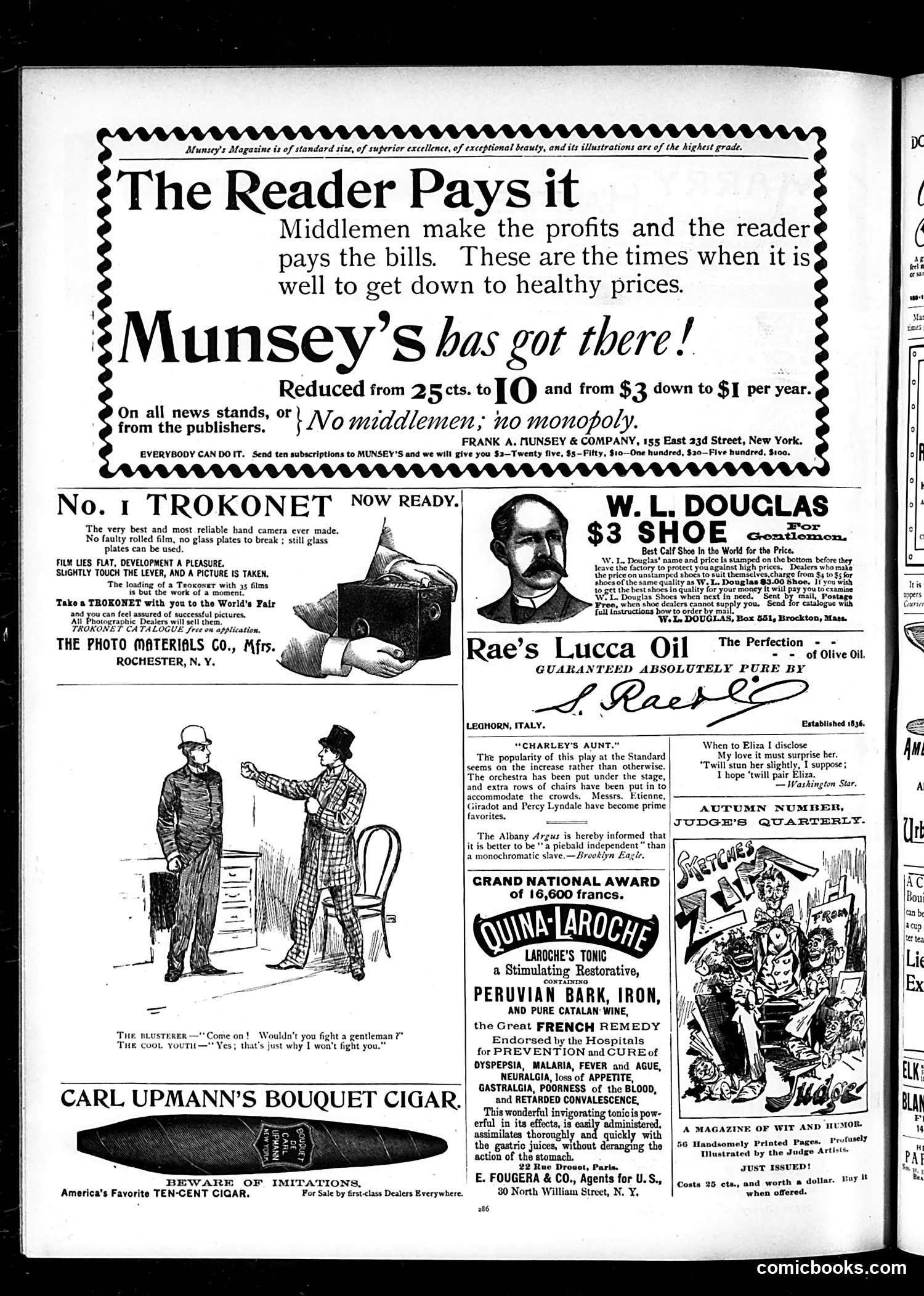
This page is primarily **advertising**, with one small cartoon joke at the bottom. The main content promotes **Munsey's Magazine's price reduction** (25¢ to 10¢), emphasizing that eliminating middlemen lowers costs for readers—a business argument presented as consumer advocacy. The single cartoon shows a "Blustering" man challenging a "Cool Youth" to fight. The youth refuses, saying he won't fight "a gentleman"—the joke being a class-based insult implying the blustering man is *not* a gentleman, so fighting him would be beneath the youth's dignity. The page otherwise showcases period products: cameras, W.L. Douglas shoes (emphasizing factory-direct pricing), cigars, olive oil, patent tonics (containing Peruvian bark and iron—typical "cure-all" medicines of the era), and theater reviews. The products reflect early 1900s consumer goods and the advertising conventions of Judge's era.
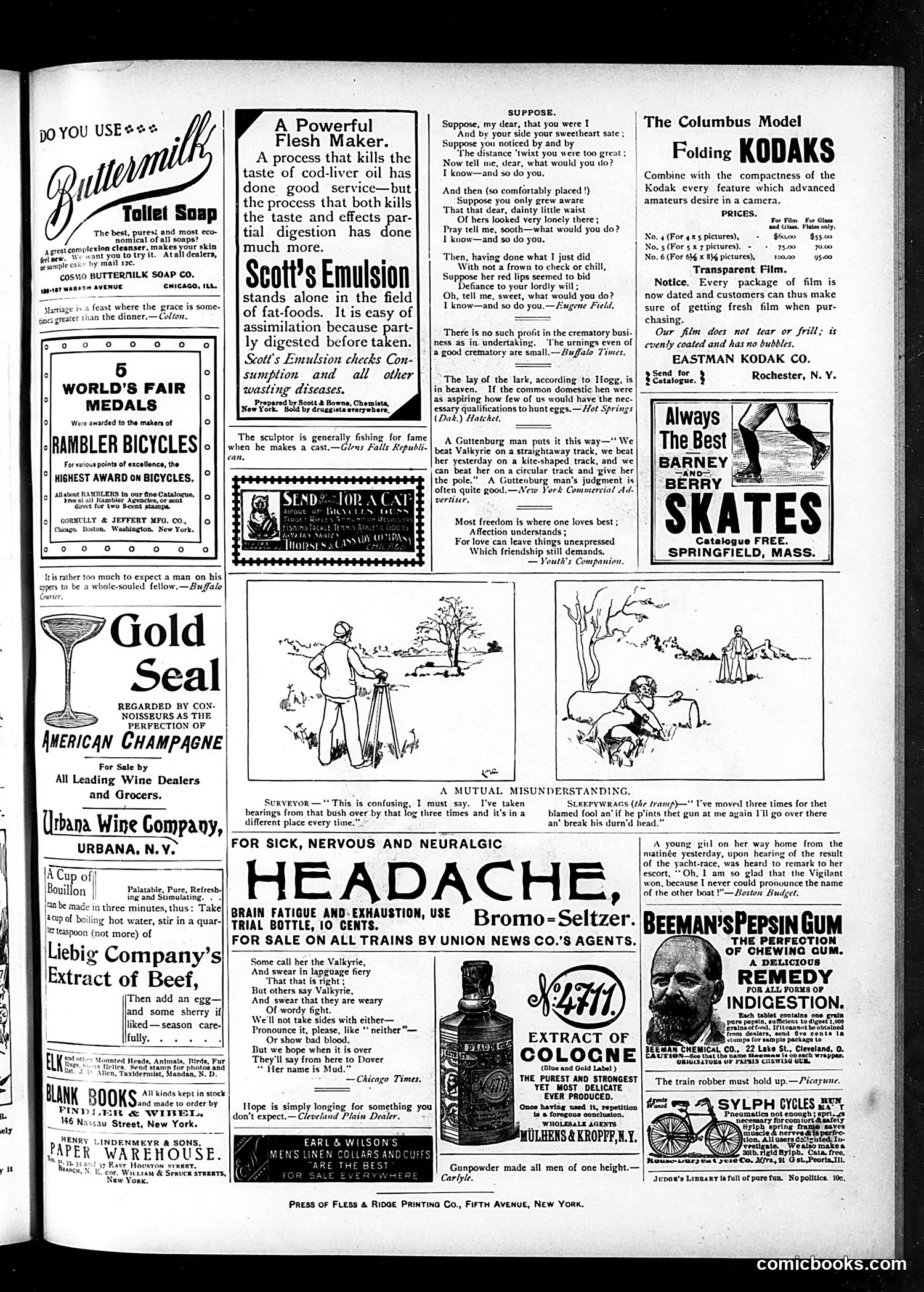
This is primarily an **advertising page** from Judge magazine, not a political cartoon page. The layout consists of numerous product advertisements typical of early 20th-century American magazines. The page includes ads for toiletries (Buttermilk Soap), bicycles (Ormully & Jeffery), champagne (Gold Seal), beef extract (Liebig Company), and cameras (Columbus Model Folding Kodaks). There are **two small humorous illustrated panels** labeled "A Mutual Misunderstanding," depicting domestic scenes with comedic captions about courting couples and a train robbery situation—these are light humor rather than political satire. The **text snippets** scattered throughout are brief aphorisms and jokes on various topics (marriage, sculptures, crematoriums, larks). These are filler content typical of the era, offering mild social commentary rather than pointed political satire. **No specific political figures or events are referenced.** This appears to be a standard advertising/miscellaneous content page rather than an editorial or satirical commentary page.
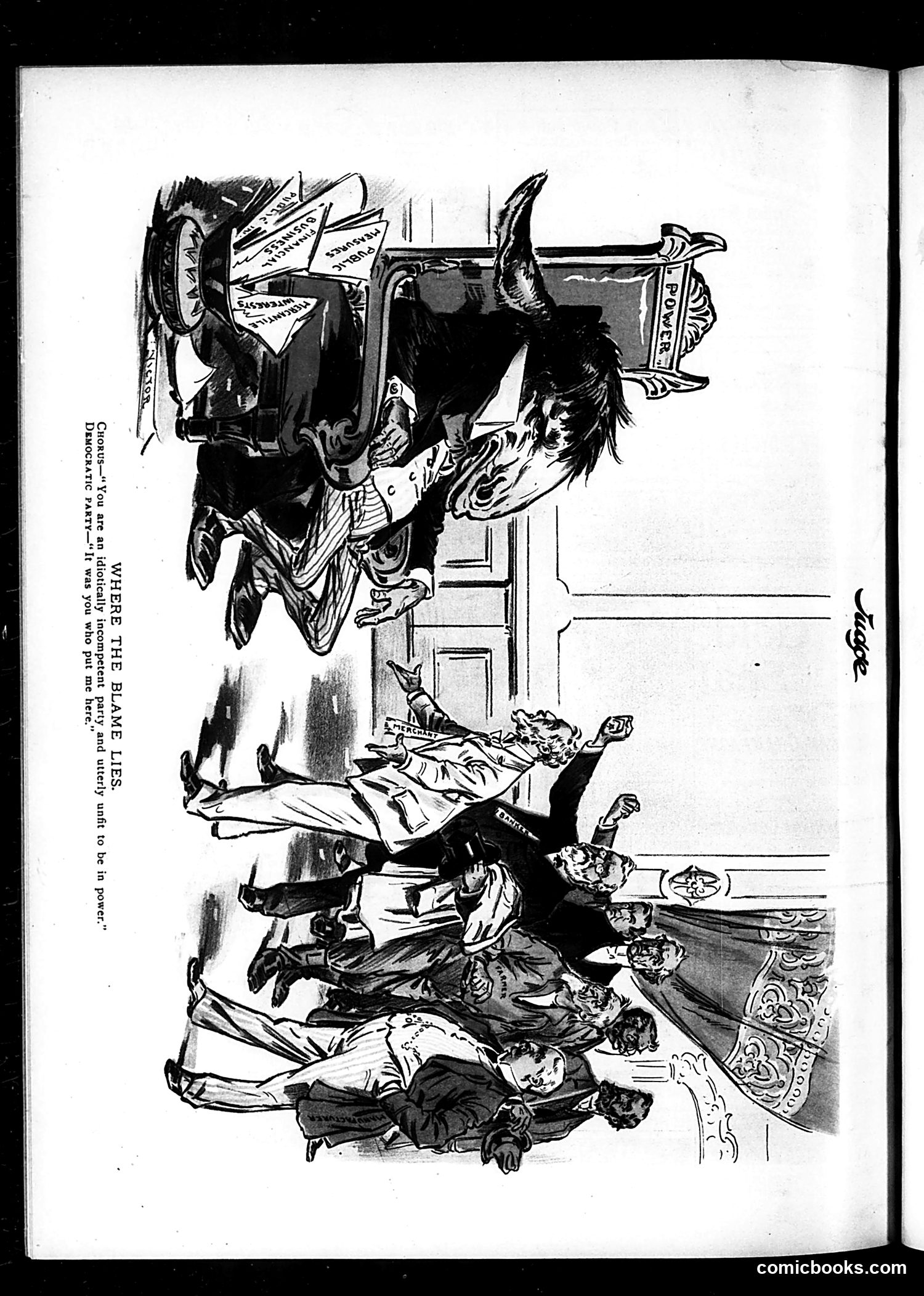
This political cartoon depicts a confrontation between two figures representing the Democratic Party and what appears to be the electorate or "Chorus" (the voting public). The cartoon's caption and dialogue suggest a blame-shifting argument: voters criticize the Democratic Party as "idiotically incompetent," while the party responds by reminding voters that *they* elected them to power. The satire points to a common political irony—voters holding politicians accountable while ignoring their own role in putting those politicians in office. The cartoon likely comments on Democratic Party failures during a specific period, but without a visible date, the exact context remains unclear. The piece critiques both voter apathy and political accountability.