
A complete issue · 16 pages · 1893
Judge — September 23, 1893
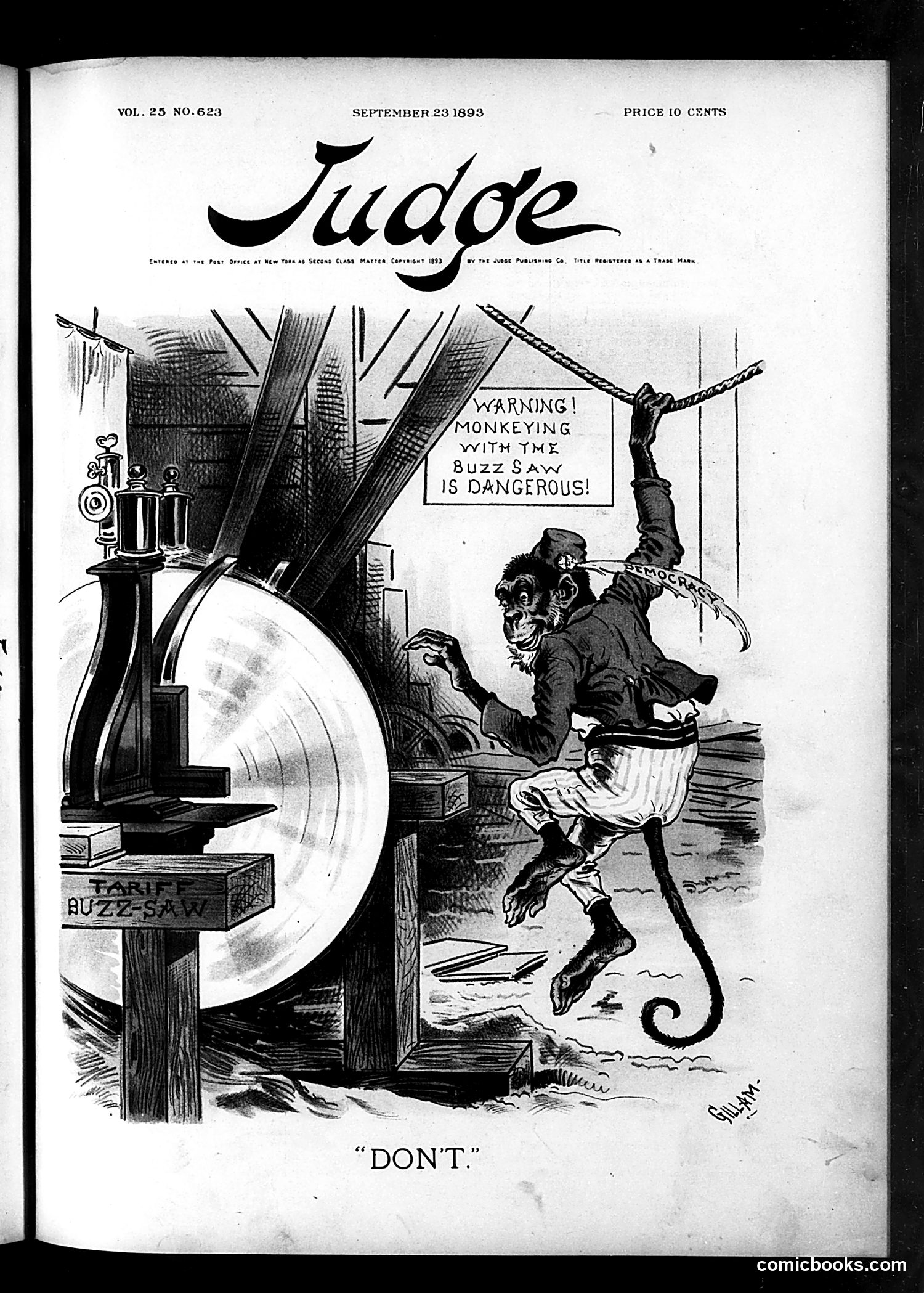
This Judge magazine cover (September 23, 1893) satirizes Democratic interference with the tariff issue. The "Buzz Saw" labeled "TARIFF" represents the dangerous machinery of tariff policy. Monkeys—a common period caricature for politicians acting foolishly—are "monkeying with" this dangerous saw, with one figure appearing to represent a Democratic politician marked "DEMOCRAT." The warning sign reads: "WARNING! MONKEYING WITH THE BUZZ SAW IS DANGEROUS!" The cartoon warns against Democratic tampering with tariff legislation, suggesting such interference risks serious economic harm. This reflects 1890s political debates over protective tariffs, where the cartoon's creator views Democratic intervention as recklessly dangerous "monkey business" that could injure the nation's economic machinery.
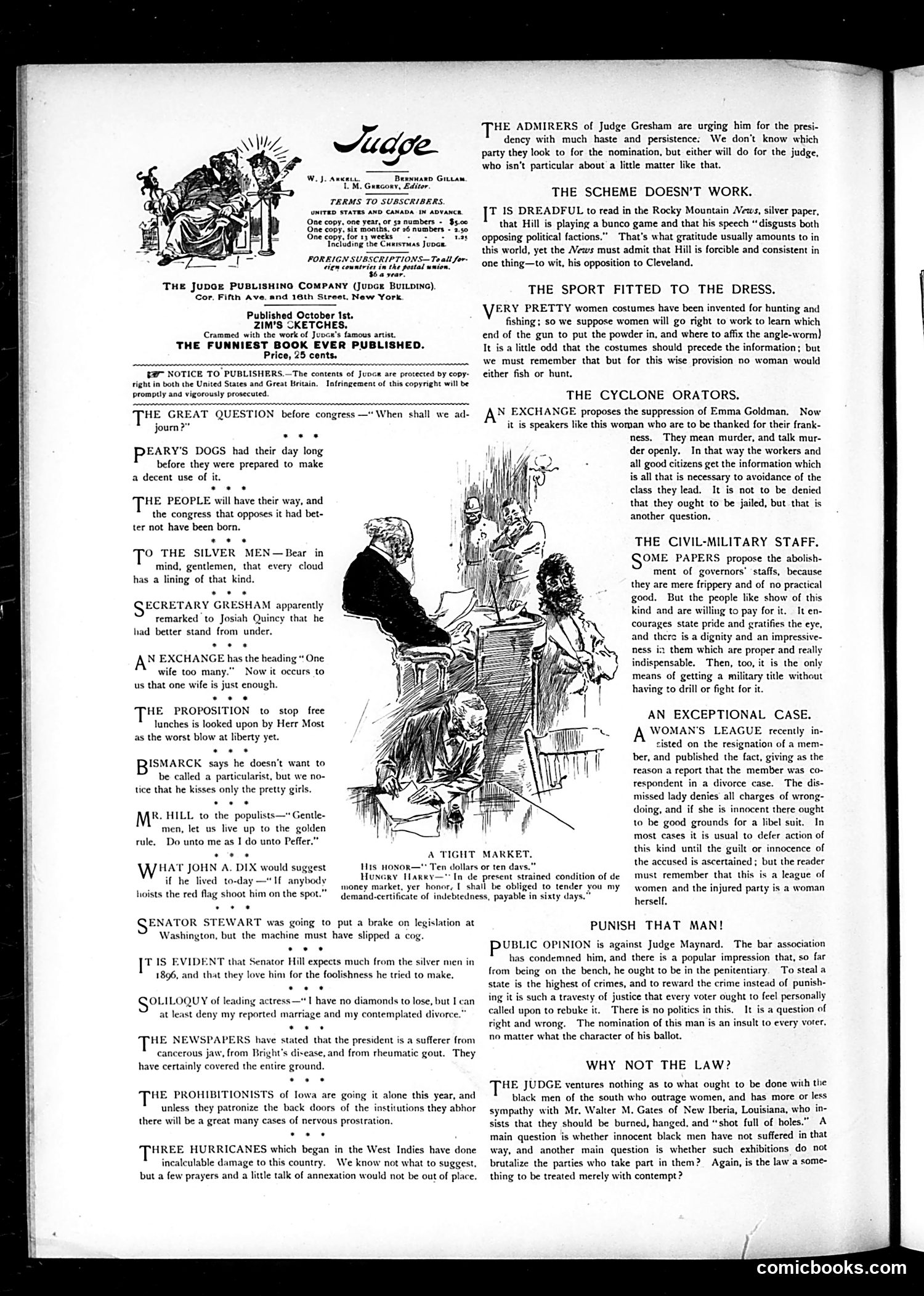
This page combines political commentary with social satire typical of early 20th-century Judge magazine. The main illustration depicts what appears to be a cyclone or natural disaster, accompanying an article titled "THE CYCLONE ORATORS" that criticizes Emma Goldman and her supporters for using free speech to promote dangerous ideas. The text suggests Goldman and her associates are blamed for inciting violence and worker unrest. The page also contains brief political jabs at figures like Secretary Gresham, Senator Stewart, and references to prohibitionists and various political debates of the era. The overall tone is conservative, opposing radical activism, labor agitation, and what the editors view as irresponsible public speech that endangers social order.
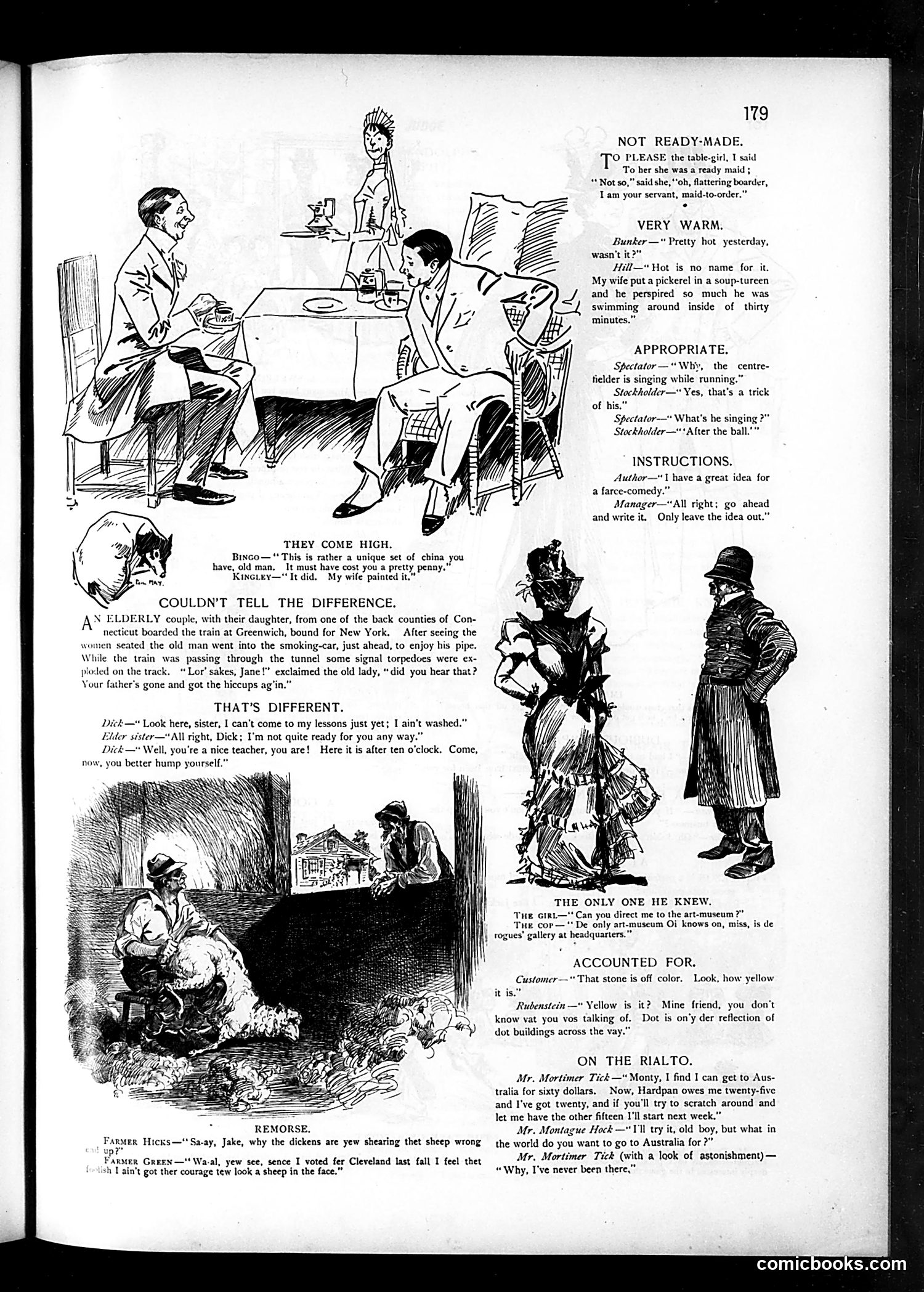
This page contains several unrelated humorous sketches typical of Judge magazine's format: **"Not Ready-Made"** mocks a servant's poor dining service through dialogue. **"Very Warm"** jokes about a man who placed a pickled object in a soup tureen as a prank. **"Appropriate"** satirizes a center-fielder singing while running—presented as fitting behavior for him. **"Instructions"** depicts a brief theatrical exchange between author and manager. **"They Come High"** shows a man trying to sell a painting to someone claiming ownership. The remaining sketches ("Couldn't Tell the Difference," "That's Different," "The Only One He Knew," "Accounted For," "On the Rialto," and "Remorse") are separate domestic or social humor comics with no apparent political content. This appears to be general entertainment/humor content rather than political satire.
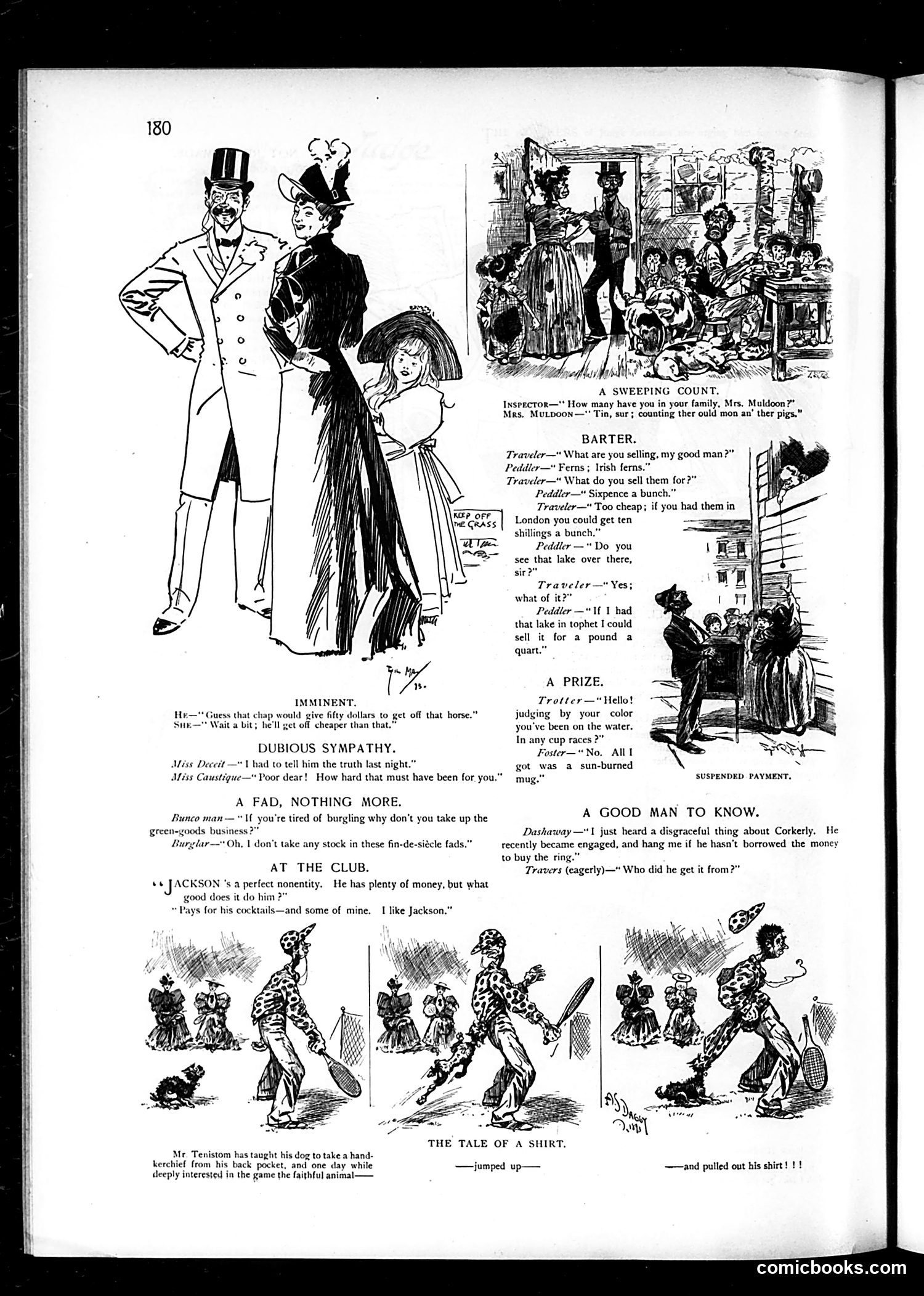
This page collects various brief satirical jokes and cartoons typical of Judge magazine's format. The humor targets: **Social pretension**: "A Sweeping Count" mocks Irish immigrants (Mrs. Muldoon) for conflating family members with livestock. "A Good Man to Know" ridicules a man who borrows money for an engagement ring—suggesting financial dishonesty masquerading as romance. **Criminal underworld**: The "Fad, Nothing More" exchange between a burglar and con artist satirizes criminal culture's adoption of trendy behaviors. **Class and commerce**: "Barter" depicts a street peddler's cleverness in comparison-selling—an Irish vendor outsmarts a well-dressed traveler through wit about hypothetical value. **Urban wealth**: "At the Club" jokes that a rich man's only value is funding others' drinks. **Bottom comic**: "The Tale of a Shirt" shows slapstick humor—a dog trained to pickpocket his master's handkerchief accidentally exposes him indecorously during a card game. The artwork style and dialect humor reflect 1890s-era sensibilities about Irish characters and working-class stereotypes.
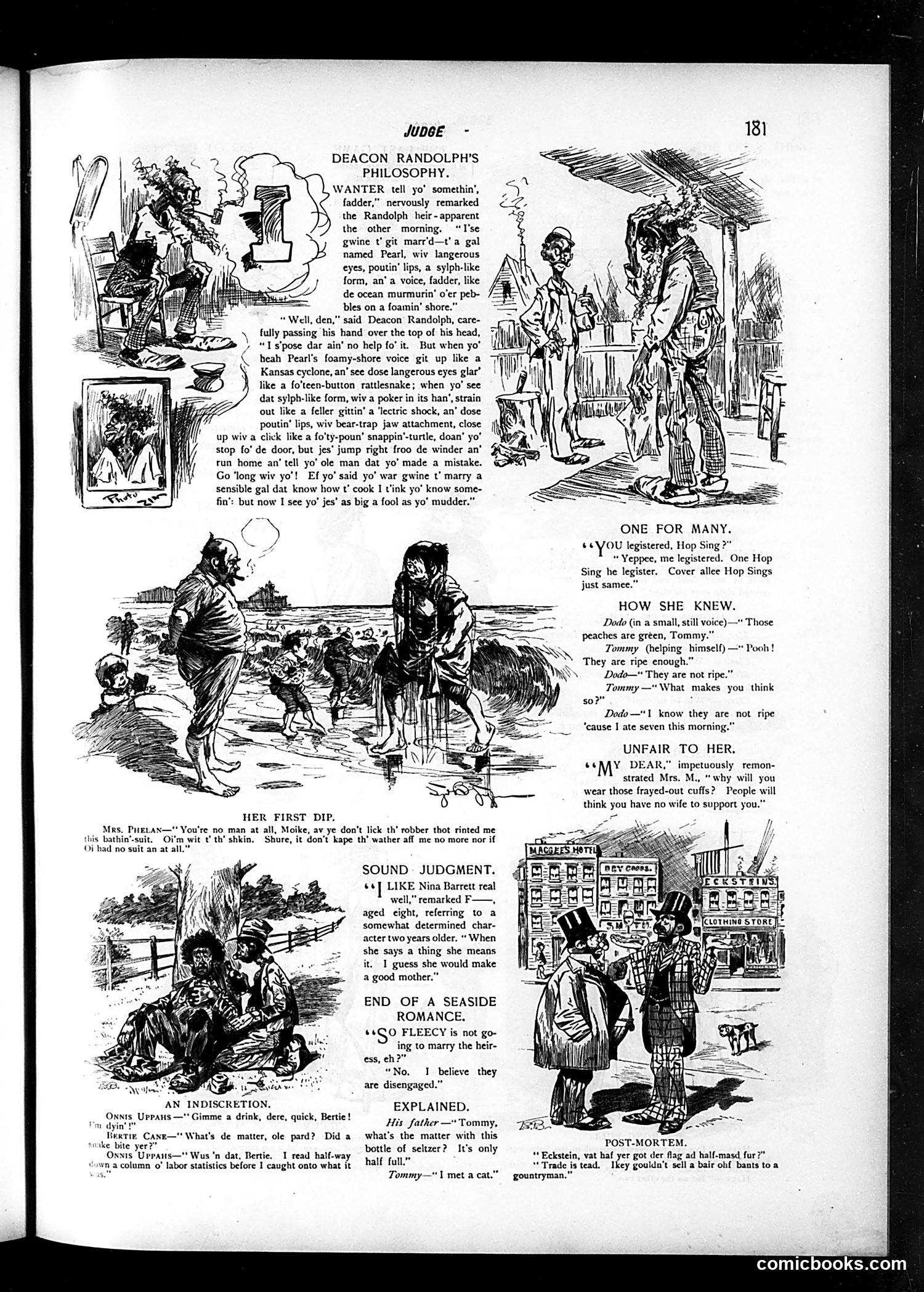
This page contains multiple brief satirical sketches typical of Judge magazine's humor. The main pieces include: **"Deacon Randolph's Philosophy"**: A dialect-heavy sketch mocking African American speech patterns (common in 19th-century American humor, now considered offensive). A father warns his son against marrying a woman named Pearl, suggesting her attractive qualities will transform into aggressive, domineering behavior once married—a misogynistic joke about women's true nature. **"One for Many"**: Satirizes Chinese immigrants, depicting "Hop Sing" as claiming one registered voter can represent multiple people of the same name—mocking both Chinese naming conventions and electoral fraud concerns of the era. The remaining items are brief, mild domestic humor sketches about children, marriage, and romantic entanglements—typical lightweight comedy. The page reflects late 19th/early 20th-century prejudices: racist caricatures of African Americans and Chinese immigrants, and dismissive attitudes toward women. These represent the magazine's target audience's attitudes rather than progressive commentary.
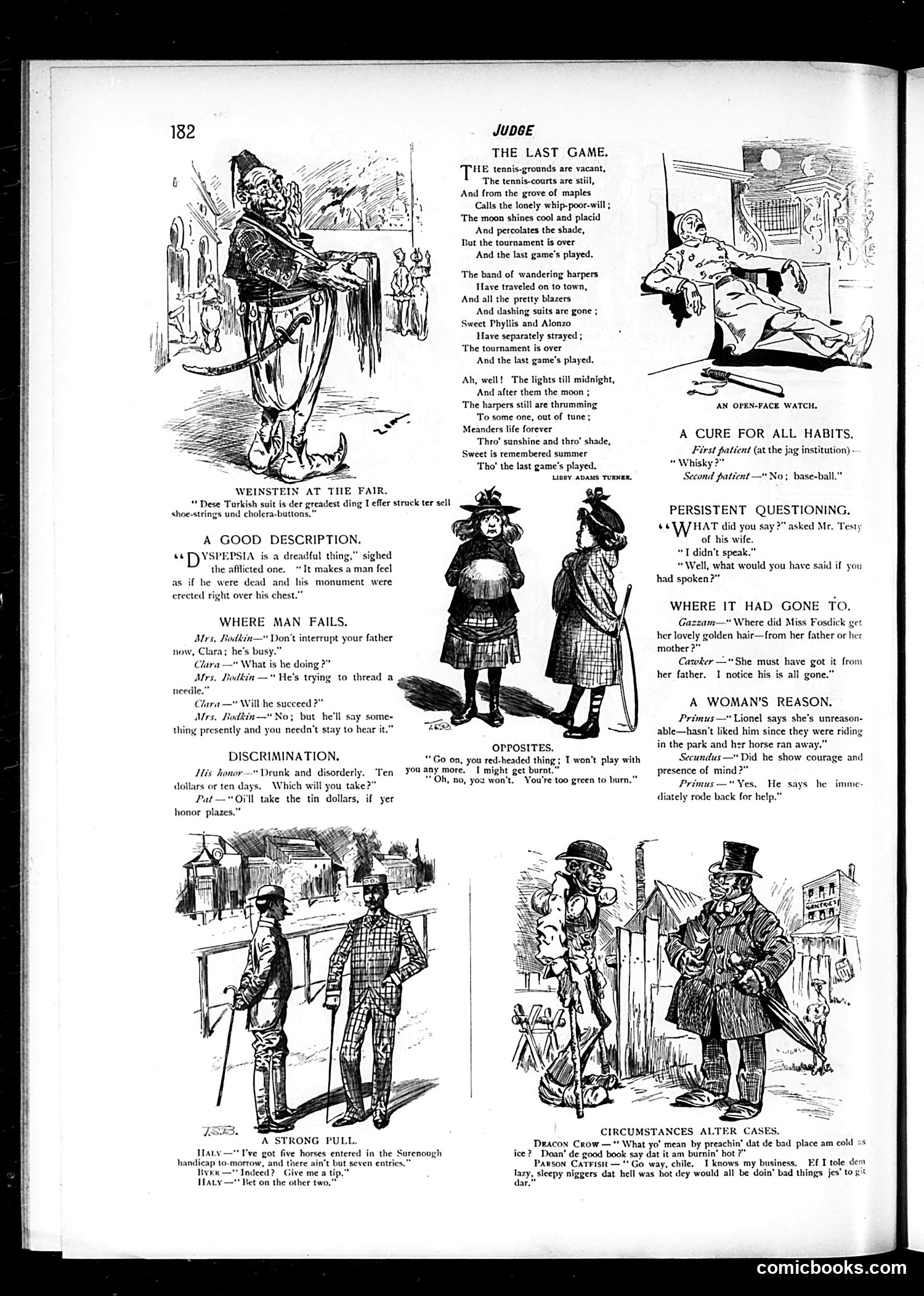
This page contains multiple short satirical pieces typical of late 19th-century American humor magazines. **"Weinstein at the Fair"** mocks a Jewish merchant with stereotypical dialect, claiming Turkish suits are his greatest sales success—the humor relies on ethnic caricature common to the era. **"The Last Game"** is a sentimental poem about the end of a tennis tournament season, with no satirical content. The remaining items are brief jokes addressing social situations: marital discord ("Where Man Fails"), class humor about horses and betting ("A Strong Pull"), immigrant/Irish stereotypes ("Discrimination"), and racial caricature ("Circumstances Alter Cases," featuring dialect-heavy depictions of Black characters). **Key context for modern readers:** This reflects Judge's reliance on ethnic and racial stereotyping for humor—now recognized as offensive. The "Parson Catfish" piece is particularly jarring, using racist dialect and suggesting deception of Black congregants. These were normalized satirical techniques of the period but represent problematic attitudes toward marginalized groups.
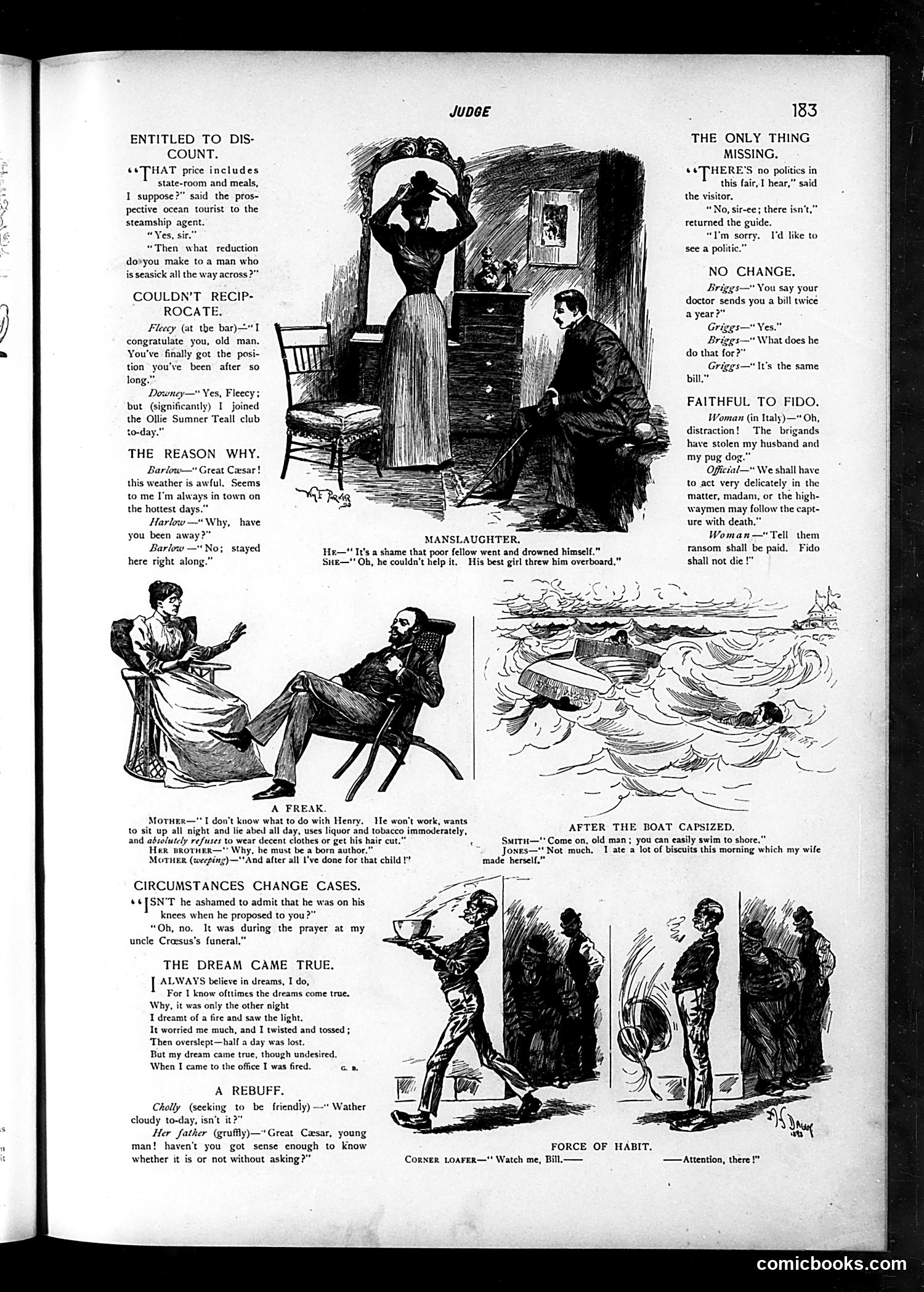
This page from *Judge* contains multiple brief comedic sketches typical of the magazine's satirical style. The humor targets everyday frustrations and social absurdities rather than specific political figures or events. Notable sketches include: **"Entitled to Discount"**: A joke about seasickness on ocean voyages—common travel complaints of the era. **"No Change"**: Satirizes doctors' billing practices, showing repetitive medical costs. **"Faithful to Fido"**: Mocks wealthy tourists' priorities, suggesting a woman values her pug dog's ransom over her husband's—a jab at aristocratic excess and misplaced values. **"The Dream Came True"**: Self-deprecating humor about oversleeping after a dream, leading to job loss. **"Force of Habit"**: A corner loafer mockingly salutes, suggesting working-class mimicry of authority. The page blends domestic comedy with mild social criticism, typical of *Judge*'s accessible humor rather than pointed political satire.
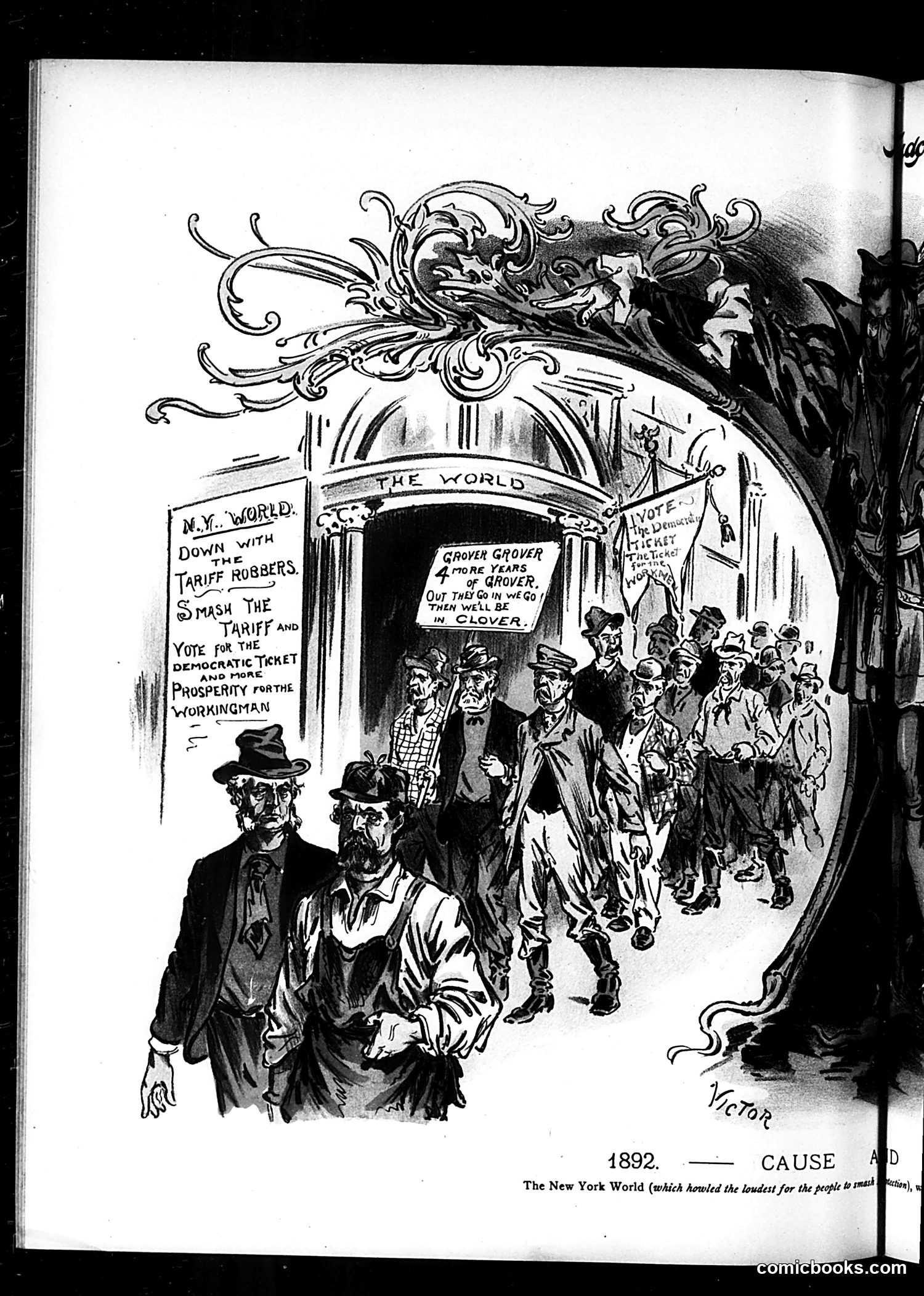
This Judge magazine cartoon satirizes the 1892 presidential election through a "clover" metaphor. The sign reads "Grover 4 more years of Grover"—referring to Grover Cleveland, the Democratic candidate seeking re-election to a non-consecutive second term. The left placard mocks the New York World's pro-Democratic messaging, claiming it championed tariff reduction and working-class prosperity. The cartoon depicts ordinary workers entering a tunnel labeled "The World," suggesting they're being led into a dark passage—implying the newspaper's populist rhetoric masks deception. The "clover" reference suggests voters will end up lucky ("in clover") if Cleveland wins, but the tunnel imagery suggests otherwise. The satire critiques how the World used working-class appeal while pursuing Cleveland's free-trade agenda, which the cartoonist likely viewed as harmful to workers. The date (1892) places this during Cleveland's actual campaign comeback.
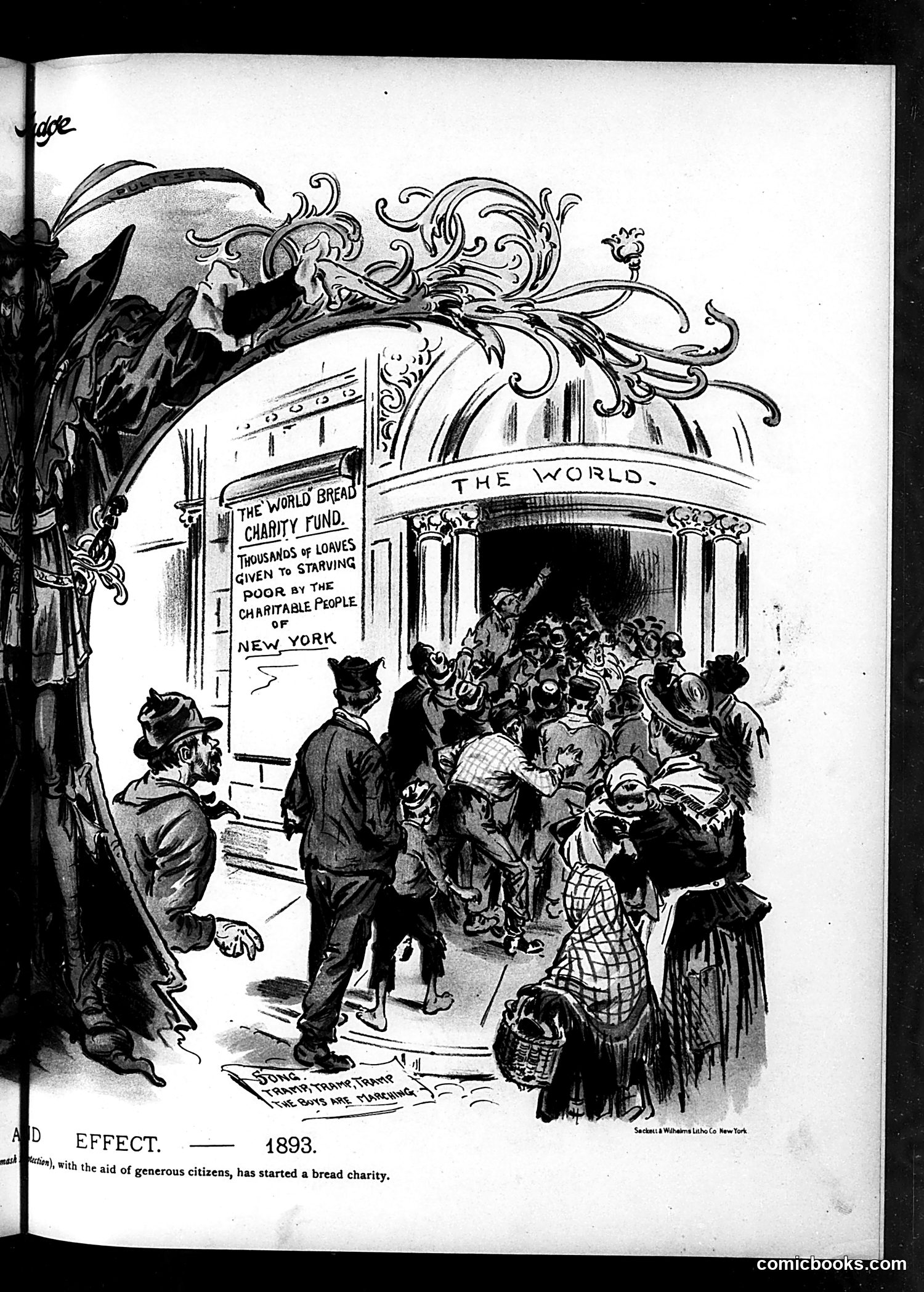
This cartoon satirizes "The World Bread Charity Fund," established by the New York newspaper *The World* to distribute loaves to starving poor. The image shows a grand classical building labeled "THE WORLD" with ornate decoration, contrasted sharply with a desperate crowd of raggedly dressed hungry people clustered at its entrance. The satire targets the *World's* charitable publicity as performative—the elaborate architectural framing suggests self-aggrandizement rather than genuine compassion. The caption's dry tone ("with the aid of generous citizens, has started a bread charity") implies skepticism about the newspaper's motives. The 1893 date places this during economic depression, when urban poverty was severe. The cartoon questions whether such charity addresses systemic poverty or merely serves the donor's reputation. The visual disparity between grandeur and desperation emphasizes this critique.
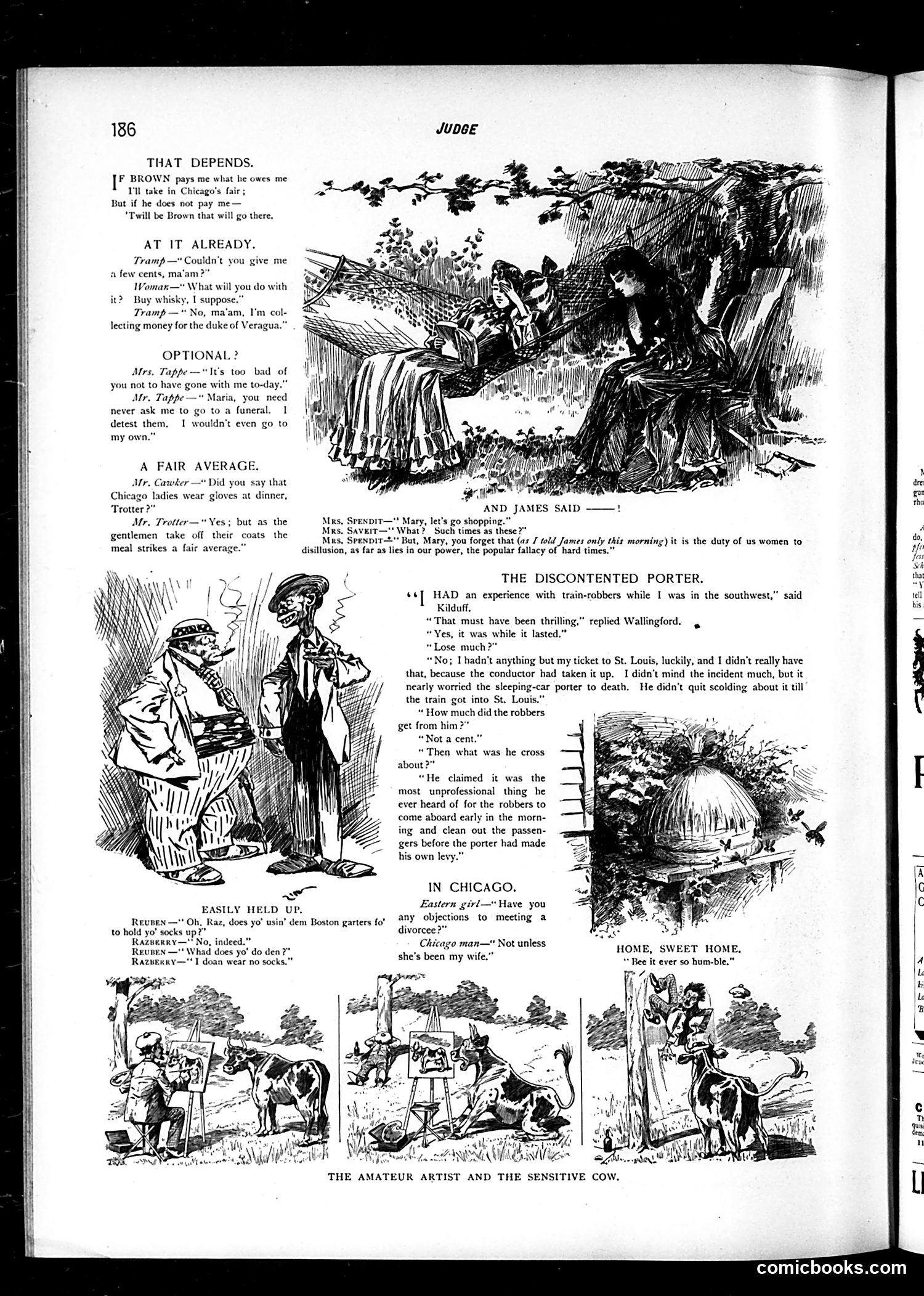
This page contains multiple brief humorous sketches typical of Judge's satirical style: **"That Depends"** and **"At It Already"**: Mock working-class desperation—a man threatening violence over unpaid debts, a tramp collecting money for nobility while panhandling. **"Optional?"** and **"A Fair Average"**: Domestic humor about marital discord and gender expectations. The "Fair Average" joke satirizes how wealthy couples maintain appearances while financial anxiety (hard times) affects society. **"The Discontented Porter"**: A train robbery anecdote mocking a sleeping-car porter's priorities—he's upset robbers stole from passengers before he could collect his own tips, suggesting porters were notorious for overcharging/exploiting travelers. **"In Chicago"** and **"Home, Sweet Home"**: Brief gags about divorce and poverty. **"The Amateur Artist and the Sensitive Cow"**: Visual humor showing an artist sketching while a cow reacts badly—likely satirizing either pretentious artists or sentimental animal sentimentality. The page reflects late-19th-century American anxieties: class conflict, marital discord, economic instability, and social hypocrisy.
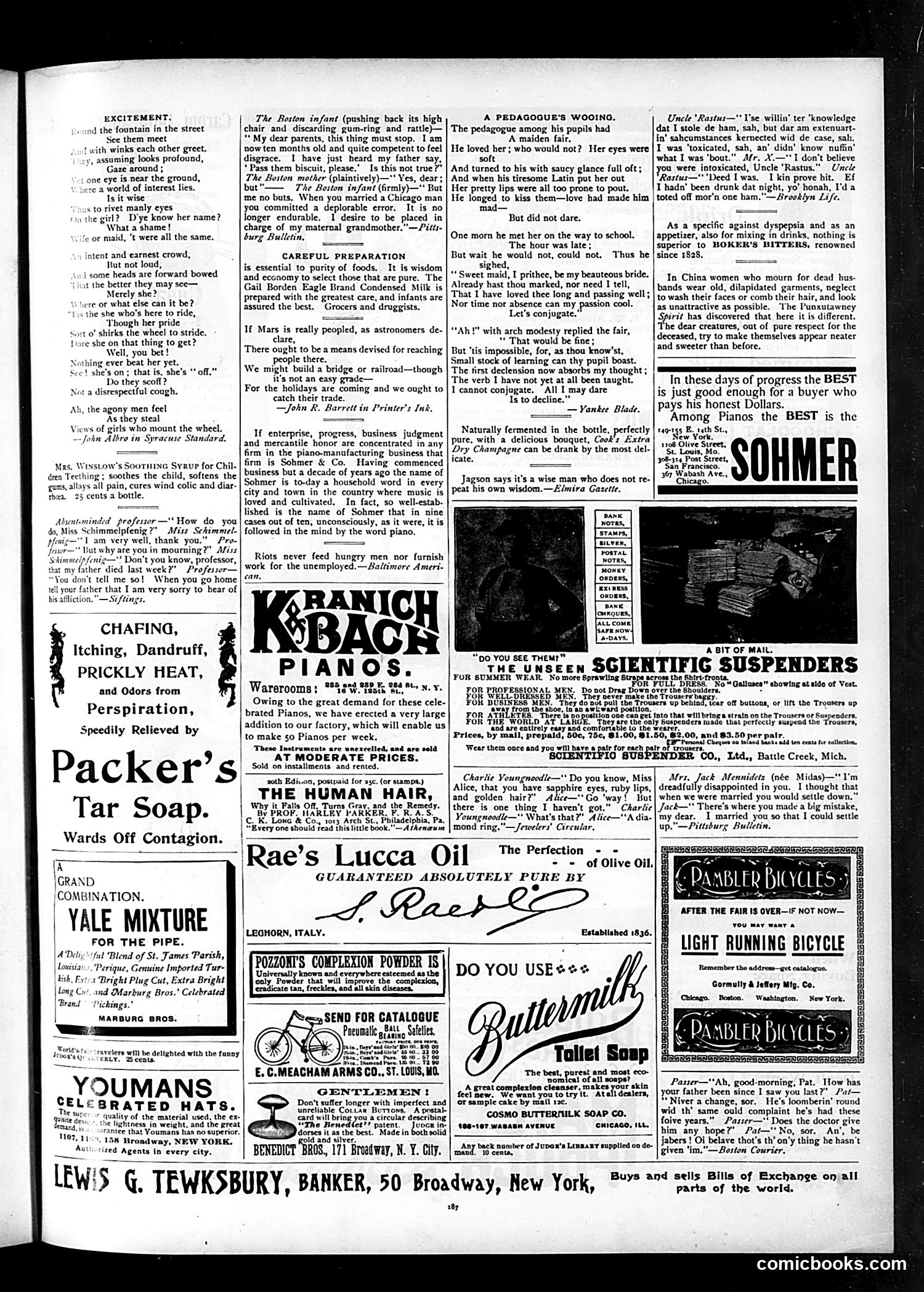
This page is primarily **advertisements and filler content** rather than political satire. The main items include: **"The Boston Infant"** is a short humorous sketch mocking Boston's perceived snobbery. A ten-month-old baby, appalled at hearing his Chicago-born father use colloquial grammar ("Pass them biscuit"), demands to be placed under his maternal grandmother's care—satirizing Boston's self-regard for refinement and snobbish disdain for Midwesterners. **"Excitement"** is a poem about men's distraction watching a young woman riding a bicycle—poking fun at the novelty and attention generated by the "New Woman" cycling fad of the 1890s. The remainder consists of product advertisements (Packer's Tar Soap, Sohmer pianos, Yale pipe tobacco, Youmans hats, etc.) typical of Judge's revenue model. There is no significant political cartoon or sustained satirical commentary on this particular page.
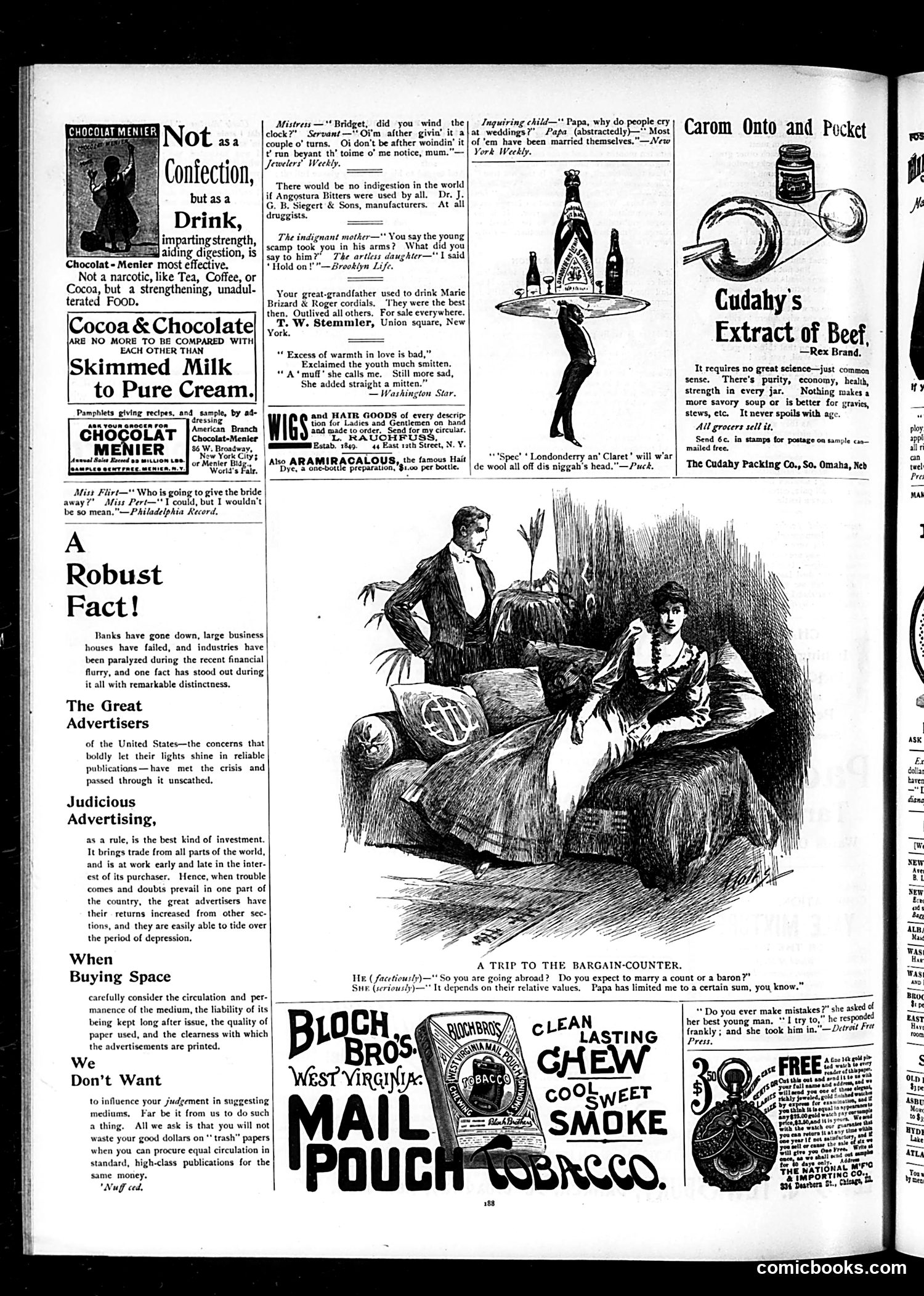
This cartoon satirizes the mercenary nature of courtship and marriage among the wealthy. A fashionably-dressed young woman, when asked by another woman whether she expects to marry a foreign nobleman (a "count or a baron"), replies cynically that it "depends on their relative values" since her father has limited her to "a certain sum." The joke targets the practice of wealthy American heiresses purchasing titles through marriage to impoverished European aristocrats—a common phenomenon in the Gilded Age. The woman treats suitors as commodities to be shopped for within a fixed budget, reducing romance to pure financial transaction. The "bargain-counter" title reinforces this mercenary view of marriage as commerce rather than love, reflecting contemporary anxieties about both gilded-age excess and changing gender economics.
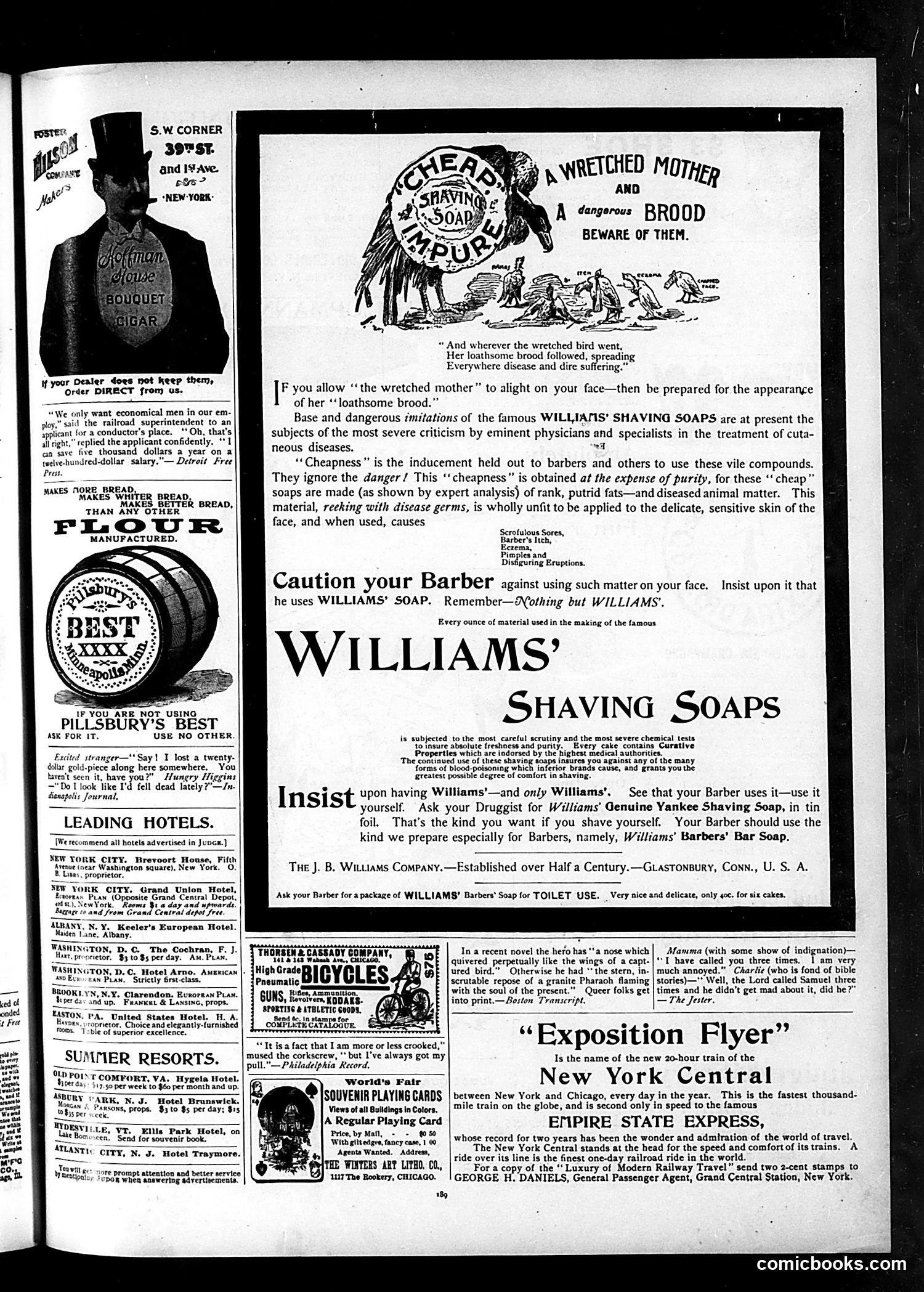
This page features a **health-scare advertisement** for Williams' Shaving Soaps, not a political cartoon. The imagery depicts a diseased mother bird and her "loathsome brood," serving as a metaphor warning against counterfeit soap products. **The Context:** In the late 19th/early 20th century, unregulated markets flooded with cheap imitations of popular brands. The ad claims inferior soaps contained "rank, putrid fats" and "diseased animal matter" causing serious skin infections—scrofulous sores, eczema, and "barber's itch." **The Satire/Pitch:** Rather than satirizing a figure or event, this exploits genuine medical anxieties of the era. By warning barbers and customers against unnamed cheap competitors, Williams' positions itself as the safe, scientifically-scrutinized alternative. The elaborate medical language and fearful imagery (disease-spreading birds) were persuasion tactics common in period advertising. **Modern Parallel:** This resembles contemporary pharmaceutical ads that emphasize purity and safety while implying competitors are dangerous—early fear-based marketing.
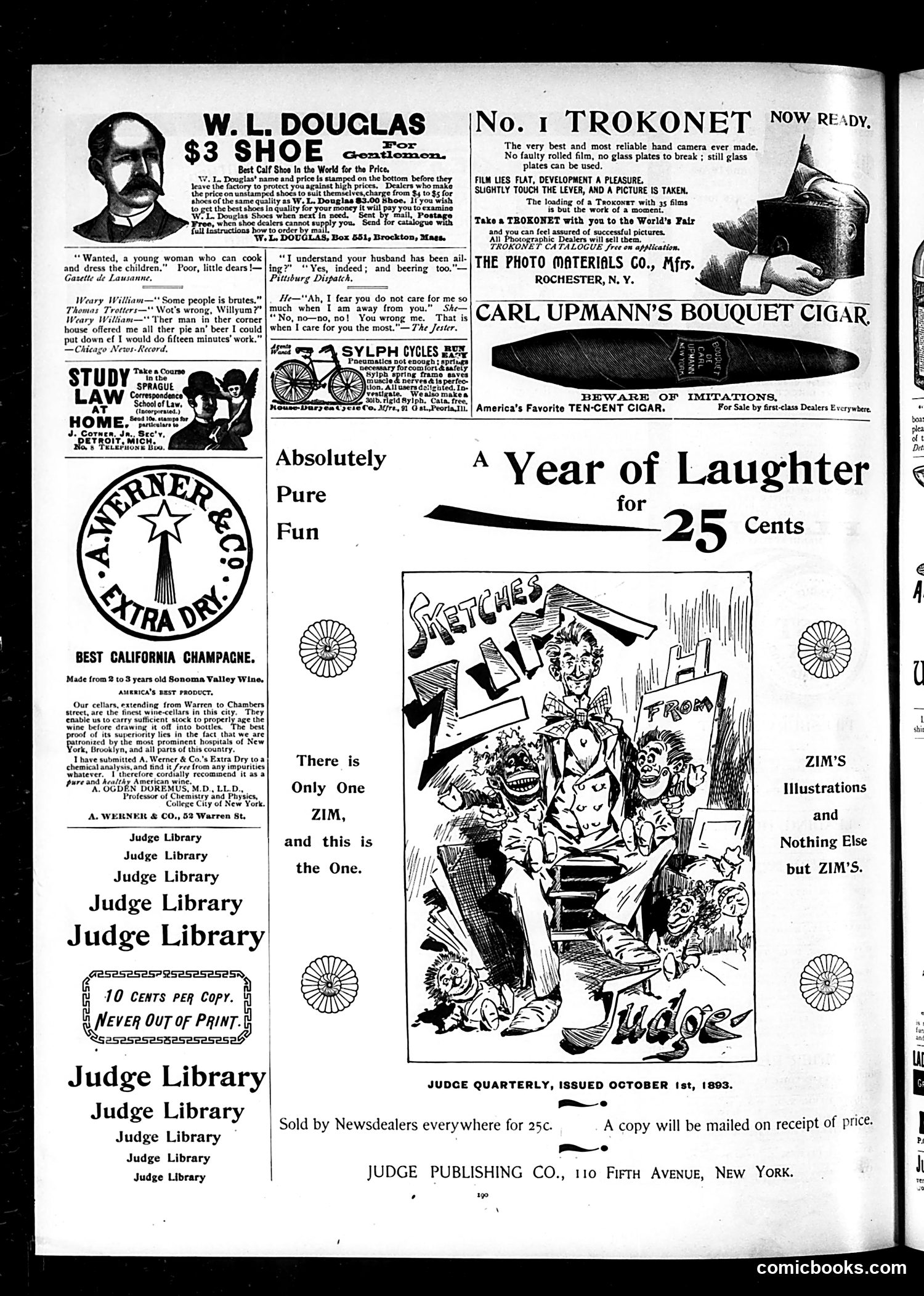
This is primarily an **advertising page** from Judge's quarterly humor issue, with minimal editorial cartoon content. The main illustrated piece—a chaotic sketch labeled "Sketches from Life"—appears to depict exaggerated caricatures in a comedic domestic or social scene, though specific figures are unclear without additional context. The page is dominated by product advertisements typical of 1890s consumer culture: W.L. Douglas shoes, camera equipment, champagne, bicycles, and cigars. Small filler jokes appear between ads (about cooking, husbands, pie-eating)—typical of Judge's format. The dominant messaging emphasizes product quality and affordability. "Judge Library" appears repeatedly, promoting the magazine's accessibility at 10 cents per copy. The issue cost 25 cents, positioning Judge as entertainment for middle-class readers. The Trokonet camera advertisement notably appeals to World's Fair attendees (likely the 1893 Chicago Columbian Exposition), indicating contemporary topical marketing. Overall, this represents Judge functioning as both satirical publication and consumer goods platform.
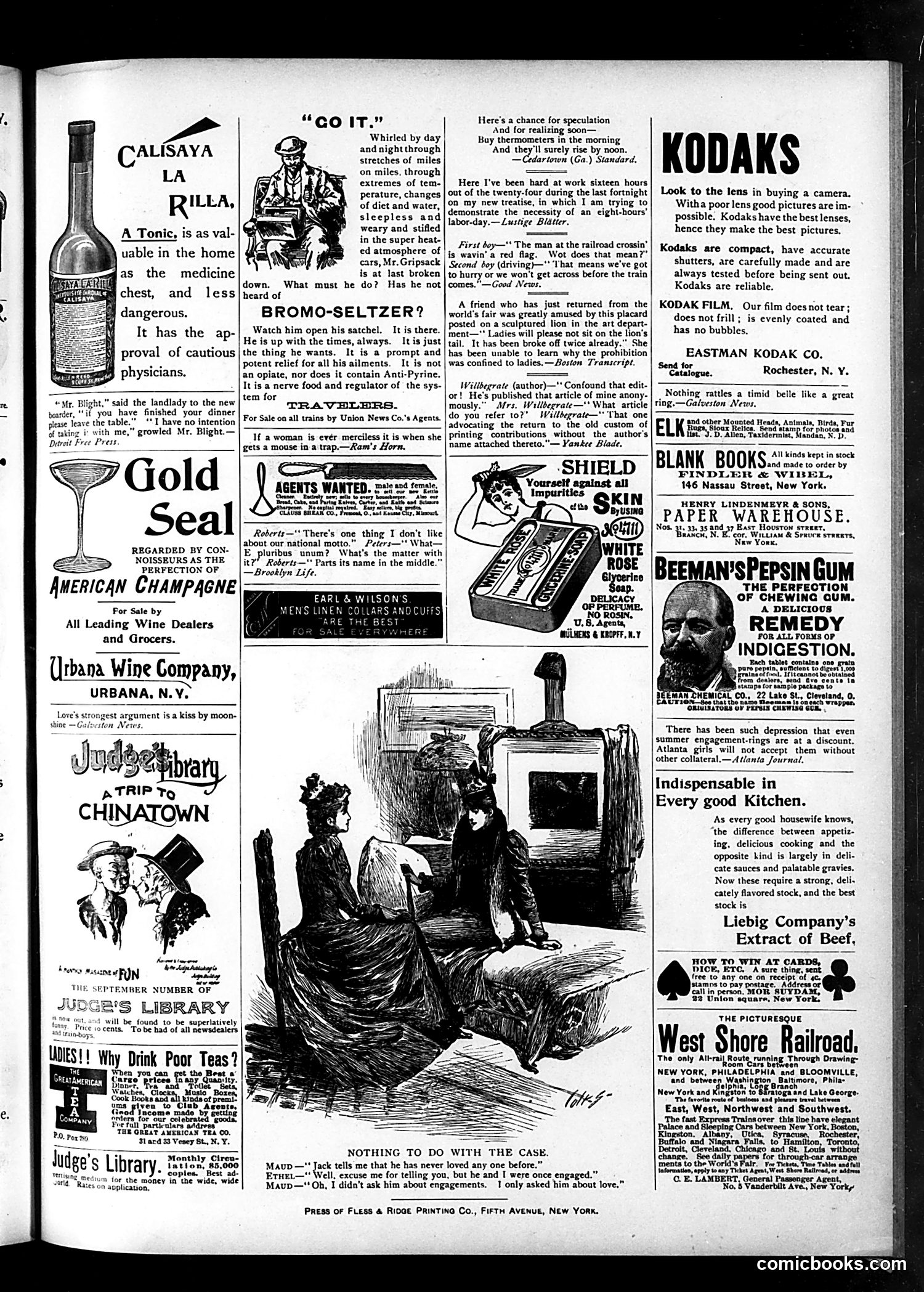
This page from Judge (a satirical weekly) contains primarily **advertisements and brief comic vignettes** rather than political cartoons. The main illustrated content is a domestic scene titled "Nothing to Do with the Case," showing a conversation between Maud and Ethel about romantic engagements versus love—a mild joke about semantic confusion in courtship. The page is dominated by **product advertising**: Calisaya La Rilla tonic, Gold Seal champagne, Bromo-Seltzer (a patent medicine), Judge's Library, Kodaks cameras, and other commercial goods. These ads often include small comic asides (like the landlord joke about Mr. Blight). The scattered text snippets represent **humor fillers**—short jokes and witticisms common to Judge's format, touching on universal subjects: travel exhaustion, women and mousetraps, labor conditions, and national mottoes. **No major political figures or events** are referenced. This is a typical late-19th/early-20th-century magazine page blending light humor with commercial promotion targeting middle-class readers.
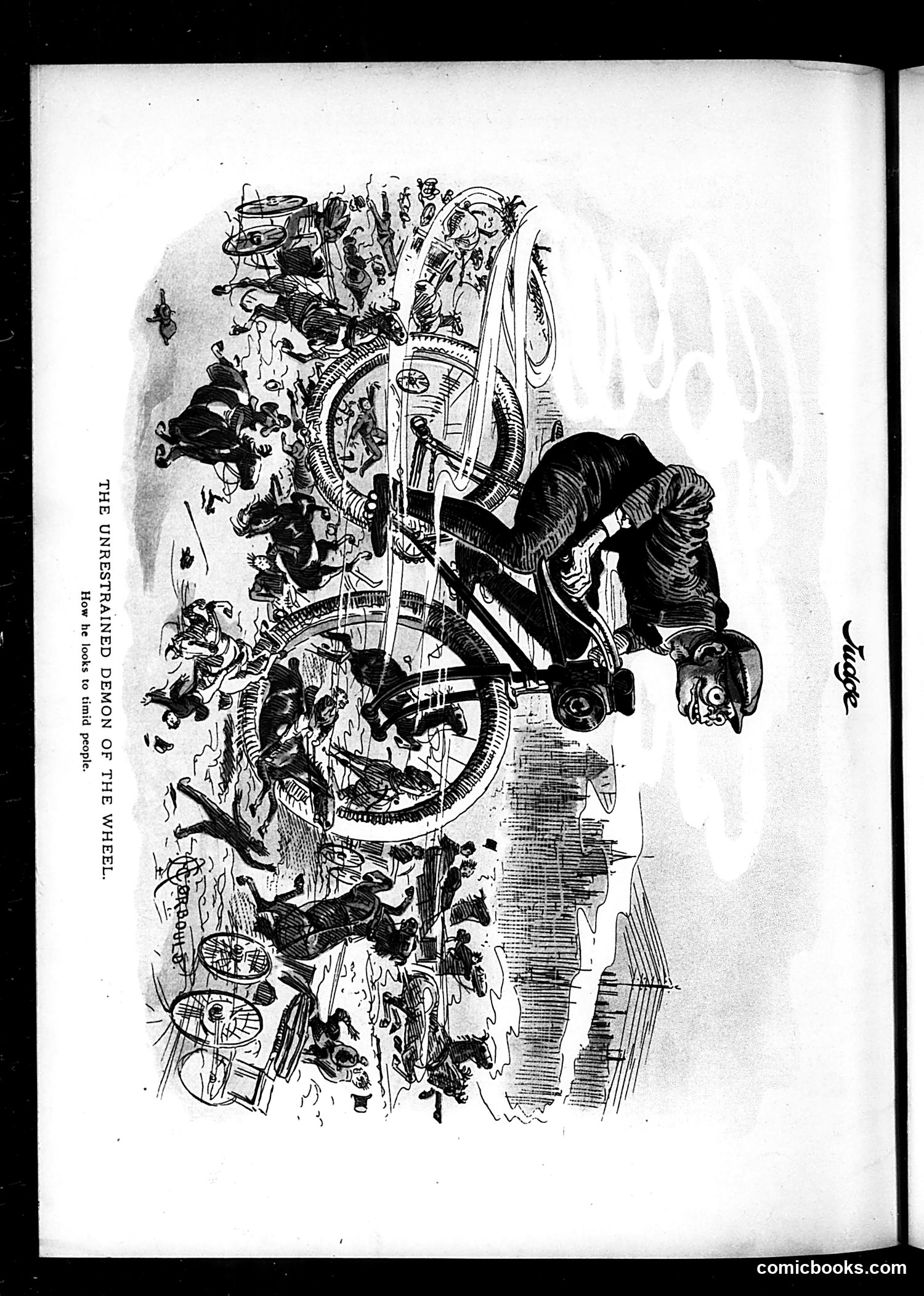
This political cartoon depicts a large wheel—apparently representing fate, fortune, or perhaps industrial/capitalist machinery—crushing and tormenting numerous figures beneath it. The title suggests these suffering people are "undeserved" victims of this destructive force. The illustration shows people being ground under the wheel's massive weight, with additional figures scattered around in distress. The style and composition suggest social commentary on economic suffering or injustice. However, the OCR text is too corrupted to read clearly, making it difficult to identify specific historical figures, date, or the precise political context. Without readable text, I cannot reliably determine whether this critiques labor conditions, monopolies, political corruption, or another specific issue of the era. The work appears to be Victorian-era satirical commentary on systemic harm to ordinary people, but specific details remain unclear.