
Judge, 1893-09-23 · page 6 of 16
Judge — September 23, 1893 — page 6: what you’re looking at
What you’re looking at
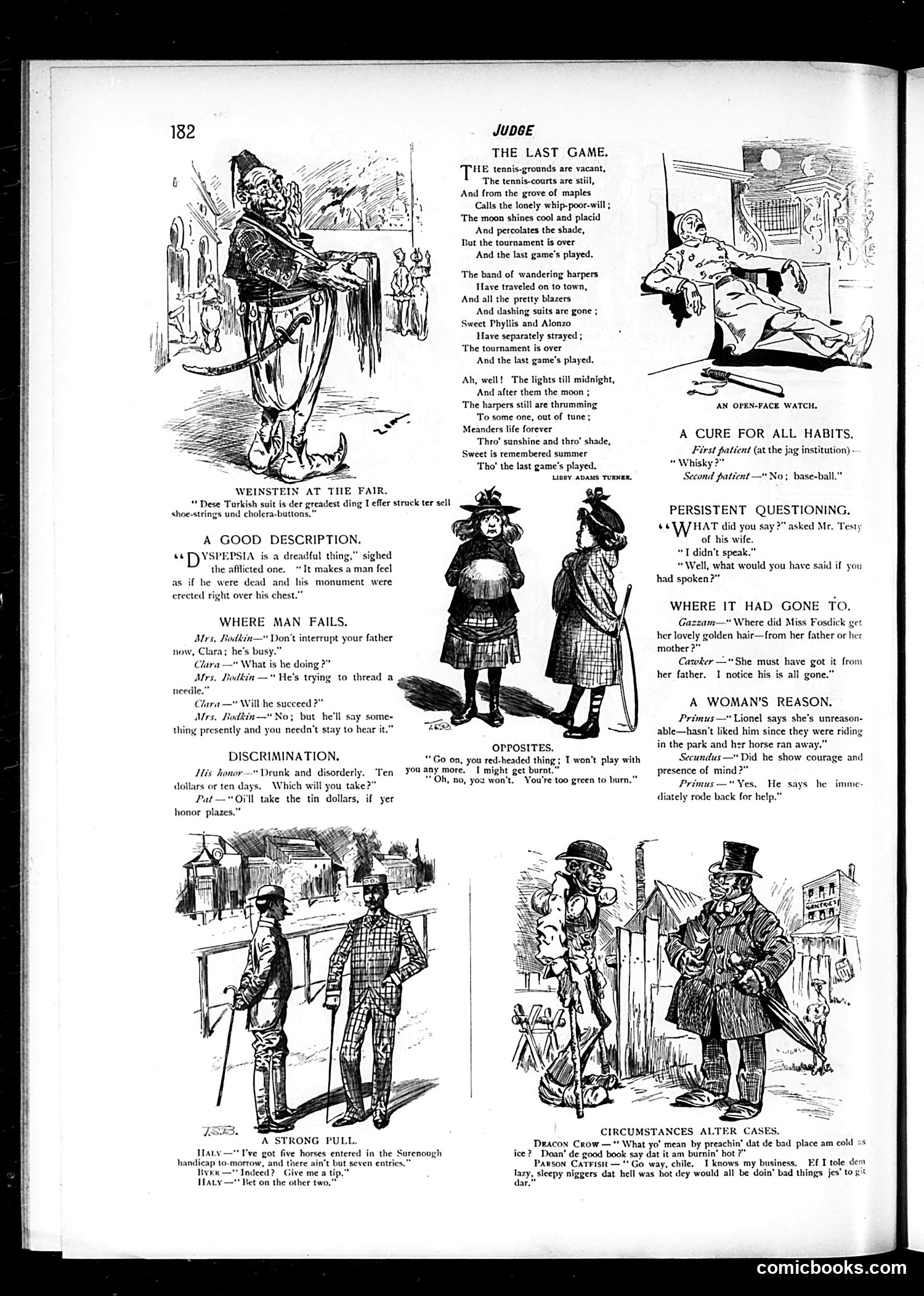
This page contains multiple short satirical pieces typical of late 19th-century American humor magazines. **"Weinstein at the Fair"** mocks a Jewish merchant with stereotypical dialect, claiming Turkish suits are his greatest sales success—the humor relies on ethnic caricature common to the era. **"The Last Game"** is a sentimental poem about the end of a tennis tournament season, with no satirical content. The remaining items are brief jokes addressing social situations: marital discord ("Where Man Fails"), class humor about horses and betting ("A Strong Pull"), immigrant/Irish stereotypes ("Discrimination"), and racial caricature ("Circumstances Alter Cases," featuring dialect-heavy depictions of Black characters). **Key context for modern readers:** This reflects Judge's reliance on ethnic and racial stereotyping for humor—now recognized as offensive. The "Parson Catfish" piece is particularly jarring, using racist dialect and suggesting deception of Black congregants. These were normalized satirical techniques of the period but represent problematic attitudes toward marginalized groups.
📄 Transcribed text from this page (OCR, searchable)
Machine-transcribed from the original scan — historical spelling and the odd misread are preserved.
WEINSTEIN AT THE FAIR. JUDGE THE LAST GAME. HE tennis-grounds are vacant, The tennis-courts are stiil, And from the grove of maples Calls the lonely whip-poor-will ; ‘The moon shines cool and placid And percolates the shade, But the tournament is over And the last game's played. ‘The band of wandering harpers Have traveled on to town, And all the pretty blazers And dashing suits are gone ; Sweet Phyllis and Alonzo Have separately strayed ; ‘The tournament is over And the last game's played. Ah, well! The lights till midnight, And after them the moon ; The harpers still are thrumming To some one, out of tune; Meanders life forever hro’ sunshine and thro’ shade, Sweet is remembered summer Tho’ the last game's played. LIBBY ADAMS TURNER, “Dese Turkish suit is der greadest ding I effer struck ter sell shoe-strings und cholera-buttons.” A GOOD DESCRIPTION. 44 DYSPEPSIA is a dreadful thing,” sighed the afflicted one, “It makes a man feel as if he were dead and his monument were erected right over his chest.”” WHERE MAN FAILS, Mrs, Bodkit now, Cl: Clara “Don't interrupt your father he’s busy.” * What is he doing ?” Mrs, Bodkin —" He's trying to thread a y needle.” Clara —" Will he succeed?" Mrs. Bodkin —" No but he'll say some- thing presently and you needn't stay to hear it.” DISCRIMINATION, His honor—" Drank and disorderly. Ten dollars or ten days. Which will you take?” Pat—“Oi'll take the tin dollars, if yer honor plazes.” TRONG PULL. IIALy —"" I've got five horses entered in the Surenough ice? handicap to-morrow, and there ain't but seven entries. Byrn —" Indeed? Give mea tip.” HALY —" Ret on the other two.” you any more, OPPOSITES. “Go on, you red-headed thin; T might get burnt.” “Oh, no, yor won't. You're too green to burn,” T won't play with AN OPEN-PACE WATCH, A CURE FOR ALL HABITS. First patient (at the jag institution) - “Whisky?” Second patient —" No; base-ball.”” PERSISTENT QUESTIONING, 6 6\YJHAT did you say?" asked Mr. Testy W of his wife. “T didn’t speak.” “Well, what would you have said if you had spoken ?” WHERE IT HAD GONE TO. Gazzam—" Where did Miss Fosdick get her lovely golden hair—from her father or her mother Cawker —*She must have got it from her father. I notice his is all gone.” A WOMAN'S REASON. Primus —" Lionel says she’s unreason- able—hasn’t liked him since they were riding in the park and her horse ran aw: Secundus—" Did he show courage and presence of mind? Primus —"Yes. He says he imme diately rode back for help."* CIRCUMSTANCES ALTER P, Deacon Crow —“' What yo’ mean by preachin’ dat de bad place am cold 3s Doan’ de good book say dat it am burnin’ hot 7” ‘ARSON CATFISH — "* Go way, chile, T knows my business. Ef I tole dem lazy, sleepy niggers dat hell was hot dey would all be doin’ bad things jes’ to git dar.” comicbooks.com