
A complete issue · 16 pages · 1893
Judge — August 5, 1893
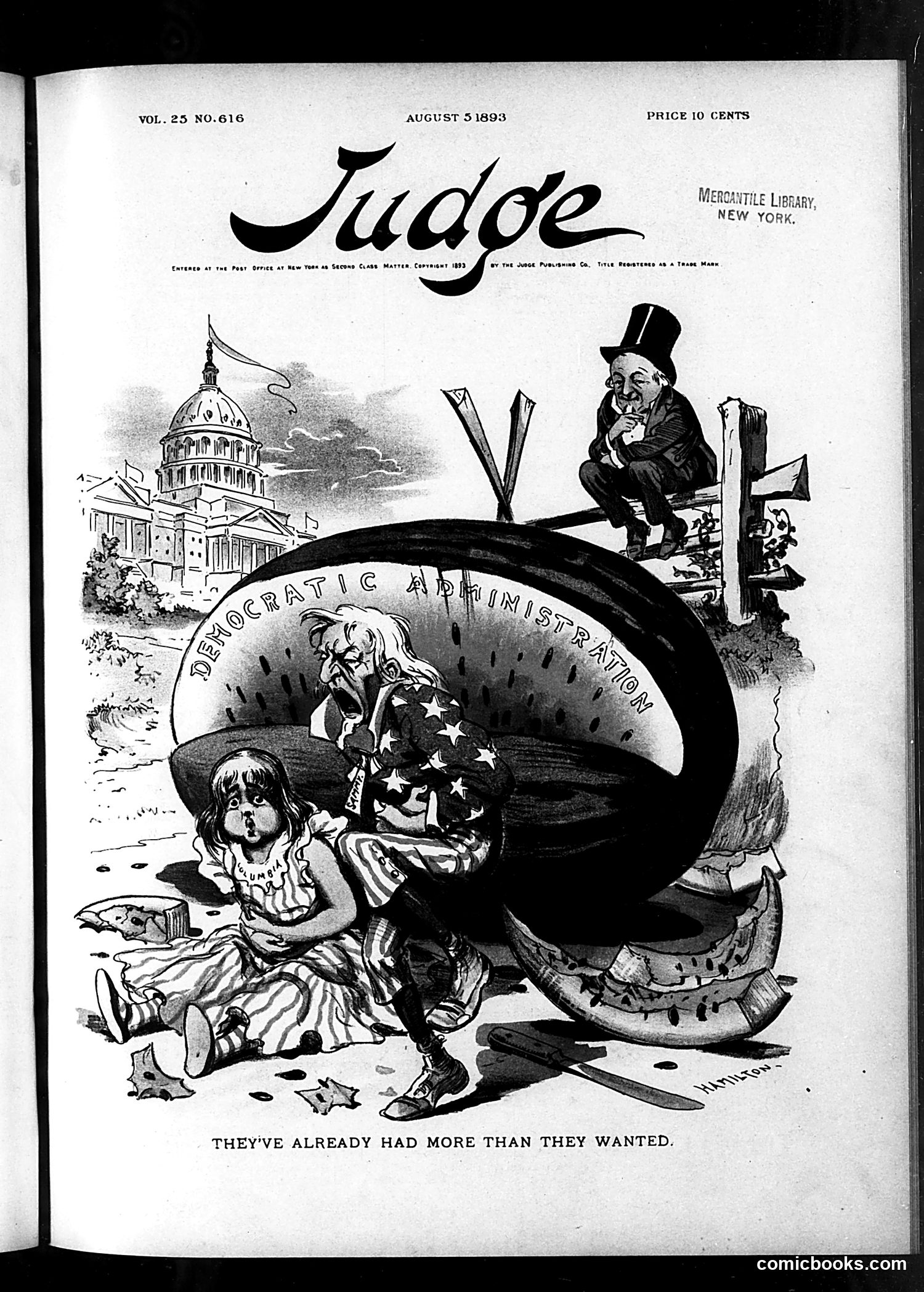
This cartoon critiques the **Democratic Administration** during the economic crisis of 1893. The central image shows Uncle Sam (represented as Lady Liberty with the American flag) being crushed or overwhelmed by a large boot labeled "Democratic Administration." Two figures frame the scene: a well-dressed man in a top hat (likely representing a Republican or critic) perches above, while below sits a distressed child figure representing the American people or economy. The caption—"They've Already Had More Than They Wanted"—suggests the Democratic administration has caused excessive suffering. This references the severe **Panic of 1893**, an economic depression that devastated the nation under President Grover Cleveland's administration, making it a focal point for political blame and satire.
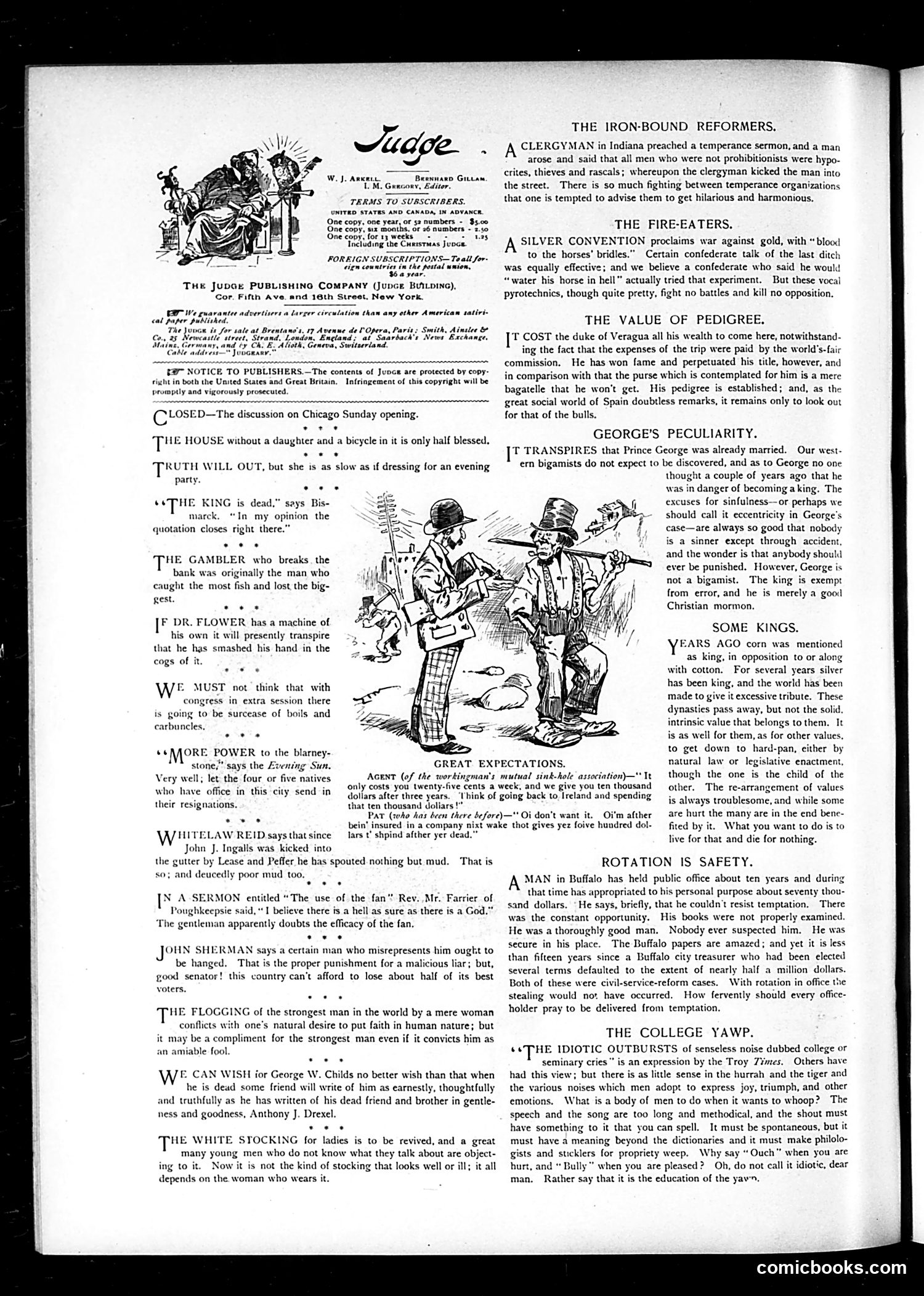
This page contains satirical commentary and editorials typical of Judge magazine's format. The main cartoon depicts two men in conversation—one appears to be a laborer or working-class figure, the other a gentleman in formal dress, suggesting a social commentary on class relations. The text pieces are brief satirical quips about contemporary issues: temperance (a clergyman's sermon), Prince George's rumored marriage, Spanish bullfighting, and civil-service reform. One piece critiques "college yawps"—suggesting educated men making pretentious or meaningless speeches. The overall tone mocks hypocrisy among the upper classes and religious figures while commenting on political and social reform movements of the era. Without clearer identification of specific political figures or dated references in the visible text, precise historical context remains uncertain.
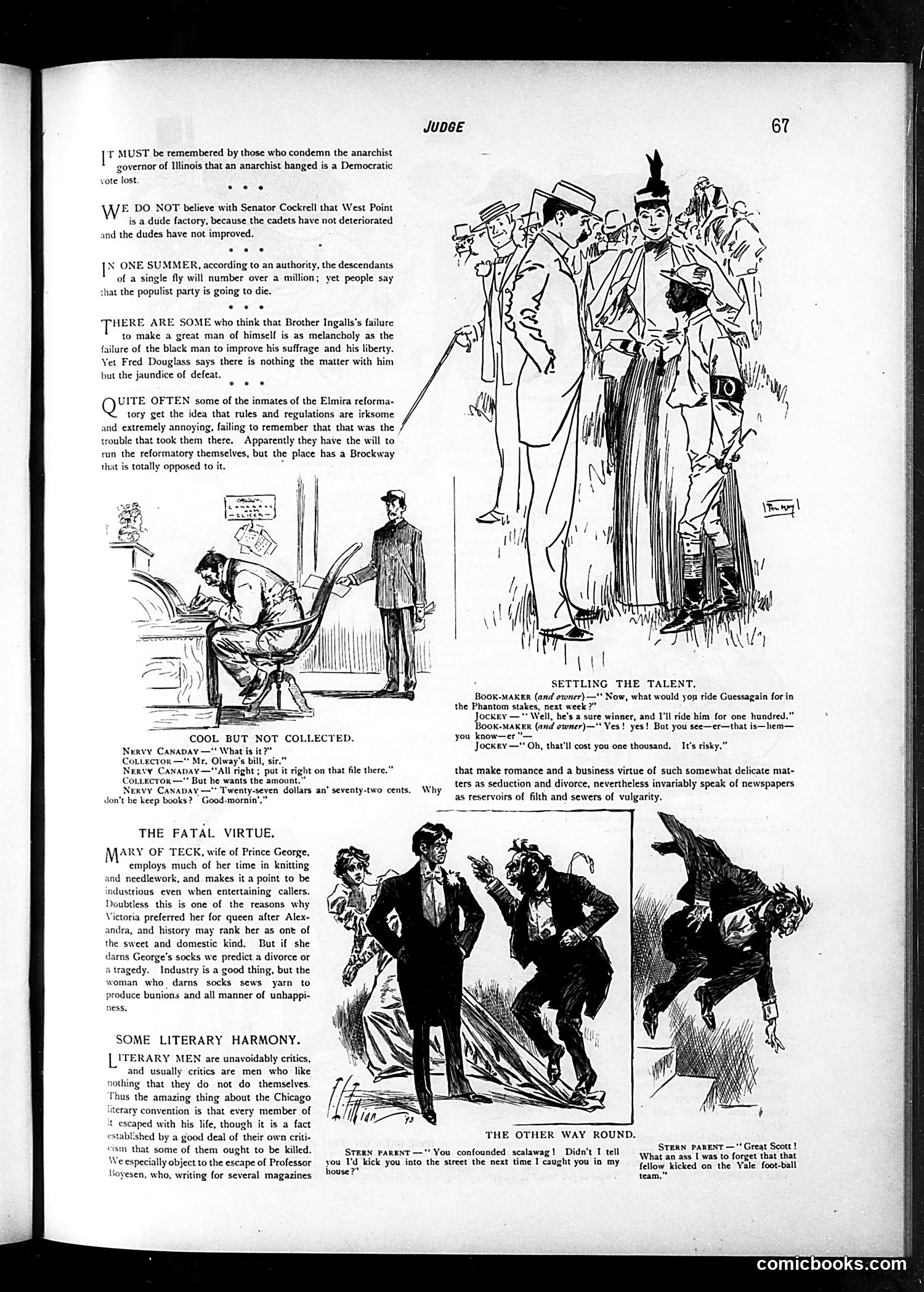
This page contains several satirical pieces critiquing American politics and society circa early 20th century. **"Cool But Not Collected"** mocks a nervous tax collector unable to extract payment from a debtor. **"The Fatal Virtue"** discusses Mary of Teck (wife of Prince George), praising her industriousness but sarcastically warning that women who engage in needlework and produce news stories risk creating "bunions and all manner of unhappiness." **"Some Literary Harmony"** criticizes literary critics, suggesting they escaped a Chicago literary convention but deserve criticism themselves. The page's cartoons satirize bureaucratic incompetence, gender roles, and intellectual pretension typical of Judge's social commentary. The specific political figures or events aren't clearly identifiable from the text provided.
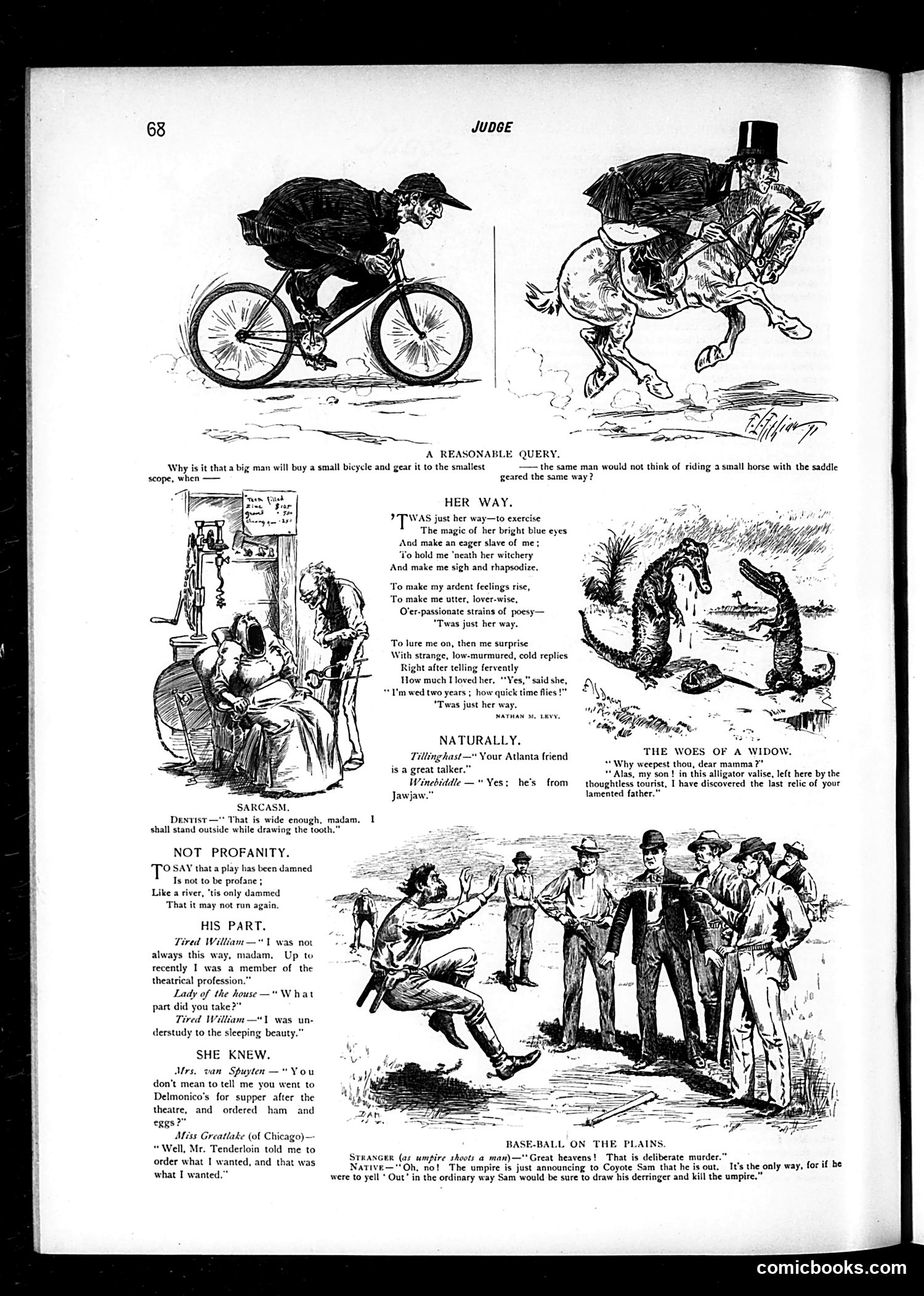
This page contains multiple unrelated satirical humor pieces typical of Judge magazine's format: **"A Reasonable Query"** uses absurdist logic to mock the fashion of men riding bicycles—a relatively new technology in the 1890s-1900s. The joke contrasts a man's willingness to buy an oversized bicycle and gear it small (impractical) with the parallel absurdity of using wrong-sized equipment on horses. **"Her Way"** is a romantic poem satirizing women's manipulative courtship tactics—flirtation, emotional hot-and-cold behavior, and keeping suitors guessing. **"Base-Ball on the Plains"** depicts a frontier settlement where the umpire shoots a player dead rather than calling him "out," because speaking normally would provoke gun violence. This mocks both Wild West lawlessness stereotypes and Americans' emerging obsession with baseball. Other brief sections include conversational jokes about dentistry, theatrical employment, and dining etiquette—standard period humor with no apparent political content. The cartoons are generic social satire rather than commentary on specific events or political figures.
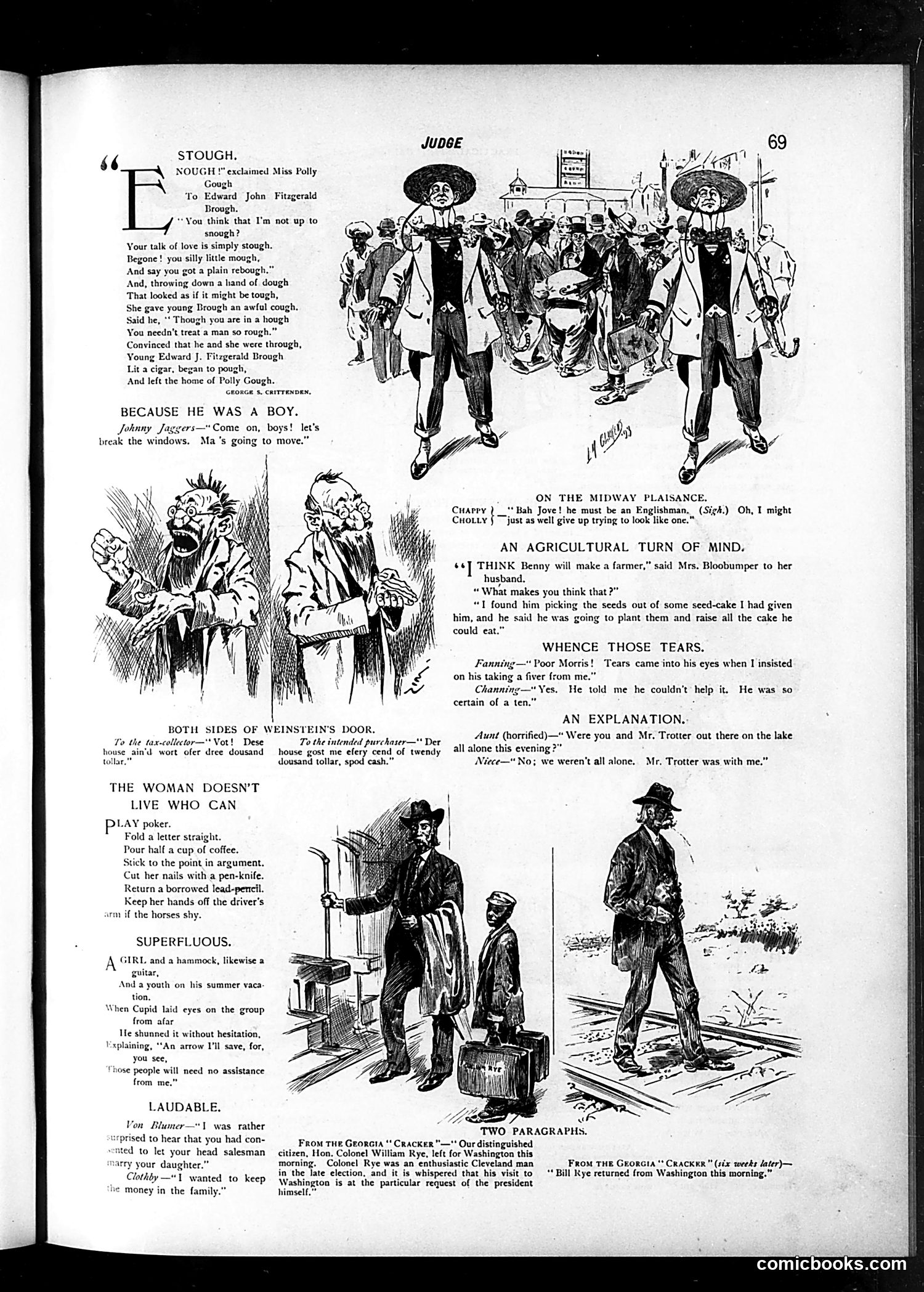
This page collects several short humorous pieces typical of Judge's satirical style: **"Stough"** is a nonsense poem playing on rhyming variations of the word "dough," mocking overwrought romantic dialogue. **"Because He Was a Boy"** critiques destructive juvenile behavior—a boy encourages window-breaking during a move, suggesting boys are expected to be destructive. **"On the Midway Plaisance"** (referencing the 1893 Chicago World's Fair) jokes about an Englishman's affected mannerisms. **"An Agricultural Turn of Mind"** presents a child literally interpreting seed-cake as seedlings to plant—gentle humor about childish logic. **"Whence Those Tears"** and other sections use brief dialogues for comic payoffs about social misunderstandings. **"The Woman Doesn't Live Who Can"** lists stereotypical female failings—poker, penmanship, arguing, punctuality—reflecting period gender prejudices humorously. **"Both Sides of Weinstein's Door"** satirizes housing negotiations through exaggerated accents, typical of Judge's immigrant humor. The page mixes wordplay, social observation, and period stereotypes in Judge's signature comedic format.
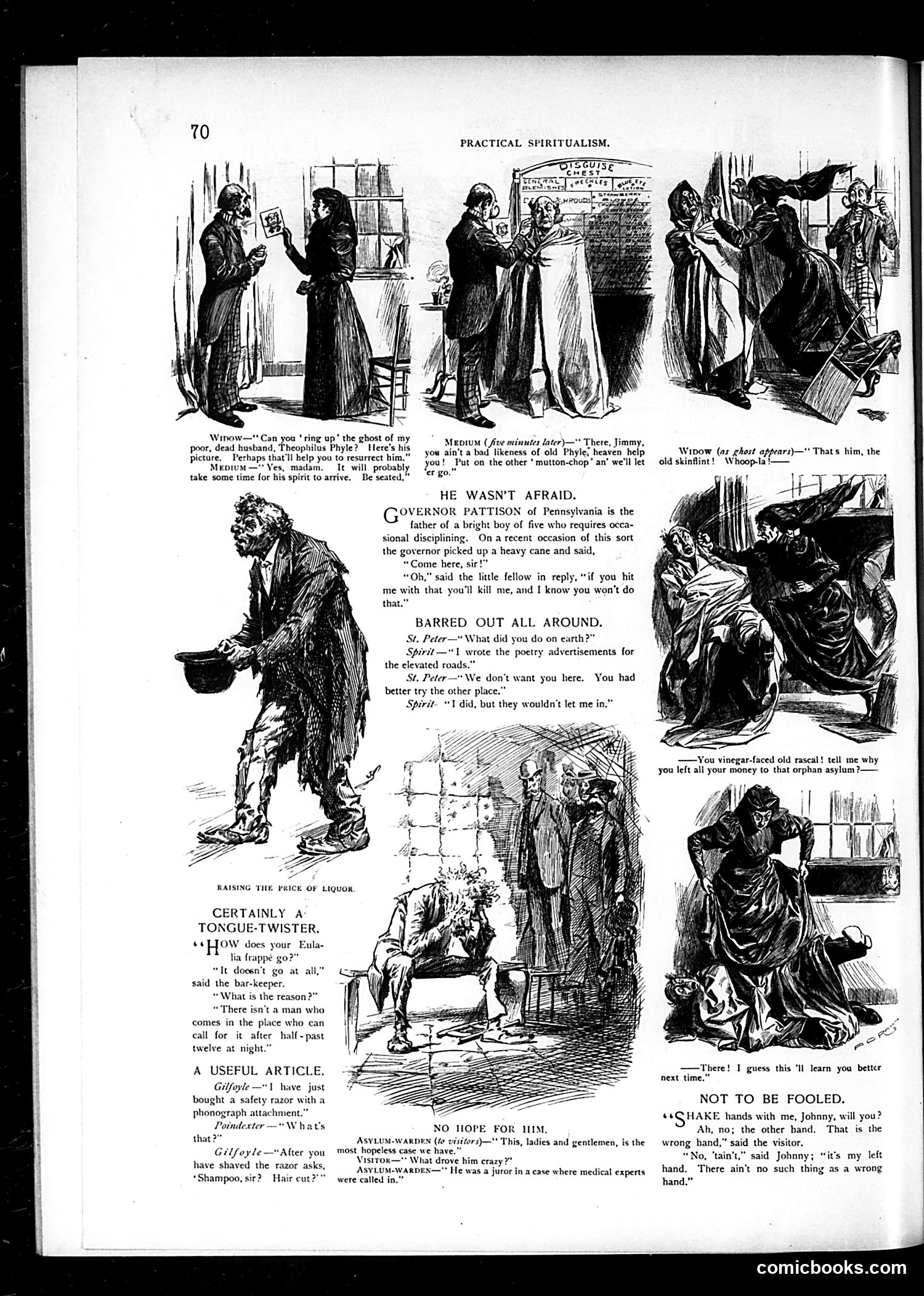
This page satirizes multiple contemporary concerns through short humorous pieces: **"Practical Spiritualism"** mocks the spiritualism craze—a genuine Victorian phenomenon where mediums claimed to contact the dead. The joke: a medium produces a "ghost" of a dead husband who is actually just an accomplice ("Jimmy") wearing fake whiskers, exposing spiritualism as obvious fraud. **"He Wasn't Afraid"** references Governor Pattison of Pennsylvania, presenting him sympathetically as a father his child trusts—the child isn't afraid of punishment because he knows his father won't actually harm him. Other brief jokes target: fake spiritualist poetry advertisements, a safety razor with a phonograph, elevated (train) prices, and a juror driven insane by medical expert testimony—all mocking contemporary American absurdities. The page demonstrates Judge magazine's approach: combining social satire with domestic humor, targeting both widespread public crazes (spiritualism) and specific public figures.
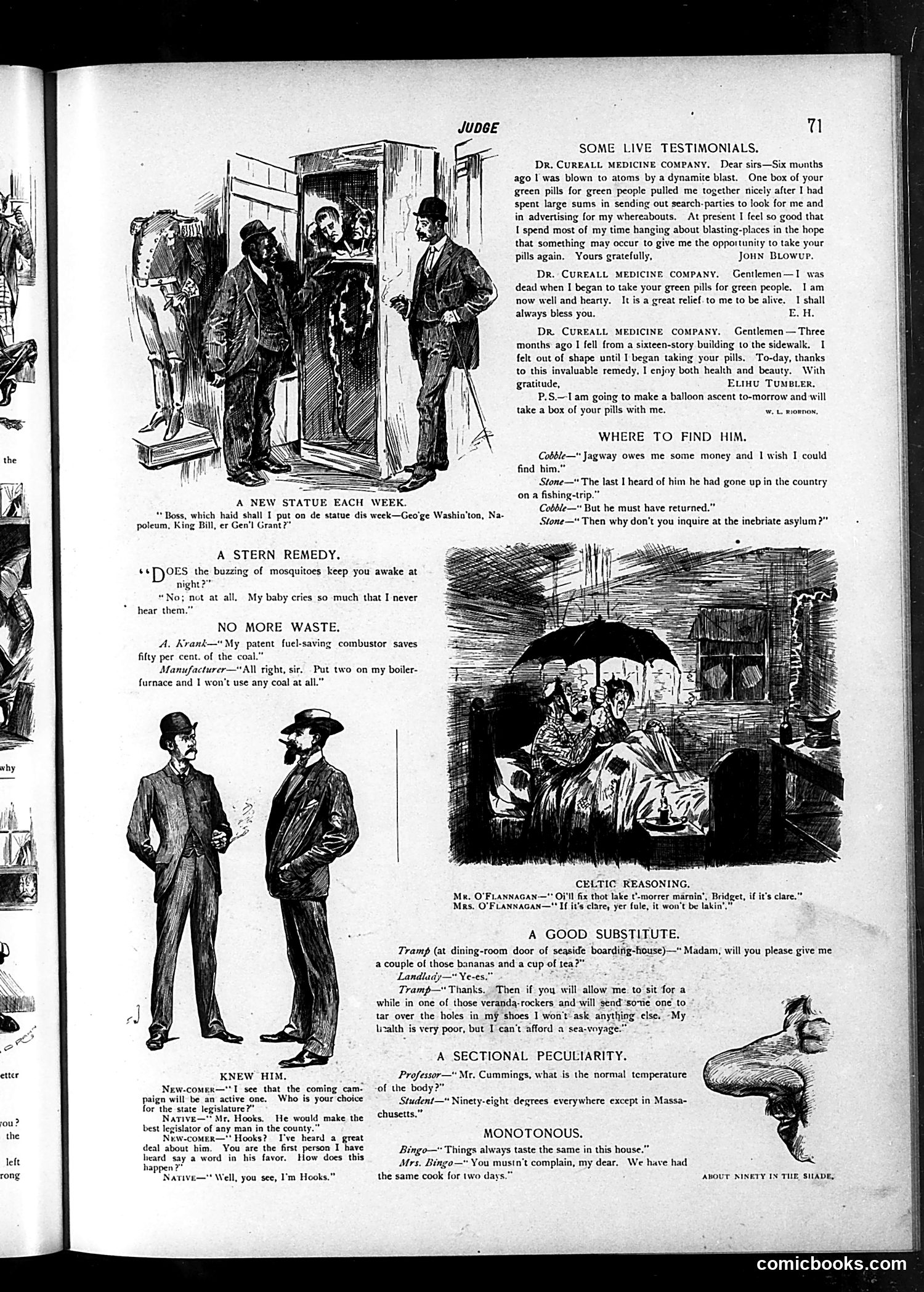
This page contains multiple satirical vignettes mocking patent medicine quackery and various social absurdities. **Main satire:** The "Dr. Cureall Medicine Company" testimonials parody fraudulent patent medicine ads common in the era. The testimonials are intentionally absurd—claiming pills cured someone "blown to atoms" by dynamite or who fell sixteen stories—to expose how ridiculous these fake cure-all advertisements were. Patent medicines were widespread scams making miracle claims without scientific basis. **Other jokes:** Brief satirical exchanges mock Irish dialect humor ("Celtic Reasoning"), a tramp seeking free lodging, political corruption (a legislator admitting he's only voting for himself), and regional stereotypes (implying Massachusetts is exceptionally hot). The page satirizes turn-of-century American gullibility regarding fraudulent health products and contains period-typical ethnic stereotyping in dialect humor.
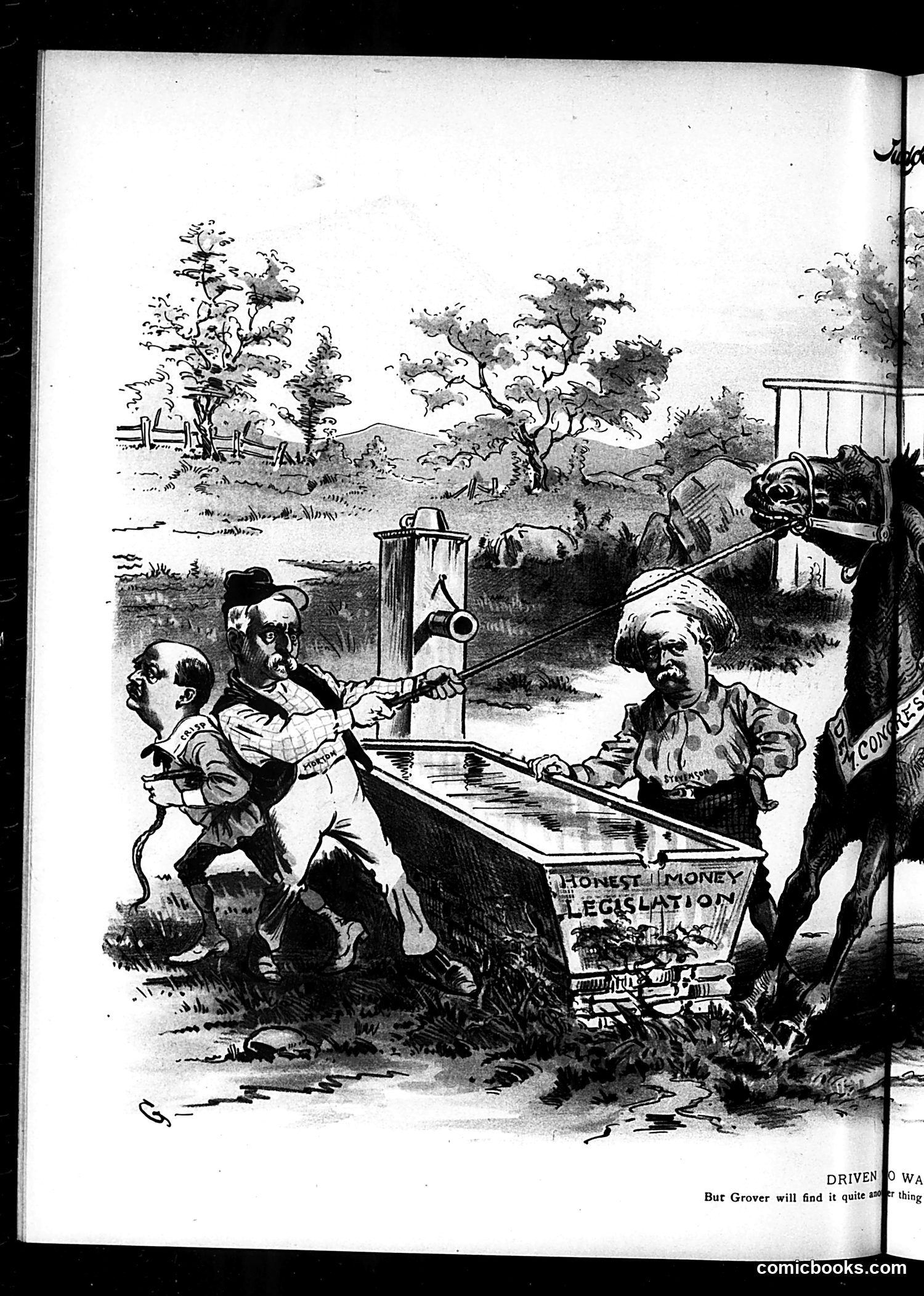
This is a satirical cartoon depicting what appears to be a water-pumping or laundering operation labeled "HONEST MONEY LEGISLATION." The caricatured figures (appearing to be politicians) are operating a pump mechanism over a trough, suggesting they are artificially "cleaning" or manipulating monetary policy through legislation. The reference to "Grover" likely indicates Grover Cleveland, a prominent late 19th-century president. The cartoon satirizes efforts to pass financial legislation, implying such laws are merely theatrical gestures that don't genuinely solve underlying economic problems—the politicians are essentially "pumping" without real effect. The rural setting and crude machinery emphasize the futility of the effort. The incomplete caption suggests more commentary follows.
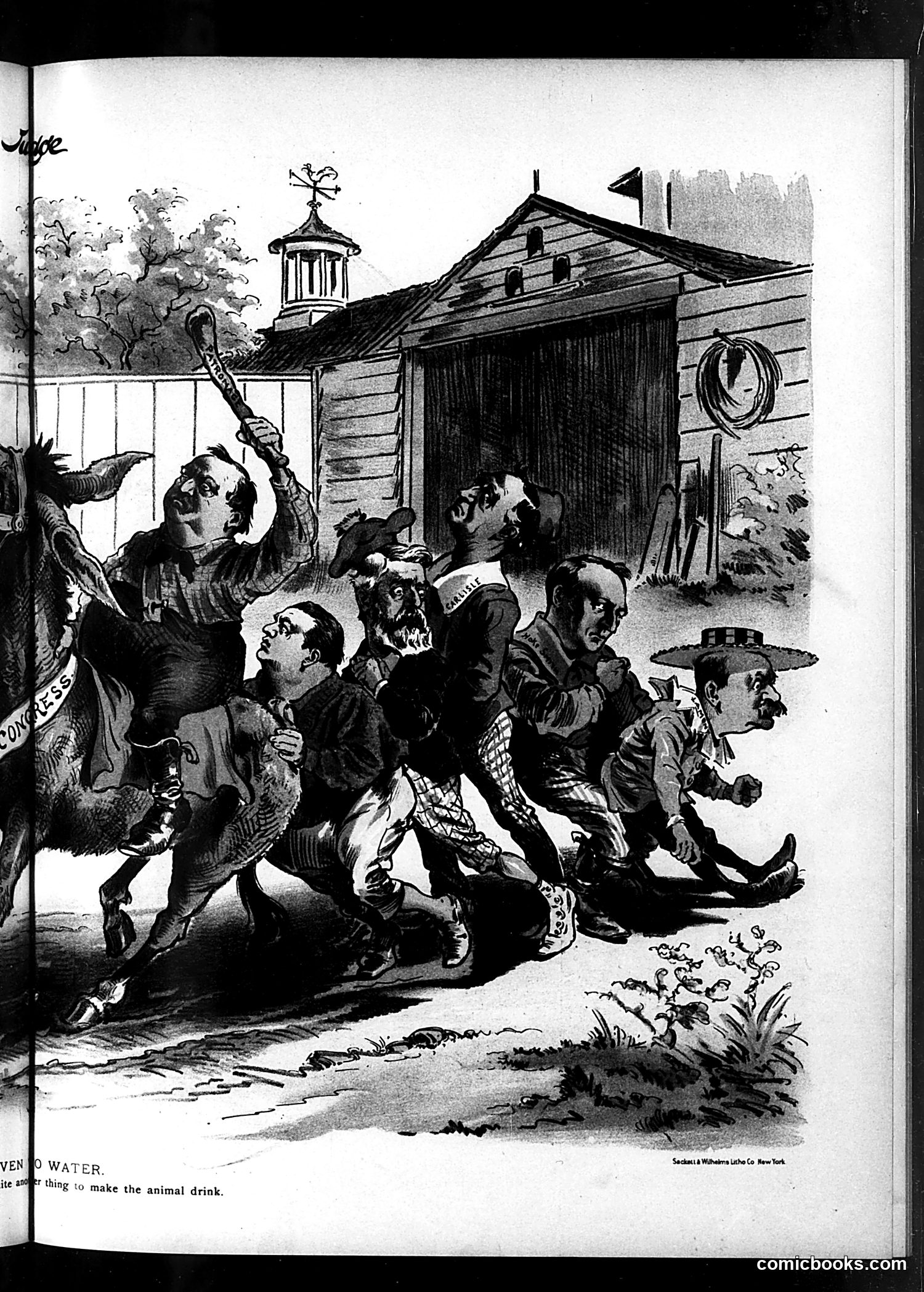
This Judge magazine cartoon satirizes a group of men attempting to give water to an animal (likely a donkey or mule) at what appears to be a farm or stable. The figures are caricatured in exaggerated style typical of 19th-century satirical art. The visible text fragment "EVEN SO WATER" and reference to "make the animal drink" suggests this is likely a political allegory about persuasion or coercion—possibly commenting on forcing an unwilling party to accept something against their nature (the adage "you can lead a horse to water but can't make it drink"). Without clearer text or identifying marks visible, the specific political figures and event referenced remain unclear, though the crude caricatures and chaotic scene suggest ridicule of contemporary political or social figures engaged in a futile or absurd endeavor.
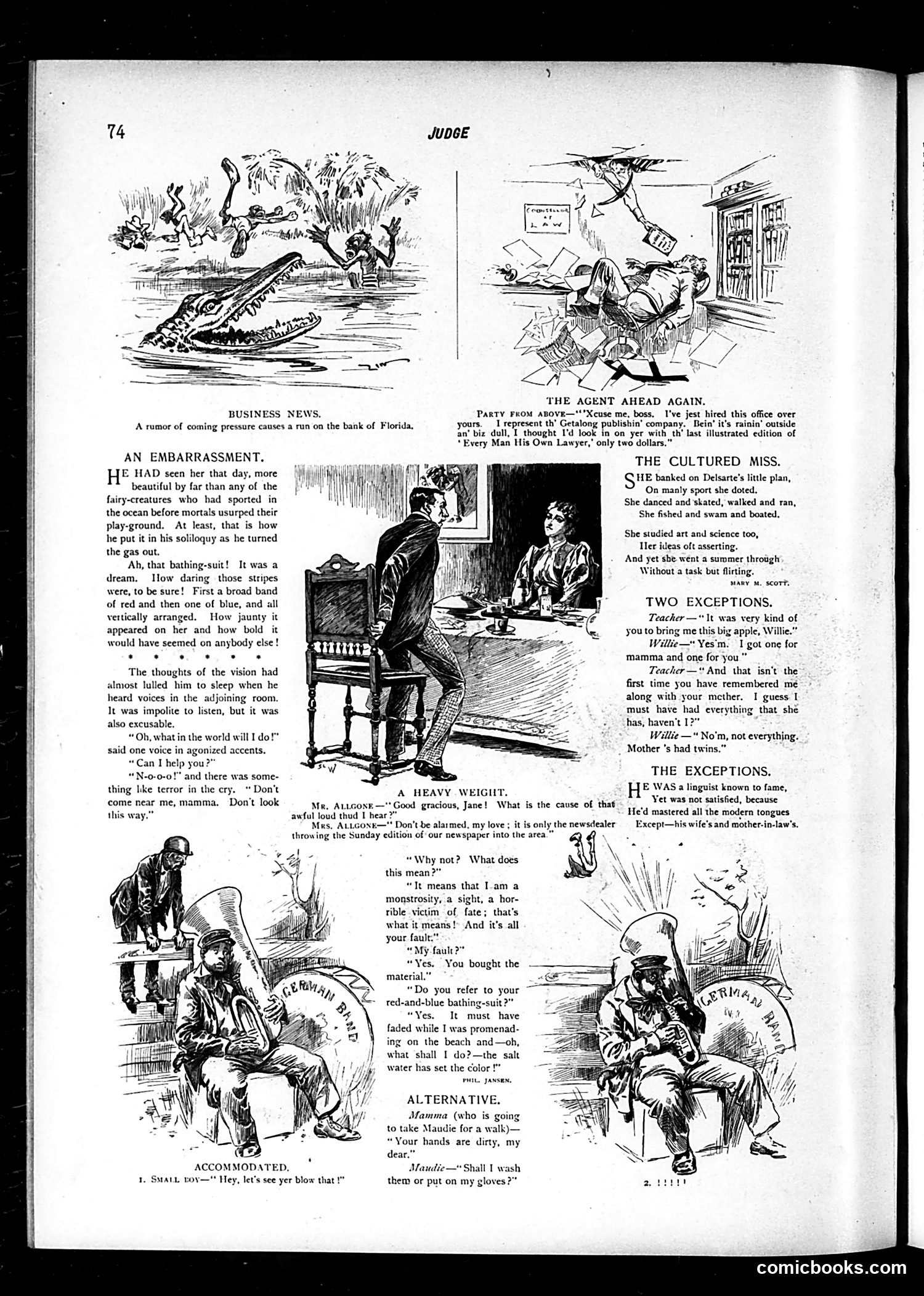
This page collects several satirical pieces and humorous sketches typical of late 19th-century American humor: **"The Agent Ahead Again"** mocks aggressive salesmen and door-to-door peddlers, showing a publisher's agent intruding on a businessman during rain, pitching a cheap self-help book—satirizing the era's proliferation of dubious mail-order publications. **"An Embarrassment"** depicts a young man infatuated with a woman's striped bathing suit, then horrified when she reveals the dyes have run in saltwater. It's gentle mockery of romantic idealization and vanity. **"A Heavy Weight"** shows a man disturbed by his newspaper being thrown into the basement, with his wife reassuring him it's just the newsdealer—likely joking about the physical heaviness and inconvenience of Sunday papers. The remaining sketches—**"Two Exceptions,"** **"The Cultured Miss,"** and **"The Exceptions"**—are brief humorous dialogues about everyday absurdities: a child's honesty about apples, a modern woman's scholarly interests undermined by flirtation, and a polyglot defeated by his wife and mother-in-law. All represent period humor about domestic life, gender relations, and consumer culture.
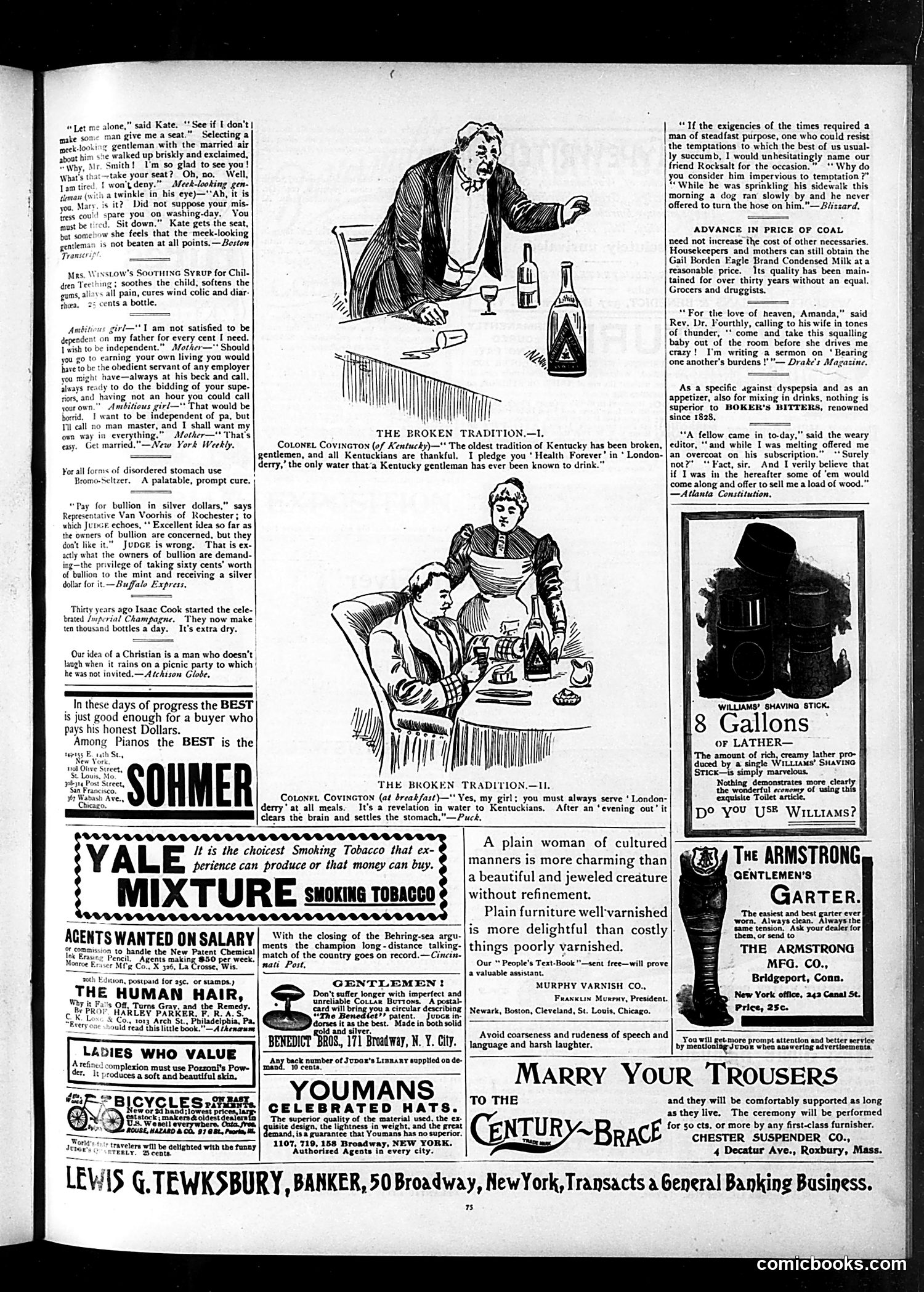
This two-panel satire mocks **Colonel Covington of Kentucky** and a supposed cultural tradition. **Panel I:** Covington announces that Kentucky's "oldest tradition" has been broken—that Kentucky gentlemen historically drank only "Londonderry" water. He toasts to this with apparent solemnity. **Panel II:** The joke lands: at breakfast the next morning, Covington himself drinks what appears to be alcohol (likely whiskey), directly contradicting his previous night's pronouncement about water being a gentleman's only proper drink. The satire targets **Southern gentlemen's hypocrisy**—specifically the contradiction between publicly proclaimed virtues (temperance, refined tradition) and private behavior (drinking). The humor relies on the immediate undercut: Covington's grand speech about tradition lasts only until morning. This reflects broader Gilded Age mockery of social pretense and the "broken" traditions of the post-Civil War South.
This is primarily an **advertising page** with brief satirical items interspersed. The satirical content consists of **short one-liners** rather than developed cartoons: - A joke about Mrs. Peary accompanying her husband to the North Pole "to look after" him (implying wives must supervise husbands) - A gag about South Carolina Governor Tillman's "saloon business" assistants calling themselves a "state bar association" (wordplay mocking Tillman's connection to alcohol regulation/sales) - A reference to "Sullivan day" at the World's Fair being "impracticable" because Sullivan has "had his day" (likely John L. Sullivan, the boxer, suggesting his celebrity has faded) - A romantic vignette about young lovers' encounter, presumably meant to be mildly humorous The page is dominated by **product advertisements** for typewriters, rupture treatment, tobacco cessation, champagne, railroads, hotels, and cigars—typical Judge magazine content. The satirical items function as filler humor between ads rather than as prominent editorial cartoons. The tone is light, topical, and relies on readers' familiarity with current public figures and events.
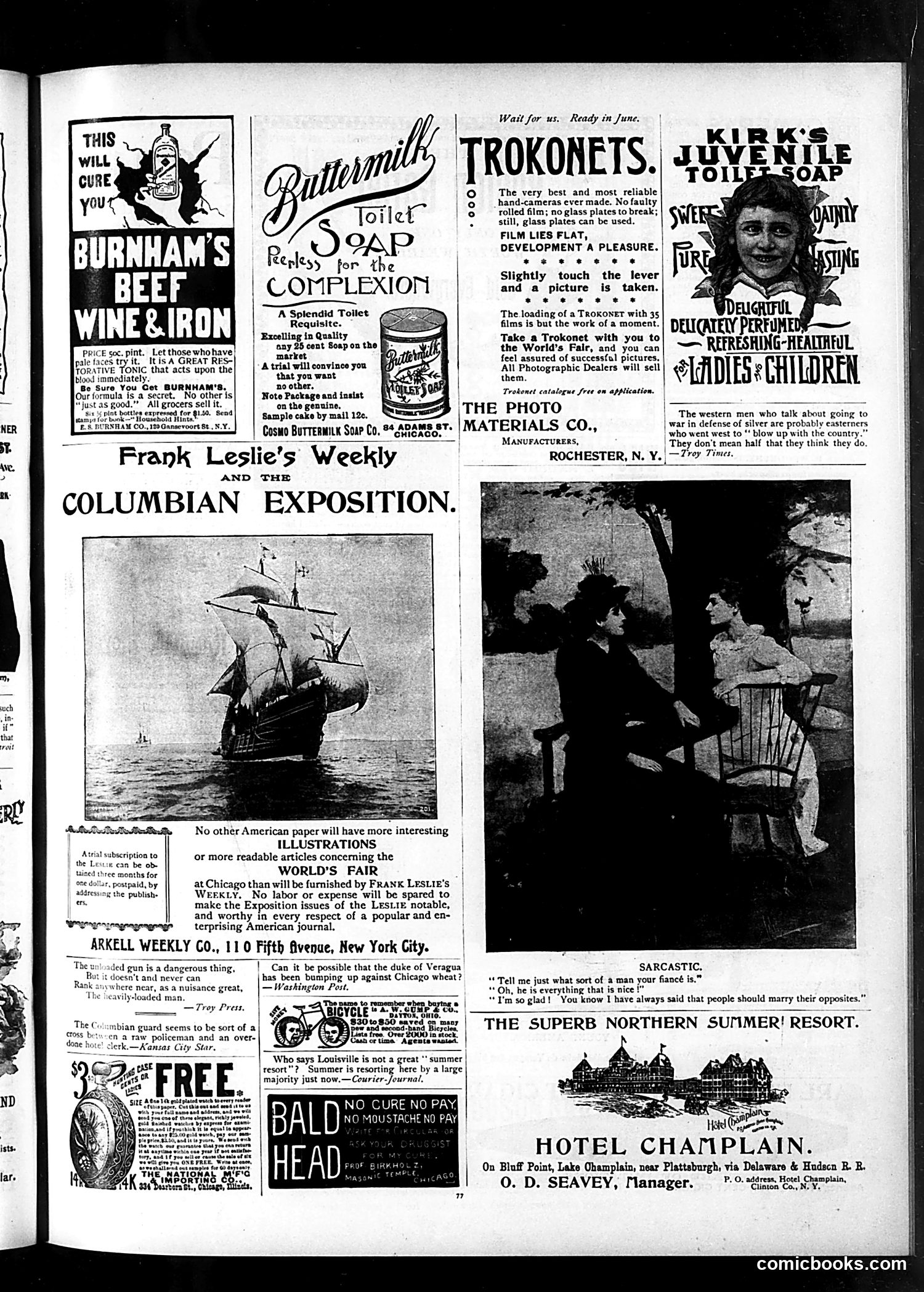
This page is primarily **advertising and promotional content** rather than political satire. It contains: **Main advertisements:** - Burnham's Beef Wine & Iron (patent medicine) - Buttermilk Toilet Soap - Trokonets cameras - Kirk's Juvenile Toilet Soap - Various other products and resorts **Small satirical snippets** (typical of Judge's format): - A brief joke about the "duke of Veragua" bumping into Chicago wheat—likely mocking a visiting Spanish nobleman's unfamiliarity with American geography - A snippet about loaded guns being dangerous - A "sarcastic" dialogue about marrying opposites **Notable feature:** Frank Leslie's Weekly prominently advertises coverage of the **1893 Columbian Exposition** (Chicago World's Fair), with an illustration of a sailing ship. The page reflects 1890s consumer culture, with heavy reliance on patent medicines and photographic equipment as status symbols. The satirical content is minimal and light—typical filler humor between advertisements rather than substantive political commentary.
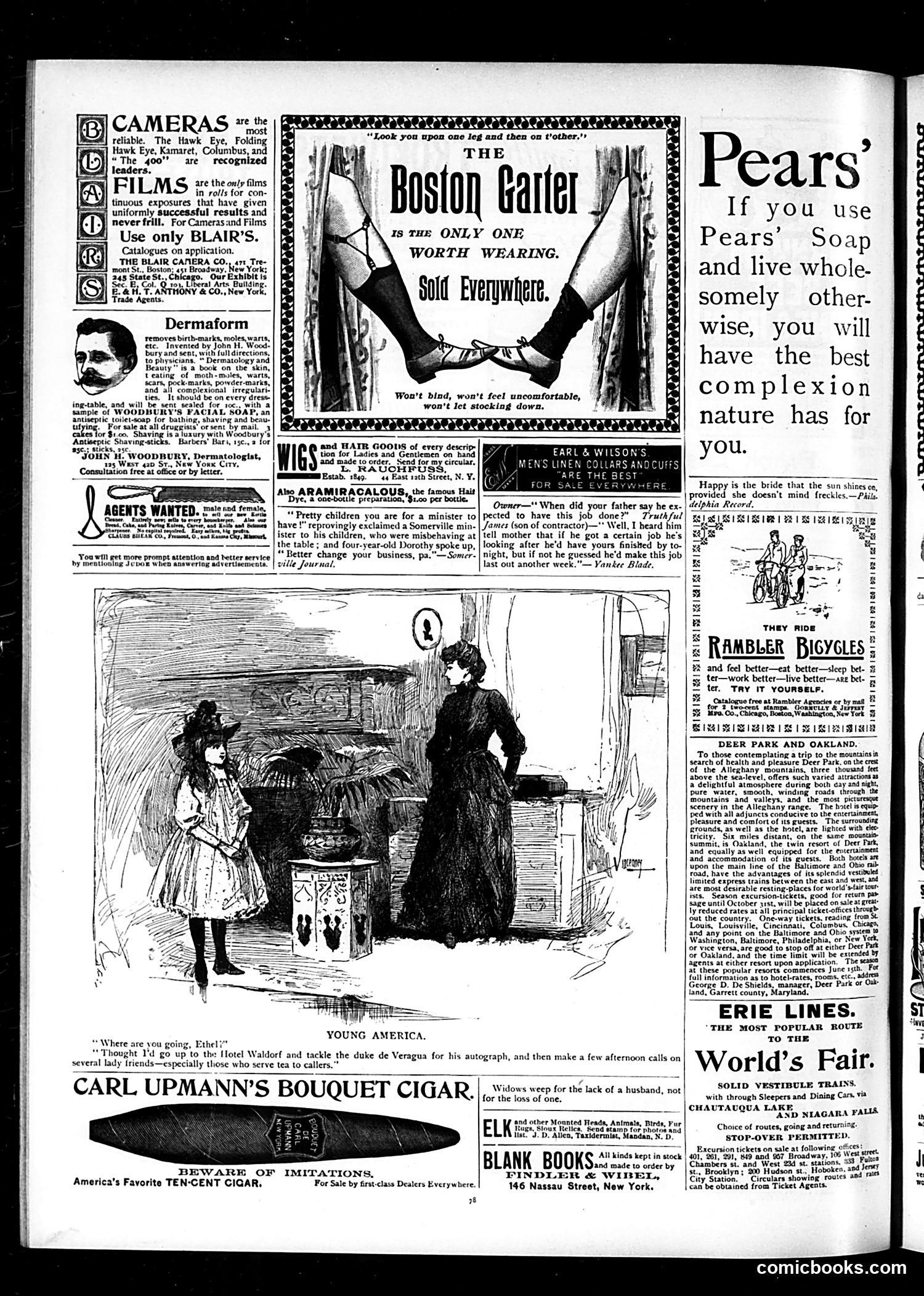
This is primarily an **advertising page** from an American satirical magazine, with minimal political content. The main cartoon, titled "Young America," depicts a domestic scene where a mother scolds her misbehaving children at table, with the caption suggesting the children are poorly behaved and the father should "change his business." The page is dominated by **product advertisements** typical of the era: Pears' Soap, Boston Garter (men's hosiery), cameras, cigars, Rambler bicycles, and patent medicines like "Dermaform" (a skin treatment). These ads reflect late 19th-century consumer culture. The small anecdotal jokes scattered throughout (about ministers, contractors, and children) are gentle domestic humor rather than political satire. One notes children misbehaving as "pretty children for a minister to have" — mild social commentary on decorum. This page represents **Judge's business model**: mixing light satirical content with lucrative advertising revenue, rather than hard political commentary.
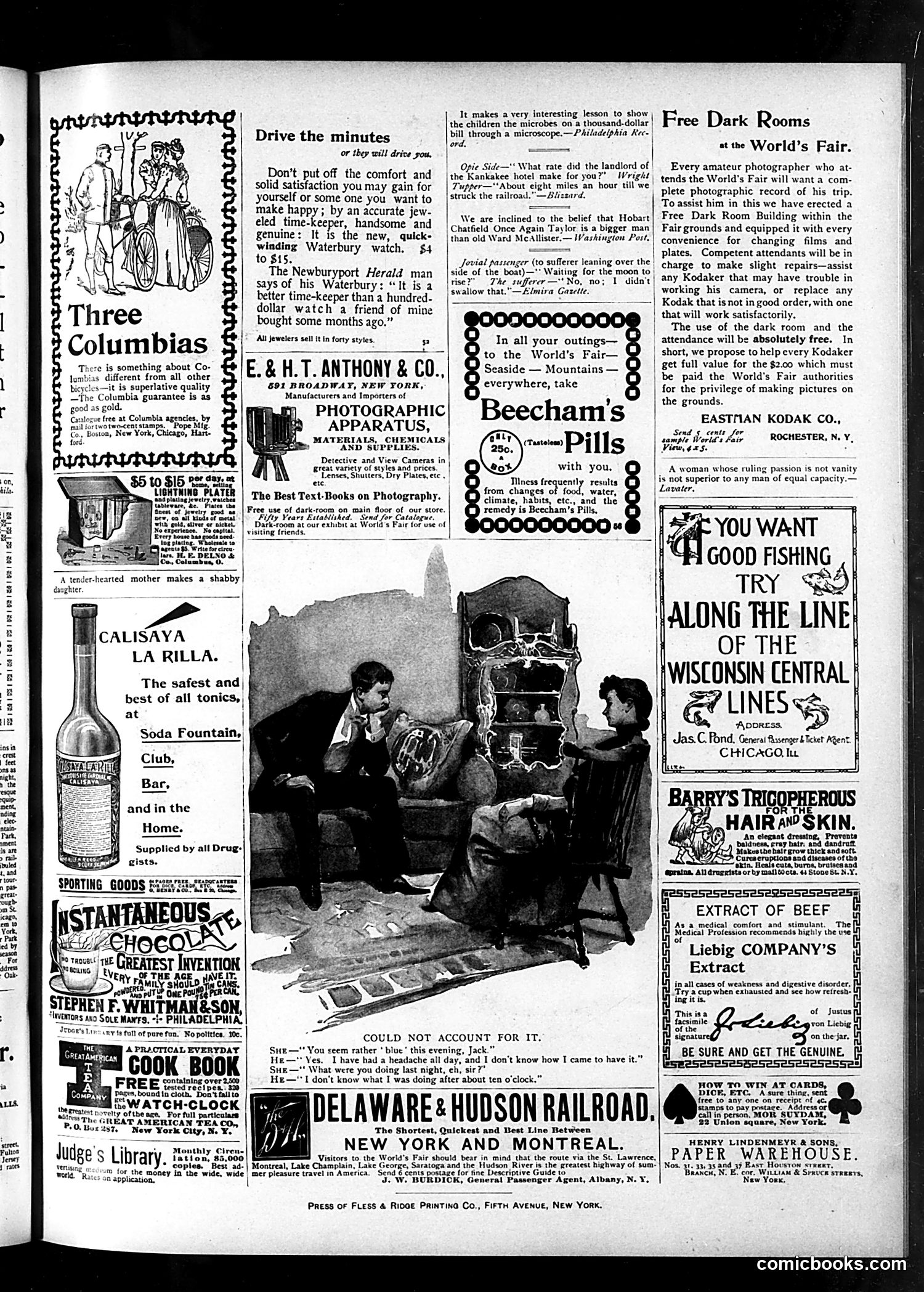
This page is primarily **advertising** for various products and services, with minimal political satire. The main cartoon—titled "Could Not Account for It"—is a domestic joke about a husband who came home late and got drunk, now claiming memory loss about his evening. His wife's pointed questions suggest infidelity or misbehavior, playing on contemporary anxieties about male conduct. The advertisements reflect 1890s consumer culture: photographic equipment (prominent given the World's Fair context), patent medicines (Beecham's Pills, Liebig's Extract), tonics, and transportation services. The "Free Dark Rooms" notice indicates this is from around the 1893 World's Columbian Exposition era. Most content appears **non-satirical**—straightforward ads and a mild domestic humor piece rather than political commentary. The page lacks the sharp social critique typical of Judge's satirical work.
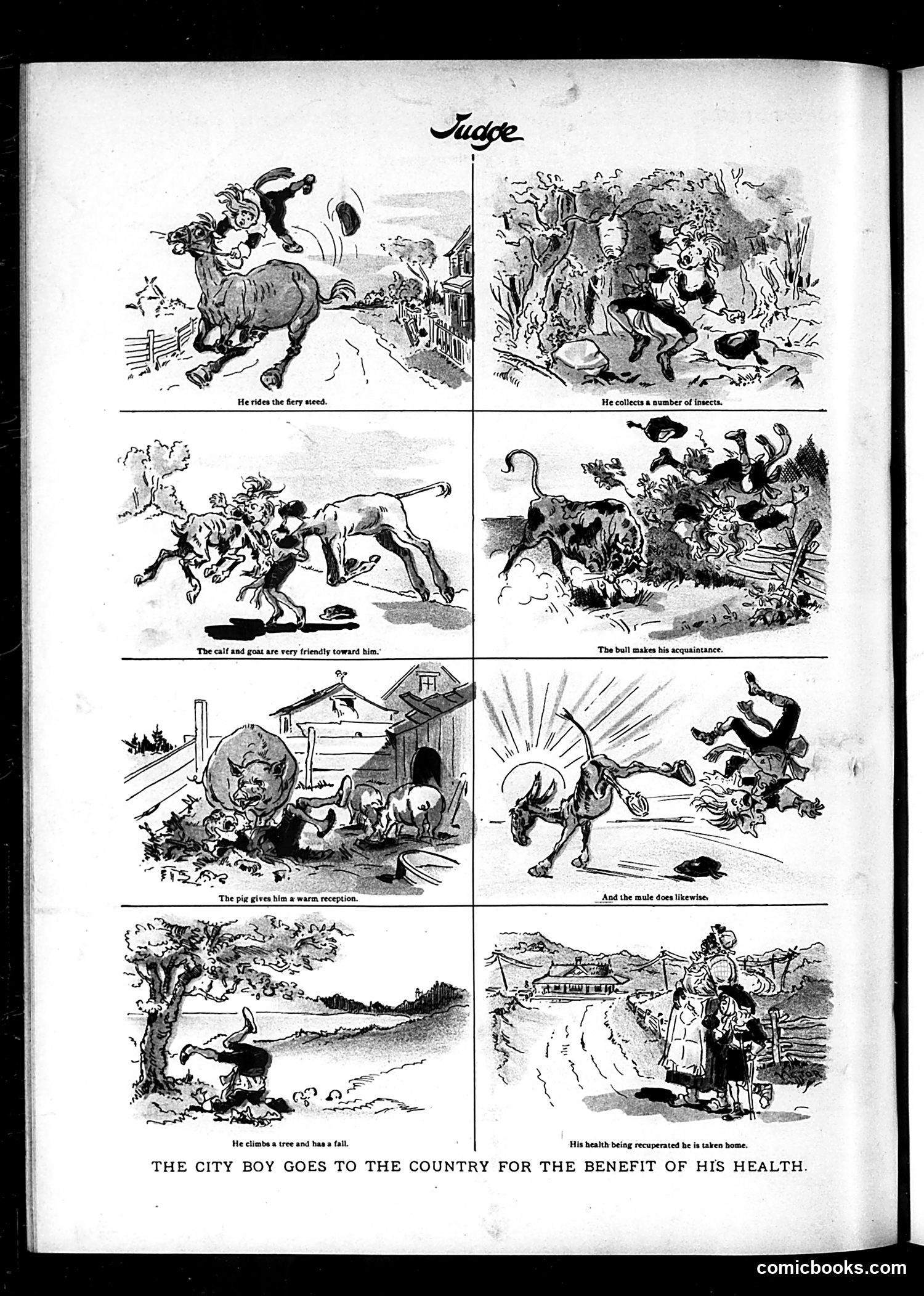
This is a humorous eight-panel comic strip depicting a city boy's misadventures during a rural visit meant to improve his health. The narrative shows him: - Riding a spirited horse that bucks him off - Collecting insects - Befriending farm animals (calf and goat) - Being chased by a bull - Receiving a warm farm reception (pig giving him greeting) - The mule kicking him - Falling from a tree - Being taken home, supposedly "recuperated" The satire mocks the 19th-century belief that country air and rural experience would cure sickly urbanites. Instead, the boy encounters only physical mishaps and danger, suggesting country life is hazardous for unprepared city dwellers. The irony is that despite all these injuries, he's supposedly healthier for the experience.