
A complete issue · 16 pages · 1893
Judge — July 29, 1893
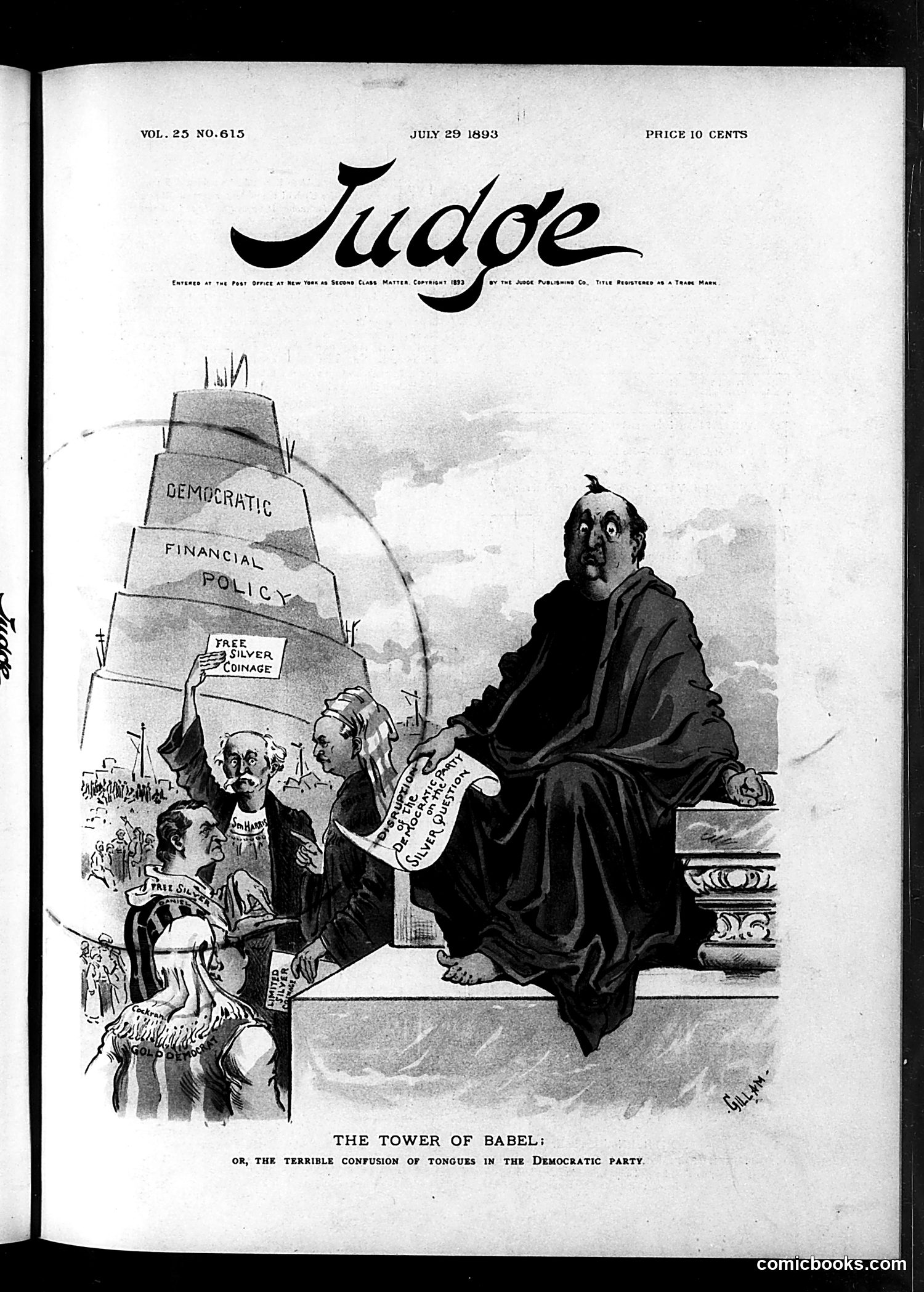
This 1893 political cartoon satirizes internal discord within the Democratic Party. The "Tower of Babel" biblical reference depicts competing factions unable to communicate—a visual metaphor for party disunity. The tower's levels show the central conflicts: "Silver Coinage," "Democratic Financial Policy," and other issues. Multiple political figures (likely party leaders) appear bewildered and arguing, unable to agree on direction. The cartoon criticizes the party's failure to present unified positions, especially regarding monetary policy—a major divisive issue of the 1890s (the Free Silver debate). Judge, a Republican-leaning magazine, uses this image to mock Democratic incompetence and suggest their inability to govern effectively due to internal contradictions and competing visions.
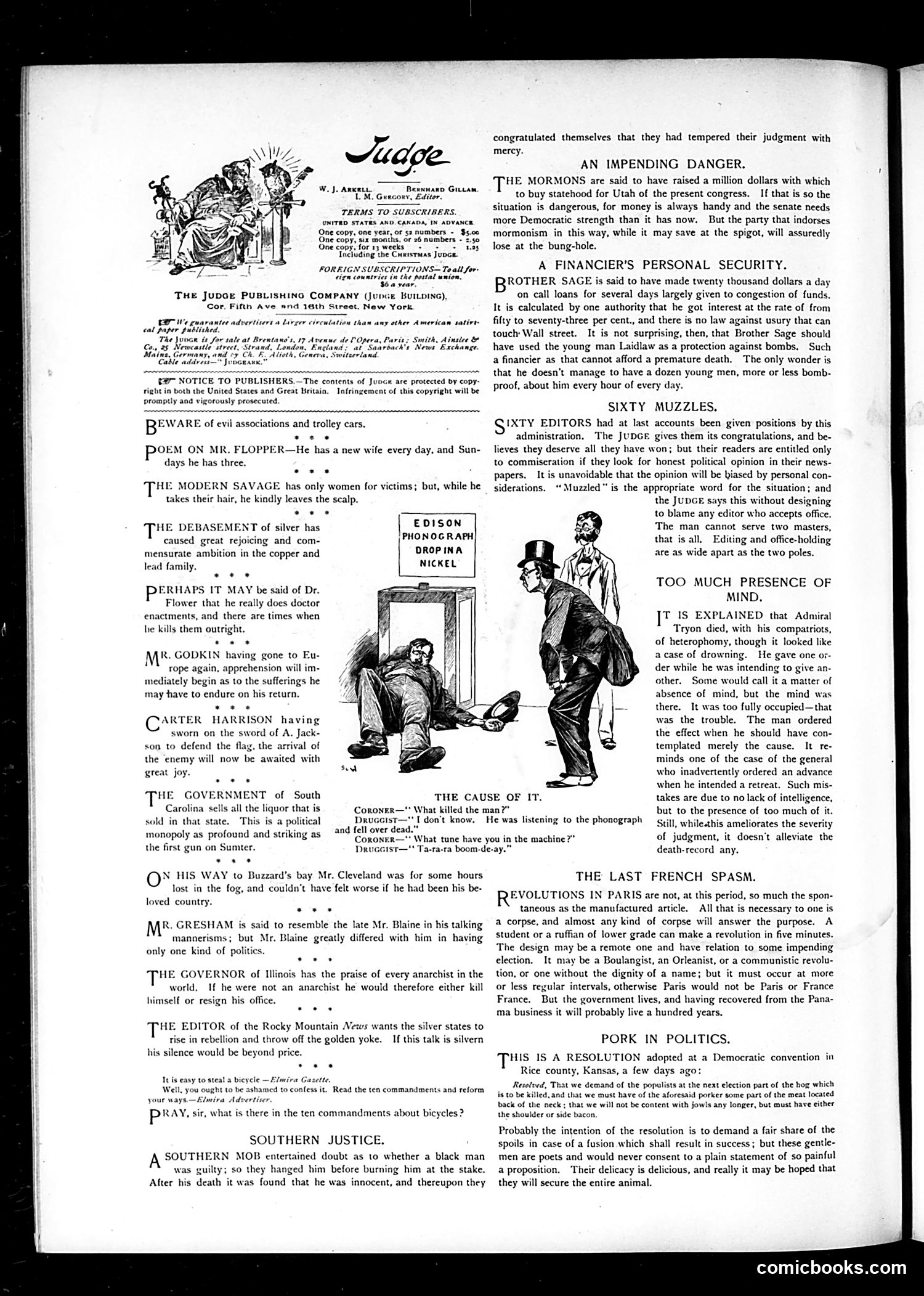
This cartoon depicts a comedic misunderstanding at an Edison phonograph shop. A well-dressed man operates the device while two onlookers watch—one appearing to fall or collapse dramatically. The humor hinges on the caption dialogue: the shopkeeper asks what caused the man's distress, and the customer replies he was "intending to give an order" but the phonograph's playback startled him into a near-drowning state. The satire mocks the then-novel phonograph technology's jarring, unnatural quality. Rather than praising Edison's invention as miraculous, *Judge* ridicules its crude sound reproduction as genuinely frightening—so realistic yet so poorly rendered that it nearly kills a customer. This reflects contemporary skepticism about emerging technologies.
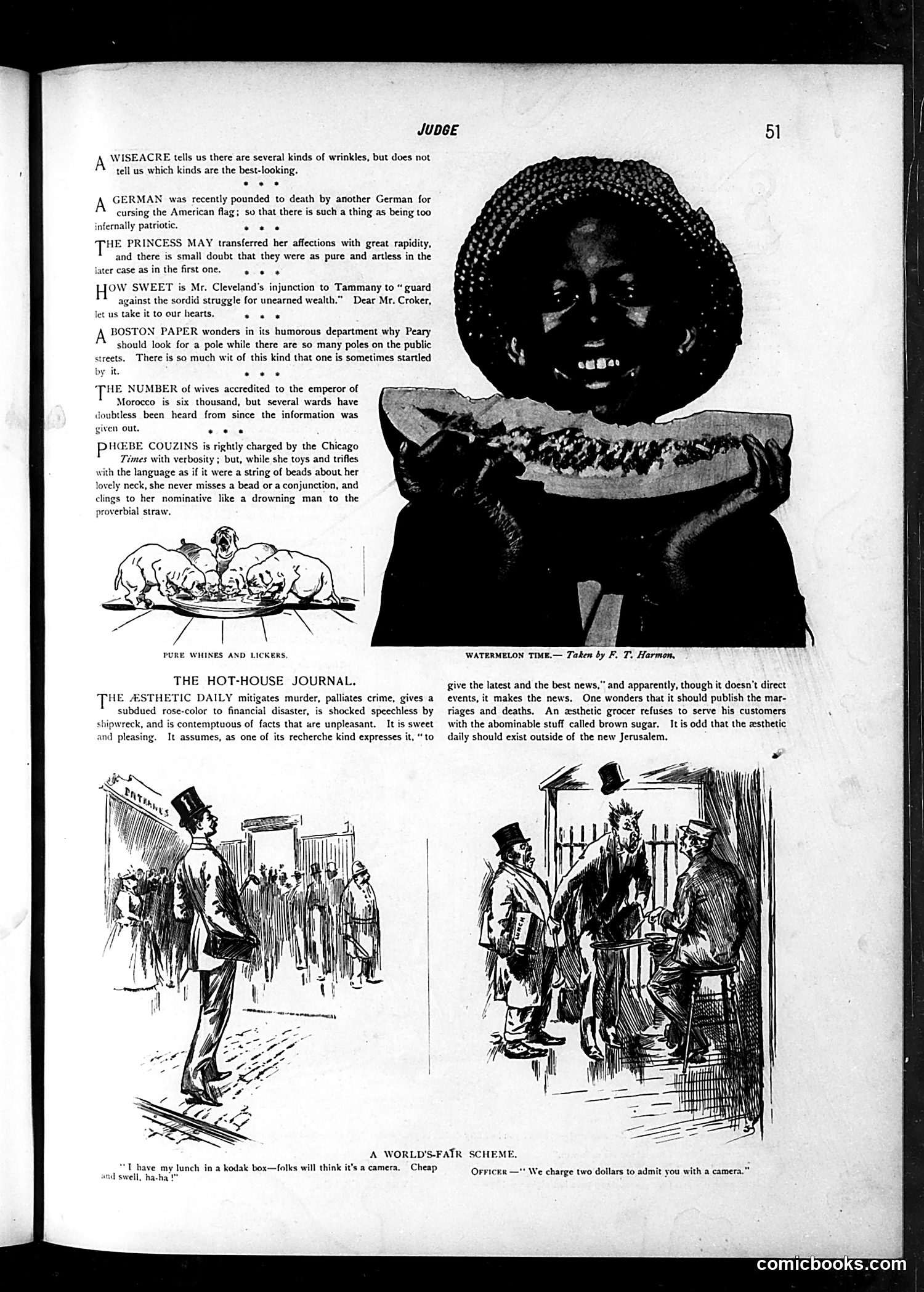
The page contains satirical commentary typical of Judge's style, including brief witty observations on contemporary topics. The "Watermelon Time" photograph shows a caricatured Black figure with exaggerated features—reflecting the deeply racist visual conventions of early 20th-century American humor. Below are two cartoon sketches satirizing urban life: "A World's Fair Scheme" mocks a photographer charging admission at what appears to be a public exhibition, with a caption about charging two dollars to admit someone with a camera. The other cartoon depicts a man with a "patent" banner, likely satirizing dubious inventions or get-rich-quick schemes popular in the era. The page's humor reflects Judge's satirical target: urban pretension, dubious commerce, and racial stereotypes considered acceptable entertainment of the period.
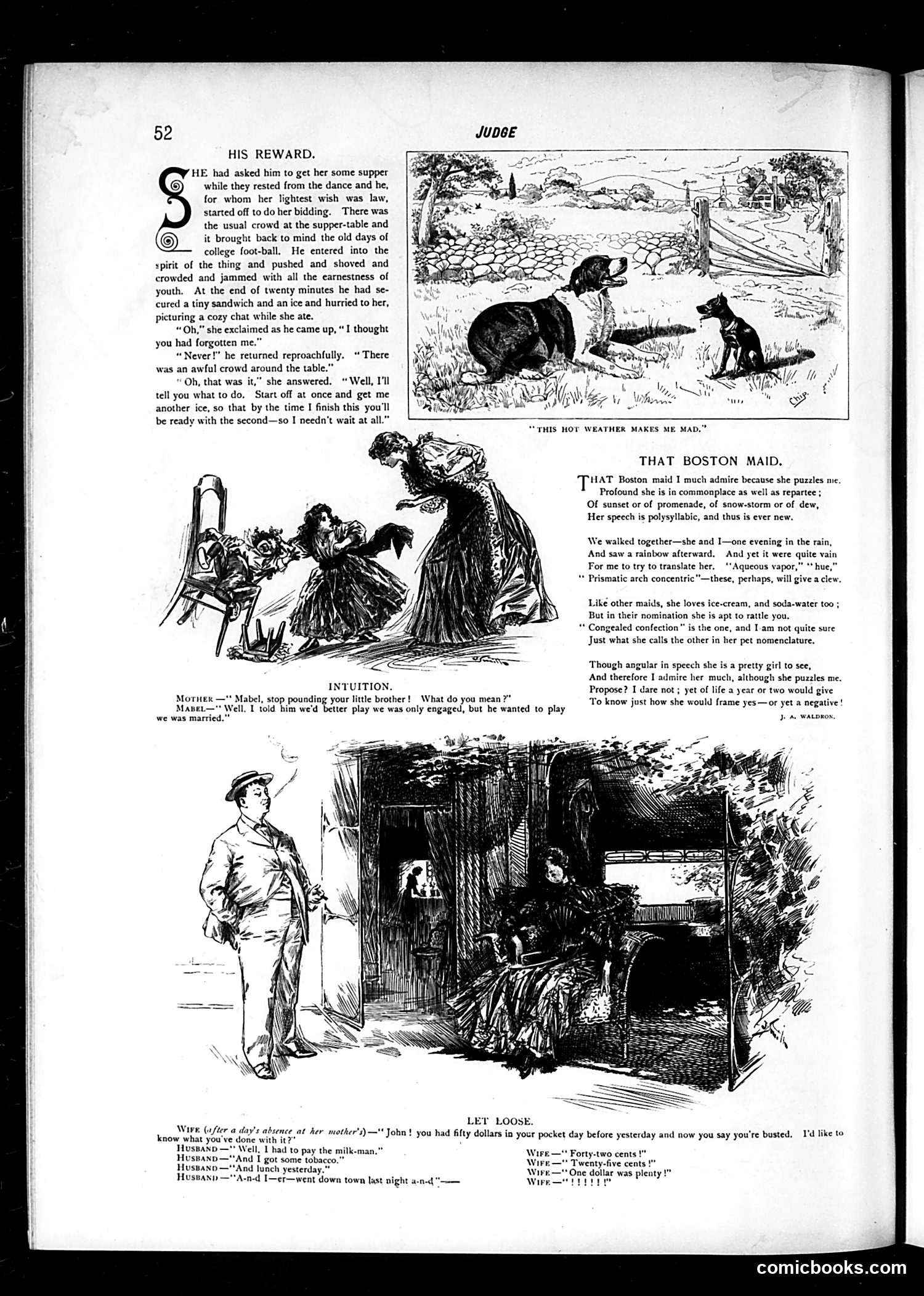
This page contains four separate humorous pieces satirizing gender relations and social behavior in early 20th-century America: **"His Reward"**: A young man exhausts himself fighting through a supper-table crowd to fetch his date a sandwich and ice. When he returns, she immediately demands he fetch *another* ice—showing female ingratitude and exploitation of male gallantry. **"That Boston Maid"**: Mocks an educated Boston woman who uses unnecessarily complex vocabulary ("congealed confection" for ice cream, "aqueous vapor" for rain) to describe ordinary things. The satire targets both pretentious intellectualism and the puzzle of courtship. **"Intuition"**: A brief joke about a child misunderstanding "engaged" (betrothal) as role-play combat. **"Let Loose"**: A husband can't account for his missing fifty dollars—small expenses add up, but his wife suspects he's lying about where the money went. The page's consistent theme: wives/women are demanding, suspicious, and often ungrateful, while husbands are hapless spenders.
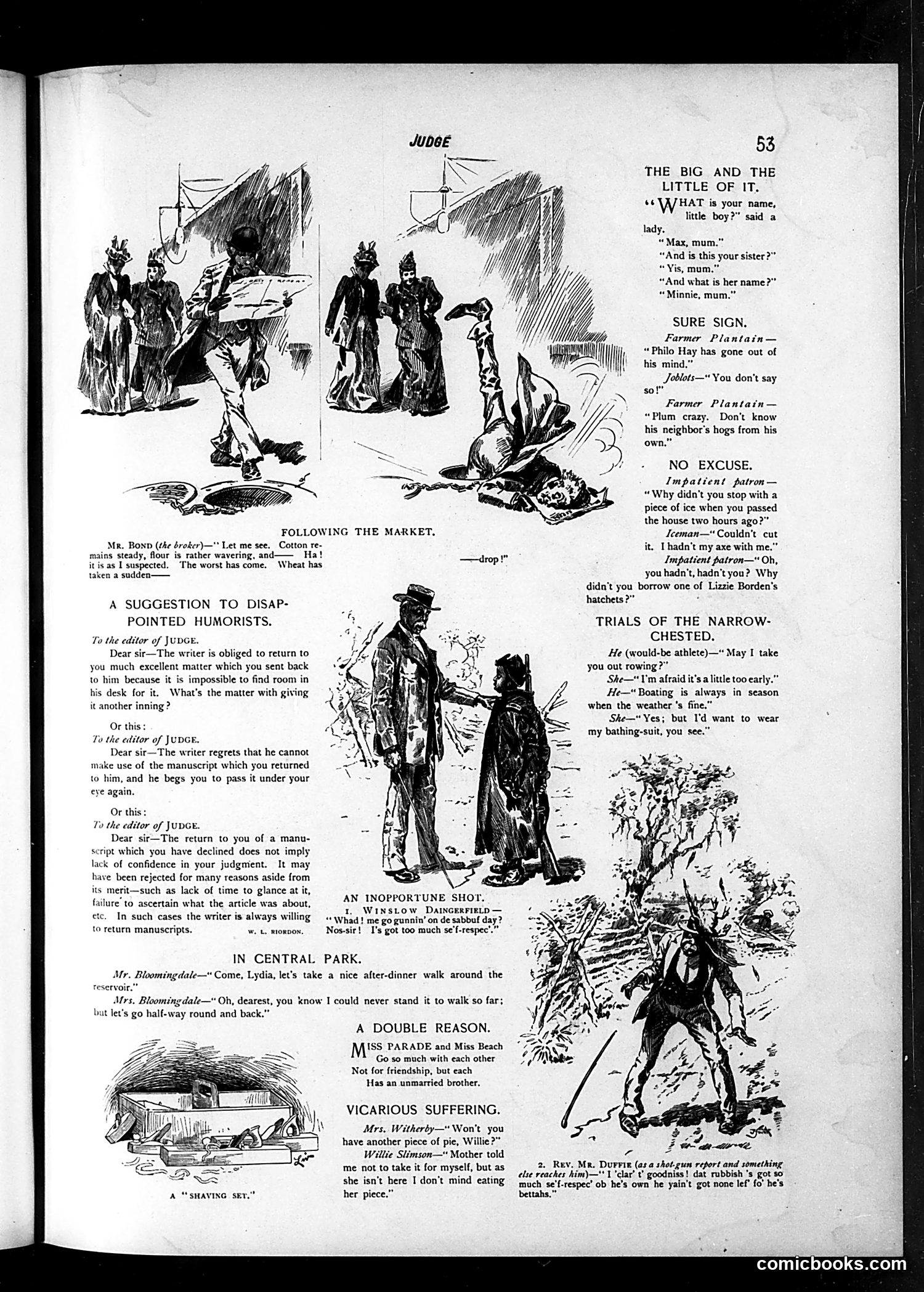
This page contains multiple short humorous sketches typical of late 19th-century American humor magazines. **Notable items:** **"Following the Market"** satirizes stock brokers obsessing over commodity prices (cotton, flour, wheat), with the joke that wheat's sudden drop represents catastrophe. **"An Inopportune Shot"** references **Lizzie Borden**, the notorious 1892 axe-murder case. A character named Winslow Daincerfield declines Sunday hunting, claiming he has "too much se'f-respec'" (self-respect)—the dialect and context suggest dark humor about avoiding violence on the Sabbath, with an implicit reference to Borden's infamous hatchet murders. **Other sketches** include mild domestic humor: a wife unwilling to walk far, two women befriending each other only to catch unmarried brothers, and a boy eating his mother's pie while she's absent. The page is primarily **satirical commentary on everyday American life**—social pretension, marital dynamics, and topical crime references—rather than political satire.
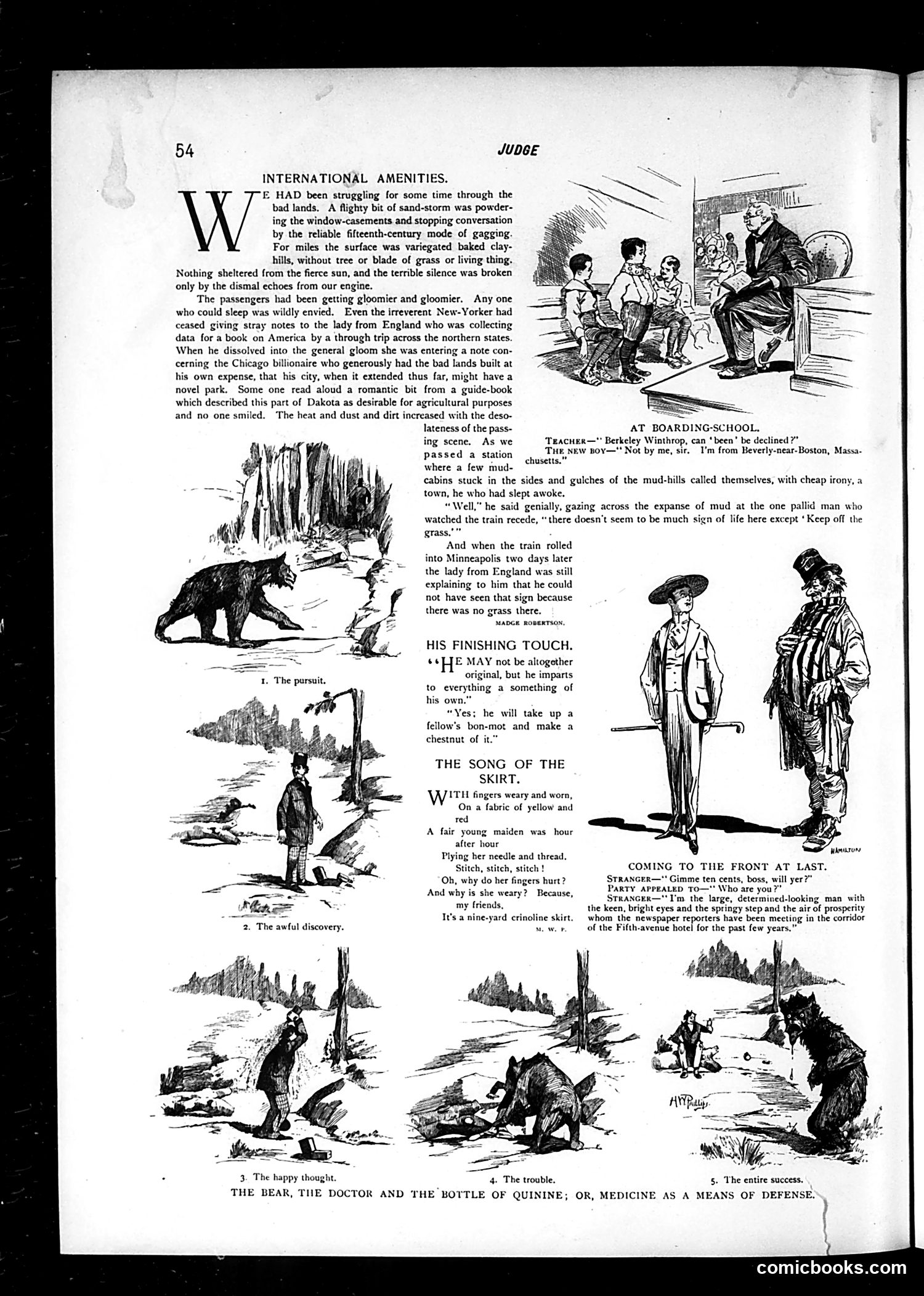
This page contains two separate satirical pieces: **"International Amenities"** mocks American provincialism. A New York traveler condescends to a British woman collecting data on America, then makes a joke about a barren Dakota landscape having "Keep off the grass" signs. When she logically points out there's no grass there, he's proven foolish by her superior observation. The satire targets American arrogance and the pretentious attitudes of wealthy travelers. **"The Song of the Skirt"** is a social commentary on women's fashion. It parodies sentimental poetry to critique the impracticality of nine-yard crinoline skirts—the wide, heavily structured garments fashionable at the time. The repeated "stitch, stitch, stitch" emphasizes the exhausting labor required to construct and wear such garments, suggesting fashion places unreasonable burdens on women. The page also includes an illustrated serial about "The Bear, the Doctor and the Bottle of Quinine," likely a humorous adventure story.
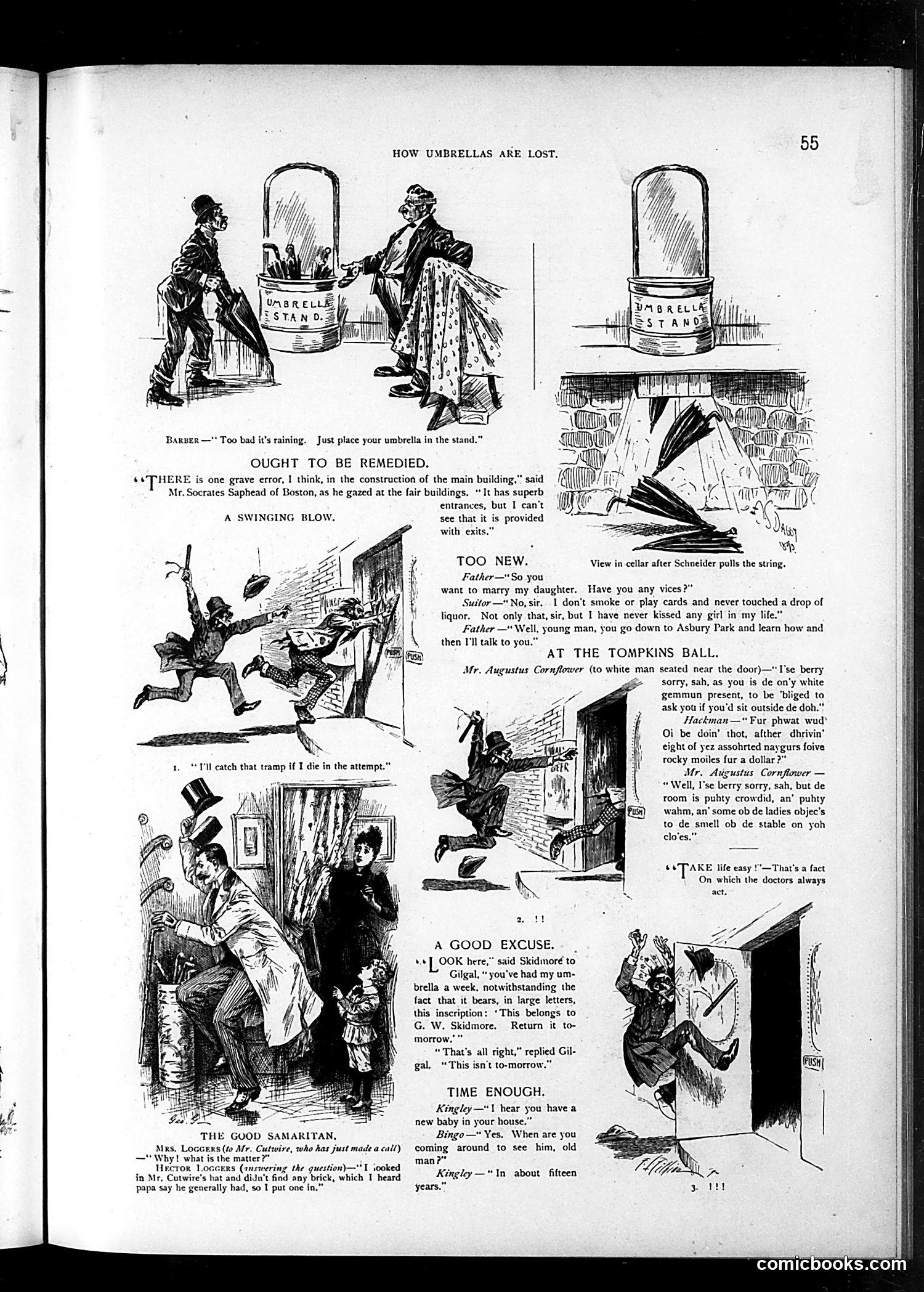
This page collects several unrelated humorous sketches typical of Judge magazine's format. The title piece shows a barber's practical solution to the problem of lost umbrellas: leaving them in a stand—which comically results in the umbrella disappearing anyway (shown in the cellar scene). Other sketches include social comedy: a father interviewing his daughter's suitor, asking about vices; a Southern Black character (Mr. Augustus Cornflower) awkwardly asking a hackman to sit outside a ball because of stable odors—a crude racial stereotype; and various short gags about umbrellas, excuses, and social situations. The humor relies on period conventions: ethnic dialect humor, class-based awkwardness, and practical domestic problems. The "Good Samaritan" sketch plays on the biblical reference ironically, showing petty behavior instead of charity. The overall tone is light, observational satire about everyday American social life circa the late 1800s.
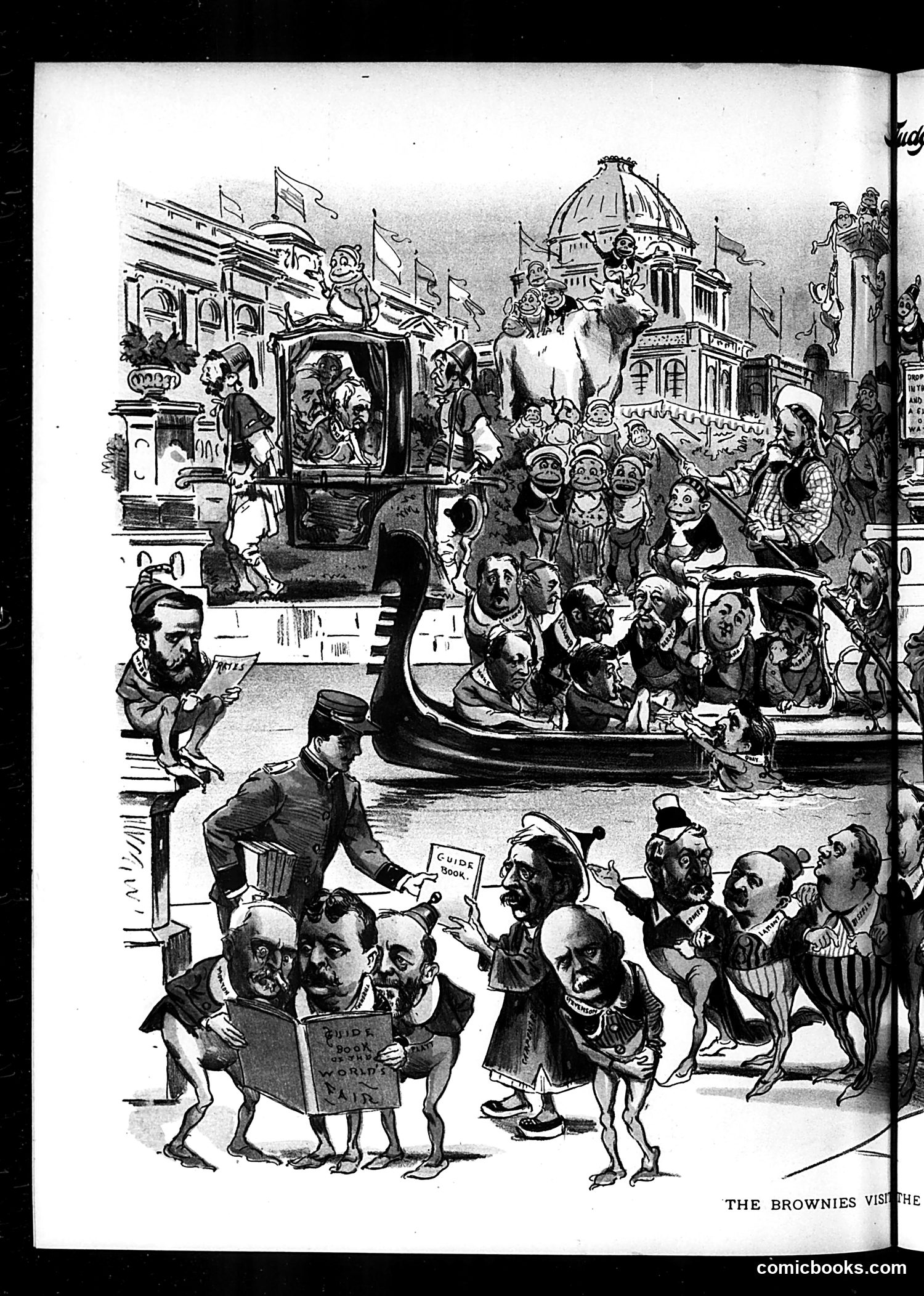
This cartoon depicts the Brownies—popular mythical creatures from children's literature of the era—touring what appears to be a major world's fair (likely the 1893 Chicago World's Columbian Exposition, given the prominent classical dome architecture). The satire targets visitors and exhibits at the fair. The Brownies' exaggerated facial features and caricatured forms contrast with the dignified classical buildings and crowds of human observers. The juxtaposition suggests mockery of either the fair's pretensions to civilization, the diverse crowds attending, or both. A figure holds a "Guide Book," emphasizing tourism's role. The point appears to be satirizing the spectacle and absurdity of the world's fair experience—whether regarding its exhibits, attendees, or the commercialization of wonder itself.
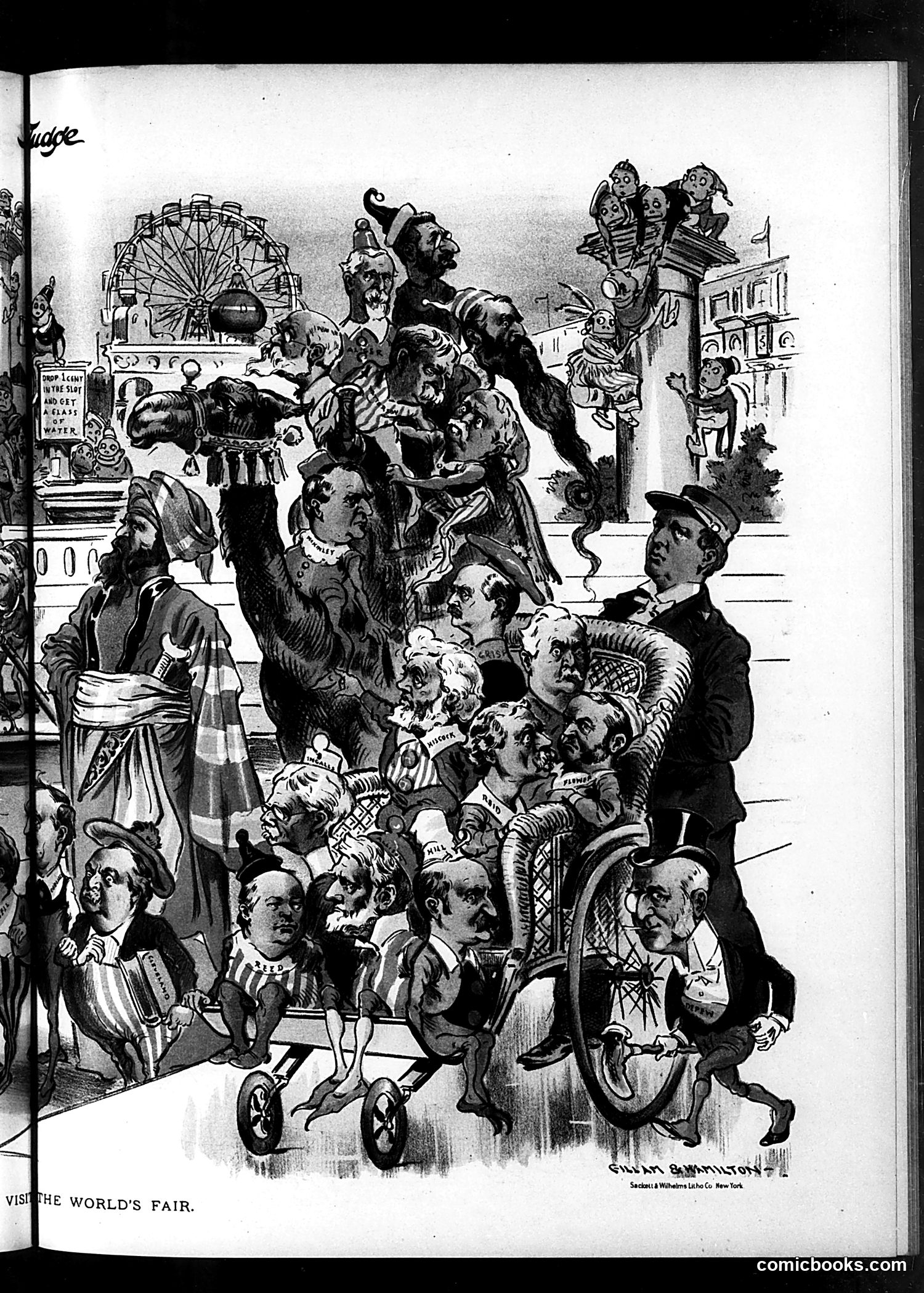
This satirical cartoon depicts a chaotic World's Fair scene—likely the 1893 Chicago Columbian Exposition based on the Ferris wheel visible in the background. The image mocks the fair as a grotesque spectacle populated by exaggerated, distorted figures: ape-like creatures, deformed caricatures, and odd characters in carriages. The satire appears to critique the fair's presentation of human diversity, particularly its "ethnological villages" that displayed non-Western peoples as exotic curiosities. The dehumanizing caricatures suggest social commentary on how the fair treated various populations as freakish attractions rather than equal humans. The chaos and disorder convey skepticism about the fair's grandiose claims to progress and civilization.
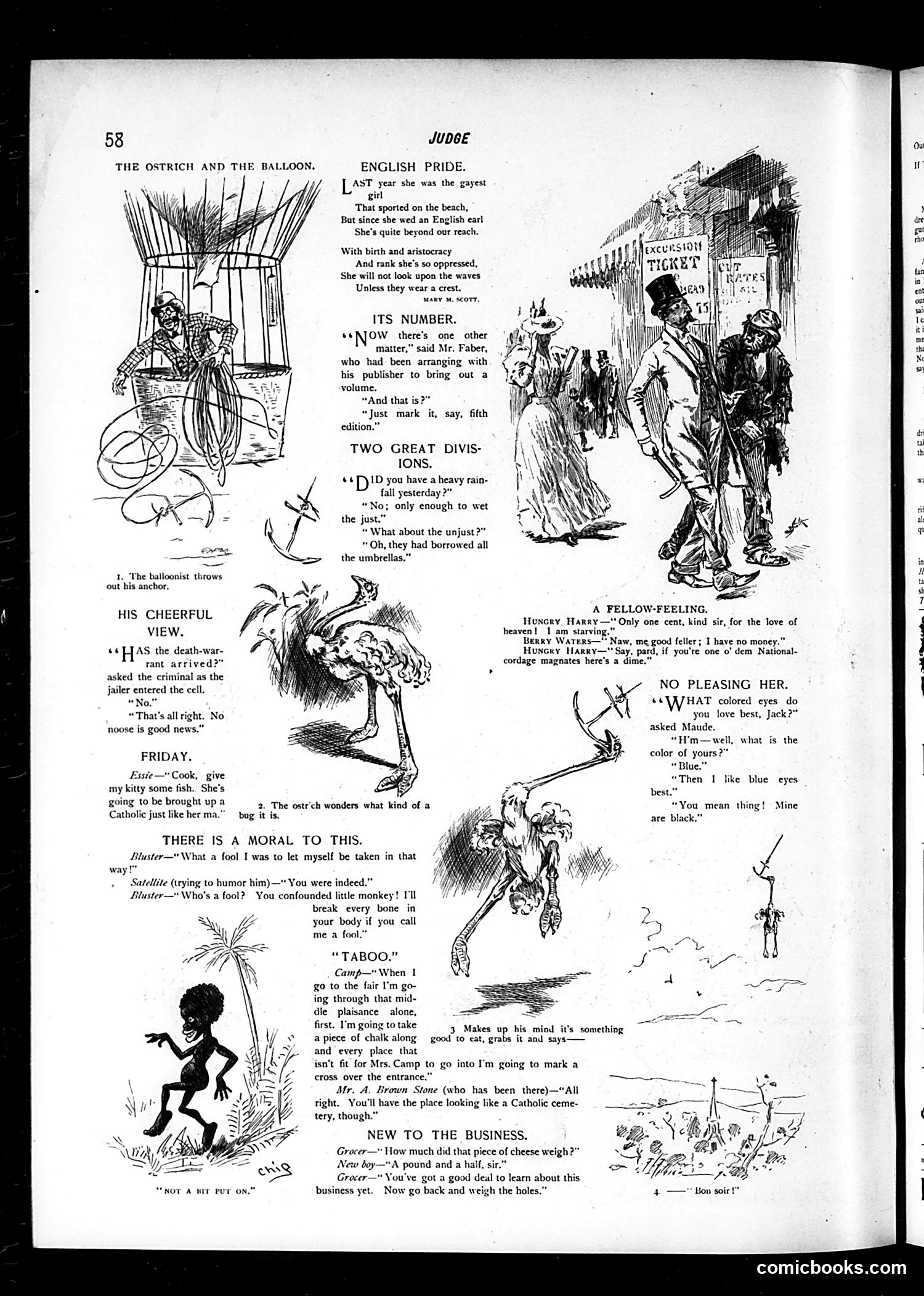
This page contains multiple short satirical pieces typical of Judge's humor: **"English Pride"** mocks a woman who, after marrying an English earl, has become snobbish and refuses to acknowledge American beach culture unless it displays aristocratic "crests." **"His Cheerful View"** jokes darkly about a death-row inmate's optimism that "no noose is good news"—a pun on the common phrase. **"Two Great Divisions"** satirizes class inequality: the wealthy borrowed all umbrellas during rain, leaving only the poor ("unjust") wet. **"A Fellow-Feeling"** depicts a beggar recognizing another poor man and offering him money when learning he works in the struggling "National-cordage" (rope) industry—suggesting both shared poverty and a failing American industry. **"No Pleasing Her"** is a simple joke about contradictory romantic preferences. The remaining pieces are brief workplace or domestic humor. The cartoons illustrate these jokes with period-appropriate sketches. Overall, the page reflects late 19th/early 20th-century American anxieties about class, immigration, and industrial decline.
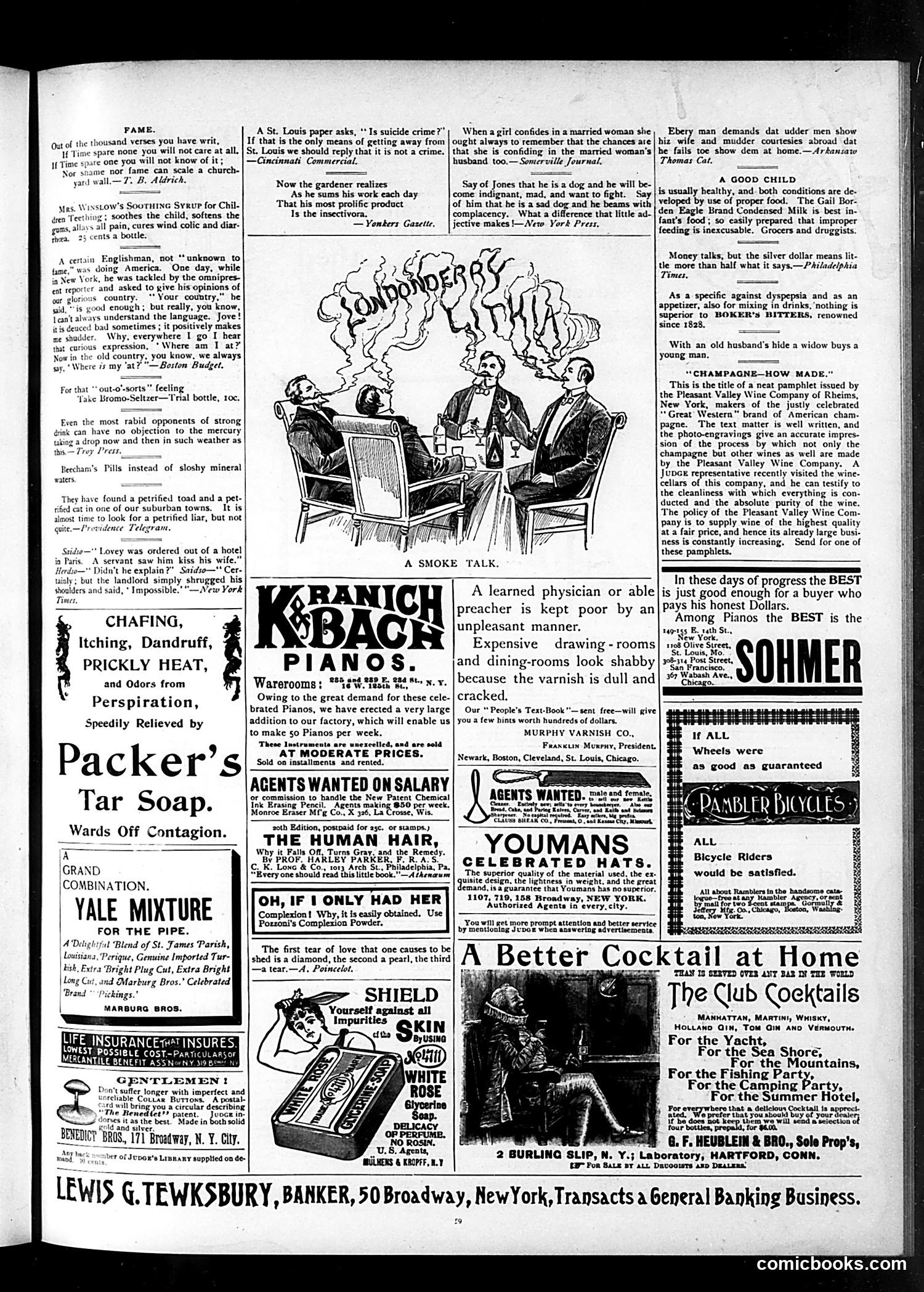
This page is primarily **advertisements with minimal editorial content**. The main cartoon titled "A Smoke Talk" depicts three well-dressed gentlemen in a relaxed social setting, apparently discussing cigars or tobacco—consistent with the ad-heavy nature of this Judge page. The scattered text items are brief humor pieces mocking regional stereotypes (an Englishman confused by American grammar) and social observations (girls gossiping to married women). One joke mocks St. Louis as so undesirable that suicide would be preferable to living there. The page overwhelmingly features ads for tobacco products (Yale Mixture pipe tobacco, Aranich & Braach Pianos, Packer's Tar Soap), patent medicines (Bromo-Seltzer, Beecham's Pills), and various consumer goods typical of early 1900s periodicals. The "Smoke Talk" cartoon serves primarily as a vehicle for advertising rather than political or social satire.
This page from *Judge* magazine contains primarily **advertisements and promotional content** rather than political cartoons or satirical editorial content. The notable satirical elements are brief **one-liner jokes** scattered throughout, such as: - "Weather, wind and a woman's mind change like the moon" — a sexist quip about women's unpredictability - A joke about John Wanamaker failing to plaster a Chicago fair with a "Columbian stamp," apparently referencing a promotional effort - A comment about a "silver-tongued orator" (identity unclear) considering changing his name The page is dominated by period advertisements for products including champagne, link cuffs, kodak cameras, bicycles, cigars, and railroads. An Eastman Kodak testimonial letter occupies the center, demonstrating the effectiveness of advertising in Judge magazine itself. The humorous content is incidental to the commercial purpose—illustrating that *Judge* operated as both satirical publication and advertising medium.
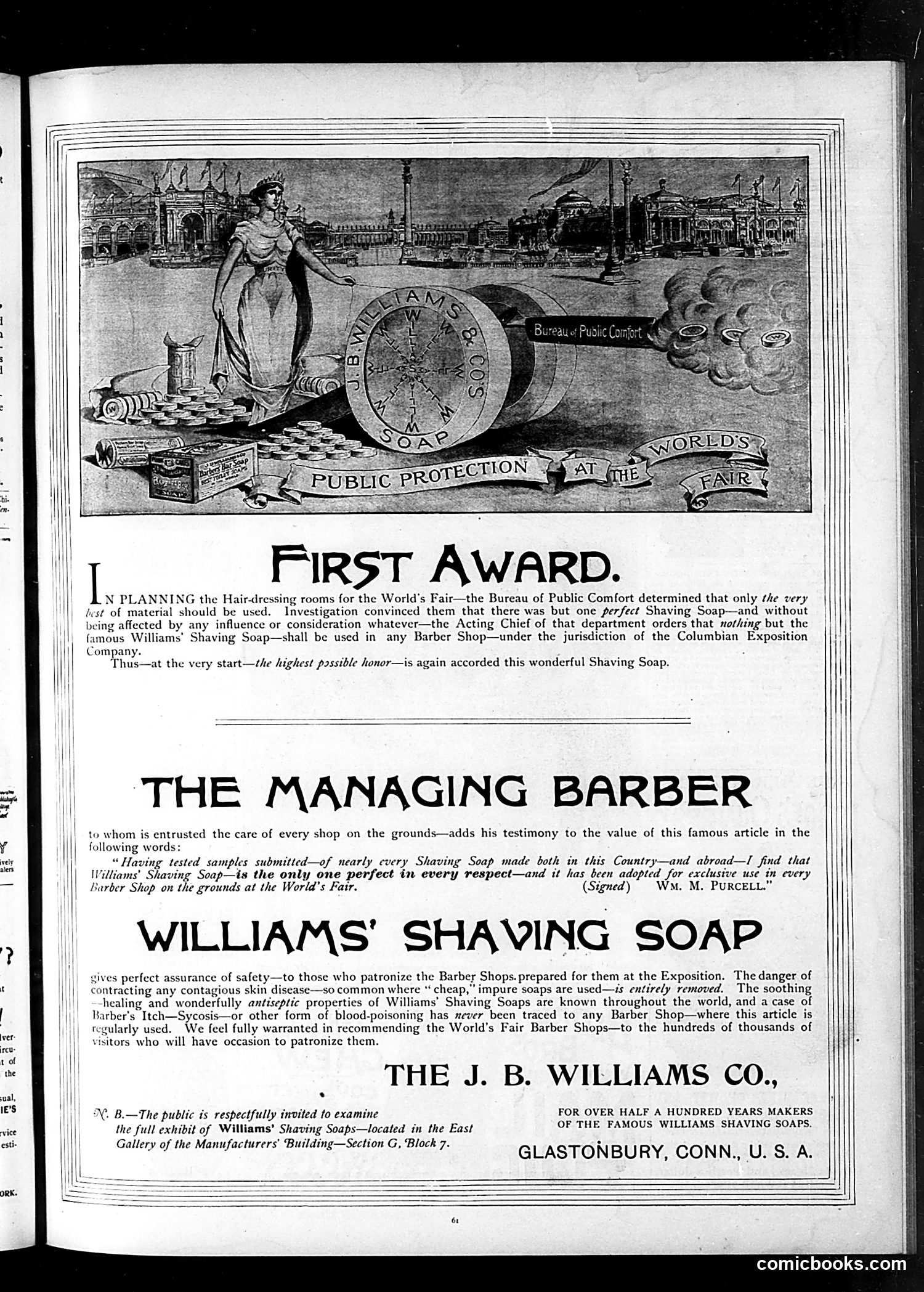
This is **not satire or political commentary**—it's a straightforward advertisement disguised as editorial content in Judge magazine, promoting Williams' Shaving Soap at the 1893 World's Columbian Exposition in Chicago. The elaborate allegorical illustration and text construct a false narrative of legitimacy: the "Bureau of Public Comfort" supposedly investigated all soaps and selected Williams' exclusively for the fair's barber shops. A testimonial from "the Managing Barber" (W.M. Purcell) claims it's the only "perfect" option and safe against contagious diseases and "Barber's Itch." This was a common advertising tactic of the era—manufacturing credibility through invented institutional endorsements. The imagery of Lady Liberty and the fair's architecture lends patriotic authority to a commercial product. For modern readers, it illustrates how advertising exploited public trust and emerging germ-theory anxieties to sell consumer goods.
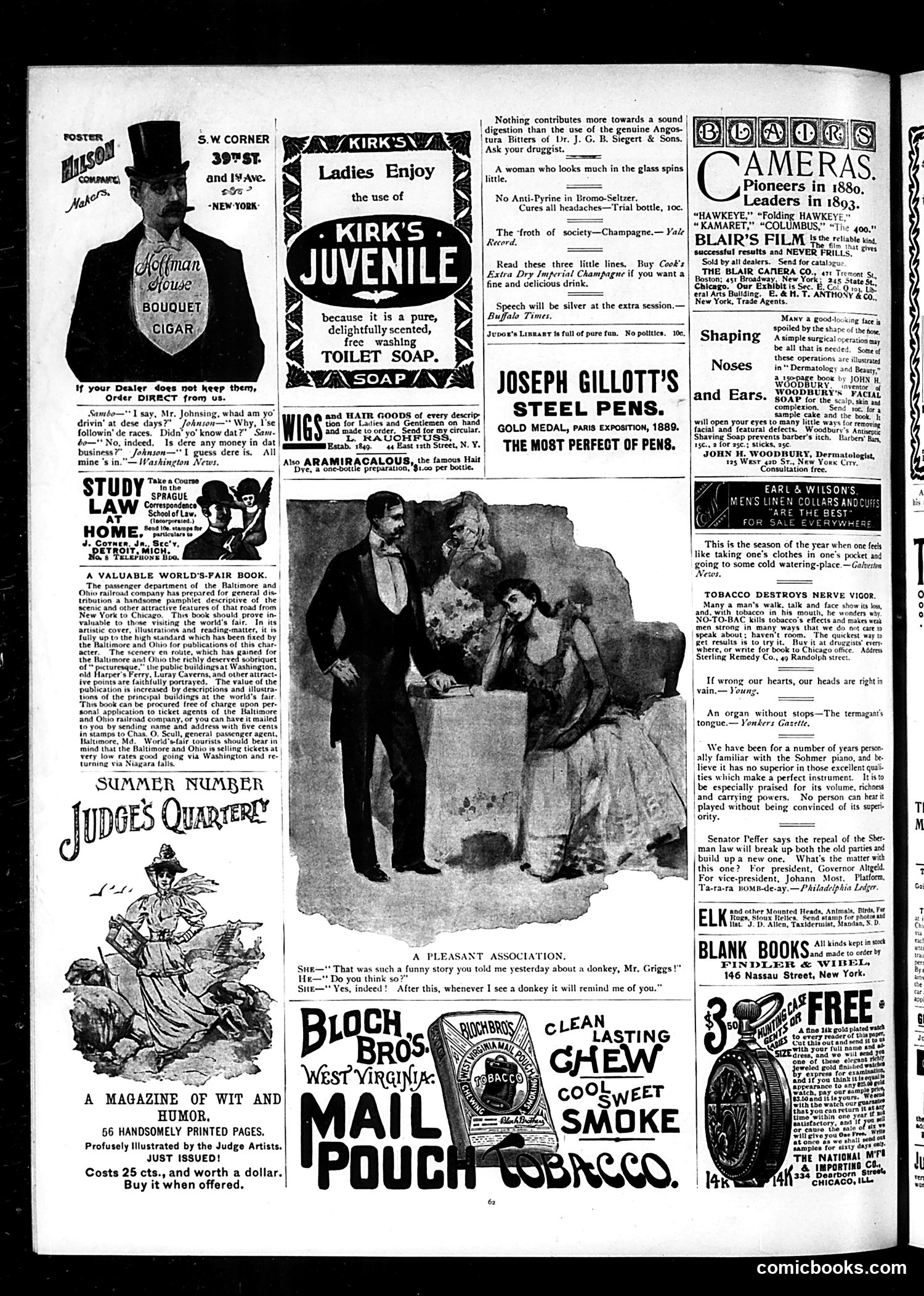
This page is primarily **advertising**, with one central cartoon and extensive product promotions typical of 1890s periodicals. ## The Main Cartoon The large illustration titled "A Pleasant Association" depicts a man with a donkey. The accompanying dialogue suggests wordplay: when asked about the animal, the man agrees it reminds him of someone—implying the donkey resembles a person he knows. This is a gentle, visual pun common to Judge's humor. ## Context & Content The page reflects 1890s American commercial culture: - **Advertisements** dominate, promoting patent medicines (Angostura Bitters, Bromo-Seltzer), writing instruments, cameras, toiletries, and tobacco - **"Shaping Noses and Ears"** advertisement for cosmetic surgery services indicates emerging aesthetic medicine - **Jokes and quips** scattered throughout (about women looking in mirrors, champagne as "froth of society") represent Judge's satirical voice - References to the **World's Fair** (1893 Chicago Columbian Exposition) and railroad travel reflect contemporary American interests The page captures Judge's dual function: satirical commentary mixed with period advertising that now appears quaint or concerning (cosmetic surgery promotion, unregulated patent medicines).
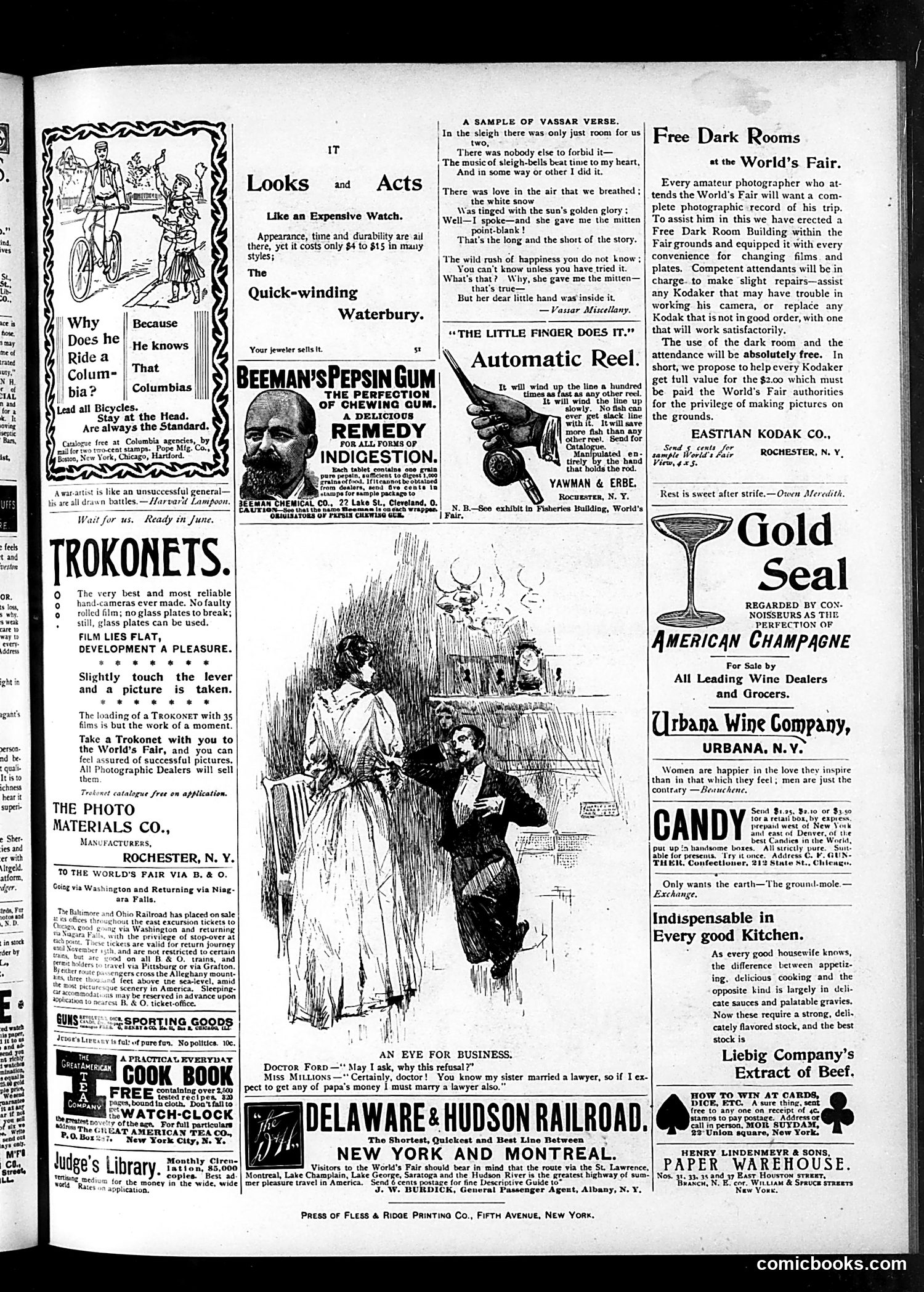
This is primarily an **advertising page** from Judge magazine's World's Fair coverage (likely 1893 Chicago Columbian Exposition, based on references to "World's Fair" and technological novelty). The only cartoon content is a small illustration captioned **"AN EYE FOR BUSINESS,"** showing what appears to be a doctor and society woman in conversation about a legal matter—a light domestic joke playing on hiring a lawyer. The rest of the page features period advertisements for emerging photographic technology (Trokonets cameras, Kodak dark rooms), watches, chewing gum, bicycles, and railroads—all targeting fair-going tourists. The Vassar poem excerpt exemplifies contemporary sentimentality about romance and propriety. **No significant political satire or social commentary is present.** This is commercial rather than editorial content—a promotional vehicle showcasing consumer goods marketed to World's Fair visitors. The humor is gentle and purely mercantile.
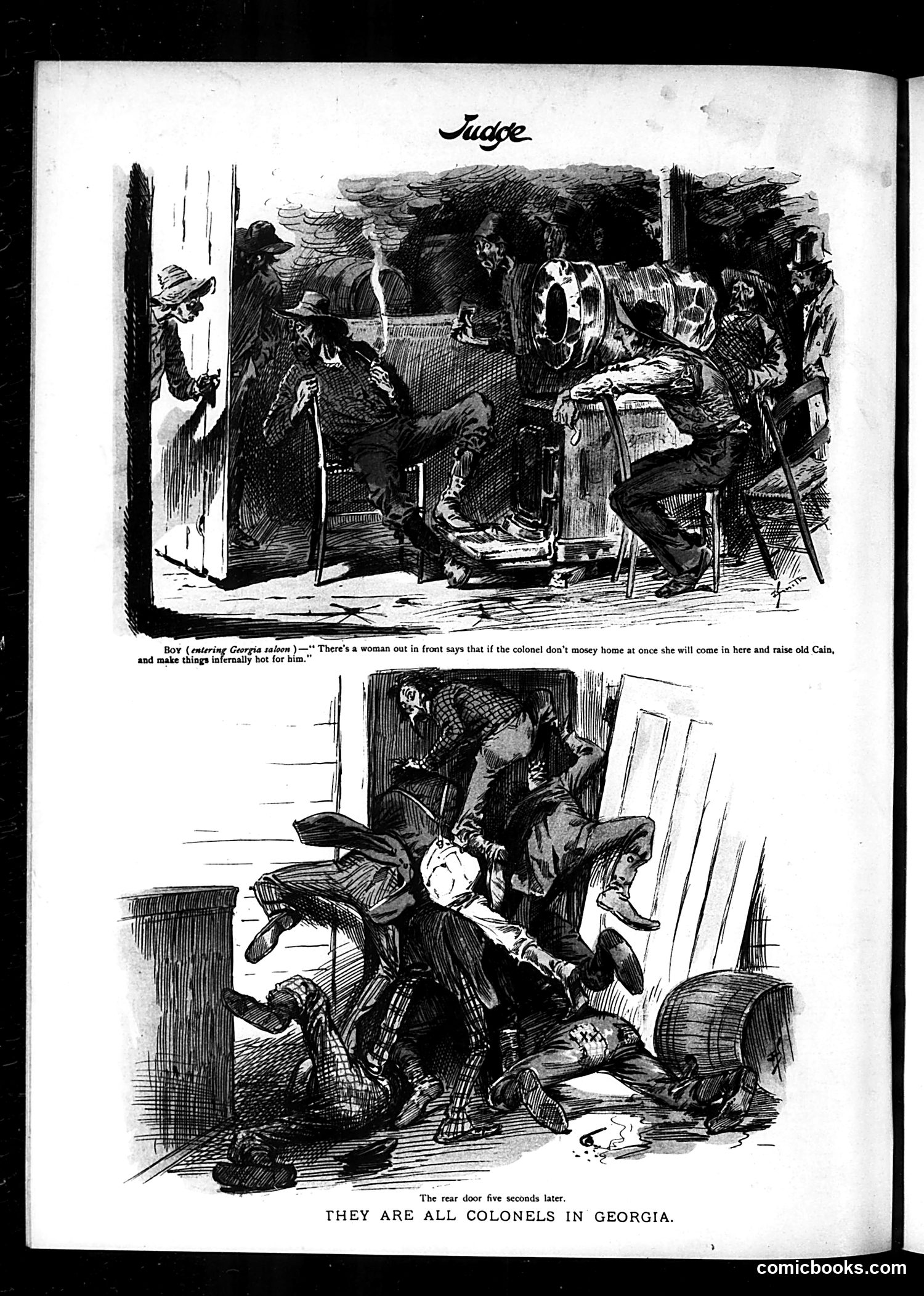
This two-panel satirical cartoon mocks Southern pretension and cowardice. In the top panel, a boy warns patrons at a Georgia saloon that a woman outside threatens to cause trouble if "the colonel" doesn't leave immediately. The humor plays on the Southern tendency to use grandiose military titles—the caption's punchline, "They Are All Colonels in Georgia," suggests that every man in Georgia claims the rank of colonel. The bottom panel shows the comedic payoff: all the supposed "colonels" scramble frantically out the rear door in panic, undignified and fearful. The satire targets both the inflated self-importance of Southern men and their actual lack of courage when confronted by a determined woman. This reflects late 19th-century Northern attitudes mocking the South's pretensions and post-Civil War vanities.