
Judge, 1893-07-29 · page 10 of 16
Judge — July 29, 1893 — page 10: what you’re looking at
What you’re looking at
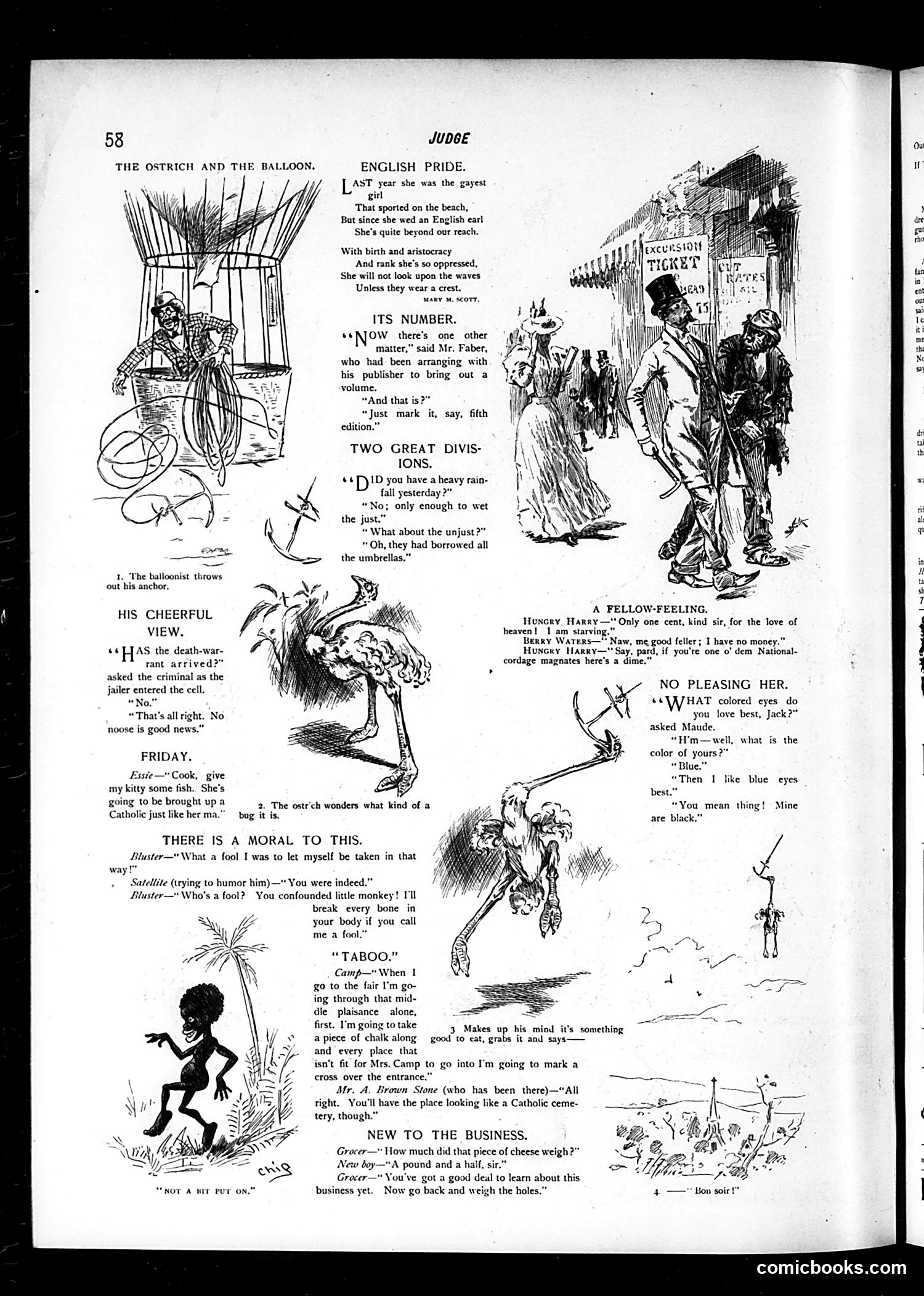
This page contains multiple short satirical pieces typical of Judge's humor: **"English Pride"** mocks a woman who, after marrying an English earl, has become snobbish and refuses to acknowledge American beach culture unless it displays aristocratic "crests." **"His Cheerful View"** jokes darkly about a death-row inmate's optimism that "no noose is good news"—a pun on the common phrase. **"Two Great Divisions"** satirizes class inequality: the wealthy borrowed all umbrellas during rain, leaving only the poor ("unjust") wet. **"A Fellow-Feeling"** depicts a beggar recognizing another poor man and offering him money when learning he works in the struggling "National-cordage" (rope) industry—suggesting both shared poverty and a failing American industry. **"No Pleasing Her"** is a simple joke about contradictory romantic preferences. The remaining pieces are brief workplace or domestic humor. The cartoons illustrate these jokes with period-appropriate sketches. Overall, the page reflects late 19th/early 20th-century American anxieties about class, immigration, and industrial decline.
📄 Transcribed text from this page (OCR, searchable)
Machine-transcribed from the original scan — historical spelling and the odd misread are preserved.
58 JUDGE THE OSTRICH AND THE BALLOON, ENGLISH PRIDE. AST year she was the gayest girl ‘That sported on the beach, Bat since she wed an English earl She's quite beyond our reach. With birth and aristocracy ‘And rank she’s so oppressed, She will not look upon the waves Unless they wear a crest. MARY 6. SCOTT. ITS NUMBER. ssnow there's one other matter,” said Mr. Faber, who had. been arranging with his publisher to bring out a volume. “And that is?” “Just mark it, say, fifth edition.” TWO GREAT DIVIS- IONS. +4 D) ID you have a heavy rain- fall yesterday ?” “ only enough to wet the just. “ What about the unjust?” “Oh, they had borrowed all the umbrellas.” 1. ‘The balloonist throws ‘out his anchor. HIS CHEERFUL A FELLOW-FEELING. Honcry. Harry —'* Only one cent, kind sir, for the love of VIEW. ‘ x heaven! 1 am starving.” S Berry Waters—" Naw, me good feller; I have no money.” +6 HAS the death-war- y , Huncky Harry—" Say, pard, if you're one o' dem National- rant arrived?” 4 . cordage magnates here's a dime.” asked the criminal as the 5 jailer entered the cell. By)! . NO PLEASING HER. “No.” ! A S©YVHAT colored eyes do “That's all right. No you love best, Jack?” noose is good news.” asked Maude. “H'm—well, what is the FRIDAY. a . color of yours?” mG) “Blue.” Essie—" Cook, give “Then I like blue eyes my kitty some fish. She's going to be brought up a 2. The ostr'ch wonders what kind of a mean thing! Mine Catholic just like her ma.” bug it is. THERE IS A MORAL TO THIS. Bluster—"* What a fool I was to let myself be taken in that way!" Satellite (ixying to humor him)—" You were indeed.” Bluster—"Who's a fool? You confounded little monkey! I'll break every bone in your body if you call me a fool.” “TABOO.” Camp—"When 1 go to the fair I'm go- ing through that mid- dle plaisance alone, first. I'm going to take 3. Makes up his mind it's something a piece of chalk along good to eat, grabs it and says— and every place that isn’t fit for Mrs. Camp to go into I'm going to mark a cross over the entrance.” Mr. A. Brown Stone (who has been there)—"All right. You'll have the place looking like a Catholic ceme- tery, though.” NEW TO THE BUSINESS. Grocer—" Wow much did that piece of cheese weigh ?” New boy—"A pound and a half, sir.” Grocer—""You've got a good deal to learn about this “Nor A miY PUT ON." business yet. Now go back and weigh the holes.” 4. "Bon soir!” comicbooks.com