
A complete issue · 16 pages · 1893
Judge — May 6, 1893
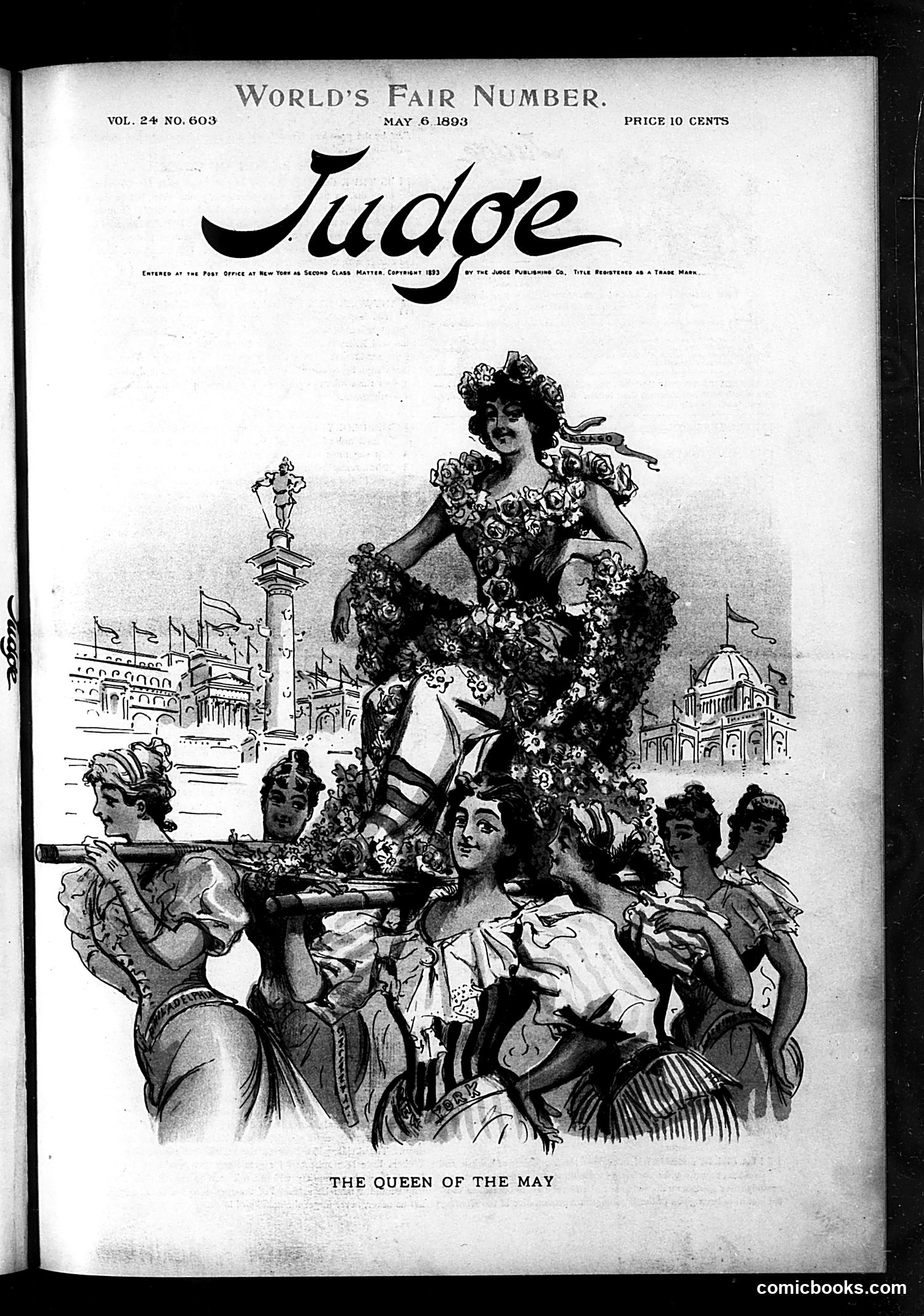
This is the cover illustration for Judge's "World's Fair Number," celebrating the 1893 World's Columbian Exposition in Chicago. The image depicts an allegorical female figure (representing the fair itself or the spirit of the exposition) as "The Queen of the May"—a traditional springtime celebration figure. She's adorned with flowers and sits elevated above attendants in classical dress, with fair buildings visible in the background. The satire likely plays on the fair's grand self-presentation and the American confidence of the era. By framing the exposition as royalty, Judge both celebrates the fair's importance and gently mocks the pretentious, somewhat artificial grandeur of the massive celebration. The classical allegorical style was typical of Gilded Age imagery promoting major American institutions.
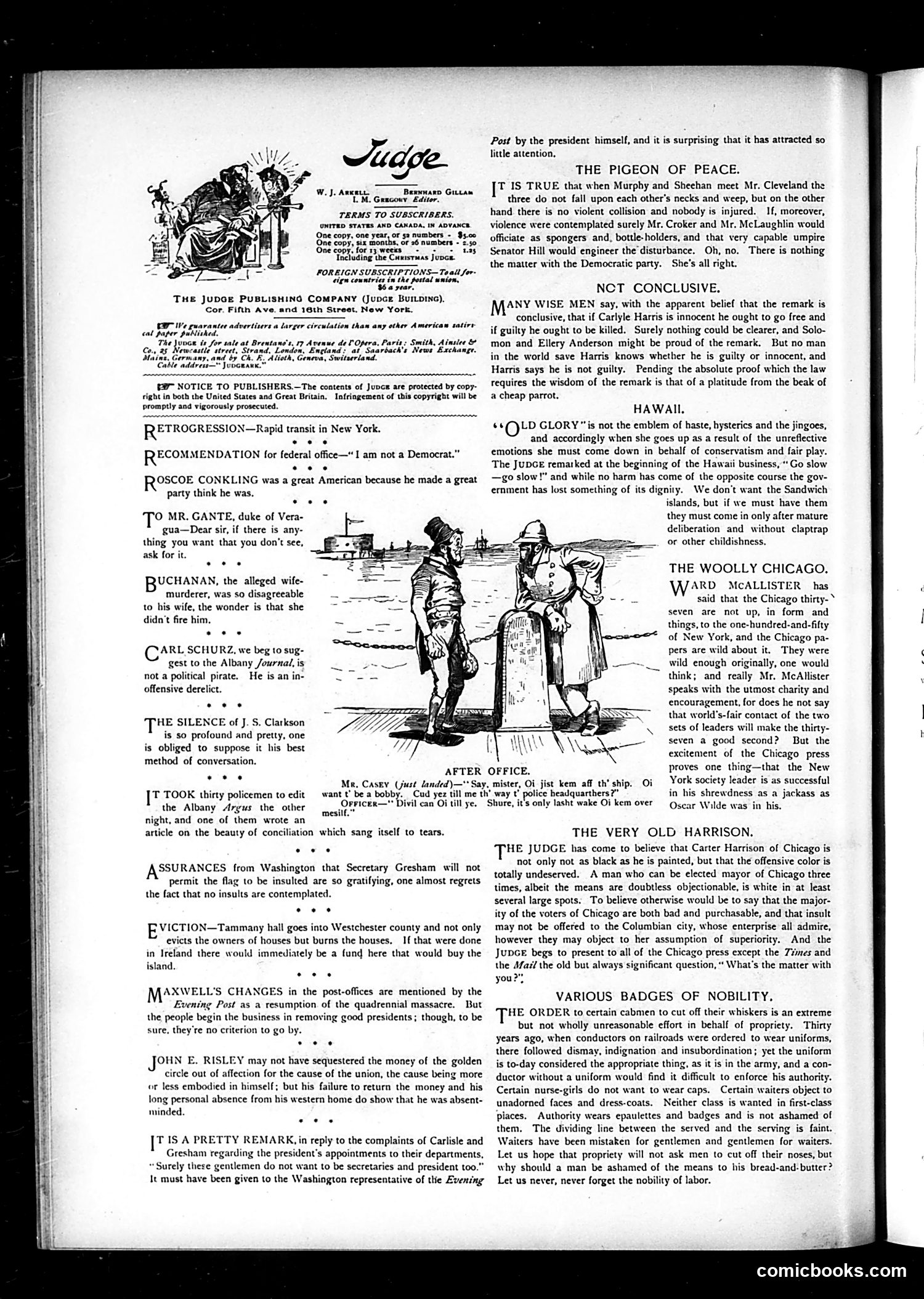
This page contains several brief political commentary items typical of Judge magazine's satirical format. The main cartoon, titled "AFTER OFFICE," depicts two figures in conversation by water, likely commenting on political appointments or patronage. The text items mock various political figures and situations: - References to Carlyle Harris (appears to be a criminal case) - Comments on Chicago politics and "Carter Harrison" as mayor - Criticism of President Cleveland's appointment decisions - Observations about railroad conductors and workplace hierarchies The cartoon and items together reflect turn-of-the-century American political satire, targeting Democratic appointments, urban corruption, and social pretension. Without clearer identification of specific figures or dates in the image itself, precise historical context remains unclear, though the tone suggests criticism of Democratic party politics and urban machine operations.
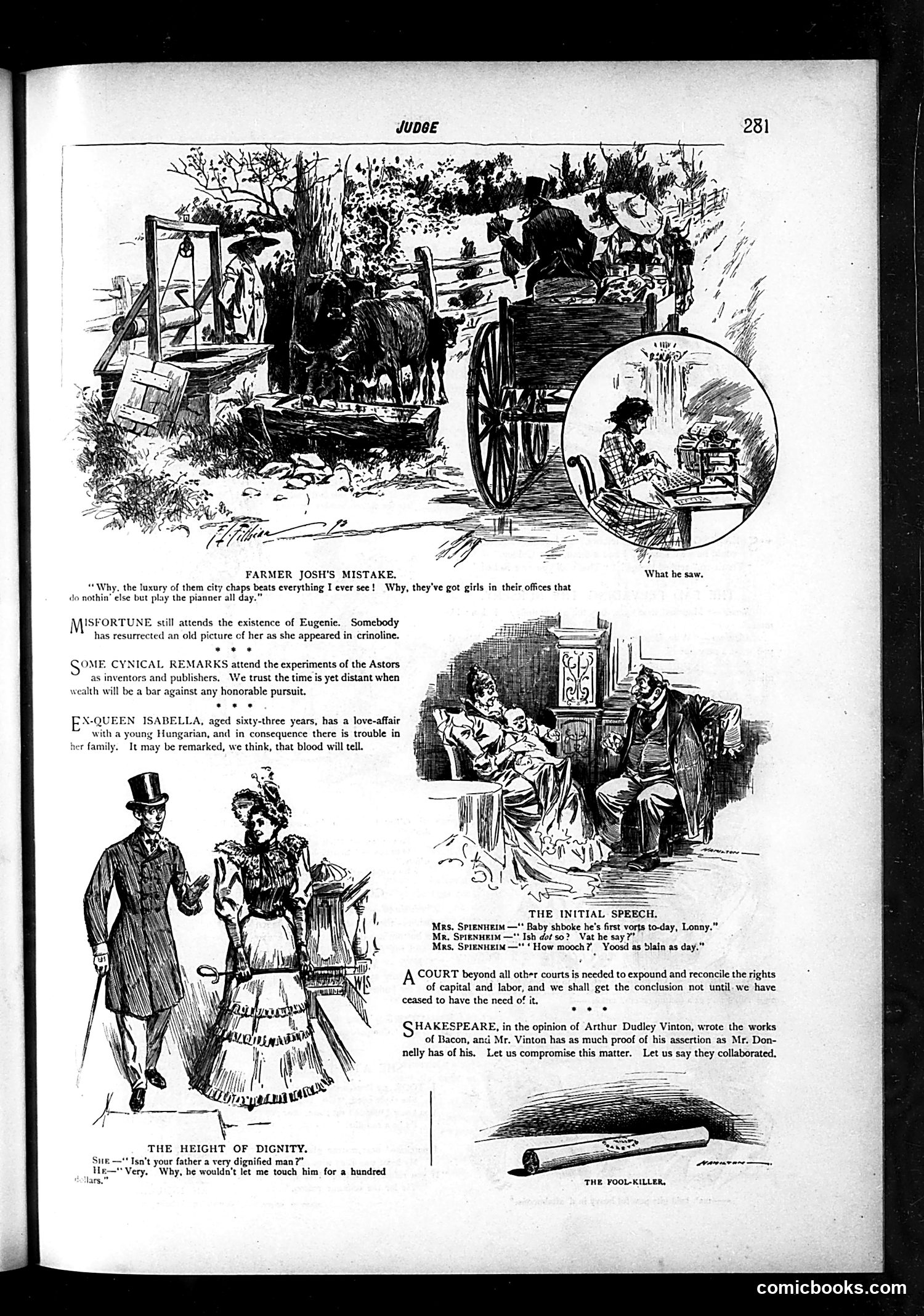
This page contains several satirical sketches with social commentary: **"Farmer Josh's Mistake"** mocks rural simplicity—a farmer is surprised city office workers don't labor constantly like farmers do. **"The Height of Dignity"** shows a couple where the woman demands her father's "dignified" treatment, though he apparently worked as a laborer—satirizing pretentious social climbing and false respectability. The remaining text discusses **Ex-Queen Isabella** (age 73) and her affair with a young Hungarian, suggesting "blood will tell"—implying inherited character traits transcend rank. There are also literary references to Shakespeare and Bacon, and commentary on labor/capital disputes. The sketches use class contrasts for humor, typical of Gilded Age satirical magazines targeting urban, educated readers who enjoyed mocking both rural ignorance and social pretension.
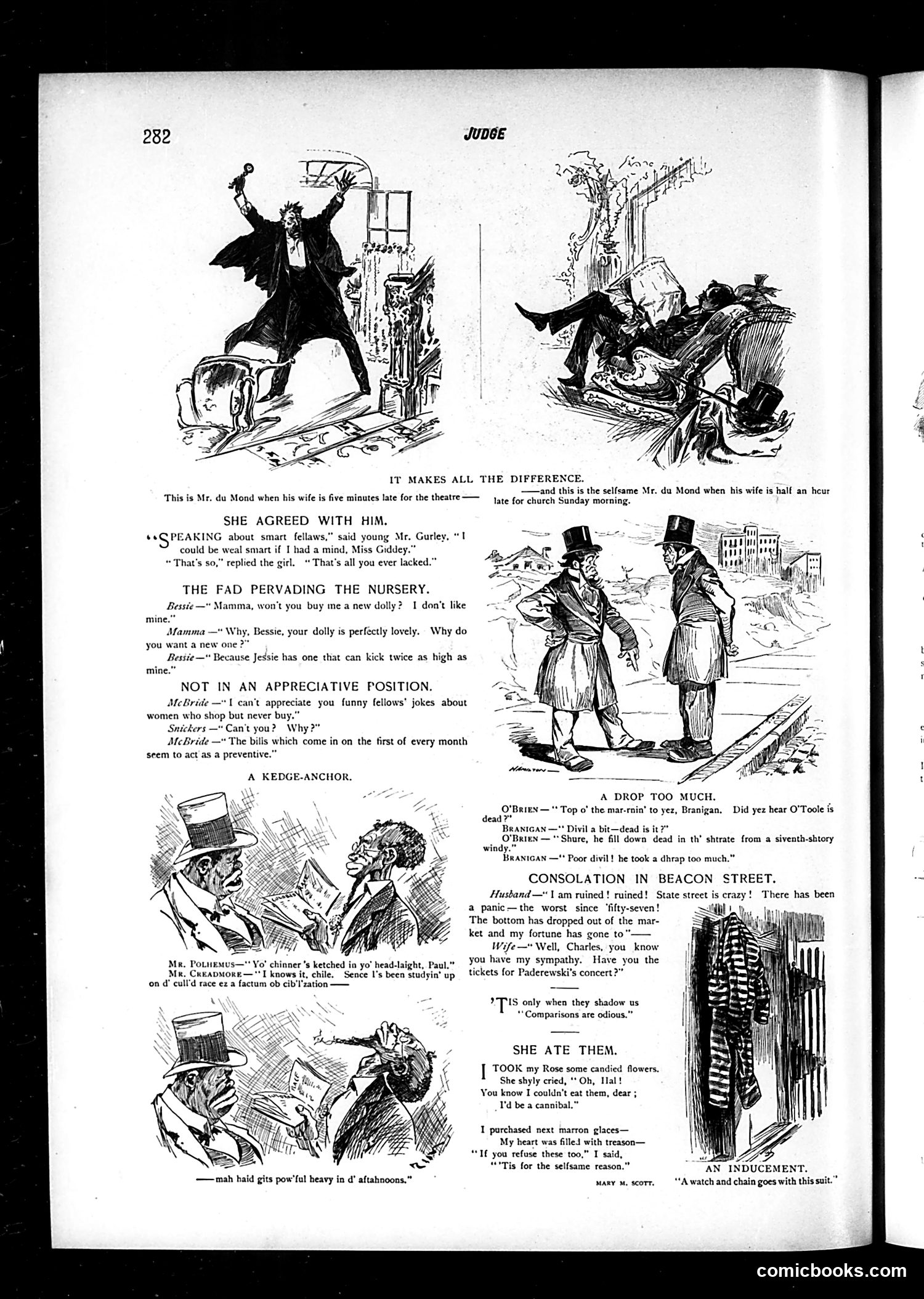
This page contains multiple short humorous vignettes typical of early 20th-century Judge magazine: **"It Makes All the Difference"** contrasts a husband's theatrical impatience (top left) with his serene composure when his wife is late for church—satirizing male hypocrisy about religious propriety versus entertainment. **"She Agreed With Him"** is a brief dialogue joke about a young man admitting his only lack is intelligence, which the young woman pointedly confirms. **Remaining sketches** mock various social foibles: a child's consumer materialism, a husband's obliviousness to his wife's shopping bills, Irish-dialect humor about a drunk's death, a wealthy husband's financial panic contrasted with his wife's concern only for concert tickets, and romantic rejection wrapped in flowery language. The cartoons employ visual exaggeration and period dialect (particularly Irish stereotypes) typical of Judge's satirical approach to middle and upper-class American social pretensions and gender dynamics.
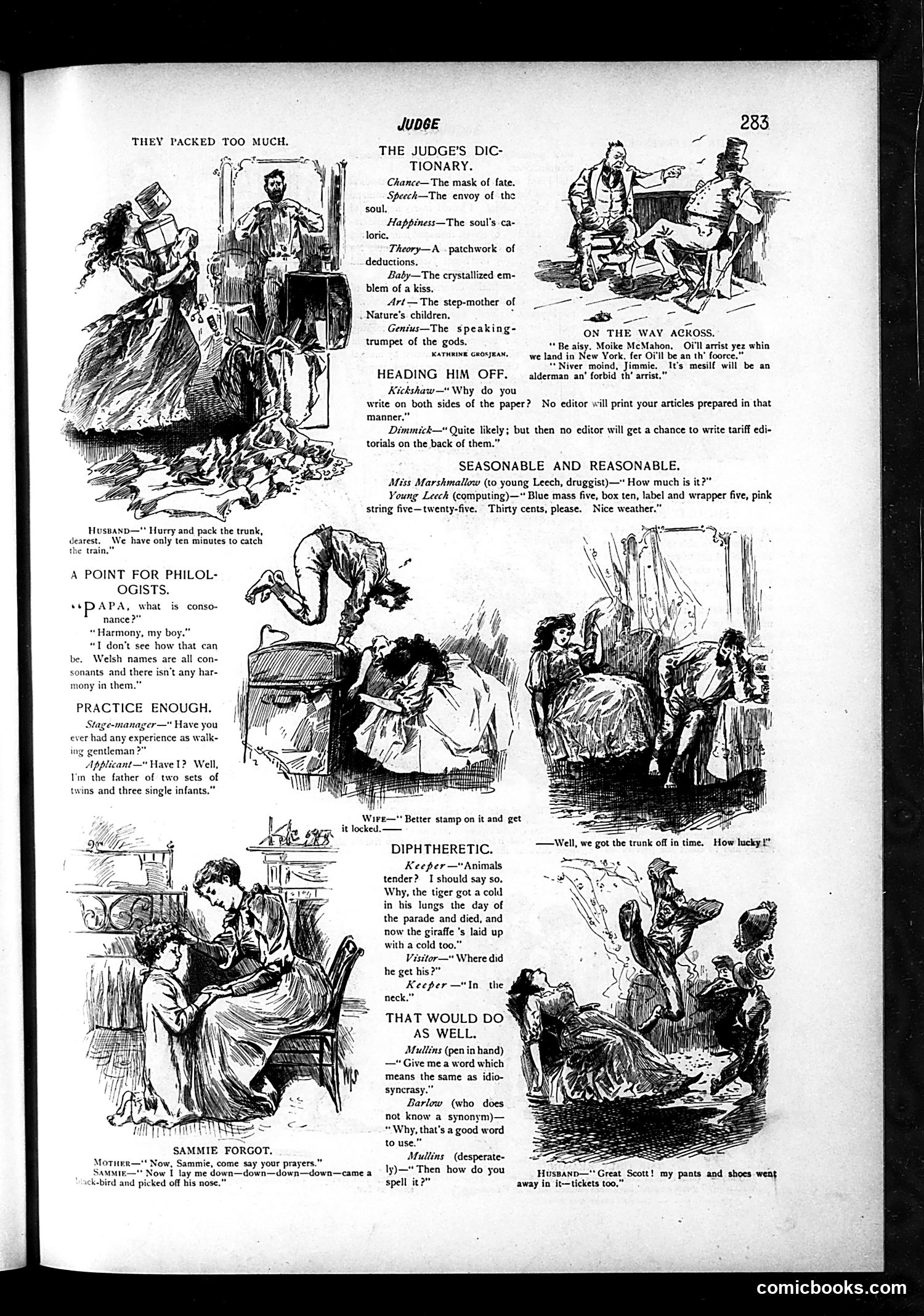
This page collects several short satirical pieces typical of 19th-century Judge magazine humor: **"The Judge's Dictionary"** offers mock definitions of abstract concepts—sardonic wordplay rather than political commentary. **"Heading Him Off"** satirizes editorial practices, suggesting tariff editorials were so common that editors used article backside space for their own pieces. **"Seasonable and Reasonable"** mocks a druggist's inflated pricing by itemizing every minor component (box, label, string) to justify costs—social satire on commercial greed. **Irish immigrant dialogue** ("Be aisy, Moike McMahon") depicts stereotypical Irish accents, reflecting period prejudices about Irish workers and their aspirations to political office ("alderman"). **"Practice Enough"** and other shorts make light domestic humor about Welsh names being consonant-heavy, absent-minded parenting, and misunderstandings. The page prioritizes **general humor over specific political targets**, focusing instead on class commentary, ethnic stereotypes, and everyday absurdities common to late 19th-century American life.
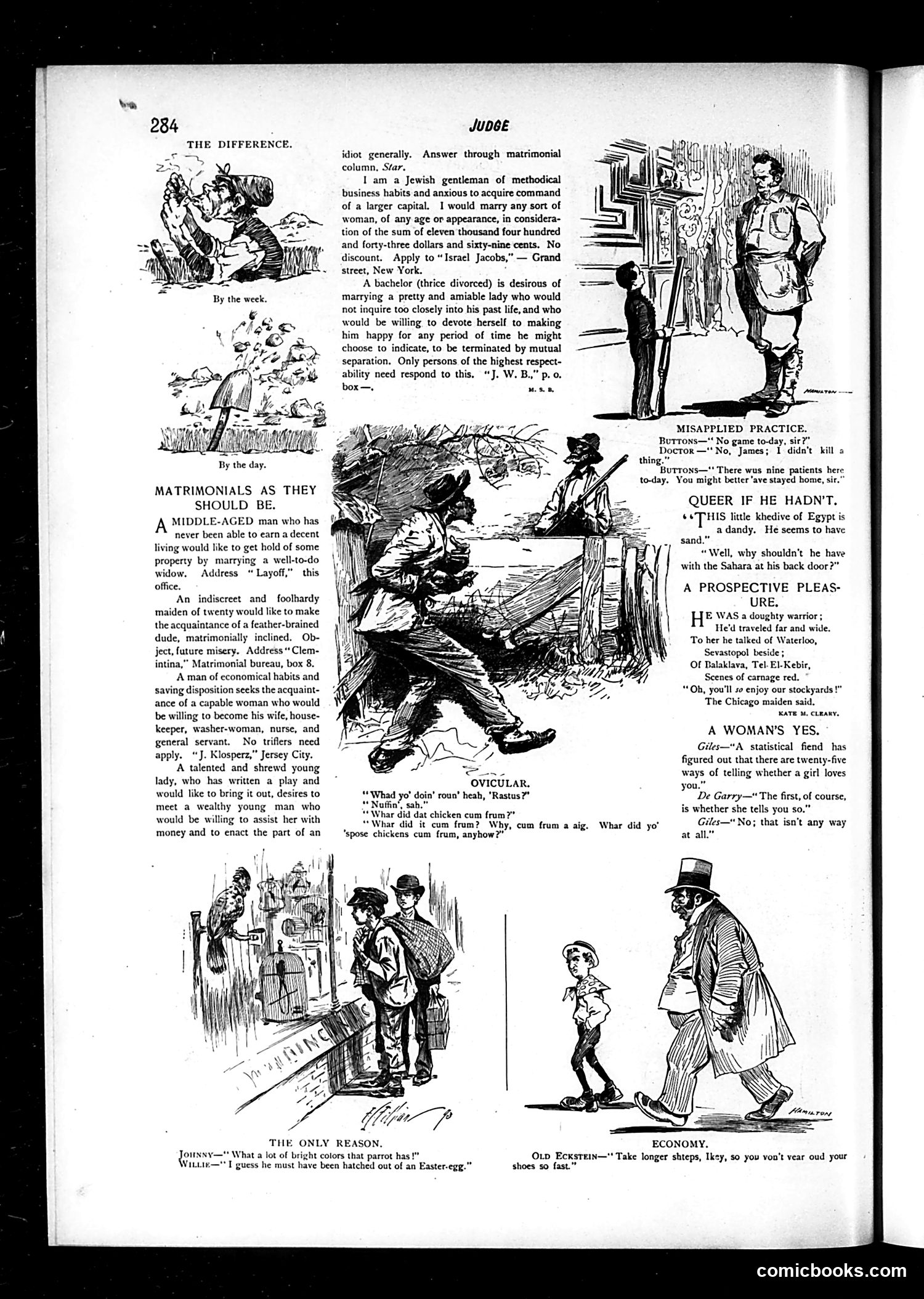
This page satirizes marriage through mock personal advertisements and humorous vignettes. The "Matrimonials as They Should Be" section mocks the era's marriage market by presenting brutally honest—rather than flattering—matrimonial notices. Subjects include a middle-aged man seeking rich widows, a foolish young woman pursuing a "feather-brained dude," and a Jewish businessman bluntly advertising his willingness to marry any woman for $11,443.69, regardless of appearance. The accompanying cartoons mock courtship pretenses and gender dynamics: a dialogue ridiculing a Black man's explanation for a stolen chicken, a businessman boasting of military exploits to a Chicago woman who counters with stockyard tourism, and domestic humor about marriage and economy. The satire targets the transactional, mercenary nature of turn-of-the-century matrimony while mocking various social groups through ethnic stereotypes typical of the era's Judge magazine.
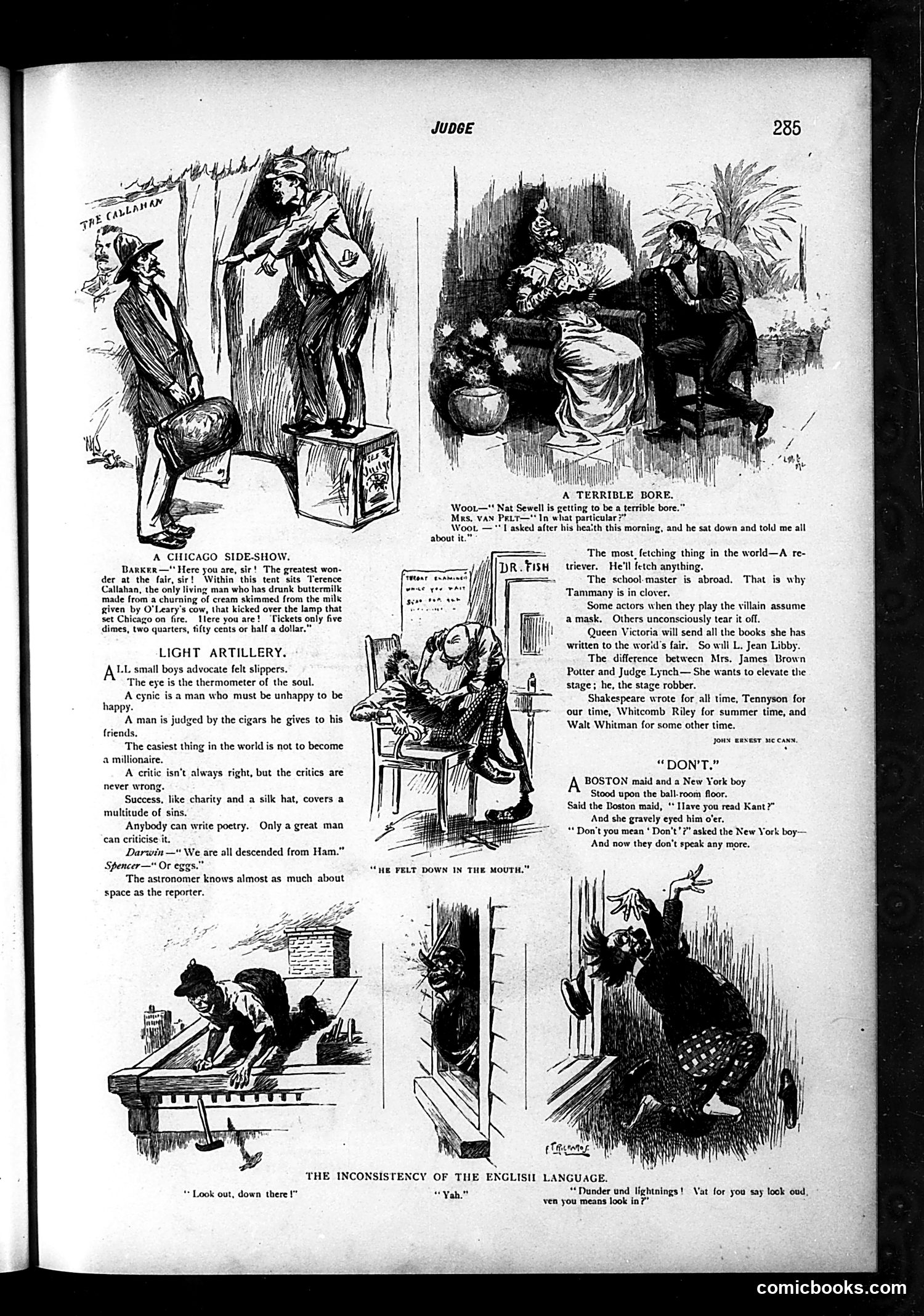
This satirical page contains several unrelated pieces typical of Judge magazine's format: **"A Chicago Side-Show"** mocks the 1871 Great Chicago Fire by imagining a circus barker promoting an absurd exhibit: a man who drank buttermilk from O'Leary's cow—the animal legendarily responsible for kicking over the lamp that started the fire. It's satirizing how disasters become sensationalized entertainment. **"Light Artillery"** is a collection of brief philosophical quips poking fun at human nature and pretension (critics, millionaires, poets, Darwin). **"A Terrible Bore"** depicts a social complaint about tedious conversation—a man who won't stop talking about his health. **"Don't"** is a pun-based joke: a Boston woman asks if a New York man has read Kant (the philosopher), but he mishears it as "can't," creating awkward misunderstanding that ends their interaction. **"The Inconsistency of the English Language"** ridicules English pronunciation through a German immigrant's confusion: "look out" (meaning "be careful") versus "look in" (meaning observe inside)—the words sound identical but mean opposite things.
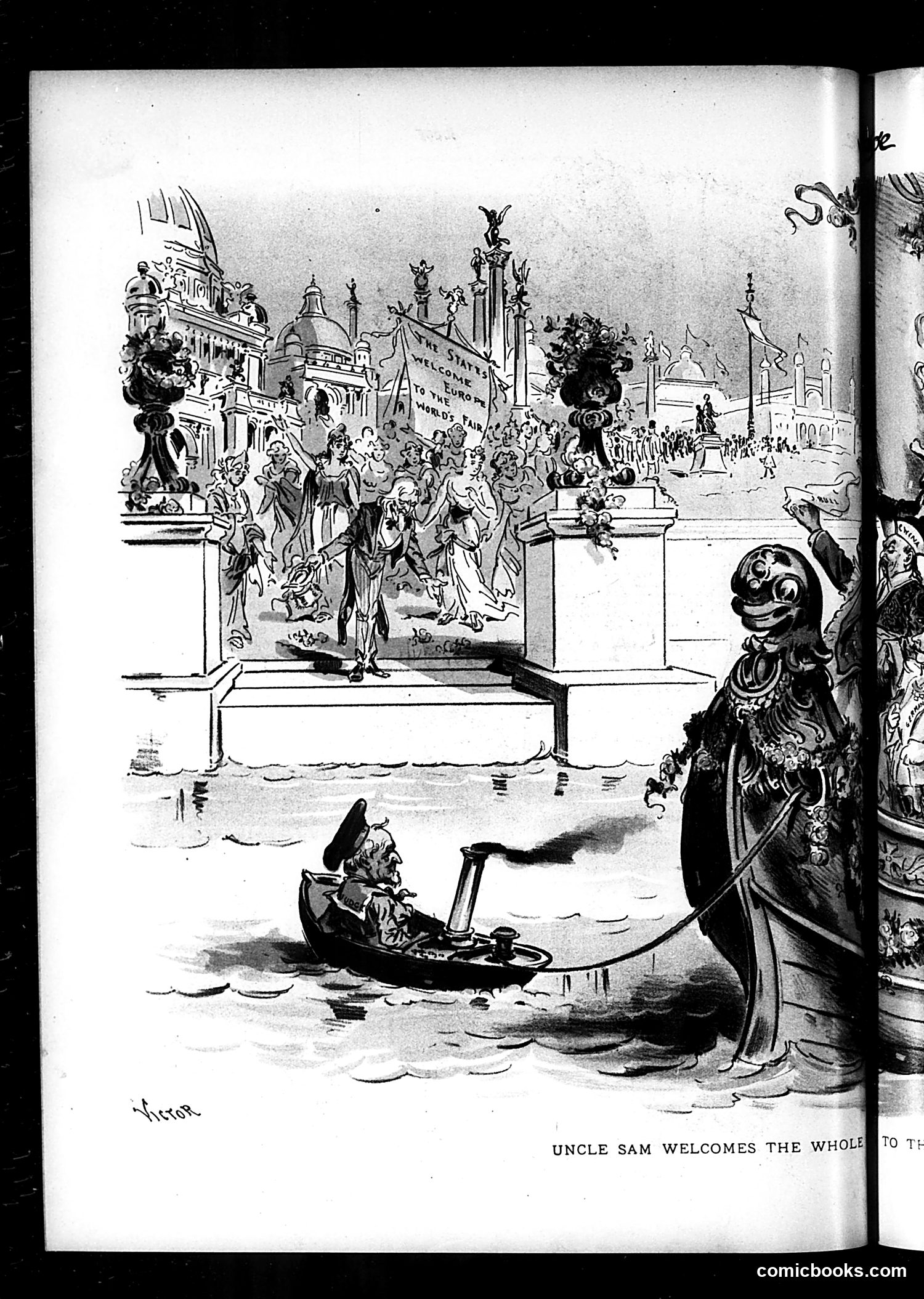
This political cartoon depicts Uncle Sam (personified as the American figure on the right, in formal dress) greeting visitors arriving by gondola to what appears to be Venice or another European city. The elaborate architectural backdrop with ceremonial crowds and monuments suggests an international exposition or world's fair setting. The incomplete caption "Uncle Sam Welcomes the Whole" (text cuts off) likely refers to welcoming foreigners or immigrants. The gondola and European setting suggest themes about American relations with Europe or immigration policy. The formal, welcoming pose contrasts with the isolated arrival scene below, possibly satirizing American attitudes toward foreign visitors or immigrants during a specific historical period when such expositions were popular venues for international exchange.
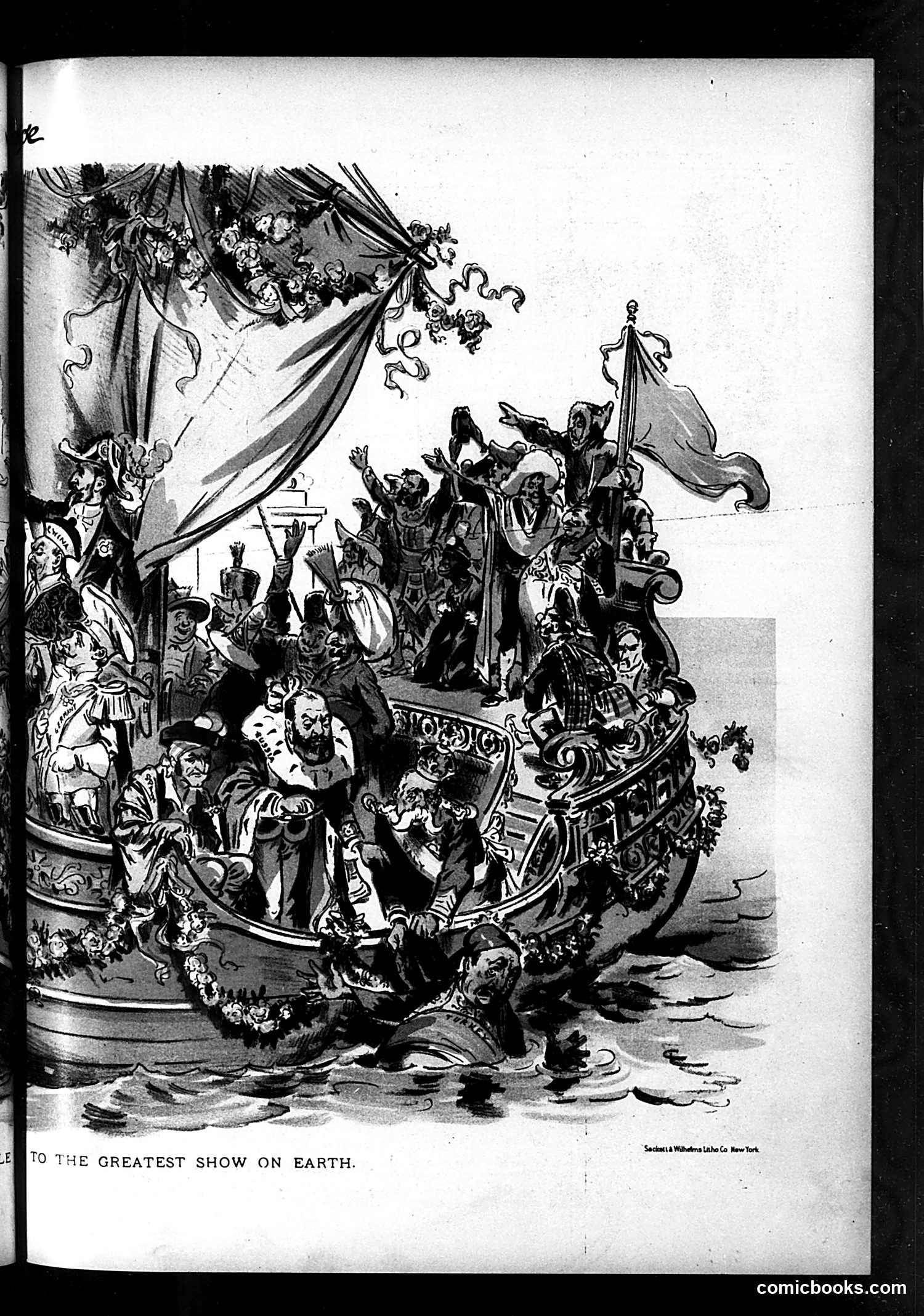
This is a satirical illustration titled "TO THE GREATEST SHOW ON EARTH." The cartoon depicts an elaborate, ornate theatrical or circus-like vessel or platform crowded with figures in period costume and formal dress, suggesting high society or political figures. The elaborate decorative elements—flags, flowers, scrollwork—create a grandiose yet chaotic scene. The satire appears to mock American politics or high society as a circus or theatrical spectacle, with the "greatest show" title suggesting ironic commentary on the perceived showmanship of politicians or public figures parading themselves. The crowded composition implies disorder masquerading as pageantry. However, without clearer identification of specific caricatured individuals or knowing the publication date, precise identification of which political figures or events are targeted remains unclear.
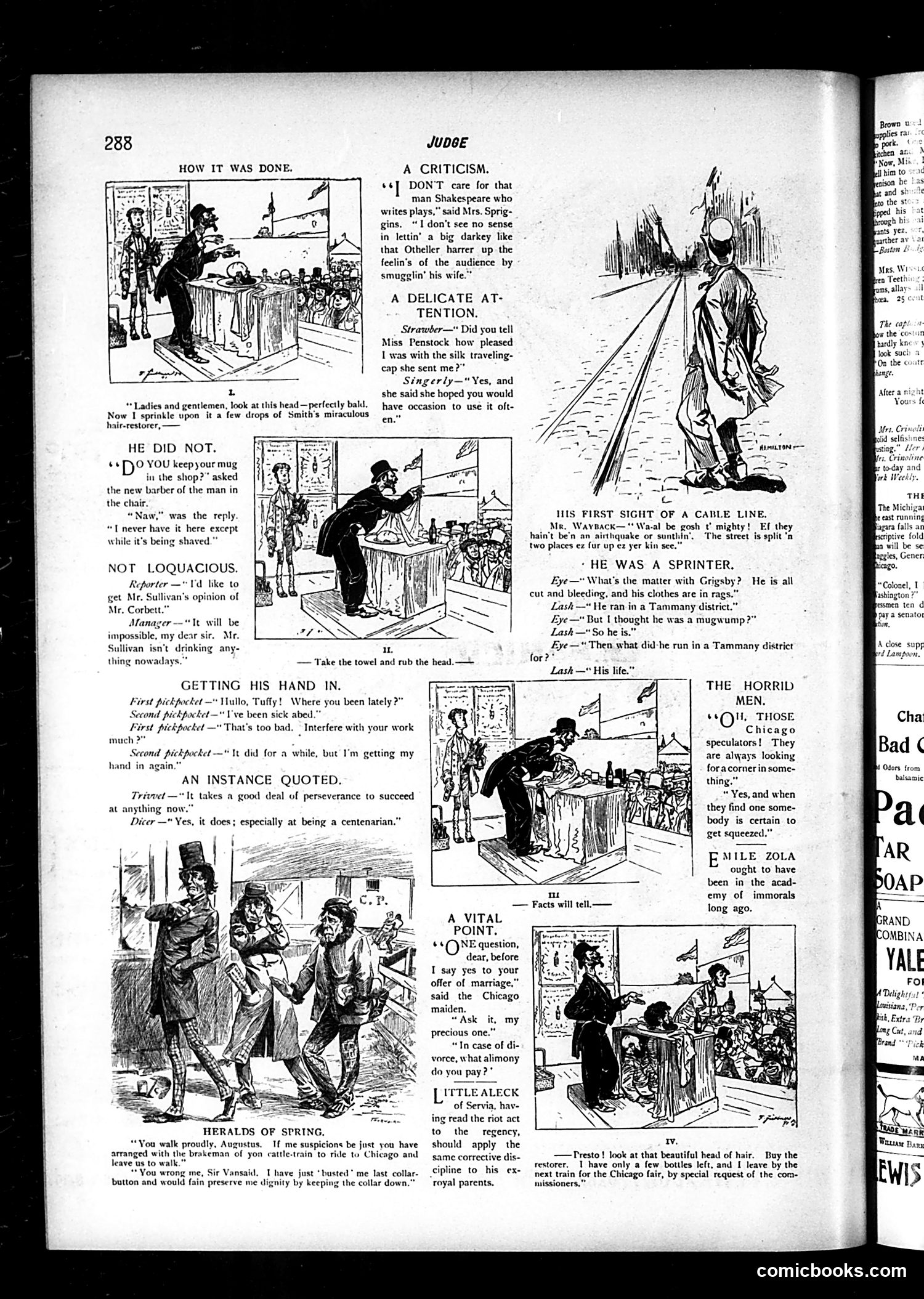
This page contains multiple short satirical cartoons and jokes typical of 1890s American humor: **"A Criticism"** mocks Mrs. Spriggins for dismissing Shakespeare's *Othello*, calling the Black protagonist by a racial slur and objecting to his relationship with a white character—satirizing racist attitudes toward interracial themes in literature. **"His First Sight of a Cable Line"** shows a rural visitor mistaking a split street (from underground cable installation) for earthquake damage, mocking rural unfamiliarity with urban infrastructure. **"A Sprinter"** jokes that someone ran through a "Tammany district" (controlled by the corrupt Tammany Hall political machine) for his life—satirizing the danger of that corrupt political organization. **Hair-restorer advertisement** embedded within editorial content, typical of Judge's mixed advertising-editorial format. Various other brief humor items mock: pickpockets, marriage negotiations, political speculators, and the French novelist Émile Zola (referenced as immoral). The overall tone is urban, class-conscious satire targeting rural ignorance, political corruption, and social pretension.
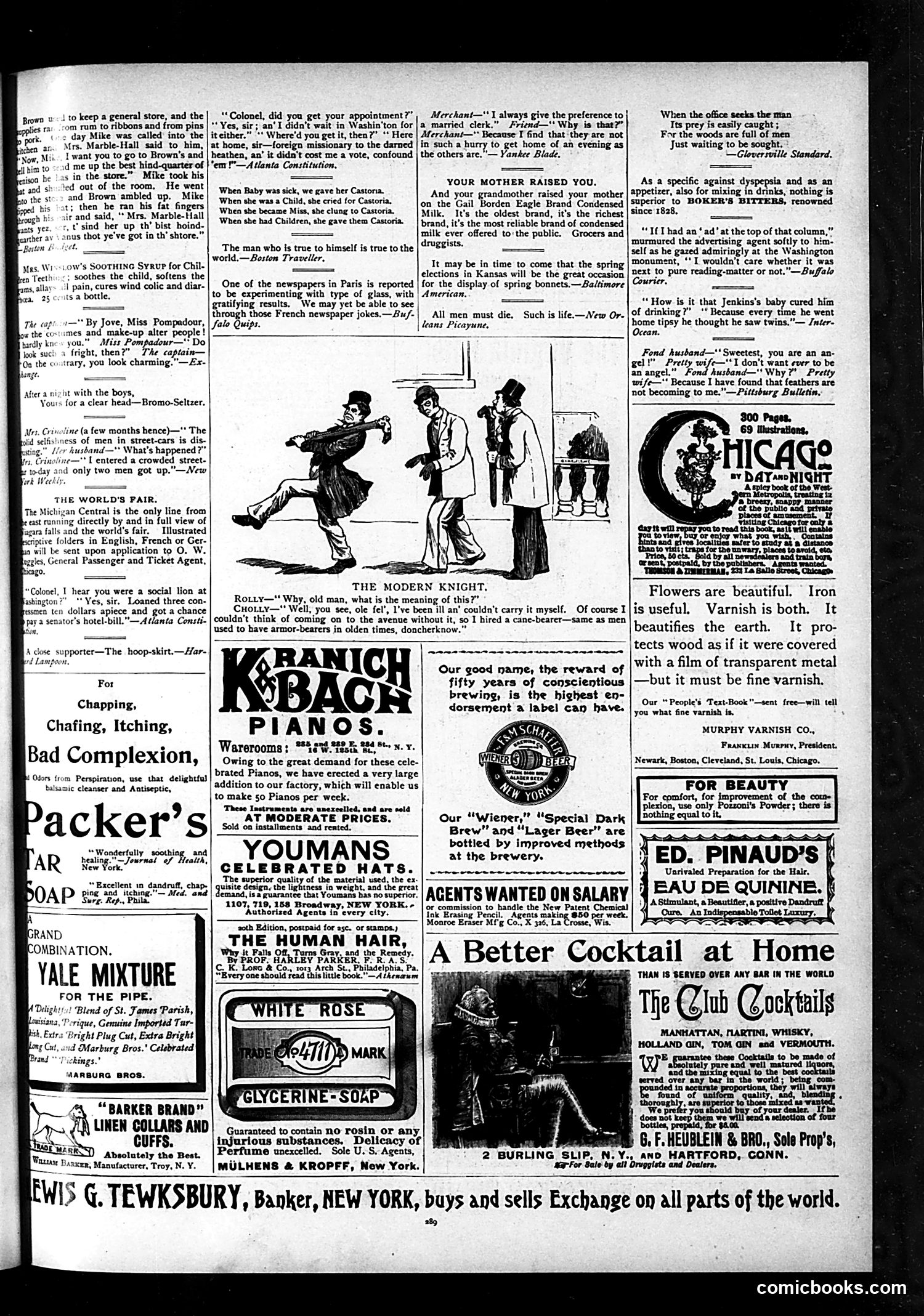
This page from Judge magazine (a satirical publication) contains **primarily advertisements and brief humorous anecdotes** rather than political cartoons. The one illustration shows a scene titled "THE MODERN KNIGHT," depicting what appears to be a street altercation or confrontation between men—likely satirizing contemporary urban social behavior or class dynamics, though the specific reference is unclear without more context. The text consists of short jokes and witticisms on common themes: workplace dynamics (clerks, appointments), domestic life (husbands and wives), and advertising copy disguised as humor. The "Colonel" anecdote mocks political patronage and nepotism in appointment-getting. The "modern knight" caption suggests satirical commentary on contemporary male behavior or masculinity. The bulk of the page is legitimate advertising for products like Castoria, condensed milk, pianos, soap, and patent medicines—typical of Judge's revenue model. Without clearer visual or textual markers identifying specific political figures or dated events, the page reflects general satirical commentary on Victorian-era American social customs rather than particular political satire.
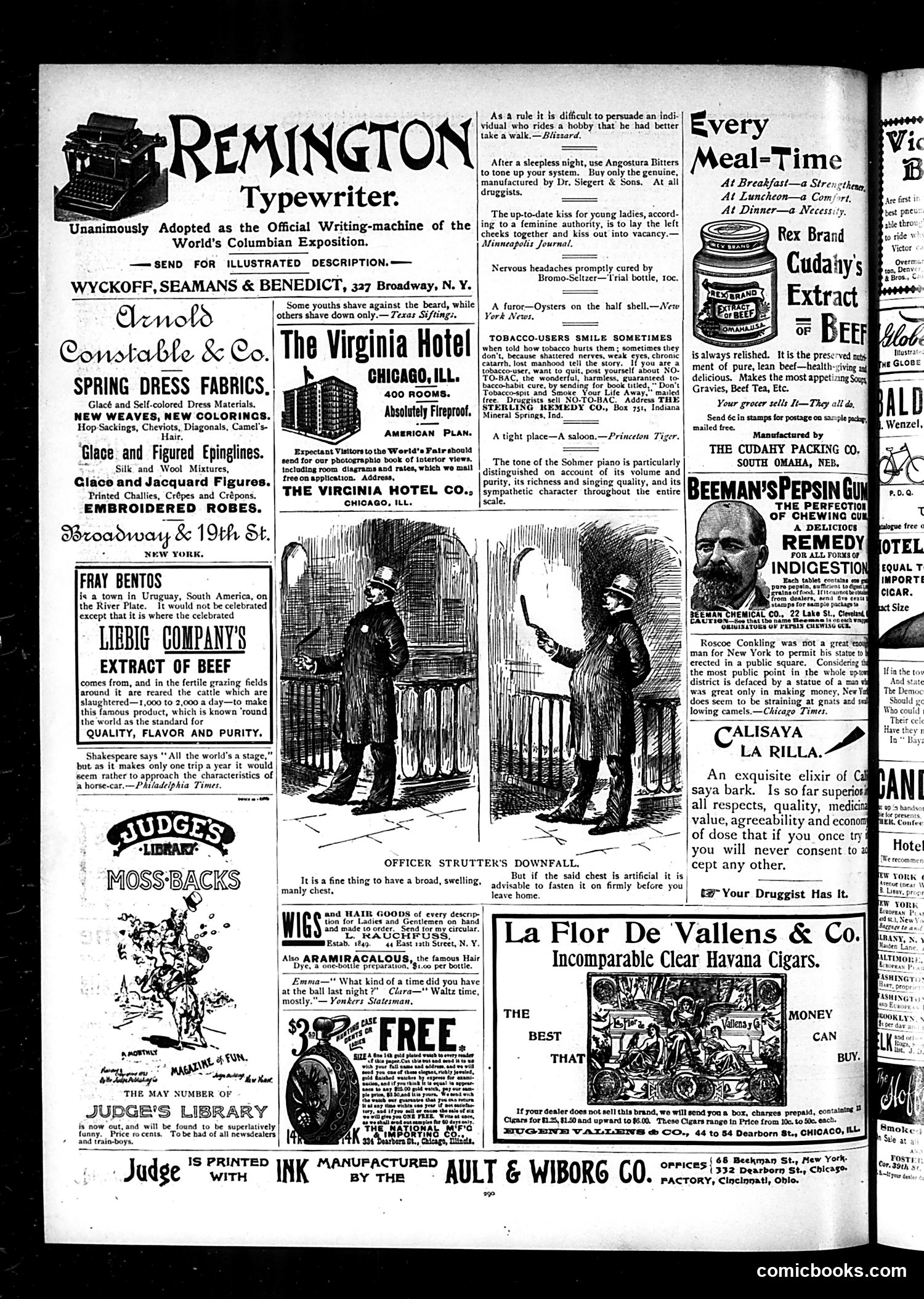
This page is **primarily advertisements** with one notable cartoon titled "Officer Strutter's Downfall." ## The Cartoon The illustration depicts a man with an artificially padded chest that has apparently collapsed or deflated—his tailored chest padding has failed him. The accompanying text jokes that while a broad, swelling chest is admirable, artificial chests must be "fastened firmly before you leave home." This is satirizing vanity and masculine posturing: men who artificially enhance their physiques through padding will be exposed and embarrassed when their deception literally falls apart. ## Advertisement Context The page features typical turn-of-the-century advertisements: typewriters (Remington, official machine of the World's Columbian Exposition), dress fabrics, beef extract, hotels, and medicinal products. One ad addresses "tobacco-users" offering a tobacco-cessation product, reflecting period health concerns. The magazine itself is identified as *Judge*'s Library—a humorous publication. The scattered witticisms throughout represent the satirical, pun-heavy humor typical of late-Victorian American magazines.
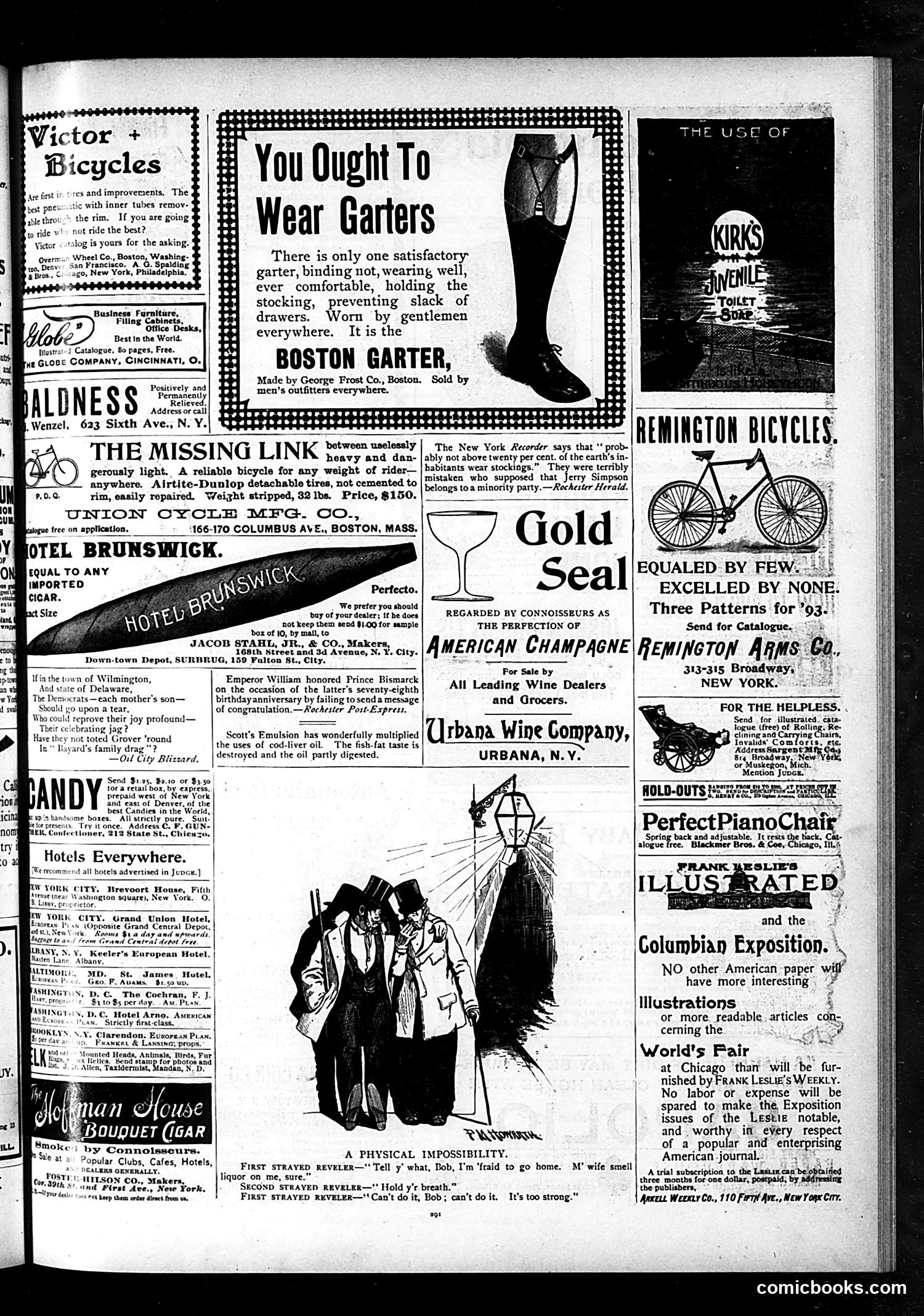
This page is primarily **advertisements** with one small cartoon. The main satirical content is the cartoon titled "A Physical Impossibility," showing two intoxicated men. The joke plays on contemporary social anxieties: one drunk man fears going home because his wife can "smell liquor" on him, while the other claims his wife is so drunk she can't detect anything. The humor hinges on the premise that wives monitor husbands' drinking—a common domestic worry of the era. The "impossibility" likely refers to the implausibility of hiding intoxication from a spouse. The page is otherwise filled with period advertisements (bicycles, garters, champagne, cigars, hotels) typical of late 19th-century magazines. One small text item jokes about Jerry Simpson, a Populist politician, and "missing stockings"—likely a political jab referencing contemporary debates.
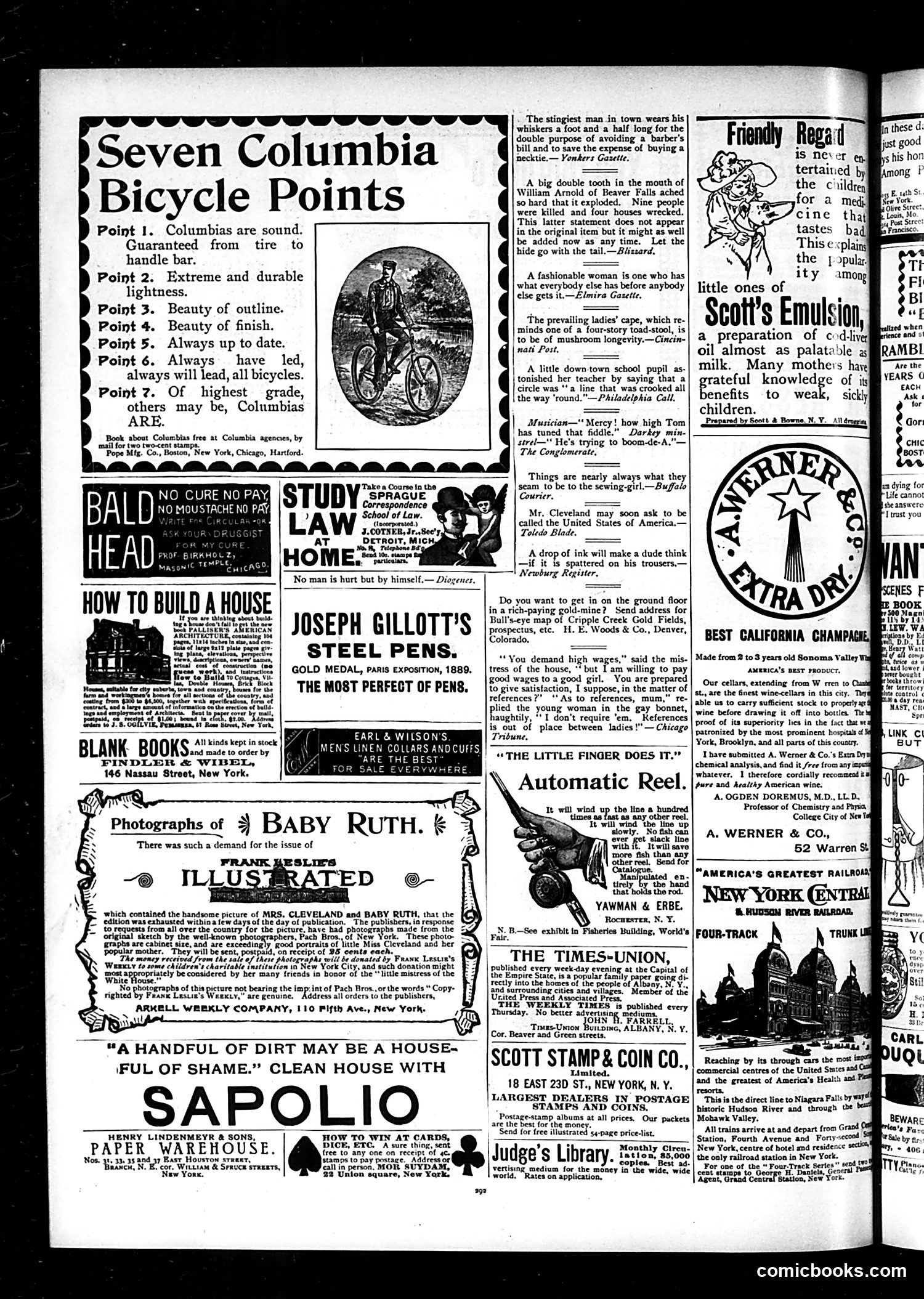
This is primarily an **advertising page** from Judge magazine, with minimal editorial cartoon content. The substantial text consists of commercial advertisements for bicycles (Columbia), steel pens (Joseph Gillott's), collars (Earl & Wilson's), and other products typical of late 19th-century periodicals. The few editorial snippets are brief humor items reprinted from other newspapers—small jokes about miserly men, odd teeth, fashionable women, and social types. These are generic satire without identifiable political figures or major social commentary. Notably, there's promotion for photographs of **Mrs. Cleveland and Baby Ruth** (the infant daughter of President Grover Cleveland), with proceeds benefiting children's charities. This reflects contemporary public fascination with the presidential family. The page reflects Judge's business model: combining light social satire with substantial advertising revenue, targeting middle-class American readers interested in consumer goods and gentle humor about everyday life rather than sharp political critique.
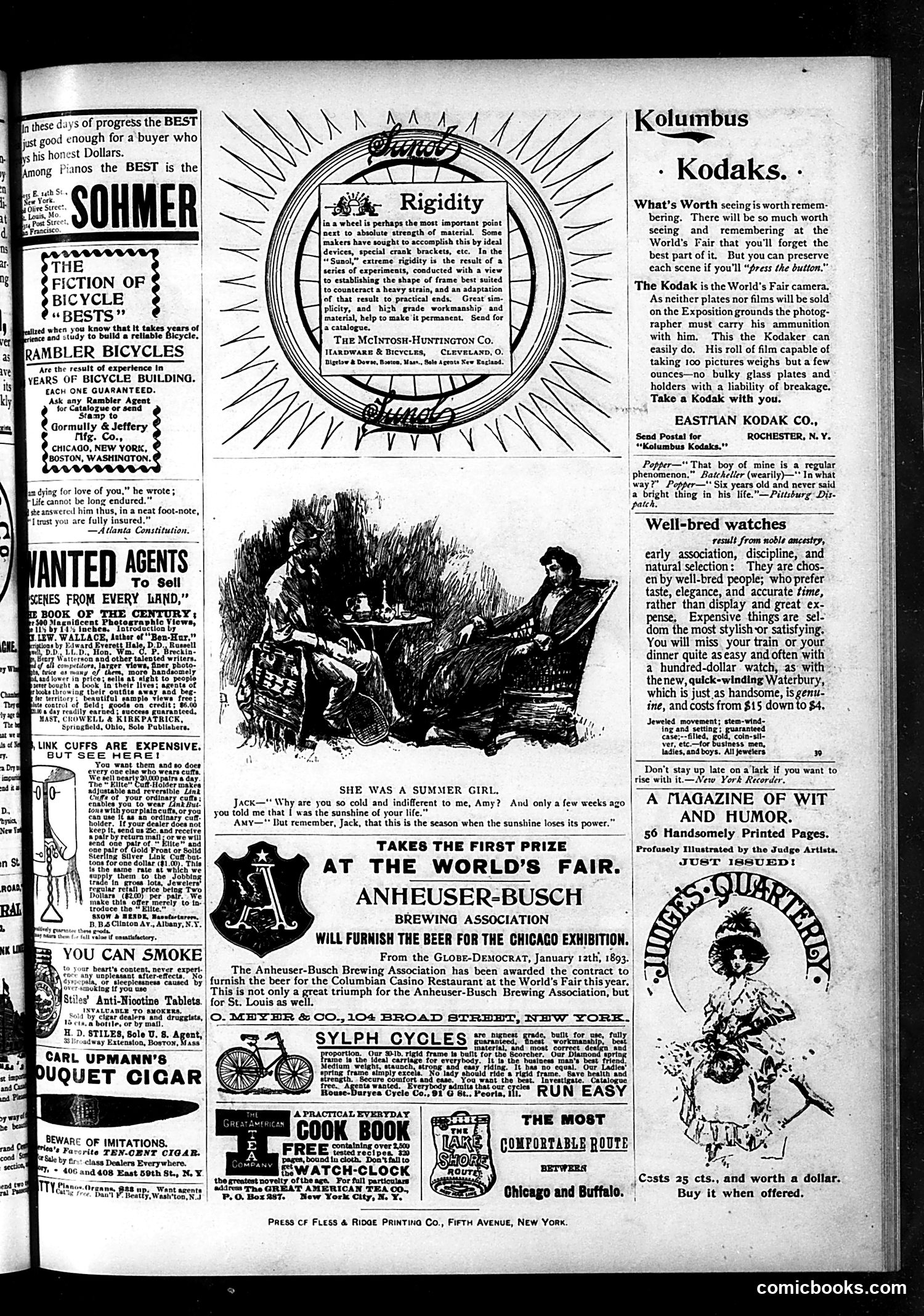
This is primarily an **advertising page** from Judge magazine (circa 1893, based on the World's Fair references). The main cartoon is a small dialogue between "Jack" and "Amy" discussing summer romance—a light romantic joke where Amy deflects Jack's declarations of love by noting that summer sunshine (and thus her affections) will fade with the season. The page is dominated by period **product advertisements**: pianos (Sommer), bicycles (Rambler, Sunol, Sylph Cycles), Kodak cameras, watches, cigars, and cooking implements. The **Kodak advertisement** is notably prominent, marketing cameras for the 1893 **World's Columbian Exposition** in Chicago. It emphasizes the camera's portability and practicality for tourists. Other minor jokes include advertisements with embedded humor (anti-nicotine tablets, expensive cuffs). The **Anheuser-Busch brewing company** advertisement claims their beer won "first prize" at the World's Fair—a significant marketing claim for a major American brand. Overall, this reflects late-Victorian consumer culture and early photography marketing.
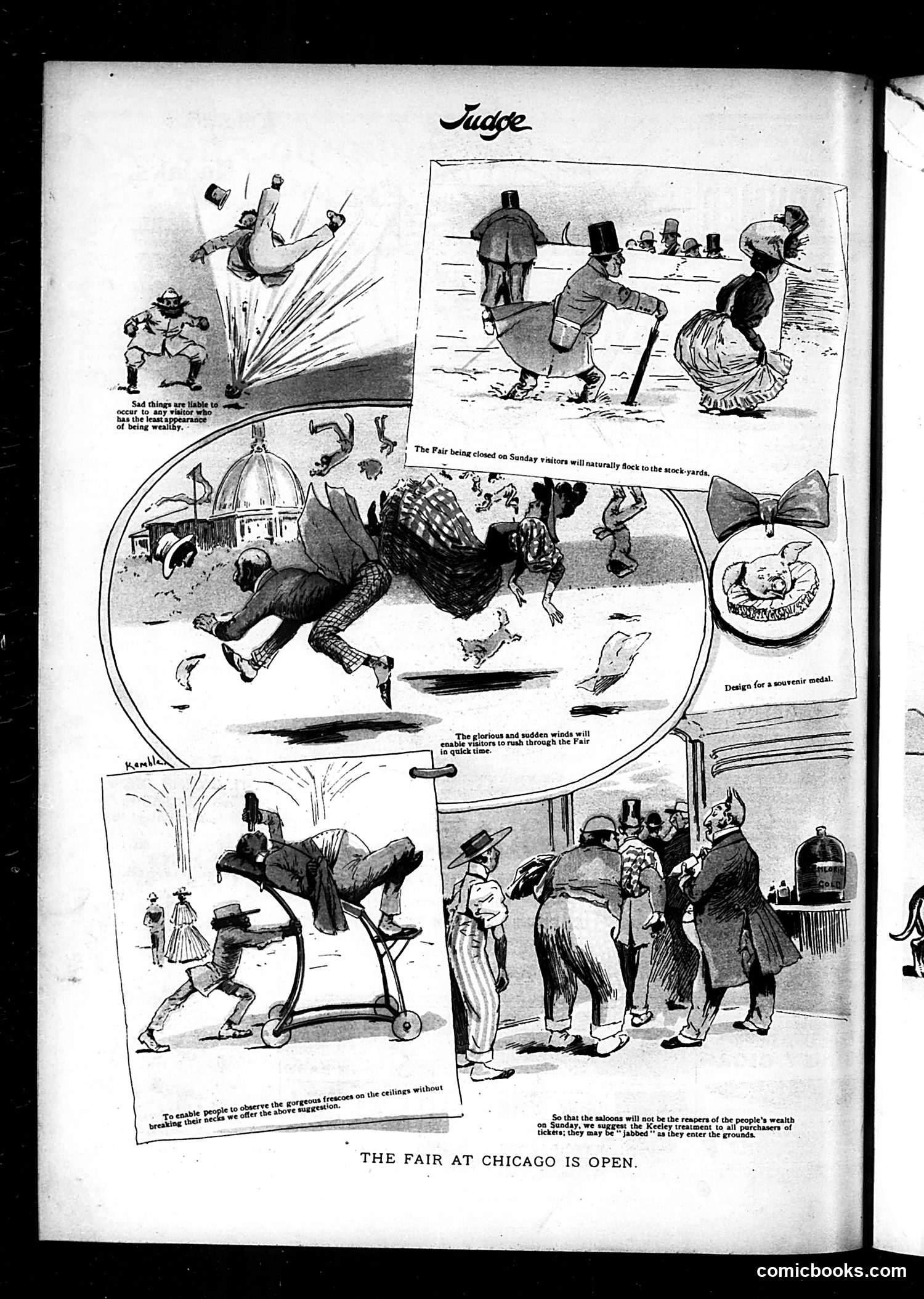
This page satirizes the 1893 World's Columbian Exposition in Chicago through multiple vignettes showing visitors experiencing mishaps and excess. The cartoons mock: 1. **Physical chaos at the Fair**: Visitors are blown about by winds, knocked down, and generally undignified—suggesting the overwhelming spectacle. 2. **Alcohol consumption**: References to "saloons" and "Keeley treatment" (a real period addiction cure) satirize heavy drinking among fairgoers. 3. **Social disorder**: Well-dressed attendees are depicted losing composure, their dignity stripped away by the Fair's attractions. The caption "So that the saloons will not be the reapers of the people's wealth" explicitly critiques how the Fair's commercial establishments—particularly bars—exploit visitors' money. The overall message: the Fair, despite its architectural grandeur, reduces civilized people to chaos and financial ruin through intoxication and excess.