
Judge, 1893-05-06 · page 2 of 16
Judge — May 6, 1893 — page 2: what you’re looking at
What you’re looking at
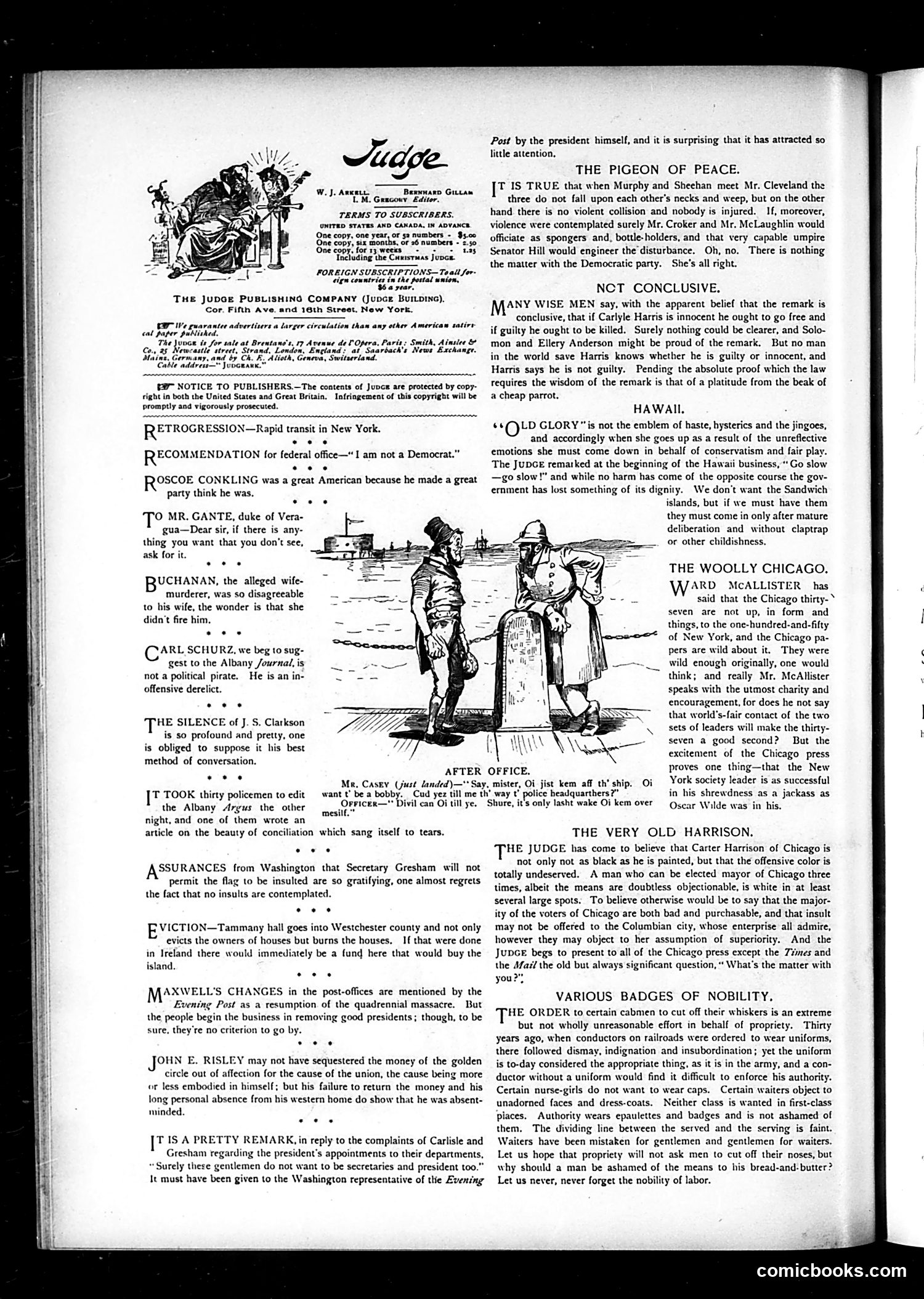
This page contains several brief political commentary items typical of Judge magazine's satirical format. The main cartoon, titled "AFTER OFFICE," depicts two figures in conversation by water, likely commenting on political appointments or patronage. The text items mock various political figures and situations: - References to Carlyle Harris (appears to be a criminal case) - Comments on Chicago politics and "Carter Harrison" as mayor - Criticism of President Cleveland's appointment decisions - Observations about railroad conductors and workplace hierarchies The cartoon and items together reflect turn-of-the-century American political satire, targeting Democratic appointments, urban corruption, and social pretension. Without clearer identification of specific figures or dates in the image itself, precise historical context remains unclear, though the tone suggests criticism of Democratic party politics and urban machine operations.
📄 Transcribed text from this page (OCR, searchable)
Machine-transcribed from the original scan — historical spelling and the odd misread are preserved.
uae. W. J. Ameen. Bassano Gian LM. Geacouy Editor. TERMS TO SUBSCRIBERS. OMFTED STATES AND CAMADA, IM ADVANCE One copy, one year, or sa numbers - $5.00 One copy, six months, or 26 numbers One copy, for rz weees = - = = Including the Cuxtstmas Jupce. FOREIGN SUBSCRIPTIONS Teall for sign countries to the otal wate Sa year THe JUDOE PUBLISHING COMPANY (JuDce BUILDING), Cor. Fifth Ave. and 16th Street. New York. $0 ery (W-We guarantee advertisers a larger circulation thi cal paper published. Ge The \vooe is for sate at Brentane't, 17 Avenue de POpera, Paris: Smith, Ainsice & 4 a5 Newcastle strect, Strand, London, England: at Saarbach's News Exchange. Germany, and 63 Ch. F., Alioth, Geneva, Switserland. any other American satire {27 NOTICE TO PUBLISHERS.—The contents of Juvox are protected by cop7- right in both the United States and Great Britain. Infringement of this copyright will be promptly and vigorously prosecuted. RRETROGRESSION=Rapid. transit in New York. RECOMMENDATION for federal office—“ I am not a Democrat.” eee ROscoE CONKLING was a great American because he made a great party think he was. . T° MR. GANTE, duke of Vera- gua—Dear sir, if there is any- thing you want that you don’t see, ask for it. BUCHANAN, the alleged wife- murderer, was so disagreeable to his wife, the wonder is that she didn’t fire him. GEARe SCHURZ, we beg to sug- gest to the Albany Journal, is not a political pirate. offensive derelict. He is an in- THE SILENCE of J. S. Clarkson is so profound and pretty, one is obliged to suppose it his best method of conversation. [7 TOOK thirty poticemen to edit ee Mr. Casey (just landed)—* Sa want t' bea bobby. Cud yez till me th’ the Albany Argus the other Orricer—" Divil can Oi till ye, Shure, it's only lasht wake Oi kem over ; mesil night, and one of them wrote an article on the beauty of conciliation which sang itself to tears. ASSURANCES from Washington that Secretary Gresham will not permit the flag to be insulted are so gratifying, one almost regrets the fact that no insults are contemplated. cee EVICTION—Tammany hall goes into Westchester county and not only evicts the owners of houses but burns the houses. If that were done in Ireland there would immediately be a fund here that would buy the island. Maxw CHANGES in the post-offices are mentioned by the Evening Post as a resumption of the quadrennial massacre. But the people begin the business in removing good presidents; though, to be OHN E. RISLEY may not have sequestered the money of the golden circle out of affection for the cause of the union, the cause being more or less embodied in himself; but his failure to return the money and his long personal absence from his western home do show that he was absent- minded. [715A PRETTY REMARK, in reply to the complaints of Carlisle and Gresham regarding the president's appointments to their departments, “Surely these gentlemen do not want to be secretaries and president too.” It must have been given to the Washington representative of thie Evening AFTER OFFICE. Post by the president himself, and it is surprising that it has attracted so little attention, [7 1S TRUE that when Murphy and Shechan meet Mr. Cleveland the three do not fall upon each other's necks and weep, but on the other hand there is no violent collision and nobody is injured. If, moreover, violence were contemplated surely Mr. Croker and Mr. McLaughlin would officiate as spongers and, bottle-holders, and that very capable umpire Senator Hill would engineer the’disturbance. Oh, no. There is nothing the matter with the Democratic party. She's all right. THE PIGEON OF PEACE. NCT CONCLUSIVE. MANY WISE MEN say, with the apparent belief that the remark is conclusive, that if Carlyle Harris is innocent he ought to go free and if guiky he ought to be killed. Surely nothing could be clearer, and Solo- mon and Ellery Anderson might be proud of the remark. But no man in the world save Harris knows whether he is guilty or innocent, and Harris says he is not guilty. Pending the absolute proof which the law requires the wisdom of the remark is that of a platitude from the beak of a cheap parrot. HAWAII 66Q)LD GLORY “is not the emblem of haste, hysterics and the jingoes, and accordingly when she goes up as a result of the unreflective emotions she must come down in behalf of conservatism and fair play. The JUDGE remarked at the beginning of the Hawaii business, “Go slow —go slow!” and while no harm has come of the opposite course the gov- ernment has lost something of its dignity. We don’t want the Sandwich islands, but if we must have them they must come in only after mature deliberation and without claptrap or other childishness. THE WOOLLY CHICAGO. W ARD MCALLISTER has said that the Chicago thirty- seven are not up, in form and things, to the one-hundred-and-filty of New York, and the Chicago pa- pers are wild about it. They were wild enough originally, one would think; and really Mr. McAllister speaks with the utmost charity and encouragement, for does he not say that world’s-fair contact of the two sets of leaders will make the thirty- seven a good second? But the excitement of the Chicago press proves one thing—that the New York society leader is as successful in his shrewdness as a jackass as Oscar Wilde was in his. mister, Oi jist kem aff th’ ship. Oi ay t’ police headquarthers?” THE VERY OLD HARRISON. THE JUDGE has come to believe that Carter Harrison of Chicago is not only not as black as he is painted, but that the offensive color is totally undeserved. A man who can be elected mayor of Chicago three times, albeit the means are doubtless objectionable, is white in at least several large spots. To believe otherwise would be to say that the major- ity of the voters of Chicago are both bad and purchasable, and that insult may not be offered to the Columbian city, whose enterprise all admire, however they may object to her assumption of superiority. And the JUDGE begs to present to all of the Chicago press except the 7ymes and the Afaz? the old but always significant question, “ What's the matter with you?" VARIOUS BADGES OF NOBILITY, HE ORDER to certain cabmen to cut off their whiskers is an extreme but not wholly unreasonable effort in behalf of propriety. Thirty years ago, when conductors on railroads were ordered to wear uniforms, there followed dismay, indignation and insubordination; yet the uniform is to-day considered the appropriate thing, as it is in the army, and a con- ductor without a uniform would find it difficult to enforce his authority. Certain nurse-girls do not want to wear caps. Certain waiters object to unadorned faces and dress-coats. Neither class is wanted in first-class piaces. Authority wears epaulettes and badges and is not ashamed of them. The dividing line between the served and the serving is faint. Waiters have been mistaken for gentlemen and gentlemen for waiters. Let us hope that propriety will not ask men to cut off their noses, but why should a man be ashamed of the means to his bread-and:butter? Let us never, never forget the nobility of labor. comicbooks.com