
A complete issue · 16 pages · 1893
Judge — February 25, 1893
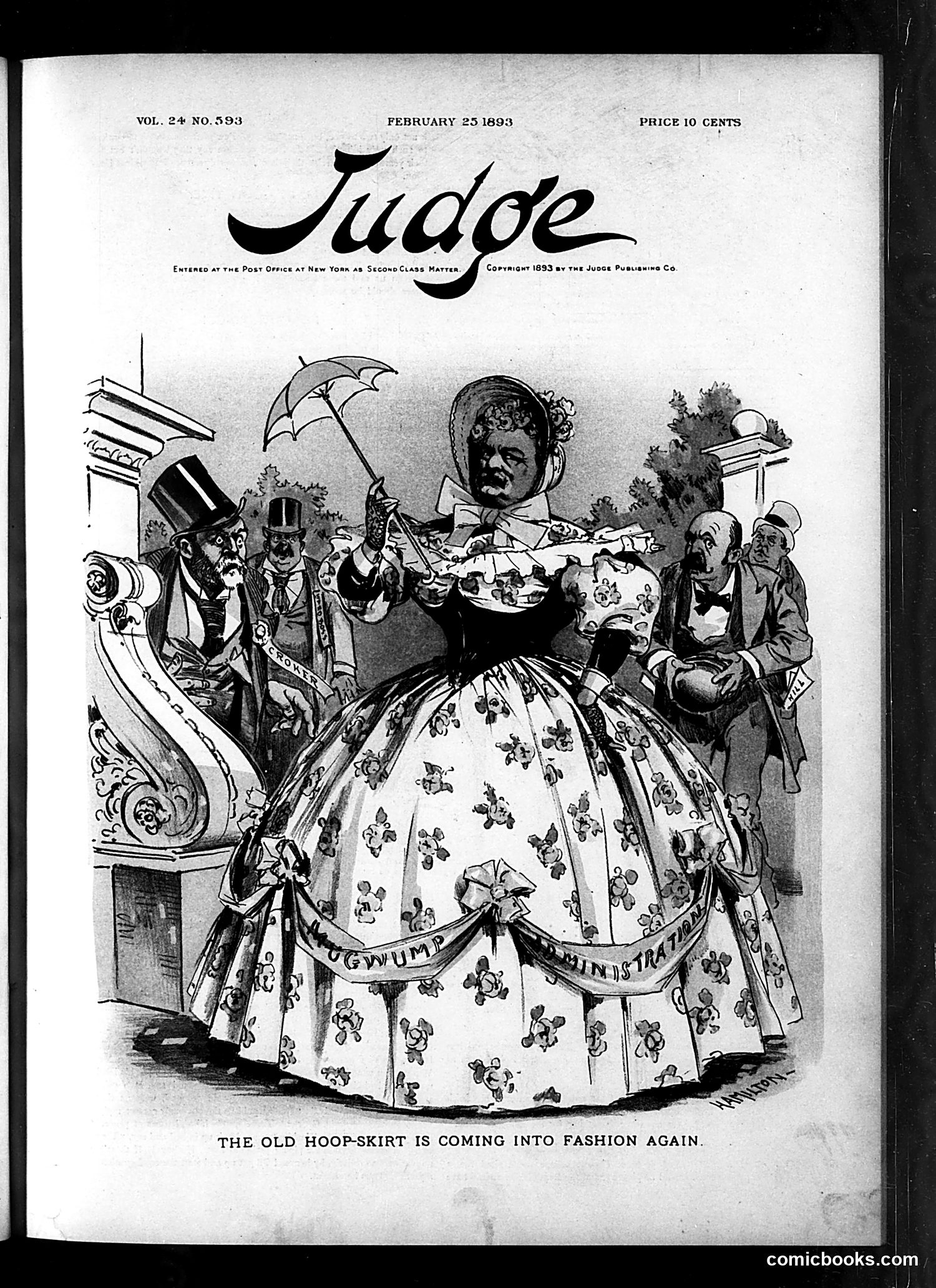
This 1893 *Judge* cartoon satirizes the cyclical nature of women's fashion. The central figure wears an exaggerated hoop-skirt (a dome-shaped petticoat structure popular decades earlier), accompanied by onlookers in contemporary dress who appear amused or bewildered by the revival. The satire targets two things: the absurdity of fashion cycles that resurrect uncomfortable, impractical styles, and perhaps women's supposed susceptibility to such trends. The grotesquely oversized skirt and the caricatured reactions suggest the cartoonist views this fashion return as ridiculous. The onlookers' varied expressions—from interest to skepticism—indicate social commentary on changing tastes and the fashion industry's influence on women's clothing choices.
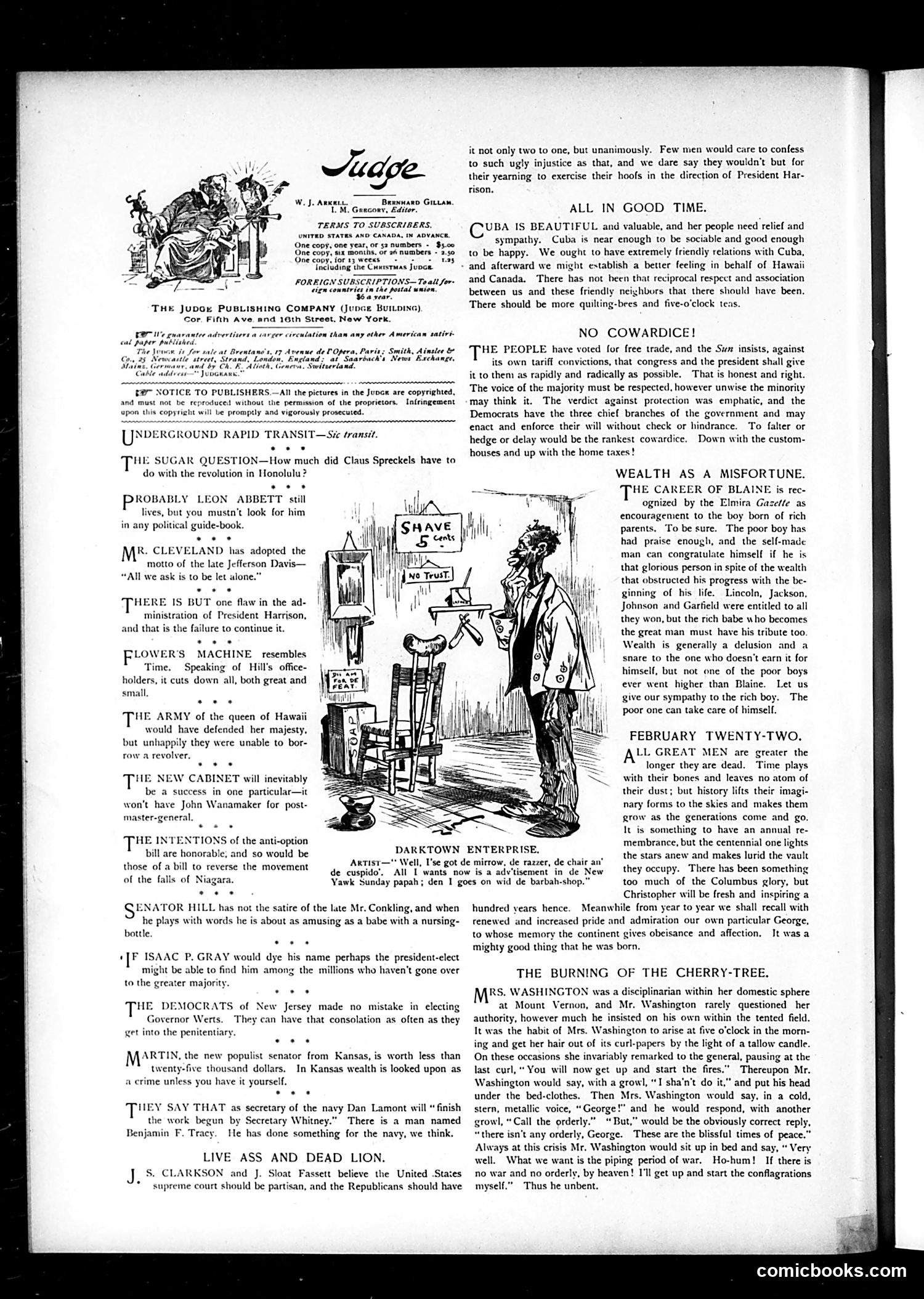
This cartoon depicts a street scene with a Black man operating a makeshift barber stand, labeled "Darktown Enterprise." The figure appears to be shaving a customer using crude implements near storefronts. The satire reflects late-19th-century *Judge* magazine's racial humor, which stereotyped African Americans through caricature. The "darktown" framing—common in period publications—presented Black urban life as comical and improvised. The makeshift barber setup mocks both the entrepreneur's ambitions and working-class Black business ventures. The accompanying text quotes suggest commentary on urban enterprise and self-improvement, though the visual presentation relies on racist caricature typical of the era. This represents problematic historical humor that Judge's audience would have found entertaining.
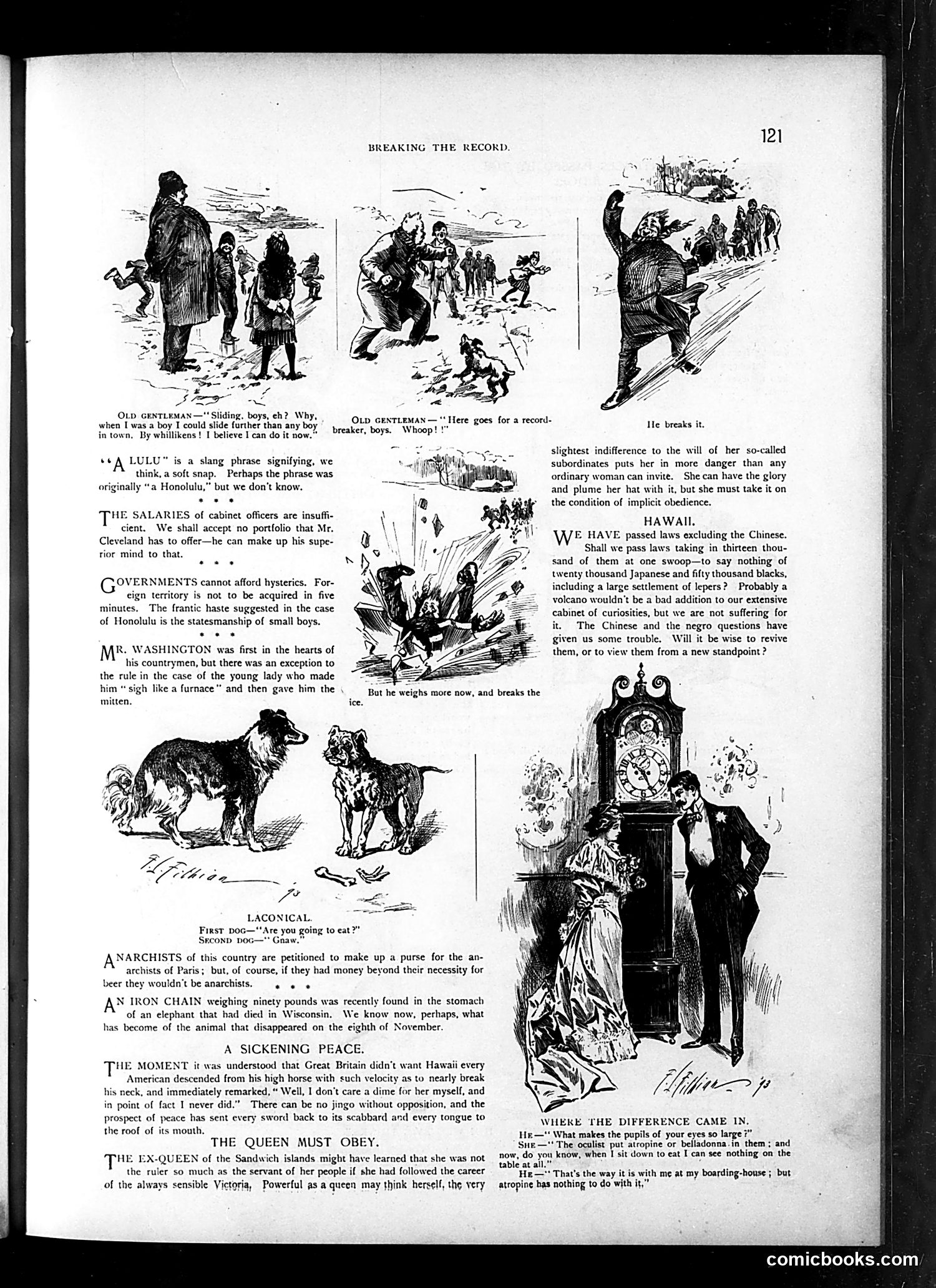
This page contains miscellaneous satirical commentary and illustrations typical of Judge magazine's format. **Top cartoons**: Depict ice-skating scenes with captions about "sliding" and "breaking records," using winter sports as metaphors for social behavior—likely commentary on competitive excess or reckless ambition. **Text sections** address contemporary issues: cabinet salary insufficiency, government inefficiency, and Hawaii policy. One notable passage criticizes exclusionary laws targeting Chinese immigrants, questioning whether reviving "the Chinese and negro questions" is wise policy. **"A Sickening Peace"** section discusses Britain and Hawaii, appearing to reference diplomatic tensions or colonial disputes. **Lower cartoon** ("Where the Difference Came In") shows a domestic scene with a clock, likely satirizing class differences or marital discord. The page reflects Judge's typical blend of political critique, social commentary, and visual humor aimed at educated, middle-class readers.
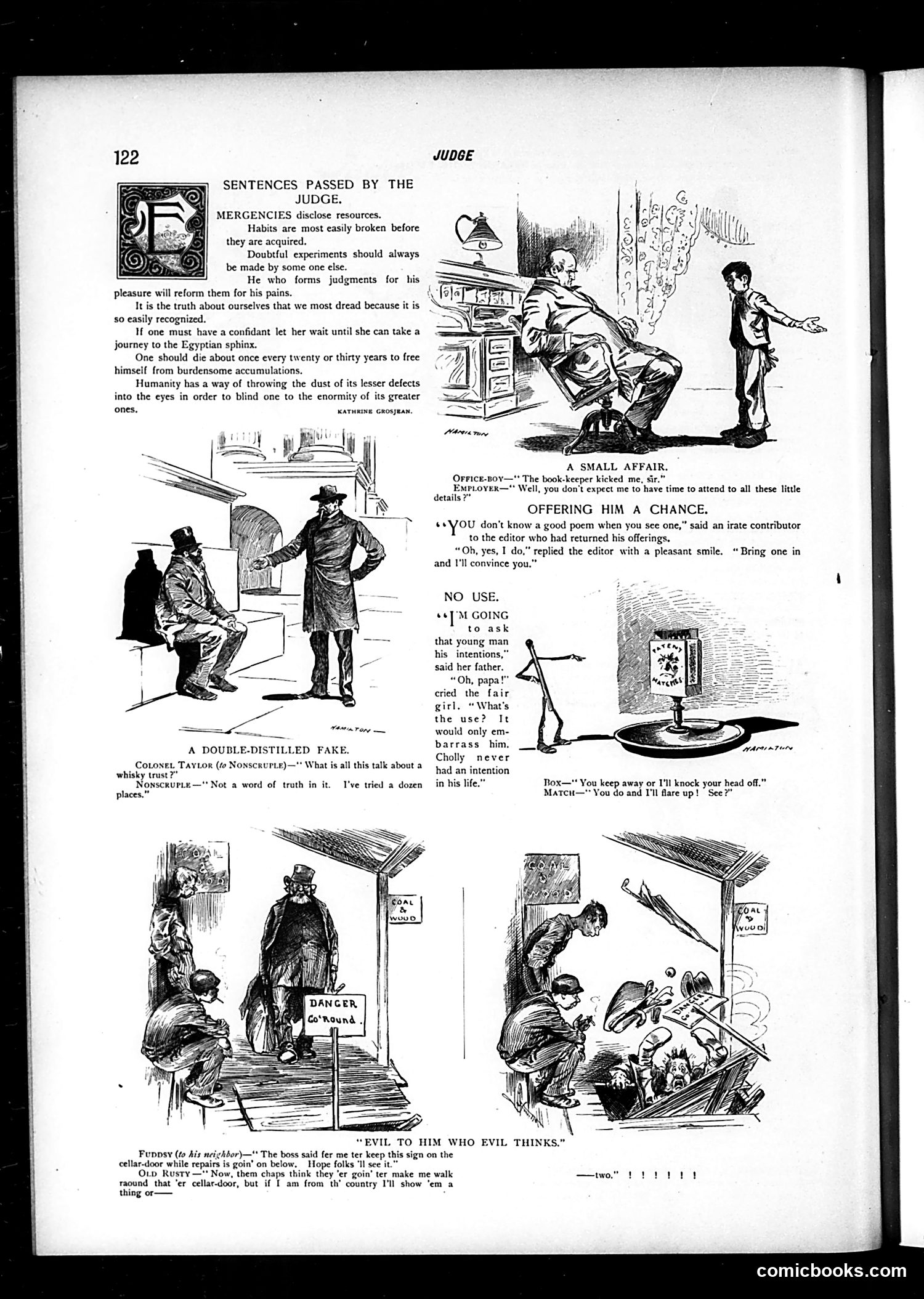
This page collects humorous satirical pieces typical of Judge magazine's social commentary. **"A Small Affair"** mocks workplace indifference—an office boy reports being kicked by the bookkeeper, but the employer dismisses it as a trivial detail beneath his notice. **"Offering Him a Chance"** satirizes editorial gatekeeping: an angry rejected poet insists the editor can't recognize good poetry, while the editor confidently invites him to submit something better. **"No Use"** jokes about courtship rituals—a father plans to ask a suitor about his intentions, but his daughter argues it's pointless because the young man has never considered marriage anyway. **"A Double-Distilled Fare"** appears to reference debates about alcohol regulation (the "whisky trust"), with a character claiming personal testing disproved concerns. **"Evil to Him Who Evil Thinks"** depicts working-class characters discussing a cellar-door assignment, with mock-rural dialect suggesting laborers outwitting their employers. The page emphasizes Judge's satirical style: lampooning middle-class pretension, workplace dynamics, and social hypocrisy through quick comic vignettes.
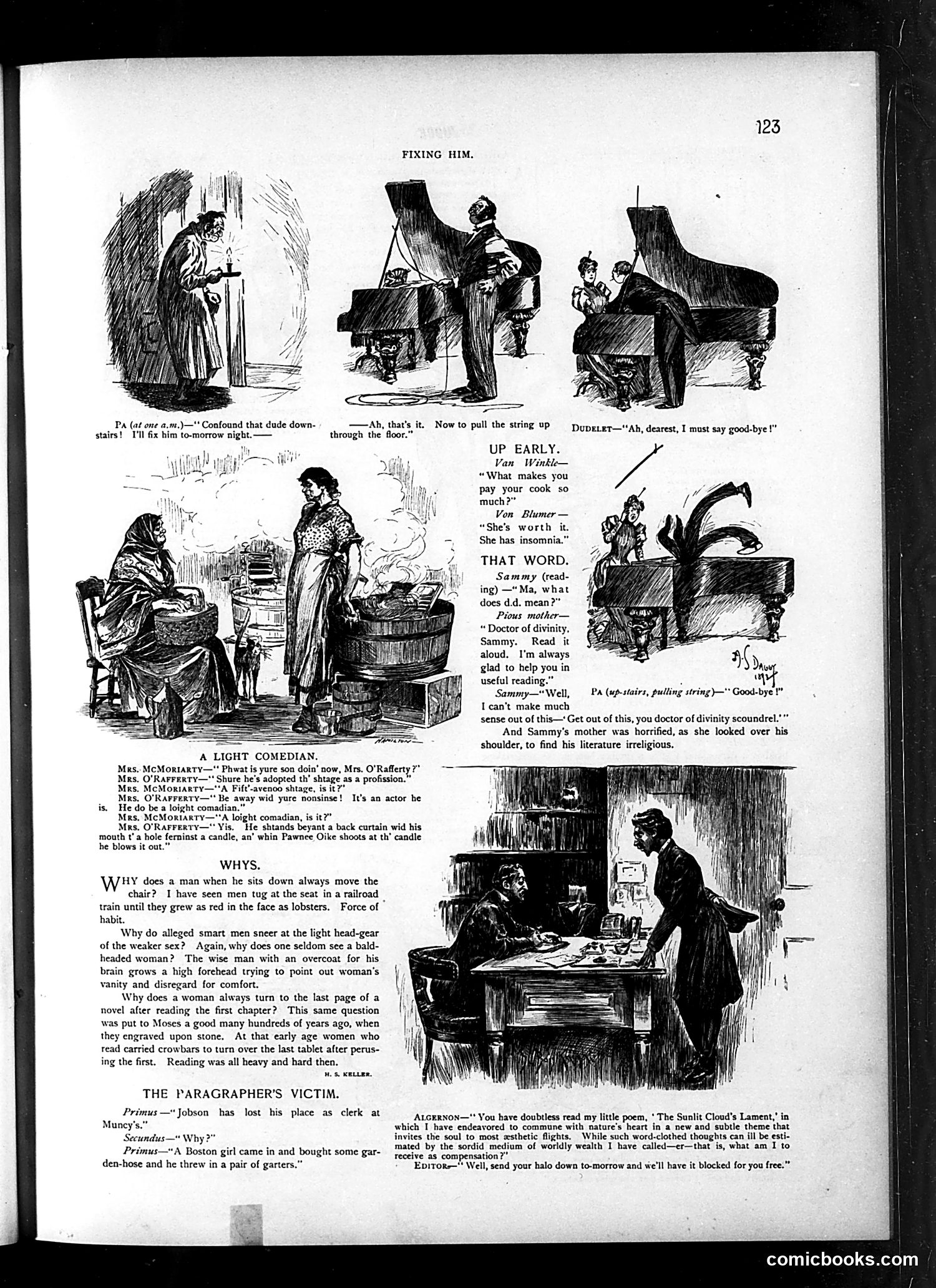
This page contains multiple short satirical pieces typical of late 19th-century American humor: **"Fixing Him"** depicts a domestic quarrel where a husband, annoyed by a "dude" upstairs, plots revenge by pulling a string—apparently connected to his wife's romantic rendezvous, creating comic marital chaos. **"Up Early"** mocks wealthy pretension: a cook's insomnia is presented as a luxury status symbol justifying high wages. **"That Word"** plays on misreading: a boy reads "d.d." (Doctor of Divinity) in literature as profanity, horrifying his pious mother—satirizing both parental naiveté and snobbish literature. **"Light Comedian"** uses Irish dialect humor (common in period Judge content) where an immigrant's son is described as an actor who merely stands behind a curtain while someone shoots at a candle he blows out—mocking both theatrical pretension and Irish-American stereotypes. **"Whys"** offers philosophical observations on human behavior with gentle misogyny typical of the era. **"The Paragrapher's Victim"** satirizes struggling poets seeking payment for contributions, with editors deflecting with absurdist humor. The overall tone reflects Gilded Age American satire targeting social pretension, gender dynamics, and immigrant stereotypes.
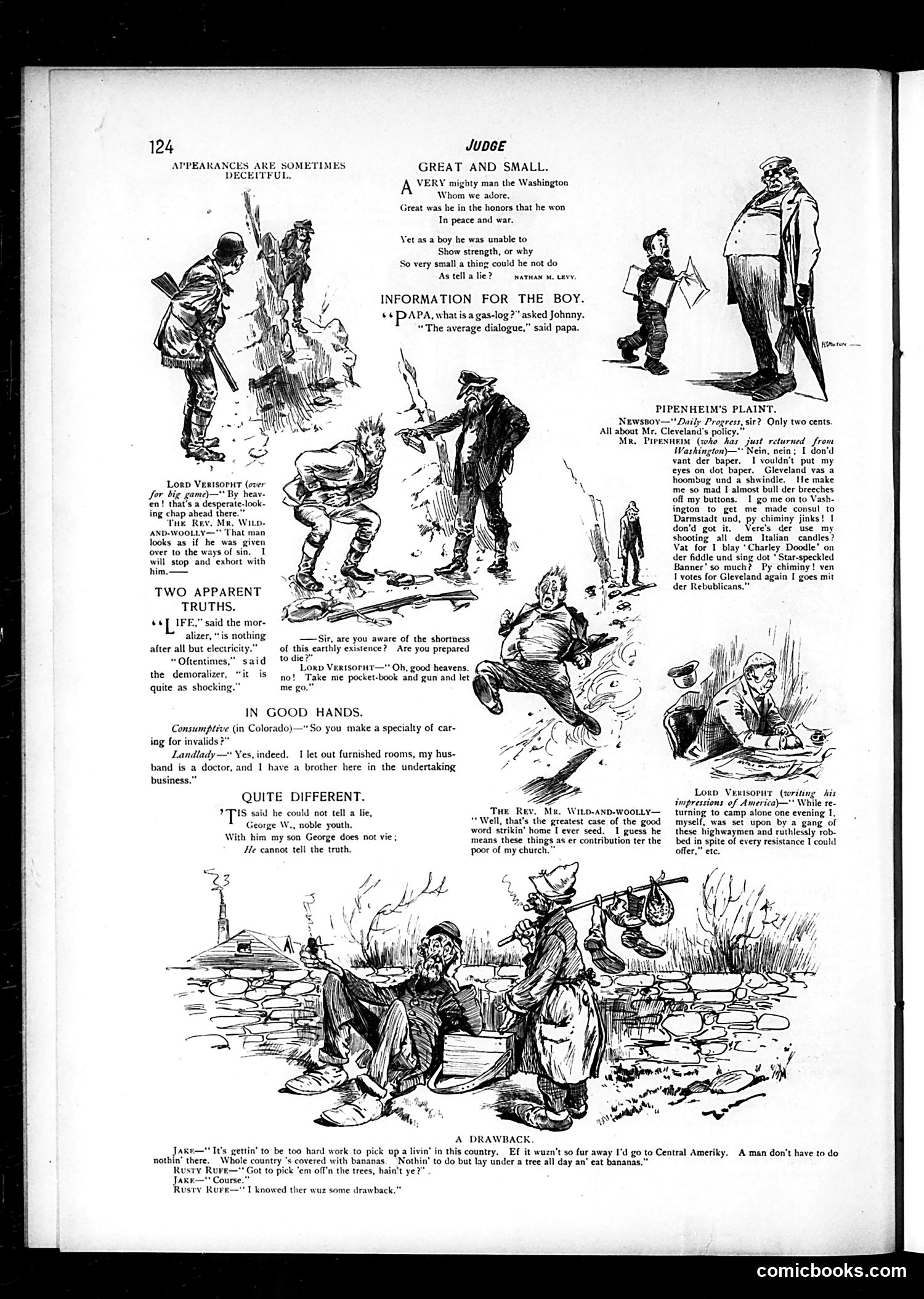
This page contains multiple satirical sketches targeting **President Grover Cleveland** and American political/social issues of his era. **Key targets:** 1. **Cleveland's unpopularity**: A German immigrant newsboy refuses the "Daily Progress" because he won't read about Cleveland, calling him a "hoombug und a shwindle" who denied him a consular appointment. This mocks both Cleveland's failed patronage system and immigrant frustration. 2. **"Lord Versourit" sketches**: A wealthy aristocratic figure appears in multiple vignettes, satirizing upper-class hypocrisy—preaching morality while evading taxes, contradicting themselves, and getting robbed while traveling. 3. **Social commentary**: Sketches mock various absurdities: fake dialogue about "gas-logs," a Colorado landlady whose family includes both doctor and undertaker (darkly implying conflict of interest), and Americans considering emigration to Central America for easy living. The overall tone criticizes political corruption, class pretension, and American materialism during Cleveland's presidency.
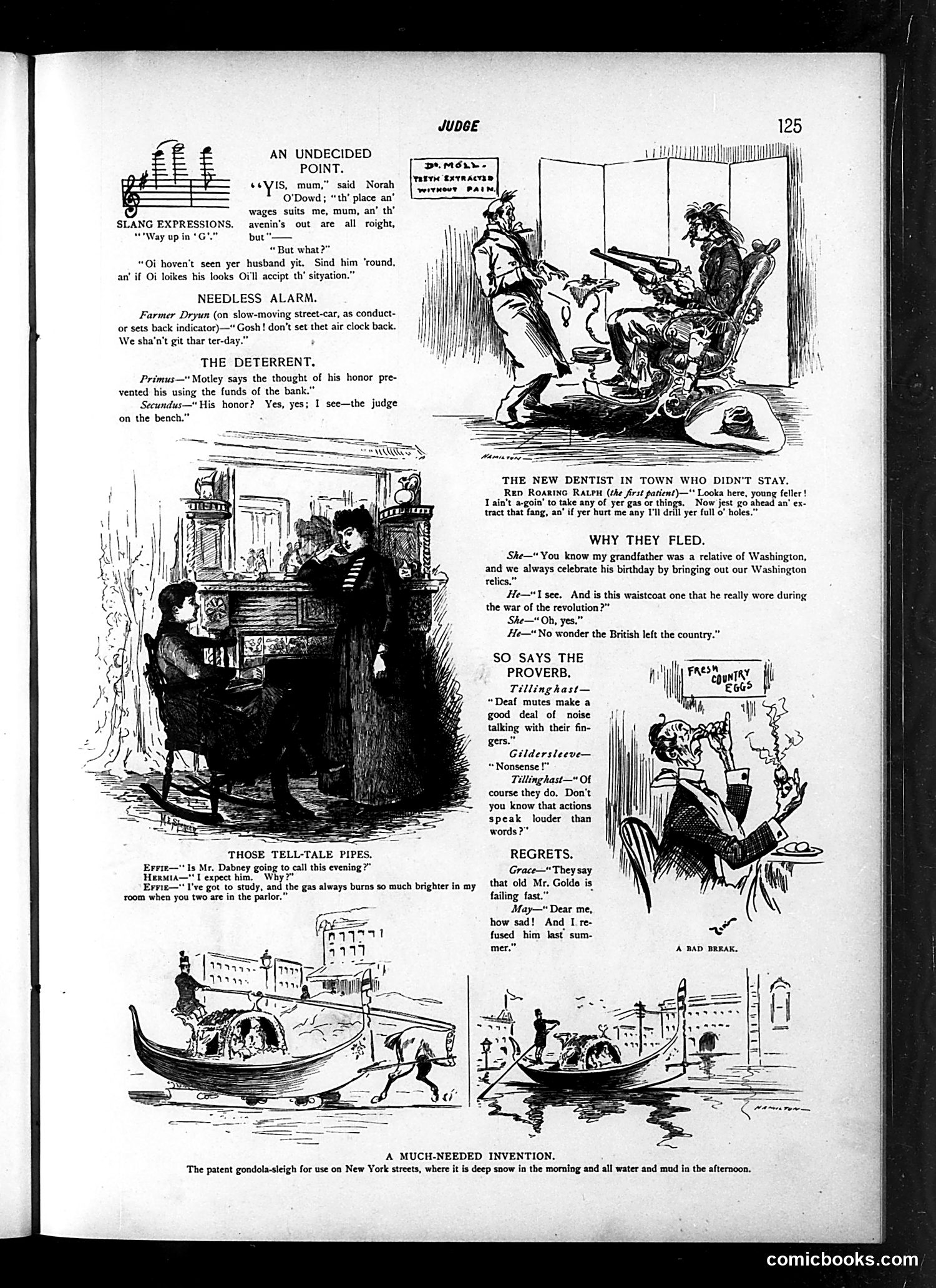
This page from *Judge* magazine contains several unrelated satirical sketches targeting everyday American life and social pretension: **"An Undecided Point"** mocks working-class Irish domestics through dialect humor—a servant agrees to a job but insists on approving the husband first. **"The Deterrent"** jokes about bank honor: a man claims moral principles prevented embezzlement, though the punchline suggests his reputation matters only in his judicial position. **"The New Dentist"** presents rough frontier dentistry ethics—a patient threatens to retaliate violently if hurt. **"Why They Fled"** ridicules American snobbery about Revolutionary War ancestry, suggesting a shabby inherited waistcoat was so poor that the British fled rather than endure it. **"So Says the Proverb"** plays on the phrase "actions speak louder than words" by noting deaf-mutes' gestural communication is literally noisy. The page concludes with a practical joke about New York winter conditions requiring a "gondola-sleigh" to navigate streets alternating between snow and mud. These sketches reflect *Judge*'s typical blend of social satire, puns, and class-based humor targeting immigrants and pretentious Americans.
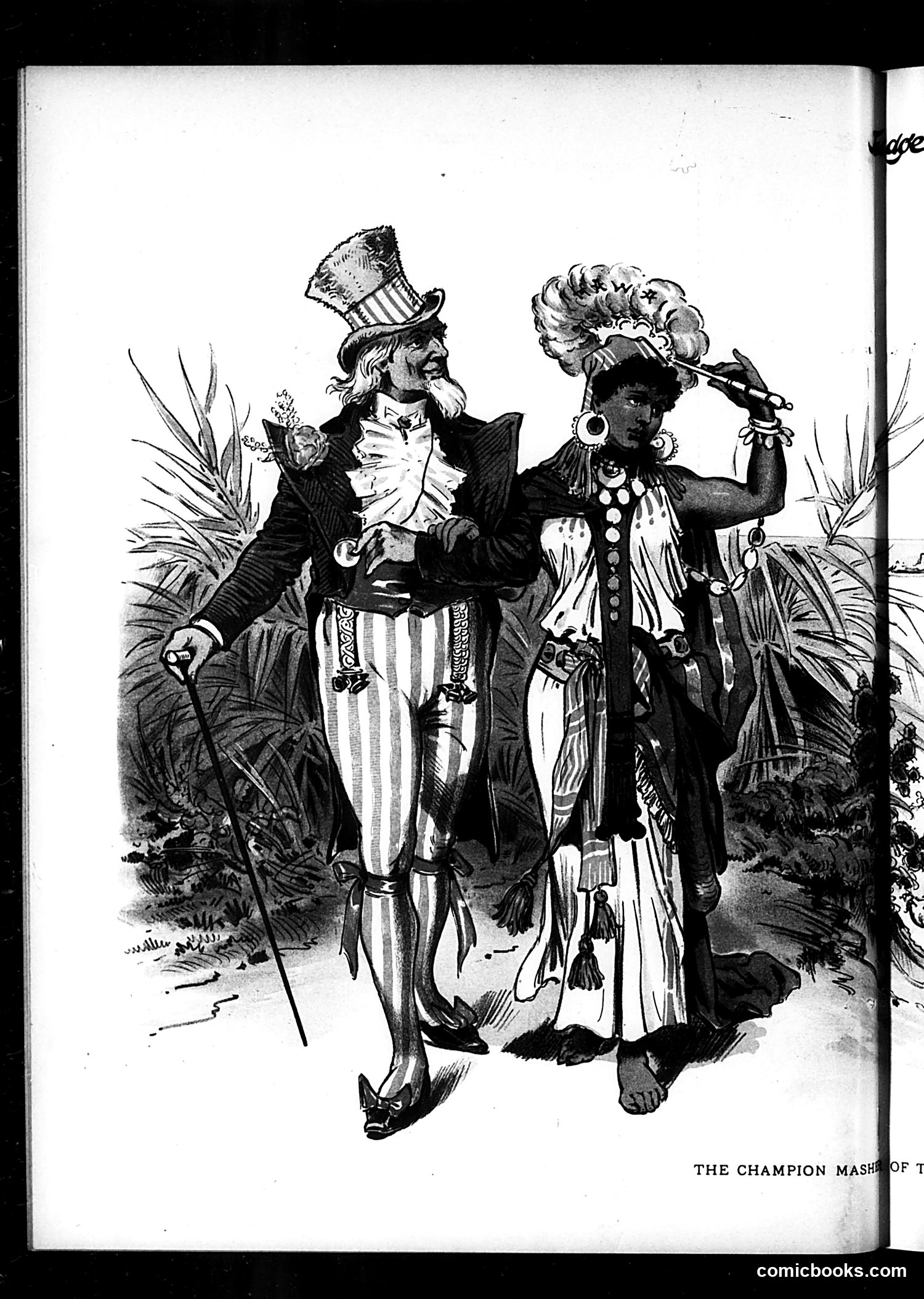
This political cartoon appears incomplete—the caption is cut off mid-word ("THE CHAMPION MASH OF T..."). The image depicts two figures in elaborate 19th-century dress in a tropical setting (suggested by the palm vegetation). The left figure wears a tall striped hat, formal coat, and holds a cane—classical Uncle Sam imagery. The right figure is depicted with caricatured features stereotypically used in that era's racist illustrations, wearing ornate clothing and a large feathered headdress. Without the complete caption, I cannot definitively identify which specific historical event or political conflict this satirizes. The style and composition suggest commentary on American foreign relations or imperial expansion, likely from the late 1800s-early 1900s. The "mash" reference may suggest courtship or diplomatic negotiation, but fuller context is needed for accurate interpretation.
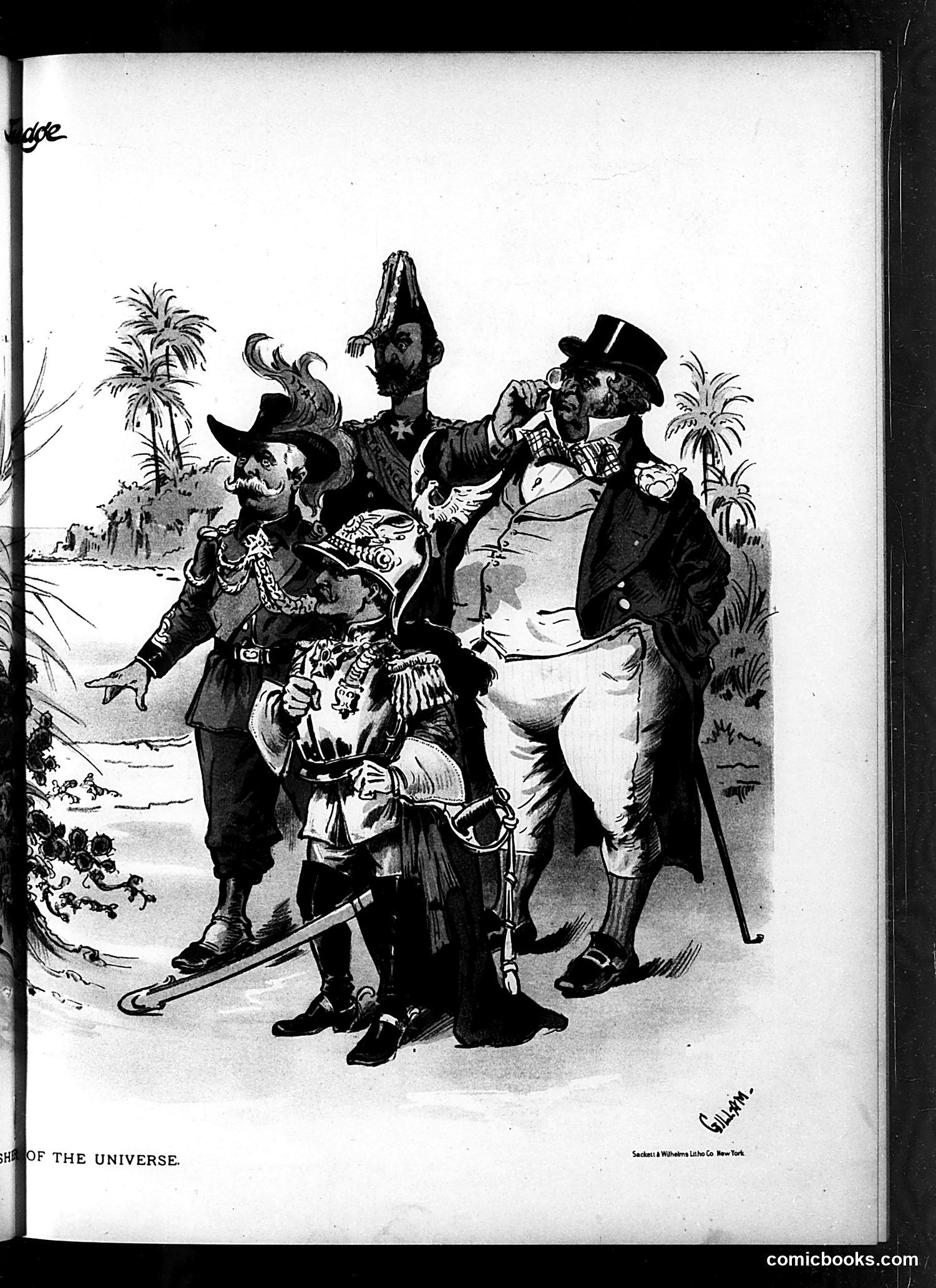
This appears to be a satirical cartoon depicting European imperial powers as grotesque, caricatured military figures in an exotic colonial setting (indicated by the palm trees). The central figure in elaborate military dress with a tall hat likely represents a Middle Eastern or Central Asian ruler, surrounded by Western diplomats or military officers in top hats. The title "Shah of the Universe" suggests mockery of imperial pretensions—the satire appears to ridicule either the Shah of Persia's grandiose claims to power or European powers' arrogant colonial ambitions. The exaggerated uniforms, medals, and theatrical poses emphasize the absurdity of imperial posturing. Without the publication date visible, the specific historical event remains unclear, but this reflects Judge magazine's typical late-19th/early-20th-century commentary on imperial competition and international diplomacy.
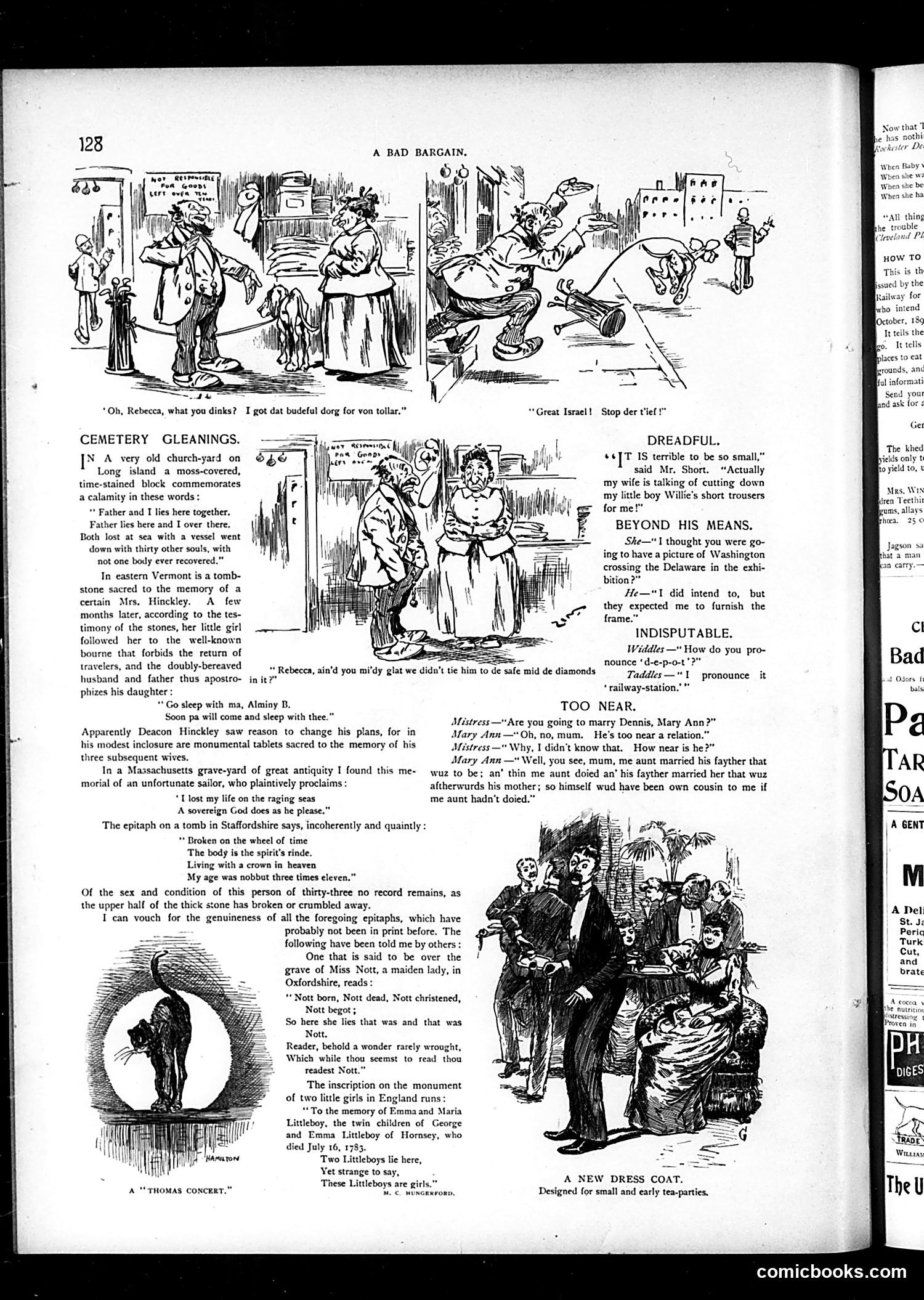
**"A Bad Bargain"** (top): A man with a Yiddish accent brags about purchasing a dog for one dollar, while the animal appears to be causing chaos in the street—stealing from a vendor and generally misbehaving. The joke is the ironic "bargain": he saved money but got a worthless, troublemaking dog. This reflects period stereotypes of immigrant Jewish merchants and their supposedly sharp but ultimately foolish deals. **"Cemetery Gleanings"** (left): A humorous essay collection of actual gravestone epitaphs and inscriptions, including darkly comic family tragedies and wordplay (like the "Nott" epitaph playing on the surname). **"Beyond His Means," "Too Near," and other shorts** (right): Brief joke vignettes about marital problems, Irish dialect ("fayther"), and class anxieties—a man can't afford to frame a painting, a woman explains her convoluted family relationship to her employer. The page represents typical Judge humor: immigrant caricature, domestic comedy, and sentimental-turned-absurd gravestone humor reflecting Victorian taste for macabre sentiment.
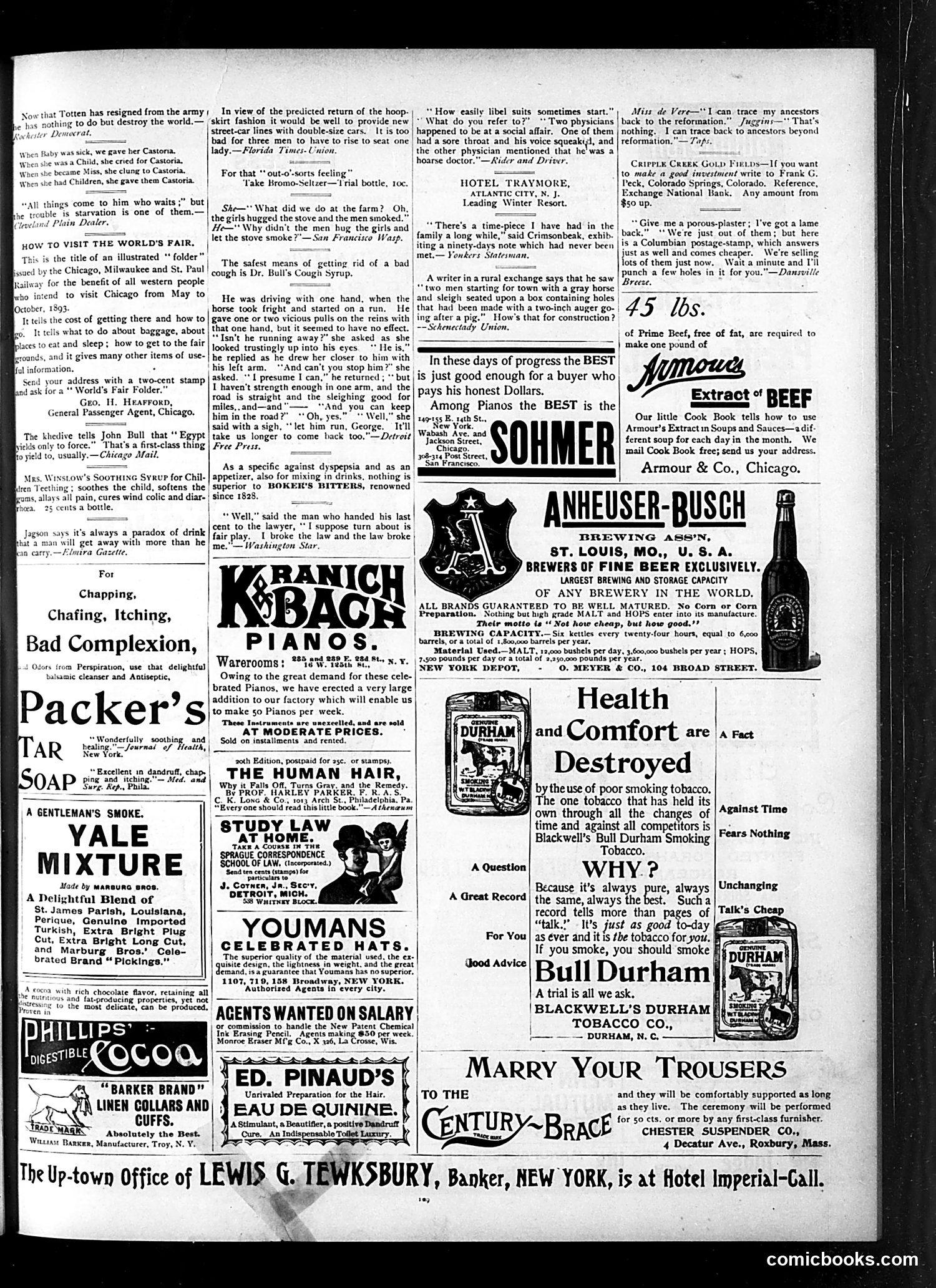
This page is primarily **advertising with minimal cartoon content**. The visible satirical material consists of brief joke items typical of Judge magazine's format: A small political reference appears in the opening line about "Totten" resigning from the army, though the full context is unclear—it likely references a contemporary military or political figure. The remaining content includes short humorous quips about social topics: women wearing hoop skirts on streetcars, farm courtship customs, and a man stopping a runaway horse. These are genteel, domestic humor typical of 1890s periodicals—gentle social observation rather than sharp satire. The bulk of the page features **advertisements** for products like Castoria (children's medicine), pianos, tobacco, hair products, and patent medicines—reflecting Judge's business model of combining light satire with lucrative advertising.
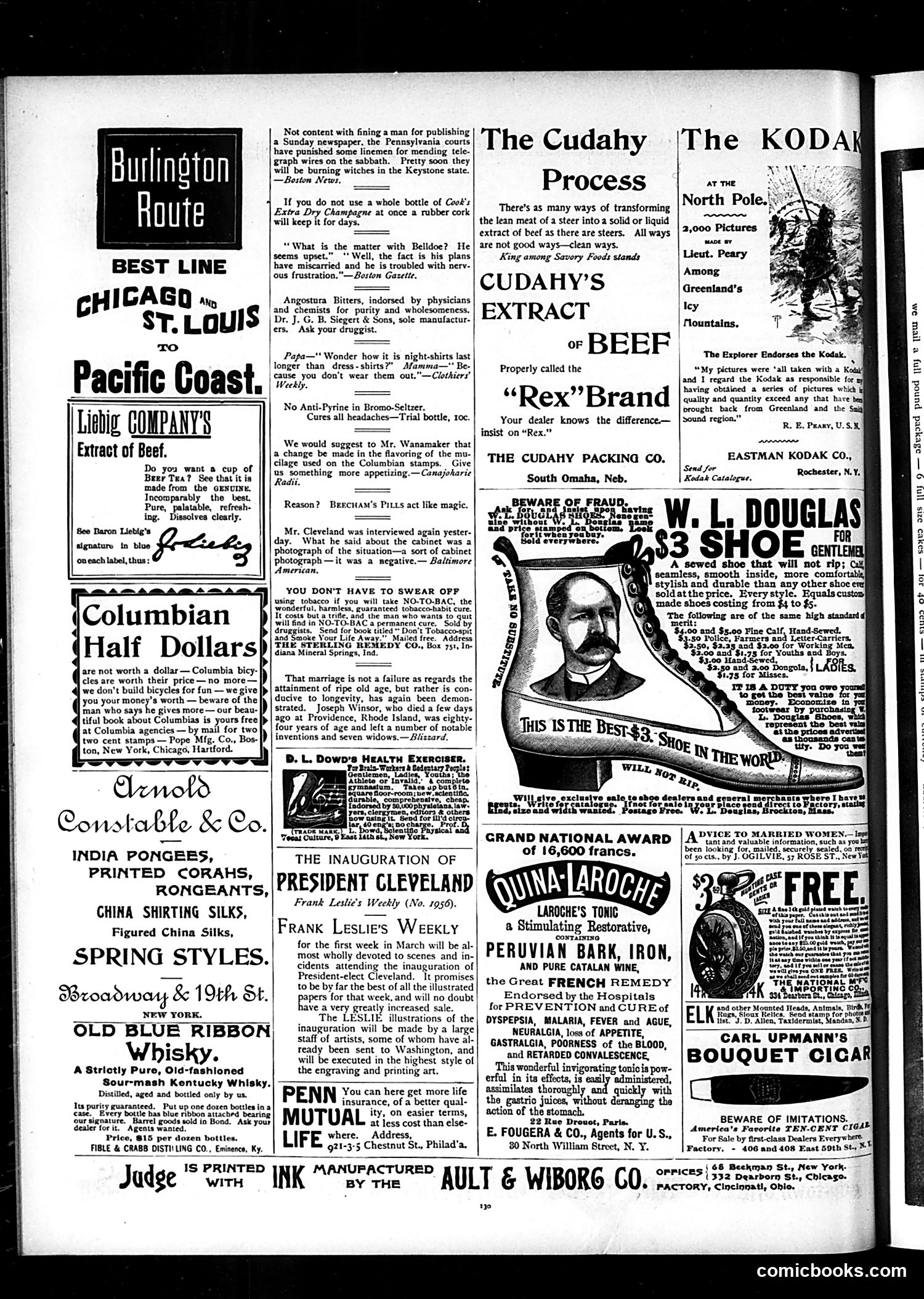
This page is primarily **advertising**, with scattered **brief jokes and social commentary** rather than significant cartoons. The short satirical items are mostly one-liners in 1880s-style satirical magazines, making light of contemporary life: Pennsylvania courts punishing people for working on Sundays, Cleveland's cabinet being "negative," and a joke about a man outliving seven wives (remarriage extending longevity). The largest illustrated content is **text about Frank Leslie's Weekly's** plans to cover President Cleveland's inauguration. The page otherwise consists entirely of **product advertisements**: bicycles, beef extract, champagne, whiskey, silk clothing, health remedies, tobacco cessation treatments, and patent medicines—typical Judge magazine filler. These ads represent the commercial and health products marketed to 1880s American consumers, many now recognized as quackery (tobacco cures, "anti-pyrine" headache powders). There is **no significant political cartoon or satire** visible here—this is a representative page showing how 19th-century magazines subsidized publication through abundant advertising.
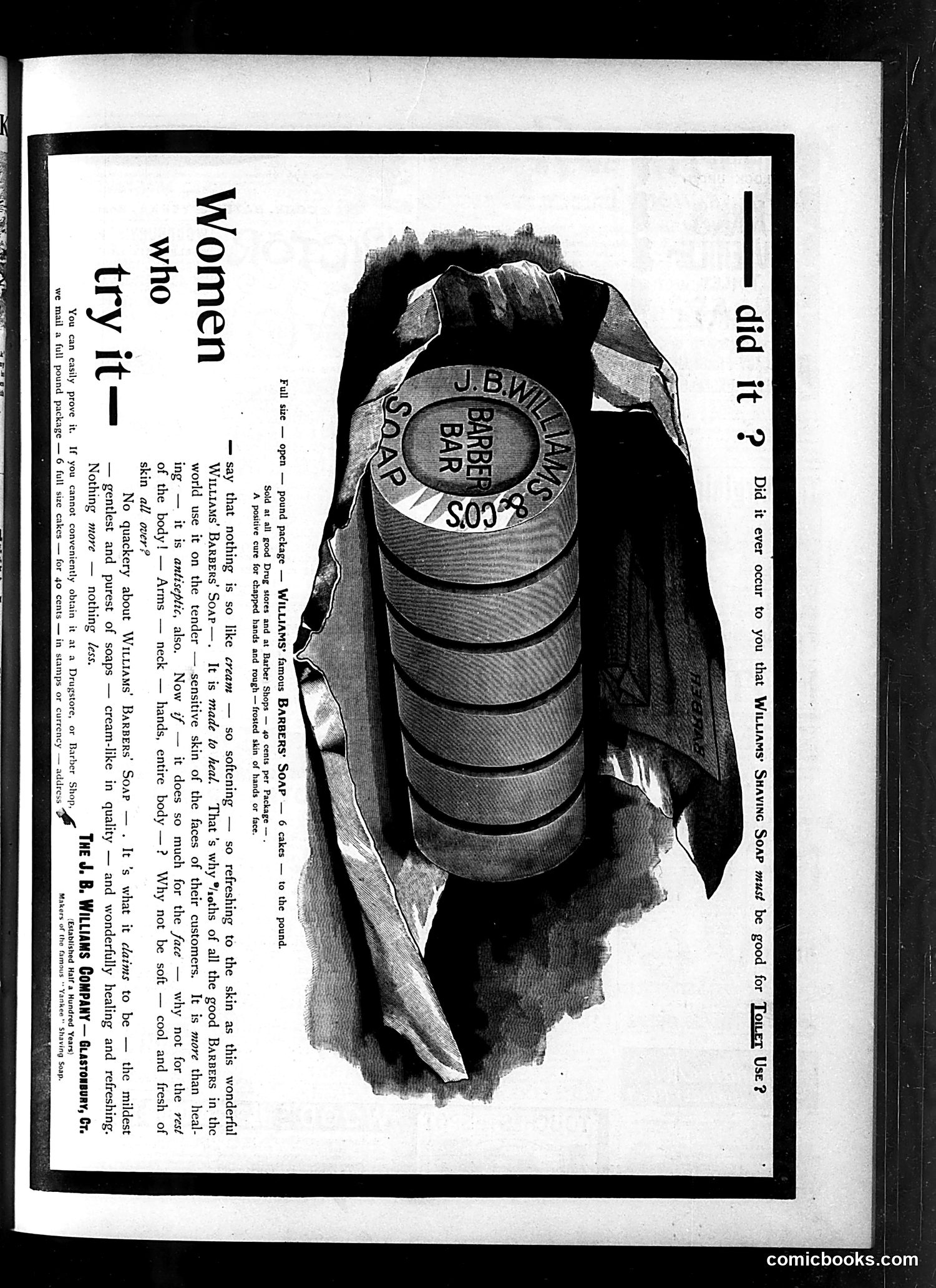
This page is primarily an **advertisement**, not a political cartoon. It promotes Williams' Barbers' Soap, a commercial product marketed to women. The ad features an illustrated bar of soap wrapped in cloth/paper. The copywriting emphasizes the soap's moisturizing and healing properties, particularly for sensitive facial skin. It appeals to women by arguing that if barbers use this soap on customers' faces, women should use it on their entire bodies for softness and freshness. The marketing strategy leverages professional endorsement (barbers' use) and pseudo-scientific claims (antiseptic, healing, cream-like properties) to position the product as superior to competitors. The "no quackery" assertion ironically suggests competitors made exaggerated claims. This reflects early 20th-century advertising conventions: emotional appeals, testimonial-style language, and mail-order purchasing options for readers without local access.
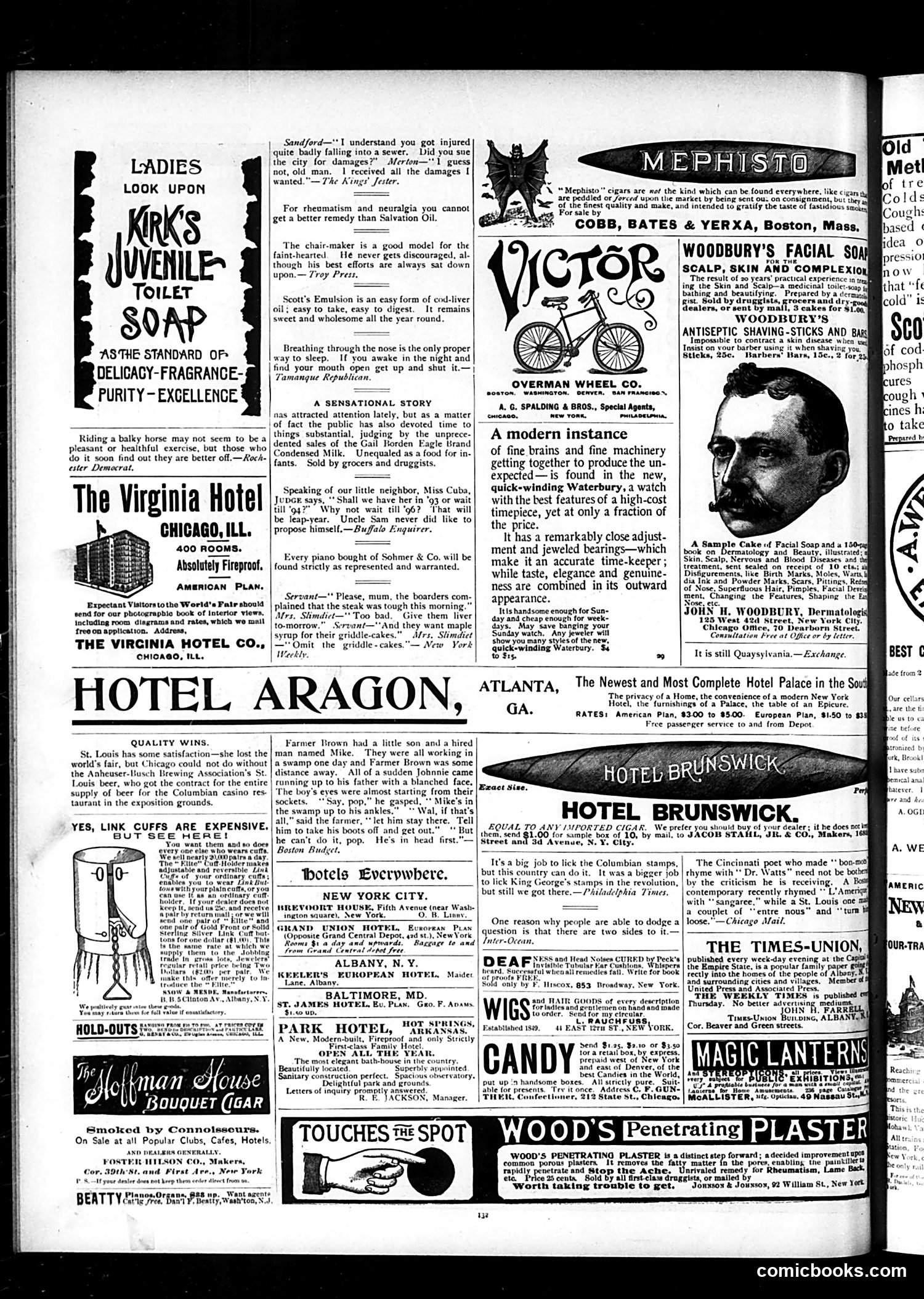
This is primarily an **advertising page** from Judge magazine, a satirical weekly publication. The page contains mostly commercial advertisements for products and hotels, with only brief satirical text snippets scattered throughout. The few jokes present are typical period humor—short, observational quips about everyday life. For example, one gibe about a chair-maker suggests he gets "sat down upon" (ignored), a pun on his profession. Another crude joke depicts a man injured falling in a sewer, claiming he "received all the damages" already. The page advertises products ranging from toiletries (Kirk's soap, Woodbury's facial soap) to mechanical goods (Overman bicycles, Waterbury watches) to lodging (The Virginia Hotel, Hotel Aragon in Atlanta). There are no political cartoons visible. No specific political figures or events are referenced. This is fundamentally a **commercial publication page**, with minimal satirical content—advertising dominates the layout entirely.
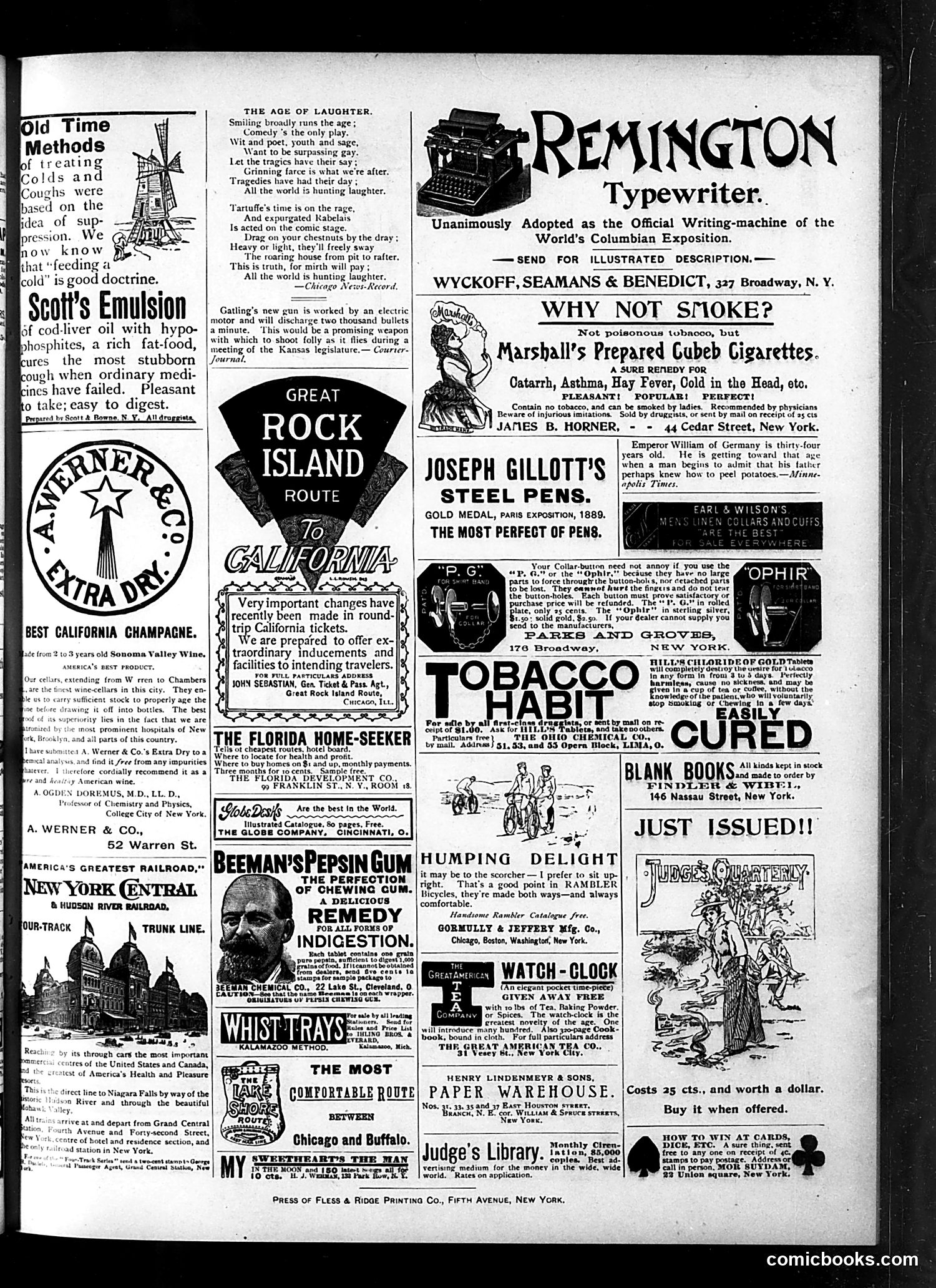
This page is primarily **advertising**, with limited satirical content. The main elements include: **Notable Advertisement:** A prominent Remington Typewriter ad claims it was "Unanimously Adopted as the Official Writing-machine of the World's Columbian Exposition" — referencing the 1893 Chicago World's Fair, a major contemporary event. **Satirical Content:** A brief poem titled "The Age of Laughter" mocks contemporary culture's obsession with comedy over tragedy. It suggests audiences prefer "expurgated" (censored) versions of classic works and cheap humor over serious drama. **Medical Advertising:** Multiple ads for dubious remedies — Scott's Emulsion for coughs, Marshall's Cubed Cigarettes claiming to cure catarrh and asthma, and Beeman's Pepsin Gum for indigestion — reflect late-19th-century patent medicine culture. **Social Commentary:** A brief joke about Emperor William of Germany suggests generational decline, implying younger men lack their fathers' competence. The page represents typical Judge content: mixing satirical commentary on contemporary tastes with period advertising for now-obsolete products.
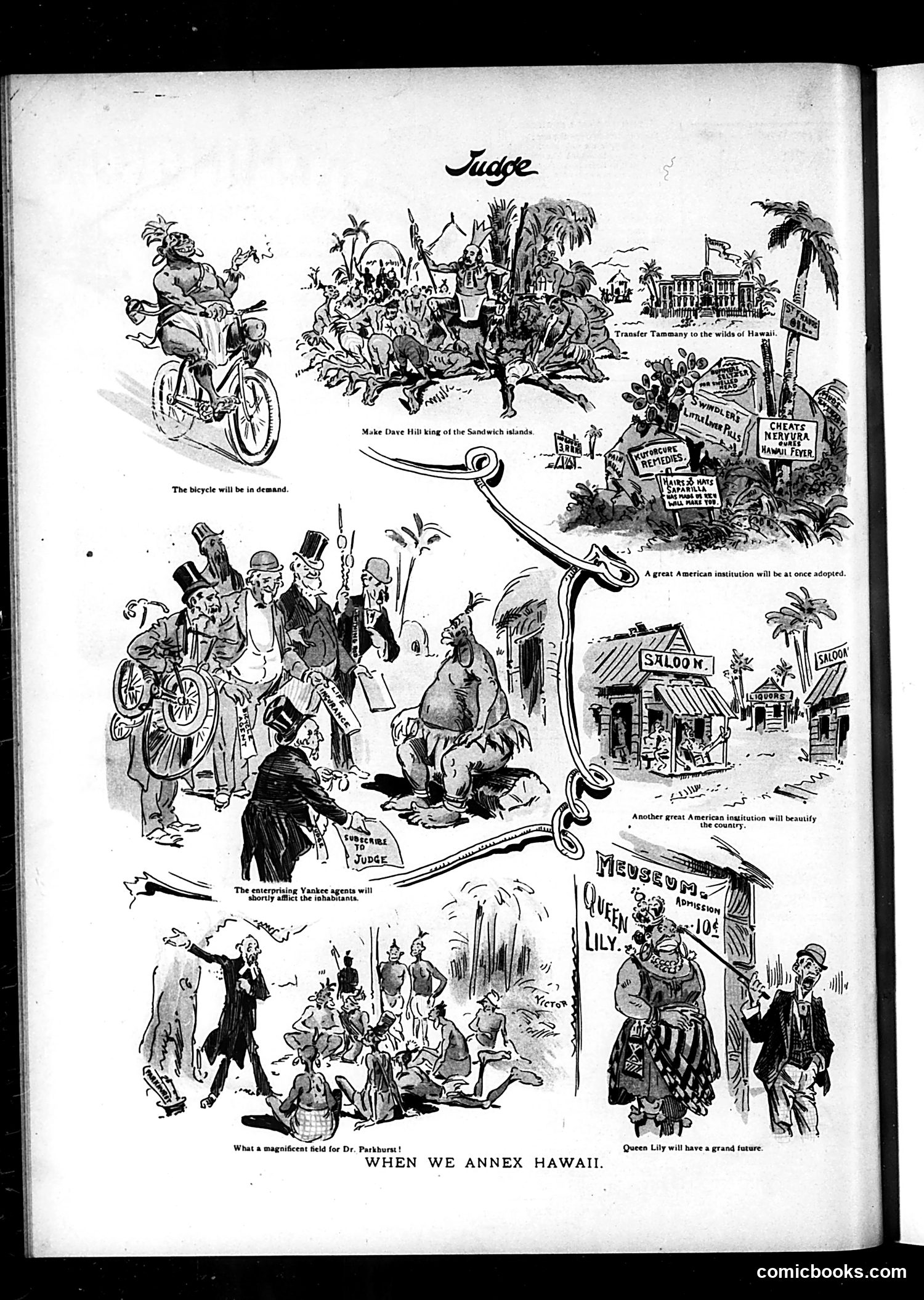
This page satirizes American imperialism and the proposed annexation of Hawaii in the 1890s. The central title "WHEN WE ANNEX HAWAII" frames multiple scenarios depicting how American institutions would supposedly "improve" Hawaiian society. The cartoons show: bicycles becoming fashionable, Dave Hill crowned "king," American saloons and museums establishing themselves, and various commercial enterprises arriving. The satire mocks the imperialist justification that annexation would "civilize" Hawaii by introducing American commerce and culture. References include "Queen Lily" (likely Queen Liliʻuokalani, Hawaii's last reigning monarch, deposed in 1893), and caricatured "Yankee agents" and tourists. The humor targets both American expansionist attitudes and the assumption that American institutions automatically represent progress and superiority over indigenous Hawaiian culture.