
A complete issue · 18 pages · 1893
Judge — January 7, 1893
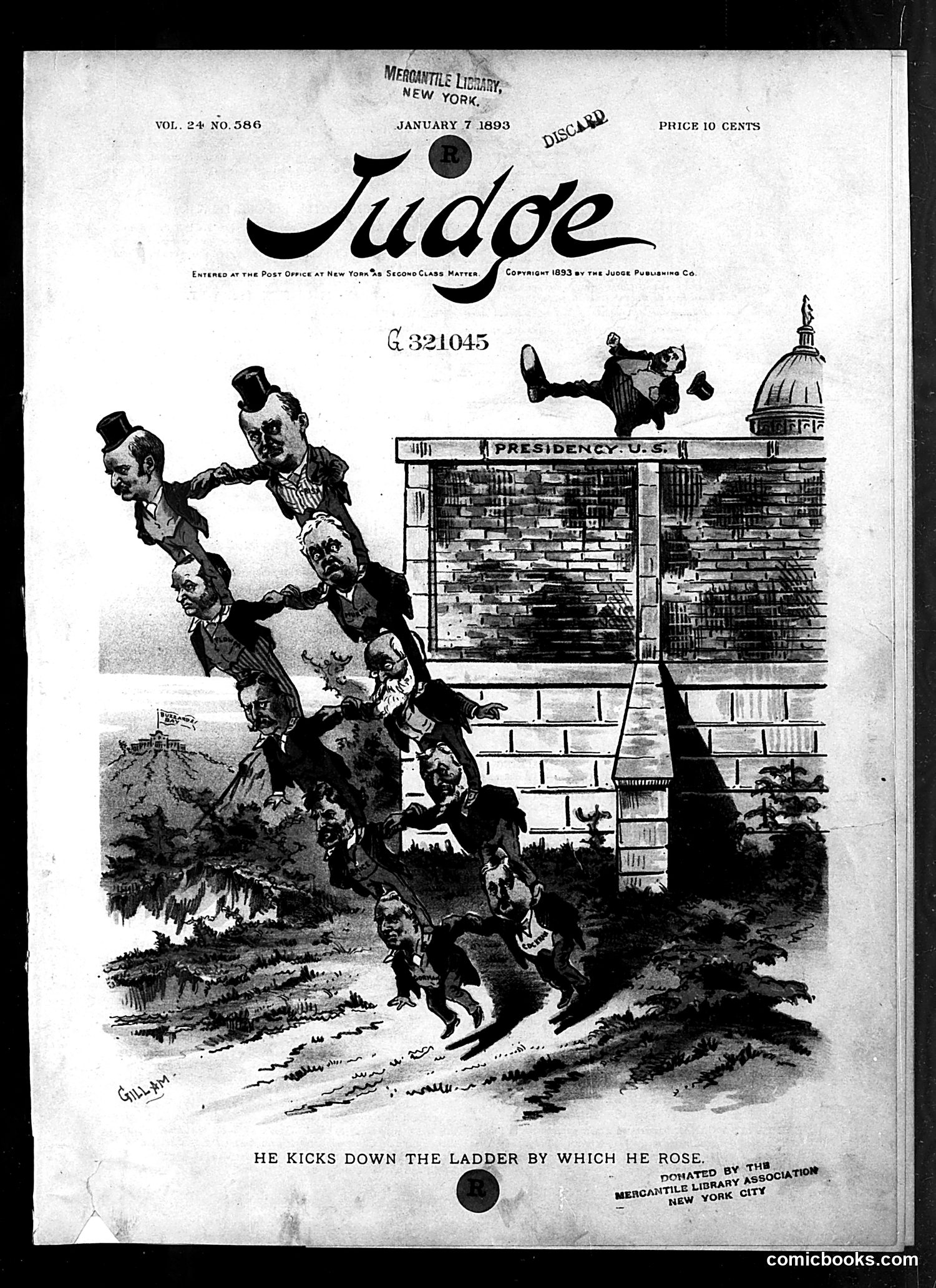
This January 1893 *Judge* cartoon satirizes a U.S. President (likely depicted in the Capitol dome scene) who is destroying the very institutional or political means by which he achieved power. The chaotic pyramid of caricatured figures being knocked down suggests political allies or supporters being betrayed or discarded. The "ladder" metaphor indicates the cartoon criticizes the President for dismantling the system, relationships, or policies that enabled his rise to office—a betrayal of those who helped him succeed. The violent tumbling figures convey the cartoon's view of this action as destructive chaos rather than justified reform. Without clearer identification, the specific President and legislative conflict referenced remain uncertain, though the composition suggests a major political upheaval of 1893.
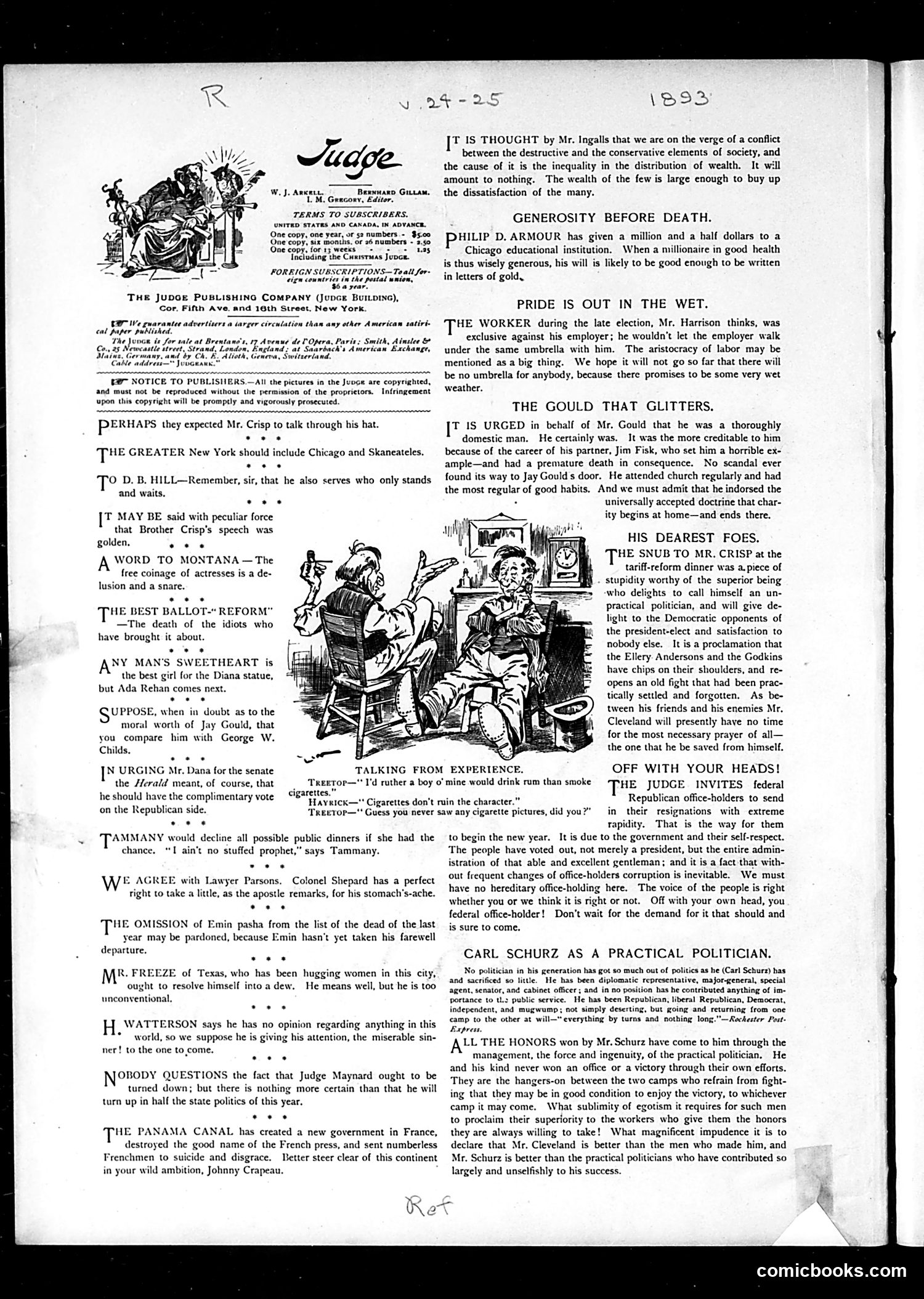
The central cartoon, titled "TALKING FROM EXPERIENCE," depicts what appears to be a political dinner scene with multiple figures engaged in animated discussion. The accompanying text critiques politicians' claims about administrative competence, suggesting that voters elected "the entire administration" rather than just a president, and warning that "frequent changes of office-holders corruption is inevitable." The various short editorial comments ("snippets") throughout the page mock political figures and current events—references to Brother Crop's speech, D.B. Hill, and Carl Schurz as a "practical politician." The satire targets 1890s political corruption, office-seeking, and the revolving-door nature of government appointments that characterized the Gilded Age.
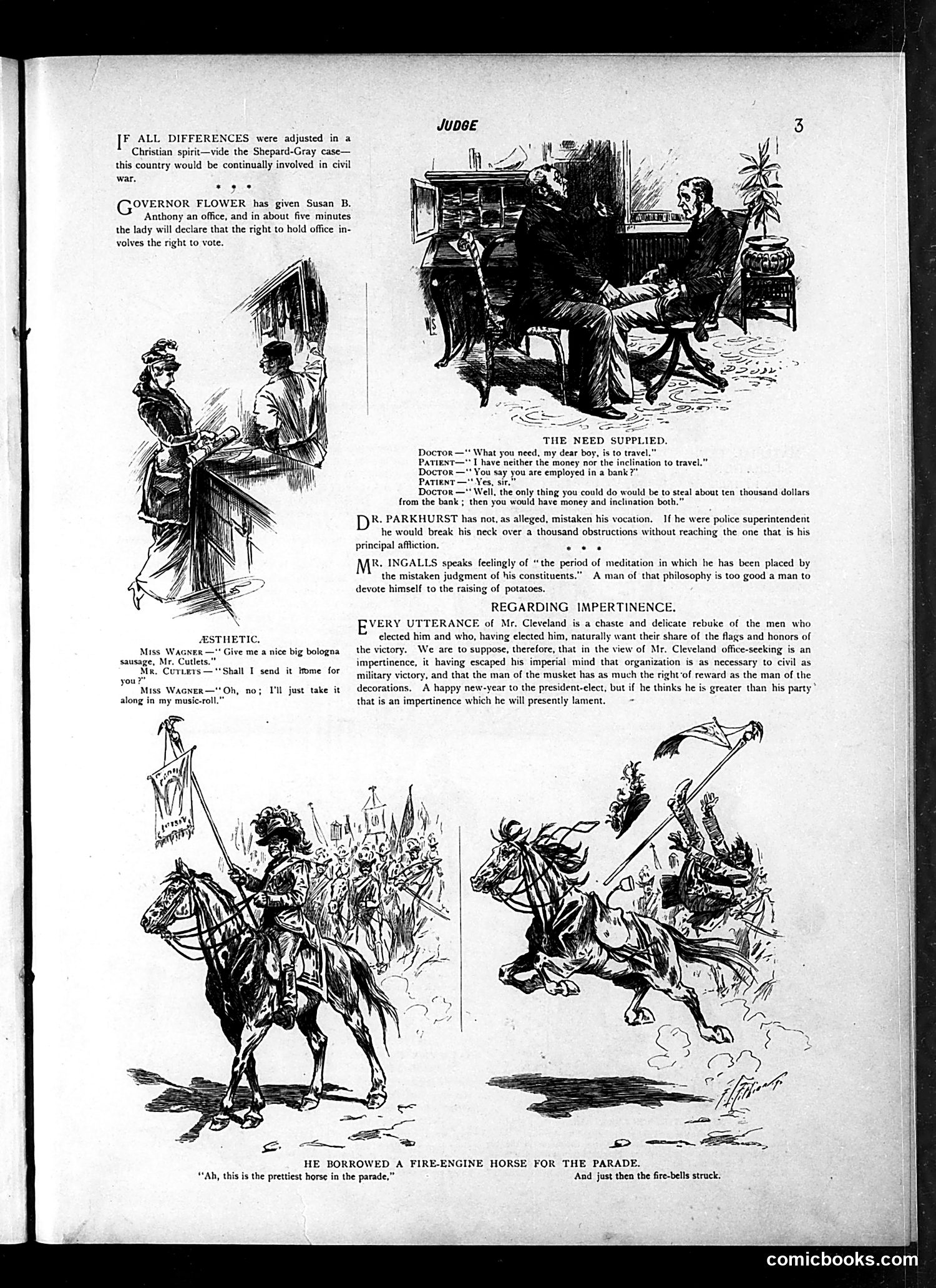
This page contains several satirical items targeting contemporary political figures: **"The Need Supplied"** depicts a doctor (likely representing a political advisor) telling a patient he needs "travel" as medicine—a joke about politicians seeking office sinecures or travel budgets as compensation. **"Regarding Impertinence"** criticizes President Cleveland for claiming military service justifies his authority, satirizing his assertion that a soldier's right to reward equals a politician's. **"Aesthetic"** mocks fashionable affectations, with Miss Wagner and Mr. Cutler's dialogue poking fun at artistic pretension. **"He Borrowed a Fire-Engine Horse for the Parade"** is a humorous anecdote about civic pageantry, where substituting a fire-engine horse creates comic chaos during a public procession. The cartoons employ exaggerated illustrations typical of satirical journalism to critique political vanity and social pretension.
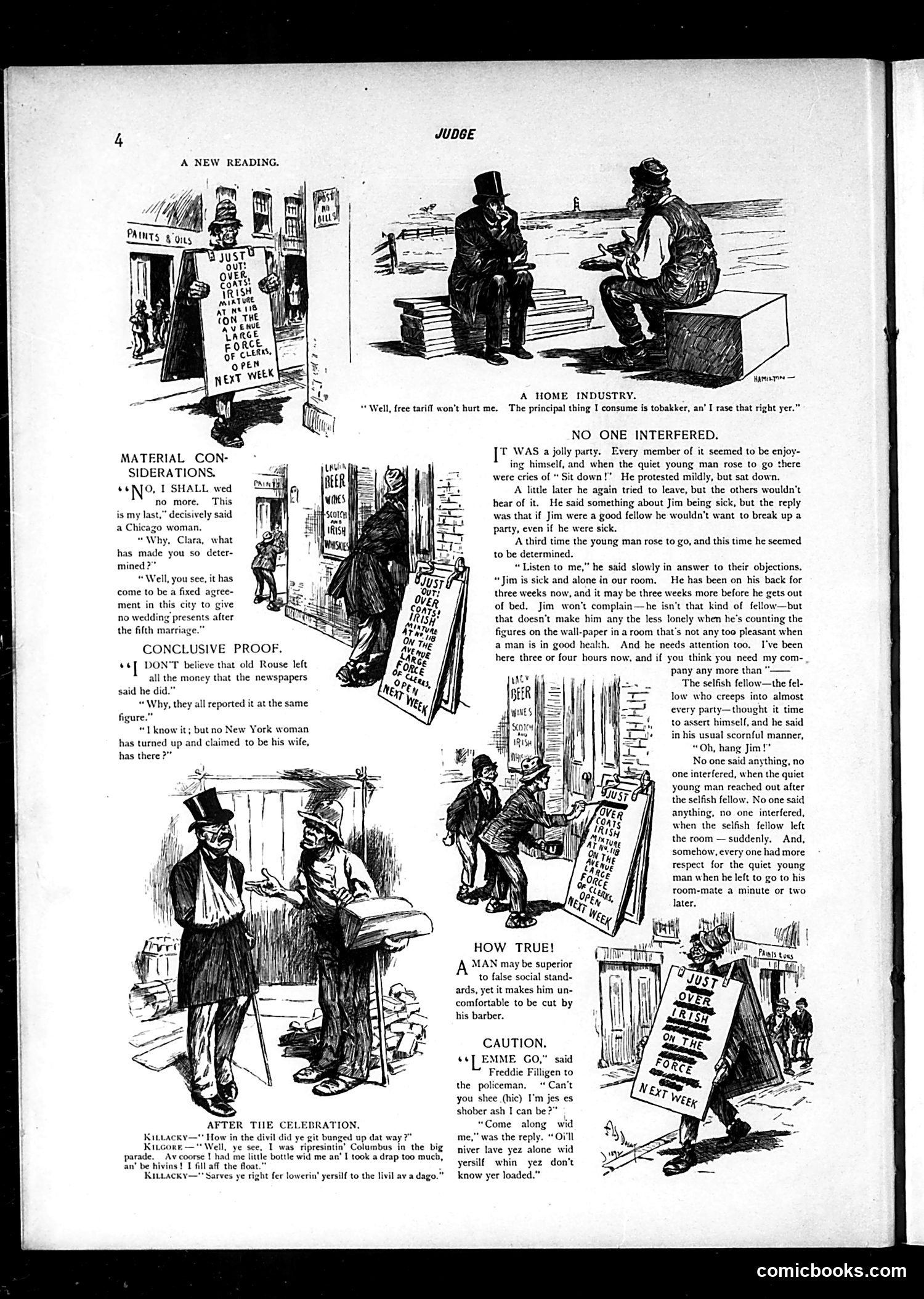
This Judge magazine page contains multiple cartoons satirizing American social customs and political issues, likely from the early 1900s. **"A Home Industry"** shows two men discussing tariffs—one claims free trade won't hurt him since he only consumes tobacco he grows locally. The satire targets protectionist arguments by showing someone who paradoxically benefits from tariffs while claiming independence. **"No One Interfered"** depicts social pressure overriding compassion: a young man repeatedly tries leaving a party to care for his sick, lonely roommate, but guests selfishly demand he stay. Only when he finally stands up to "the selfish fellow" do others respect him. The cartoon critiques how social convention prevents kindness. **"Conclusive Proof"** jokes about wealthy men's estates: a woman claims an old rich man left "all the money" to newspapers through their identical reports of his will—implying newspapers exaggerate wealthy deaths. The remaining cartoons are brief gags about barbers, drunkenness, and social pretense. Overall, the page satirizes American materialism, social conformity, and newspaper sensationalism.
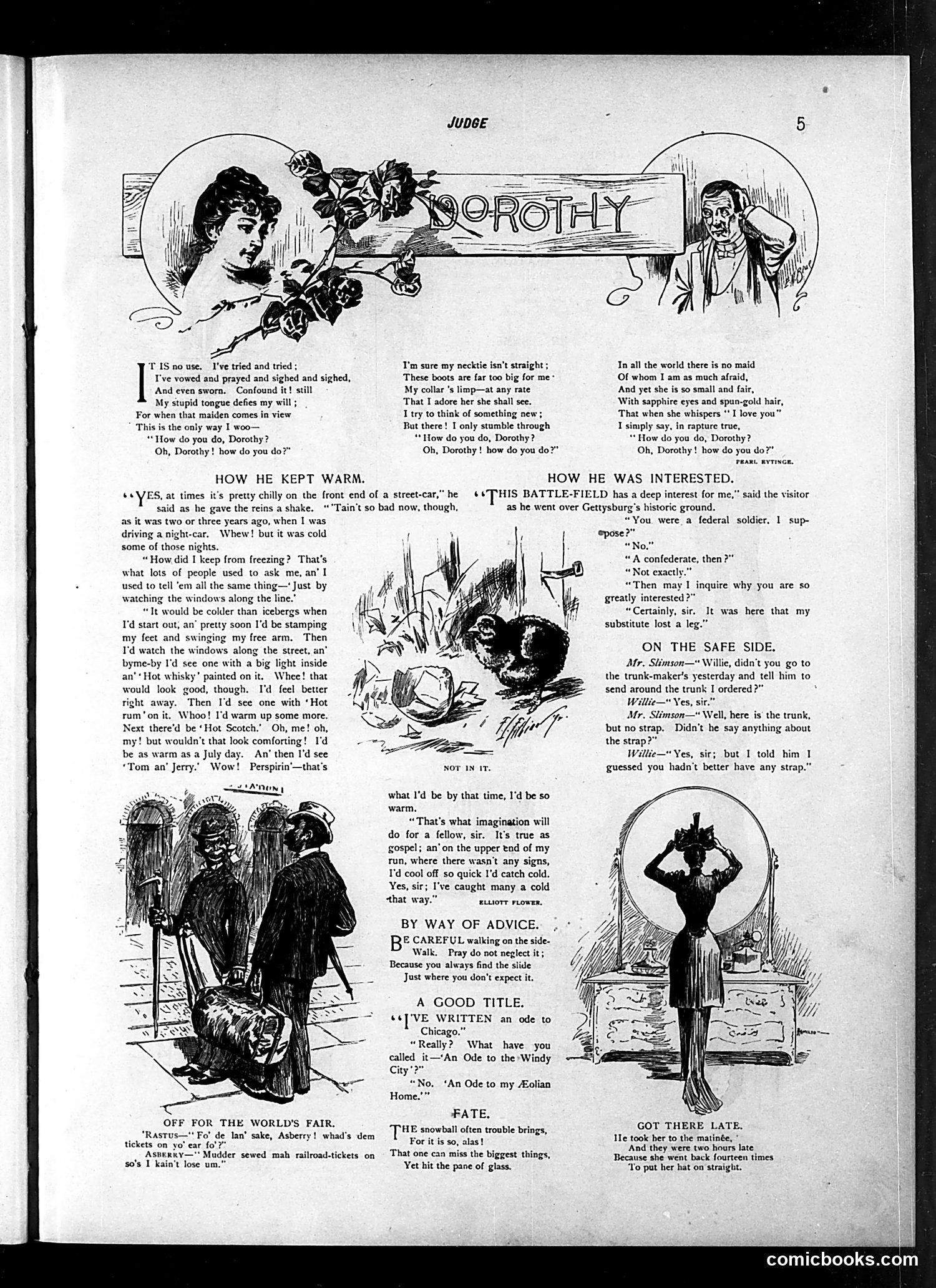
This page contains multiple humorous short stories and cartoons typical of Judge's satirical style, circa early 1900s. The main pieces include: **"Dorothy" poems**: Comic verses about a shy suitor who can only greet his love interest with awkward "How do you do, Dorothy?" exchanges—satirizing male social incompetence and inability to express genuine emotion. **"How He Kept Warm"**: A street-car driver's anecdote about staying warm by imaginatively reading tavern signs ("Hot Whisky," "Hot Rum," "Hot Scotch") through windows—mocking both working-class experience and fantasy as escape from hardship. **"Battle-field" joke**: A visitor's interest in Gettysburg battlefield stems solely from losing his substitute soldier there—satirizing indifference to historical significance and self-interest. **"World's Fair" references**: Appear to reference the 1893 Chicago World's Columbian Exposition, a major contemporary event. The cartoons use pen-and-ink illustrations typical of late 19th-century humor magazines. Overall, the page satirizes everyday American social awkwardness, working-class struggles, and materialistic self-interest through gentle, accessible humor.
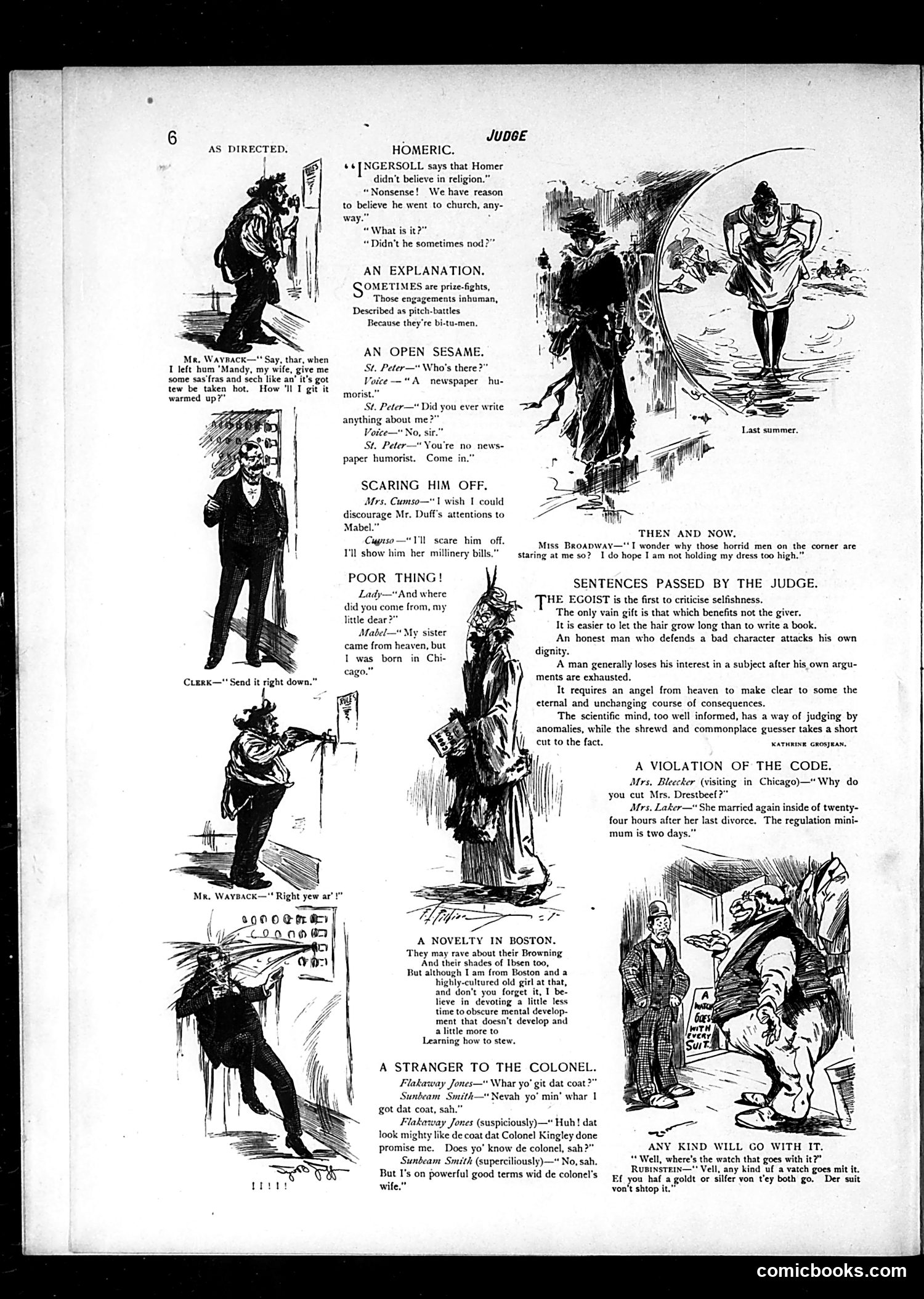
This page from Judge magazine contains multiple satirical pieces targeting late-19th-century social pretensions and hypocrisy: **"Homeric"** mocks Robert Ingersoll's famous atheism by suggesting Homer must have been religious because he "sometimes nod[ded]" in church—a joke about nodding off during services. **"An Open Sesame"** satirizes newspaper humorists as unoriginal; St. Peter admits only non-humorists to heaven since humorists never write anything original about him. **"Then and Now"** contrasts Victorian modesty with contemporary women's concerns about their dress hemlines being too revealing. **"A Violation of the Code"** mocks strict Chicago society rules requiring a two-day minimum between divorce and remarriage; Mrs. Drestbeef married within 24 hours. **"A Novelty in Boston"** ridicules Boston's pretentious intellectual culture (Browning, Ibsen) while ignoring practical domestic skills like cooking stew. The page uses dialect humor and social commentary to critique class pretension, religious hypocrisy, and changing social mores.
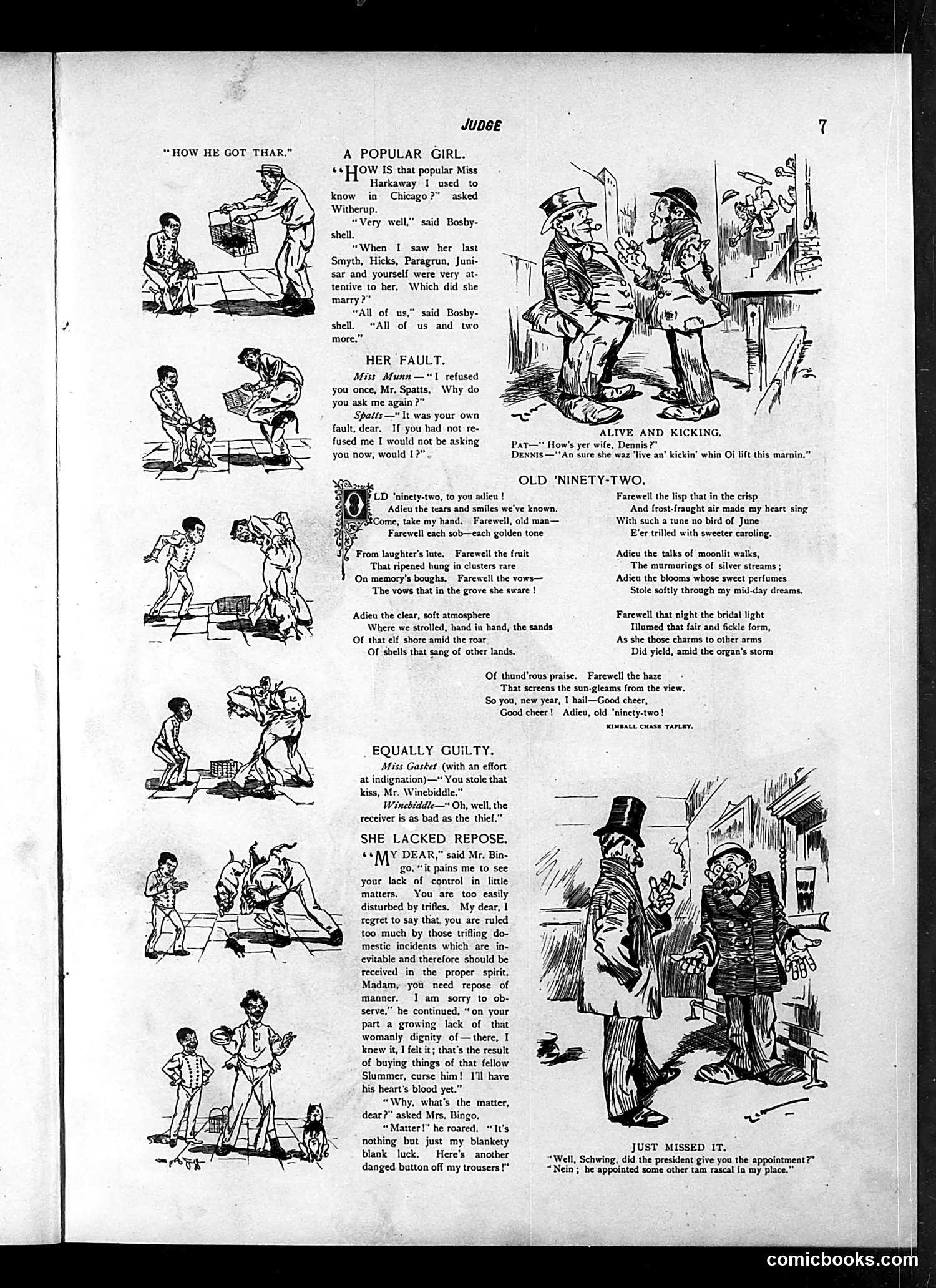
This page contains multiple short humorous sketches typical of late-19th-century satirical magazines: **"A Popular Girl"** mocks a woman's promiscuity through a joke where she married all five men who courted her—plus two more. **"Her Fault"** presents a man repeatedly proposing to a woman who rejected him once, blaming her refusal for his persistence—satirizing male entitlement and circular logic. **"Old 'Ninety-Two"** is a sentimental farewell poem to the year 1892, mourning lost romance and youth—likely mocking overly nostalgic New Year's reflections. **"Equally Guilty"** plays on a double standard: a man steals a kiss but claims the woman is equally culpable as "receiver"—commentary on victim-blaming. **"She Lacked Repose"** shows a hypocritical husband criticizing his wife's emotional reactivity while raging about a lost button—satirizing male domestic tyranny and obliviousness. **"Just Missed It"** depicts ethnic stereotyping (the name "Schwing/Nein" suggests German or Jewish character) regarding political appointment disappointment.
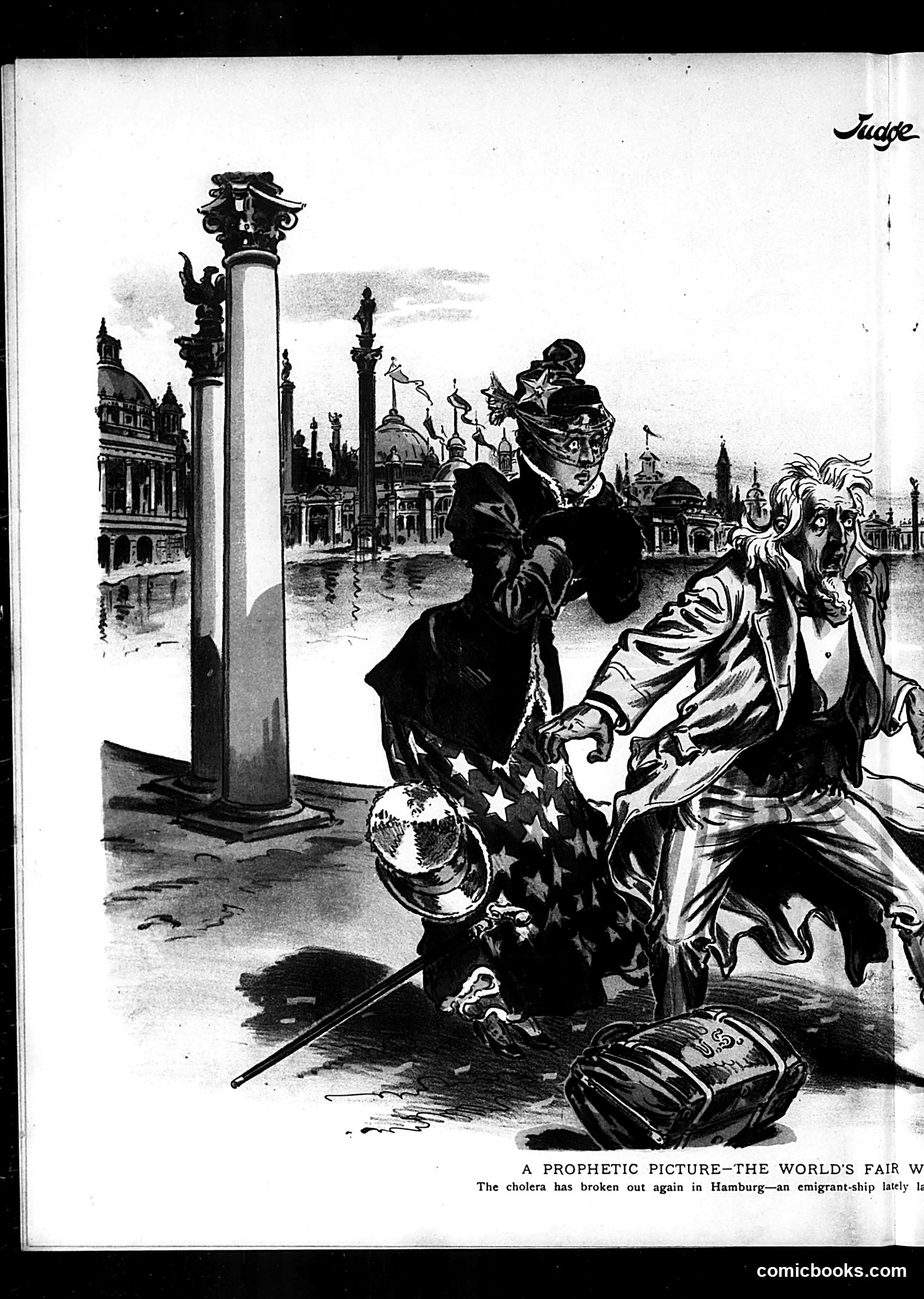
This political cartoon satirizes fears about disease and immigration. The title references a "World's Fair" (likely the 1893 Chicago World's Columbian Exposition) and warns of cholera outbreak in Hamburg, Germany. The imagery shows Uncle Sam (identifiable by his star-spangled clothing) recoiling in horror as skeletal Death personified—and an elderly, diseased immigrant figure—approach from a European harbor scene in the background. A barrel labeled "U.S." sits abandoned in the foreground. The cartoon expresses xenophobic anxiety: that European cholera epidemics would be imported to America via emigrant ships. It reflects late-19th-century concerns about disease transmission through immigration, using Death and disease as visual metaphors for the perceived threat posed by foreign arrivals to American public health and safety.
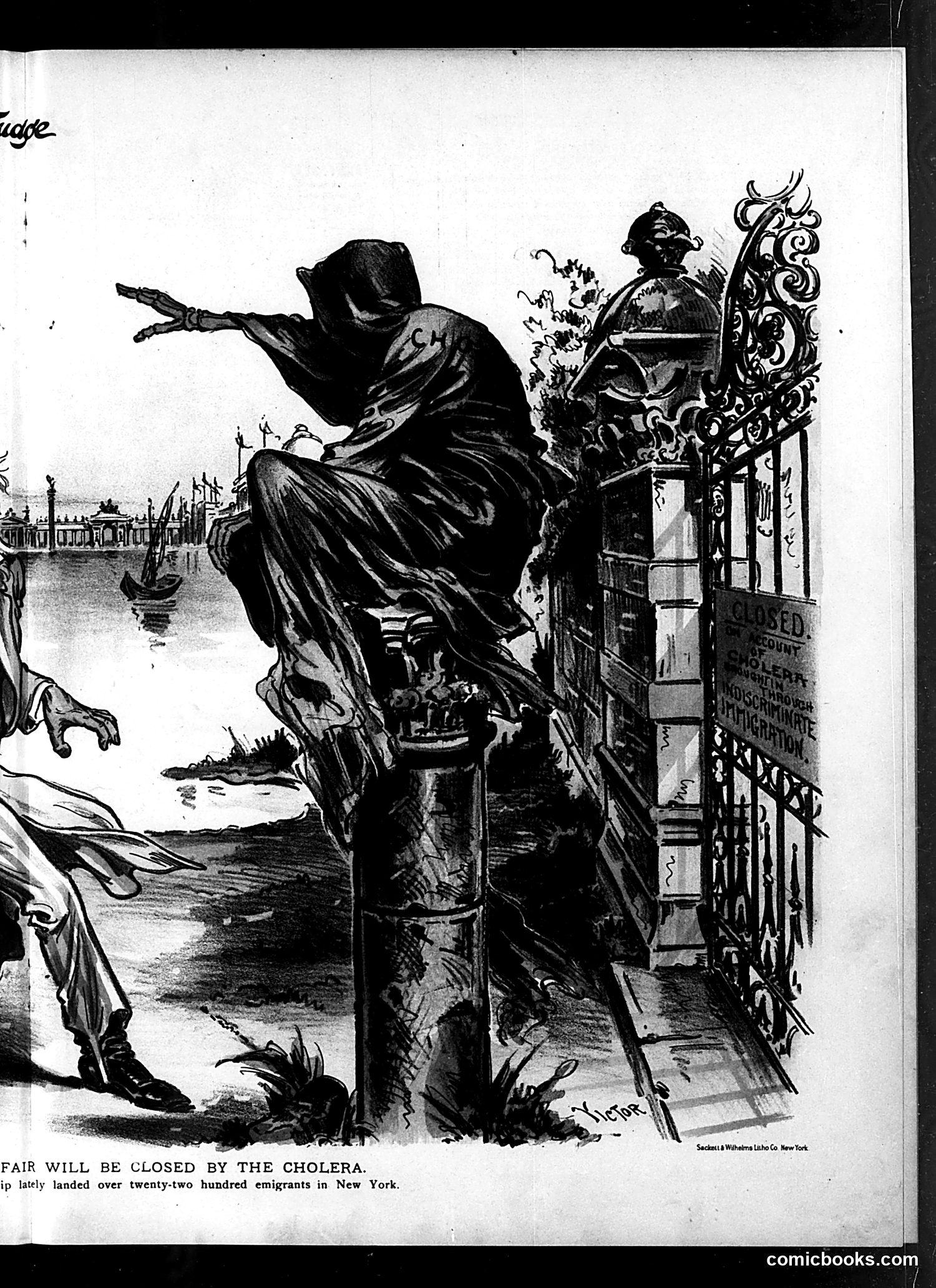
This satirical cartoon depicts **Death** (the skeleton figure in flowing robes) closing down a fair or public gathering due to cholera—a deadly infectious disease that periodically swept through 19th-century cities. The skeleton points accusingly toward the harbor where immigrants' ships have recently arrived, implying that cholera was brought to New York by the "twenty-two hundred emigrants" mentioned in the text. The cartoon reflects **anti-immigrant sentiment** common in the era: blaming newly arrived foreigners for disease outbreaks and public health crises. The ornate gate and urban waterfront setting suggest this is targeting New York's immigrant communities, particularly those arriving by ship. The satire criticizes both the disease threat and the perceived danger posed by mass immigration.
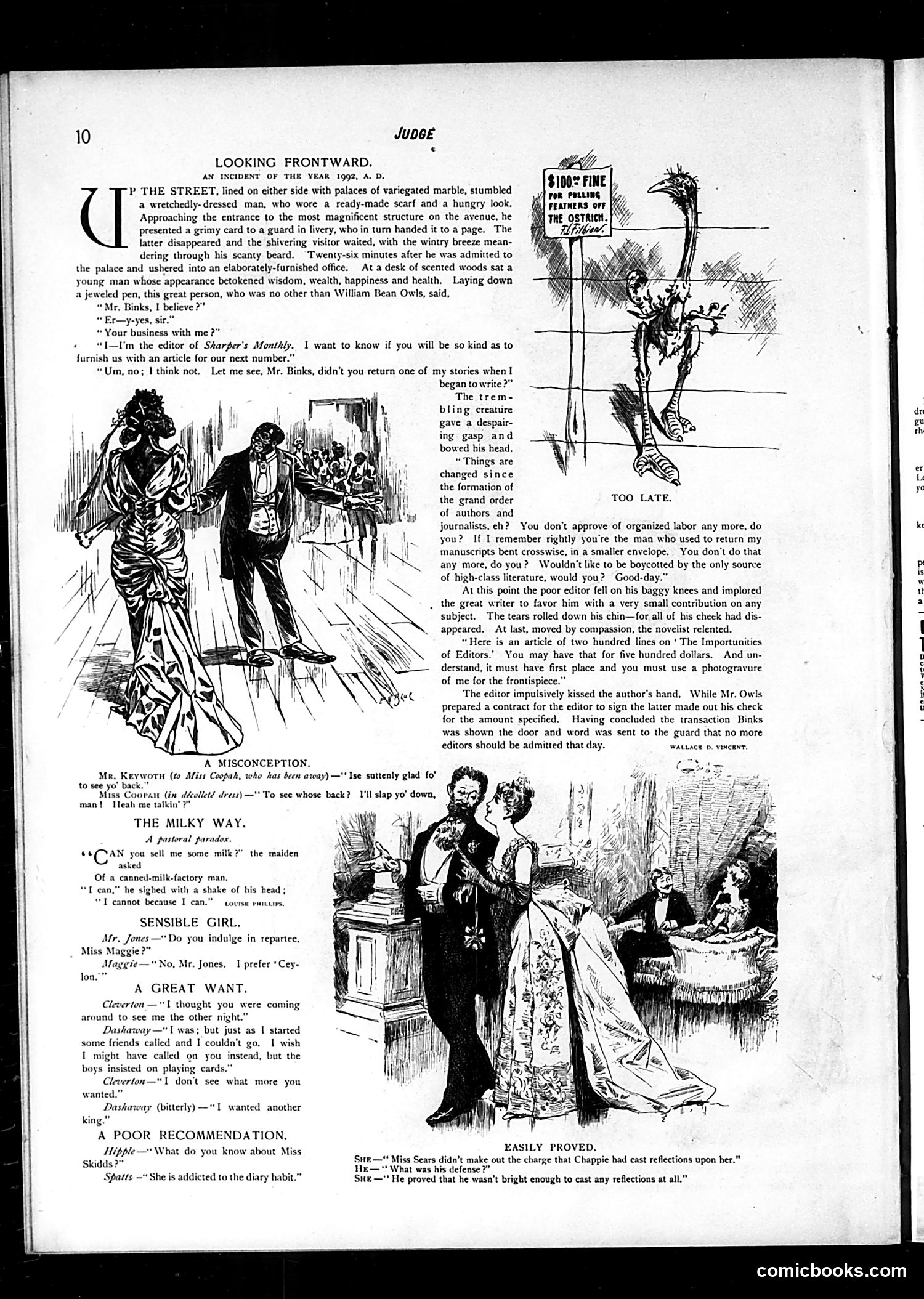
This satirical page mocks the emerging power of organized labor unions and author guilds in the 1890s. The main cartoon, "Too Late," depicts a future (1992) where writers have formed a powerful labor organization that allows them to dictate terms to editors and publishers. The scenario: a struggling editor visits William Bean Owls, a successful author who previously rejected the editor's manuscripts. Now reversed, Owls exploits his position—demanding $500 for a 200-line article, refusing to submit work unless paid exorbitantly, and threatening boycotts. The humiliated editor, powerless against organized writers, capitulates. The satire criticizes how unionization could flip traditional power hierarchies, making struggling editors subservient to formerly-rejected writers. Judge's perspective appears anti-labor: the cartoon warns readers that organized labor protects mediocre writers while punishing legitimate business interests. The page includes unrelated short humor pieces mocking courtship and commercial absurdities typical of Judge's miscellaneous content.
This page features a romantic allegory poem by Sam Walter Foss depicting Canada as a "maiden sweet" with "frost-kissed cheek of rose," while "Uncle Sam has turned his eyes / Toward those blushing northern skies." The poem suggests American romantic/political interest in Canada, with Sam as a patient suitor awaiting the moment when Canada becomes "a willing bride"—likely referencing American expansionist ambitions or discussions of Canadian-American union or annexation during this period. The poem reassures Canada that she need not weep; Sam will wait until she willingly consents. The text frames this as inevitable romantic destiny rather than coercion, though the underlying message concerns geopolitical territorial interest. The rest of the page consists primarily of period advertisements (pianos, medicines, tobacco) with scattered brief humorous anecdotes unrelated to the main allegory.
This page is primarily **advertising with minimal editorial content**. It's a typical early 20th-century magazine layout mixing commercial pitches with brief satirical quips. The few actual jokes include: - **"Miss Outeast" dialogue**: A mild gender joke about a woman caring more about removing suntan than appreciating poetry (Browning). - **Political quips**: References to Washington politics ("catching the speaker's eye") and treasury debates, typical period commentary. - **"Mamma" joke**: A child misinterprets instructions for dish-mending paste, illustrating foolish literalism—a common formula for period humor. The remainder consists of product advertisements: cocoa, obesity pills, champagne, bitters, tobacco cessation aids, and jewelry. The ads themselves sometimes contain embedded humor or testimonials, but this is primarily a **revenue page**, not satirical content. Judge relied heavily on advertising to fund operations.
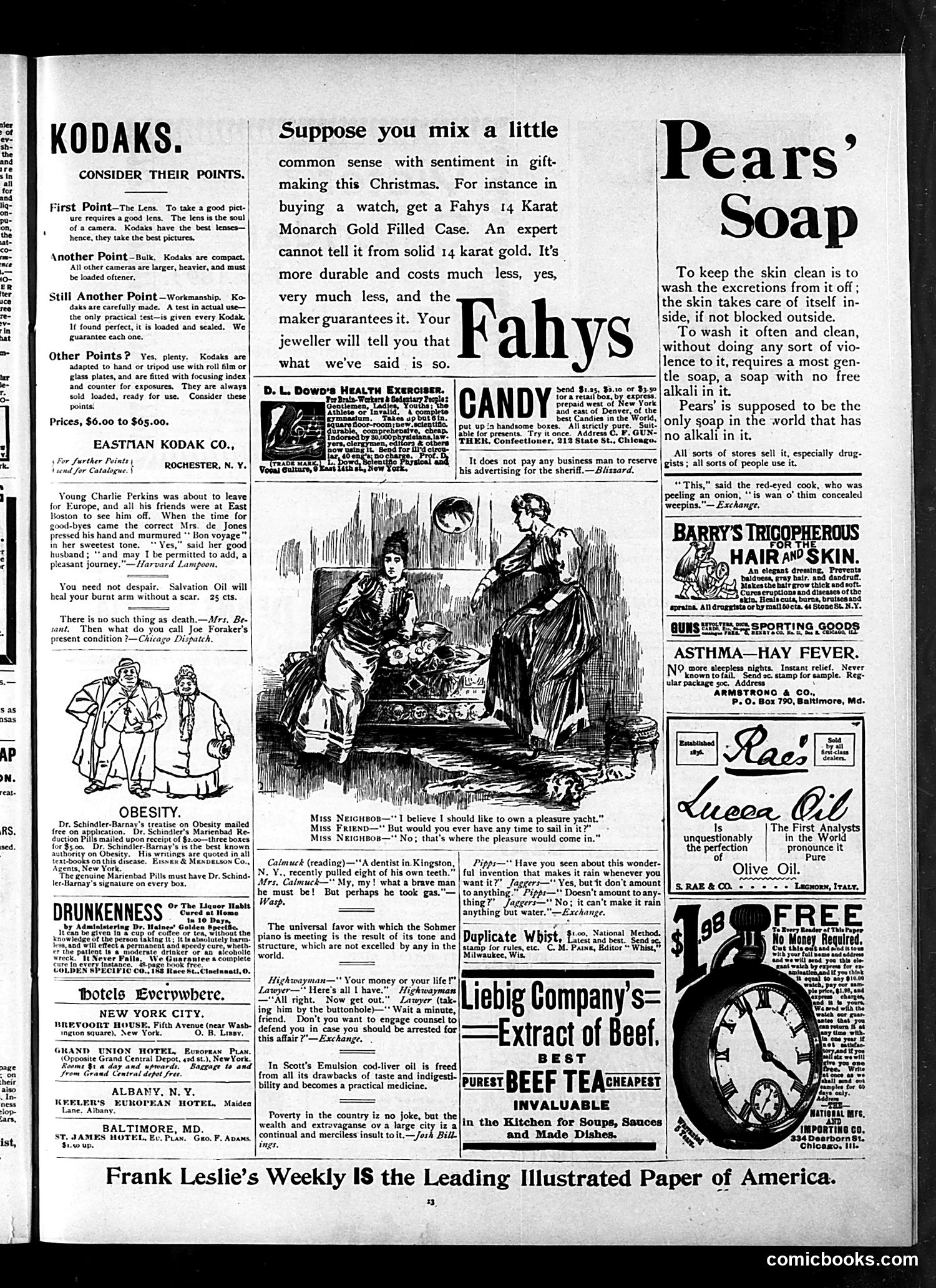
This page is primarily **advertising and light humor**, not political satire. It features: **Main Content:** - Product advertisements (Kodak cameras, Fahys watches, Pears' Soap, Liebig's Beef Extract) - Hotel listings for major cities - Patent medicine ads (obesity treatments, asthma remedies, "Salvation Oil") **Humor Sections:** A small cartoon depicts a wealthy woman telling her friend she'd enjoy owning a yacht—but only because she'd never actually have *time* to use it, thus avoiding the inconvenience. The joke satirizes leisure-class pretension: wealthy people buying status symbols they don't actually want to use. Other brief jokes mock Joe Foraker (unclear reference without additional context) and include wordplay about dentistry. **Historical Context:** This reflects late-19th/early-20th century magazine culture: light comedy mixed with aggressive patent medicine and consumer product advertising, before FDA regulation of dubious health claims. The page lacks serious political commentary—it's entertainment and commerce.
This page is **primarily advertising**, not a political cartoon. It's from Judge magazine's 1893 issue and showcases late-19th-century commercial advertisements rather than satirical content. The ads reflect period preoccupations: a "Victor Calendar" promoting bicycles (then a novelty/status symbol), wine and whiskey companies, early photography equipment, patent medicines claiming to cure deafness, taxidermy services, and novelty items like cuff-holders. The Pennsylvania Railroad advertises luxury California tours—expensive leisure travel for the wealthy. Notably absent: modern products. Present instead: solutions to problems we've solved (kerosene heaters for warmth, "cures" for deafness). The "Carbonite" fuel and safety heater ads suggest indoor heating was still hazardous and unreliable. The Hotel Brunswick and cigar ads reveal upper-class social venues. Overall, this page documents what advertisers thought would appeal to Judge's educated, affluent male readership circa 1893—luxury goods, technological novelties, and dubious health remedies.
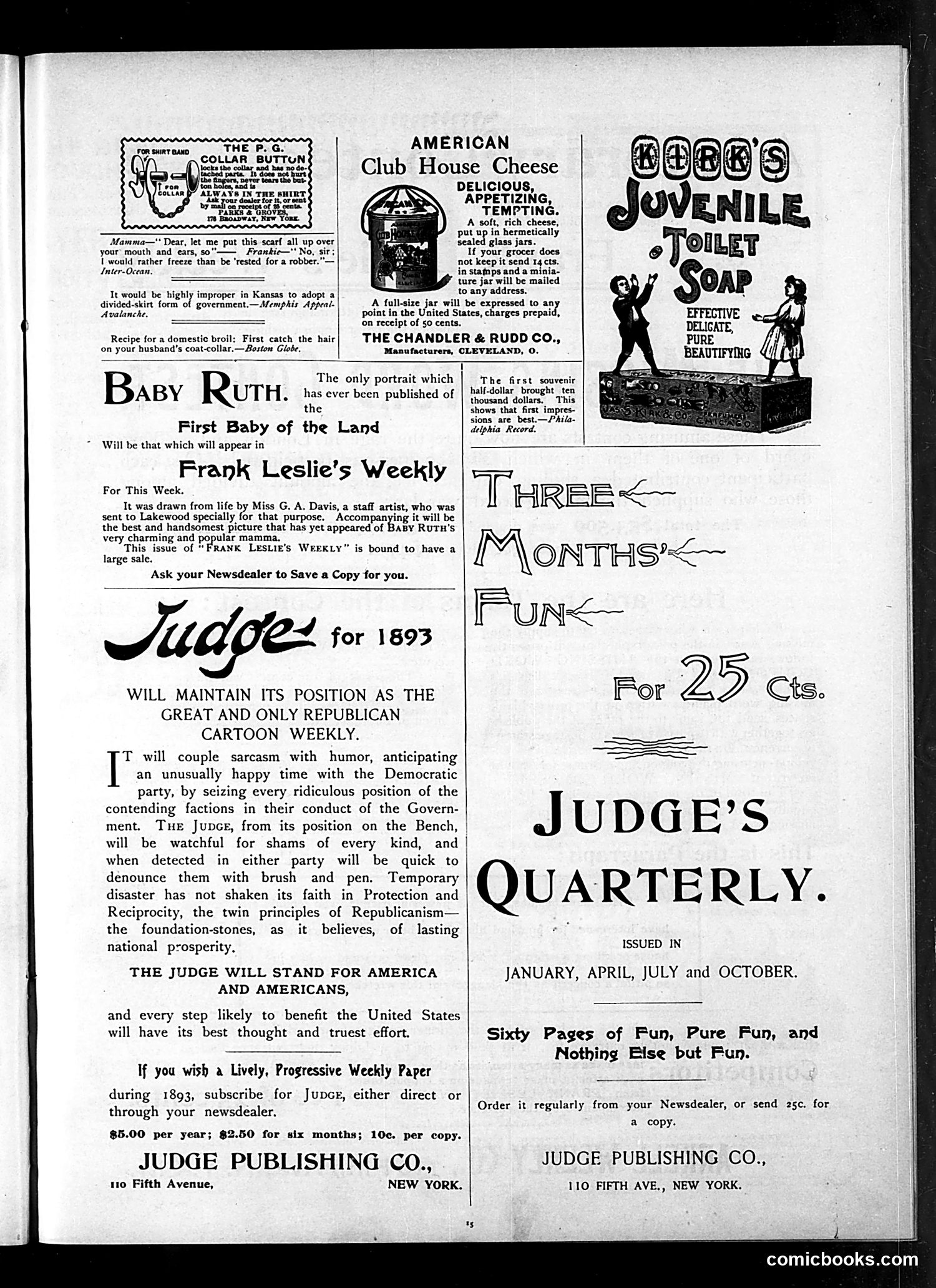
This is primarily a **title/advertising page** from Judge magazine's 1893 promotional issue, not a satirical cartoon page. The main content announces Judge's editorial stance for 1893: as "the great and only Republican cartoon weekly," it promises to satirize the **Democratic party** through "sarcasm with humor," attacking their positions on governance. Judge declares allegiance to Republican principles of **Protection and Reciprocity** (protectionist tariffs and trade reciprocity agreements—key Republican economic policies). The page also advertises Judge's offerings: the **Judge's Quarterly** (60 pages, 25¢), plus advertisements for consumer products (cheese, soap, collar buttons) and a teaser about publishing the first portrait of "Baby Ruth" in Frank Leslie's Weekly. The scattered jokes at top reference contemporary social issues: divided skirts (women's fashion debates) and domestic disputes—typical satirical fodder of the era. **Historical context for modern readers**: Judge was explicitly partisan Republican propaganda dressed as comedy.
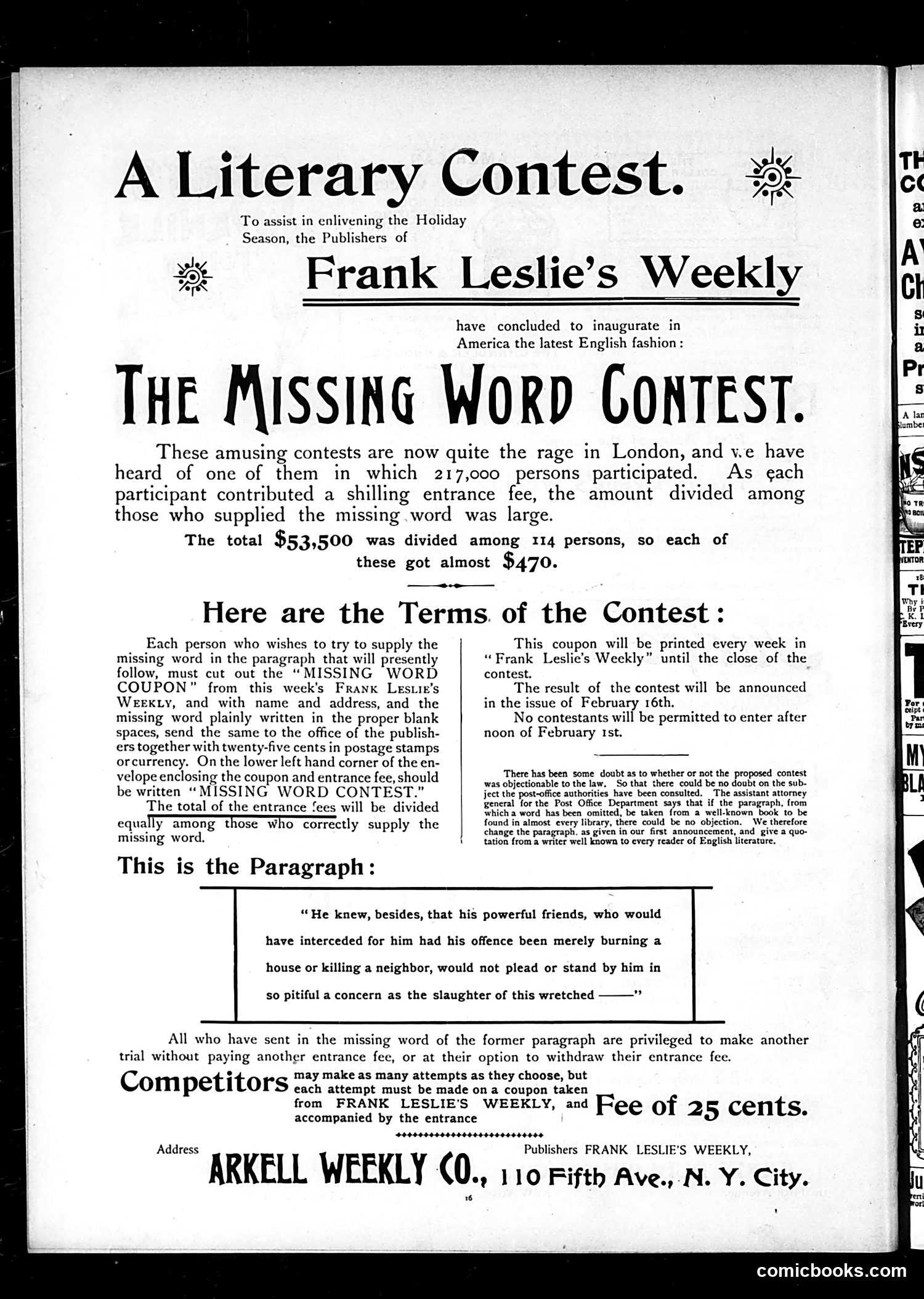
This page advertises a literary contest modeled on a popular English craze. Participants pay 25 cents to guess a missing word from a provided paragraph and compete for prize money split among correct answers. The satire targets the contest's popularity and profit potential: a London version supposedly attracted 217,000 participants and distributed $53,500 in prizes. The advertisement ironically notes post-office concerns about legality, then assures readers the paragraph will be taken from a famous published work—a safeguard against accusations of impropriety. The missing-word paragraph itself (from an unnamed classic) describes someone whose powerful friends won't help him for "the slaughter of this wretched [blank]"—a dramatic, melodramatic excerpt designed to intrigue participants. The real target appears to be readers' gullibility about get-rich-quick schemes and the absurdity of mass participation in frivolous contests.
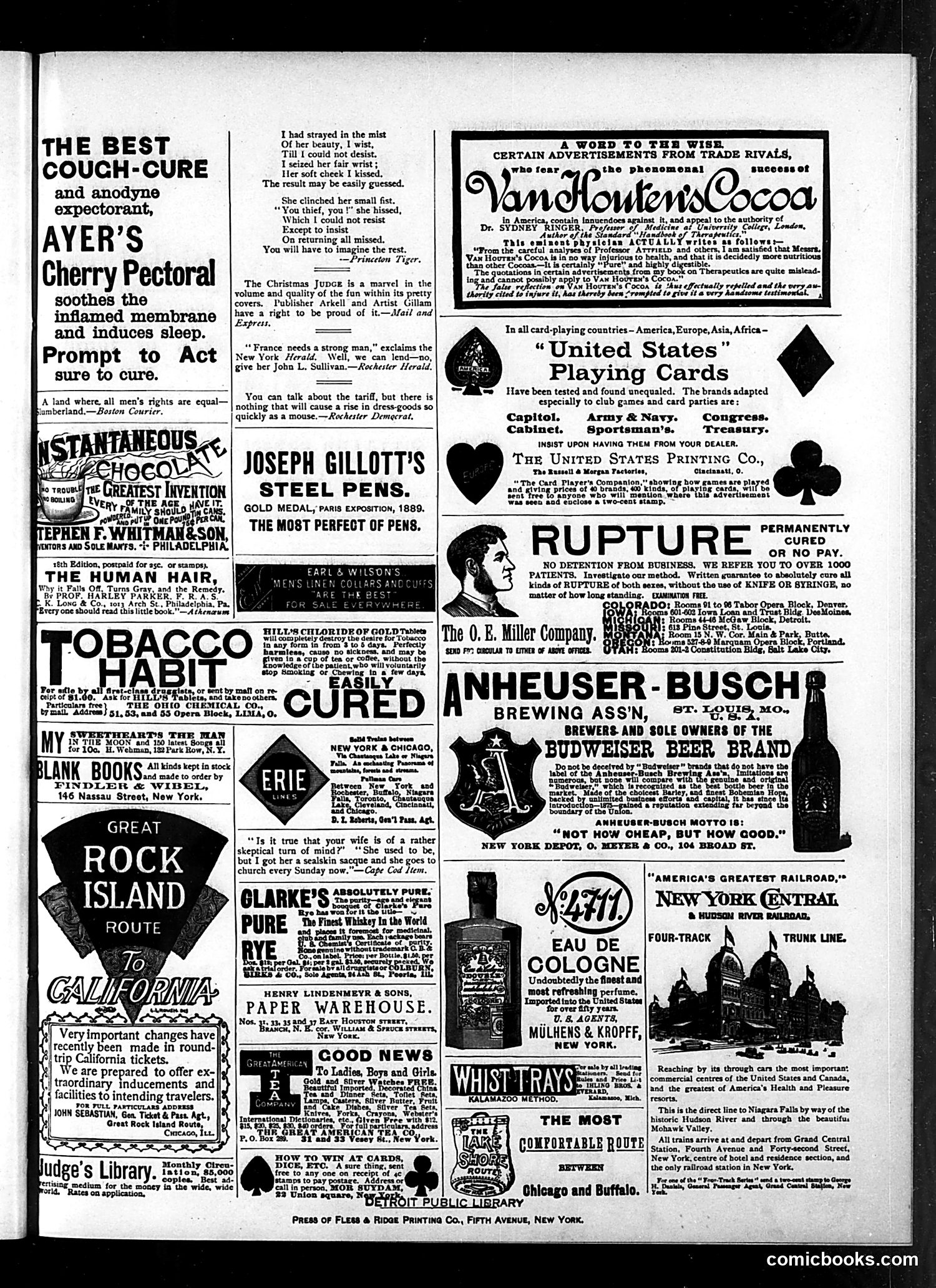
This is primarily an **advertising page** from Judge magazine, not a political cartoon. It contains various commercial advertisements typical of the late 19th century, with minimal satirical content. The page includes ads for products like Ayer's Cherry Pectoral (cough medicine), Gillott's Steel Pens, playing cards, rupture treatment, beer, and railroad services. There are small **humorous verse snippets** (likely from other Judge sections), including a risqué poem about a young man kissing a woman who punches him—typical of period humor. The most substantive item is a **defense of Van Houten's Cocoa** against competitors' attacks, where an authority figure (Dr. Stoney Ringer) vouches for the product's superiority. The cartoons or satirical commentary are **minimal or absent**—this appears to be a revenue-generating advertising section rather than editorial content meant for historical or political analysis.
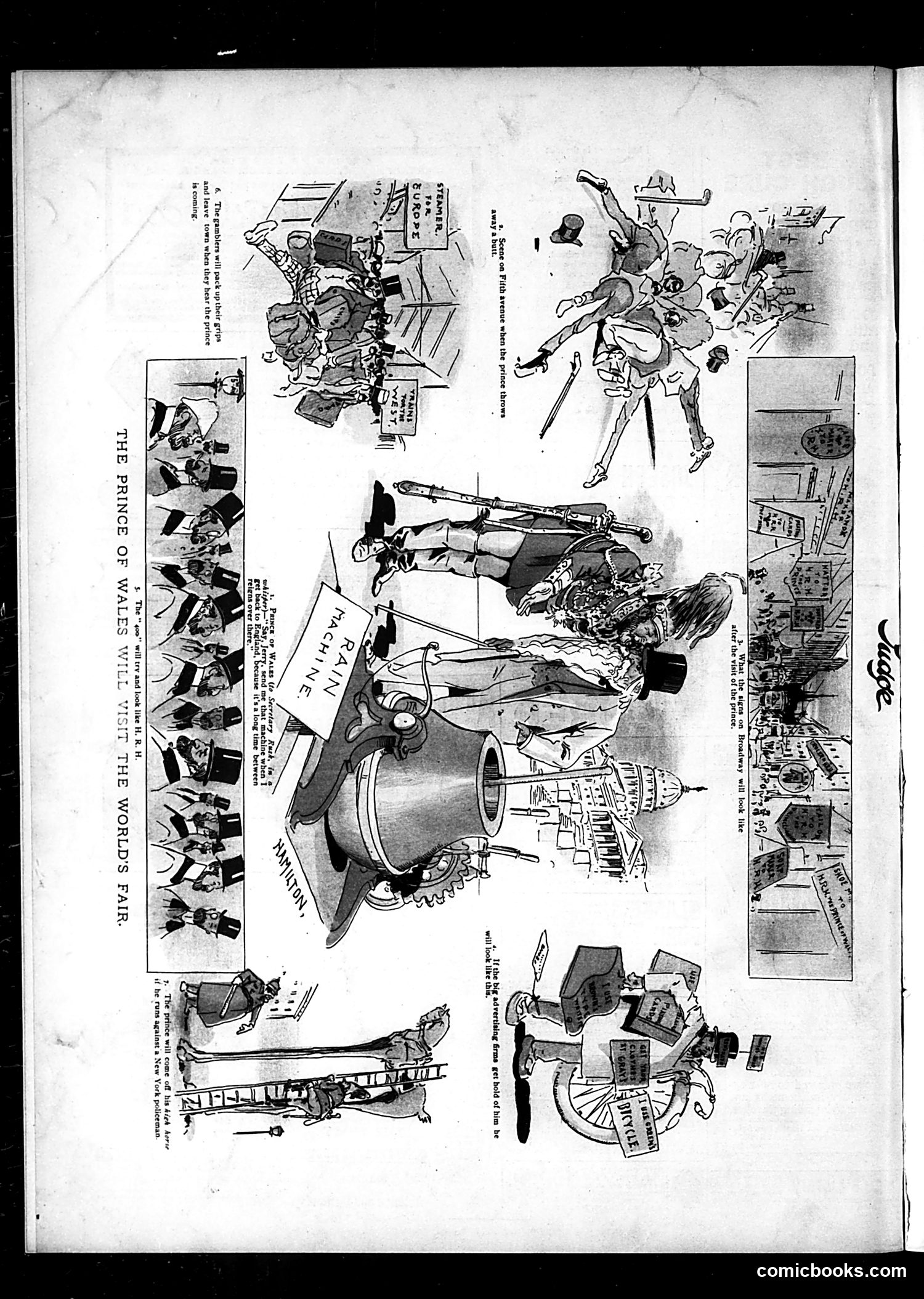
This satirical page mocks the British Prince of Wales's visit to a World's Fair (likely the 1893 Chicago exposition). The cartoons depict exaggerated scenarios showing how Americans obsessively compete for the prince's discarded items and attention. Panel 2 shows crowds scrambling for a cigarette butt he tosses on Fifth Avenue. Panel 4 satirizes advertising firms capitalizing on his presence, imagining how they'd exploit his image commercially. The overall point: American materialism and celebrity worship are so extreme that even royal garbage becomes a commodity. The cartoons ridicule both the prince-chasing American public and corporate opportunism, suggesting that national dignity is sacrificed for profit and social climbing.