
Judge, 1893-01-07 · page 10 of 18
Judge — January 7, 1893 — page 10: what you’re looking at
What you’re looking at
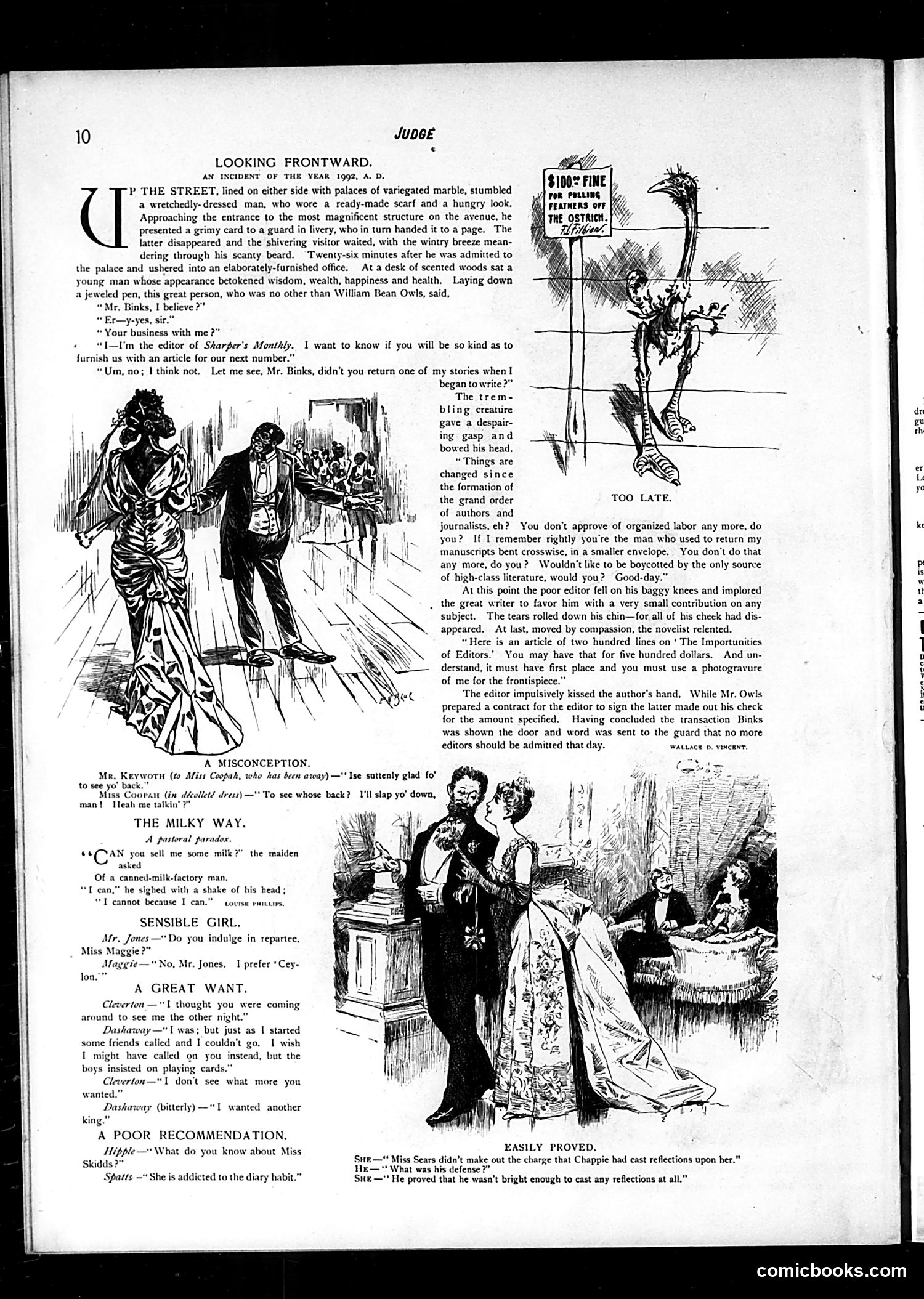
This satirical page mocks the emerging power of organized labor unions and author guilds in the 1890s. The main cartoon, "Too Late," depicts a future (1992) where writers have formed a powerful labor organization that allows them to dictate terms to editors and publishers. The scenario: a struggling editor visits William Bean Owls, a successful author who previously rejected the editor's manuscripts. Now reversed, Owls exploits his position—demanding $500 for a 200-line article, refusing to submit work unless paid exorbitantly, and threatening boycotts. The humiliated editor, powerless against organized writers, capitulates. The satire criticizes how unionization could flip traditional power hierarchies, making struggling editors subservient to formerly-rejected writers. Judge's perspective appears anti-labor: the cartoon warns readers that organized labor protects mediocre writers while punishing legitimate business interests. The page includes unrelated short humor pieces mocking courtship and commercial absurdities typical of Judge's miscellaneous content.
📄 Transcribed text from this page (OCR, searchable)
Machine-transcribed from the original scan — historical spelling and the odd misread are preserved.
JUDGE LOOKING FRONTWARD. AN INCIDENT OF THE YEAR 1992, A. D. P THE STREET, lined on either side with palaces of variegated marble, stumbled a wretchedly-dressed man, who wore a ready-made scarf and a hungry look. Approaching the entrance to the most magnificent structure on the avenue, he presented a grimy card to a guard in livery, who in turn handed it to a page. The latter disappeared and the shivering visitor waited, with the wintry breeze mean- dering through his scanty beard. Twenty-six minutes after he was admitted to the palace and ushered into an elaborately-furnished office. Ata desk of scented woods sat a young man whose appearance betokened wisdom, wealth, happiness and health. Laying down a jeweled pen, this great person, who was no other than William Bean Owls, said, “Mr. Binks, I believe?” “ Er—y-yes, sir.” ‘our business with me ?” —I'm the editor of Sharper's Monthly. 1 want to know if you will be so kind as to furnish us with an article for our next number.” “Um, no; I think not. Let me see, Mr. Binks, didn’t you return one of my stories when I began to write?” The trem- bling creature gave a despair- ing gasp and bowed his head. “Things are changed since the formation of the grand order TOO LATE. of authors and journalists, ch? You don’t approve of organized labor any more, do you? If I remember rightly you're the man who used to return my manuscripts bent crosswise, in a smaller envelope. You don’t do that any more, do you? Wouldn't like to be boycotted by the only source of high-class literature, would you? Good-day.” At this point the poor editor fell on his baggy knees and implored the great writer to favor him with a very small contribution on any subject. The tears rolled down his chin—for all of his check had dis- appeared. At last, moved by compassion, the novelist relented. “Here is an article of two hundred lines on ‘ The Importunities of Editors." You may have that for five hundred dollars. And un- derstand, it must have first place and you must use a photogravure of me for the frontispiece.” The editor impulsively kissed the author's hand. While Mr. Owls prepared a contract for the editor to sign the latter made out his check for the amount specified. Having concluded the transaction Binks was shown the door and word was sent to the guard that no more editors should be admitted that day. WALLACE D, VINCENT, A MISCONCEPTION, Mr. Kevwornt (to Miss Coopah, who has been atoay) —"' Ise suttenly glad fo! to see yo" back,” Miss Coorant (in décolleté dress) —"* To see whose back? 1'll slap yo' down, man! Heal me talkin’ ?” THE MILKY WAY. A pastoral paradox. es CAN you sell me some milk?" the maiden asked Of a canned-milk-factory man, “LE can," he sighed with a shake of his head; *T cannot because I can.” Lovise raiurs. SENSIBLE GIRL. Mr. Jones —" Do you indulge in repartee, Maggie?” Maggie—" No, Mr. Jones. 1 prefer *Cey- A GREAT WANT. Cleverton —""1 thought you were coming around to sce me the other night.” Dashaway—" 1 was; but just as I started some friends called and I couldn't go. I wish I might have called on you instead, but the boys insisted on playing cards.” Cleverton—"1 don't see what more you wanted.” Dashaway (bitterly) —""1 wanted another king.” A POOR RECOMMENDATION. Hipple—" What do you know about Miss EASILY PROVED. : Skidds C Miss Sears didn’t make out the charge that Chappie had cast reflections upon her.” whe t . . bi What was his defense?” Spatts —" She is addicted to the diary habit.’ Sux —"* He proved that he wasn't bright enough to cast any reflections at all.” comicbooks.com