
A complete issue · 19 pages · 1892
Judge — December 31, 1892
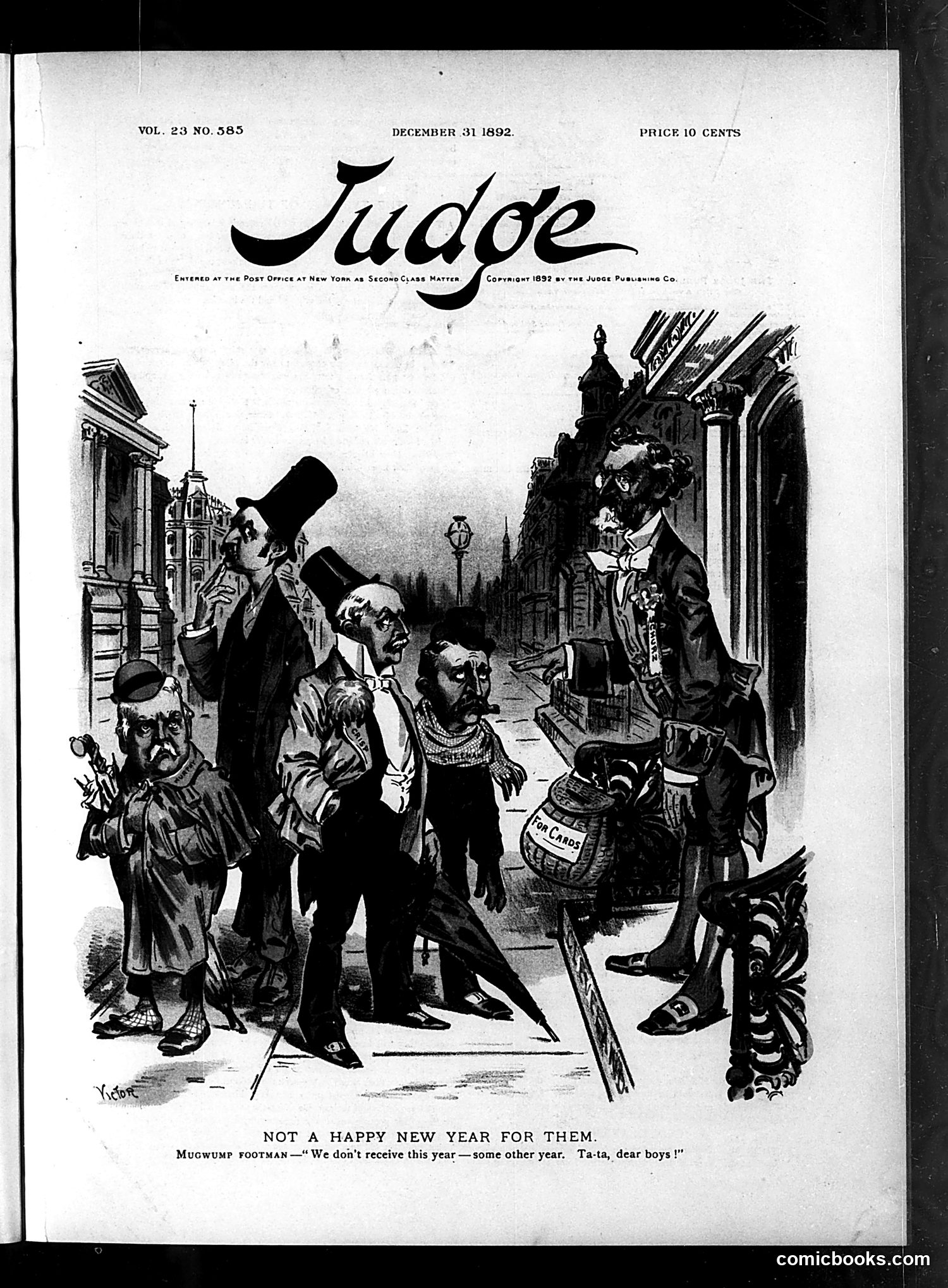
This New Year's Eve cartoon satirizes Irish immigrants' financial struggles. The caption "NOT A HAPPY NEW YEAR FOR THEM" and the "Mugwump Footman's" dismissive quote ("We don't receive this year—some other year") suggests wealthy elites are excluding or rejecting Irish visitors during the holiday season. The figures on the left appear to be working-class Irish men (identifiable by period caricature conventions), while the right shows well-dressed establishment figures at what seems to be a fashionable address. The contrast emphasizes class division and social exclusion in Gilded Age America. "Mugwump" was a political term for independents/reformers, here used mockingly to critique elite indifference to immigrant hardship during economic uncertainty.
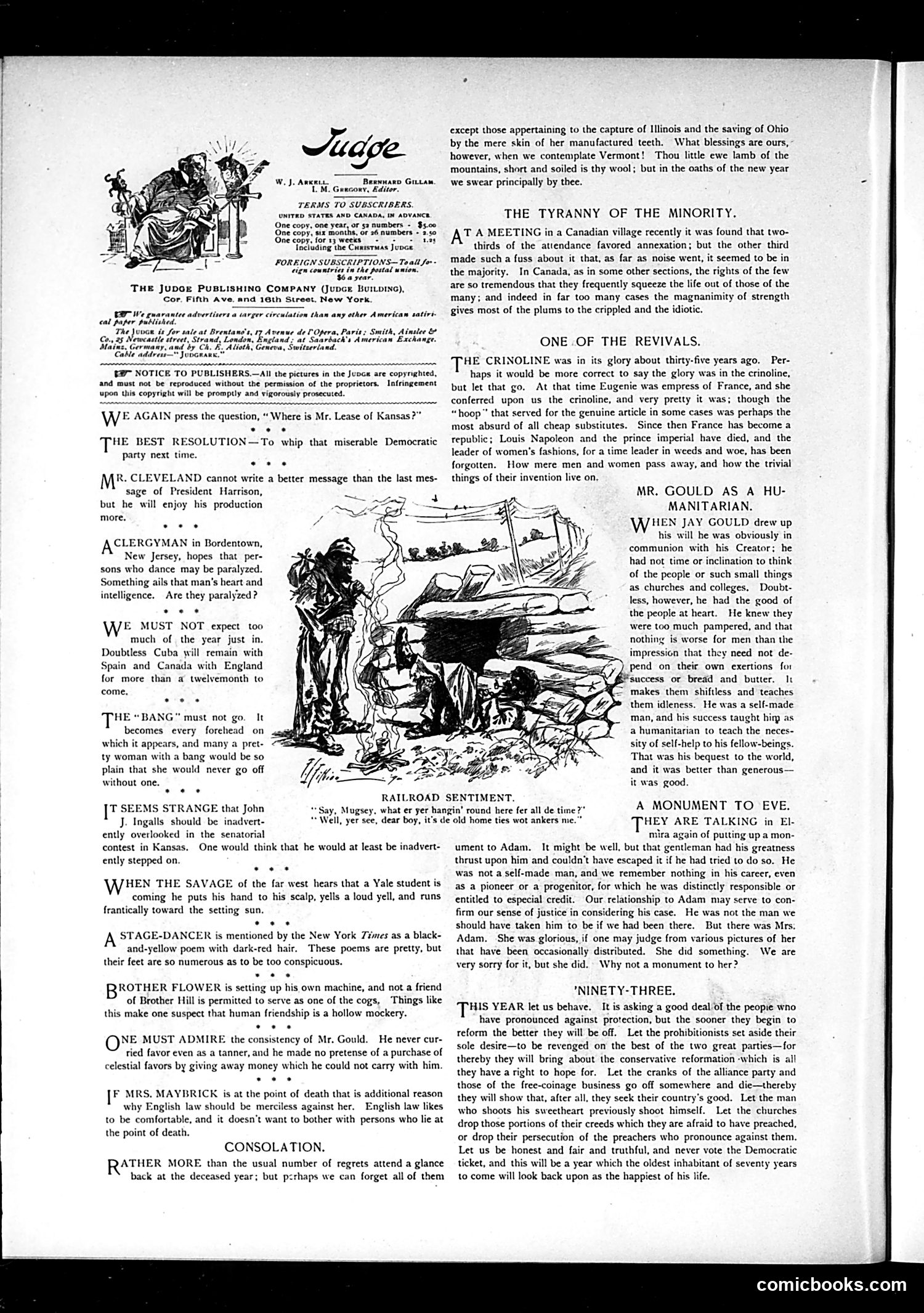
This page contains several short satirical editorials rather than a single cartoon. The main illustrated piece, "Railroad Sentiment," shows a poor man asking a wealthy gentleman for money, with the caption suggesting the man has been ruined by railroad interests. The editorials mock political figures and social issues of the era: - "We Again Press the Question" references Kansas politics - "Mr. Cleveland" critiques the Democratic president's messaging - "The Tyrant of the Minority" discusses Canadian politics and majority rule - "Mr. Gould as a Humanitarian" appears to satirize railroad magnate Jay Gould's philanthropic claims, suggesting his "success" teaching self-reliance actually left people helpless The page reflects late 19th-century progressive concerns about corporate power, particularly railroads, and political hypocrisy.
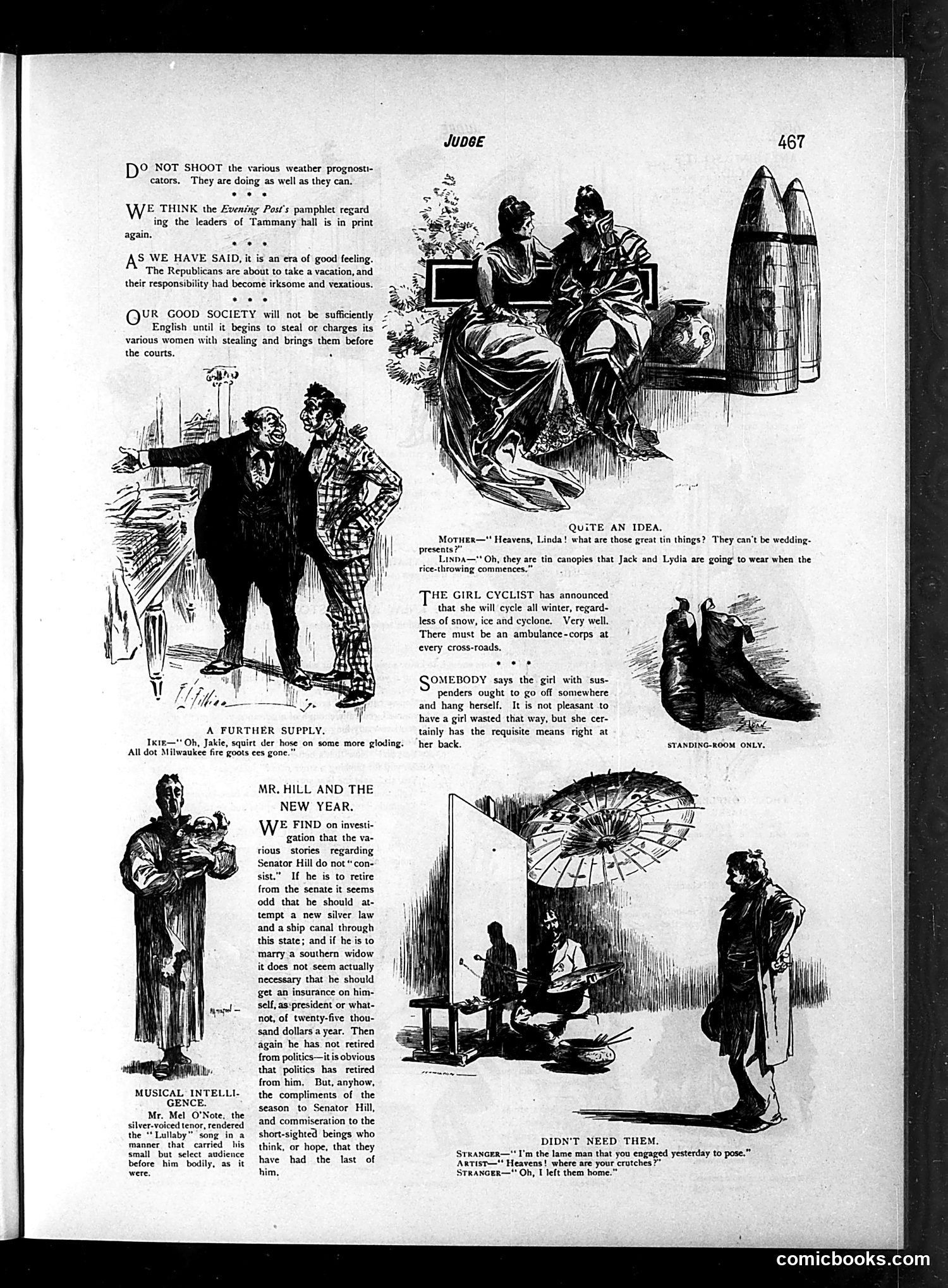
This page contains several satirical sketches mocking contemporary social issues and figures circa the 1880s-1890s. **"A Further Supply"** depicts a man requesting more "glowing" Milwaukee beer, suggesting beer was marketed as a health product. **"Quite an Idea"** jokes about women wearing wedding presents—apparently large, impractical tin canopies—as fashion. **"The Girl Cyclist"** satirizes the new phenomenon of women cyclists, mocking claims she'll ride year-round despite weather. **"Mr. Hill and the New Year"** discusses Senator Hill's alleged plans to retire from politics to pursue various business ventures and remarry, treating his political future as gossip. **"Didn't Need Them"** shows a lame artist rejecting crutches, playing on physical disability for humor. The page reflects Victorian attitudes toward emerging women's independence, new technologies (bicycles), and political intrigue.
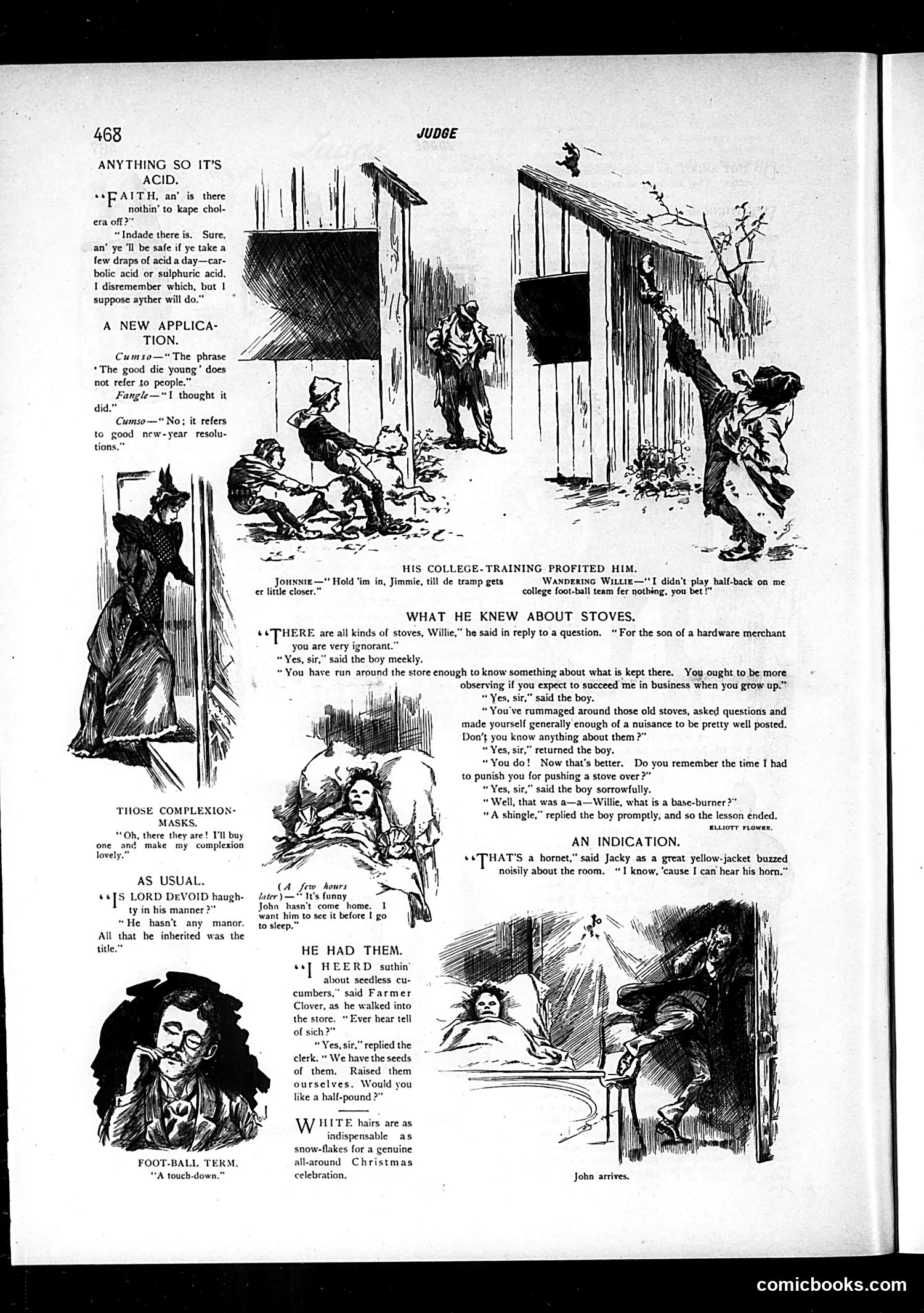
This page contains several brief satirical jokes typical of late-19th-century American humor magazine content: **"What He Knew About Stoves"** (main feature): A father tests his hardware merchant's son's knowledge of stoves. The boy, despite working in the store and being expected to learn the business, admits ignorance. When finally asked to define a "base-burner" (a type of stove), he answers "a shingle"—a nonsensical response suggesting he's learned nothing despite his access and opportunity. The satire mocks both lazy youth and parental expectations of business succession. **Smaller items** include social humor: Irish dialect jokes about cholera prevention using acid; wordplay about "good die young" referring to New Year's resolutions rather than people; a man inheriting only a title without property; and a child's misunderstanding of "hornet" based on mishearing "horn." The overall tone reflects period concerns about education, class, immigration (Irish stereotypes), and generational responsibility in business.
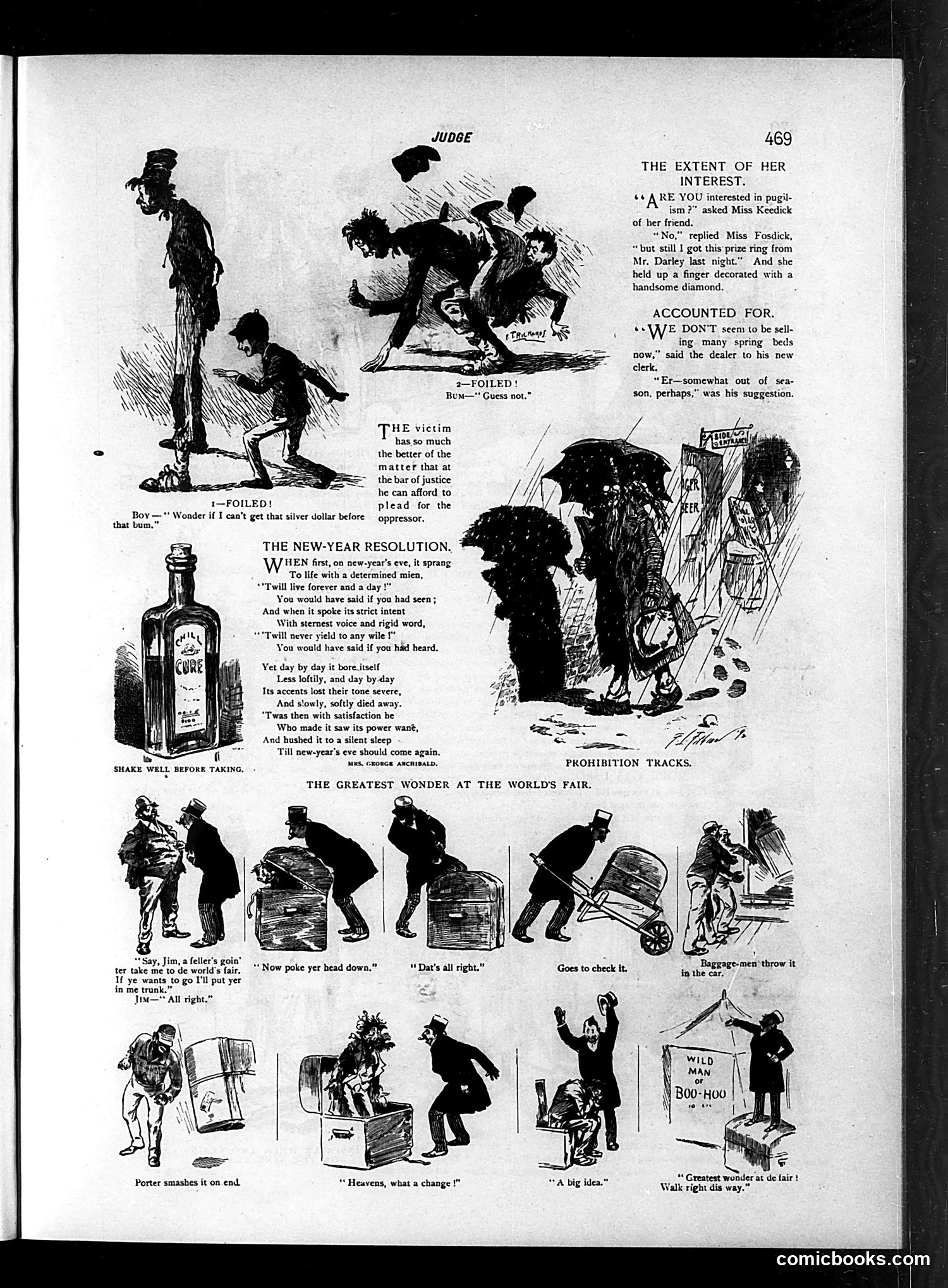
This page contains several satirical pieces typical of late 19th/early 20th-century Judge humor: **"The Extent of Her Interest"** mocks women's purported disinterest in boxing (pugilism) while eagerly accepting engagement rings from wealthy suitors—the humor turns on the contradiction between claimed indifference and material incentive. **"Accounted For"** jokes about poor spring-bed sales being "out of season," a merchant's excuse for sluggish business. **"The New-Year Resolution"** uses poetry to satirize the universal human failure to maintain New Year's resolutions—personifying a resolution as something that starts boldly but gradually weakens and "dies away" by year's end. **"The Greatest Wonder at the World's Fair"** appears to be a sequential comic strip satirizing visitors to a world's fair (likely the 1893 Chicago Columbian Exposition), showing bumbling tourists struggling with luggage and displays, culminating in someone examining a "Wild Man of Boo-Hoo" exhibit. The page emphasizes class anxiety, gender stereotypes, and turn-of-the-century American social foibles through visual and textual humor.
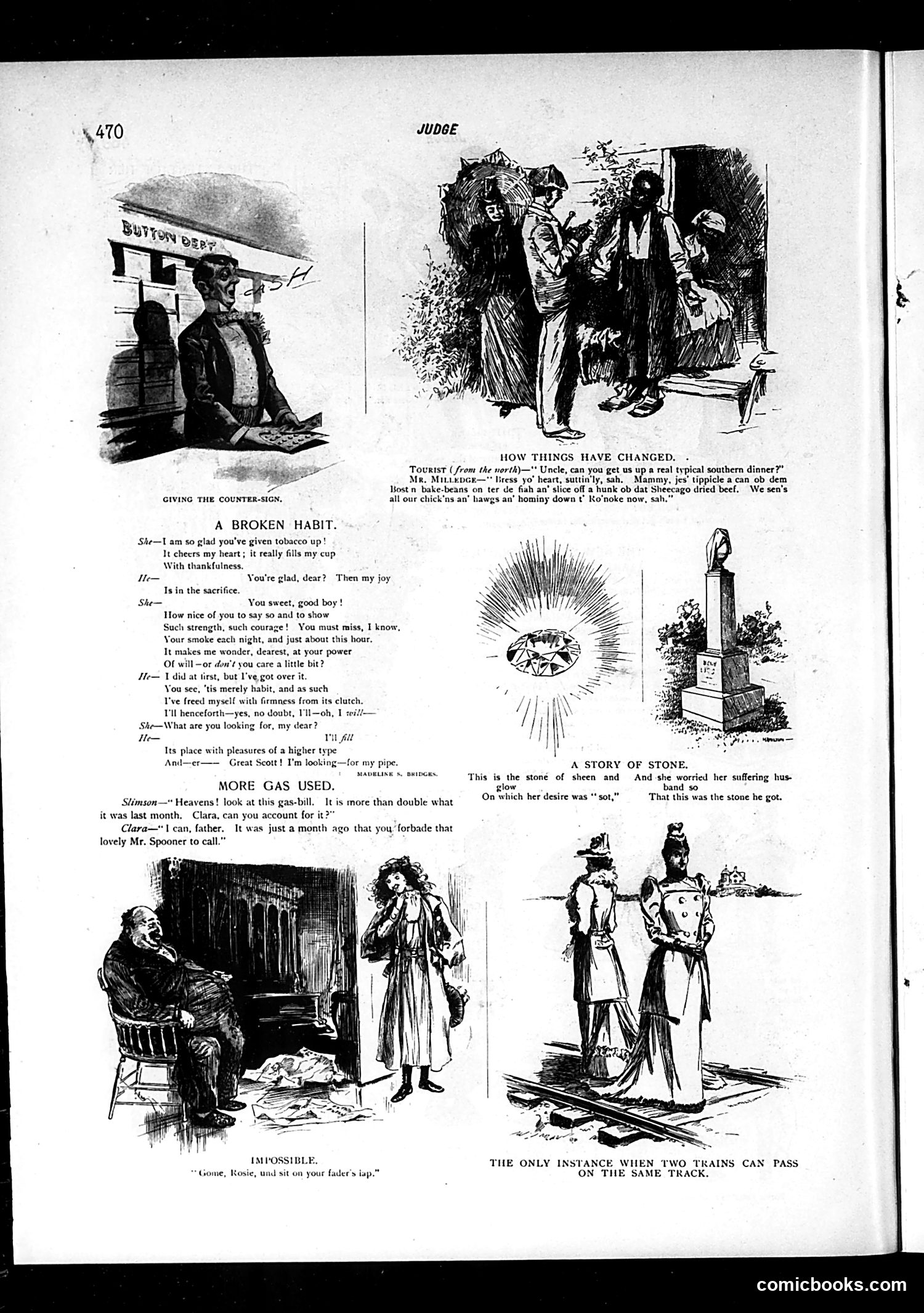
This page contains multiple satirical cartoons reflecting late-19th/early-20th century social attitudes: **"How Things Have Changed"** mocks the post-Civil War South, depicting a formerly genteel Southern host now serving canned Boston beans and Chicago beef instead of homegrown Southern fare—suggesting economic decline and Northern industrial dominance following Reconstruction. **"A Broken Habit"** satirizes a man who claims to have quit smoking for his girlfriend, then immediately searches for his pipe when she leaves—commentary on male weakness and hypocrisy regarding self-improvement promises. **"More Gas Used"** depicts a father blaming increased gas bills on forbidding a caller (suitor), implying the daughter now burns gas through depression or increased household activity. **"A Story of Stone"** appears to be domestic commentary about a woman's nagging wearing down her husband. **"The Only Instance When Two Trains Can Pass"** uses the visual pun of two women in bustles (fashionably wide skirts) passing each other—the joke being their combined width equals train track width. The humor targets class anxieties, gender relations, and fashion absurdities typical of the era.
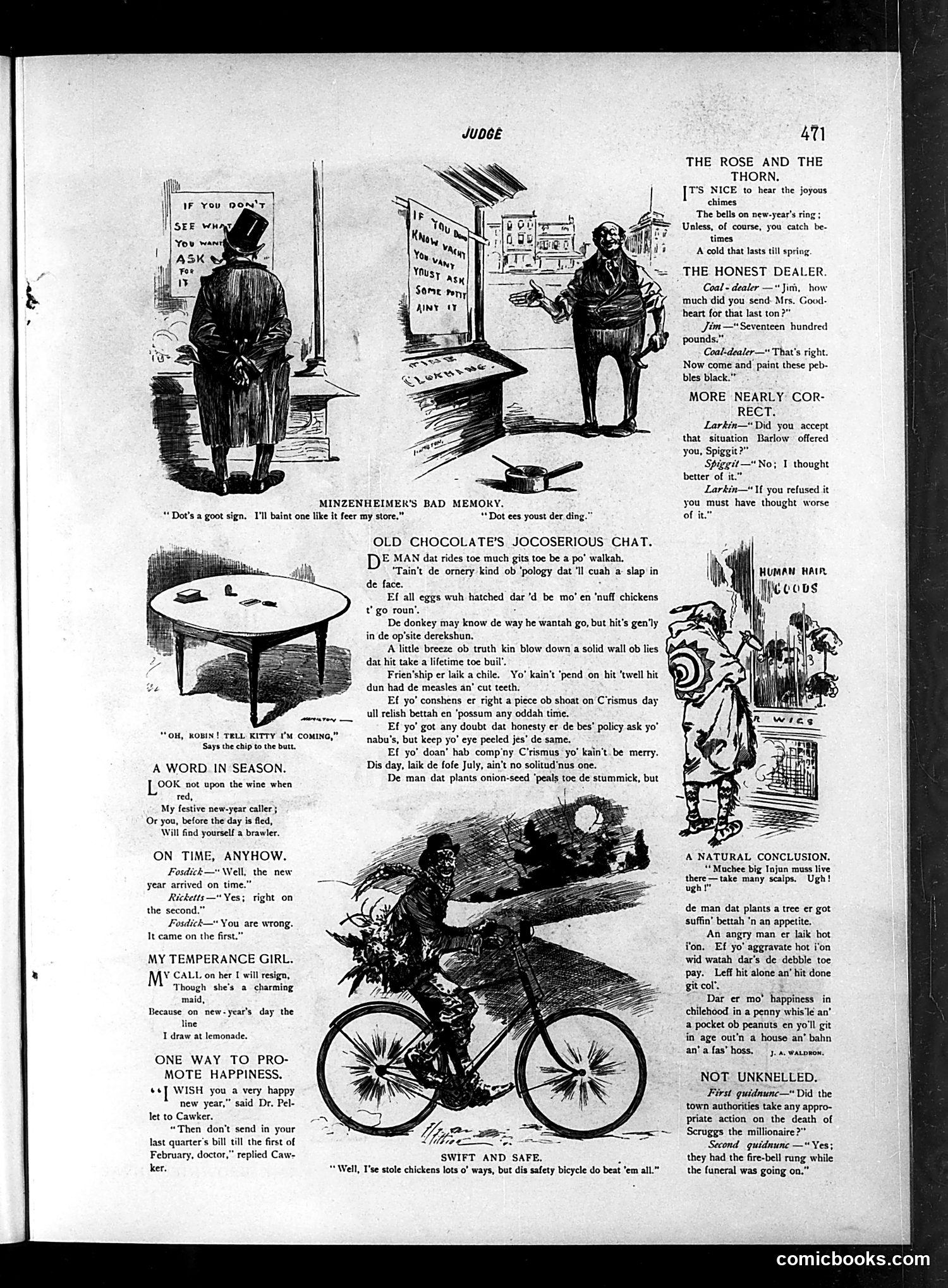
This page contains multiple short humorous sketches typical of Judge's satirical format, mostly poking fun at human nature and contemporary manners rather than specific political figures. **Key content includes:** - **"Minzenheimer's Bad Memory"**: A German-accented character (indicated by dialect spelling) sees a shop sign and plans to copy it—satirizing unoriginal business practices. - **"Old Chocolate's Jocoserious Chat"**: A Black character dispensing folksy philosophical observations in exaggerated dialect—reflecting the period's problematic racial humor conventions. - **Various one-liner jokes** about New Year's resolutions, punctuality, temperance, bill collection, and social behavior. - **"Swift and Safe"**: A cartoon about someone using a safety bicycle to steal chickens—playing on the bicycle's newness as a technology. The humor relies heavily on ethnic/racial stereotyping (German and Black dialects), class-based observations, and gentle domestic comedy. There's no identifiable major political content—this page focuses on everyday social satire rather than current events.
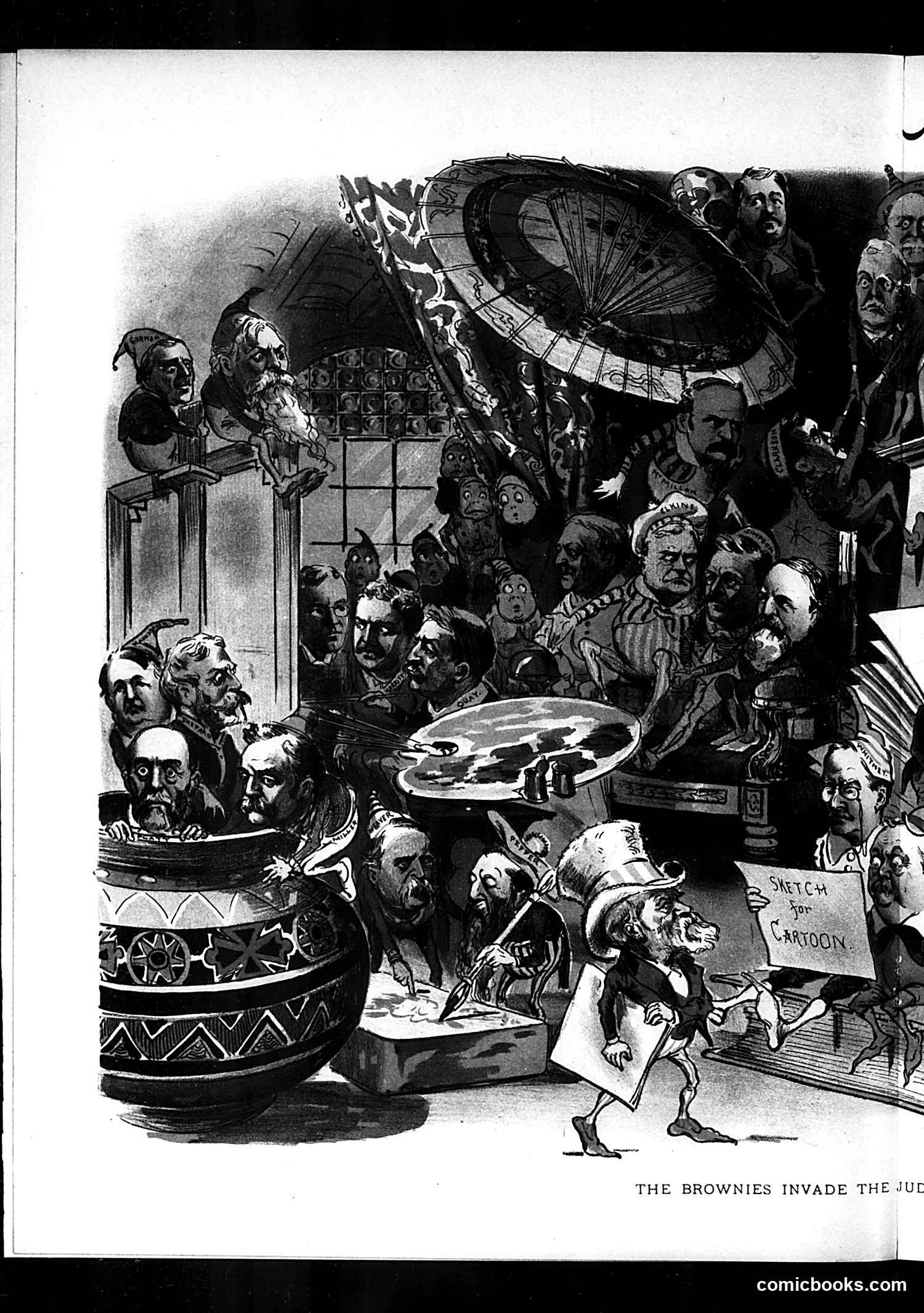
This appears to be a satirical cartoon featuring "the Brownies"—likely referring to the popular Brownie character illustrations by Palmer Cox that were widespread in late 19th-century American culture. The cartoon depicts these mischievous folkloric creatures invading what the caption suggests is "Judge" magazine itself (the text is cut off). The scene shows a crowded, chaotic gathering with numerous caricatured figures observing or reacting to the Brownies' intrusion. A figure in the foreground holds a sign reading "SKETCH for CARTOON," suggesting meta-commentary about the cartoon-making process itself. The satire appears to mock either the Brownie phenomenon's cultural ubiquity or Judge magazine's editorial choices, presented as an invasion or disruption of the publication's serious satirical mission.
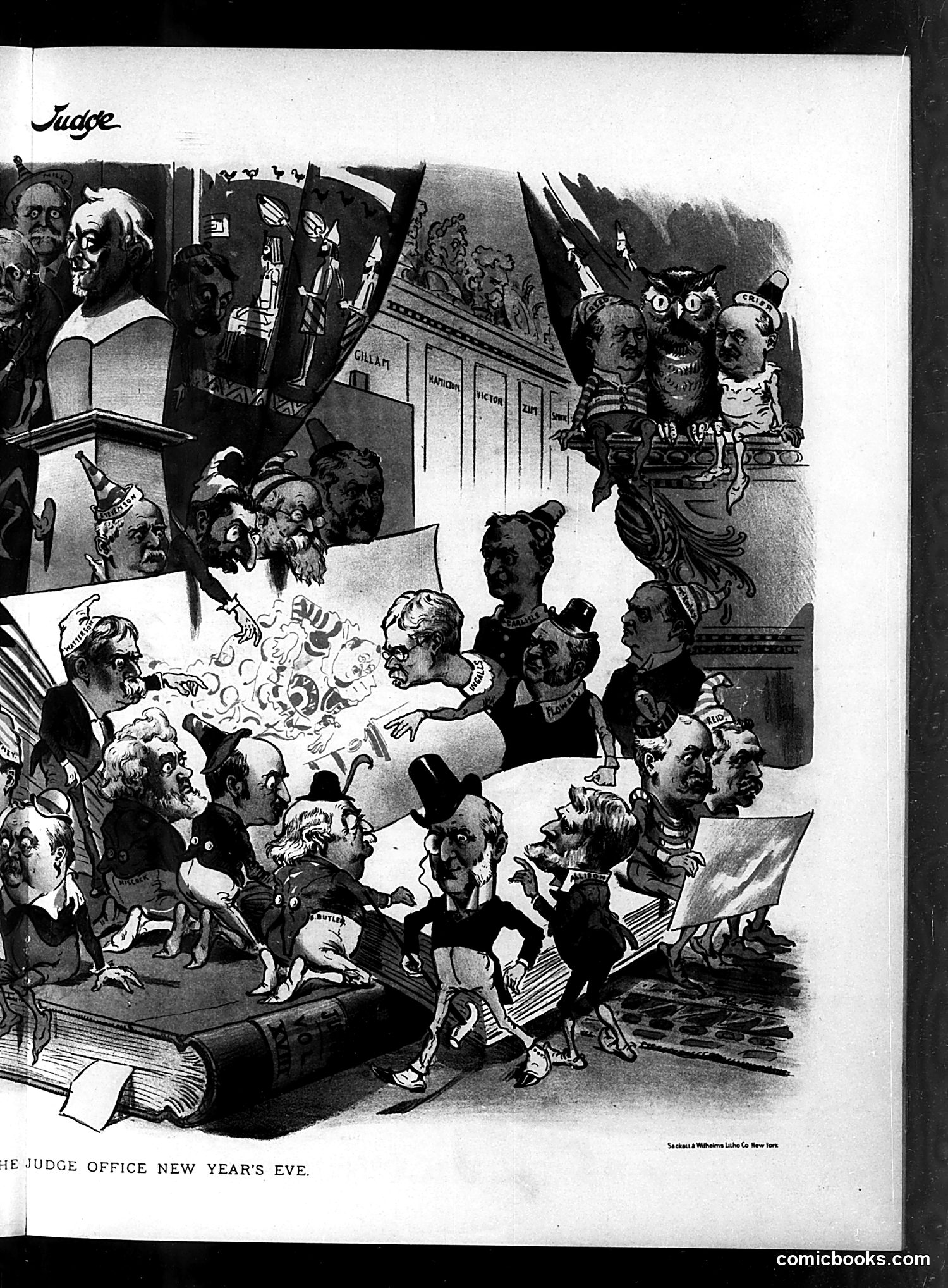
This satirical cartoon depicts a chaotic New Year's Eve celebration at the offices of *Judge* magazine. The scene shows numerous caricatured figures—politicians, public figures, and likely magazine staff—in various states of revelry and mischief. The exaggerated facial features and caricature style typical of 19th-century political satire suggest these represent recognizable contemporary figures, though specific identities are unclear from the image alone. The setting within the Judge office itself makes this self-referential satire about the magazine's own staff and contributors. The celebration appears deliberately anarchic and undignified, suggesting the cartoon mocks both the figures depicted and the pretensions of high society's New Year's festivities. The satirical intent appears to be ridiculing the vanity and excess of notable public figures during holiday celebrations.
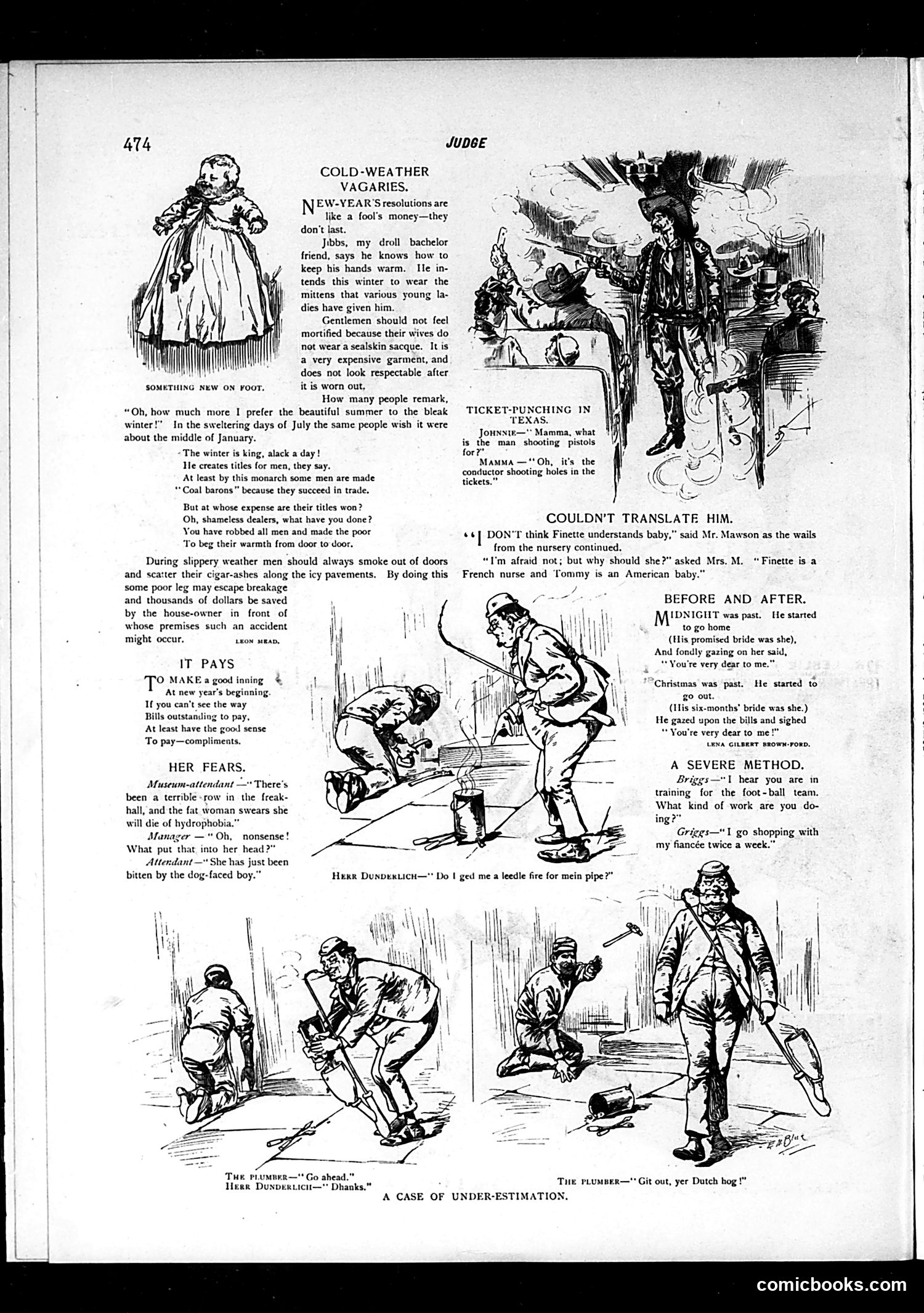
This page from Judge magazine (a 19th-century American satirical publication) contains multiple unrelated humorous pieces typical of the era: **"Cold-Weather Vagaries"** opens with social commentary on winter, including a jab at newly wealthy "coal barons"—men who profited from coal trading and adopted aristocratic airs. The satire mocks their pretension while criticizing their exploitation that left the poor suffering in cold. **Other brief jokes** mock New Year's resolutions, include a museum freak-show gag, and poke fun at language barriers (a French nurse caring for an American baby). **"Before and After"** contrasts romantic pre-marriage declarations with post-marriage complaints about expenses—standard domestic humor. **"A Severe Method"** uses shopping as a humorous stand-in for athletic training. The bottom cartoons appear to involve plumbers and apparently an ethnic slur. Overall, this is typical Judge content: social satire mixed with domestic humor, workplace comedy, and casual period prejudices.
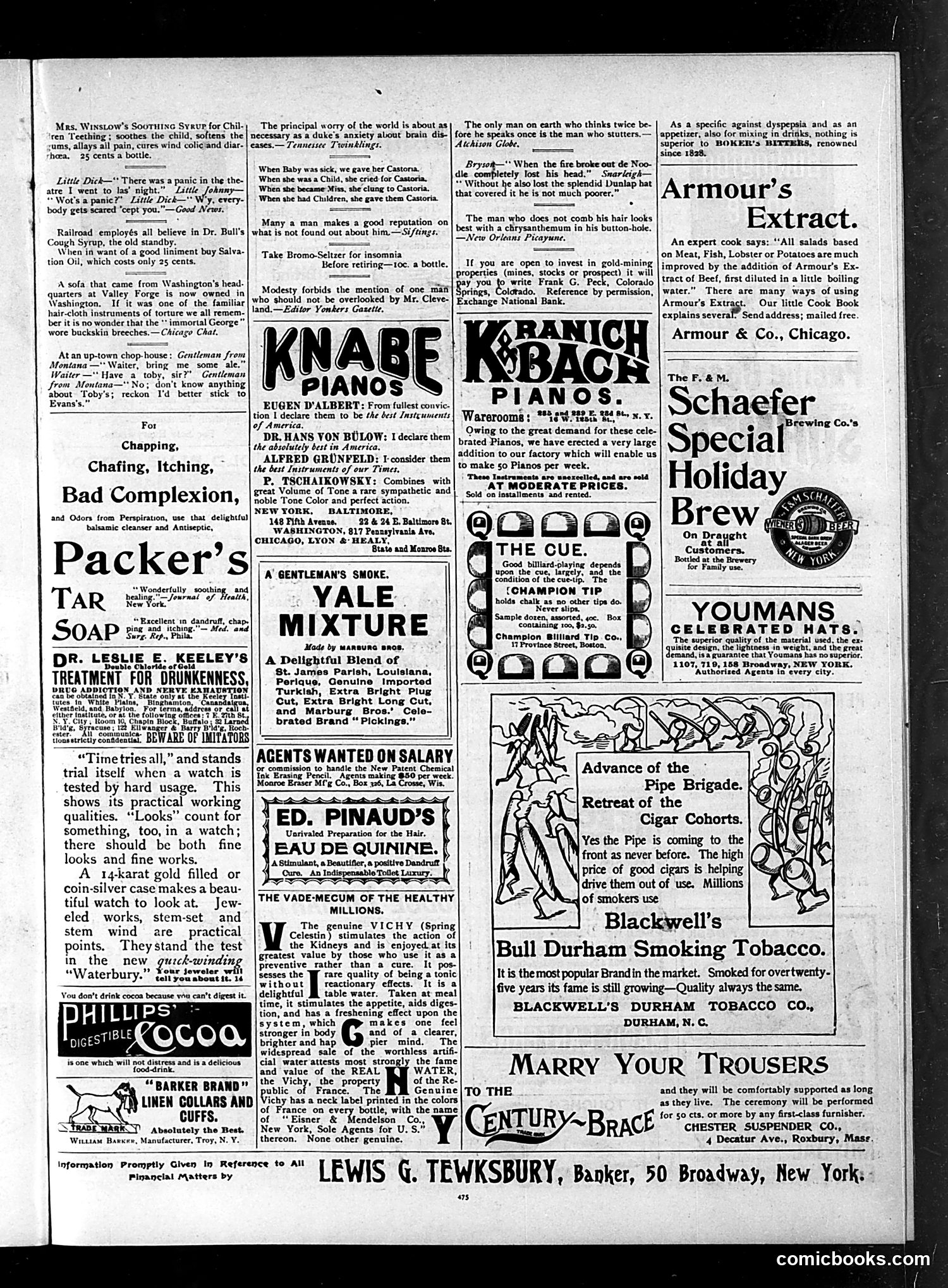
This page is **primarily advertisements** with minimal editorial content. The scattered short humorous items (jokes about panics, Washington's sofa, etc.) serve as filler between ads for patent medicines, tobacco, pianos, and grooming products—typical of late 19th-century magazines. The one **illustrated cartoon** shows the "Advance of the Pipe Brigade. Retreat of the Cigar Cohorts"—a playful military metaphor about smoking trends, depicting pipes apparently advancing while cigars retreat. The joke reflects period anxieties about changing consumer preferences. The ads themselves reveal era-specific concerns: teething syrups, treatments for drunkenness, dandruff cures, and heavily-endorsed piano brands. Celebrity endorsements from composers (Tschaikowsky, von Bülow) lend credibility to instruments. Overall, this reflects a Judge readership of middle-to-upper-class urban men concerned with grooming, health tonics (many containing alcohol or opiates), and consumer goods. The satire is gentle and product-focused rather than politically pointed.
This page is primarily **advertising-heavy** rather than containing political cartoons. It features typical early 1900s commercial advertisements interspersed with brief satirical quips and jokes. The small comedic items scattered throughout target common social situations: - A joke about typewritten love letters and "manifolding" (carbon copies), suggesting infidelity concerns - A quip about men thinking women talk too much unless they're in love with them - A classroom joke where a boy defines "synonym" as a word you use when you can't spell the real one - Observations about piano-tuners' professional jealousy These humor pieces reflect period anxieties: romantic deception, gender dynamics, and professional competitiveness. The advertisements promote medicines (French tonics, Bromo-Seltzer), champagne, bitters, patent remedies, office furniture, and cosmetics—typical Judge magazine revenue sources. The "Judge Library" advertisement appears to be an actual book promotion rather than satire. No identified political figures or major satirical cartoons appear on this page.
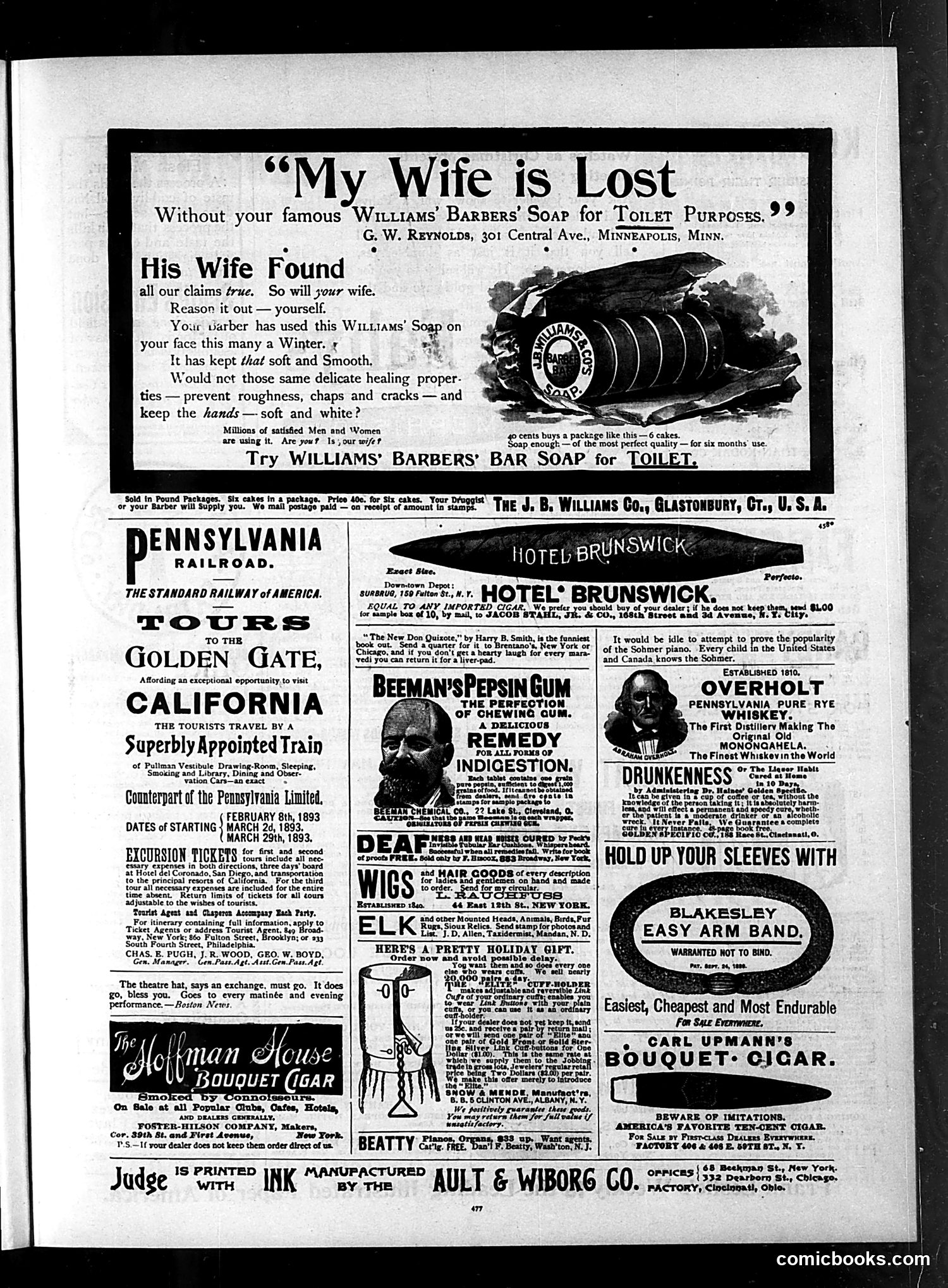
This page is primarily **advertising**, not a satirical cartoon. It's a collection of late-19th-century commercial advertisements from *Judge* magazine (dated 1893). The largest ad depicts **Williams' Barbers' Soap**, using a dated marketing strategy: testimonial advertising. A Minneapolis barber claims his wife is "lost" without the product, implying it's indispensable for maintaining soft skin and hands. This reflects contemporary gender assumptions—the ad targets both men (barbers) and women, but frames soap use as central to wives' household value. Other notable ads include a Pennsylvania Railroad tour to California, Beeman's Pepsin Gum (marketed as digestive aid), deaf and hair goods, and the Sohmer piano. These advertisements reveal consumer concerns of the era: travel, digestive health, appearance, and genteel home furnishings. The page contains no discernible political satire—it's essentially a revenue-generating advertising section typical of period magazines.
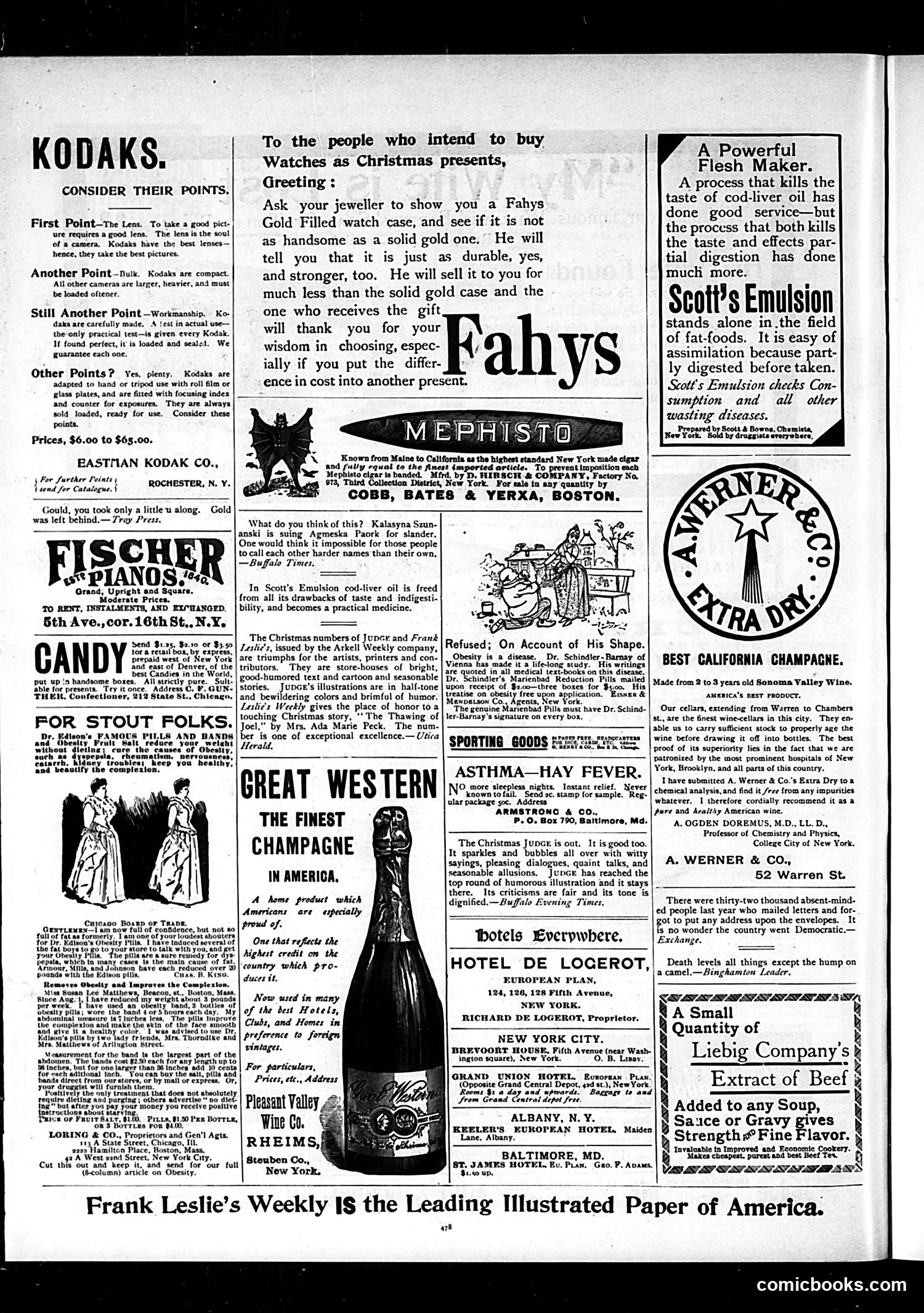
This is primarily an **advertising page** from what appears to be a late 19th or early 20th-century magazine. The dominant content consists of product advertisements rather than political cartoons or satirical content. **Notable advertisements include:** - Kodak cameras (emphasizing lens quality and portability) - Fischer pianos - Candy and confectionery products - Fahys Gold Filled watch cases - "Great Western" champagne - Various patent medicines and health products (pills for obesity, asthma remedies, etc.) - Hotel listings and beef extract **The single satirical element** appears to be a brief quip: "Gould, you took only a little u along. Gold was left behind"—a likely reference to the wealthy Gould family, joking about their greed. The page reflects period consumer culture and the prevalence of patent medicine advertising, which was largely unregulated at this time. Most content is commercial rather than editorial or satirical.
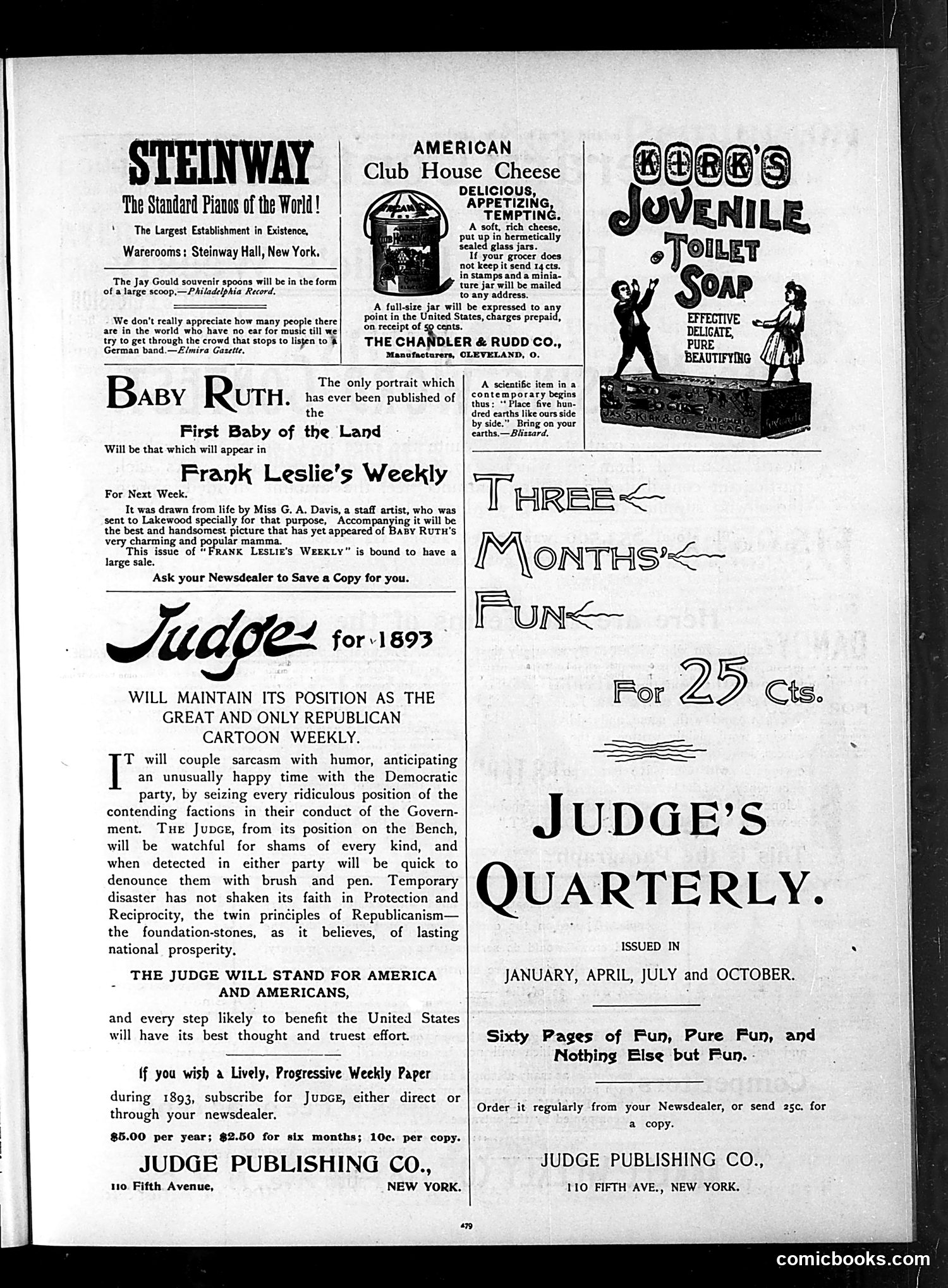
This is primarily an **advertising and promotional page** rather than featuring political cartoons. The main content includes: **"Baby Ruth" teaser**: Judge advertises an upcoming portrait in *Frank Leslie's Weekly* of "Baby Ruth," described as the "First Baby of the Land"—likely referring to Ruth Cleveland, President Grover Cleveland's infant daughter, who was a significant public figure at the time. **Judge's 1893 Platform**: The magazine's self-promotion states it will remain "the great and only Republican cartoon weekly," promising to use "sarcasm with humor" to critique the Democratic party while maintaining faith in Republican principles of "Protection and Reciprocity." **Surrounding advertisements**: Steinway pianos, Club House Cheese, and Judge's Quarterly subscription promotion. The page reflects late-19th-century magazine culture—combining partisan Republican rhetoric with celebrity interest (the Cleveland baby) and commercial advertising, typical of American satirical periodicals of this era.
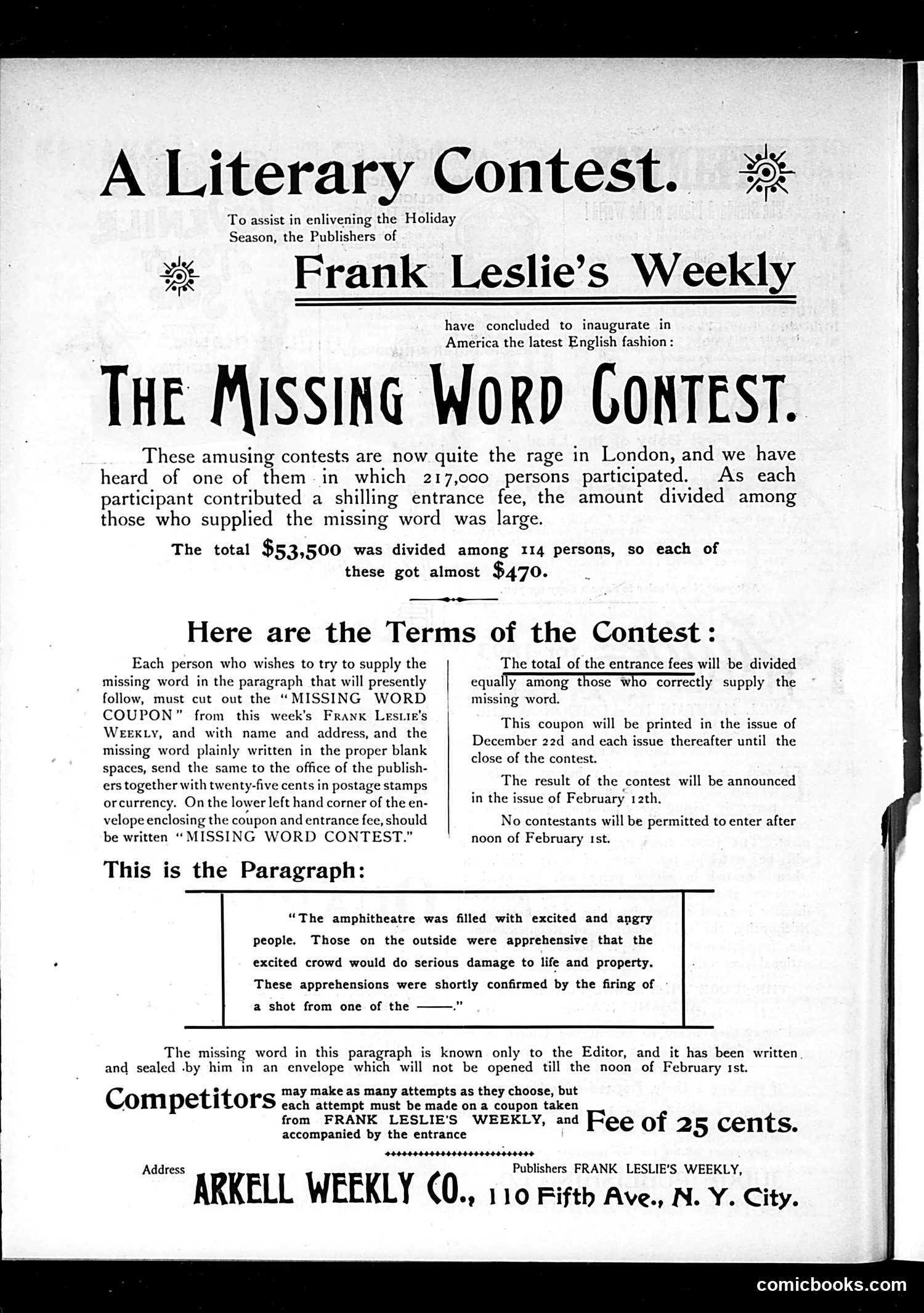
This page is primarily an advertisement for a "Missing Word Contest" sponsored by *Frank Leslie's Weekly*. Rather than satire, it's a promotional scheme modeled on popular English contests then gaining attention. The contest works as a lottery: participants pay 25 cents, guess a missing word from a printed paragraph (about an amphitheater incident), and the entrance fees are divided equally among those who guess correctly. The text references a London contest that generated $53,500 split among 114 winners—roughly $470 each. The paragraph itself appears mundane—describing an excited crowd and gunfire—with the missing word deliberately withheld until after entries close February 1st. This ensures the outcome cannot be predicted. The appeal is clear: for a quarter, readers could win substantial money if few others guessed correctly. It's a gambling mechanism disguised as a literary puzzle, exploiting public fascination with chance and prize-winning.
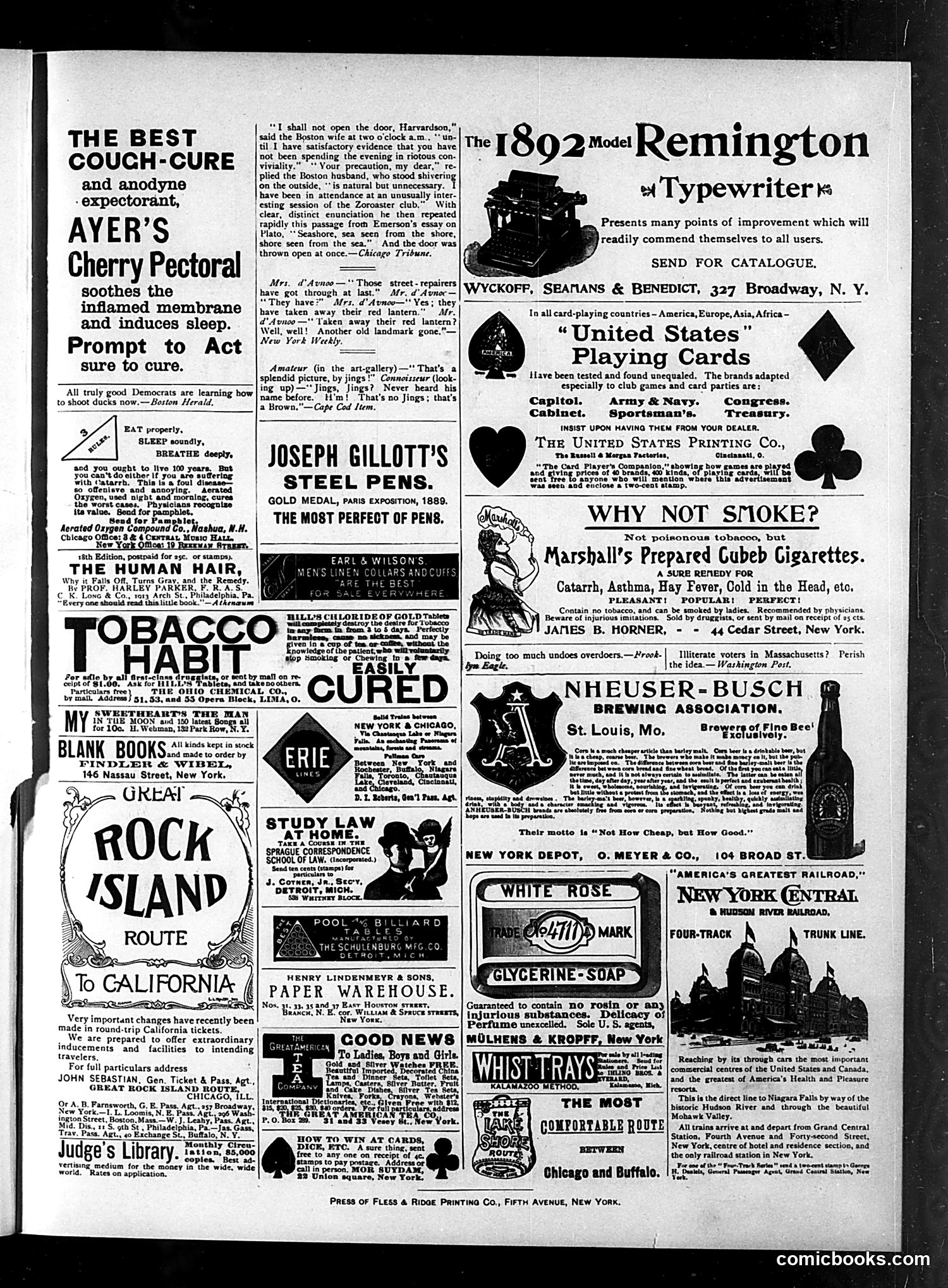
This page is primarily a **late 19th-century advertisement section** from Judge magazine, containing mostly commercial ads for typewriters, playing cards, patent medicines, pens, soaps, and transportation services. The only satirical content appears to be **four brief humor items** scattered among the ads: 1. **Boston marriage joke**: A wife refuses to let her husband in at 2 a.m. without proof he hasn't been carousing. He quotes Emerson about the seashore to convince her, which works—the humor lies in using highbrow literary references as an excuse for late-night behavior. 2. **Street repairs joke**: A husband notes the workers removed their red warning lanterns, calling it "another old landmark gone"—light social commentary on urban change. 3. **Art gallery joke**: A confused amateur calls a painting by "Jings"; the connoisseur corrects him that it's actually by an artist named Brown. 4. **Democratic/duck hunting reference**: A one-liner about Democrats learning to "shoot ducks," likely a political jab, though context is unclear. The page reflects how Judge mixed satire with aggressive advertising.
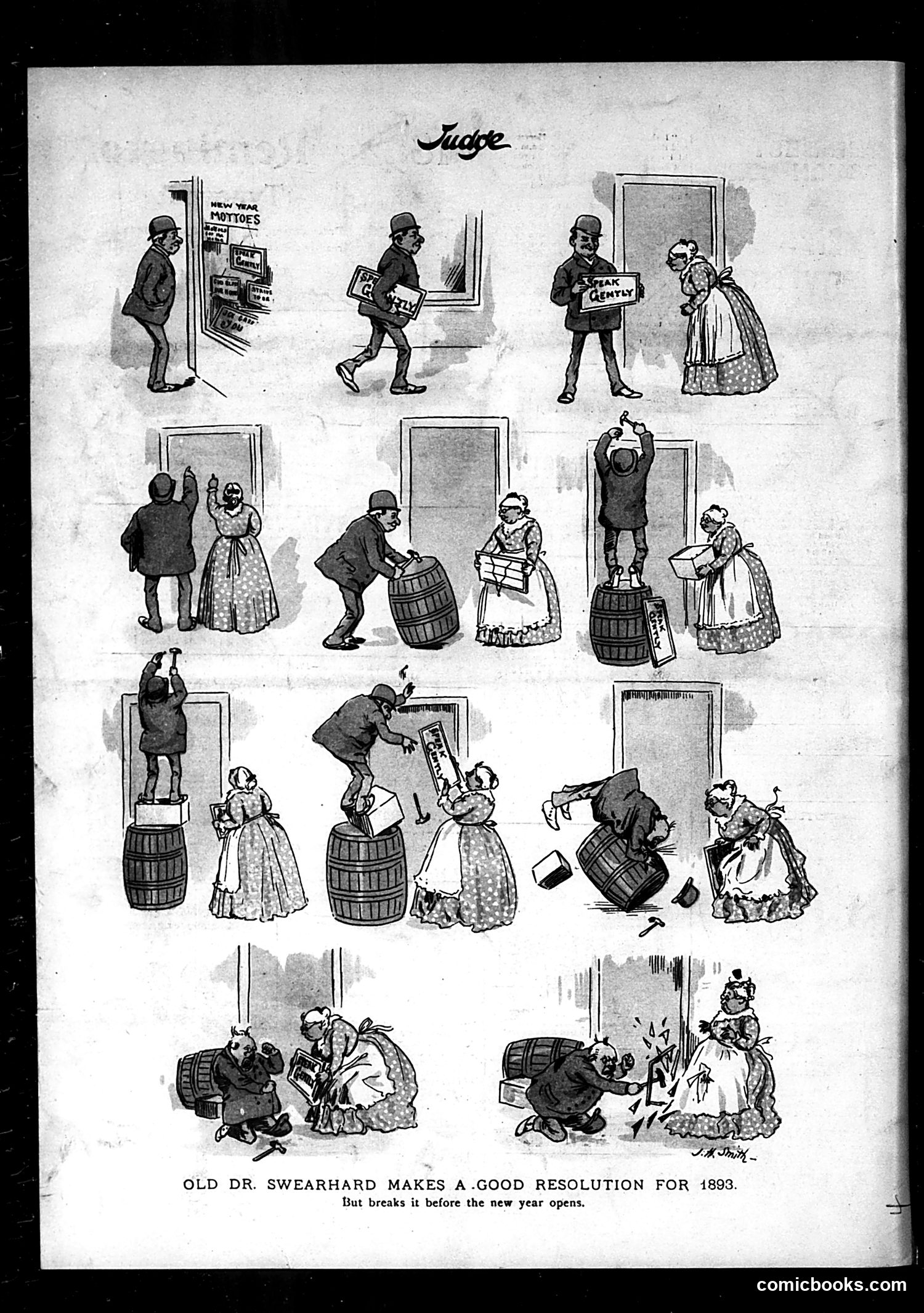
This is a sequential comic strip satirizing New Year's resolutions, specifically mocking a character called "Old Dr. Swearhard" (a pun on his habit of swearing). The strip shows the same man making a resolution to quit cursing, then immediately breaking it through a series of increasingly frustrating situations—dropping barrels, spilling things, and losing his temper with his wife. The humor derives from the universal human experience of failing resolutions almost instantly. "Swearhard" represents the common type who makes grand promises but lacks self-control. Each panel depicts progressively worse scenarios designed to test his resolve, culminating in his visible rage and cursing. The satire targets human hypocrisy and weakness of will—the gap between our aspirations and actual behavior, particularly relevant to New Year's traditionally being a time for self-improvement promises that rarely stick.

I can see this is a page from *Judge* magazine, but the image quality is too poor for me to make out specific cartoon content, figures, or text with confidence. The page appears predominantly dark/black with some faint detail visible along the left edge and margins, but the main content area is not legible enough to identify particular caricatures, political figures, or satirical subjects. To provide accurate historical context about which figures are depicted, what events are being referenced, and what the satire's point was—as your instructions require—I would need a clearer image where the artwork and text are actually readable. I cannot responsibly guess at identities or meanings here.