
Judge, 1892-12-31 · page 4 of 19
Judge — December 31, 1892 — page 4: what you’re looking at
What you’re looking at
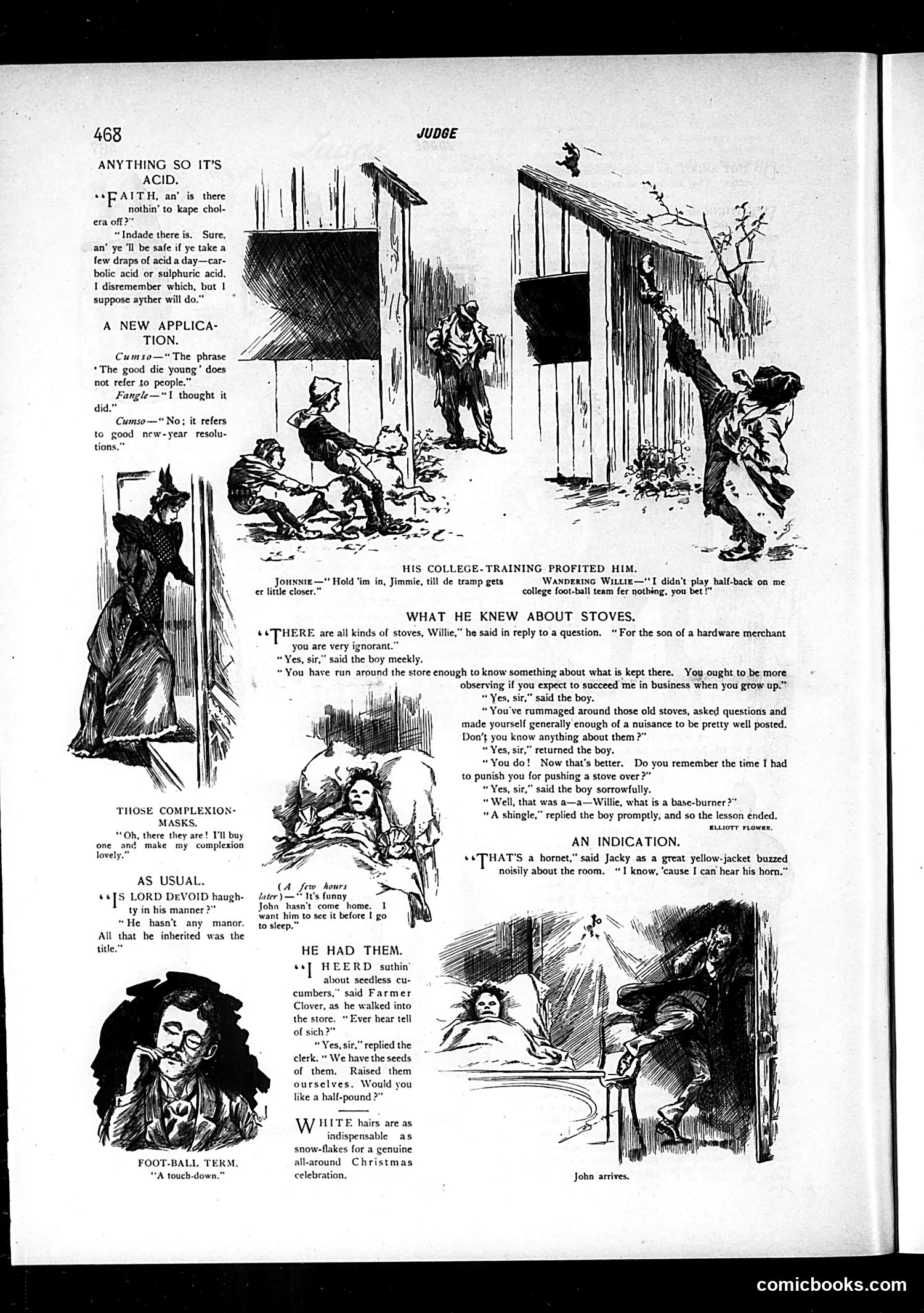
This page contains several brief satirical jokes typical of late-19th-century American humor magazine content: **"What He Knew About Stoves"** (main feature): A father tests his hardware merchant's son's knowledge of stoves. The boy, despite working in the store and being expected to learn the business, admits ignorance. When finally asked to define a "base-burner" (a type of stove), he answers "a shingle"—a nonsensical response suggesting he's learned nothing despite his access and opportunity. The satire mocks both lazy youth and parental expectations of business succession. **Smaller items** include social humor: Irish dialect jokes about cholera prevention using acid; wordplay about "good die young" referring to New Year's resolutions rather than people; a man inheriting only a title without property; and a child's misunderstanding of "hornet" based on mishearing "horn." The overall tone reflects period concerns about education, class, immigration (Irish stereotypes), and generational responsibility in business.
📄 Transcribed text from this page (OCR, searchable)
Machine-transcribed from the original scan — historical spelling and the odd misread are preserved.
468 ANYTHING SO IT’S ACID, ‘¢PAITH, an’ is there nothin’ to kape chol- era off?” “Indade there is. Sure, an’ ye ‘ll be safe if ye take a few draps of acid a day—car- bolic acid or sulphuric acid, I disremember which, but | suppose ayther will do.” A NEW APPLICA- TION. Cumso—“The phrase “The good die young’ does not refer to people.” Fangle—“1 thought it did.” Cumso—" No; it refers to good new-year resolu- tions.” THOSE COMPLEXION- MASKS. “Oh, there they are! T'll buy make my complexion one lovely.” AS USUAL. +45 LORD DeVOID haugh- ty in his manner 2” “He hasn't any manor. All that he inherited was the title.” “BALL TERM. “A touch-down.” er little closer.” WHAT HE KNEW ABOUT STOVES. SO THERE are all kinds of stoves, Willie,” he said in reply to a question. “For the son of a hardware merchant you are very ignorant.” “Yes, (A few hours later) —* W's funny John hasn't come home. 1 want him to see it before I go to sleep.” HE HAD THEM. ss] HEERD suthin about seedless cu- cumbers,” said Farmer Clover, as he walked into the store. “Ever hear tell of sich ? “Yes, sir,” replied the clerk. “ We have the seeds of them, Raised them ourselves. Would you like a half-pound 2” W HITE hairs are as indispensable as snow-flakes for a genuine all-around Christmas celebration. HIS COLLEGE- TRAINING PROFITED HIM. Jounniz—"' Hold ‘im in, Jimmie, till de tramp gets Wanperinc WILLE: aid the boy meekly. ¢ run around the store enough to know something about what is kept there. You ought to be more didn’t play half-back on me college foot-ball team fer nothing, you bet!" observing if you expect to succeed me in business when you grow up.”* “Yes, sir,” said the boy. “You've rummaged around those old stoves, asked questions and made yourself generally enough of a nuisance to be pretty well posted. Don’t you know anything about them ?” "Yes, sir,” returned the boy. “You do! Now that’s better. Do you remember the time I had to punish you for pushing a stove over ?” "Yes, sir,” said the boy sorrowfully. “Well, that was a—a—Willie, what is a base-burner?” “+A shingle,” replied the boy promptly, and so the lesson ended. ELLIOTT rLoweR, AN_ INDICATION. S“THAT'S a hornet,” said Jacky as a great yellow-jacket buzzed noisily about the room. ‘1 know, ‘cause I can hear his horn.” comicbooks.com