
Judge, 1892-12-31 · page 2 of 19
Judge — December 31, 1892 — page 2: what you’re looking at
What you’re looking at
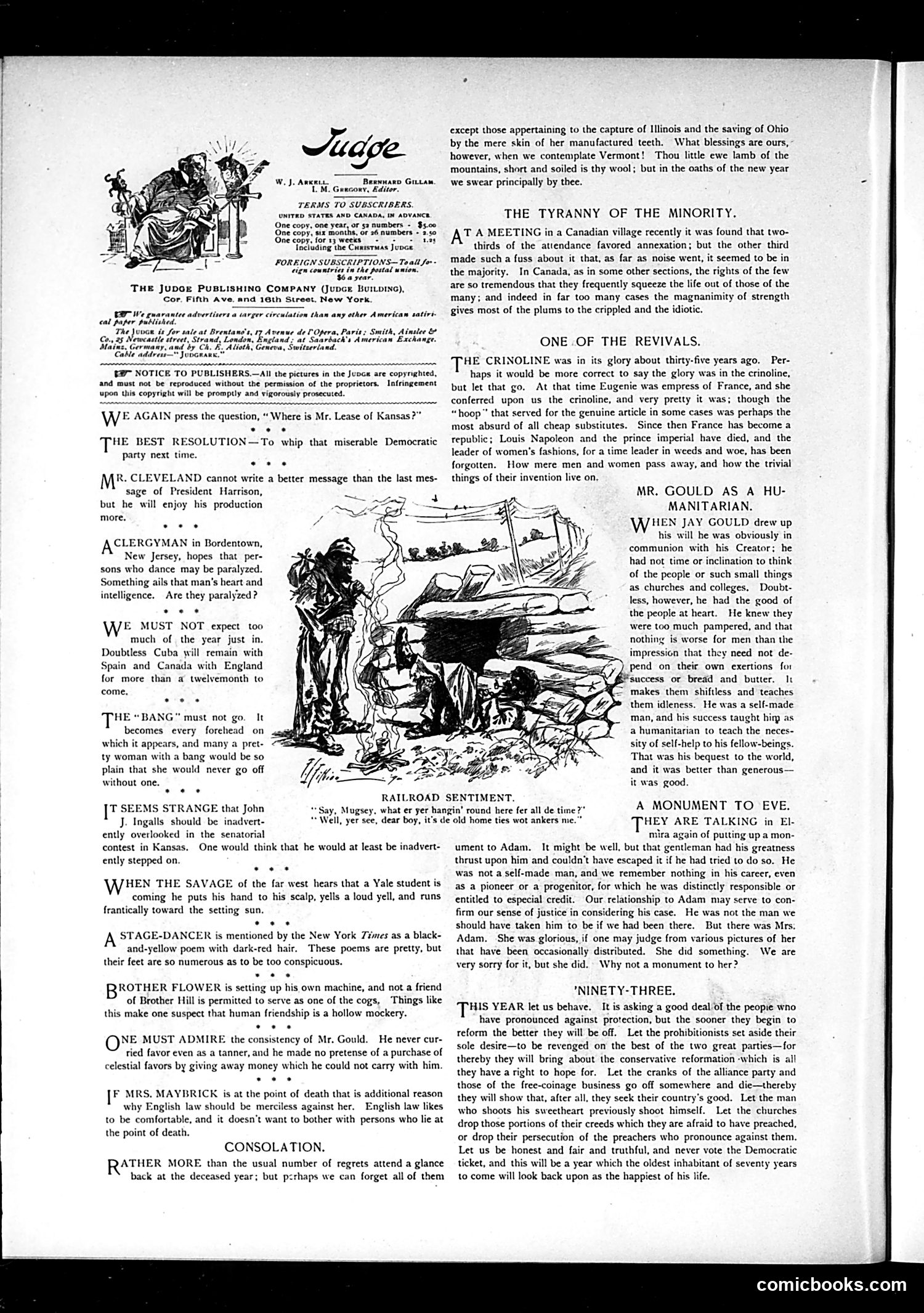
This page contains several short satirical editorials rather than a single cartoon. The main illustrated piece, "Railroad Sentiment," shows a poor man asking a wealthy gentleman for money, with the caption suggesting the man has been ruined by railroad interests. The editorials mock political figures and social issues of the era: - "We Again Press the Question" references Kansas politics - "Mr. Cleveland" critiques the Democratic president's messaging - "The Tyrant of the Minority" discusses Canadian politics and majority rule - "Mr. Gould as a Humanitarian" appears to satirize railroad magnate Jay Gould's philanthropic claims, suggesting his "success" teaching self-reliance actually left people helpless The page reflects late 19th-century progressive concerns about corporate power, particularly railroads, and political hypocrisy.
📄 Transcribed text from this page (OCR, searchable)
Machine-transcribed from the original scan — historical spelling and the odd misread are preserved.
W, J. Ament. Bexwwaro Giitam, 1. M. Geacony, Editor. TERMS TO SUBSCRIBERS. UNITRD STATES AND CANADA, IN ADVANCE One copy, one year, or s2 numbers - $5.00 One copy, six months, or 26 numbers - 2.50 One copy. forty wens = Including the Cunistaas Jupce THE JUDGE PUBLISHING COMPANY (JuDGE BUILDING), Cor. Fifth Ave. and 16th Street, New York. We guarantee advertisers a targer circulation than any other American satir’- ‘Mished. The Joes is for saieat Brentane's, 17 Avenue de lOpera. Paris: Smith, Ainslee & Co. 25 Neweastle ttreet, Strand, London, England: at Saarback's American Exchange. Mains, Germany, and by Ch. F, Alioth, Geneva, Switserland. $27 NOTICE TO PUBLISHERS.—AIl the pictures in the Juoce are copynghted, and must not be reproduced without the permission of the proprietors. Infringement upon this copyright will be promptly and vigorously prosecuted. WE AGAIN press the question, “ Where is Mr. Lease of Kansas?” JHE BEST RESOLUTION party next time. —To whip that miserable Democratic eee MB. CLEVELAND cannot write a better message than the last mes- sage of President Harrison, but he will enjoy his production more, / ACLERGYMAN in Bordentown, New Jersey, hopes that per- sons who dance may be paralyzed. Something ails that man’s heart and intelligence. Are they paralyzed? WE MUST NOT expect. too much of the year just in, Doubtless Cuba will remain with Spain and Canada with England for more than a twelvemonth to come. THE “BANG” must not go. It becomes every forehead on which it appears, and many a pret- ty woman with a bang would be so plain that she would never go off without one. except those appertaining to the capture of Illinois and the saving of Ohio by the mere skin of her manufactured teeth. What blessings are ours, however, when we contemplate Vermont! Thou little ewe lamb of the mountains, short and soiled is thy wool; but in the oaths of the new year we swear principally by thee. THE TYRANNY OF THE MINORITY. T A MEETING in a Canadian village recently it was found that two- thirds of the attendance favored annexation; but the other third made such a fuss about it that, as far as noise went, it seemed to be in the majority. In Canada, as in some other sections, the rights of the few are so tremendous that they frequently squeeze the life out of those of the many; and indeed in far too many cases the magnanimity of strength gives most of the plums to the crippled and the idiotic. ONE .OF THE REVIVALS. THE CRINOLINE was in its glory about thirty-five years ago. Per- haps it would be more correct to say the glory was in the crinoline, but let that go. At that time Eugenie was empress of France, and she conferred upon us the crinoline, and very pretty it was; though the “hoop” that served for the genuine article in some cases was perhaps the most absurd of all cheap substitutes. Since then France has become a republic; Louis Napoleon and the prince imperial have died, and the leader of women’s fashions, for a time leader in weeds and woe, has been forgotten. How mere men and women pass away, and how the trivial things of their invention live on. MR. GOULD AS A HU- MANITARIAN. N JAY GOULD drew up his will he was obviously in communion with his Creator; he had not time or inclination to think of the people or such small things as churches and colleges. Doubt- less, however, he had the good of the people at heart. He knew they were too much pampered, and that nothing is worse for men than the impression that they need not de- pend on their own exertions for ‘Success or bread and butter. It makes them shiftless and teaches them idleness. He was a self-made man, and his success taught hing as a humanitarian to teach the neces- sity of self-help to his fellow-beings. ‘That was his bequest to the world, and it was better than generous— it was good. RAILROAD SENTIMENT. [7 SEEMS STRANGE that John “Say, J. Ingalls should be inadvert- “Wel ently overlooked in the senatorial contest in Kansas. One would think that he would at least be inadvert- ently stepped on. HEN THE SAVAGE of the far west hears that a Yale student is coming he puts his hand to his scalp, yells a loud yell, and runs frantically toward the setting sun. STAGE-DANCER is mentioned by the New York Zzmes as a black- and-yellow poem with dark-red hair. These poems are pretty, but their feet are so numerous as to be too conspicuous. ROTHER FLOWER is setting up his own machine, and not a friend of Brother Hill is permitted to serve as one of the cogs, Things like this make one suspect that human friendship is a hollow mockery. NE MUST ADMIRE the consistency of Mr. Gould. He never cur- ried favor even as a tanner, and he made no pretense of a purchase of celestial favors by giving away money which he could not carry with him, IF MRS. MAYBRICK is at the point of death that is additional reason why English law should be merciless against her. English law likes to be comfortable, and it doesn’t want to bother with persons who lie at the point of death. CONSOLATION. ATHER MORE than the usual number of regrets attend a glance back at the deceased year; but perhaps we can forget all of them Mugsey, what er yer hangin’ round here fer all de time?” , yer see, dear boy, it's de old home ties wot ankers nie.” A MONUMENT TO EVE. HEY ARE TALKING in El- mira again of putting up a mon- ument to Adam. It might be well, but that gentleman had his greatness thrust upon him and couldn't have escaped it if he had tried to do so. He was not a self-made man, and we remember nothing in his career, even as a pioneer or a progenitor, for which he was distinctly responsible or entitled to especial credit. Our relationship to Adam may serve to con- firm our sense of justice in considering his case. He was not the man we should have taken him to be if we had been there. But there was Mrs, Adam. She was glorious, if one may judge from various pictures of her that have been occasionally distributed. She did something. We are very sorry for it, but she did. Why not a monument to her? "NINETY-THREE. ‘THIS YEAR let us behave. It is asking a good deal’of the peopie wno have pronounced against protection, but the sooner they begin to reform the better they will be off. Let the prohibitionists set aside their sole desire—to be revenged on the best of the two great parties—for thereby they will bring about the conservative reformation -which is all they have a right to hope for. Let the cranks of the alliance party and those of the free-coinage business go off somewhere and die—thereby they will show that, after all, they seek their country’s good. Let the man who shoots his sweetheart previously shoot himself. Let the churches drop those portions of their creeds which they are afraid to have preached, or drop their persecution of the preachers who pronounce against them. Let us be honest and fair and truthful, and never vote the Democratic ticket, and this will be a year which the oldest inhabitant of seventy years to come will look back upon as the happiest of his life. comicbooks.com