
A complete issue · 18 pages · 1892
Judge — December 10, 1892
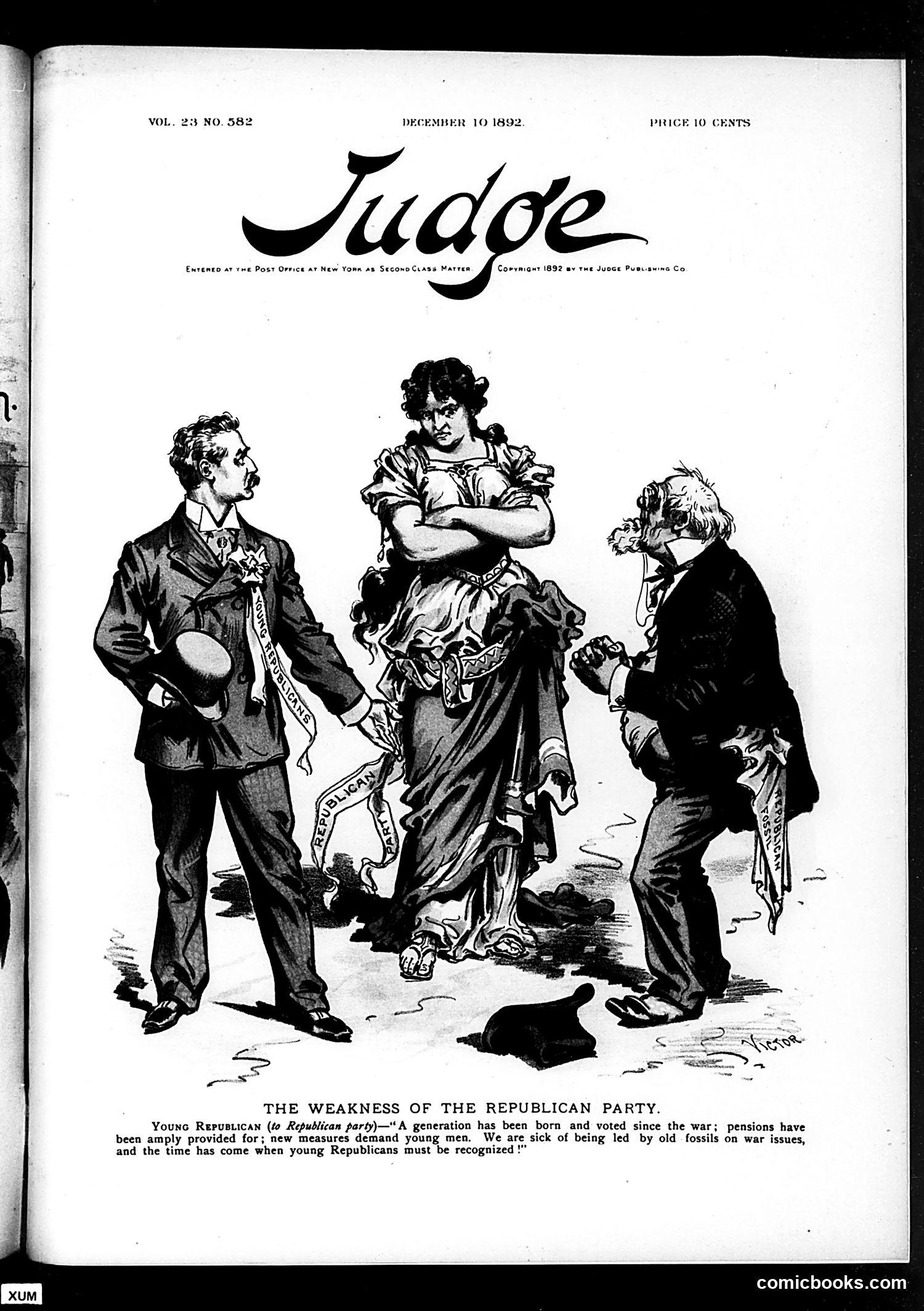
This cartoon satirizes internal Republican Party conflict. A young Republican (center, in classical robes as "Liberty" or the party's ideals) stands between two older men in formal dress, each pulling in opposite directions. The caption identifies the left figure as representing "old fossils on war issues"—likely referring to aging Civil War-era Republicans clinging to outdated political positions. The young Republican complains: "A generation has been born and voted since the war; pensions have been amply provided for; new measures demand young men. We are sick of being led by old fossils on war issues, and the time has come when young Republicans must be recognized!" The cartoon depicts generational tension within the party as younger members demand fresh leadership and modern policy direction.
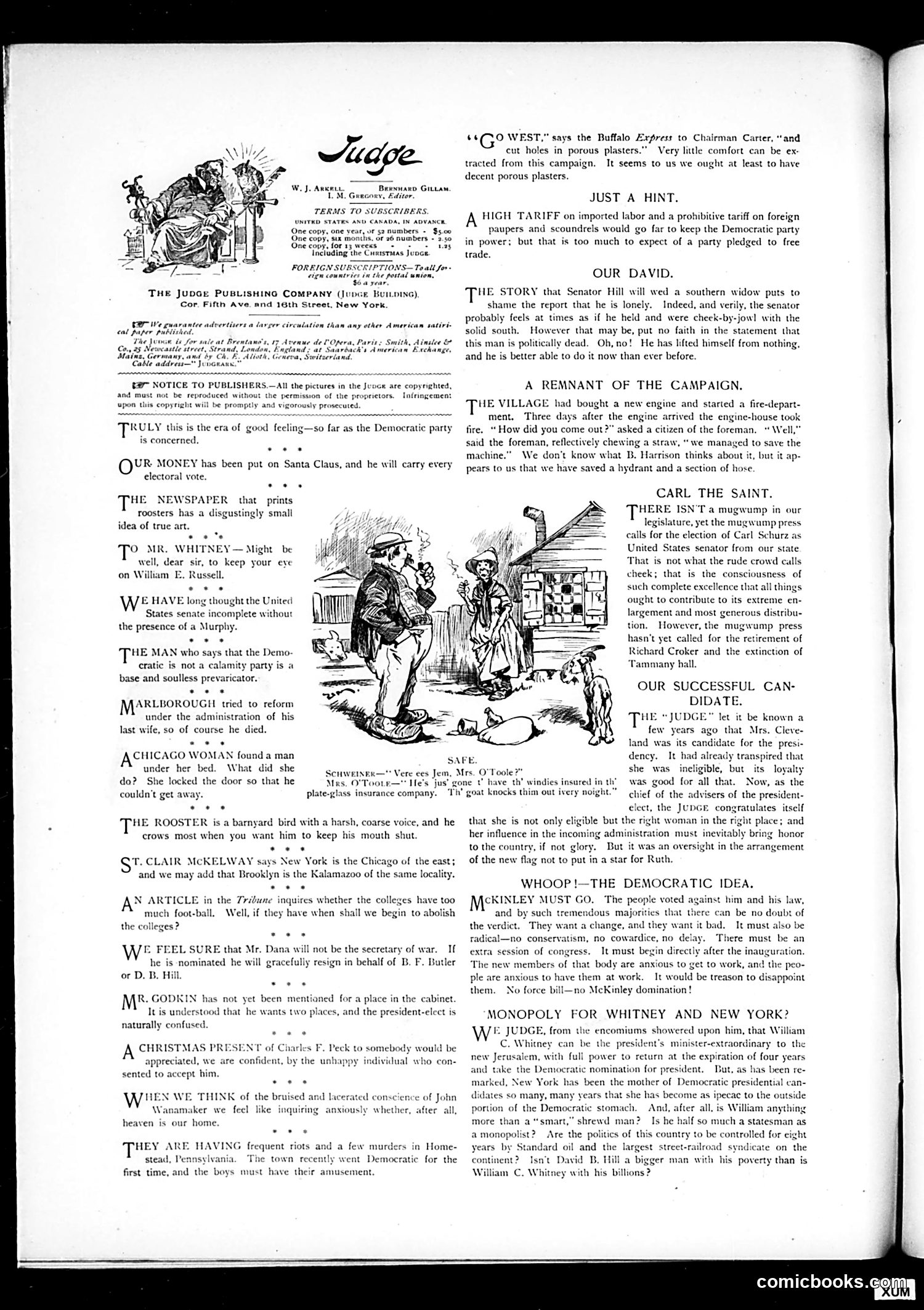
This page contains multiple brief political commentaries typical of Judge's format. The main cartoon depicts a rural scene with figures discussing a fire engine, satirizing small-town politics and mechanical progress. The text sections mock various Democratic Party figures and policies of the era. References include Senator Hill (regarding a southern widow), mentions of tariff policy, and critiques of Democratic candidates. One section titled "Carl the Saint" appears to mock a political figure named Carl Schurz regarding senatorial elections. The satire criticizes Democratic leadership, suggesting party dysfunction and poor candidate selection. Without clearer date indicators or more specific figure identification in the visible text, the exact election cycle remains unclear, though the anti-Democratic stance is consistent throughout.
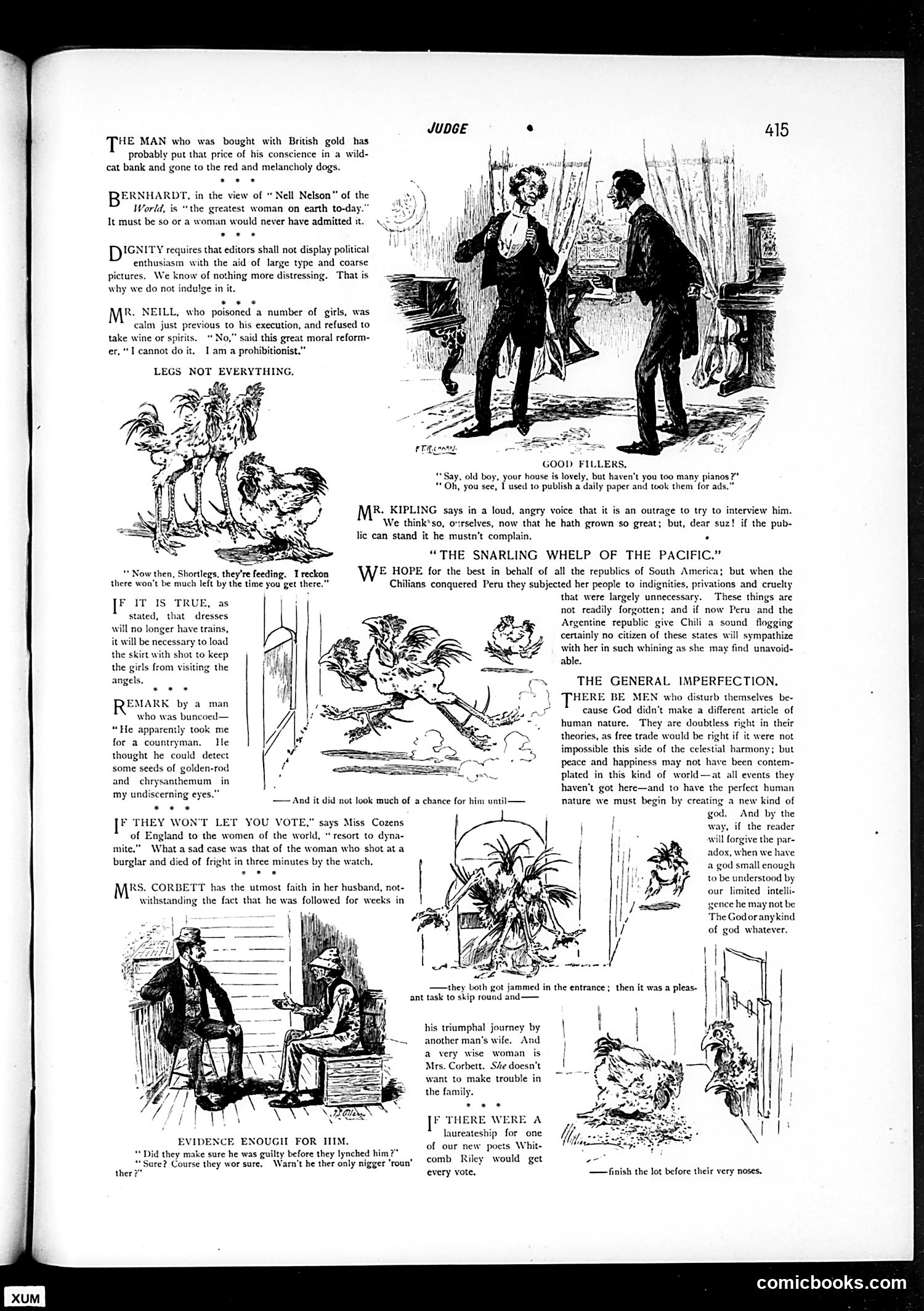
This Judge page contains several brief satirical items mocking contemporary figures and social issues: **"Good Fillers"** (top cartoon): Shows two men discussing a woman's house and piano—likely satirizing wealthy society's superficial values and the importance placed on material displays. **"The Snarling Whelp of the Pacific"**: References Peru and Chile's conflicts, appearing to criticize Chile's aggressive foreign policy in South America. **"The General Imperfection"**: Mocks religious arguments about God not creating perfect humans, using this to critique free-trade economic theory. **Other items**: Include jabs at voting rights ("If They Won't Let You Vote"), women's fashion concerns, and a anecdote about Mrs. Corbett's faith in her philandering husband—typical period satire about marriage and morality. The illustrations throughout are crude cartoons typical of 1880s-90s satirical journalism.
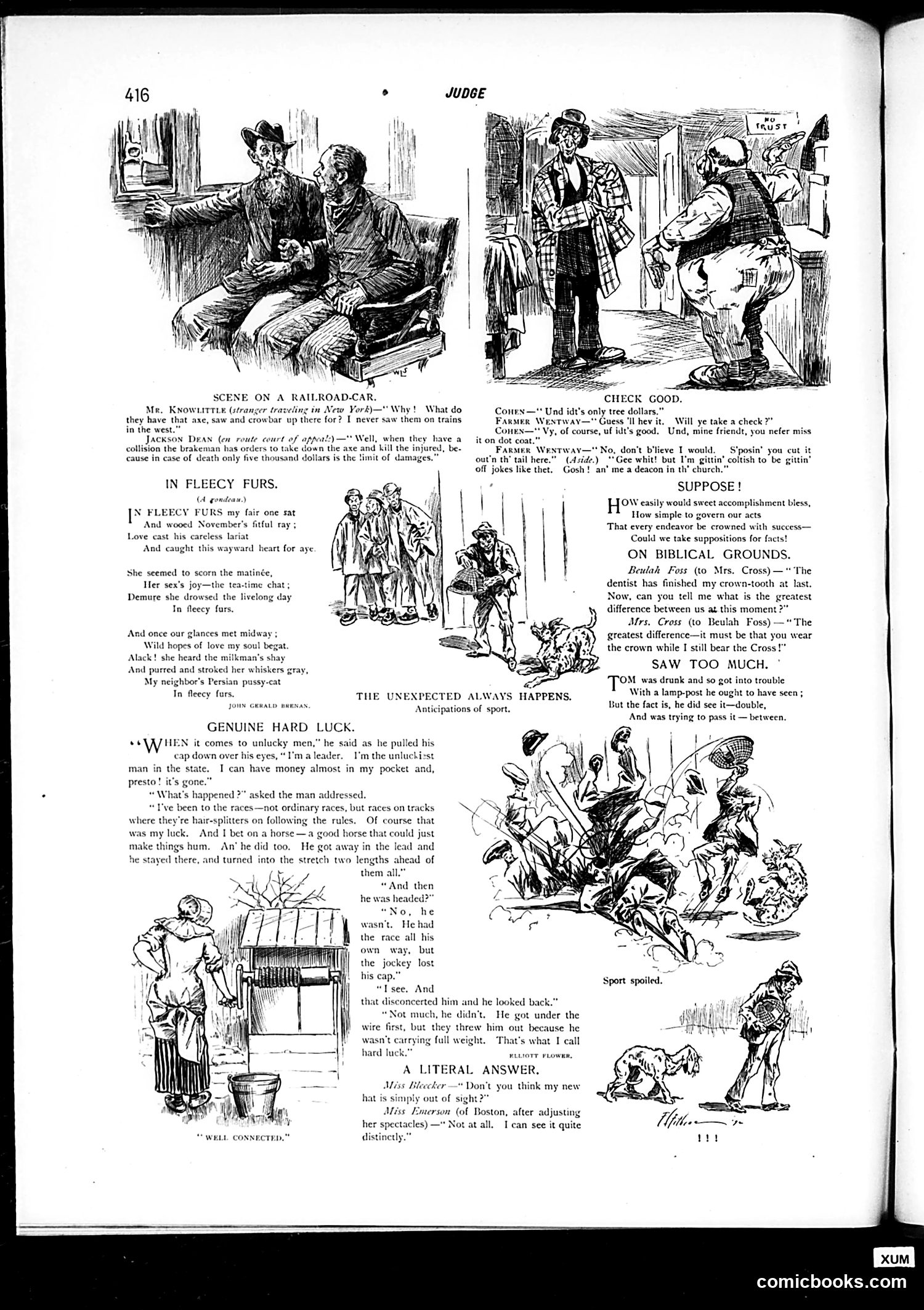
This page contains several unrelated humorous sketches typical of late 19th-century American satirical magazines: **"Scene on a Railroad Car"**: A joke about Western vs. Eastern railroad safety practices, where a naive traveler questions why an axe and crowbar are kept on the train. The punchline involves dark humor about using the axe to kill injured passengers to limit liability claims to $5,000. **"In Fleecy Furs"**: A romantic poem that tricks readers—the narrator falls in love with what he thinks is a woman in fur coats, but the "she" is actually his neighbor's Persian cat. **"Genuine Hard Luck"**: A man recounts losing money at horse races due to technicalities (jockey not carrying full weight), illustrating bad luck. **"Check Good"**: A dialect comedy about a foreigner accepting payment by check, unaware checks can bounce. **"On Biblical Grounds"**: A woman with a new dental crown asks another woman the difference between them; the reply jokes that one wears a crown while the other bears a cross (suffering). **"Saw Too Much"**: A drunk man sees a lamp-post double and tries to walk between the two images.
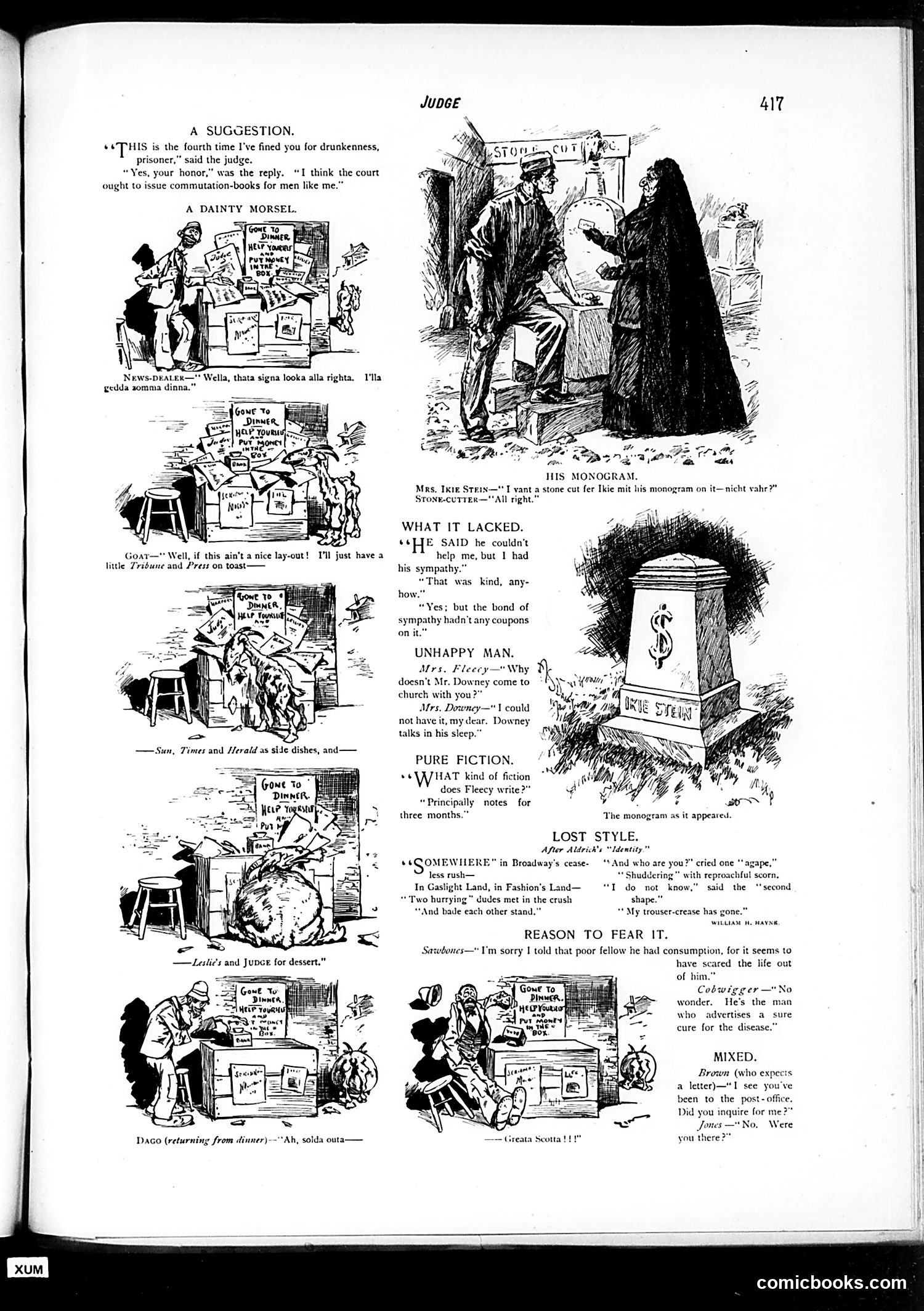
This page contains multiple short satirical sketches typical of late 19th-century American humor: **"A Suggestion"** mocks repeat drunk offenders, with the prisoner joking that the court should issue "commutation-books" (like transit passes) for habitual drinkers—satirizing both judicial leniency and alcoholism. **"A Dainty Morsel"** shows a newsdealer wanting to eat newspapers—likely satirizing sensationalist journalism as literally consumable garbage. **"His Monogram"** plays on Jewish immigrant dialect humor (then common in Judge), with Mrs. Stein ordering a gravestone featuring her husband's monogram. **"What It Lacked"** jokes that sympathy without financial support ("coupons") is worthless. **"Pure Fiction"** quips that writer "Fleecy" produces only promissory notes—mocking unsuccessful authors. Other sketches target church absenteeism, fashion consciousness, medical quackery, and postal inefficiency. The humor relies on wordplay, dialect comedy (often ethnic), and social observation typical of Judge's era.
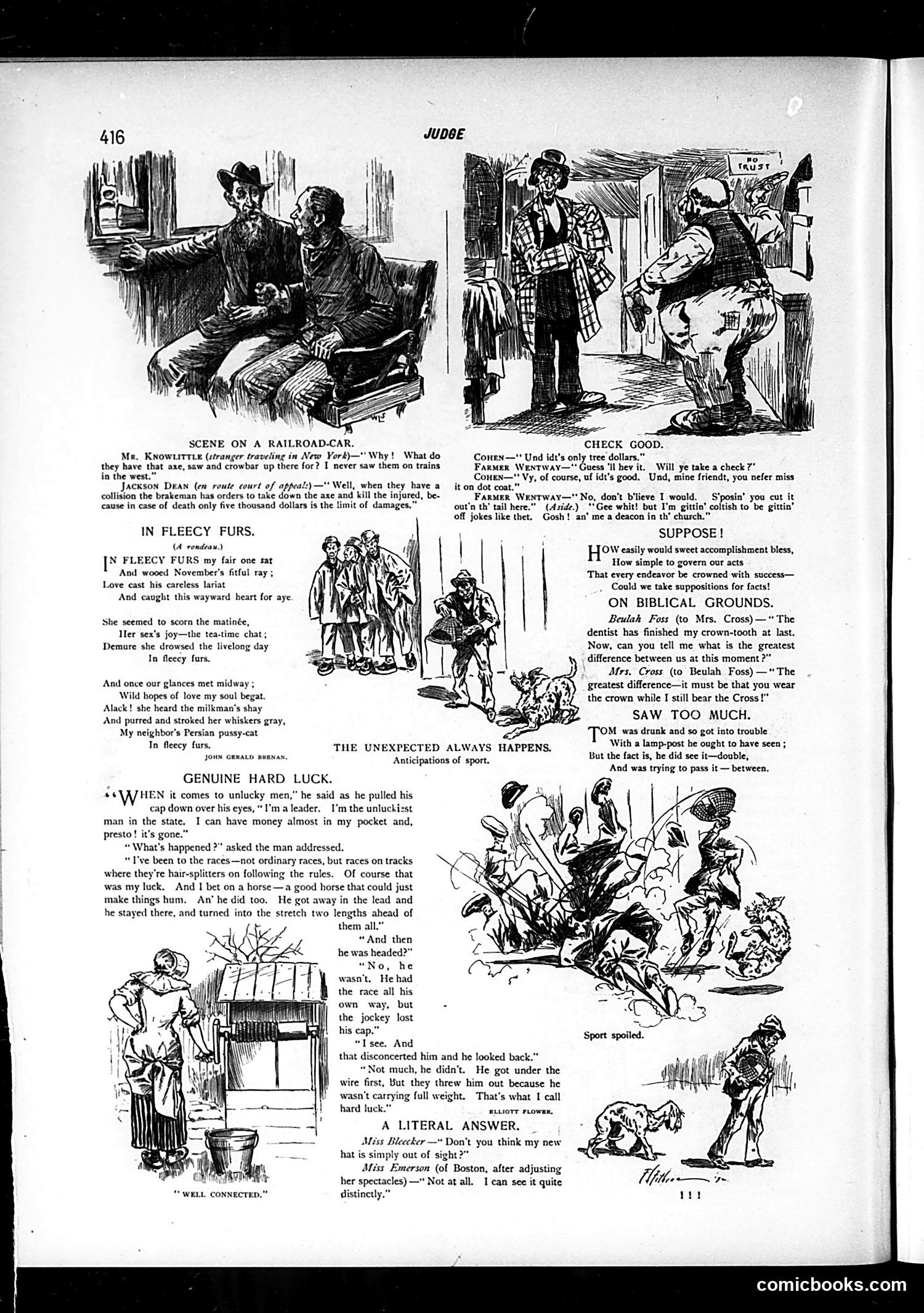
This page contains several satirical vignettes typical of Gilded Age humor: **"Scene on a Railroad-Car"** mocks American litigation culture. A western traveler questions why a train carries axes and crowbars. Jackson Dean (identified as "en route court of appeal") cynically explains that railroad companies intentionally kill injured passengers to limit liability to five thousand dollars—a dark jab at corporate malfeasance and judicial corruption. **"In Fleecy Furs"** is a humorous poem where the narrator believes he's courting a woman in fur but discovers she's actually a Persian cat—a play on romantic delusion. **"Genuine Hard Luck"** satirizes racing culture and its arbitrary rules. A habitual loser recounts losing a sure horse-race victory because the jockey lost his cap, triggering disqualification for insufficient weight—illustrating how technicalities defeat logic. Remaining items are brief comic quips: a Boston woman's literal interpretation of "out of sight," a farmer's check-passing deception, and a drunk man seeing double. The artwork throughout uses period crosshatching typical of 1890s-era comic illustration.
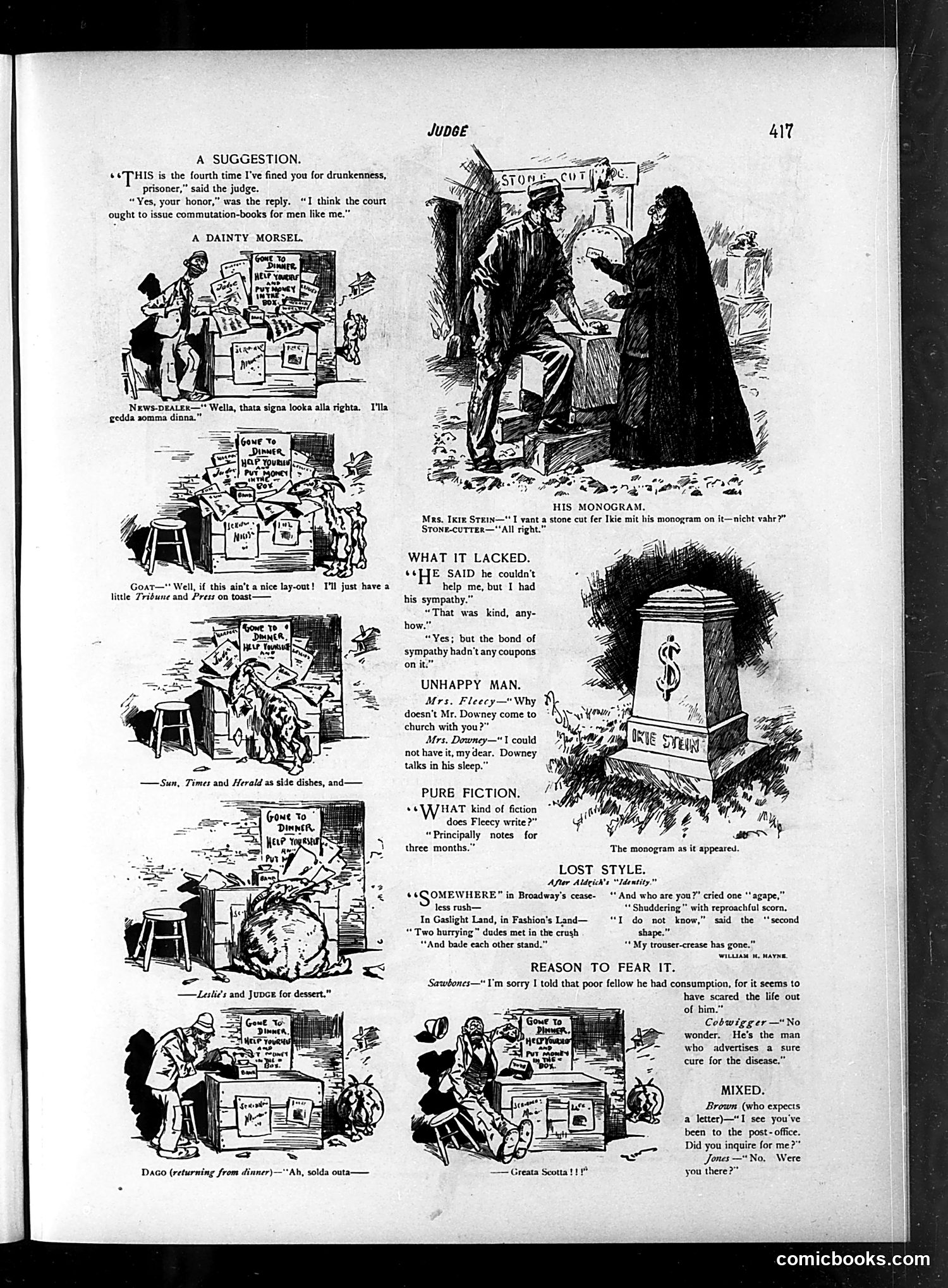
This page contains multiple brief satirical sketches typical of Judge magazine's humor: **"A Suggestion"**: A drunk repeatedly fined for drunkenness suggests the court issue "commutation books"—a joke about repeat offenders and judicial leniency. **"A Dainty Morsel"**: A news dealer with Italian dialect (stereotypical immigrant humor) plans to serve newspapers on toast, satirizing cheap newspaper content as inedible. **"His Monogram"**: Jewish characters (indicated by dialect) requesting a monogram on a gravestone—dark humor about mortality and pretension. **"What It Lacked"**: Sympathy without financial backing (no "coupons"/practical value) is worthless—social commentary on empty sentiment. **Other sketches** mock: marital discord, financial struggles, romantic confusion, and medical quackery. The page reflects early 20th-century American class anxiety, immigrant stereotyping, and satirical commentary on urban life, consumerism, and human weakness. Dialect humor was standard period fare.
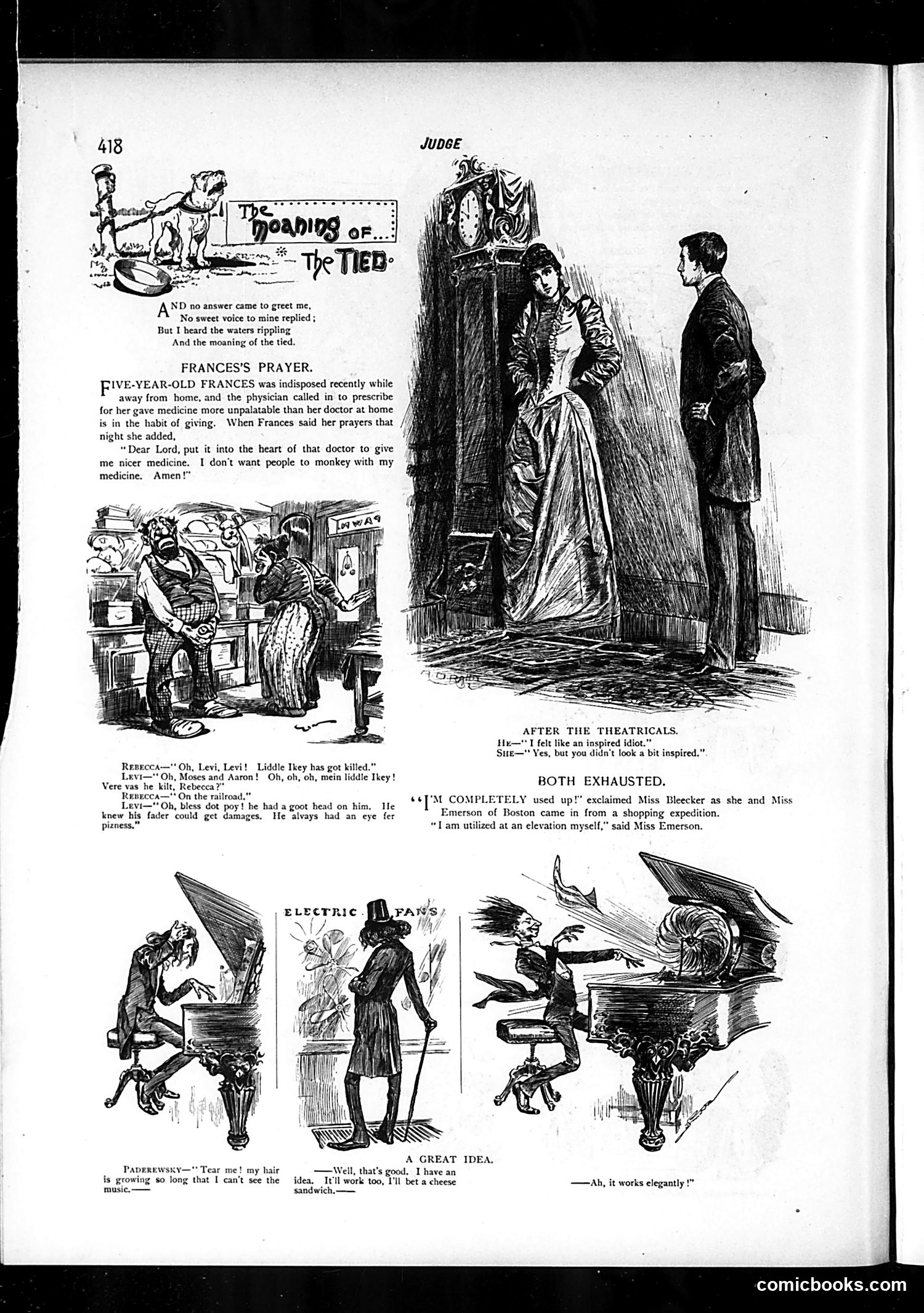
This page contains several humor sketches typical of late 19th/early 20th-century American satire: **"Frances's Prayer"**: A wholesome anecdote where a five-year-old, given unpleasant medicine by a visiting doctor, prays for God to make the doctor kinder—satirizing children's literal-minded piety and parental coddling. **"After the Theatricals"**: A brief exchange mocking theatrical pretension, where someone felt "inspired" but didn't appear so. **"Both Exhausted"**: Two Boston women return from shopping, exhausted but "utilized"—satirizing upper-class women's leisure activities and affected language. **Bottom sketches**: Comic vignettes featuring ethnic caricatures (notably stereotyped Jewish and immigrant characters with exaggerated accents) in absurd situations—"Electric Pans," "Paderewski" (hair-growth joke), and "A Great Idea" (cheese sandwich nonsense). These represent period humor relying heavily on ethnic stereotyping and dialect comedy, now considered offensive.
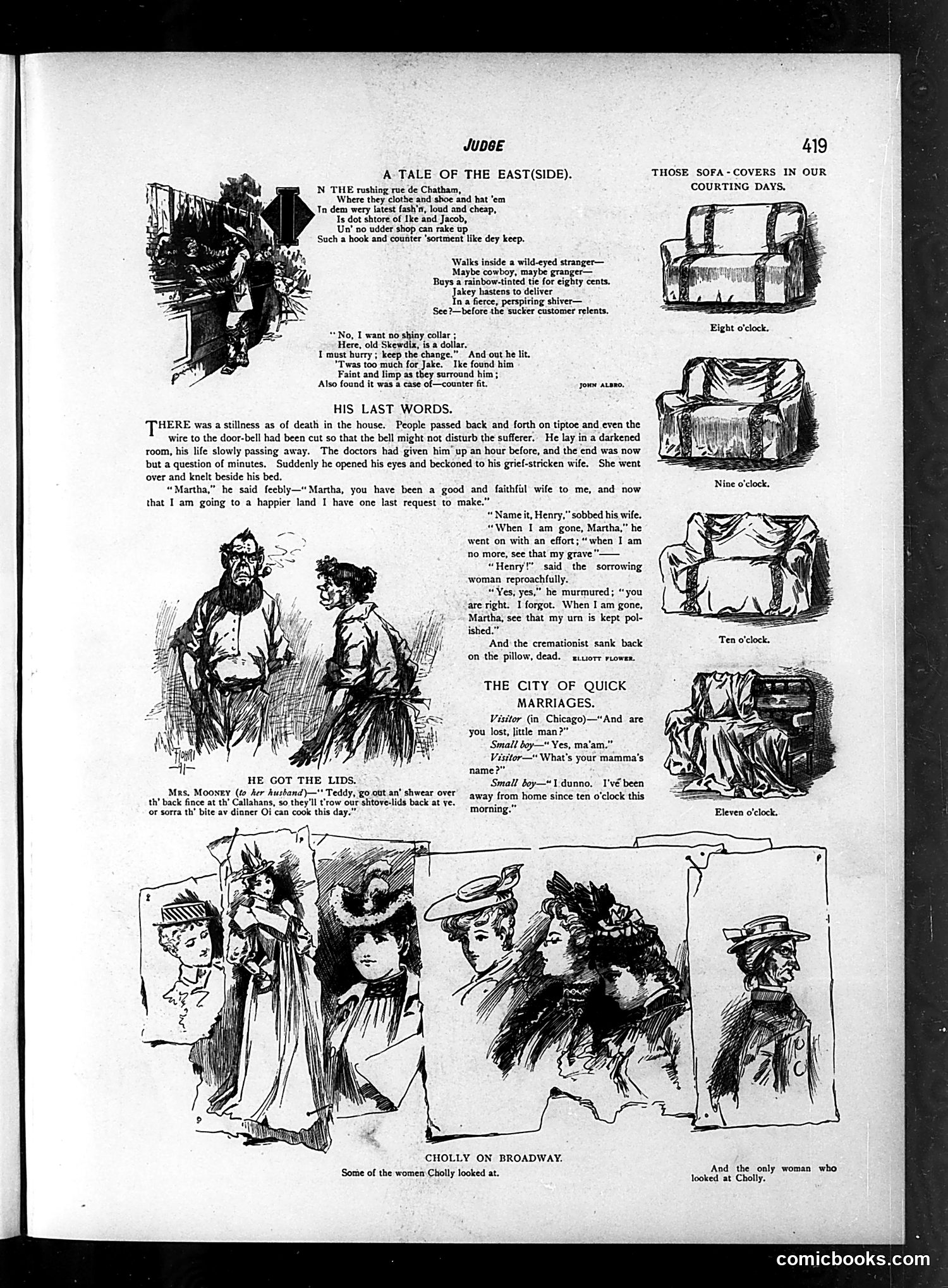
This page contains three distinct satirical pieces: **"A Tale of the East Side"** mocks Jewish immigrant shopkeepers (Ike and Jacob) on New York's Lower East Side, using exaggerated dialect humor. A customer buys a cheap tie, receives counterfeit change, and Jake collapses—the joke being both the wordplay ("counter fit") and the stereotype of Jewish merchants as shrewd but bumbling. **"His Last Words"** satirizes the emerging cremation trend of the early 1900s. A dying man's final request about keeping his grave polished is revealed to be about his cremation urn instead—the humor deriving from the unexpected shift and the absurdity of maintaining an urn's appearance. **"The City of Quick Marriages"** and **"Cholly on Broadway"** appear to be shorter joke pieces about Chicago marriages and New York social life. The page reflects Judge's typical approach: ethnic caricature humor targeting immigrants, combined with commentary on contemporary middle-class anxieties (cremation, urban life). Most would be considered offensive today.
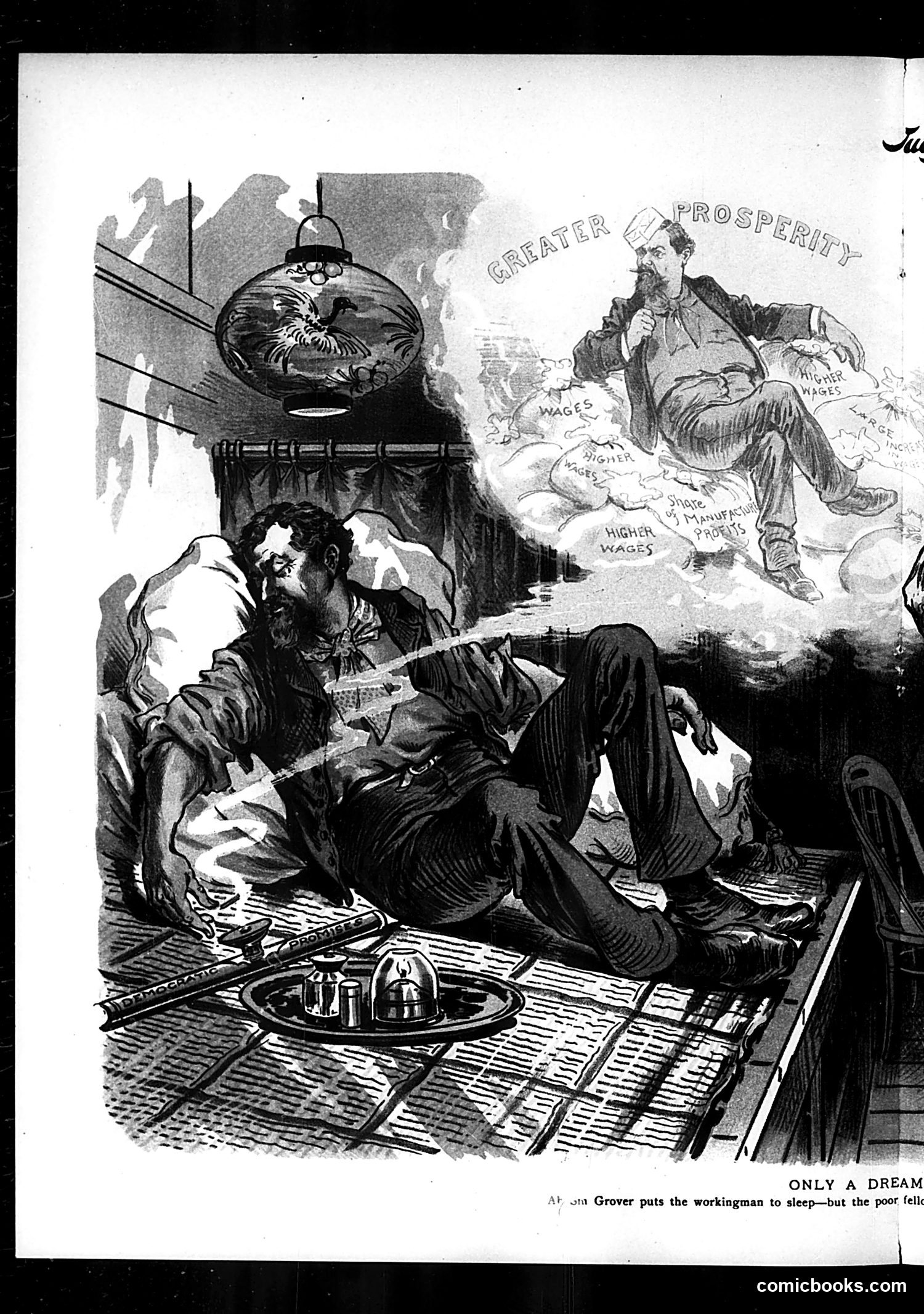
This is a political cartoon satirizing Grover Cleveland (identifiable by the caption "Grover"). The image depicts Cleveland as a figure putting working-class men to sleep, while a well-dressed businessman in the background enjoys "Greater Prosperity." The satire critiques what the cartoonist sees as a disparity: Cleveland's policies allegedly benefit wealthy interests ("Greater Prosperity") while leaving ordinary workers sedated and oblivious to their own economic hardship. The sleeping workers, surrounded by what appear to be wage-related documents or ledgers, represent the working class being lulled into complacency or false consciousness. The caption "Only a Dream" suggests the workers' hopes for genuine prosperity are merely illusions under Cleveland's administration. This reflects late 19th-century labor tensions and criticism of Cleveland's perceived pro-business, anti-labor stance.
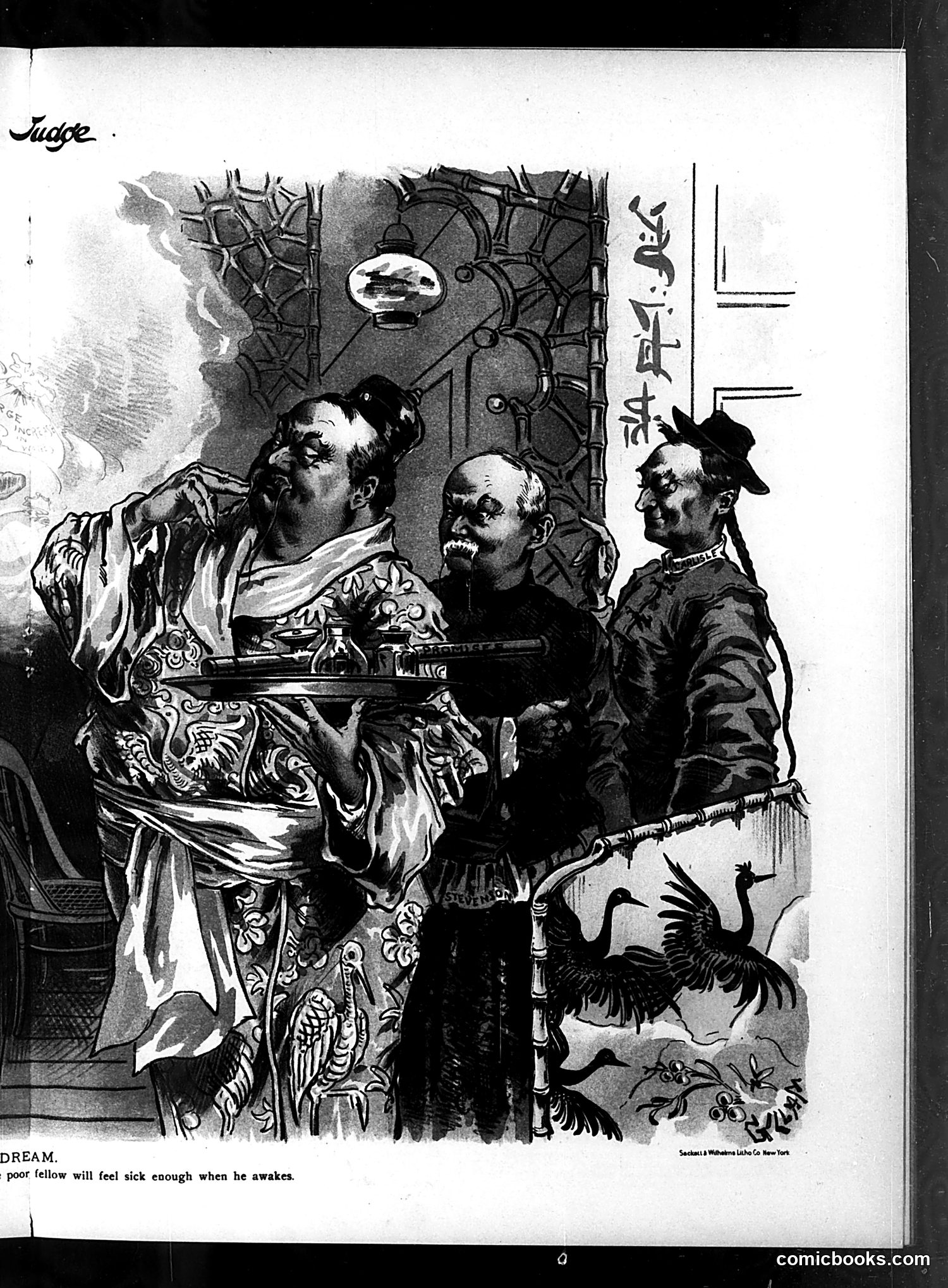
This appears to be a satirical cartoon titled "Dream," depicting three figures in ornate Asian-inspired clothing examining or discussing something. The style suggests late 19th or early 20th-century American political satire. The caption "poor fellow will feel sick enough when he awakes" indicates this is critiquing someone's naive or wishful thinking—likely commenting on American foreign policy or diplomatic relations with Asia. The elaborate costumes and artistic style suggest commentary on Asian affairs, possibly related to imperialism or trade negotiations during this era. Without the publication date visible, the specific historical event remains unclear, but the tone suggests mocking someone's optimistic but unrealistic expectations regarding international dealings.
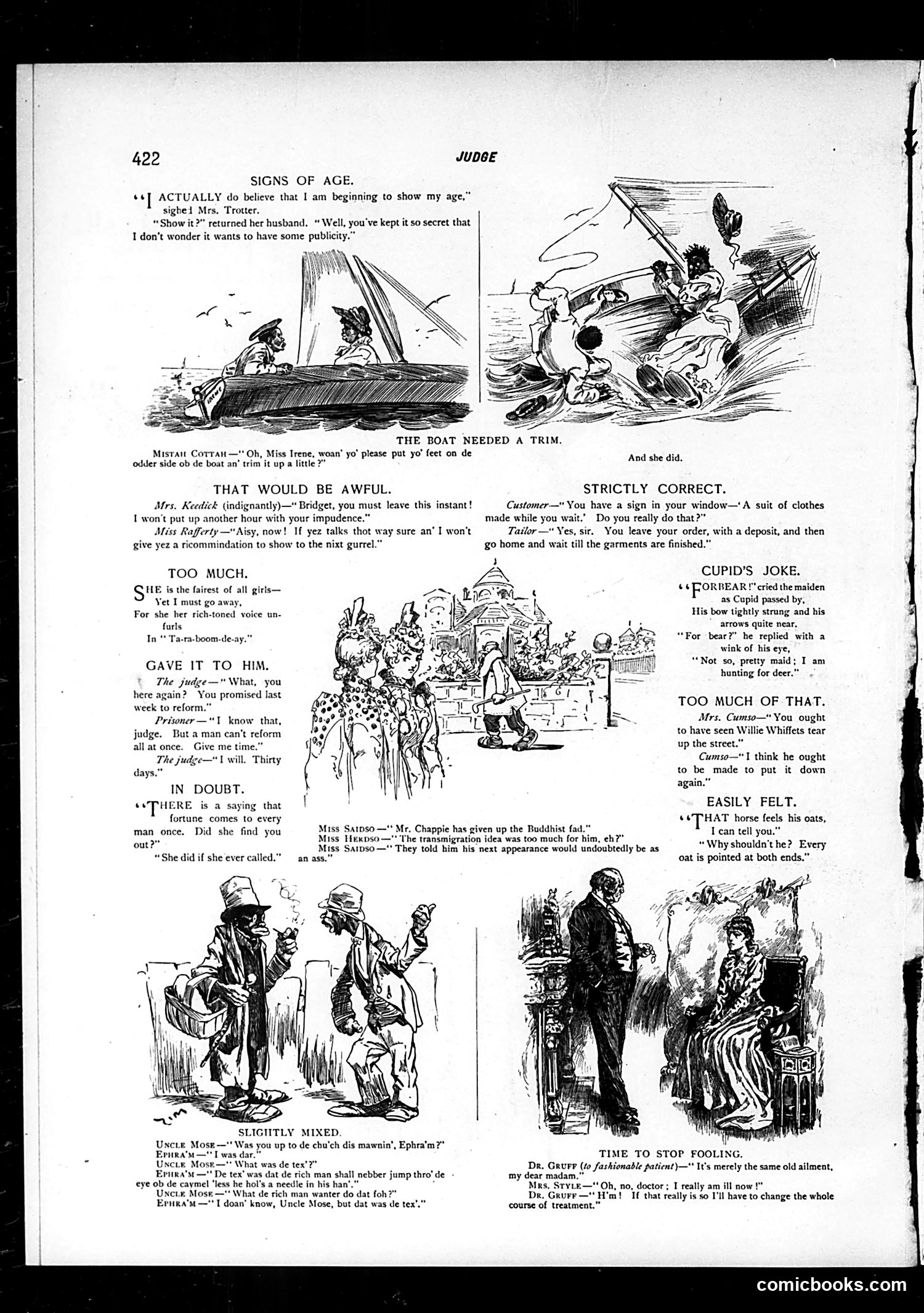
This page from *Judge* presents a collection of brief comic sketches satirizing everyday social situations and human foibles circa early 1900s. **Key themes:** **Class and domestic humor:** "That Would Be Awful" mocks servant-employer relations, with an Irish maid (Bridget) threatening to withhold her recommendation—inverting the power dynamic. "The Boat Needed a Trim" uses a woman's weight as the joke. **Marriage and aging:** "Signs of Age" presents marital discord over a wife's appearance; the husband quips her secret aging "wants publicity." **Period attitudes:** "Slightly Mixed" uses dialect humor with African American characters misquoting scripture. "Cupid's Joke" plays on sexual double-entendre ("for bear/forbear"). **Social pretense:** "Strictly Correct" mocks tailors' bait-and-switch delays. "Time to Stop Fooling" satirizes hypochondriacs—a fashionable patient insists she's genuinely ill only when the doctor threatens actual treatment changes. The humor relies on servant stereotypes, gender roles, ethnic caricature, and social class observations typical of period satire.
This page is primarily **advertising** with interspersed short humor items. The content reflects late 19th-century American concerns and sensibilities. The humor pieces use brief anecdotes to satirize social customs. One jokes about a man giving "forget-me-nots" to a woman who loses them—mocking romantic sentimentality. Another ridicules a "converted" man who becomes hypocritical. A third satirizes affected Boston-New York courtship language ("owny-dony itty petty love"). The "Dunlap hat" reference appears to mock Chicago fashion or vanity. The advertisements promote period remedies (Castoria, Bromo-Seltzer, Salvation Oil), pianos, the Keeley Institute (for alcoholism/drug addiction treatment), and consumer goods. This reflects widespread patent medicine marketing and the era's prominent social concern about male drinking and addiction. No specific political figures or events appear caricatured on this page—it's entertainment and commercial content aimed at Judge's middle-class readership.
This page is primarily **advertising content** rather than satirical editorial material. It contains numerous commercial advertisements for products including: - Railroad services (Burlington Route) - Patent medicines (Beecham's Pills for digestive complaints) - Luxury goods (Fahys Gold Filled watch cases, Fischer pianos, diamonds and jewelry) - Clothing and accessories (Armstrong Garter, Barney & Berry skates) - Food products (Liebig Company's beef extract) - Toiletries (Barry's hair and skin products, Muller & Krupp cologne) The only illustration appearing to be editorial content shows two stout gentlemen in formal dress under "FOR STOUT FOLKS," likely a humorous advertisement. The page reflects typical Judge magazine revenue strategy: satirical editorial content subsidized by extensive paid advertising.
This is primarily an **advertising page** rather than a satirical cartoon page. It contains various commercial advertisements from the 1890s era, with minimal political or social satire. The notable content includes: **Anheuser-Busch Brewing Association** advertisement showcasing their new brewery as "the Largest Brewing Capacity" in America—reflecting the industrial expansion and German-American business prominence of the era. **Small humorous anecdotes** scattered among ads, including an Irish servant girl ("Bridget") comedy about champagne bottles, and a joke about "special providence"—typical period humor relying on ethnic stereotypes and class-based comedy. **Consumer products advertised** include photography equipment (Kodak cameras), furs, pianos, cigars, and whiskey—reflecting Gilded Age consumer culture and luxury goods marketing. The page demonstrates how Judge mixed satirical commentary with commercial advertising to reach affluent readers.
This is primarily an **advertising and miscellaneous content page** rather than a satirical cartoon page. The page contains: **Main content:** Product advertisements (Scott's Emulsion for consumption/disease, Pears' Soap, whisky, candy, health devices) interspersed with literary content including a poem by James Whitcomb Riley and a brief marital humor piece from *Harvard Lampoon* about a forgetful wife. **The humor:** The single joke depicts tired domestic stereotypes—a husband annoyed at his wife's forgetfulness. This reflects period gender attitudes treating women's memory as a source of comedy. **No political satire:** Unlike Judge's typical satirical cartoons, this page serves primarily **commercial purposes**, showcasing late-19th/early-20th century patent medicines, beauty products, and luxury goods marketed through pseudo-scientific claims about health benefits. The page illustrates how magazines monetized through advertising while maintaining literary credibility.
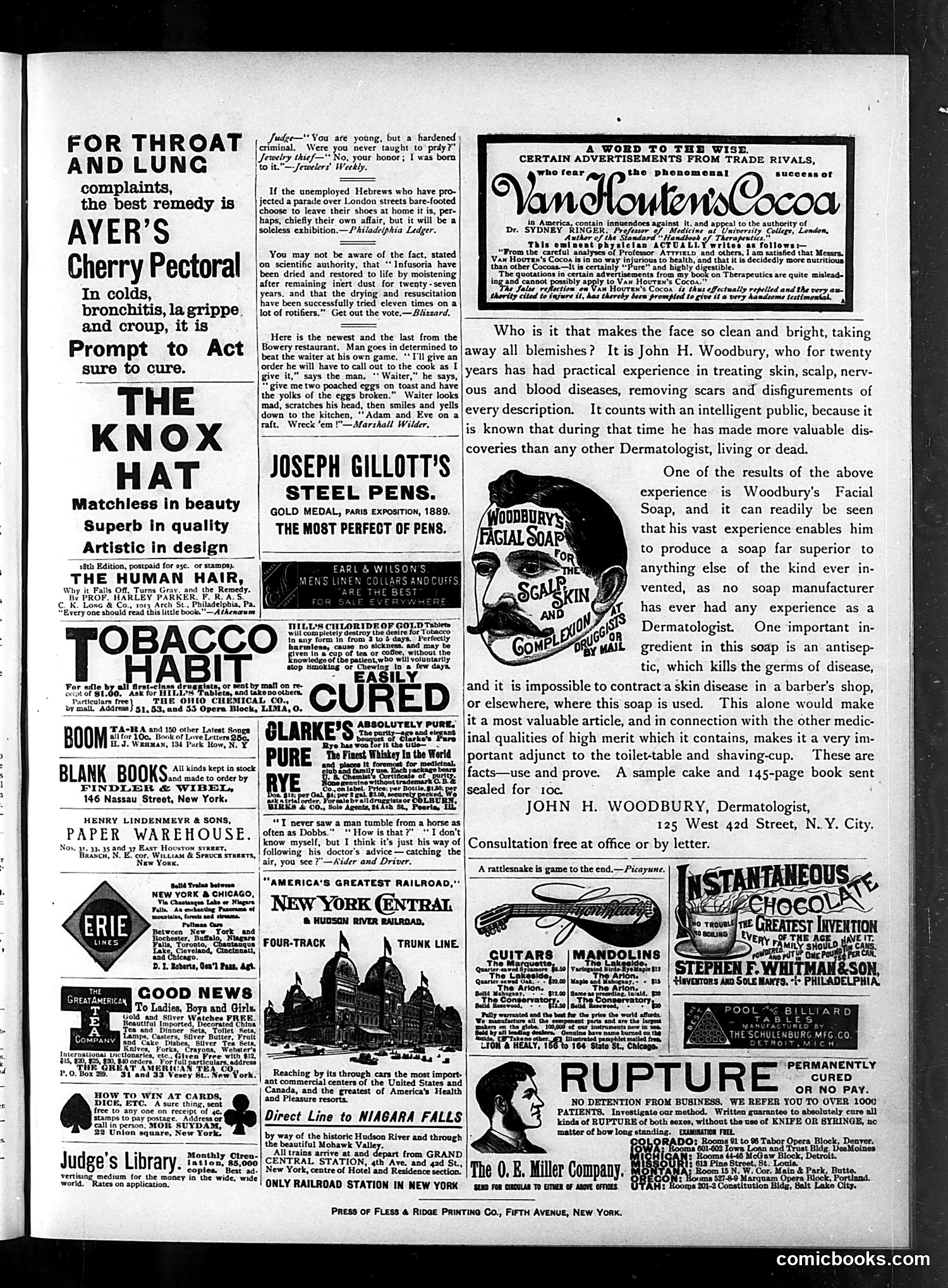
This page is primarily **advertisements with minimal editorial cartooning**. The dominant content is patent medicine and consumer product ads typical of late 19th-century American magazines. The notable exception is a brief **satirical dialogue** about an unemployed Hebrew man in London going barefoot, and a Bowery restaurant anecdote where a customer tries to confuse a waiter with a deliberately cryptic egg order ("Adam and Eve on a raft"). These appear to be ethnic/class-based humor common to the era—poking fun at immigrant communities and working-class dialect. The page's main feature is extensive advertising copy for **Woodbury's Facial Soap**, prominently featuring dermatologist John H. Woodbury's endorsement. This represents the period's emerging use of medical authority in marketing—positioning products as scientifically validated. Other ads promote throat remedies, steel pens, tobacco cessation, railroad travel, and dubious medical devices (rupture cures). **No identifiable political cartoons or caricatures of public figures appear on this page.**
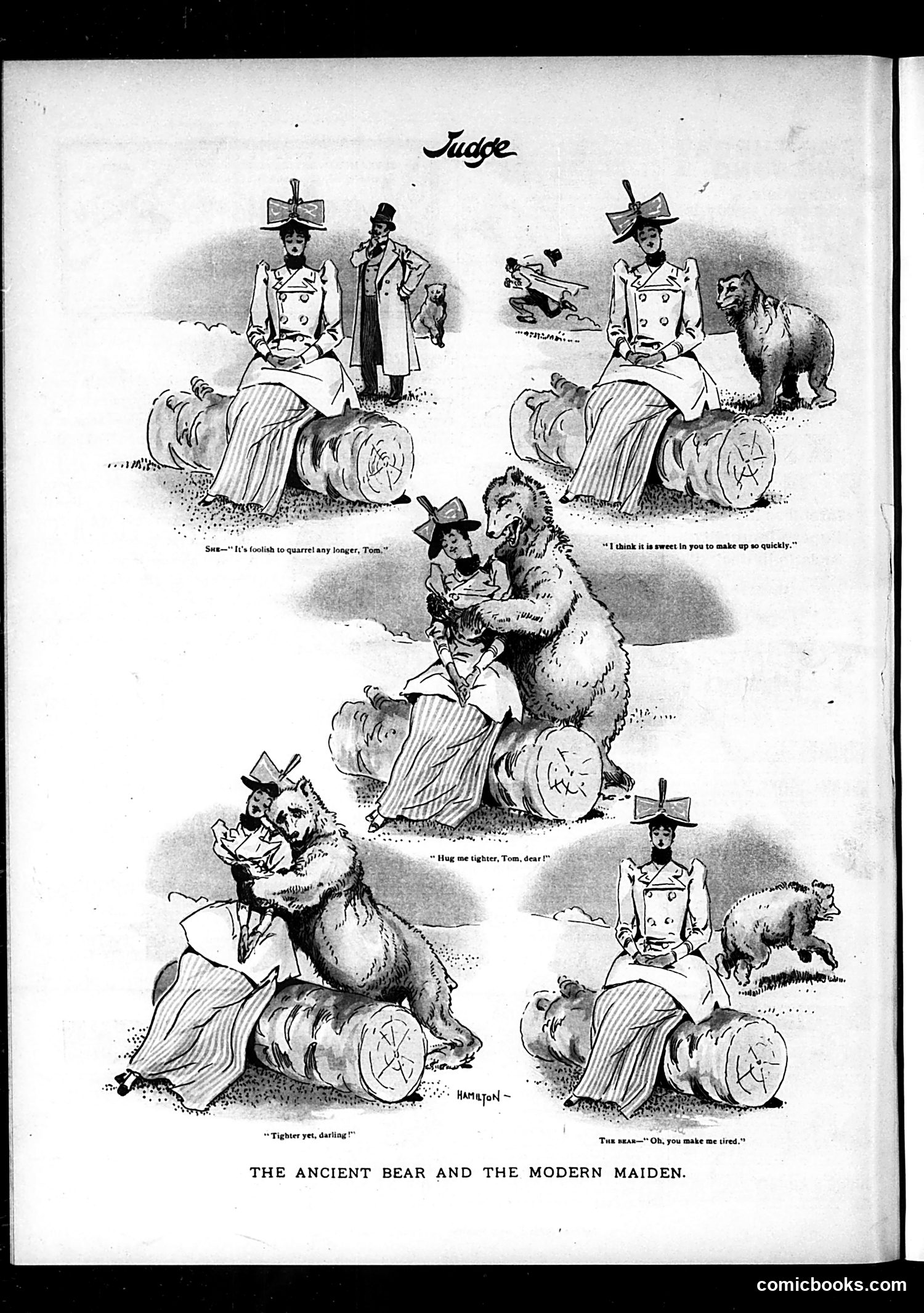
This Judge cartoon series satirizes the relationship between a woman (representing "the modern maiden") and a bear (representing "the ancient bear," likely tsarist Russia). The six panels show a progression where the woman progressively embraces and restrains the bear, with captions like "It's foolish to quarrel any longer, Tom," "I think it is sweet in you to make up so quickly," and "Tighter yet, darling!" The satire appears to mock diplomatic reconciliation or rapprochement—specifically, a woman willingly becoming closer to a dangerous, powerful force. The "modern maiden's" increasing affection toward the threatening bear suggests naïveté or folly in trusting an inherently dangerous adversary. This likely references early 20th-century U.S.-Russian relations, where American attitudes toward Russia shifted between suspicion and attempted cooperation.