
Judge, 1892-12-10 · page 9 of 18
Judge — December 10, 1892 — page 9: what you’re looking at
What you’re looking at
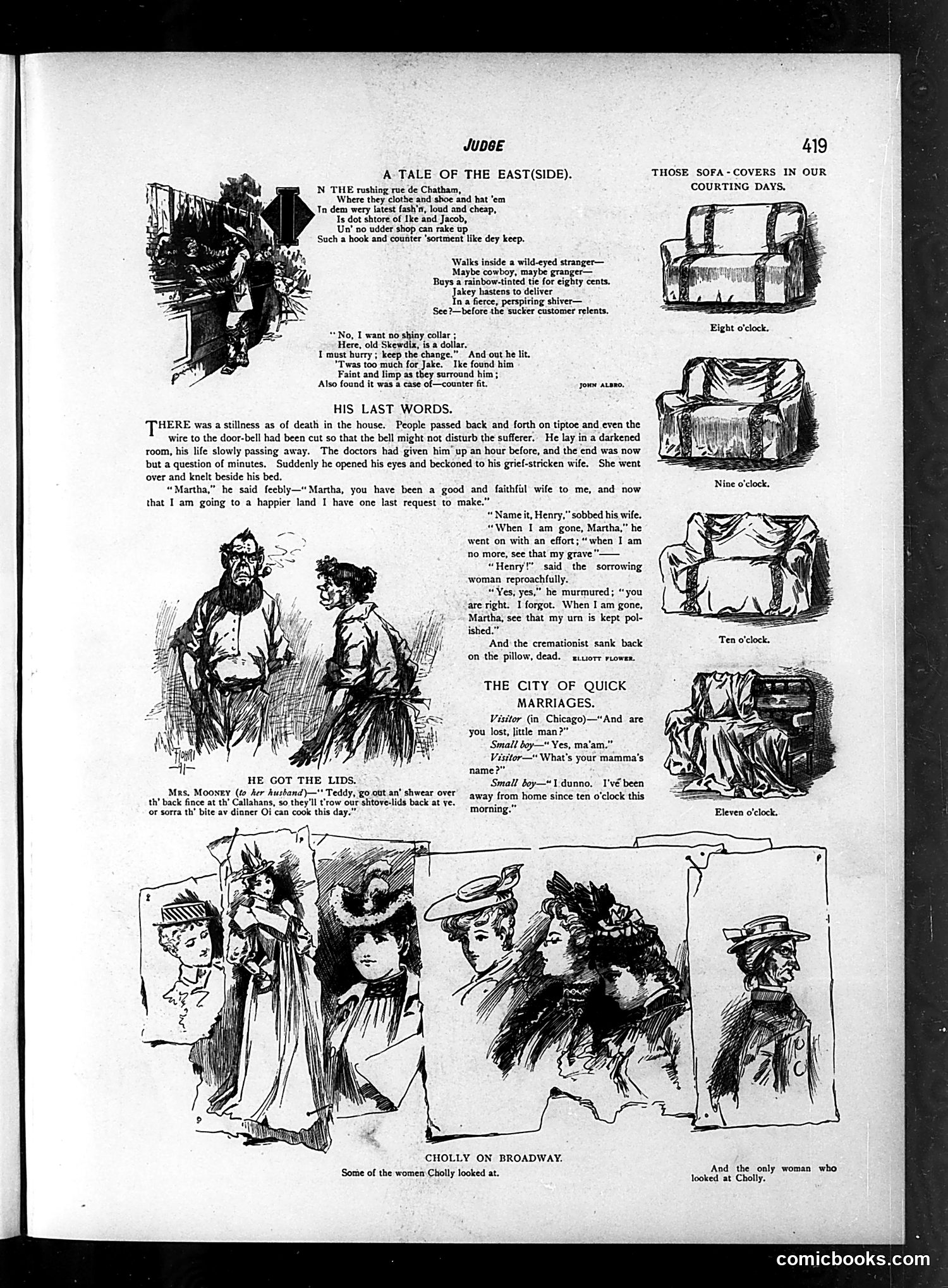
This page contains three distinct satirical pieces: **"A Tale of the East Side"** mocks Jewish immigrant shopkeepers (Ike and Jacob) on New York's Lower East Side, using exaggerated dialect humor. A customer buys a cheap tie, receives counterfeit change, and Jake collapses—the joke being both the wordplay ("counter fit") and the stereotype of Jewish merchants as shrewd but bumbling. **"His Last Words"** satirizes the emerging cremation trend of the early 1900s. A dying man's final request about keeping his grave polished is revealed to be about his cremation urn instead—the humor deriving from the unexpected shift and the absurdity of maintaining an urn's appearance. **"The City of Quick Marriages"** and **"Cholly on Broadway"** appear to be shorter joke pieces about Chicago marriages and New York social life. The page reflects Judge's typical approach: ethnic caricature humor targeting immigrants, combined with commentary on contemporary middle-class anxieties (cremation, urban life). Most would be considered offensive today.
📄 Transcribed text from this page (OCR, searchable)
Machine-transcribed from the original scan — historical spelling and the odd misread are preserved.
JUDGE 419 A-TALE OF THE EAST(SIDE). THOSE SOFA-COVERS IN OUR NN THE rushing rue de Chatham, COURTING DAYS, Where they clothe and shoe and hat ‘em Tn dem wery latest fash’n, loud and cheap, Is dot shtore of Ike and Jacob, Un’ no udder shop can rake up Such a hook and couater ‘sortment like dey keep. Walks inside a wild-eyed stranger— Maybe cowboy, maybe granger— Buys a rainbow-tinted tie for eighty cents. Jakey hastens to deliver In a fierce, perspiring shiver— See ?—before the sucker customer relents. “No, I want no shiny collar ; Here, old Skewdix, is a doliar. I must hurry ; keep the change.” And out he lit. "Twas too much for Jake. Ike found him Faint and limp as tbey surround him; Also found it was a case of—counter fit. HIS LAST WORDS. HERE was a stillness as of death in the house. People passed back and forth on tiptoe and even the wire to the door-bell had been cut so that the bell might not disturb the sufferer. He lay in a darkened room, his life slowly passing away. The doctors had given him’ up an hour before, and the end was now but a question of minutes, Suddenly he opened his eyes and beckoned to his grief-stricken wife. She went over and knelt beside his bed. “Martha,” he said feebly—“ Martha, you have been a good and faithfil wife to me, and now that I am going to a happier land I have one last request to make.” “ Name it, Henry,” sobbed his wife. “When I am gone, Martha,” he went on with an effort; “when I am no more, see that my grave "— “Henry!” said. the sorrowing woman reproachfully, “Yes, yes," he murmured; “you are right. I forgot. When I am gone, Martha, see that my urn is kept pol- ished.” And the cremationist sank back on the pillow, dead. s.uorr riowss. THE CITY OF QUICK MARRIAGES. Visitor (in Chicago)—“And are you lost, jittle man?” Small boy— Yes, ma'am.” Visitor—" What's yout mamma's name?” HE GOT THE LIDS. Small boy—“1 dunno. I'vé been Mas, Mooney (to her Ausband)—" Teddy, go out an’ shwear over’ aw, i i = th’ back fince at th Callahans, so they'll t'row our shtoyelids back at ye. *W2Y from home since ten o'clock this as or sorra th’ bite av dinner Oi can cook this day.” morning.” Eleven o'clock. CHOLLY ON BROADWAY. And the only woman who Some of the women Cholly looked at. ieoeetae Chae comicbooks.com