
Judge, 1892-12-10 · page 6 of 18
Judge — December 10, 1892 — page 6: what you’re looking at
What you’re looking at
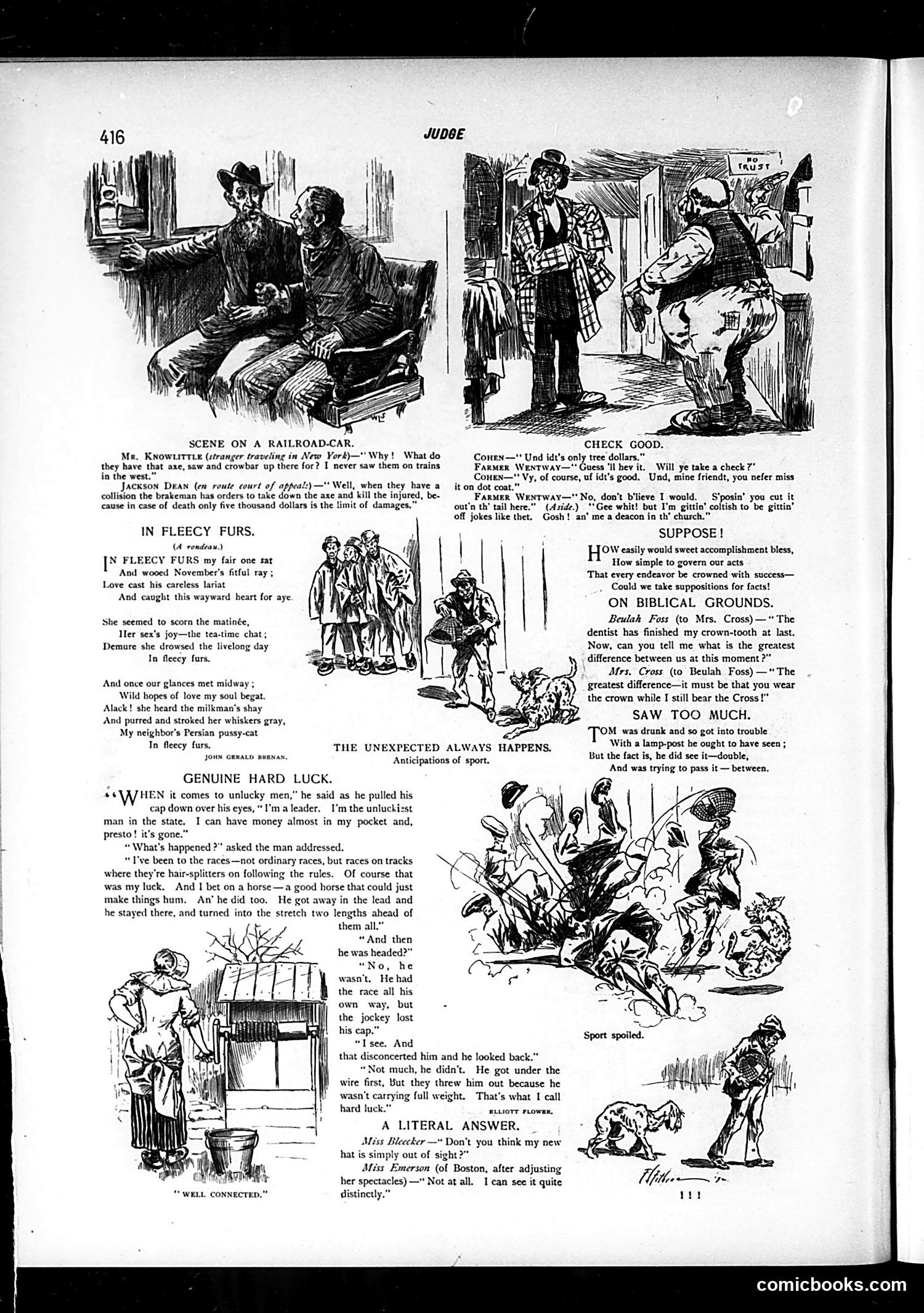
This page contains several satirical vignettes typical of Gilded Age humor: **"Scene on a Railroad-Car"** mocks American litigation culture. A western traveler questions why a train carries axes and crowbars. Jackson Dean (identified as "en route court of appeal") cynically explains that railroad companies intentionally kill injured passengers to limit liability to five thousand dollars—a dark jab at corporate malfeasance and judicial corruption. **"In Fleecy Furs"** is a humorous poem where the narrator believes he's courting a woman in fur but discovers she's actually a Persian cat—a play on romantic delusion. **"Genuine Hard Luck"** satirizes racing culture and its arbitrary rules. A habitual loser recounts losing a sure horse-race victory because the jockey lost his cap, triggering disqualification for insufficient weight—illustrating how technicalities defeat logic. Remaining items are brief comic quips: a Boston woman's literal interpretation of "out of sight," a farmer's check-passing deception, and a drunk man seeing double. The artwork throughout uses period crosshatching typical of 1890s-era comic illustration.
📄 Transcribed text from this page (OCR, searchable)
Machine-transcribed from the original scan — historical spelling and the odd misread are preserved.
SCENE ON A RAILROAD-CAR. Mr. KNowuittx (stranger traveling in New York)—" Why! What do they have that axe, saw and crowbar up there for? I never saw them on trains in the west.” JACKSON DEAN (en route court of appeal:)—"* Well, when they have a collision the brakeman has orders to take down the axe and kill the injured, be- cause in case of death only five thousand dollars is the limit of damages.” it on dot coat. out'n th’ tail her IN FLEECY FURS. (A rondeau.) N FLEECY FURS my fair one sat And wooed November's fitful ray; Love cast his careless lariat And caught this wayward heart for aye She seemed to scorn the matinge, Her sex’s joy—the tea-time chat ; Demure she drowsed the livelong day In fleecy furs. And once our glances met midway ; Wild hopes of love my soul begat. Alack! she heard the milkman’s shay And purred and stroked her whiskers gray, My neighbor's Persian pussy-cat In fleecy furs. JONN GERALD BREAN. GENUINE HARD LUCK. *¢\JHEN it comes to unlucky men,” he said as he pulled his cap down over his eyes, “I'm a leader, I'm the unluchizst man in the state, I can have money almost in my pocket and, presto! it's gone.” ib “ What's happened ?” asked the man addressed. “I've been to the races—not ordinary races, but races on tracks where they're hair-splitters on following the rules. Of course that was my luck. And I bet on a horse—a good horse that could just make things hum. An’ he did too. He got away in the lead and he stayed there, and turned into the stretch two lengths ahead of them all.” “And then he was headed?” “No, he wasn't, He had the race all his own way, but the jockey lost his cap.” “Tsee. And that disconcerted him and he looked back.” ‘ot much, he didn’t. He got under the wire first, But they threw him out because he wasn’t carrying full weight. That's what I call hard luck. ELLIOTT Flown, A LITERAL ANSWER. Miss Bleecker —" Don't you think my new hat is simply out of sight?” Miss Emerson (of Boston, after adjusting her spectacles) —* Not at all. I can see it quite distinctly,” THE UNEXPECTED ALWAYS HAPPENS. Anticipations of sport. ‘* WELL CONNECTED.” CHECK GOOD. “* Und idt's only tree dollars.” Farmer Wentway—“* Guess ‘Il hev it. Will ye take a check 7” Conex—" Vy, of course, uf idt’s good, Und, mine friendt, you nefer miss Farsen Wextwav—" No, don’t bilieve 1 would. (Aside) off jokes like thet. Gosh! an’ me a deacon in th’ church.” S'posin' you cut it “Gee whit! but I'm gittin’ coltish to be gittin’ SUPPOSE! HOW easily would sweet accomplishment bless, How simple to govern our acts ‘That every endeavor be crowned with success— Could we take suppositions for facts! ON BIBLICAL GROUNDS. Beulah Foss (to Mrs. Cross) —“ The dentist has finished my crown-tooth at last. Now, can you tell me what is the greatest difference between us at this moment ?” Mrs. Cross (to Beulah Foss) —“ The greatest difference—it must be that you wear the crown while I still bear the Cross!” SAW TOO MUCH. M_ was drunk and so got into trouble With a lamp-post he ought to have seen ; But the fact is, he did see it—double, And was trying to pass it — between, comicbooks.com