
A complete issue · 18 pages · 1892
Judge — November 26, 1892
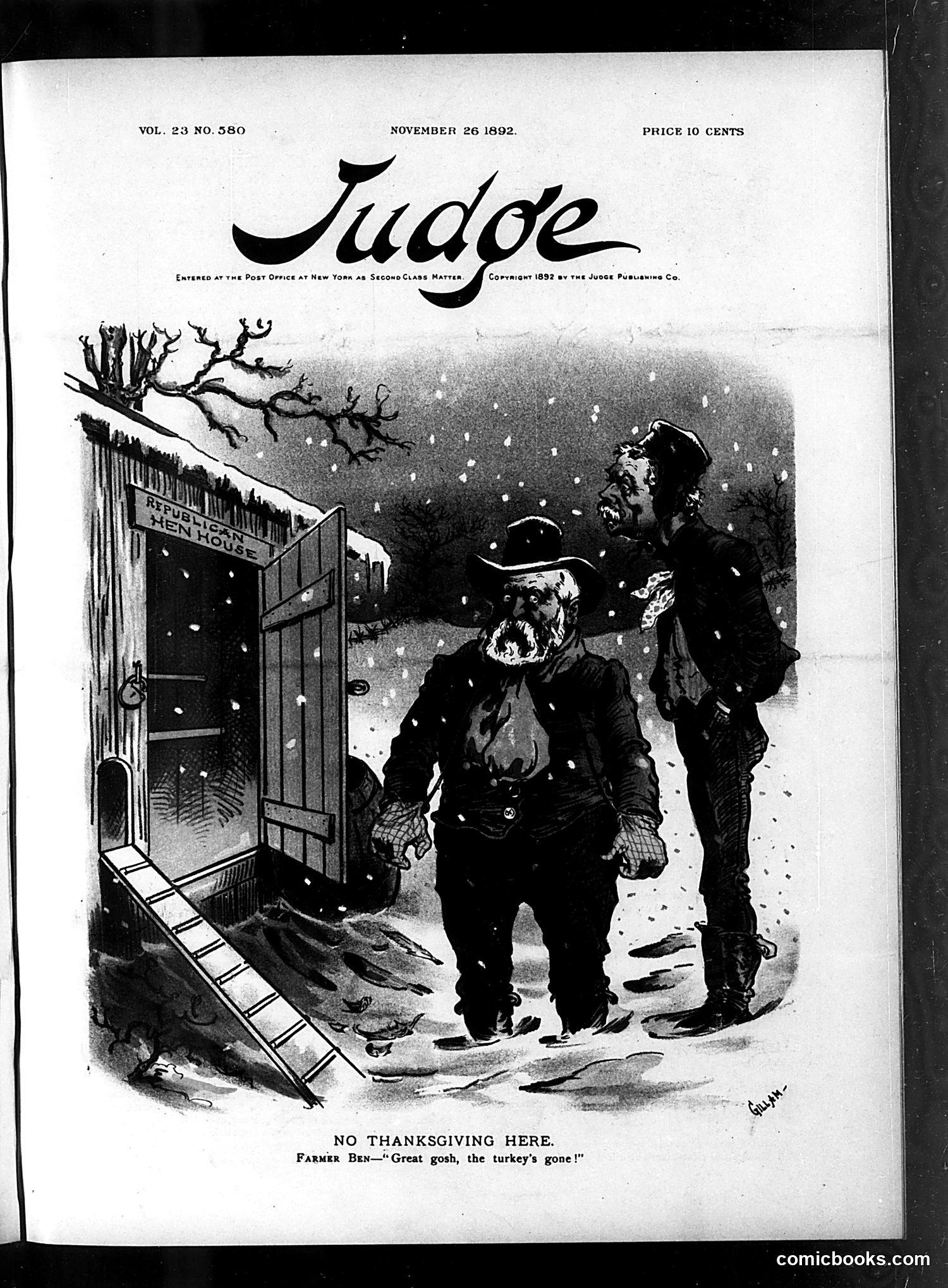
This cartoon satirizes homelessness and poverty during the 1892 holiday season. Two men stand outside a "Refuge" or shelter during a snowstorm. The figure labeled "Farmer Ben" laments that "the turkey's gone"—meaning there's no festive meal available, even at a charitable institution meant to provide holiday relief. The satire targets the inadequacy of poor-relief systems: even establishments designed to help the destitute cannot provide basic Thanksgiving provisions. The "refuge" offers only minimal shelter, not genuine comfort or sustenance. The cartoon critiques both the failure of charitable institutions and broader social inequality during the Gilded Age, highlighting how economic hardship meant many Americans faced bleak holidays without food or warmth.
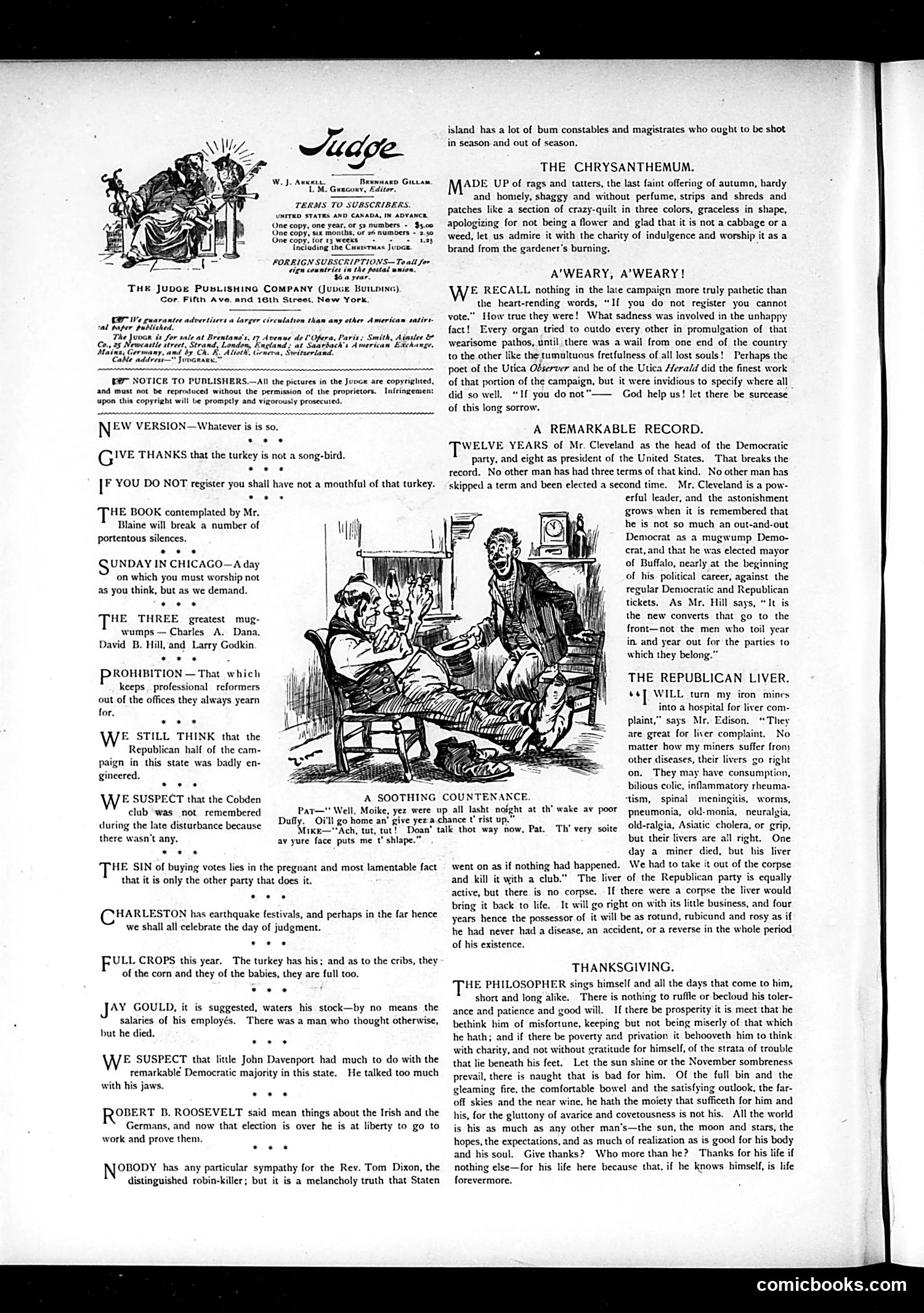
This page contains multiple short satirical items typical of Judge's format. The main cartoon depicts "A Soothing Countenance"—two figures in what appears to be a medical or domestic setting, with dialogue about giving someone "a chance t' rist up." The text items include political commentary on: - **"A Weary! A Weary!"** - criticizing voter fatigue from campaign appeals - **"A Remarkable Record"** - discussing a U.S. president's (appears to be Cleveland's) political career and party conversions - **"The Republican Liver"** - using liver disease as metaphor for Republican party problems - **"Thanksgiving"** - a philosophical piece on gratitude The satire targets electoral politics, voter manipulation, and party corruption typical of Gilded Age American political discourse. Without dates or clearer identification, precise historical references remain unclear, though the content suggests late 19th-century American political satire.
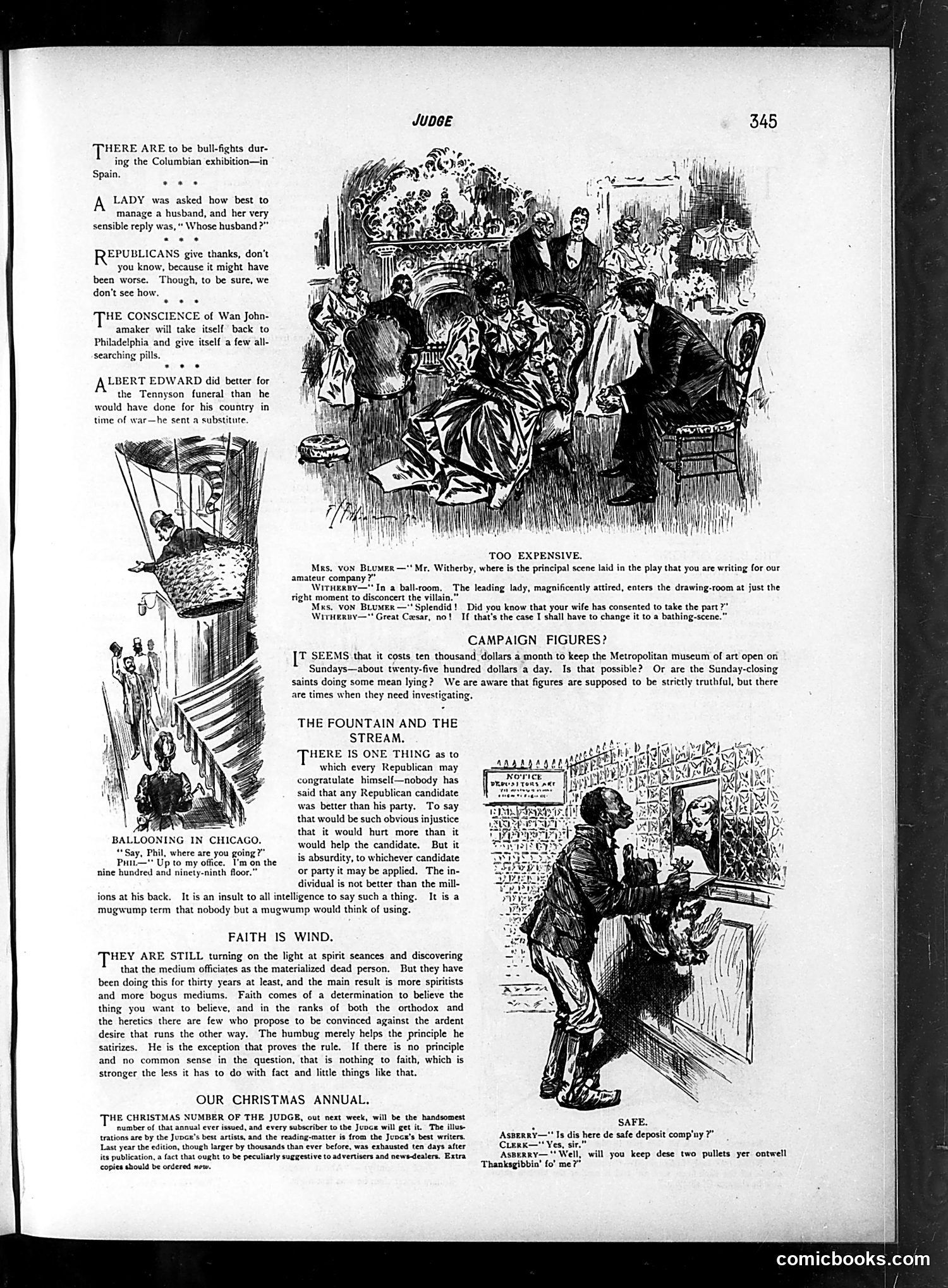
This page contains several satirical pieces and cartoons typical of Judge magazine's political commentary. **"Too Expensive"** depicts a theater scene where Mrs. von Blümer discusses staging costs with Mr. Wetherby. The joke appears to mock theatrical productions and their budgets, with a reference to changing a villain to a bathing scene—satirizing how productions compromise artistic vision for economic reasons. **"Campaign Figures"** critiques the cost of maintaining institutions like the Metropolitan Museum, questioning whether donors' charitable contributions truly serve public good or conceal questionable practices. **"Ballooning in Chicago"** shows a hot air balloon mishap, satirizing either dangerous leisure activities or metaphorically criticizing inflated rhetoric/aspirations. The page includes additional satirical sections on Republicanism, spiritualism, and Christmas advertising, reflecting Judge's broad social commentary approach.
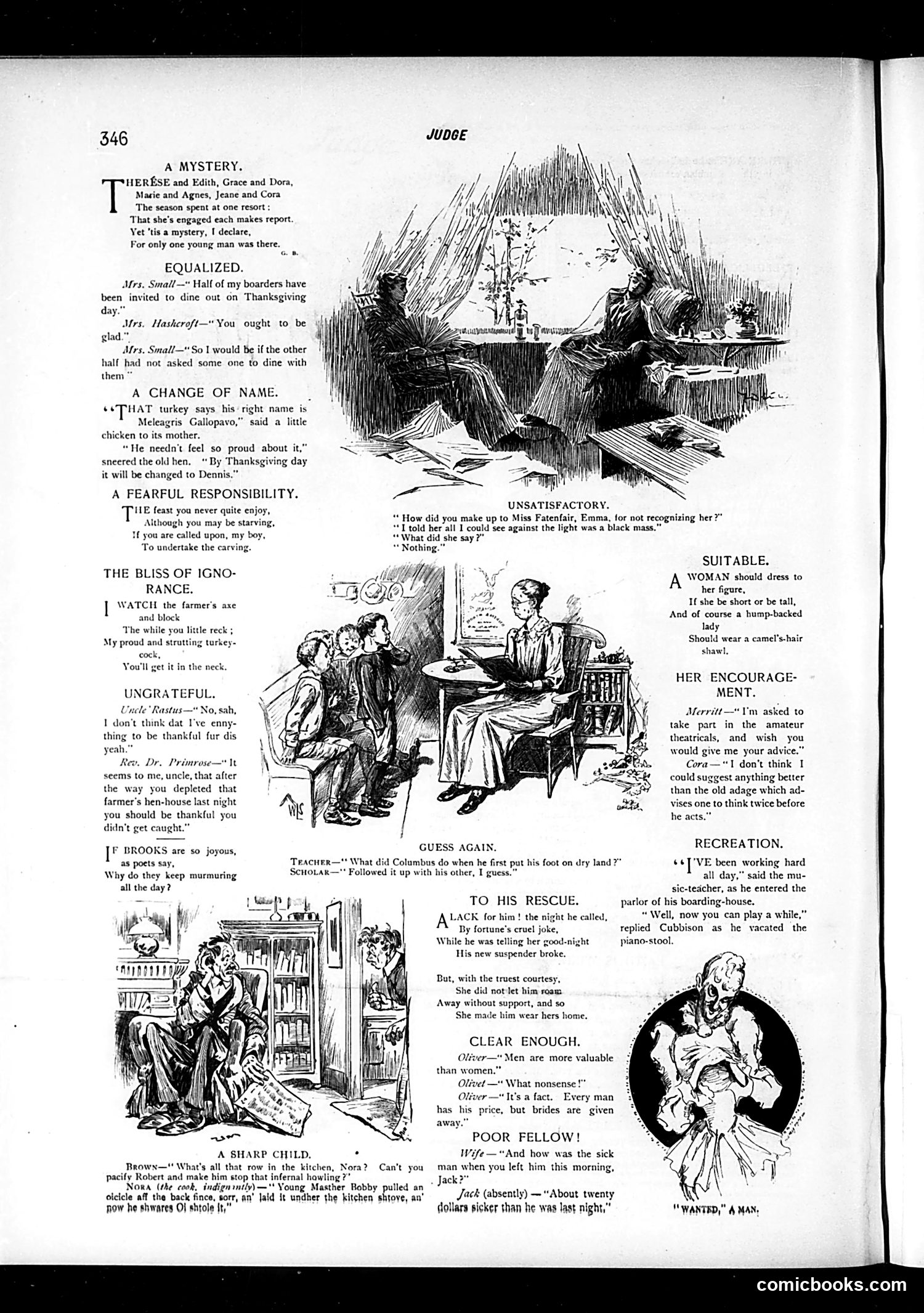
This page contains a collection of brief humorous anecdotes typical of late-19th/early-20th-century American satirical magazines. The jokes target: **Social observations**: "A Mystery" mocks women's marriage prospects; "Equalized" jokes about boarding house dynamics; "A Change of Name" uses a turkey's Latin name (*Meleagris Gallopavo*) to set up a dark punchline about Thanksgiving slaughter. **Class and racial humor**: "Ungrateful" features "Uncle Rastus," a racist caricature of a Black man. "A Sharp Child" involves an Irish servant's malapropism. **Gender relations**: Multiple jokes stereotype women's materialism and vanity ("Unsatisfactory," "Clear Enough"), while "Her Encouragement" suggests women shouldn't participate in amateur theatre. **Domestic life**: Several anecdotes mock marriage, carving turkey, and boarding house life. The accompanying illustrations are period pen-and-ink sketches. The humor relies on now-offensive racial stereotypes, gendered assumptions, and class-based mockery typical of this era's "sophisticated" satire.
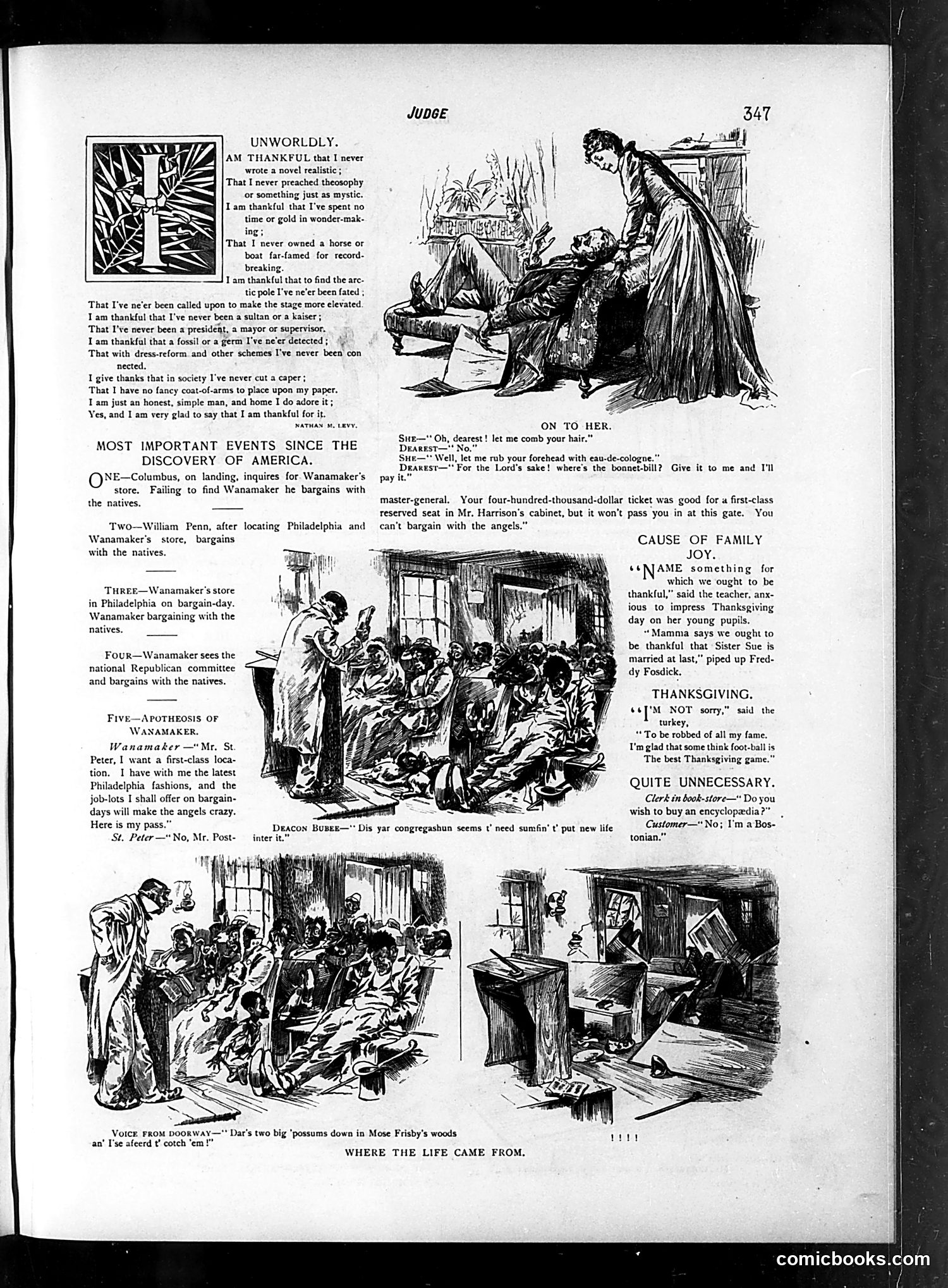
This page satirizes **John Wanamaker**, the Philadelphia department store magnate and political figure. The central conceit is absurd: Wanamaker is portrayed as so obsessed with bargaining and commerce that he's the most important figure in American history—rivaling Columbus and William Penn. The five-panel "Most Important Events" sequence jokes that Wanamaker encountered/bargained with natives upon landing in America, established his store before the nation itself, and essentially created Philadelphia through commercial dealings. The "Apotheosis" section shows him attempting to enter heaven by offering St. Peter a "first-class location" deal using Philadelphia fashions and job-lot bargains—only to be rejected because "you can't bargain with the angels." The satire mocks Wanamaker's legendary business acumen and aggressive marketing while implying that American progress had become synonymous with commercial excess. The surrounding miscellaneous humor pieces and sketches are typical Judge filler content.
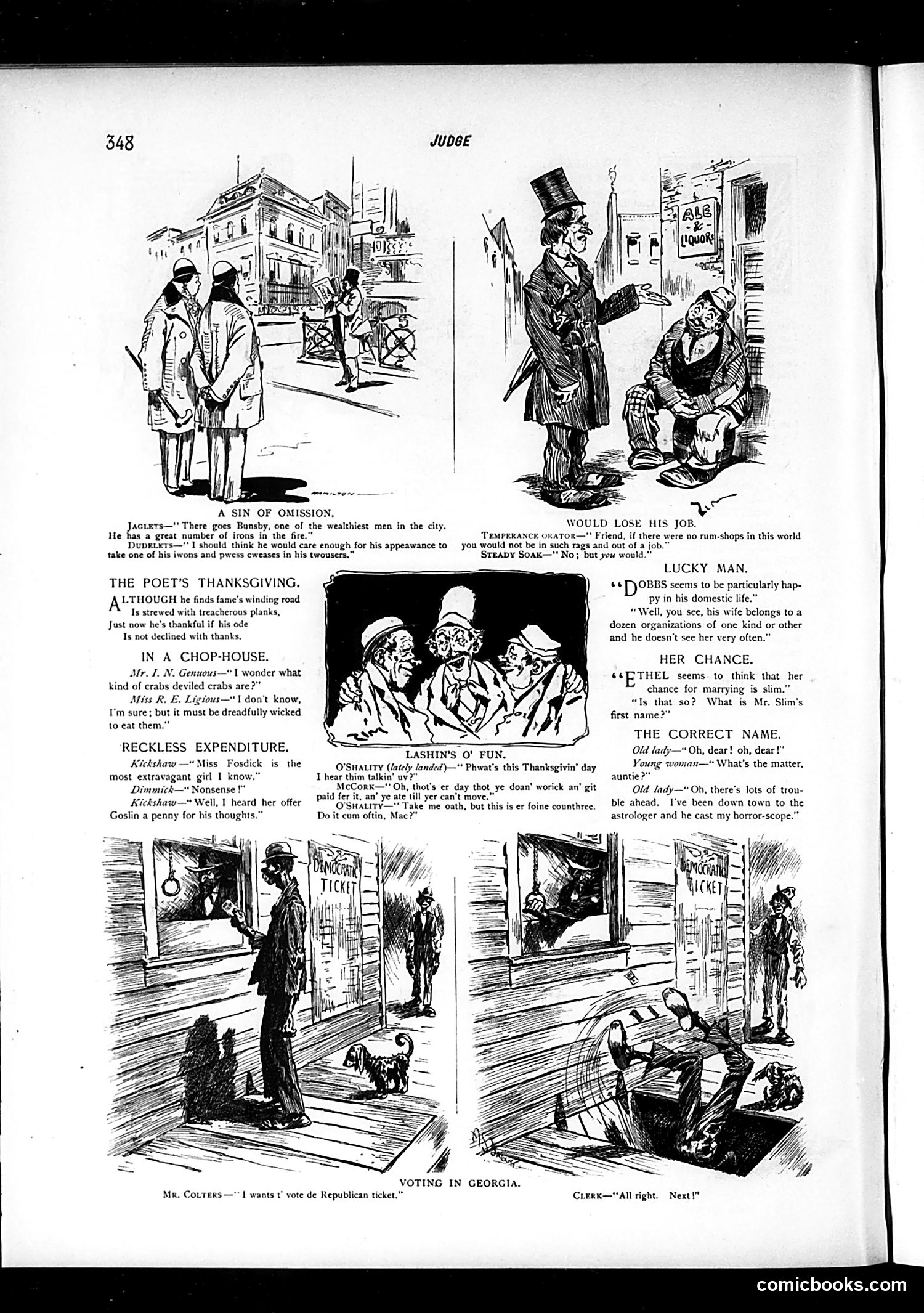
This page contains multiple short satirical pieces typical of late 19th-century American humor: **"A Sin of Omission"** mocks wealthy businessman Bunsby for neglecting personal grooming despite his fortune—a jab at nouveau riche pretension. **"The Poet's Thanksgiving"** jokes about rejected manuscript submissions, a common literary complaint. **"Voting in Georgia"** depicts racial/political humor: a Black man requesting a Republican ballot is turned away by a clerk, reflecting post-Reconstruction voter suppression and intimidation in the South—dark satire of actual disenfranchisement. **"Lashin's O' Fun"** features Irish immigrant dialect comedy (common in period humor) about Thanksgiving and American abundance. Other pieces play on wordplay and domestic situations ("Lucky Man," "Her Chance"). The cartoons employ stereotypical immigrant accents and social class commentary typical of Judge's middle-class readership. The Georgia voting cartoon is the most politically pointed, though presented as comedy rather than critique.
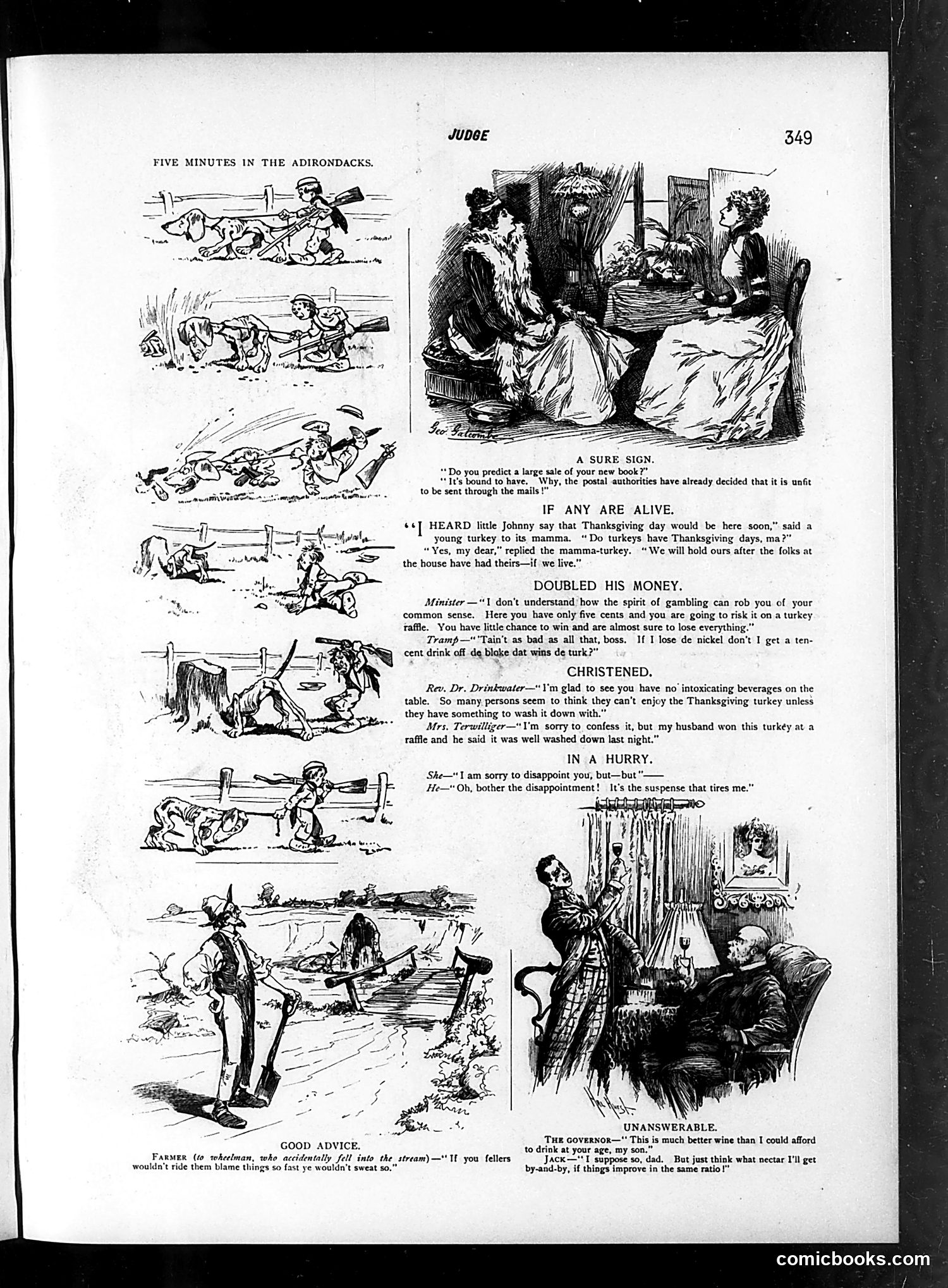
This page from *Judge* contains multiple short satirical sketches typical of late 19th-century American humor magazines. **Key satirical pieces:** 1. **"A Sure Sign"**: Mocks censorship and "obscene" literature—a publisher celebrates that postal authorities banned his book as "unfit for mails," treating rejection as marketing success. 2. **Turkey jokes** ("If Any Are Alive," "Doubled His Money"): Dark humor about Thanksgiving turkey raffles and gambling, common working-class amusements. A tramp calculates he'll profit even losing a nickel bet. 3. **"Christened"**: Puns on Rev. Dr. Drinkwater's name; satirizes hypocrisy about temperance and alcohol consumption among the wealthy. 4. **"Unanswerable"**: Social commentary on class inequality—a governor enjoys fine wine he couldn't afford at his age; an implication that wealth/status grants privileges unavailable to ordinary citizens. 5. **"Good Advice"**: Rural humor about cyclists ("wheelmen") being reckless speedsters—a contemporary moral panic about new bicycle technology. The page reflects *Judge's* satirical focus on social pretense, class divisions, censorship, and modern anxieties.
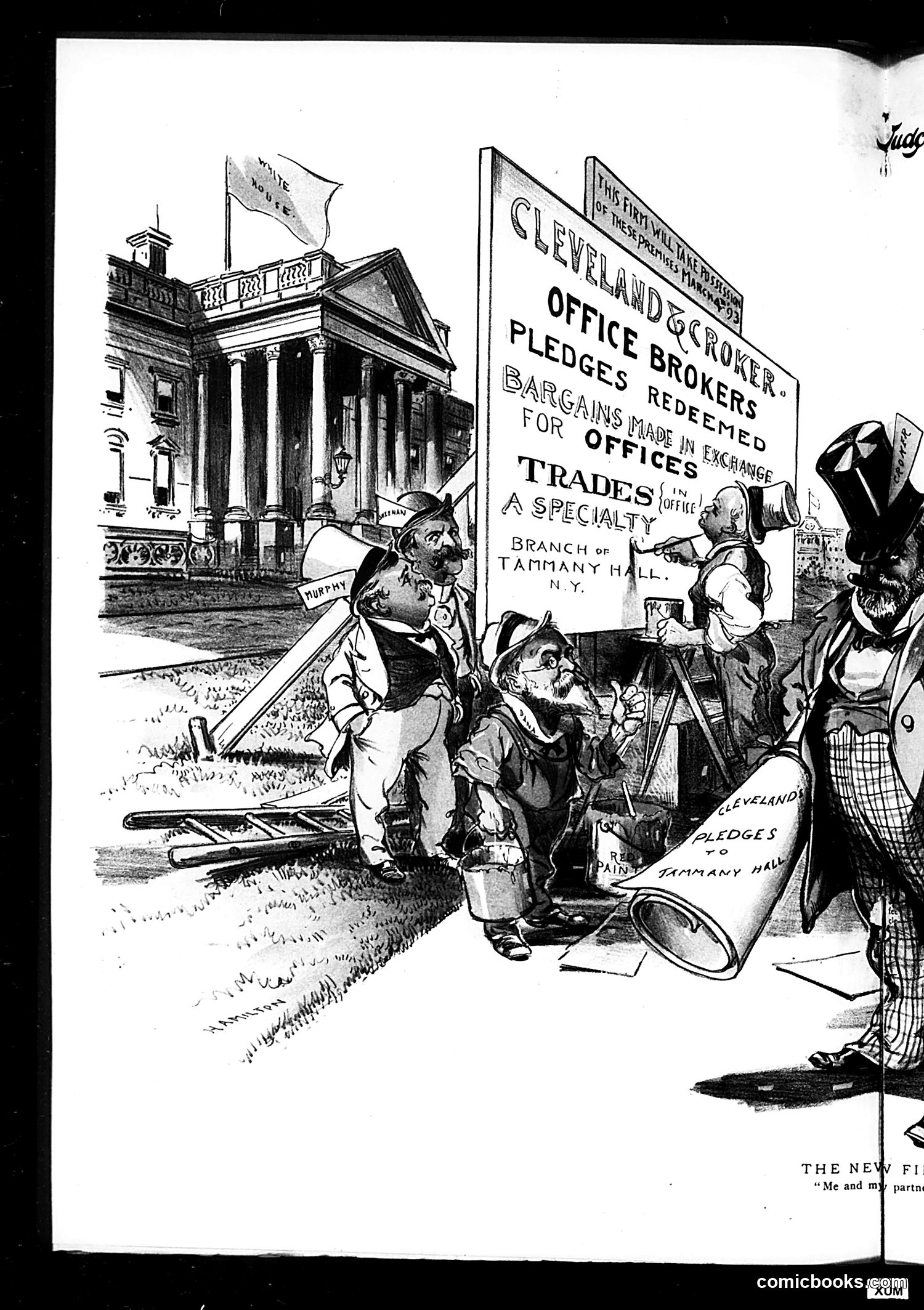
This is a satirical advertisement cartoon from Judge magazine depicting Cleveland Croker as an "Office Broker" operating from Tammany Hall in New York. The caricature shows Croker (identifiable by the label) conducting dubious business with anthropomorphized figures representing political pledges and trades. The satire mocks Tammany Hall's notorious practice of trading political favors and offices for money—essentially "brokering" government positions to the highest bidder. The figures carrying signs reading "pledges," "bargains," and "trades" illustrate how the political machine commodified public office. This reflects the era's widespread criticism of urban political corruption, where Tammany Hall epitomized backroom dealing and the sale of civic positions to those with connections rather than merit.
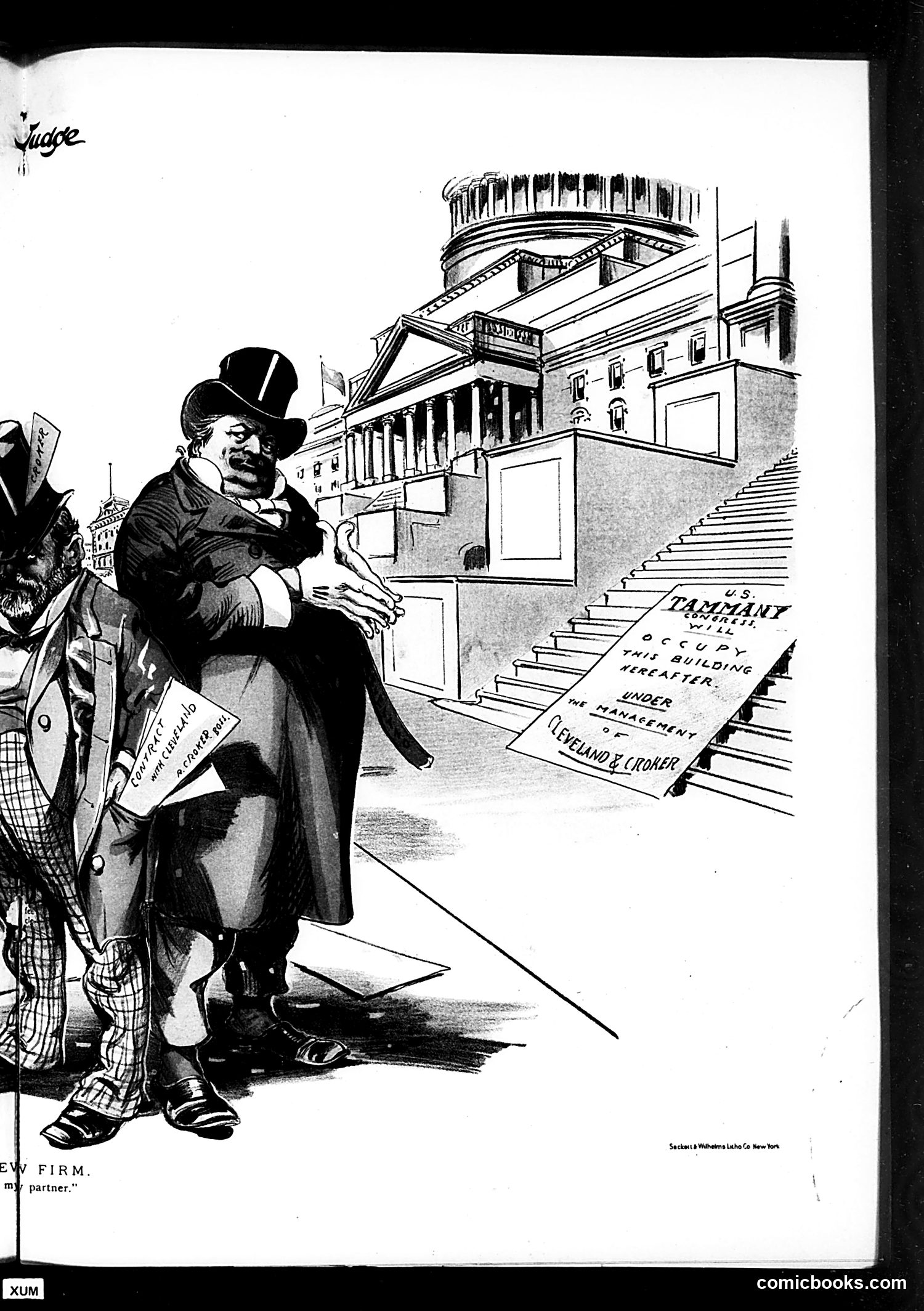
This Judge magazine cartoon satirizes corporate management of a major film studio. The caricatured figure in the top hat represents a wealthy executive or financier standing before the U.S. Capitol building. The sign on the steps reads "Paramount Pictures This Studio Hereafter Under Management of Lowell & Cromer," indicating a change in studio leadership or ownership. The satire appears to mock the influence of business interests on American cultural institutions—specifically how corporate executives with top-hat formality ("new money" wealth) now control major entertainment companies. The Capitol building backdrop suggests commentary on the intersection of big business and government power during the early film industry era. The exact identities of "Lowell & Cromer" remain unclear without additional historical context.
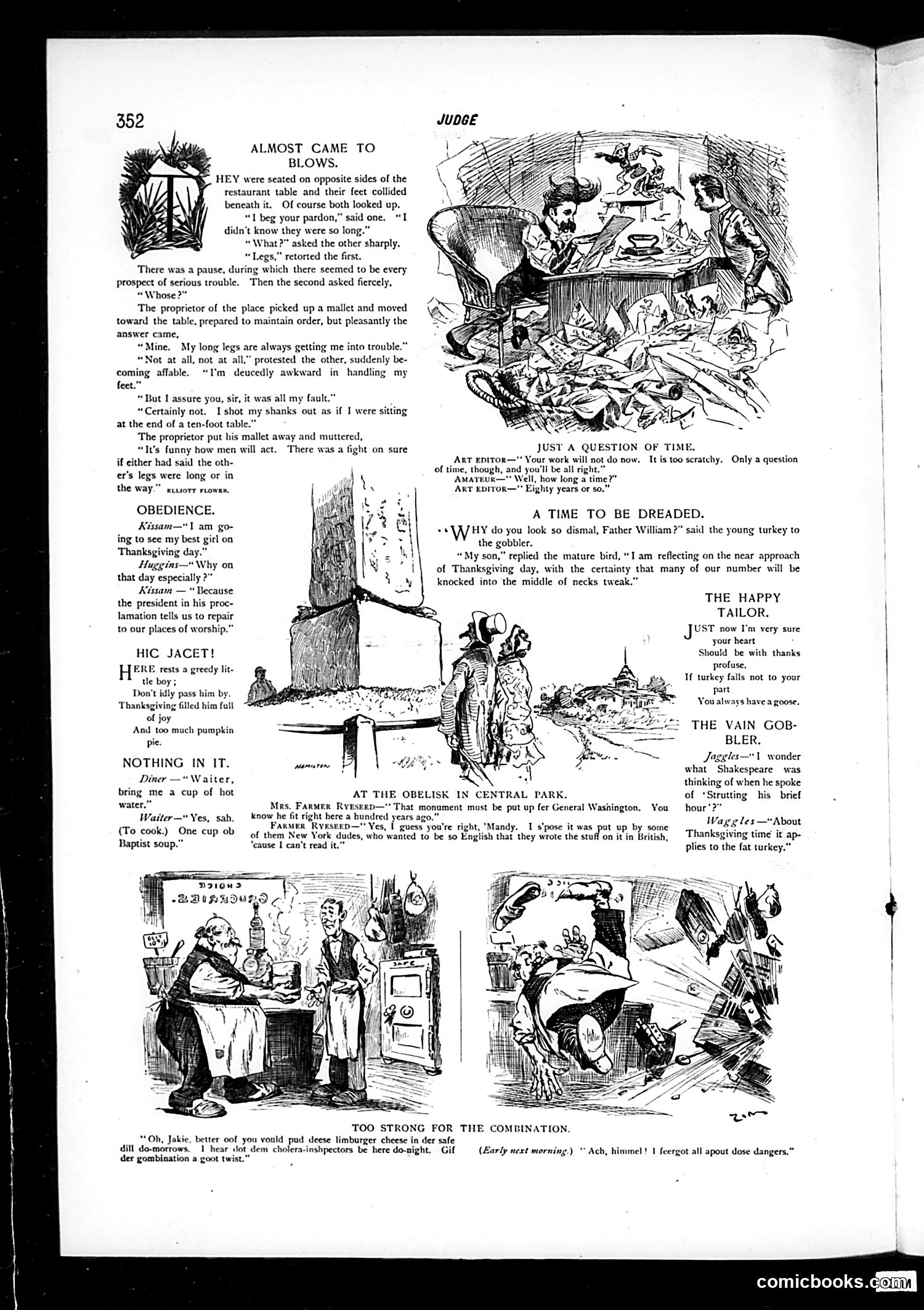
This page collects brief Thanksgiving-themed comedic sketches typical of Judge magazine's satirical humor. **"Almost Came to Blows"** depicts a restaurant mishap where two men's feet collide under a table. The joke's point: they nearly fight over the insult ("your legs are long"), but immediately become friendly upon realizing the collision was accidental—satirizing how men's pride and quick temper can escalate trivial incidents, yet civility dissolves conflict just as easily. **Other sketches** include wordplay and visual gags: a man visiting his girlfriend on Thanksgiving because the president's proclamation mentions "places of worship"; a dead turkey ("Hic jacet"); turkeys dreading the holiday; and a vain gobbler. The final cartoon shows a deli owner forgetting to secure pungent limburger cheese before health inspectors arrive. The humor is genteel, relying on puns, mild social observation, and slapstick rather than sharp political satire. These appear designed as filler content around advertisements in this era's humor magazine.
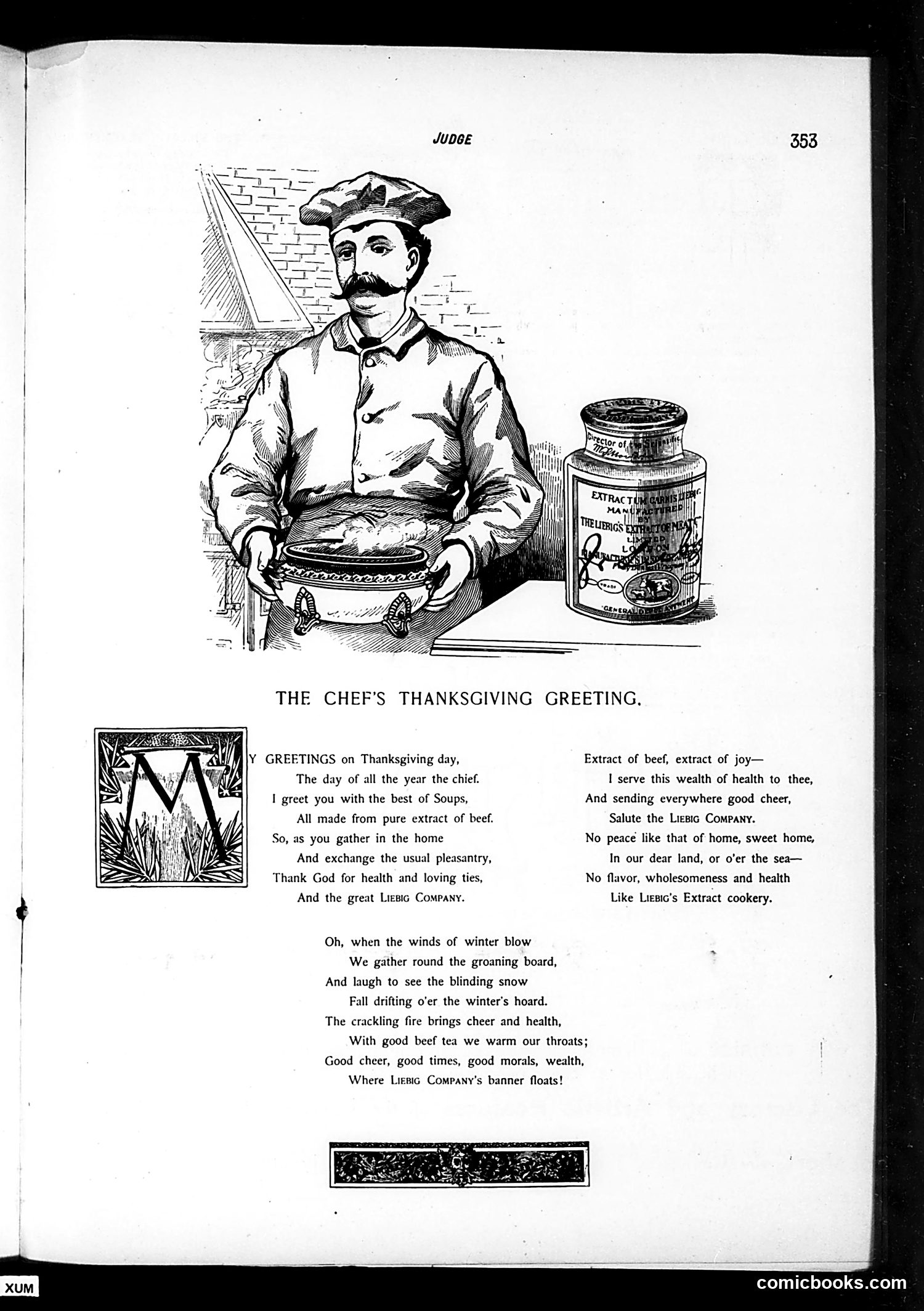
This is a **Liebig Company advertisement** disguised as editorial content in Judge magazine. The image shows a chef holding a tureen, with a jar of Liebig's Extract of Beef prominently displayed. The "poem" is a mock-serious Thanksgiving greeting that repeatedly promotes Liebig's beef extract as essential to holiday celebration and winter comfort. It's satirical advertising—the text absurdly elevates a commercial product to near-religious status ("Thank God for...the great Liebig Company"), treating beef extract as fundamental to health, home, and morality. This exemplifies 19th-century advertising practices where companies paid magazines to publish promotional content styled as legitimate editorial material. The satire lies in the exaggerated reverence for a mundane cooking ingredient, poking fun at both aggressive advertising and consumer culture's growing influence on American traditions.
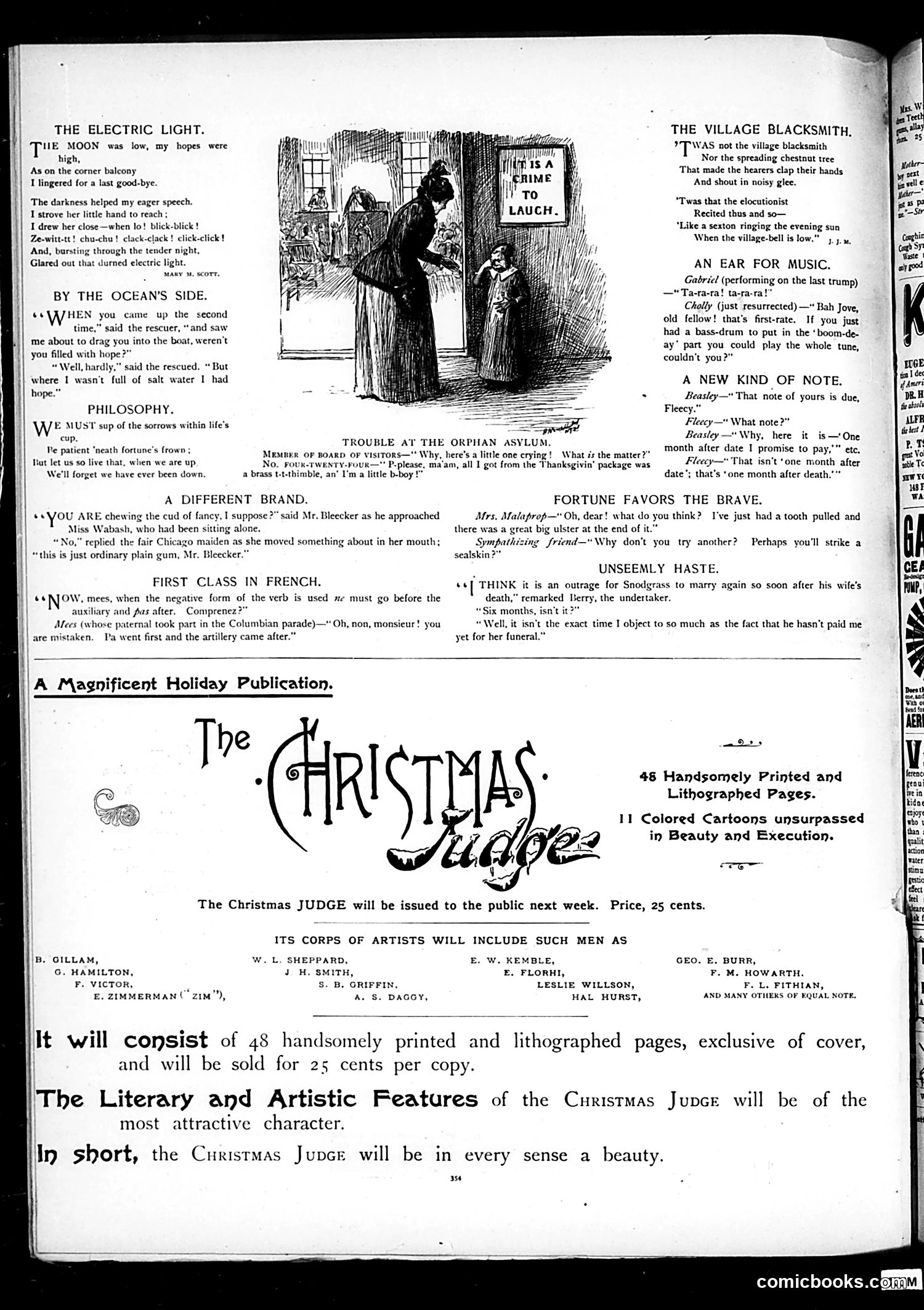
This page contains mostly **short humorous sketches and jokes** rather than political cartoons. The content reflects late-19th-century American humor: **Key pieces:** - "The Electric Light" jokes about an electric streetlight ruining a romantic moment—satire on new technology disrupting traditional courtship - "The Village Blacksmith" parodies Longfellow's famous poem, subverting reader expectations - "An Ear for Music" and "Fortune Favors the Brave" are puns on financial/death themes - "First Class in French" jokes about a student whose father participated in the Columbian Parade, mixing language learning with contemporary events **The main content** is advertising for an upcoming "Christmas Judge" special issue, listing prominent illustrators (Gillam, Hamilton, Victor, etc.) and promising 48 pages with 11 colored cartoons for 25 cents. These are **social comedy sketches** reflecting genteel, middle-class concerns: romance, etiquette, education, and wordplay—typical of Judge's satirical humor targeting educated readers rather than hard political satire.
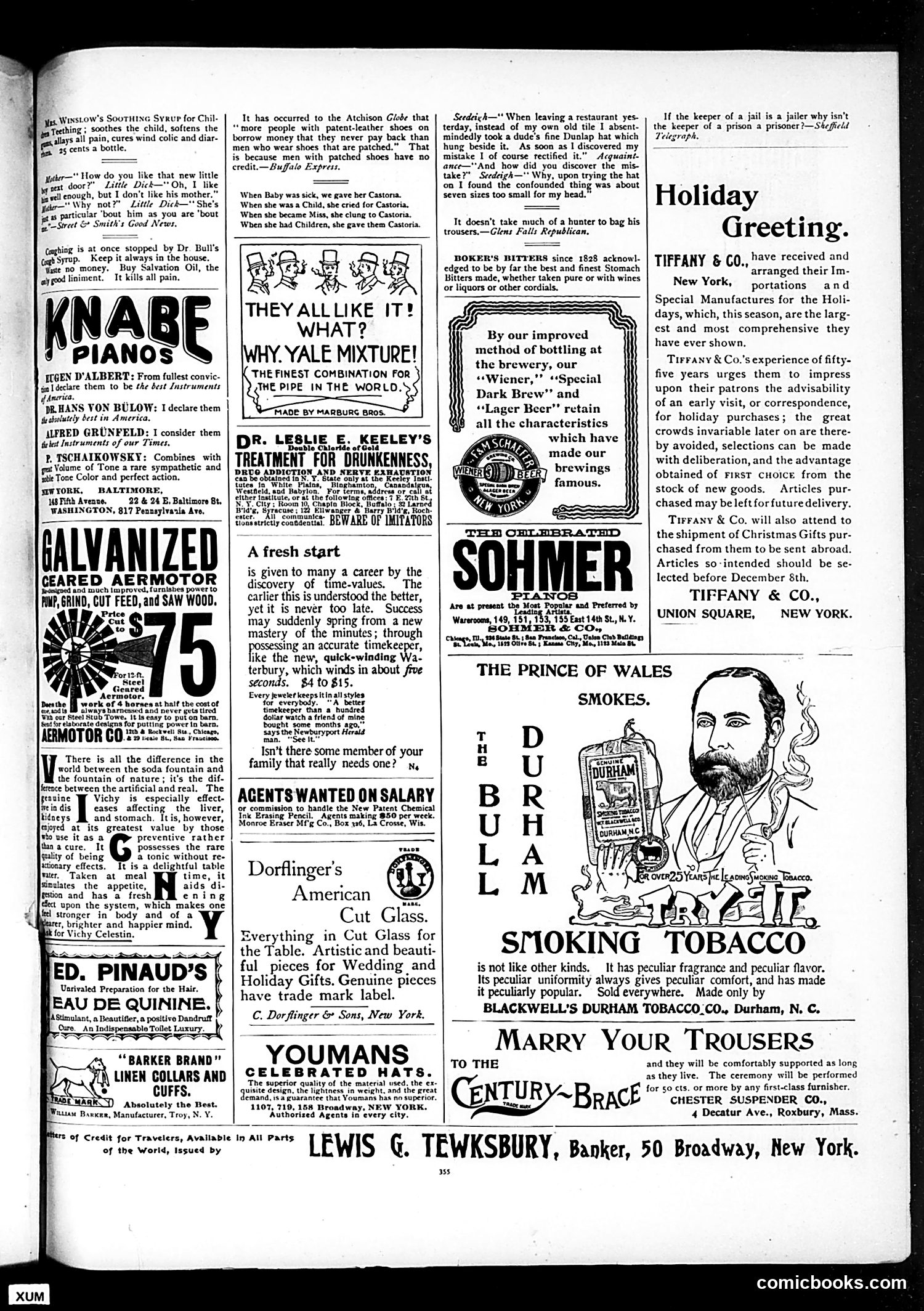
This page is primarily **advertising and light humor** rather than political satire. The cartoons and jokes are social commentary on everyday life, not political critique. The main humorous pieces include brief jokes about: - A man borrowing a fancy hat at a restaurant and discovering the mistake - Confusion between "jailer" and "prisoner" terminology - A child's preference for a neighbor's door but not his mother The page features extensive **advertisements for consumer products**: pianos (Knabe, Sohmer), patent medicines (Dr. Keeley's drunkenness treatment, Castoria), tobacco products (Yale Mixture, Durham tobacco), cut glass, and personal grooming items. One notable ad shows **"The Prince of Wales Smokes"** Durham tobacco, using a bearded man's portrait—typical 19th-century celebrity endorsement advertising. The humor is gentle, domestic, and commercial in nature. This appears to be a standard Judge issue mixing satirical commentary on manners and consumer culture with paid advertising.
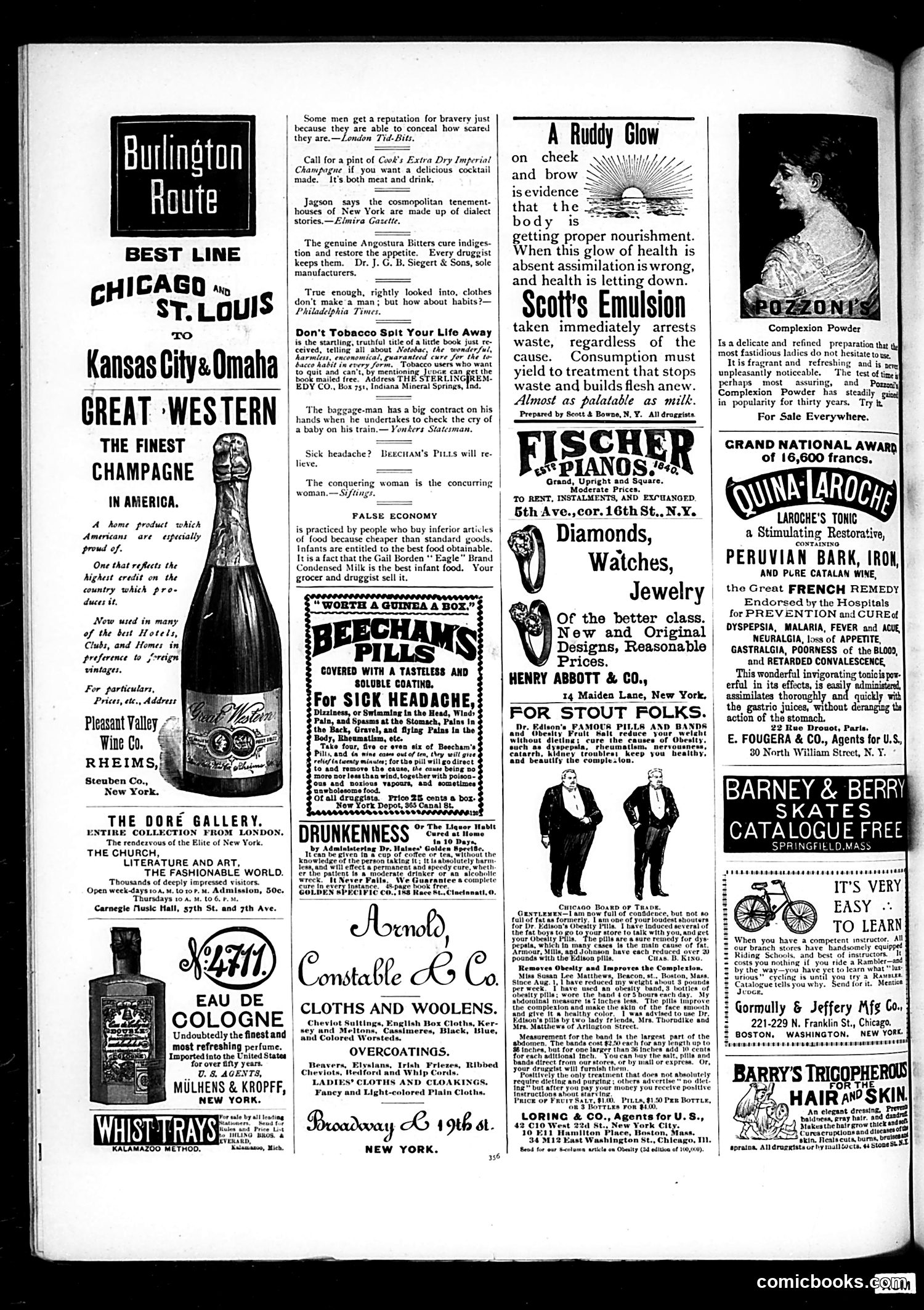
This is primarily an **advertising page** from Judge magazine, not a political cartoon page. It contains numerous product advertisements typical of late 19th-century America, including champagne, cologne, patent medicines, jewelry, bicycles, and hair treatments. The few text snippets included are **brief humorous quotes** rather than satire: - A joke about men concealing fear - Observations about New York tenements and clothing - A quip about babies crying on trains These are generic wit pieces with no apparent political or social commentary beyond mild social observation. The only illustrated content shows product images and what appears to be a profile portrait advertising a complexion powder, but no identifiable political figures or satirical cartoons are present on this page. This represents Judge's **advertising-heavy** editorial format rather than its satirical cartoon tradition.
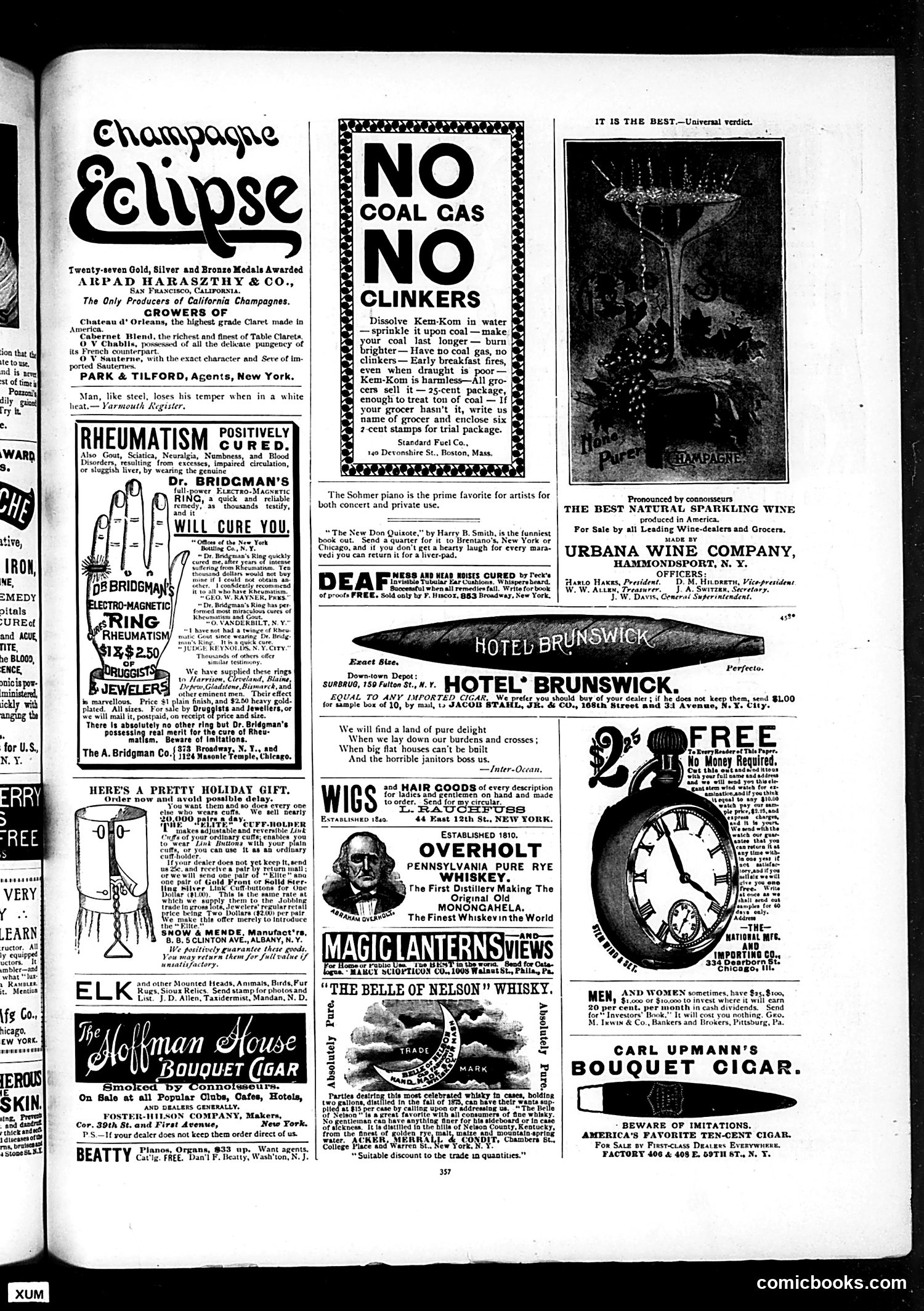
This page is primarily **advertising**, not political satire. It contains numerous commercial ads typical of late 19th-century magazines, with no identifiable political cartoons. The ads include: - **Champagne Eclipse** (California wine) - **Kem-Kom** (coal treatment product) - **Dr. Bridgman's Rheumatism Ring** (medical device claiming to cure rheumatism and other ailments) - **Hotel Brunswick** (lodging) - **Urbana Wine Company** (sparkling wine) - Various cigars, whiskeys, and other consumer goods The only editorial content is a humorous line: "Man, like steel, loses his temper when in a white heat"—a mild joke about human nature. The page reflects Gilded Age consumer culture and the medical quackery era, when dubious products (like the rheumatism ring) were widely advertised without FDA regulation. Names like Harrison and Cleveland appear in testimonials, suggesting prominent endorsements.
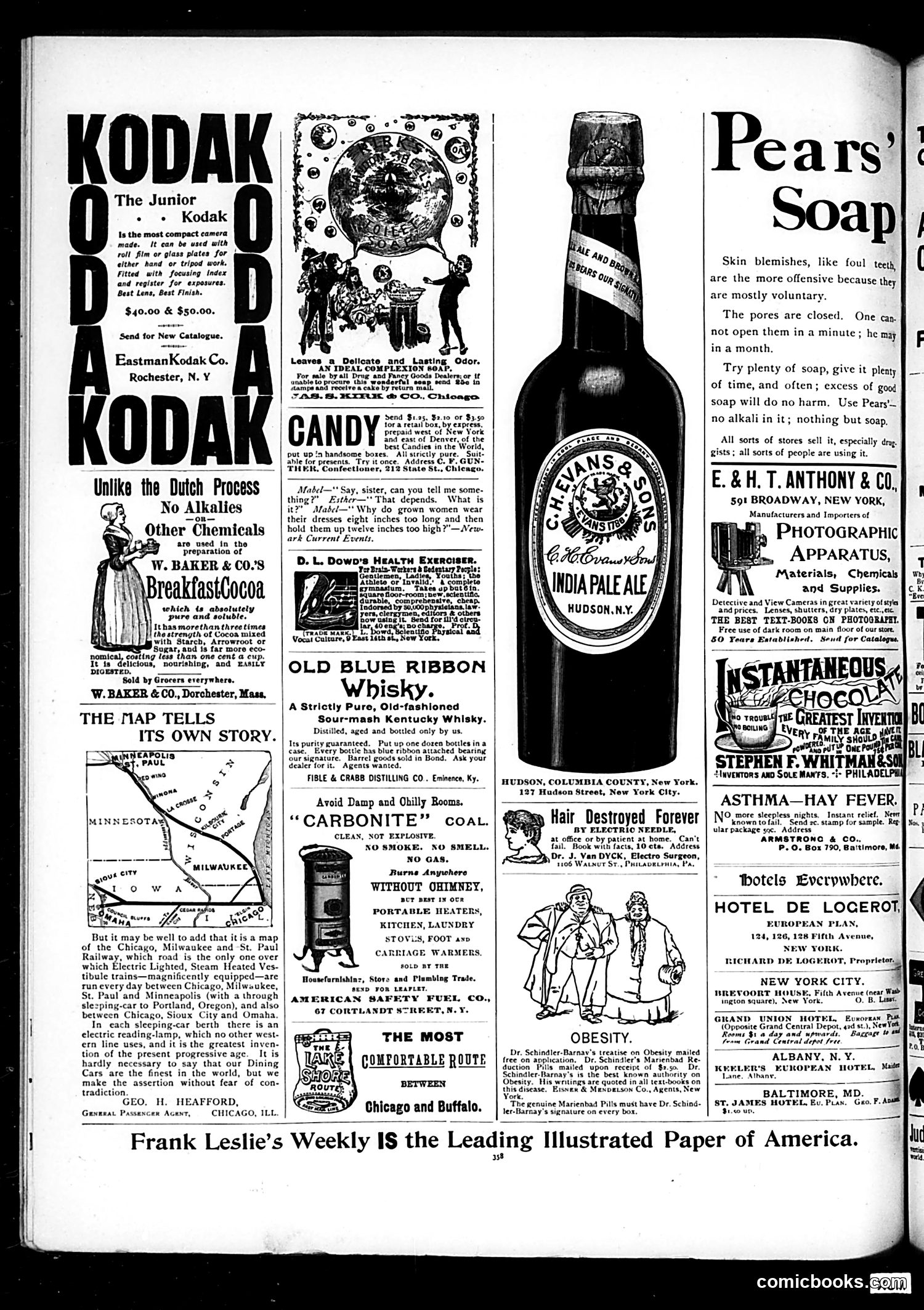
This is primarily a **advertisements page** from an older American publication, not a political cartoon. The page contains various product ads from the late 19th or early 20th century, including cameras, cocoa, soap, whiskey, and health products. The only satirical content is a small dialogue labeled "Current Events" featuring two characters named Mabel and Esther. The joke mocks women's fashion: Esther asks why women wear dresses eight inches too long on the ground while holding them up twelve inches high—a critique of impractical Victorian-era dress conventions that required constant manual adjustment. The page's main value today is **historical**: it documents period advertising claims (cocoa's digestibility, "permanent" hair removal, obesity pills) that reveal era-specific medical misconceptions and marketing tactics now considered dubious or humorous by modern standards.
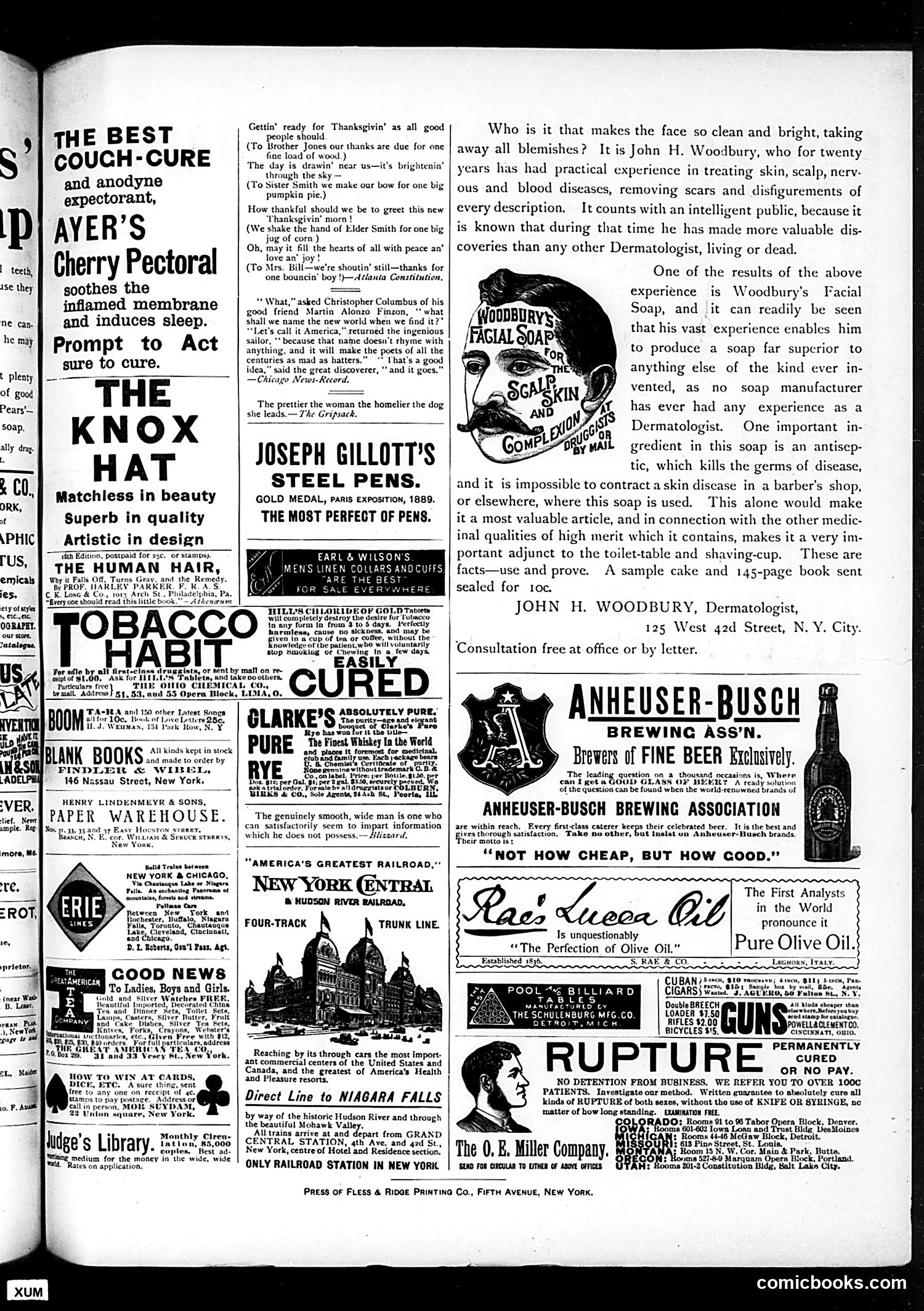
This page is primarily **advertising**, not political satire. However, the text includes brief humorous items: The **Columbus joke** mocks the difficulty of naming America—suggesting "America" has no rhymes, which would frustrate poets. This appears as light editorial humor rather than satire. The **"Thanksgiving" verse** is sentimental doggerel about giving thanks while listing practical obligations to neighbors (wood, pumpkin pie, corn, a baby). The **"smooth man" aphorism** is cynical social commentary about men who convincingly discuss topics they don't understand. The bulk of the page features period **product advertisements**: Ayer's Cherry Pectoral, Knox Hats, Woodbury's Facial Soap (promoted by dermatologist John H. Woodbury), Joseph Gillott's pens, tobacco-cessation remedies, the New York Central Railroad, and various other goods. These reflect late-19th/early-20th-century consumer culture and medical marketing practices. The page demonstrates *Judge's* dual function as satirical publication and advertising vehicle.
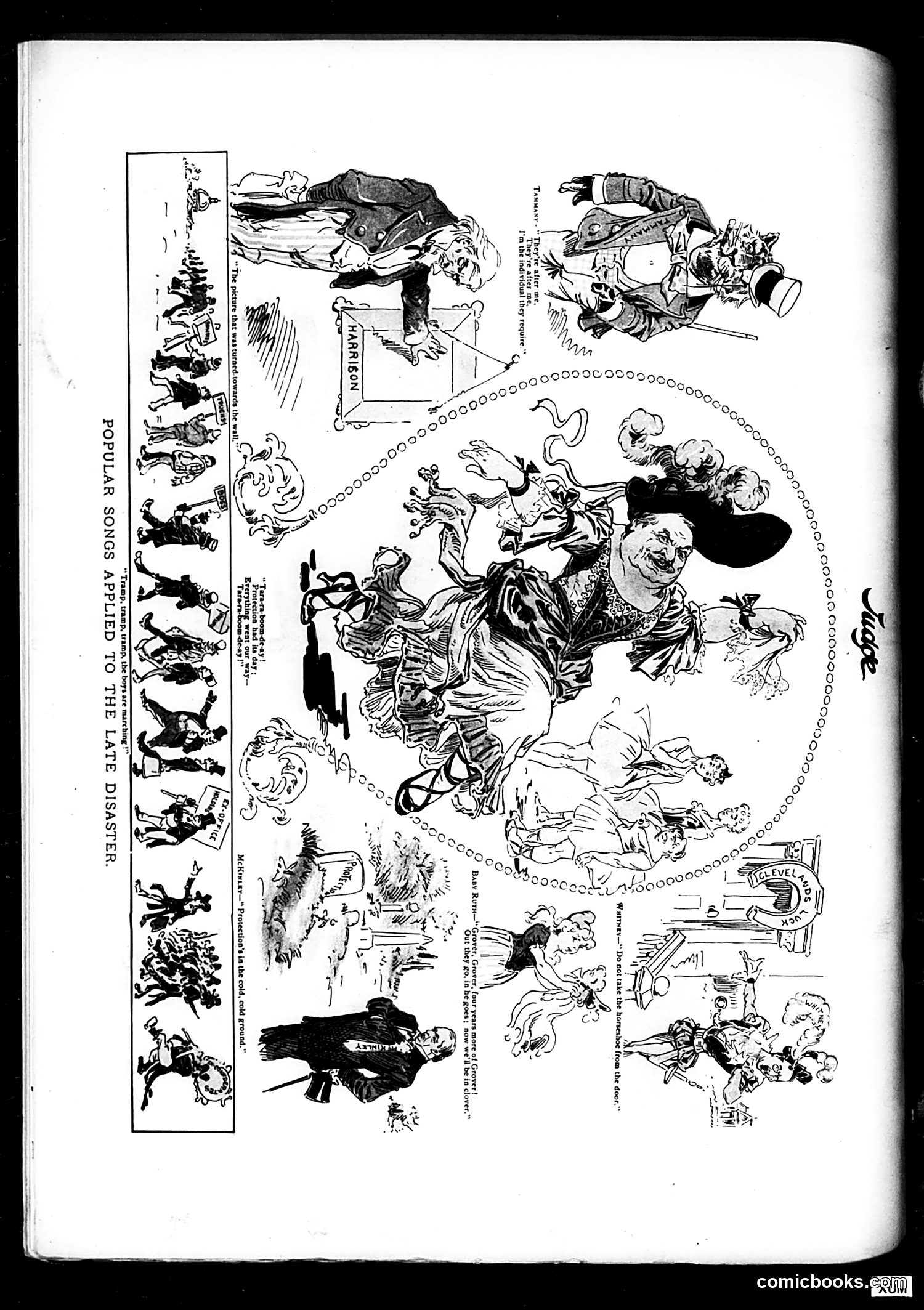
This page satirizes the 1892 presidential election aftermath, featuring Grover Cleveland's return to office. The central circular composition shows various figures celebrating Cleveland's victory with popular song lyrics rewritten as political commentary. Key elements: **The figures:** Cleveland (identifiable by context) appears as the central focus, with supporters depicted celebrating his return. The "horseshoe" reference suggests luck/fortune in politics. **The satire:** The page mocks both Cleveland supporters' triumphalism and his opponents' dismay by pairing their celebrations with song parodies. Lyrics like "four years more of Grover" and "now we'll be in clover" mock the optimistic promises made by the winning party. **The "disaster" reference:** The title suggests the previous administration (likely Harrison's) was viewed negatively by Judge's editors, though the satirical tone suggests skepticism about whether Cleveland's return would truly improve conditions. The strip on the left appears to show related electoral/political scenes, though details are unclear in the image quality provided.