
A complete issue · 16 pages · 1892
Judge — November 12, 1892
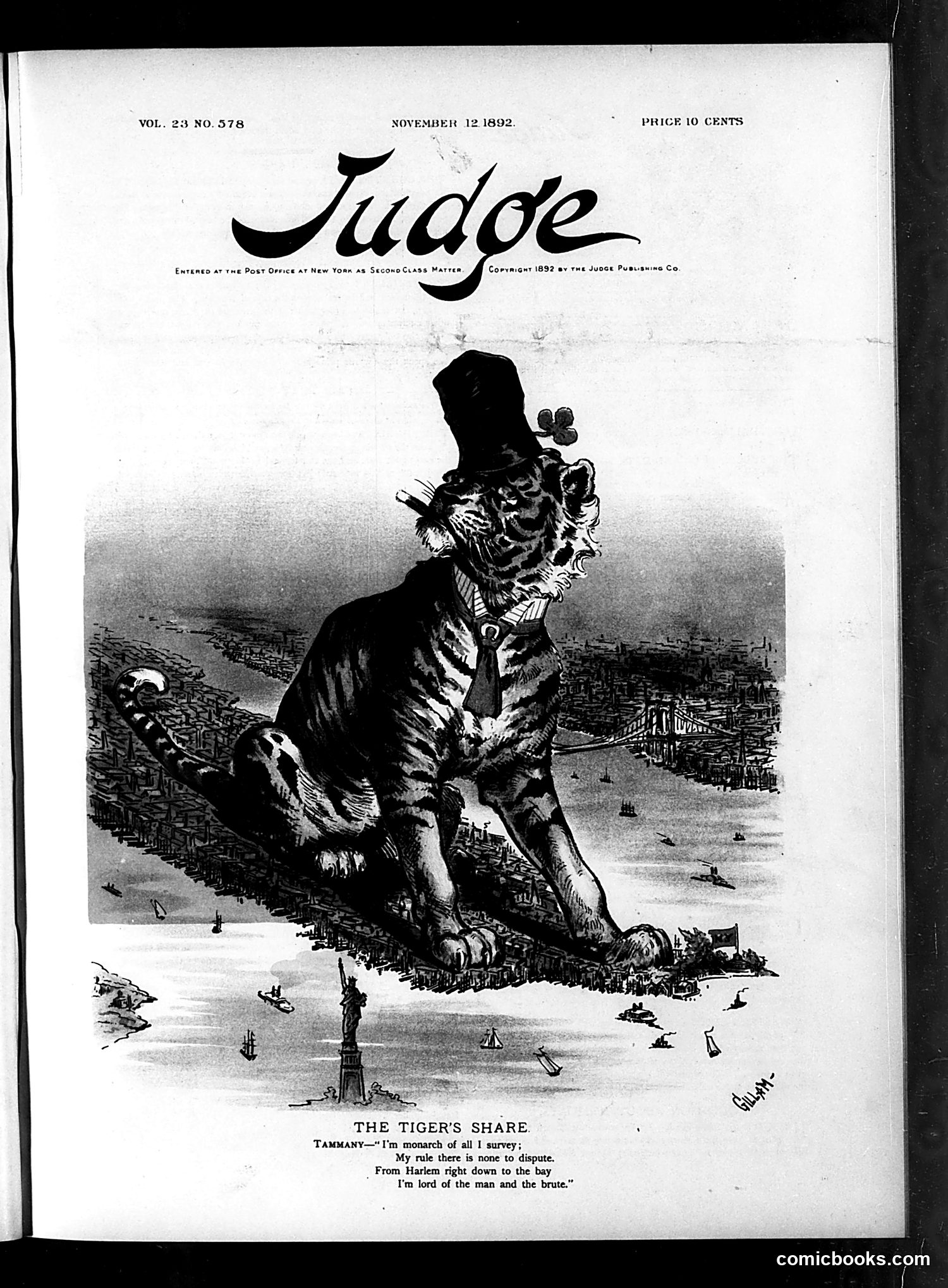
This political cartoon depicts a tiger in formal dress (top hat and clothing) towering over New York City. The tiger claims dominion: "I'm monarch of all I survey / My rule there is none to dispute / From Harlem right down to the bay / I'm lord of the man and the brute." The tiger appears to represent **Tammany Hall**, New York's powerful Democratic political machine known for corruption and control. The image satirizes Tammany's grip on the city during the 1892 election period. The tiny city below and ships in the harbor emphasize the organization's perceived domination over all civic life. The cartoon critiques how thoroughly Tammany controlled New York politics and resources, treating the entire metropolis as its personal domain.
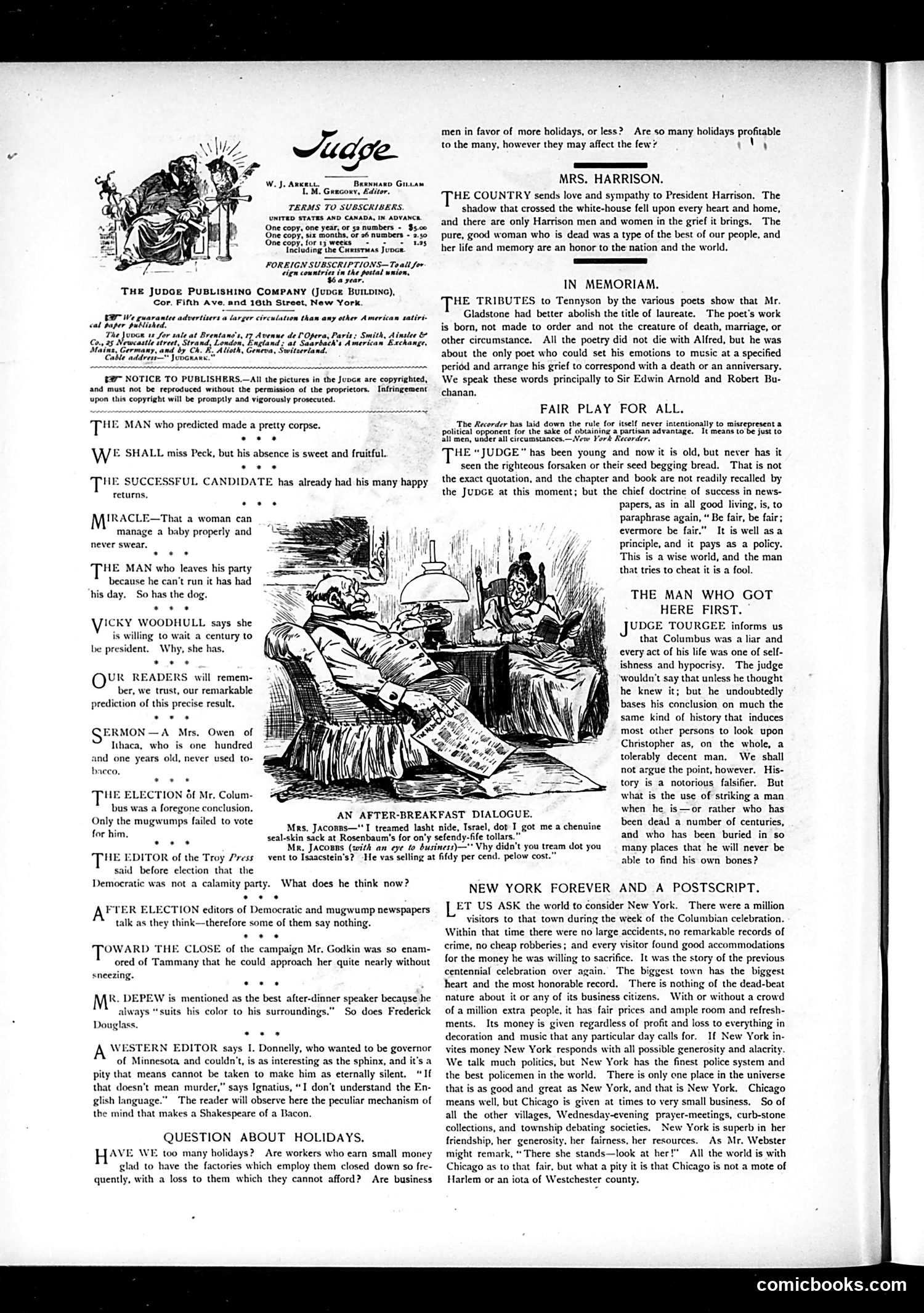
The central cartoon titled "AN AFTER-BREAKFAST DIALOGUE" depicts two figures in what appears to be a domestic scene. Based on the dialogue, it's a satirical commentary on consumer prices and household finances. One figure (Ms. Jacobs) complains about the cost of living—specifically that items like linen thread cost "fifty per cent. below cost," sarcastically questioning where profits go. The satire targets post-WWI inflation and the contradiction between manufacturers' claims of selling at minimal profit while consumers faced escalating prices. The cartoon mocks both commercial dishonesty and the housewife's frustration with unexplained price increases on everyday goods. The surrounding text pieces are editorial commentary on elections, journalism, and social issues of the era, but lack sufficient context for certain identification.
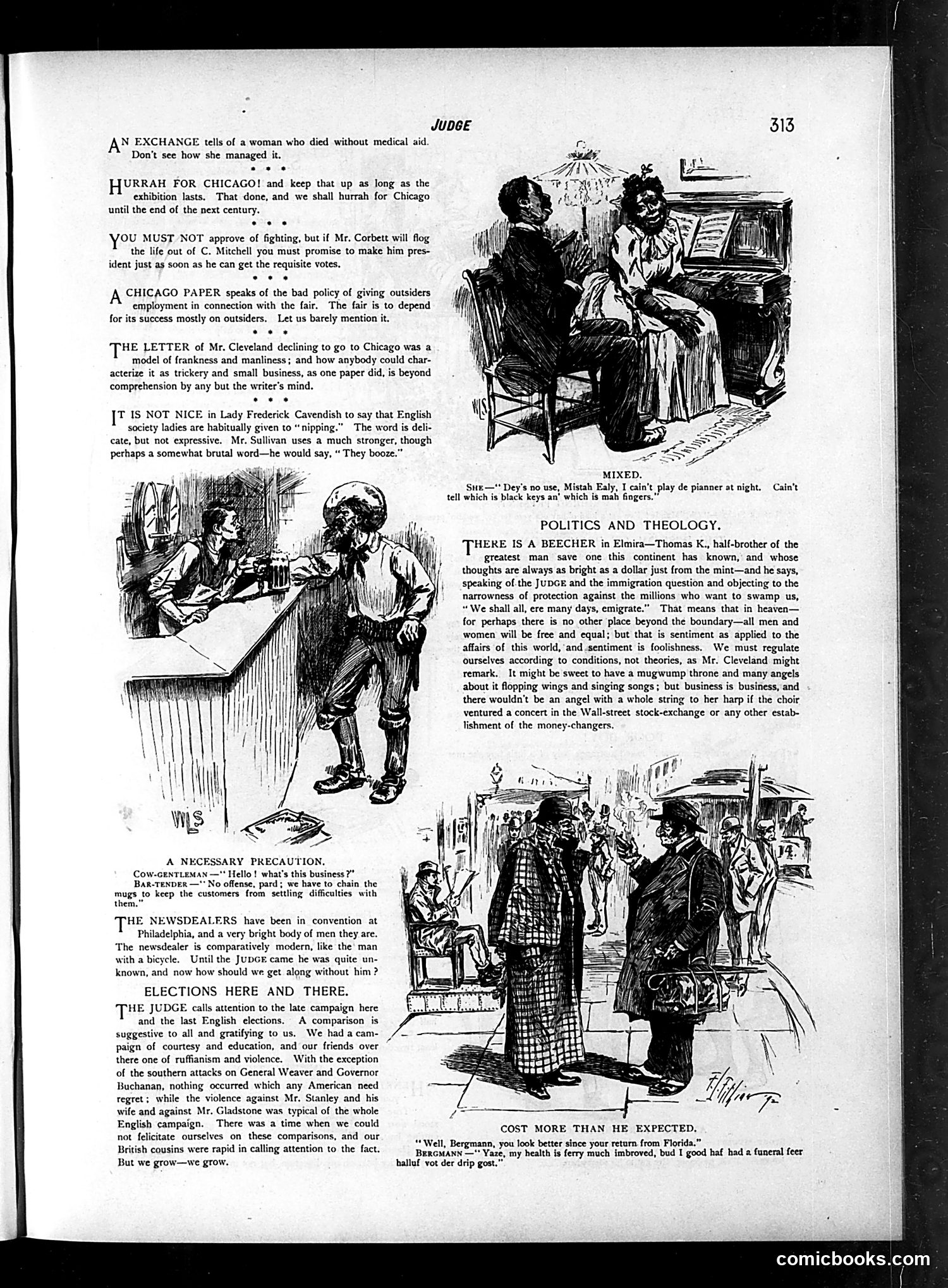
This page contains several satirical pieces typical of late-19th-century American political commentary: **Top cartoon**: Depicts two figures at a piano—likely commentary on social propriety or musical performance among the classes. **"Politics and Theology"**: Attacks a character named Thomas K., described as a "Beecher" (likely referencing the famous Beecher family), criticizing his views on immigration and protectionism as hypocritical. The piece contrasts his religious sentiment about equality with practical business concerns. **Lower cartoons**: "A Necessary Precaution" and "Cost More Than He Expected" appear to be humorous domestic or street scenes with working-class characters, using visual humor and dialect humor typical of Judge's satirical approach. The overall tone reflects the magazine's focus on political hypocrisy, class commentary, and contemporary social debates of the era.
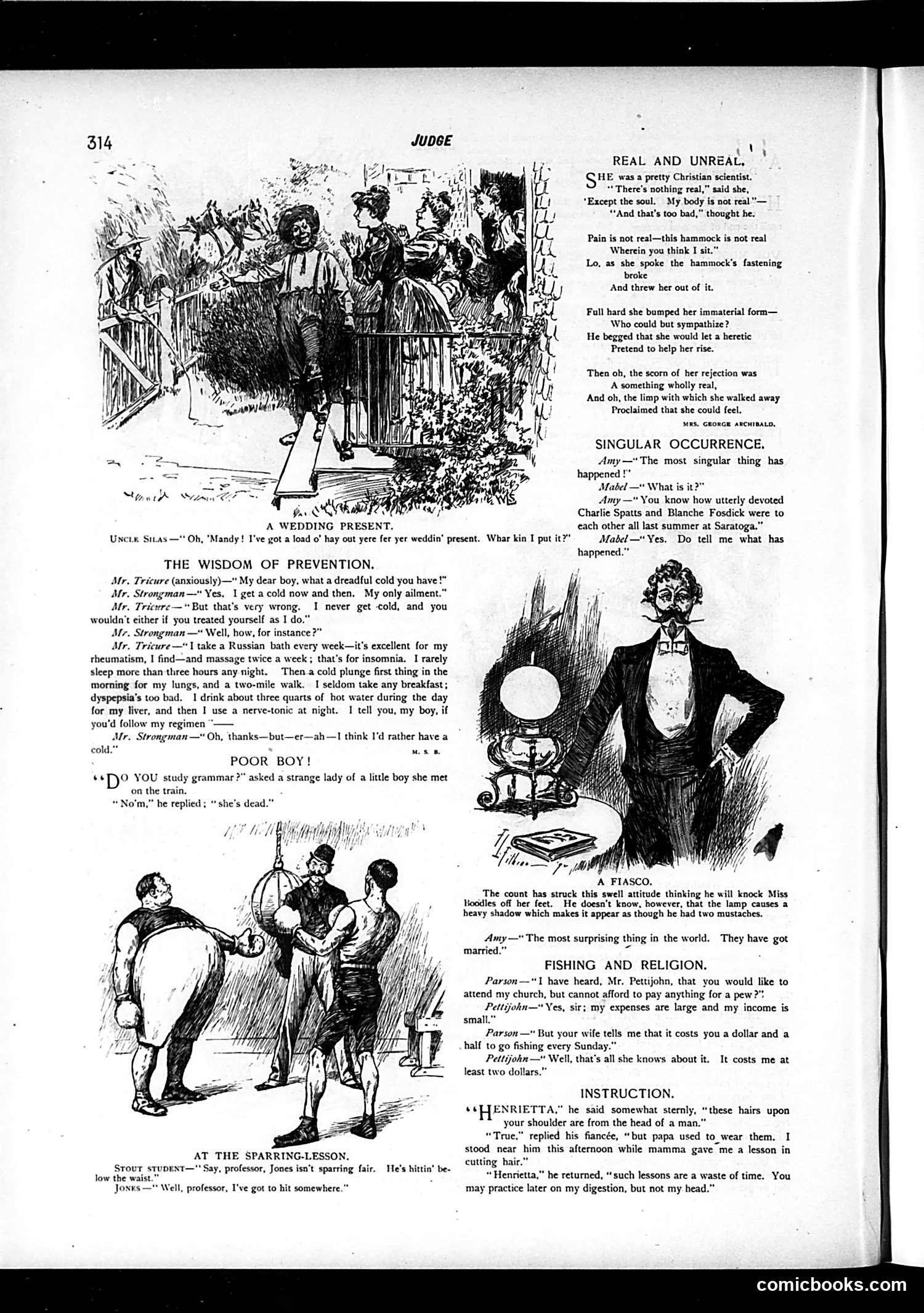
This page satirizes **Christian Science**, a religious movement popular in late 19th/early 20th century America that denied the reality of matter and pain, affirming only spiritual reality. The main cartoon mocks a Christian Scientist woman who insists her body isn't "real" and only the soul exists. When the hammock she's sitting in breaks, she falls hard—and suddenly discovers pain *is* quite real. Her angry limp as she walks away "proclaimed that she could feel," undercutting her philosophical claims through physical comedy. The satire's point: Christian Science's denial of material reality collapses when confronted with actual bodily harm. The joke works through ironic contradiction—the woman's rejection of the helpful "heretic" (the man offering aid) and her physical response betray that her doctrine doesn't match lived experience. The page includes other unrelated humorous anecdotes typical of *Judge* magazine's miscellaneous format.
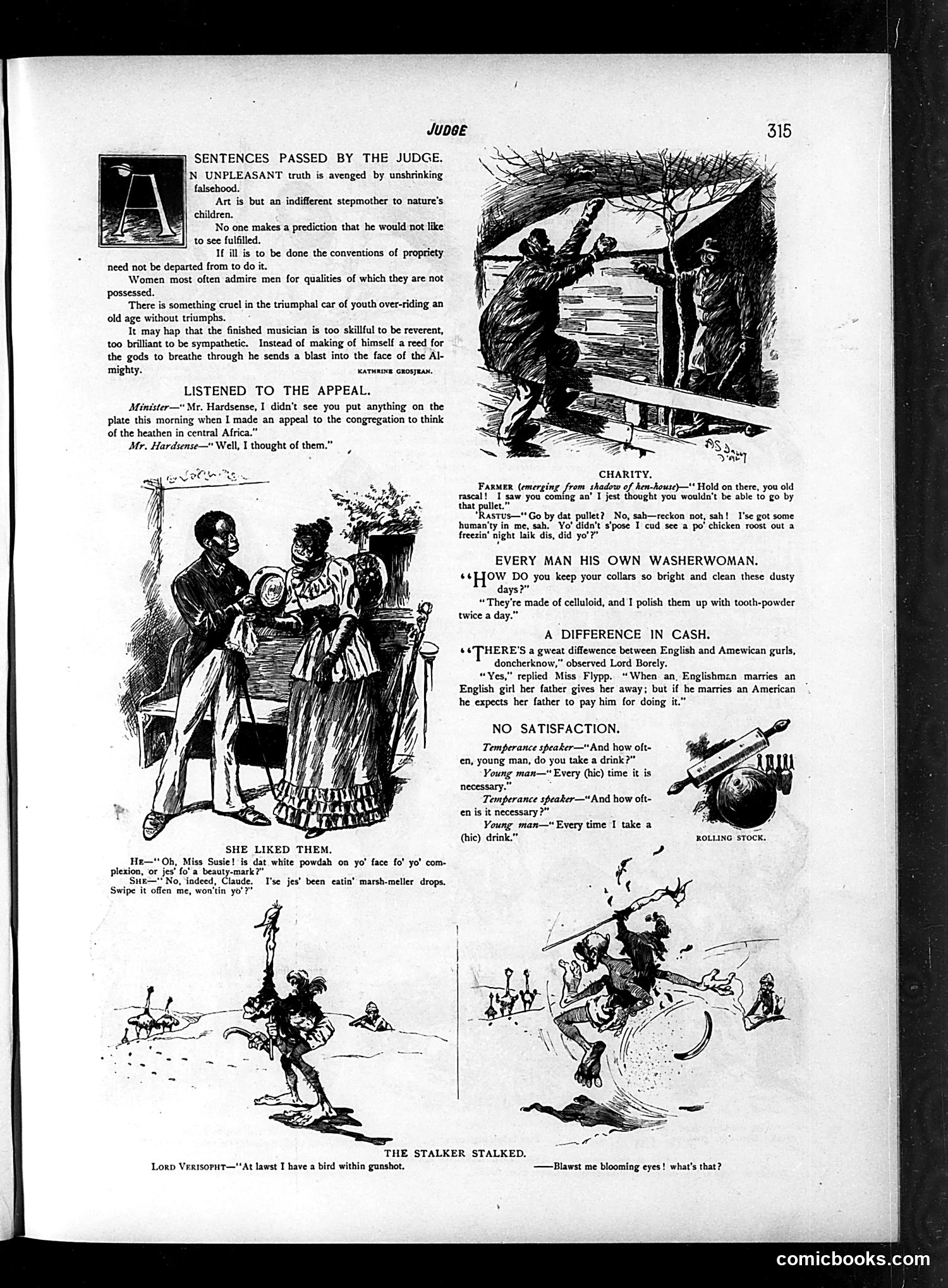
This page collects brief satirical jokes and observations typical of Judge's social humor. Key pieces include: **"Listened to the Appeal"**: A minister criticizes a parishioner (Mr. Hardsense) for not donating during a church collection for African missions. The joke's punchline—that merely thinking about the poor counts as charity—mocks both stingy congregants and hollow religious sentiment. **"Charity"**: A racist caricature of an enslaved or formerly enslaved Black man (Rastus) stealing a chicken, claiming "humanity" motivated him. The satire targets white rural proprietors and the supposed moral superiority of the poor. **"A Difference in Cash"**: A transatlantic joke suggesting American fathers demand payment when their daughters marry Englishmen, implying Americans are mercenary compared to proper English folk. **"No Satisfaction"**: A temperance speaker's circular logic with a drunk—each drink is "necessary," and necessity occurs whenever one drinks—mocks anti-alcohol activists and alcoholics' rationalizations. The illustrations throughout feature period-typical sketch work, reinforcing Judge's satirical tone targeting Victorian social pretensions and hypocrisy.
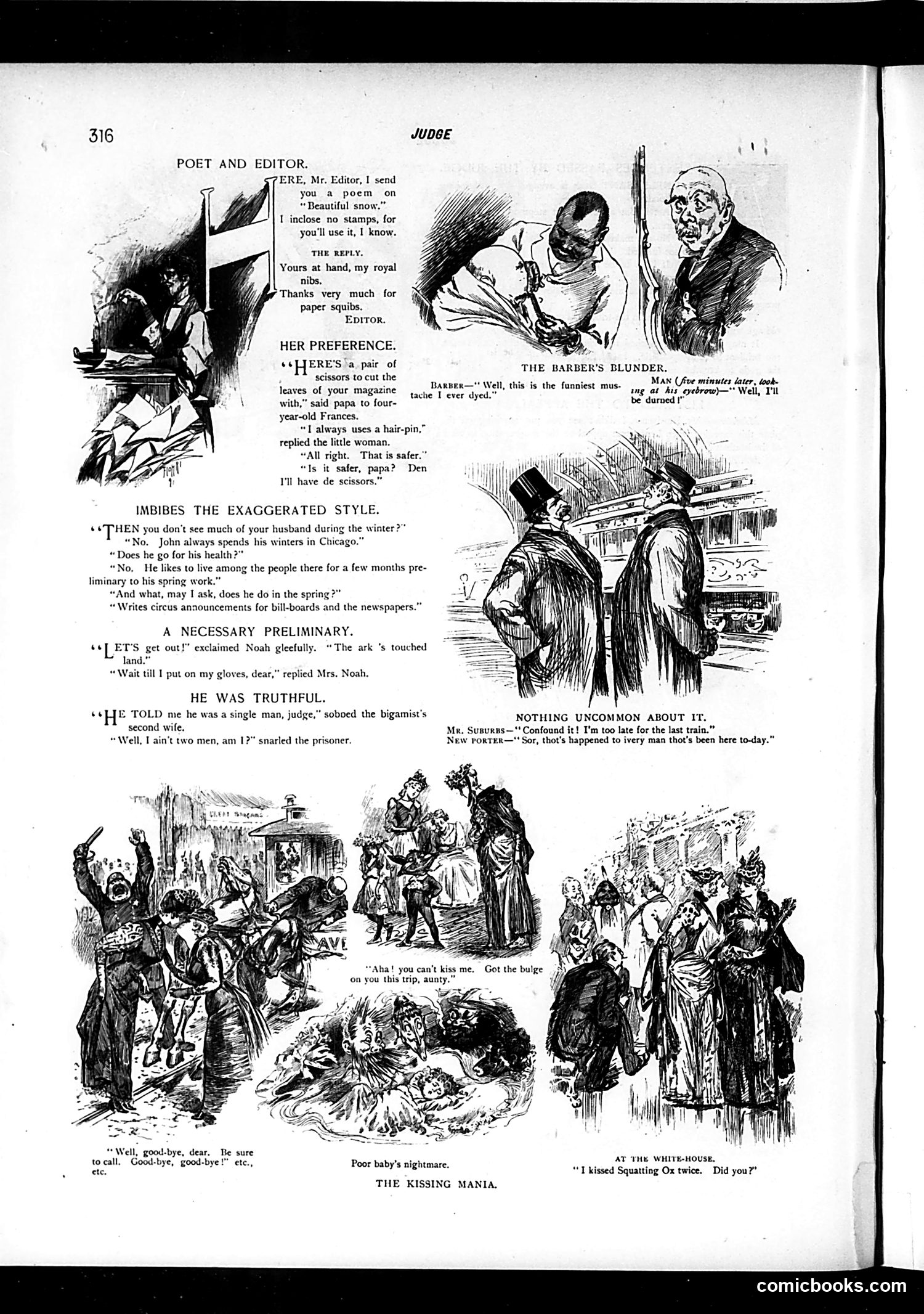
This page collects brief humorous sketches typical of Judge's satirical style. The content mocks everyday absurdities and social conventions rather than addressing specific political figures: **"Poet and Editor"** ridicules amateur poets who submit unsolicited work expecting editors to use stamps (pay postage). **"Her Preference"** plays on childhood logic—a girl prefers scissors over a hairpin despite being told scissors are less safe, inverting the parent's reasoning. **"The Kissing Mania"** appears to reference a contemporary fad of excessive kissing, shown through scenes including one at the White House, suggesting public figures participated in this trend. **"The Barber's Blunder"** depicts a practical mishap where dye intended for a mustache damages the customer's eyebrow. Other sketches mock marital arrangements, exaggeration in conversation, and Noah's ark domestic comedy. The page exemplifies Judge's light satirical humor targeting ordinary human foibles and social fashions rather than partisan politics.
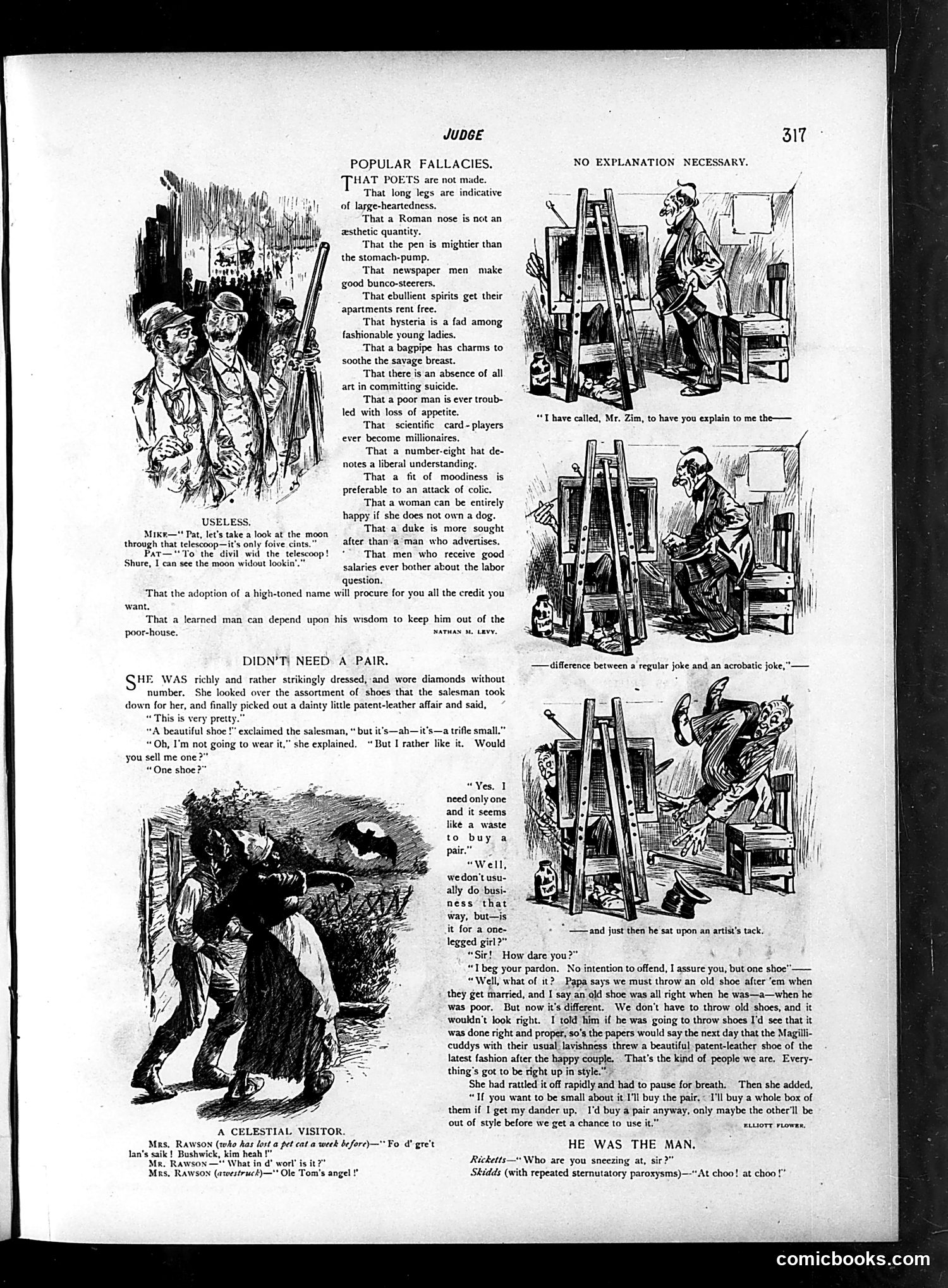
This page contains several satirical pieces typical of Judge magazine's humor: **"Popular Fallacies"** is a list of common misconceptions presented as social commentary. Items mock pretension ("a high-toned name will procure credit"), pseudoscience ("scientific card-players become millionaires"), and class anxiety (poor men losing appetite, learned men avoiding poorhouses). The accompanying sketch shows working-class characters (Mike and Pat, identified by Irish dialect) discussing the moon—mocking their lack of sophistication. **"Didn't Need a Pair"** satirizes nouveau riche pretension. A wealthy woman wants to buy a single shoe to throw at a newlywed couple, but only a fashionable new shoe will do—the old tradition is beneath her now. The joke mocks status-obsessed wealthy people concerned with appearing proper to newspapers. **"A Celestial Visitor"** and **"He Was the Man"** are brief joke captions about sneezing and a lost cat, relying on wordplay and situational humor rather than social commentary. The page primarily targets class pretension and ostentatious wealth—recurring Judge themes from the Gilded Age.
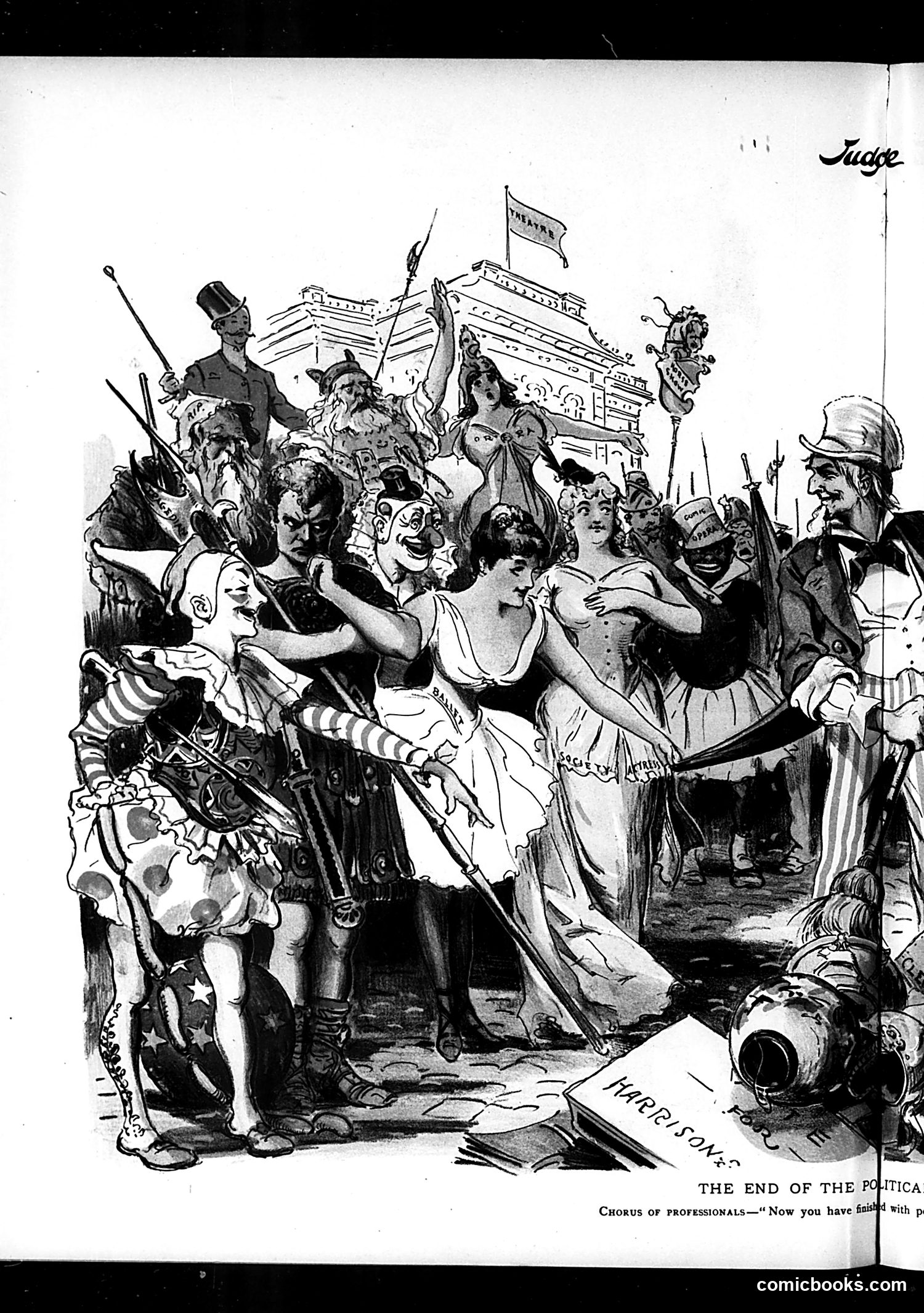
This Judge magazine cartoon depicts "The End of the Politica" (likely "Politica" or political season). The central figure is a woman in classical dress, surrounded by costumed performers including soldiers, jesters, and masked characters representing various political "professionals." The satire suggests that politics operates like theatrical entertainment or carnival performance—the assembled "chorus of professionals" are portrayed as actors in costume rather than serious statesmen. The woman appears to be concluding or dismissing this theatrical political spectacle. The cartoonist critiques how political actors perform for public consumption, treating governance as entertainment rather than substantive work. The classical female figure likely represents either Liberty, Democracy, or the American Republic witnessing this circus of professional politicians.
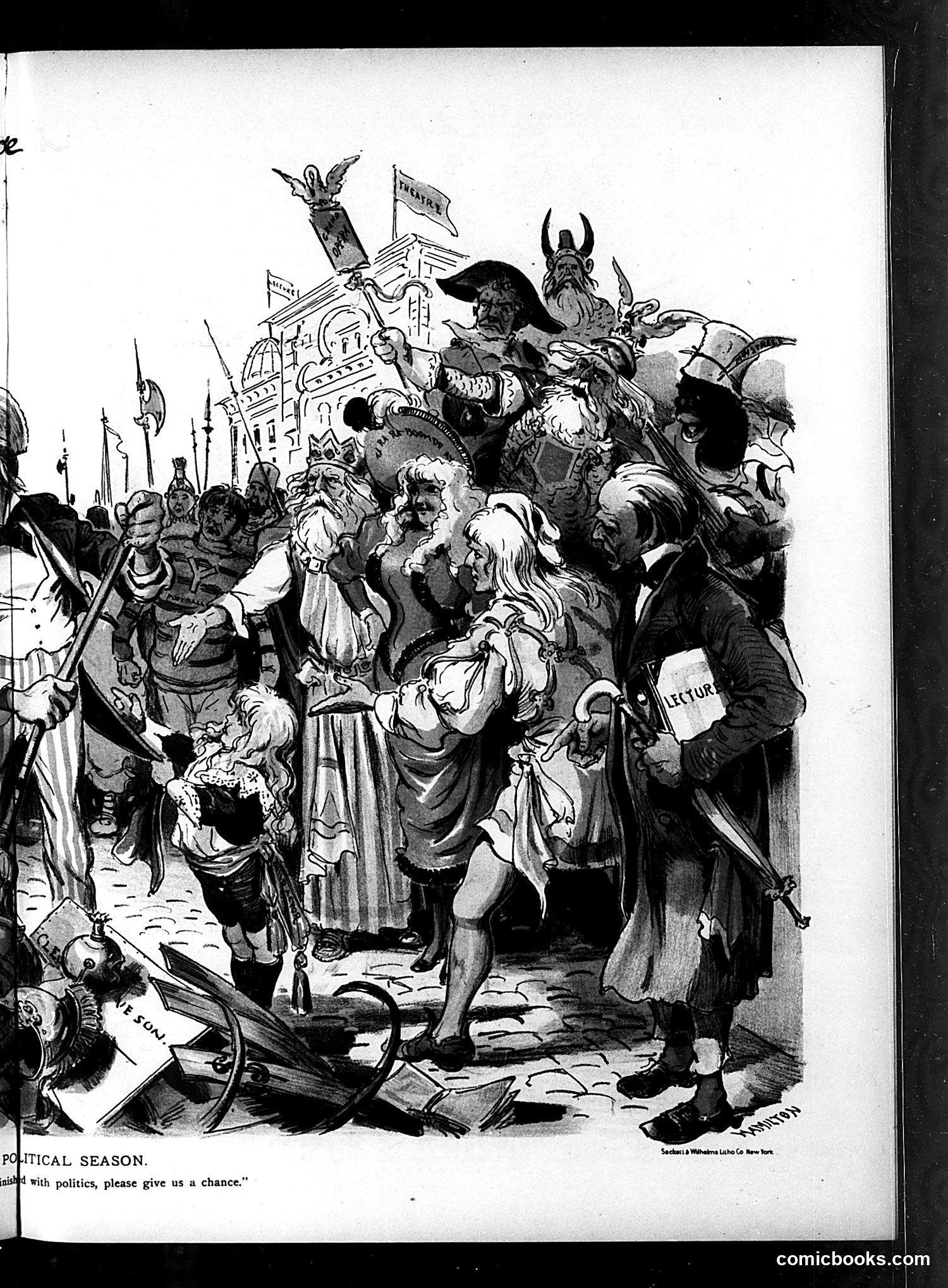
This satirical cartoon depicts the chaos of American electoral politics. A well-dressed modern man (likely representing the average citizen or voter) stands amid a chaotic mob of mythological and demonic figures—devils, demons, and fantastical creatures wearing political regalia and bearing weapons and flags. The title "Political Season" and the caption "Disgusted with politics, please give us a chance" suggest the cartoon mocks the pandemonium of political campaigns. The mix of classical/infernal imagery with contemporary dress implies politicians and partisan fervor are depicted as corrupt, destructive forces beyond rational control. The overall message critiques how politics devolves into bedlam during election cycles, with competing factions behaving like uncontrolled demons rather than reasonable actors. The plea "give us a chance" is likely ironic—suggesting the public wants relief from this political circus.
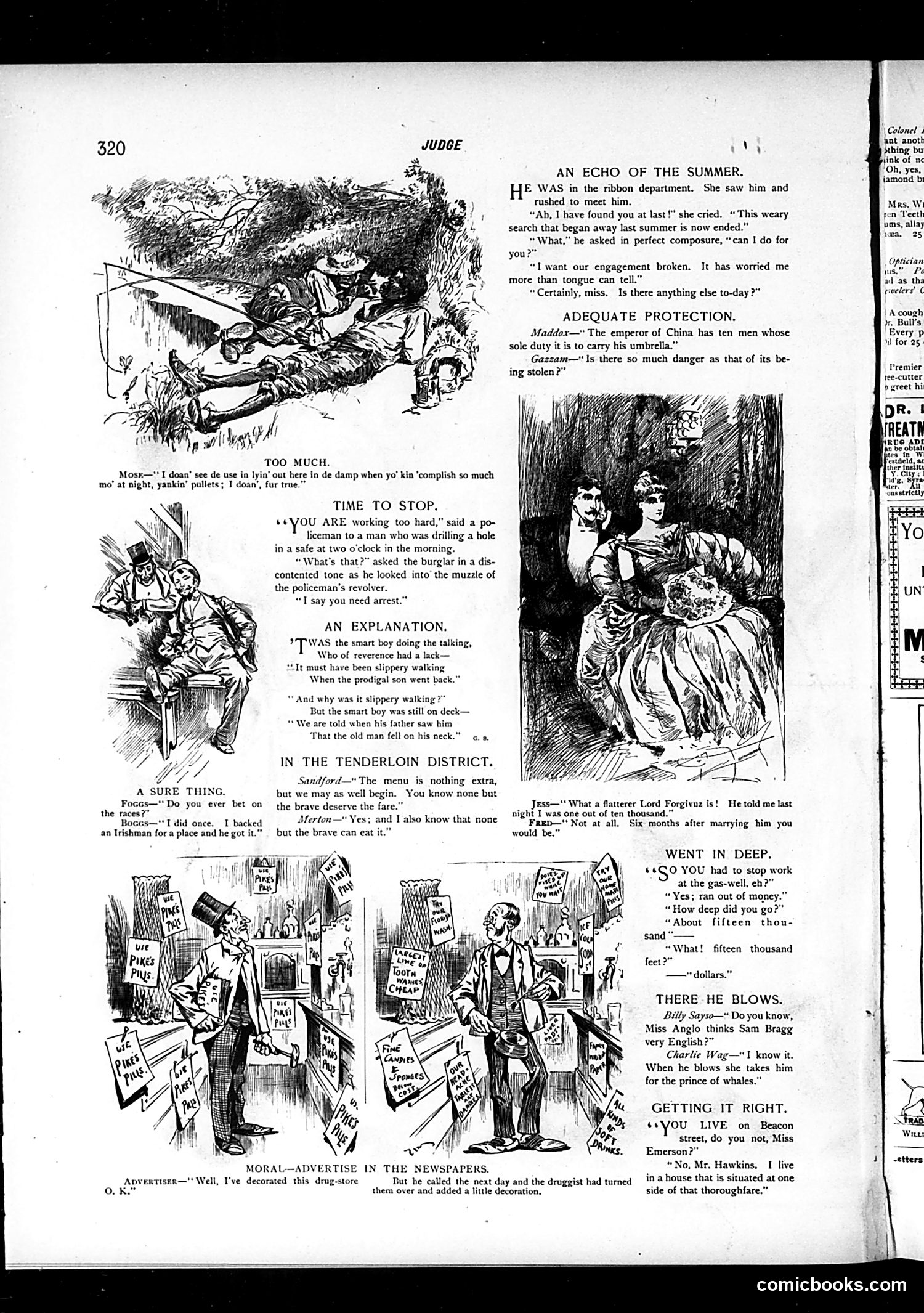
This page contains multiple short humorous sketches typical of *Judge* magazine's satirical format. Key content includes: **"An Echo of the Summer"**: A woman urgently seeks out a man to break their engagement, only to find him professionally indifferent—satirizing the melodrama of romantic entanglements and modern emotional detachment. **"Adequate Protection"**: A joke about Chinese imperial umbrellas and theft risk—poking fun at exotic foreign customs through absurdist logic. **"Time to Stop"**: A burglar caught mid-safe-cracking by a policeman—straightforward crime humor. **"Getting It Right"**: A woman pedantically corrects someone's reference to her address, refusing to acknowledge living "on" Beacon Street—satirizing upper-class social pretension and affected speech. **"Moral—Advertise in the Newspapers"**: A druggist decorates his storefront, but the advertiser flips the signs upside-down—commentary on advertising effectiveness and merchant incompetence. The sketches target pretension, romantic foolishness, and social affectation through quick, punchy dialogue rather than political content.
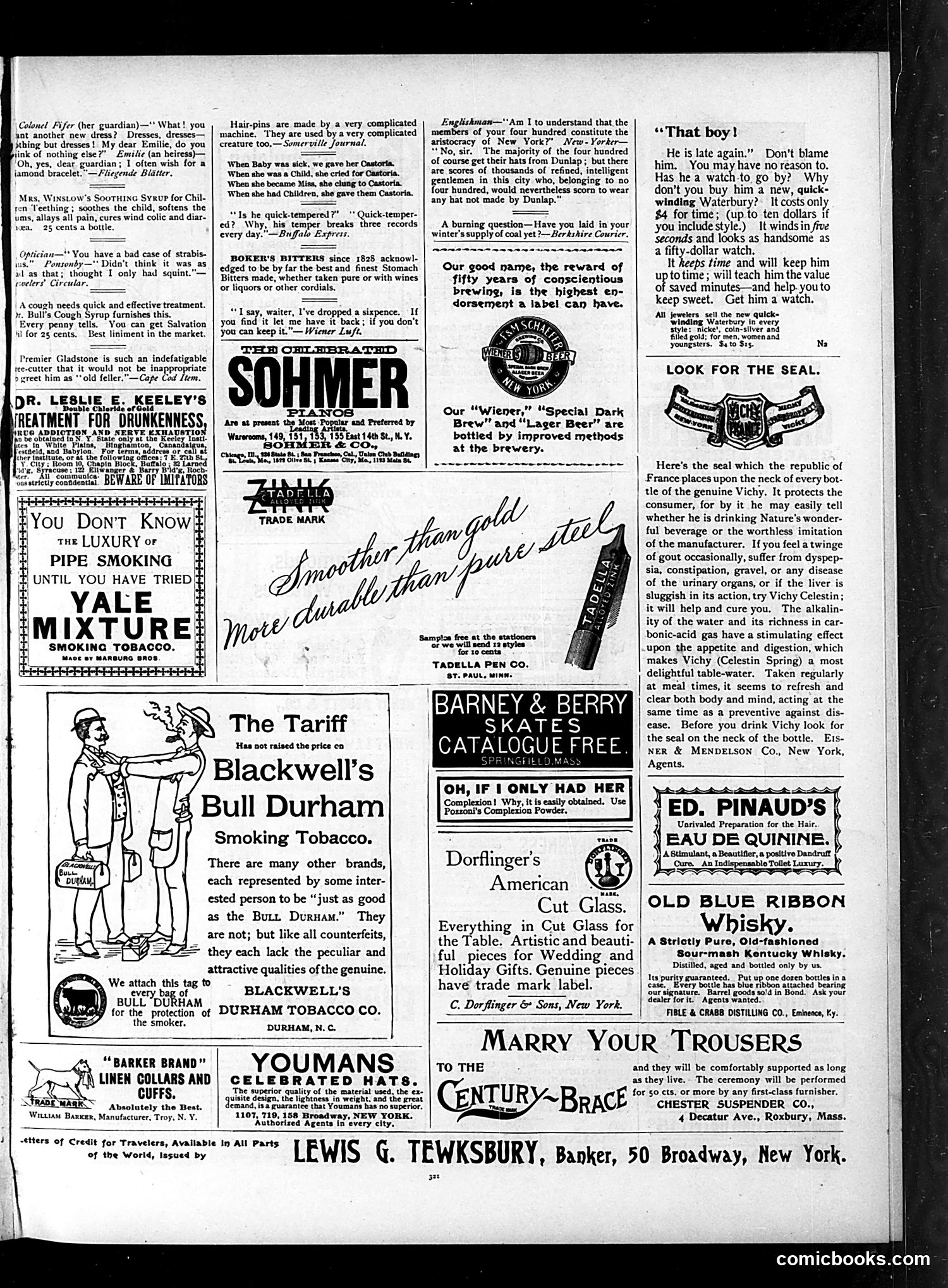
This page is primarily **advertisements** from the late 19th/early 20th century, with only a few small satirical jokes embedded among them. The notable satirical content includes: 1. **"Colonel Fifer" cartoon**: A guardian scolds his wealthy ward Emilie for constantly demanding new dresses, complaining she thinks of nothing else. She responds she also wants diamond bracelets—satirizing the materialism and frivolous consumption of wealthy heiresses. 2. **Quick-tempered man joke**: A brief gag about someone whose temper "breaks three records every day"—mocking volatile personalities. 3. **Four Hundred aristocracy joke**: An Englishman asks if New York's "four hundred" (wealthy elite) constitute the city's aristocracy. A New Yorker clarifies that true gentlemen are defined not by social status but by wearing Dunlap hats—satirizing how wealth and fashion define American "aristocracy" rather than breeding or refinement. The page is dominated by patent medicines, tobacco products, whiskey, cut glass, and other consumer goods—typical Judge advertising revenue.
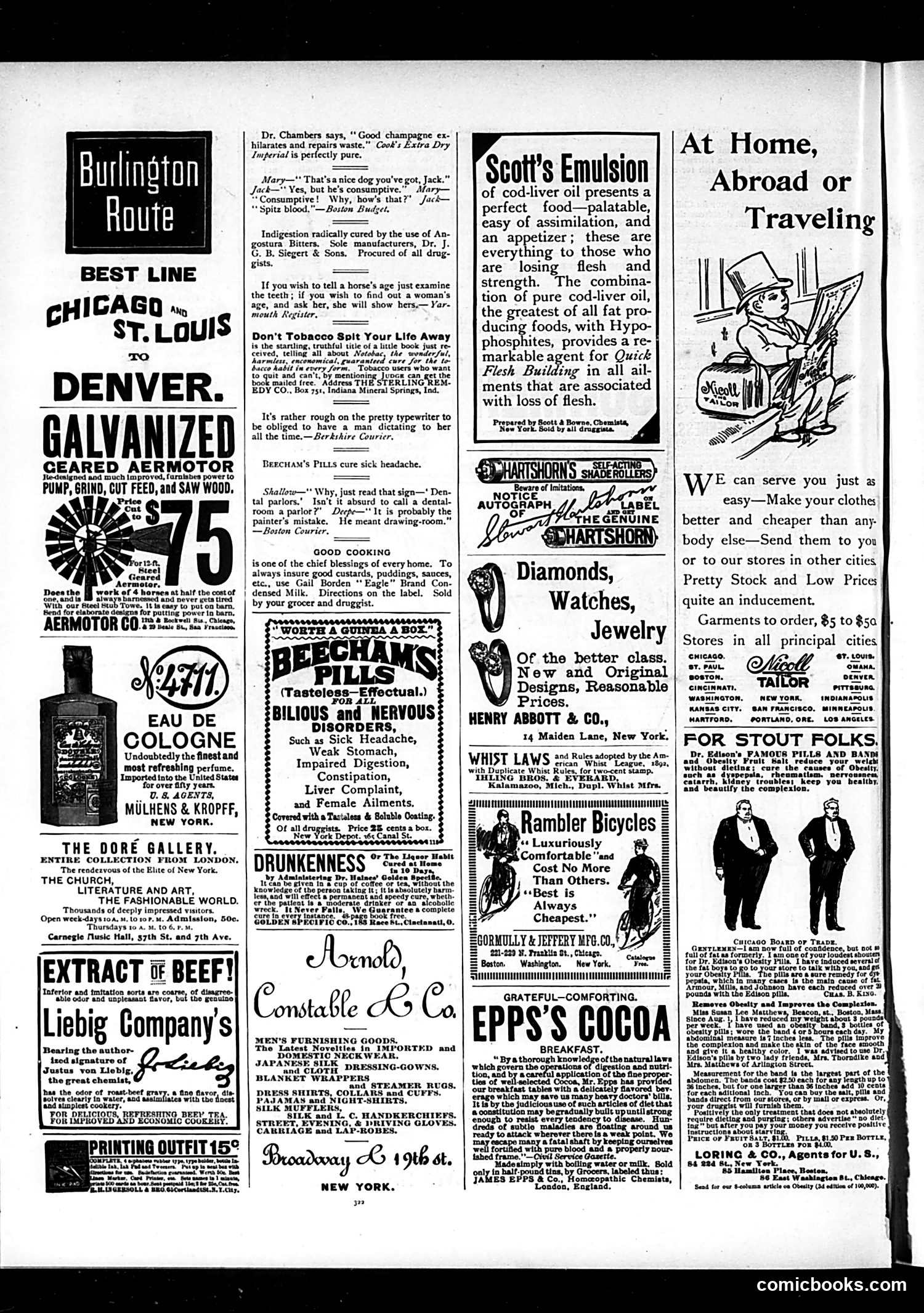
This page is primarily **advertising**, typical of Judge magazine's revenue model. There are no significant political cartoons or satirical illustrations requiring historical context. The small humorous snippets scattered among ads are brief, innocuous jokes: - A pun about a dog being "consumptive" (sick) because it's part Spitz breed - A quip about determining a woman's age by asking her (implying women lie about age) - A joke about a dental office being called a "parlor" instead of a "drawing room" - A comment about male dictation annoying female typewriter operators These reflect period gender stereotypes and wordplay typical of early 1900s humor magazines, but contain no identifiable caricatures or political references. The advertisements promote contemporary products: Aermotor pumps, Beecham's Pills, Scott's Emulsion (cod liver oil), Liebig's beef extract, and various jewelry and clothing items. The page serves primarily as a vehicle for paid advertisements rather than satirical content.
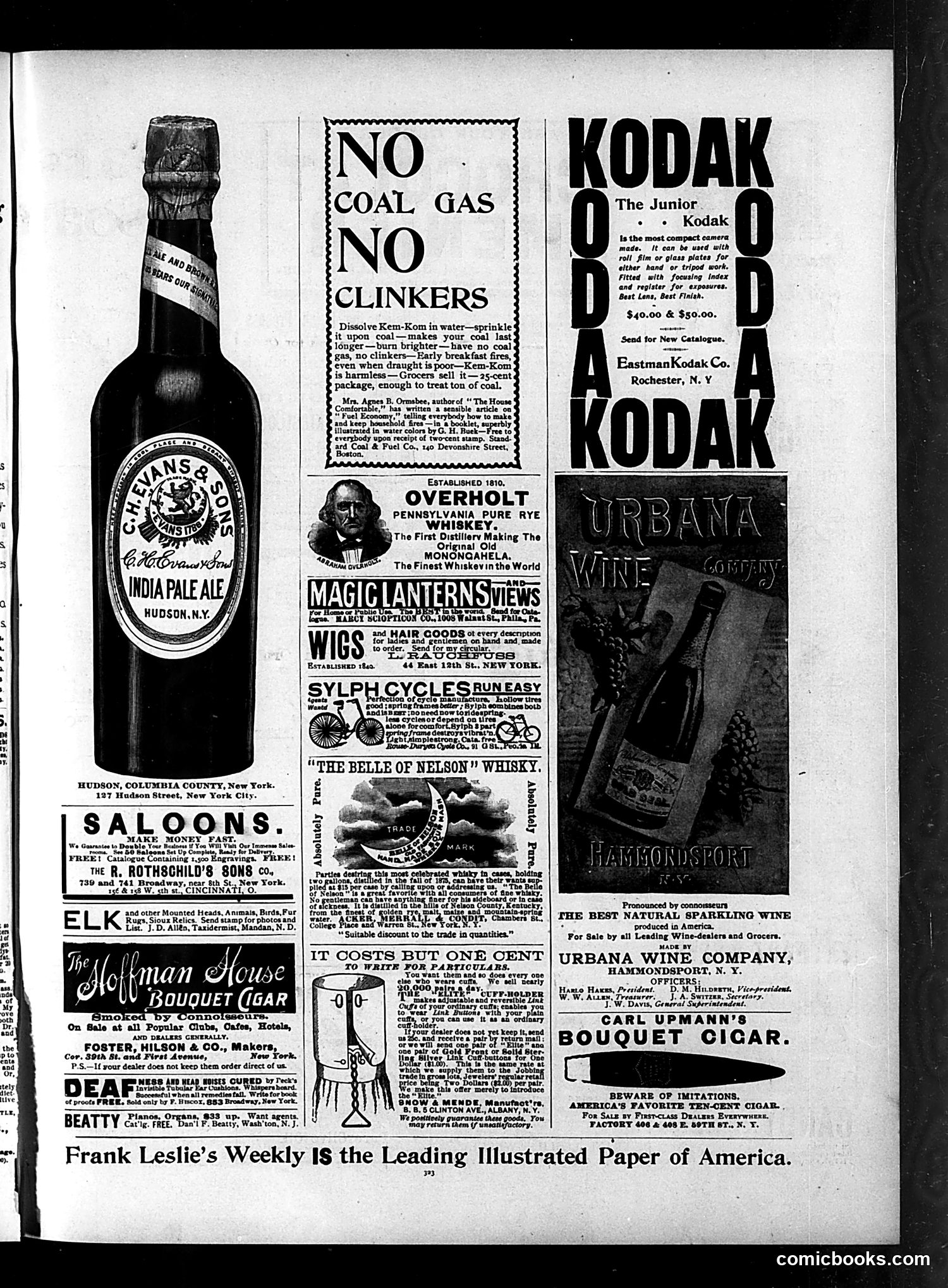
This is primarily an **advertising page** from Frank Leslie's Weekly, not a satirical cartoon page. It contains various product advertisements typical of the era, including: - **Alcoholic beverages**: Overholt Pennsylvania rye whiskey, "The Belle of Nelson" whisky, and Urbana wine - **Tobacco products**: Stollman House cigars, Carl Upmann's Bouquet cigars - **Consumer goods**: Kodak cameras, Sylph bicycles, wigs, and taxidermy services - **Patent remedies**: Kem-Kom coal additive and Beatty's medicinal product The only content with potential satirical intent is the **Kem-Kom advertisement**, which humorously addresses the mundane problem of coal smoke and clinkers in home heating—a genuine household complaint of the era. However, this appears to be straightforward advertising rather than editorial satire. The page reflects late 19th-century consumer culture and advertisements for now-obsolete products and services.
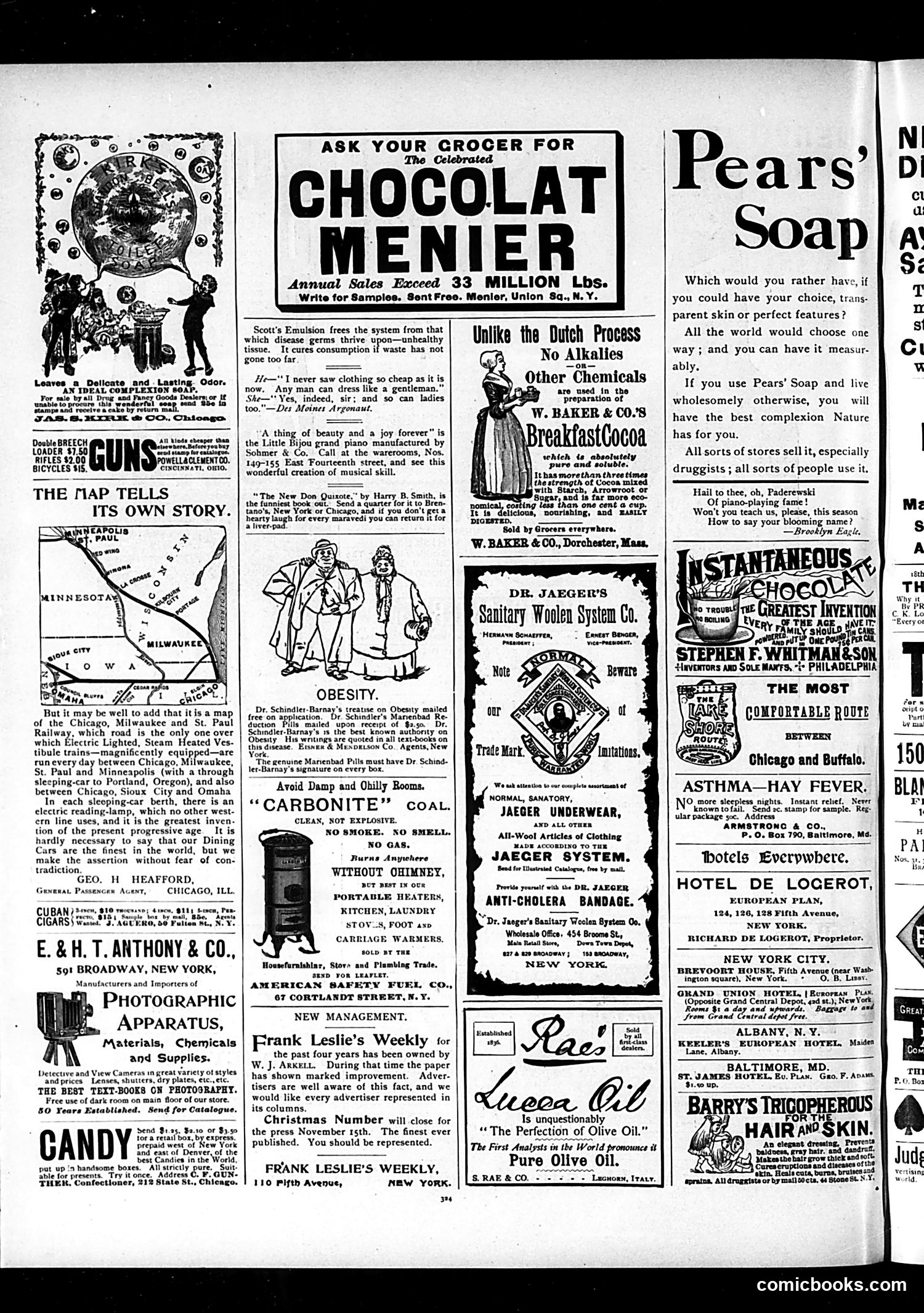
This is primarily an **advertising page** from Judge magazine, not a political cartoon. The main content consists of period product advertisements (cocoa, soap, trains, pianos, obesity treatments, heating stoves). The only actual cartoon appears to be **"The Map Tells Its Own Story"** — a railroad advertisement featuring a map of the Chicago, Milwaukee and St. Paul Railway. The "story" is promotional: this railway uniquely offers electric-lit, steam-heated Pullman cars between major Midwestern cities. The page also includes a brief **gender-stereotype joke**: a man remarks that clothing is now so cheap anyone can dress like a gentleman; a woman replies that men aren't the only ones who can do this now — a mild jab at women's ability to present themselves respectably regardless of class. The advertisements reflect **late 19th/early 20th-century concerns**: obesity treatment, complexion products, tuberculosis remedies, and portable heating. These ads reveal contemporary attitudes about health, beauty, and consumer culture of the era.
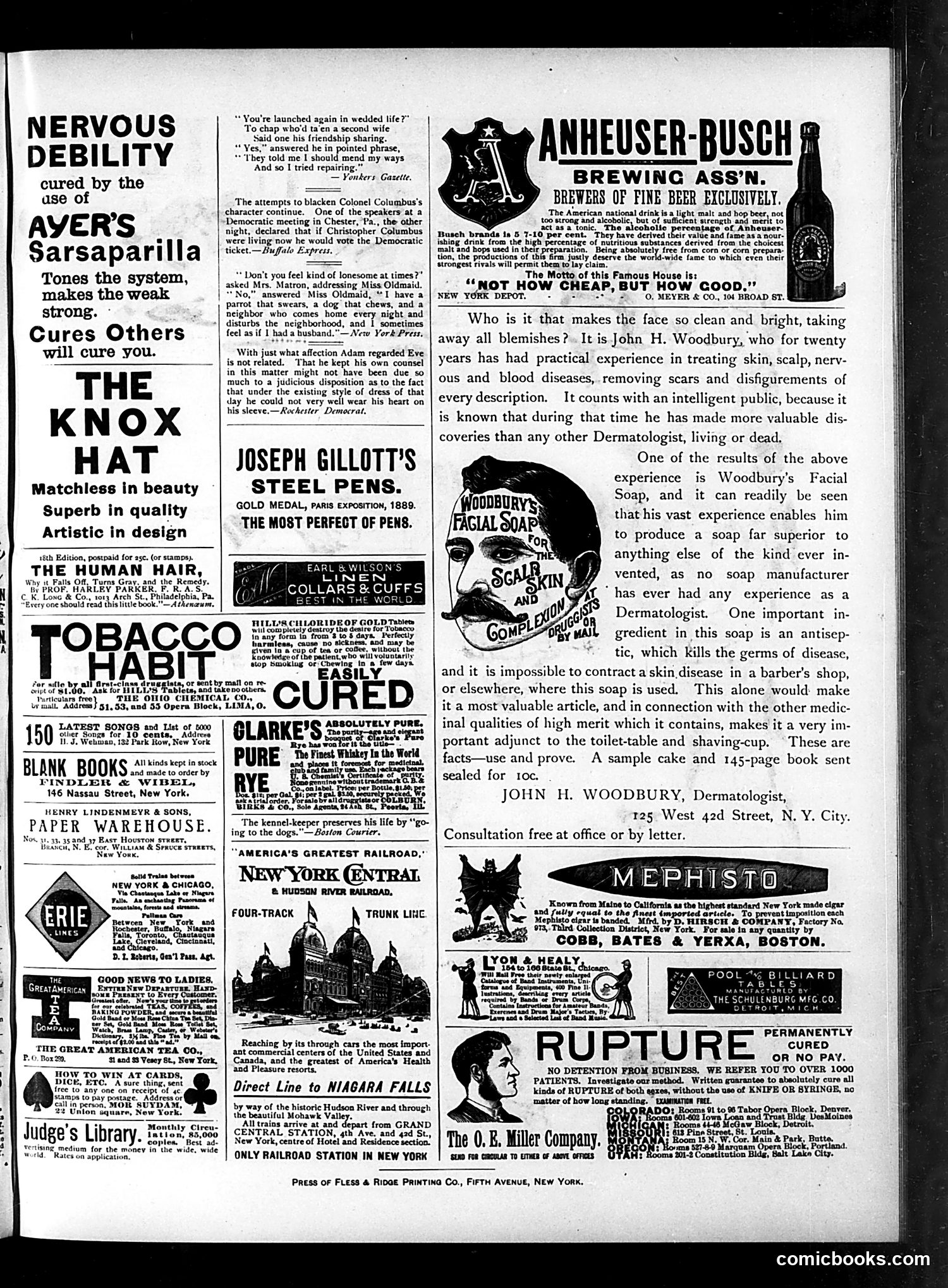
This page is primarily **advertisements** with a few brief satirical jokes, typical of Judge magazine's format. The main visual content includes ads for patent medicines (Ayer's Sarsaparilla for "nervous debility"), the Knox Hat, and Anheuser-Busch beer. There are also small text jokes scattered throughout. **The satirical content** is minimal and consists of short quips: - A joke about remarriage and infidelity (a man marries again and claims he's "repairing" the damage) - A jab at Democrats for claiming Christopher Columbus would vote Democratic - A woman claiming she doesn't feel lonely because her parrot, dog, and noisy neighbor provide sufficient domestic chaos - A commentary on Adam and Eve's marriage, joking that Adam couldn't "wear his heart on his sleeve" given period clothing These jokes reflect late 19th-century concerns: remarriage, political partisanship, spinsterhood, and Biblical domesticity. The satire is gentle rather than pointed—typical of Judge's lighter fare mixed among advertisements.
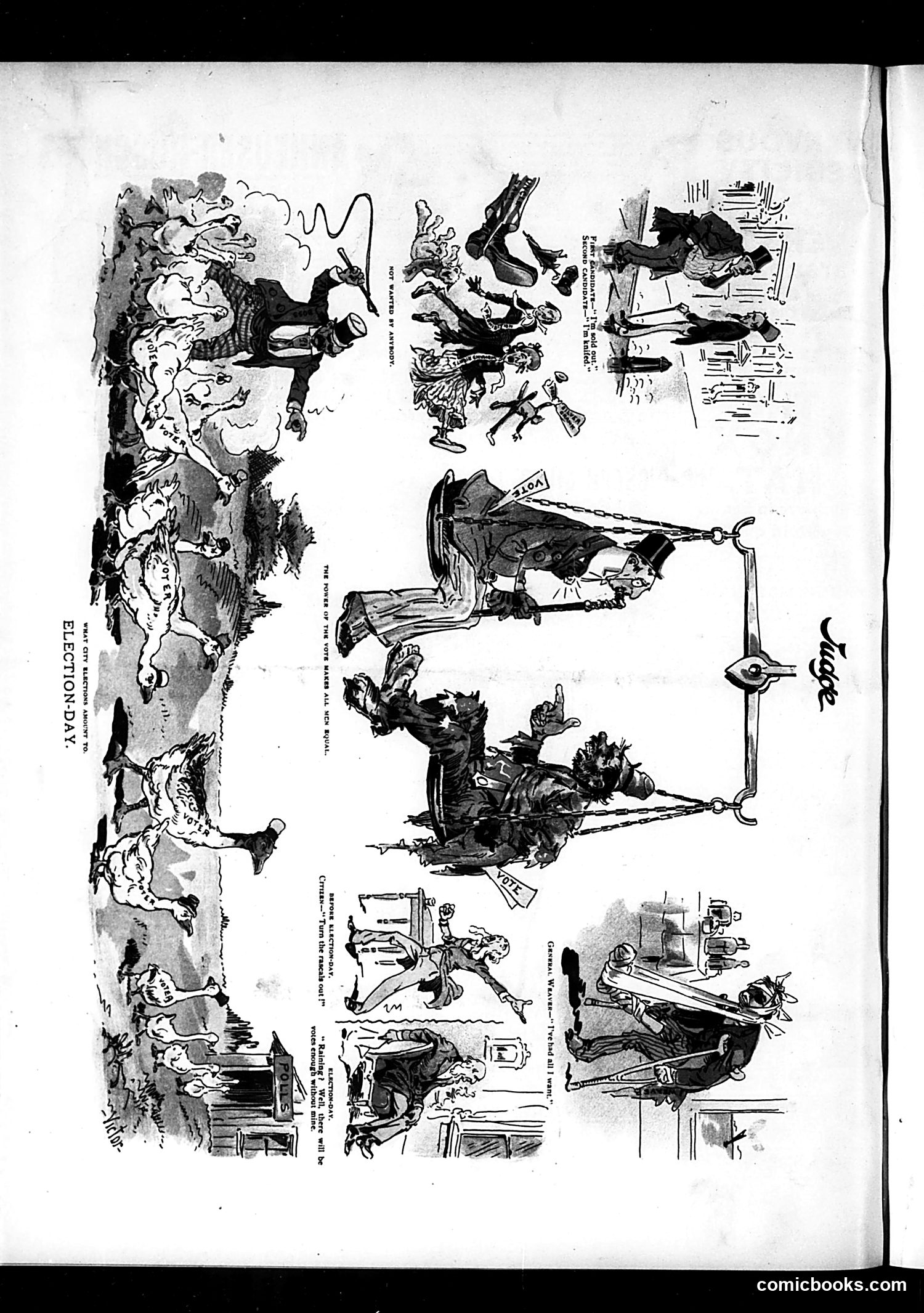
This Judge magazine cartoon satirizes the futility of municipal elections. The title "Election-Day" is ironic—the imagery shows chaos rather than civic virtue. The main scene depicts a crowded, disorderly mob of voters with exaggerated facial features (typical of 19th-century caricature style). The caption "'Turn the rascals out!'" represents the public's rallying cry for reform, while "'I've had all I want'" suggests voter exhaustion or cynicism. The surrounding vignettes appear to show various election-related scenarios—possibly depicting corruption, vote-buying, or the revolving-door nature of political corruption, where removing one set of corrupt officials simply meant another group took their place. The overall message: city elections were theatrical exercises in futility, offering no real change to the underlying political corruption.