
Judge, 1892-11-12 · page 2 of 16
Judge — November 12, 1892 — page 2: what you’re looking at
What you’re looking at
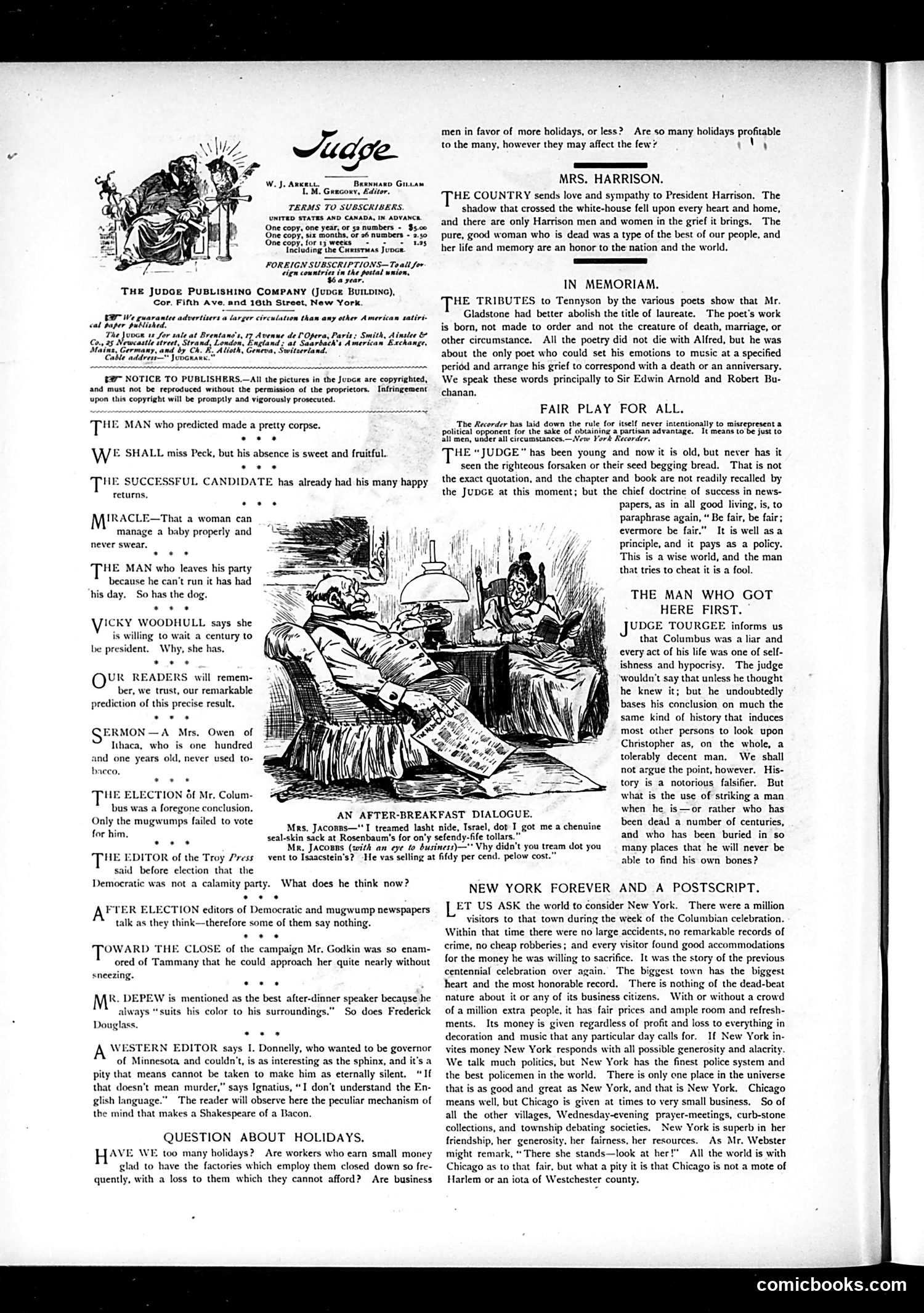
The central cartoon titled "AN AFTER-BREAKFAST DIALOGUE" depicts two figures in what appears to be a domestic scene. Based on the dialogue, it's a satirical commentary on consumer prices and household finances. One figure (Ms. Jacobs) complains about the cost of living—specifically that items like linen thread cost "fifty per cent. below cost," sarcastically questioning where profits go. The satire targets post-WWI inflation and the contradiction between manufacturers' claims of selling at minimal profit while consumers faced escalating prices. The cartoon mocks both commercial dishonesty and the housewife's frustration with unexplained price increases on everyday goods. The surrounding text pieces are editorial commentary on elections, journalism, and social issues of the era, but lack sufficient context for certain identification.
📄 Transcribed text from this page (OCR, searchable)
Machine-transcribed from the original scan — historical spelling and the odd misread are preserved.
W. J. Ameatt. 1. M. Grecoxy, £di TERMS TO SUBSCKIBERS. UNITED STATES AND CANADA, IN ADVANCE, ‘One copy, one year, or sa numbers - $5.00 ‘One copy, six months, or 26 numbers - 2.50 One copy, fort; weeks = = + as Including the Cwrerstas Junce. POREIGN SUBSCRIPTIONS—Te all for ‘tign countries in the postal union, year. THE JUDGE PUBLISHING COMPANY (JupGe Burpinc), Cor. Fifth Ave. and 16th Street, New York EB We guarantee advertisers a larger circulation than any other American satiri- cal paper published. The Jovan 1s for sale at Brentano's, rt nd, Lo ris: Smith, Ainslee & ch's American’ Exchange, © §27- NOTICE TO PUBLISHERS.—All the pictures in the Juoce are copyrighted, and must not be reproduced without the permission of the proprietors, Infringement upon this copyright will be promptly and vigorously prosecuted. THE MAN who predicted made a pretty corpse. eee W E SHALL miss Peck, but his absence is sweet and fruitful. HE SUCCE returns. SFUL CANDIDATE has already had his many happy TRACLE—That a woman can manage a baby properly and never swear, THE MAN who leaves his party because he can’t run it has had his day. So has the dog. VICKY WOODHULL says she is willing to wait a century to be president. Why, she has, QUE READERS will remem- ber, we trust, our remarkable prediction of this precise result. GERMON—A Mrs, Owen of Ithaca, who is one hundred and one years old, never used to- bacco, HE ELECTION éf Mr. Colum- bus was a foregone conclusion. Only the mugwumps failed to vote for him, THE EDITOR of the Troy Press J before election that the Democratic was not a calamity party. What does he think now? R ELECTION editors of Democratic and mugwump newspapers talk as they think—therefore some of them say nothing. eee OWARD THE CLOSE of the campaign Mr. Godkin was so enam- ored of Tammany that he could approach her quite nearly without sneezing. R. DEPEW is mentioned as the best after-dinner speaker because he always “suits his color to his surroundings.” So does Frederick Douglass. A WESTERN EDITOR says I. Donnelly, who wanted to be governor of Minnesota and couldn't, is as interesting as the sphinx, and it’s a pity that means cannot be taken to make him as eternally silent. “If that doesn't mean murder,” says Ignatius, “I don’t understand the En- glish language.” The reader will observe here the peculiar mechanism of the mind that makes a Shakespeare of a Bacon. QUESTION ABOUT HOLIDAYS. HAVE WE to0 many holidays? Are workers who earn small money ad to have the factories which employ them closed down so fre- quently, with a loss to them which they cannot afford? Are business AN AFTER-BREAKFAST DIALOGUE. Mrs. Jaconns—"'I treamed lasht nide, Israel, dot I got me a chenuine seal-skin sack at Rosenbaum’s for on'y sefendy-fife tollars.”” Mr, Jacopps (with an eye to business)—" Vhy didn't you tream dot you vent to Isaacstein's? He vas selling at fifdy per cend. pelow cost.” men in favor of more holidays, or less? Are so many holidays profitable to the many, however they may affect the few? FO MRS. HARRISON. THE COUNTRY sends love and sympathy to President Harrison, The shadow that crossed the white-house fell upon every heart and home, and there are only Harrison men and women in the grief it brings. The pure, good woman who is dead was a type of the best of our people, and her life and memory are an honor to the nation and the world. = IN MEMORIAM. THE TRIBUTES to Tennyson by the various poets show that Mr. Gladstone had better abolish the title of laureate. The poet's work is born, not made to order and not the creature of death, marriage, or other circumstance. All the poetry did not die with Alfred, but he was about the only poet who could set his emotions to music at a specified period and arrange his grief to correspond with a death or an anniversary. We speak these words principally to Sir Edwin Arnold and Robert Bu- chanan. FAIR PLAY FOR ALL. The Recorder has laid down the rule for itself never intentionally to misrepresent a political opponent for the sake of obtaining a partisan advantage. It means to be just to all men, we all circumstances.—New York Kecorder, HE “JUDGE” has been young and now it is old, but never has it seen the righteous forsaken or their seed begging bread. That is not the exact quotation, and the chapter and book are not readily recalled by the JUDGE at this moment; but the chief doctrine of success in news- papers, as in all good living, is, to paraphrase again, “ Be fair, be fair; evermore be fair.” It is well as a principle, and it pays as a policy. This is a wise world, and the man that tries to cheat it is a fool. THE MAN WHO GOT HERE FIRST. JUDGE TOURGEE informs us that Columbus was a liar and every act of his life was one of self- ishness and hypocrisy. The judge ‘wouldn't say that unless he thought he knew it; but he undoubtedly bases his conclusion on much the same kind of history that induces most other persons to look upon Christopher as, on the whole, a tolerably decent man, We shall not argue the point, however, His- tory is a notorious falsifier. But — what is the use of striking a man when he is—or rather who has been dead a number of centuries, and who has been buried in so many places that he will never be able to find his own bones? NEW YORK FOREVER AND A POSTSCRIPT. ET US ASK the world to consider New York. There were a million visitors to that town during the week of the Columbian celebration. Within that time there were no large accidents, no remarkable records of crime, no cheap robberies; and every visitor found good accommodations for the money he was willing to sacrifice. It was the story of the previous centennial celebration over again. The biggest town has the biggest heart and the most honorable record. There is nothing of the dead-beat nature about it or any of its business citizens. With or without a crowd of a million extra people, it has fair prices and ample room and refresh- ments. Its money is given regardless of profit and loss to everything in decoration and music that any particular day calls for. If New York in- vites money New York responds with all possible generosity and alacrit We talk much politics, but New York has the finest police system and the best policemen in the world. There is only one place in the universe that is as good and great as New York, and that is New York. Chicago means well, but Chicago is given at times to very small business. So of all the other villages, Wednesday-evening prayer-mectings, curb-stone collections, and township debating socie! New York is superb in her friendship, her generosity, her fairness, her resources. As Mr. Webster might remark, “There she stands—look at her!" All the world is with Chicago as to that fair, but what a pity it is that Chicago is not a mote of Harlem or an iota of Westchester county. comicbooks.com