
Judge, 1892-11-12 · page 3 of 16
Judge — November 12, 1892 — page 3: what you’re looking at
What you’re looking at
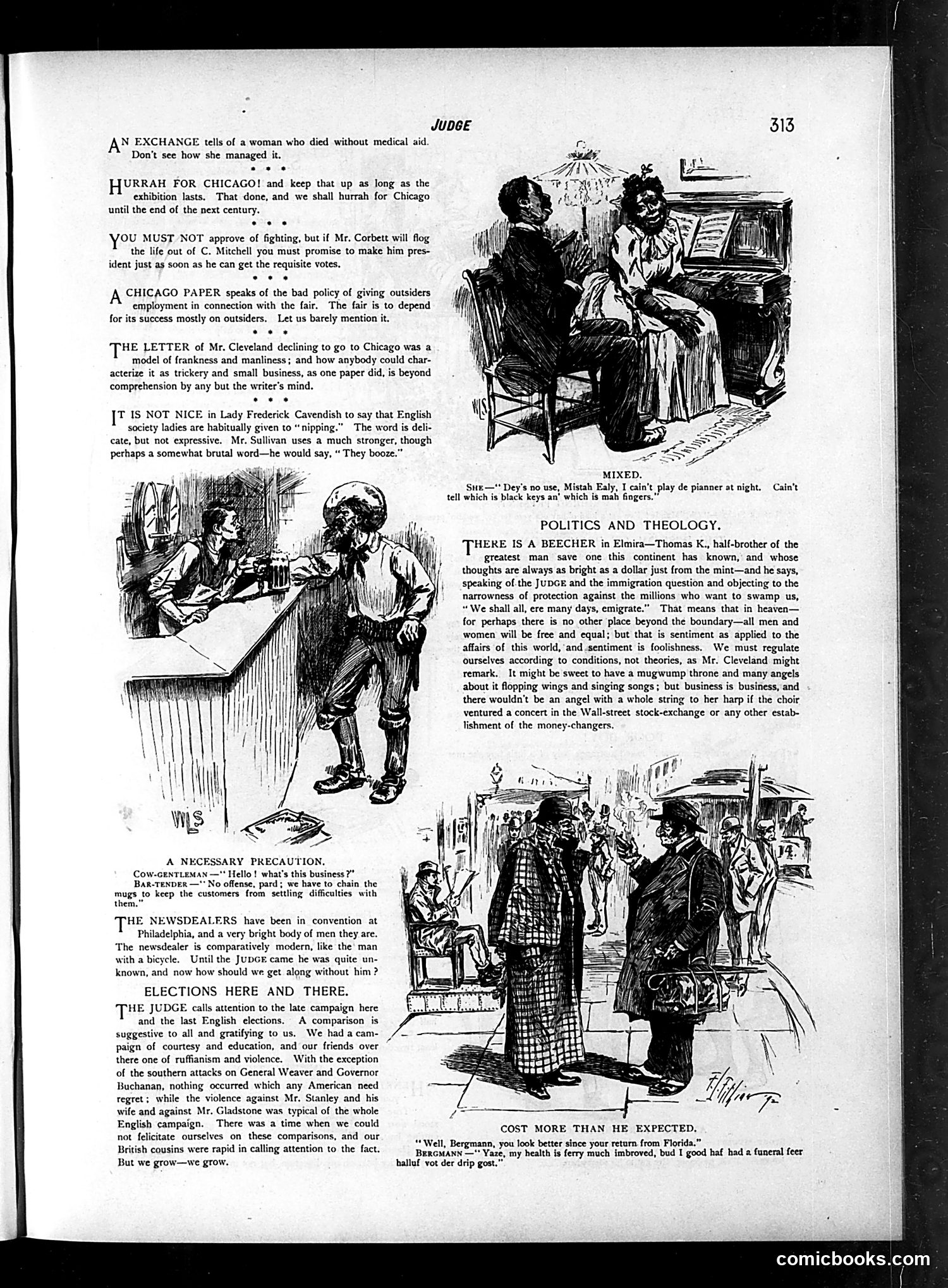
This page contains several satirical pieces typical of late-19th-century American political commentary: **Top cartoon**: Depicts two figures at a piano—likely commentary on social propriety or musical performance among the classes. **"Politics and Theology"**: Attacks a character named Thomas K., described as a "Beecher" (likely referencing the famous Beecher family), criticizing his views on immigration and protectionism as hypocritical. The piece contrasts his religious sentiment about equality with practical business concerns. **Lower cartoons**: "A Necessary Precaution" and "Cost More Than He Expected" appear to be humorous domestic or street scenes with working-class characters, using visual humor and dialect humor typical of Judge's satirical approach. The overall tone reflects the magazine's focus on political hypocrisy, class commentary, and contemporary social debates of the era.
📄 Transcribed text from this page (OCR, searchable)
Machine-transcribed from the original scan — historical spelling and the odd misread are preserved.
JUDGE AN EXCHANGE tells of a woman who died without medical aid. Don’t see how she managed it. suste URRAH FOR CHICAGO! and keep that up as long as the exhibition lasts. That done, and we shall hurrah for Chicago until the end of the next century. YOU MUST NOT approve of fighting, but if Mr. Corbett will flog the life out of C. Mitchell you must promise to make him pres- ident just as soon as he can get the requisite votes. cee A CHICAGO PAPER speaks of the bad policy of giving outsiders employment in connection with the fair. The fair is to depend for its success mostly on outsiders. Let us barely mention it. ‘THE LETTER of Mr. Cleveland declining to go to Chicago was a model of frankness and manliness; and how anybody could char- acterize it as trickery and small business, as one paper did, is beyond comprehension by any but the writer’s mind. eee T IS NOT NICE in Lady Frederick Cavendish to say that English society ladies are habitually given to “nipping.” The word is deli- cate, but not expressive. Mr. Sullivan uses a much stronger, though perhaps a somewhat brutal word—he would say, “ They booze.”* Dey’s no use, Mistah Ealy, I cain’t play de pianner at night. Cain’t black keys an! which iS mah fingers.” POLITICS AND THEOLOGY. ‘THERE IS A BEECHER in Elmira—Thomas K., half-brother of the greatest man save one this continent has known,’ and whose thoughts are always as bright as a dollar just from the mint—and he says, speaking of the JUDGE and the immigration question and objecting to the narrowness of protection against the millions who want to swamp us, “We shall all, ere many days, emigrate.” That means that in heaven— for perhaps there is no other ‘place beyond the boundary—all men and women will be free and equal; but that is sentiment as applied to the affairs of this world,’and.sentiment is foolishness. We must regulate ourselves according to conditions, not theories, as Mr. Cleveland might remark. It might be sweet to have a mugwump throne and many angels about it flopping wings and singing songs; but business is business, and there wouldn't be an angel with a whole string to her harp if the choir ventured a concert in the Wall-street stock-exchange or any other estab- lishment of the money-changers. Ws A NECESSARY PRECAUTION, COW-GENTLEMAN Hello ! what's this business ?* BaR-TENDER —"* No offense, pard ; we have to chain the mugs to keep the customers from settling difficulties with them.” ‘THE NEWSDEALERS have been in convention at Philadelphia, and a very bright body of men they are. ‘The newsdealer is comparatively modern, like the’ man with a bicycle. Until the JUDGE came he was quite un- known, and now how should we get along without him ? ELECTIONS HERE AND THERE. ‘THE JUDGE calls attention to the late campaign here and the last English elections. A comparison is suggestive to all and gratifying to us. We had acam- paign of courtesy and education, and our friends over there one of ruffianism and violence. With the exception of the southern attacks on General Weaver and Governor Buchanan, nothing occurred which any American need regret; while the violence against Mr. Stanley and his wife and against Mr. Gladstone was typical of the whole English campaign. There was a time when we could le Serra iin GAIT. not felicitate ourselves on these comparisons, and our British cousins were rapid in calling attention to the fact. Be een a Cane ena aioe bo ed hata Caner fer But we grow—we grow. halluf vot der drip gost."” comicbooks.com