
A complete issue · 18 pages · 1892
Judge — October 22, 1892
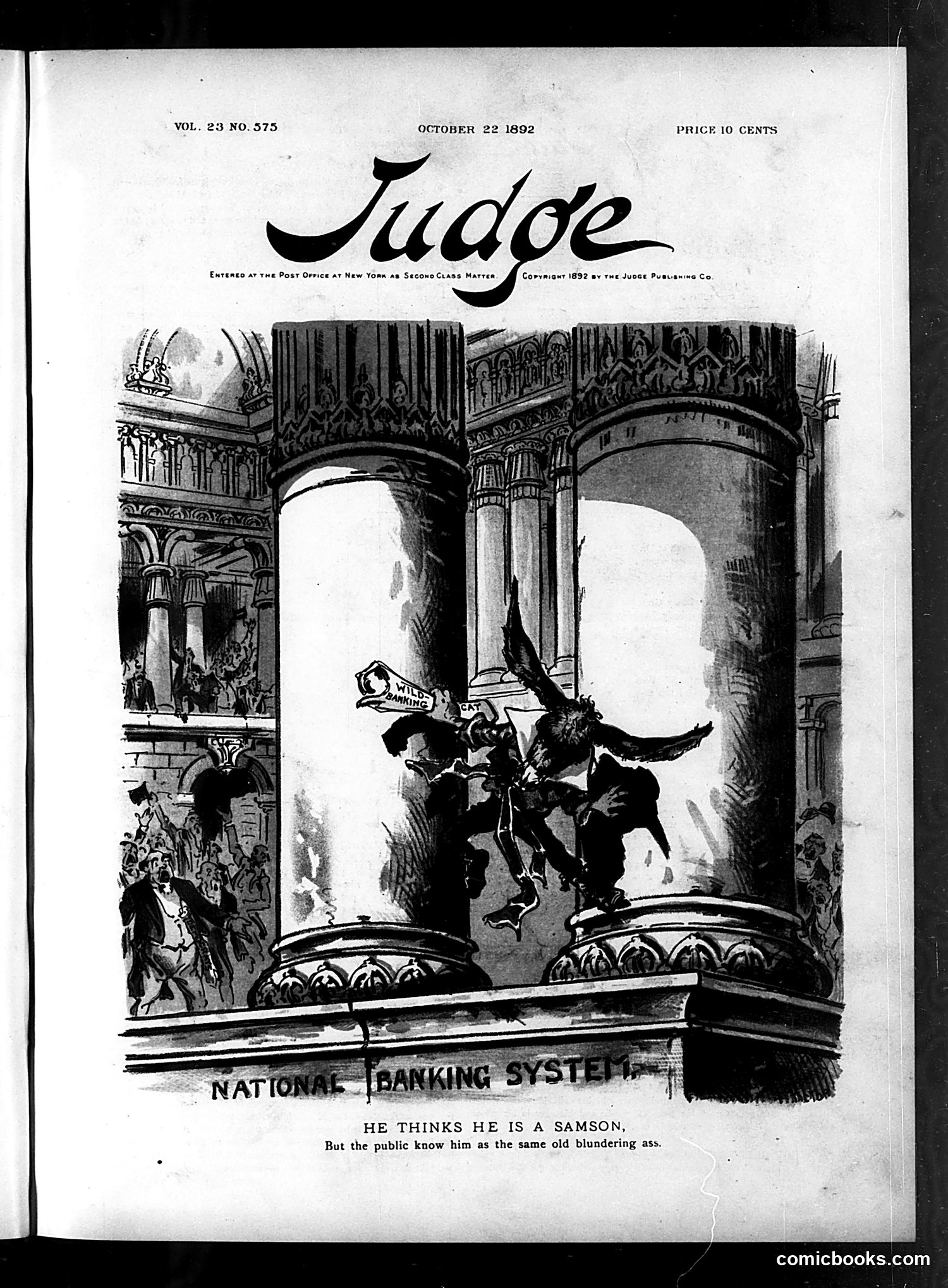
This political cartoon satirizes the **National Banking System** during the Gilded Age. The illustration depicts demons or devils wreaking havoc within a grand classical bank building, suggesting corruption and instability within America's banking infrastructure. The caption—"HE THINKS HE IS A SAMSON, / But the public know him as the same old blundering ass"—likely references a political figure attempting to appear strong or reformist while actually causing damage. The Samson reference suggests someone claiming to be powerful enough to destroy corrupt institutions, yet the public views him as incompetent. The cartoon critiques either a banker, politician, or reformer's ineffectual attempts to address banking system problems that were plaguing the 1890s economy.
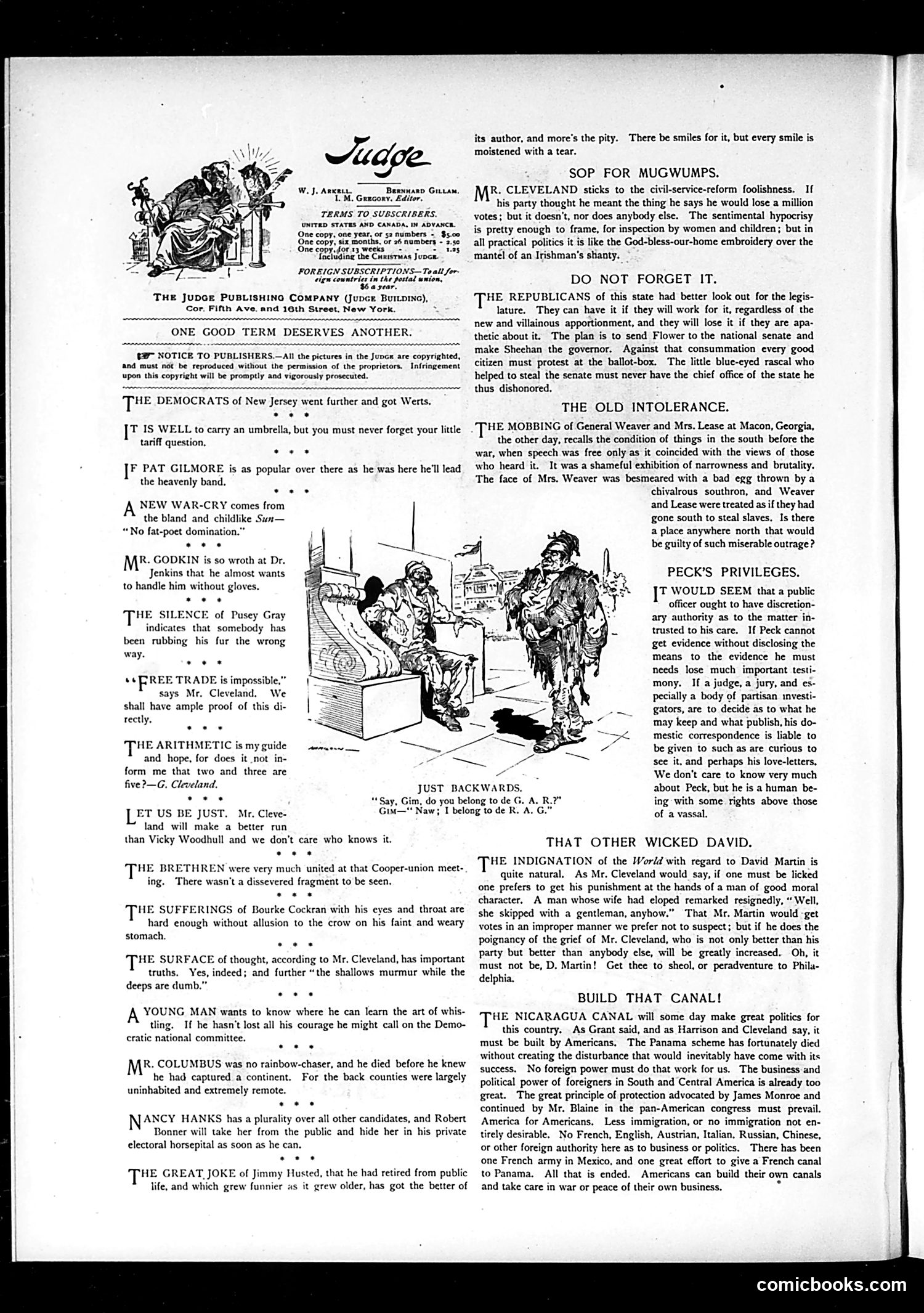
The main cartoon depicts a dialogue between two figures at what appears to be a ballot box, with one asking "Say, Gin, do you belong to de G. A. R?" and the other responding "Naw; I belong to de R. A. G." This is a pun playing on fraternal/veteran organizations—likely referencing the Grand Army of the Republic (G.A.R., a Union veterans group) versus a derogatory acronym suggesting the figure belongs to a rag-tag or disreputable group. The accompanying text items are brief political jabs at various contemporary figures and issues, including references to tariffs, free trade debates, and personal scandals. Without clearer visual identification of specific figures, the precise targets remain unclear, though the overall tone suggests partisan criticism of political opponents and their positions.
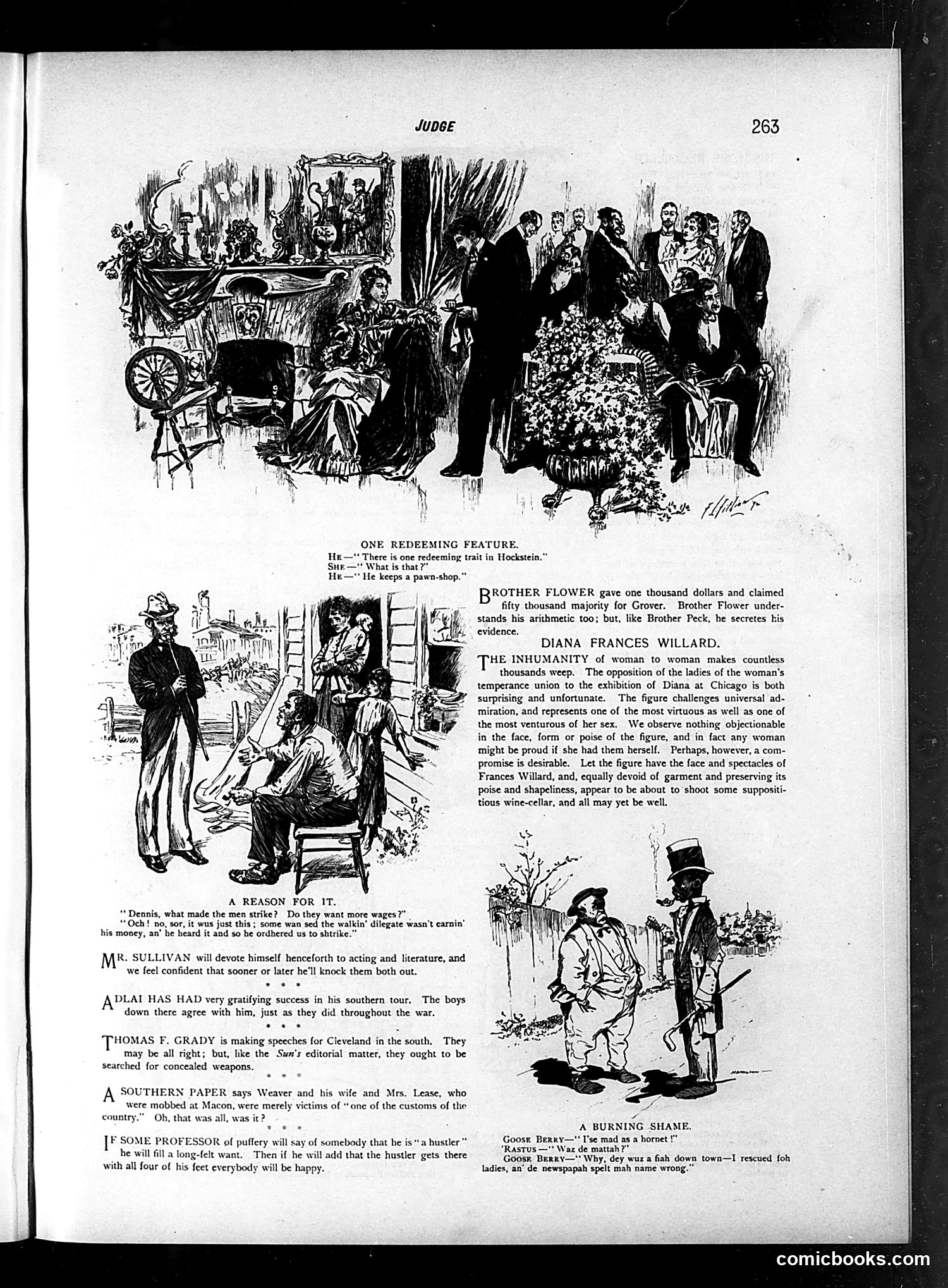
This page contains several brief satirical items and sketches rather than a single unified cartoon. **"One Redeeming Feature"** mocks a character in Hocksheim who runs a pawn shop—suggesting moral compromise. **"Diana Frances Willard"** is a substantial prose item praising a woman's virtue and appearance, likely referencing a contemporary public figure or society woman, though the specific person is unclear without additional context. The remaining items appear to be gossip-style social commentary about various figures: Mr. Sullivan (actor/writer), Adlai (likely Adlai Stevenson, receiving Southern support), Thomas F. Grady (making Cleveland speeches), and references to Weaver and his wife being robbery victims. **"A Burning Shame"** and **"A Reason for It"** are brief joke items with unclear specific references. Without clearer historical context, the exact targets remain partially obscure.
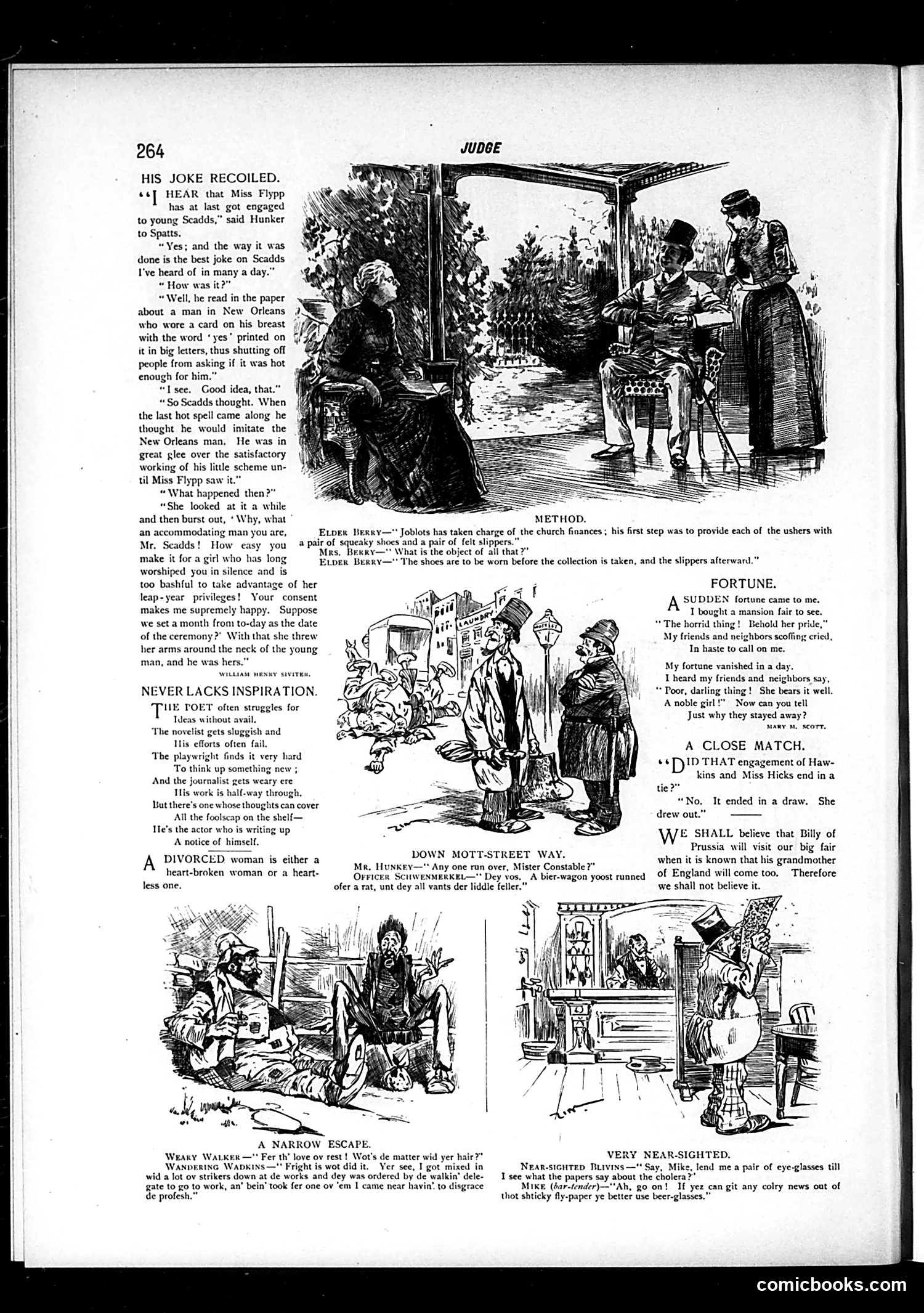
This page contains multiple brief satirical pieces typical of late-19th/early-20th-century American humor: **"His Joke Recoiled"**: A young man named Scadds wears a "yes" card (mimicking a New Orleans trend to avoid repetitive "hot enough for you?" comments) intending to mock romantic interest. Miss Flypp interprets it as acceptance of her courtship proposal during leap year (when women traditionally propose). The joke backfires—he gains an unwanted fiancée. **"Never Lacks Inspiration"**: Satirizes actors' self-aggrandizing promotional writing. **Other sketches** include: working-class characters (strikers, laborers), a church collection scheme using squeaky vs. felt shoes, commentary on social climbing and lost friendships after fortune reverses, and a German accent joke about nearsightedness. The humor relies on wordplay, class stereotypes, period-specific customs (leap year proposals), and Irish/German immigrant dialect humor—reflecting era conventions now considered dated.
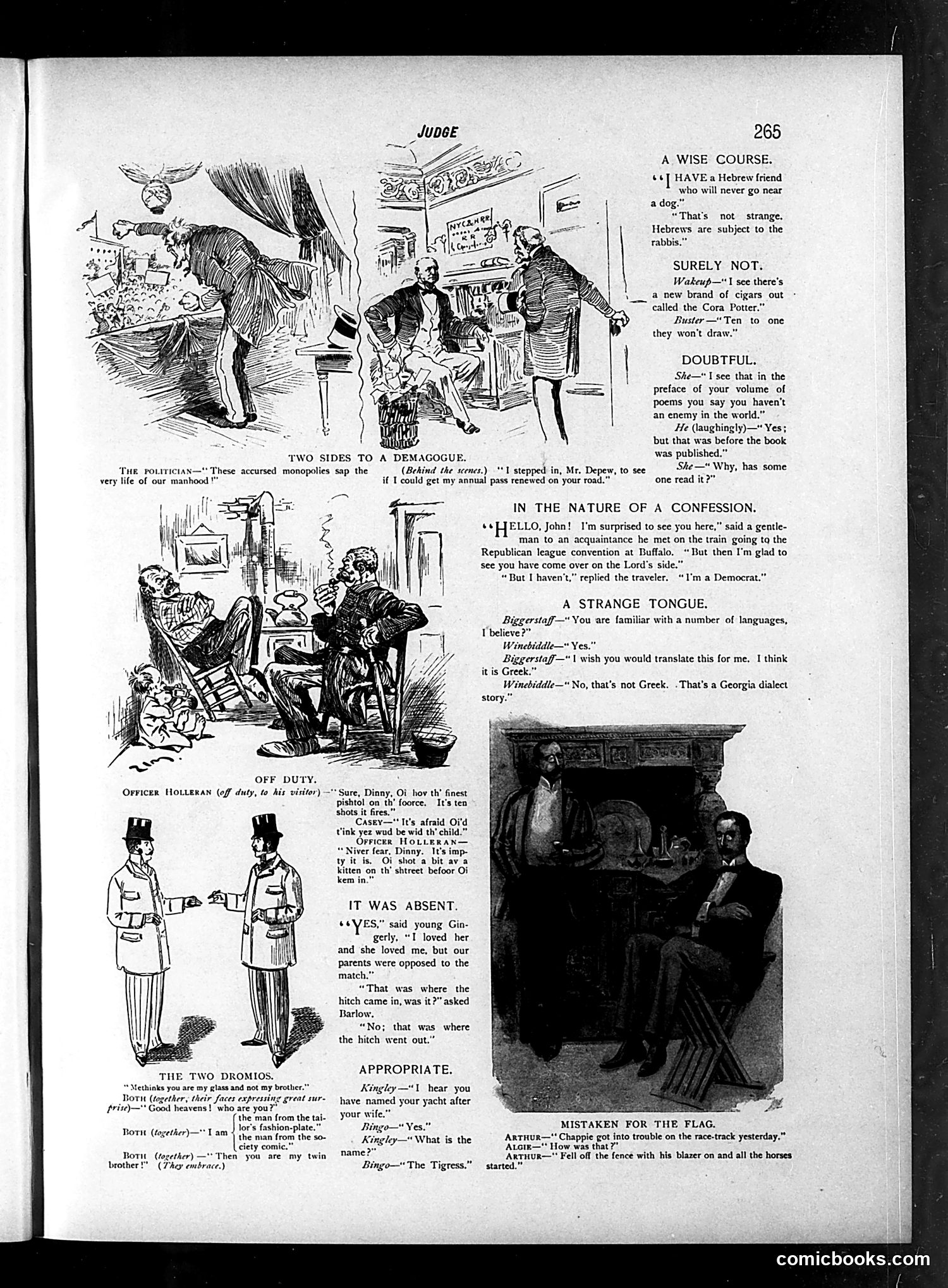
This page contains multiple short satirical jokes typical of Judge magazine's humor: **"A Wise Course"** plays on anti-Semitic stereotypes, using a pun ("rabbis/rabbits") to mock Jewish dietary laws. **"Two Sides to a Demagogue"** critiques a politician (likely a railroad magnate or similar figure) who privately seeks favors while publicly railing against monopolies—standard political hypocrisy satire. **"In the Nature of a Confession"** jokes about the 1896 Republican League Convention in Buffalo, mocking someone's claimed Democratic loyalty. **"Off Duty"** satirizes Irish-American police stereotypes through dialect humor and depicts an officer casually admitting to animal cruelty. **"A Strange Tongue"** contrasts educated language with regional Georgian dialect as unintelligible. The remaining items are brief joke exchanges about poetry, yachts, and mistaken identity. The page reflects Judge's era sensibilities: ethnic humor, political mockery, and class-based comedy that would be considered offensive today.
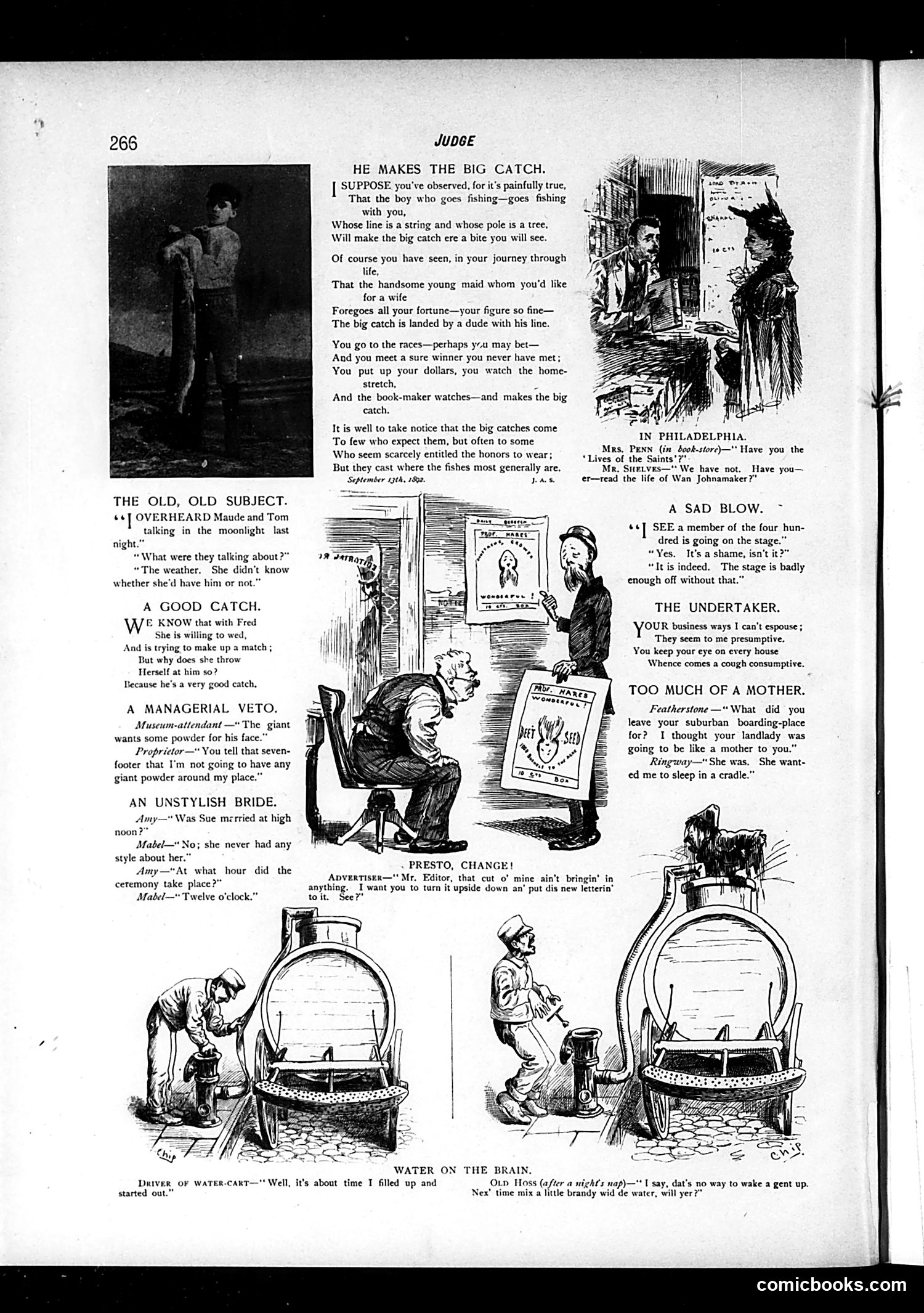
This page contains multiple short humorous items typical of Judge's satirical format: **"He Makes the Big Catch"** (main poem): A commentary on luck and social advantage. The poem observes that success—whether in romance, fishing, or gambling—often goes to those least deserving or expecting it, particularly to men with social status ("dudes") who succeed where ordinary men fail. It's social satire about inequality and unfairness in courtship and fortune. **Other short jokes** address everyday absurdities: a couple discussing weather instead of romance; a museum owner refusing to provide powder for a giant performer; confusion over wedding times; advertising mishaps. **"Water on the Brain"** cartoons depict a water-cart driver and an old horse discussing whether to add brandy to wake someone—crude working-class humor. The page reflects Gilded Age concerns: class mobility, gender dynamics in courtship, and the apparent randomness of success. The satire assumes readers recognize the injustice of merit being overlooked in favor of appearance or social position.
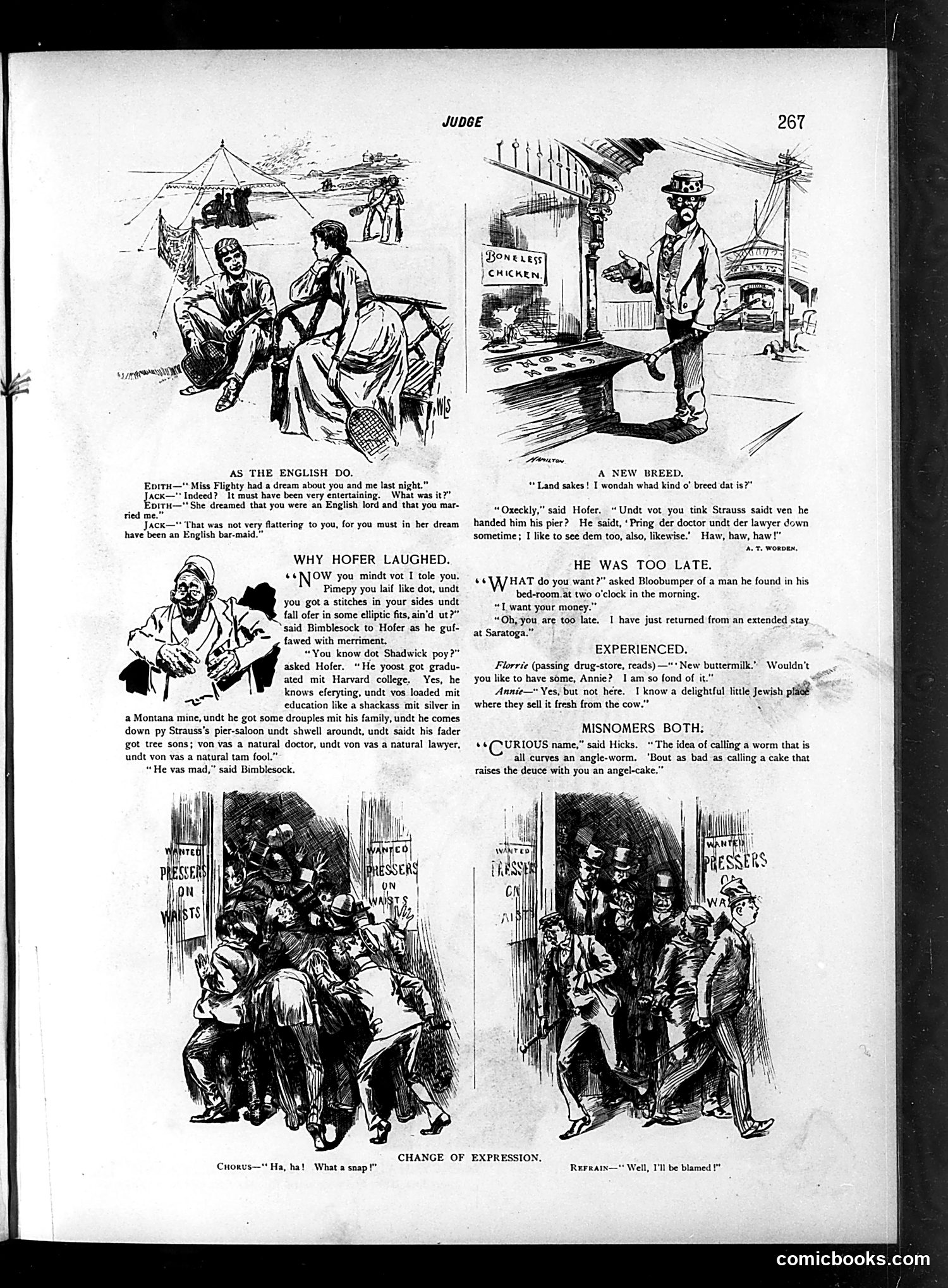
This page collects several satirical sketches typical of late 19th-century American humor: **"As the English Do"** mocks Anglo-philia through a dialogue where a man dismisses his girlfriend's dream of marrying an English lord, retorting that she'd have been a barmaid—satirizing American admiration for English aristocracy. **"Why Hofer Laughed"** features a thick German-accented character recounting a joke about a Harvard graduate who's one of three sons (a doctor, lawyer, and "natural fool")—likely satirizing both pretentious educated immigrants and the gap between Harvard credentials and actual competence. **Other sketches** include variations on robbery ("He Was Too Late"), ethnic humor about Jewish delis selling "fresh buttermilk," and wordplay about "angle-worms" and "angel-cakes." The cartoons employ heavy ethnic stereotypes (German and Jewish accents) common to Judge's era. The humor relies on class commentary, immigrant characters, and puns—reflecting early 1900s American satirical conventions that modern readers would find dated and offensive.
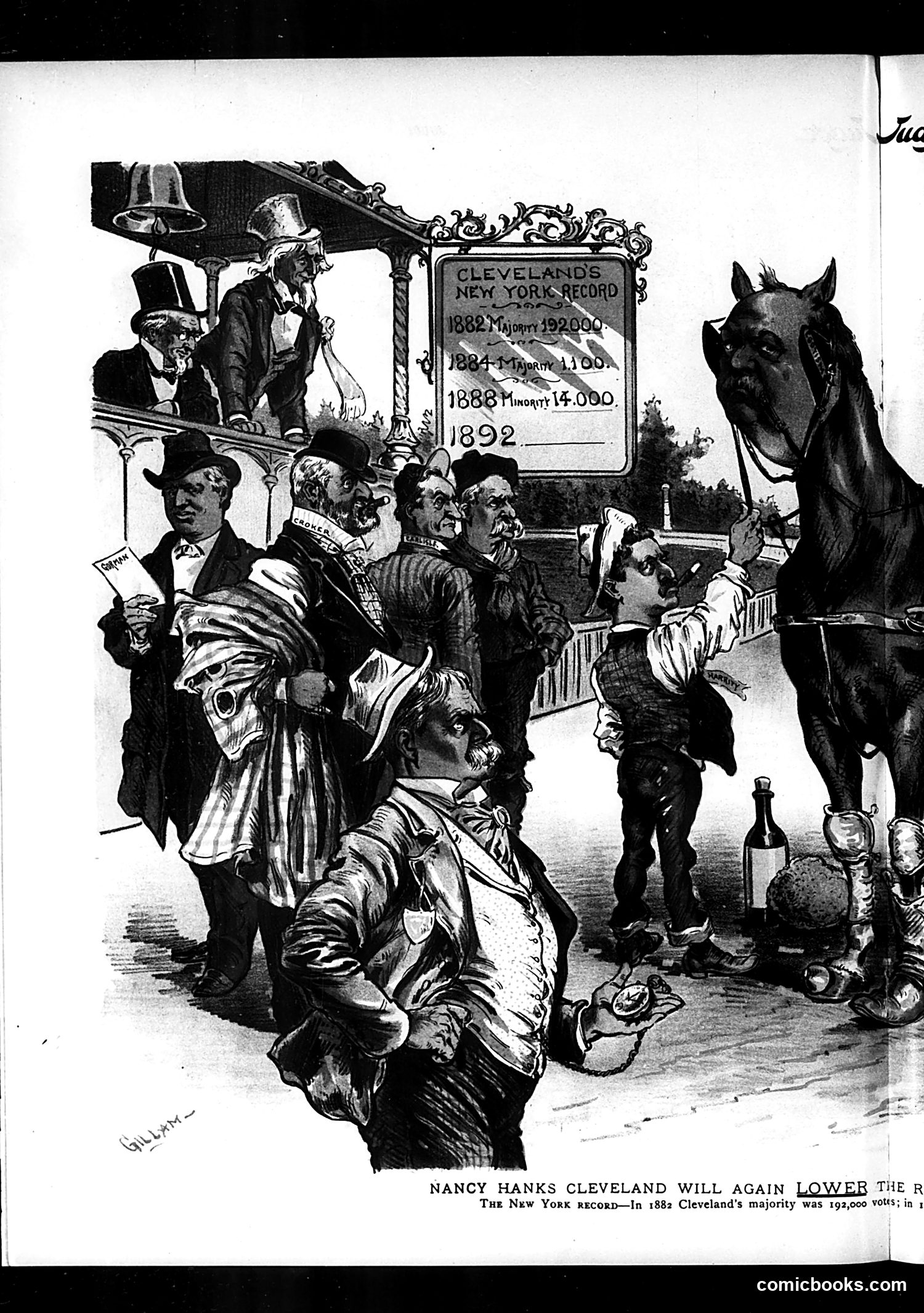
This is a satirical cartoon about Grover Cleveland's electoral record. The sign shows "Cleveland's New York Record" with voting majorities listed: 1882 (192,000), 1884 (roughly 1,100), and 1888 (14,000), with 1892 blank—suggesting his support was declining dramatically. The caption references "Nancy Hanks Cleveland" (the President's wife) "lowering the record," playing on the word "record" as both electoral performance and a literal downward trend. The crowded scene of well-dressed men and a horse appears to depict a racetrack or betting environment, suggesting Cleveland's political fortunes are being wagered upon like a horse race. The satire mocks Cleveland's weakening electoral support in New York, his home state, implying his reelection prospects were diminishing.
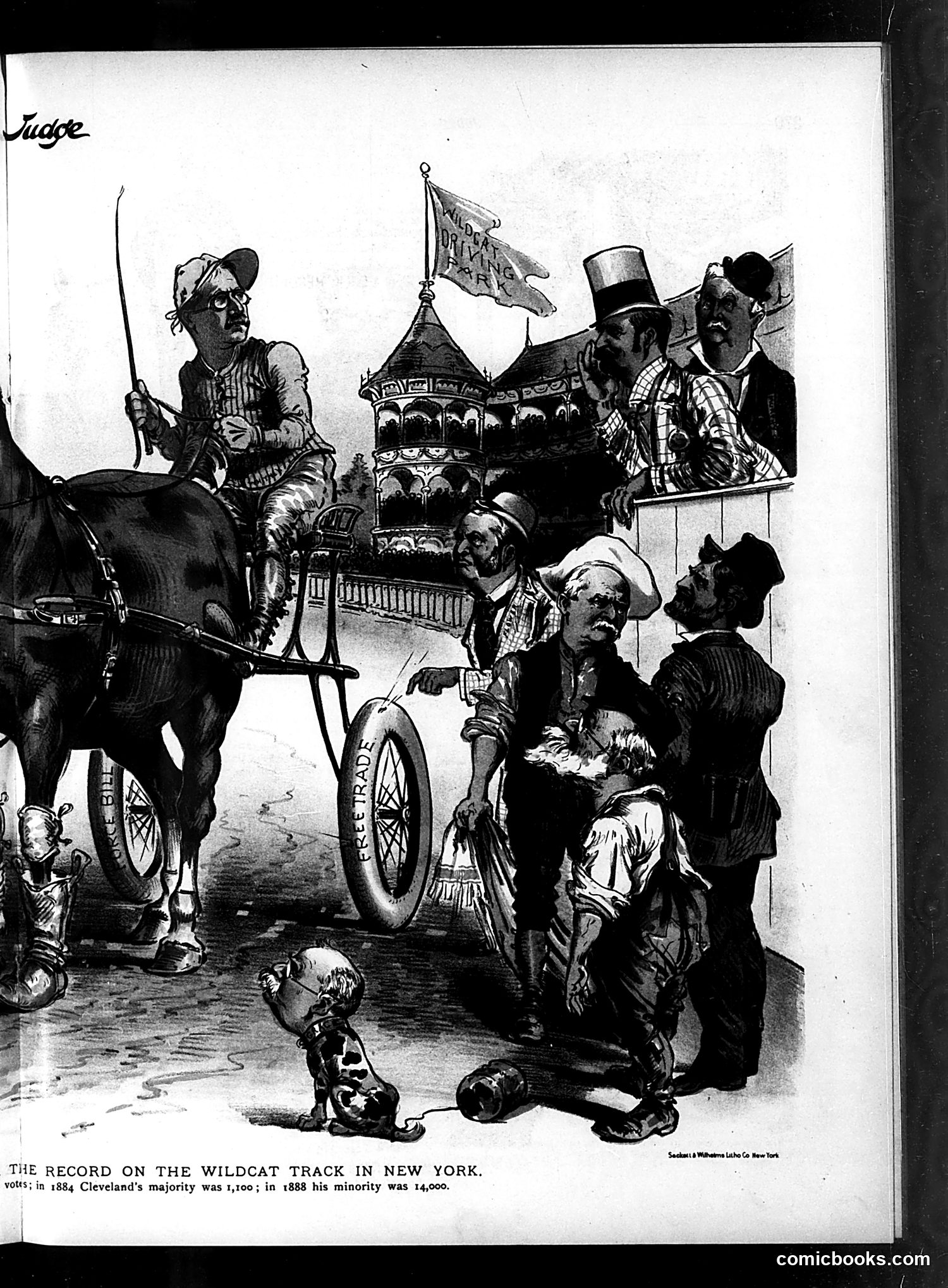
This political cartoon satirizes Grover Cleveland's electoral collapse in New York between 1884 and 1888. The caption notes his majority of 1,100 votes in 1884 reversed to a minority of 14,000 in 1888—a dramatic swing referenced as "the wildcat track," implying unpredictable, dangerous political movement. The central ornate structure appears to represent political machinery or a reviewing stand. Various caricatured figures—likely representing political opponents, voters, or party factions—surround a horse-drawn cart, suggesting Cleveland's political fortunes being driven chaotically. The flag visible on the structure likely represents political authority or party symbolism. The cartoon mocks Cleveland's failed reelection bid, portraying his political standing as erratic and unstable rather than solidly grounded.
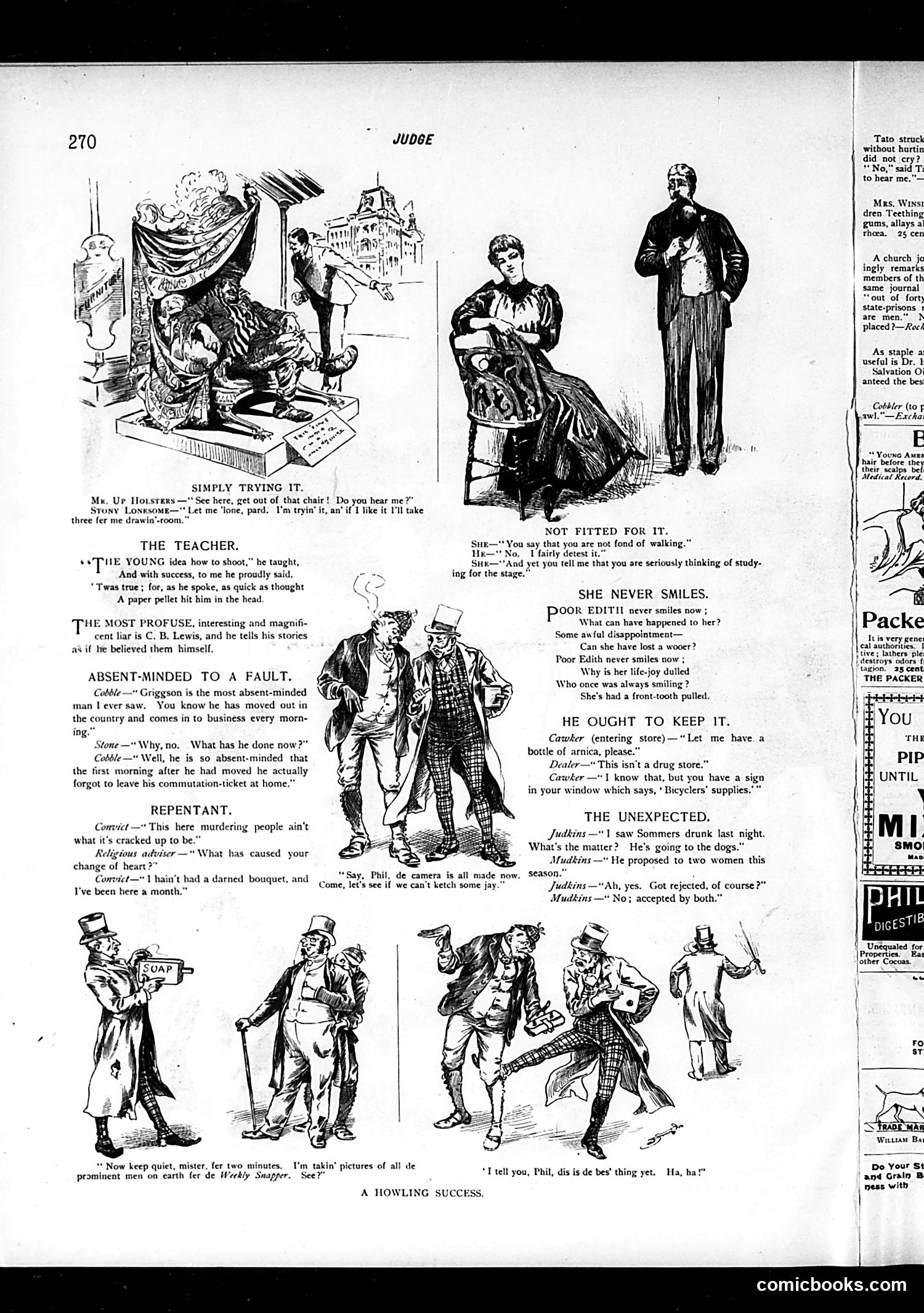
This page from Judge presents multiple unrelated satirical vignettes typical of the magazine's format. The cartoons mock contemporary social types and situations: **"Simply Trying It"** shows a man test-sitting an expensive chair, threatening to buy multiple copies—satirizing nouveau riche consumerism and vulgar materialism. **"The Teacher"** and related verses humorously depict education's failures and absurdities. **"Absent-Minded to a Fault"** jokes about a commuter so forgetful he left his train ticket at home rather than his new residence—poking fun at distracted modern businessmen. **"Not Fitted for It"** mocks a woman who despises walking yet wants to pursue stage acting, suggesting her unsuitability. **"She Never Smiles"** uses light humor about a woman's lost tooth explaining her cheerlessness. Other brief jokes target absent-minded professors, drunk proposal-makers, and bicycle-related mishaps. The humor is gentle, domestic, and class-conscious—aimed at middle-class readers recognizing these social types. No specific political content or identifiable public figures appear on this page.
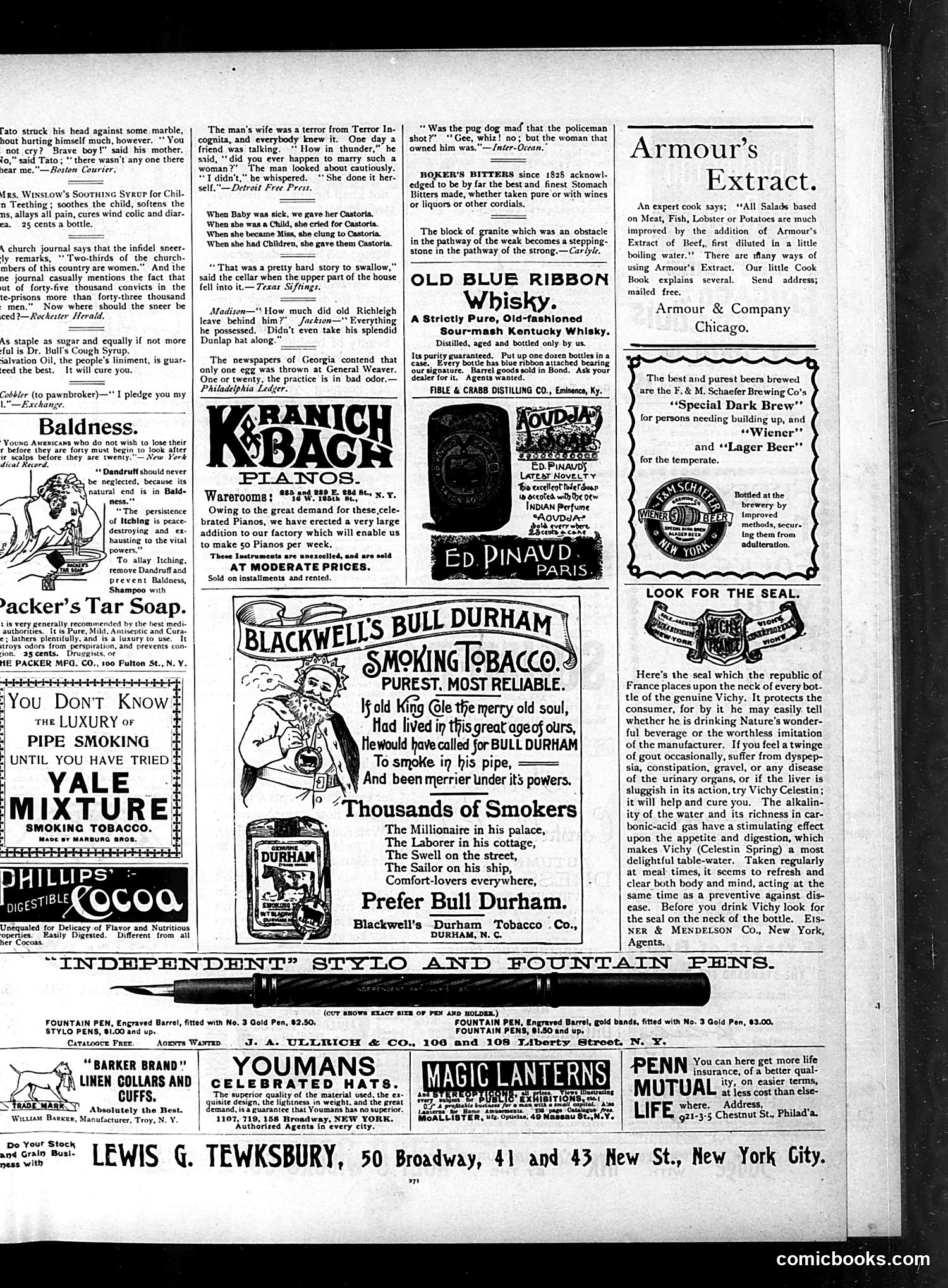
This page is primarily **advertisements**, typical of late 19th-century magazines. However, it contains scattered brief humorous anecdotes in the margins—short jokes rather than political cartoons. The visible humor includes: **Social satire snippets:** - A joke about a man's domineering wife ("She done it herself") - Commentary on Georgia newspapers minimizing violence against General Weaver (a Populist candidate), suggesting bias - Wordplay about a cellar "swallowing" a story about eggs thrown at Weaver **The Weaver references** appear to allude to James B. Weaver, the 1892 Populist presidential candidate, who faced hostile receptions in the South. The sardonic tone suggests Judge's skepticism toward pro-Weaver Georgia newspapers downplaying the egg-throwing incident. The page otherwise advertises patent medicines, tobacco, whiskey, and pianos—standard Judge content. There are no prominently signed political cartoons visible; the satire is subtle and embedded in brief text jokes typical of the magazine's format.
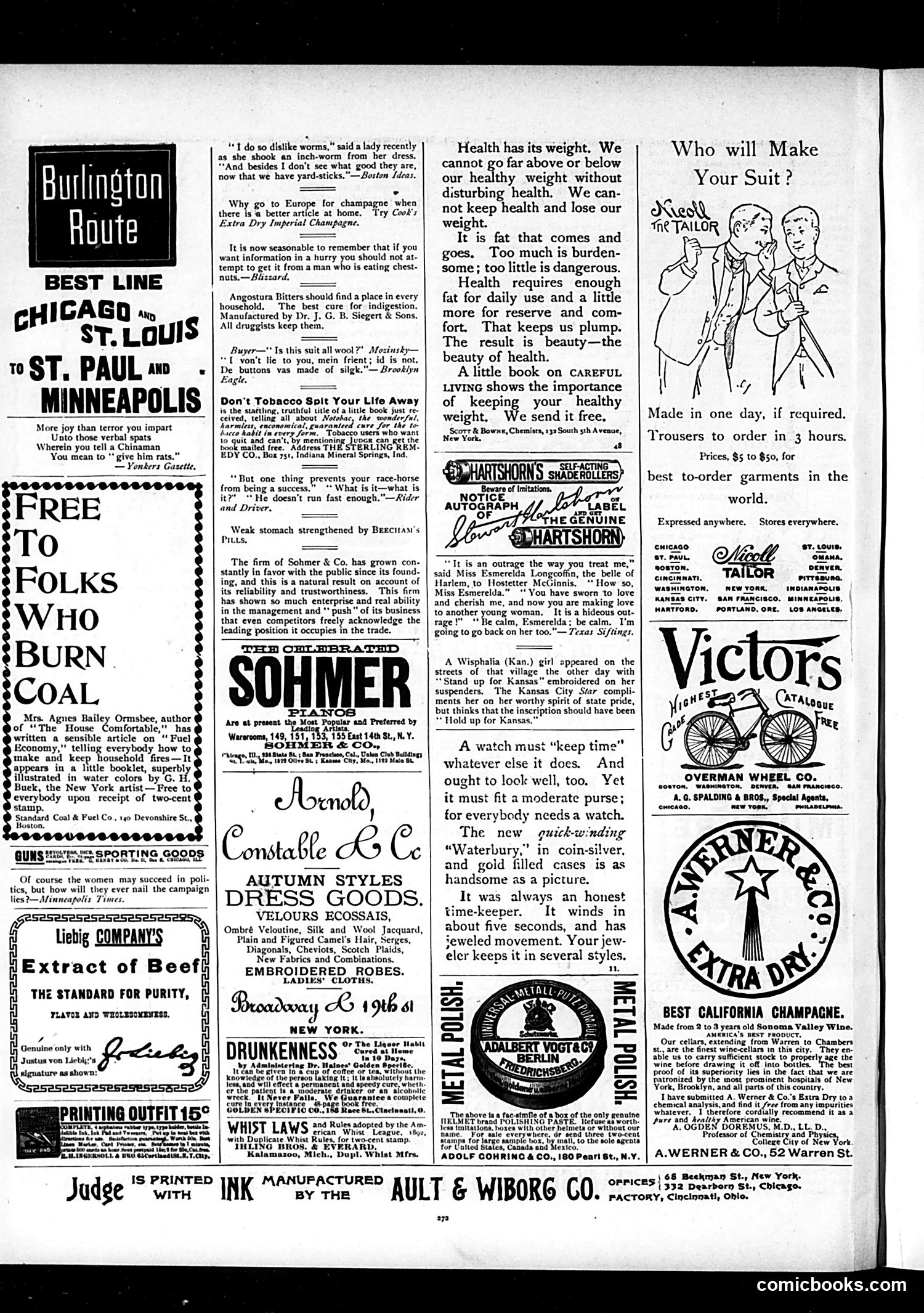
This is primarily an **advertising page** from Judge magazine, with minimal editorial content. The few jokes and quips scattered throughout reflect early 1900s sensibilities: **Key Content:** - A quip about a woman confusing an inchworm with a "yard-stick" (modern measurement tool)—topical humor about new technology - A joke about a man eating chestnuts being unreliable for information—mundane social observation - A Yiddish-dialect joke about a suit with silk buttons ("mein frient")—reflecting immigrant communities in America - A quip about politicians and "campaign lies"—suggesting skepticism about women's political participation **Advertising Focus:** Most of the page features patent medicines (Beecham's Pills, "Notobac" for tobacco addiction), furniture, champagne, and clothing. These ads reflect common early-1900s commercial concerns: digestive aids, addiction remedies, and genteel fashion. The humor is gentle, topical, and targeted at educated, urban readers. There are **no significant political cartoons or caricatures** on this page—it's primarily commercial.
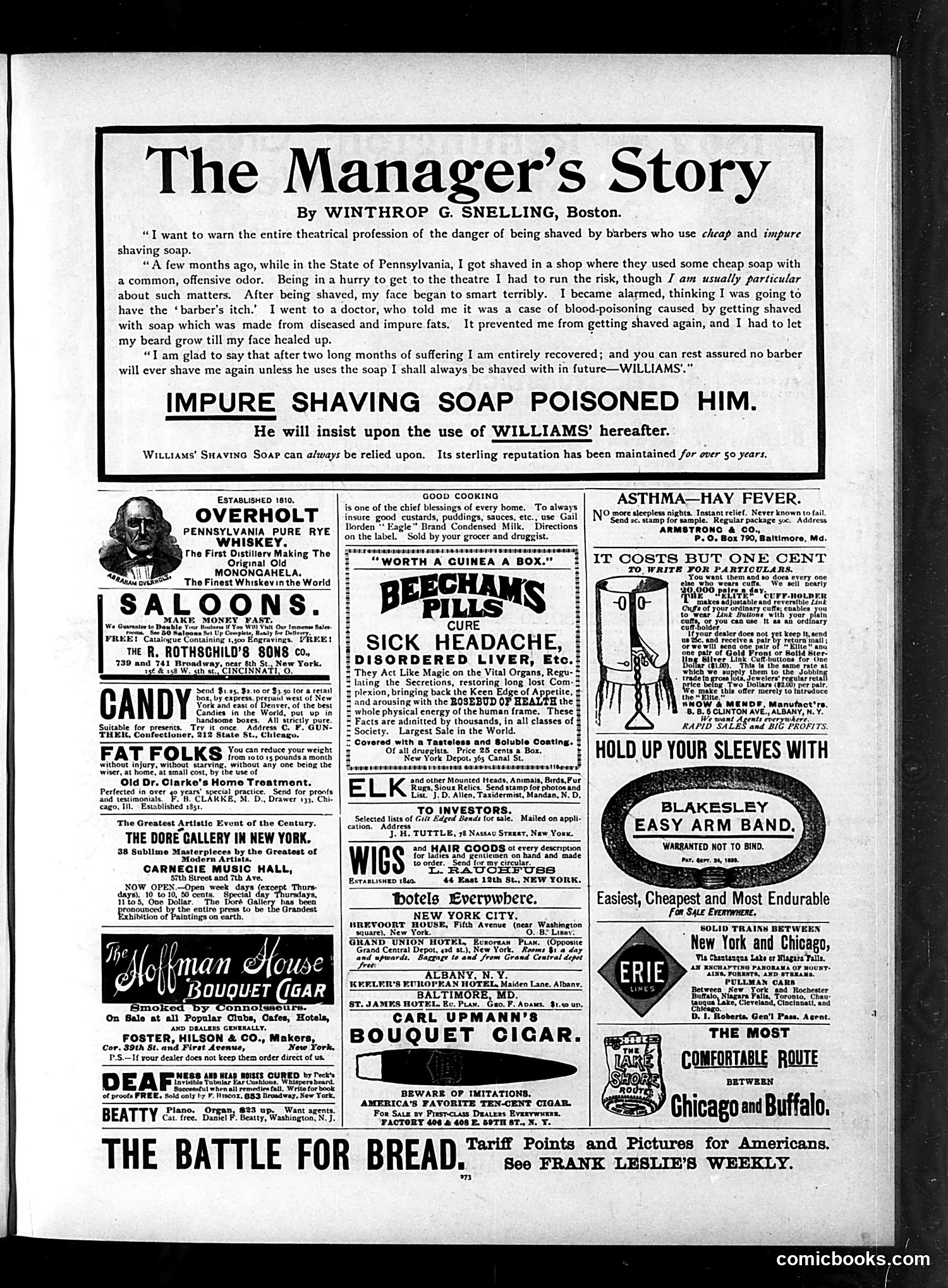
This page is primarily **advertising**, not satire or political commentary. The lead article—"The Manager's Story" by Winthrop G. Snelling—is a **testimonial advertisement** for Williams' Shaving Soap. The "story" presents a theatrical manager's cautionary tale: he suffered blood poisoning and "barber's itch" after being shaved with cheap, impure soap in Pennsylvania. A doctor attributed his condition to contaminated shaving products. After recovery, he pledges lifelong loyalty to Williams' brand, which has maintained its "sterling reputation for over 50 years." This is **native advertising**—a fictional narrative designed to persuade readers through dramatic personal testimony rather than direct product claims. The heavy underlining ("IMPURE SHAVING SOAP POISONED HIM") emphasizes the danger message. The rest of the page contains typical late-19th/early-20th-century patent medicine and consumer product ads (whiskey, weight-loss treatments, cigars, hair products), reflecting Judge magazine's revenue model.
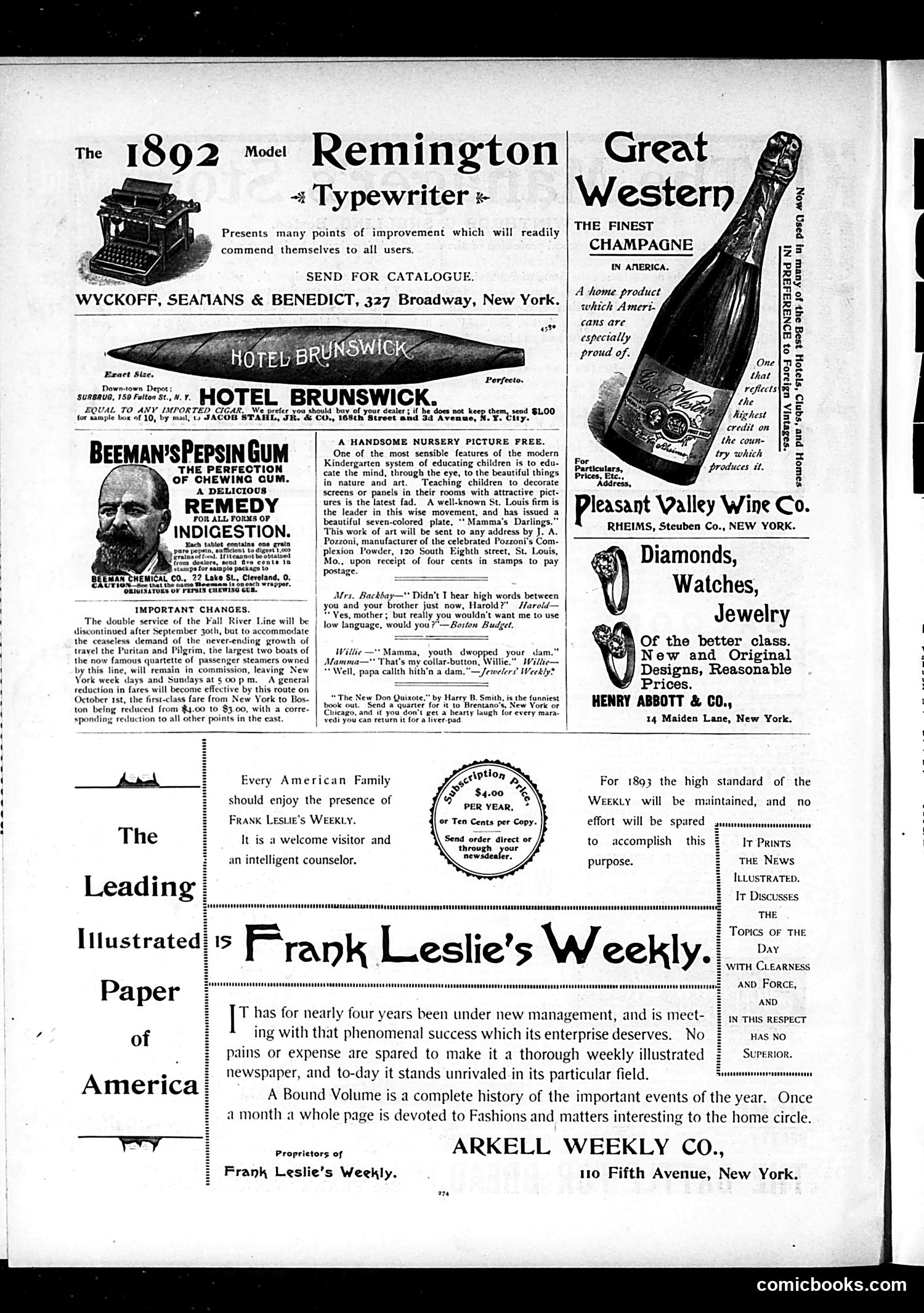
This page is primarily **advertising**, not a satirical cartoon. It's a collection of commercial advertisements from what appears to be an 1893 periodical, promoting various products and services to American consumers. Key advertisements include: - **Remington Typewriter** (office technology) - **Hotel Brunswick** (hospitality) - **Beeman's Pepsin Gum** (patent medicine claiming digestive benefits) - **Pleasant Valley Wine** (champagne) - **Henry Abbott & Co.** (jewelry) - **Frank Leslie's Weekly** (the magazine itself) The page includes minor humorous anecdotes (like children's mispronunciations), but these are brief filler content, not satirical commentary. The overarching message is consumerist: promoting branded products to middle and upper-class American households. The emphasis on "American" products (particularly the wine) suggests emerging American manufacturing pride. There is no discernible political satire visible on this page.
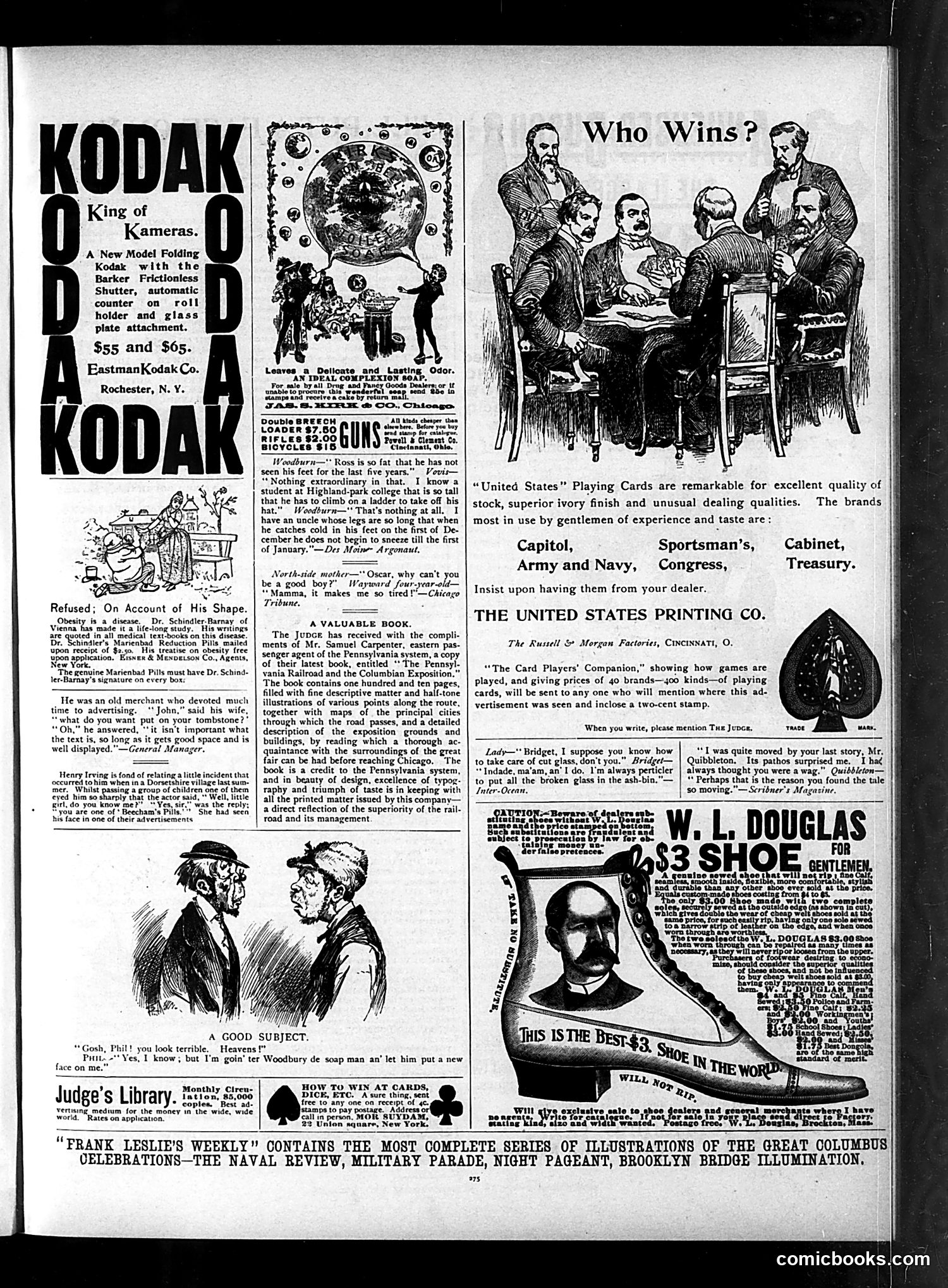
This is primarily an **advertising page** with scattered satirical content typical of Judge magazine's format. The key elements: **Main Satire:** The "Who Wins?" cartoon depicts men gambling at cards, likely referencing concerns about card games and cheating—a common vice in the era. The adjacent advertisement for "United States" Playing Cards ironically promotes brands used by "gentlemen of experience and taste," suggesting these were the cards preferred by serious (or disreputable) gamblers. **Other Humor:** Short joke items mock obesity, extreme physical characteristics, and advertising obsession (the merchant wanting prominent tombstone placement). These reflect early 1900s attitudes and popular humor styles. **Advertising:** The page is dominated by period advertisements—Kodak cameras, patent medicines (obesity pills), firearms, bicycles, shoes, card games—typical of Judge's revenue model. **Context:** This appears to be from around the 1893 Columbian Exposition era (mentioned in text), placing it in the 1890s. The satire assumes readers shared contemporary anxieties about gambling, bodily excess, and commercialism.
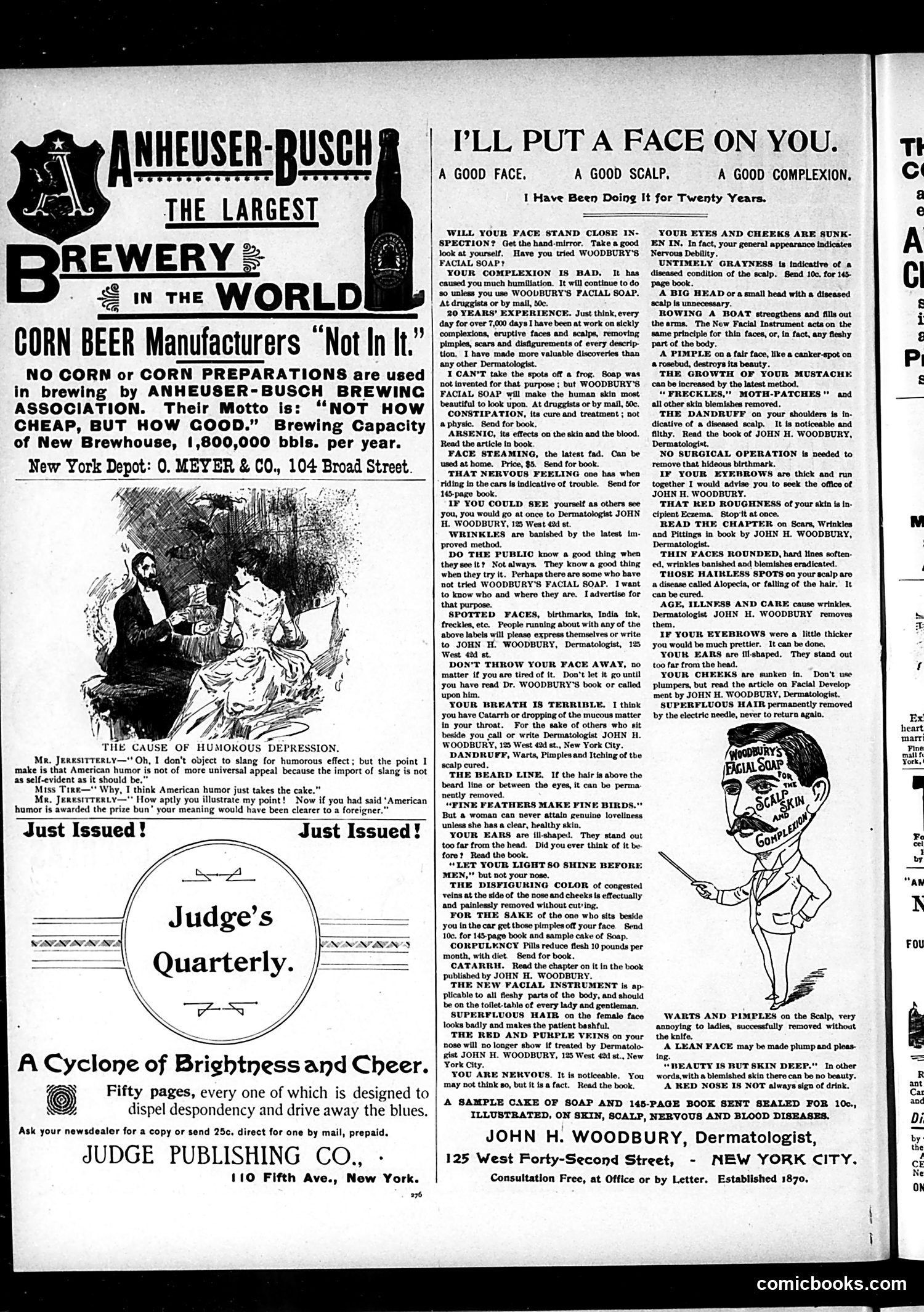
This page is primarily **advertising content** rather than political satire. It contains: 1. **Anheuser-Busch Beer Advertisement** (top left): Promotes their brewery as "the largest in the world," emphasizing they use NO corn despite competitors doing so cheaply. Their motto is "NOT HOW CHEAP, BUT HOW GOOD." 2. **Small Dialogue Joke**: A brief exchange between "Mr. Jetsitterley" and "Miss Tite" about American humor and slang—the joke being that saying "American humor takes the cake" is better understood than "is awarded the prize bun" to foreigners. 3. **Judge's Quarterly Promotion** (center): Advertisement for Judge Publishing Company's magazine ("A Cyclone of Brightness and Cheer"). 4. **Woodbury's Facial Soap & Dermatology Services** (right): Large advertisement for Dr. John H. Woodbury's skincare products and dermatological treatments, claiming 20 years of experience treating complexion problems. The page reflects **early 1900s advertising conventions**—mixing editorial content with extensive product placement and medical/beauty services typical of period magazines.
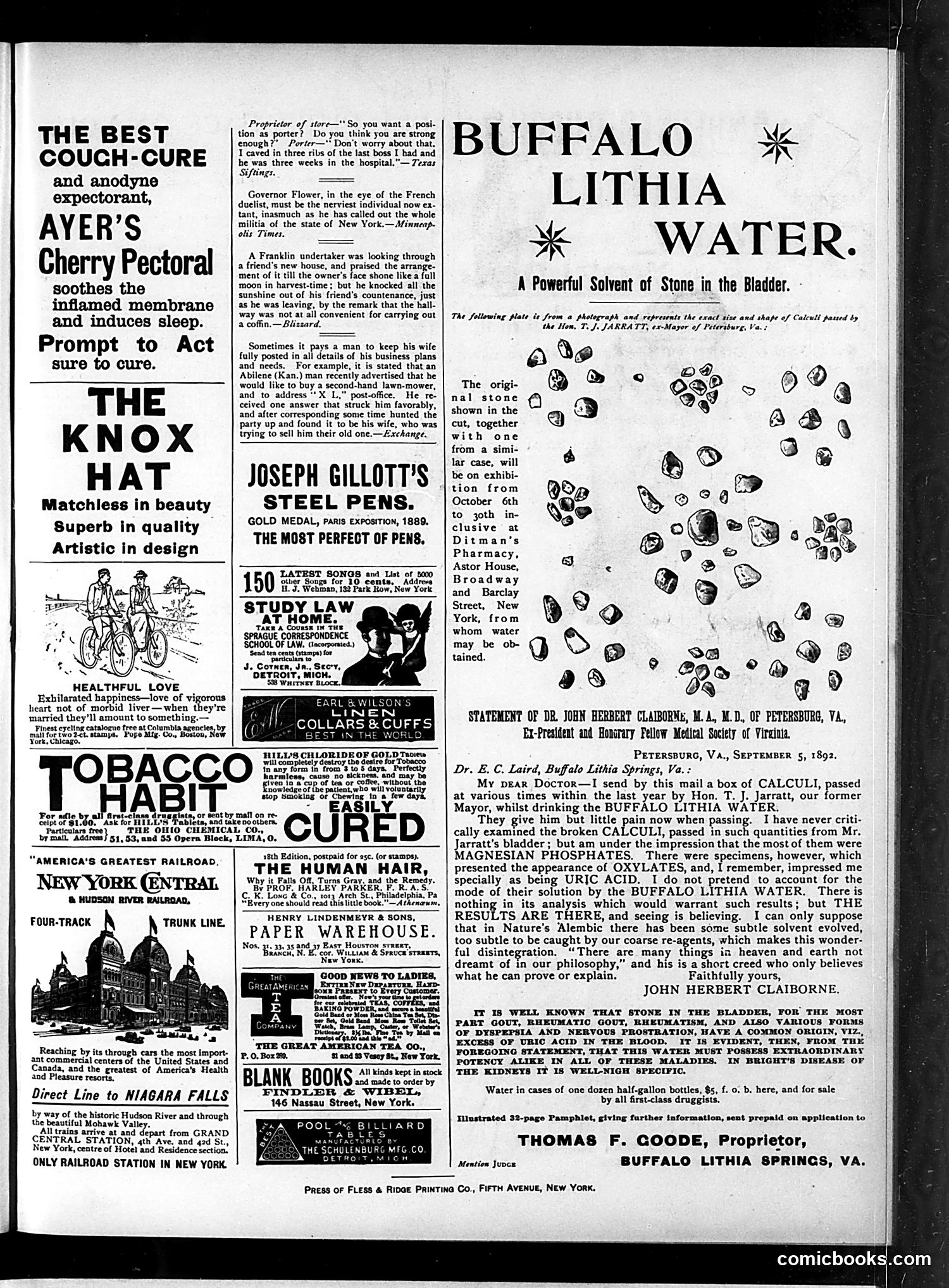
This page is dominated by a medical advertisement for Buffalo Lithia Water, marketed as a treatment for bladder stones. The centerpiece shows a photograph of an actual kidney stone passed by T. J. Jarratt, former mayor of Petersburg, Virginia, presented as proof of efficacy. The endorsement comes from Dr. John Herbert Claiborne, a Petersburg physician and medical society official, who testifies that the water dissolved calculi (stones) that he had previously examined. His statement emphasizes the stone's composition—primarily magnesium phosphate and uric acid—and claims the water's alembic properties (subtle natural solvents) achieved results that medical analysis couldn't explain. The advertisement promises further evidence on display at a New York pharmacy, typical marketing strategy for patent medicines of this era. The surrounding advertisements for cough cures, steel pens, and other products reflect standard magazine content, but the lithia water dominates as the primary commercial message.
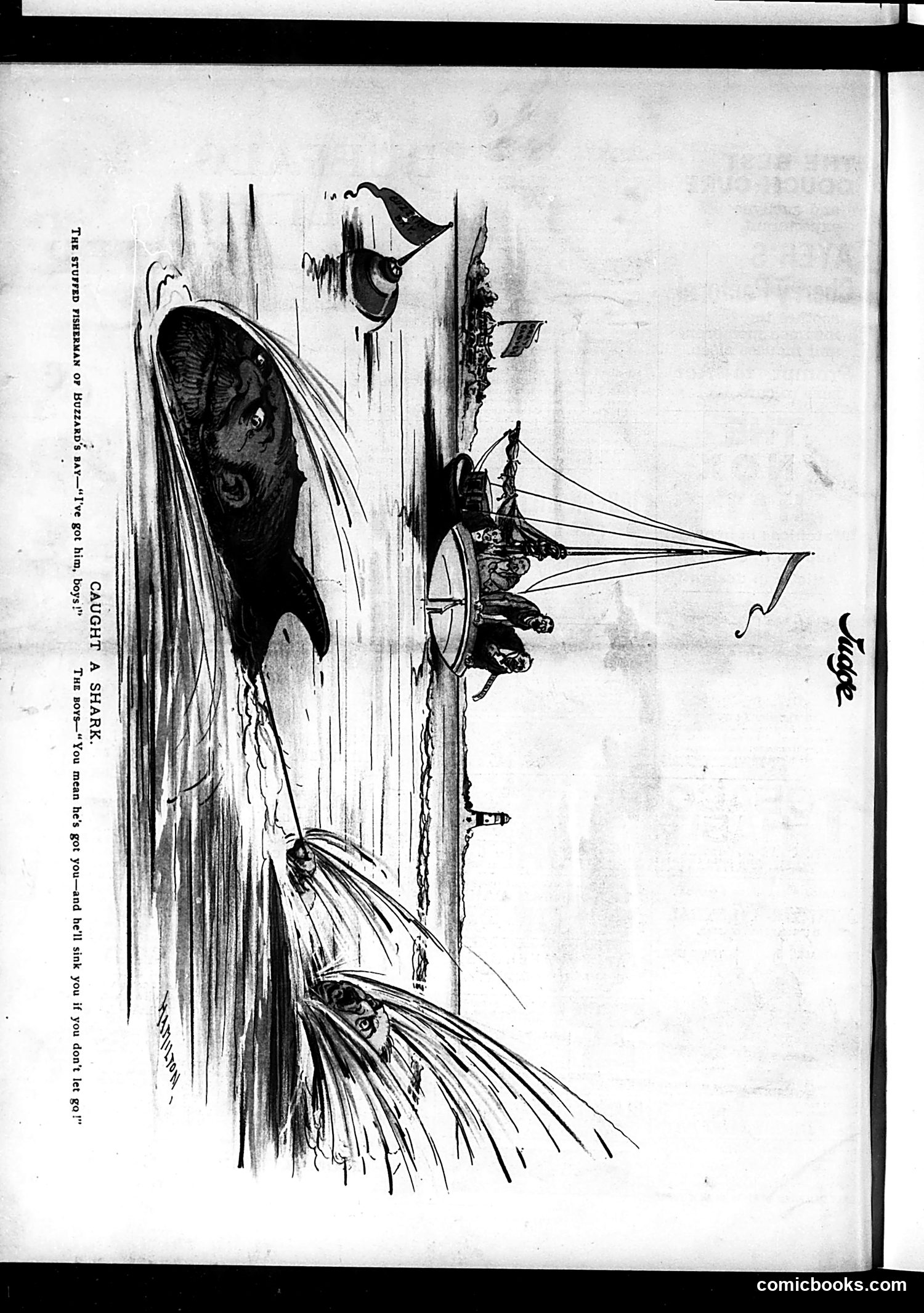
This appears to be a satirical fishing scene titled "The Stuffed Fisherman of Buzzard's Bay." A fisherman has caught what he believes is a shark, triumphantly declaring "I've got him, boys!" However, the other fishermen warn him the situation is reversed—the shark has actually caught *him*, and will sink the boat if he doesn't release it. The cartoon likely uses this fishing scenario as a metaphor for a political or financial situation where someone misjudged their control over a dangerous situation. Without knowing the specific publication date, the exact political figure or event referenced remains unclear, but the satire suggests someone overconfident about managing a threat that could actually destroy them if mishandled.