
Judge, 1892-10-22 · page 3 of 18
Judge — October 22, 1892 — page 3: what you’re looking at
What you’re looking at
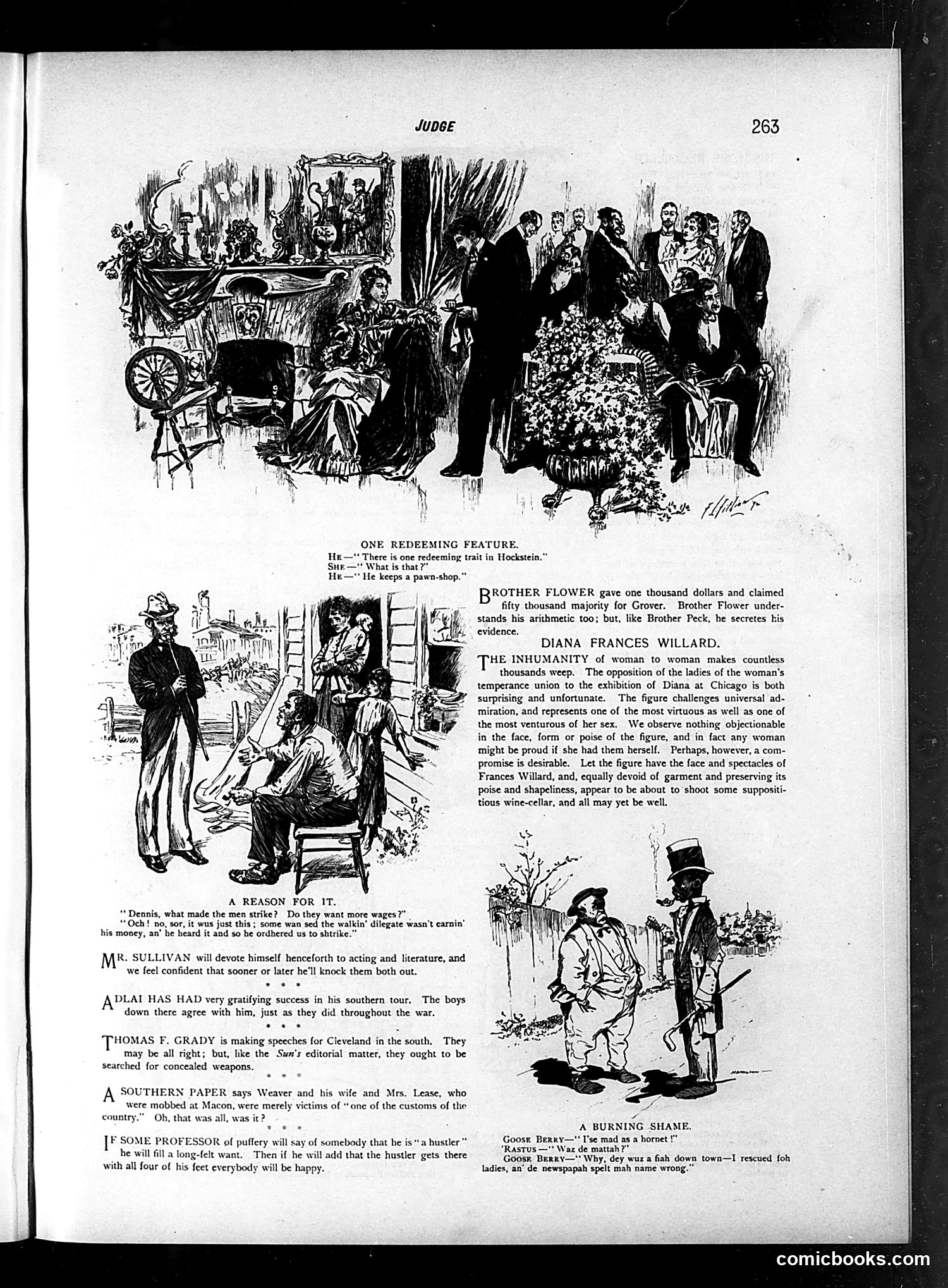
This page contains several brief satirical items and sketches rather than a single unified cartoon. **"One Redeeming Feature"** mocks a character in Hocksheim who runs a pawn shop—suggesting moral compromise. **"Diana Frances Willard"** is a substantial prose item praising a woman's virtue and appearance, likely referencing a contemporary public figure or society woman, though the specific person is unclear without additional context. The remaining items appear to be gossip-style social commentary about various figures: Mr. Sullivan (actor/writer), Adlai (likely Adlai Stevenson, receiving Southern support), Thomas F. Grady (making Cleveland speeches), and references to Weaver and his wife being robbery victims. **"A Burning Shame"** and **"A Reason for It"** are brief joke items with unclear specific references. Without clearer historical context, the exact targets remain partially obscure.
📄 Transcribed text from this page (OCR, searchable)
Machine-transcribed from the original scan — historical spelling and the odd misread are preserved.
. ONE REDEEMING FEATURE. He—" There is one redeeming trait in Hockstein.”” Sue —"* What is that?” He —" He keeps a pawn-shop.”* ROTHER FLOWER gave one thousand dollars and claimed fifty thousand majority for Grover. Brother Flower under- stands his arithmetic too; but, like Brother Peck, he secretes his evidence. DIANA FRANCES WILLARD. THE INHUMANITY of woman to woman makes countless thousands weep. The opposition of the ladies of the woman's temperance union to the exhibition of Diana at Chicago is both surprising and unfortunate, The figure challenges universal ad- miration, and represents one of the most virtuous as well as one of the most venturous of her sex. We observe nothing objectionable in the face, form or poise of the figure, and in fact any woman might be proud if she had them herself. Perhaps, however, a com- promise is desirable. Let the figure have the face and spectacles of Frances Willard, and, equally devoid of garment and preserving its poise and shapeliness, appear to be about to shoot some suppositi- tious wine-cellar, and all may yet be well. A REASON FOR IT. “Dennis, what made the men strike? Do they want more wages?” “Och! no, sor, it wus just this ; some wan sed the walkin’ dilegate wasn't earnin’ his money, an’ he heard it and so he ordhered us to shtrike.” Me: SULLIVAN will devote himself henceforth to acting and literature, and we feel confident that sooner or later he'll knock them both out. ADPLAL HAS HAD very gratifying success in his southern tour. ‘The boys down there agree with him, just as they did throughout the war. THOMAS F. GRADY is making speeches for Cleveland in the south. They may be all right; but, like the Sust's editorial matter, they ought to be searched for concealed weapons. A SOUTHERN PAPER says Weaver and his wife and Mrs. Lease, who were mobbed at Macon, were merely victims of “one of the customs of the country.” Oh, that was all, was it? ef e- : A BURNING SHAME, [ F SOME PROFESSOR of puffery will say of somebody that he is “a hustler” Goose, —"* I'se mad as a hornet {” - 5 4 "Wi z he will fill a long-felt want. Then if he will add that the hustler gets there for tas dre Gara Galidewal townelivescted’ (oh with all four of his feet everybody will be happy. ladies, an’ de newspapah spelt mah name wrong.” comicbooks.com