
A complete issue · 18 pages · 1892
Judge — May 28, 1892
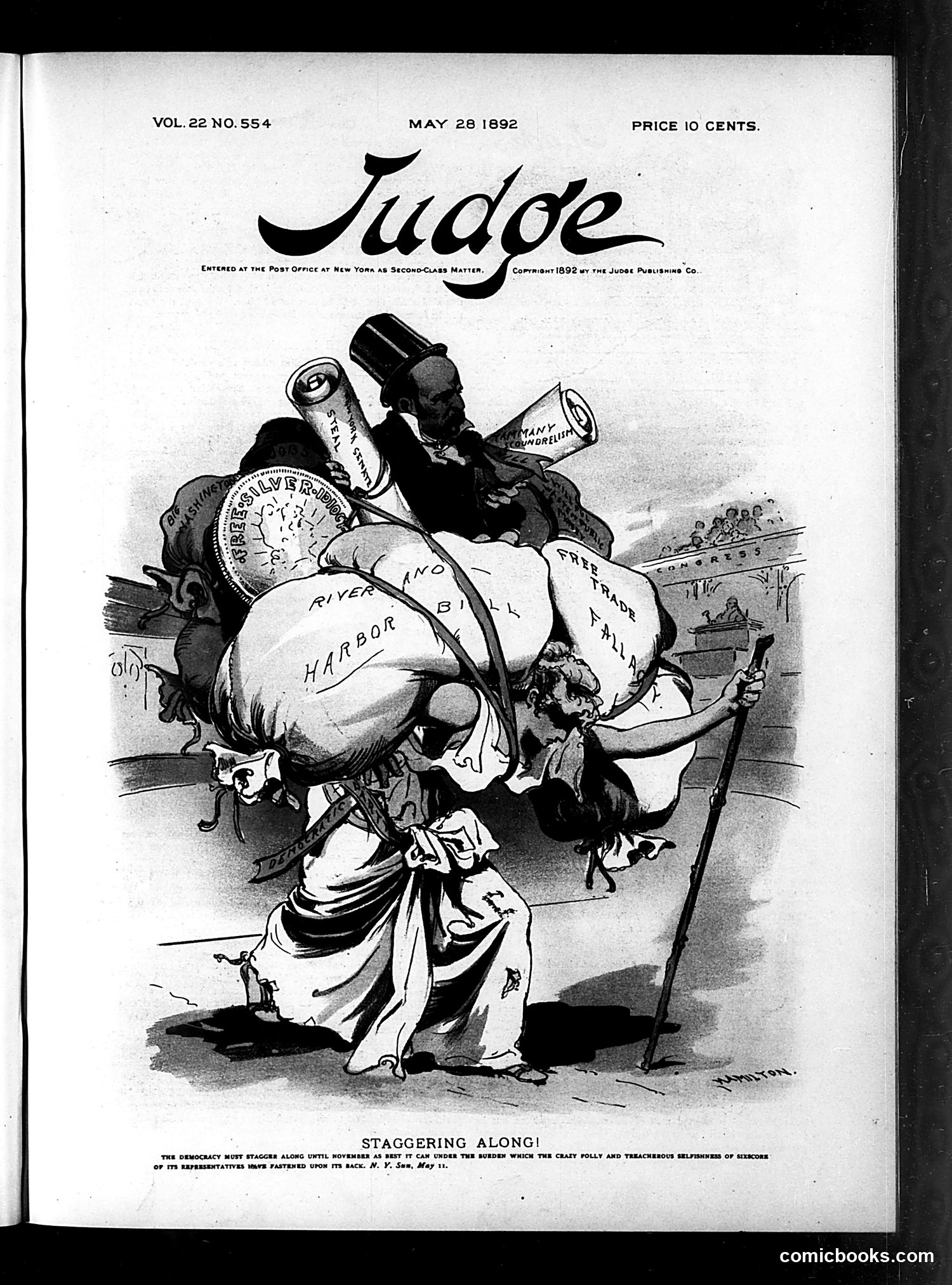
This cartoon satirizes the Democratic Party's political instability during the 1892 election cycle. Lady Columbia (representing America, shown in classical dress with staff) staggers under the weight of competing interests labeled "Harbor Bill," "Free Trade," and "Tariff"—major policy disputes dividing Democrats. The figure atop the burden appears to be a politician (likely representing Democratic leadership) struggling to maintain balance while carrying conflicting legislative priorities. The caption warns that "democracy must stagger along until November at best" under the burden of these internal contradictions. The cartoon mocks the party's inability to reconcile protectionist versus free-trade factions, suggesting Democratic governance is fundamentally unstable and compromised by competing economic interests.
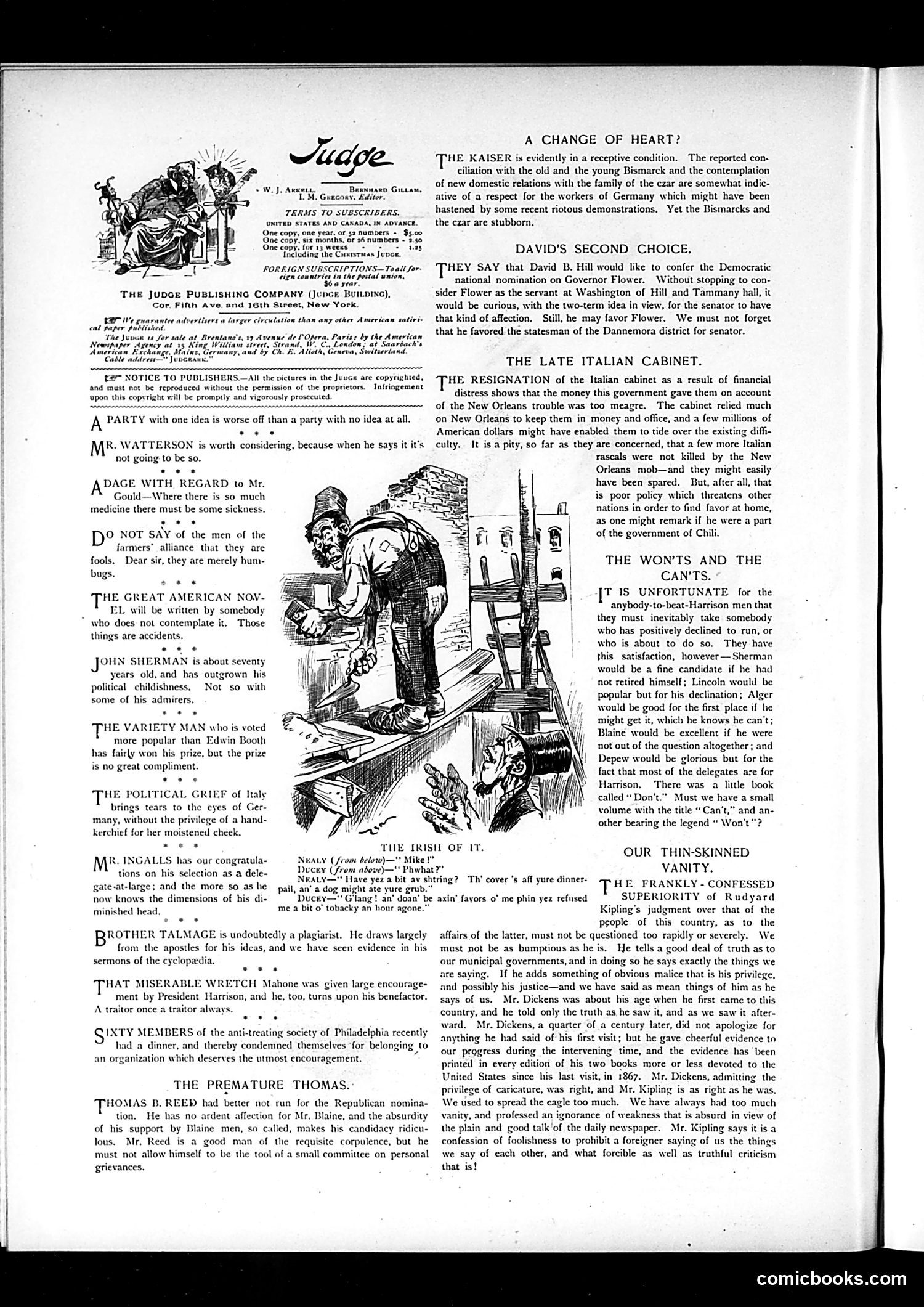
This cartoon depicts an Irish immigrant struggling with an enormous bundle labeled with various demands and burdens. The accompanying text "The Irish of It" suggests satire targeting Irish-American political participation. The joke appears to reference tensions around Irish voters and political machines—likely depicting how Irish immigrants were simultaneously courted for votes while being stereotyped as easily manipulated or burdened by political obligations. The exaggerated caricature and heavy load symbolize the satirical view that Irish voters were weighed down by political bosses' expectations. The surrounding editorial sections discuss political figures like David B. Hill and references to Democratic politics, suggesting this reflects late-19th-century debates about immigrant voting blocs and their influence on American governance—a common Judge magazine target combining nativism with political critique.
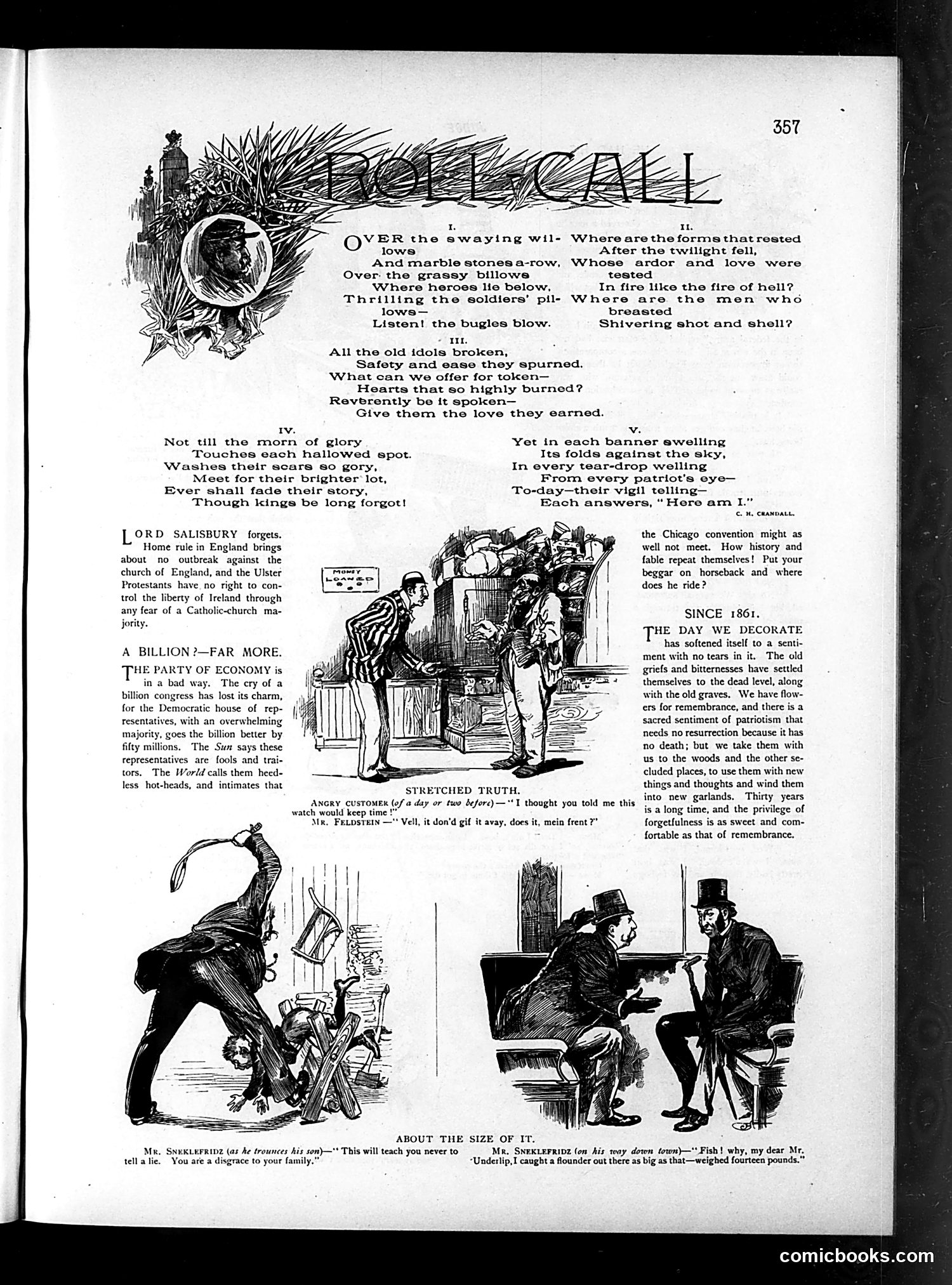
This page contains patriotic poetry about fallen soldiers and memorial observances, likely related to Decoration Day (Memorial Day) observances. The upper sections are verses honoring the dead and graves of soldiers. The three cartoon panels below satirize different social issues: 1. **"A Billion?—Far More"**: Criticizes Democratic politicians, suggesting they mishandle public funds worse than a billion-dollar error. 2. **"Stretched Truth"**: Shows a customer confronting a jeweler about a faulty watch—a common consumer fraud complaint. 3. **"About the Size of It"**: Depicts a conversation about exaggerated fishing tales, poking fun at people who boast. The cartoons use working-class characters to mock political incompetence, commercial dishonesty, and everyday deception. The overall page balances solemn patriotic sentiment with sharp social criticism typical of Judge magazine's satirical approach.
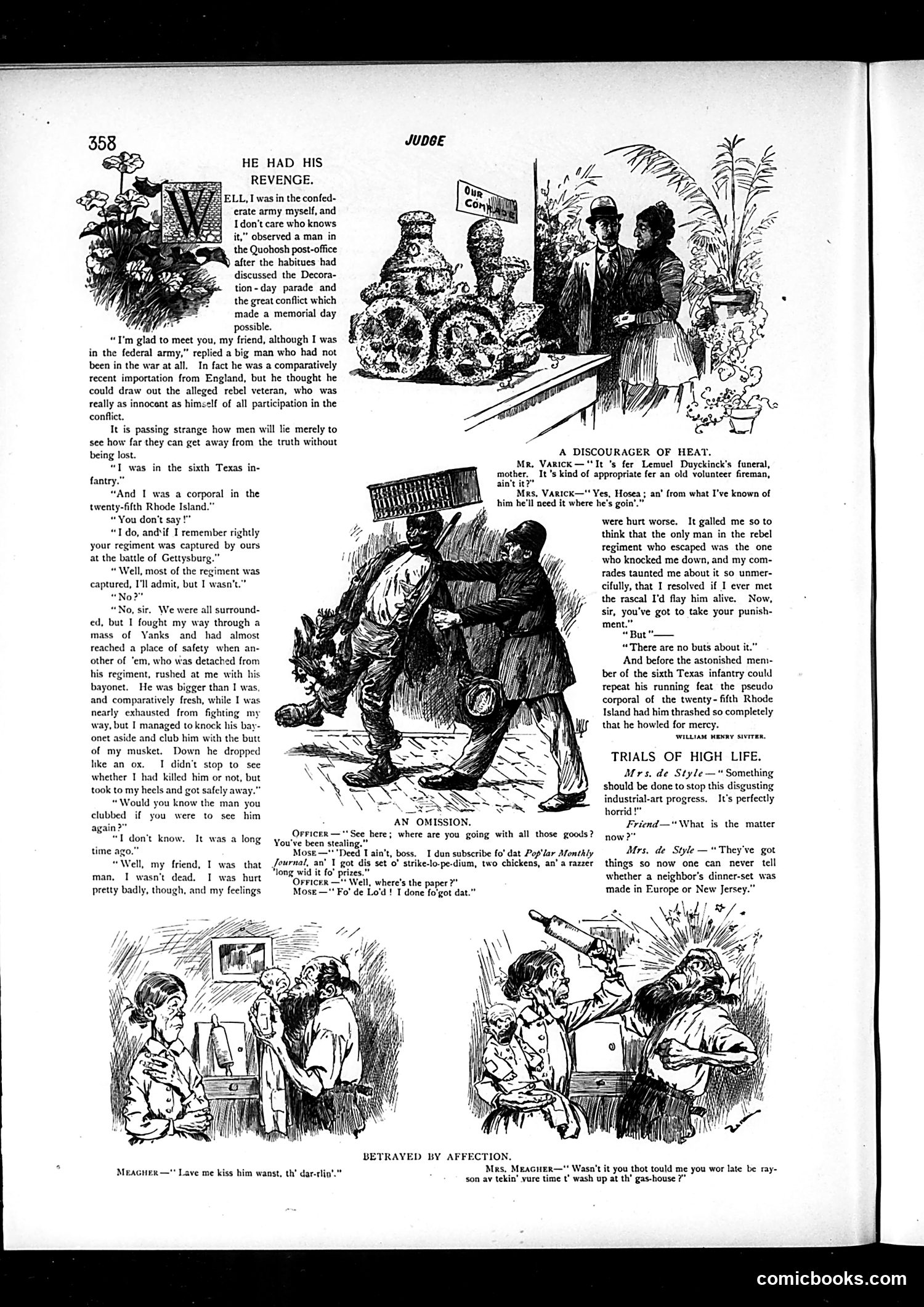
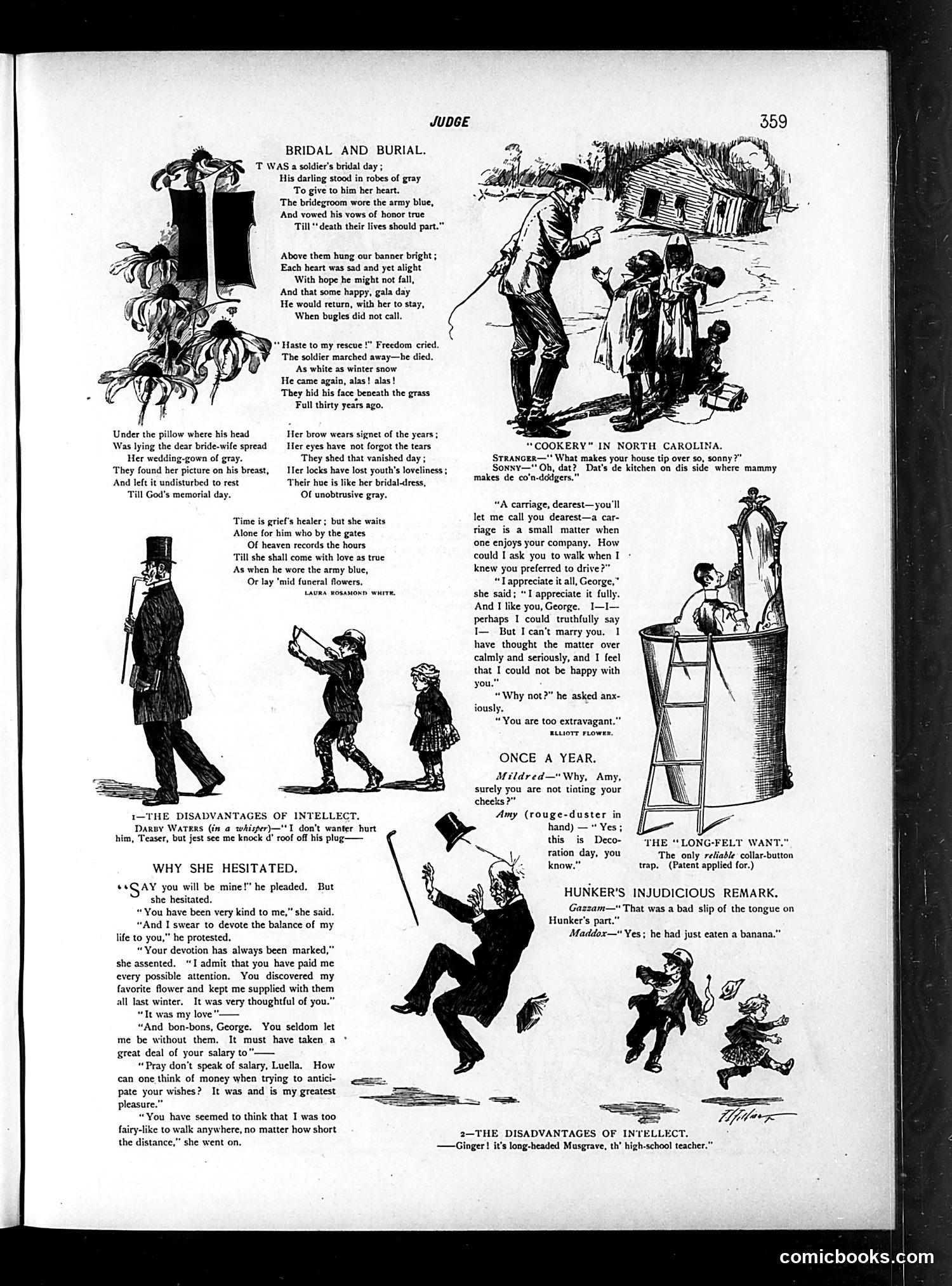
This page contains multiple satirical pieces typical of Judge's late 19th/early 20th-century humor: **"Bridal and Burial"** is a sentimental Civil War poem about a soldier who marries in his army uniform, dies in battle, and whose bride waits thirty years at his grave. The satire lies in Judge's juxtaposition of romantic war sentiment with harsh reality—contrasting the bride's hopeful wedding day against her decades of mourning. **The other humor pieces** mock contemporary social conventions: a woman rejecting an overly extravagant suitor, racial stereotypes in "Cookery in North Carolina," women's vanity about makeup on Decoration Day, and the running "Disadvantages of Intellect" series mocking educated men for being socially awkward. The cartoons emphasize Judge's satirical approach to American life—critiquing both sentimental patriotism and middle-class pretension through visual gags and ironic contrast between stated ideals and actual behavior.
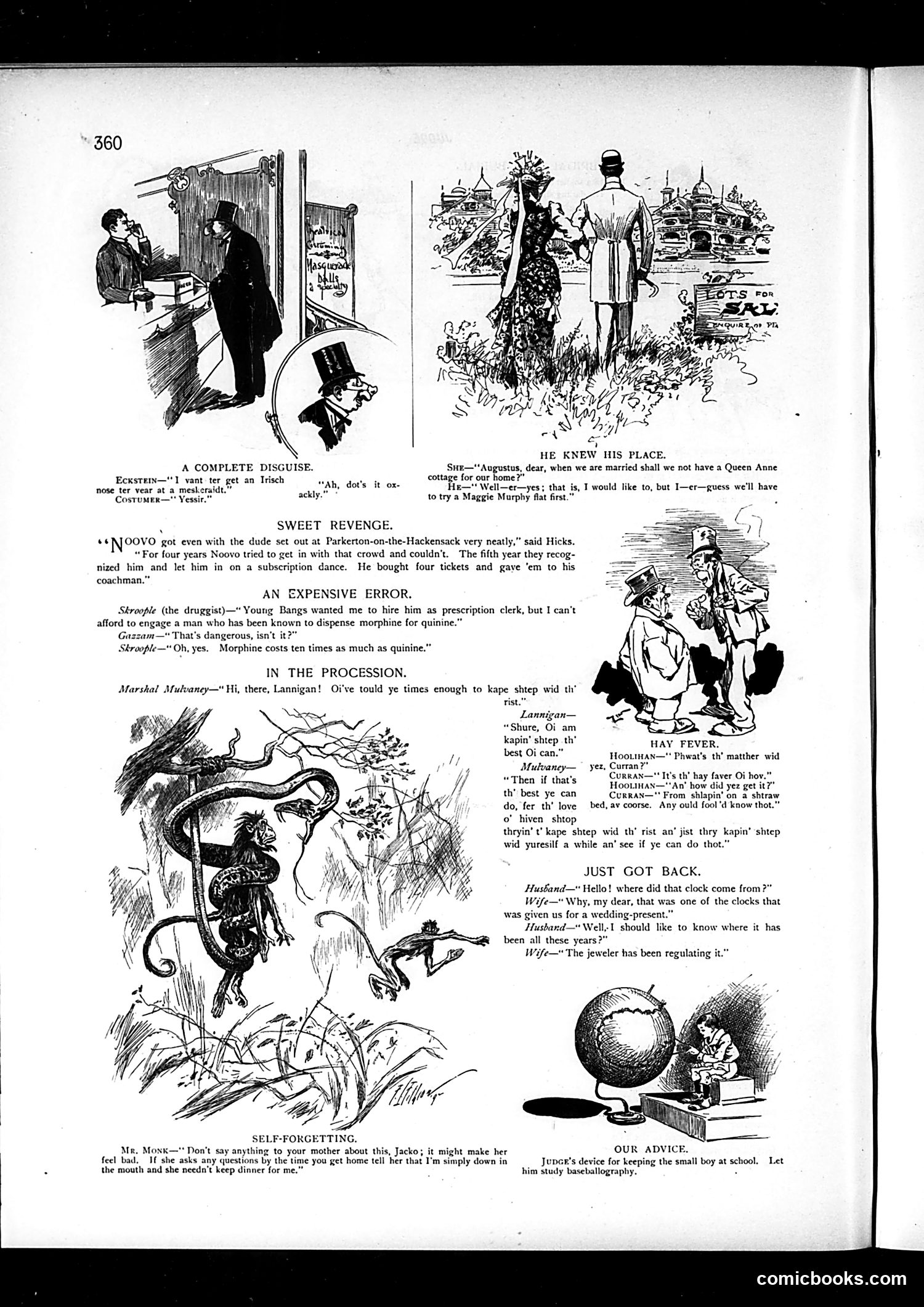
This page collects brief humorous sketches typical of *Judge* magazine's satirical style. The cartoons mock social pretensions and domestic life: **"A Complete Disguise"** and **"He Knew His Place"** target class anxiety—characters attempt to present themselves as wealthy (Queen Anne cottages, upper-class disguises) while their actual circumstances betray them (Irish servants, tenement flats). **"Sweet Revenge"** satirizes social climbing: a man spends years seeking admission to an exclusive crowd, and when finally accepted, exacts subtle revenge by giving away his expensive tickets to his coachman—implying the "dude set" isn't worth the investment. Other sketches mock everyday foolishness: a druggist's hiring mistake (confusing expensive morphine with cheap quinine), domestic mishaps, Irish dialect humor (common in the period), and marital misunderstandings. The humor relies on period-specific class anxieties and ethnic stereotyping typical of early 20th-century American satire.
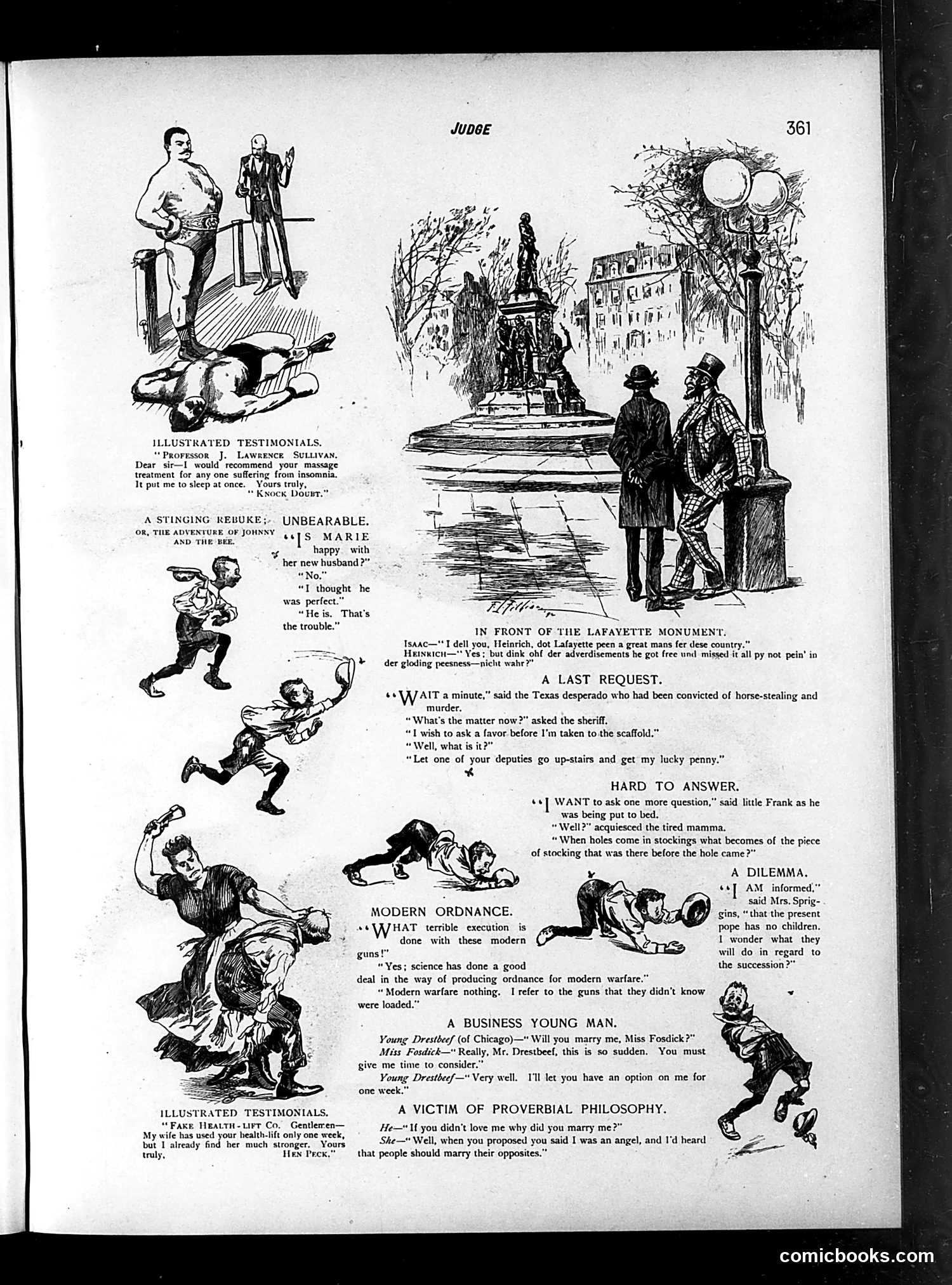
This page from the 19th-century satirical magazine *Judge* contains multiple brief comedic sketches mocking contemporary American society: **"A Last Request"** satirizes the criminal justice system—a condemned Texas outlaw asks for his "lucky penny" before execution, highlighting the superstitions of even hardened criminals. **"Hard to Answer"** jokes about childhood logic: a boy asks his mother what happens to fabric when holes appear in stockings, a question adults struggle to answer sensibly. **"Modern Ordnance"** mocks military technology by conflating "ordnance" (weapons) with guns accidentally discharged because loaded by mistake—dark humor about warfare incompetence. **"A Business Young Man"** satirizes modern courtship as transactional: a suitor offers his fiancée an "option" on marriage like a business contract. **"A Victim of Proverbial Philosophy"** critiques the saying "marry your opposite"—a wife married an "angel" only to discover opposites don't always complement. The page also includes ethnic-stereotype humor and testimonial parodies typical of *Judge*'s satirical approach.
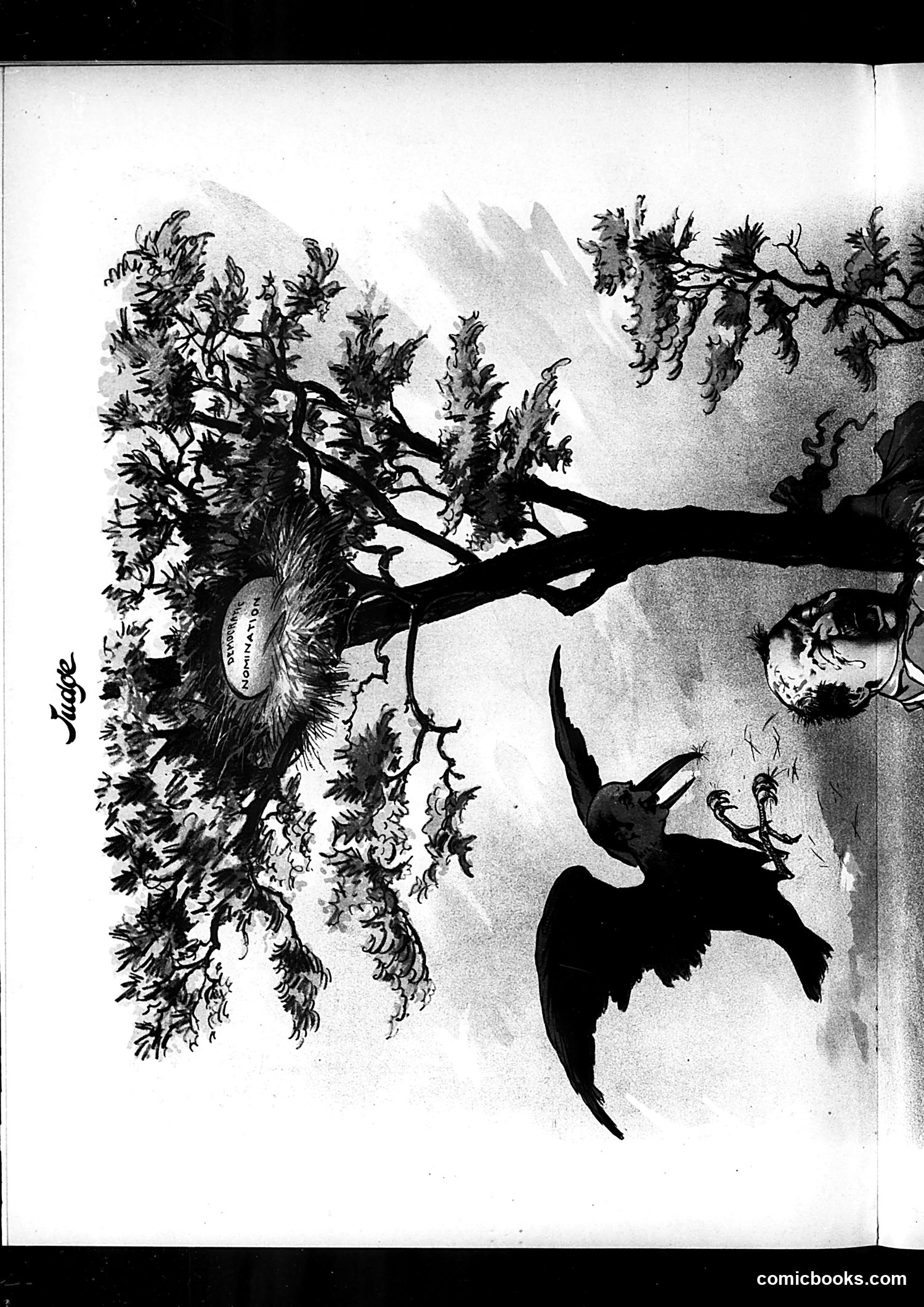
I can see this is a black and white illustration showing silhouetted figures and detailed botanical elements, but the image quality and orientation make it difficult to read specific text or identify particular political figures with certainty. The artistic style appears consistent with late 19th or early 20th-century satirical magazine illustration. To provide an accurate historical explanation, I would need: - Clearer visibility of any caption text or labels - The issue date of Judge magazine - Artist attribution if visible Without these details, I cannot reliably identify the specific figures, political references, or satirical intent. Rather than guess, I must acknowledge the limitations of what I can confidently determine from this reproduction alone.
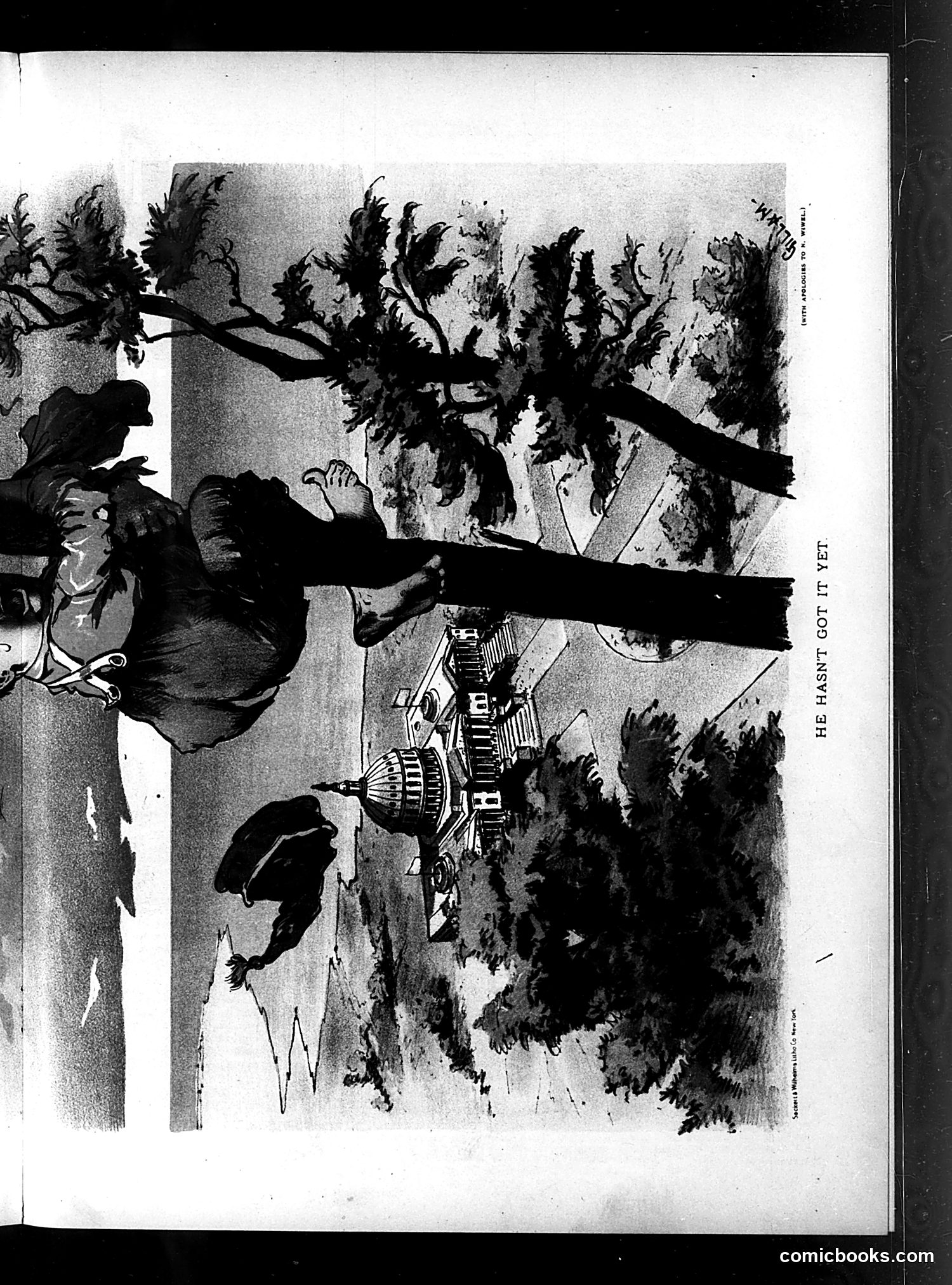
This page from *Judge* magazine shows a figure (appearing to be a politician or public figure) reaching toward a bare, dead tree while surrounded by lush vegetation. The caption reads "HE HASN'T GOT IT YET." The cartoon likely satirizes someone's failed attempts to achieve a political goal or grasp power—the dead tree representing their objective while everything else flourishes around them. The figure's straining posture suggests futile effort. However, the OCR text is severely corrupted and illegible, making it impossible to identify the specific figure, date, or political event referenced. Without readable text or clearer visual context, I cannot definitively explain which politician or controversy this targets or what historical moment it addresses.
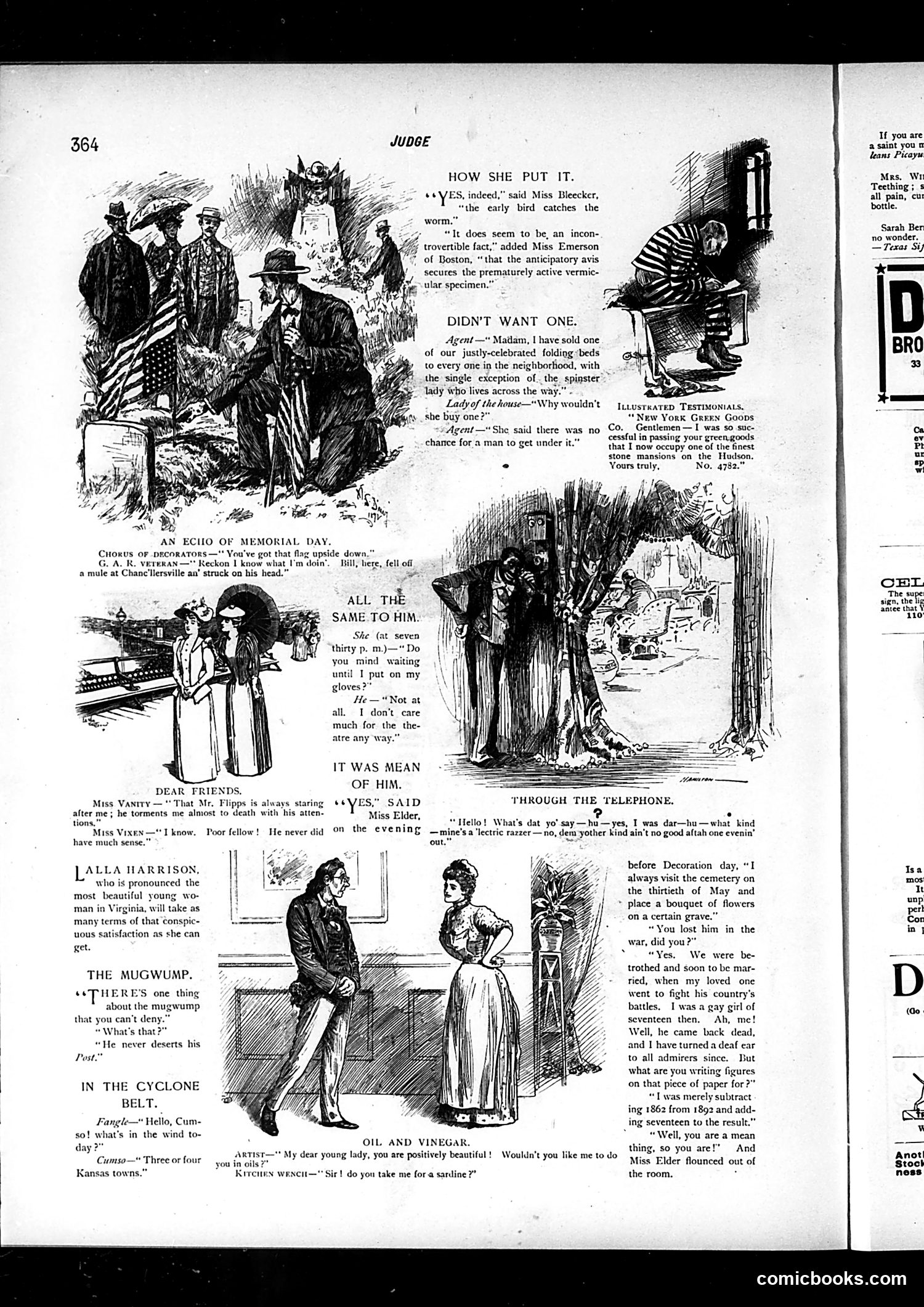
This page contains multiple satirical vignettes typical of late 19th-century American humor: **"An Echo of Memorial Day"**: Mocks Civil War veterans, suggesting one suffered brain damage ("fell off a mule...struck on his head"), explaining why he holds the flag upside down—a joke about veterans' competence. **"All the Same to Him"**: A woman delays attending theater; the man doesn't care, implying he's indifferent to her company—satirizing romantic disinterest. **"Didn't Want One"**: A traveling salesman notes a spinster won't buy a folding bed because "there was no chance for a man to get under it"—crude innuendo about unmarried women's presumed loneliness. **"Oil and Vinegar"**: An artist's hollow compliment to a young woman, followed by asking if she takes a "sanitaire" (likely a corset or medical device)—satirizing courtship duplicity. **"Through the Telephone"**: A woman admits holding a grudge since 1862 (Civil War era); a man does math implying she's aged 30 years—mocking female vanity and aging. The page reflects period prejudices about women, veterans, and courtship conventions.
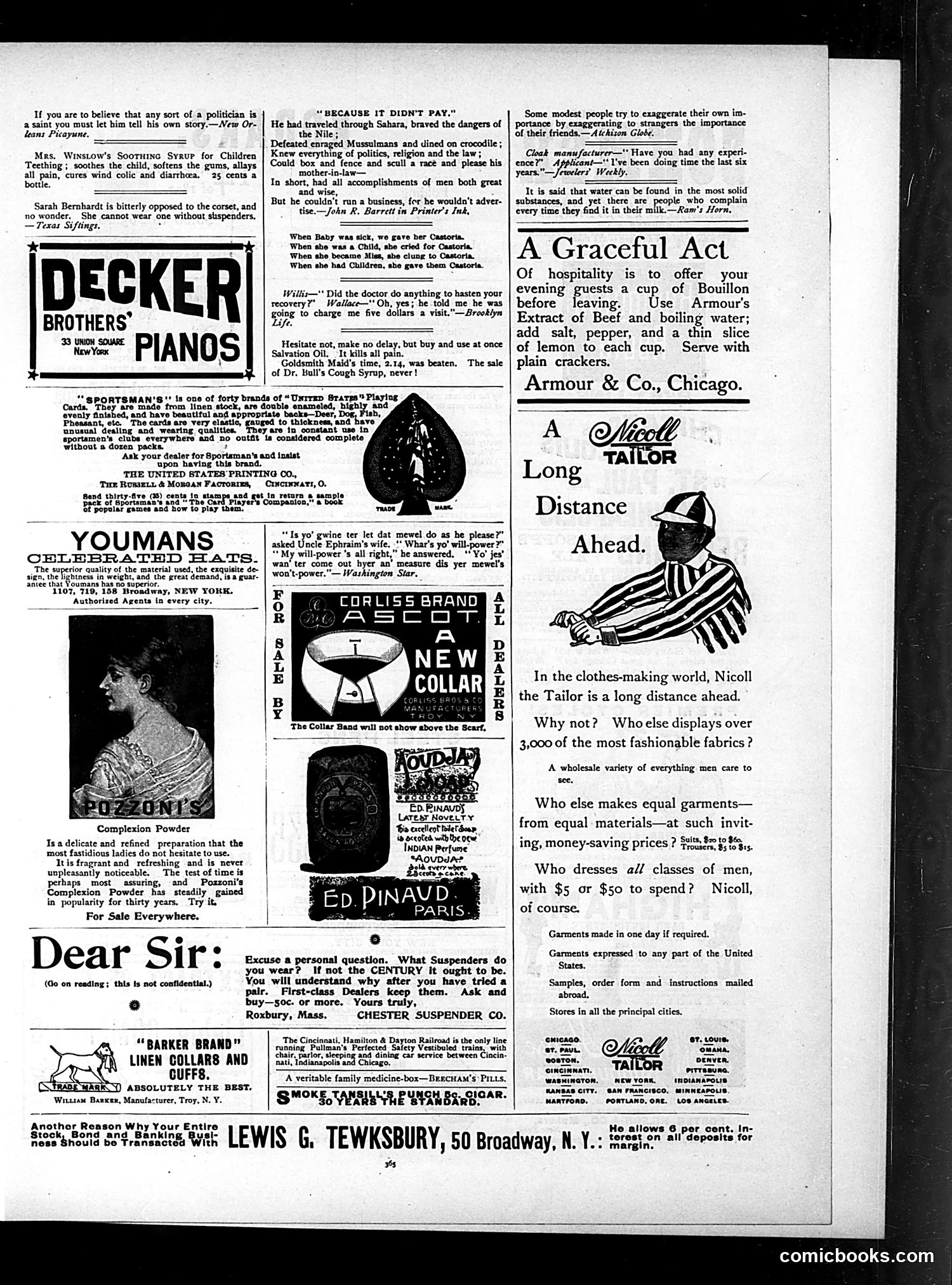
This page from *Judge* magazine is primarily **advertising** rather than editorial cartooning. The ads promote consumer products typical of the late 19th century: pianos, hats, collars, suspenders, and patent medicines (cough syrup, teething syrup, complexion powder). The few brief satirical items are short, punchy jokes: - **Sarah Bernhardt corset joke**: References the famous actress's body, implying she's so large she'd need suspenders to keep a corset up—a body-shaming gag. - **"Because It Didn't Pay"**: A cautionary verse about a well-accomplished man who failed in business because he wouldn't advertise—essentially an advertisement masquerading as satire. - **Uncle Ephraim dialect joke**: Features racist stereotyping common to the era, with a Black character portrayed in exaggerated dialect. The page reflects *Judge*'s mix of advertising revenue and light satirical content, with humor often relying on then-acceptable mockery of women's bodies, immigrants, and racial minorities.
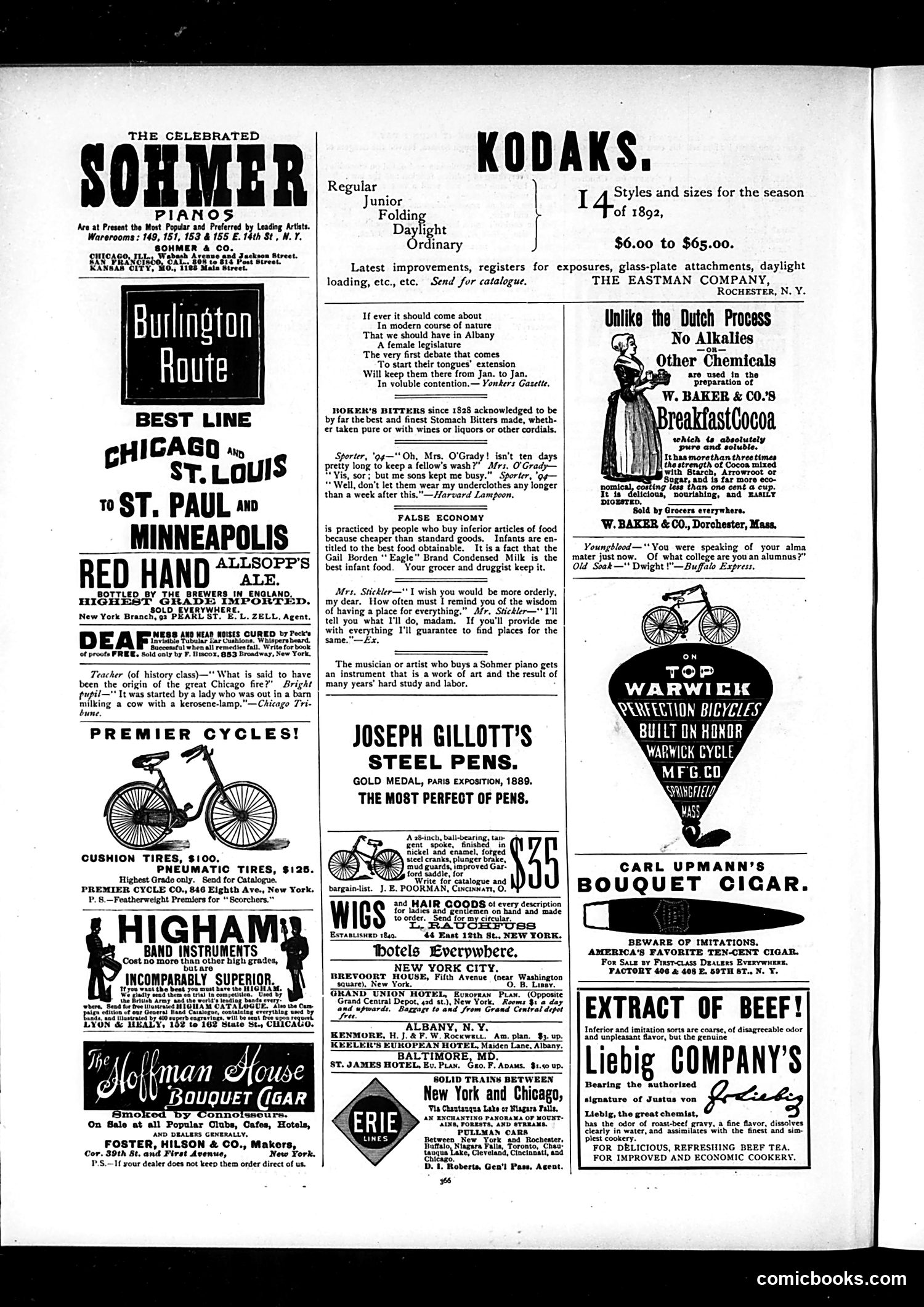
This page is primarily an **advertising section** from Judge magazine (circa 1892, based on the Kodak reference to "the season of 1892"). The only discernible **cartoon or satirical content** is the brief **dialogue jokes**: 1. **The Albany Legislature joke** references the contemporary idea of women in politics—a satirical prediction that if women held the Albany state legislature, debates would be endlessly prolonged and quarrelsome. This reflects 1890s skepticism about female political participation. 2. **The O'Grady laundry joke** is an ethnic humor piece mocking an Irish family's cleanliness through a thick-accent stereotype. 3. **The Sohmer piano joke** satirizes male domestic disorganization. 4. **The history teacher joke** references the Chicago Fire origin legend (Mrs. O'Leary's cow). These are mild period humor. The rest of the page consists of product advertisements for pianos, bicycles, ink pens, cocoa, cigars, and other goods typical of late-19th-century American publications.
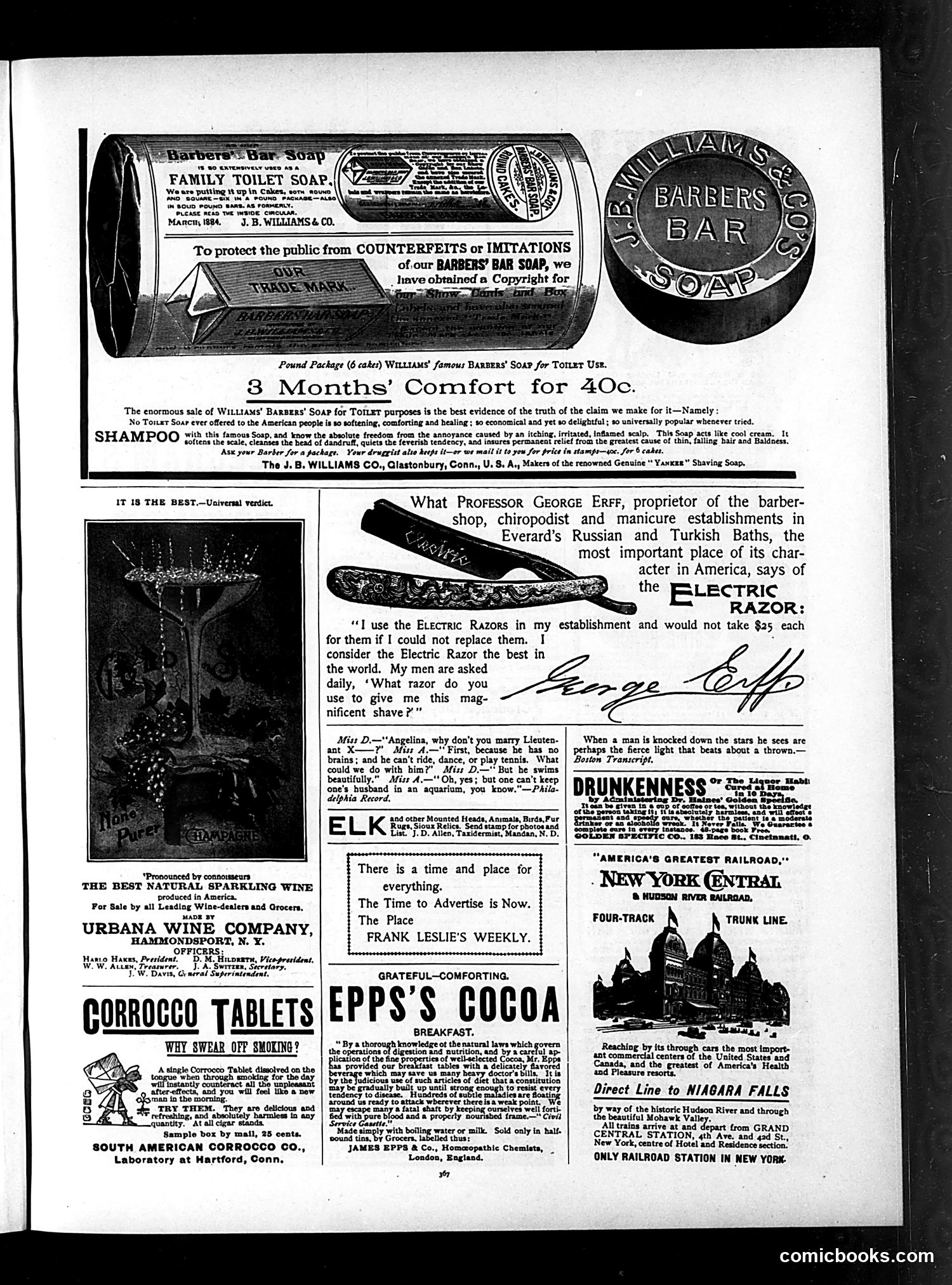
This is primarily an **advertising page** from Judge magazine, circa 1890s, featuring various patent medicines, soaps, wines, and railroad services typical of the era. ## The One Notable Content: The only satirical item is a **brief joke** (credited to Philadelphia Record) about a woman named Miss D. being urged to marry a man named Lieutenant X. The humor relies on the period's class/social anxieties: though the lieutenant "swims beautifully," Miss D. dismisses him by quipping one "can't keep one's husband in an aquarium"—a joke about his unsuitability for marriage despite one accomplishment. It's gentle domestic humor poking fun at courtship standards. ## Advertisements Include: - Williams' Barbers' Bar Soap - Corrocco smoking-cessation tablets - Urbana Wine Company - Electric Razors (endorsed by Professor George Erff) - Epps's Cocoa - New York Central Railroad The page lacks significant political satire or caricature—it's commercial content typical of Judge's revenue model.
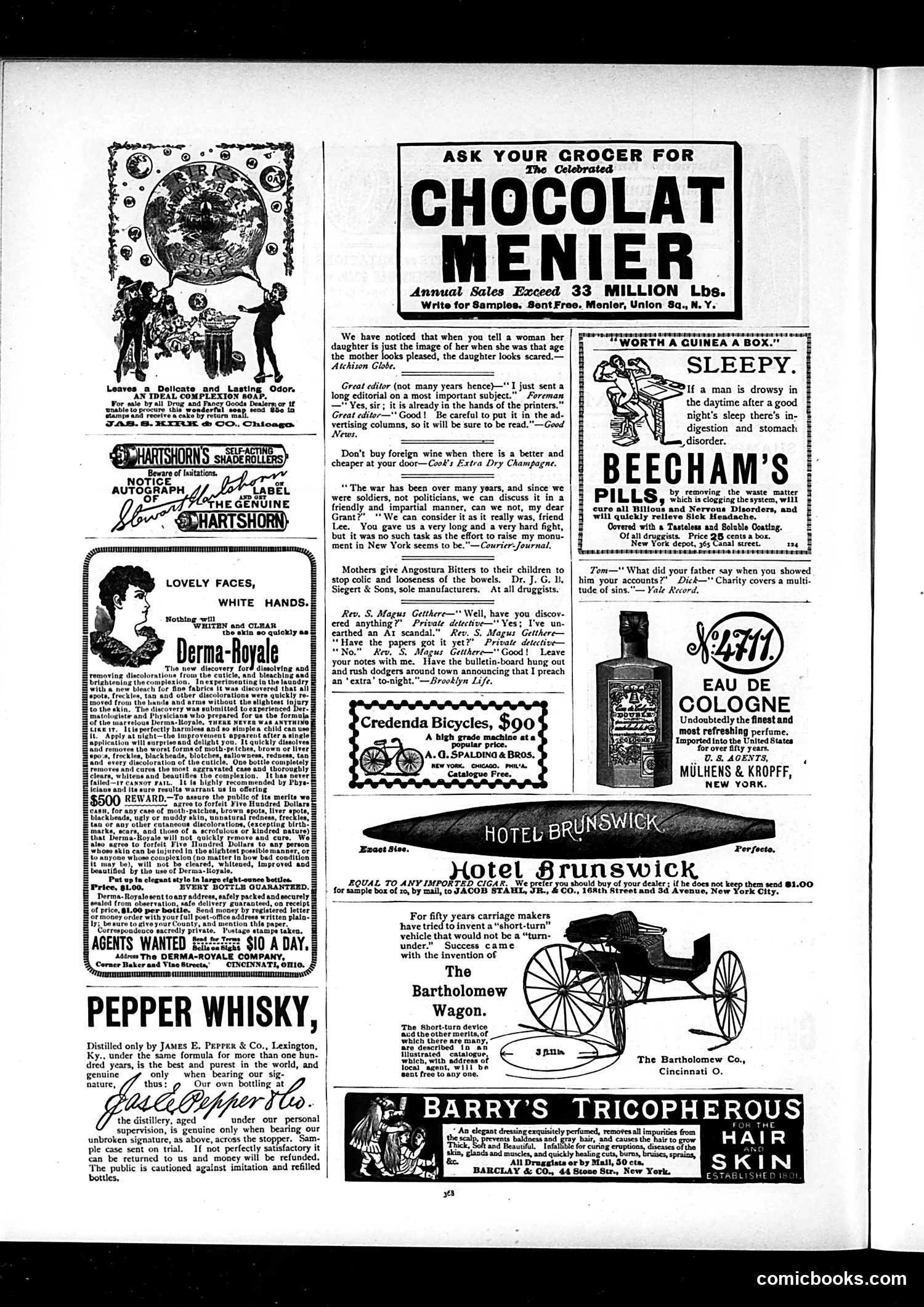
This page is primarily **advertising**, not political satire. It contains numerous patent medicine and product advertisements typical of the late 19th/early 20th century. The small editorial cartoons/jokes scattered among ads include: 1. **"Lovely Faces, White Hands"** section: Promotes "Derma-Royale," a skin-bleaching cream claiming to remove discoloration, freckles, and "liver spots." This reflects era-specific beauty standards favoring pale skin. 2. **Brief humorous quips**: One jokes about complimenting a woman's appearance; another satirizes editors prioritizing advertisements over editorial content—suggesting advertising revenue drove publications. 3. **Products advertised**: Chocolate Menier, Beecham's Pills (digestive aids), Pepper Whisky, Hotel Brunswick, Bartholomew Wagon, and Barry's hair/skin treatments. The page reflects **historical attitudes about race, gender, and commerce**—particularly the prevalence of skin-lightening products marketed to women. The overall tone is commercial rather than politically satirical; advertisements dominate the content.
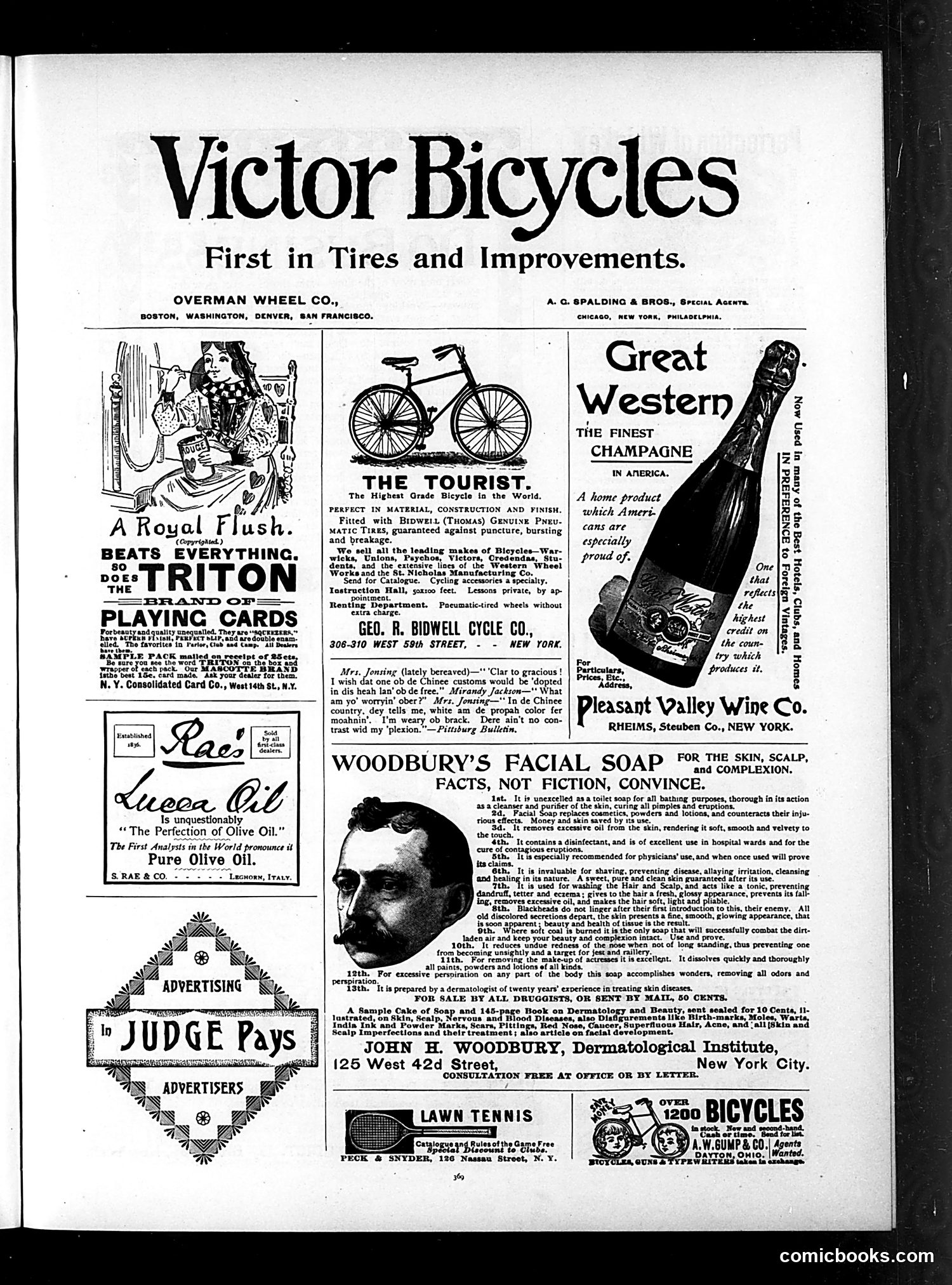
This page is primarily **advertising**, not political satire. It showcases various consumer products popular in the late 19th/early 20th century. The one notable cartoon ("A Royal Flush") depicts a woman in luxurious repose, advertising playing cards. The title is a pun on the poker hand. A small embedded cartoon shows a Black woman ("Mrs. Jonesing") speaking in heavy dialect to another Black character, discussing Chinese funeral customs. She wishes America would adopt the practice of "turning the corpse face down" because it would improve her appearance—a crude racist joke implying ugliness. The page's main content consists of ads for **bicycles** (Victor, Tourist brands), **champagne**, **olive oil**, **facial soap**, and other goods. The bicycle advertisements emphasize technical superiority and safety features—reflecting the cycling craze of the 1890s-1900s. Woodbury's Facial Soap takes up substantial space with detailed medical claims about skin health. This reflects Judge's dual nature: satirical commentary mixed with lucrative advertising that subsidized publication.
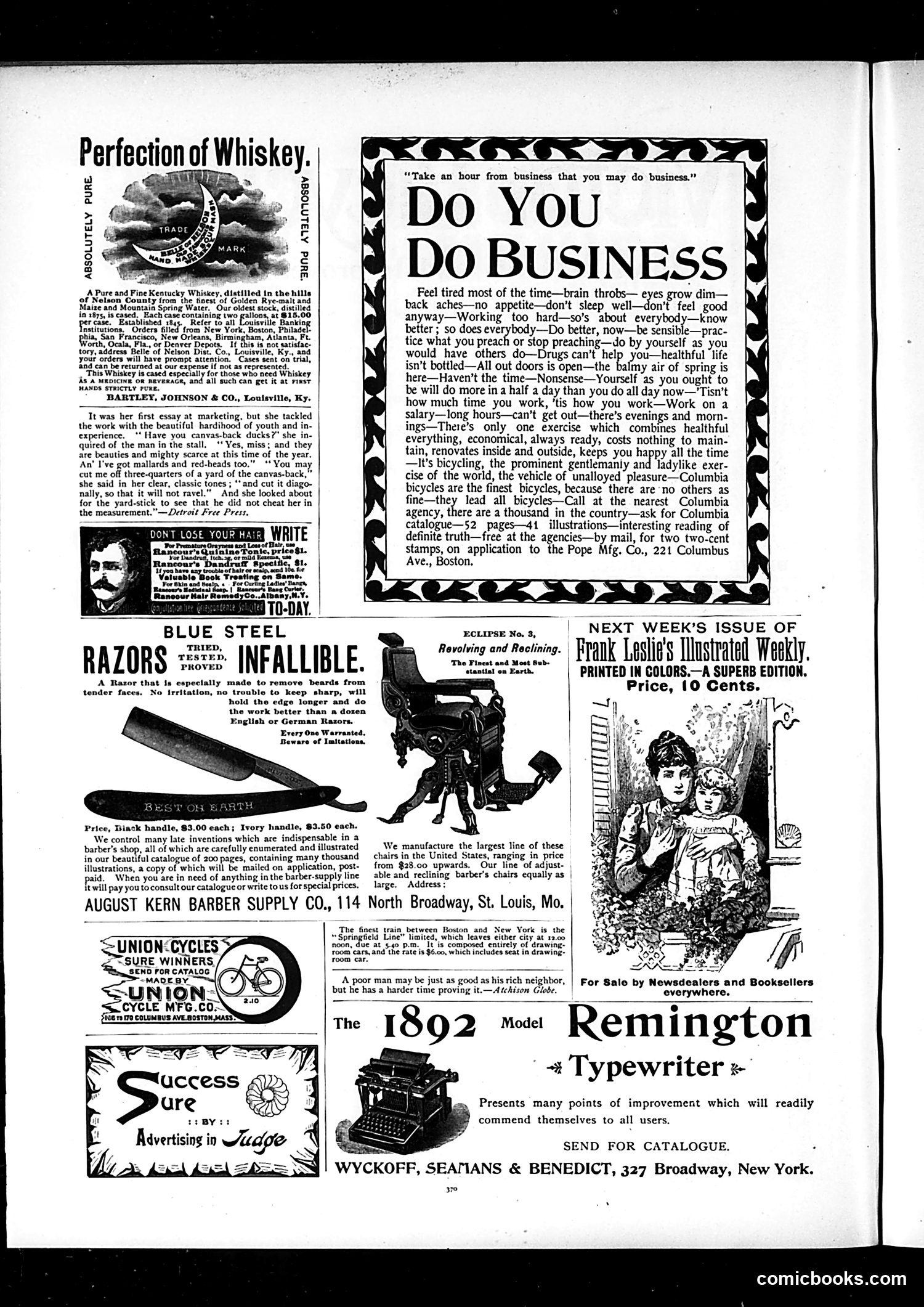
This page is primarily **advertising**, with one satirical article. The main content is: **"Do You Do Business"** — A humorous health advice piece promoting Columbia bicycles as the solution to overwork and exhaustion. The article mocks the excuses of tired businesspeople ("Working too hard—so's about everybody") and prescribes bicycling as the cure-all exercise that will restore productivity. It's satirizing the era's obsession with self-improvement through activity while gently criticizing workaholic culture. The remaining content consists of period advertisements for whiskey, razors, barber supplies, bicycles, and a typewriter — typical of Judge's revenue model. **Historical context for modern readers**: This reflects late 19th/early 20th-century attitudes toward health, recreation, and the emerging bicycle craze as both a legitimate exercise solution and a status symbol for the middle and upper classes.
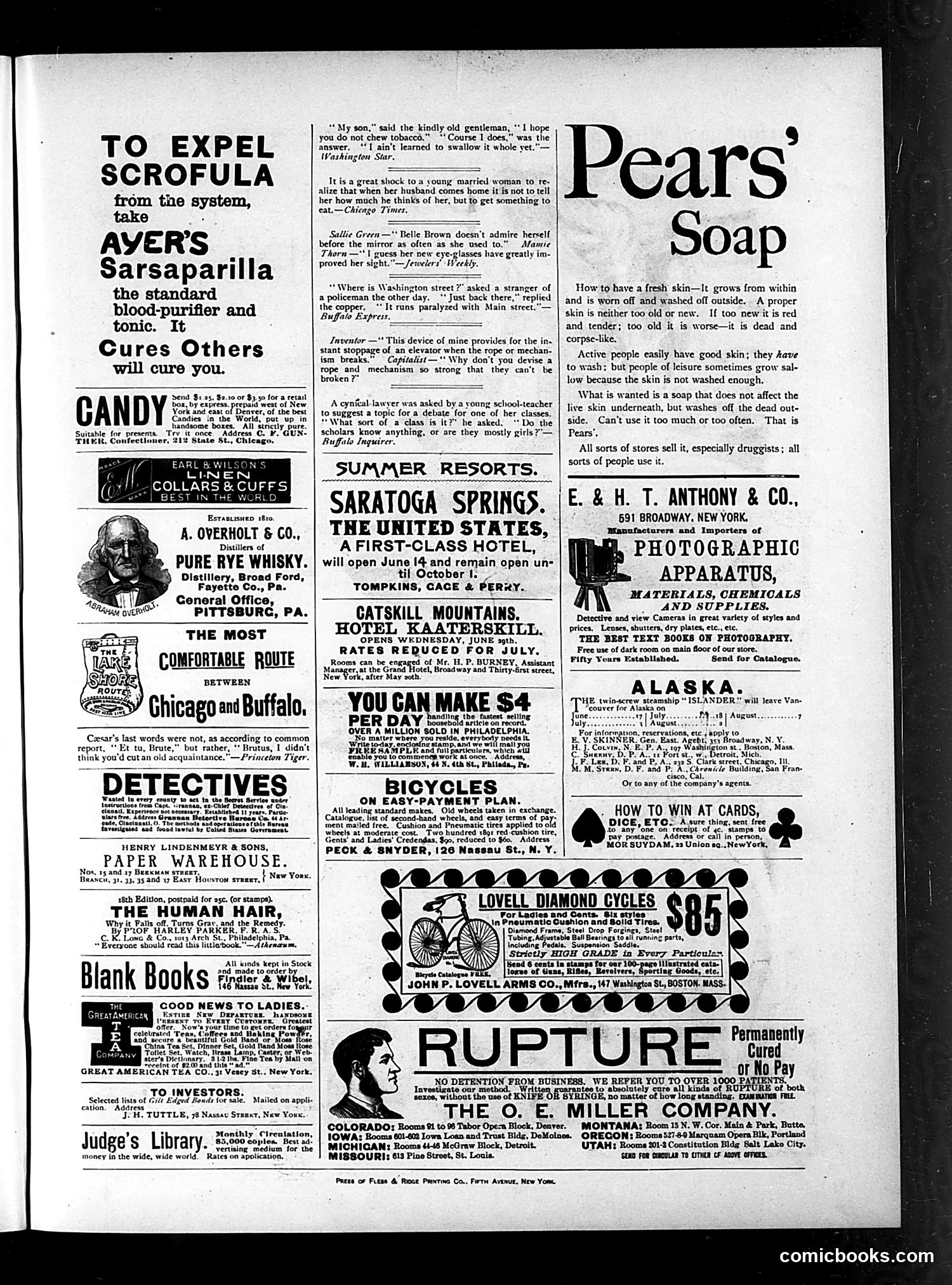
This page is primarily **advertisements and short humor items**, with no political cartoons. It's from what appears to be the late 19th century (circa 1880s-1890s based on references and styling). The humor pieces are brief jokes playing on contemporary social observations: - A boy hasn't learned to "swallow" tobacco whole (joke about tobacco chewing) - A married woman expects her husband home to express affection, not ask for food - A woman's appearance improved with new eyeglasses (implying vanity) - A lawyer cynically asks if schoolgirls "know anything" - An inventor is mocked for not designing stronger elevator ropes These reflect period attitudes about gender, social behavior, and courtship. The page is dominated by **product advertisements** (Ayer's Sarsaparilla, whiskey, bicycles, paper goods) typical of Judge magazine's revenue model. No significant political satire or caricature appears on this particular page.
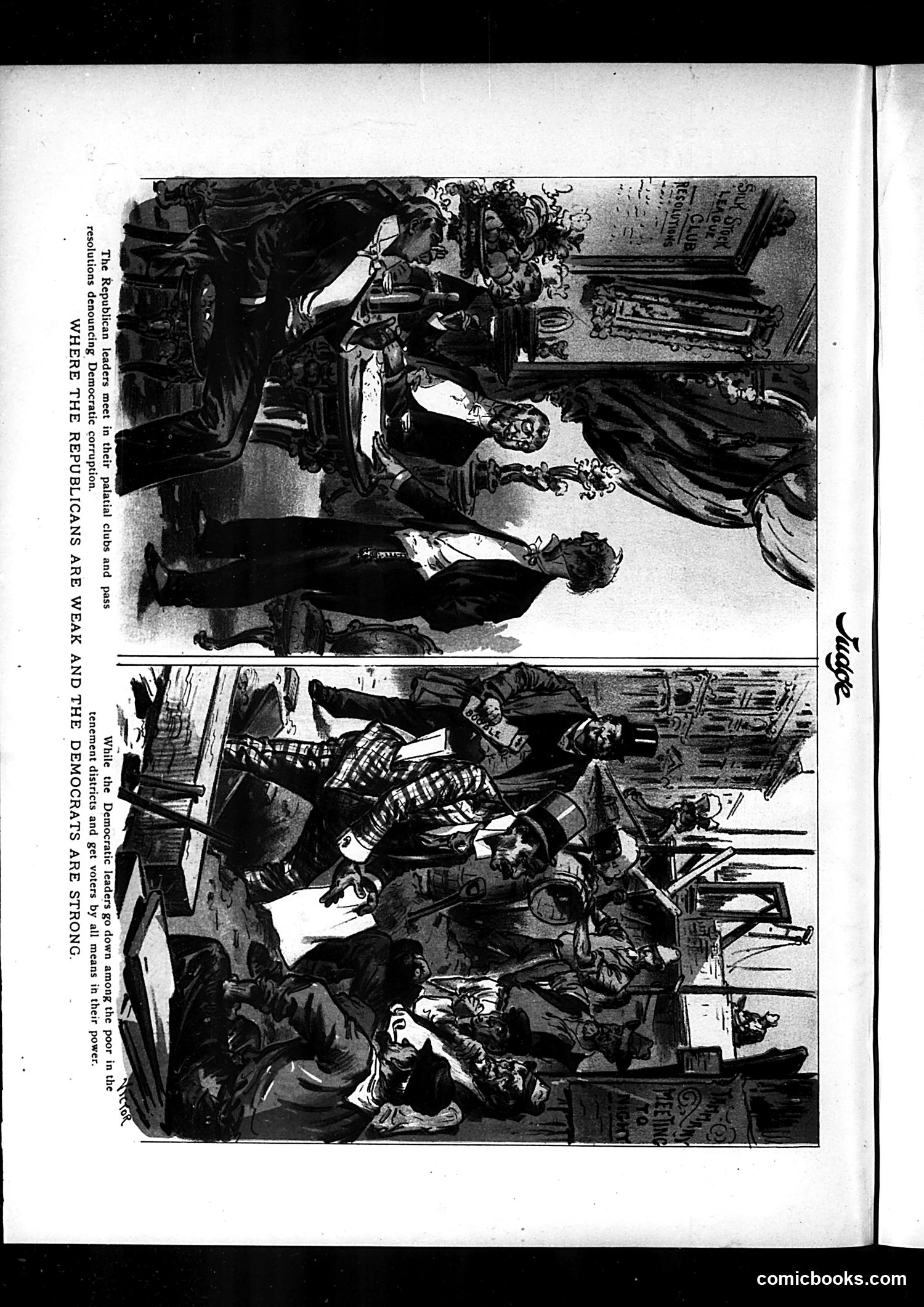
This Judge magazine cartoon contrasts Republican and Democratic campaign strategies in the Gilded Age. The top panel shows Republican leaders in an ornate, wealthy club passing resolutions against Democratic corruption—depicted as comfortable, detached from ordinary people. The bottom panel shows Democratic leaders actively canvassing poor tenement neighborhoods, directly engaging voters through personal contact and persuasion ("by all means in their power"). The satire critiques Republicans as hypocritical: they denounce corruption while remaining isolated in elite spaces, unaware of or unconcerned with working-class concerns. Meanwhile, Democrats succeed politically precisely because they engage with poor voters on the ground, regardless of their methods. The cartoon's title suggests Democrats' grassroots presence is their actual strength, while Republicans' weakness stems from their disconnection from ordinary people.