
Judge, 1892-05-28 · page 5 of 18
Judge — May 28, 1892 — page 5: what you’re looking at
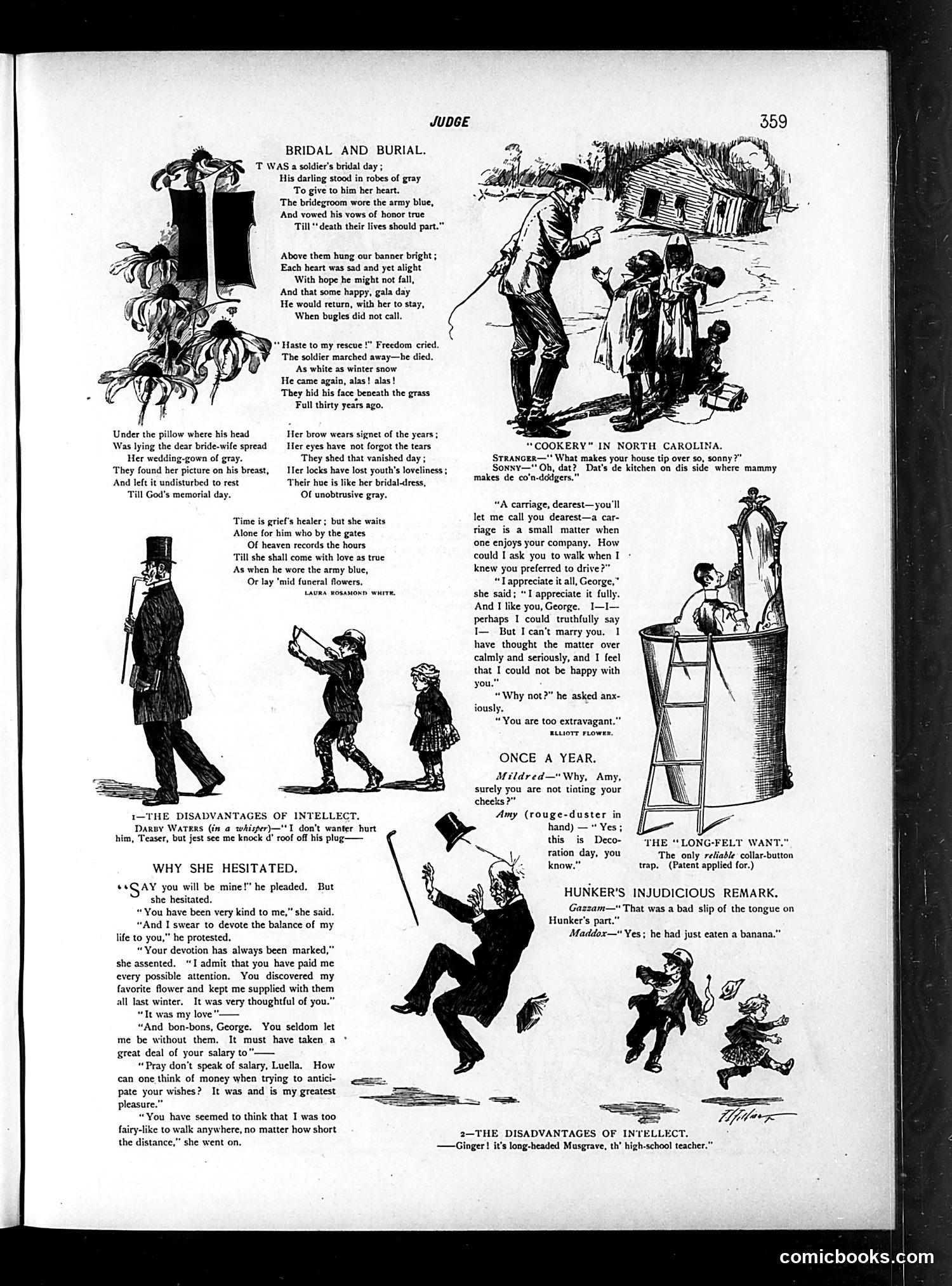
What you’re looking at
This page contains multiple satirical pieces typical of Judge's late 19th/early 20th-century humor: **"Bridal and Burial"** is a sentimental Civil War poem about a soldier who marries in his army uniform, dies in battle, and whose bride waits thirty years at his grave. The satire lies in Judge's juxtaposition of romantic war sentiment with harsh reality—contrasting the bride's hopeful wedding day against her decades of mourning. **The other humor pieces** mock contemporary social conventions: a woman rejecting an overly extravagant suitor, racial stereotypes in "Cookery in North Carolina," women's vanity about makeup on Decoration Day, and the running "Disadvantages of Intellect" series mocking educated men for being socially awkward. The cartoons emphasize Judge's satirical approach to American life—critiquing both sentimental patriotism and middle-class pretension through visual gags and ironic contrast between stated ideals and actual behavior.
📄 Transcribed text from this page (OCR, searchable)
Machine-transcribed from the original scan — historical spelling and the odd misread are preserved.
JUDGE BRIDAL AND BURIAL. T WAS a soldier's bridal day ; Under the pillow where his head Was lying the dear bride-wife spread Her wedding-gown of gray. ‘They found her picture on his breast, And left it undisturbed to rest Till God's memorial day. His darling stood in robes of gray To give to him her heart. The bridegroom wore the army blue, ‘And vowed his vows of honor true Till “death their lives should part.”” Above them hung our banner bright ; Each heart was sad and yet alight With hope he might not fall, ‘And that some happy, gala day He would return, with her to stay, When bugles did not call. Jaste to my rescue !” Freedom cried. The soldier marched away—he died. As white as winter snow He came again, alas! alas! They hid his face beneath the grass Full thirty years ago. Her brow wears signet of the years; Her eyes have not forgot the tears ‘They shed that vanished day ; Ter locks have lost youth's loveliness ; Their hue is like her bridal-dress, Of unobtrusive gray. Time is grief's healer ; but she waits Alone for him who by the gates Of heaven records the hours Till she shall come with love as true As when he wore the army blue, COOKERY" IN NORTH CAROLINA. STRANGER—"* What makes your house tip over so, sonny?” Sonxy—"'Oh, dat? Dat's de kitchen on dis side where mammy makes de co'n-dédgers."” “A carriage, dearest—you'll let me call you dearest—a car- riage is a small matter when one enjoys your company. How could [ask you to walk when I knew you preferred to drive?” Or lay ‘mid funeral flowers. LAURA ROSAMOND WHITH, “Tappreciate it all, George,” she said; “I appreciate it fully. And I like you, George. I—I— perhaps I could truthfully say I— But Ican't marry you. 1 have thought the matter over calmly and seriously, and I feel that I could not be happy with you.” “Why not?” he asked anx- iously. “You are too extravagant.” RLLIOTT Flown. ONCE A YEAR. Mildred—"Why, Amy, surely you are not tinting your cheeks?" Amy (rouge-duster in hand) — * Yes ; this is Deco- “THE “LONG-FELT WANT.” ration day, you The only reliable collar-button WHY SHE HESITATED. ~ know." trap, (Patent applied for.) +*GAY you will be mine!” he pleaded. But she hesitated. “You have been very kind to me,” she said. “And I swear to devote the balance of my life to you,” he protested. “Your devotion has always been marked,” she assented. “I admit that you have paid me every possible attention. You discovered my favorite flower and kept me supplied with them all last winter. It was very thoughtful of you.” “Tt was my love "— “And bon-bons, George. You seldom let me be without them, It must have taken a * great deal of your salary to” — “Pray don't speak of salary, Luella, How can one think of money when trying to antici- hes? di 2 pate your wishes? It was and is my greatest pleasure.” SS “You have seemed to think that I was too fairy-like to walk anywhere, no matter how short the distance,” she went on. ‘THE DISADVANTAGES OF INTELLECT, Danny WATERS (in a whisfer)—"'T don't wanter hurt him, Teaser, but jest see me knock a roof off his plug— HUNKER’S INJUDICIOUS REMARK. “That was a bad slip of the tongue on —— SSS Lif a-z— 2—THE DISADVANTAGES OF INTELLECT. —Ginger! it's long-headed Musgrave, th’ high-school teacher.” coniicbooks ta