
A complete issue · 18 pages · 1892
Judge — March 19, 1892
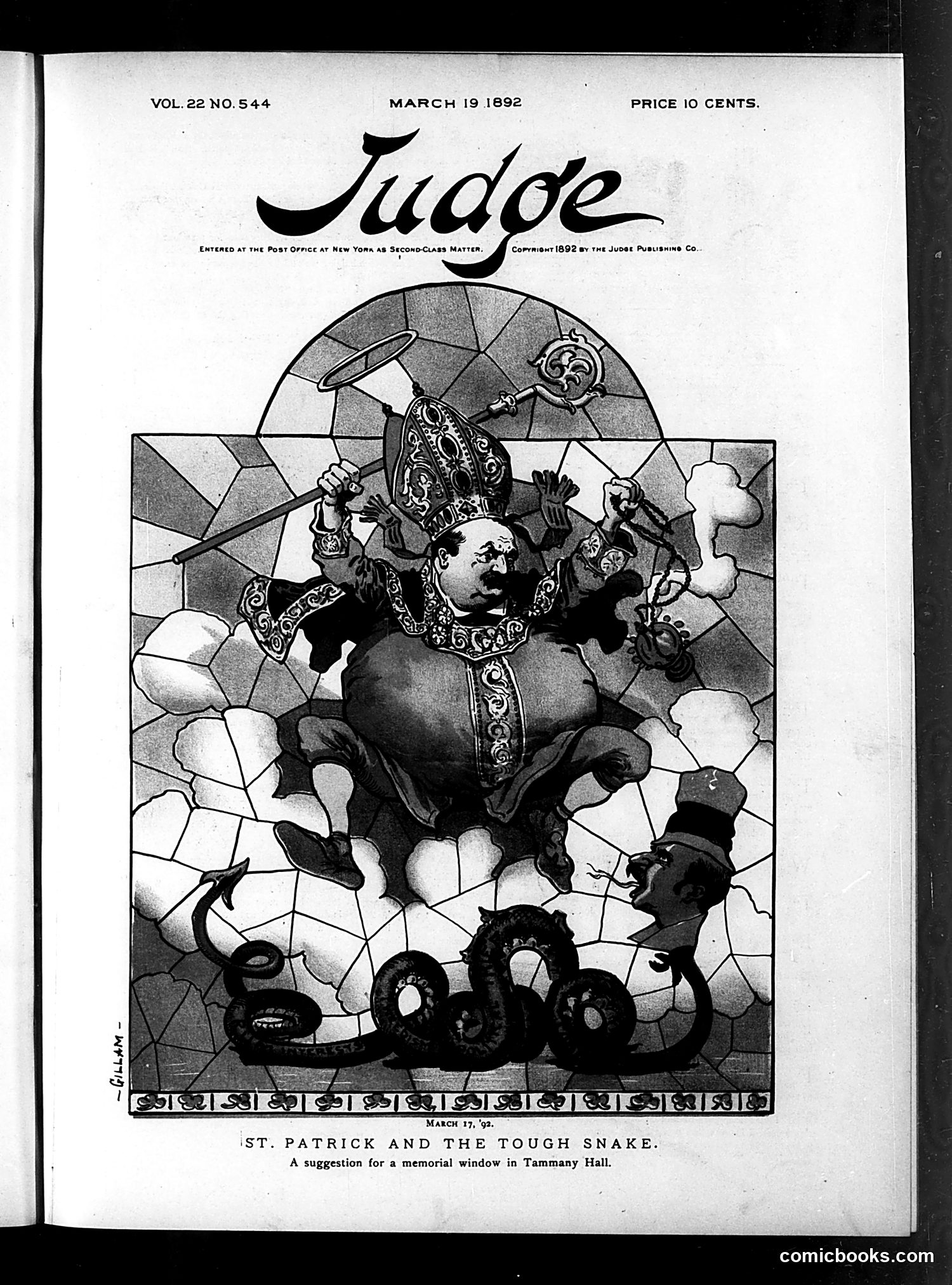
This 1892 *Judge* cartoon satirizes Irish-American political power, specifically in Tammany Hall (the Democratic political machine controlling New York City). The central figure appears to be a caricatured Irish politician or personification of Irish-American interests, depicted as St. Patrick in ornate religious vestments, seated triumphantly above serpents. The satire suggests that Irish-American political leaders—through Tammany Hall—are "taming" or controlling the "tough snake," likely representing political corruption, criminal elements, or rival factions. The subtitle indicates this is "a suggestion for a memorial window in Tammany Hall," mockingly proposing a religious monument to celebrate the organization's power. The cartoon reflects contemporary anxieties about Irish-Catholic political dominance in American cities.
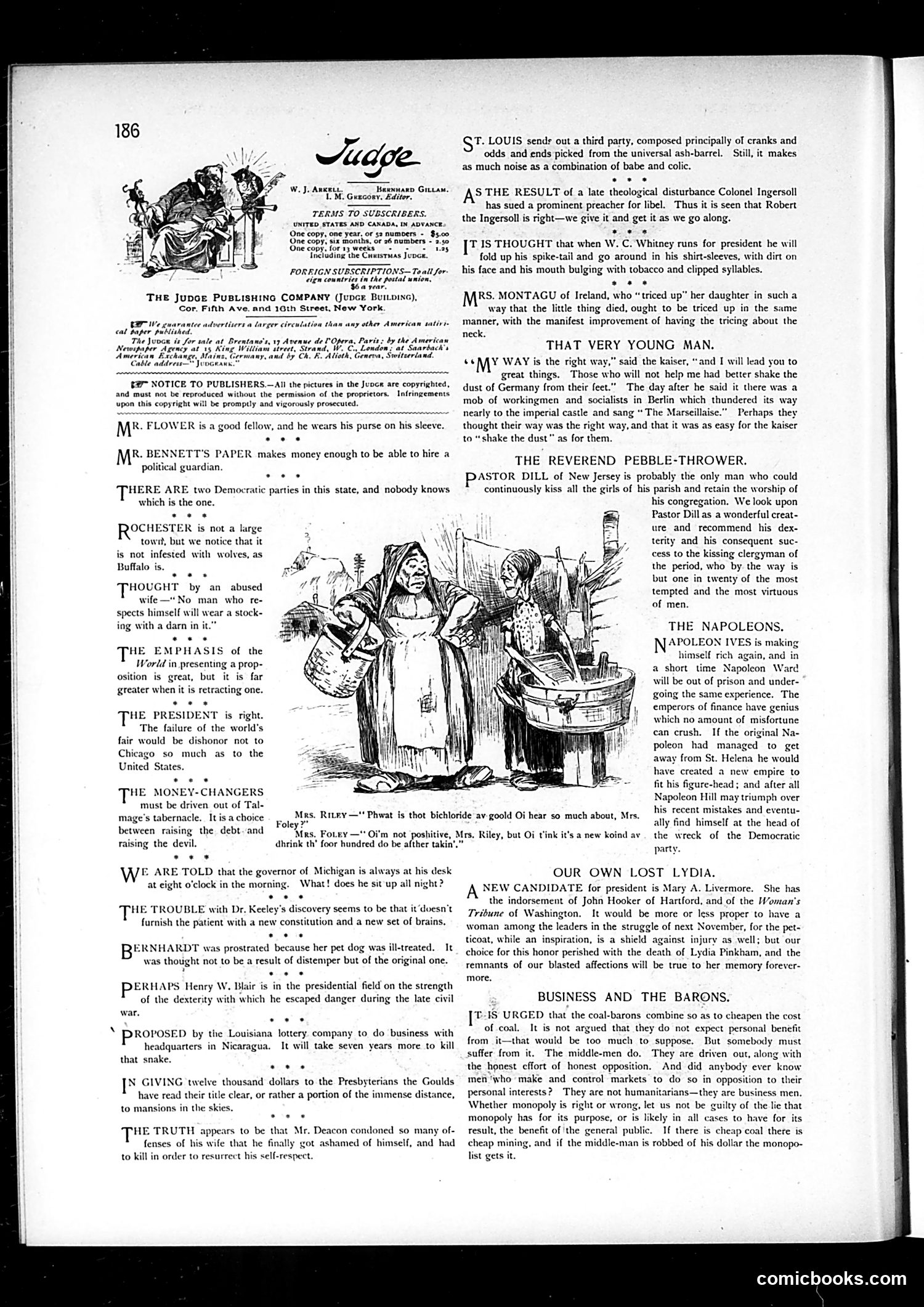
This page from *Judge* magazine contains several brief political commentaries rather than a single cohesive cartoon. The visible illustration shows two women in conversation—labeled "Mrs. Riley" and "Mrs. Foster"—discussing neighborhood gossip about drinking and morality. The text items reference contemporary (Gilded Age) political figures and issues: Colonel Ingersoll's atheism, W.C. Whitney's presidential ambitions, and discussion of Democratic party factionalism. Other pieces mock judicial corruption, business monopolies (coal barons), and political hypocrisy. Without clearer dating or additional context, the specific events referenced remain somewhat unclear, but the overall tone satirizes political corruption, moral hypocrisy among the wealthy, and social pretension—typical *Judge* magazine fare criticizing American power structures and public figures of the period.
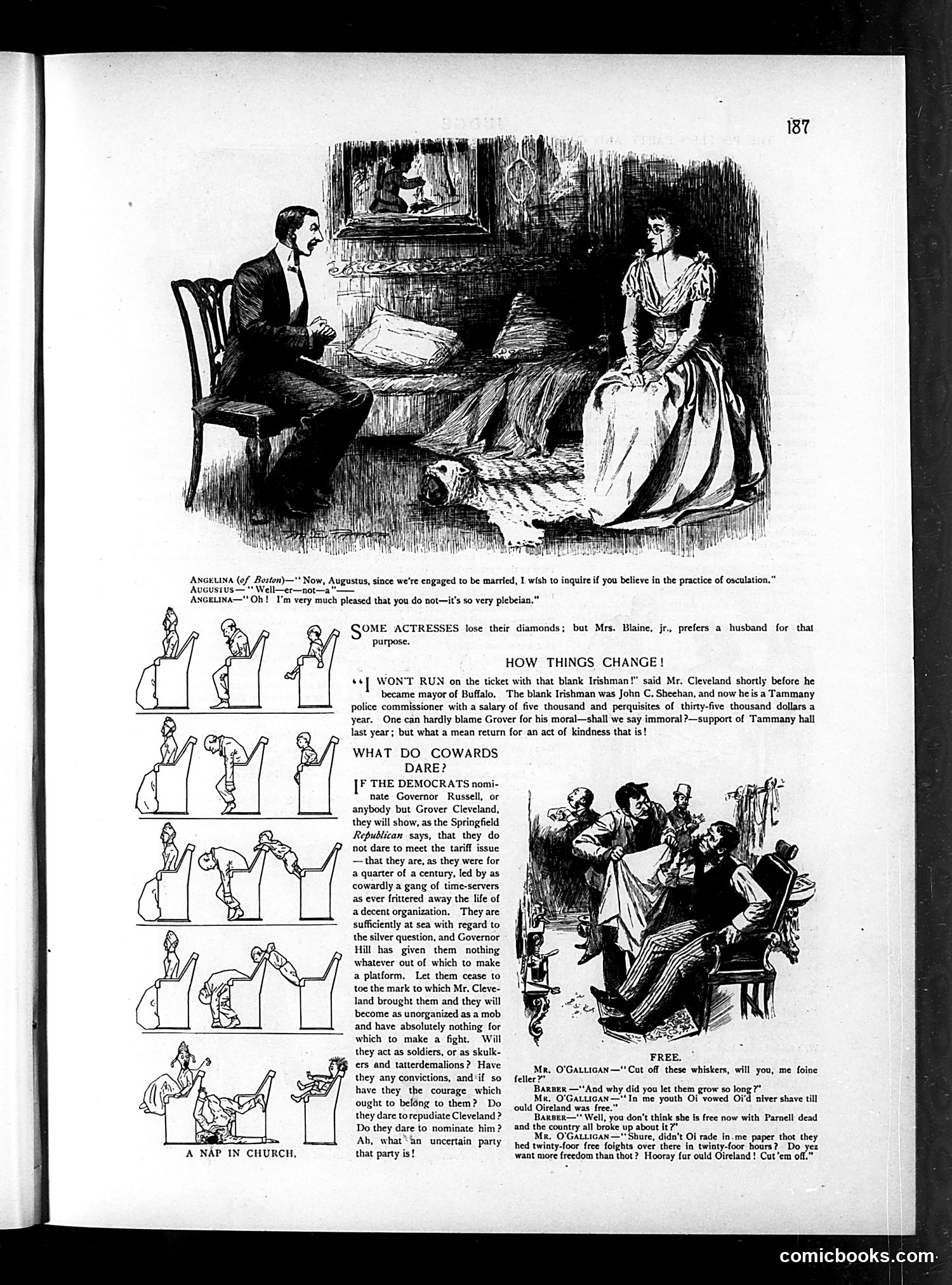
This page contains political satire from the 1880s-90s era, focusing on Democratic Party cowardice regarding tariff policy. The main article "WHAT DO COWARDS DARE?" attacks Democrats for avoiding the tariff issue, comparing them to "time-servers" who abandoned an organization's principles. It challenges whether Democrats will nominate someone like Governor Russell to face the tariff question directly, or continue hiding their position. The top illustration depicts a marital conversation about "the practice of osculation" (kissing), presenting a mild domestic humor contrast. The left panel "A NAP IN CHURCH" uses sequential comic panels showing a man falling asleep during a sermon—early visual comedy format. The page reflects late-19th-century partisan Republican attacks on Democratic electoral strategy.
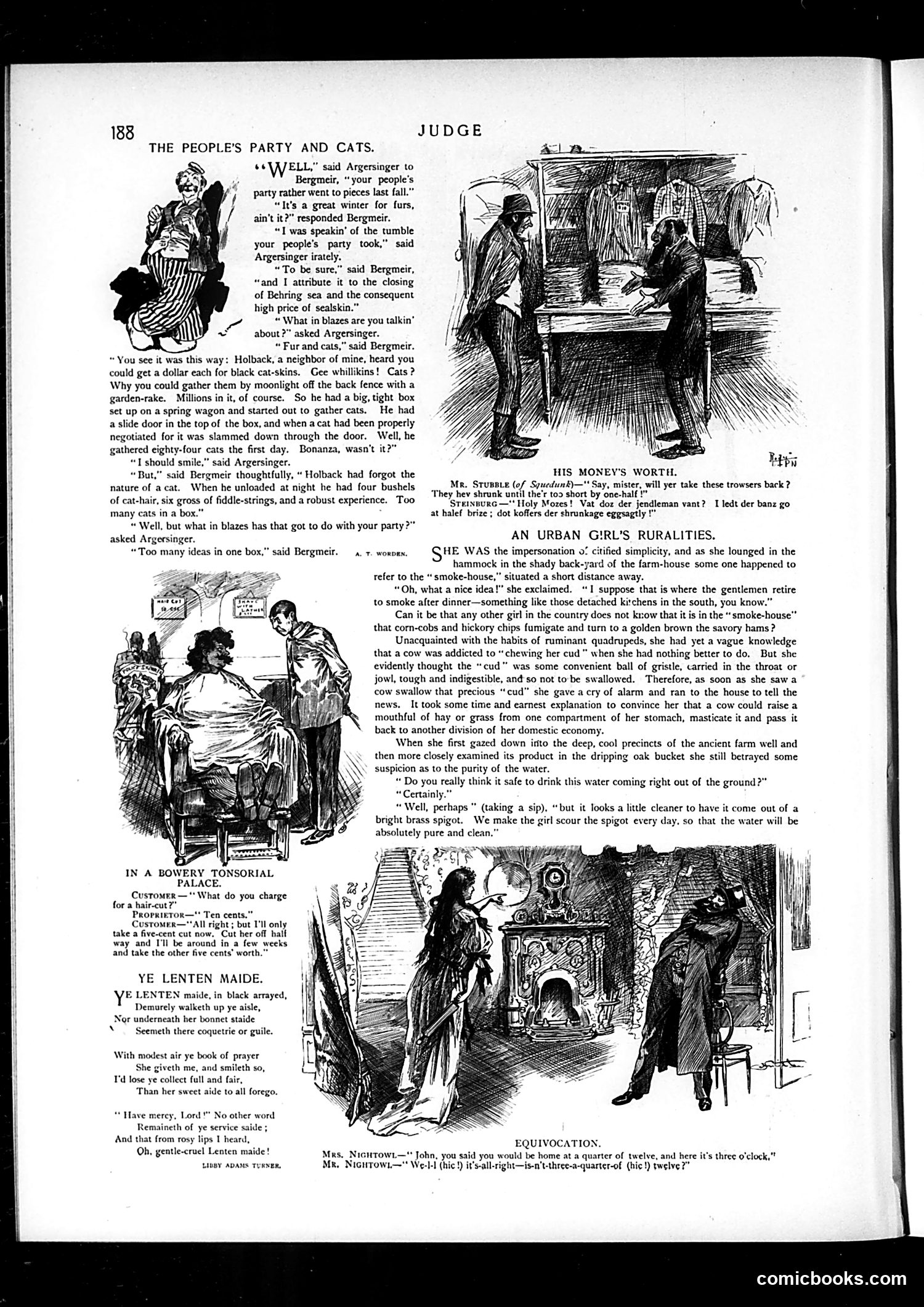
## "The People's Party and Cats" This political satire mocks the **Populist Party** (People's Party), which suffered electoral losses. The joke uses a absurd cat-collecting anecdote as metaphor: a man gathers 84 cats in a box expecting profit, but gets "four bushels of cat-hair, six gross of fiddle-strings"—worthless byproducts. The moral: the Populist Party crammed too many incompatible ideas into its platform ("too many ideas in one box"), resulting in chaos rather than coherent policy. ## "An Urban Girl's Ruralities" This sketch ridicules a city girl visiting a farm, ignorant of rural life. She mistakes the smoke-house (for curing meat) as a gentleman's smoking parlor, misunderstands cattle "chewing cud," and suspects well water is unsafe unless it comes from a brass spigot—implying urban pretension and disconnection from natural processes. Both pieces reflect Gilded Age satirical humor targeting political incompetence and urban/rural cultural divides.
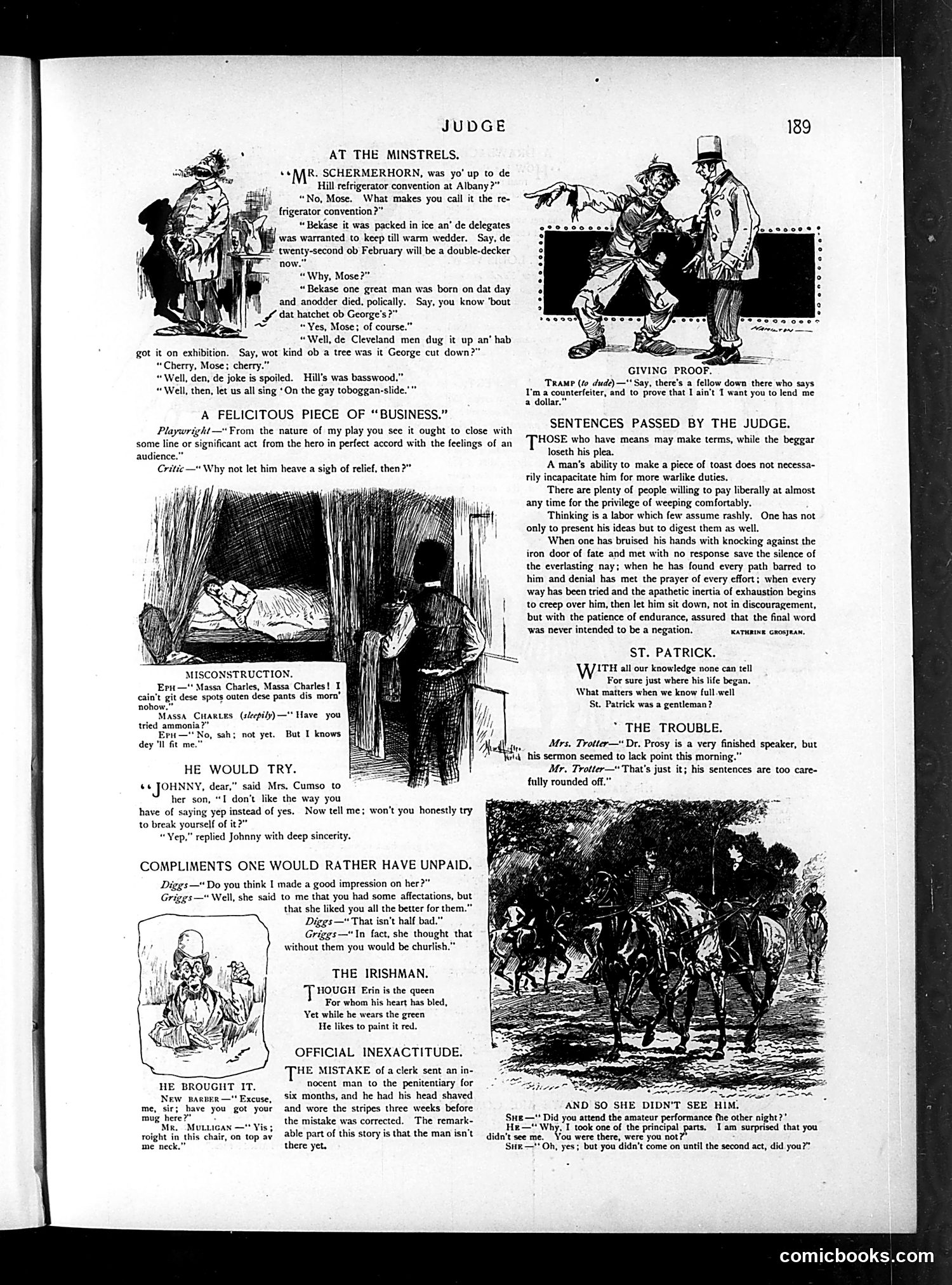
This page from Judge (an American satirical weekly) contains several short humor pieces typical of late 19th-century comedy: **"At the Minstrels"** features blackface dialect humor common to the era, with characters "Mose" and "Schermerhorn" discussing a "refrigerator convention" at Albany and a joke about David B. Hill (a New York politician) versus Grover Cleveland—apparently Cleveland had recently died politically (lost office), coinciding with George Washington's birthday. **Other sketches** include workplace humor ("Misconstruction"), a child's stubbornness joke ("He Would Try"), and observational comedy about compliments and Irish drinking habits. The page also contains short aphoristic "Sentences Passed by the Judge"—philosophical observations about poverty, toasting bread, crying, and perseverance. The cartoons are small, illustrative vignettes accompanying these brief humor pieces rather than standalone political satire. The content reflects Judge's formula: topical references, ethnic stereotypes, and genteel observational humor aimed at educated readers.
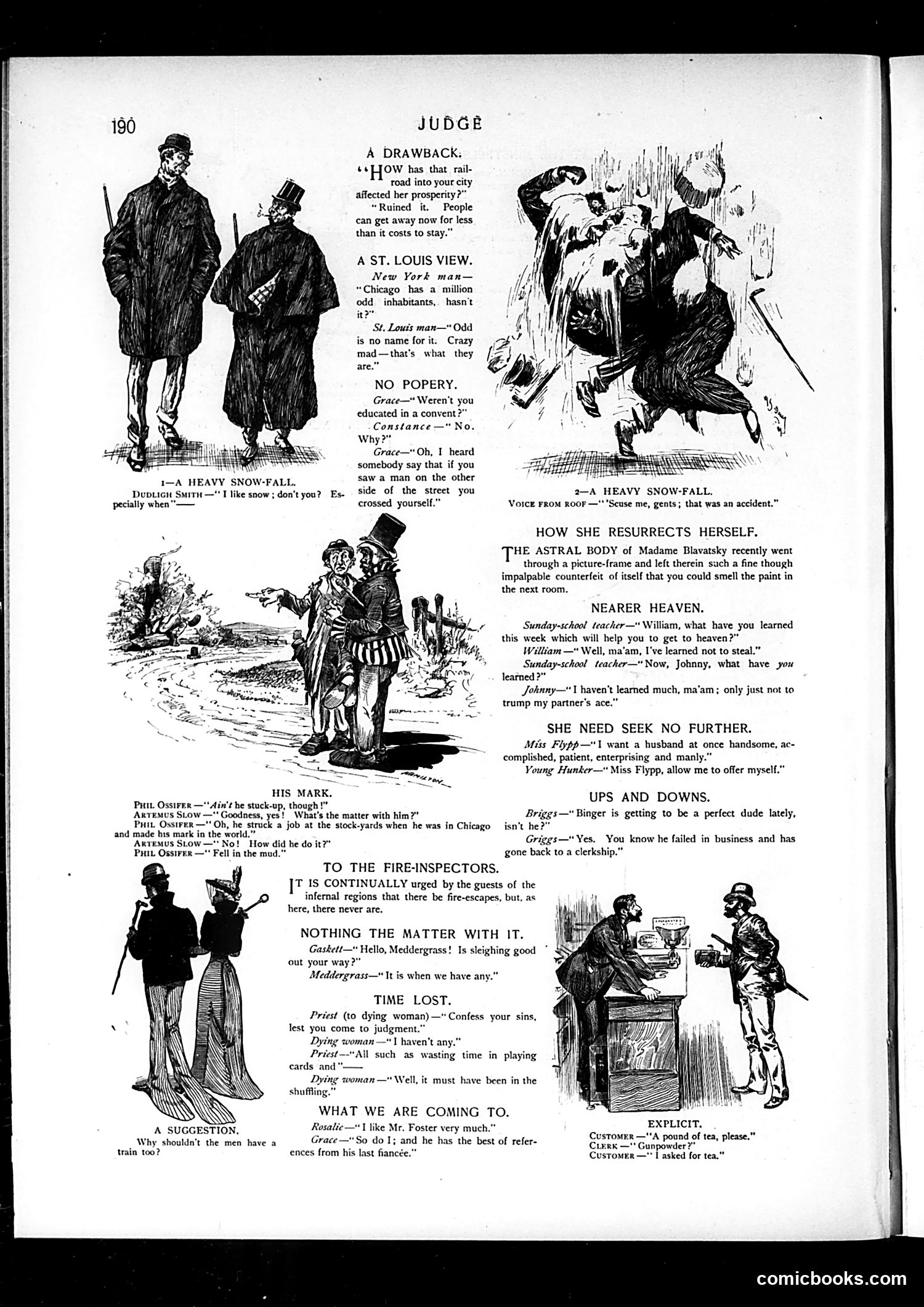
This page contains multiple brief satirical vignettes typical of Judge's humor: **"A Drawback"** mocks how railroads, meant to improve cities, actually let residents escape to better places. **"A St. Louis View"** plays on regional rivalry—a St. Louis man dismisses Chicago's million inhabitants as "crazy mad," suggesting Midwestern cities competed for status. **"No Popery"** references anti-Catholic prejudice of the era, joking that convent education supposedly teaches people to "cross themselves"—a Protestant jab at Catholic practice. **"Madame Blavatsky"** satirizes the famous spiritualist's astral-body claims as fraudulent theater. **"Nearer Heaven"** contrasts children's Sunday-school virtue (not stealing) with adults' moral compromises (cheating at cards). Other sketches mock human vanity, business failure, clerical hypocrisy, and social pretension. The overall tone is gentle mockery of American foibles, class aspirations, and contemporary fads like spiritualism.
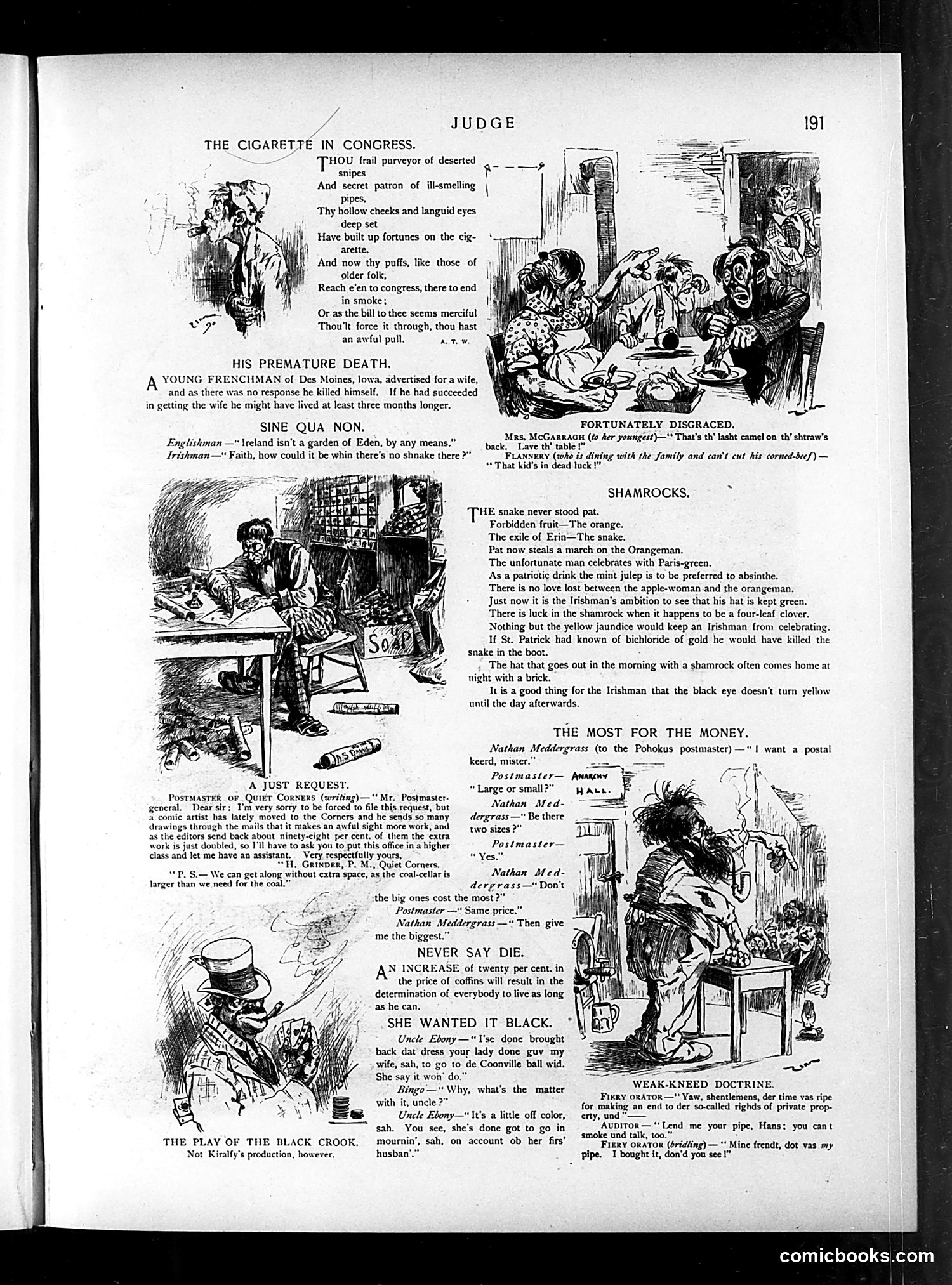
This page contains multiple satirical pieces typical of late-19th-century American humor: **"The Cigarette in Congress"** mocks cigarettes' growing influence, suggesting they corrupt even Congress through lobbying power ("thou hast an awful pull"). **Irish stereotype humor** dominates several pieces ("Sine Qua Non," "Shamrocks"). These contain ethnic caricatures playing on stereotypes about Irish immigrants, alcohol, fighting, and religion—common in period humor but reflecting contemporary anti-Irish prejudice. **"The Most for the Money"** satirizes rural postal service inefficiency through a country postmaster's complaint about excessive mail from a persistent correspondent. **"She Wanted It Black"** uses offensive racial dialect humor about a Black servant returning a dress, playing on period stereotypes. **"Weak-Kneed Doctrine"** appears to mock socialist or radical speakers interrupting polite society with revolutionary rhetoric. These pieces reflect Judge's satirical approach to immigration, rural life, and social change, though many rely on offensive ethnic and racial caricatures standard to the era.
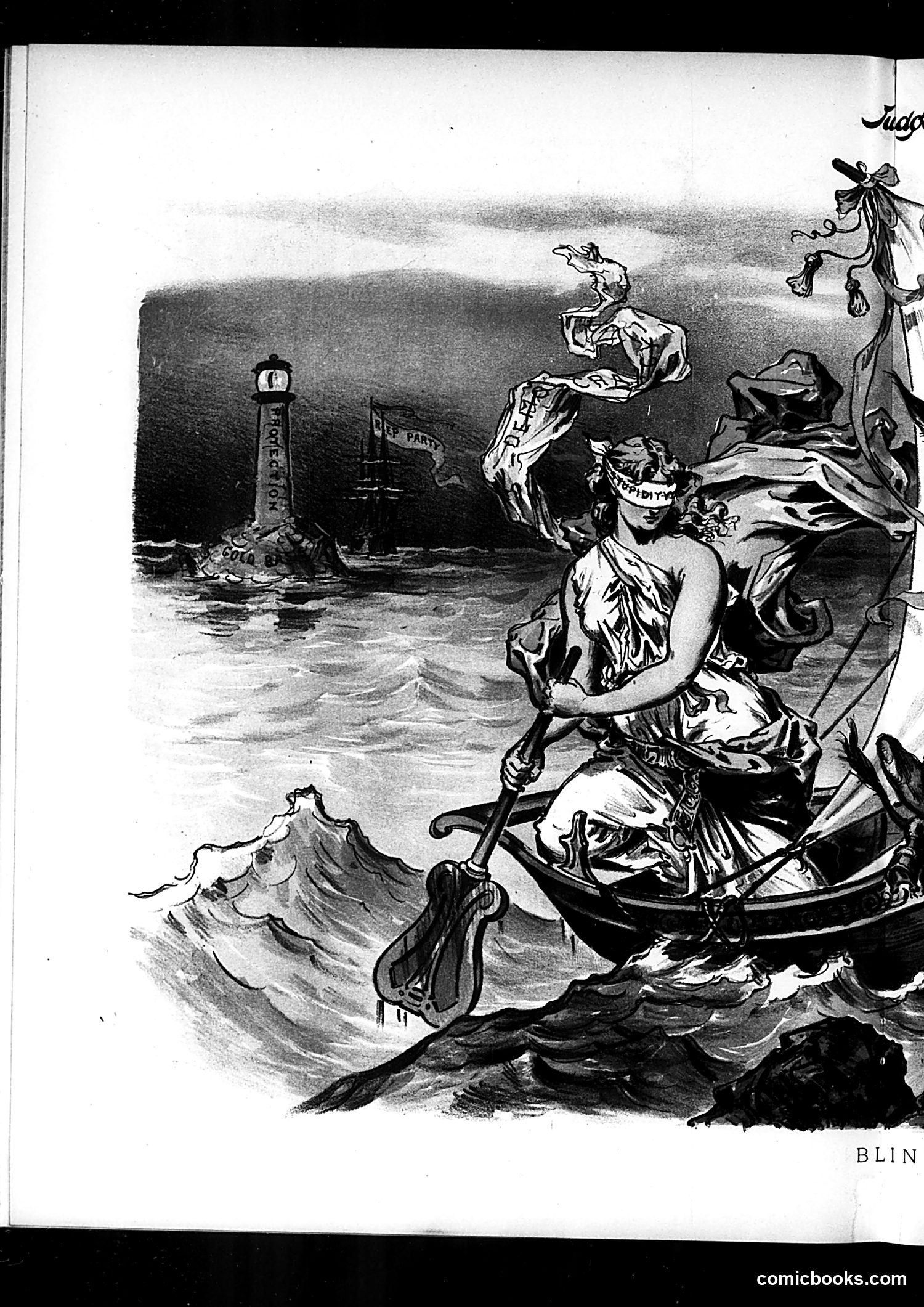
This appears to be a political cartoon from *Judge* magazine (visible as "BLIN" at bottom right, likely "BLIND" truncated). The image shows allegorical female figures—possibly representing Justice or Liberty—on the right side of the composition, gesturing toward a lighthouse or beacon in stormy waters on the left. The text is too corrupted by OCR to read clearly, making precise identification of the specific political reference difficult. However, the composition suggests commentary on guidance, hope, or moral leadership during turbulent times. The lighthouse is a common symbol for truth, safety, or correct direction in political satire. Without readable text, I cannot definitively identify which historical event or political figure this satirizes. The style appears to be from the late 19th or early 20th century.
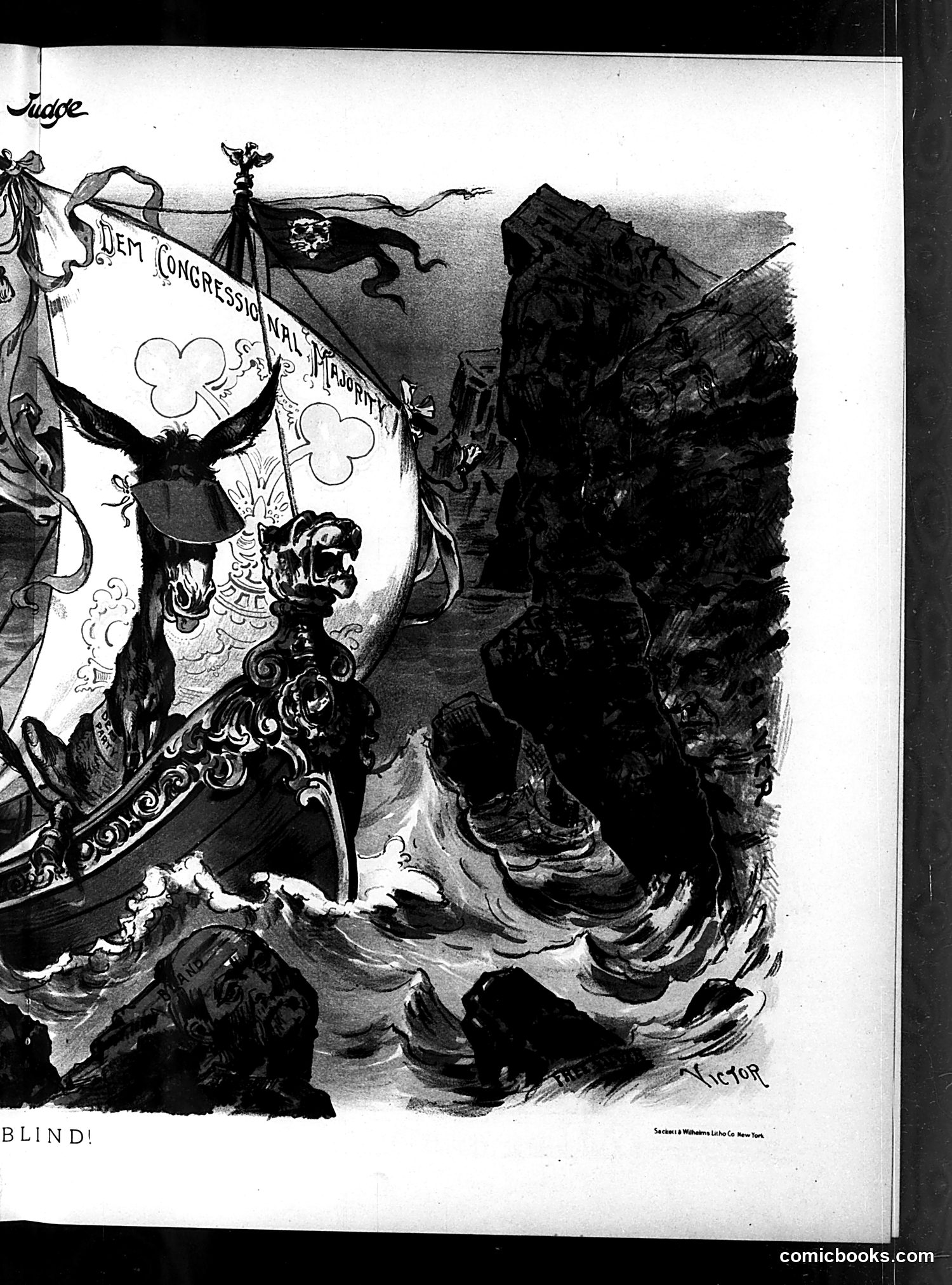
This Judge cartoon critiques Congressional appropriations. The left side shows an ornate ship labeled "ITEM CONGRESSIONAL APPROPRIATION" with decorative flourishes and classical elements, suggesting wasteful spending dressed up as legitimate government business. On the right, a dark, rocky cliff or dangerous coastline looms—representing the peril such frivolous spending creates. The title "BLIND!" indicates Congress is blindly approving these appropriations without scrutiny, sailing toward disaster. The elaborate ship contrasts sharply with the ominous, treacherous landscape ahead, emphasizing how decorative justifications obscure genuine fiscal recklessness. This reflects Progressive Era concerns about government waste and the need for legislative oversight.
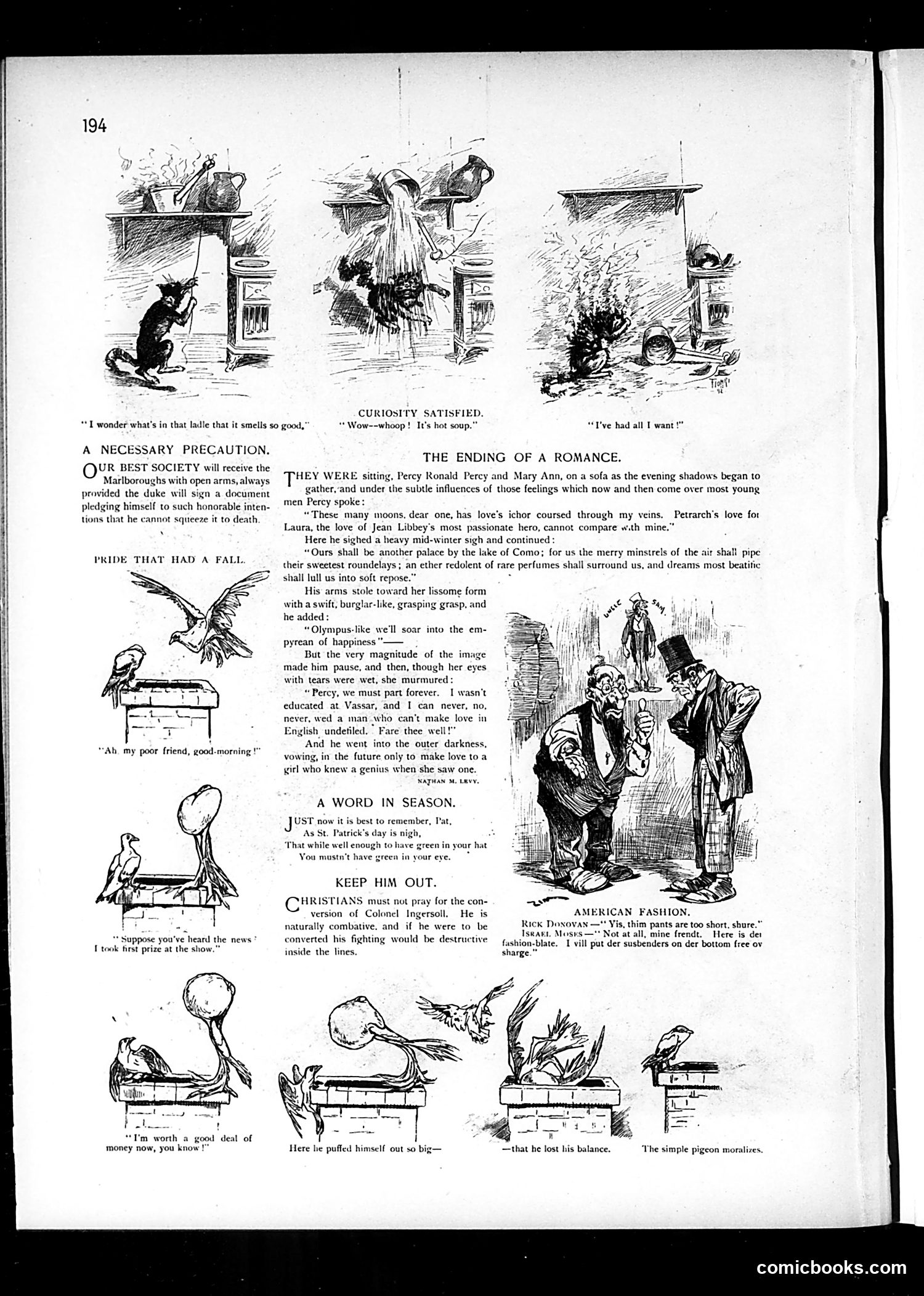
This page contains several unrelated satirical pieces typical of Judge magazine's humor: **"A Necessary Precaution"** mocks wealthy American society's eagerness to welcome the Duke of Marlborough, satirizing the social climbing of the era by suggesting he sign a document pledging honorable intentions—implying society fears he's a fortune hunter. **"The Ending of a Romance"** parodies melodramatic romantic literature (referencing Petrarch and "Jean Libbey's" sentimental novels) by having a man wax poetic about love in ornate language, only to be rejected because he lacks a Vassar education—a joke about women's education and pretentious courtship rituals. **"A Word in Season"** is a St. Patrick's Day warning to Irish immigrants ("Pat") about maintaining respectability. **"Keep Him Out"** references Colonel Robert Ingersoll, a famous atheist and freethinker, sardonically suggesting Christians shouldn't convert him because his argumentative nature would be destructive. **"American Fashion"** depicts an immigrant tailor (stereotypical dialect) absurdly shortening pants and using suspenders as compensation—mocking both immigrant workers and changing fashion trends.
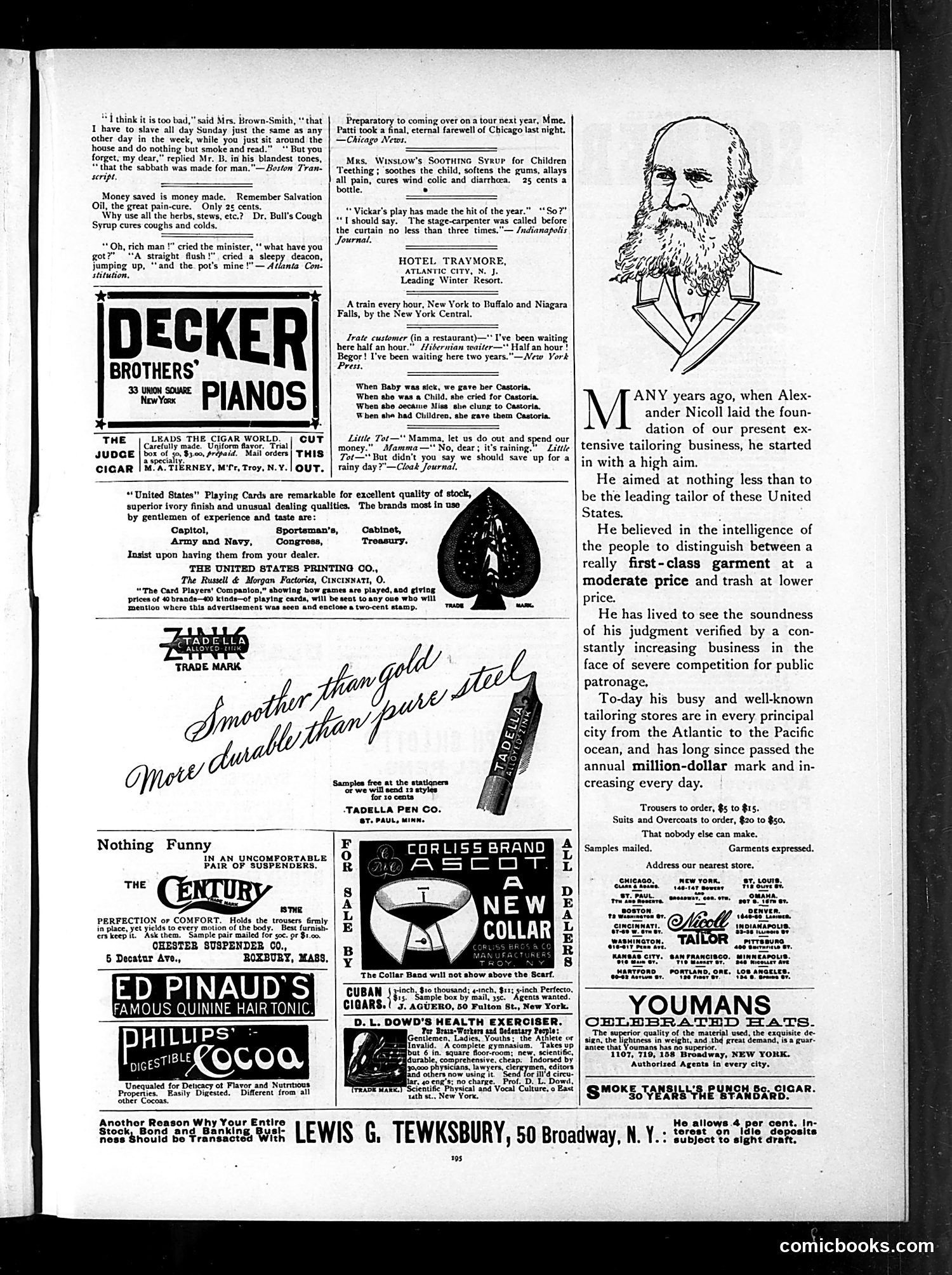
This is primarily an **advertising-heavy magazine page** rather than a satirical editorial spread. The page contains multiple vintage advertisements and only a few brief comedic snippets. The visible humor pieces are short anecdotal jokes, including one about a deacon falling asleep during a church service and waking to cry "straight flush!" after someone mentions "the pot"—a poker reference in a religious setting that plays on the double meaning of "pot." Another joke satirizes Irish service workers, depicting stereotypical impatience through an exchange with an "Hibernian waiter." The predominant content is late 19th-century commercial advertising for products like pianos, cigars, cough syrup, hair tonic, and corsets. There is a small portrait illustration (likely of a notable figure), but it's unclear from context alone who is depicted. Without clear editorial cartoons or identified political references, this page primarily reflects **Judge magazine's business model as an advertising vehicle** alongside light humor.
This is primarily an **advertising page** from Judge magazine, not a political cartoon. It features numerous product advertisements typical of the 1890s, including: - **Sohmer Pianos** (with sales figures showing growth) - **Aermotor Company** windmills - **Liebig Company's Beef Extract** (with a quote from "a famous French chef") - **Eastman Kodak** cameras - Various patent medicines (**Boker's Bitters**, **Beecham's Pills**, **Hall's Catarrh Cure**) - Cigars, hotels, and railroads The page includes a brief **satirical snippet** mocking verbose newspaper writing (about Bob Ingersoll), and some mild social humor about courtship. However, there are **no identifiable political cartoons or caricatures** visible. This appears to be a standard late-19th-century magazine ad page with scattered light comic content mixed in.
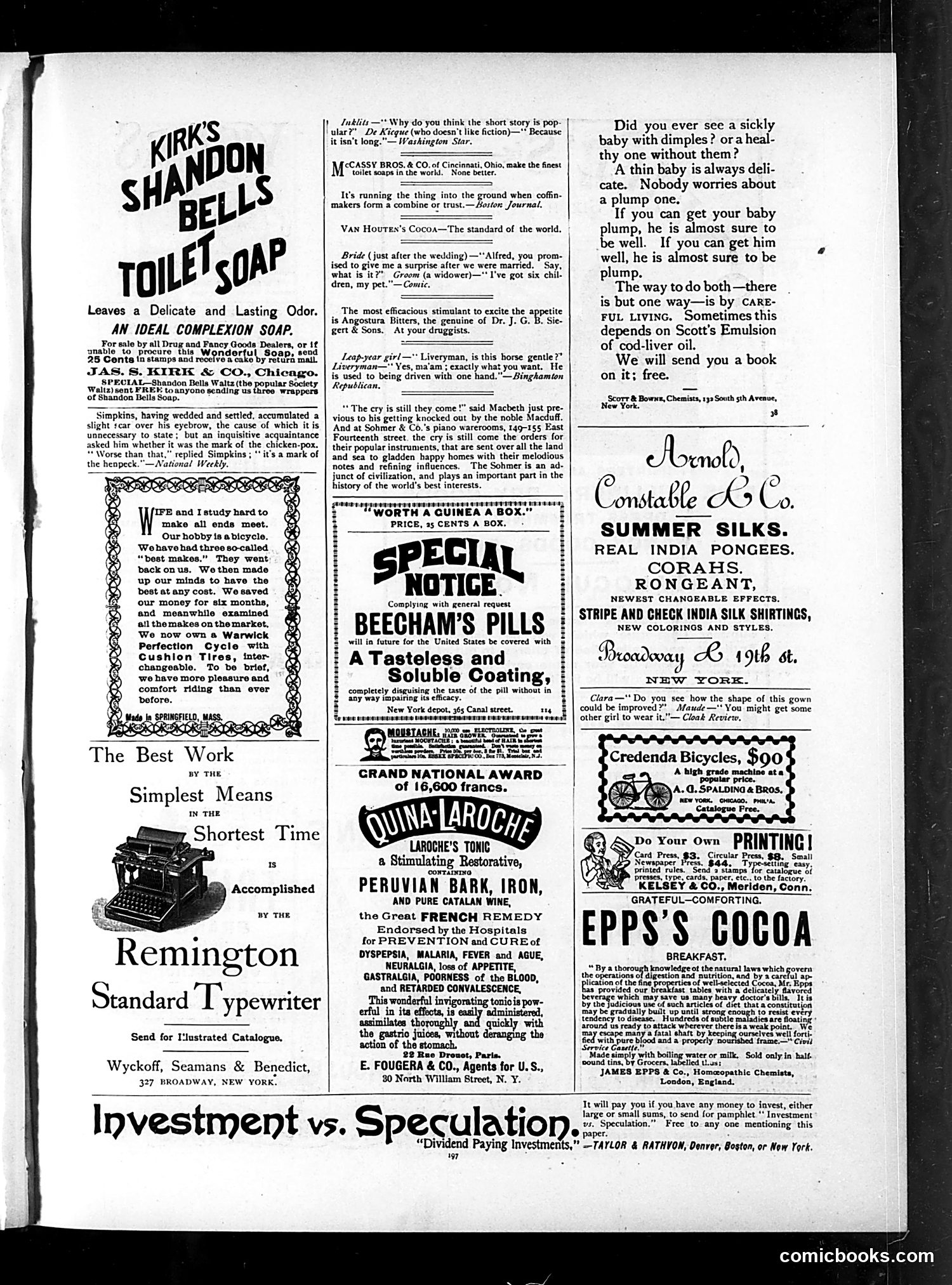
This page is primarily **advertising** with minimal editorial content. The few jokes present are brief filler items typical of early 1900s magazines. The notable editorial content includes: **"Simpkins" anecdote**: A husband with a scar over his eyebrow claims it's from being "henpecked" (dominated by his wife) rather than chickenpox. This reflects contemporary anxieties about marriage and male authority—treating wives' domestic control as a humorous wound. **Piano warehouse joke**: References Macbeth's "the cry is still they come" before defeat, then pivots to Sohmer & Co. pianos receiving constant orders. It's a forced literary reference with no real satirical bite. The page is dominated by **patent medicine and consumer product advertisements**—soaps, pills, tonics, bicycles, typewriters, silk clothing, and cocoa. These reflect the era's prolific marketing of dubious medical remedies (Beecham's Pills, Laroche's Tonic claiming to cure malaria and dyspepsia) and emerging consumer goods aimed at middle-class readers. The humor is gentle, domestic, and largely designed to entertain while selling products to Judge's affluent audience.
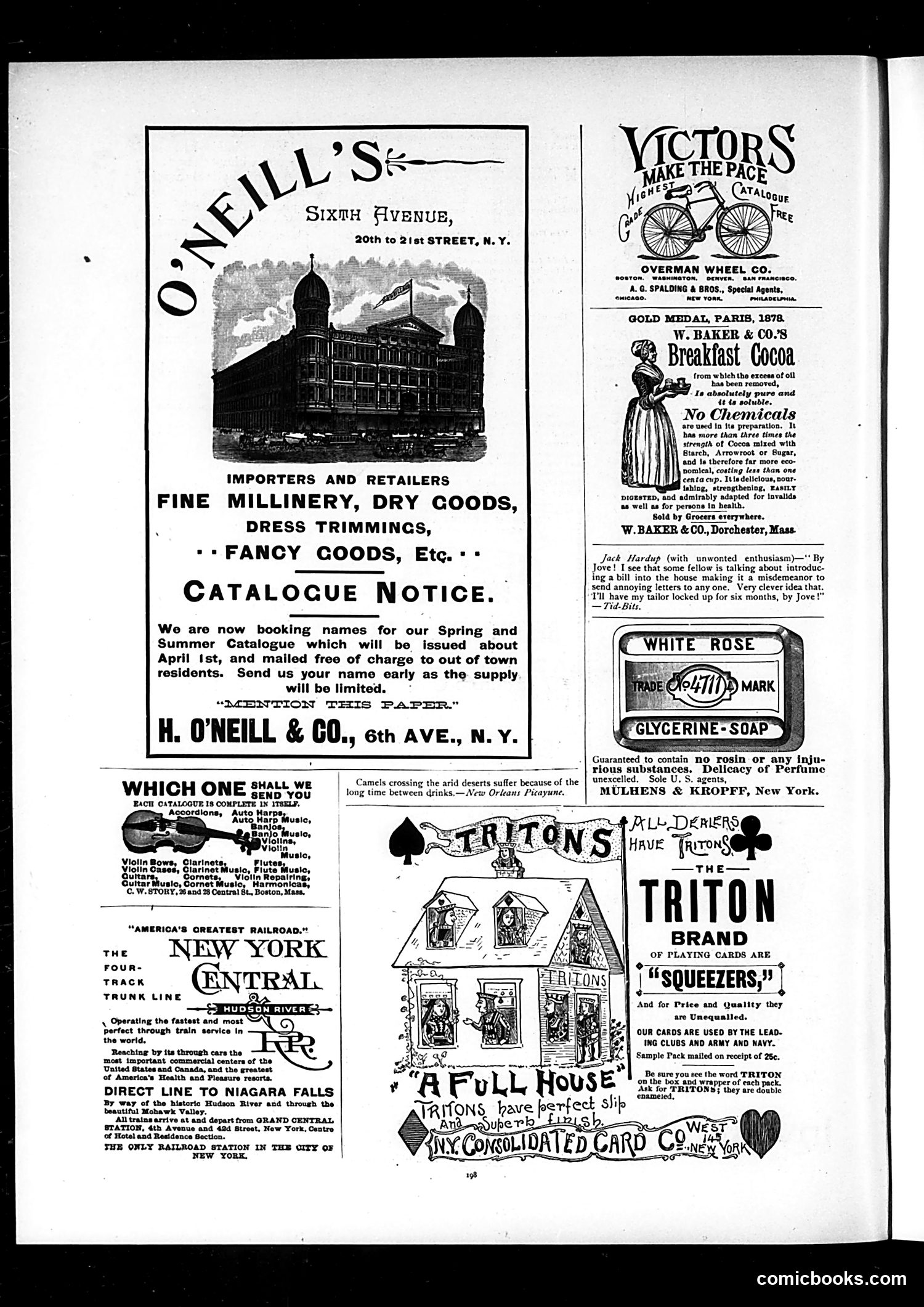
This page is primarily **advertising**, not political satire. It contains commercial notices for late 19th-century retailers and product manufacturers, including O'Neill's millinery store, W. Baker & Co.'s breakfast cocoa, the New York Central Railroad, and various other vendors. The only joke content appears to be a brief item labeled "Tid-Bits" about a character named Jack Hardup discussing a proposed bill making it a misdemeanor to send love letters—a mild Victorian-era humor reference with no clear political meaning. The page also includes a small cartoon advertisement for Triton brand playing cards showing a house with card-related imagery. **Verdict**: This is essentially a **classified advertising section** of Judge magazine rather than a page of political or social satire. The advertisements target urban readers (New York addresses dominate) and reflect consumer goods of the 1870s-1890s period.
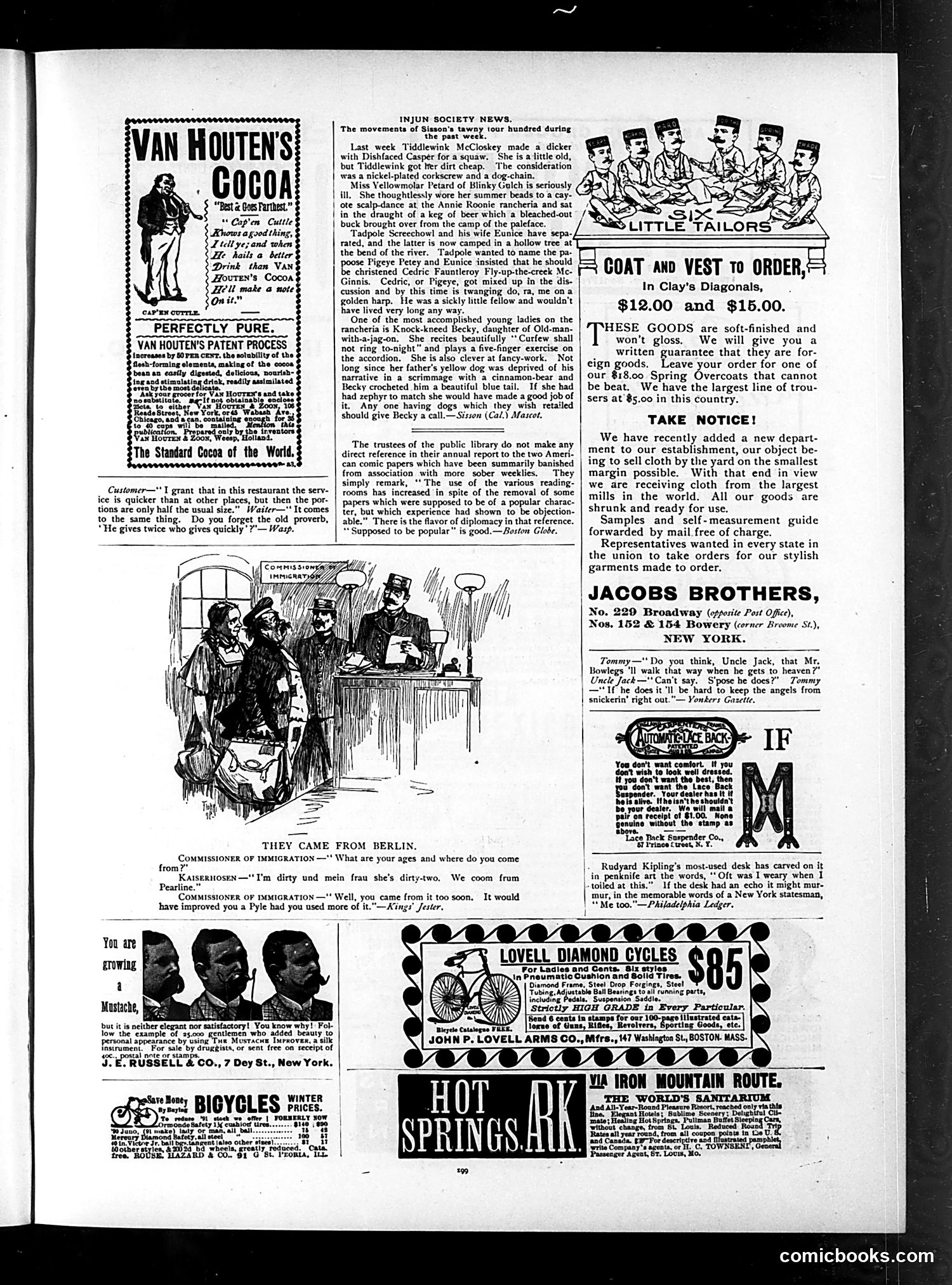
This page from **Judge** magazine contains primarily **advertisements and humor columns** rather than political cartoons. The main satirical content includes: 1. **"Injun Society News"** — A racist mock-gossip column mocking Native Americans with stereotypical, dehumanizing names ("Tiddlewink McCloskey," "Yellowmolar Petard") and behaviors. This reflects the era's casual, virulent racism toward Indigenous peoples. 2. **"They Came from Berlin"** — A brief immigration joke where German immigrants speak in exaggerated dialect, playing on anti-German sentiment and mocking their English and hygiene. 3. **Restaurant service joke** — A server defends small portions by claiming "he gives twice who gives quickly." The page is dominated by period **product advertisements** (Van Houten's Cocoa, bicycles, clothing) typical of late 19th-century magazines. The racist "Injun Society" column was standard in American humor publications of this era, though deeply offensive by modern standards.
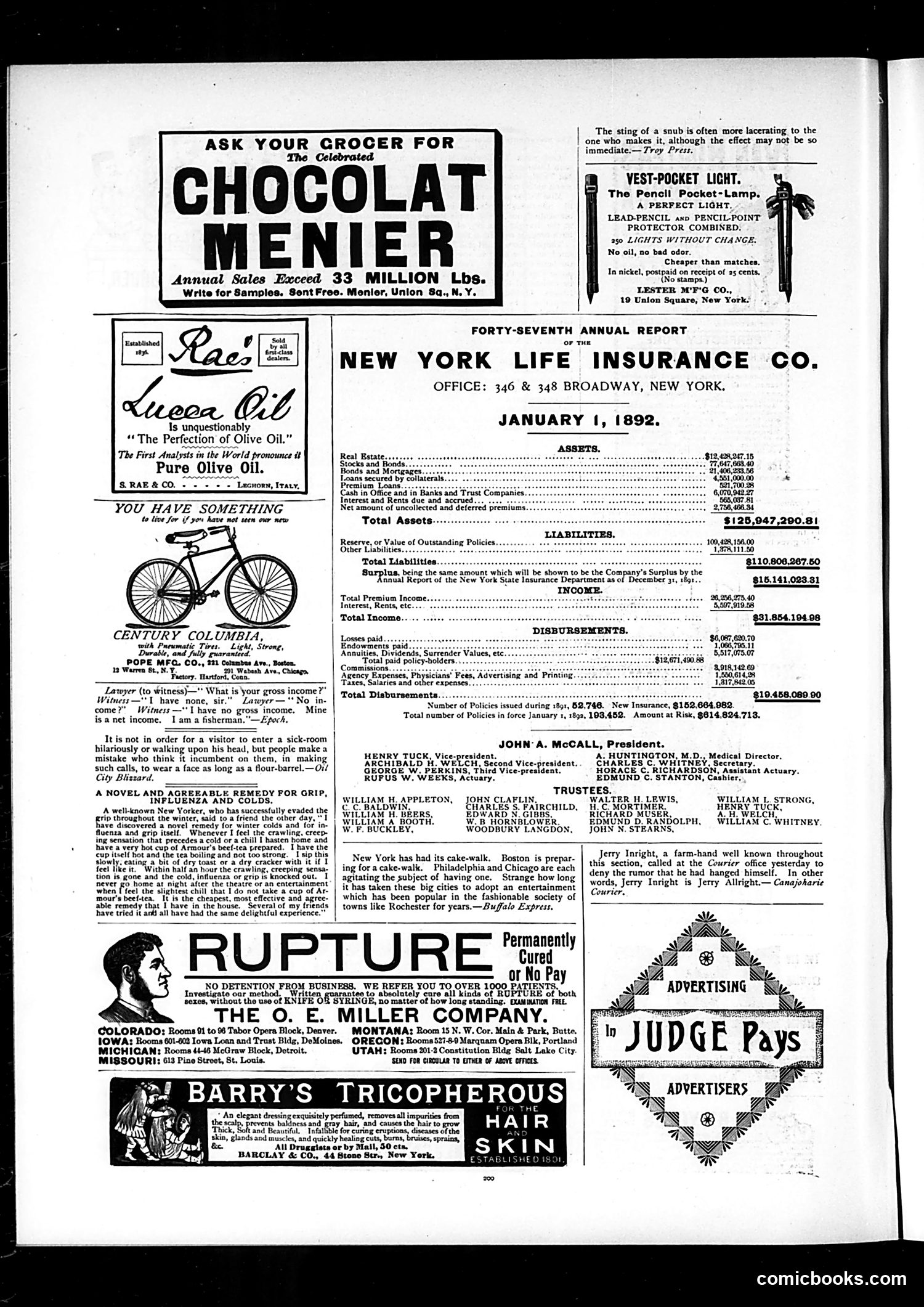
This is primarily a **title/contents page** for Judge magazine's January 1, 1892 issue, dominated by advertising and corporate announcements rather than political satire. The page features **advertisements** for consumer products (Chocolat Menier chocolate, olive oil, bicycles, pocket lamps) and the **47th Annual Report of the New York Life Insurance Company**, listing officers and financial details. The only **humor content** consists of brief, apolitical jokes: a lawyer questioning a fisherman about "gross income" versus "net income," and a quip about proper decorum during sickroom visits. There are **no political cartoons or caricatures** visible. The page represents a common magazine format of this era where advertising subsidized publication, with satirical content appearing elsewhere in the issue.
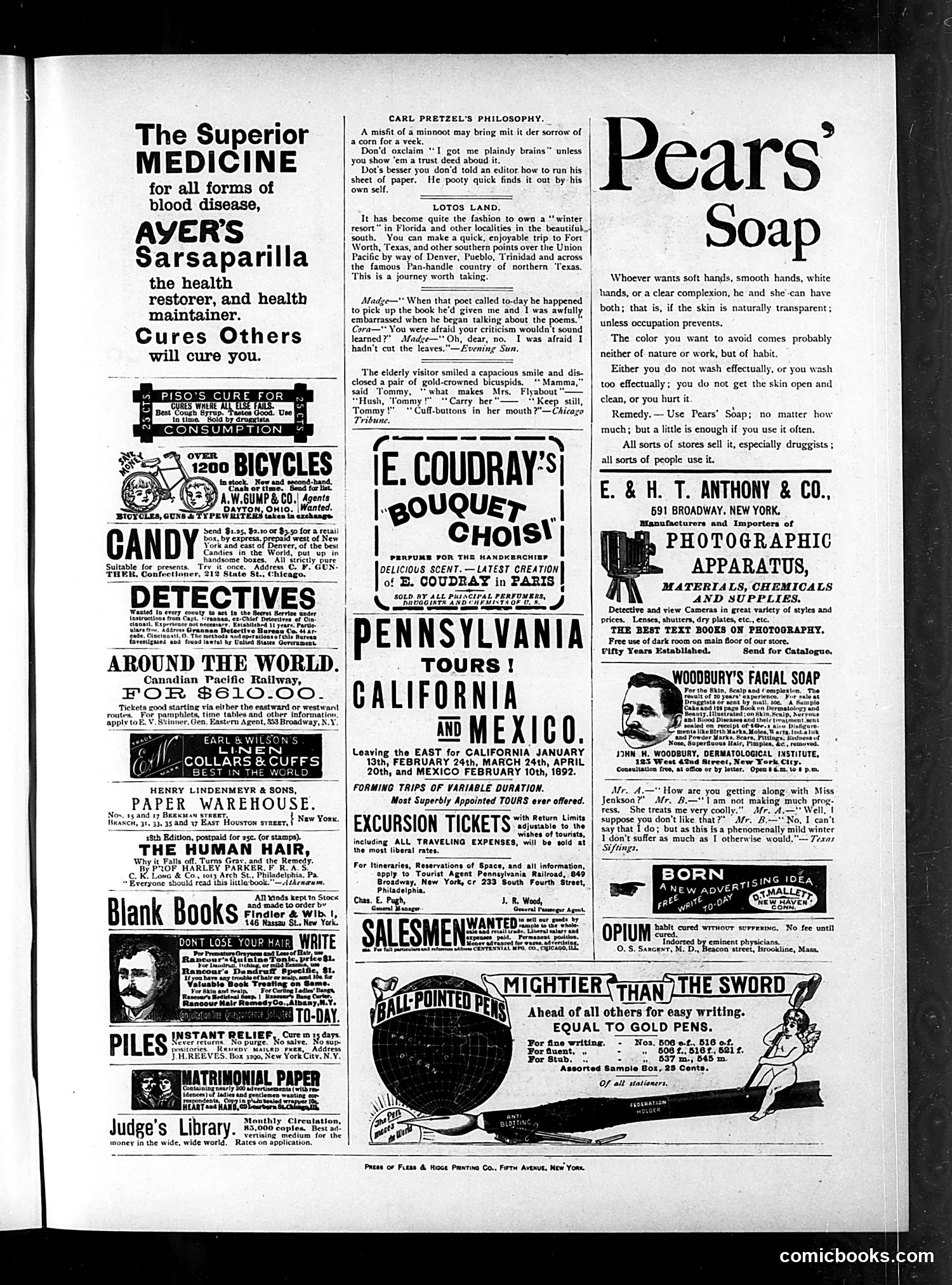
This is primarily an **advertising page** from Judge magazine, circa 1892. The content consists almost entirely of commercial advertisements with minimal editorial cartooning. The notable exceptions are: **"Carl Pretzel's Philosophy"** - A humor column featuring a German-accented character offering folksy wisdom. The jokes mock pretentious behavior: a man bragging about his "plain brains" while hiding behind legal documents; an editor who learns journalism through experience; a woman embarrassed about not reading a gifted poetry book (hadn't even cut the pages open). **Small anecdotes** scattered through the ads present mild social satire: a woman with gold dental work, children's innocent observations about appearance. The rest—Ayer's Sarsaparilla, Piso's Cure, hair remedies, bicycles, paper goods, travel tours—represents typical 1890s patent medicine and consumer product advertising. These pages financed the magazine, allowing Judge to publish its satirical content elsewhere. The page demonstrates how 19th-century humor magazines balanced editorial content with advertising revenue.
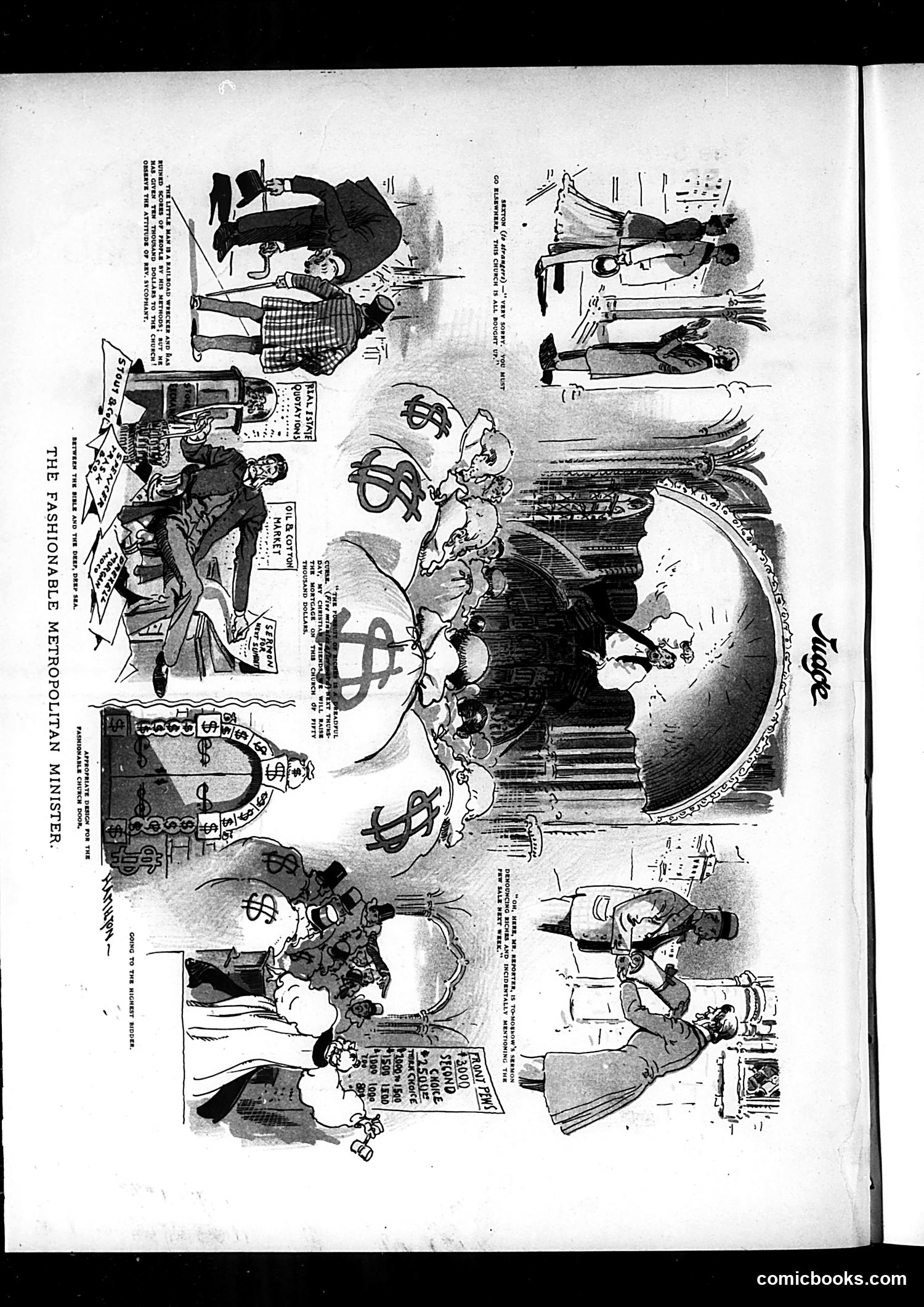
This page appears to contain multiple political cartoons satirizing the American church and clergy in the Gilded Age. The title "The Fashionable Metropolitan Minister" suggests critique of wealthy urban churches. One visible cartoon shows a sexton (church custodian) turning away strangers, saying the church is "all bought up"—satirizing how fashionable churches catered exclusively to wealthy congregants who could afford pew rentals, excluding the poor. Another cartoon references being caught "between the Bible and the deep, deep sea," likely critiquing ministers who compromised religious principles for wealthy parishioners' donations and social influence. The cartoons mock the hypocrisy of churches that prioritized wealth and status over Christian charity and inclusive worship. This reflects common Progressive-era criticism of how commercialism had corrupted American religious institutions.