
A complete issue · 16 pages · 1892
Judge — March 12, 1892
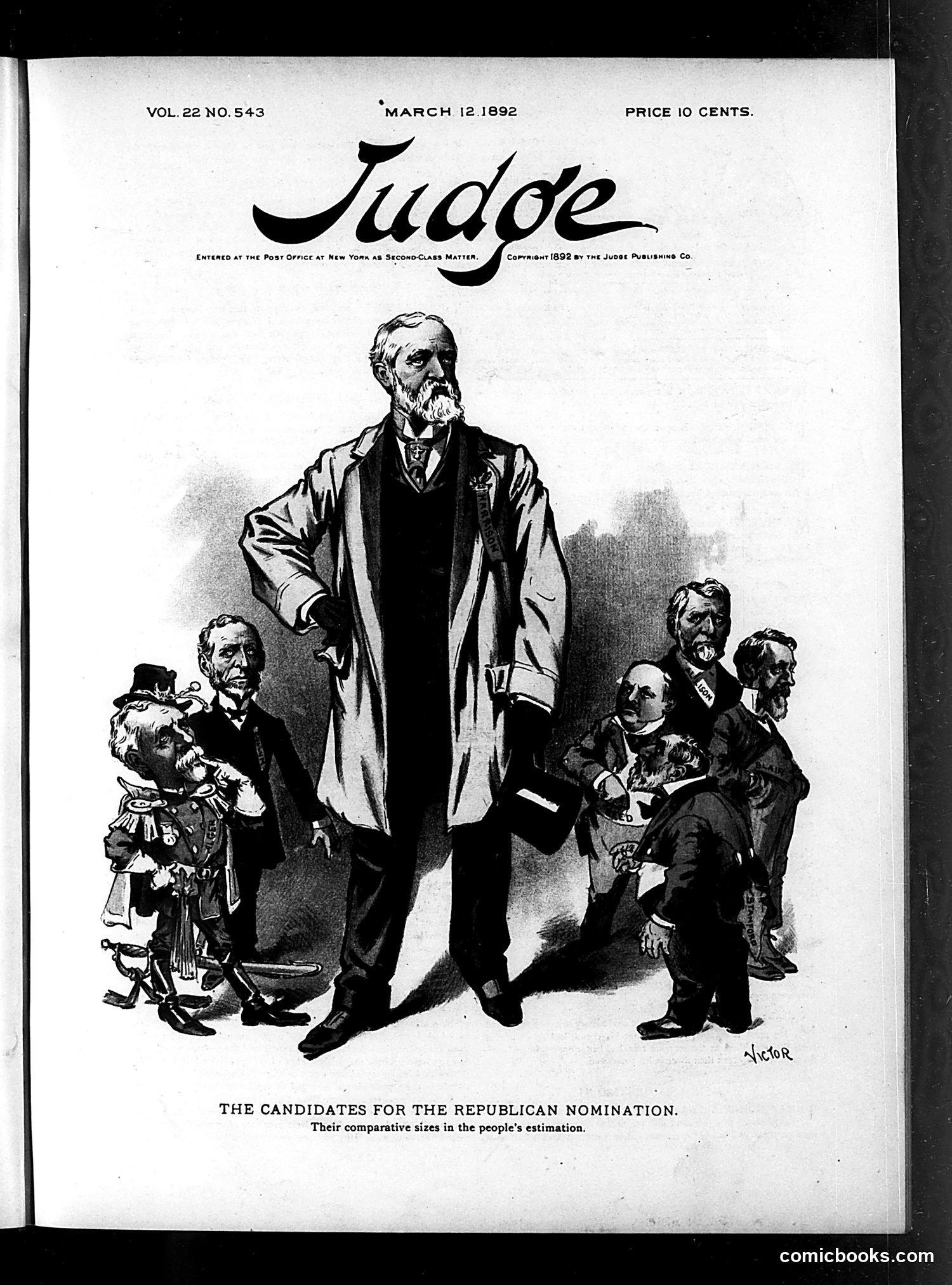
This March 1892 *Judge* cartoon satirizes the 1892 Republican presidential race by depicting candidates as dramatically different in size—a visual metaphor for their perceived viability or public support. The tall central figure dominates the composition, while smaller figures surround him, suggesting a stark hierarchy in the candidates' comparative standing. The caption explicitly states the cartoon's purpose: showing "their comparative sizes in the people's estimation." This is political commentary on which Republican candidates voters actually took seriously for the nomination, with the towering central figure representing the frontrunner while the diminished figures represent lesser contenders. Without additional context, specific identities remain unclear, though this reflects contemporary public perception of candidate strength during that election cycle.
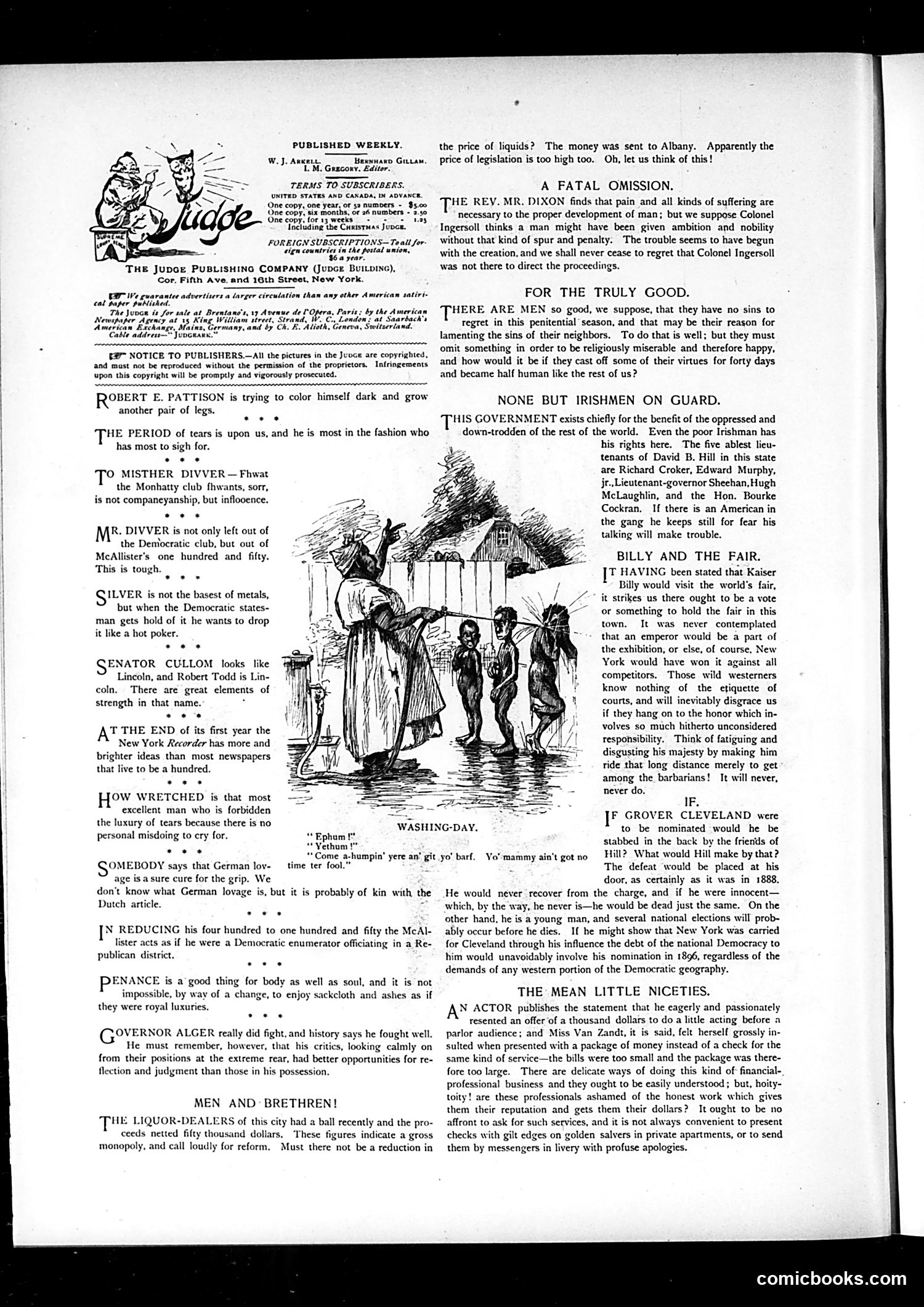
The main cartoon, titled "WASHING-DAY," depicts a figure labeled "Tammany" being forcibly washed or scrubbed, while onlookers labeled "Reform" and "Slimplin'" observe. This satirizes Tammany Hall—the powerful Democratic political machine controlling New York City—as corrupt and in need of cleaning up through reform efforts. The accompanying text articles critique various political figures and practices. "Billy and the Fair" mocks a proposal to nominate Grover Cleveland for a world's fair, questioning whether an emperor should participate in such exhibitions. "None But Irishmen on Guard" criticizes the composition of what appears to be a government agency or position. The overall page reflects Progressive-era satirical commentary on urban political corruption and reform movements.
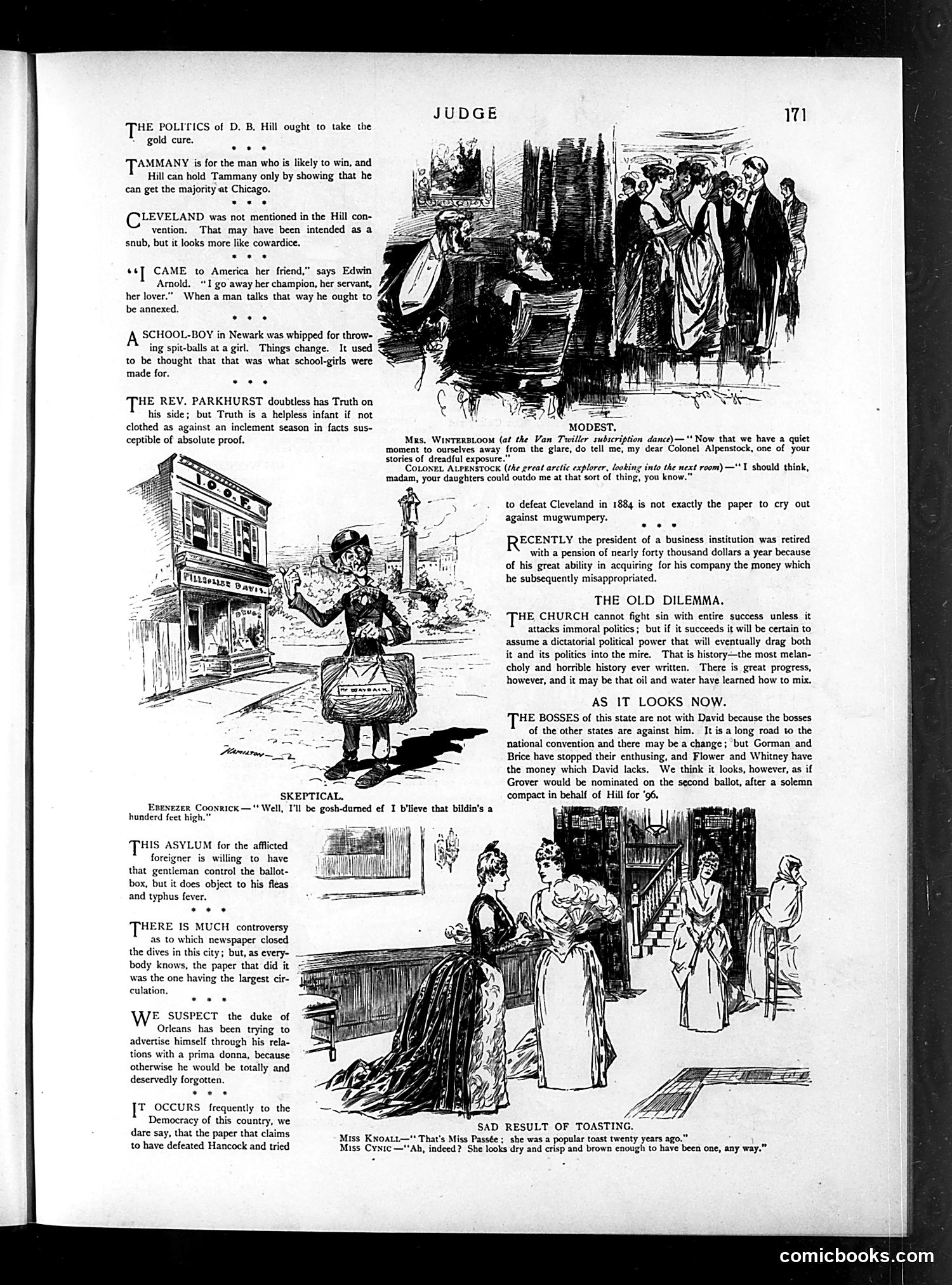
This page contains political commentary and social satire typical of late 19th-century Judge magazine. Key items include: **"Modest"** cartoon depicts a woman (Mrs. Winterbrook) and Colonel Alpenstock discussing propriety—she's shocked by a woman's public behavior, he defends it as modest compared to past excess. **"Skeptical"** shows Ebenezer Covenock, apparently skeptical of claims of moral improvement. **"The Old Dilemma"** discusses the church's difficulty fighting immorality while avoiding political entanglement. **"Sad Result of Toasting"** mocks Miss Pasde, described as looking "dry and crisp"—satirizing women's social rituals around toasting at gatherings. The page reflects Victorian anxieties about changing social standards, women's public roles, and propriety. Without clearer dates or context, specific political figures remain unclear.
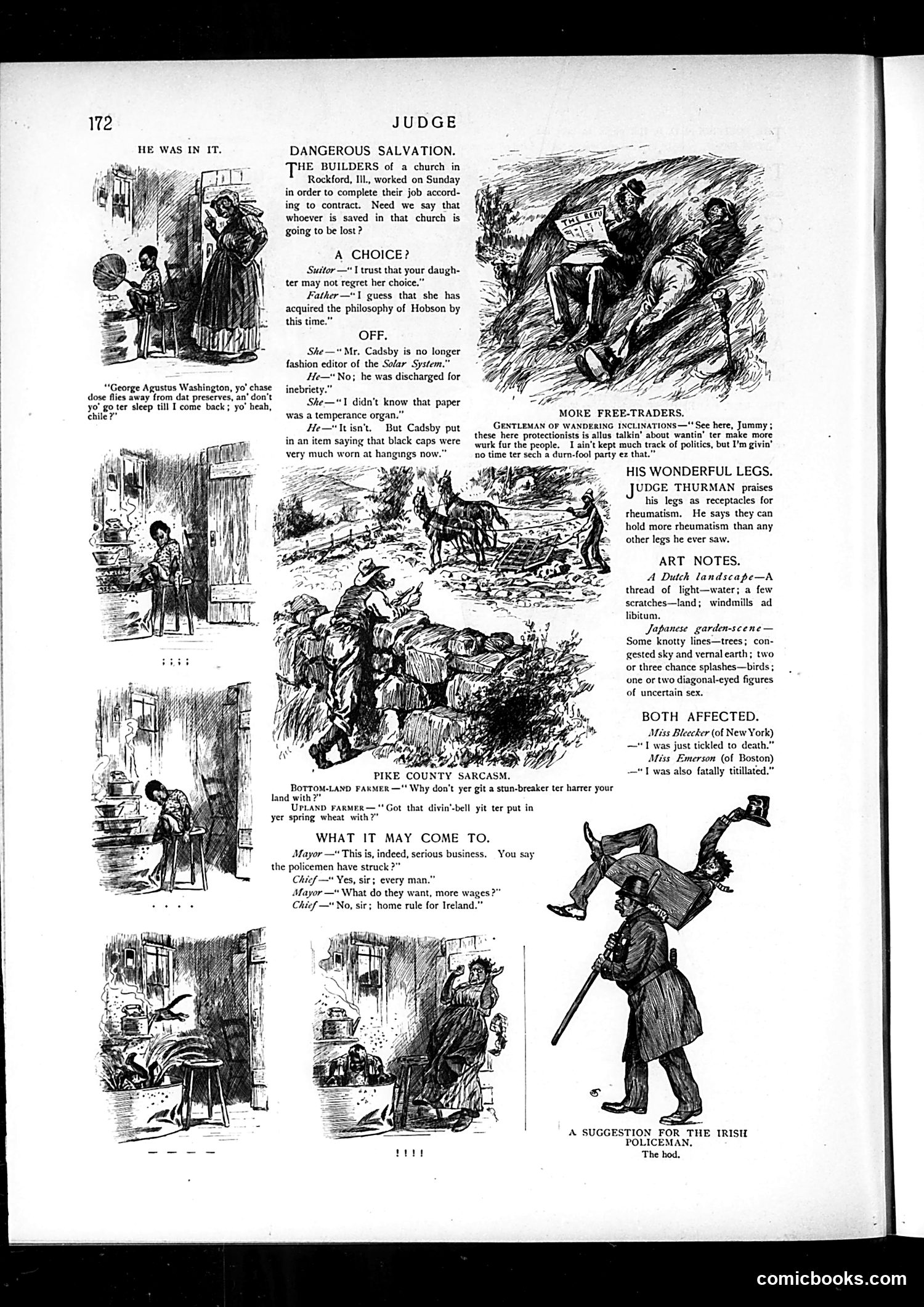
This page contains multiple satirical pieces typical of the era: **"Dangerous Salvation"** mocks Sunday labor during church construction in Rockford, Illinois—suggesting workers building on the Sabbath will damn whoever worships there. **"A Choice?"** and **"Off"** are society humor about romantic/professional decisions and a fashion editor's dismissal for drunkenness. **"Pike County Sarcasm"** uses rural dialect humor about farming equipment. **"What It May Come To"** satirizes a police strike, with the Chief claiming officers demand "home rule for Ireland"—a contemporary political controversy—rather than wage increases. This conflates labor unrest with Irish independence politics. **"Judge Thurman's Legs"** appears to reference a public figure's much-discussed rheumatism. **"A Suggestion for the Irish Policeman"** shows an Irishman wielding a hod (construction tool), stereotyping Irish immigrants as laborers, possibly mocking their police participation. The overall tone reflects period class anxiety and ethnic stereotyping common to 1880s-1890s American satire.
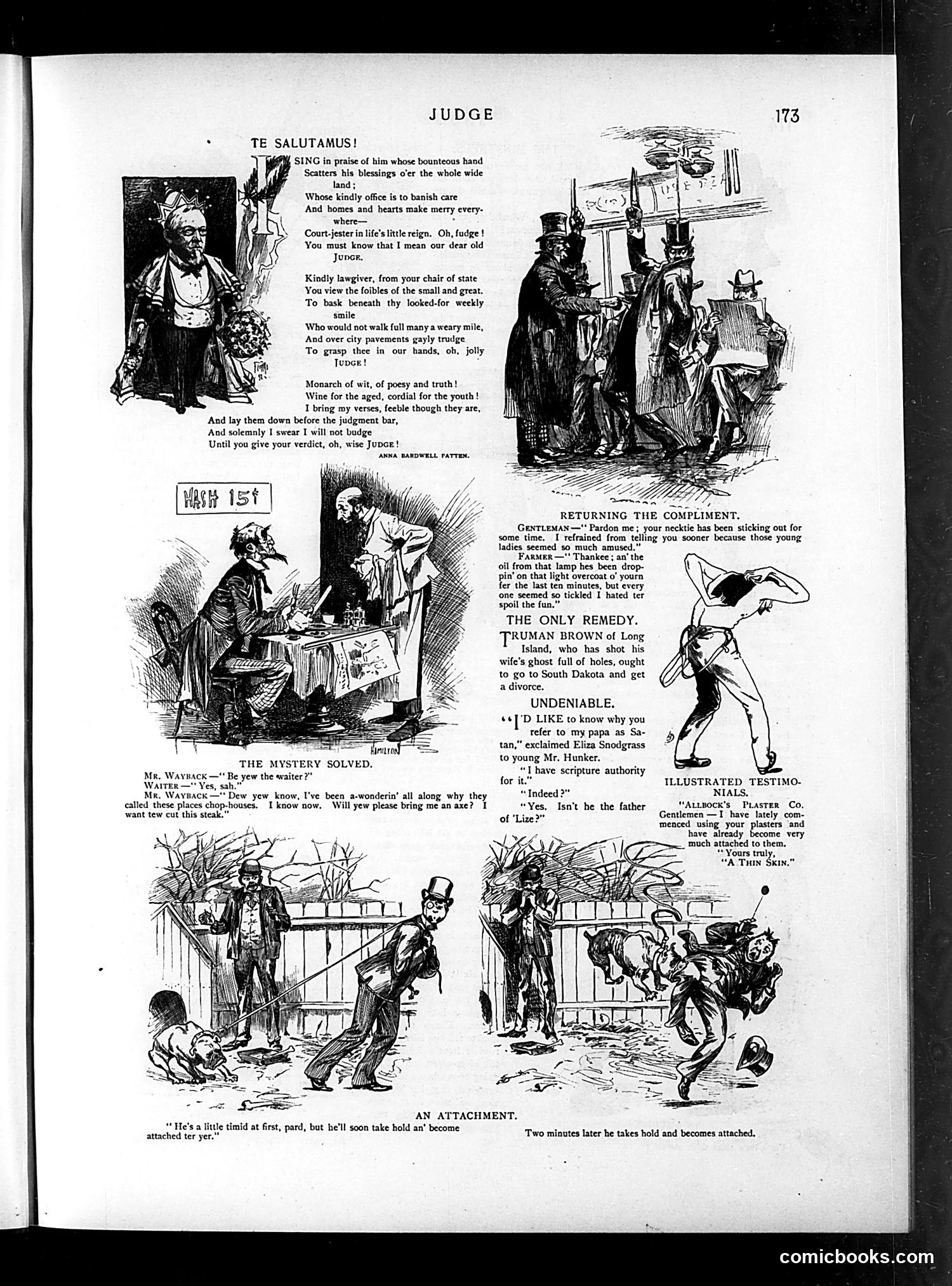
This page from the satirical magazine **Judge** contains several distinct humor pieces: **"Te Salutamus!"** — A fawning poem praising the editor/judge of Judge magazine itself, mock-heroically treating him as a benevolent ruler dispensing "weekly" verdicts on submitted work. The satire targets obsequious contributor submissions. **"The Mystery Solved"** — A visual joke about "chop-houses" (restaurants). A man wonders why they're called that; the punchline reveals it's because the meat is chopped/axed—he wants to "cut this steak" with an axe, treating the mystery as solved by brutal logic. **"The Only Remedy"** — A brief jab at Truman Brown, who apparently shot his wife's ghost repeatedly. The absurdist humor suggests only South Dakota divorce law can help this clearly delusional man. **"An Attachment"** — A two-panel visual gag where a timid child gradually becomes "attached" (both emotionally and physically through contact) to a dog over two minutes—playing on the double meaning of "attachment." The page primarily contains lighthearted domestic humor and wordplay rather than political satire.
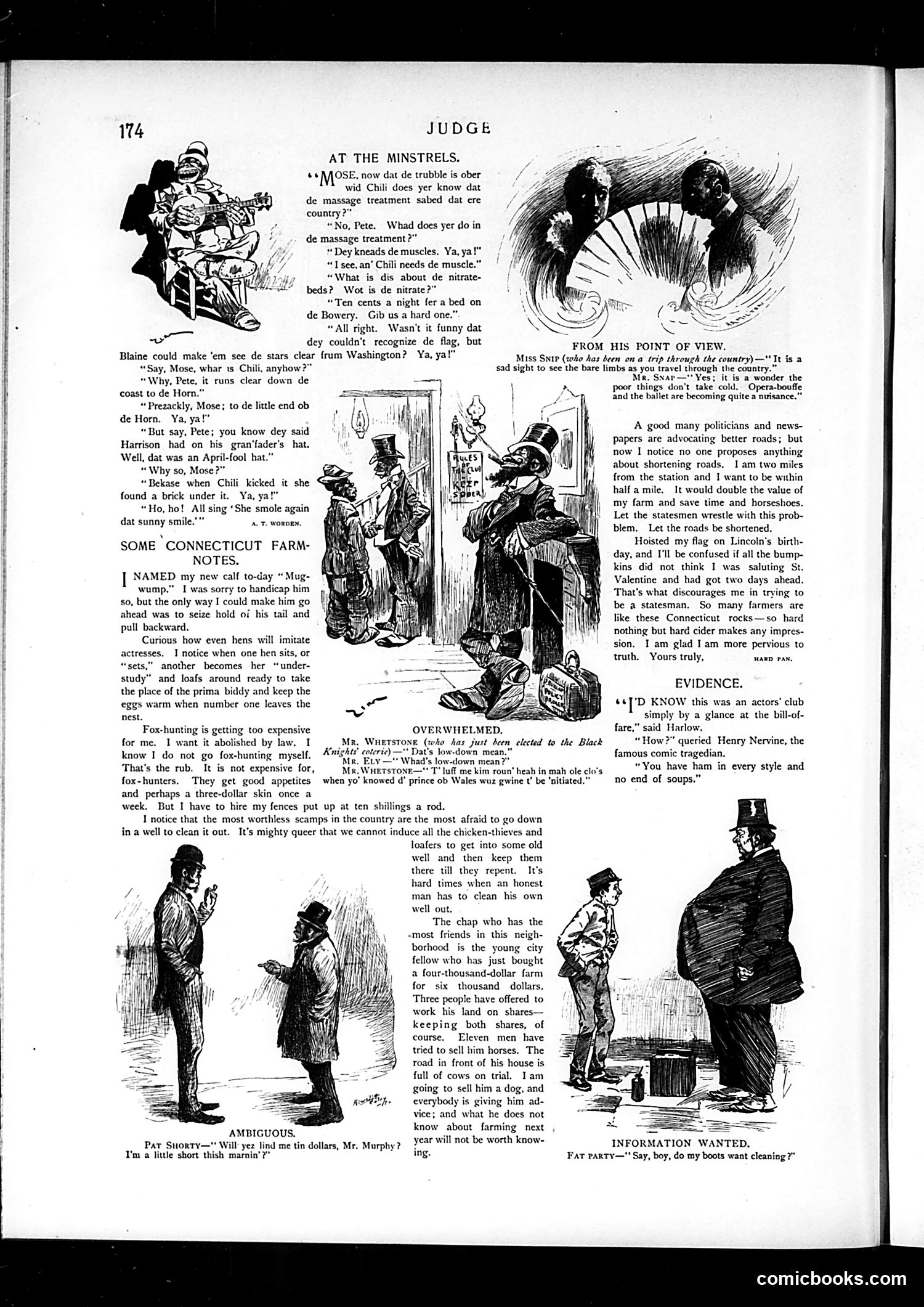
This page from Judge magazine contains several satirical pieces mocking contemporary American life and politics (likely 1880s-90s based on references to Harrison and Chile). **"At the Minstrels"** features racist dialect humor typical of the era, with Black characters discussing Chile's geography and U.S. politics. The "brick under the hat" joke mocks President Harrison as foolish (an April Fool). References to "nitrate beds" and massage treatment likely allude to Chile's nitrate disputes and recent diplomatic tensions. **"Some Connecticut Farm Notes"** satirizes rural life and farmers' gullibility. The closing joke mocks a wealthy city buyer duped into paying excessive prices for farmland, then pestered by locals selling him worthless horses and offering farming advice—commentary on rural exploitation and con-artistry. The scattered cartoons illustrate these themes: bewildered figures, characters in urban/rural friction. **"Evidence"** and **"Information Wanted"** are brief sight-gag vignettes typical of humor magazines. The overall tone reflects urban-centered contempt for rural Americans and casual racism endemic to period satire.
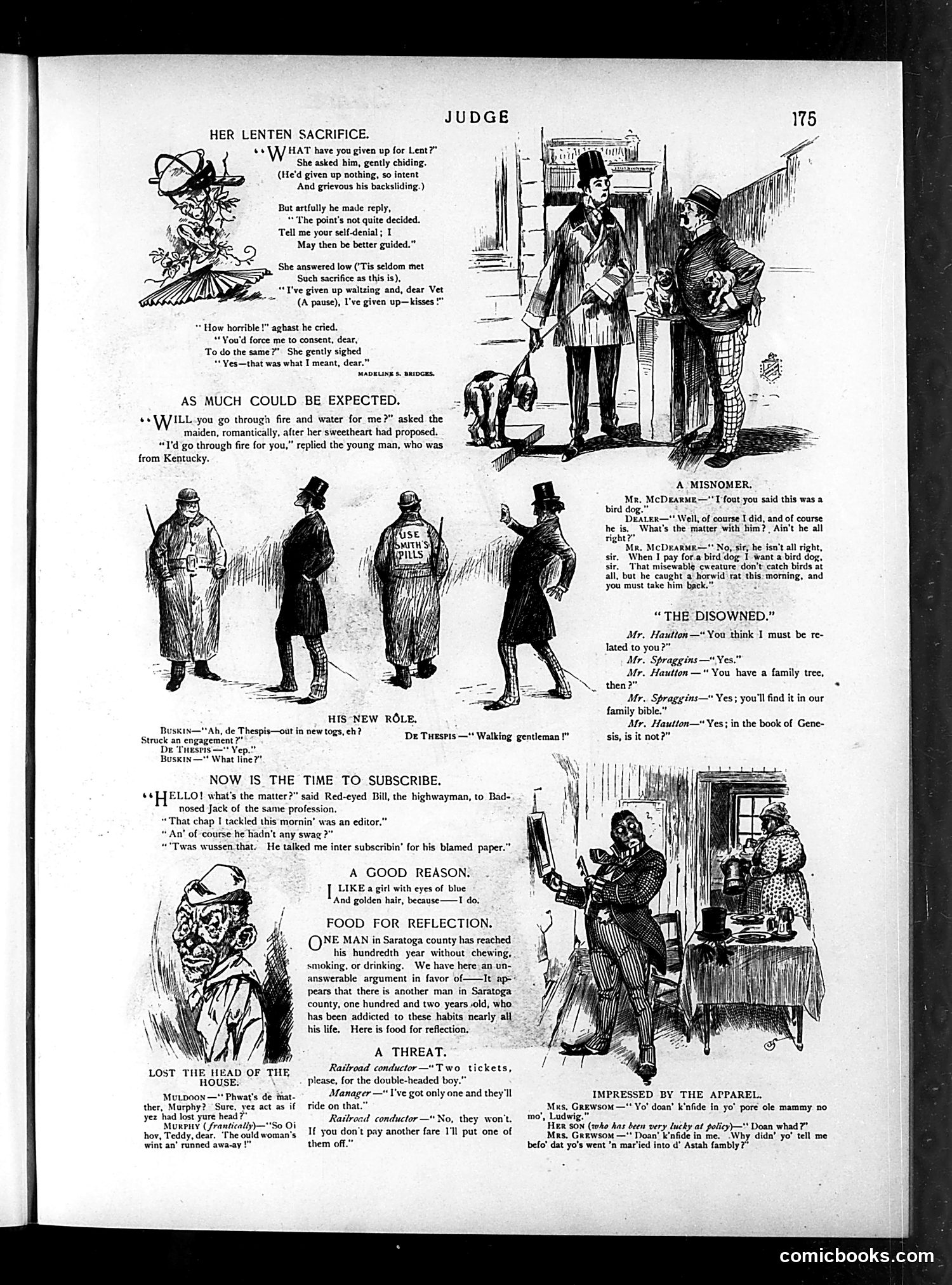
This page contains multiple short satirical pieces typical of late-19th-century American humor: **"Her Lenten Sacrifice"** mocks romantic courtship rituals and male hypocrisy—a woman sacrifices waltzing and kisses for Lent; her suitor pretends he'll match her sacrifice but clearly won't. **"As Much Could Be Expected"** jokes about a Kentucky man's limited commitment—he'd go through fire for love, but only fire, not water, playing on regional stereotypes. **"Now Is the Time to Subscribe"** satirizes newspaper subscription tactics: two highwaymen discuss being robbed—one of valuables, the other tricked into subscribing to a paper. **"A Misnomer"** ridicules a dog-seller: the "bird dog" catches rats instead, inverting its intended purpose. **"The Disowned"** contains a genealogical insult—suggesting someone's family tree appears in the Book of Genesis (implying primitive ancestry). Other pieces mock theatrical aspirations, mismatched romantic preferences, and social pretensions through brief comedic dialogues. The humor relies on wordplay, exaggeration, and contemporary social observations rather than specific political events.
This political cartoon from *Judge* magazine depicts a courtroom or official proceeding at Westminster (indicated by Big Ben in the background). A figure with judicial authority stands elevated on the left, while a group of caricatured foreign dignitaries or politicians on the right appear dismayed or defeated. The caption "HE HAS GOT THEM" suggests someone has gained legal or political advantage over these figures. The cartoon likely satirizes a British legal victory or political triumph affecting foreign powers, though without a date, I cannot identify the specific figures or dispute referenced. The exaggerated facial features and costumes suggest these represent different nations or ethnic groups, typical of *Judge's* satirical approach to international affairs during the late 19th or early 20th century.
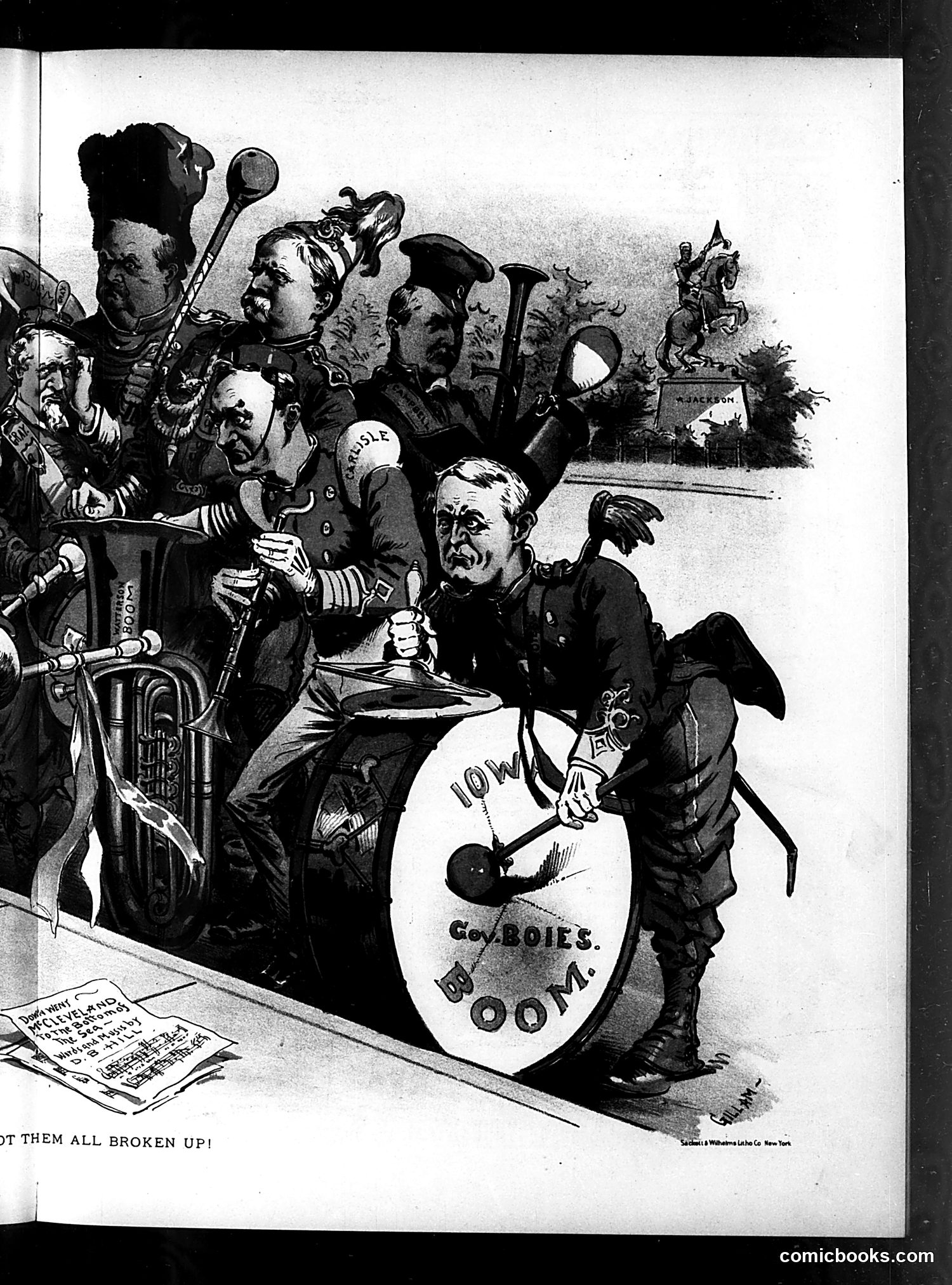
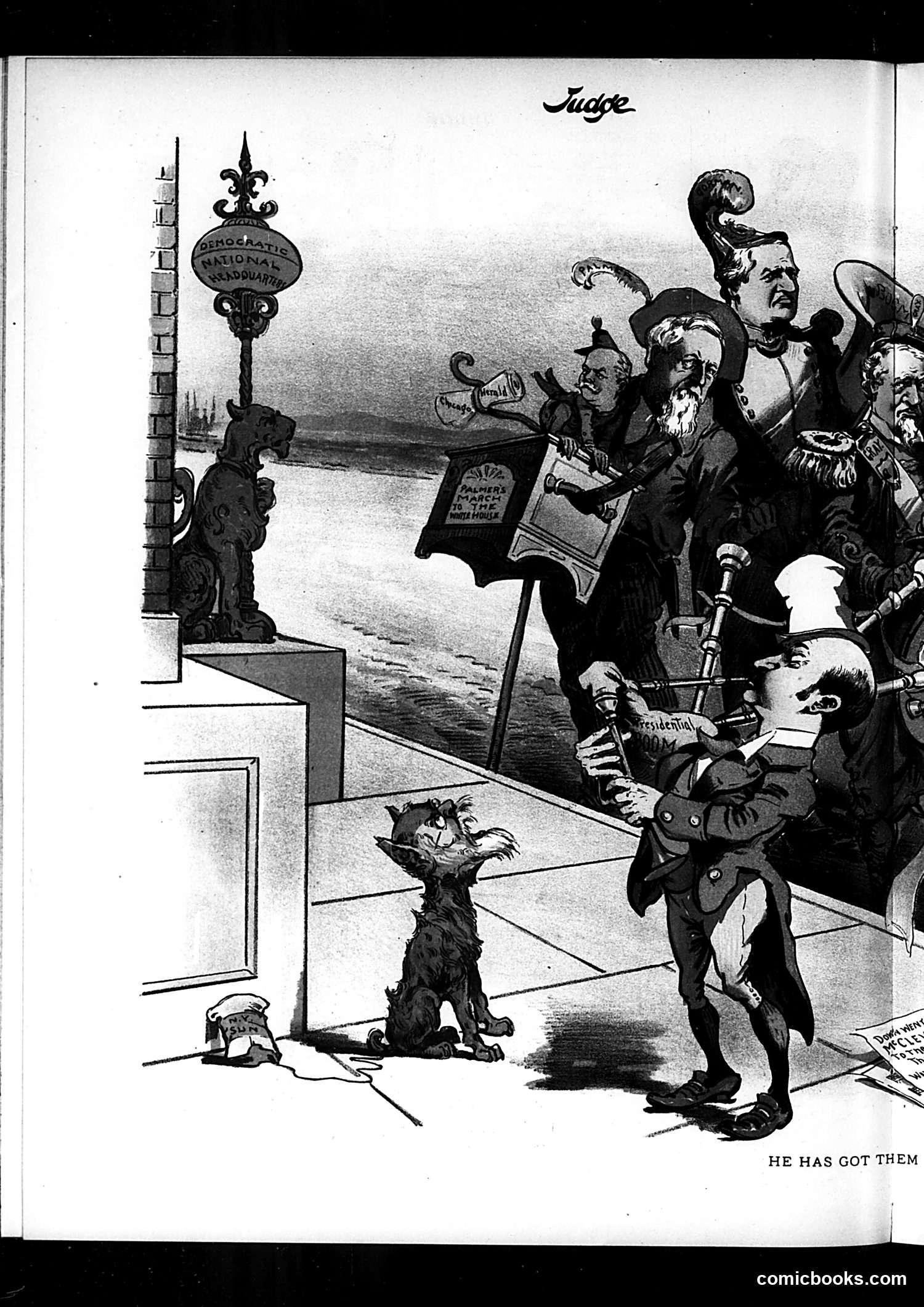
This political cartoon from *Judge* magazine satirizes military or political leadership, likely from the early 20th century based on the style. The central figure labeled "Gov. BOIES" (appearing to reference Iowa Governor) sits at a drum labeled "IOWA BOOM," surrounded by military officers and officials in formal dress. The figures hold various implements—staffs, weapons, musical instruments—suggesting discord or competing agendas within leadership ranks. The caption "GOT THEM ALL BROKEN UP!" implies the cartoon critiques internal conflict, mismanagement, or the fracturing of a political coalition or military command structure. The caricatured faces suggest specific, identifiable political figures of the era, though without additional context, precise identification of individuals beyond Governor Boies remains unclear. The overall tone is mocking toward governmental dysfunction.
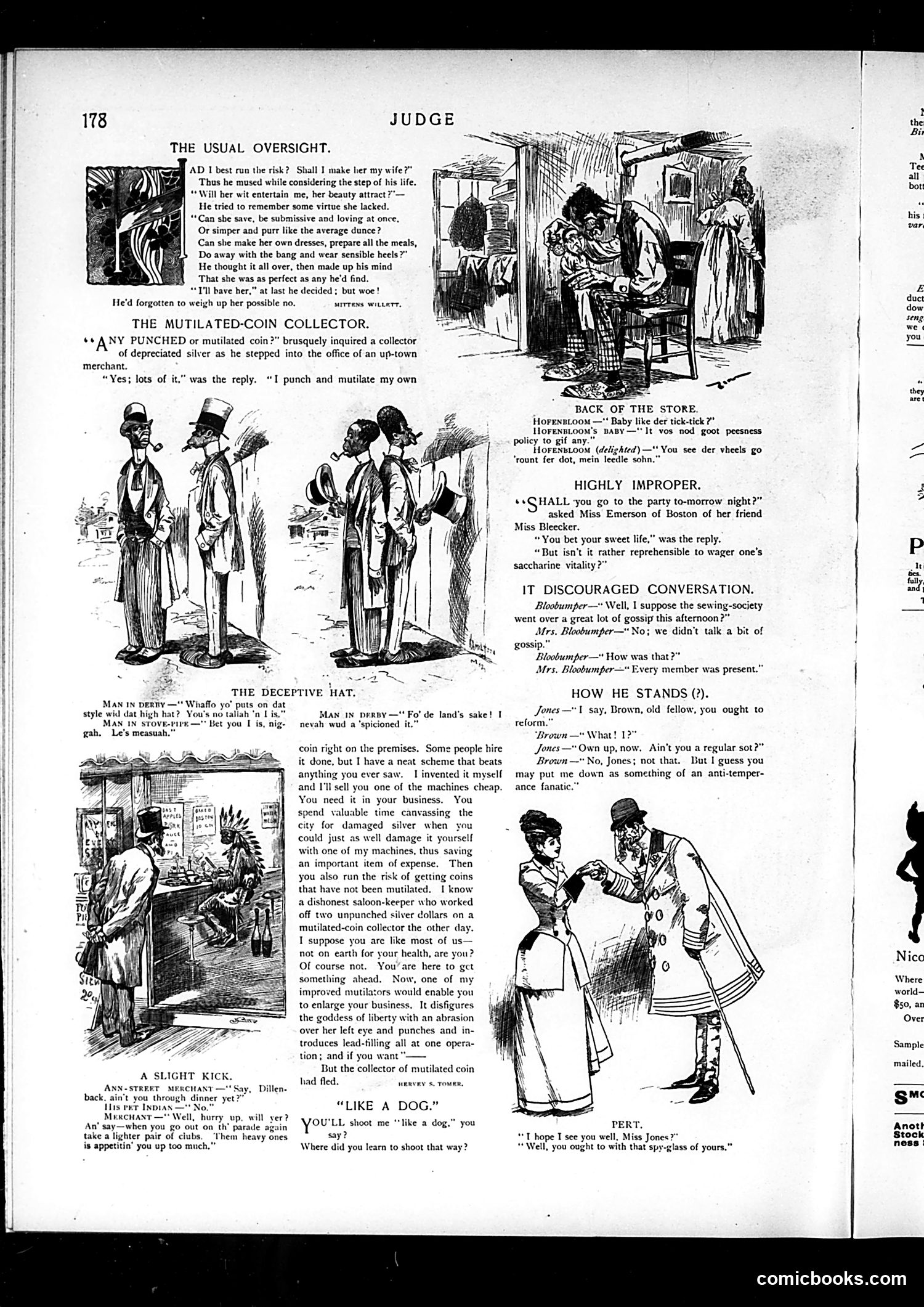
This page contains several brief comic sketches typical of late-19th-century American humor magazines: **"The Usual Oversight"** mocks a man deliberating marriage—he carefully considers whether his prospective bride has all desirable qualities, then realizes he never asked if *she* wanted to marry *him*. **"The Mutilated-Coin Collector"** satirizes business fraud: a con artist tries selling a machine to deliberately damage coins to a merchant already engaged in the practice, who flees in disgust at such transparent dishonesty. **"The Deceptive Hat"** features dialect humor common to the era, with working-class characters mistaking formal attire for tailoring skill. Other brief vignettes employ similar period stereotypes—Irish and German immigrant characters in particular—for mild domestic and social comedy. The humor relies on misunderstandings, class pretension, and romantic awkwardness rather than political satire. These represent typical Judge magazine filler content between advertisements.
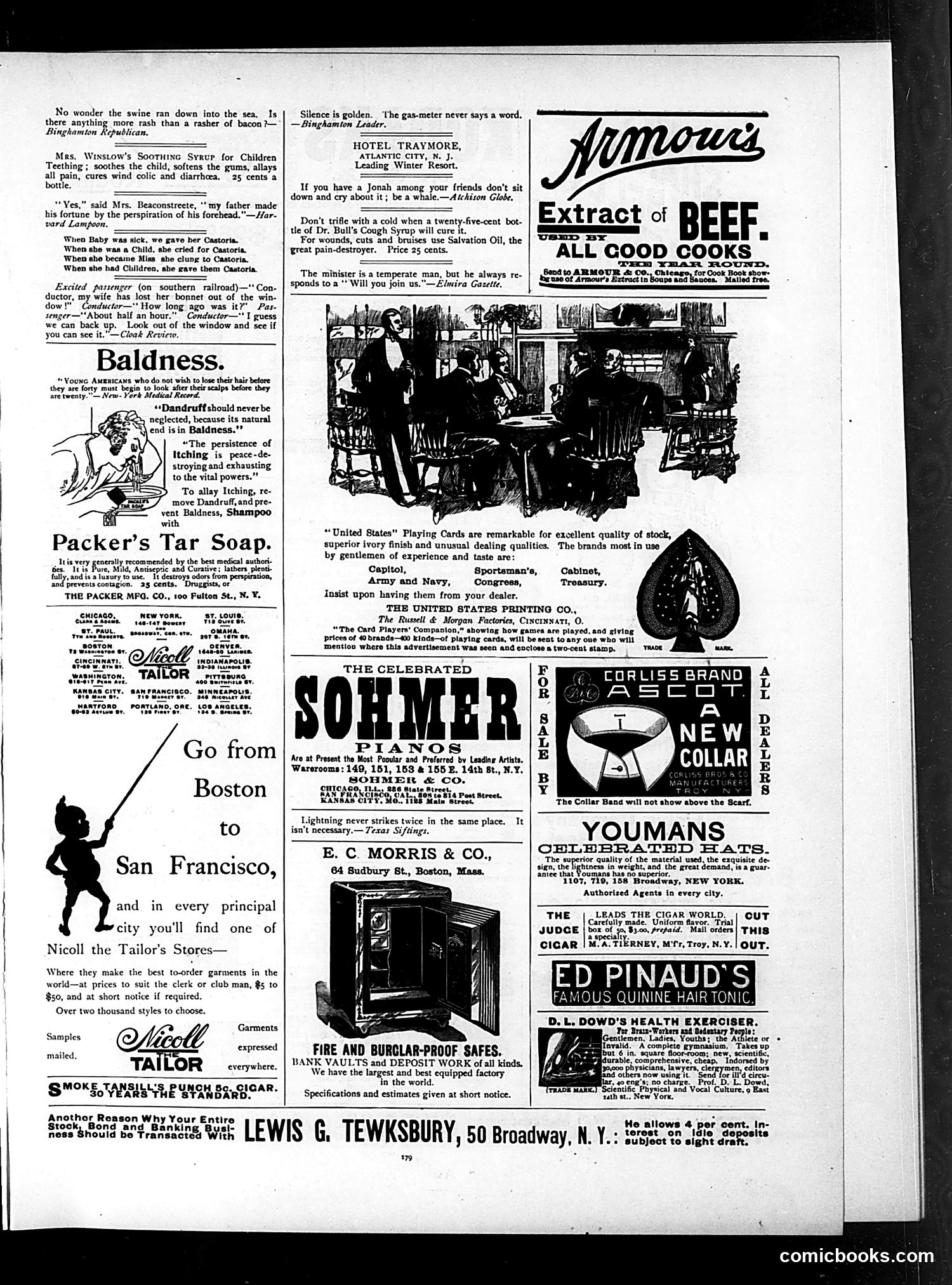
This page is primarily **advertising**, not political satire. It contains numerous commercial advertisements for products like Mrs. Winslow's Soothing Syrup, Castoria, Packer's Tar Soap, Nicoll the Tailor, Sohmer Pianos, and playing cards. The only discernible humor appears in brief **joke snippets** scattered throughout—such as quips about rasher of bacon ("Is there anything more rash than a rasher of bacon?") and references to a "Jonah" as bad luck. These are generic wordplay and proverbial wisdom rather than political commentary. The page lacks identifiable political figures or satire. It appears to be a standard Judge magazine page where editorial space is filled with paid advertisements, with minor filler jokes providing brief entertainment value. No specific political or social critique is evident.
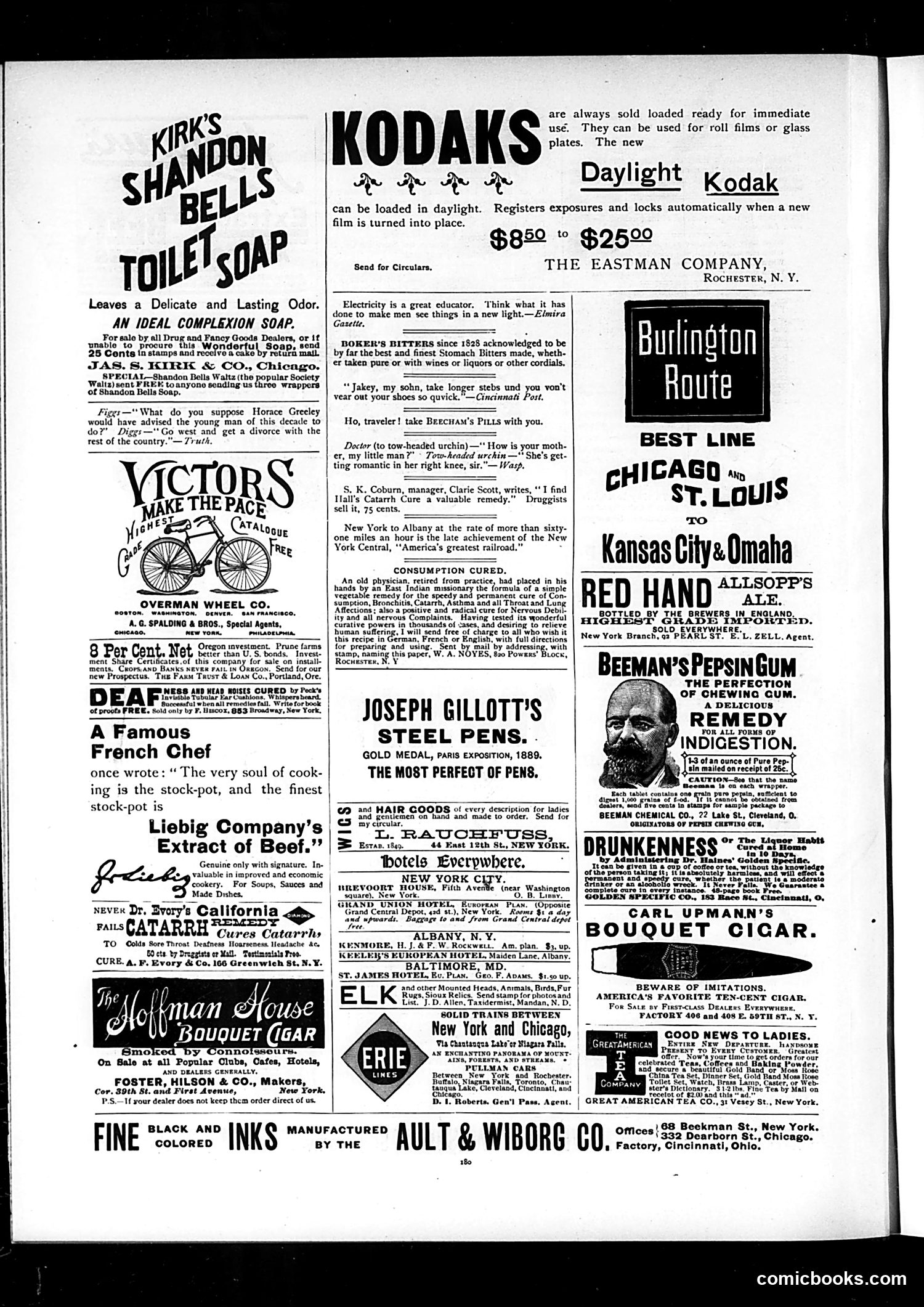
This page is primarily **advertisements** with one small cartoon joke. The only substantive editorial content is a brief dialogue between "Figgs" and "Diggs" at upper left. When Figgs asks what advice Horace Greeley would give today's young men, Diggs responds: "Go west and get a divorce with the rest of the country." This references the famous 1865 Greeley quote "Go West, young man"—sage advice about opportunity and frontier life. The joke updates it cynically: by the 1880s-90s, the implication is that westward migration and American expansionism have become morally exhausted, so the modern equivalent is simply divorce (then scandalous and still rare). It's satirizing perceived American moral decline and the erosion of earlier values, with a jab at the growing prevalence of divorce among the wealthy and mobile classes. The rest of the page consists entirely of patent medicines, commercial products, and travel advertisements typical of Judge magazine's revenue model.
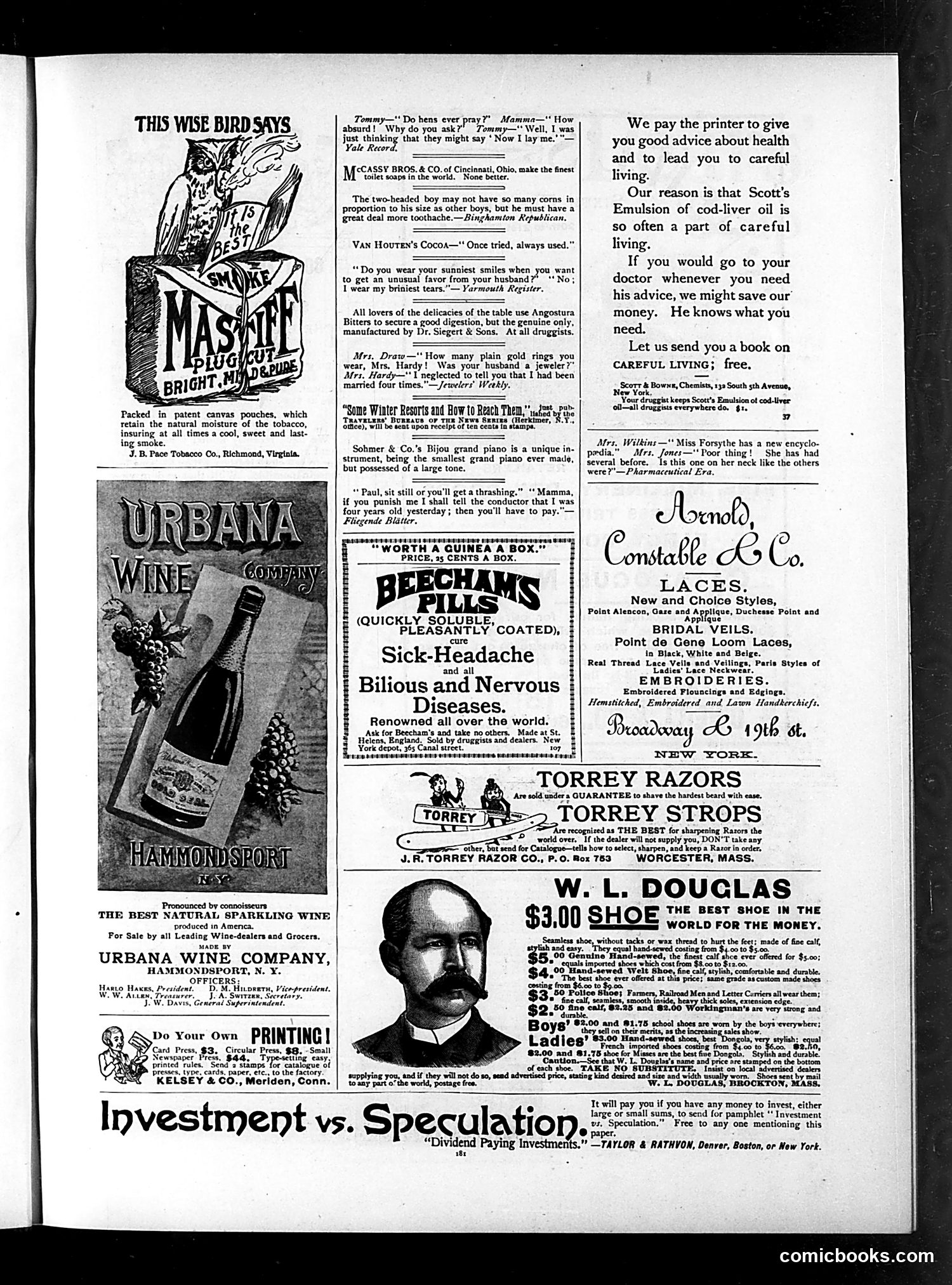
This page is primarily **advertisements and filler humor** rather than editorial cartoons. The only cartoon at top ("This Wise Bird Says") advertises J.B. Pace tobacco—an owl mascot mascot promoting "cool, sweet and lasting smoke." The page contains numerous **puns and brief jokes** (credited to various sources like *Yarmouth Register*, *Binghamton Republican*) typical of Judge's format: a child jokes about hens praying "Now I lay me," a woman has multiple marriages evidenced by four gold rings, a child threatens to claim he's younger to avoid punishment. **Advertisements dominate**: Scott's Emulsion cod-liver oil, Beecham's Pills, Urbana Wine, W.L. Douglas shoes, Torrey Razors, Arnold Constable clothing, and toiletries. The Scott's ad notably claims advertising "good advice about health" drives purchasing. The bottom features a financial advertisement: "Investment vs. Speculation." This appears to be a typical mid-period Judge page blending light humor with lucrative advertising—the magazine's business model.
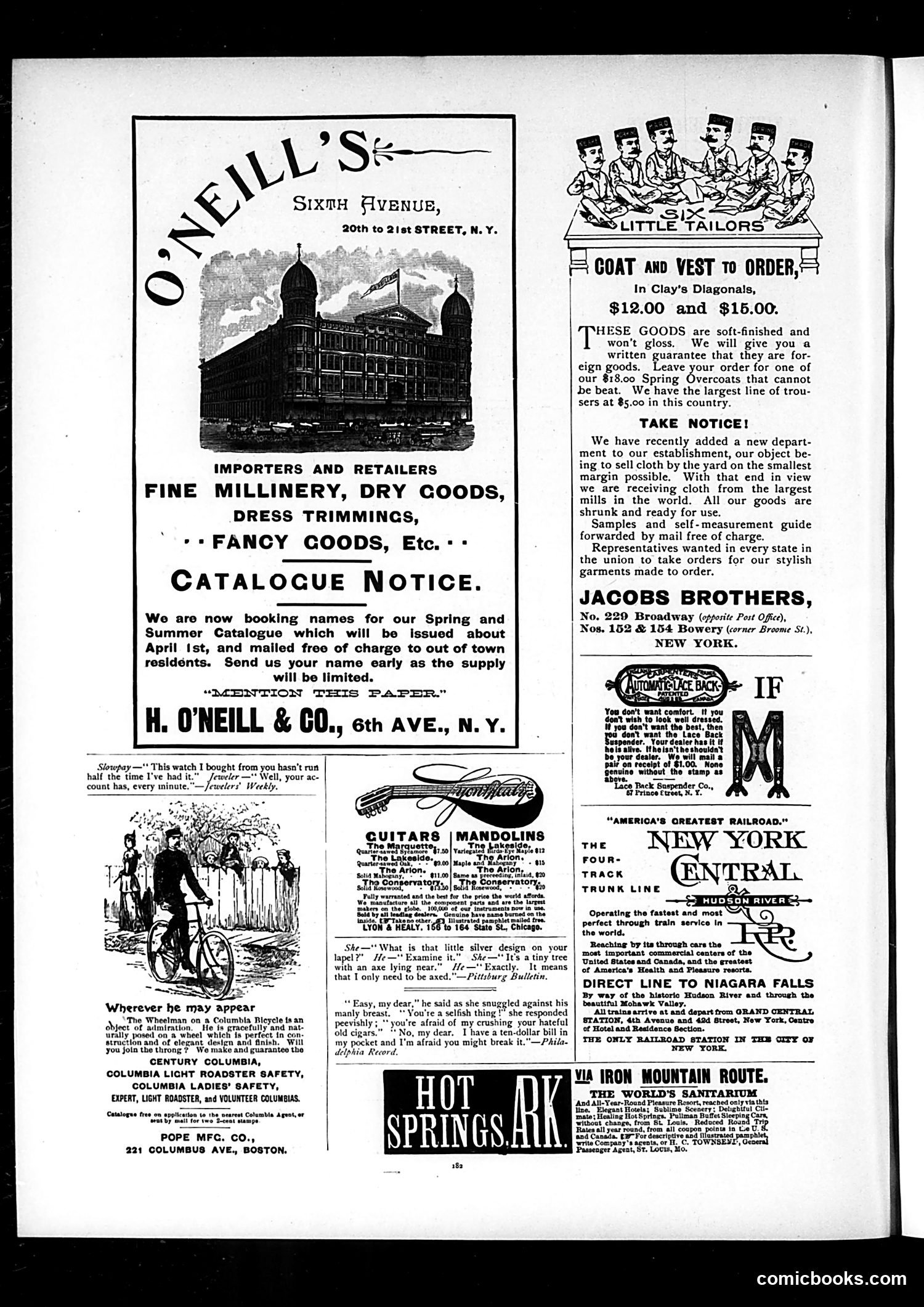
This is primarily a **commercial advertising page** from Judge magazine, not a political cartoon page. The content consists almost entirely of late-19th-century business advertisements for clothing, bicycles, railroads, and other goods. The small **humorous vignettes** scattered among ads are brief jokes: - A jeweler quips that a customer's payment account runs better than the watch they bought - A couple's domestic exchange: she calls him selfish for worrying about his cigar, he reveals he's actually protecting a ten-dollar bill in his pocket from her crushing it These are **gentle domestic humor** typical of the era—not political satire. The page reflects Judge's dual nature as a satirical magazine that also served as an advertising vehicle. The jokes mock everyday consumer anxieties and marital dynamics rather than addressing political or social issues. The advertising emphasizes quality goods, fashionable tailoring, and new consumer conveniences of the period.
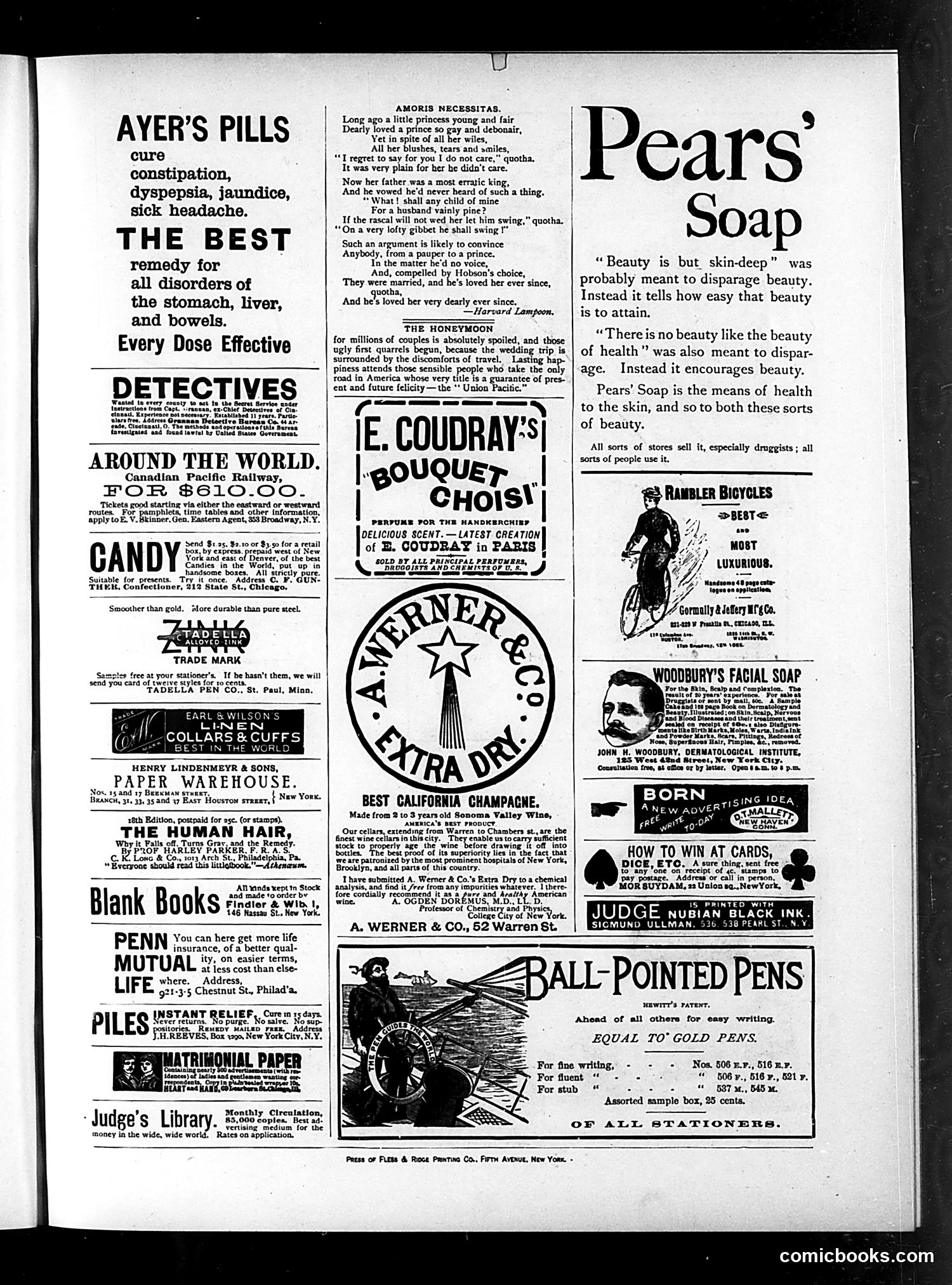
This page is primarily **advertisements** for consumer products and services, with one satirical poem ("Amoris Necessitas"). The poem, attributed to *Harvard Lampoon*, tells a fairy-tale satire: a princess loves a prince who doesn't return her affection. Her king father threatens to hang the reluctant prince unless he marries her. Faced with this "argument," the prince agrees—and then genuinely falls in love with his forced bride. **The satire's point**: The poem mocks romantic conventions and arranged marriages of the era by suggesting that forced marriage can paradoxically produce genuine love. It's a humorous inversion of fairy-tale logic—the "happily ever after" arrives not through courtship but through coercion and resignation. The remaining content is **period advertising**: Ayer's Pills for digestion, Canadian Pacific Railway tours, blank books, pens, champagne, soap, and other goods typical of early-1900s American consumer magazines. No political cartoons appear on this page.
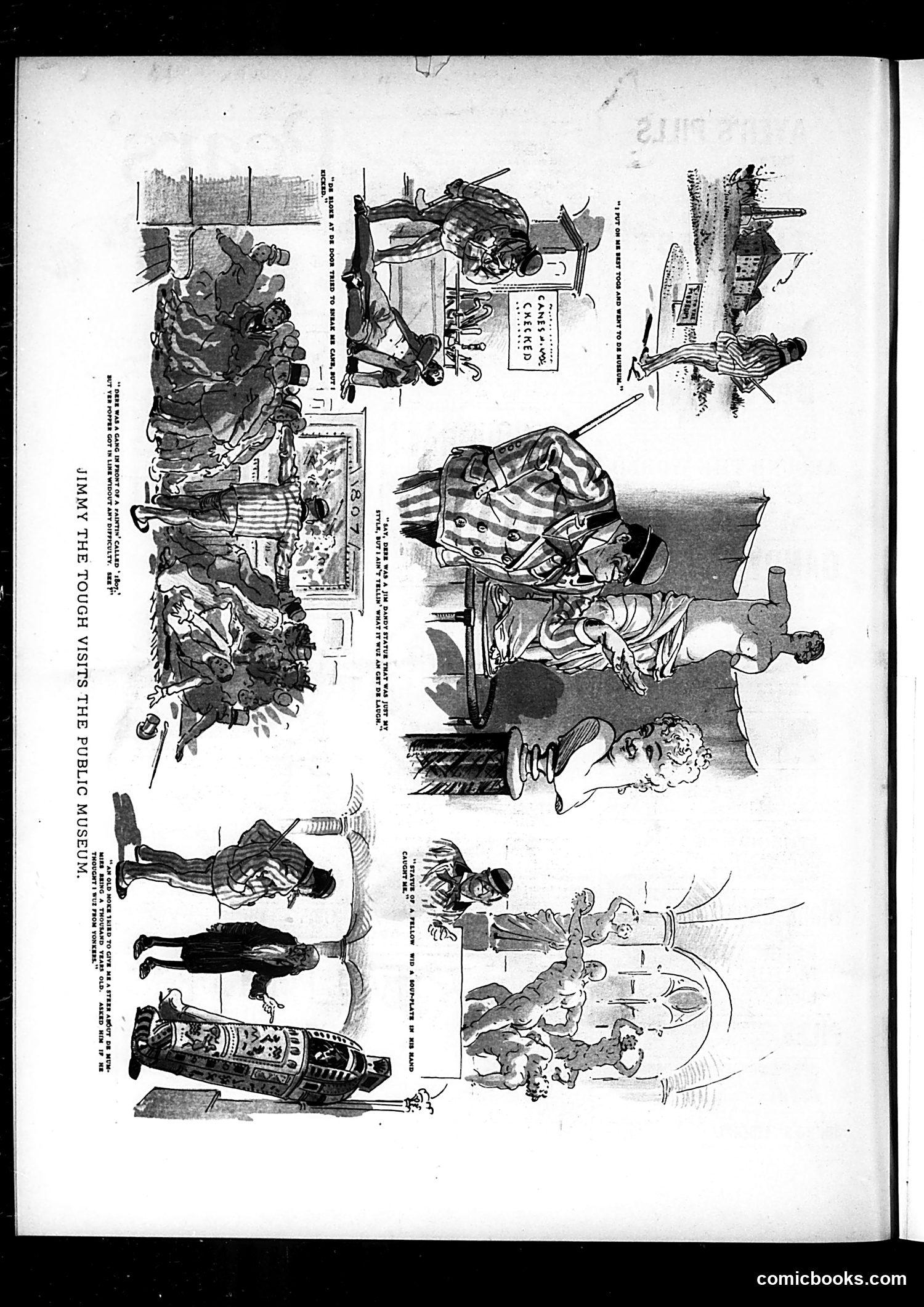
This Judge magazine page satirizes art world pretension and snobbery. The cartoon appears to mock wealthy or fashionable people viewing art exhibitions, with characters speaking in exaggerated dialect (suggesting working-class or immigrant speech patterns common in period satire). The humor targets two things: first, people who affect sophistication about art they don't understand; second, the absurdity of crowds forming around famous artworks. References to a specific statue and painting ("1807") suggest actual contemporary exhibitions, though the exact works are unclear. The dialogue implies someone's father entered an art viewing "widout any difficulty"—likely mocking the pretense that viewing certain artworks requires special status or knowledge, when access is actually straightforward. The satire punches at class-based gatekeeping in arts culture.