
A complete issue · 18 pages · 1891
Judge — December 12, 1891
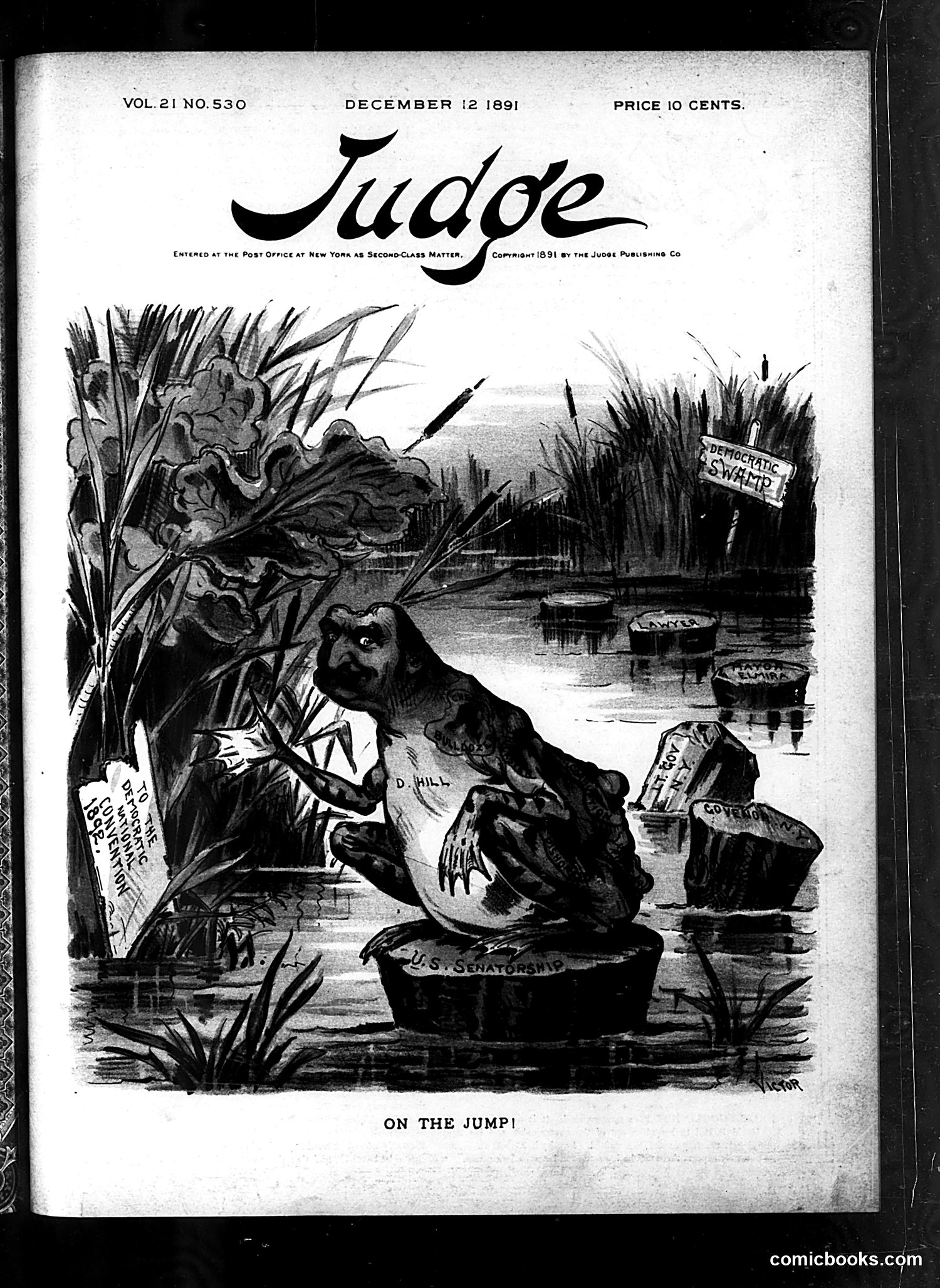
This 1891 *Judge* cartoon satirizes political instability during the early Cleveland administration. A frog labeled "U.S. Senatorship" sits in a swamp, surrounded by signs indicating Democratic and Republican interests competing for control. The central figure—a large rat or similar creature labeled "D. Hill" (likely David B. Hill, New York politician)—appears "on the jump," leaping between lily pads representing competing political factions. The cartoon mocks the chaotic jockeying for Senate positions and patronage appointments characteristic of Gilded Age politics. The aquatic setting suggests these politicians are trapped in murky, unstable waters, unable to maintain steady footing. The satire critiques the opportunism and constant maneuvering of politicians seeking advantage.
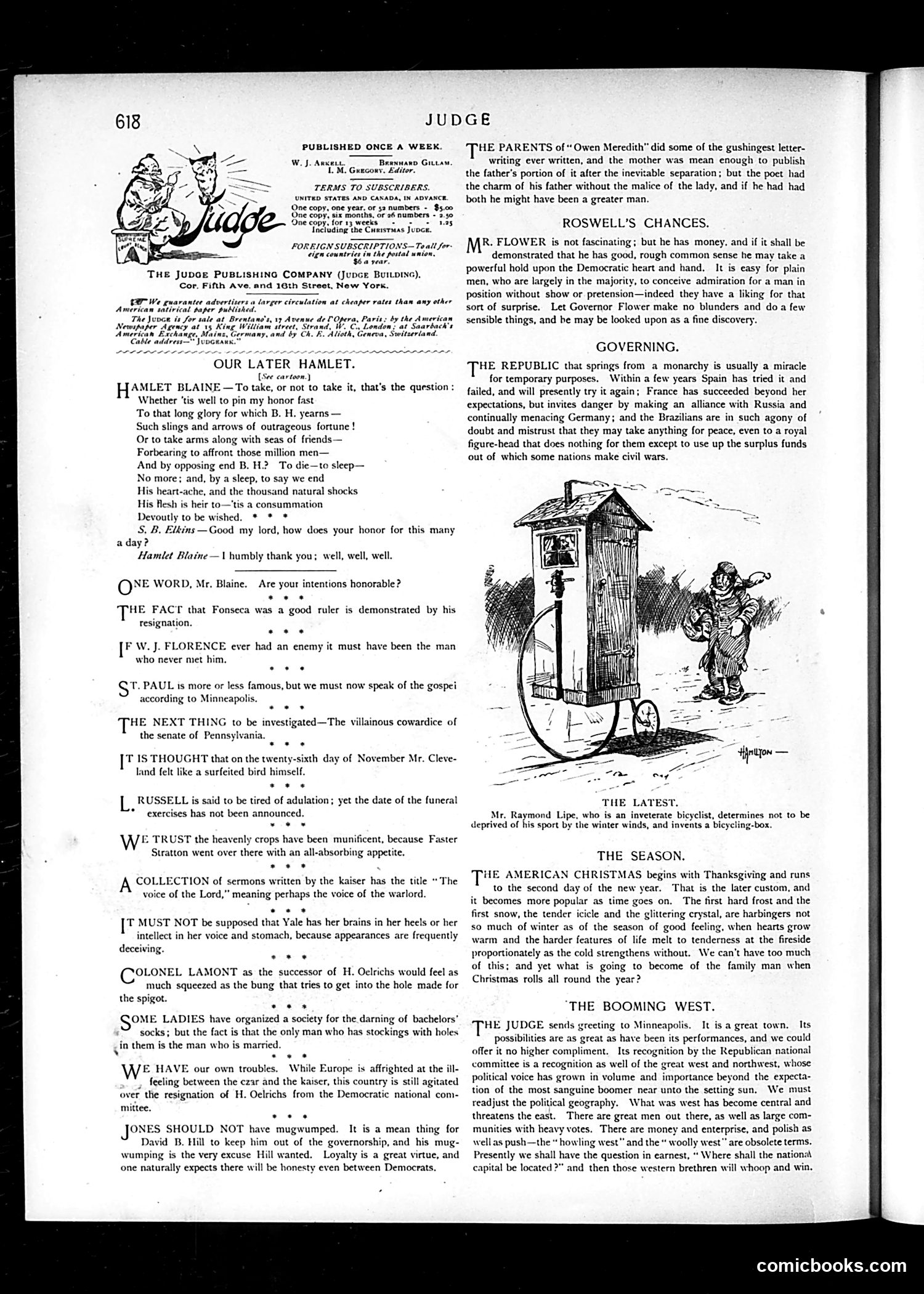
This page contains editorial commentary rather than comics. The main cartoon shows a figure in a tall cylindrical structure (appearing to be an outhouse or similar rural fixture) with another figure approaching, illustrating "The Latest" section's joke about a man determining to avoid being deprived of his bicycle during winter by investing in a bicycle box. The text discusses various political and social topics of the era, including references to H. Oelichs (unclear figure), Pennsylvania senate cowardice, and Cleveland's political standing. "Roswell's Chances" discusses Governor Flower's political prospects. "The Booming West" praises Minneapolis as a great town with growing political importance. The overall tone is satirical commentary on contemporary American politics and society, though specific figures and events are difficult to date precisely without additional context.
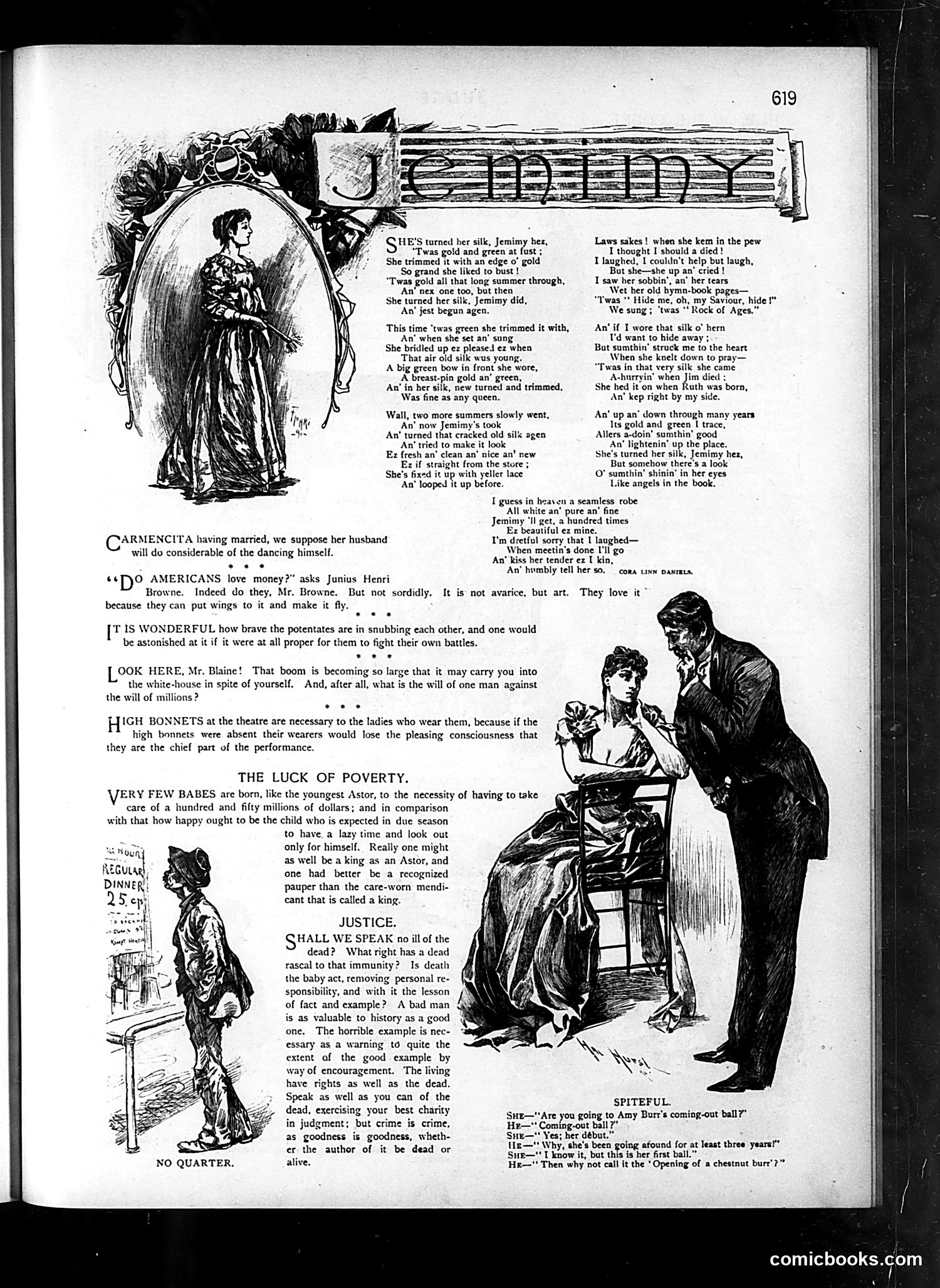
This page contains several distinct pieces rather than a unified cartoon: **Upper section:** A poem about "Jeminy" (likely a woman's name) and her silk dress, illustrated with a sketch of an elegantly dressed woman. The text celebrates her wardrobe upgrades over time. **Middle section:** Brief commentary on American manners, questioning whether Americans "love money" as stereotype suggests, with discussion of proper social conduct and bonnets at the theater. **Lower sections:** Two separate pieces—"The Luck of Poverty" discussing class disparities in childbirth expectations, and "Justice," a philosophical essay on speaking ill of the dead and morality in judgment. **Bottom right:** A dialogue illustration labeled "Spiteful" depicting what appears to be a social interaction about a coming-out ball. The page is primarily **literary and moralistic** rather than sharply satirical, reflecting Judge's 19th-century focus on etiquette, social commentary, and gentle humor about American manners and class distinctions.
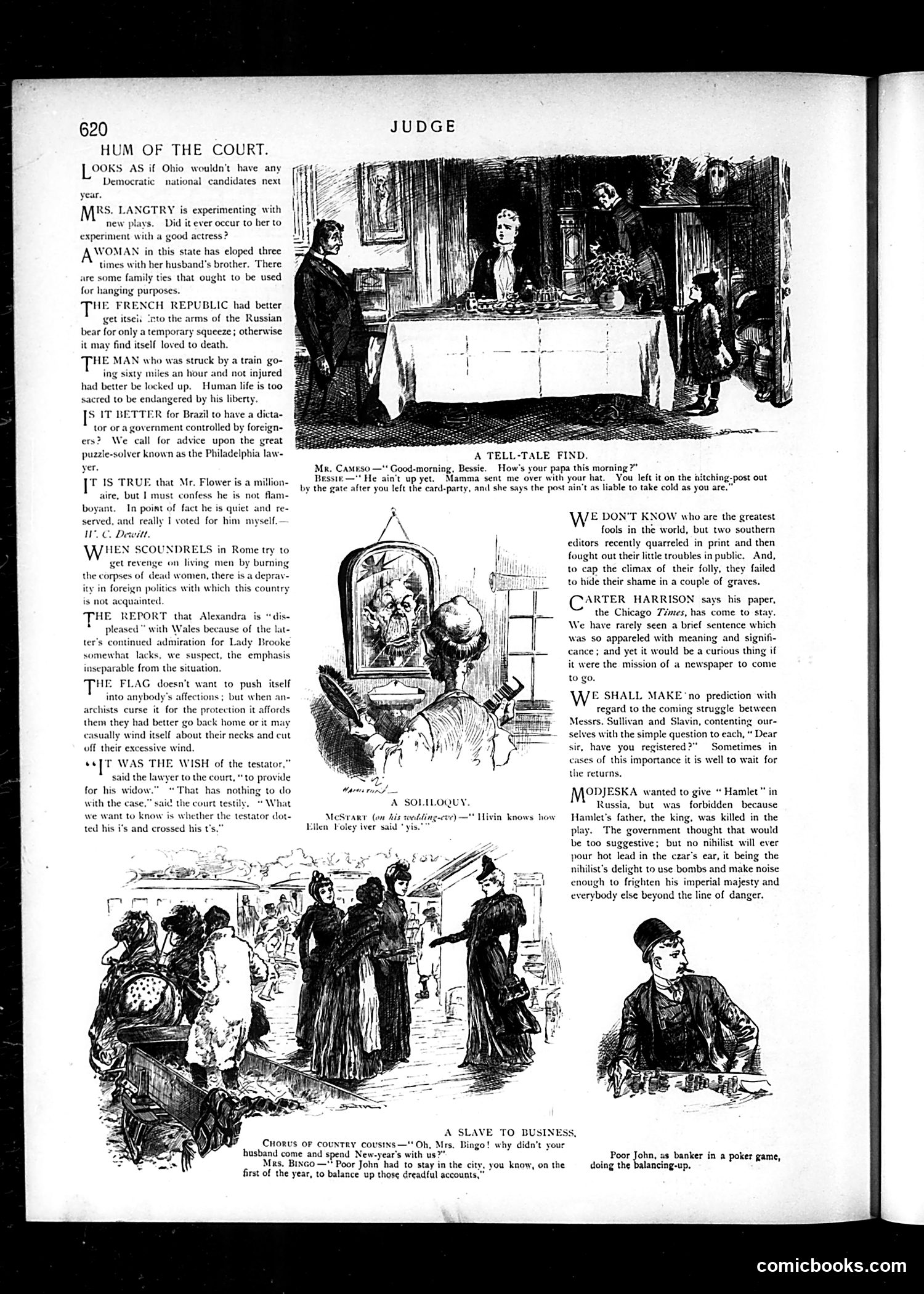
This page collects brief satirical commentary on contemporary issues circa 1880s-1890s: **"Hum of the Court"** section offers quick jabs at political figures and social absurdities: Ohio's Democratic prospects, the French alliance with Russia (mocking romantic/dangerous entanglement), Brazilian governance, and testamentary law technicalities. **Key cartoons:** - **"A Tell-Tale Find"**: A domestic humor sketch where a child innocently reveals his father's infidelity by returning a hat left at a card party, exposing the father's lie about his whereabouts. - **"A Soliloquy"**: Features a man in a window, likely depicting personal introspection or urban loneliness. - **"A Slave to Business"**: Shows a banker absorbed in poker, satirizing financial men's gambling habits. The page also mocks Southern newspaper editors who fought publicly over print disputes, and references Russian censorship preventing Hamlet's performance due to regicide themes (ironically noting nihilists use actual bombs rather than theatrical plots). The satire targets hypocrisy, political incompetence, and social pretension typical of Gilded Age *Judge* humor.
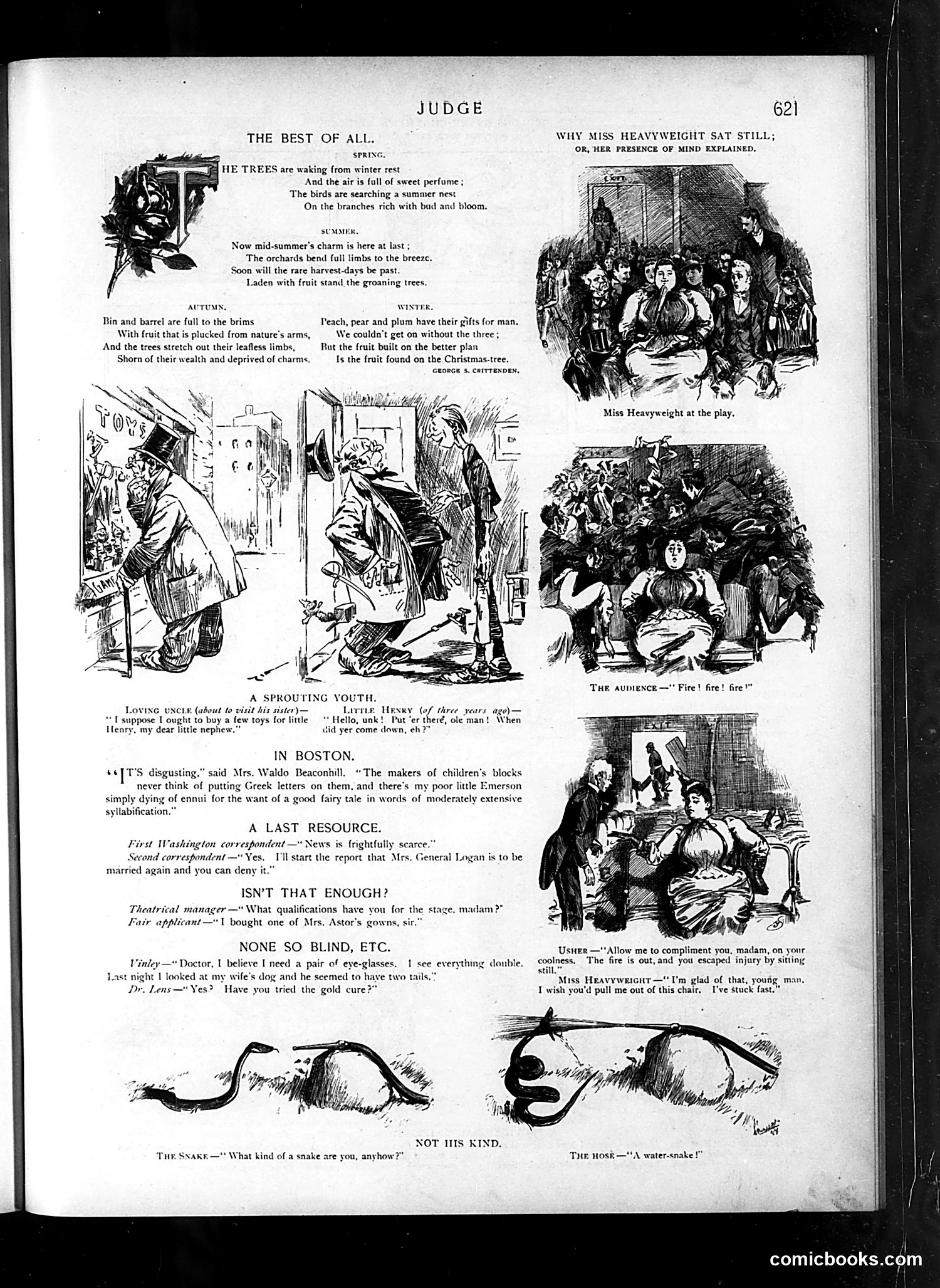
This page from *Judge* contains multiple satirical pieces reflecting late 19th-century upper-class anxieties: **Main Content:** "The Best of All" is a sentimental poem about seasons, contrasting nature's fruit with Christmas gifts—likely satirizing Victorian sentimentality about holidays. **Social Satire:** "In Boston" mocks pretentious Brahmin culture: Mrs. Waldo Beaconhill wants Greek letters on children's blocks and "syllabification" in fairy tales for her bored son Emerson—ridicule of over-educated, insufferable wealthy parents. **Cartoons:** Include a "Theatrical Manager" joke about an actress who owns a Paris gown (implying Americans buy status through clothing), and "None So Blind"—a man seeing double in his wife's dog, possibly satirizing alcohol consumption ("gold cure" references treatment for alcoholism). **"Miss Heavyweight":** Shows a large woman stuck in a chair, rescued by fire—dark humor about obesity and physical incompetence among the wealthy. The page overall mocks pretension, hypochondria, and the absurdities of the leisure class.
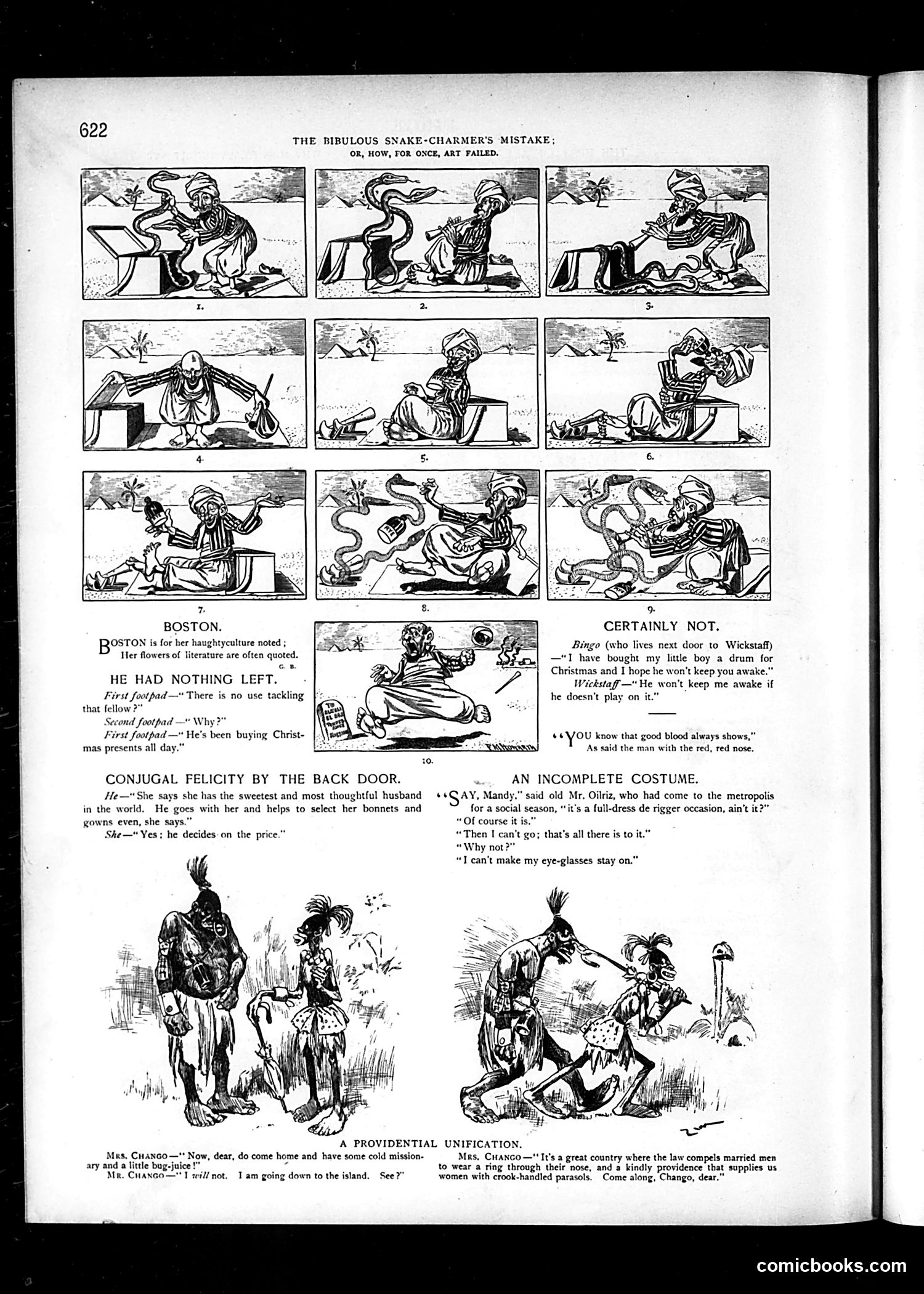
This page contains multiple satirical vignettes typical of Judge magazine's humor: **Top strip (9 panels):** A comedic sequence showing a snake-charmer who appears intoxicated, with snakes attacking him in increasingly chaotic ways—the "mistake" being his drunkenness renders him unable to control his serpents. **Other jokes target:** - **Boston's pretension**: Mocking the city's reputation for intellectual superiority - **Holiday poverty**: Footpads (robbers) avoid a man who spent all money on Christmas presents - **Marital dynamics**: Husbands controlling wives' spending on clothing; wives manipulating husbands - **Class/fashion anxiety**: A man worried his eye-glasses won't stay on at formal dress occasions - **Ethnic stereotypes**: "Chango" appears to be a racial caricature in the lower section The humor relies on domestic situations, economic struggles, social pretension, and period-specific anxieties about appearance and propriety—typical of late 19th/early 20th-century American satire.
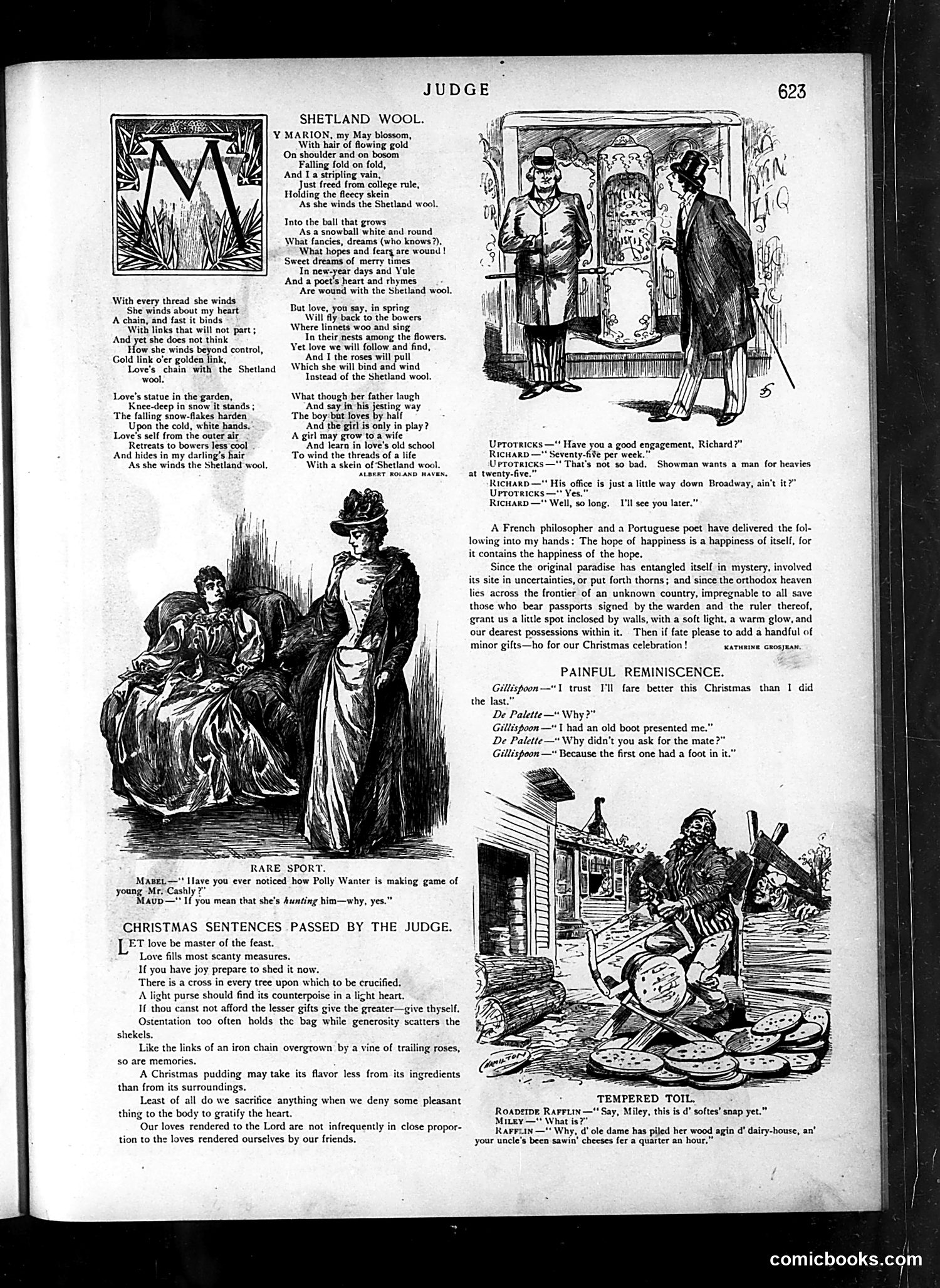
This page from *Judge* combines romantic poetry with workplace humor and holiday sentiment, typical of late 19th-century American satirical magazines. The dominant feature is "Shetland Wool," a sentimental poem about a young man watching his beloved wind wool—using the domestic task as metaphor for love's binding chains. It's earnest Victorian romance, not satire. The cartoon titled "Urtopsticks" depicts a brief theatrical employment negotiation: a man accepting a twenty-five-dollar-per-week job offer for "heavies" (muscular roles) from a theater manager. The humor is gentle workplace banter, with no apparent political content. The remaining sections—"Painful Reminiscence" (a pun-based joke about an old boot with a foot in it), "Rare Sport" (brief character dialogue), and "Christmas Sentences Passed by the Judge"—are lighthearted holiday-themed moral observations and wordplay, reflecting *Judge's* mix of sentiment and mild wit typical of its era.
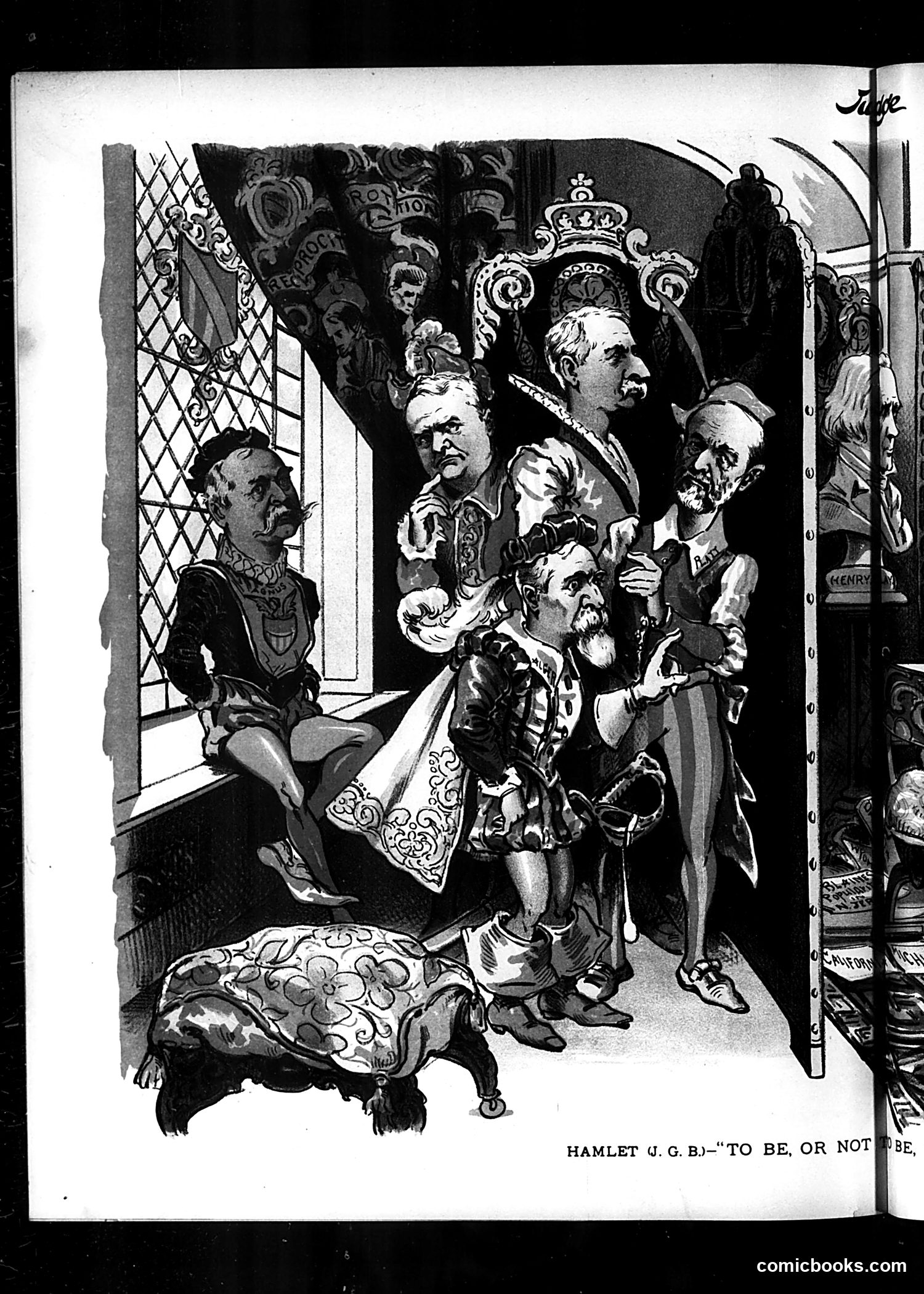
This is a political cartoon referencing Shakespeare's *Hamlet*, specifically the famous "To be or not to be" soliloquy. The caption "HAMLET (J.G.B)" suggests the cartoonist is depicting someone with initials J.G.B. in the role of Hamlet, contemplating a life-or-death decision. The scene shows a figure in period costume (center-left, seated by a window) surrounded by what appear to be courtiers or nobles in elaborate Renaissance dress. The theatrical staging and multiple observers suggest this is satirizing a real political figure's moment of indecision or crisis—likely someone facing a significant choice between two major options. Without the full date or identifying the specific J.G.B. figure, the exact historical reference remains unclear, though the cartoon clearly mocks someone's hesitation in a consequential political moment.
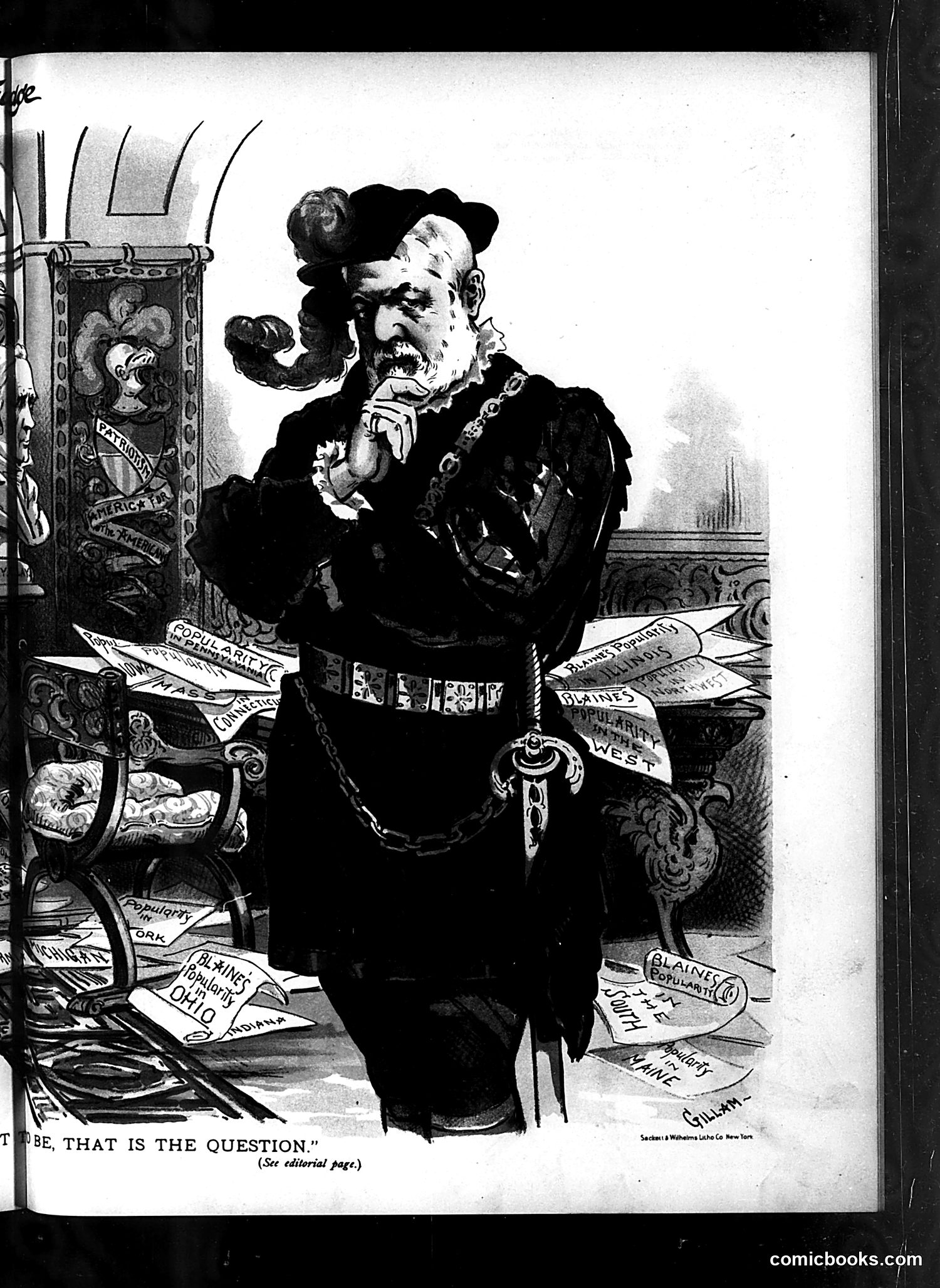
This cartoon depicts a disheveled, corpulent figure surrounded by scattered papers labeled with U.S. state names (York, Ohio, Maine, West, etc.), asking "To Be, That Is The Question"—a Hamlet reference suggesting existential uncertainty. The figure appears to represent a political boss or party leader grappling with control over various states during what seems to be electoral redistricting or political realignment. The scattered state labels suggest fragmentation of political power or the instability of party dominance across regions. The Shakespearean quote transforms Hamlet's existential crisis into commentary on whether this political entity/machine can survive—implying the satirist questions its continued viability or legitimacy. The ornate, corrupt-looking setting reinforces critiques of machine politics and backroom dealing typical of Gilded Age satire in *Judge* magazine.
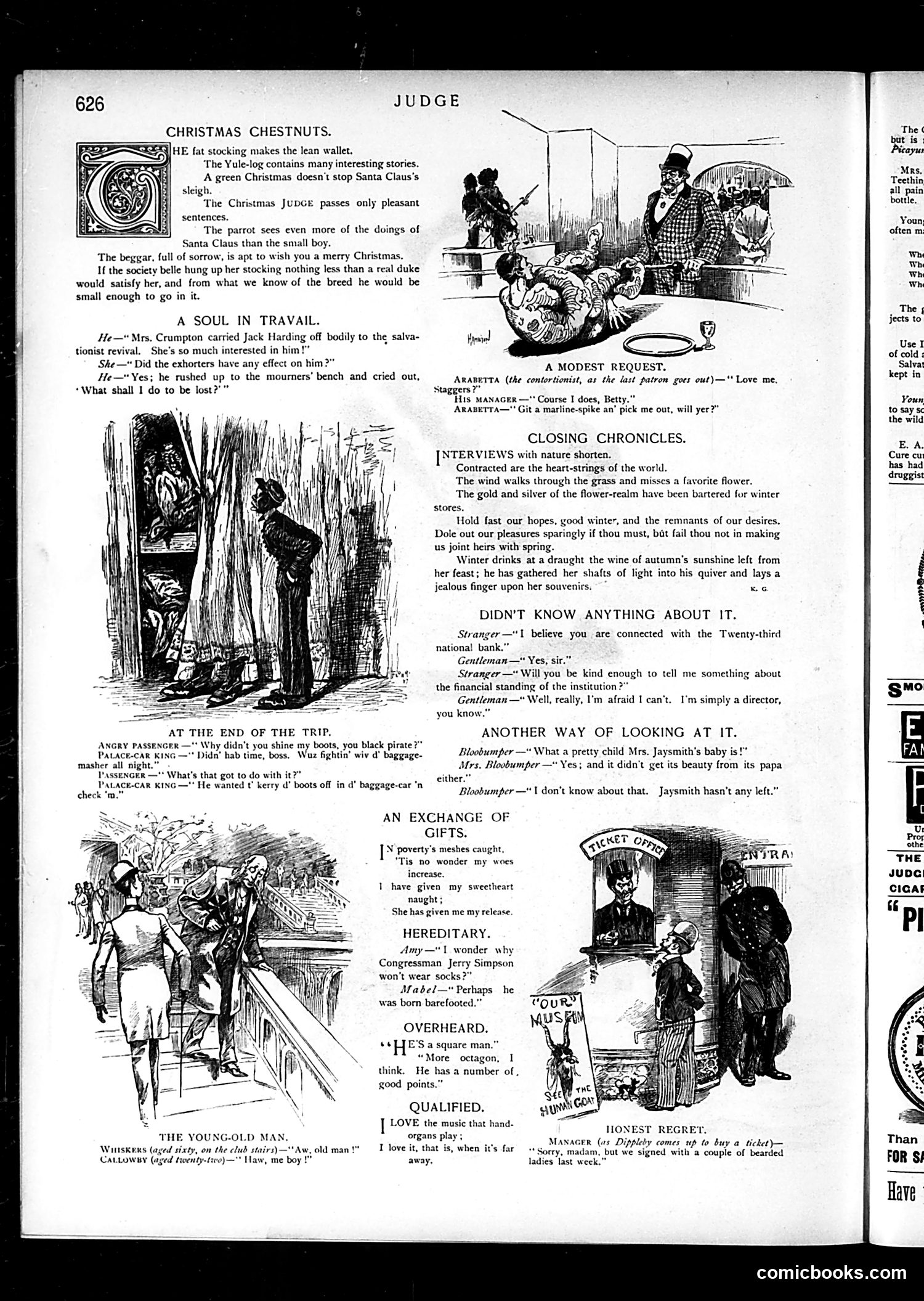
This is a collection of brief humorous sketches and witty observations typical of Judge's satirical format. Key items include: **"A Soul in Travail"**: A joke about a man at a religious revival who, moved by the experience, cries out "What shall I do to be lost?"—inverting the typical evangelical plea for salvation. **"At the End of the Trip"**: A porter and passenger exchange about a baggage-car altercation, playing on racial dialect humor common to the era. **"A Modest Request"**: A contortionist asks her manager to use a marline-spike to help unstick her joints after performance. **Financial ignorance satire**: A bank director admits he cannot discuss the institution's finances because he's "simply a director"—mocking corporate leadership's detachment. **Congressman Simpson reference**: A joke about why a congressman won't wear socks, suggesting barefoot origins (likely referencing actual Populist politician Jerry Simpson, known for his eccentric image). The page relies on wordplay, social observation, and contemporary references rather than sustained political cartooning.
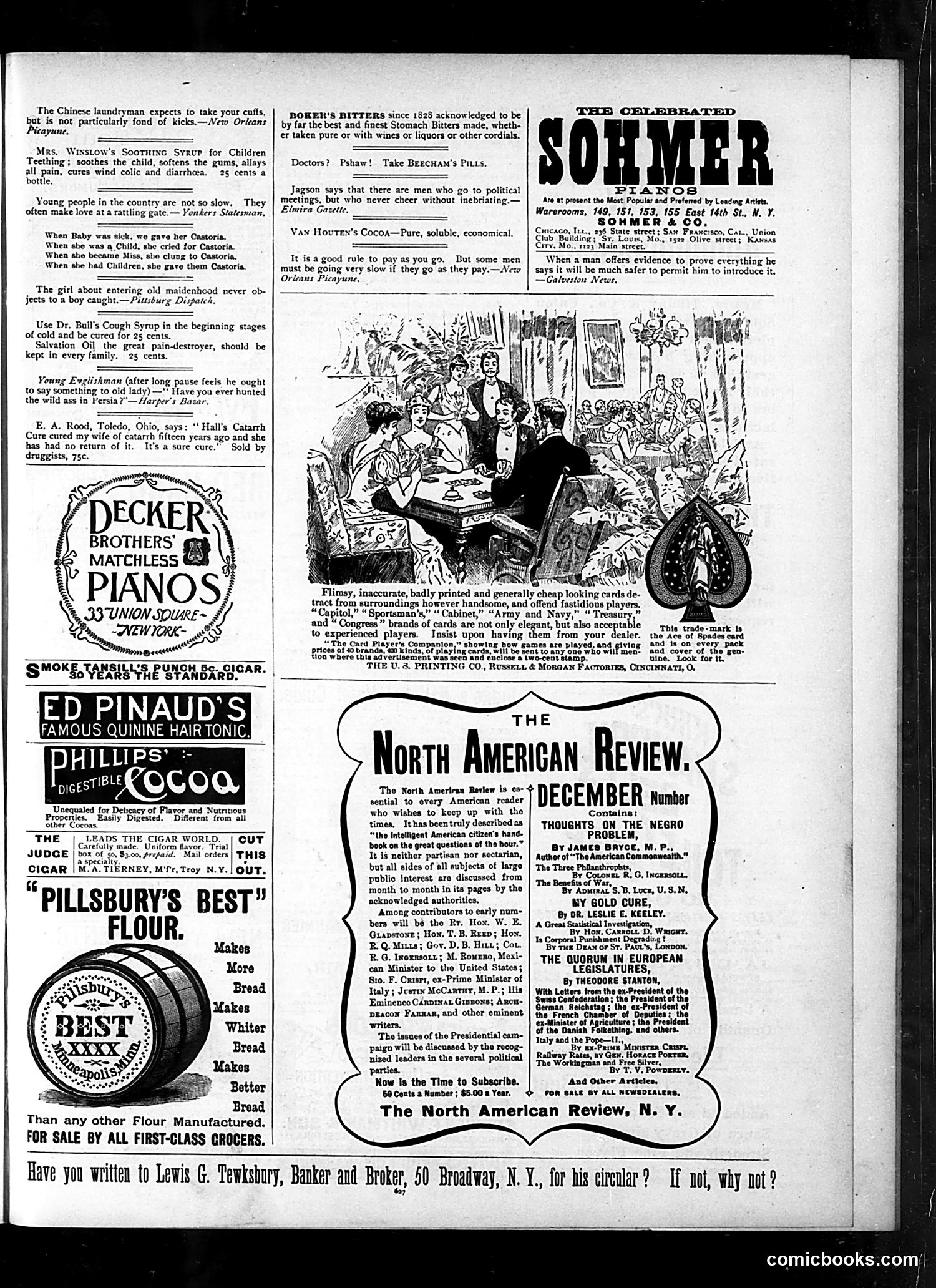
This page is primarily **advertising and promotional content** rather than a satirical cartoon page. The dominant image shows a large illustration of what appears to be a social gathering or party scene with well-dressed figures, but the accompanying text is fragmented and unclear about its specific satirical point. The page contains numerous patent medicine and product advertisements typical of late 19th-century magazines (Castoria, Dr. Bull's Cough Syrup, Beecham's Pills), along with pianos, flour, and cigars. Several brief humorous quotes appear—including references to Chinese laundrymen, country courtship, and political meetings—but these are generic jokes rather than specific political satire targeting identifiable figures. The **North American Review advertisement** promotes the December issue with articles on topics like "Thoughts on the Negro" and "The Quorum in European Legislatures," suggesting contemporary social and political discourse. Without clearer context or identifying captions, the main illustration's satirical subject remains **unclear**.
This page is primarily **advertising and announcements**, not political satire. It features holiday shopping notices from Tiffany & Co., Kirk's Shandon Bells soap, and Liebig's Extract of Beef, alongside small humorous anecdotes typical of the era. The few jokes present are mild domestic humor: a child wanting an apple only because another kid might watch him eat it; a tailor measuring trousers too short; a cart-horse wishing he could enter politics for self-advancement. These reflect period anxieties about competition, social climbing, and childhood mischief. A notable item is a brief quip about seals being scarce, leading to someone getting "a new collar on his overcoat"—playing on the word "seal" (the animal fur versus the verb). The page demonstrates how early satirical magazines like *Judge* blended advertising revenue with light social commentary, though this particular page skews heavily toward commercial content rather than pointed political commentary.
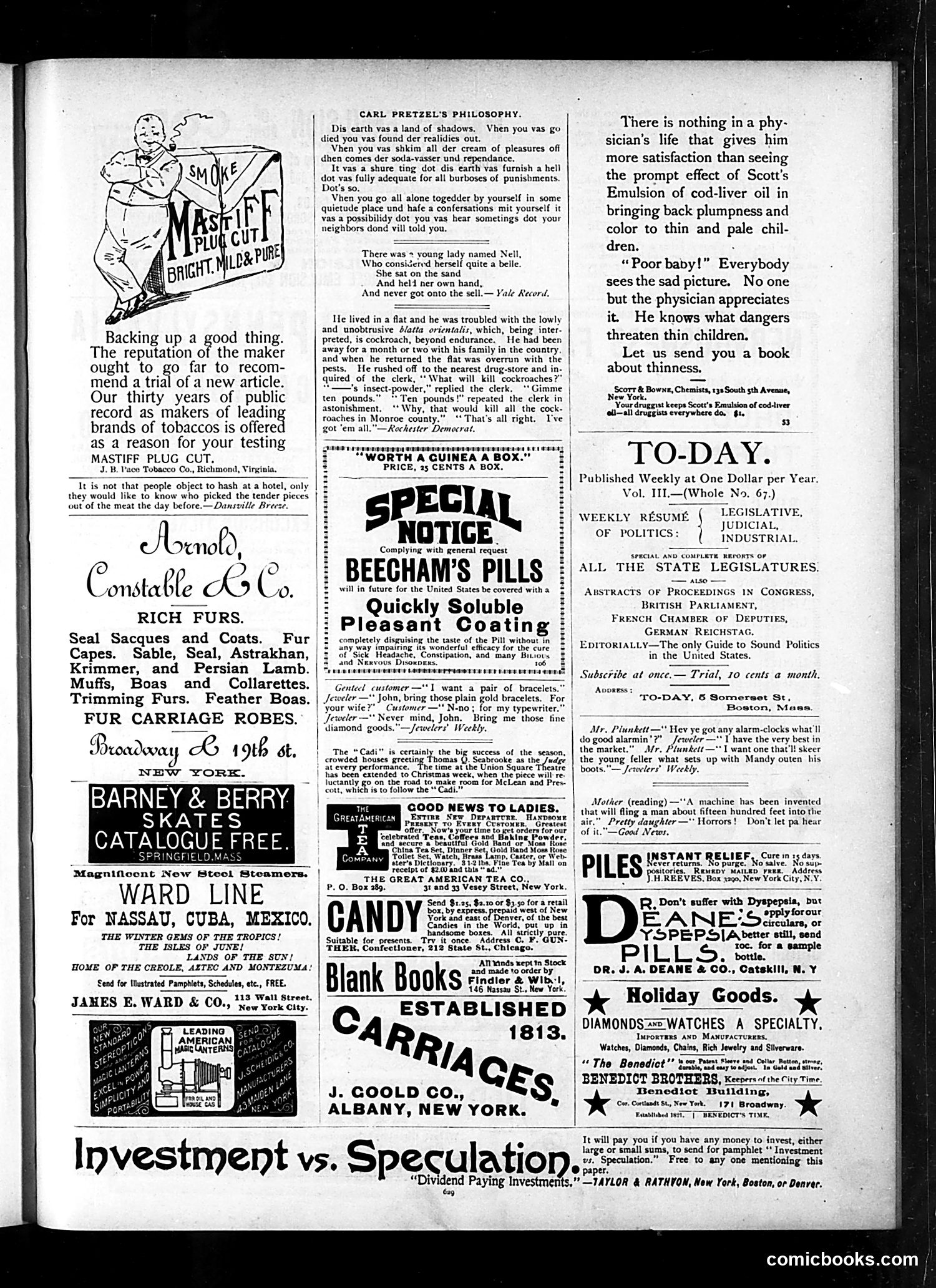
This page is primarily a collection of advertisements and filler material rather than editorial cartoons. The most substantive editorial content is "Carl Pretzel's Philosophy" at the top—a column written in heavy German-dialect English that was common in 19th-century American humor. The philosophy presented is pessimistic working-class fatalism: life offers only temporary pleasures (cream skimmed from reality) before disappointment and hardship ("soda-water and repentance"). The dialect humor, which relied on ethnic stereotyping of German immigrants, would be considered offensive today. The page otherwise features vintage ads for furs, steamship lines, candy, pills, and carriages—reflecting the magazine's business model of satirical content alongside commercial advertisements.
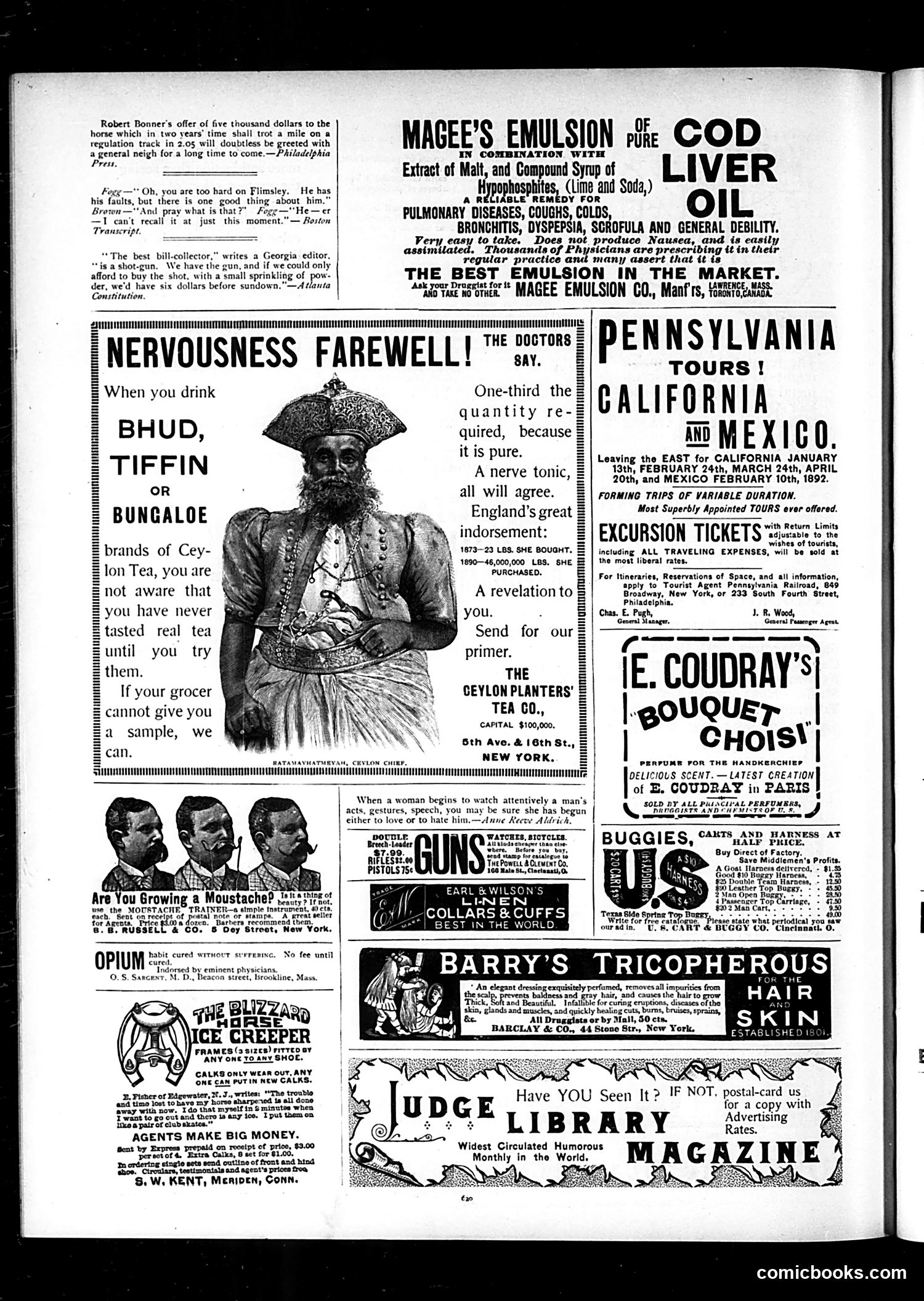
This page is primarily **advertising**, typical of late 19th-century magazines. The content mixes small humorous snippets with product advertisements. The few editorial items include: jokes about horse-racing (Bonner's $5,000 wager on a fast trotter), a mild gag about a forgetful character named Flimsley, and a Georgia editor's dark humor about using shotguns to collect debts. The advertisements promote patent medicines (Magee's Cod Liver Oil Emulsion for coughs/bronchitis), Ceylon tea brands (Bhud, Tiffin, Bungaloe), a "Moustache Trainer" device, gun and pistol sales, railroad excursion tours to California and Mexico, perfume, buggy sales, and ice creepers for shoes. One notable ad features an engraved portrait labeled "The Doctors Say" endorsing Ceylon tea, referencing England's massive consumption increase (1873-1890). The overall tone reflects Gilded Age consumer culture and patent medicine marketing before modern FDA regulations.
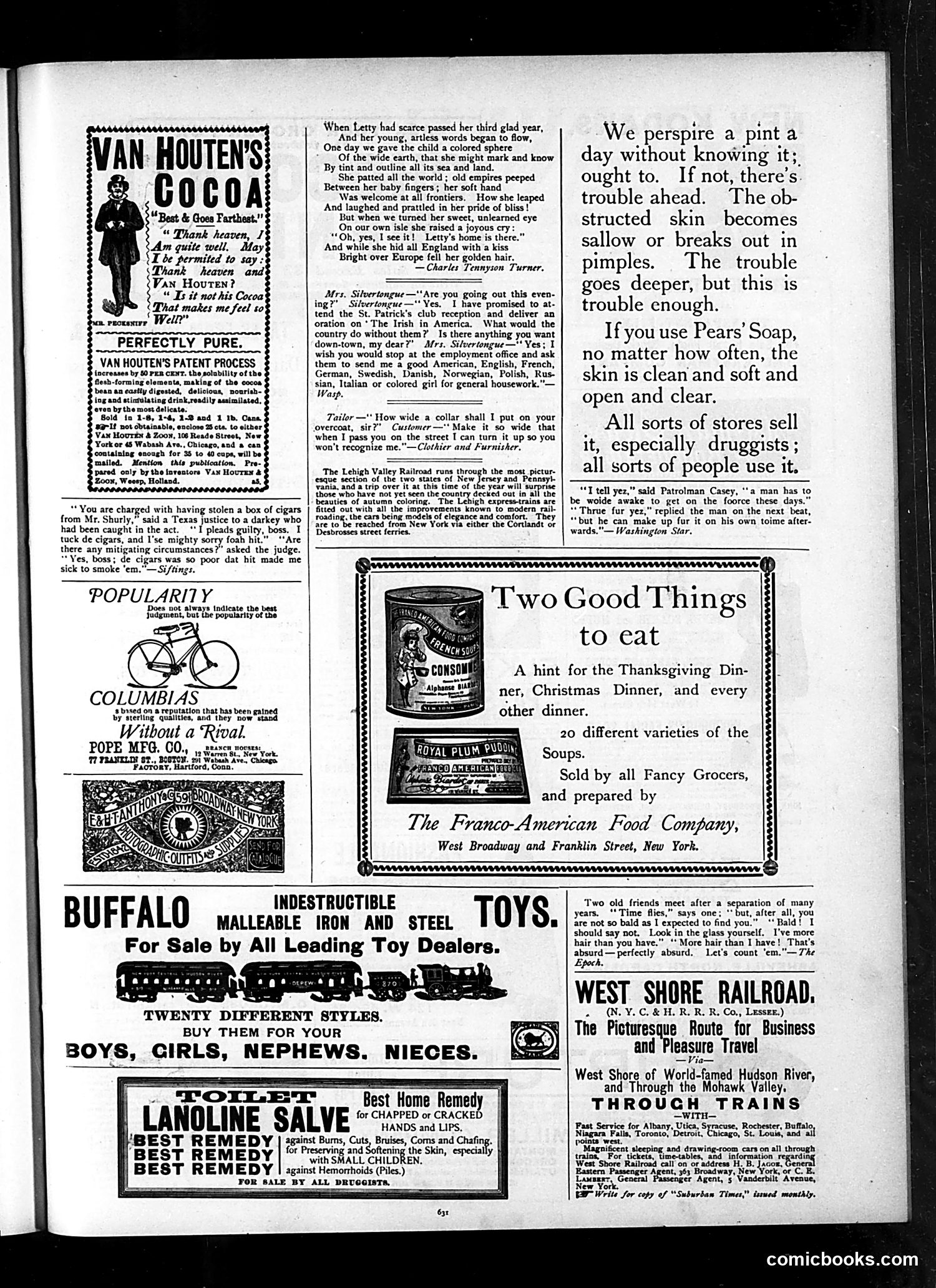
This page is primarily **advertising and light satirical content**, typical of Judge magazine's format. **Main satirical pieces:** 1. **"Letty" poem** (top center): Sentimental verse about a child recognizing England on a globe—gentle patriotic humor about childhood innocence and English nationalism. 2. **"Mrs. Silvertongue" dialogue**: Sharp satire on Irish-American social climbing. Mr. Silvertongue grandiosely claims Irish immigrants are indispensable to America while his wife simultaneously tries to hire an American servant—exposing hypocrisy about immigrant labor. 3. **Tailor/Customer exchange**: Absurdist humor about an unflattering tailor—the customer wants a collar so wide he won't be recognized when passing the tailor on the street. 4. **Cigar theft anecdote**: Racial caricature (dialect humor about a Black defendant). The "joke" relies on period stereotypes and crude characterization. **The page is dominated by product advertisements** (Van Houten's Cocoa, Pears' Soap, Buffalo Toys, Lanoline Salve) interspersed with these brief comedic sketches—standard Judge magazine format mixing advertising with satirical humor.
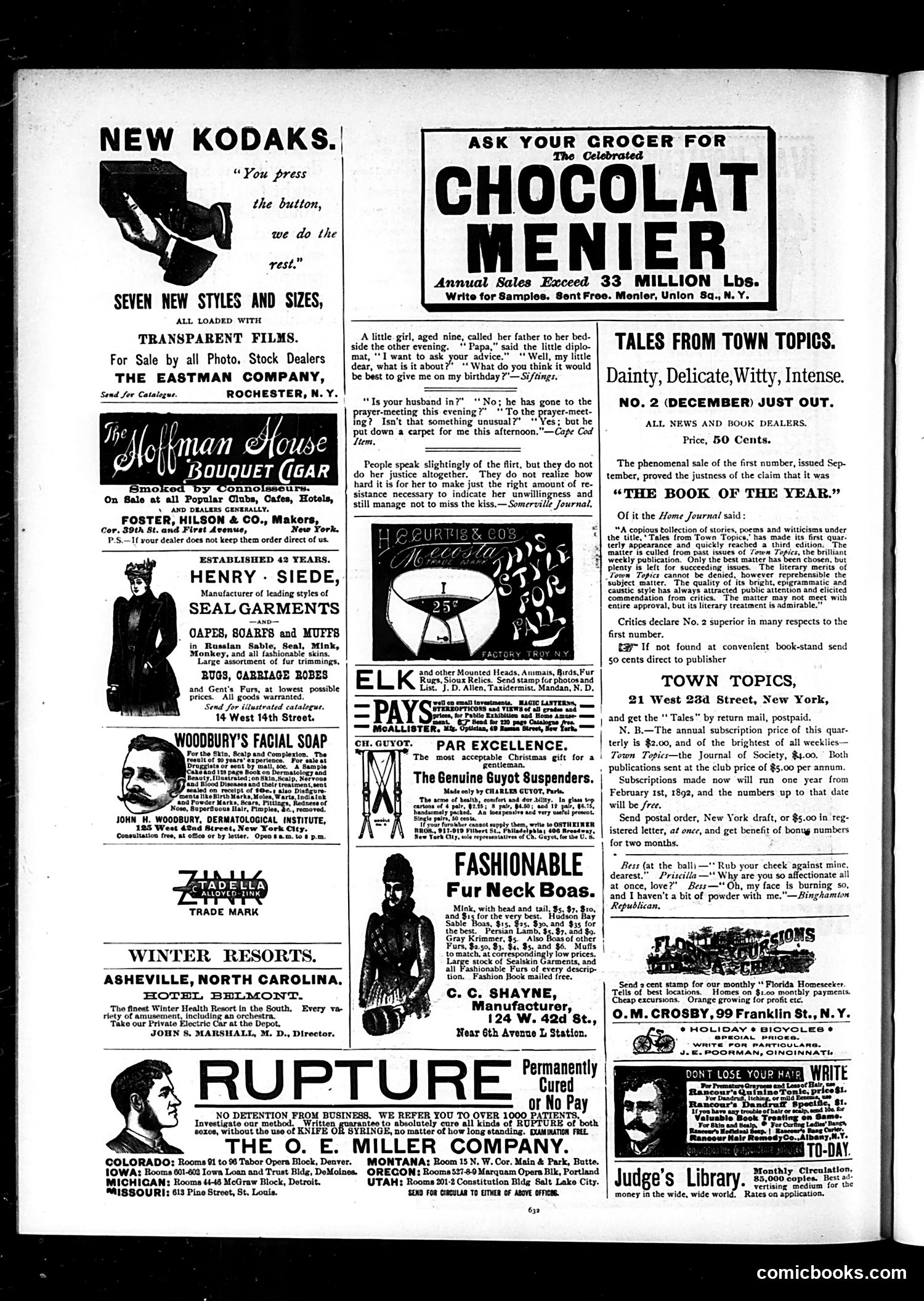
This page is primarily **advertisements and filler content**, typical of late-19th-century magazines like *Judge*. There are no significant political cartoons or satirical commentary requiring historical context. The page features standard period advertising (Kodak cameras, fur garments, chocolate, suspenders) and brief humorous anecdotes in the "Tales from Town Topics" section—light domestic jokes about a child's birthday gift request and a husband attending prayer meeting. The only notable item is the **"Rupture Cured or No Pay"** advertisement, which exploits a common surgical condition without modern medical oversight—a type of claim that would now be heavily regulated. The content reflects *Judge* magazine's mixed format: primarily a vehicle for advertisements supporting satirical editorial content elsewhere in the publication, with filler humor throughout. Nothing on this specific page requires decoding historical references or identifying caricatures.
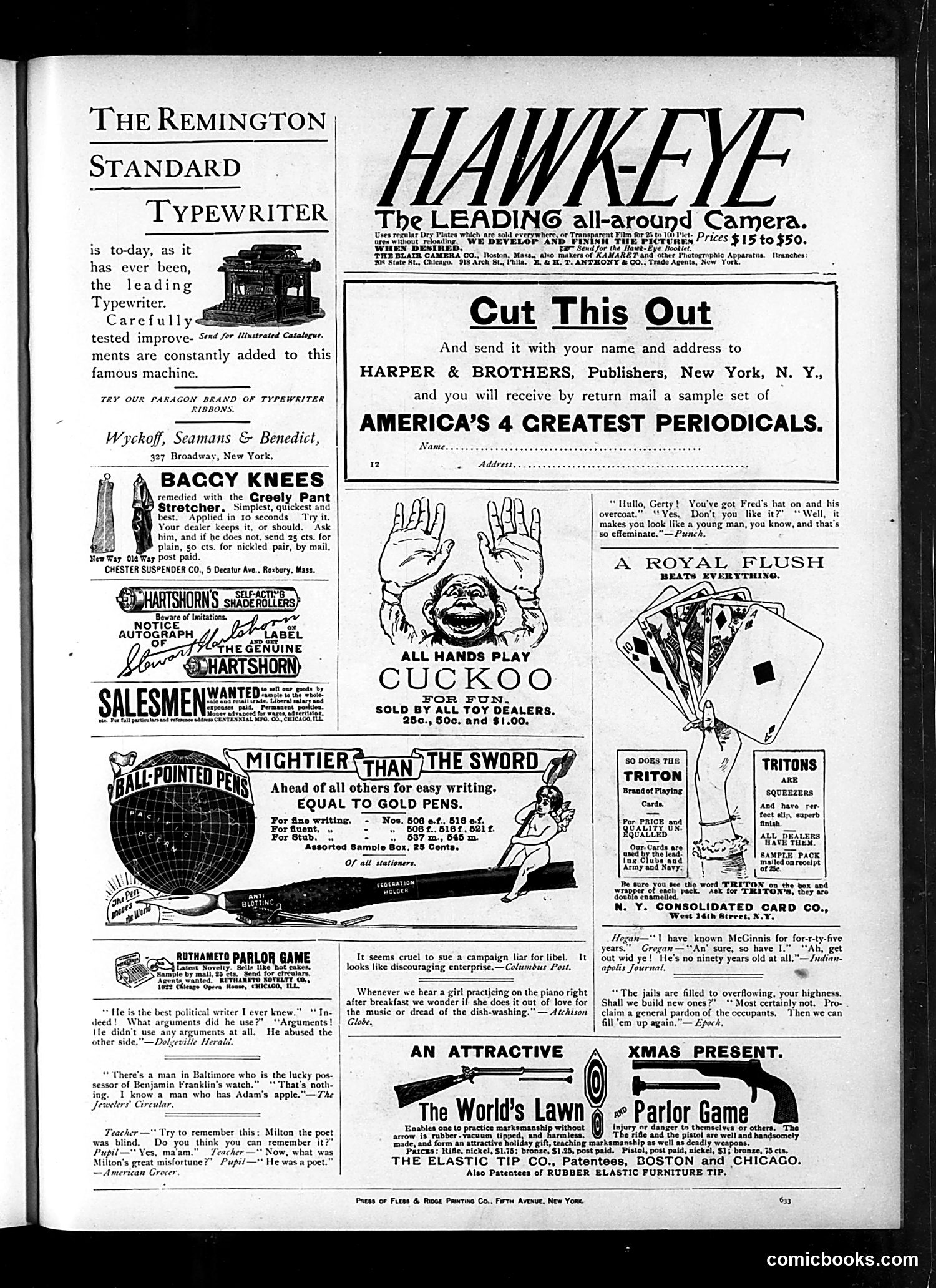
This page is primarily **advertising**, typical of Judge magazine's back pages. It contains commercial notices for typewriters, sporting goods, toys, playing cards, and novelty items—products ranging from Remington typewriters to the "Hawkeye" camera to the "Cuckoo" game. Interspersed are brief **humorous quips** rather than political cartoons. These include jokes about fashion (a woman in a man's hat looking feminine), jails and crime (a governor pardoning prisoners), and courtship. One cartoon depicts a hand emerging from playing cards with the caption "A Royal Flush Beats Everything"—a pun on poker terminology. **No significant political satire** is evident. The page reflects early-20th-century consumer culture and light domestic humor typical of Judge's miscellaneous advertisement sections. The jokes are gentle social commentary about everyday life rather than hard political critique.
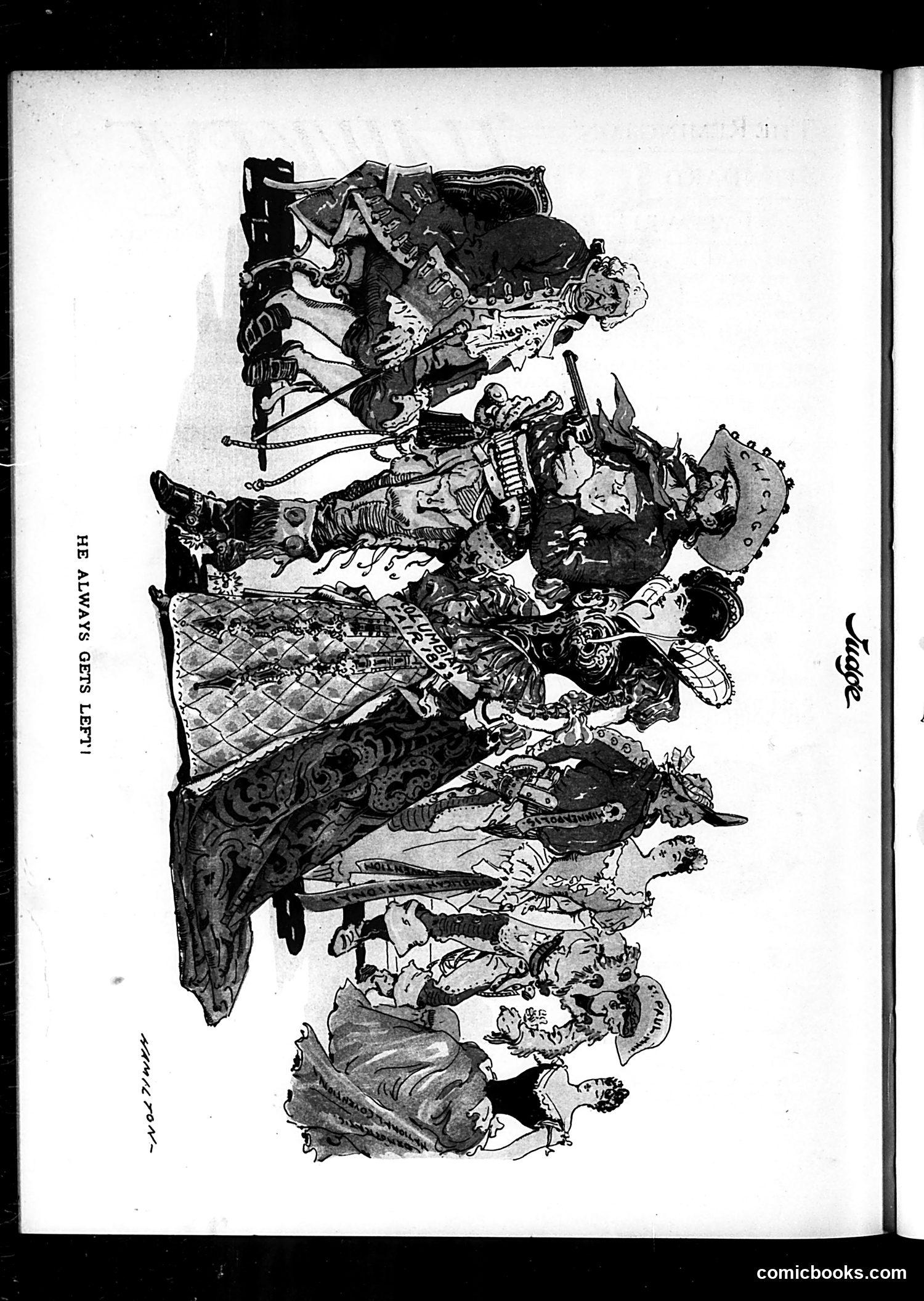
This Judge magazine cartoon, titled "HE ALWAYS GETS LEFT SIED SKAMITY H," depicts a chaotic scene with multiple figures in 19th-century dress arranged around what appears to be a political or social situation. The phrase "He always gets left" suggests commentary on someone repeatedly excluded or abandoned—likely political satire about a public figure being sidelined or overlooked. The crowded composition with numerous caricatured characters suggests a commentary on political maneuvering or social hierarchies of the era. Without clearer identification of specific figures or visible dates, the precise political context remains unclear, though the satirical tone typical of Judge magazine indicates criticism of contemporary political or social arrangements where a particular individual faces consistent marginalization.