
Judge, 1891-12-12 · page 3 of 18
Judge — December 12, 1891 — page 3: what you’re looking at
What you’re looking at
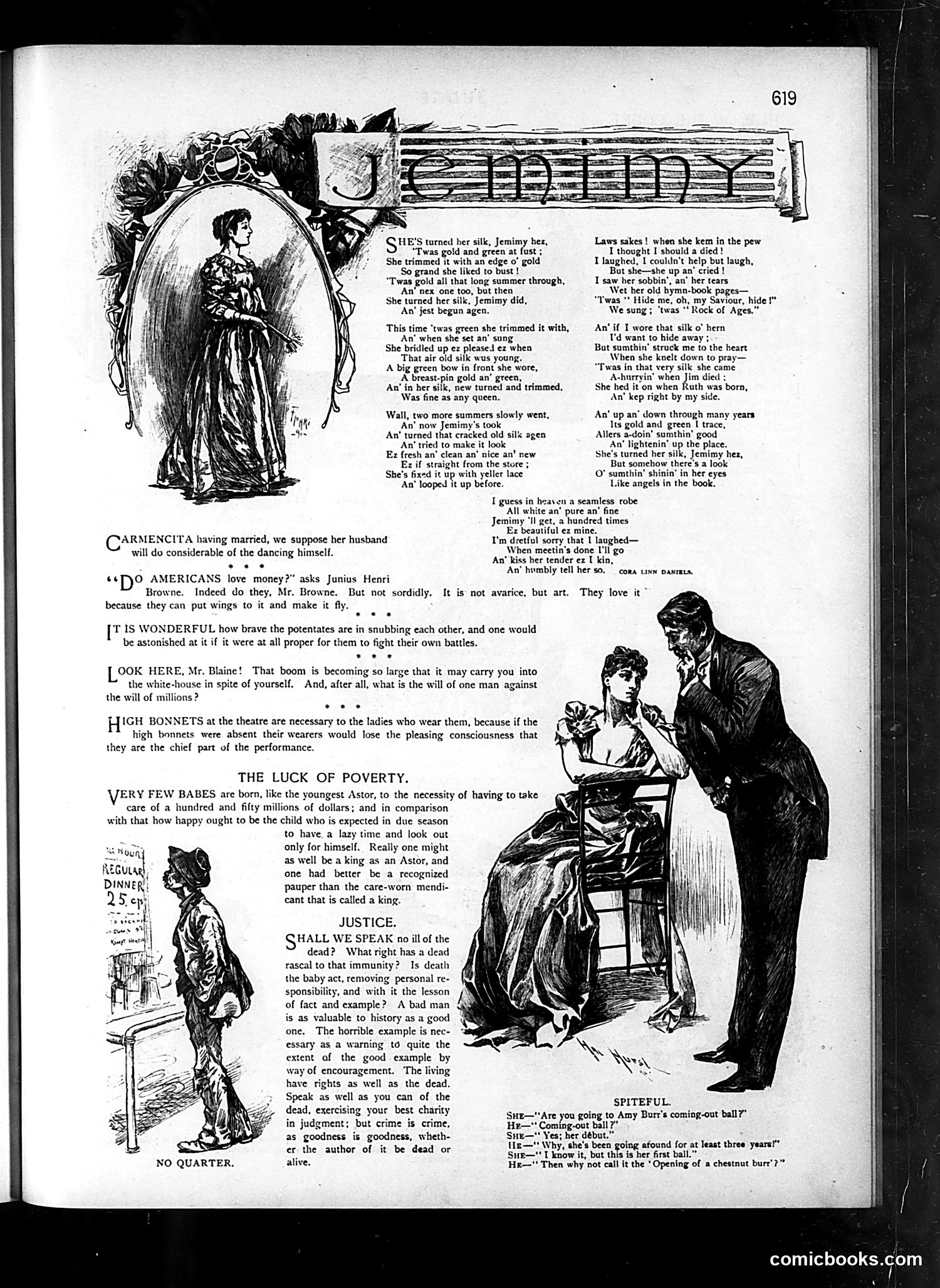
This page contains several distinct pieces rather than a unified cartoon: **Upper section:** A poem about "Jeminy" (likely a woman's name) and her silk dress, illustrated with a sketch of an elegantly dressed woman. The text celebrates her wardrobe upgrades over time. **Middle section:** Brief commentary on American manners, questioning whether Americans "love money" as stereotype suggests, with discussion of proper social conduct and bonnets at the theater. **Lower sections:** Two separate pieces—"The Luck of Poverty" discussing class disparities in childbirth expectations, and "Justice," a philosophical essay on speaking ill of the dead and morality in judgment. **Bottom right:** A dialogue illustration labeled "Spiteful" depicting what appears to be a social interaction about a coming-out ball. The page is primarily **literary and moralistic** rather than sharply satirical, reflecting Judge's 19th-century focus on etiquette, social commentary, and gentle humor about American manners and class distinctions.
📄 Transcribed text from this page (OCR, searchable)
Machine-transcribed from the original scan — historical spelling and the odd misread are preserved.
HE'S turned her silk, Jemimy hes, “Twas gold and green at fust ; She trimmed it with an edge o' gold So grand she liked to bust ! “Twas gold all that long summer through, ‘An’ nex one too, but then She turned her silk, Jemimy did, ‘An’ jest begun agen, This time ‘twas green she trimmed it with, ‘An’ when she set an’ sung She bridled up ez pleased ez when That air old silk wus young. A big green bow in front she wore, A breast-pin gold an’ green, An’ in her silk, new turned and trimmed, Was fine as any queen. Wall, two more summers slowly went, An’ now Jemimy's took ‘An’ turned that cracked old silk agen An’ tried to make it look Ez fresh an’ clean an’ nice an’ new Ez if straight from the store ; She's fixed it up with yeller lace ‘An’ looped it up before. Laws sakes! when she kem in the pew T thought I should a died! I laughed, I couldn't help but laugh, But she—she up an’ cried ! I saw her sobbin’, an’ her tears Wet her old bymn-book pages— “Twas ‘ Hide me, oh, my Saviour, hide I" We sung; ‘twas “Rock of Ages.” An’ if I wore that silk o' hern T'd want to hide away ; But sumthin’ struck me to the heart When she knelt down to pray— “Twas in that very silk she came ‘A-hurryin’ when Jim died ; She hed it'on when Ruth was born, An’ kep right by my side. An’ up an’ down through many years Its gold and green I trace, Allers a-doin'’ sumthin’ good An’ lightenin’ up the place. She's turned her silk, Jemimy hez, But somehow there's a look ' sumthin’ shinin’ in her eyes Like angels in the book. I guess in heaven a seamless robe i All white an’ pure an’ fine Jemimy ‘Il get, a hundred times CARMENCITA having married, we suppose her husband will do considerable of the dancing himself. eae spo AMERICANS love money?” asks Junius Henri Browne. Indeed do they, Mr. Browne. But not sordidly. It is not avarice, but art. because they can put wings to it and make it fly. T IS WONDERFUL how brave the potentates are in snubbing each other, and one would be astonished at it if it were at all proper for them to fight their own battles. OOK HERE, Mr. Blaine! That boom is becoming so large that it may carry you into the white-house in spite of yourself. And, after all, what is the will of one man against the will of millions ? HIGH BONNETS at the theatre are necessary to the ladies who wear them, because if the high bonnets were absent their wearers would lose the pleasing consciousness that they are the chief part of the performance. THE LUCK OF POVERTY. ERY FEW BABES are born, like the youngest Astor, to the necessity of having to take care of a hundred and fifty millions of dollars; and in comparison with that how happy ought to be the child who is expected in due season to have, a lazy time and look out only for himself. Really one might as well be a king as an Astor, and one had better be a recognized pauper than the care-worn mendi- cant that is called a king. JUSTICE. HALL WE SPEAK no ill of the dead? What right has a dead rascal to that immunity? Is death the baby act, removing personal re- sponsibility, and with it the lesson of fact and example? A bad man is as valuable to history as a good one, The horrible example is nec- essary as a warning to quite the extent af the good example by way of encouragement. The living have rights as well as the dead. Speak as well as you can of the dead, exercising your best charity Ez beautiful ez mine, I'm dretful sorry that I laughed— When meetin’s done I'll’ go An’ kiss her tender ez I kin, An’ humbly tell her so. CORA LINN DANTELA, They love it~ SPITEFUL. NO QUARTER. in judgment; but crime is crime, as goodness is goodness, wheth- er the author of it be dead or alive. re you going to Amy Burr's coming-out ball?” Coming-out ball ?” Yes; her début.” Why, she’s been going afound for at least three years!” Sue—' 1 know it, but this is her first ball.” He—" Then why not call it the ‘Opening of a chestnut burr?” comicbooks.com