
A complete issue · 18 pages · 1891
Judge — October 10, 1891
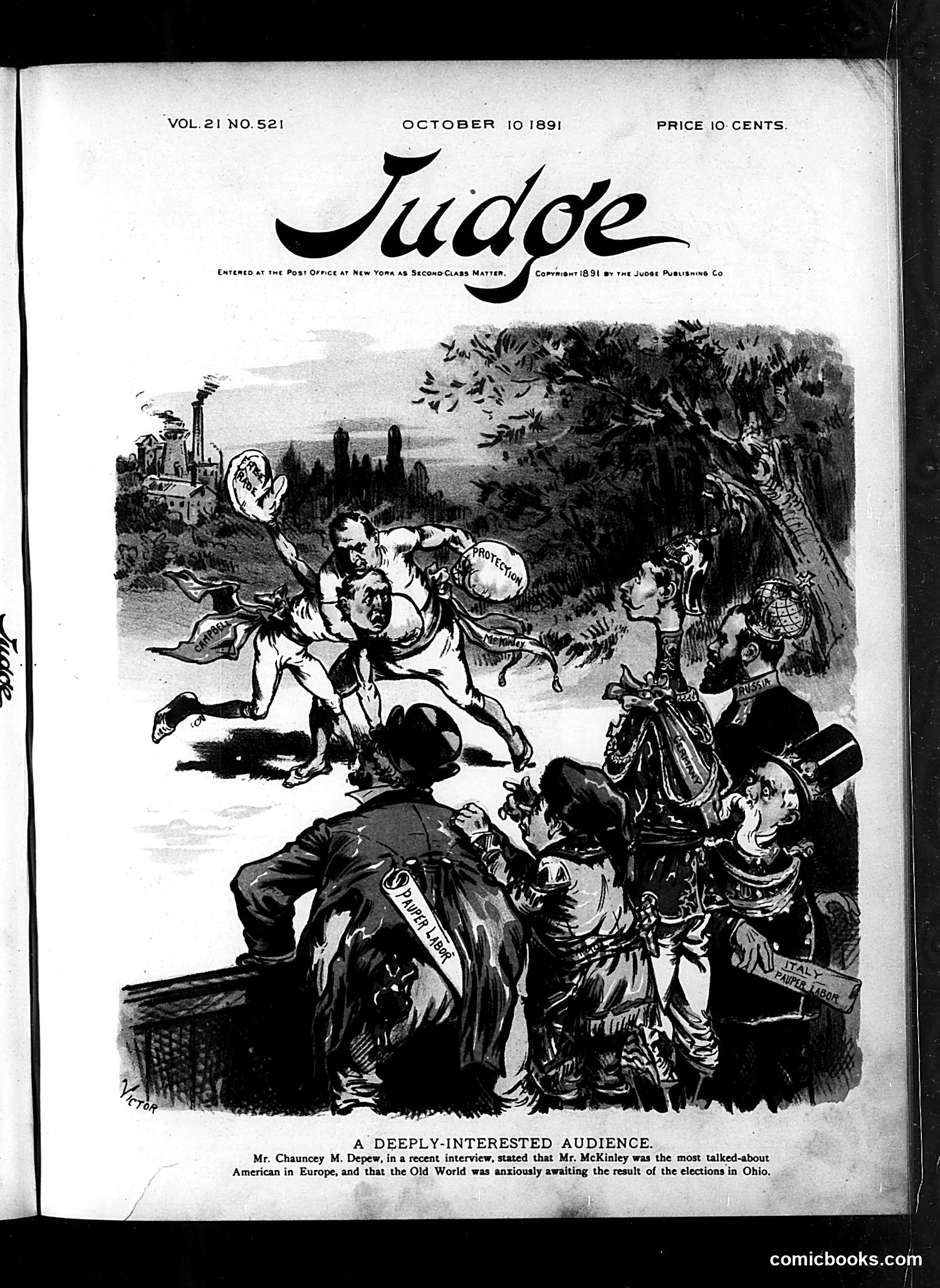
This October 1891 Judge cartoon satirizes European interest in American politics, specifically the 1891 Ohio elections. The caption references an interview where Chauncey M. Depew stated that President McKinley was "the most talked-about American in Europe" and that "the Old World was anxiously awaiting the result of the elections in Ohio." The cartoon depicts European figures (identifiable by their national dress and labels like "Italy") gathered to observe American political drama unfold, portrayed as a theatrical performance. The central figures appear to be American politicians engaged in acrobatic or chaotic activity—satirizing both the tumultuous nature of American politics and the absurdity of foreigners treating U.S. elections as entertainment. The satire mocks European fascination with American political affairs while critiquing American politics itself as spectacle.
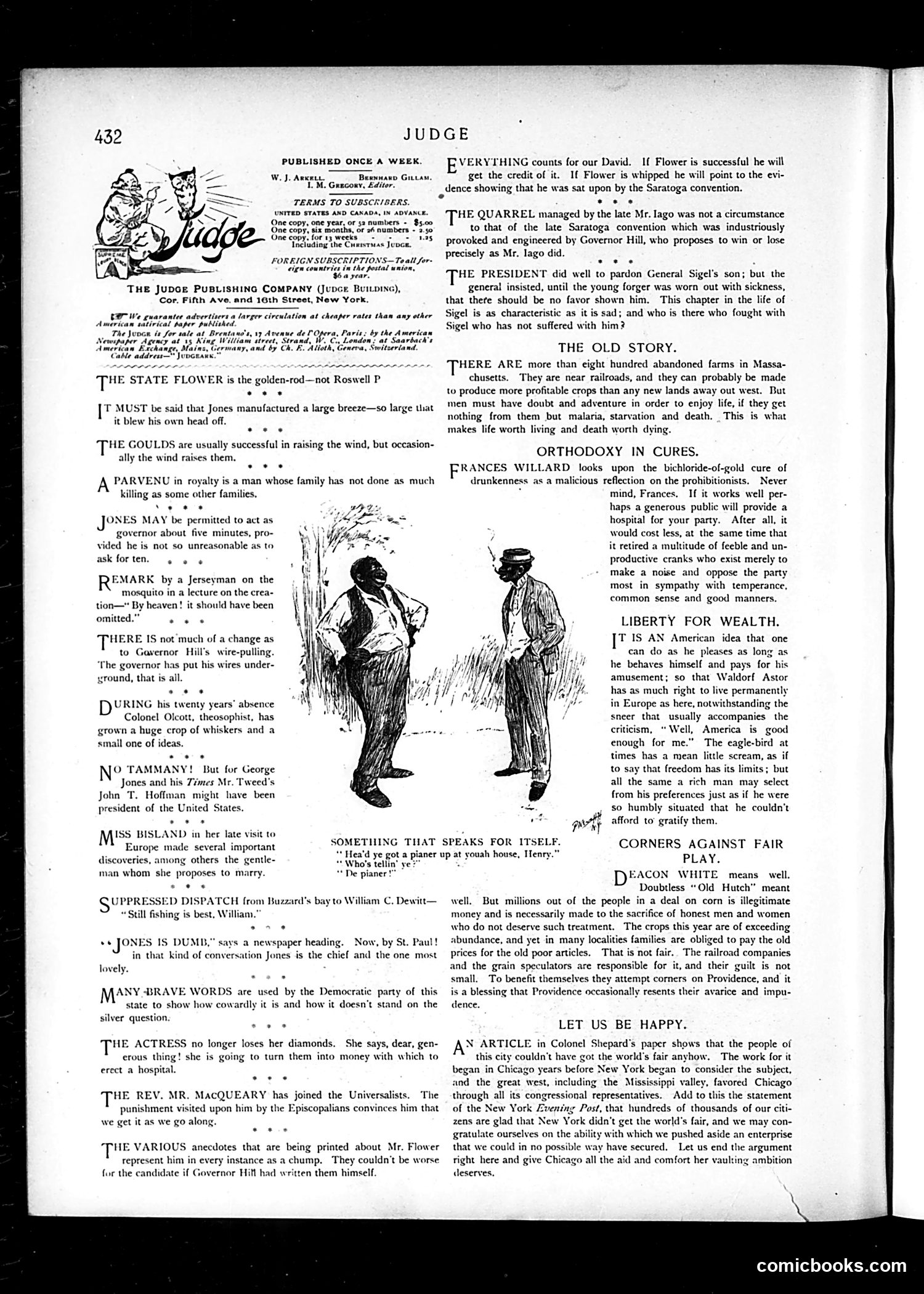
The main cartoon, titled "SOMETHING THAT SPEAKS FOR ITSELF," depicts two men in conversation. One says to the other: "I've got a piano up at my house, Henry" / "I've piano!" This appears to be a simple social satire about pretension or one-upmanship among wealthy Americans—a common Judge theme. The joke likely concerns material boasting or social climbing, though the specific humor is unclear without additional context. The surrounding text consists of brief satirical commentary on contemporary political and social issues, including critiques of Democratic Party rhetoric, commentary on Governor Hill's policies, and discussion of Chicago's municipal ambitions versus New York's established prominence. The page represents typical Judge content: lighthearted mockery of American social pretension and political figures.
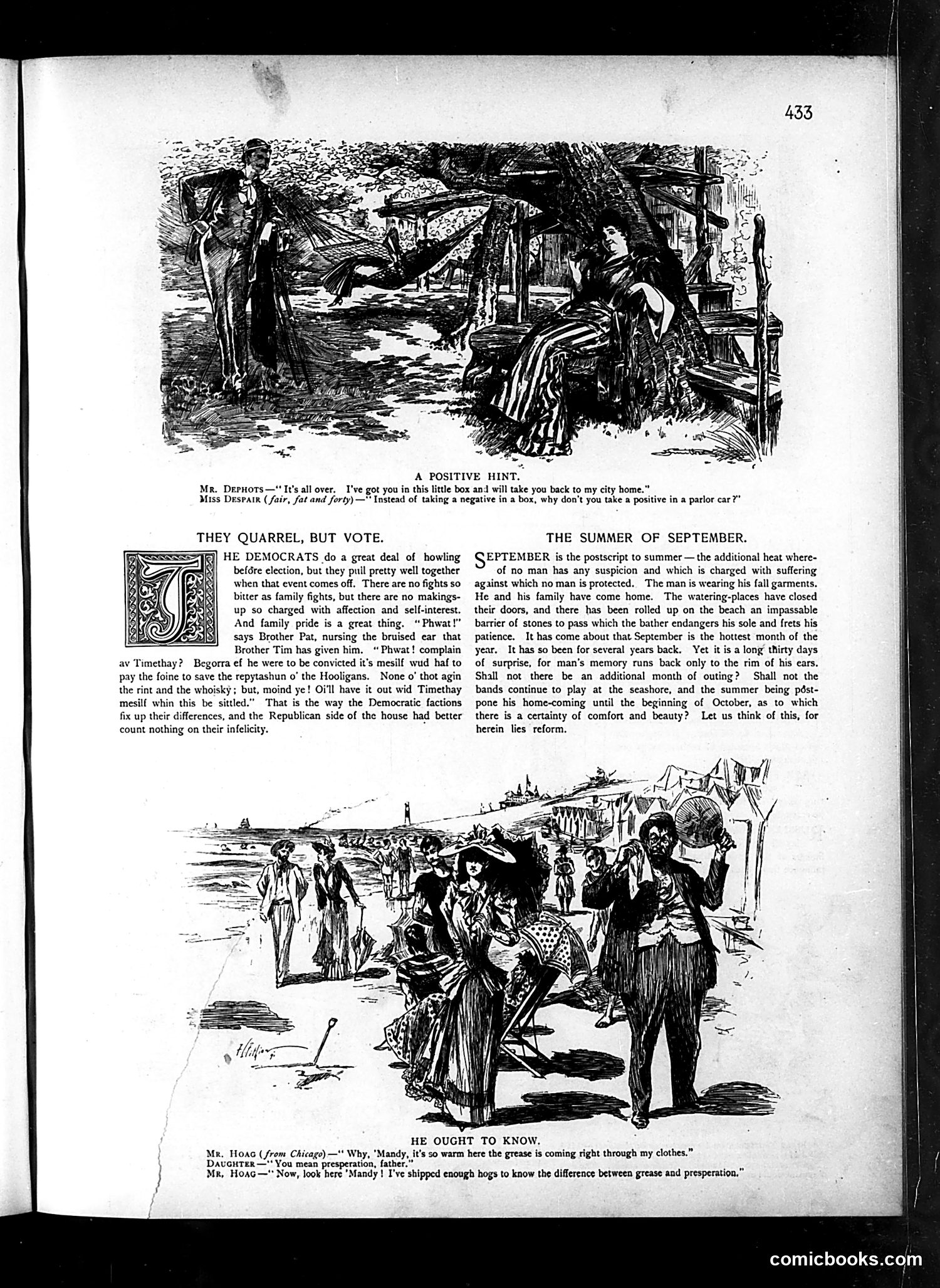
This page contains three cartoon vignettes satirizing American social and political life, likely from the early 20th century: **"A Positive Hint"** (top): Depicts a woman offering a man a ride in a parlor car instead of a box—a subtle class commentary on transportation and social status. **"They Quarrel, But Vote"** (left): Discusses Democratic and Republican family disputes before elections. The satire emphasizes that despite bitter disagreements, families maintain voting loyalty to their parties, suggesting political partisanship overrides family harmony. **"The Summer of September"** (right): Commentary on summer ending and families returning home, with implied social reform messaging about leisure and class dynamics. **"He Ought to Know"** (bottom): A Chicago-based joke about "grass" coming through clothes—appears to reference poor versus wealthy cleanliness standards or laundry preparedness. The overall tone critiques American political polarization and class distinctions.
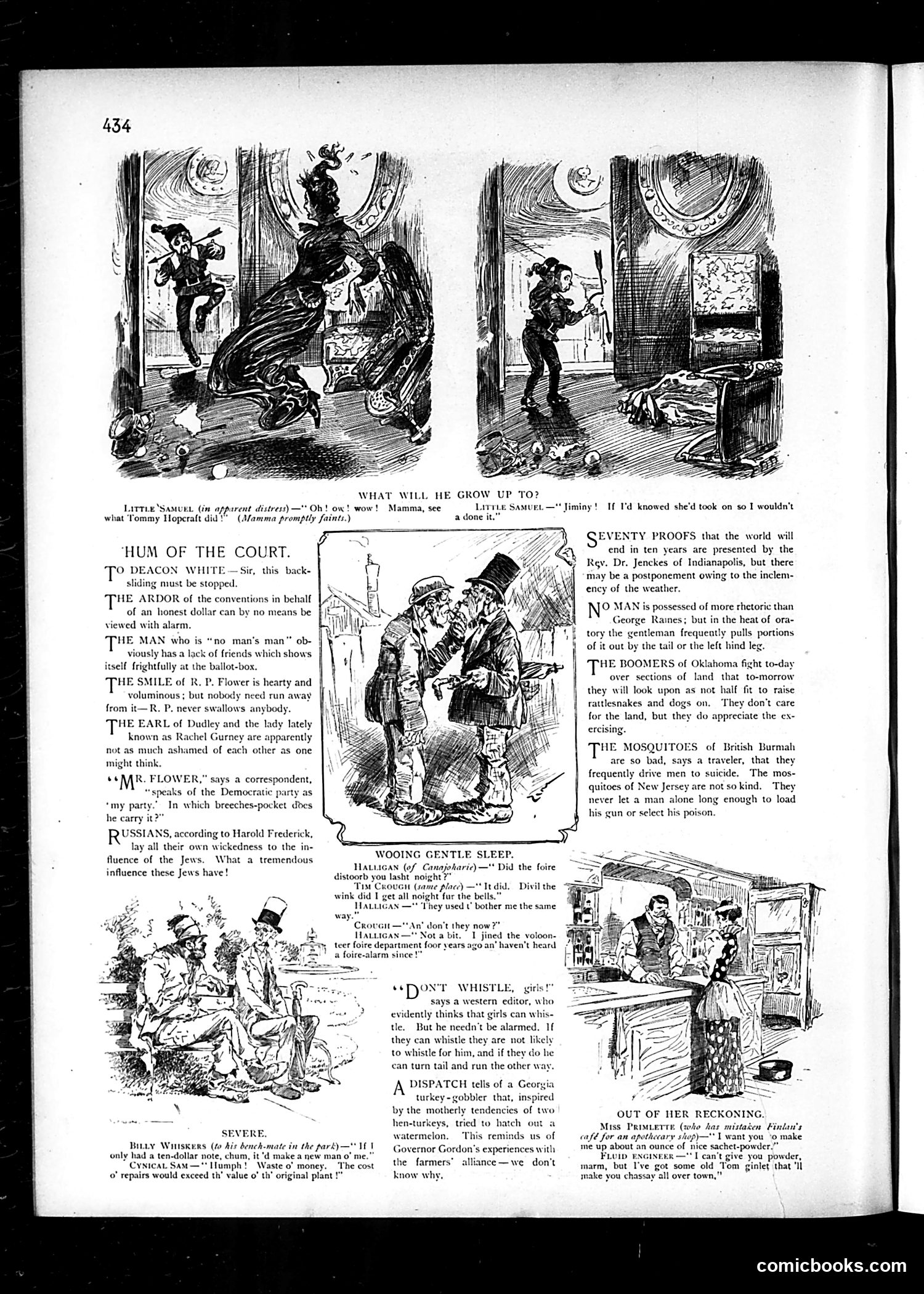
This page from Judge magazine comprises several brief satirical items typical of the publication's format. The top cartoons mock childhood behavior ("What Will He Grow Up To?"). The "Hum of the Court" section offers political jabs: mocking Deacon White's backsliding, commenting on R.P. Flower's political affiliations, and notably containing an anti-Semitic stereotype about Jews ("What a tremendous influence these Jews have!"). Other items satirize contemporary figures and events: Governor Gordon's failed "Farmers' Alliance" efforts in Oklahoma, the competitive land disputes among "Boomers," and Irish immigrant speech patterns in the dialect humor sections. The bottom cartoon satirizes a woman mistaking a bar ("Finlin's café") for a pharmacy, playing on period assumptions about female naïveté. The page reflects Judge's mix of partisan politics, ethnic stereotyping, and social observation typical of late 19th-century American humor magazines.
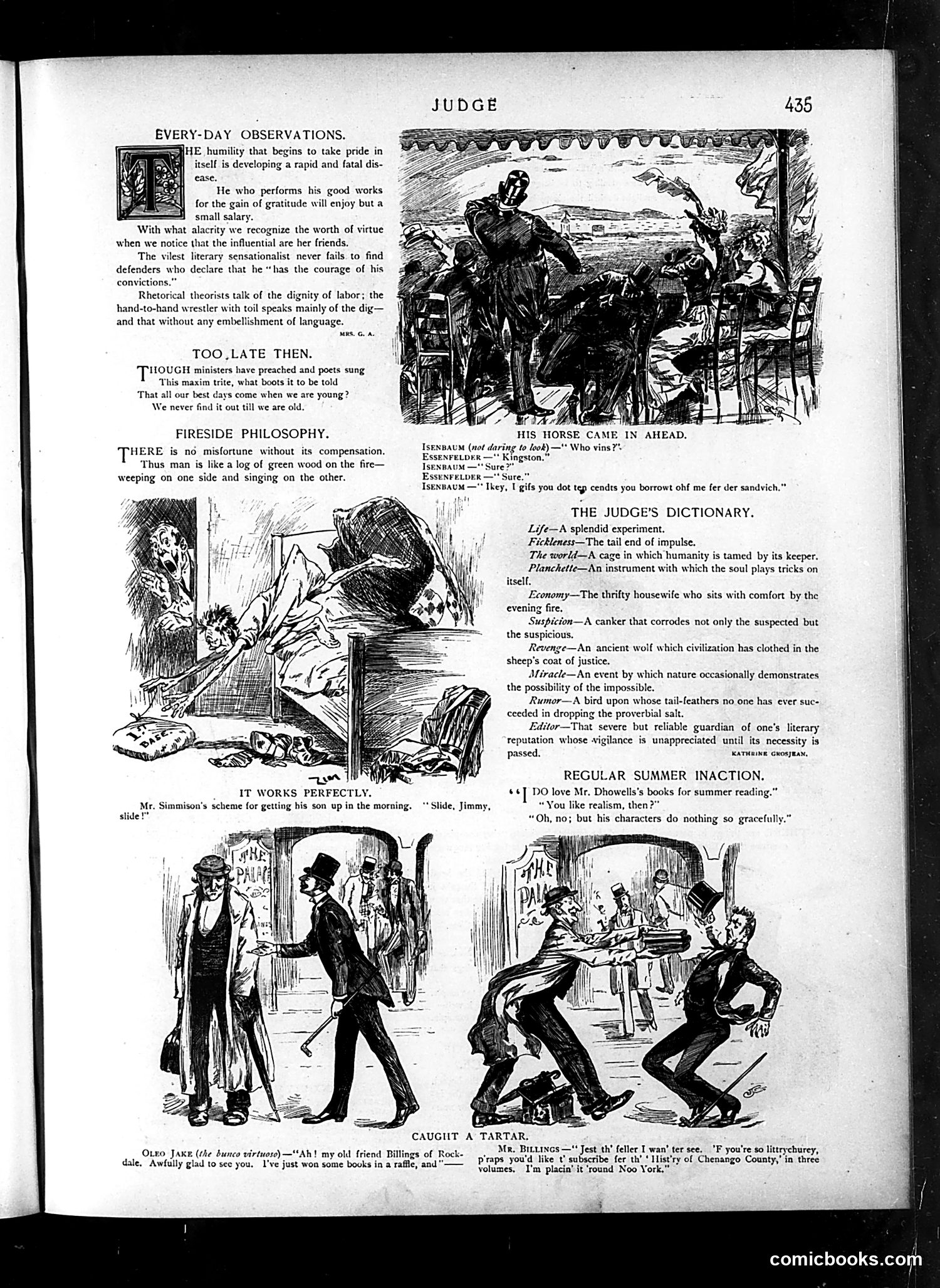
This page contains several satirical pieces typical of Judge's social commentary: **"Every-Day Observations"** offers cynical aphorisms mocking hypocrisy—virtue that takes pride in itself, good works done for gratitude, and rhetorical praise for "dignity of labor" from those who've never done manual work. **"Too, Late Then"** laments that wisdom about youth's value only arrives in old age. **The cartoons** depict everyday scenes: A man teaching his son to wake by sliding him across the floor; a street encounter where "Oiko Jake" (a con artist/"bunco virtuoso") reunites with Billings, whom he's swindled before, now attempting to sell him a local history book; and a summer reading discussion where someone prefers Howells's realism but finds his characters insufficiently graceful. The humor targets middle-class pretension, failed schemes, and the gap between rhetoric and reality. The dialect humor reflects period attitudes toward immigrant speech ("dot tep cendts").
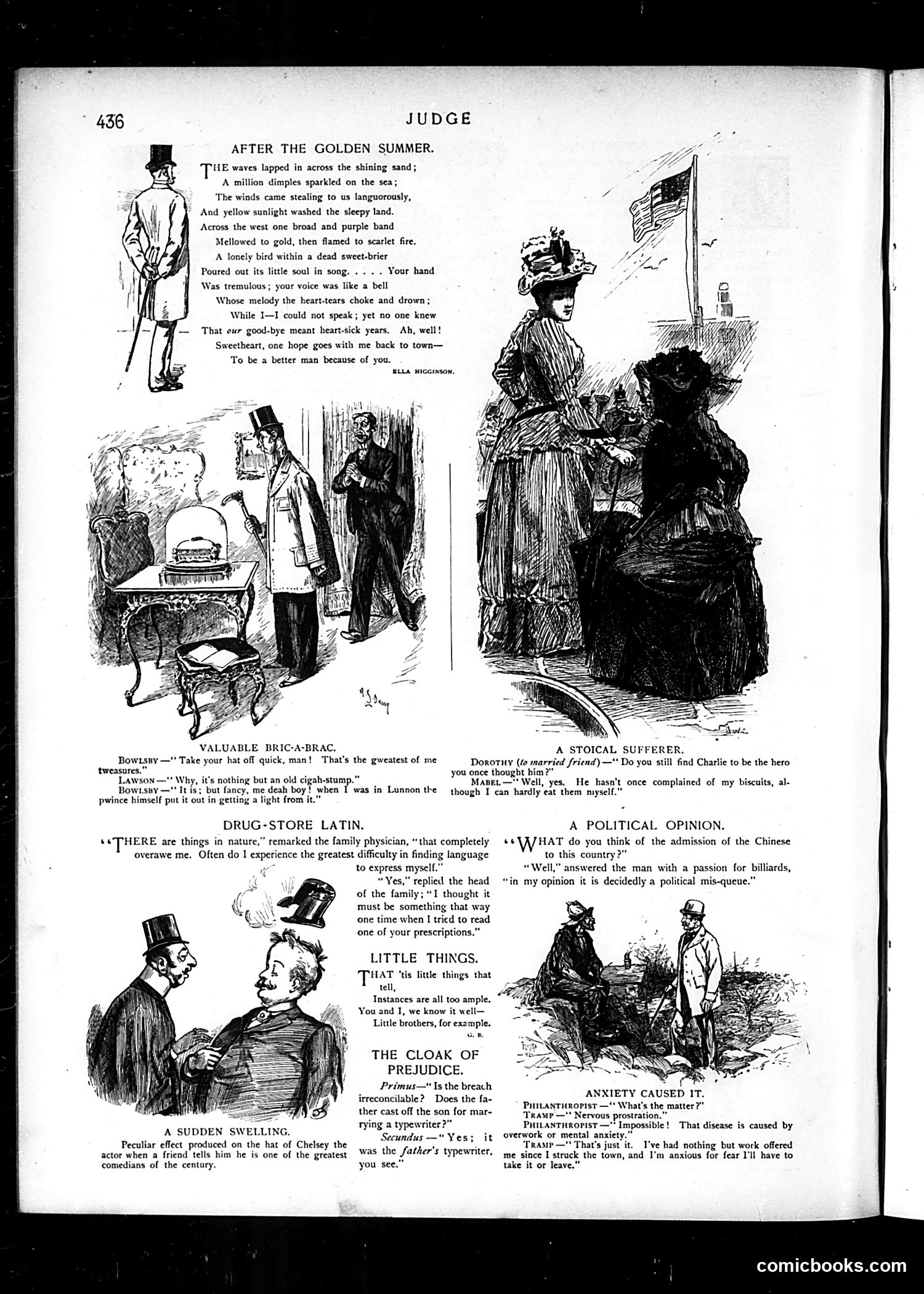
This satirical page from *Judge* magazine contains multiple brief humorous sketches mocking American society and manners. **Notable items:** "Valuable Bric-a-Brac" ridicules social climbing—a character treasures a cigar stub because a prince supposedly discarded it, satirizing the absurd reverence some Americans held for European aristocracy. "Drug-Store Latin" jokes about doctors' illegible prescriptions, a perennial complaint about the medical profession. "The Cloak of Prejudice" appears to address class conflict and social estrangement, though context is unclear. "A Political Opinion" puns on Chinese immigration (a contentious 1880s-90s issue) with a billiards reference—"mis-queue" playing on "queue" (the stick) and "Chinese queue" (the traditional hairstyle). "Anxiety Caused It" ironically presents a vagrant's catch-22: terrified of being offered actual work. The page mixes sentimental poetry with light social satire typical of *Judge's* entertainment-focused approach.
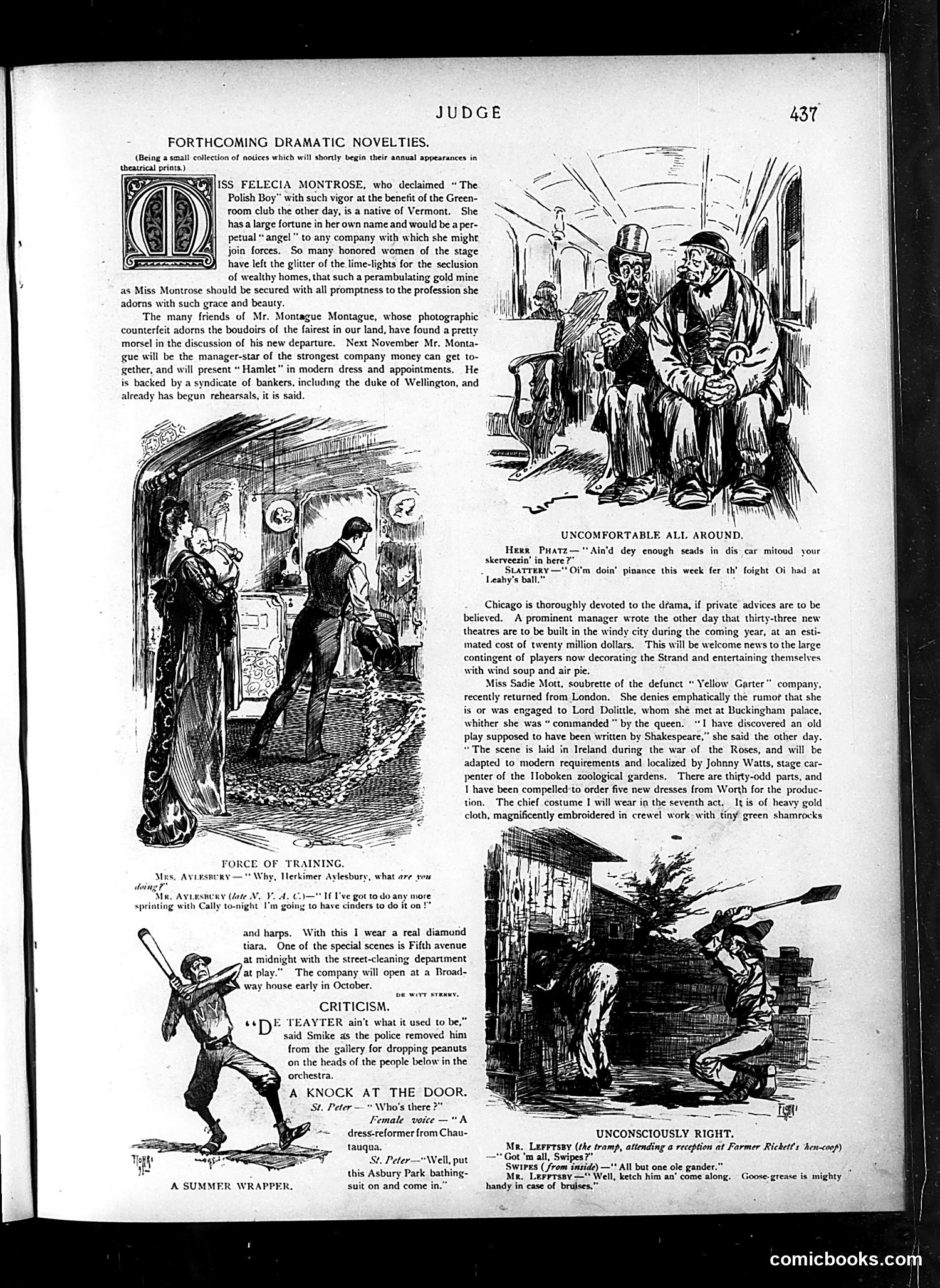
This page from *Judge* contains theatrical gossip and satirical sketches mocking drama and performers. **Main Content:** The top article discusses upcoming theatrical novelties, including Miss Felecia Montrose (a wealthy Vermont actress seeking to fund productions) and Mr. Montague Montague, who plans to stage "Hamlet" in modern dress with financial backing from bankers and nobility. **Satirical Points:** The satire targets theatrical pretension and commercialism—particularly the notion of wealthy amateurs "playing" theater professionally, and the absurdity of over-ambitious productions (like a Shakespeare adaptation "localized" to modern Hoboken with elaborate Worth gowns). **Comic Sketches:** Several small cartoons mock everyday situations: crowded transportation, prize-fighting, and a joke about St. Peter admitting a "dress-reformer from Chautauqua" to heaven—mocking the dress-reform movement of the era as pedantic. The overall tone ridicules both theatrical excess and contemporary social movements through exaggeration and stereotypical characters.
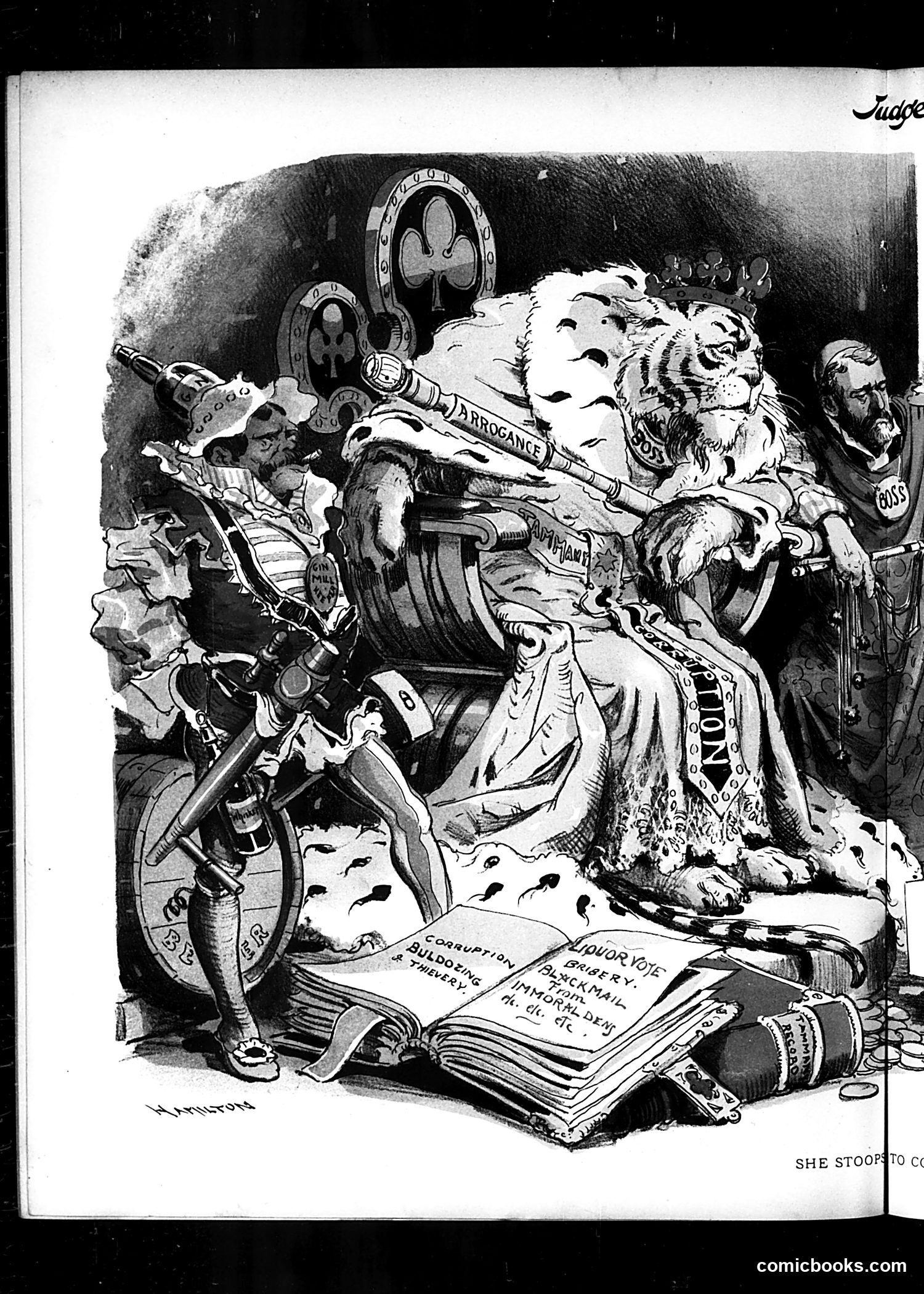
This Judge magazine cartoon depicts **Tammany Hall** (the Democratic political machine, symbolized by the tiger) engaged in corrupt practices. The central figure appears to be a lion wearing robes labeled "ARROGANCE," while smaller figures surround it—likely representing political players or reformers. The open book at the bottom lists accusations: "CORRUPTION," "BRIBERY," "BLOCK MAIL" (blackmail), and "IMMORALITY," documenting Tammany's alleged crimes. The weapons and theatrical staging suggest satire about political warfare and public spectacle. The caption "SHE STOOPS TO..." (text cut off) implies criticism of a female figure—possibly Lady Justice or Tammany itself—compromising her principles. This reflects late 19th/early 20th-century anti-Tammany reformist sentiment, when such machines controlled urban politics through patronage and graft.
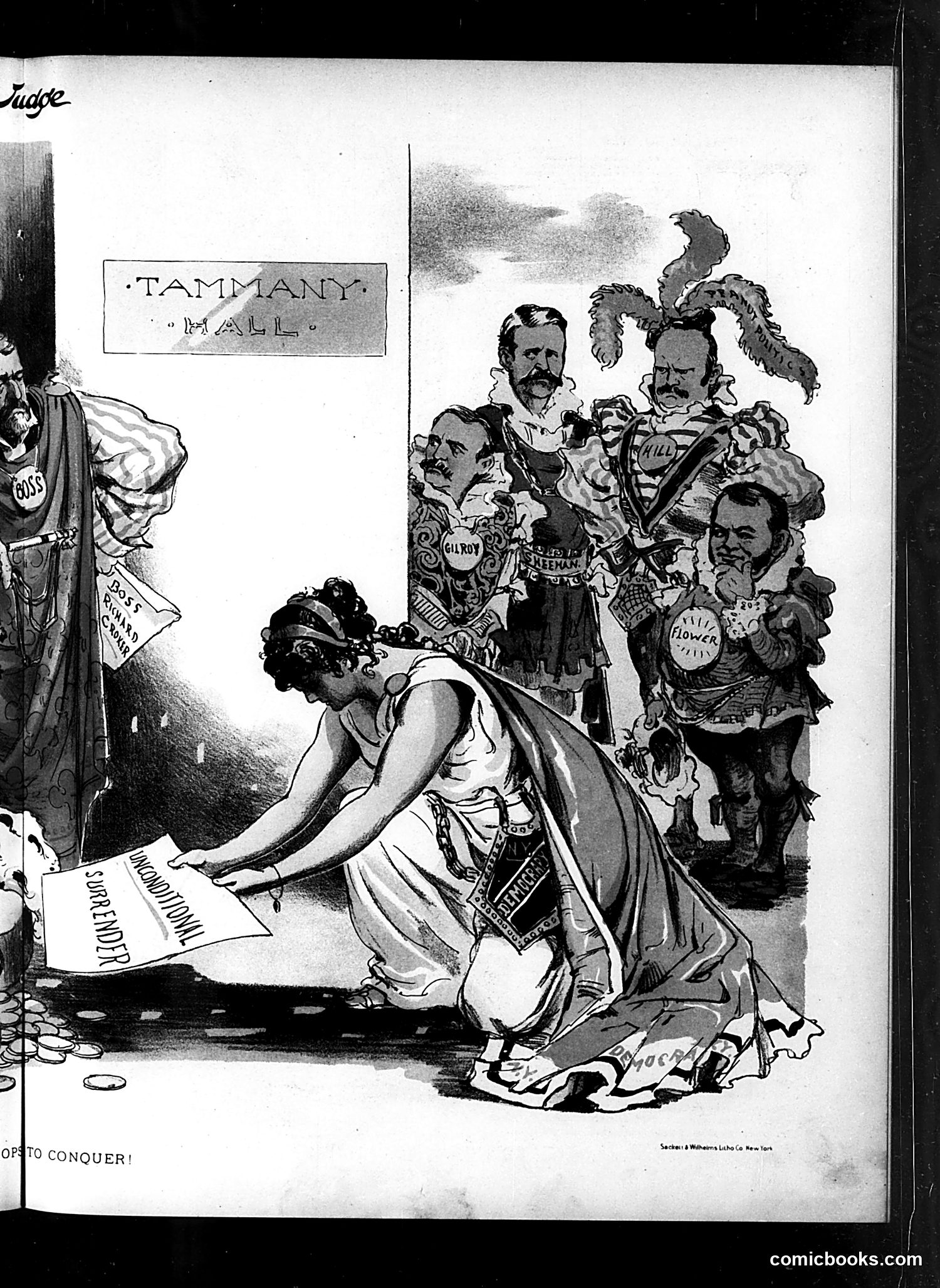
This political cartoon satirizes **Tammany Hall**, the corrupt Democratic political machine that dominated New York City politics. The central figure is **Lady Justice** (blindfolded woman), shown kneeling before a group of caricatured political bosses labeled with names like "GOULD," "HILL," and "FLOWER"—likely referring to prominent Tammany figures and wealthy industrialists. The cartoon critiques how Tammany Hall's leadership corrupted the justice system and democratic process. Justice appears subjugated to these powerful men, suggesting they operated above the law. The eagle overhead and the framing suggest American ideals being betrayed. The title's tone is ironic—"Op to Conquer" suggests these bosses remained triumphant despite public opposition to machine politics. This reflects Progressive Era anti-corruption sentiment of the late 1800s/early 1900s.
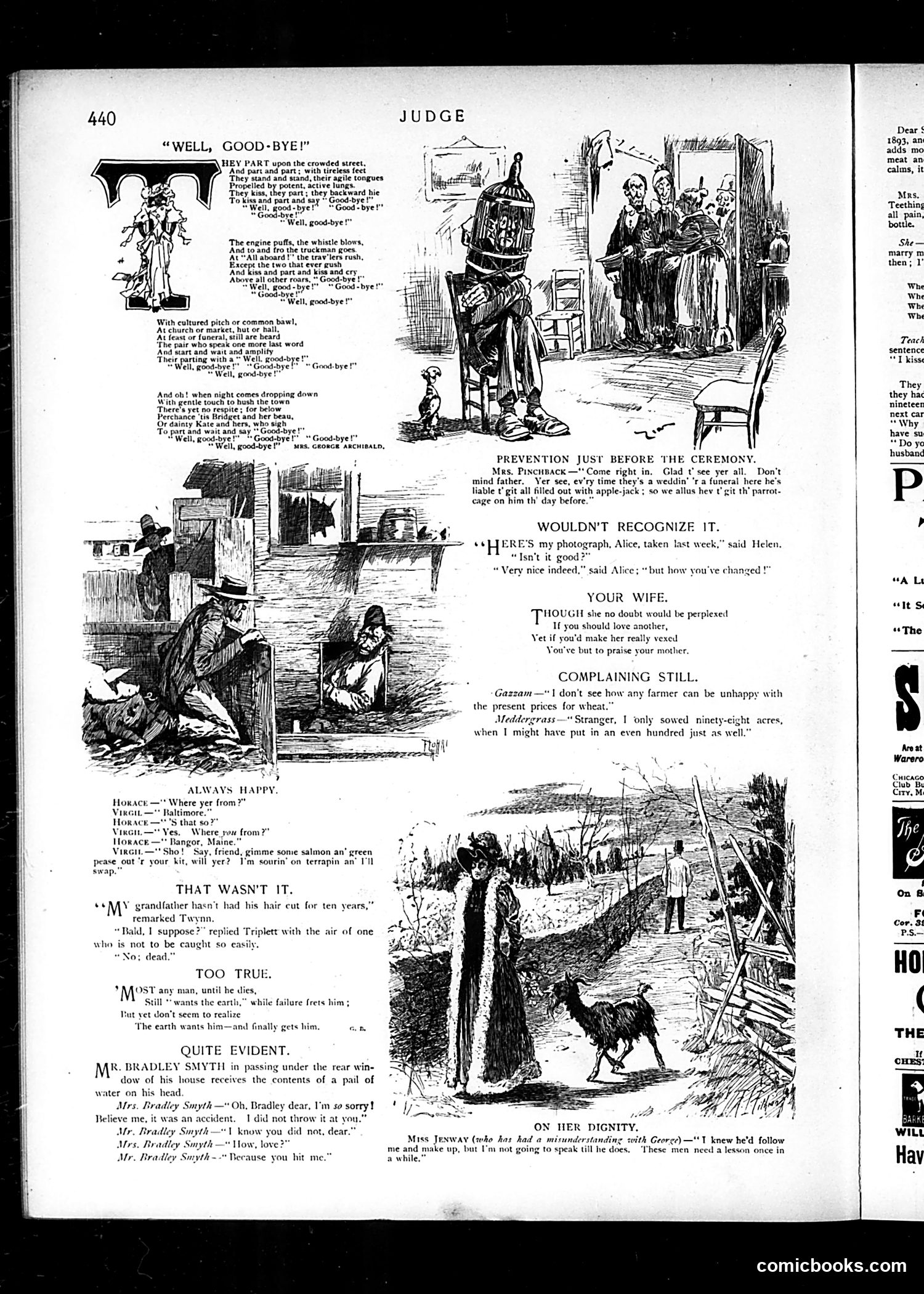
This page from Judge magazine (appears to be 1890s based on style) contains several satirical pieces mocking everyday social situations: **"Well, Good-Bye!"** - A humorous poem about couples who endlessly prolong their partings on crowded streets and train platforms, repeatedly saying goodbye without actually leaving. The satire targets sentimental, dramatic behavior in public. **"Prevention Just Before the Ceremony"** - A brief joke about a father who drinks excessively at weddings/funerals, requiring a "parrot cage" restraint beforehand. **Other short humor items** include: - A woman's changing appearance between photos - Wifely jealousy of mothers-in-law - A farmer complaining about wheat prices despite favorable conditions - A bald man's death mistaken for a haircut refusal - Marital disputes over accidental water-throwing The cartoons satirize Victorian-era middle-class domestic life, courtship rituals, and human nature's tendency toward petty complaints and melodrama. The humor is gentle, focusing on universal relationship quirks rather than political commentary.
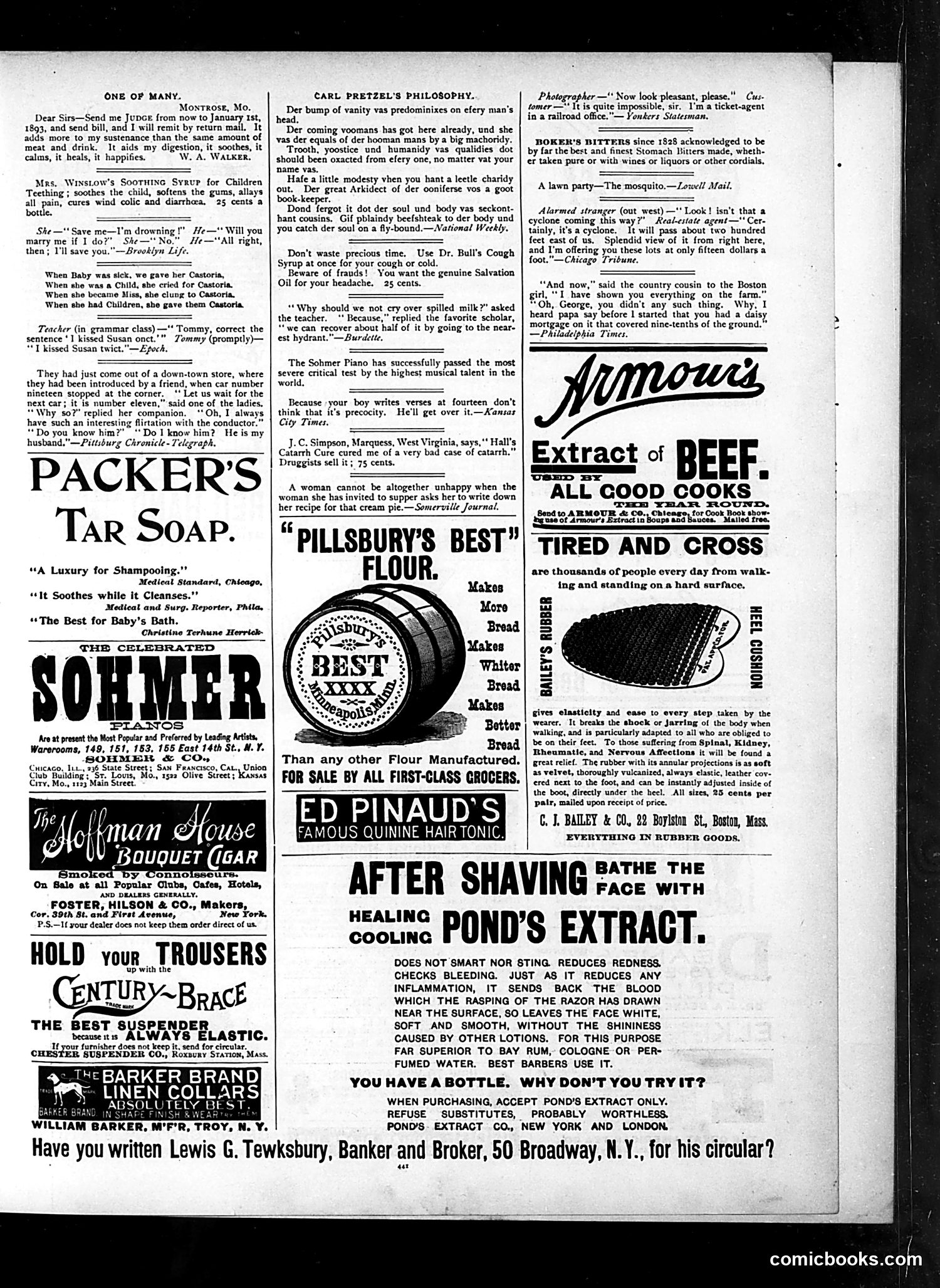
This page is primarily **advertisements and filler content** rather than political satire or cartoons requiring historical context. The visible material consists of: - **Reader letters** praising Judge magazine and various patent medicines (common advertising of the era) - **"Carl Pretzel's Philosophy"** — humorous aphorisms in heavy German-dialect English, a popular comedic style of the period - **Numerous product advertisements** for items like flour, soap, hair tonic, patent medicines, and clothing suspenders - **Short joke items** about everyday domestic situations (drowning proposals, streetcar flirtations, schoolroom grammar corrections) **Key observation:** The German-dialect humor in "Carl Pretzel" reflects turn-of-the-century American entertainment that mocked immigrant speech patterns — acceptable at the time but now recognized as ethnic caricature. The page contains **no identifiable political figures or events**, no coherent cartoon narrative, and reflects Judge's typical late-19th-century format: satirical magazine mixed with advertising revenue.
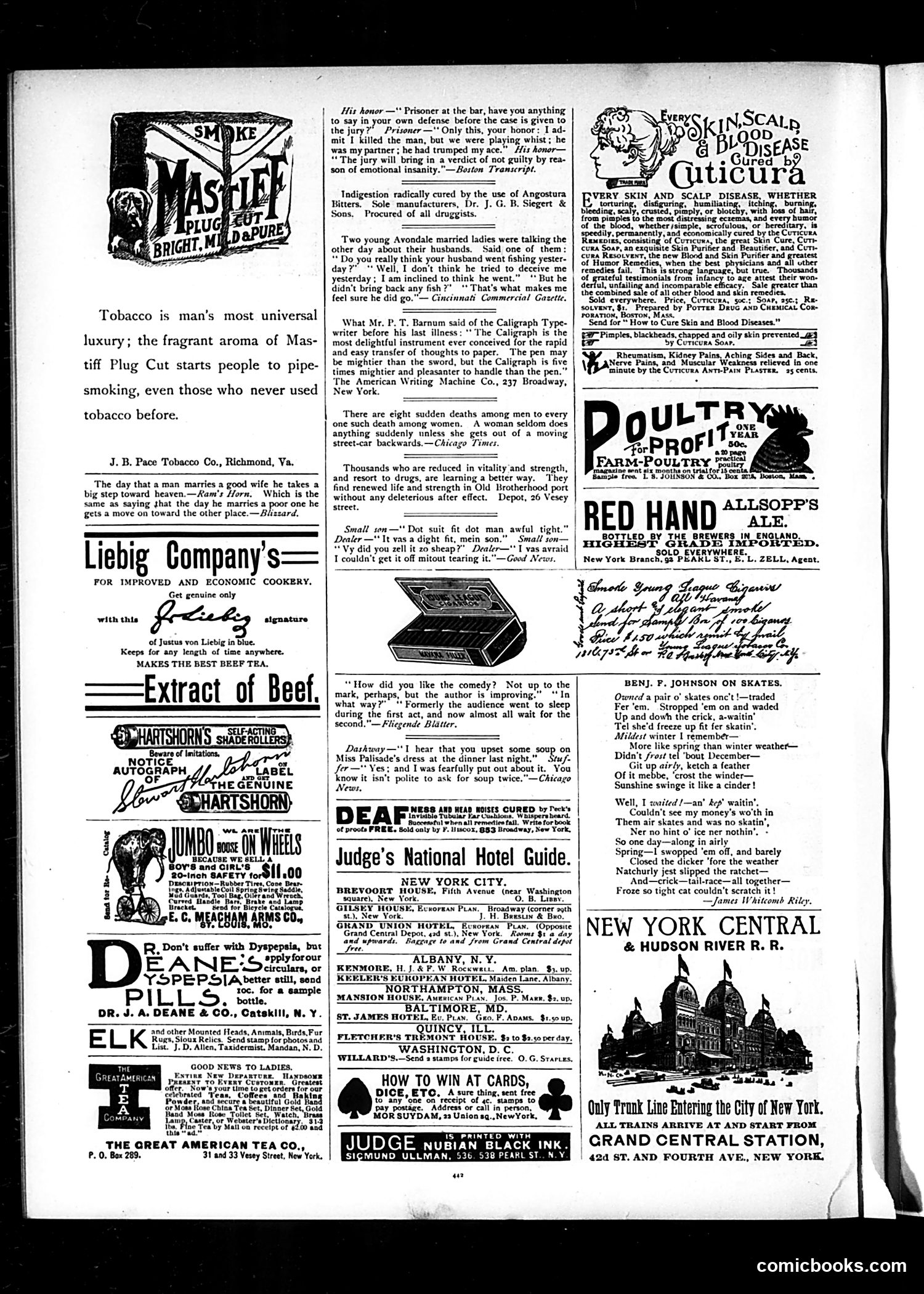
This page is primarily **advertising**, with small satirical snippets interspersed. The cartoons are brief, joke-driven items rather than political commentary. The main satirical content includes: 1. **Whist/Murder joke**: A prisoner admits killing his card-playing partner but claims "emotional insanity" because the victim trumped his ace. The satire mocks both courtroom logic and the passion people invest in card games. 2. **Fishing excuse joke**: A wife's circular reasoning about her husband's fishing trip—she believes he went because he came home with no fish, proving he actually fished. The satire targets marital deception and spousal skepticism. 3. **Immigration/dialect humor**: A merchant can't remove a tight-fitting suit without tearing it, explaining his low price. The exaggerated German-Jewish accent ("dot," "zell," "vy") reflects period stereotypes common in Judge's humor. The page otherwise consists of contemporary advertisements for tobacco, beef extract, typewriters, hotels, and patent medicines—typical commercial content of late-19th-century American magazines.
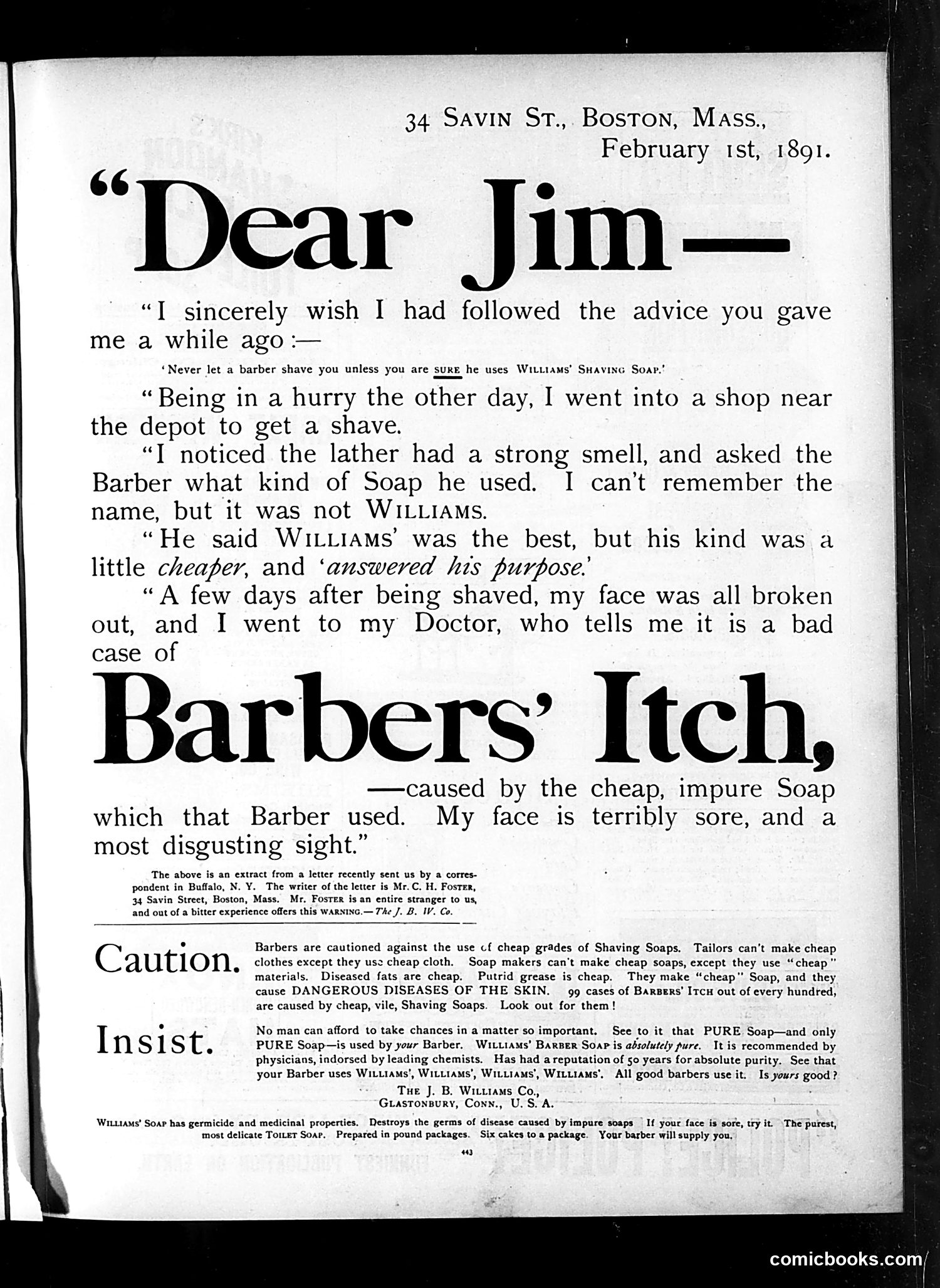
This is a **product advertisement**, not political satire. It's a testimonial-style ad for Williams' Shaving Soap, presented as a cautionary letter from a customer named C.H. Foster in Buffalo, New York. The narrative warns that a barber used cheaper, inferior soap on Foster's face, resulting in "Barbers' Itch"—a real skin infection common in that era caused by unsanitary conditions and poor-quality products. The ad exploits this genuine health concern to promote Williams' as the pure, safe alternative. The "satire" is mild: the barber admits Williams' is best but chooses something "cheaper" that "answered his purpose," highlighting how cost-cutting endangers customers. The ad then directly addresses barbers and customers, claiming Williams' has 50 years of reputation and physician endorsement. This reflects late-Victorian marketing tactics using fear-based testimonials to establish brand trust in an era before modern product regulation.
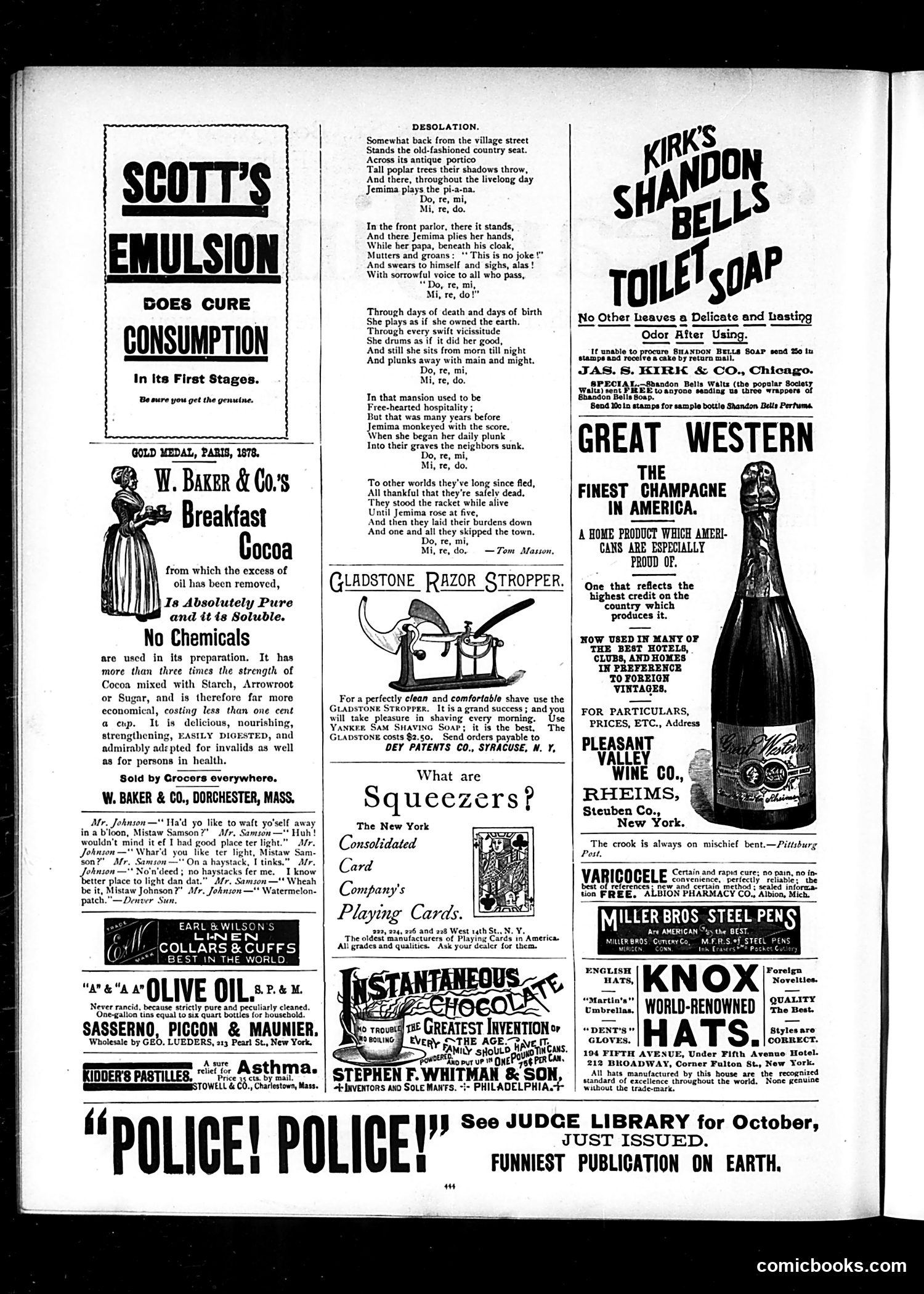
This page is **primarily advertising**, typical of late-19th-century magazines. The main satirical content is a short comic poem titled "Desolation" by Tom Masson, which ridicules a young woman named Jemima for her incessant, tone-deaf piano playing. The poem's satire targets the genteel torture of amateur musicianship: Jemima plays monotonous scales ("Do, re, mi / Mi, re, do") relentlessly, driving her family and neighbors to despair. The exaggerated claim that neighbors literally flee town and "skip the town" to escape her playing mocks both her lack of musical talent and the Victorian-era social obligation to endure tedious parlor recitals. The surrounding advertisements (Scott's Emulsion, Baker's Cocoa, Kirk's Shandon Bells Soap) are unrelated to the satire—typical of Judge's revenue model.
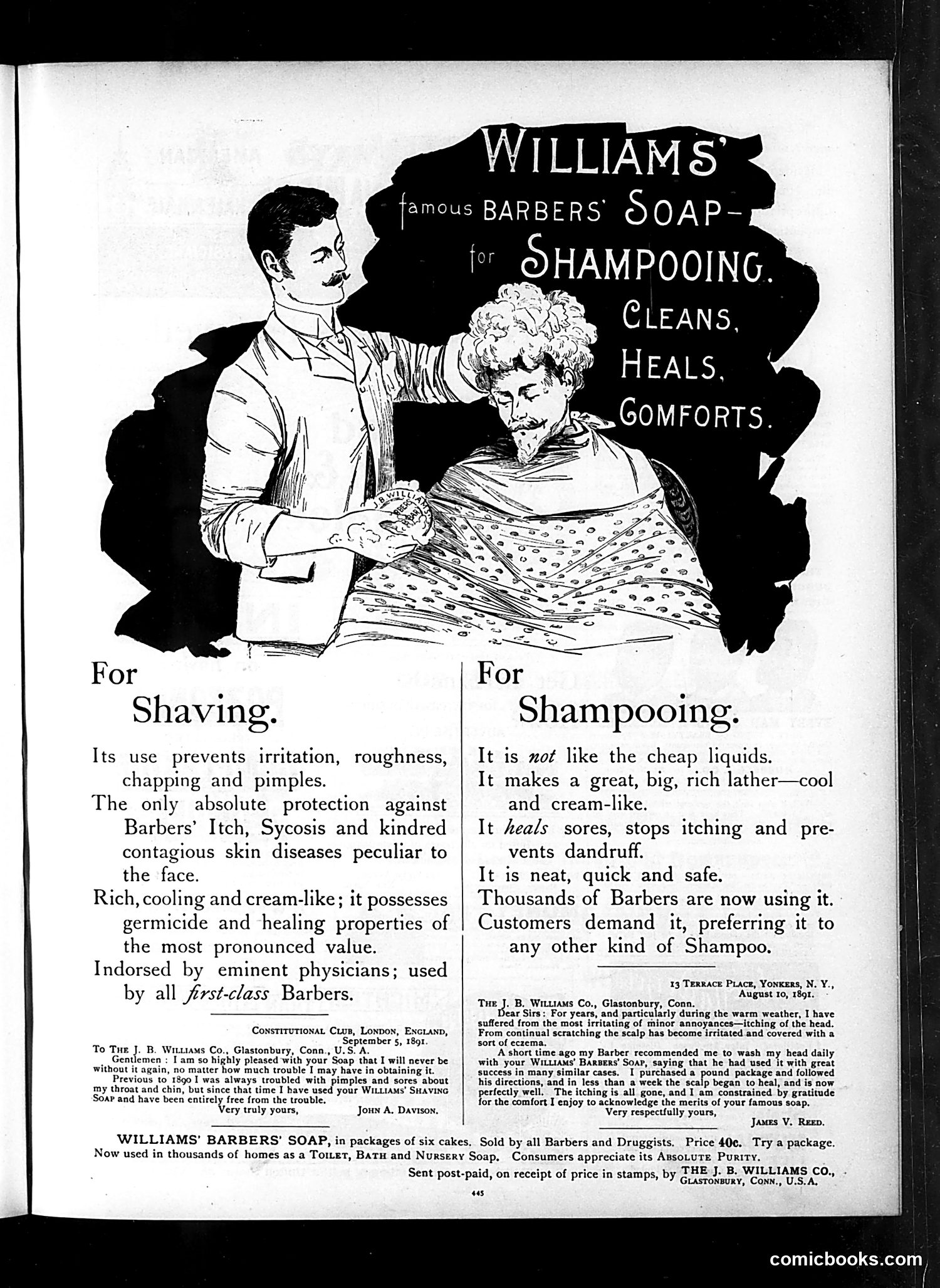
This is **not a political cartoon or satire**—it's a full-page advertisement for Williams' Barbers' Soap from *Judge* magazine (circa 1891). The illustration shows a barber applying the product to a customer. The ad makes two-column claims: for shaving, it prevents irritation and protects against "Barbers' Itch" and contagious skin diseases; for shampooing, it creates rich lather and heals scalp conditions like dandruff and eczema. The page includes testimonial letters from satisfied users (dated 1891), claiming the soap cured chronic skin problems. This was a common advertising strategy of the era—using customer endorsements to establish credibility before modern regulations controlled medical claims. The product cost 40¢ per package of six cakes and could be ordered by mail. The emphasis on "absolute purity" reflects late-19th-century consumer anxieties about product safety.
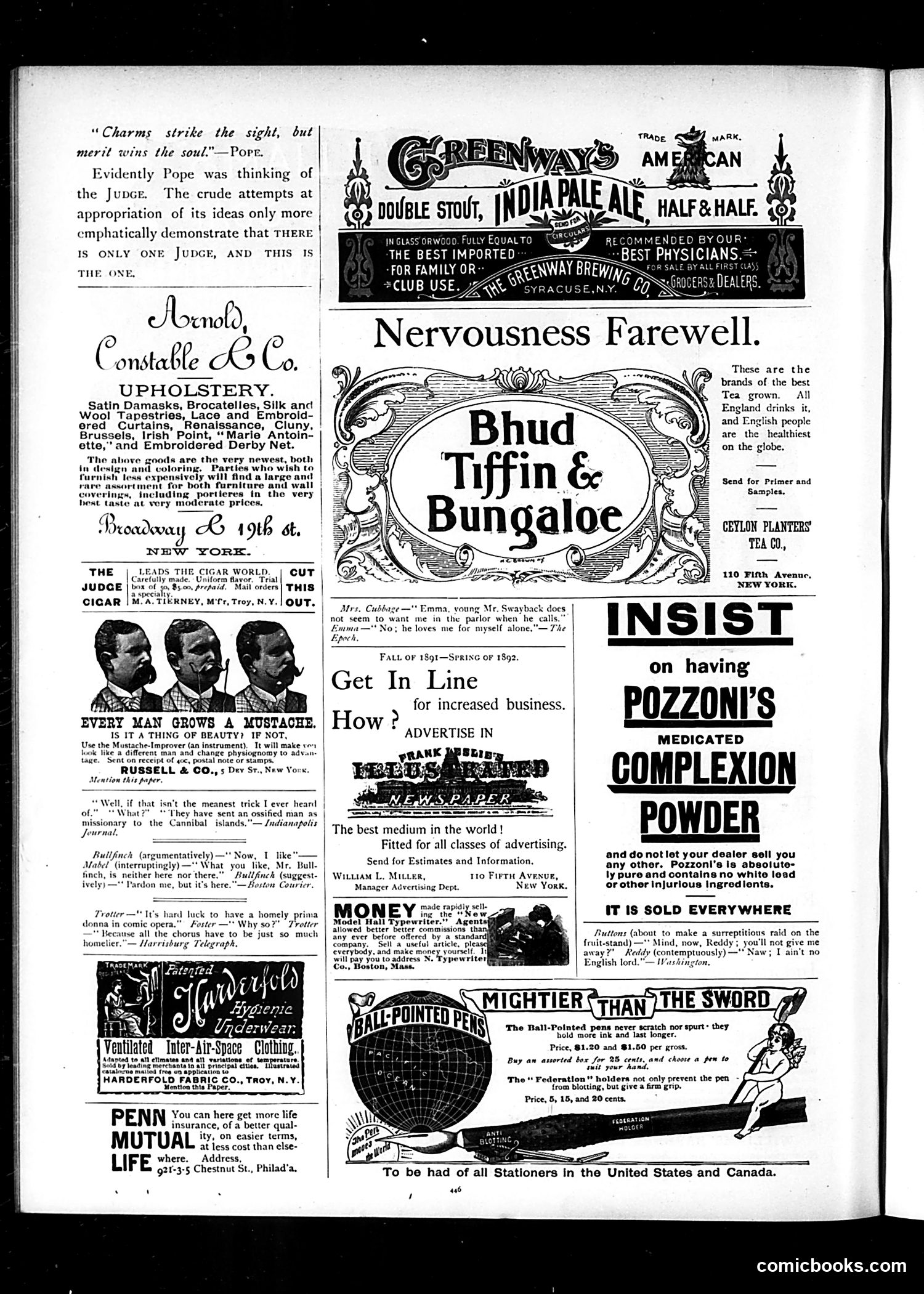
This is primarily an **advertising page** from Judge magazine (late 1891/early 1892), with minimal editorial content. The notable elements: **Masthead/Editorial Comment:** The top features a brief self-promotional statement defending Judge's originality against competitors, quoting Pope about merit winning souls—suggesting rivals were imitating Judge's satirical format. **Cartoons:** A small, crude cartoon shows three men with prominent mustaches, captioned "Every Man Grows a Mustache—Is It a Thing of Beauty?" This advertises a mustache-improvement device, reflecting contemporary vanity products. **Advertisements:** The bulk of the page comprises ads for upholstery, cigars, mustache improvers, life insurance, tea, face powder, typewriters, and pens—typical consumer goods of the 1890s. **Social Context:** These ads reveal period concerns: personal grooming, mortality insurance, and the novelty of typewriter technology. The face powder ad notably promises "no white lead or other injurious ingredients," suggesting cosmetics safety was a concern. The page reflects Judge's business model: satirical content subsidized by advertising revenue.
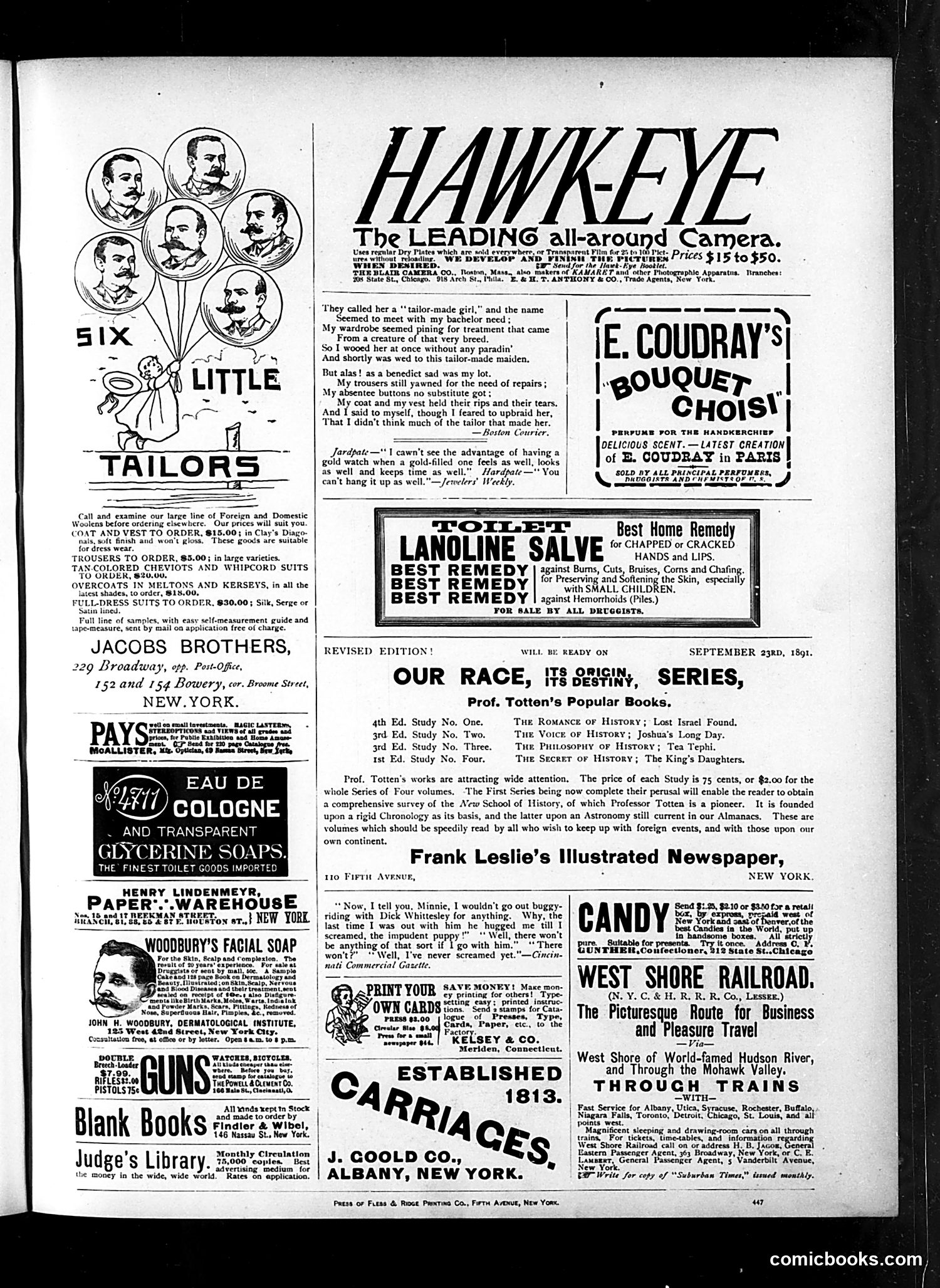
This page is primarily **advertising** with one satirical poem-cartoon titled "Six Little Tailors." The cartoon illustrates a humorous domestic complaint: a bachelor marries a woman nicknamed a "tailor-made girl"—likely meaning fashionably dressed or refined. He expects she'll mend his clothes, but ironically, after marriage his wardrobe falls apart: buttons disappear, trousers gap, coats and vests tear. The joke's punchline criticizes both the wife ("the tailor that made her") and deflates the "tailor-made girl" concept itself. The six circular portraits above show various mustachioed men—possibly representing different social types or the husband's frustrations—though specific identities aren't clear from context. The satire mocks the gap between romantic expectations and married reality, and possibly pokes fun at contemporary fashion consciousness and gender roles—the "tailor-made girl" being a type rather than a person. The rest of the page contains period advertisements for cameras, perfume, clothing tailors, soap, and other goods.
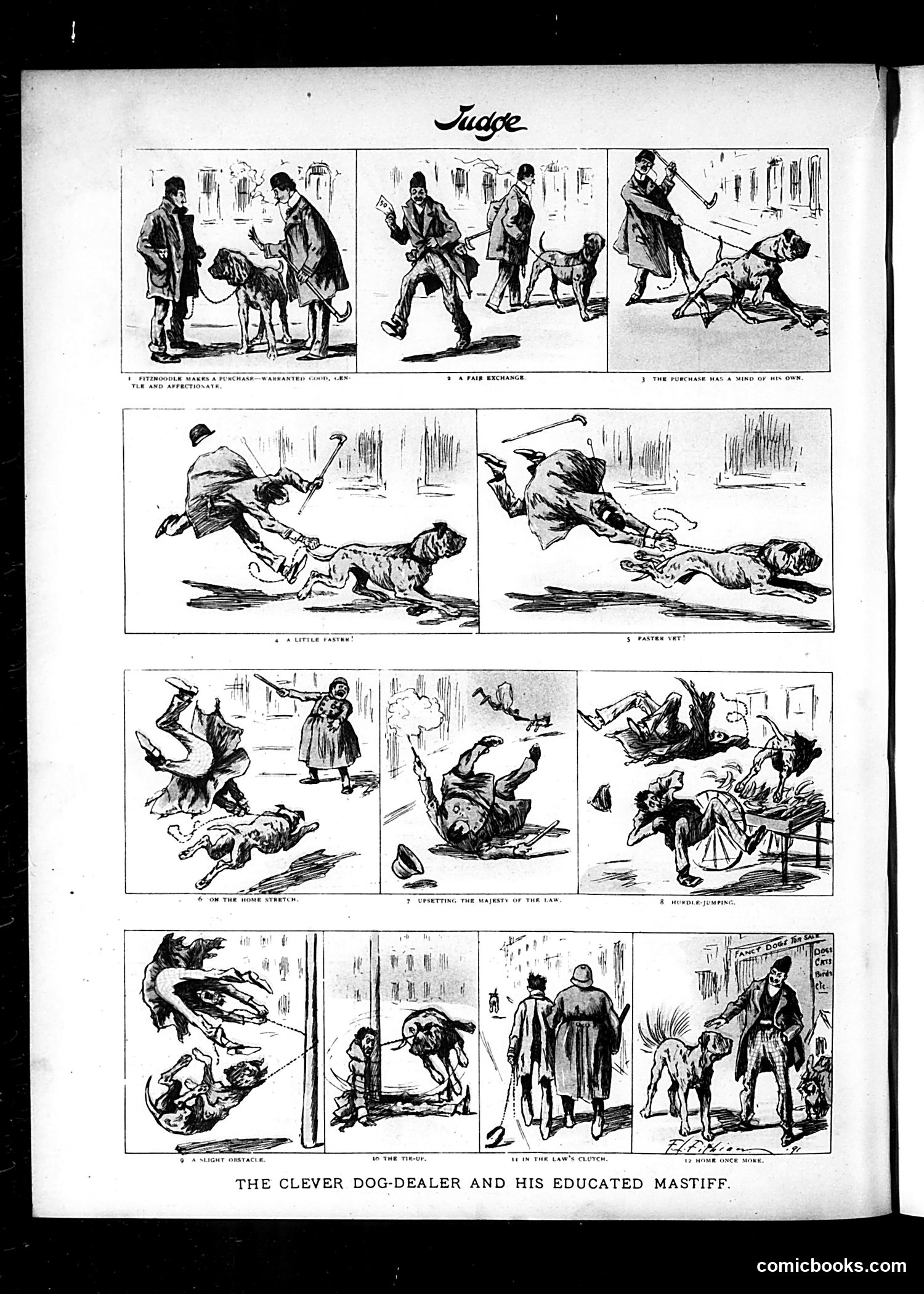
This satirical comic strip depicts a man using a dog as a tool for crime and mischief. The narrative shows the "dog-dealer" training or directing his mastiff to perform increasingly elaborate schemes: initiating fake accidents with pedestrians, staging confrontations, and executing elaborate street scams that appear designed to defraud or embarrass victims. The satire likely mocks either actual contemporary con artists who exploited animals for criminal purposes, or more broadly critiques corruption and trickery in urban society. The "educated" mastiff serves as the willing accomplice—suggesting both animal abuse and the moral corruption required to participate in such schemes. The comic's title frames this as a relationship of manipulation and exploitation.