
Judge, 1891-10-10 · page 3 of 18
Judge — October 10, 1891 — page 3: what you’re looking at
What you’re looking at
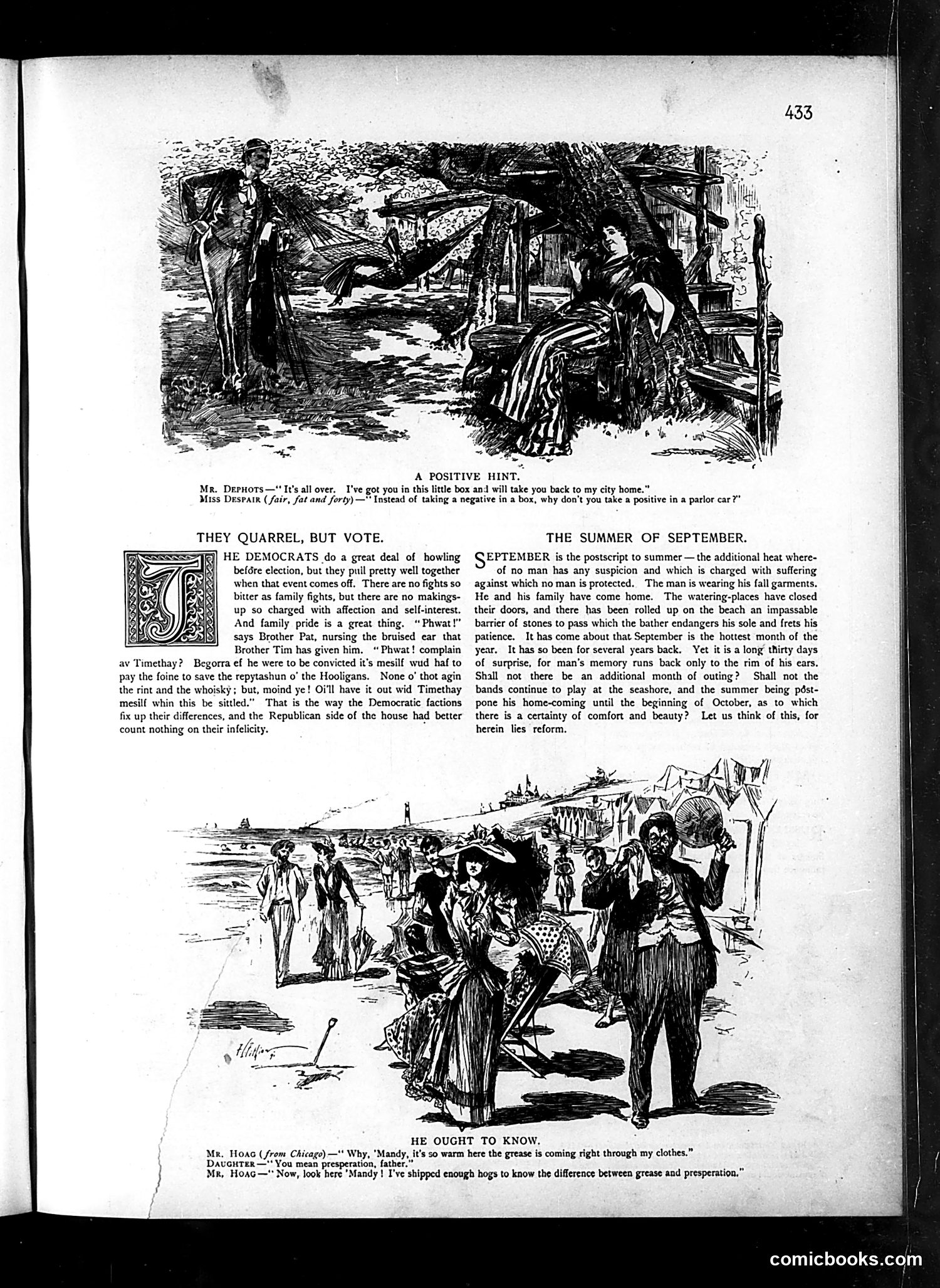
This page contains three cartoon vignettes satirizing American social and political life, likely from the early 20th century: **"A Positive Hint"** (top): Depicts a woman offering a man a ride in a parlor car instead of a box—a subtle class commentary on transportation and social status. **"They Quarrel, But Vote"** (left): Discusses Democratic and Republican family disputes before elections. The satire emphasizes that despite bitter disagreements, families maintain voting loyalty to their parties, suggesting political partisanship overrides family harmony. **"The Summer of September"** (right): Commentary on summer ending and families returning home, with implied social reform messaging about leisure and class dynamics. **"He Ought to Know"** (bottom): A Chicago-based joke about "grass" coming through clothes—appears to reference poor versus wealthy cleanliness standards or laundry preparedness. The overall tone critiques American political polarization and class distinctions.
📄 Transcribed text from this page (OCR, searchable)
Machine-transcribed from the original scan — historical spelling and the odd misread are preserved.
A POSITIVE HINT. Mr. Dernots—“ It’s all over, I'v got you in this little box and will take you back to my city home.” Miss Despair (fair, fat and forty) —" Instead of taking a negative in a box, why don't you take a positive in a parlor car?” THEY QUARREL, BUT VOTE. HE DEMOCRATS do a great deal of howling befdre election, but they puil pretty well together when that event comes off. There are no fights so bitter as family fights, but there are no makings- up so charged with affection and self-interest. And family pride is a great thing. “Phwat!” says Brother Pat, nursing the bruised ear that Brother Tim has given him. “ Phwat! complain av Timethay? Begorra ef he were to be convicted it's mesilf wud haf to pay the foine to save the repytashun o' the Hooligans. None o' thot agin the rint and the whoisky ; but, moind ye! Oi'll have it out wid Timethay mesilf whin this be sittled.” That is the way the Democratic factions fix up their differences, and the Republican side of the house had better count nothing on their infelicity. THE SUMMER OF SEPTEMBER. SEPTEMBER is the postscript to summer —the additional heat where of no man has any suspicion and which is charged with suffering against which no man is protected. The man is wearing his fall garments. He and his family have come home. The watering-places have closed their doors, and there has been rolled up on the beach an impassable barrier of stones to pass which the bather endangers his sole and frets his patience, It has come about that September is the hottest month of the year. It has so been for several years back. Yet it is a long thirty days of surprise, for man’s memory runs back only to the rim of his ears. Shall not there be an additional month of outing? Shall not the bands continue to play at the seashore, and the summer being pést- pone his home-coming until the beginning of October, as to which there is a certainty of comfort and beauty? Let us think of this, for herein lies reform. HE OUGHT TO KNOW. Mr. Hoac (from Chicago) —“ Why, ‘Mandy, it's so warm here the grease is coming right through my clothes.” Datcuter—"' You mean presperation, father. Mk, Hoac—" Now, look here ‘Mandy ! I've shipped enough hogs to know the difference between grease and presperation,”” comicbooks.com