
A complete issue · 16 pages · 1891
Judge — October 3, 1891
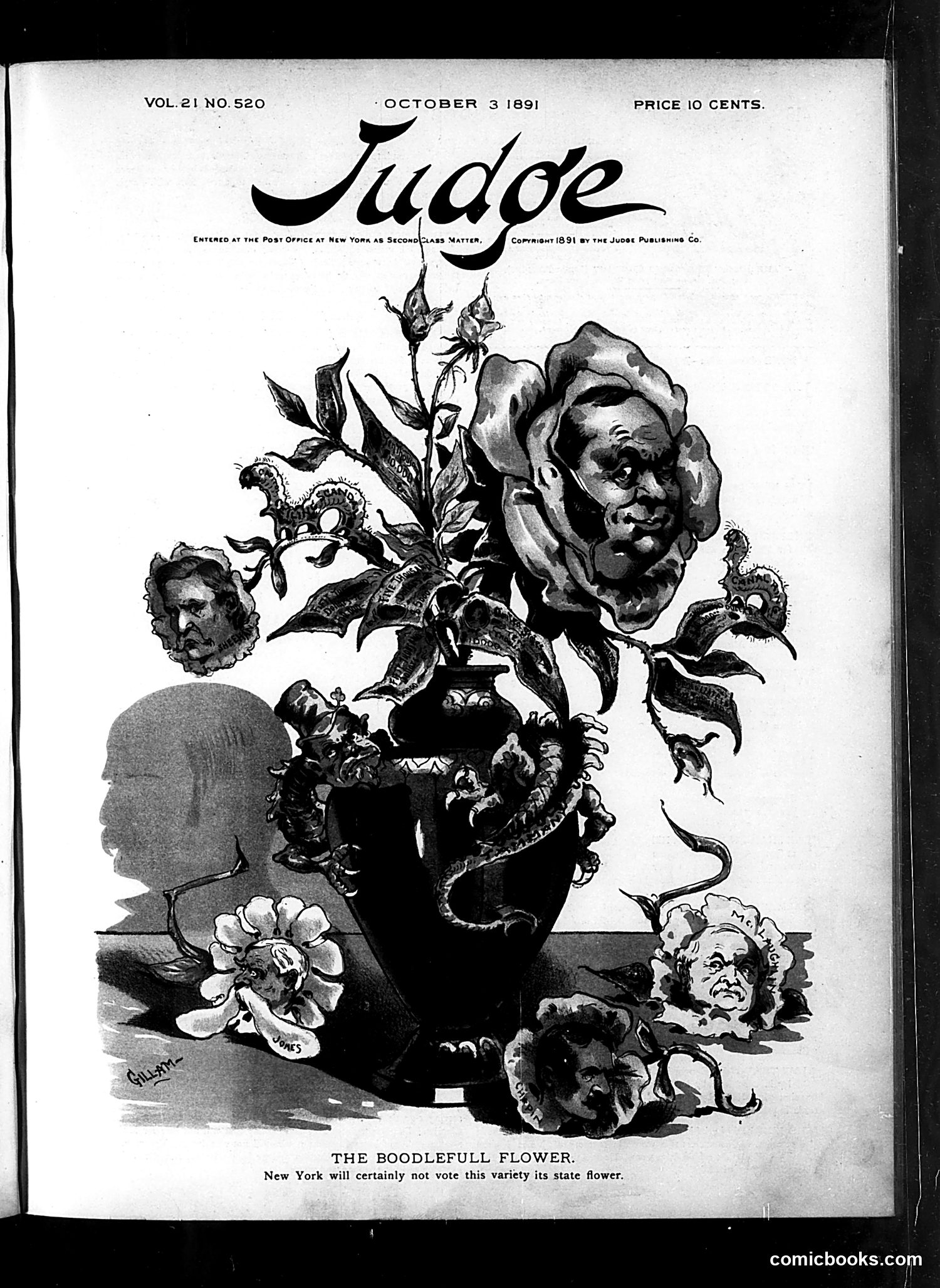
This political cartoon satirizes corrupt New York politics through the metaphor of a grotesque flowering plant. "Boodle" was 1890s slang for bribery money and political corruption. The vase contains caricatured faces of what appear to be corrupt New York political figures, with flowers blooming from their heads. The caption states: "New York will certainly not vote this variety its state flower"—a sardonic joke, since New York's actual state flower selection was likely being debated at this time. A silhouetted profile (possibly a political leader) appears on the left. The overall message: New York politics is so thoroughly corrupted by bribery and graft that if politicians were flowers, they'd be monstrous weeds rather than worthy of official recognition.
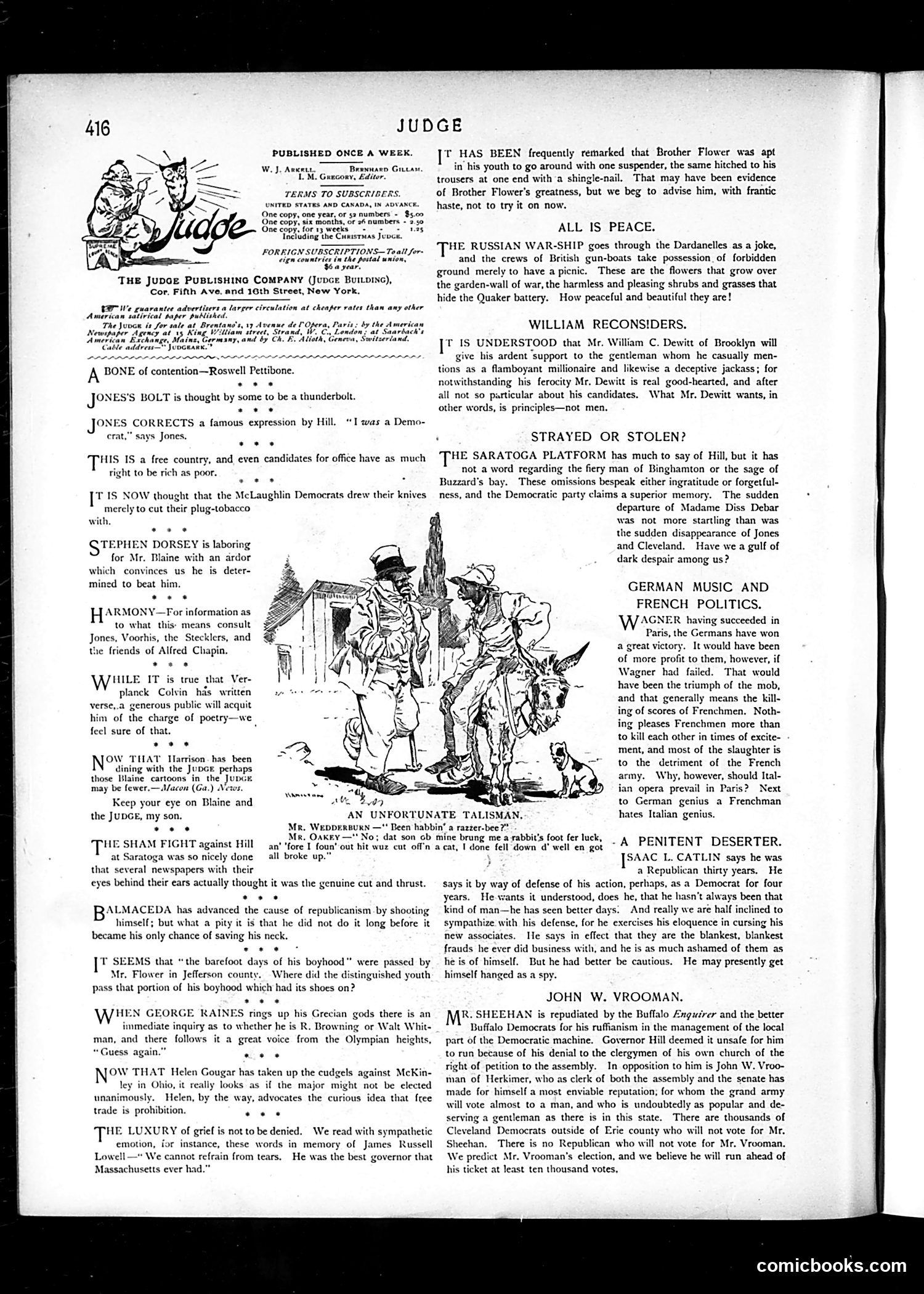
This page contains political commentary and brief satirical pieces rather than a single cartoon. The main illustration titled "An Unfortunate Talisman" depicts figures on horseback, likely referencing contemporary political figures or events, though specific identities are unclear from the image alone. The text pieces mock various politicians and political situations: one discusses William C. Dewitt's candidacy, another critiques the Saratoga Platform and mentions Jones and Cleveland (likely referencing Democratic politics), and pieces comment on Harrison, Stephen Dorsey, and George Raines. The "German Music and French Politics" section satirizes European political tensions, referencing Wagner and French-German relations. Without clearer context or captions, precise identification of all figures and specific events referenced is difficult, but the overall tone mocks Democratic and Republican political maneuvering of the era.
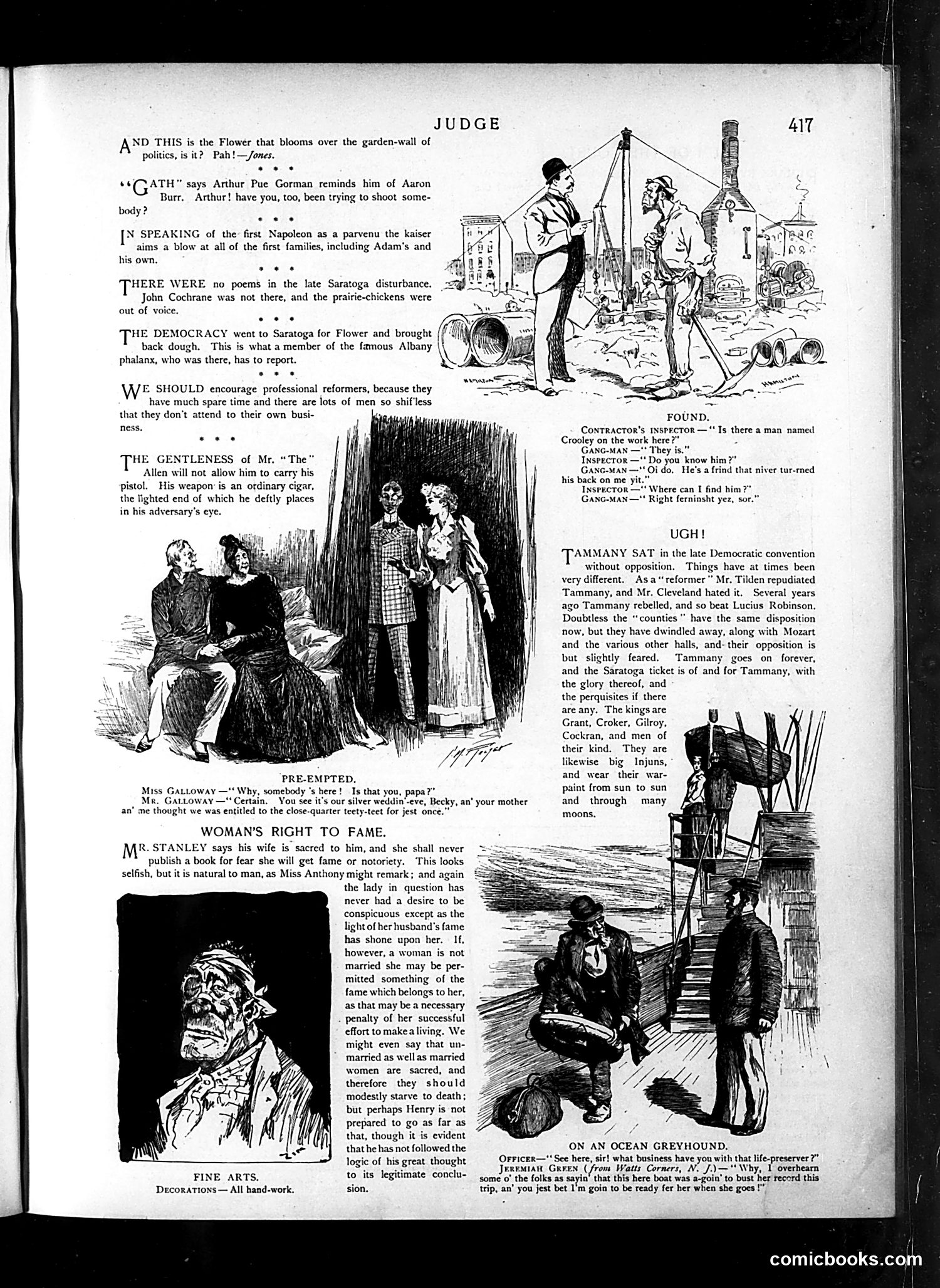
This page contains several satirical pieces about late 19th-century American politics and society. **Top cartoon** depicts surveyors or engineers using theodolites, likely satirizing professional reformers or their methods. **"Pre-Empted"** mocks domestic relations, showing a wife confronting her husband about a woman's presence, with wordplay on "silver wedding eve." **"Woman's Right to Fame"** discusses Mr. Stanley and his wife's relationship to his fame—criticizing how married women cannot claim independent recognition. This reflects contemporary debates about women's legal status and identity within marriage. **"Fine Arts"** features a grotesque caricature labeled "Decorations—All hand-work," though the specific target is unclear. **Lower cartoon** shows figures at a dock discussing a "life-preserver," apparently satirizing maritime fraud or shipping scandals of the period. The page reflects Gilded Age concerns: professional ethics, gender roles, and commercial dishonesty.
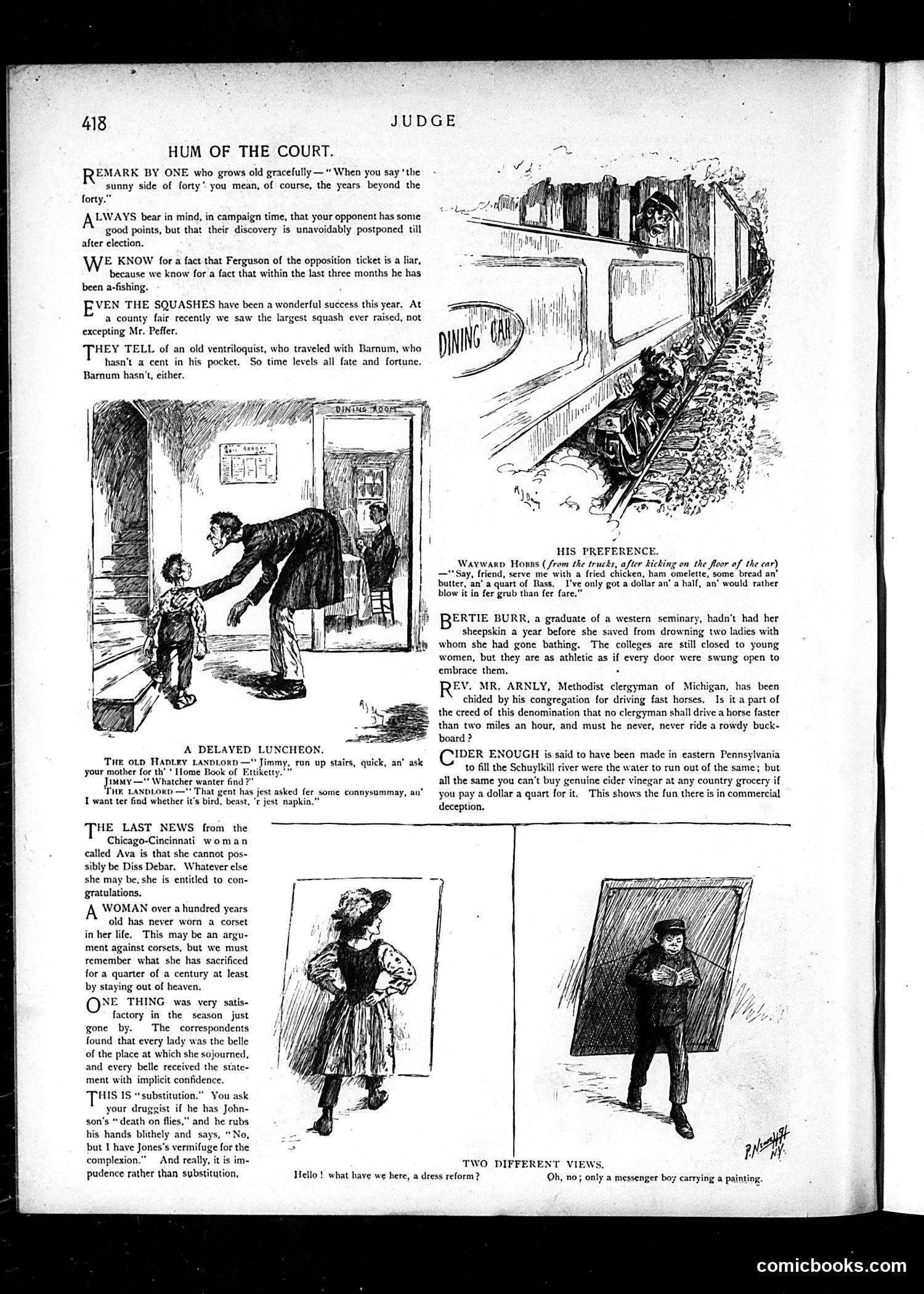
This page contains miscellaneous satirical commentary and cartoons typical of Judge's "Hum of the Court" section—short political and social jabs rather than unified narratives. **Key content:** - **Ferguson reference**: A candidate is mocked as a liar, with the joke that his fishing trip proves dishonesty—likely referencing a specific opposition politician, though unclear which era. - **Peffer comparison**: The squash joke compares a large vegetable to "Mr. Peffer" (possibly James H. Peffer, a Kansas politician), suggesting he's unusually large or otherwise notable. - **Social commentary**: Pieces mock corsets, dress reform movements, fast-driving clergy, and commercial deception (selling inferior cider vinegar). - **"Two Different Views" cartoon**: Shows contrasting interpretations—one character sees "dress reform," another sees merely "a messenger boy carrying a painting," satirizing how observers project different meanings onto the same scene. The page's humor relies on period-specific references and assumes reader familiarity with contemporary politicians and social debates about women's fashion and education.
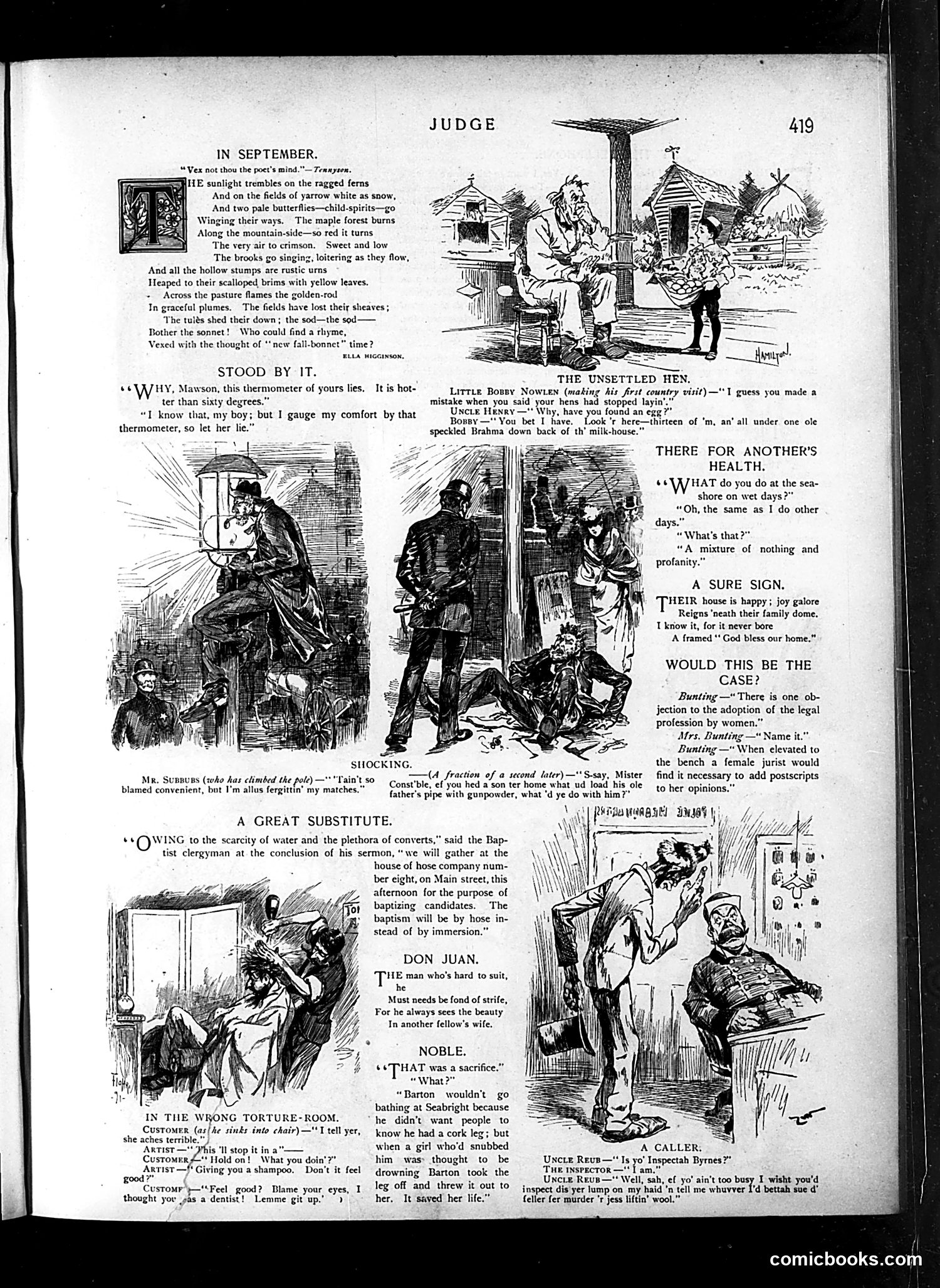
This page contains satirical sketches and humorous dialogue typical of late-19th-century American humor. Key content includes: **"In September"** — A poem mocking overwrought romantic poetry, where the poet abandons his sonnet mid-composition, frustrated that practical concerns ("new fall-bonnet time") intrude on artistic inspiration. **Various short comedic sketches** featuring rural characters and domestic situations: a farmer defending an inaccurate thermometer, a visiting city person confused by farm life, and exchanges about marriage and courtship. **Social satire** addressing contemporary issues: women entering the legal profession (the "female jurist" joke about needing postscripts), Baptist baptism practices, and masculine vanity. **The humor relies on** class contrasts (city vs. rural characters), wordplay, and observations about marriage dynamics. The sketches assume readers' familiarity with 19th-century domestic life and professional debates about women's roles. The page reflects Judge's formula: light verse, brief comedy sketches, and social commentary through caricature and dialogue rather than explicit political messaging.
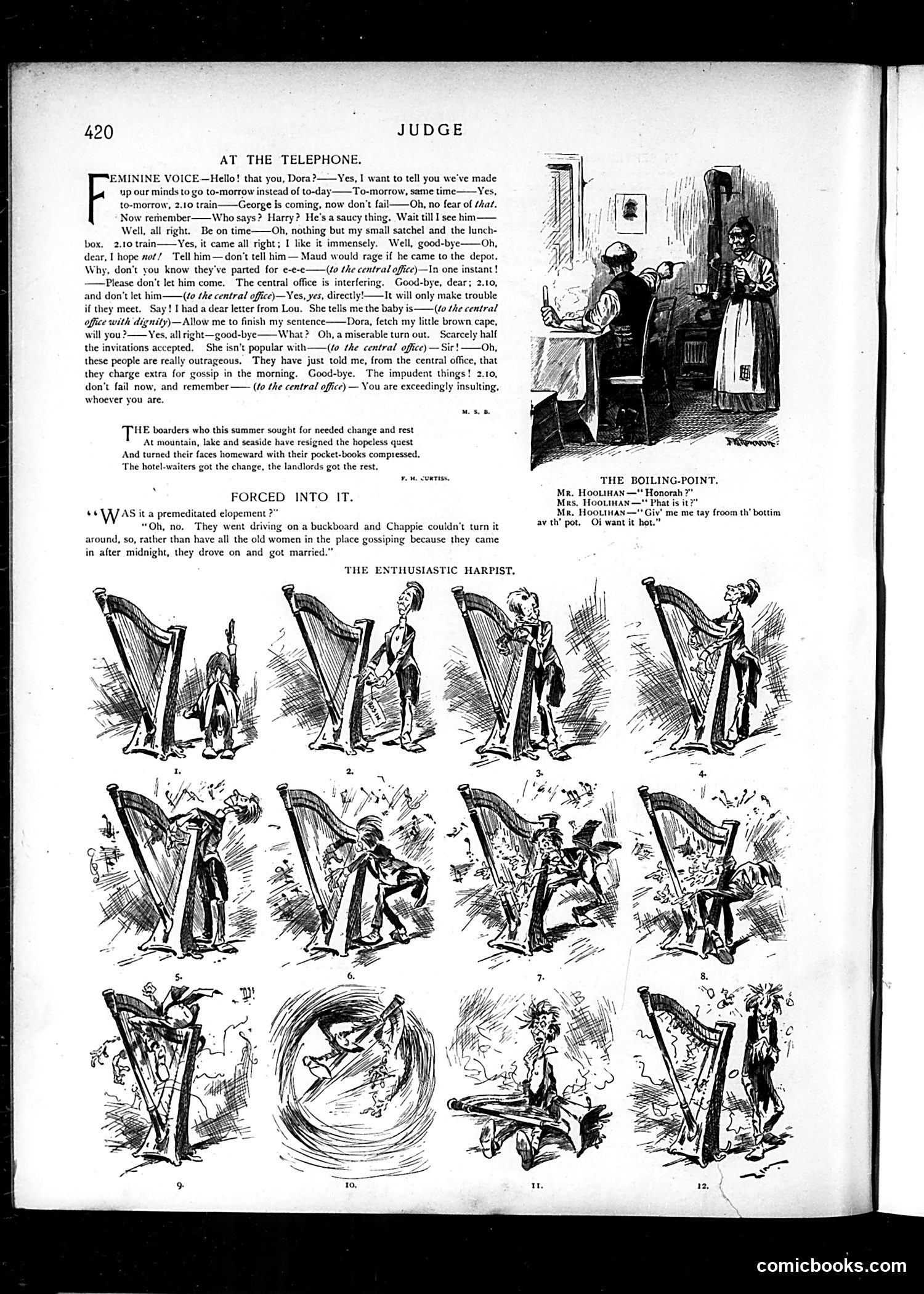
This page contains three satirical pieces mocking early 20th-century social conventions: **"At the Telephone"** satirizes women's gossiping and the telephone's role in facilitating it. A woman makes endless plans while repeatedly being interrupted by the telephone operator, whom she insults for "charging extra for gossip." The joke targets both women's perceived chattiness and the new intrusion of operators into private conversations—a social anxiety of the telephone era. **"Forced Into It"** mocks hasty elopements, suggesting a couple married simply to avoid small-town gossip when they couldn't turn their buckboard around after a late-night drive. **"The Boiling Point"** and **"The Enthusiastic Harpist"** use Irish dialect humor (common in period satire) to depict domestic scenes, though the specific jokes are unclear from the text provided. The cartoons collectively satirize gossip culture, small-town surveillance, and emerging technology's social complications.
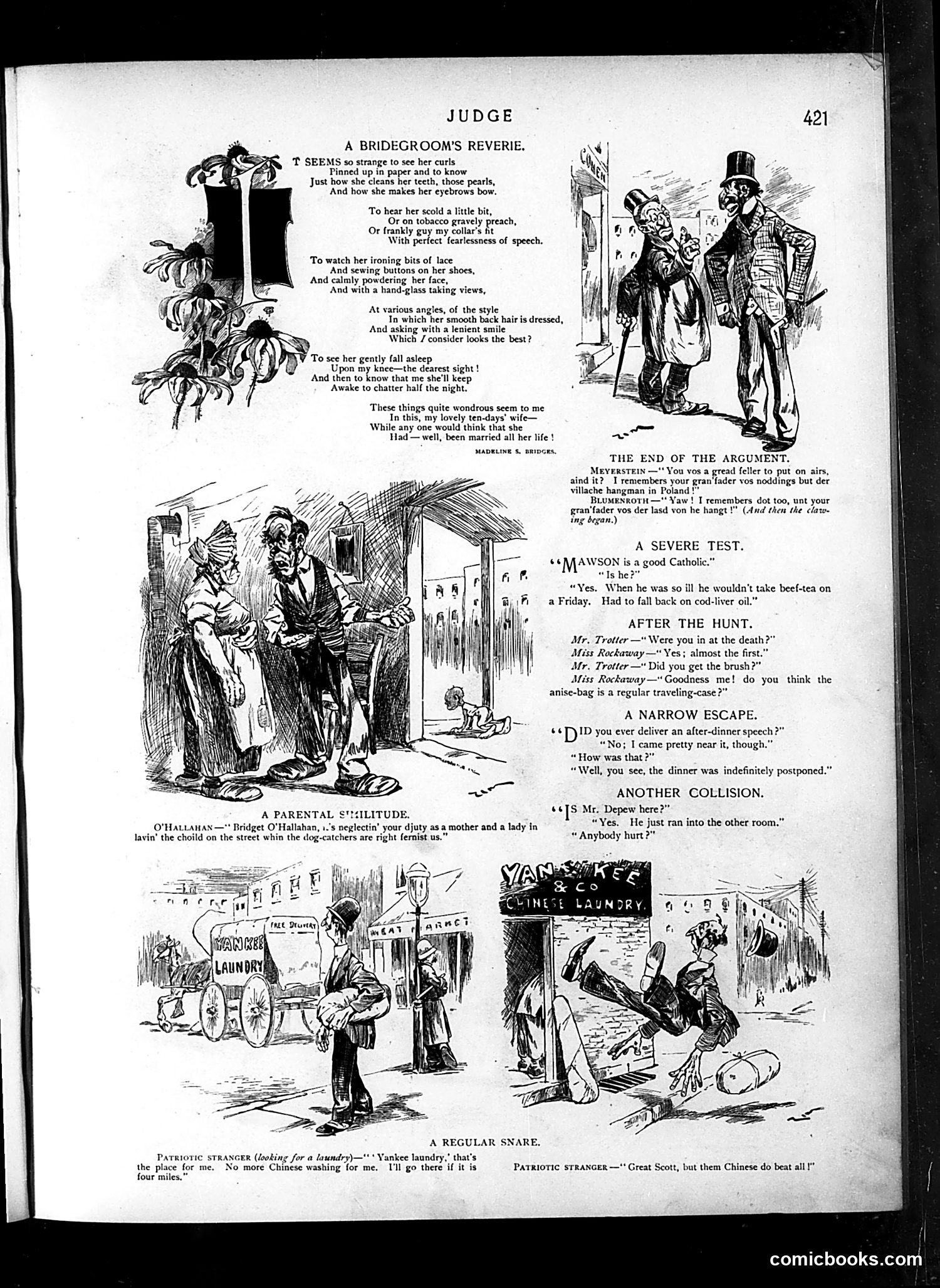
This page contains several short humor pieces typical of late 19th/early 20th-century satirical journalism: **"A Bridegroom's Reverie"** presents a newlywed's amazement at discovering his wife's mundane domestic realities—her grooming routines, minor complaints, and sleeping habits—contrasting romantic idealization with ordinary married life. **Multiple brief jokes** mock various social types: working-class immigrants with heavy accents (the "O'Hallahan" and "Blumenroth" pieces), pretentious fox hunters, and religious hypocrisy (the "Catholic" who avoids beef on Friday but accepts cod-liver oil). **The laundry cartoons** satirize American xenophobia and economic anxiety. They depict a "patriotic stranger" dismissing Chinese laundries for being foreign, yet grudgingly admitting Chinese workers do superior work—poking fun at nativist sentiment while acknowledging immigrant labor's actual quality. The humor relies on ethnic stereotyping, class mockery, and social observation typical of the era's satirical magazines.
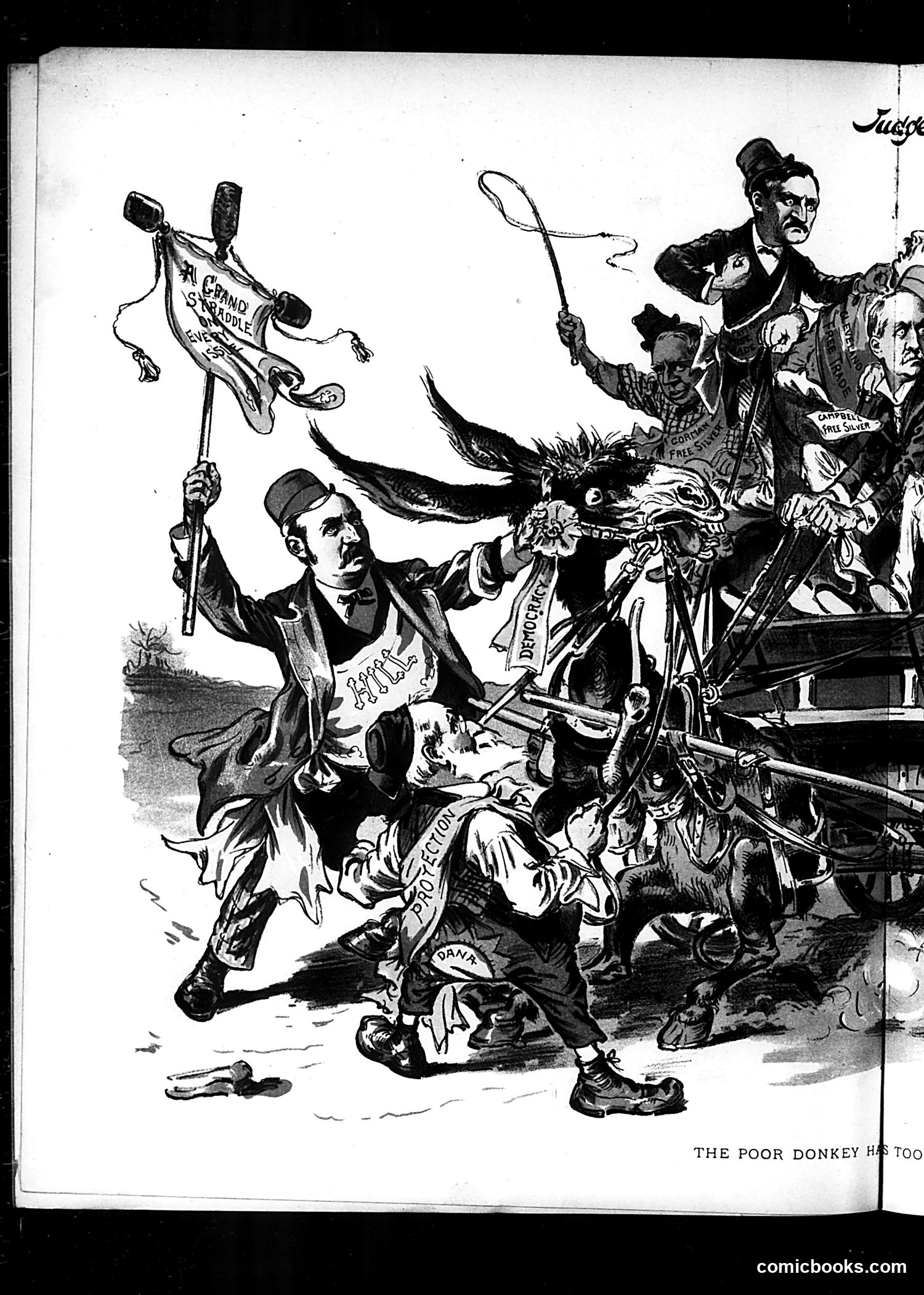
This political cartoon from *Judge* magazine satirizes what appears to be excessive taxation or burden-placing on ordinary citizens (represented by the donkey). A well-dressed man in the foreground wields a whip and brandishes a banner labeled "CANDIES" (possibly referencing specific taxes or policies), while a donkey—a traditional symbol of the common person or working class—strains under accumulated weight and burdens. To the right, wealthy or powerful figures oversee the scene, suggesting they benefit from or orchestrate this exploitation. The cartoon's title implies the donkey (average citizen) is already overburdened, yet more is being added. This critiques economic inequality and the disproportionate taxation or demands placed on working-class Americans while the wealthy escape similar burdens.
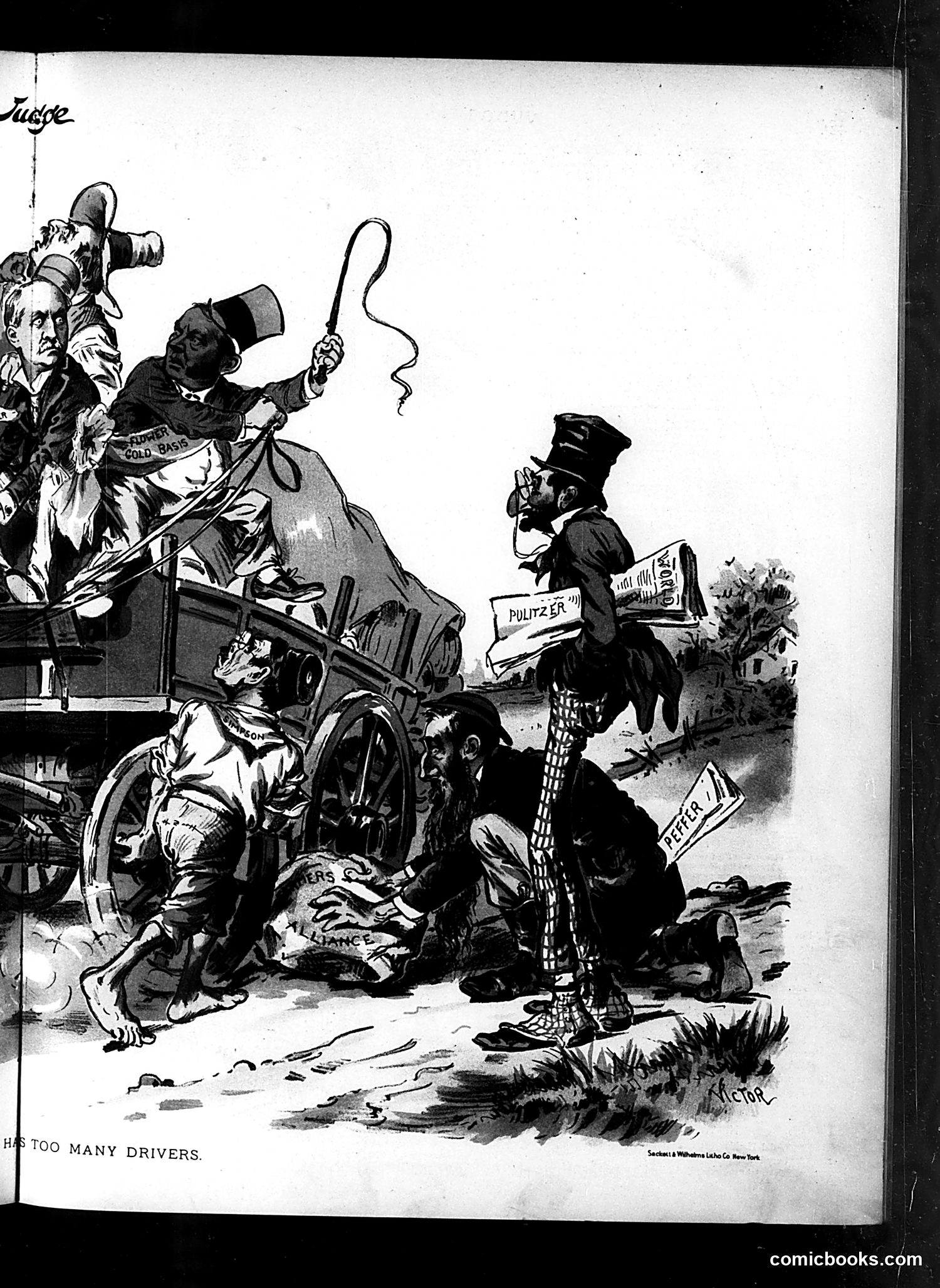
This political cartoon depicts a chaotic scene where multiple figures are attempting to control a single vehicle, causing a crash. The title "Too Many Drivers" suggests a critique of leadership or governance—too many people trying to steer simultaneously results in disaster. The figures appear to represent different political factions or interest groups competing for control. Labels visible on the cart include "GOLD," "PULITZER," and "PRESS," suggesting the cartoon satirizes conflicts between political parties, media outlets, and financial interests over national direction. The person on the right (wearing a top hat and appearing distressed) likely represents the common citizen or nation suffering from this competing leadership. The artistic style and Judge magazine context suggest this comments on late 19th or early 20th-century American political instability.
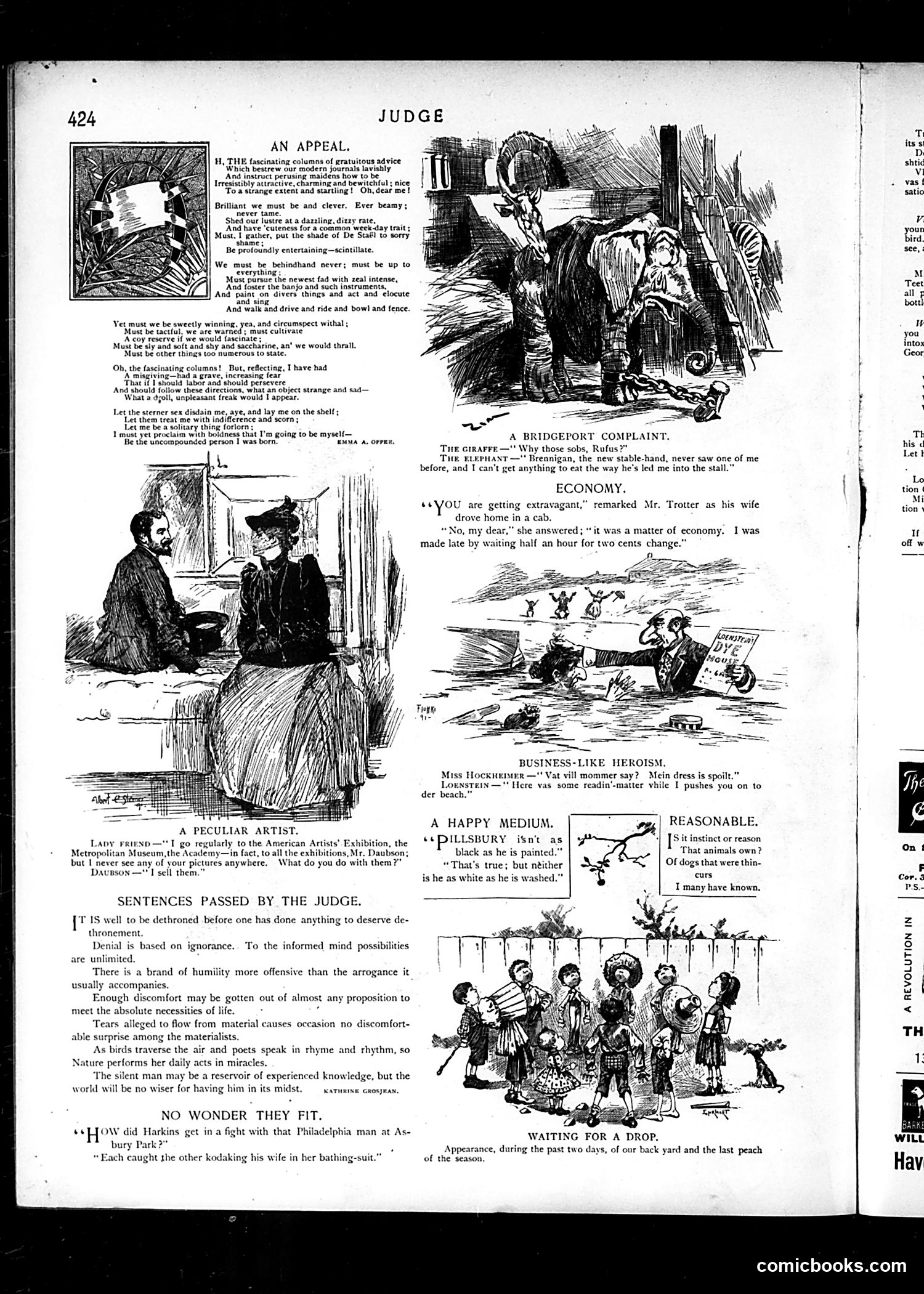
This page from Judge magazine (a satirical weekly) contains multiple satirical pieces targeting social conventions and human nature: **"An Appeal"** (poem by Emma A. Offer): Mocks advice columns that impose impossible standards on women—they must be brilliant, charming, entertaining, fashionable, yet also demure and modest. The satire celebrates rejecting these contradictory expectations to "be myself." **"A Peculiar Artist"**: Brief joke about an artist (Daubson) who sells rather than exhibits his work—satirizing the struggling artist's paradox. **"Sentences Passed by the Judge"**: Philosophical aphorisms satirizing human folly, ignorance, and hypocrisy (e.g., tears from "material causes"). **"A Bridgeport Complaint"**: Absurdist humor about an elephant unable to eat because a stable-hand unfamiliar with elephants has improperly tied it in its stall. **"Economy"** and other brief jokes: Mock domestic arguments and social pretension through wordplay and irony. The illustrations depict these scenarios with period-appropriate pen-and-ink style typical of late-19th/early-20th century American humor magazines.
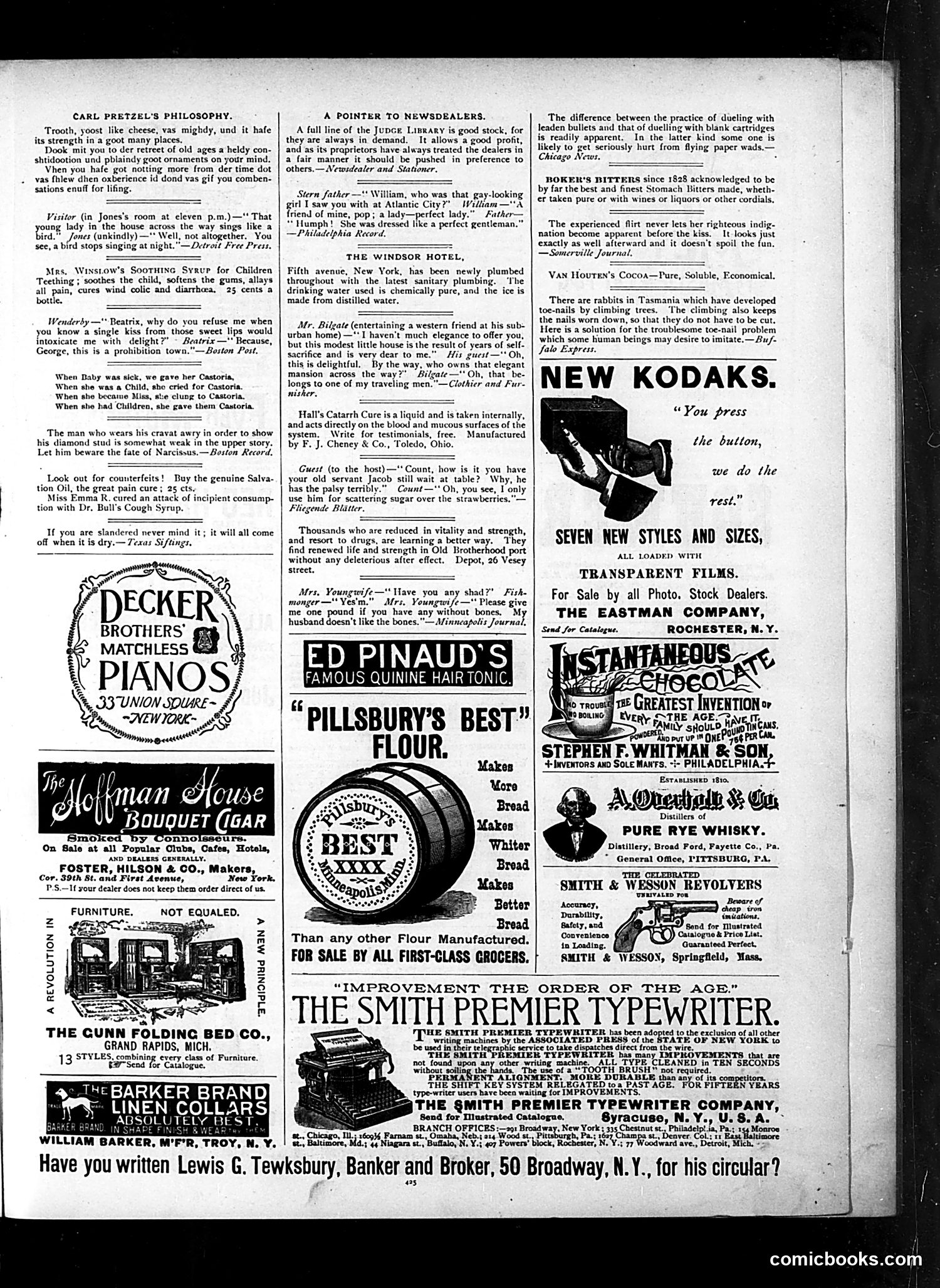
This page is primarily **advertising and filler content** rather than political satire. It consists of: **Text Content:** - "Carl Pretzel's Philosophy" — ethnic humor featuring a German-accented character dispensing homespun wisdom - Several brief joke items (about singers, prohibition, slander) - Product testimonials for patent medicines and consumer goods **Advertisements:** Multiple full and half-page ads for: pianos, cigars, folding beds, flour, hair tonic, chocolate, whiskey, revolvers, and typewriters—typical of 1890s magazines. **The Satire:** Limited. The jokes rely on ethnic stereotypes (German accent in Pretzel) and period-specific references (prohibition town, Atlantic City conventions). There are no identifiable political figures or major social commentary. **For Modern Readers:** This page reflects late-19th-century consumer culture and casual ethnic humor acceptable then but offensive now. The patent medicine ads are notable as these products were largely unregulated frauds.
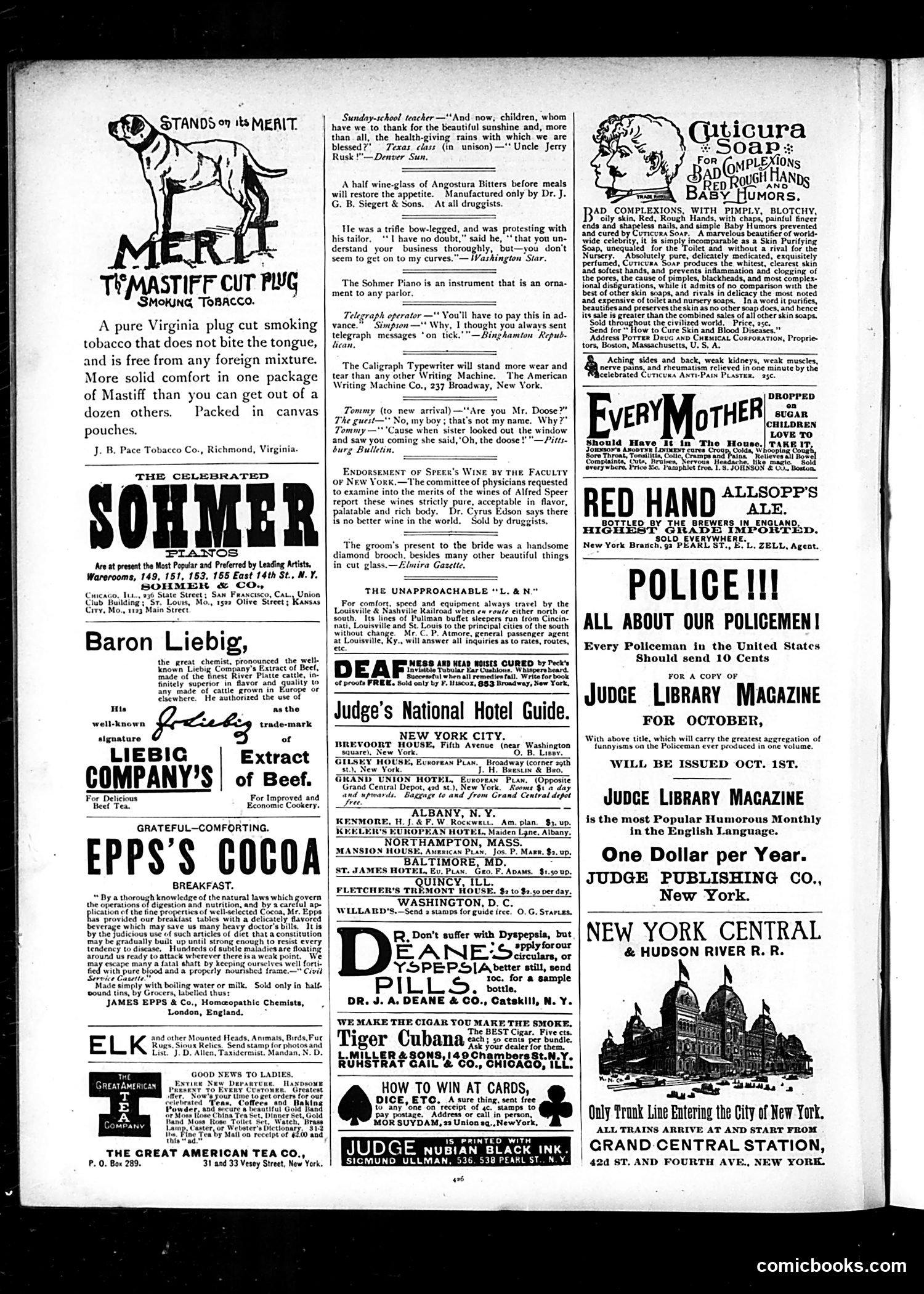
This page is primarily **advertising**, typical of Judge magazine's revenue model. The prominent advertisements include tobacco (Mastiff), pianos (Sohmer), meat extract (Liebig), cocoa (Epps), and various patent medicines and services. The only **satirical content** consists of brief, captioned jokes scattered throughout: 1. A Sunday school teacher asks children what to thank for sunshine and rain; they answer "Uncle Jerry Rusk" (likely Secretary of Agriculture under President Harrison, suggesting he controlled weather/harvests—political mockery of his influence). 2. A man complains to his tailor that the tailor "doesn't understand curves" (a body-shaming joke about the customer's bow-legged figure). 3. A telegraph operator demands advance payment for a message; the sender jokes that telegrams usually go "on tick" (on credit). These are light, topical humor pieces typical of Judge's satirical approach—poking fun at contemporary political figures and social situations through brief anecdotes rather than visual cartoons.
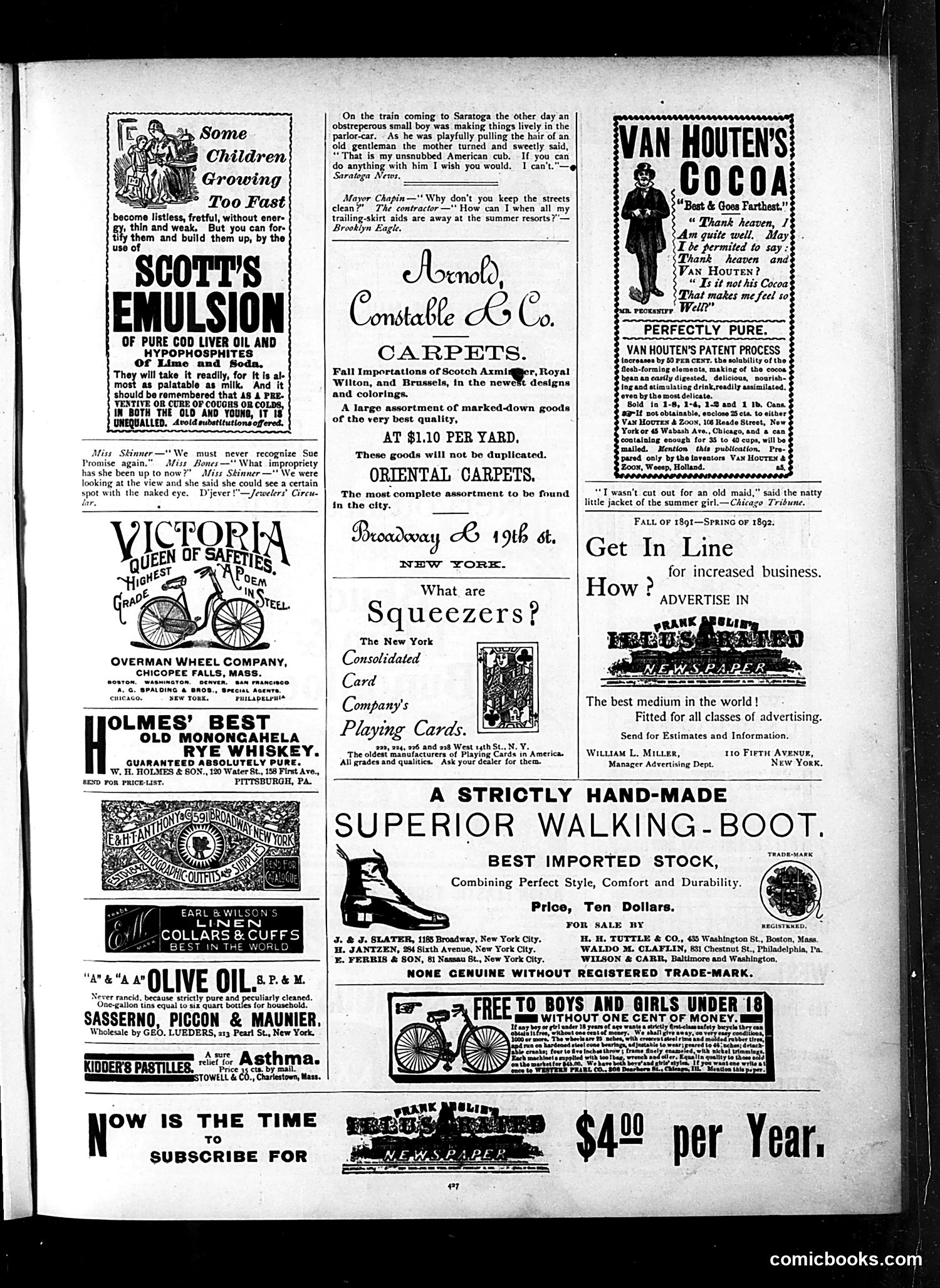
This page is primarily **advertising** from Judge magazine (Fall 1891–Spring 1892), with minimal cartoons or satire. The few jokes present are mild period humor: 1. **"Miss Skinner" anecdote**: Victorian-era prudishness—Miss Skinner refuses to acknowledge Miss Promise because Promise innocently mentioned seeing something "with the naked eye," which prudish ladies found embarrassingly suggestive. 2. **Mayor Chapin joke**: Light satire on municipal incompetence and the fashionable "trailing skirt" craze. The contractor humorously blames street-cleaning failures on women's fashion accessories. 3. **Saratoga anecdote**: A mother offers her misbehaving son to a stranger, calling him an "unsnubbed American cub"—gentle satire on American parenting permissiveness versus European strictness. The page is otherwise dominated by product advertisements (Scott's Emulsion, carpets, playing cards, cocoa, boots) and subscription promotion. No political cartoons are visible.
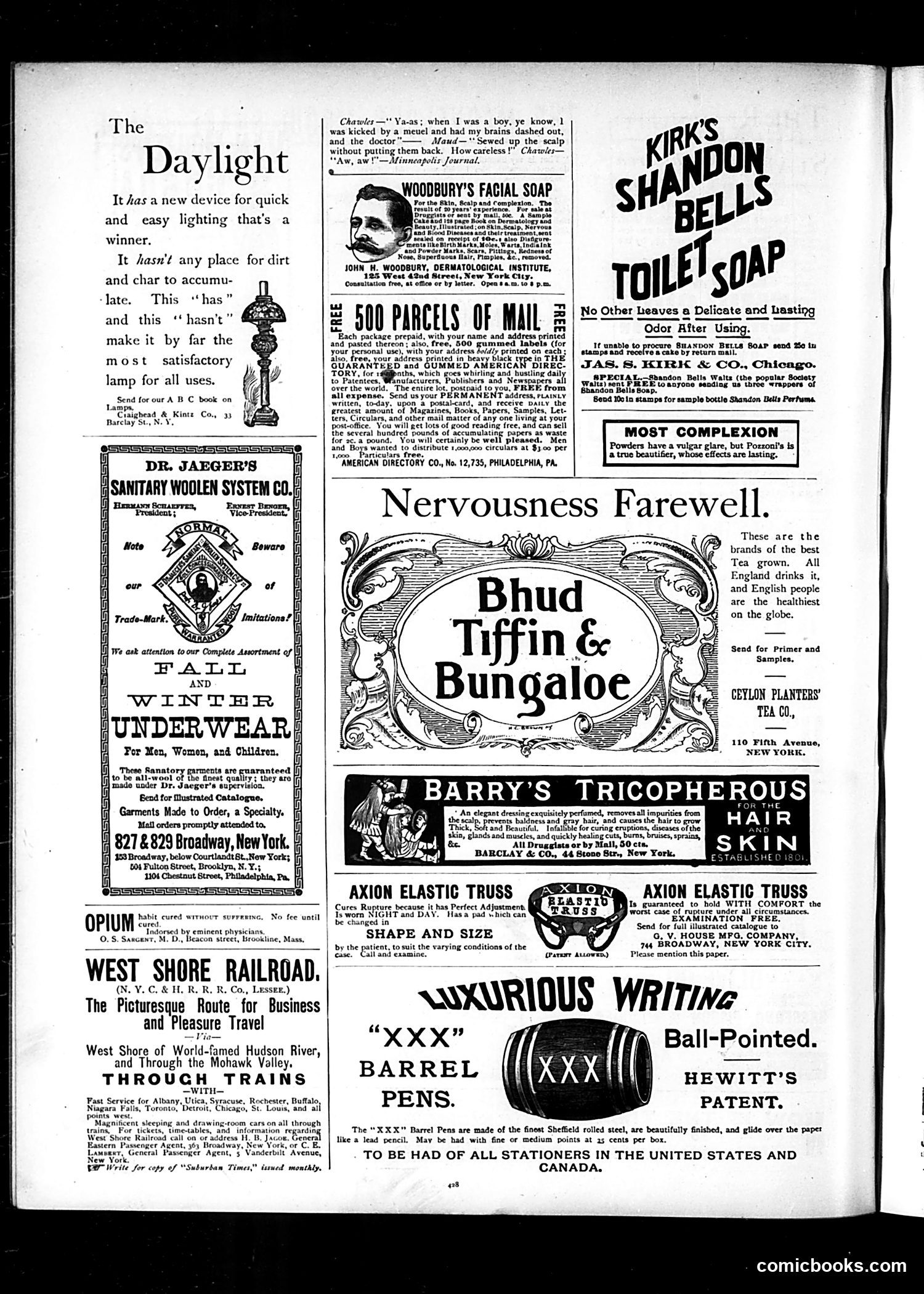
This page is primarily **advertising**, not satirical cartoons. It's a collection of late-19th/early-20th-century product advertisements typical of Judge magazine. The single small cartoon at the top is a mild joke: a character named Chawles describes being kicked by a mule as a boy, which "dashed out" his brains. His companion Maud responds with mock sympathy, joking that the doctor was "careless" for sewing up his scalp *without* putting the brains back—implying Chawles was already stupid before the accident. The rest of the page advertises period products: Woodbury's soap, mail parcels, Kirk's Shandon Bells toilet soap, Dr. Jaeger's underwear, Barry's hair tonic, Axion elastic trusses (hernia supports), West Shore Railroad, and XXX barrel pens. These ads reflect common consumer goods and medical devices of the era, many with exaggerated health claims typical of unregulated advertising before modern consumer protection laws.
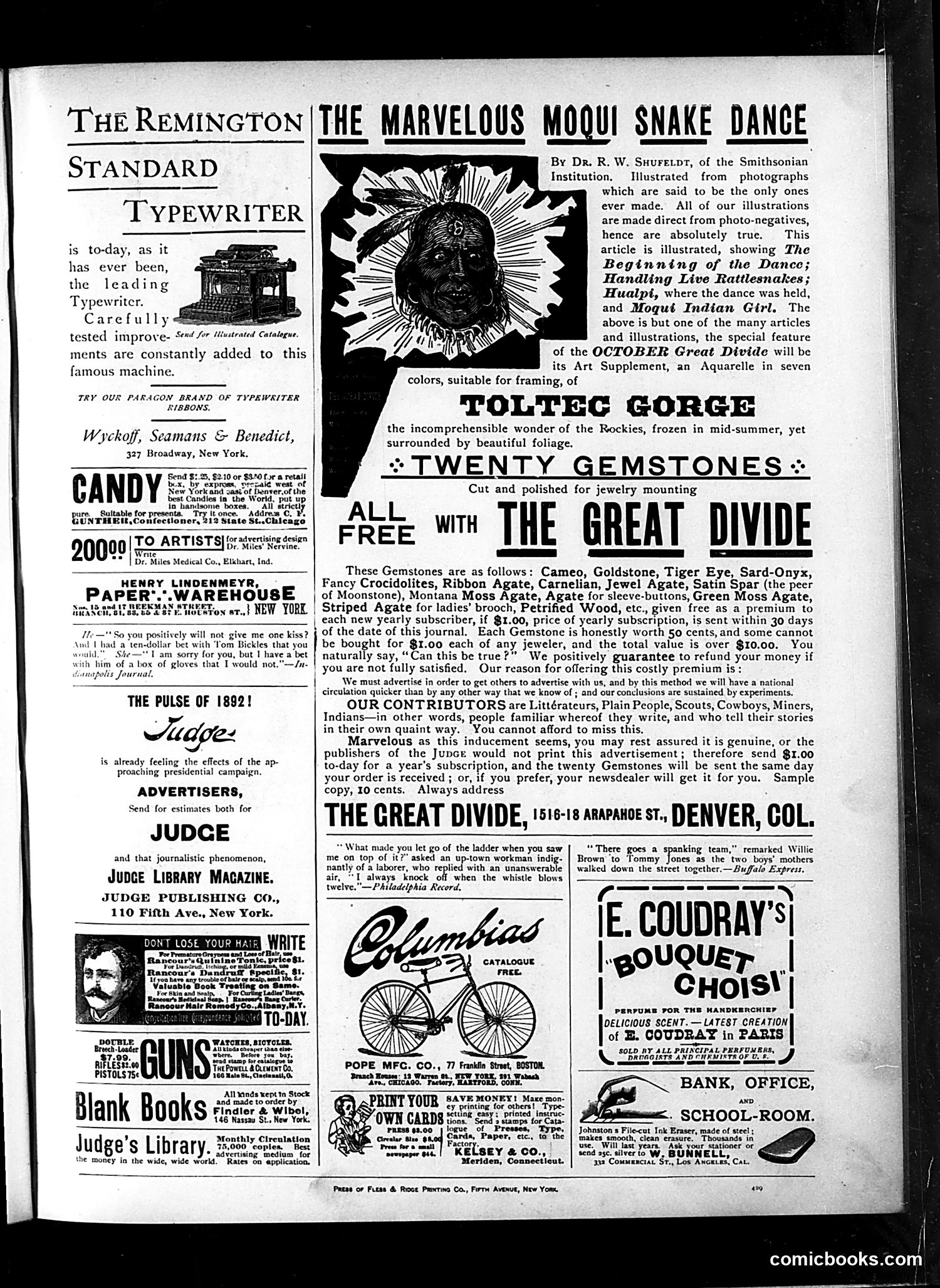
This is primarily an **advertising page** from Judge magazine, circa 1892 (as indicated by "The Pulse of 1892!" reference). The main content is commercial rather than satirical. The featured article advertises **"The Marvelous Moqui Snake Dance"** from the Smithsonian Institution—an ethnographic piece about Native American ceremonial practices, illustrated with photographs. This reflects the era's fascination with "exotic" indigenous cultures presented as curiosities for educated readers. The bulk of the page consists of **period product advertisements**: Remington typewriters, candies, blank books, firearms, bicycles, hair treatment, and most prominently, "The Great Divide" magazine's promotional offer of twenty gemstones free with subscription. The small dialogue snippets scattered throughout appear to be humorous filler content typical of Judge's satirical style, though their context is unclear without surrounding material. Overall, this represents Judge functioning as a commercial vehicle rather than primarily as political satire on this particular page.
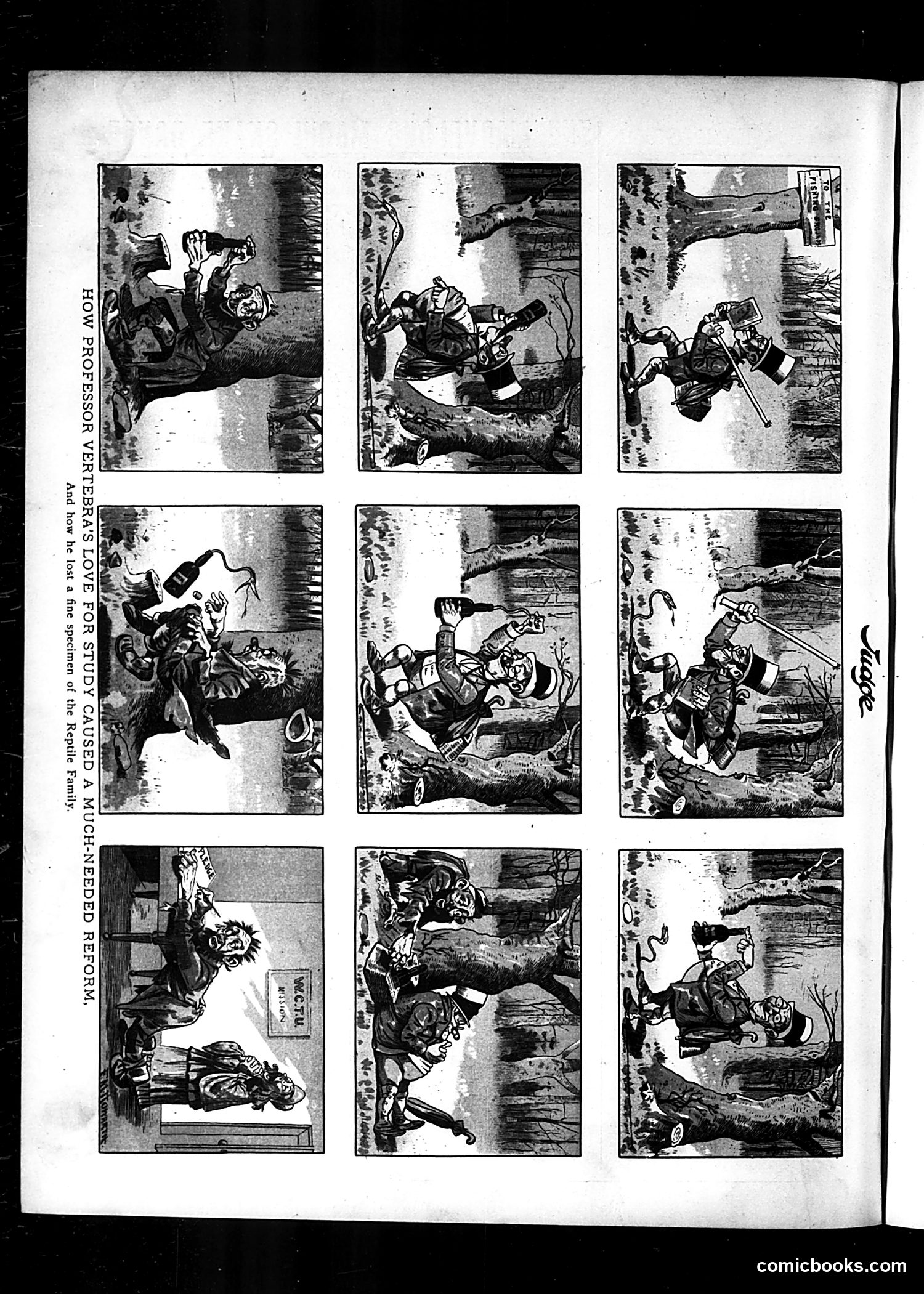
This page presents a nine-panel comic strip titled "How Professor Verbeek's Love for Study Caused a Much-Needed Reform" (likely referring to cartoonist Albert Verbeek). The narrative follows a character's misadventure involving a reptile—appears to be a snake or alligator based on the imagery. The strip depicts slapstick consequences of the professor's scholarly distraction: the creature escapes, causing chaos through domestic and public spaces. The "much-needed reform" likely refers to how this disruption prompts some societal change, though the specific reform remains unclear from the visible panels. The humor relies on physical comedy typical of early Judge magazine—exaggerated reactions, property damage, and mayhem resulting from the loose reptile. The satirical point appears to target absent-minded academics whose pursuit of knowledge creates practical problems for ordinary people around them.