
A complete issue · 16 pages · 1891
Judge — August 22, 1891
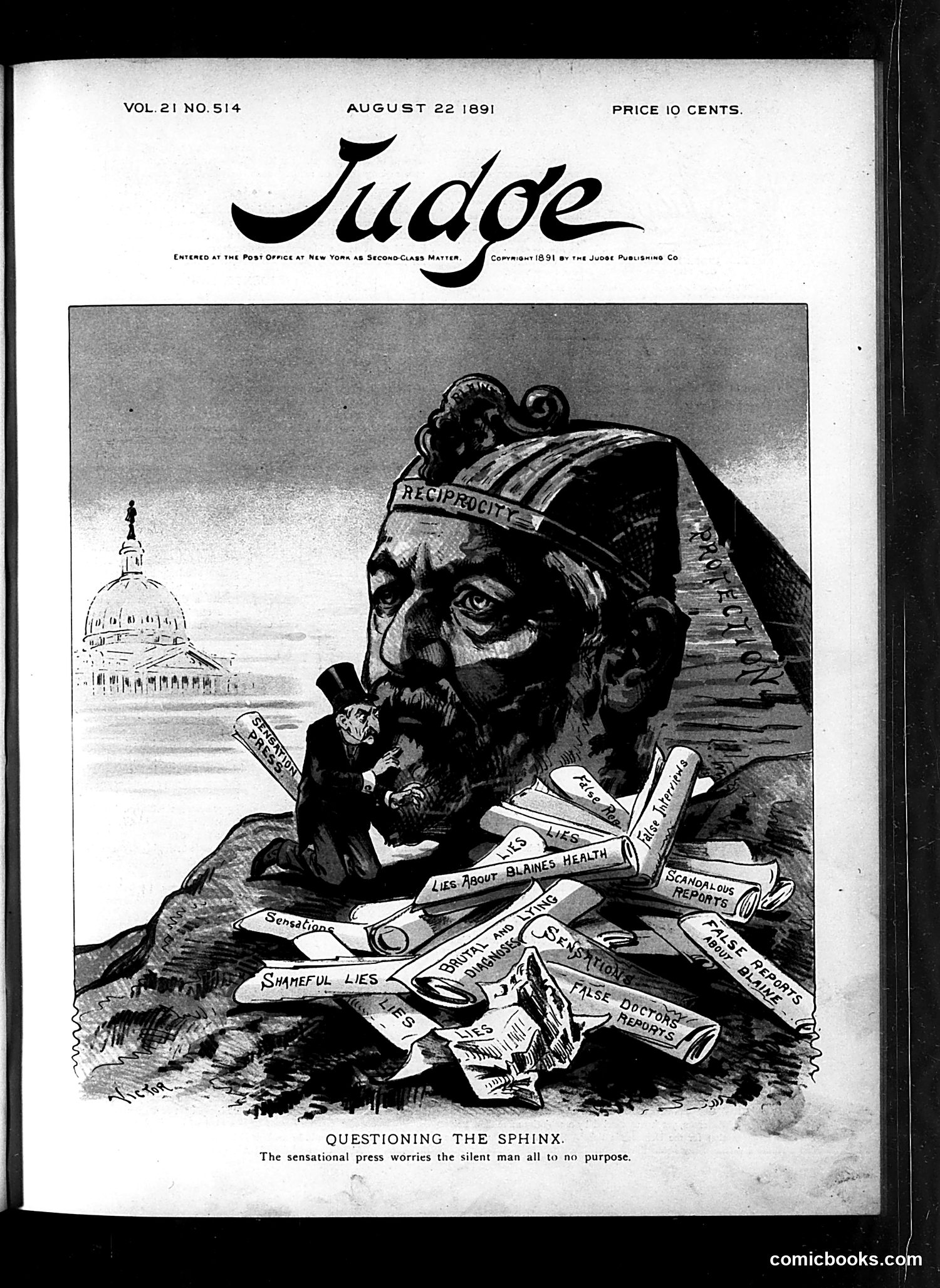
This Judge magazine cover from August 22, 1891 depicts a large, sphinx-like head labeled "RECIPROCITY" being pestered by a small figure (likely representing the sensational press) holding various scrolls of false or misleading claims: "Shameful Lies," "Lies About Blames Health," "False Doctors Recipes," "Scandulous Reports," and others. The Capitol building appears in the background. The cartoon satirizes how American newspapers were spreading unfounded rumors and misinformation about a reciprocity trade policy—likely referring to President Harrison's reciprocity trade agreements of that era. The point: the "sensational press worries the silent man all to no purpose," critiquing journalists for manufacturing controversy around legitimate policy discussions through fabricated stories and exaggeration.
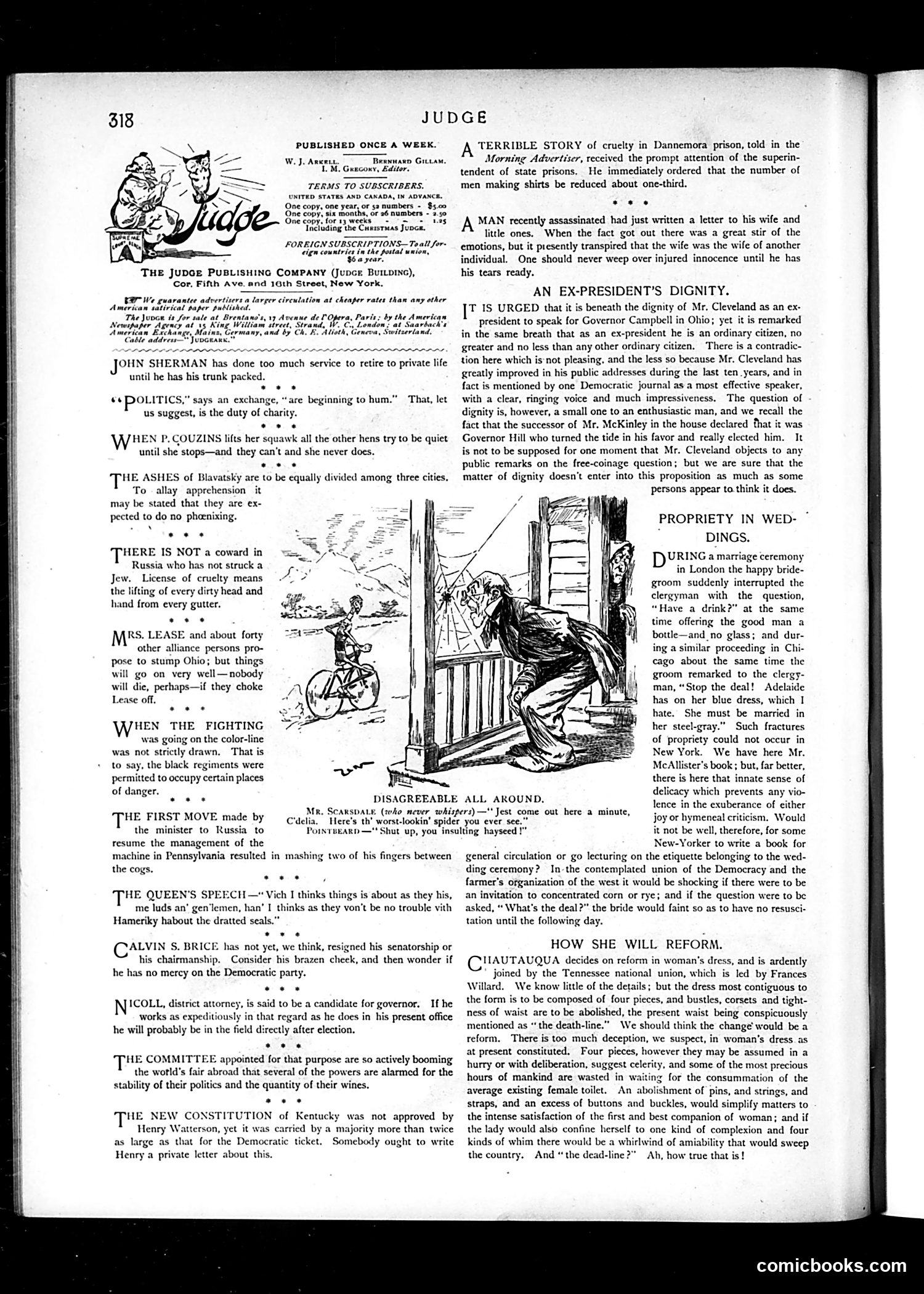
This page from Judge magazine contains several brief satirical commentary pieces rather than a single cartoon. The main visible illustration shows a man on a bicycle accosting a woman at a doorway, captioned "DISAGREEABLE ALL AROUND." The humor relates to a section titled "PROPRIETY IN WEDDINGS," which satirizes etiquette violations during marriage ceremonies—specifically discussing whether a clergyman should offer the bride a drink. Other sections mock political figures and current events: John Sherman's retirement, P. Couzins and women's voting rights, divisions over Biavatsky's ashes, and references to Cleveland and McKinley regarding dignity and public conduct. The magazine employs sardonic commentary on American politics, women's rights debates, and social propriety rather than relying primarily on visual satire on this particular page.
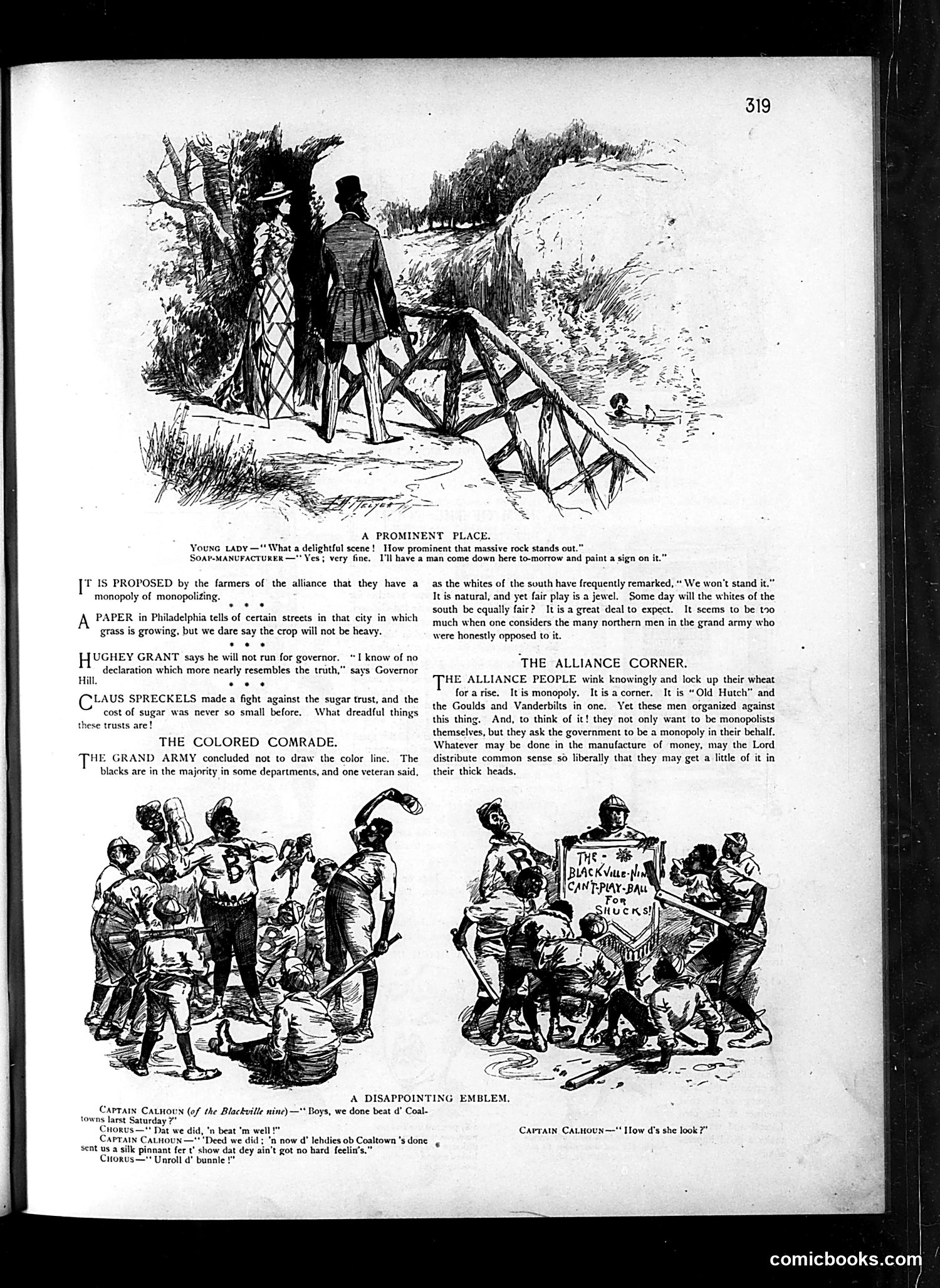
This page contains three distinct satirical sections critiquing late 19th-century American monopolies and political issues: **"A Prominent Place"** mocks railroad monopolies, depicting wealthy industrialists planning to erect monuments celebrating their market dominance. **"The Alliance Corner"** attacks the Populist/Farmers' Alliance movement, portraying them as naive for expecting government intervention against monopolies (the Goulds and Vanderbilts). The satire suggests farmers lack political sophistication. **"The Colored Comrade"** and **"Disappointing Emblem"** appear to reference Civil War military integration, with "Captain Calhoun" (likely evoking Southern politician John C. Calhoun) commenting on mixed-race military units. The cartoons mock Reconstruction-era racial politics and military desegregation efforts. The overall page critiques monopoly power while simultaneously mocking reform movements and racial equality initiatives.
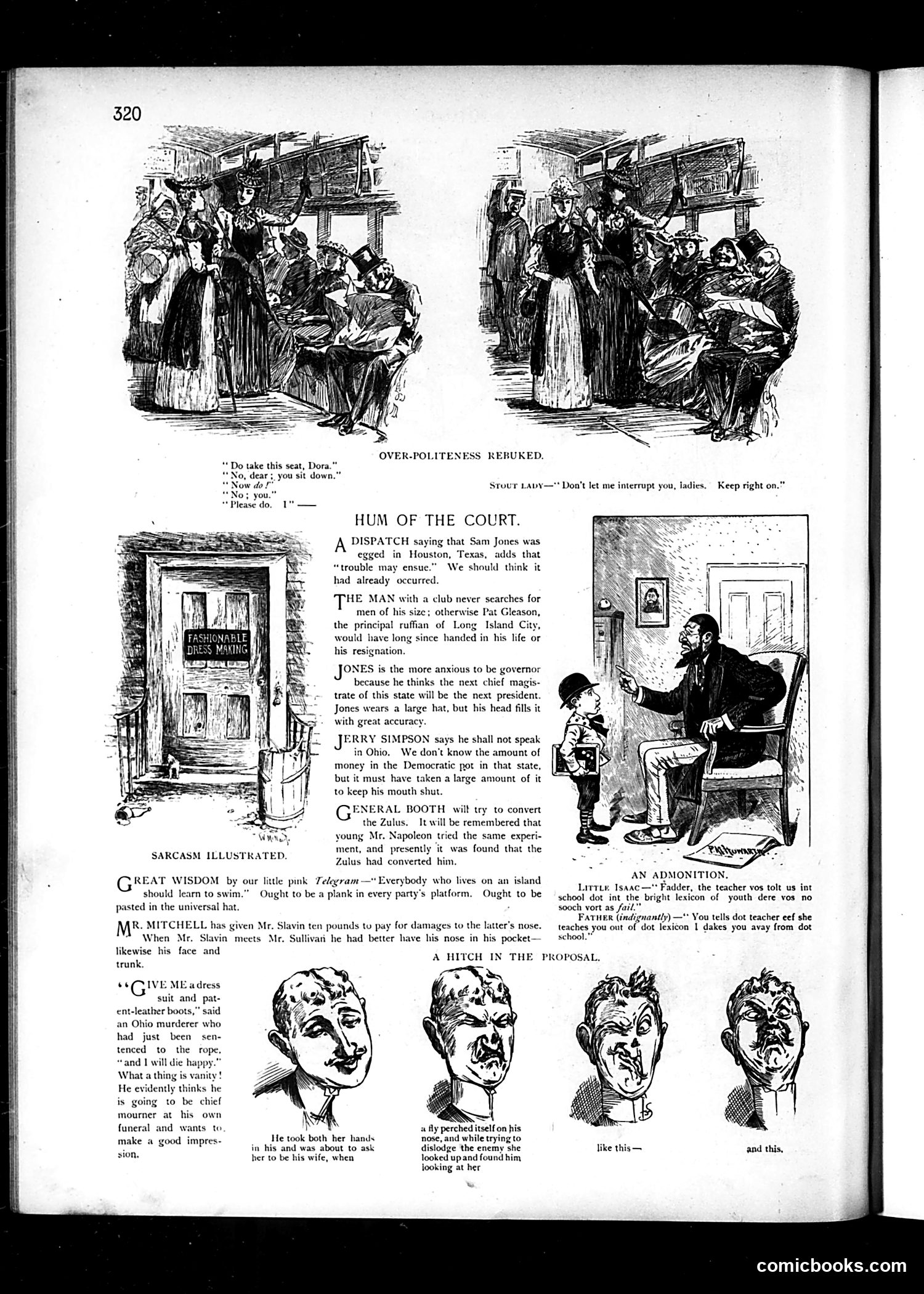
This page collects brief satirical items mocking contemporary political and social figures (circa 1880s-90s, based on references). **Key targets include:** - **Sam Jones**: A revivalist preacher attacked for political ambitions; the joke criticizes his outsized hat and head - **Jerry Simpson**: A politician apparently paid by Democrats to stay silent during Ohio campaigning - **General Booth**: Salvation Army founder attempting missionary work among Zulus, sarcastically compared to Napoleon's failed conquest - **Pat Gleason**: A "ruffian" of Long Island City whom the writer suggests should have been beaten down by now The cartoons mock **excessive politeness** (two women endlessly deferring seating) and include vignettes about vanity, courtship mishaps, and immigrant dialect humor (the father correcting his child's teacher). **The satire targets** political hypocrisy, physical vanity, and social pretension. Most references are now obscure without historical context, making this primarily interesting as period political commentary rather than universally comprehensible humor.
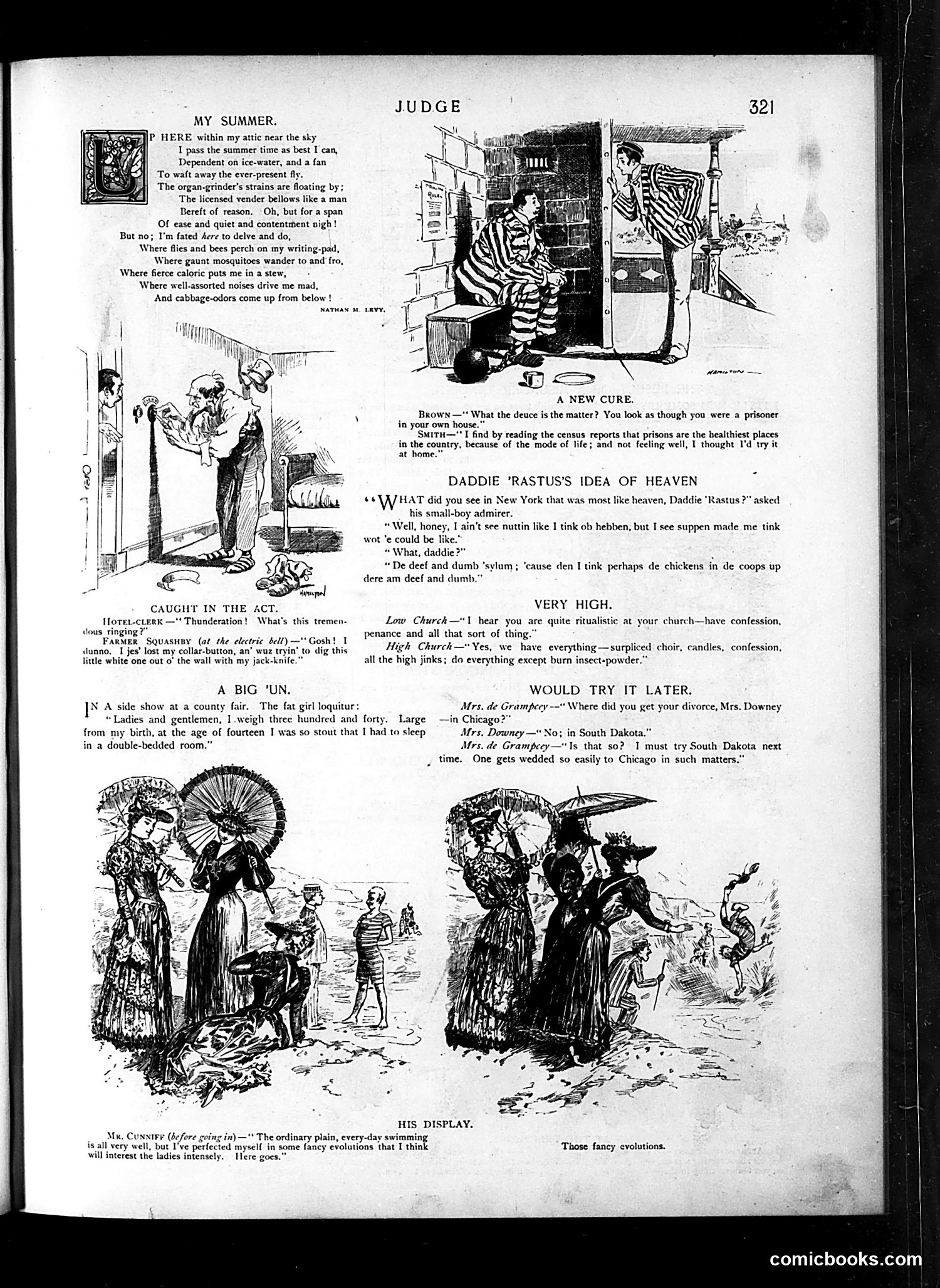
This page collects various humorous satirical pieces typical of late 19th/early 20th-century American humor: **"My Summer"** mocks urban heat and noise—the poet trapped in an attic suffers organ-grinders, street vendors, flies, and mosquitoes, capturing middle-class complaints about city summers. **"Caught in the Act"** plays on rural ignorance: a farmer uses a hotel's electric bell button like a jack-knife to retrieve a lost collar-button from the wall, not understanding the device's purpose. **"A Big 'Un"** satirizes circus sideshow exaggeration—the fat girl's absurd claim that at fourteen she was "so stout" she needed a double bed appears to joke about her implausible proportions. **"Daddie 'Rastus's Idea of Heaven"** uses a racist caricature (dialect and name suggest a Black character) for ethnic humor about mistaking an asylum for heaven. **Church satire** contrasts "Low" and "High" church practices, with High Church ridiculed for excessive ritual. **Divorce joke** mocks easy Chicago divorce laws; South Dakota apparently offered similar lax standards. The page primarily offers light domestic and social humor, with period-typical racial stereotyping.
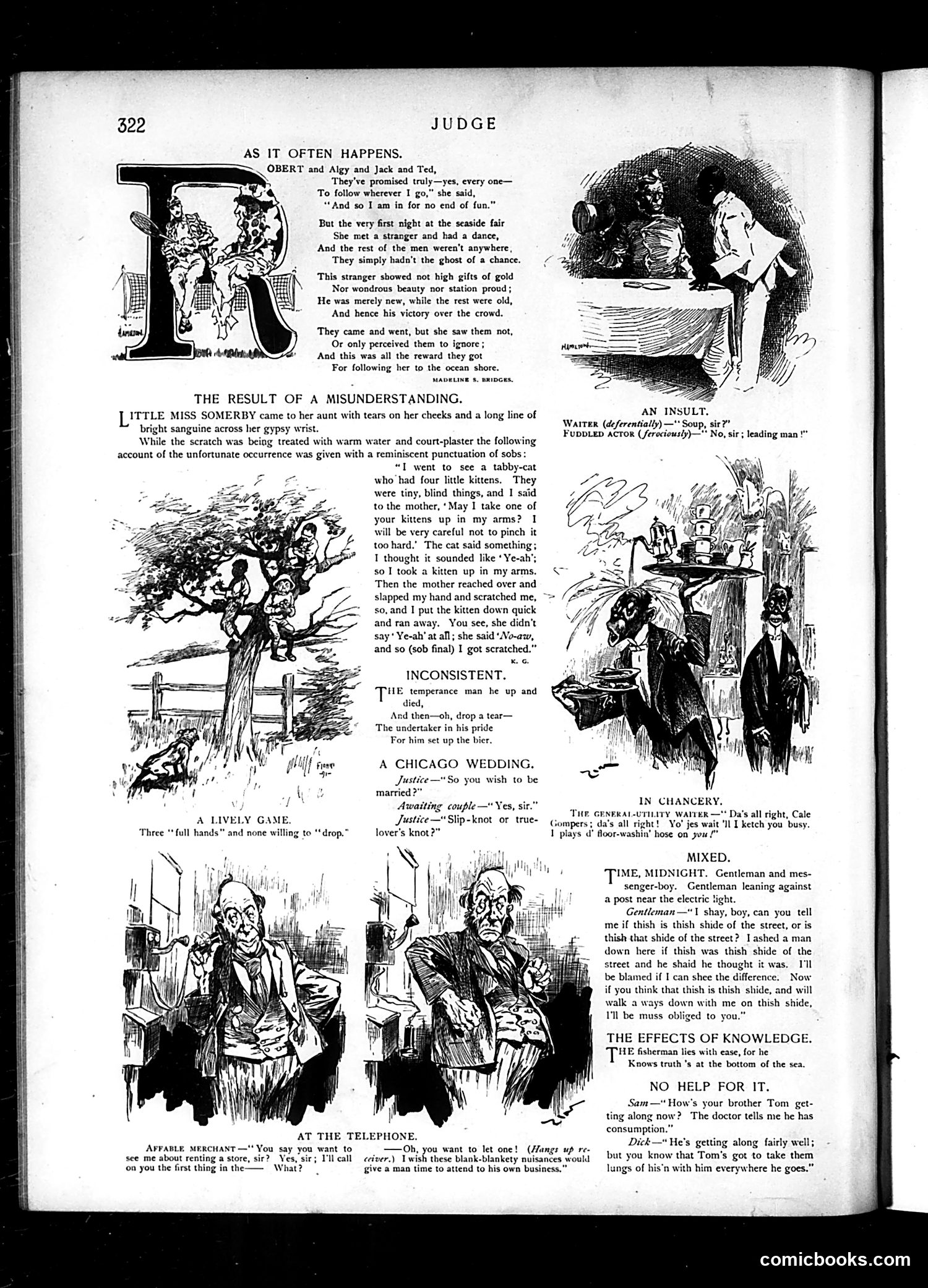
This page contains multiple brief satirical sketches typical of Judge's humor: **"As It Often Happens"** depicts the familiar social observation that a woman's new suitor outcompetes her established admirers simply by being novel—not through wealth, beauty, or status, but through freshness. **"The Result of a Misunderstanding"** shows a child misinterpreting a cat's warning sound ("No") as permission ("Yes"), resulting in scratches—gentle satire on miscommunication's consequences. **"A Chicago Wedding"** mocks a courthouse marriage where the judge conflates marriage vows with the general-utility worker's threat to use a floor-washing hose on the couple. **"Mixed"** satirizes a drunk man's inability to distinguish one side of the street from another despite multiple confirmations. **"At the Telephone"** ridicules a merchant's interrupted business call—early satire on telephone etiquette and commercial interruptions. The remaining sketches ("Inconsistent," "Chicago Wedding," "Inconsistent," "Effects of Knowledge," "No Help for It") offer similar observational humor about daily life, miscommunication, and human folly—typical Judge content aimed at middle-class readers.
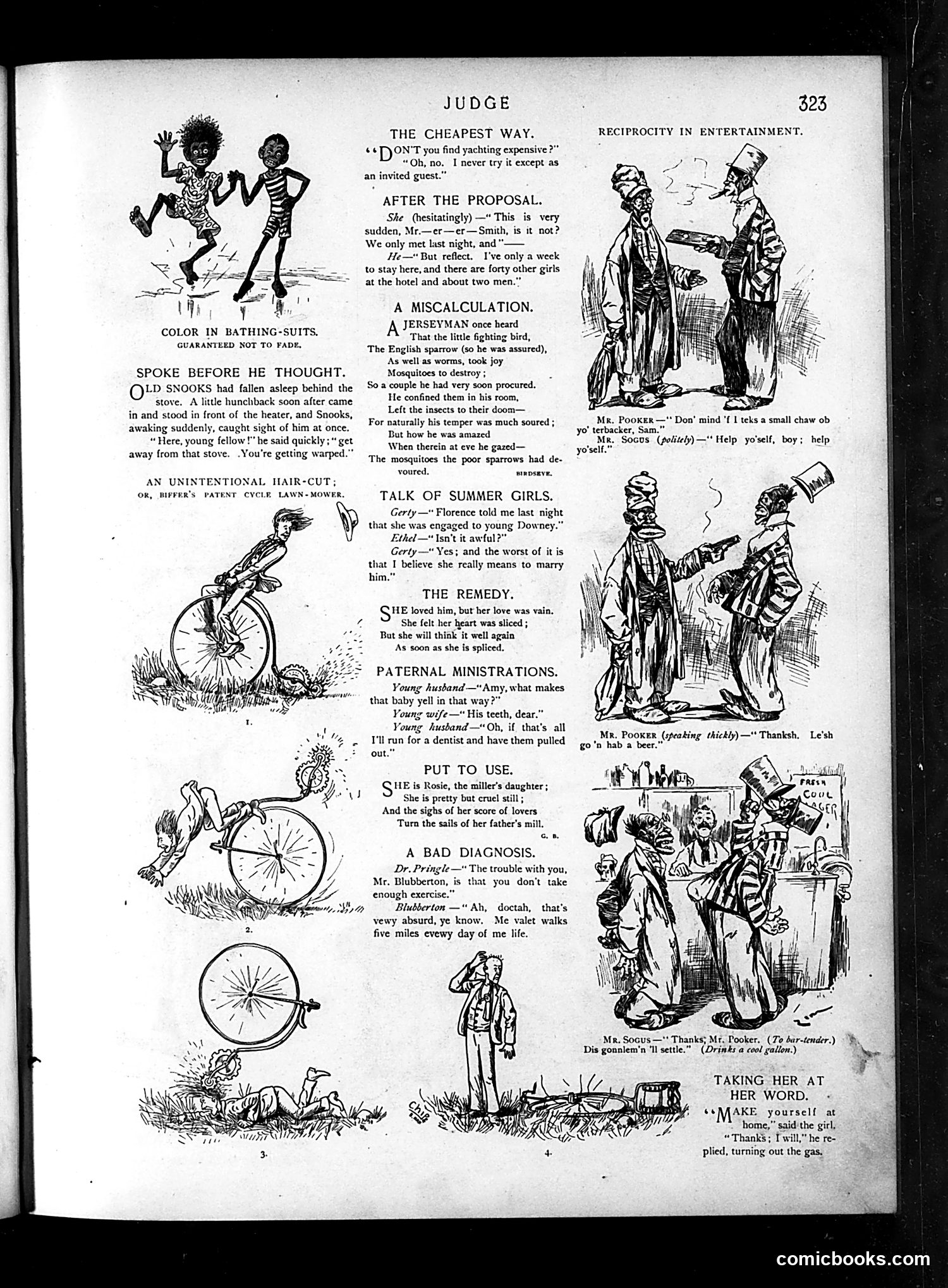
This page from *Judge* magazine presents early-20th-century American humor through multiple short jokes and cartoons. **Key Satirical Pieces:** **"The Cheapest Way"** mocks wealthy leisure—a man avoids yacht expenses by only sailing as an invited guest, satirizing the affluent classes' cost-avoidance tactics. **"After the Proposal"** skewers hasty romance among vacationing hotel guests. A man proposes after one night, cynically noting he's only staying a week and there are "forty other girls" available—dark humor about transient romantic desperation. **"A Bad Diagnosis"** plays on class pretension: a wealthy man claims he exercises plenty because his valet walks five miles daily—he doesn't walk himself, only his servant does. **"Reciprocity in Entertainment"** depicts two working-class Black men sharing tobacco and drinks, with one getting a free meal at a bar—gentle humor about reciprocal social obligation. The cartoons (bicycles, bathing suits, hair-cutting mishaps) illustrate physical comedy common to the era. Overall, the page targets wealthy pretension, hasty romance, and social climbing through accessible, if dated, humor.
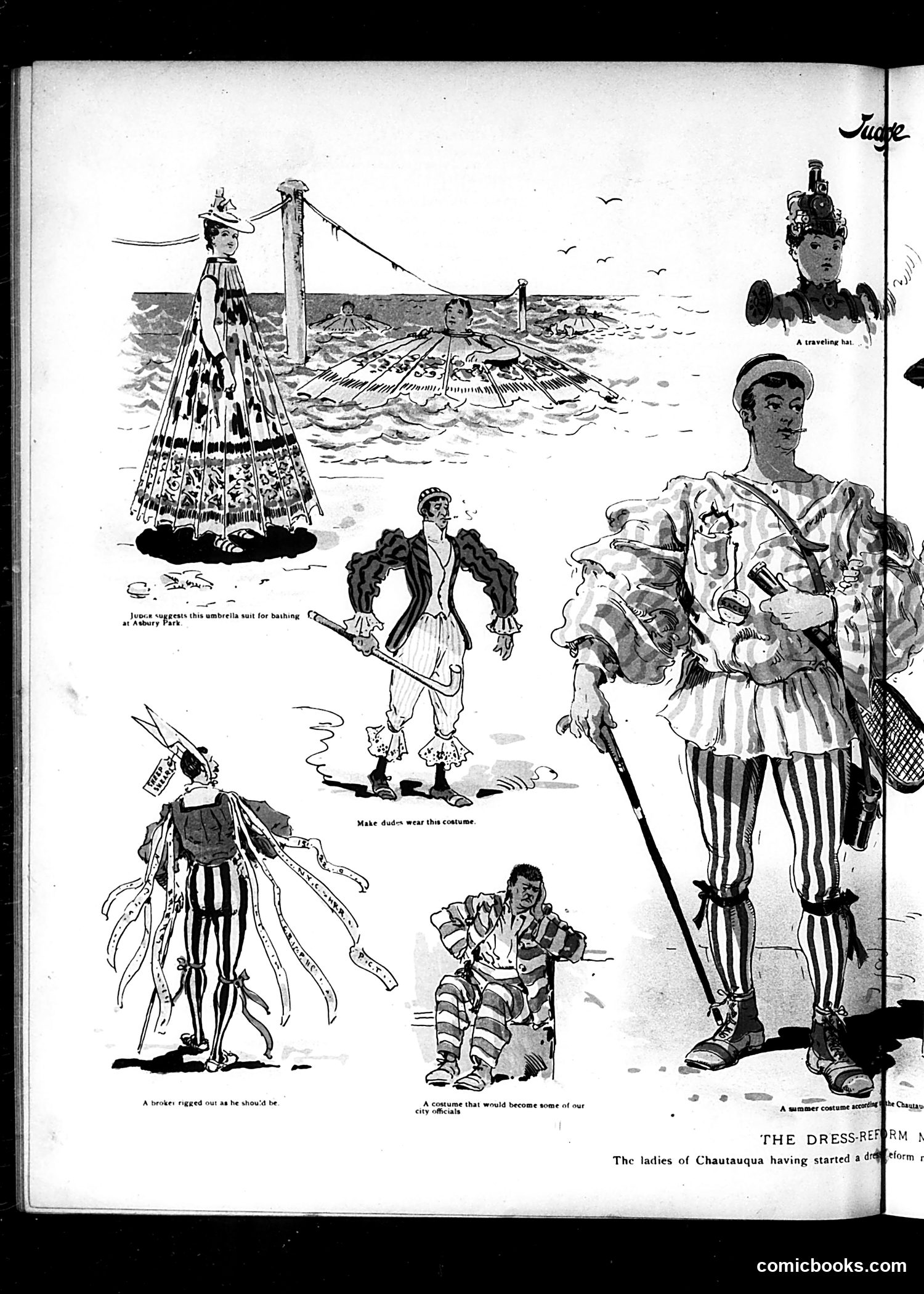
This page satirizes the "dress reform movement" of the late 19th/early 20th century, which advocated for more practical women's clothing. The Chautauqua reference (visible at bottom) indicates this relates to the educational assembly movement. The cartoons mock exaggerated costume proposals: - A woman in an absurdly elaborate seaside outfit with a parasol - A figure in impractical "bloomer" style pants with enormous puffed sleeves - Ridiculous hybrid costumes combining multiple styles unsuitably The satire targets reformers by showing their proposed alternatives as equally or more ridiculous than the restrictive fashions they criticized. The captions like "Make duden wear this costume" suggest the reformers' suggestions were equally unfeasible for practical wear. This reflects the period's resistance to women's clothing modernization, portrayed through exaggerated visual absurdity rather than reasoned argument.
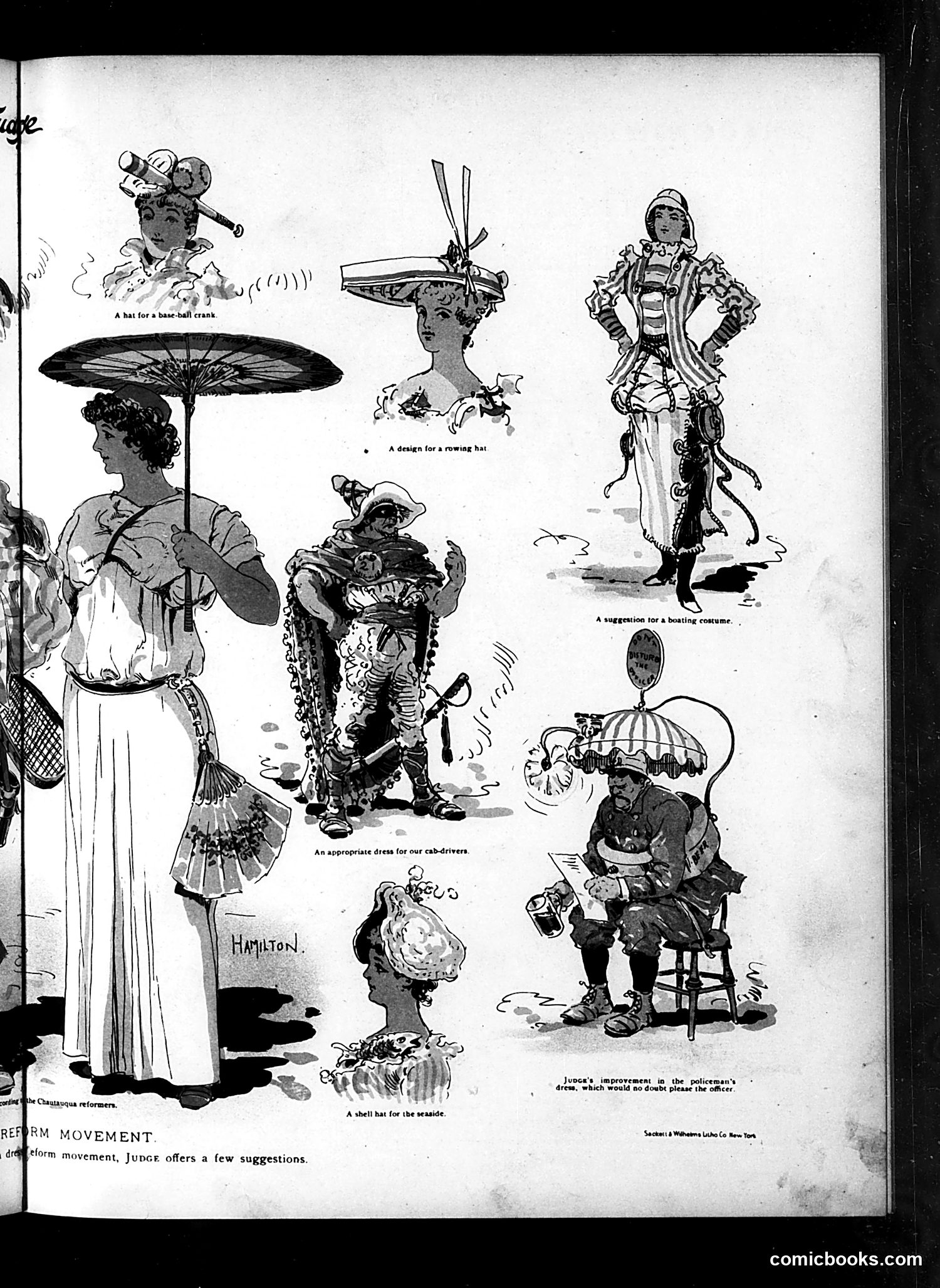
This Judge page satirizes the "reform movement" by mocking proposed fashion changes, particularly for public officials. The large left figure shows a woman holding an umbrella labeled "reform movement," suggesting pretentious reformism. The sketches mock suggested costume improvements: absurd hats for baseball crashes and seaside wear, elaborate "boating costumes," and ridiculous dress for cab drivers. Most pointedly, the bottom caption references improving "the policeman's dress," suggesting reformers focus on trivial aesthetic changes rather than substantive institutional problems. The satire implies that 1910s-era reformers were frivolous—fixated on superficial wardrobe modifications while ignoring real governance issues. The cartoonist (Hamilton) argues reform advocates waste energy on fashionable posturing rather than meaningful social change.
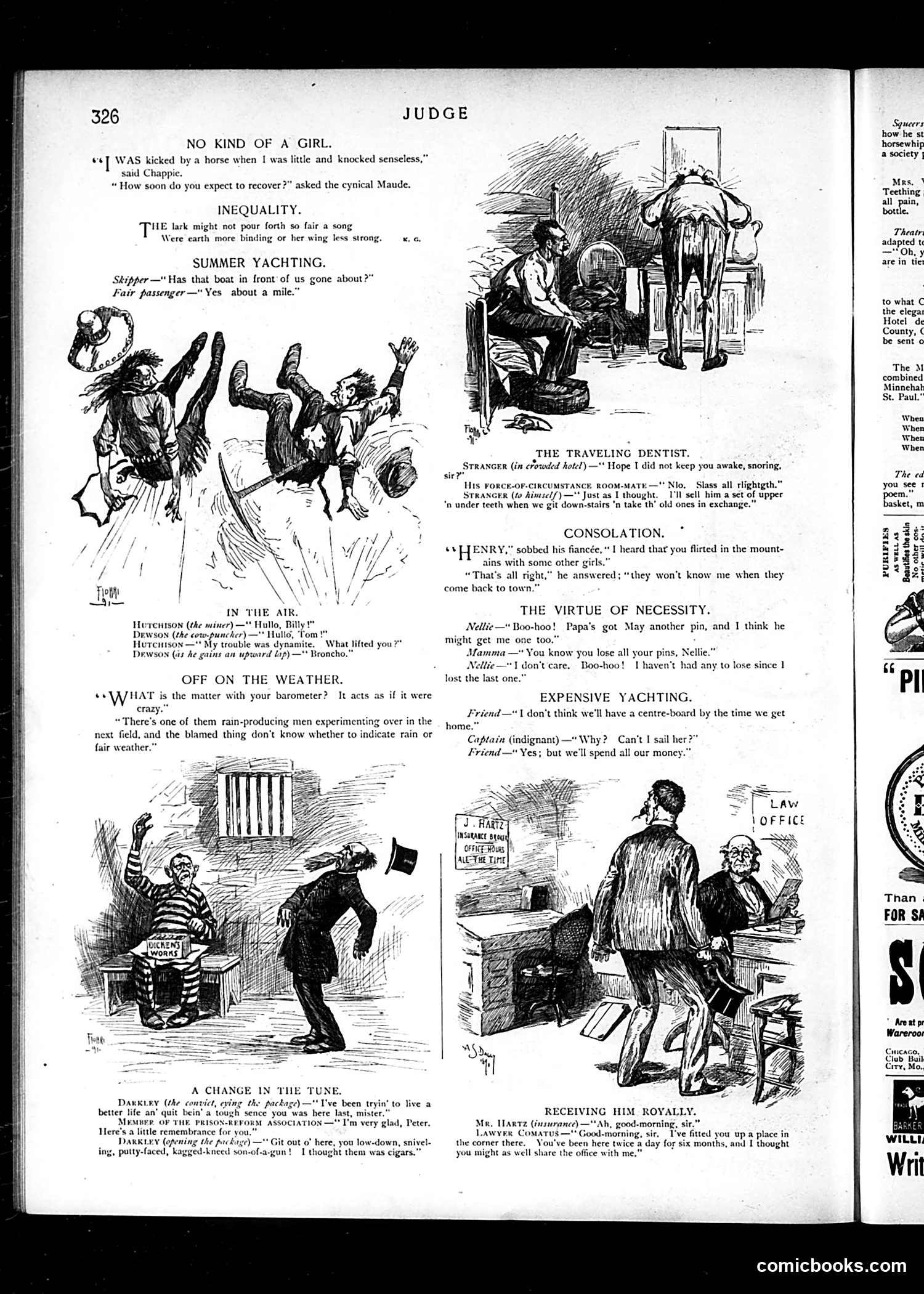
This page from *Judge* magazine contains multiple standalone jokes and cartoons satirizing American social classes and behaviors circa early 1900s. **Key satires:** - **"Summer Yachting"**: Mocks the wealthy's casual boasting about leisure activities - **"The Traveling Dentist"**: Rural/working-class character plans to exchange old teeth for new ones, suggesting both dental poverty and class difference in medical access - **"Receiving Him Royally"**: A lawyer sarcastically "welcomes" an insurance agent who visits constantly by offering him permanent office space—mocking both aggressive salesmanship and the lawyer's irritation - **"Off on the Weather"**: Ridicules pseudo-scientific weather prediction - **"Prison Reform"**: Darkly jokes that a convict's reformation is shallow; he thanks his reformer benefactor by cursing him out over disappointing cigars The page reflects *Judge*'s typical upper-class perspective, mocking working people's behavior, romantic naïveté, and commercial desperation with gentle mockery rather than sharp political critique.
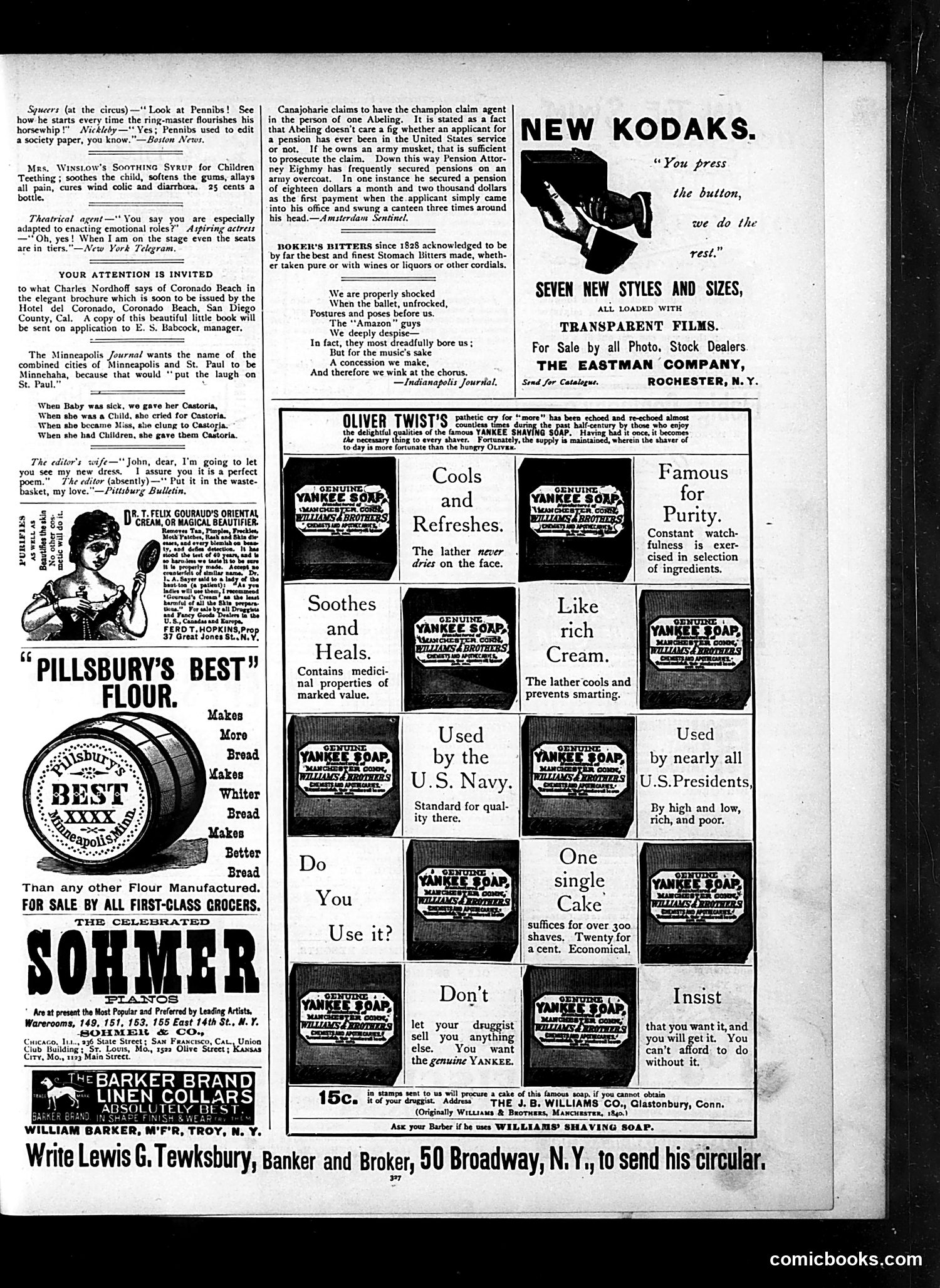
This page is primarily **advertisements** with brief comedic snippets interspersed. The cartoons are minimal and generic: **The humor present:** - A joke about a circus performer named "Pennibs" who flinches at the whip because he "used to edit a society paper"—implying editors are cowardly or sensitive - An aspiring actress's pun about "emotional roles" causing theater "seats in tiers" (tears) - A husband distracted by work dismissing his wife's new dress as waste-basket material **Historical context:** These are light, domestic jokes typical of 1890s-era *Judge* magazine. The "Pennibs" reference to newspaper editing suggests mild satire of press figures, but lacks specific political targeting. The advertisements (Kodak cameras, flour, soap, collars) are the page's primary content. **No significant political cartoons or major figures** are identifiable here. This appears to be a lighter editorial page mixing filler content with product advertisements rather than serious satirical commentary.
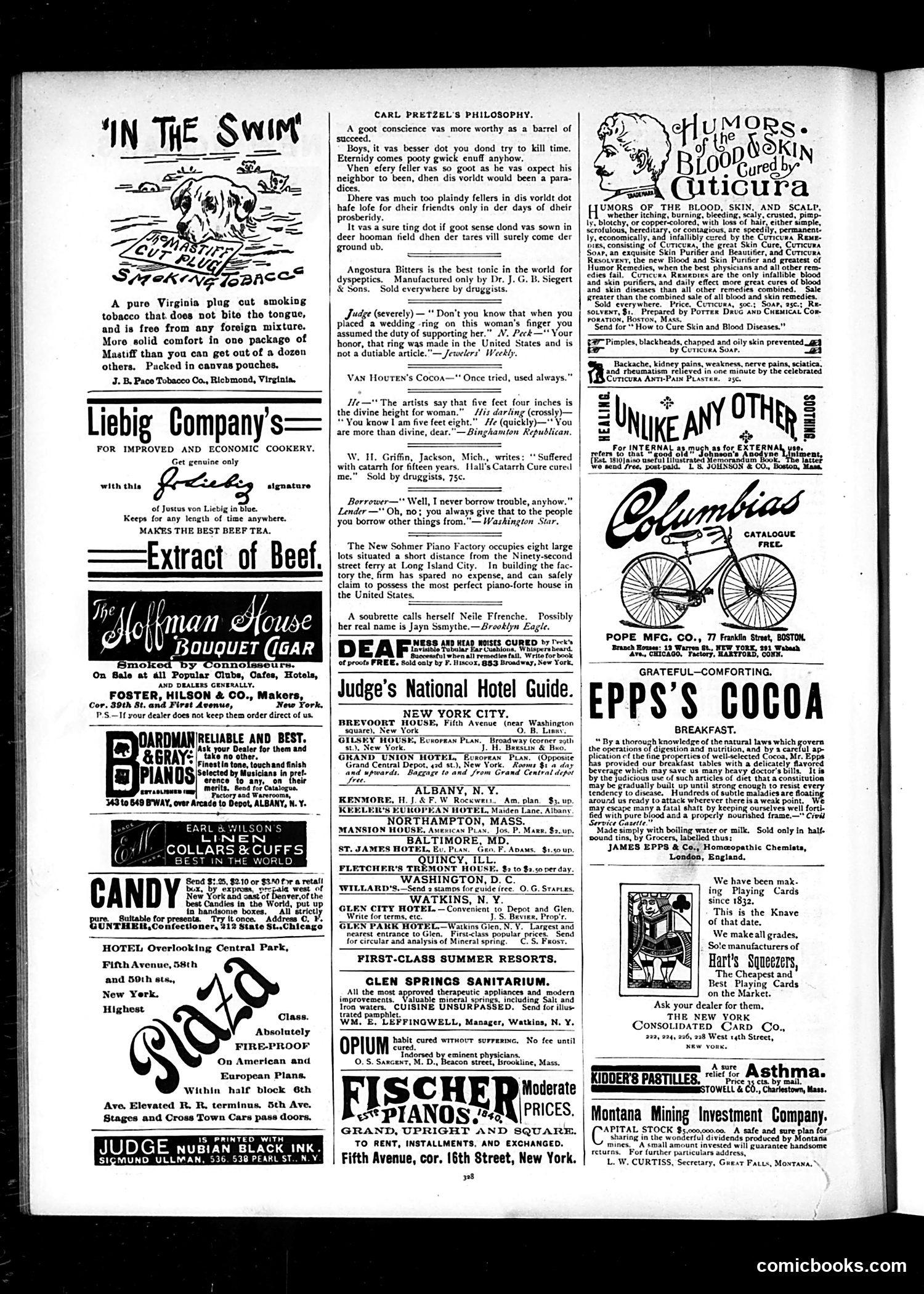
This is primarily an **advertising page** with one notable cartoon feature. **Main Cartoon:** "Carl Pretzel's Philosophy" presents a German-immigrant character dispensing folksy wisdom in exaggerated dialect ("vas," "dond," "gwick"). This reflects a common Judge magazine format: ethnic humor through stereotyped speech patterns. The philosophy itself—about conscience, time-wasting, and human nature—is gentle moralizing rather than political satire. **Below that:** A brief joke about a newly married man claiming his wedding ring isn't "dutiable" (taxable) because it was made in the United States, punning on his marital duties. **Remainder:** The page is dominated by period advertisements for tobacco, beef extract, pianos, hotels, patent medicines, and other goods typical of late 19th/early 20th-century magazines. The German-dialect "Carl Pretzel" character appears to be a recurring Judge feature, using ethnic caricature as entertainment rather than political commentary.
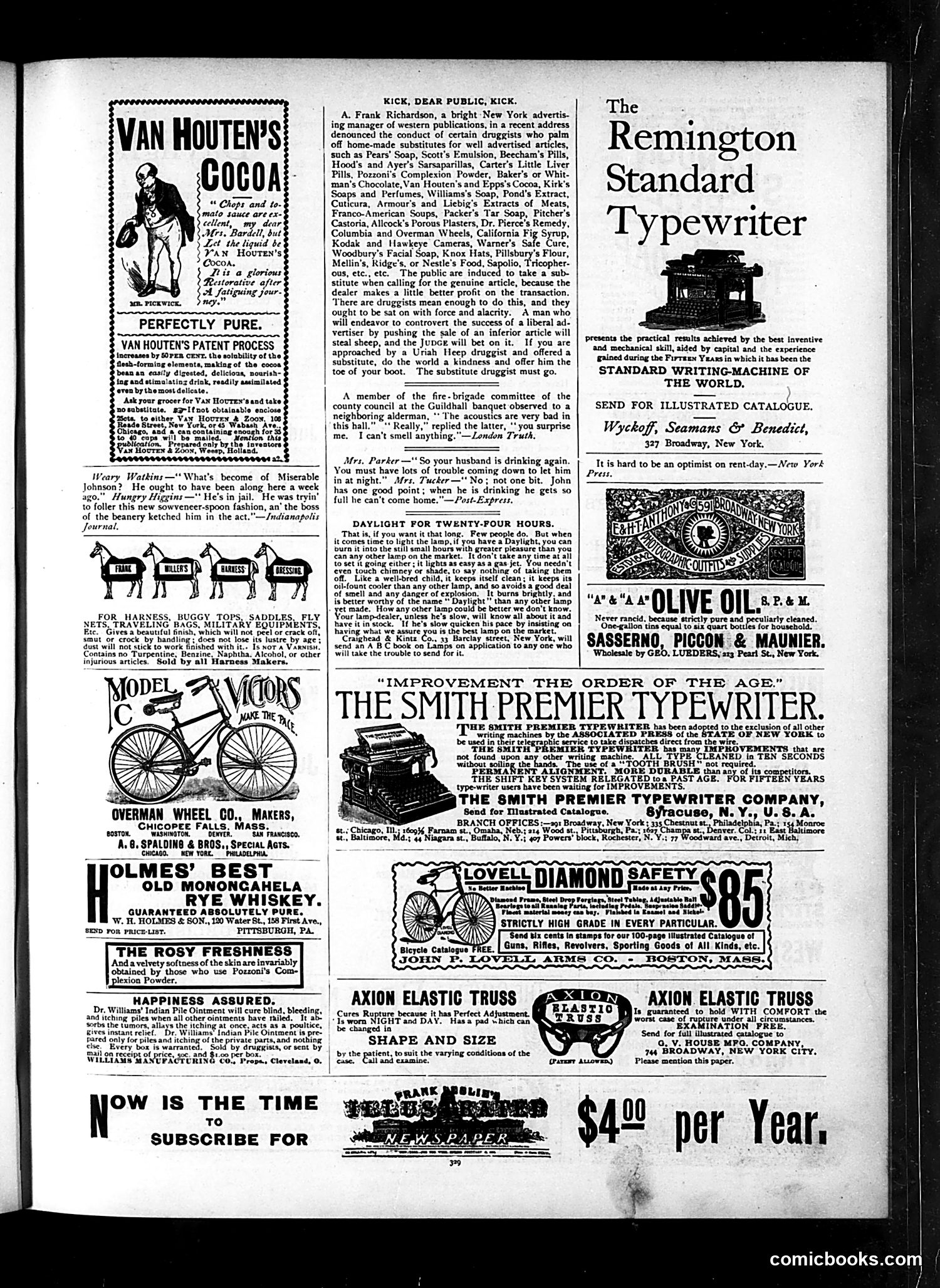
This is primarily an **advertising page** rather than a satirical cartoon page. The one substantive text item is titled "KICK, DEAR PUBLIC, KICK," an editorial by advertising manager A. Frank Richardson. **The Main Argument:** Richardson denounces druggists who substitute cheaper, homemade products for well-known advertised brands (Pears' Soap, Hood's Sarsaparilla, Van Houten's Cocoa, etc.). He argues these dishonest merchants profit from deception and urges the public to "kick"—protest and reject—such substitutes. His language is forceful: such druggists "will steal sheep," and deserve to be "sat on with force and alacrity." **The Context:** This reflects late-19th-century consumer anxiety about product authenticity and brand trust, before modern FDA regulation. Reputable brands relied on advertising to build customer loyalty, while unscrupulous retailers undercut them with inferior imitations. The remainder of the page consists of period advertisements for cocoa, typewriters, bicycles, whiskey, and medical devices.
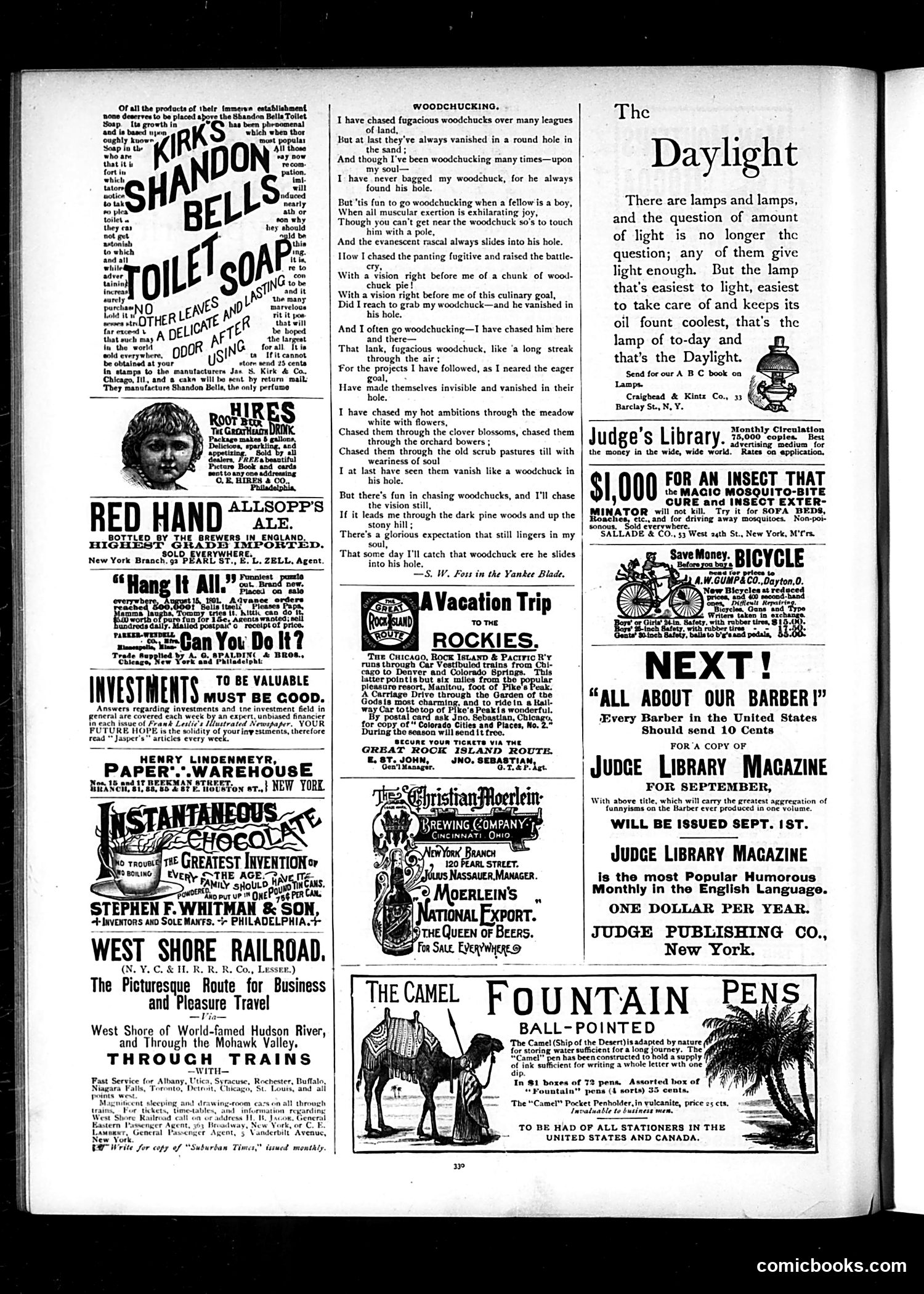
This page is primarily **advertisements** with one notable **poem** by S. W. Foss titled "Woodchucking." The poem uses woodchuck hunting as an extended metaphor for pursuing life's ambitions. The speaker describes repeatedly chasing woodchucks as a boy—they always escape into holes—and reflects that adult ambitions similarly vanish before being grasped. Lines like "I have chased my hot ambitions through the meadow white with flowers" make the allegory explicit: the evasive woodchuck represents unrealized dreams. The satire is gentle rather than political: it's a commentary on **human futility and persistent hope**. Despite always failing to catch the woodchuck, the speaker declares he'll "chase the vision still." The poem pokes fun at both youthful naiveté and adult self-delusion—we keep pursuing goals we'll never catch. The surrounding advertisements (soap, chocolate, railroads, investments) are standard period copy, unrelated to the poem's theme.
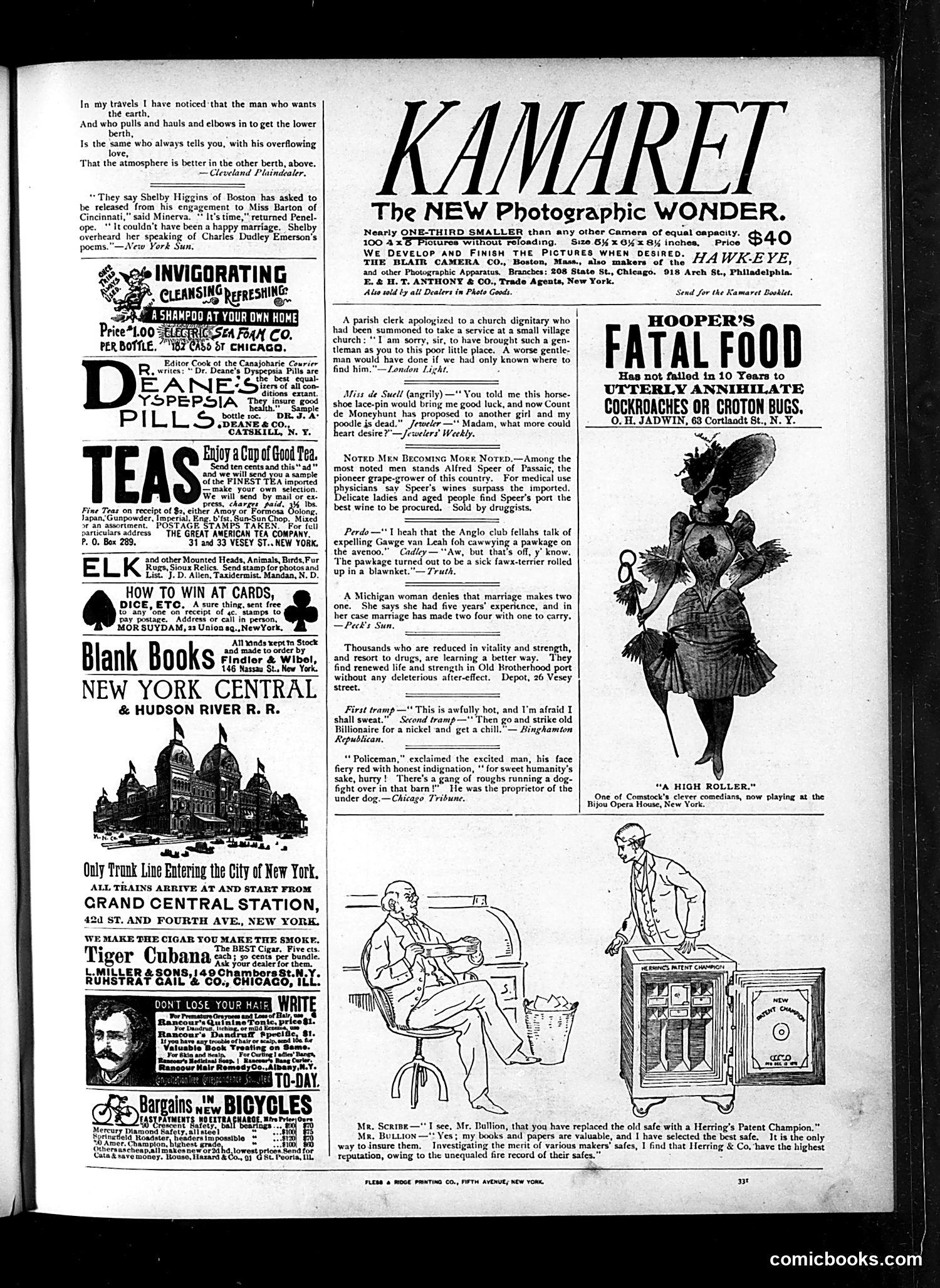
This page is primarily **advertisements and brief humorous anecdotes** rather than political cartoons. The main content includes: **Humorous Vignettes:** - A quip about a man wanting the lower berth while praising the upper berth (hypocrisy) - A broken engagement joke about Shelby Higgins - A parish clerk's awkward apology to a visiting clergyman - A woman angry that a horseshoe lace-pin didn't bring good luck in romance **Advertisements:** The page features numerous period product ads: Dr. Deane's Dyspepsia Pills, tea, taxidermy services, card-game cheating guides, the Kamaret camera, Tiger Cubana cigars, hair restoration treatments, bicycles, and Hooper's Fatal Food (for killing cockroaches). **Illustrations:** Two cartoons show: a dentist scene and a man demonstrating a safe to a woman. Neither depicts recognizable political figures or references specific events. The cartoons illustrate the accompanying text captions about safe-keeping valuables. This appears to be a typical Judge issue mixing light satire with period advertising.
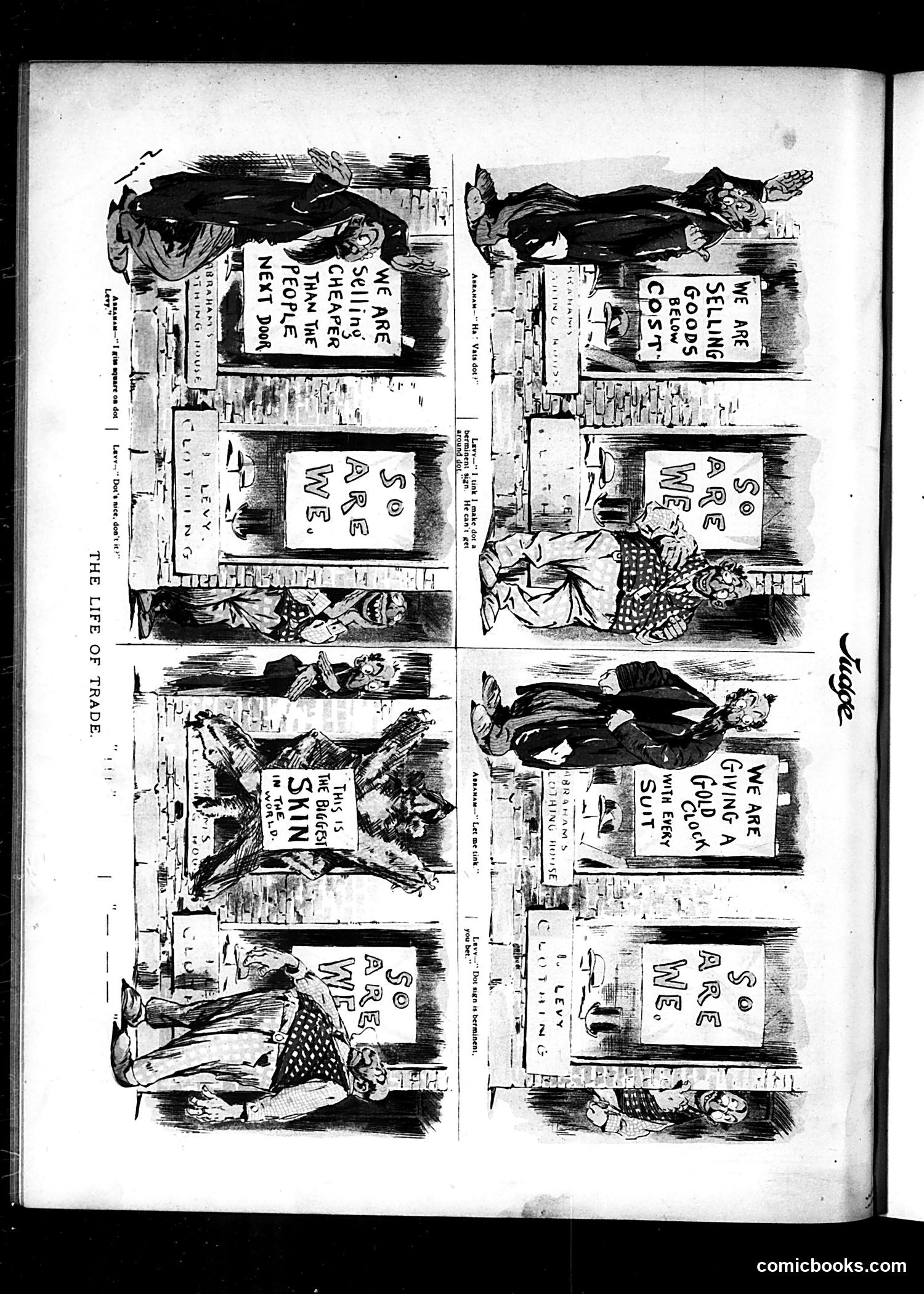
This appears to be a sequential comic strip satirizing the cycle of commercial life and labor. The repeated panels show figures in different positions with signs reading "SO ARE WE" and variations like "WE ARE SELLING GOODS," "WE ARE GETTING A GOOD SUIT," and "WE ARE GOING A GUYING A SUIT." The satire seems to mock the circular, repetitive nature of commerce and consumer behavior—workers earning money to buy goods, then needing to work again to afford more purchases. The figures appear to be in different social/economic classes, suggesting commentary on how all levels of society remain trapped in this consumption cycle. The title "THE LIFE OF TRADE" indicates Judge is critiquing capitalism's endless treadmill of labor and spending.