
Judge, 1891-08-22 · page 3 of 16
Judge — August 22, 1891 — page 3: what you’re looking at
What you’re looking at
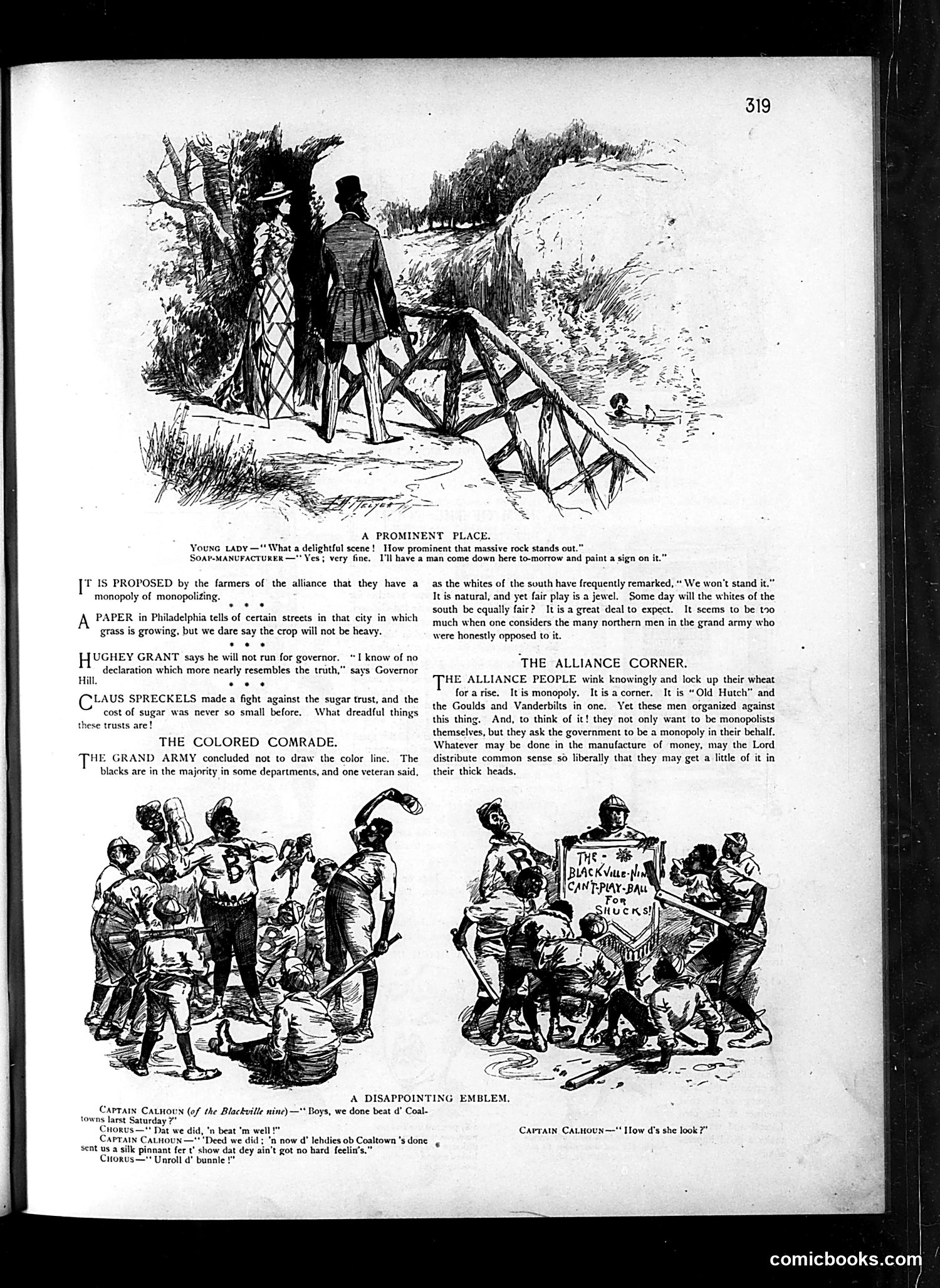
This page contains three distinct satirical sections critiquing late 19th-century American monopolies and political issues: **"A Prominent Place"** mocks railroad monopolies, depicting wealthy industrialists planning to erect monuments celebrating their market dominance. **"The Alliance Corner"** attacks the Populist/Farmers' Alliance movement, portraying them as naive for expecting government intervention against monopolies (the Goulds and Vanderbilts). The satire suggests farmers lack political sophistication. **"The Colored Comrade"** and **"Disappointing Emblem"** appear to reference Civil War military integration, with "Captain Calhoun" (likely evoking Southern politician John C. Calhoun) commenting on mixed-race military units. The cartoons mock Reconstruction-era racial politics and military desegregation efforts. The overall page critiques monopoly power while simultaneously mocking reform movements and racial equality initiatives.
📄 Transcribed text from this page (OCR, searchable)
Machine-transcribed from the original scan — historical spelling and the odd misread are preserved.
SF? ae e A PROMINENT PLACE. Youne Lavy lightful scene !_ How prominent that massive rock stands out.” SOAP-MANUPACTURER —"* Yes; very fine. I'll have a man come down here to-morrow and paint a sign on it.”” T IS PROPOSED by the farmers of the alliance that they have a monopoly of monopolizing. PAPER in Philadelphia tells of certain streets in that city in which grass is growing, but we dare say the crop will not be heavy. 2 ete HUGHEY GRANT says he will not run for governor. “I know of no declaration which more nearly resembles the truth,” says Governor Hill. e -01'¢ CLAUS SPRECKELS made a fight against the sugar trust, and the cost of sugar was never so small before. What dreadful things these trusts are! THE COLORED COMRADE. THE GRAND ARMY concluded not to draw the color line. The blacks are in the majority in some departments, and one veteran said, as the whites of the south have frequently remarked, “ We won't stand it.” It is natural, and yet fair play is a jewel. Some day will the whites of the south be equally fair? It isa great deal to expect. It scems to be t20 much when one considers the many northern men in the grand army who were honestly opposed to it. THE ALLIANCE CORNER. ‘THE ALLIANCE PEOPLE wink knowingly and lock up their wheat for arise. It is monopoly. It isa corner. It is “Old Hutch” and the Goulds and Vanderbilts in one. Yet these men organized against this thing, And, to think of it! they not only want to be monopolists themselves, but they ask the government to be a monopoly in their behalf. Whatever may be done in the manufacture of money, may the Lord distribute common sense so liberally that they may get a little of it in their thick heads. A DISAPPOINTING EMBLEM, Catnoun (of the Blackville nine)—* Boys, we done beat d’ Coal- day?" Captain CaLnoun sent us a silk pinnant fer t’ show dat dey ain't got no hard feeli Citorus—** Unroll d’ bunnle !” Carrain CaLnoun—*' How d's she look?" comicbooks.co | | |