
A complete issue · 16 pages · 1891
Judge — July 11, 1891
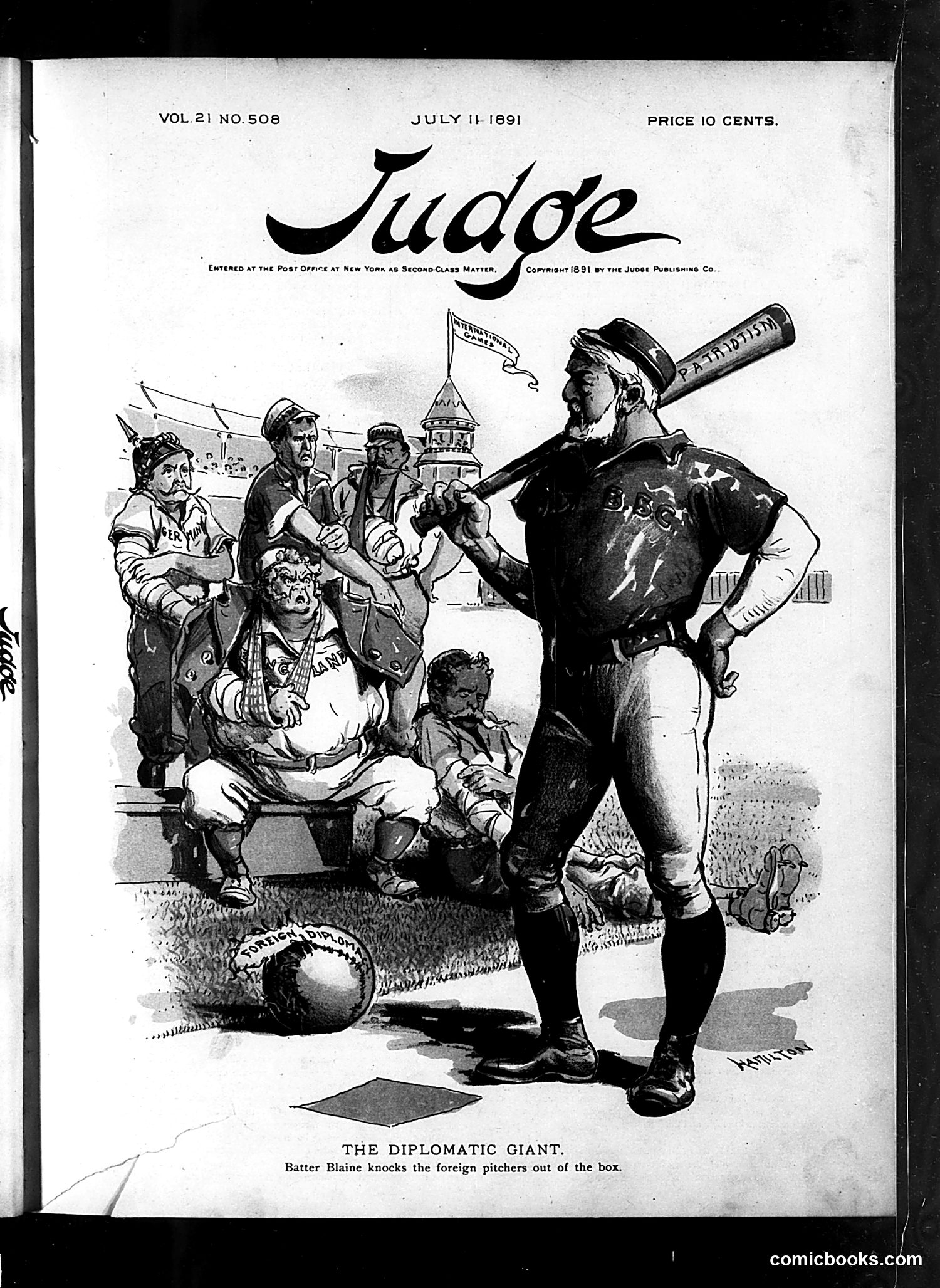
This baseball-themed political cartoon uses sports as metaphor for international diplomacy. A large figure labeled "U.S.A." (the "Diplomatic Giant") stands as a baseball player holding an enormous bat, confronting smaller foreign figures who appear to be international "pitchers." The caption reads: "Batter Blaine knocks the foreign pitchers out of the box"—referencing James G. Blaine, Secretary of State under President Harrison (1889-1892). The cartoon satirizes American assertiveness in foreign policy during this period, portraying Blaine as aggressively batting away foreign competition and influence. The smaller caricatured figures likely represent European or other foreign powers. The imagery suggests American confidence and dominance in international affairs during this era of expanding American commercial and diplomatic influence.
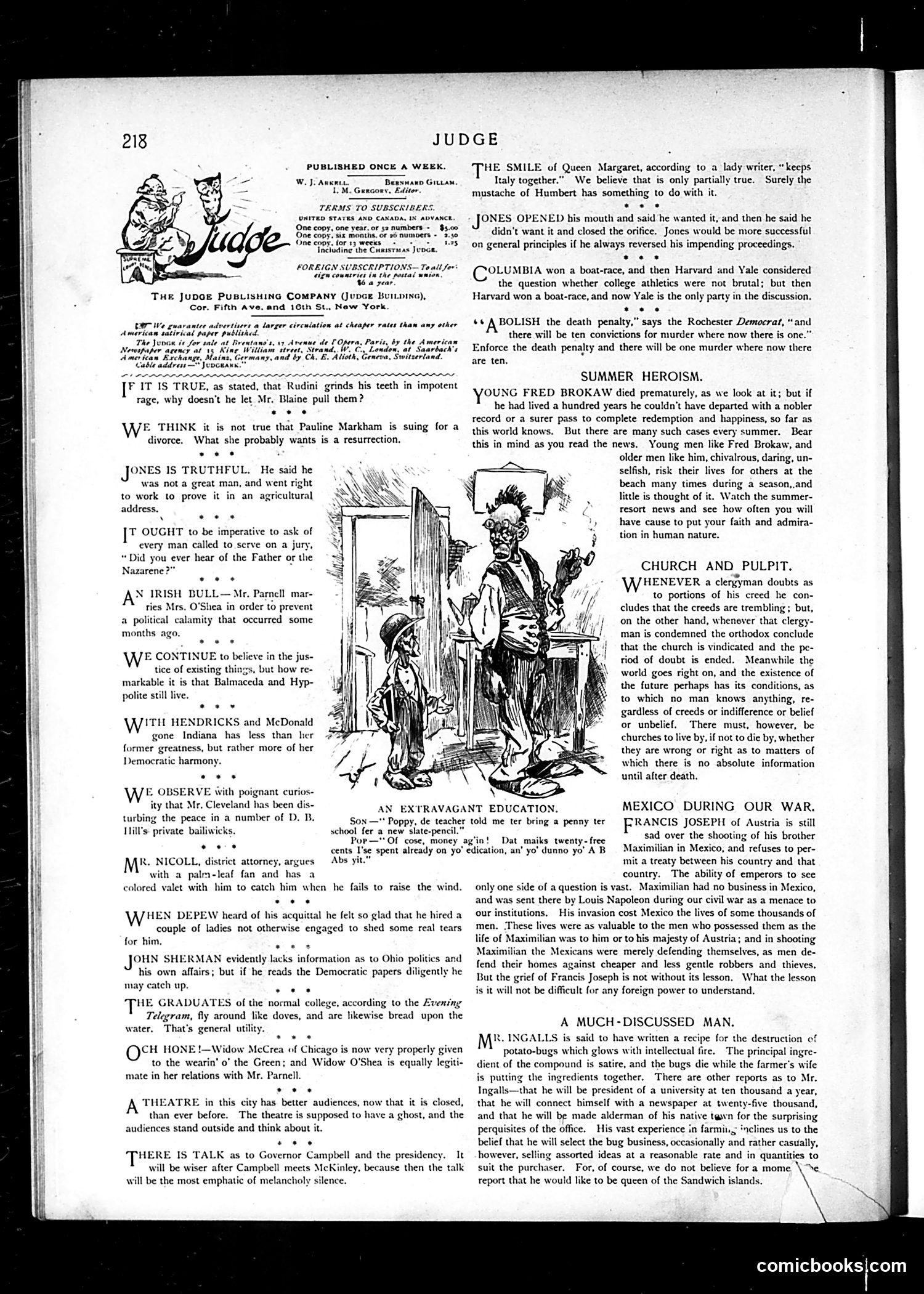
The page contains multiple short editorial commentary pieces rather than a single cartoon. The main illustration shows a figure (appearing to be a vagrant or poor person) at a doorway with a child, likely commenting on poverty or social conditions. The text references several contemporary issues: criticism of Mr. Blaine's political positions; commentary on Pauline Markham's rumored divorce and "resurrection"; observations about college athletics (Columbia, Harvard, Yale); and discussion of capital punishment. One section titled "Summer Heroism" praises young men who risk their lives at beaches during summer season, contrasting their sacrifice with older men's caution. Without specific dates or clearer identification of figures referenced, the exact political targets remain unclear, though the tone suggests typical late-19th-century American satirical critique of politicians, social conditions, and public figures.
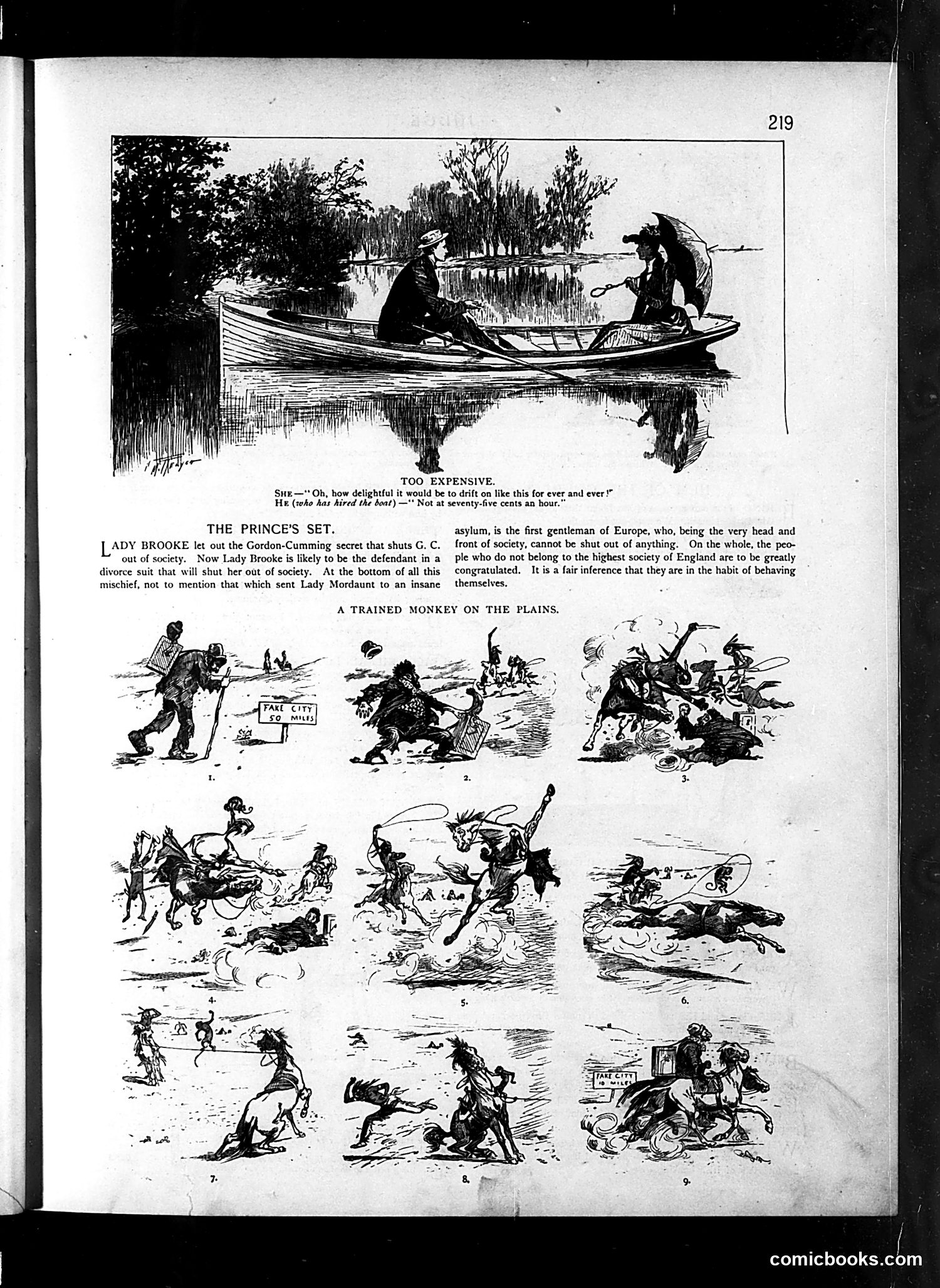
**Top cartoon**: A couple in a rowboat discusses the cost of recreation. The woman suggests drifting as a free activity, but the man replies it costs seventy-five cents per hour—satirizing the commercialization of leisure and the difficulty of finding affordable entertainment, even outdoor pursuits. **Bottom series**: Nine panels depicting a trained monkey performing increasingly chaotic stunts across plains landscape. The sequence appears to satirize animal training, slapstick entertainment, or possibly mocking someone's uncontrolled behavior or public antics. The progression from controlled tricks to mayhem suggests loss of control or competence. **"The Prince's Set"**: Brief text mocking Lady Brooke as the cause of a divorce scandal involving high society, suggesting satirical coverage of contemporary celebrity gossip.
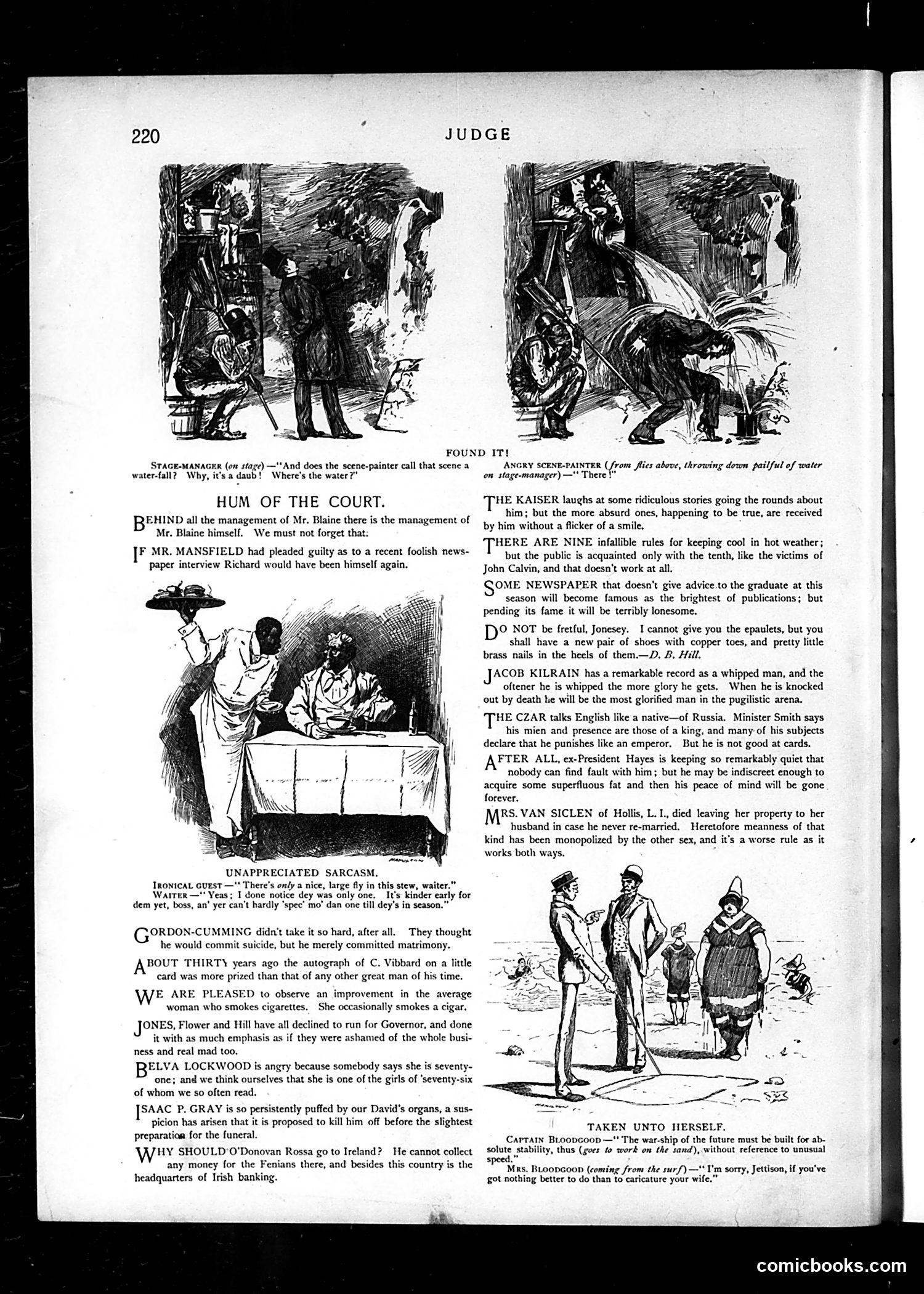
This page contains several satirical short items and cartoons typical of 1880s-90s American humor magazines. **Key figures referenced:** - **James G. Blaine** (mentioned twice)—likely Secretary of State or presidential candidate, satirized for self-management - **Richard Mansfield**—actor, referenced regarding a newspaper interview - **Gordon-Cumming**—appears to reference a scandal (possibly the baccarat cheating scandal) - **Jacob Kilrain**—prizefighter, mocked for glorifying beatings - **The Czar** and **ex-President Hayes**—political figures receiving light jabs - **O'Donovan Rossa**—Irish-American Fenian activist, satirized for fundraising **The cartoons** mock theatrical incompetence (stage manager disputes with scene-painter), working-class service (waiter's sarcasm), and marital foolishness. The humor targets political figures, social pretension, gender roles, and contemporary scandals—typical **Judge** content mixing political satire with general social mockery. Most references require period-specific knowledge to fully appreciate.
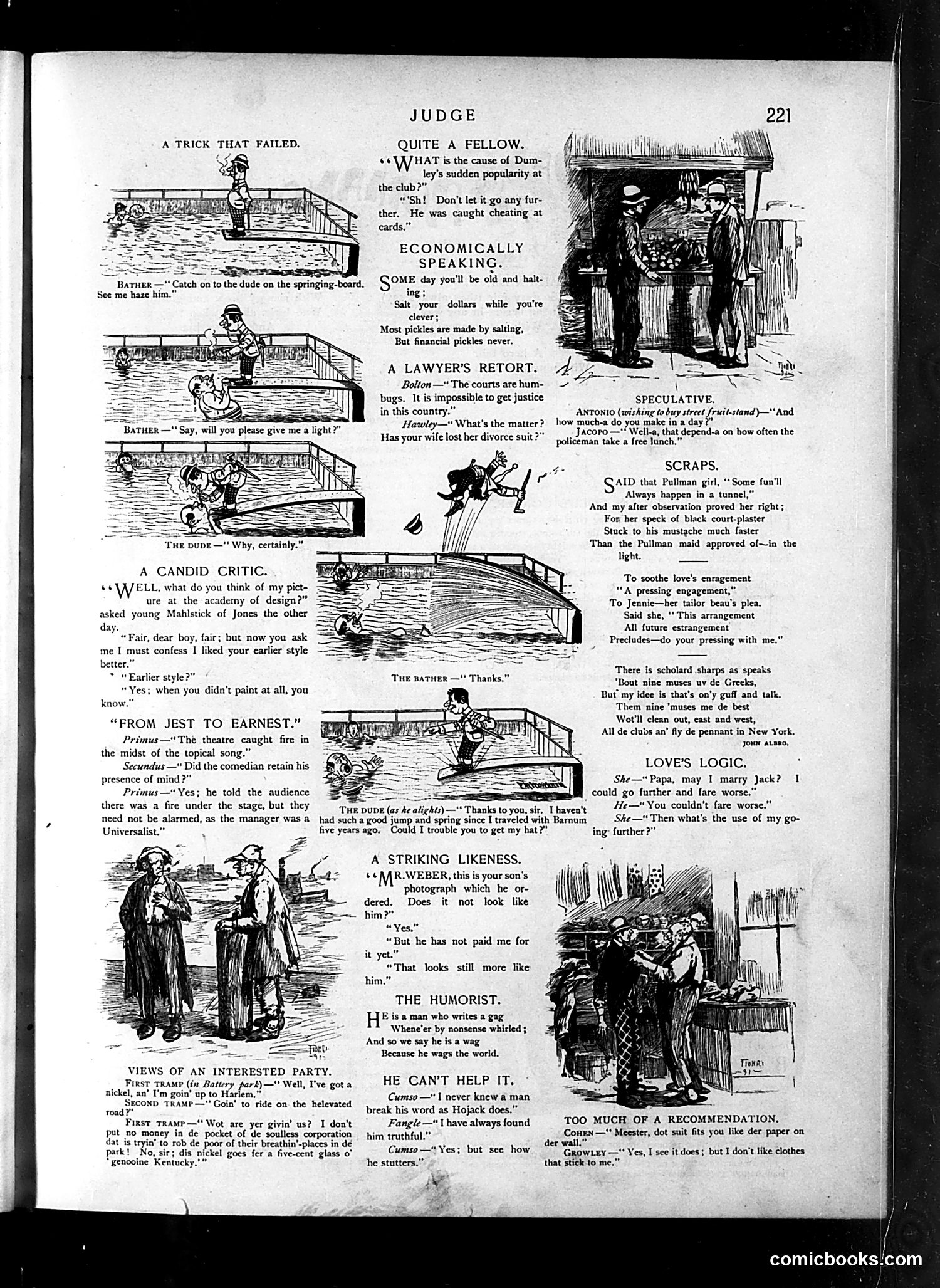
This page from the satirical magazine *Judge* contains multiple short humorous sketches typical of late 19th-century American humor. Key content includes: **"A Trick That Failed"**: A comic sequence showing someone attempting to trick a swimmer on a diving board, with the punchline that cheating at cards has ironically made the cheater *popular* at his club—satirizing hypocritical social values. **"Economically Speaking"**: A quip contrasting literal pickling (preserving with salt) with financial ruin, suggesting the wealthy should invest wisely while young. **"A Lawyer's Retort"**: Mocks both the legal system's ineffectiveness and marital discord, implying even divorce suits fail. **"Speculative"**: Depicts Antonio negotiating purchase of a street fruit stand, satirizing immigrant entrepreneurs' economic aspirations. **"Love's Logic"** and related sketches: Brief domestic comedy about courtship, engagement, and marital disputes—common *Judge* themes. **Minor pieces** address theater fires, photography, hobo economics, and tailors. The overall tone reflects Gilded Age anxieties: class mobility, marital instability, legal corruption, and emerging immigrant culture. The art style uses wood engravings typical of 1880s-90s satirical journalism.
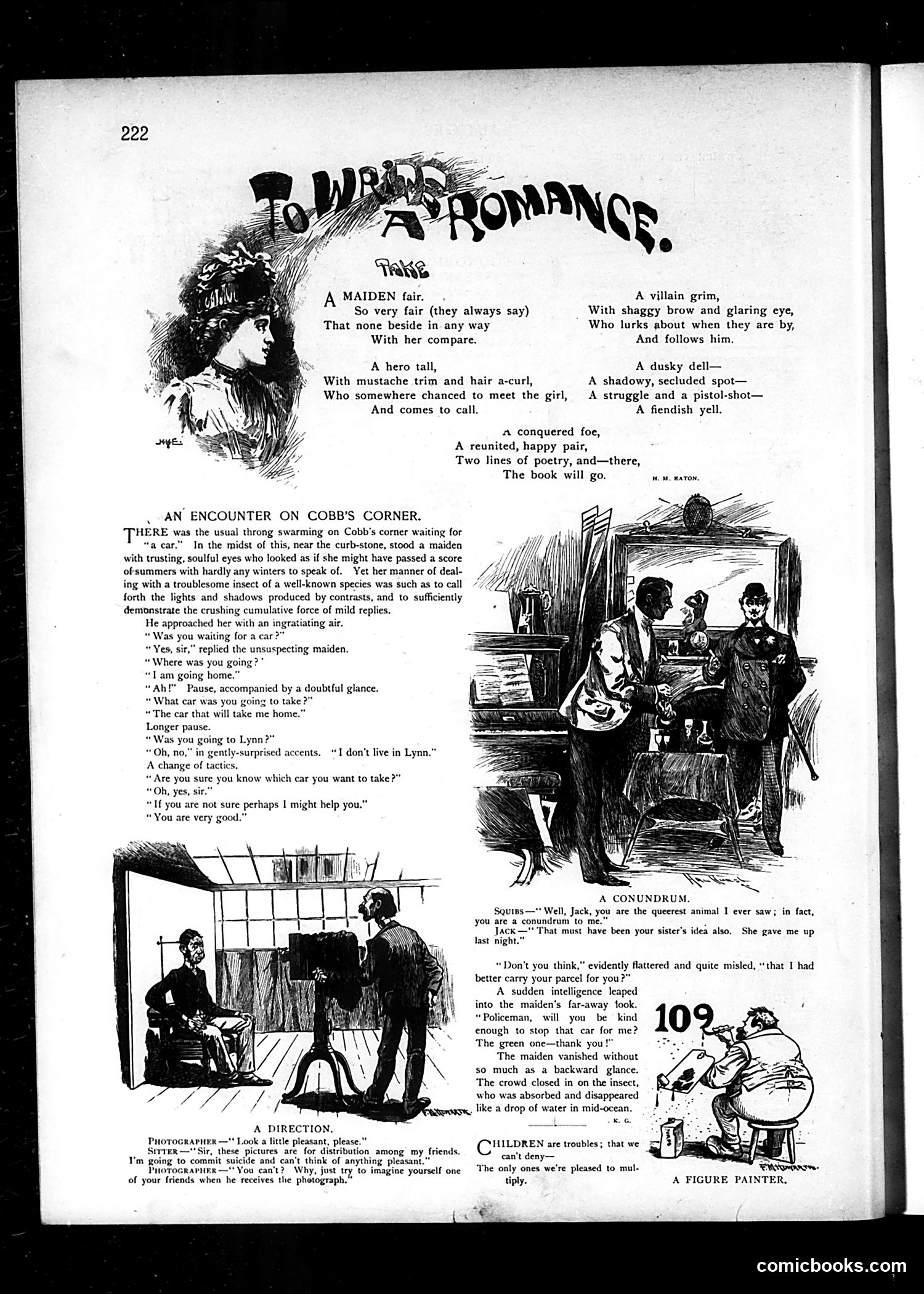
This Judge page mocks two distinct targets: **Top section ("To Dress a Romance"):** A tongue-in-cheek recipe for melodramatic romance novels—the wildly popular penny dreadfuls and serialized fiction of the era. It satirizes the formulaic plotting: virtuous maiden, dashing hero, lurking villain, shadowy struggle, pistol shot, happy reunion. The satire suggests these stories were predictable literary products designed for mass consumption. **Main cartoon ("An Encounter on Cobb's Corner"):** depicts street harassment. A man approaches an unaccompanied young woman waiting for a streetcar, using transparent manipulative tactics ("Can I help you?"). She initially responds politely but eventually recognizes his predatory intent and calls a policeman to stop her escape vehicle. The joke subverts the romance formula: real life ends not with reunited lovers, but with the "insect" being exposed and disappearing into the crowd. Together, the page contrasts literary fantasy with harsh social reality—contrasting how romance was sold versus how women actually experienced unwanted male attention in public.
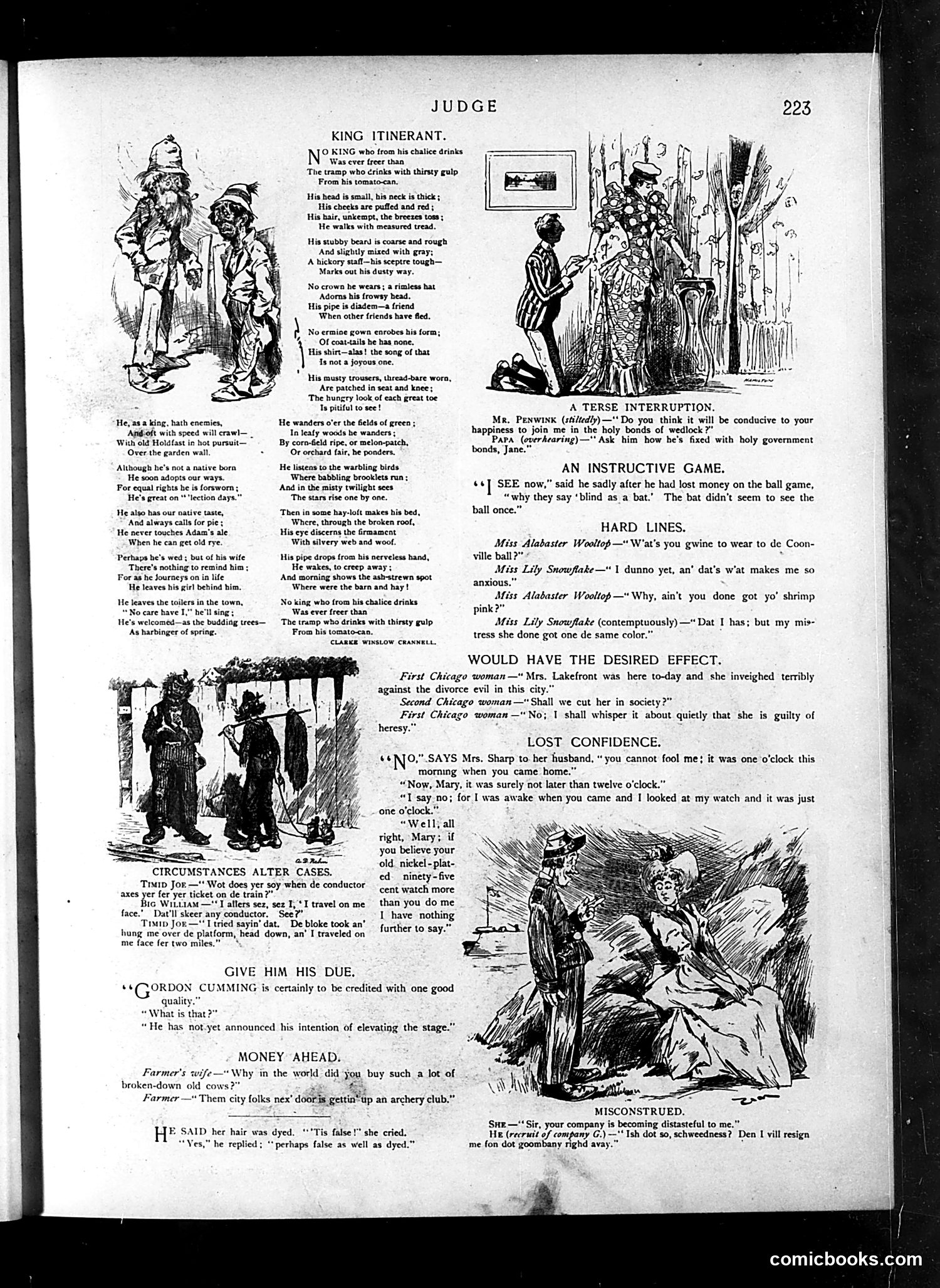
This page from Judge presents several satirical pieces mocking different social groups: **"King Itinerant"** (main poem with illustration): A lengthy satire depicting a vagrant/tramp as royalty. The joke inverts class hierarchy—this "king" wears rags, sleeps in barns, and travels freely, yet enjoys liberties that actual wealthy kings lack. The refrain compares his freedom to drinking from a tomato-can versus a chalice, suggesting ironic dignity in poverty. The accompanying sketches show the disheveled tramp character. **"Hard Lines"** and other brief dialogues: Mock African American vernacular speech (characteristic of Judge's era racism), depicting stereotyped "coon" characters discussing ball gowns and social events. **"Lost Confidence"** sketch: A domestic comedy where a wife catches her husband arriving home late, and he unconvincingly claims it was midnight when she insists it was one o'clock. The overall tone reflects late-19th/early-20th-century American satirical humor: class mockery, ethnic caricature, and domestic comedy.
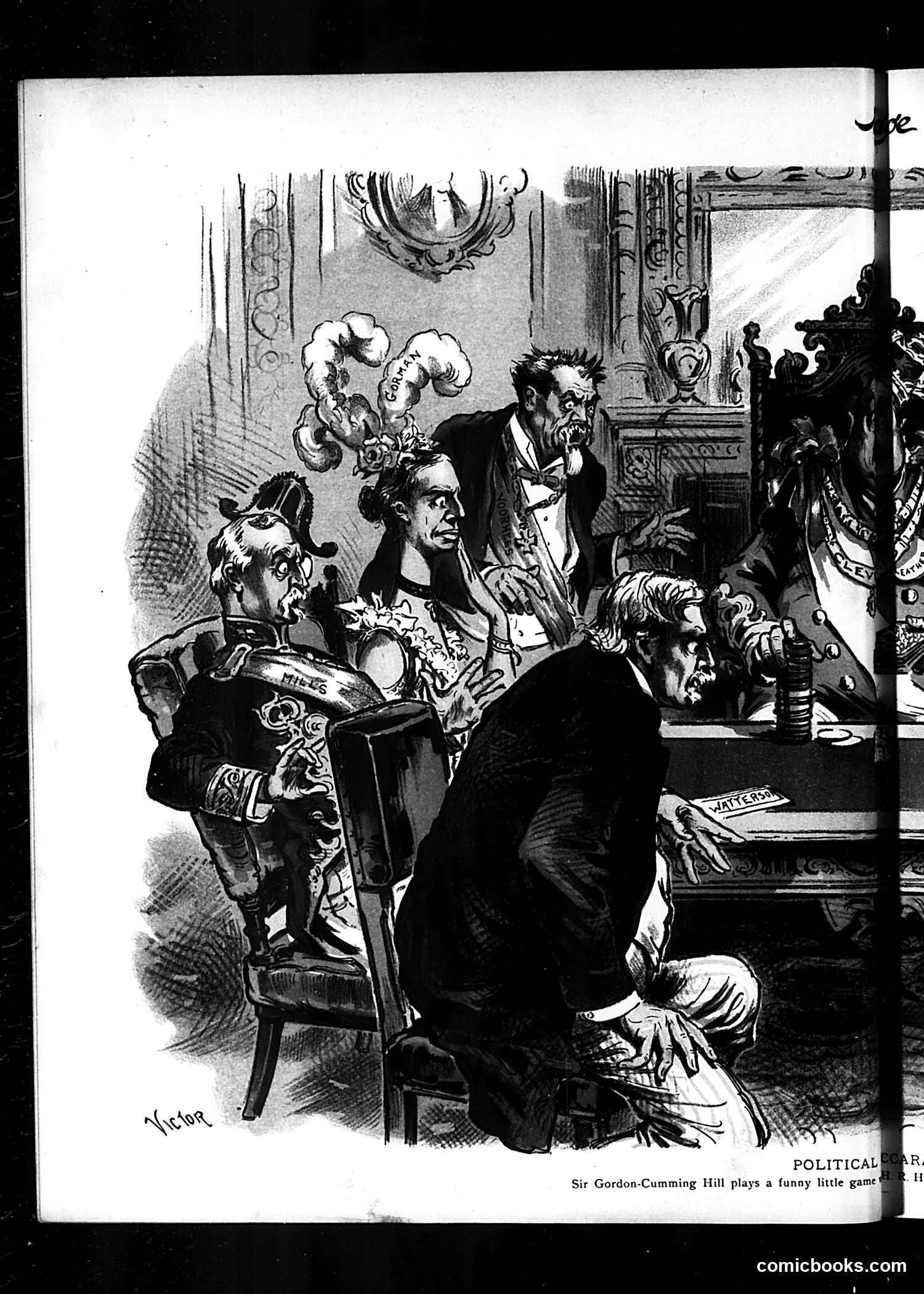
This is a satirical cartoon featuring **Sir Gordon-Cumming Hill** (identified in the caption), who appears to be engaged in some sort of social or political game or scheme. The scene shows an ornate interior with multiple figures—some wearing military uniforms and formal dress, others in civilian clothes. Their exaggerated facial expressions and body language suggest mockery or disapproval of Hill's activities. The cartoon's humor relies on depicting Hill as duplicitous or manipulative in high society settings. Without additional historical context about the specific scandal or incident involving Gordon-Cumming Hill, the exact nature of the "funny little game" remains unclear, but the ornate setting and formal dress suggest this critiques behavior among the British upper classes or military establishment.
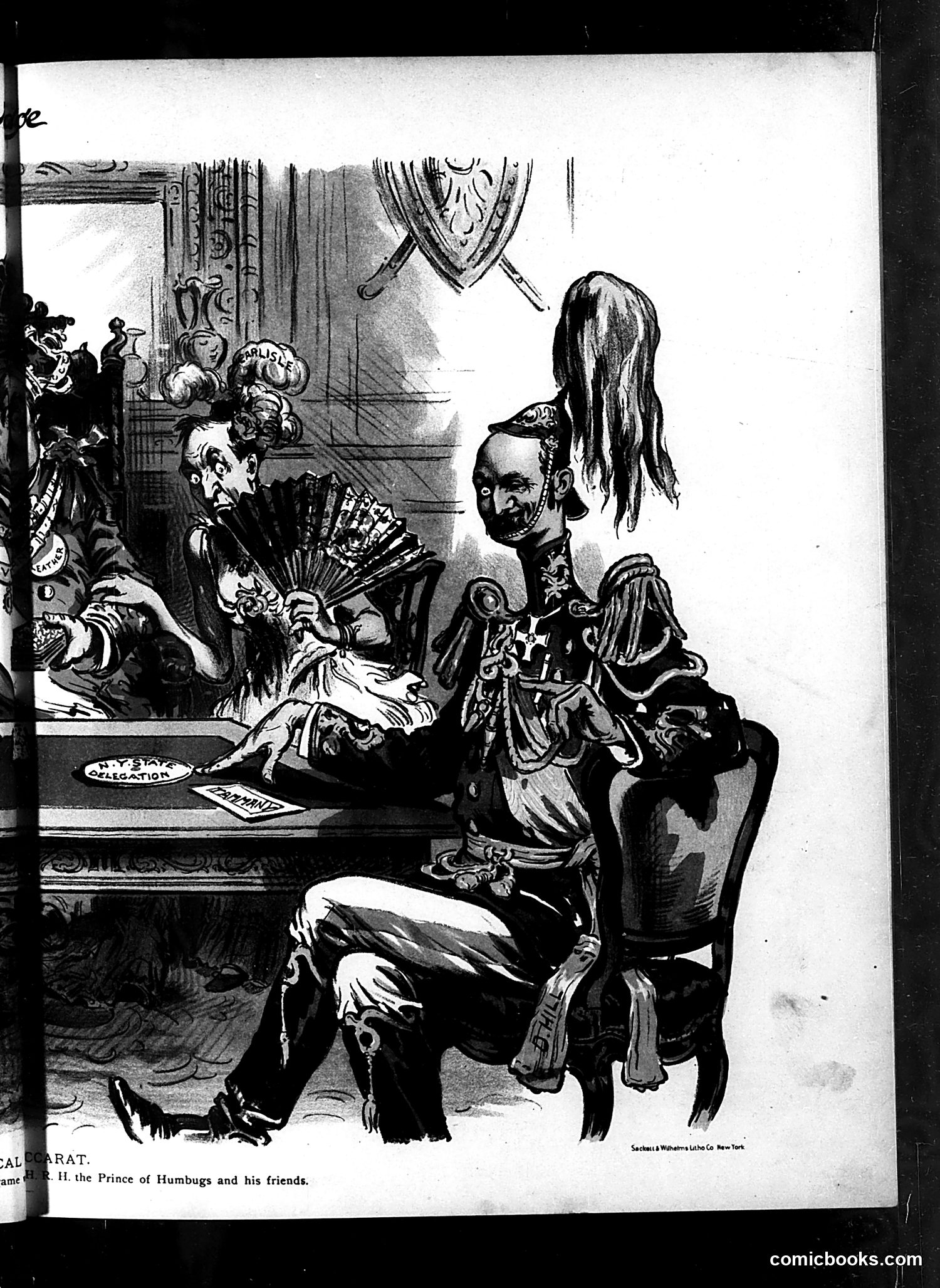
This is a satirical cartoon titled "H. the Prince of Humbugs and his friends." The image depicts a military or political figure seated in the foreground, observing elegantly dressed figures in an ornate interior setting. The caption identifies the central character as "the Prince of Humbugs," suggesting criticism of someone as a fraud or charlatan. The elaborate military dress, formal setting with decorative shields and architectural details, and the overall composition suggest this targets a European political or military leader of the late 19th or early 20th century. The "humbug" label indicates Judge magazine's satirical critique of the figure's pretense, false claims, or deceptive conduct. Without additional context, the specific identity and historical event referenced remain unclear, though the ornate staging emphasizes mockery of affected grandeur.
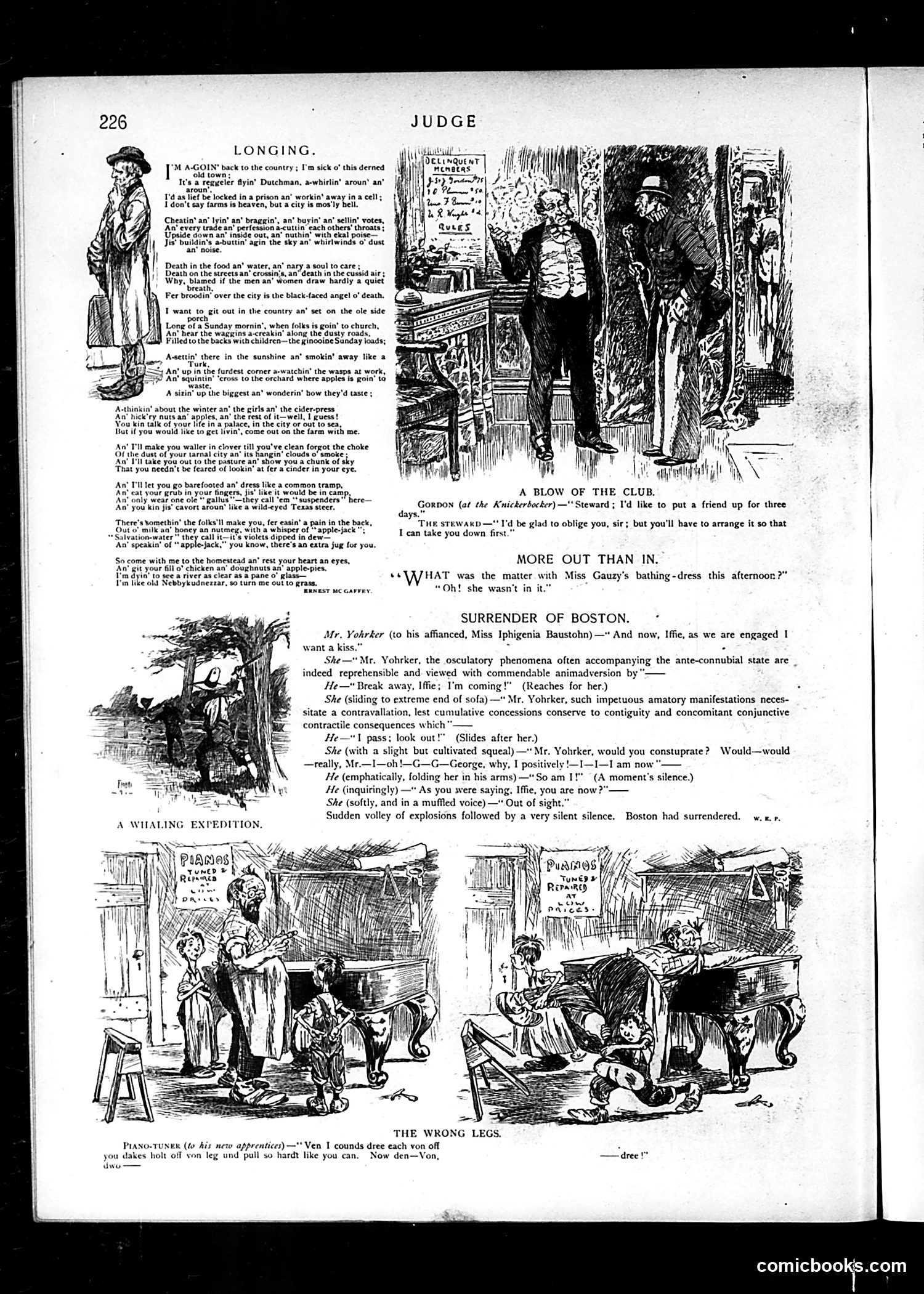
This page contains satirical pieces mocking urban versus rural life and pretentious speech: **"Longing"** (left): A rural character's nostalgic poem yearning for country life over the city's corruption, disease, and noise. This reflects late-19th-century anxieties about rapid industrialization and urbanization. **"A Blow of the Club"** and **"More Out Than In"**: Brief humor pieces—the first about club membership arrangements, the second a double entendre about a woman's bathing suit. **"Surrender of Boston"**: The main satirical target. A couple's courtship is mocked through exaggerated, pompous dialogue. The woman uses deliberately obscure vocabulary ("osculatory phenomena," "contravallation") to resist the man's advances—satirizing affected intellectualism and Victorian prudery. The man's frustrated responses ("I pass; look out!") suggest he abandons verbal persuasion for physical action, a joke about masculine impatience with feminine pretense. **The cartoons** illustrate these scenarios with detailed period engravings typical of Judge's visual humor.
This page is primarily **advertisements and short joke content** rather than political cartoons, though it's worth noting what these reveal about the era. The brief jokes are typical Judge magazine humor—mostly puns and observational comedy. One references Alexander the Great and advertising (joking he couldn't conquer more worlds because he didn't advertise). Another mocks patent medicine and quack cures, mentioning "Brown-Sequard's elixir" and "Koch's consumptive cure"—likely satirizing fake remedies popular at the time. **The advertisements are most historically revealing**: they promote stomach bitters, Castoria (a children's medication), sewing aids, and piano manufacturers. These ads reflect the era's unregulated patent medicine market and class-conscious consumer goods. A Kodak camera ad emphasizes photography as an upper-class leisure activity for summer trips. The magazine itself (Judge, a satirical weekly) typically targeted educated, affluent readers. The page shows it was simultaneously platform for biting social commentary and vehicle for advertising luxury goods to the same audience.
**The Main Content**: This page is primarily advertising with one notable cartoon feature: "In the Swim" — a small illustration showing a dog smoking a cigar while labeled "Smoking Tobacco." The cartoon's point appears to be lighthearted humor about the quality of a particular tobacco brand (Mastiff, made by J.B. Pace Tobacco Co.), using the absurd image of a dog enjoying the product to suggest it's so good and mild that even a dog would approve. **"Carl Pretzel's Philosophy"**: Below is a humorous column attributed to "Carl Pretzel," apparently an Irish or German immigrant character (suggested by his thick dialect), dispensing folk wisdom in broken English about life's lessons regarding effort, honesty, and self-awareness. The remainder of the page consists of product advertisements typical of the era — patent medicines, furniture, pianos, hotels — with no coherent satirical or political content. It appears this is simply an advertising-heavy page from *Judge* magazine.
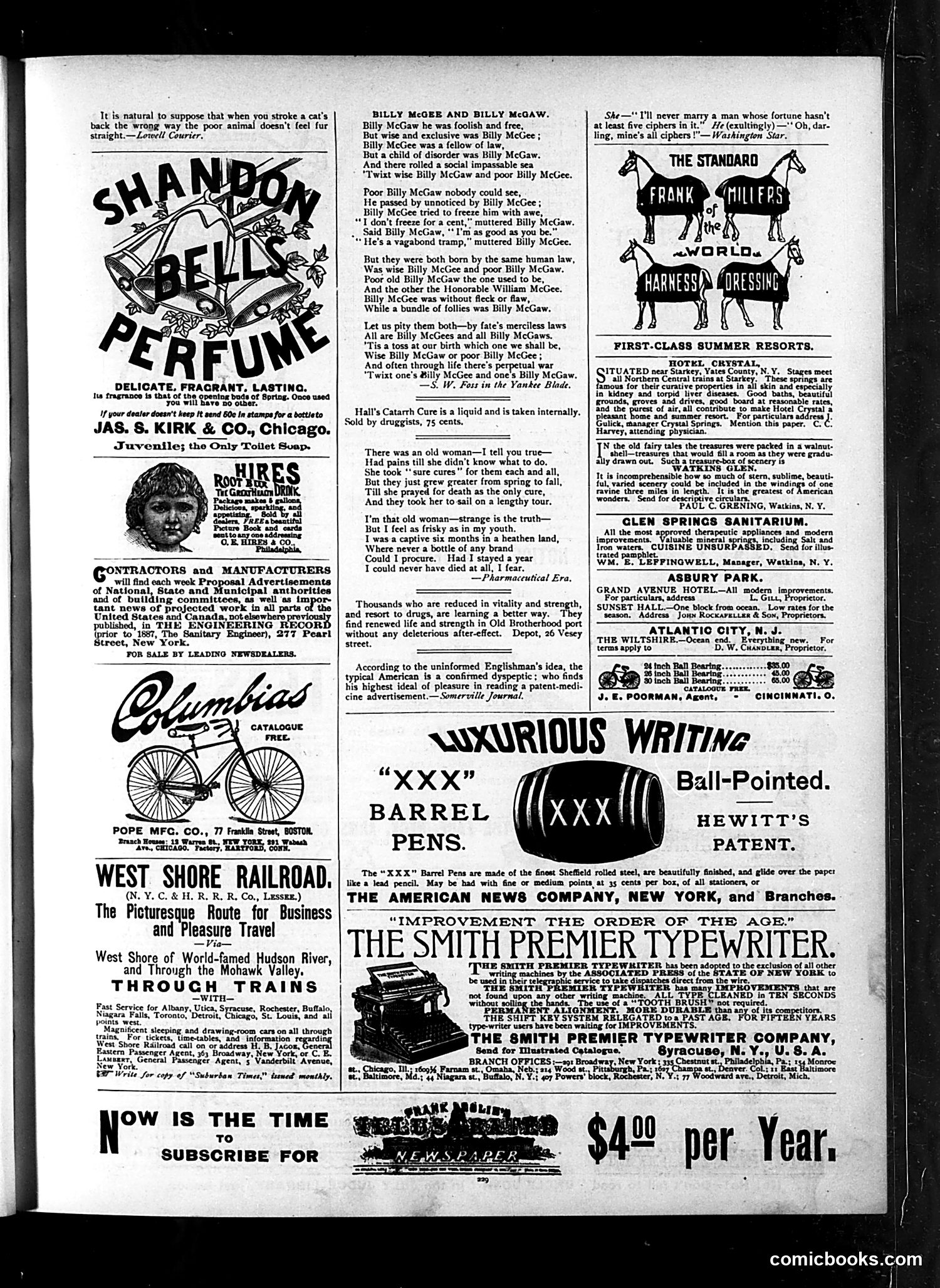
This page is primarily **advertising**, not political satire. The main content consists of product advertisements interspersed with light verse. The notable literary piece is "Billy McGee and Billy McGaw" by S. W. Foss—a moralistic poem contrasting two men born under identical circumstances who diverge into opposite fates: one becomes wise and respectable ("the Honorable William McGee"), the other a poor vagrant. The poem's message is fatalistic social commentary: birth circumstances are arbitrary ("a toss at our birth"), and people contain both their better and worse selves ("one's Billy McGee and one's Billy McGaw"). The surrounding ads promote period products: Shannon Bell Perfume, Columbia bicycles, the West Shore Railroad, and various remedies. One poem humorously describes a woman cured of chronic pain simply by traveling abroad—implying her ailments were psychosomatic. There is **no obvious political cartoon** on this page. It represents typical late-19th-century magazine content mixing advertising revenue with genteel, sentimental verse.
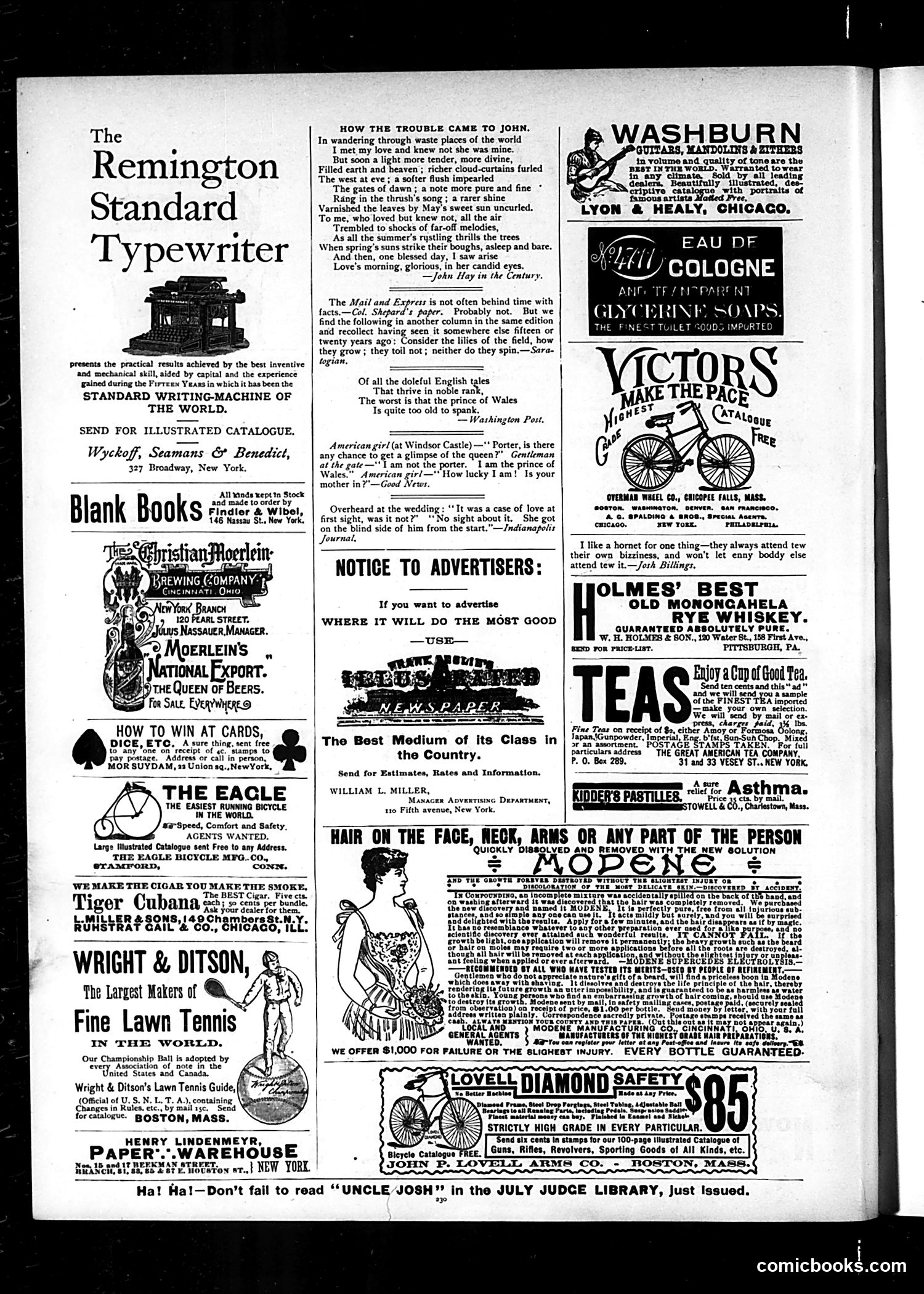
This is primarily an **advertising page** from Judge magazine, with minimal editorial content. The page features numerous product advertisements (typewriters, bicycles, cigars, beer, tennis equipment) typical of late 19th-century magazine advertising. The limited editorial content includes: 1. **"How the Trouble Came to John"** — a romantic poem by John Hay about falling in love, presented without satirical intent. 2. **Brief humor snippets** mocking the British royal family: - A joke about the Prince of Wales being "too old to spank" - An anecdote about an American girl mistaking the Prince of Wales for a porter at Windsor Castle 3. **Media criticism** — a brief jab at *The Mail and Express* for recycling old material. These jokes reflect common American satirical attitudes toward British royalty and class hierarchy. The page itself demonstrates how Judge balanced editorial content with substantial advertising revenue, which was typical of 19th-century magazines.
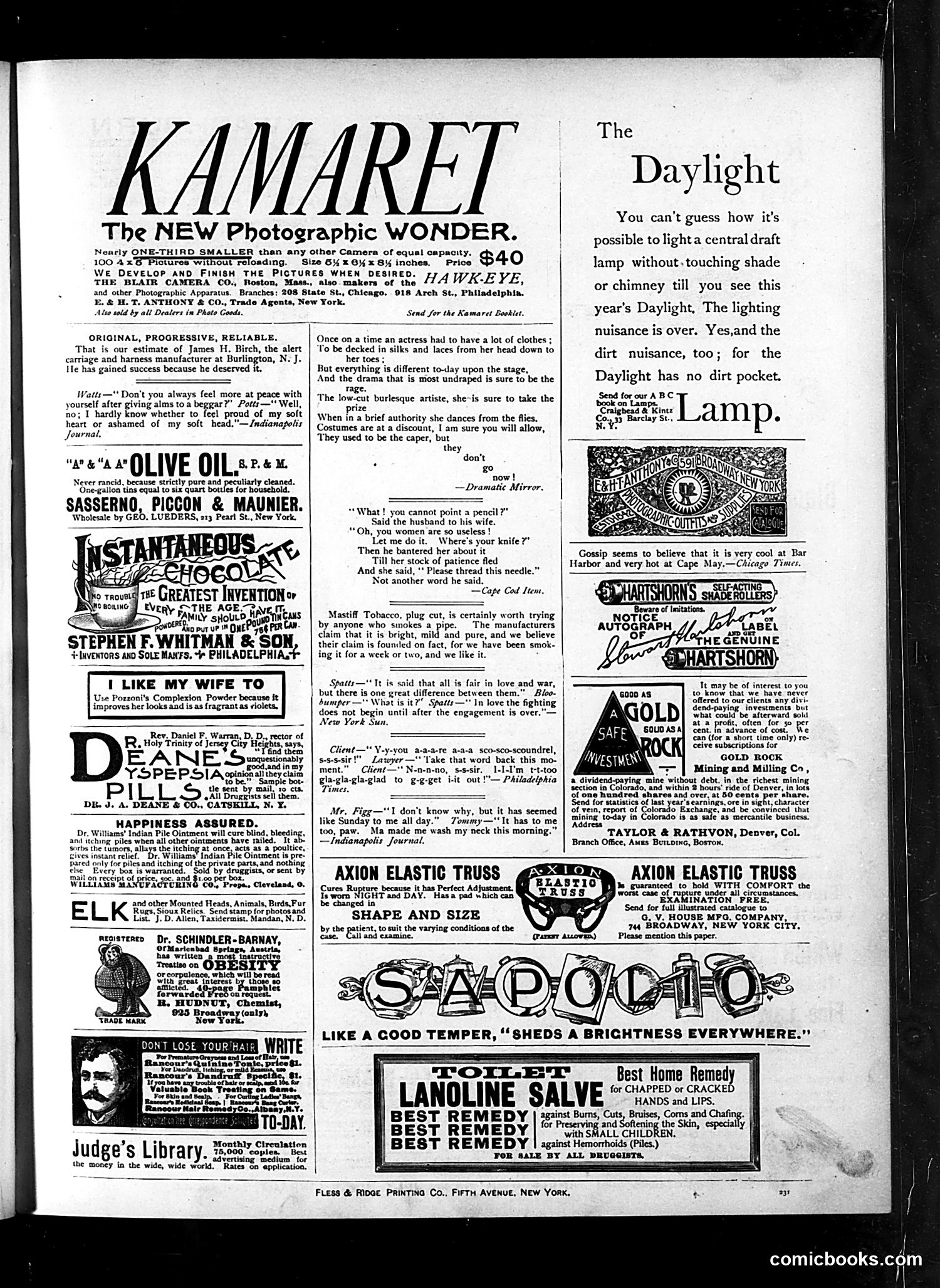
This is primarily an **advertising page** from Judge magazine, circa early 1900s, with minimal satirical content. The page contains dozens of product advertisements rather than political cartoons or editorial satire. The few non-advertising items include: 1. **Brief comedic dialogue snippets** on humorous topics (almsgiving, marital disputes about painting/threading needles) — lightweight domestic humor typical of the era. 2. **A theatrical commentary** about stage costumes becoming increasingly revealing in burlesque performances, presented as social observation rather than political satire. The page reflects **early 20th-century consumer culture**, advertising products like cameras, olive oil, complexion powder, pills for dyspepsia and piles, taxidermy services, and hair remedies—alongside light domestic humor. There are no identifiable political figures or substantive satirical commentary visible. This appears to be a revenue page where advertising dominated editorial content.
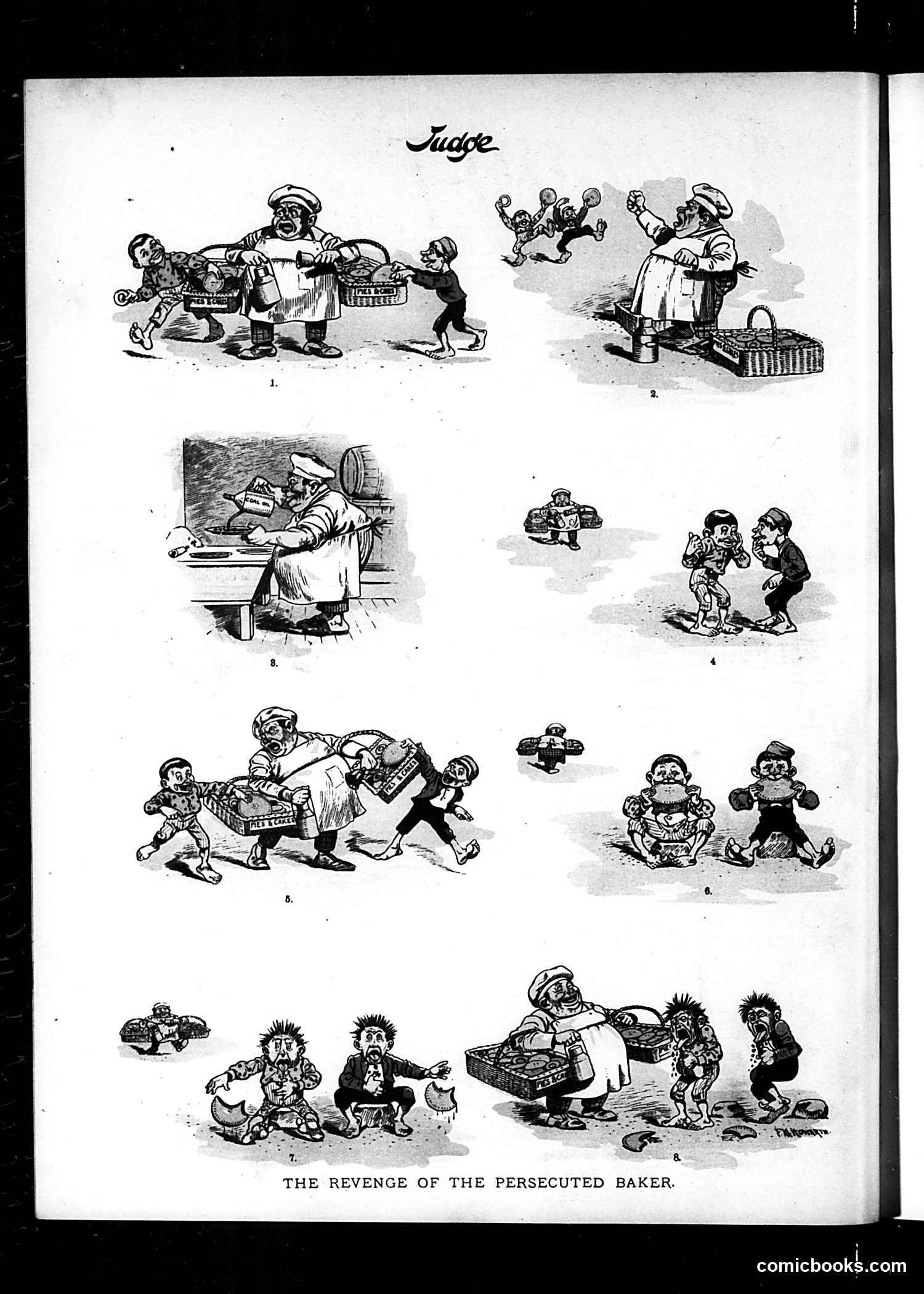
This satirical cartoon series depicts a baker gaining retribution against those who've wronged him. The narrative progresses through eight panels showing: 1. A large authority figure (appears to be a policeman or inspector) confiscating the baker's goods 2. The baker being ejected or punished 3. The baker working at his trade 4. Escalating conflict between the baker and authority figures 5. The baker seemingly "striking back" at his persecutors The satire likely critiques food inspection laws, regulations, or police harassment of working-class bakers—common grievances in the era when Judge magazine published. The "revenge" appears humorous rather than violent, suggesting the baker ultimately triumphs through his own labor or cunning. Without a specific date visible, the exact regulatory controversy remains unclear, though such baker-persecution scenarios reflected real tensions between authorities and street vendors/small merchants in industrial-era America.