
A complete issue · 16 pages · 1891
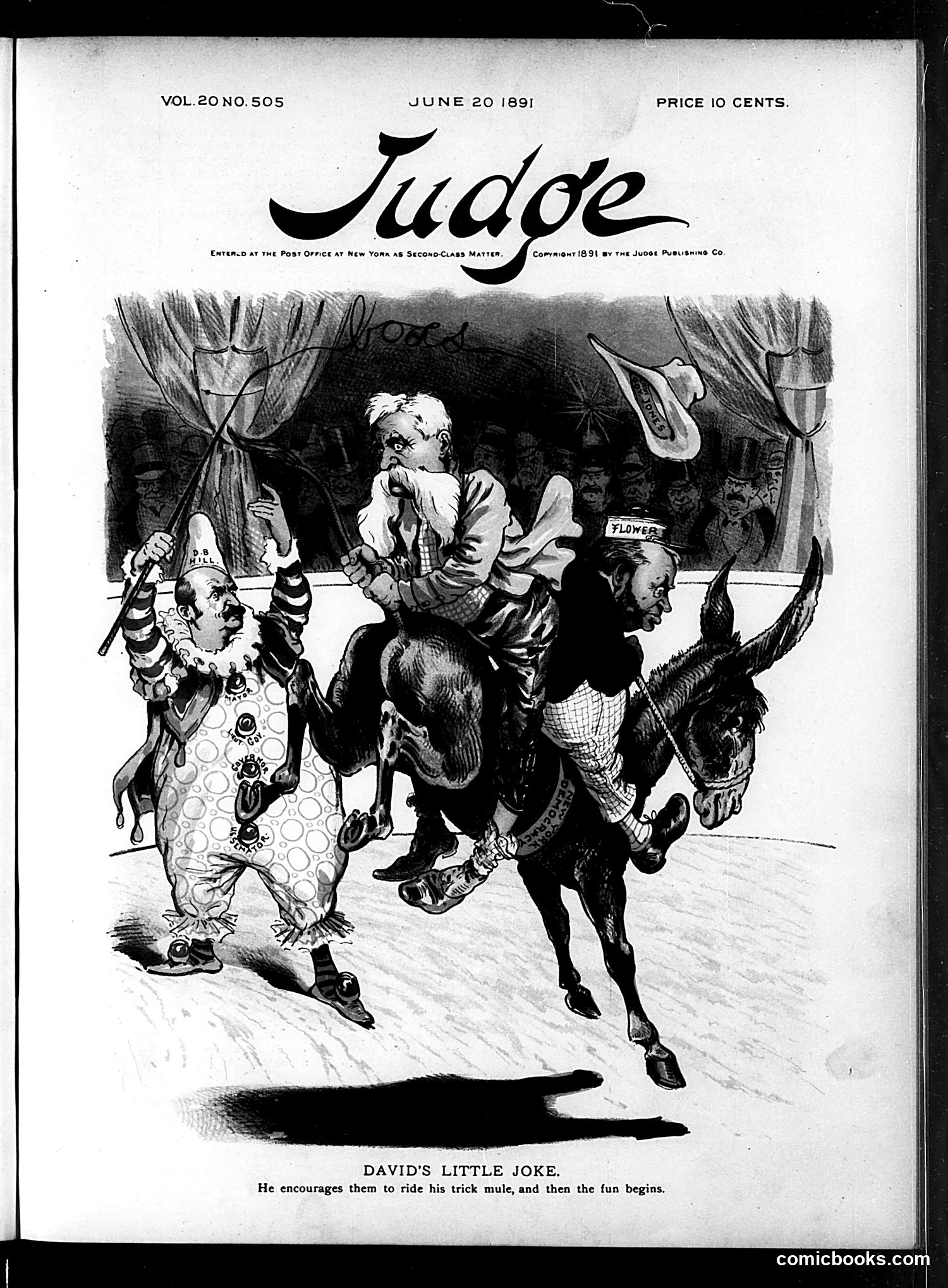
Judge — June 20, 1891
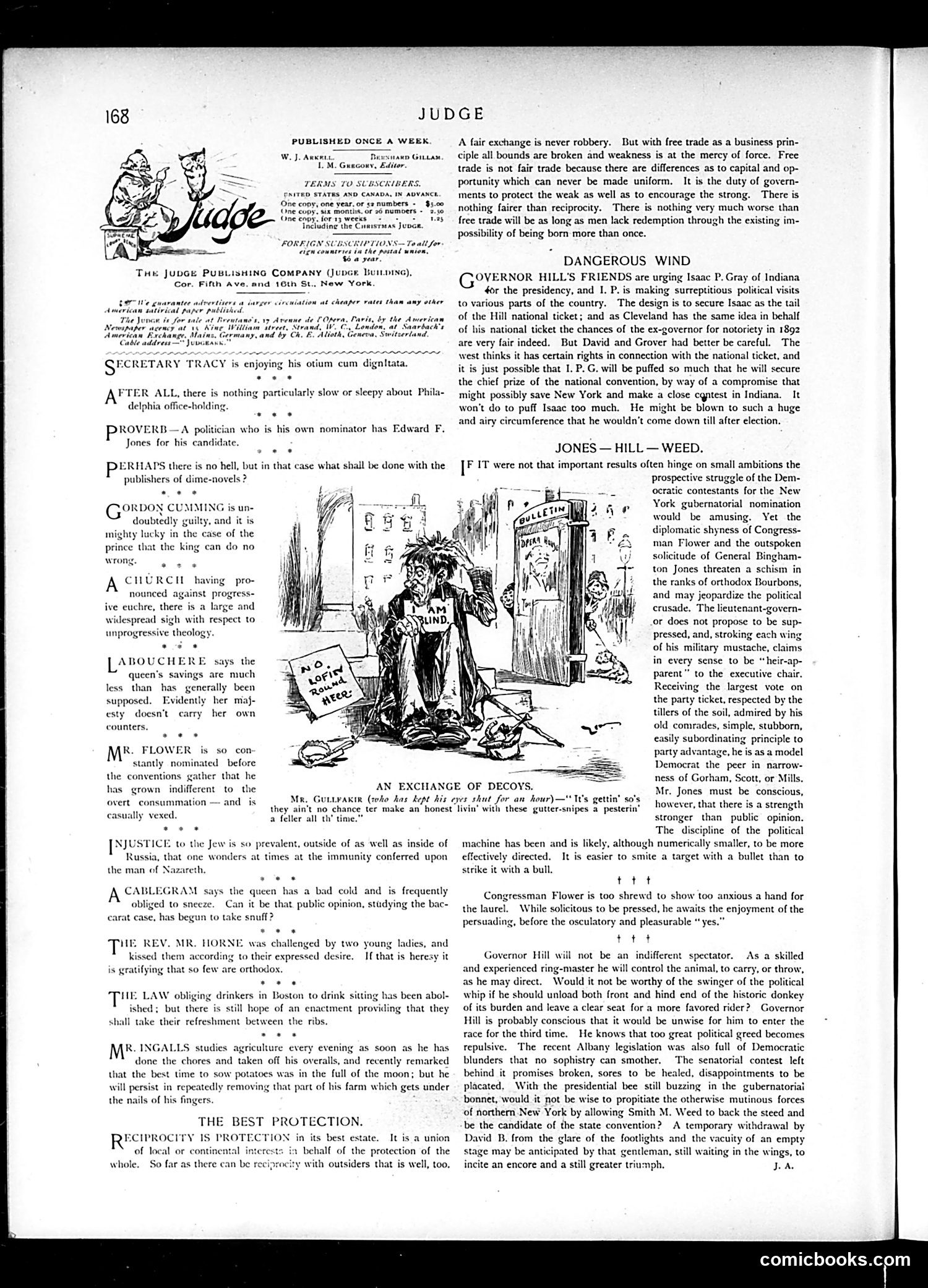
The central cartoon titled "AN EXCHANGE OF DEVOYS" depicts a disheveled figure labeled "SMITH" sitting amid scattered debris and campaign materials. The satire concerns New York Democratic politics, specifically referencing Congressman Flower, General Gould (likely a political figure), and the Democratic nomination struggle. The cartoon mocks internal party dysfunction—suggesting the Democratic Party's leadership is in disarray over the gubernatorial nomination. The figure appears to represent a party operative or candidate trapped in political chaos, surrounded by campaign refuse. The accompanying text criticizes these political figures for their narrow factional disputes ("machine has been and is likely...more effectively directed"), suggesting their internal squabbling weakens Democratic chances in the upcoming election.
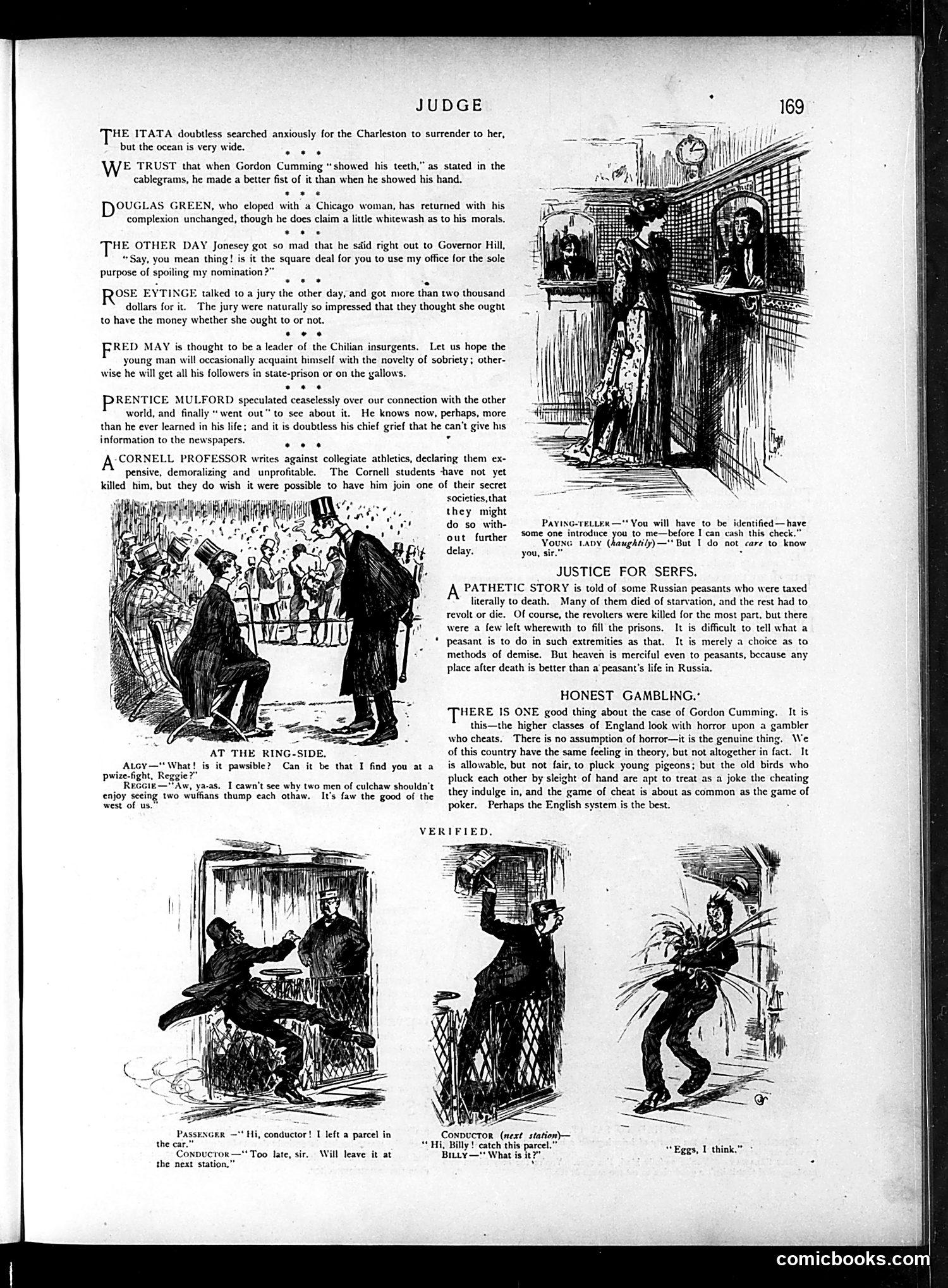
This page contains several brief satirical items and illustrations typical of Judge's format: **Main content includes:** - Short anecdotes mocking various public figures (Douglas Green, Gordon Cumming, Rose Eytinge, Fred May, Prentice Mulford) - A section titled "Justice for Serfs" criticizing Russian peasant conditions - "Honest Gambling" - commentary on cheating and gaming, suggesting English sports culture tolerates deception - Three captioned cartoon vignettes at bottom involving a conductor, passenger, and railway scenarios The page exemplifies Judge's satirical approach: mixing political/social criticism with humorous observations about contemporary society, using brief anecdotes and illustrations to mock hypocrisy, corruption, and cultural absurdities. Without specific dates or clearer context, precise historical references remain unclear, though the content targets 19th-century American and international society.
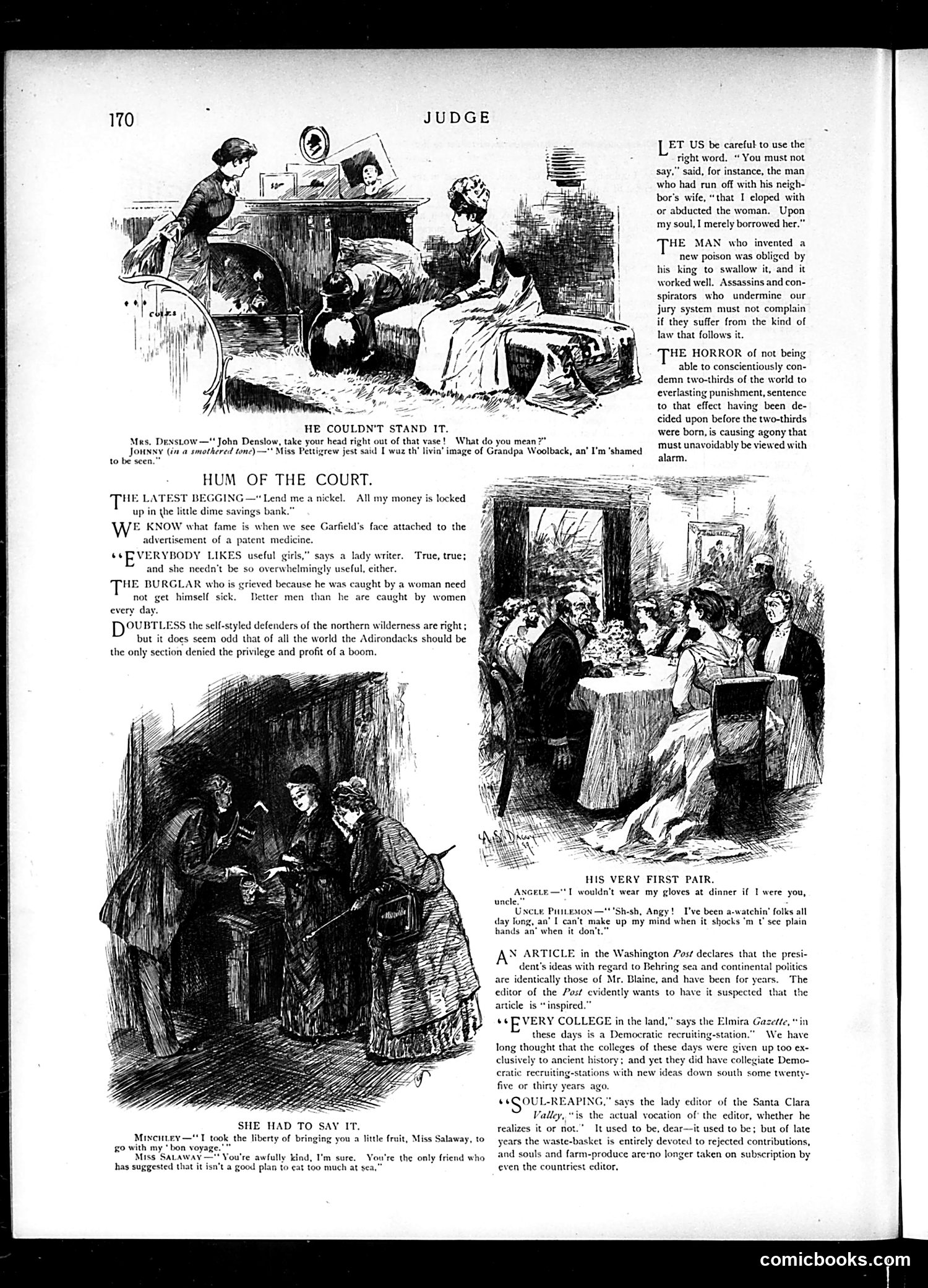
This page from *Judge* contains several brief satirical vignettes mocking social conventions and contemporary figures: **"He Couldn't Stand It"**: A domestic comedy where a boy hides in a vase to avoid a girl (Miss Pettigrew), suggesting awkwardness around courtship. **"Hum of the Court"**: Short witty observations on society, including one referencing **Garfield** (likely President James Garfield, assassinated 1881) endorsing patent medicine—satirizing celebrity endorsements. Another mocks a burglar's complaint about being caught by a woman, implying women are dangerously effective. **"She Had to Say It"**: A farewell scene where a woman awkwardly mentions her suitor's resemblance to "Grandpa Woolback," likely a contemporary figure or type representing unattractiveness. **"His Very First Pair"**: A couple navigates dinner etiquette confusion about wearing gloves. The remaining text includes commentary on the Washington *Post*, college recruiting practices, and editorial practices—typical *Judge* satirical commentary on current events and social absurdities.
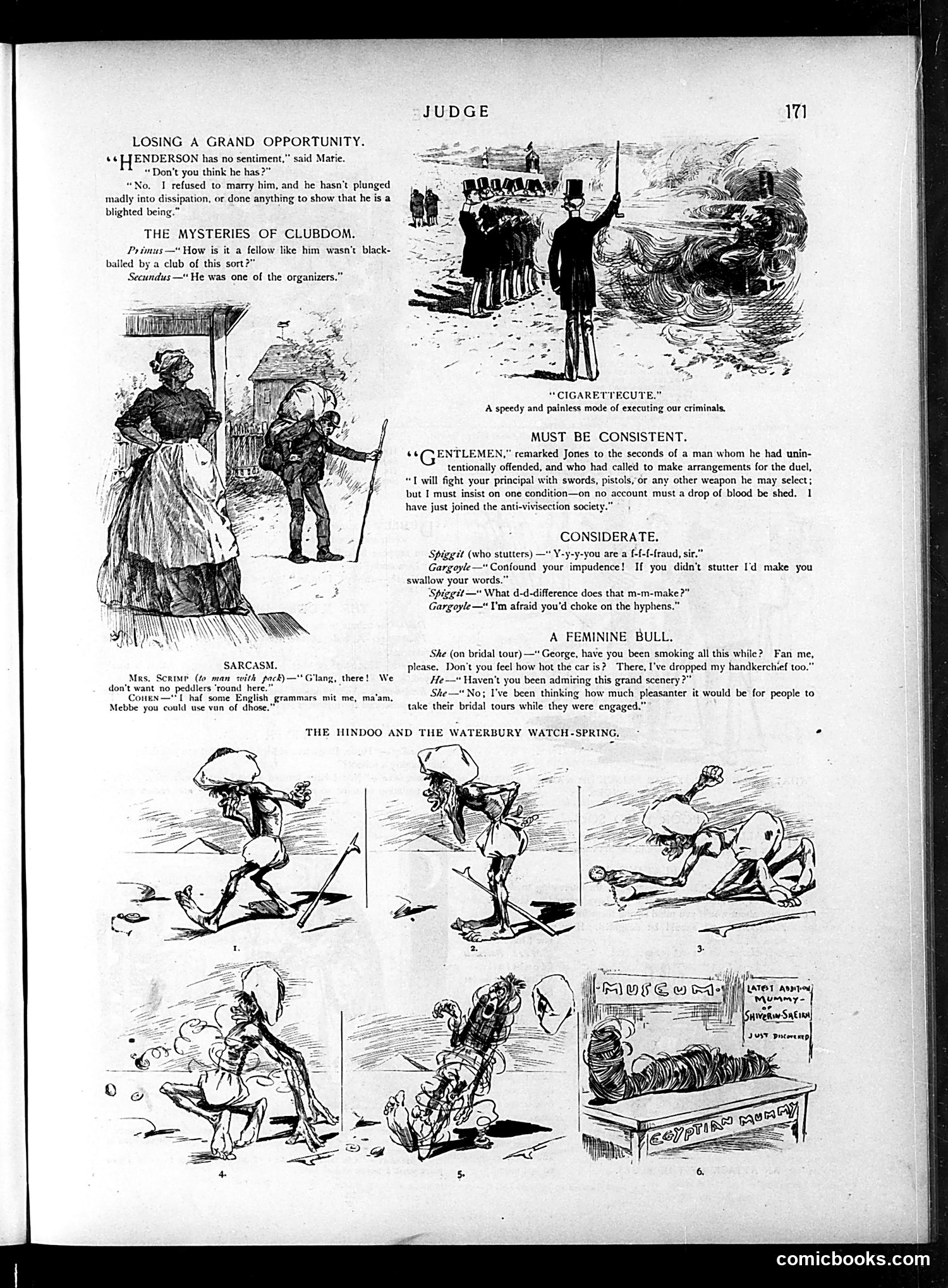
This page collects brief satirical items typical of late-19th-century American humor magazines: **"Losing a Grand Opportunity"** mocks romantic expectations—a woman rejected a man (Henderson), expecting him to become a "blighted being," but he simply moved on, disappointing her sense of drama. **"Mysteries of Clubdom"** jokes that exclusive clubs blackball undesirable members, except founders are protected regardless of character. **"Cigarettecute"** darkly satirizes capital punishment, proposing execution by cigarette smoking as "painless." **"Must Be Consistent"** ironically depicts a man refusing a duel's bloodshed after joining an anti-vivisection society—exposing hypocrisy in selective morality. **"A Feminine Bull"** shows a newlywed wife simultaneously complaining about heat while creating discomfort (dropping handkerchiefs, criticizing scenery), inverting the term's meaning. **"The Hindoo and the Waterbury Watch-Spring"** (bottom comic strip) appears to reference Indian subjects and American watches, likely ethnic comedy typical of the era, though the specific joke is unclear. The page reflects period attitudes: anti-sentimentality, club elitism, capital punishment debates, and ethnic caricature humor.
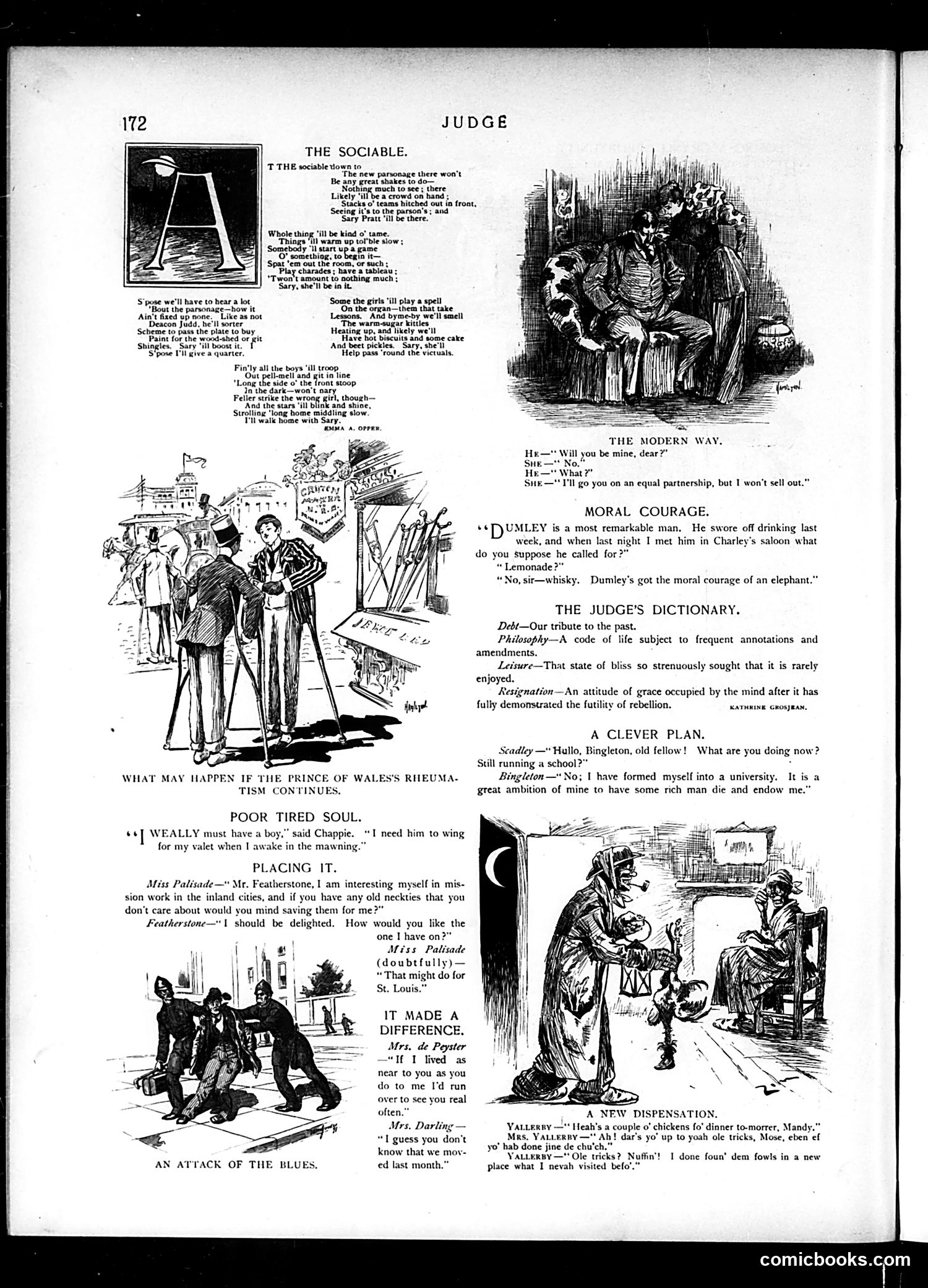
This page from *Judge* magazine contains multiple satirical pieces mocking American social conventions and character types of the era. **"The Sociable"** depicts rural/small-town life, with recurring mention of "Sary" (Sarah), suggesting predictable social rituals at a church parsonage gathering—pie socials, charades, and romantic pairings. **"Moral Courage"** jokes that a man who swore off drinking shows "courage" by ordering whisky anyway—satirizing hollow moral posturing. **"The Modern Way"** mocks contemporary marriage negotiations, with a woman demanding "equal partnership" while refusing to "sell out"—critique of emerging feminist rhetoric treated as transactional. **"Placing It"** and **"It Made a Difference"** are brief social humor about donation-seeking and moving neighborhoods. **"A Clever Plan"** ridicules a schemer posing as university founder hoping for wealthy patronage. **"A New Dispensation"** features a Black character (rendered in period dialect) finding stolen chickens, playing on stereotype humor common to the era. The page reflects turn-of-century anxieties about changing social mores, particularly women's independence and evolving class relations.
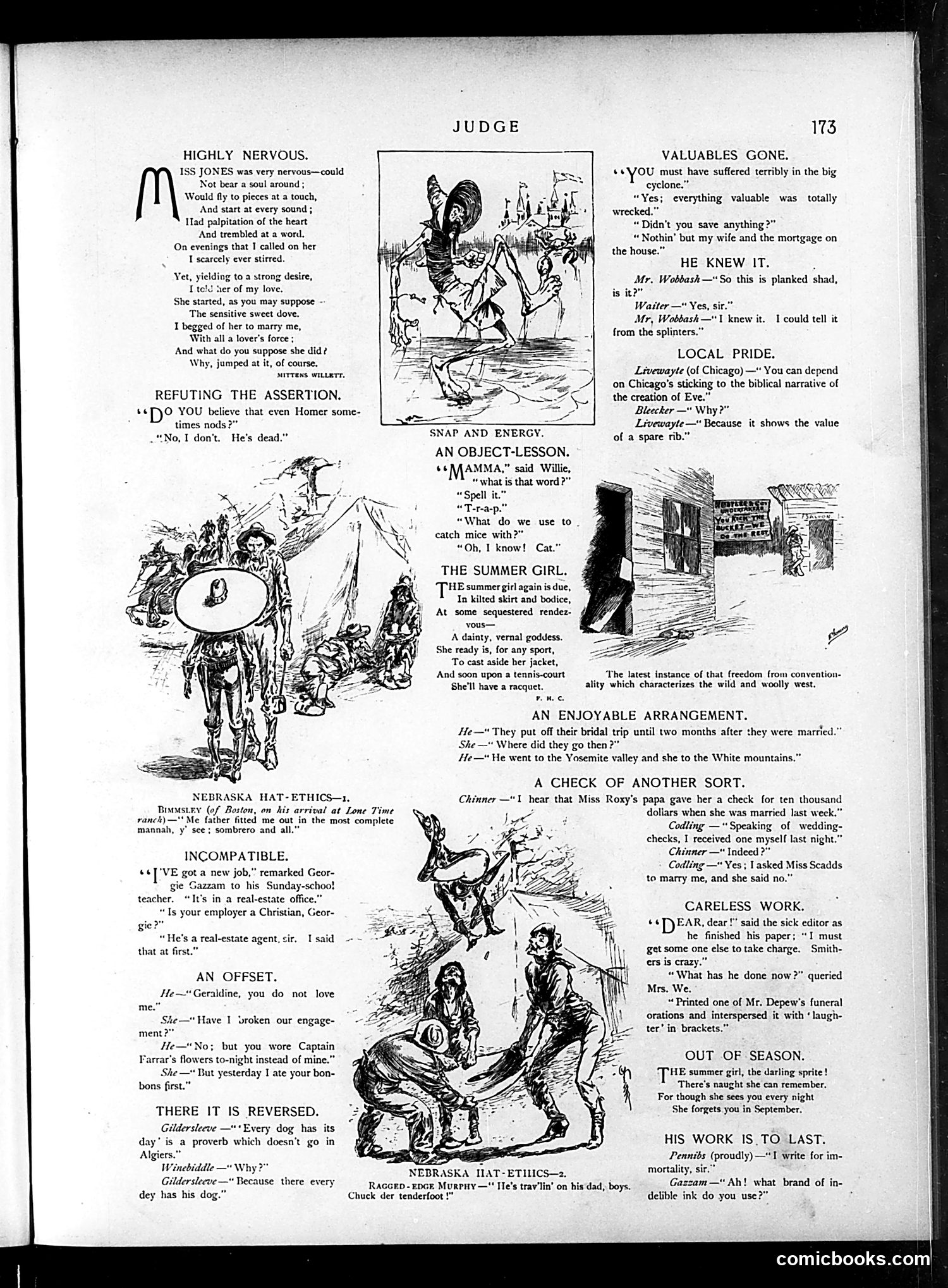
This page from *Judge* magazine contains brief comedic sketches typical of late 19th-century American humor. The jokes rely on domestic situations and social observations: **"Highly Nervous"** plays on the nervous temperament of a woman who ironically jumps at the marriage proposal despite her anxiety. The humor lies in the contradiction. **"Valuables Gone"** satirizes a man who lost everything in a cyclone except his wife and mortgage debt—suggesting the mortgage is as inescapable as an unwanted possession. **"Local Pride"** is Chicago-specific humor about the city's presumed provincialism, linking it to biblical creation mythology. **"The Summer Girl"** depicts the fashionable, athletic young woman of the era in her seasonal, carefree persona. Other sketches mock marital discord, real estate agents, careless newspaper editors, and the fleeting memory of summer romance. The cartoons are primarily domestic satire reflecting middle-class anxieties and social types recognizable to contemporary readers.
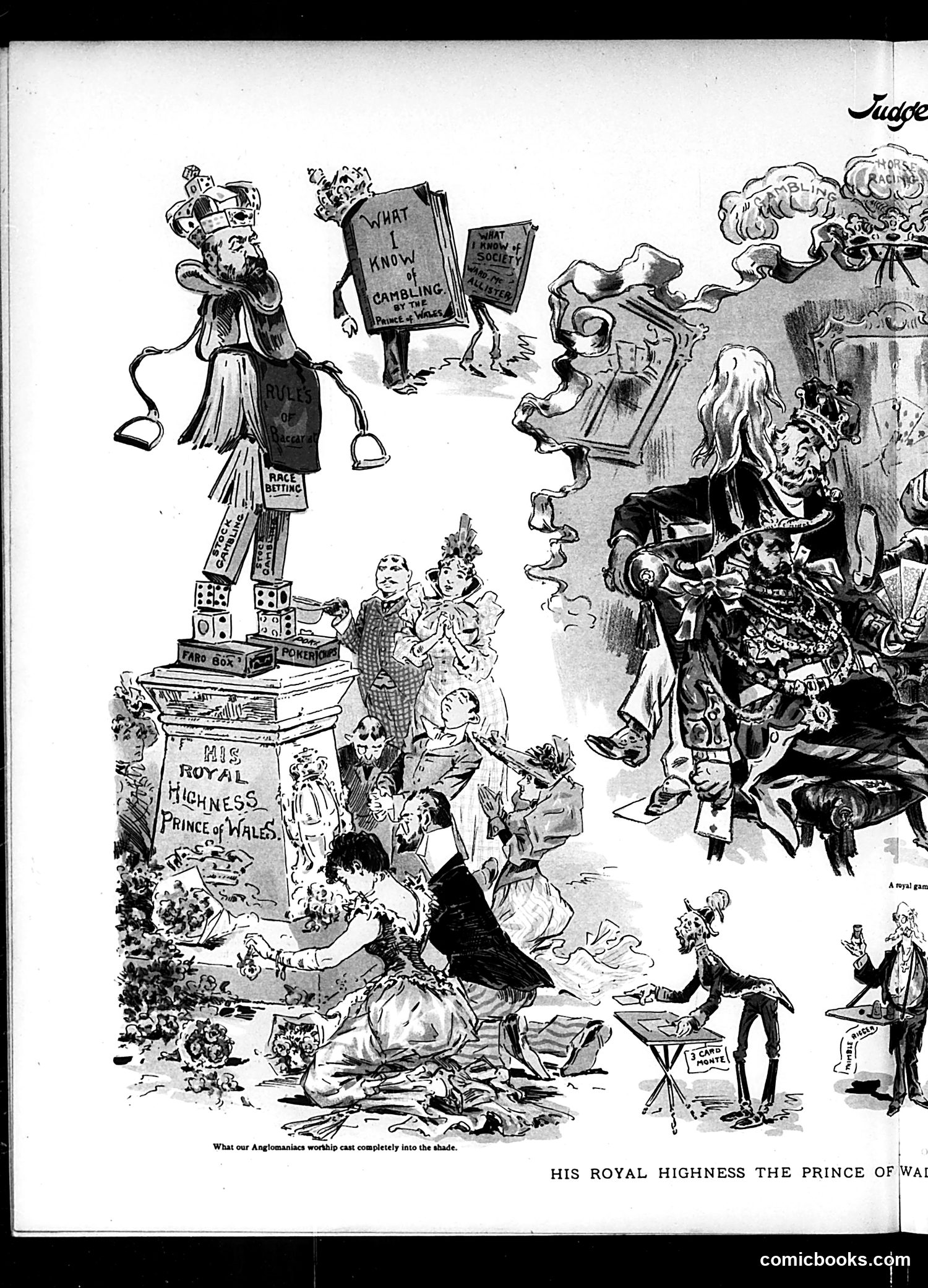
This Judge magazine cartoon satirizes American "Anglomaniacs"—wealthy Americans who excessively admire and imitate British culture and aristocracy. The central tower depicts what American elites "worship," stacked with symbols of British royalty and gambling (dice, playing cards labeled "gambling," references to the Prince of Wales). Below, well-dressed Americans genuflect before this tower of Britishness. The right side shows figures at what appears to be a fancy establishment, mocking the pretentiousness of such devotion. The satire criticizes American social climbers who elevate British royalty and aristocratic culture above American values—suggesting this obsession with British society and its vices (particularly gambling, associated with the dissolute Prince of Wales) represents misplaced national priorities and snobbish behavior among the wealthy.
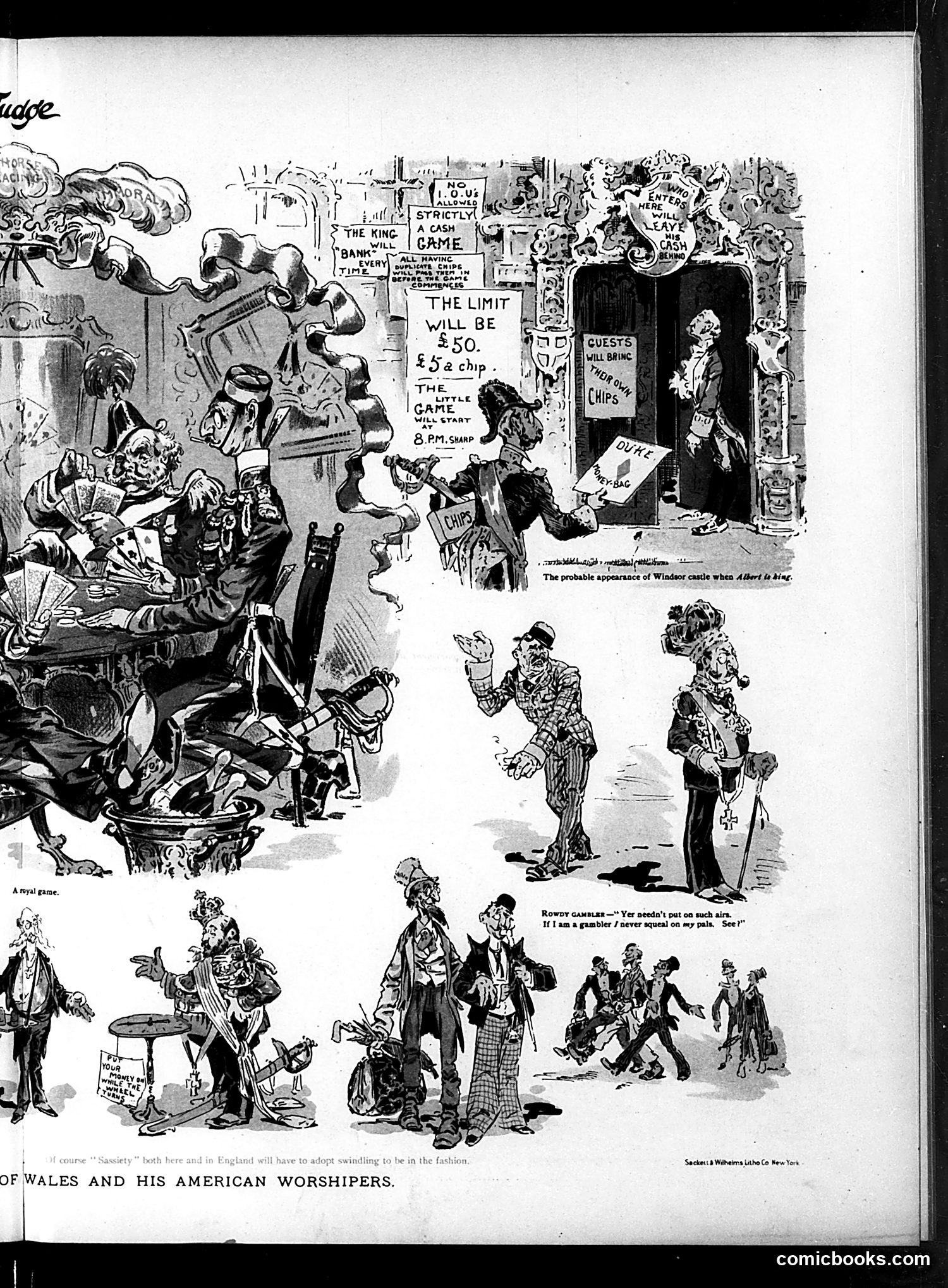
This Judge magazine page satirizes American fascination with British royalty, specifically the Prince of Wales. The title suggests wealthy Americans ("worshipers") fawn over the royal visitor. The central scene depicts a lavish gambling establishment where the Prince of Wales conducts a card game with exaggerated stakes (limit of £50, £5 chip). The cartoon mocks both: 1. **British aristocratic excess** — the ornate, corrupt gambling den 2. **American social climbing** — wealthy Americans desperate to associate with nobility The lower vignettes show various character types (gamblers, hustlers, society figures) discussing the Prince's visit, with one figure proclaiming loyalty among criminals: "If I am a gambler, I never squeal on my pals." The satire targets American reverence for foreign titles and the moral hypocrisy of wealthy elites who embrace royalty despite engaging in questionable behavior themselves. The "worshipers" label is deliberately ironic and contemptuous.
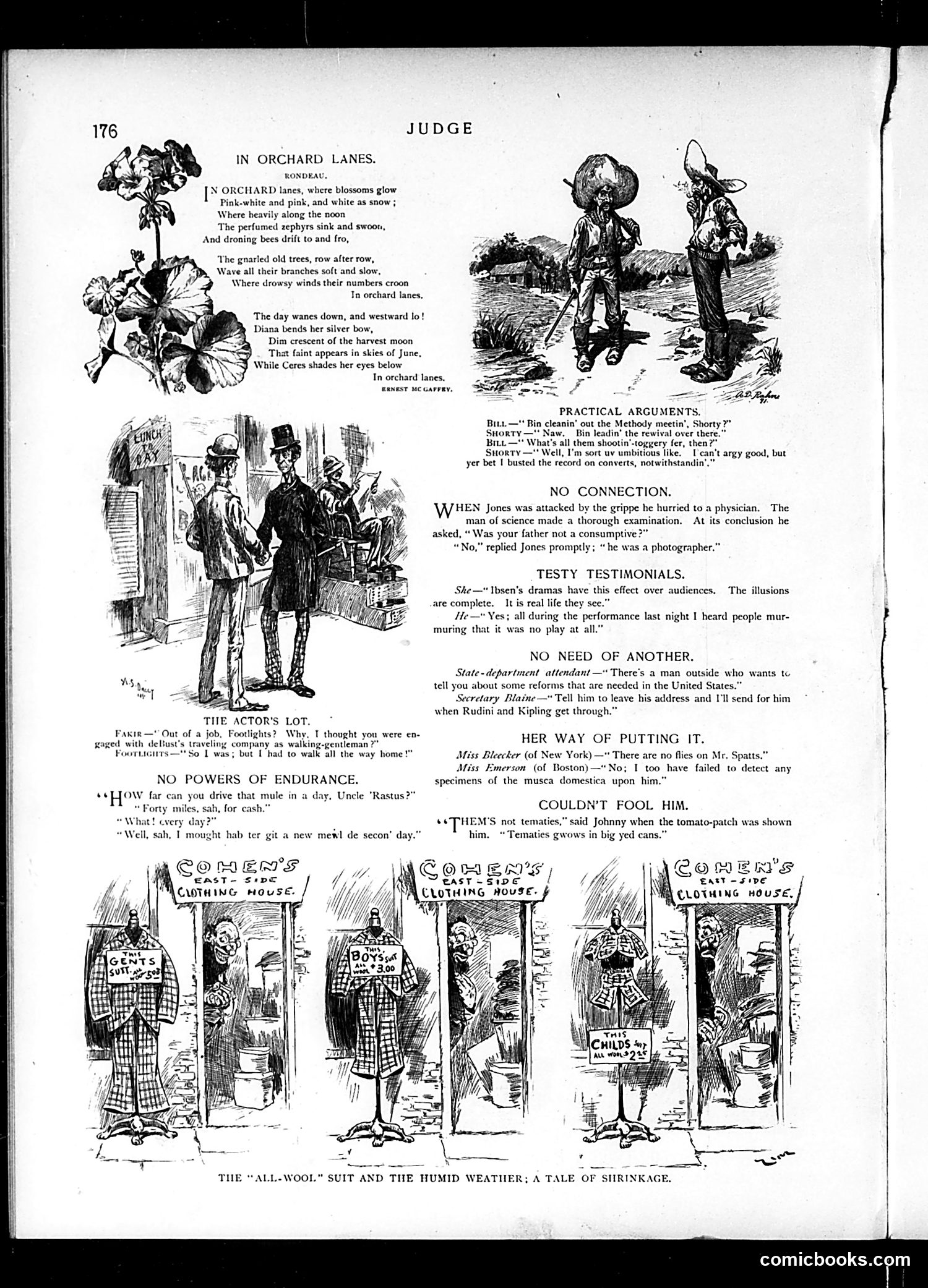
This page from Judge contains multiple satirical pieces targeting American life and politics around the 1880s-90s era. **Key Content:** The top features a romantic poem ("In Orchard Lanes") contrasting sharply with crude humor below—a common Judge format juxtaposing high and low culture. **Specific Jokes:** - A revival preacher carrying guns claims converting souls while armed ("shootin'-toggery") - A medical joke: Jones's father was a photographer, not consumptive—satirizing superficial medical reasoning - References to Secretary Blaine and political figures (Rudini, Kipling) being too busy for reform suggestions - The three-panel comic about "all-wool" suits shrinking in humid weather shows a man progressively smaller in labeled changing rooms (Gents, Boys, Childs), mocking cheap clothing fraud **Social Satire:** The humor targets religious hypocrisy, incompetent medicine, political indifference to reform, and consumer fraud—typical Judge concerns. The racist dialect humor reflects period prejudices. The overall effect mocks American institutions through exaggeration and absurdist logic.
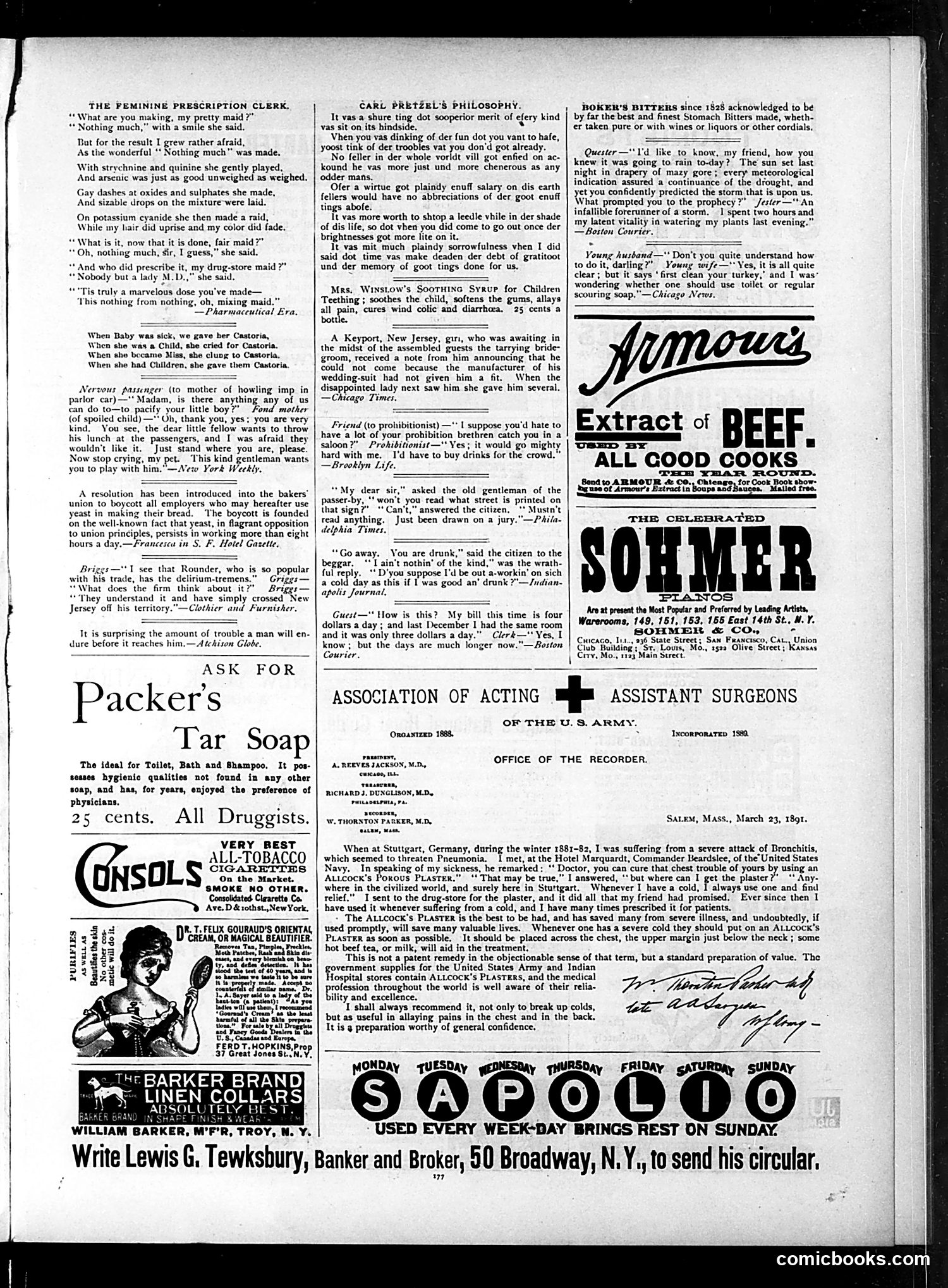
This page is primarily **advertisements and light humor pieces** rather than political satire. The main content includes: **"The Feminine Prescription Clerk"** — A darkly comic poem mocking female pharmacy workers. The joke relies on period anxieties about women in professional roles; the speaker nervously watches a woman pharmacist casually mix dangerous chemicals (strychnine, arsenic, cyanide) with comic incompetence, then dismissively calls it "nothing much." The humor depends on stereotypes about women's carelessness and unfitness for technical work. **Other items** include doggerel about Castoria (a children's laxative), a joke about a spoiled child, and "Carl Pretzel's Philosophy"—malapropism-laden wisdom from a German-accented character—a common ethnic humor trope of the era. The page is otherwise filled with **patent medicine advertisements** (Boker's Bitters, Dr. Gouraud's skin cream, Packer's Tar Soap), reflecting Judge's era when such ads dominated magazines and dubious remedies were openly marketed.
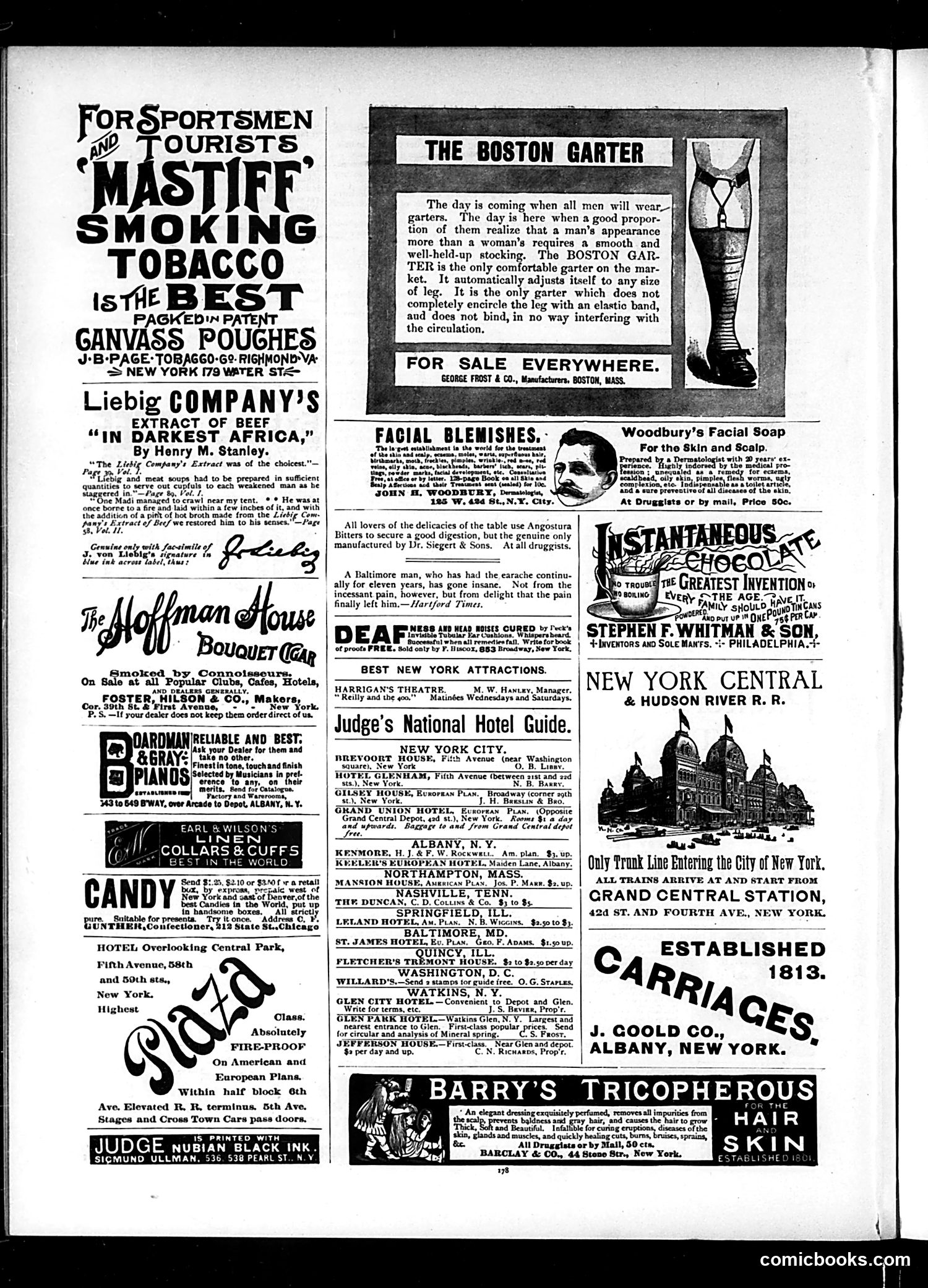
This page is primarily **advertising, not political satire**. It contains commercial advertisements from Judge magazine, likely from the late 19th or early 20th century. The ads promote period products: Mastiff smoking tobacco, Liebig beef extract (endorsed via Henry Stanley's African exploration narrative), the Hoffman House cigar, Boston Garters, Woodbury's Facial Soap, and various hotels and services. **Notable social context**: The Boston Garter ad reveals contemporary attitudes about masculine appearance and leg support—marketed as a modern concern for men's self-presentation. The Stanley reference trades on Victorian-era fascination with African exploration and colonial adventure. The page also includes practical travel information: hotel guides and New York Central Railroad advertising, reflecting Judge's readership of affluent urban travelers. There is **no discernible political cartoon or satire** on this page—it functions as a commercial directory disguised within editorial framing.
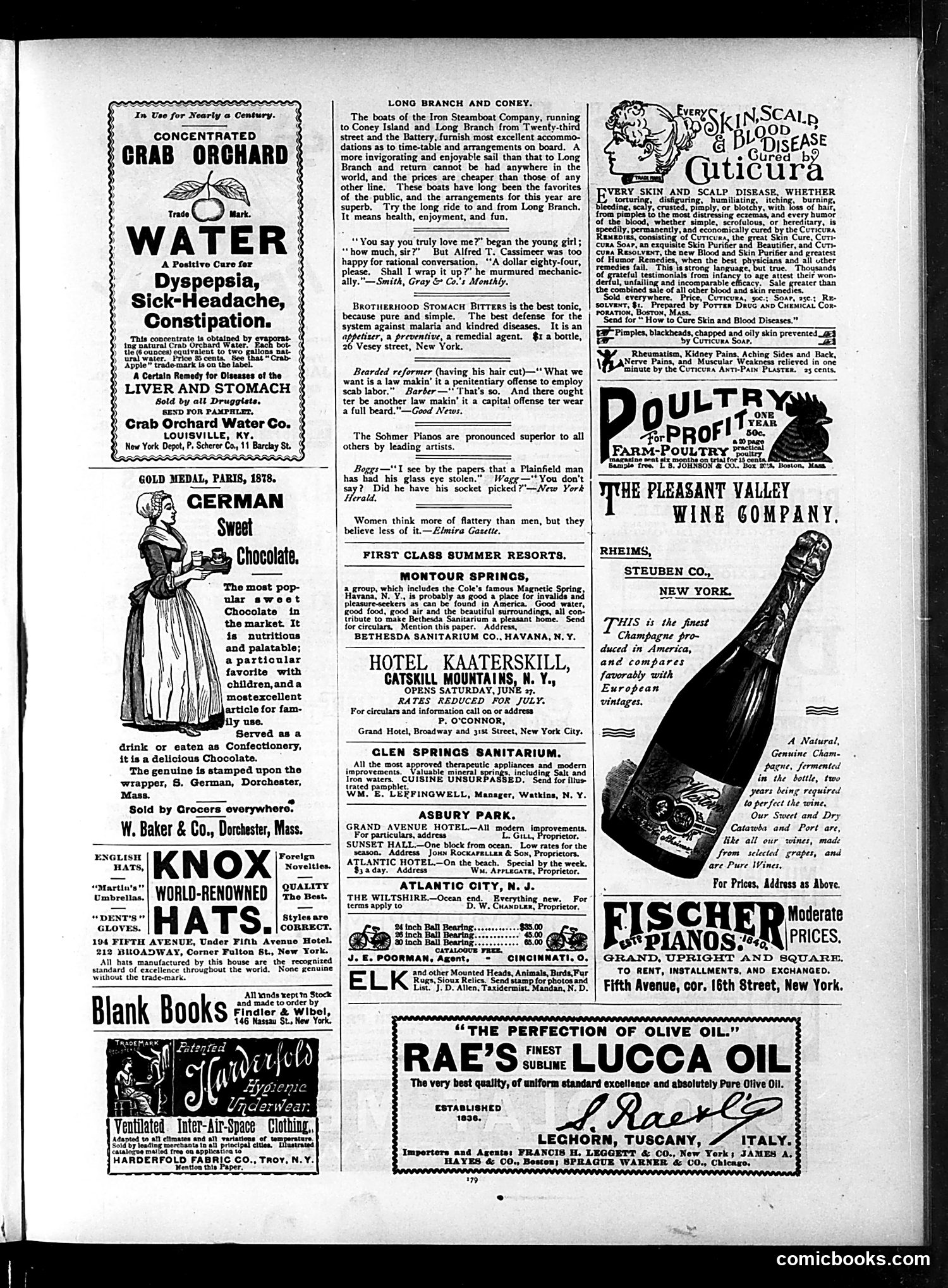
This page consists primarily of **period advertisements**—including patent medicines (Crab Orchard Water, German Sweet Chocolate, Brotherhood Stomach Bitters), pianos, hats, hotels, and other goods typical of the era. There are **no significant political cartoons** on this page. The page contains several brief **joke items**, including: - A young couple's romantic exchange interrupted by a shopkeeper's mundane request ("A dollar eighty-four, please") - A barber joke about labor laws and beards - Puns about a stolen glass eye and "socket picked" These humor pieces reflect mild social commentary: the shopkeeper joke satirizes commercial banality intruding on romance; the barber's quip suggests reformist labor activists might face ridicule. The glass-eye pun is simply wordplay. None represents substantial political satire. This appears to be primarily a **revenue page** featuring classified advertising, a standard feature in Judge magazine's layout.
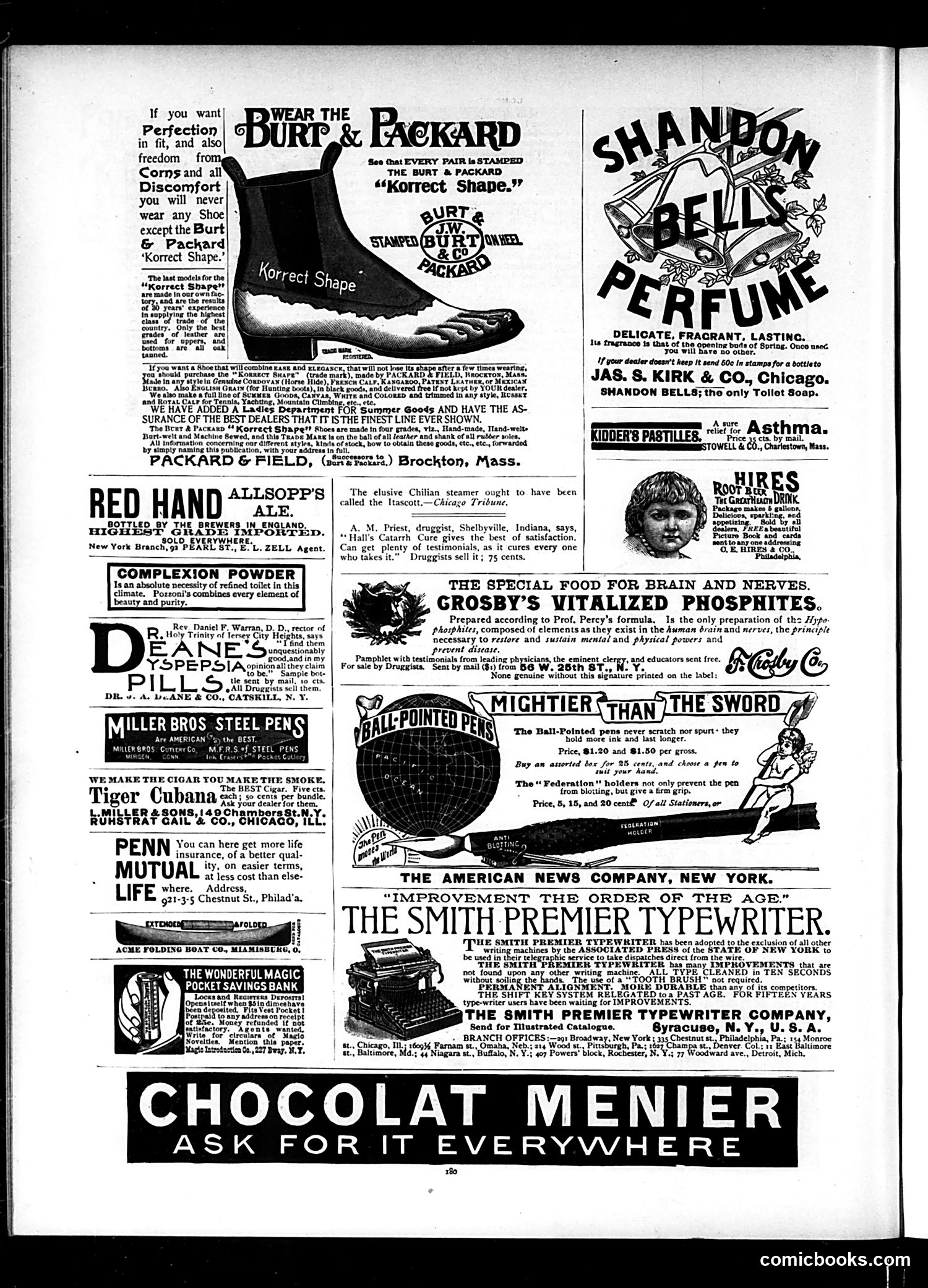
This is primarily an **advertising page** from Judge magazine, not a satirical cartoon page. It contains numerous product advertisements typical of late 19th-century American periodicals. **Key advertisements visible:** - **Burt & Packard shoes** ("Korrect Shape") - emphasizing proper foot support - **Shandon Bells toilet soap** - marketed as fragrant and lasting - **Smith Premier typewriter** - notably adopted by the Associated Press of New York - **Various patent medicines**: Dr. DeAne's pills for dyspepsia, Hall's Catarrh Cure, Crosby's Vitalized Phosphites (a "brain food") - **Complexion powder, steel pens, cigars, and insurance** **Social context for modern readers:** These ads reflect the period's obsession with "improvements" and remedies—medical quackery was rampant, typewriters represented cutting-edge technology, and personal grooming products catered to middle-class aspirations. The page's motto ("Improvement the Order of the Age") captures the era's faith in progress through consumption. No political satire is evident here.
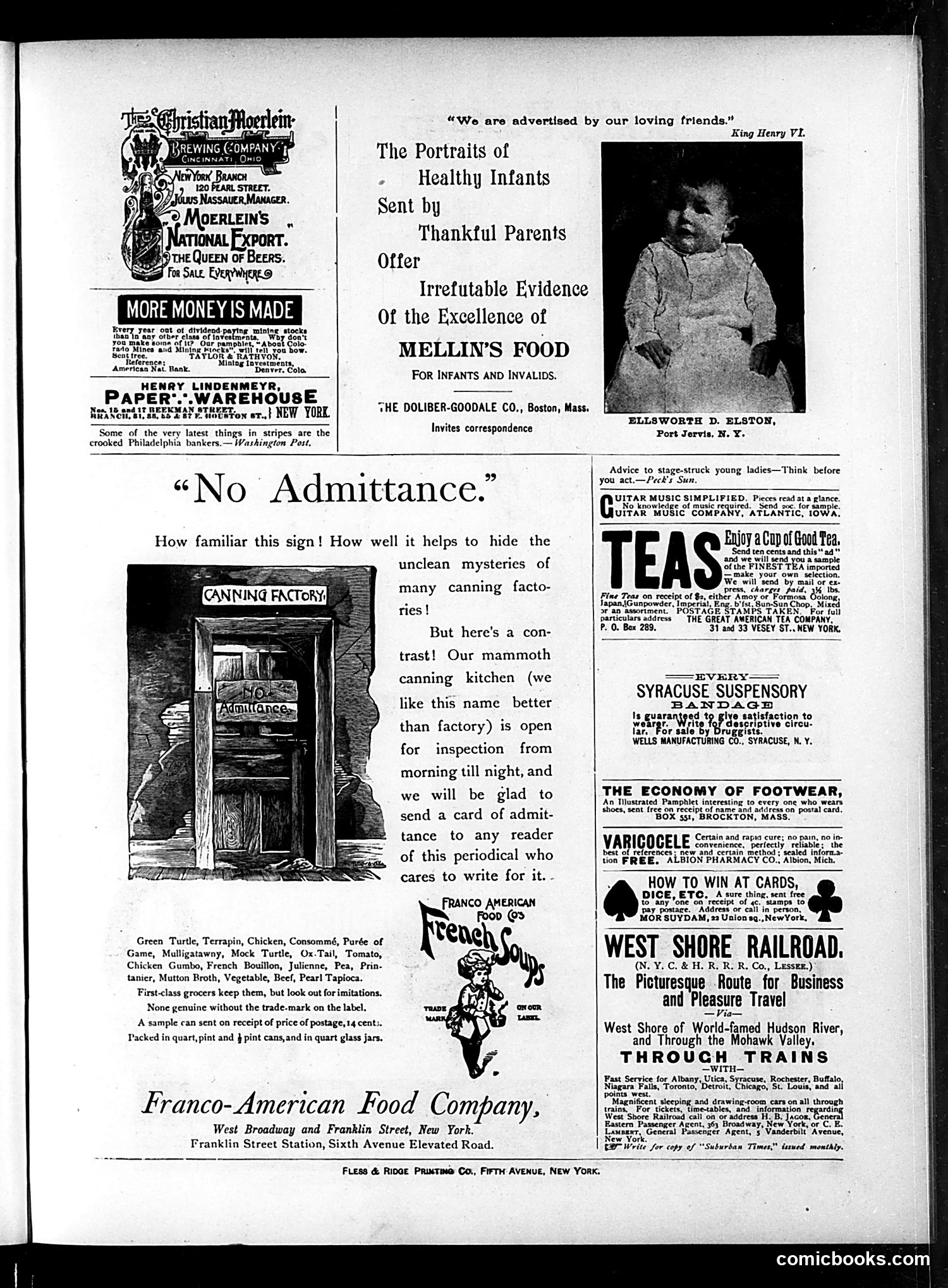
This page is **primarily advertising** with one minor editorial cartoon. The main visual satire is the small cartoon titled **"No Admittance,"** showing a factory door marked "Admittance" sealed shut. The cartoon's point: It sarcastically critiques canning factories that hide their operations from public view. The accompanying text explains the contrast—while most canning facilities post "No Admittance" signs to conceal "unclean mysteries," the Franco-American Food Company claims to keep its "mammoth canning kitchen" open for inspection day and night. This reflects **Progressive Era concerns** (early 1900s) about food safety and factory conditions, likely referencing scandals like Upton Sinclair's *The Jungle* (1906), which exposed meatpacking industry horrors. The satire suggests companies marketing cleanliness and transparency were unusual enough to advertise as a selling point. The remainder of the page consists entirely of product advertisements for patent medicines, food products, railroads, and various services—typical Judge magazine content of the era.
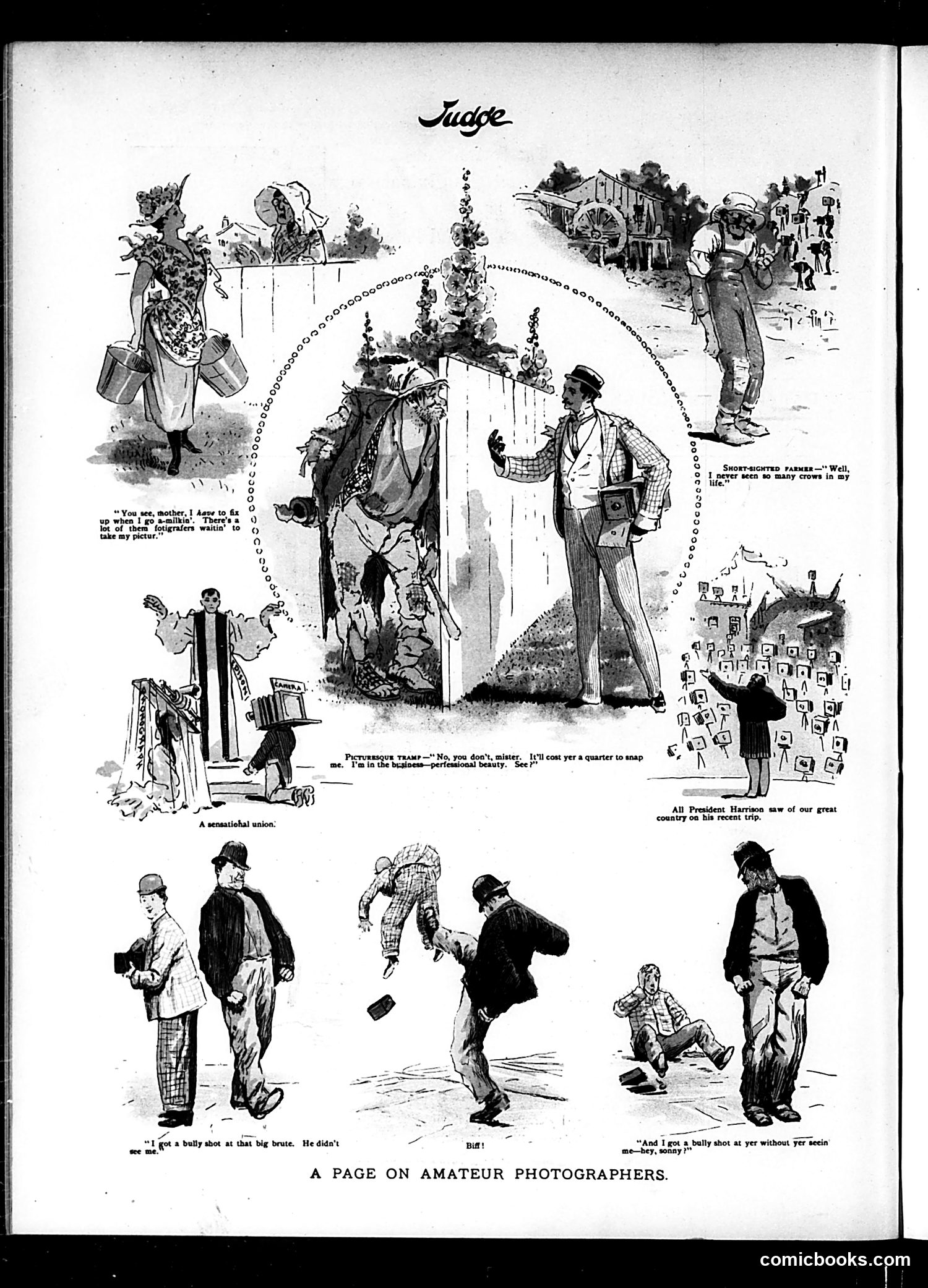
This satirical page mocks the growing craze of amateur photography in the late 19th century. The central theme shows how enthusiastic but clumsy amateur photographers intrude upon everyday life with their cameras, treating subjects—people, animals, even professional performers—as objects to photograph without permission or consideration. The vignettes depict various offenses: a short-sighted farmer photographing crows, a professional dancer/performer demanding payment ("I'm in the business"), and amateur photographers pursuing subjects who object ("without yer seein me—hey, sonny?"). The reference to "President Harrison saw of our great country on his recent trip" appears to satirize how photographers obsessively document everything rather than experiencing it directly. The overall joke: amateur photography had become so widespread and socially oblivious that photographers were becoming public nuisances, invading privacy and interfering with normal life in pursuit of snapshots.