
A complete issue · 20 pages · 1891
Judge — May 2, 1891
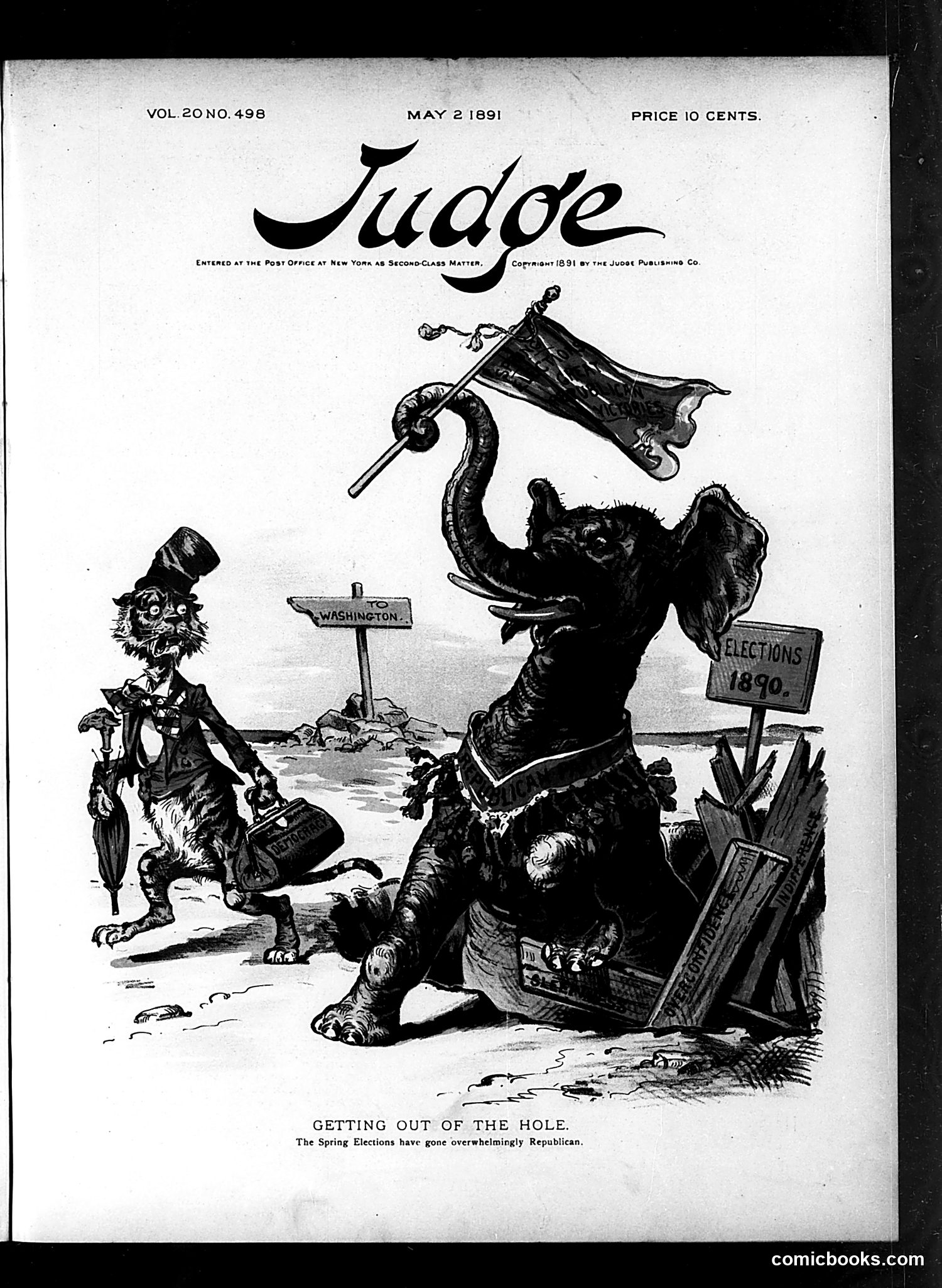
This is a Judge magazine cover from May 2, 1891, satirizing the 1890 spring elections' overwhelming Republican victories. The caption reads: "The Spring Elections have gone overwhelmingly Republican." The cartoon depicts a Democratic donkey (the party's symbol) struggling to climb out of a hole, while a ragged Democratic figure with a top hat stands nearby looking dejected. Signs reading "Washington" and "Elections 1890" mark the scene. The donkey holds a tattered flag, suggesting the party's weakened state. The satire mocks the Democrats' electoral defeat and their difficult position afterward. The "hole" represents their political predicament—they must work hard to recover from their losses. This reflects the actual 1890 congressional elections where Republicans made significant gains.
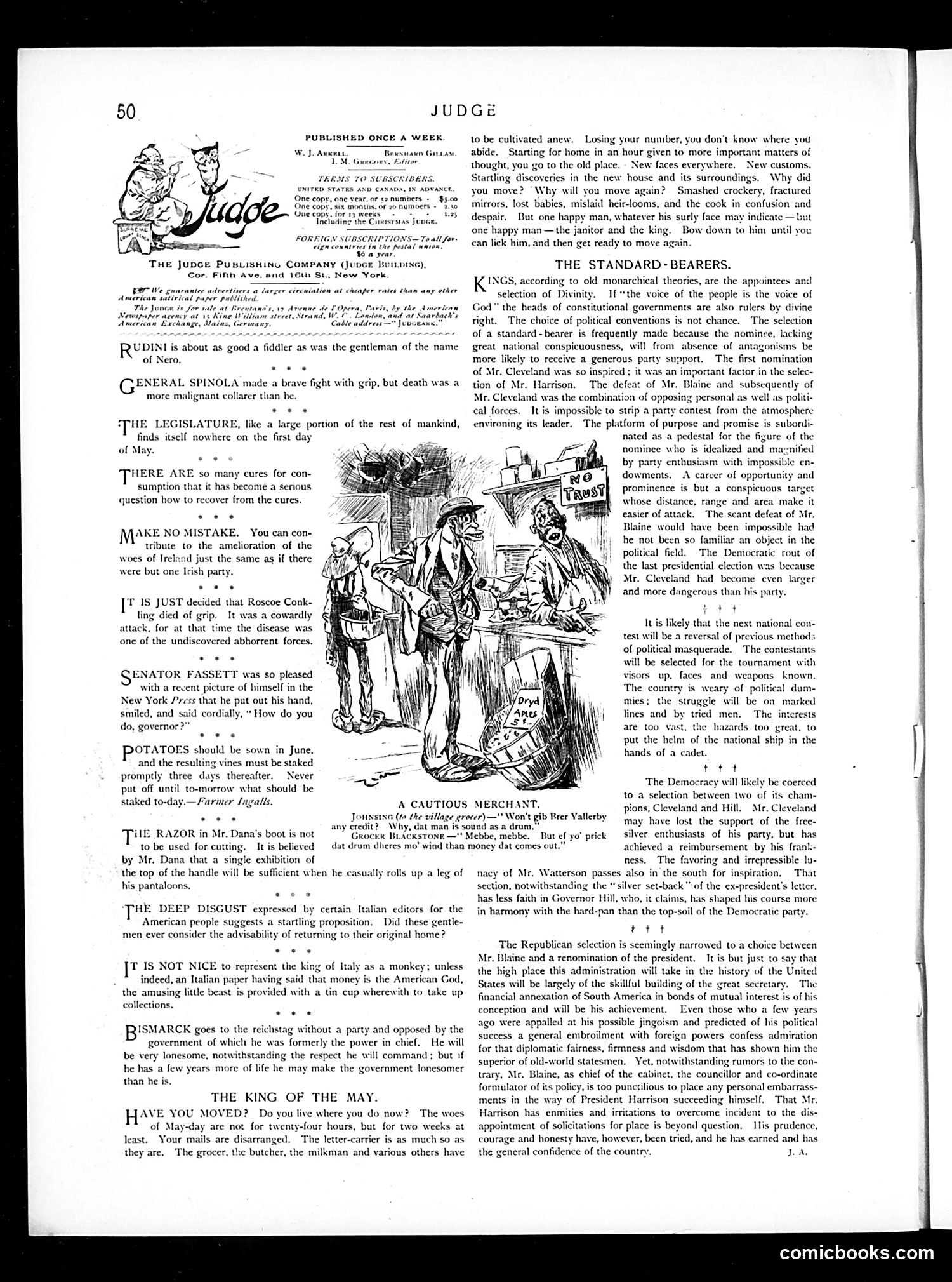
This page contains political commentary on the 1892 presidential election. "The Standard-Bearers" section discusses Cleveland and Harrison as the Democratic and Republican nominees. The text criticizes Cleveland's political vulnerability while praising Harrison's cabinet, particularly Secretary of State Blaine. The cartoon "A Cautious Merchant" (bottom) shows a village grocer warning someone about "river Valleby" and money/drums, likely satirizing economic concerns or political rhetoric of the era. Other brief items mock various political figures and situations—Senator Fassett, Italian editors, and government inefficiency. The page's tone is conservative-leaning Republican, supporting Harrison's administration while questioning Cleveland's fitness for office. Without clearer image resolution, specific figure identifications in the cartoon remain uncertain.
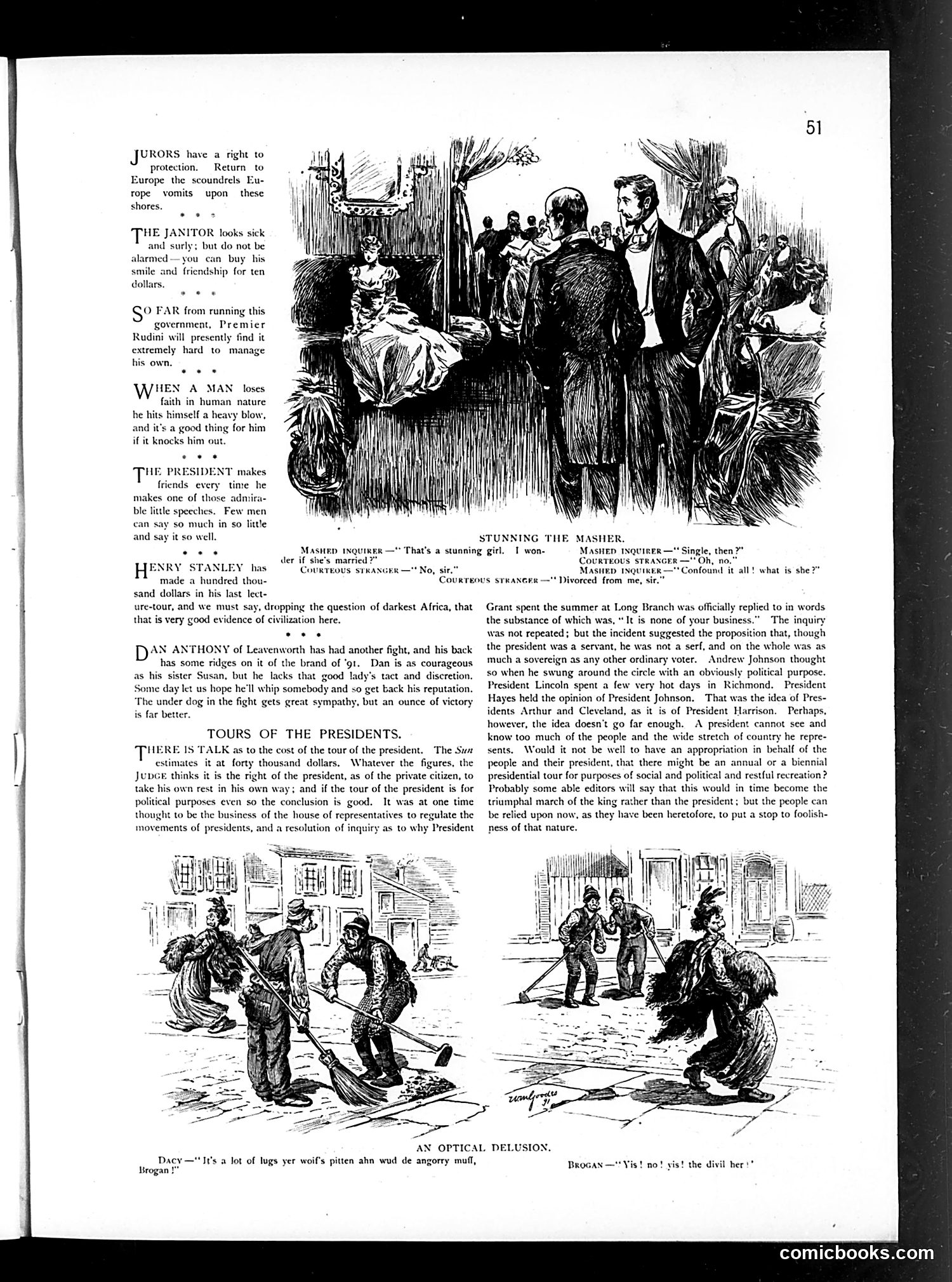
This page contains several satirical pieces about late 19th-century American politics and society. The main cartoon, "STUNNING THE MASTER," depicts a woman addressing male politicians, with dialogue suggesting she's shocking them with her presence or opinions—likely commentary on women's emerging political voice. The text sections mock various political figures and institutions: President Lincoln's speaking habits, Henry Stanley's African explorations, and presidential touring expenses. The lower cartoons titled "AN OFFICIAL DELUSION" show workers or janitors, with dialogue suggesting they're being fooled about government efficiency. The overall theme critiques governmental inefficiency, excess spending, and the disconnect between political leaders and ordinary citizens—concerns that dominated Gilded Age satirical journalism.
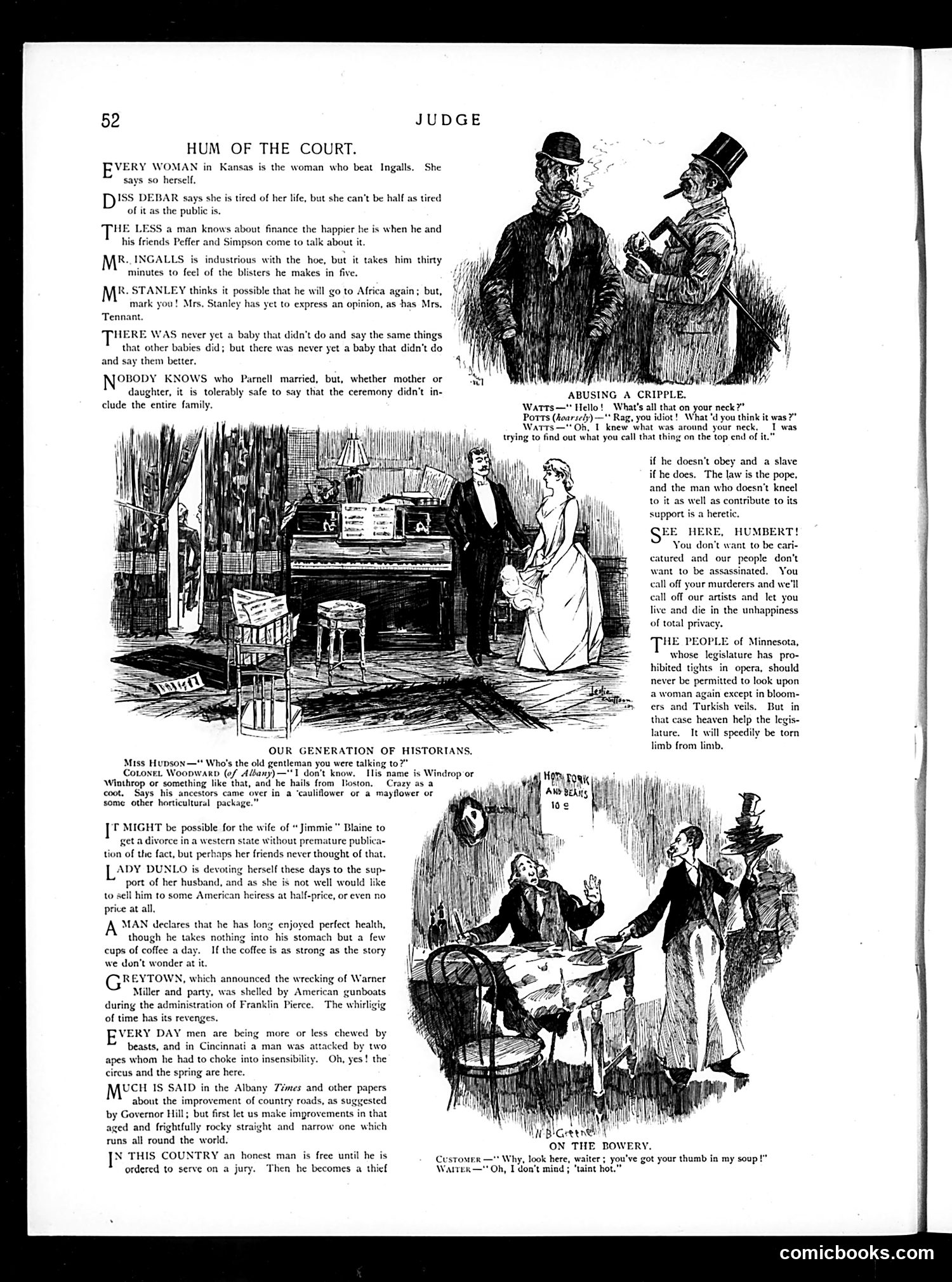
This page from *Judge* contains several satirical commentary pieces and cartoons mocking contemporary political and social figures: **"Abusing a Cripple"** depicts a man harassing someone about a neck rag, representing mockery of disabled persons—a common target of Victorian-era satirists. **"Our Generation of Historians"** ridicules vague family genealogy, with Miss Hudson dismissing an acquaintance whose ancestor arrived via "cauliflower or mayflower"—satirizing Americans' fuzzy grasp of their own heritage. The text includes jabs at Kansas politicians (Ingalls, Peffer, Simpson), actress Miss Debar, and references to Charles Stewart Parnell's controversial marriage. **"The Bowery" sketch** shows a waiter with his thumb in soup—a slapstick joke about service-industry incompetence. A longer piece criticizes Minnesota's legislature for banning stage tights, sarcastically suggesting women wear bloomers and veils instead. Overall, the page represents *Judge*'s mix of political commentary, social satire, and crude humor typical of 1880s-90s American satirical journalism.
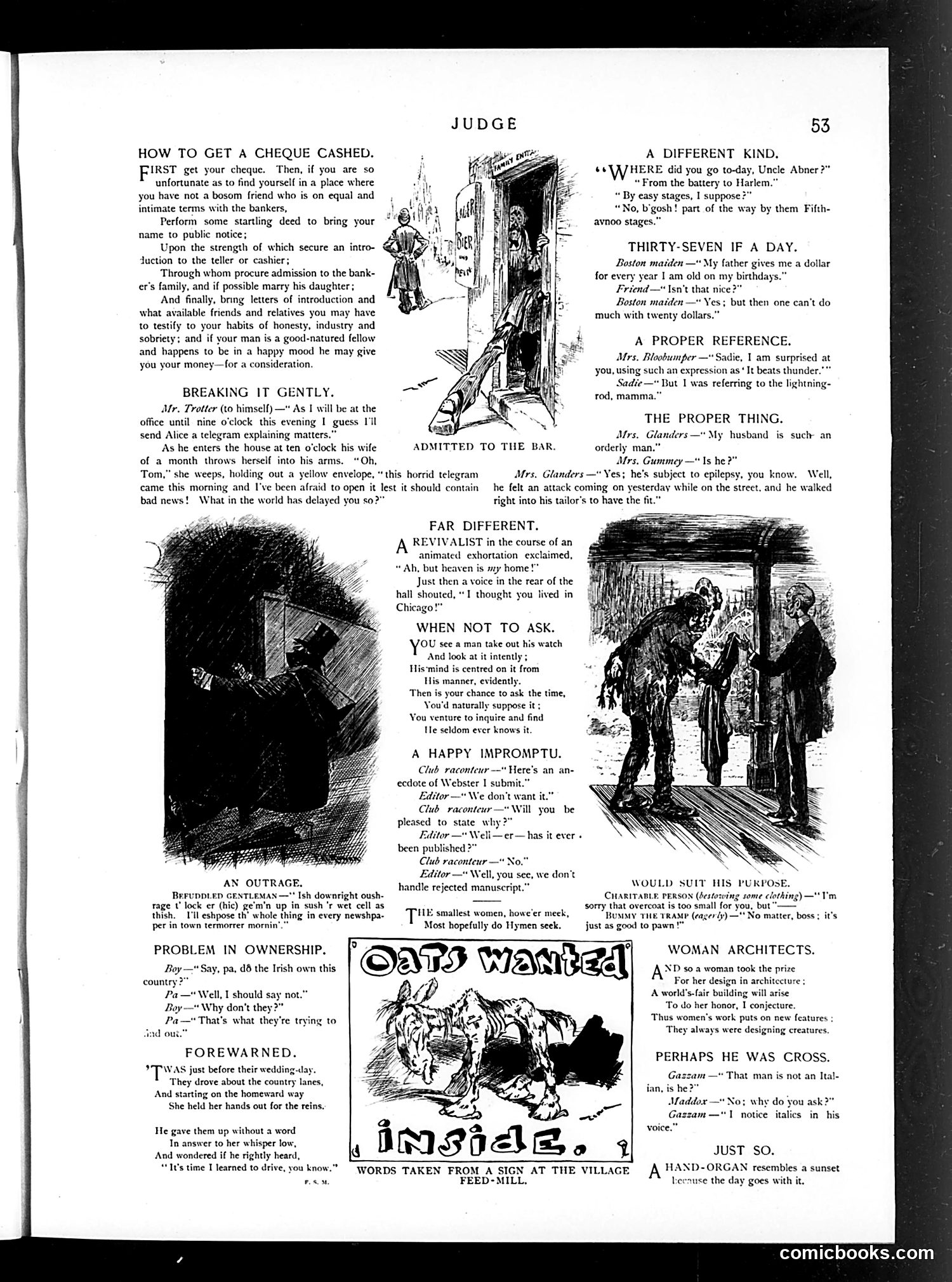
This page from *Judge* contains a collection of brief humorous sketches and one-liners typical of the satirical magazine's format. The cartoons mock everyday social situations and American life: **"How to Get a Cheque Cashed"** satirizes the difficulty of banking without personal connections—suggesting one must perform dramatic deeds, marry the banker's daughter, or provide countless character references just to access one's own money. This reflects genuine banking practices of the era requiring extensive personal introductions. **Other sketches** humorously target social absurdities: a wife's dramatic misunderstanding of a delayed telegram, a drunk's complaint about arrest, a Boston woman's mathematical confusion about age-based allowances, and various etiquette violations. The illustrated anecdotes ("Admitted to the Bar," "Far Different," "Would Suit His Purpose") use visual humor alongside text. There's also an advertisement for "Oats Wanted" featuring a dog. Overall, the page represents *Judge*'s typical approach: gentle social satire aimed at middle-class readers, mocking pretension, banking inconvenience, and social protocol rather than political issues.
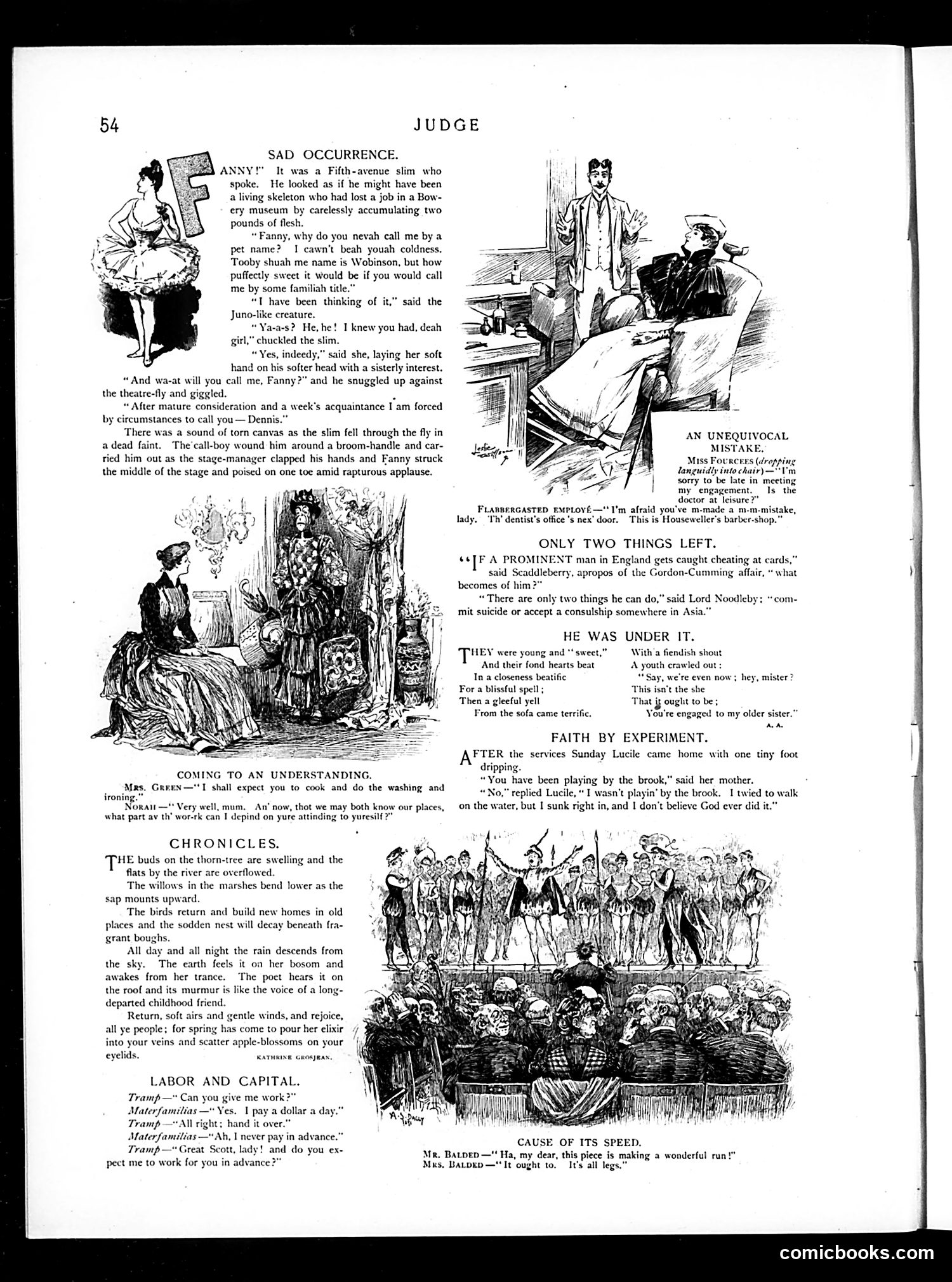
This page from *Judge* contains several satirical pieces targeting upper-class affectation and social pretension: **"Sad Occurrence"**: Mocks theatrical types and affected speech. A thin, fashionable man ("Fifth-avenue slim") uses exaggerated upper-class dialect ("cawn't beah youah coldness," "puffectly sweet"). After a week's acquaintance, his actress girlfriend names him "Dennis"—apparently a devastating insult suggesting he's ordinary/common, causing him to faint dramatically on stage. **"To An Understanding"**: A domestic servant negotiates with her employer about duties and payment, asserting her dignity through Irish dialect humor. **"Labor and Capital"**: Satirizes class exploitation—a wealthy woman refuses to pay a tramp in advance for work, while he points out the unfairness. **"Only Two Things Left"**: References the Gordon-Cumming scandal (British aristocratic card-cheating case), suggesting disgrace leaves only suicide or colonial exile. **Minor pieces** mock misunderstandings, romantic entanglement, and childhood faith through situational humor. The overall tone targets pretentious wealthy people while sympathizing with working-class dignity.
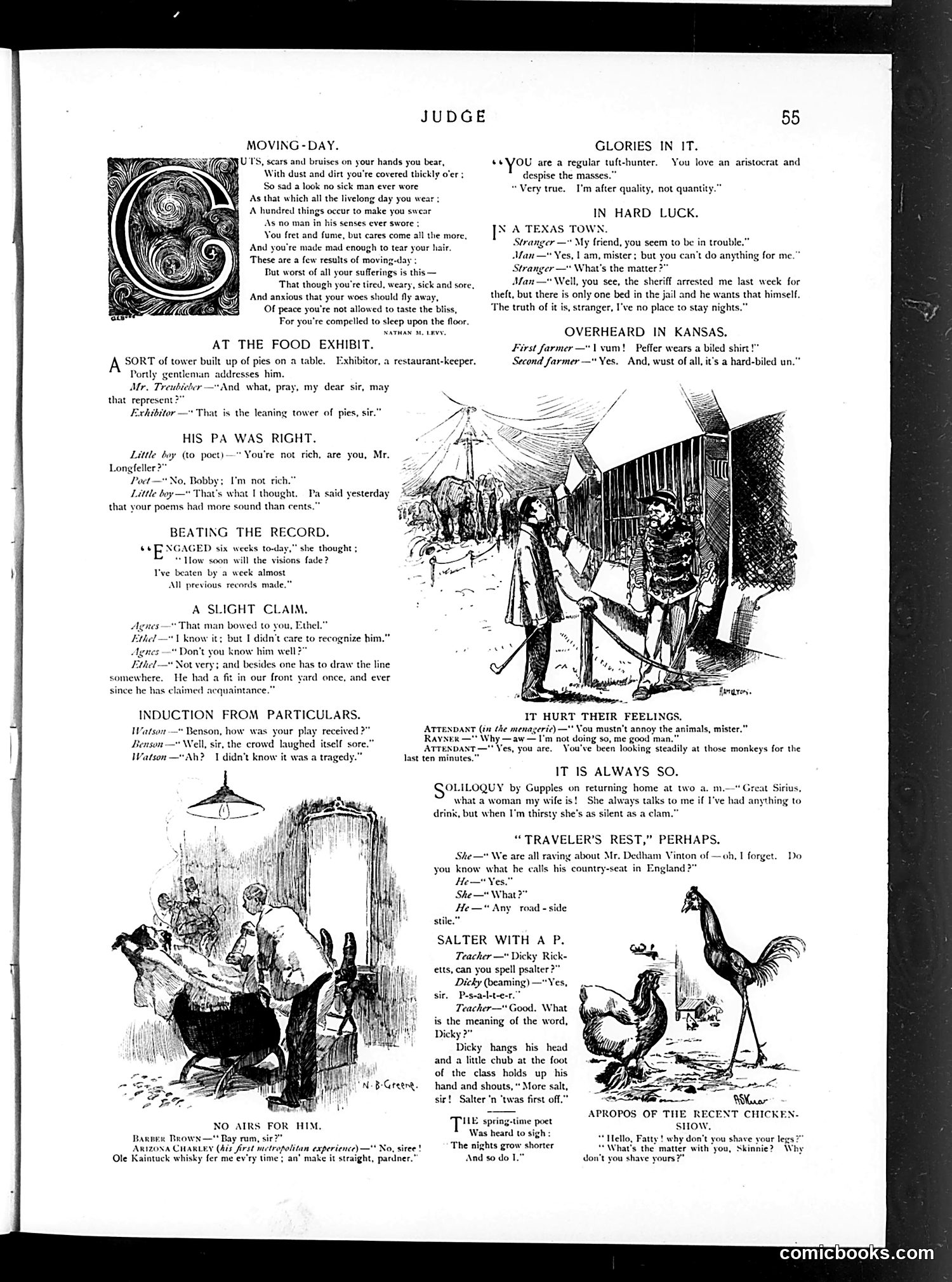
This page from Judge magazine (undated, but likely early-to-mid 20th century based on style) contains numerous brief humorous sketches and satirical observations rather than one major cartoon. Key content includes: **Social satire**: "Moving-Day" mocks the exhausting chaos of relocating; "At the Food Exhibit" jokes about a restaurant keeper's "leaning tower of pies"; "A Slight Claim" ridicules social climbing and drawing class lines. **Political reference**: "Overheard in Kansas" appears to reference Peffer (likely Senator James H. Peffer, a Populist), mocking him for wearing a "biled shirt"—suggesting pretension unbecoming a Kansas farmer. **Gender humor**: Several sketches stereotype women as gossipy ("Traveler's Rest") or talkative ("It Is Always So"), while others mock social pretension among the wealthy. **General tone**: The page exemplifies Judge's formula of gentle, class-conscious satire targeting middle-class aspirations, social climbers, and regional figures—typical late-Victorian/Edwardian humor emphasizing respectability and proper station.
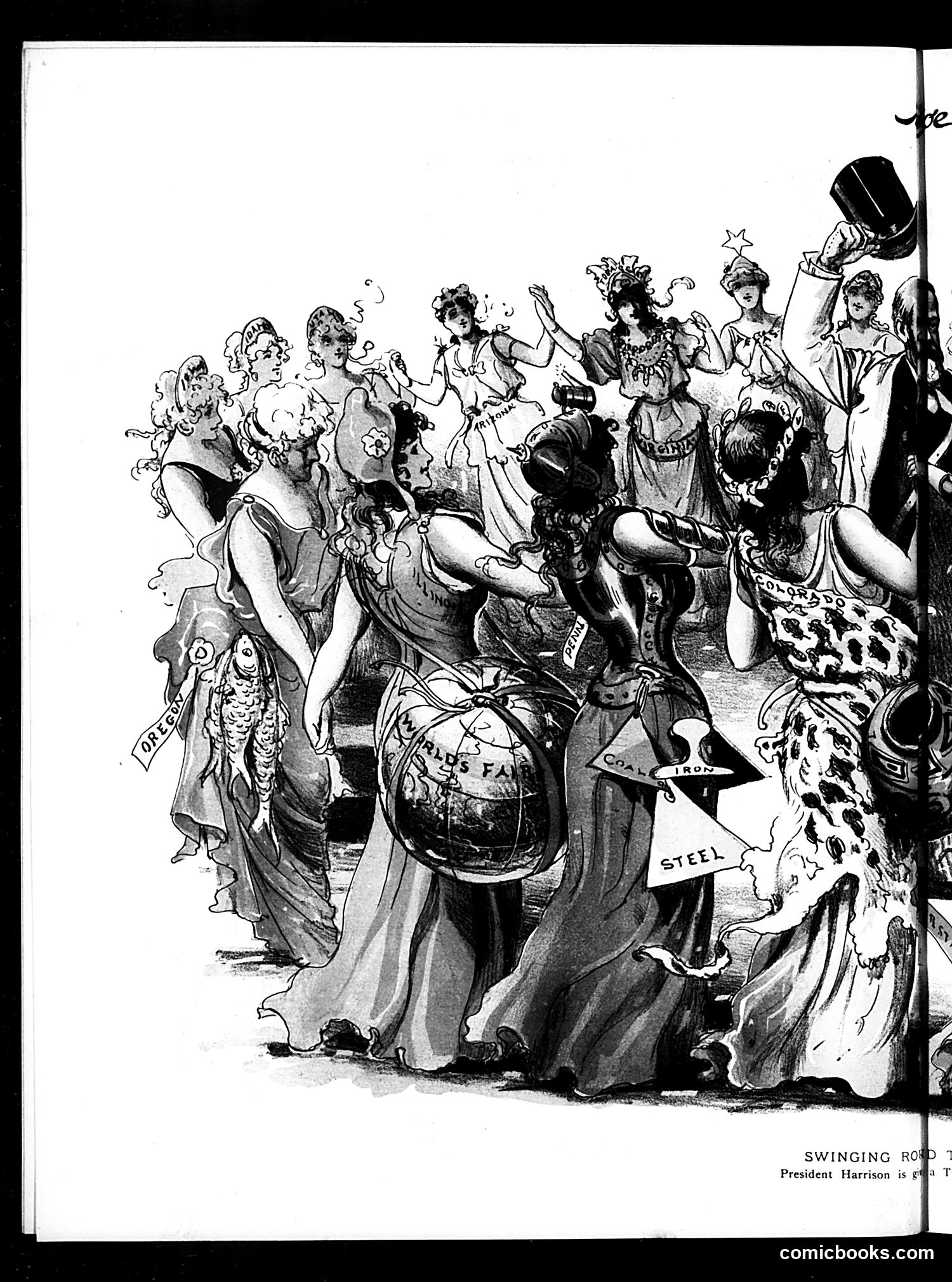
This appears to be a satirical cartoon from **Judge** magazine depicting **President Harrison** (likely Benjamin Harrison, president 1889-1893) engaged in a "swinging rope" scenario with various female figures in elaborate dress. The cartoon uses the metaphor of rope-swinging to satirize Harrison's political dealings or social relationships. The women's formal attire and decorative styling suggest commentary on high society or political circles. Labels visible on the figures reference **"Steel"** and **"Rails"** — likely alluding to major industrial interests and tariff policies that defined Harrison's presidency. The satire likely mocks Harrison's entanglement with wealthy industrialists and monopolistic interests, portraying him as literally dancing to their tune. The elaborate, somewhat chaotic composition emphasizes the absurdity of these political entanglements.
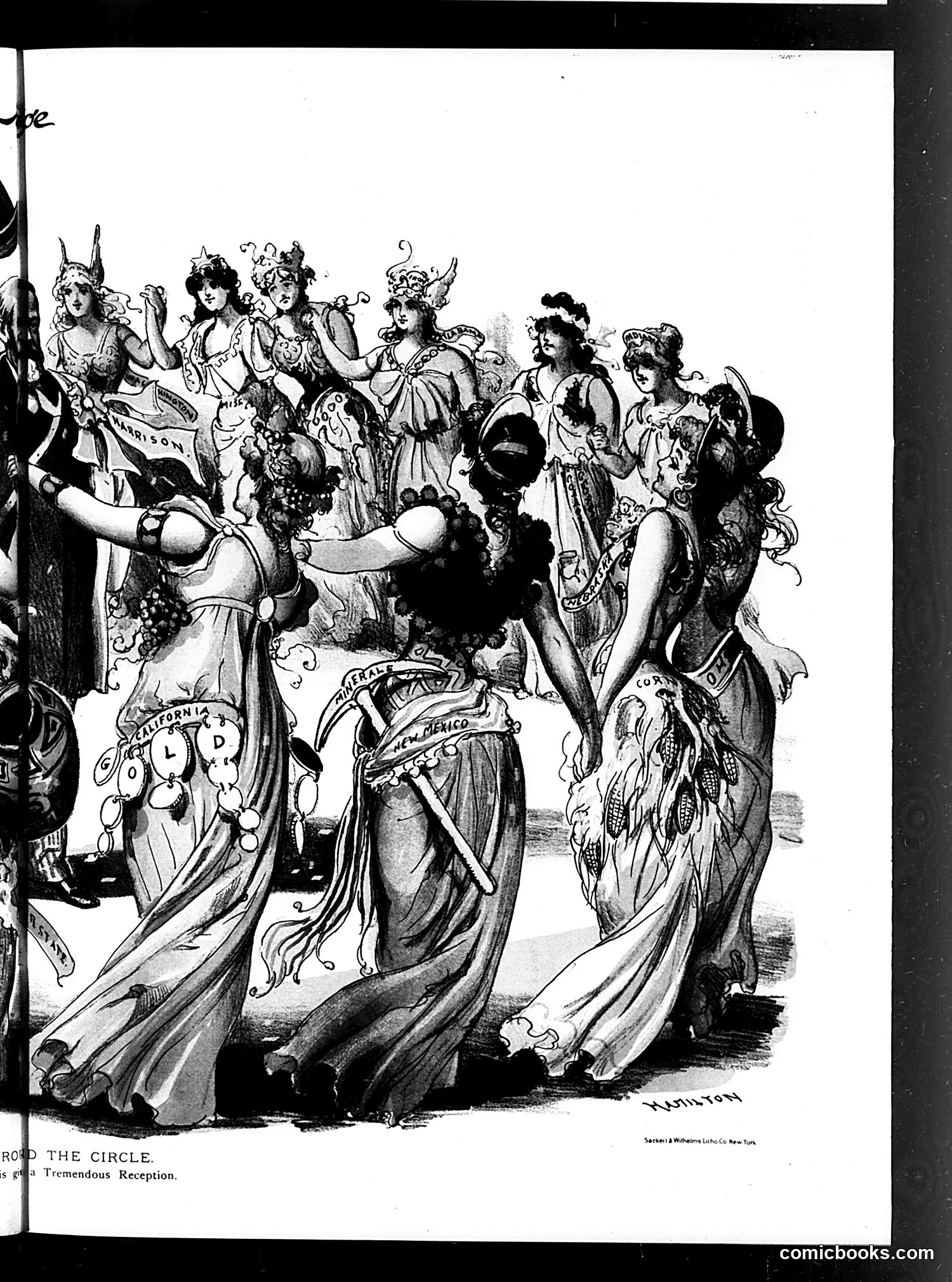
This satirical cartoon depicts female allegorical figures representing U.S. states and territories receiving new arrivals. The three figures in the foreground wear sashes labeled "California," "New Mexico," and what appears to be another territory, suggesting this comments on American territorial expansion or newly admitted states. The elaborate costumes and "tremendous reception" caption suggest satire about how these new regions were welcomed into the Union. The gathering of female figures in classical dress likely represents established states greeting newcomers, possibly satirizing either the political process of expansion or the social/cultural integration of new territories. Without a visible date, the specific historical event remains unclear—this could reference late 19th or early 20th-century territorial acquisitions.
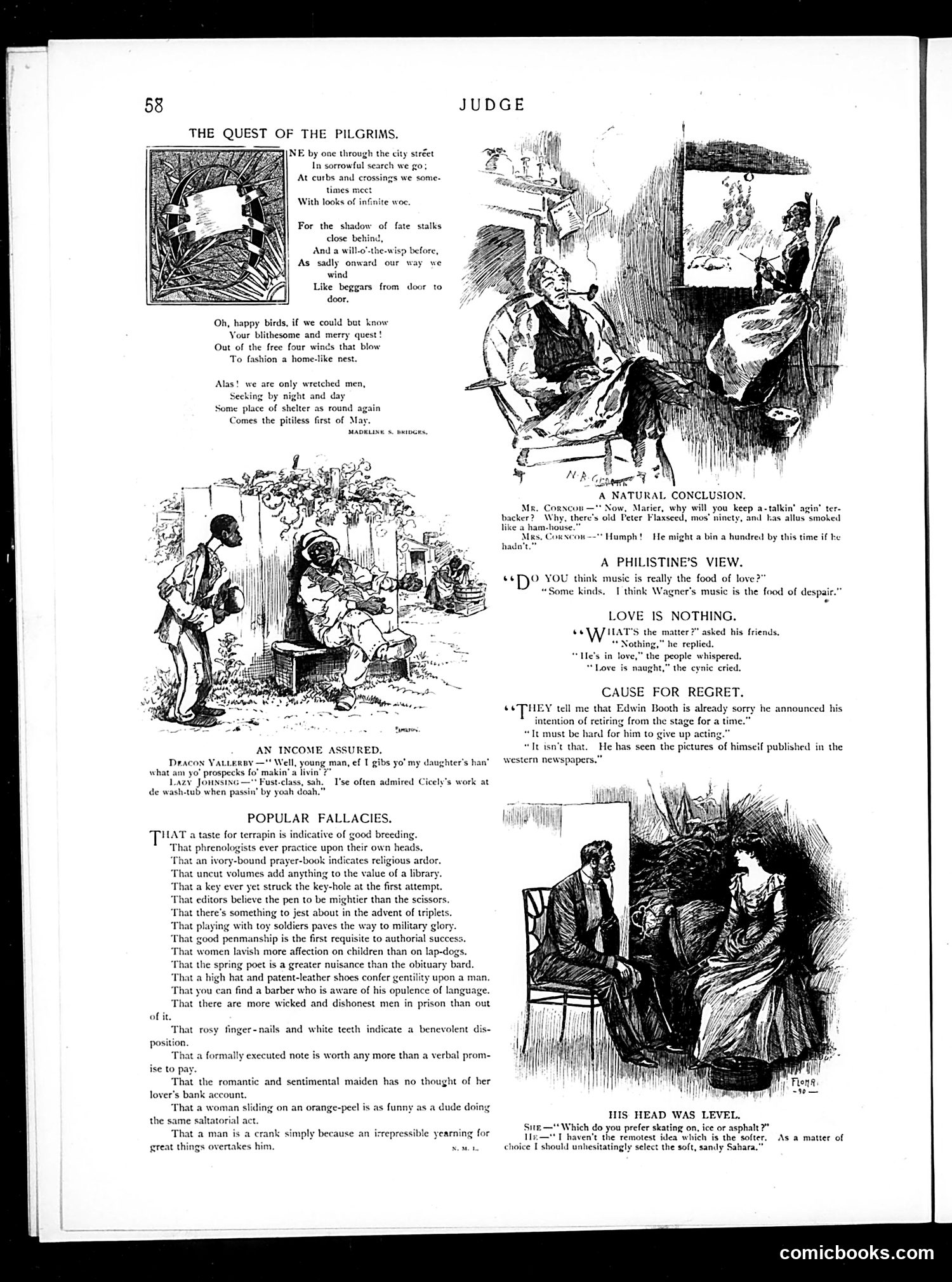
This page from the satirical magazine **Judge** contains several unrelated humor pieces typical of late 19th-century American comedy: **"The Quest of the Pilgrims"** is a melancholic poem about poor urban dwellers seeking affordable housing, particularly referencing the "first of May"—when rental leases traditionally ended, forcing families to relocate. **"An Income Assured"** is a racial stereotype joke depicting a Black father ("Deacon Vallery") and lazy suitor ("Lazy Jonesing"), playing on period prejudices about African Americans and domestic labor. **"Popular Fallacies"** is a list of humorous social observations mocking gentility, fashion, and human behavior—typical satirical fare. The remaining brief jokes mock Wagner's music as "despair," reference actor **Edwin Booth's** retirement announcement (which he allegedly regretted upon seeing unflattering newspaper photos), and joke about skating surface preferences. The cartoons illustrate these pieces with period-appropriate sketches. The humor relies heavily on period stereotypes and now-outdated social references.
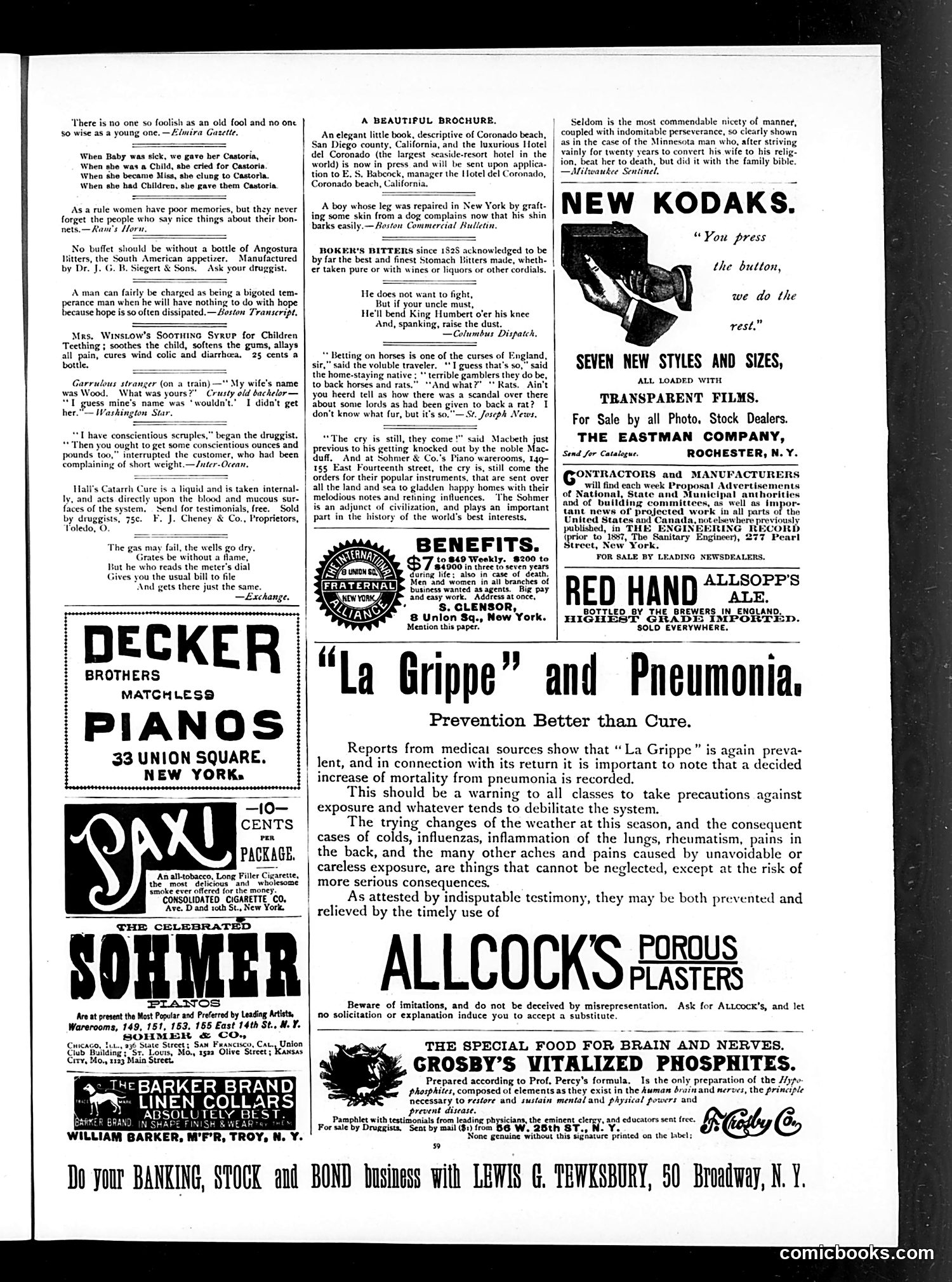
This page is primarily **advertisements and satirical jokes**, not political cartoons. The content reflects late-19th/early-20th century American humor and commerce. **Key elements:** The jokes mock contemporary social attitudes: a quip about women having poor memories; a temperance-movement joke; crude humor about a Minnesota man beating his wife "with the family bible" (satirizing religious hypocrisy); and a reference to "King Humbert" (likely Italy's King Umberto I, assassinated 1900), used as a comedic threat. **Advertisements** dominate—pianos, cigarettes, patent medicines (Castoria, Sohmer pianos, Allcock's porous plasters), and Kodak cameras with their famous slogan "You press the button, we do the rest." A major ad warns against "La Grippe" (influenza) and pneumonia, promoting Allcock's porous plasters as prevention—reflecting genuine public health concerns of the era. The page's humor is dated, often offensive by modern standards, relying on period stereotypes and crude jokes rather than sophisticated satire. It's primarily a **commercial publication** masquerading as comedy.
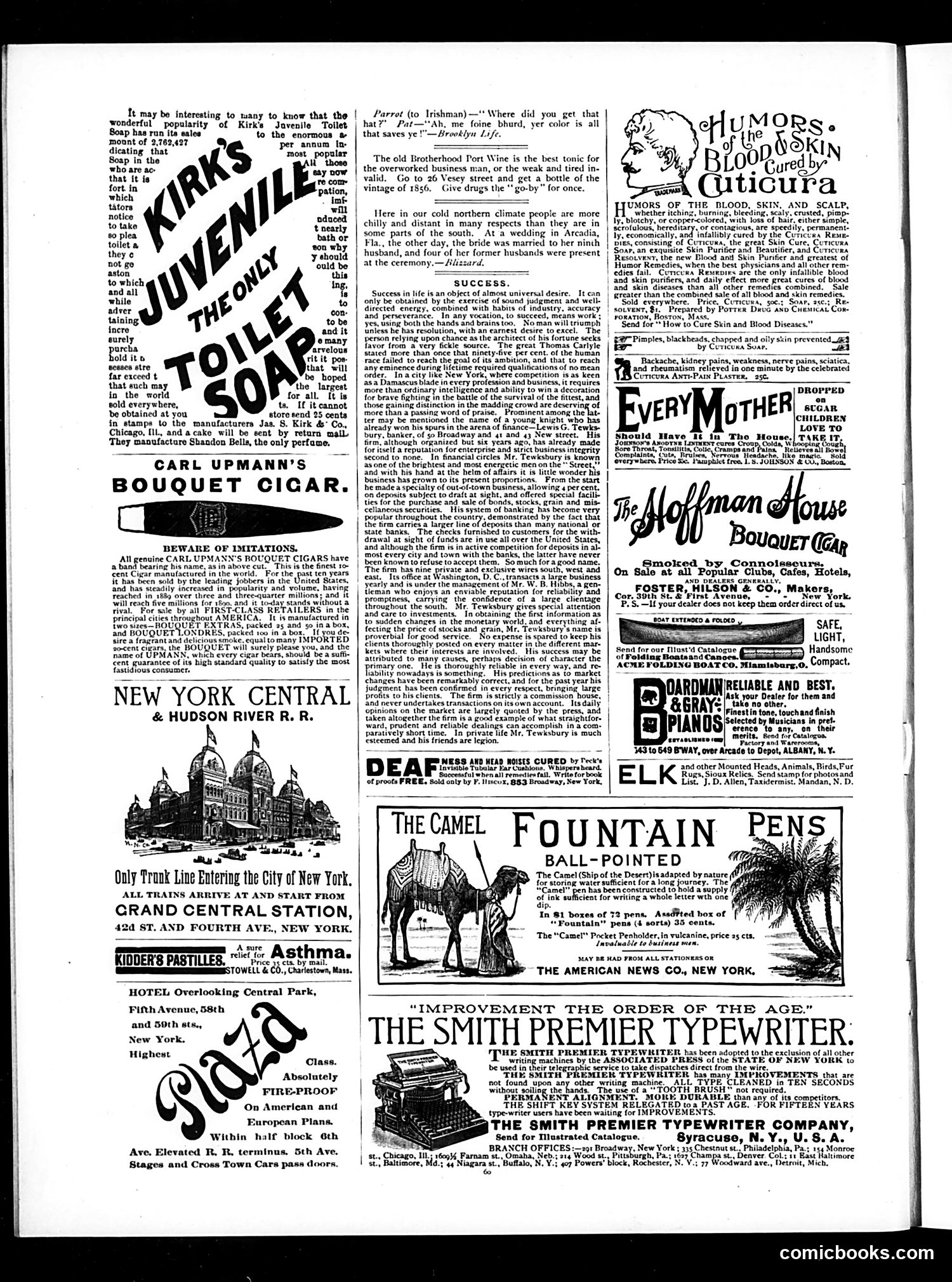
This page is primarily **advertising**, not political cartoons. However, it contains one brief joke: The small cartoon shows a **parrot speaking to an Irishman**, asking where he got his "color." The Irishman replies his coloring comes from "me fone" (phonetic spelling suggesting Irish dialect). This appears to be a crude **ethnic stereotype joke** playing on period prejudices—the humor relies on mocking Irish appearance or complexion through dialect humor. The rest of the page is filled with turn-of-the-century product advertisements: Kirk's Javelin Toilet Soap (boasting 2.7 million sales), Carl Upmann's Bouquet Cigars, hotels, the New York Central Railroad, and Cuticura remedies for skin conditions. The single joke reflects the casual, offensive ethnic stereotyping common in early 1900s American humor publications, where mocking Irish, German, and other immigrant groups was standard comedic fare.
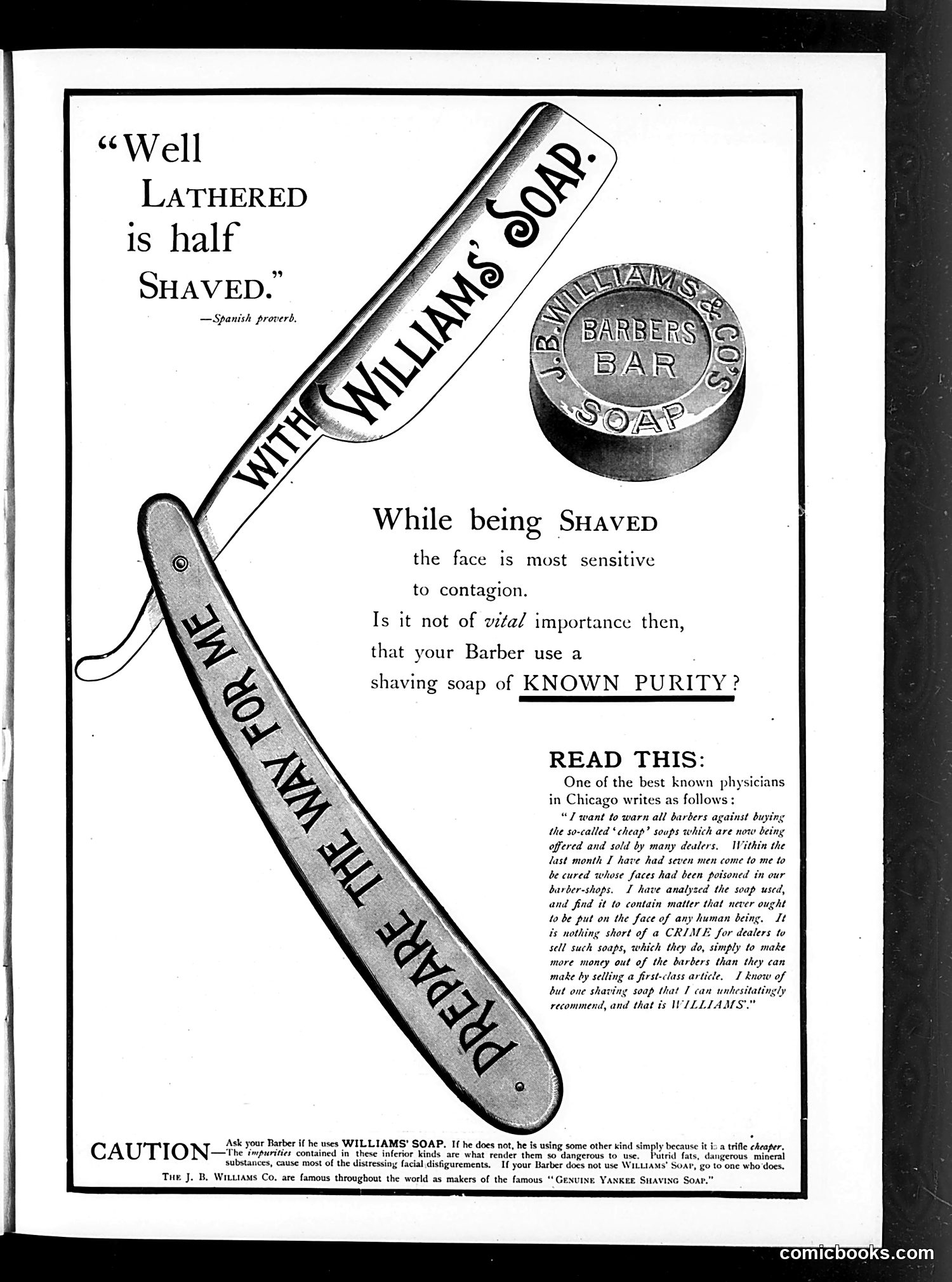
This is primarily a **product advertisement**, not satire or political commentary. It promotes Williams' brand shaving soap by appealing to health and safety concerns. The page uses a Spanish proverb ("Well lathered is half shaved") as a hook, then pivots to a health warning: during shaving, facial skin is vulnerable to infection, so barbers should use pure soap. A Chicago physician's testimonial claims he treated seven men for facial poisoning caused by contaminated cheap soaps containing "putrid fats" and dangerous minerals. The ad suggests unscrupulous dealers sell inferior soap simply to maximize profit at barbers' expense. The advertisement warns consumers to ask their barber whether he uses Williams' soap—implying competitors' products are dangerously adulterated. The razor and soap bar illustrations serve as product branding. This reflects early 20th-century concerns about product safety and purity before strict FDA regulation existed.
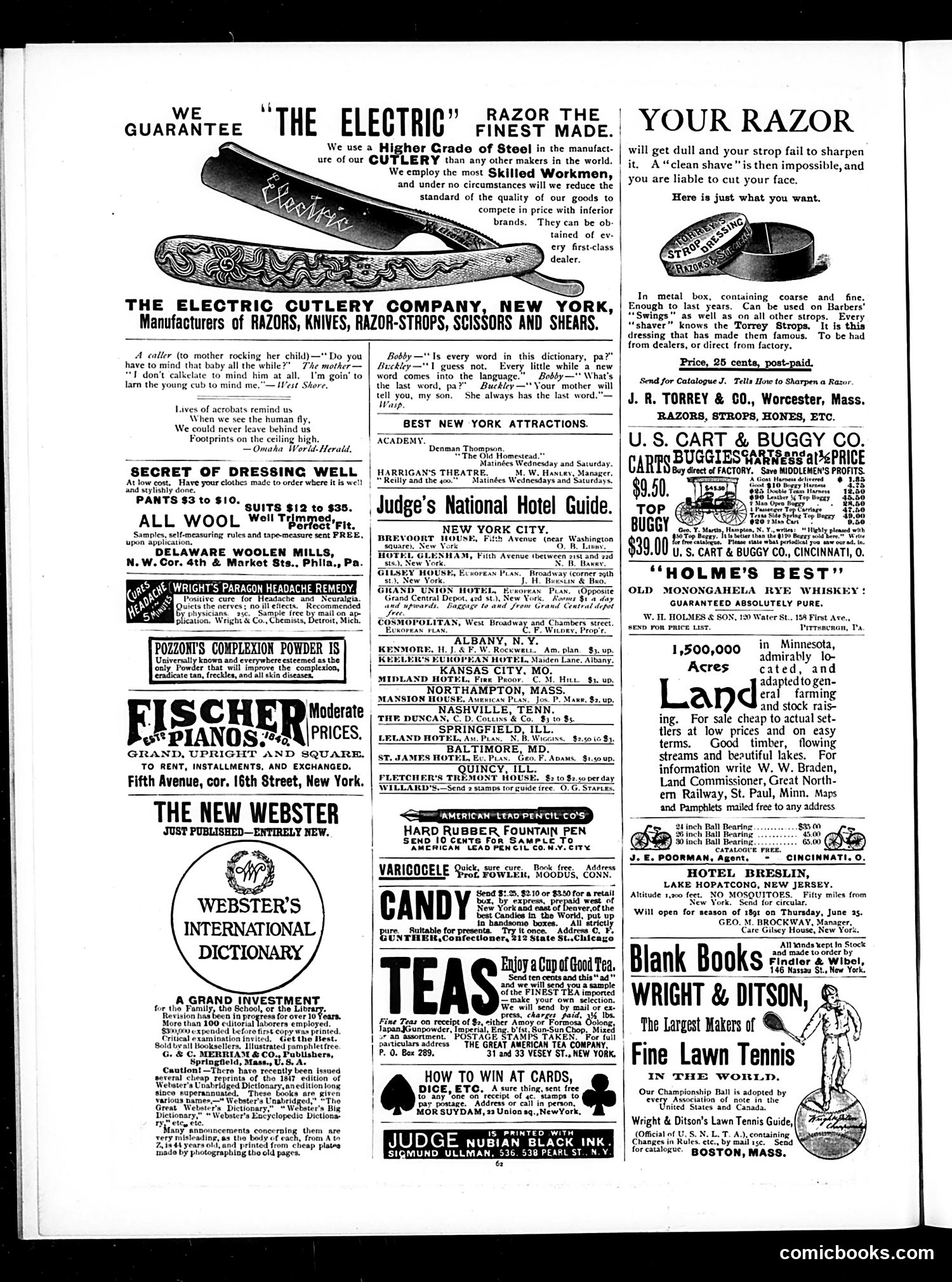
This is primarily an **advertising page** from Judge magazine, not a satirical cartoon page. It features commercial advertisements for various products and services typical of the late 19th century. The **text content** consists of three brief humorous anecdotes (about child-rearing, dictionaries, and acrobats) that serve as filler between ads—standard magazine practice. The **advertisements** promote razors, clothing, pianos, hotels, carriages, whiskey, tea, candy, and other goods. They reflect period consumer culture and commercial claims about quality and superiority. Notable is the "Electric" razor company's assertion of using "Higher Grade of Steel" than competitors—typical competitive advertising language that would mean little to modern readers. The hotel guide section and theatrical notices indicate Judge's role informing urban leisure-class readers about entertainment and travel options in major American cities. **No political satire or caricature is present** on this particular page—it's essentially a commercial marketplace presented in editorial form.
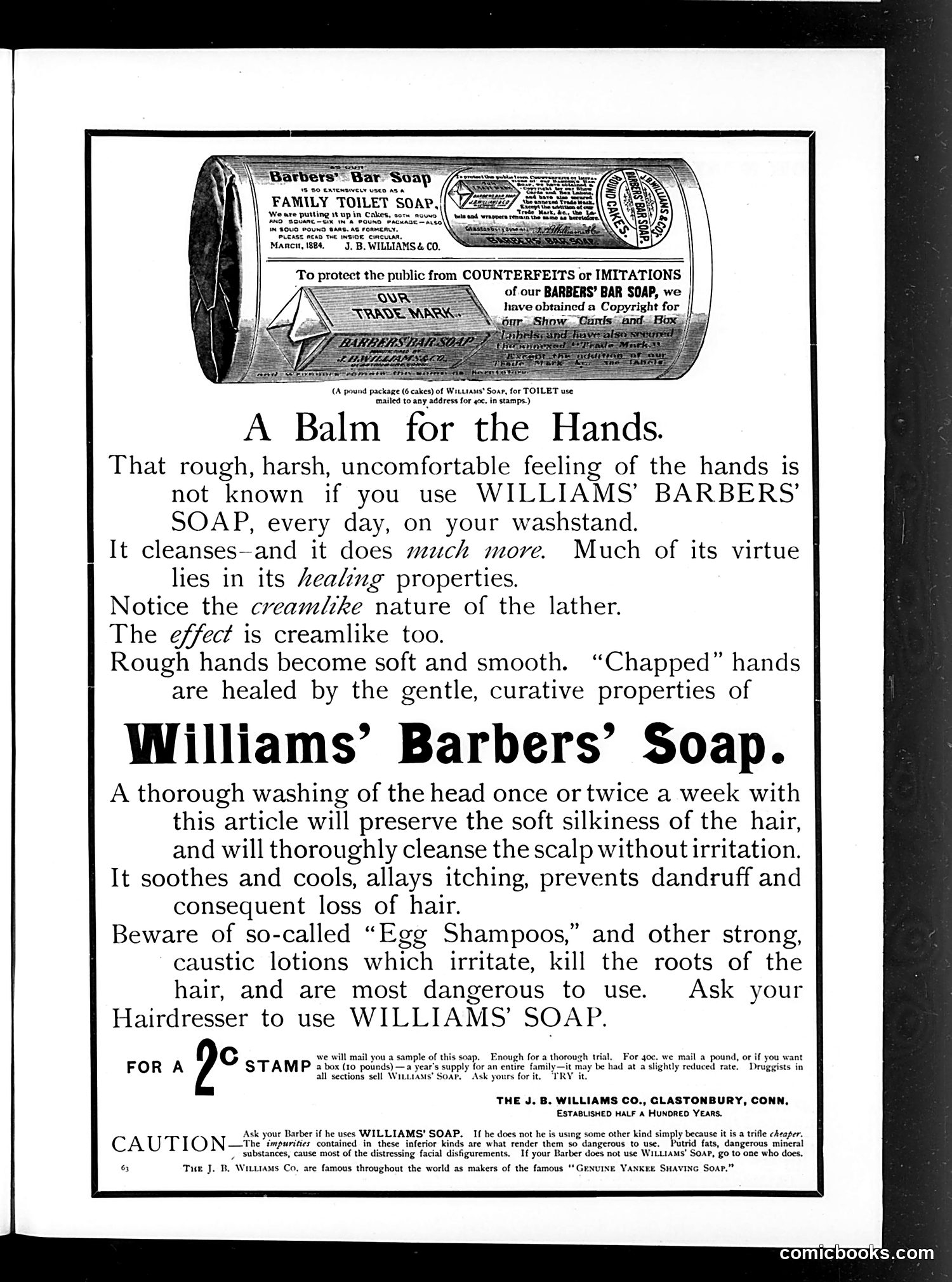
This is a **product advertisement**, not a political cartoon. It appears in *Judge* magazine promoting Williams' Barbers' Soap, manufactured by J.B. Williams Co. of Connecticut. The ad uses common late-19th/early-20th-century marketing tactics: - **Anti-counterfeiting messaging**: Warns against cheap imitations, claiming the company obtained copyright protection for packaging - **Health claims**: Promises the soap heals "chapped" hands, prevents dandruff, and preserves hair quality - **Fear-based marketing**: Warns against competitor products ("Egg Shampoos") as caustic and dangerous - **Affordable sampling**: Offers a 2-cent stamp for trial samples to build consumer confidence The cautionary tone about inferior products containing "putrid fats" and "dangerous mineral substances" reflects period anxieties about product safety before FDA regulation. The emphasis on asking your barber to verify he uses Williams' soap reveals competitive pressures in the grooming market of that era.
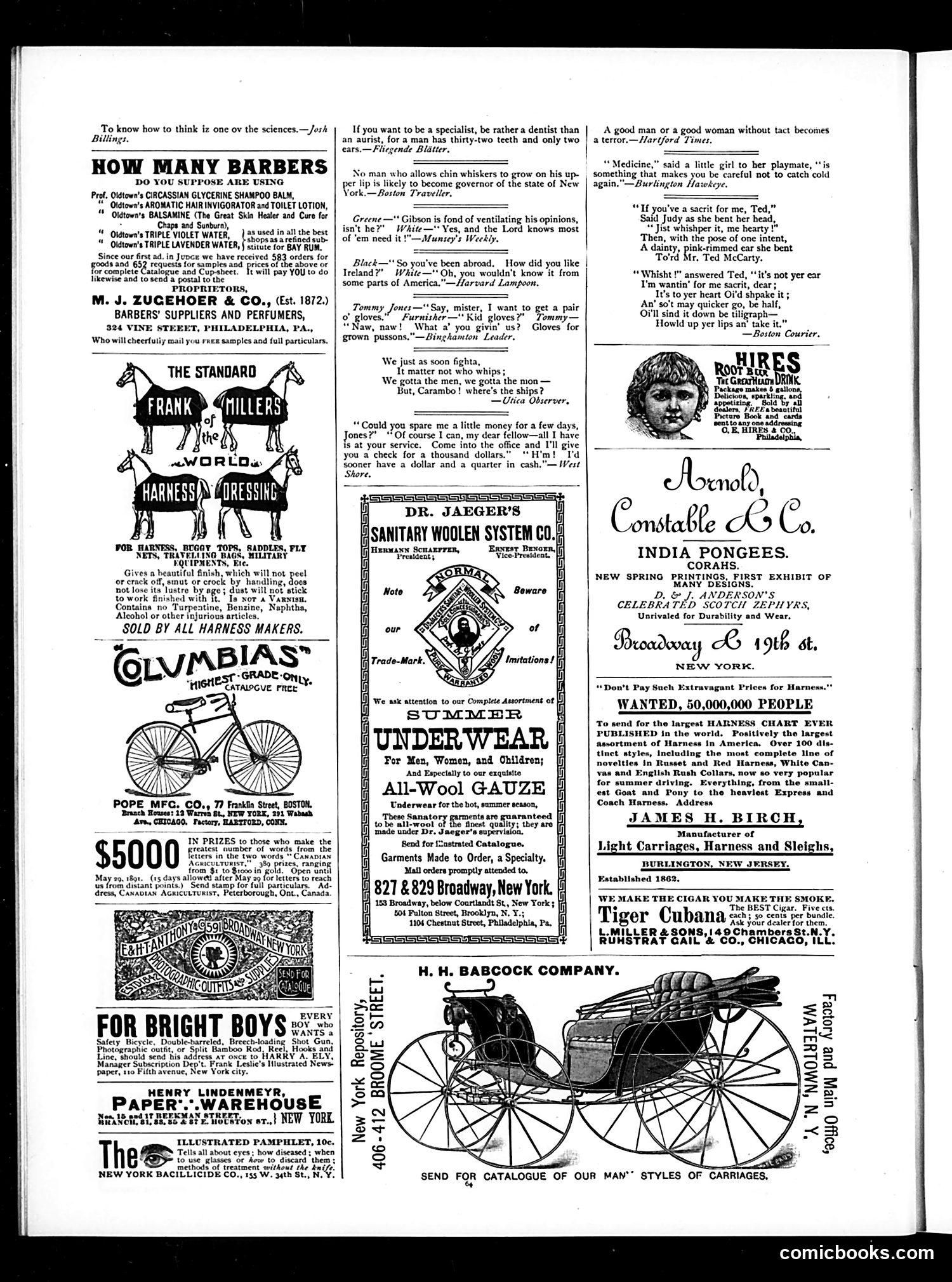
This page is primarily **advertising**, featuring multiple product and service advertisements typical of 1890s American commerce. Key advertisers include barber supplies (Prof. Oldtown's hair products), harness dressing, bicycles (Pope Manufacturing), and Dr. Jaeger's sanitary wool clothing system. The page includes several **brief humorous quotations and jokes** scattered throughout, sourced from various publications (Harvard Lampoon, Munsey's Weekly, etc.). These are typical Judge-style editorial filler—short, punchy observations on contemporary life and human nature. One notable excerpt satirizes the absurdity of expert specialization, suggesting dentists are preferable to ear doctors simply because humans have more teeth than ears. Another joke mocks Irish-American identity stereotypes. **The carriage illustration** (H.H. Babcock Company) is straightforward product advertisement rather than political satire. Overall, this is a commercial page with light satirical humor woven throughout—representative of Judge's formula of mixing advertising revenue with wit and social commentary.
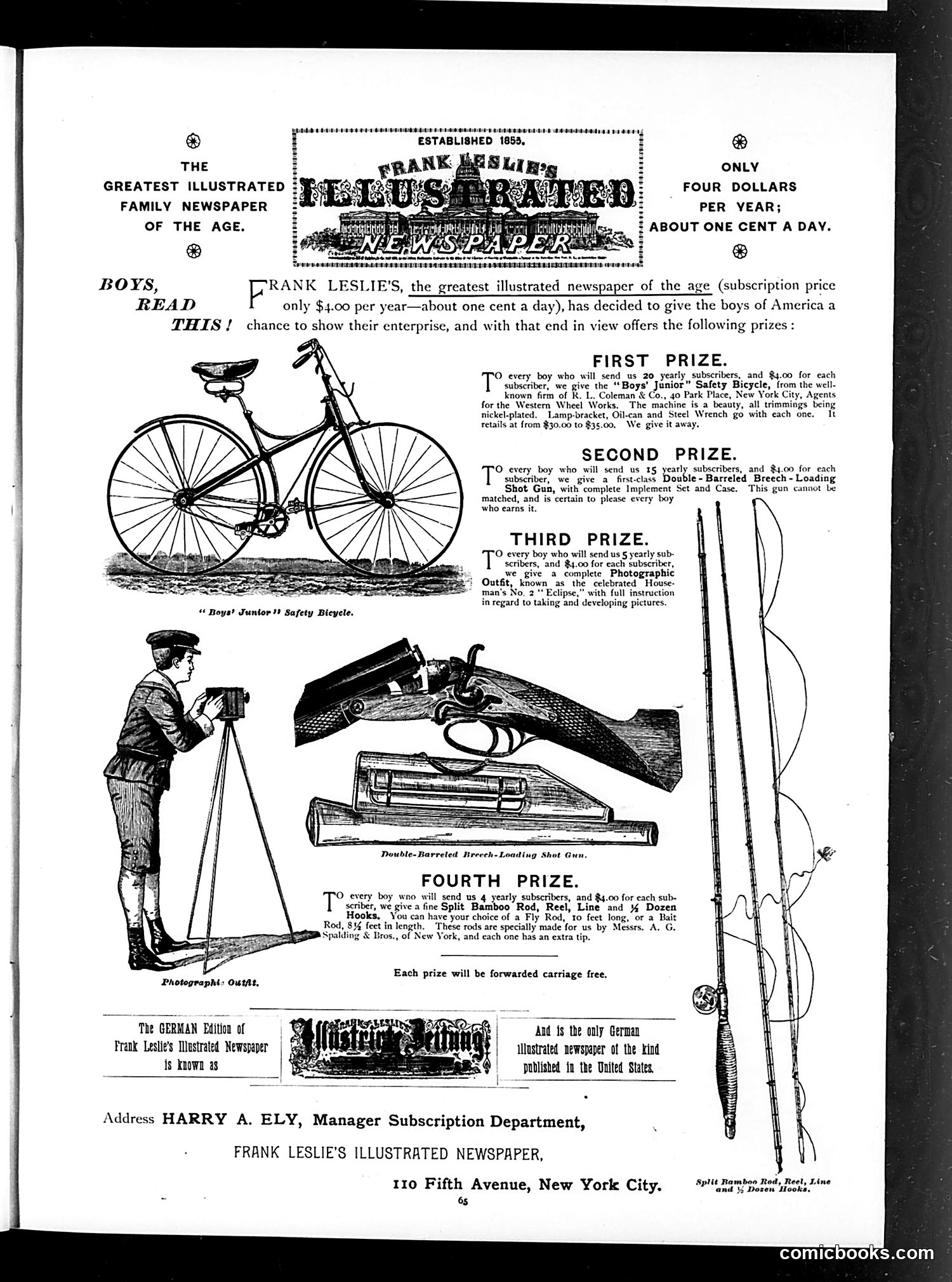
This is **not a political cartoon** but rather a **subscription advertisement** for Frank Leslie's Illustrated Newspaper, a major American family publication established 1853. The page promotes a contest targeting boys as subscription salesmen. The newspaper offers escalating prizes based on recruitment success: - **20 subscribers** = "Boys' Junior" Safety Bicycle (~$30-35 retail value) - **15 subscribers** = Double-barreled breech-loading shotgun - **8 subscribers** = Complete photography outfit ("Eclipse" camera with developing instructions) - **4 subscribers** = Fishing rod by sporting goods maker A.G. Spalding & Bros. **Context for modern readers:** This reflects late-19th-century business practices where publications used child labor as subscription agents, incentivizing sales with desirable goods (bicycles, sporting equipment, cameras—luxuries then). The prizes reveal what boys valued: outdoor recreation, technology, and independence. The "carriage free" shipping note indicates these were substantial, valuable items.
This is a full-page advertisement for *Frank Leslie's Illustrated Newspaper*, a prominent American illustrated weekly. The text promotes the publication's value as family entertainment and education. The ad highlights several features designed to appeal to middle-class households: contributed articles by prominent figures (including General Sherman and Frederick Douglass), fashion coverage for women, investigative columns on life insurance fraud and Wall Street investment advice, amateur photography contests, and fine illustrations. A notable section advertises a German-language edition (*Illustrirte Zeitung*), marketed as an educational tool for families learning German—reflecting late-19th-century immigration patterns and the value placed on language instruction. The recurring emphasis on affordability ("one cent a day" for $4 annually) and family-appropriate content ("scrupulously omitted" offensive material) targets middle-class respectability. This is essentially a product pitch dressed as editorial content, common in period magazines.
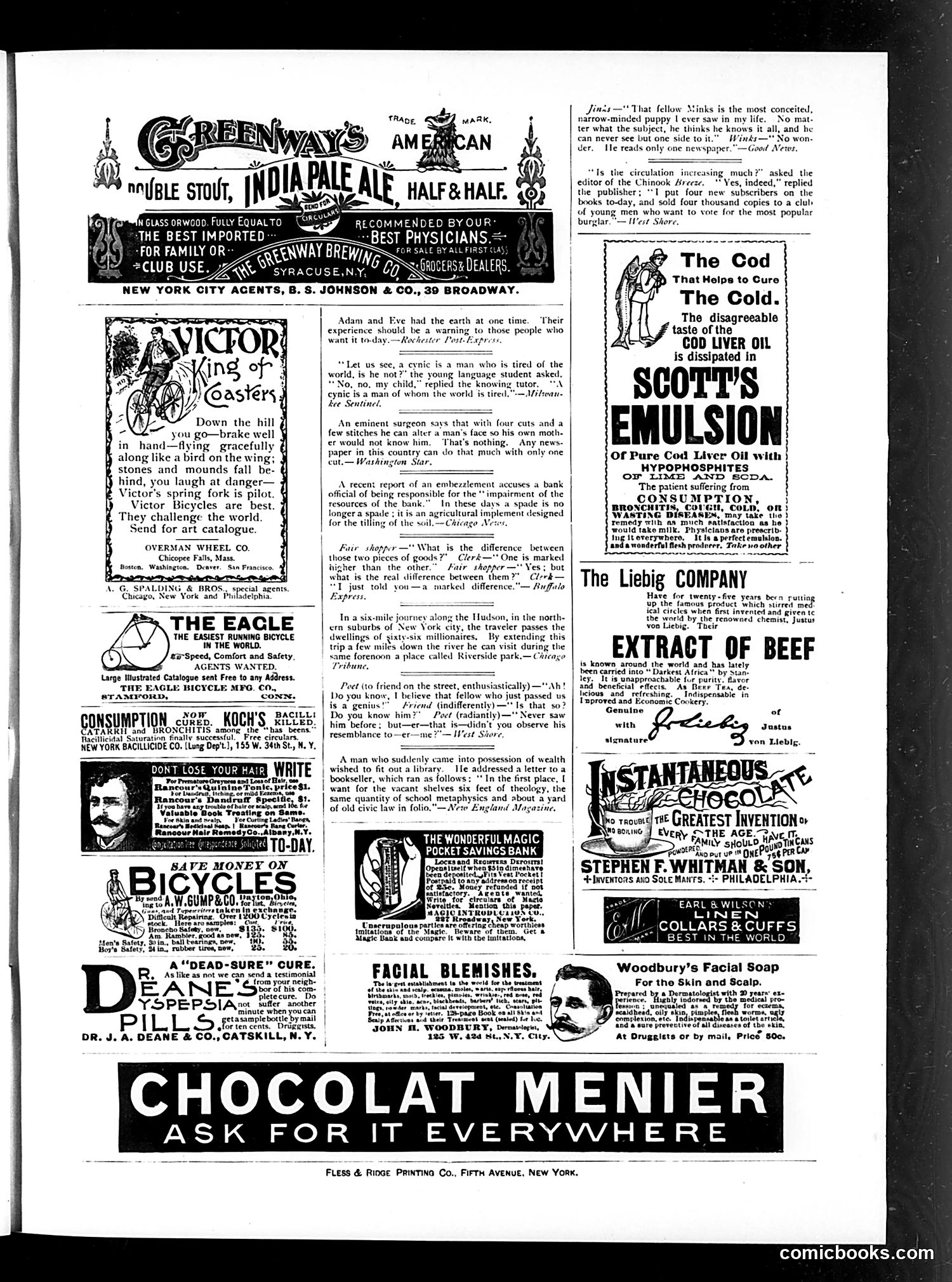
This page is primarily **advertising**, with several small humorous anecdotes sprinkled between ads. The cartoons are minimal. The main content includes: **Top**: Greenway's Brewing Company ad for ale/stout, recommending their product to physicians. **Left side**: Victor Bicycles advertisement featuring a small illustration of a cyclist riding downhill, with text describing the bike's superior "spring fork." **Center & scattered**: Brief jokes mocking vanity and narrow-mindedness—one about a man named Minks who only sees one side of issues; another about a cynic being "a man of whom the world is tired." **Right side**: Multiple patent medicine ads (Scott's Emulsion cod liver oil, Liebig's Extract of Beef, Instantaneous Chocolate, Deane's Pills) typical of the era. **Bottom**: Woodbury's Facial Soap ad and Chocolat Menier advertisement. The satirical content is light and focused on personality flaws rather than political commentary. The page reflects late-19th/early-20th-century consumer culture and medical pseudoscience marketing.
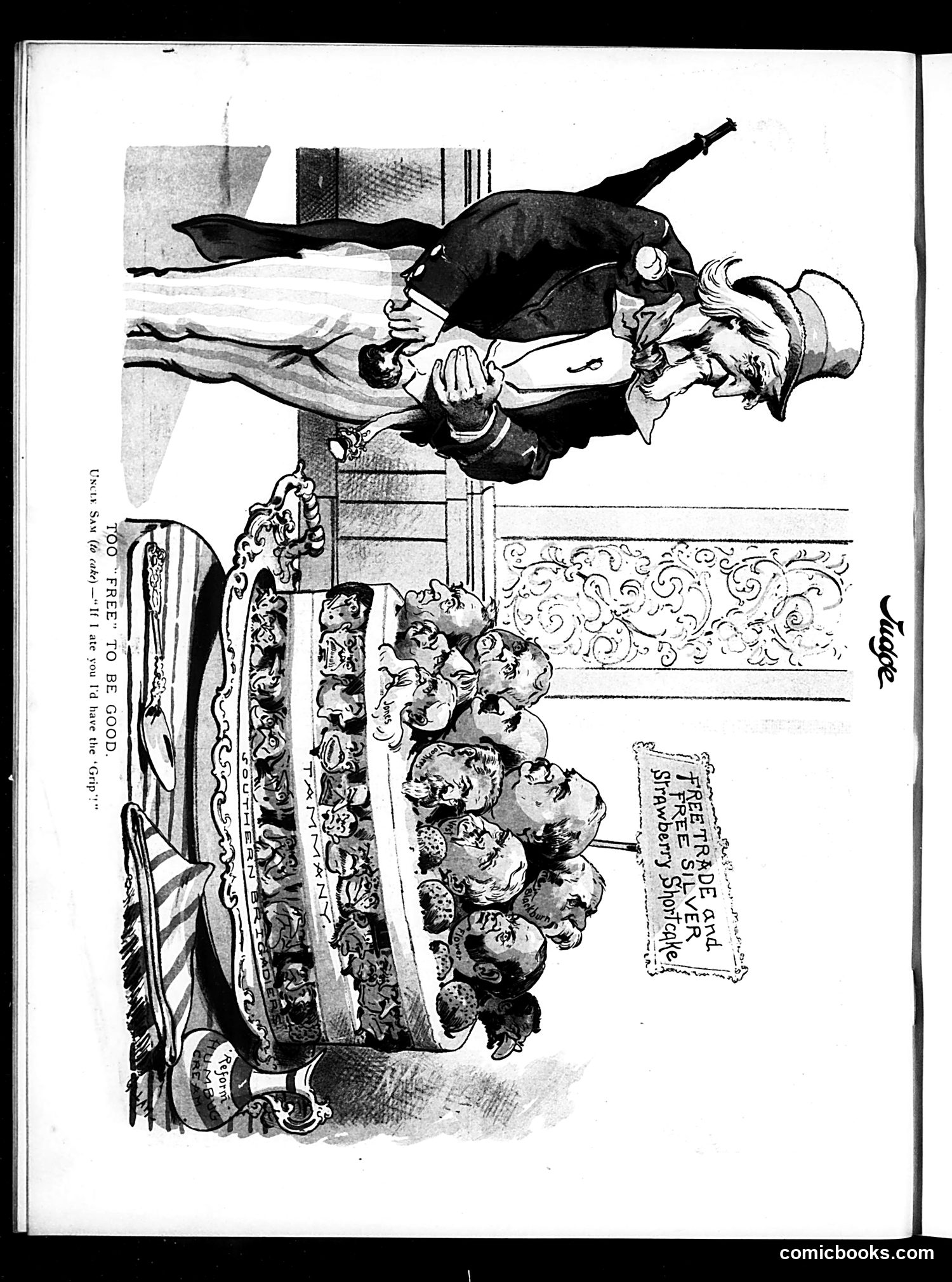
This *Judge* magazine cartoon satirizes the concept of "free" goods or services. The main figure appears to be a well-dressed man examining what looks like a cake or food item, with the caption suggesting he's worried about getting "the Grip" (likely influenza or grippe) if he consumed it. The satire appears to critique false economy or deceptive "free" offerings—suggesting that seemingly free items come with hidden costs or dangers. The ornate, decorated cake at the bottom of the image, labeled "FREE CAKE" with what appears to be additional text about "STRAIGHTEDGE" support, reinforces this theme. The cartoon mocks the public's gullibility regarding "free" promotions that may actually be harmful or worthless, a common *Judge* theme of consumer skepticism and social commentary.