
A complete issue · 16 pages · 1891
Judge — April 25, 1891
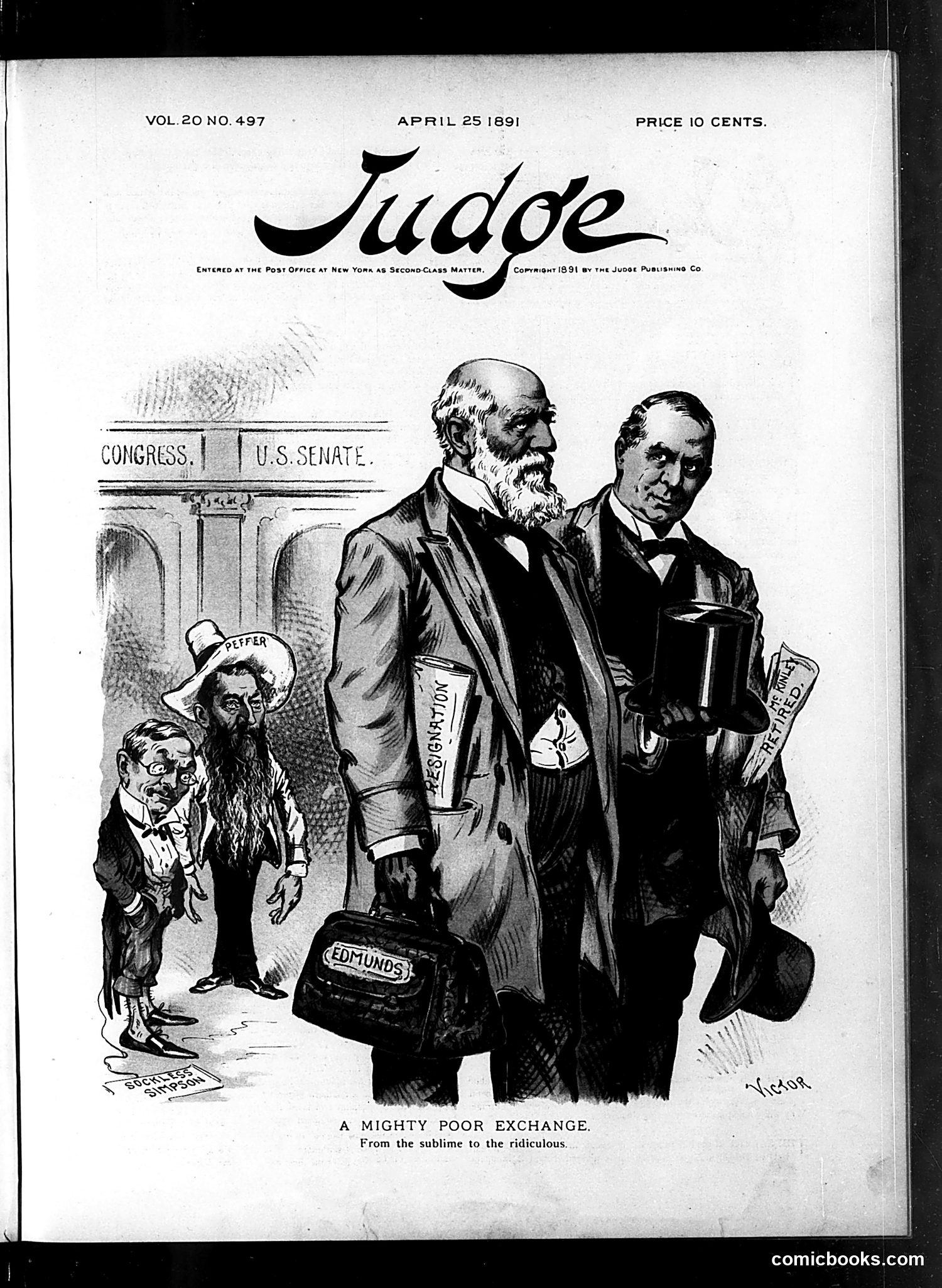
This political cartoon titled "A Mighty Poor Exchange: From the Sublime to the Ridiculous" satirizes a corrupt political transaction occurring near Congress and the U.S. Senate. Two well-dressed men (likely senators or congressmen) are exchanging bribes or patronage with smaller, grotesque figures representing political corruption. One figure carries a suitcase labeled "Edmunds," referencing Senator George F. Edmunds. The caption and imagery suggest legislators are trading their dignified governmental positions for bribes and personal gain—descending from the "sublime" authority of elected office to the "ridiculous" criminality of corruption. The cartoon critiques 1891-era congressional corruption and the apparent ease with which public servants could be compromised financially.
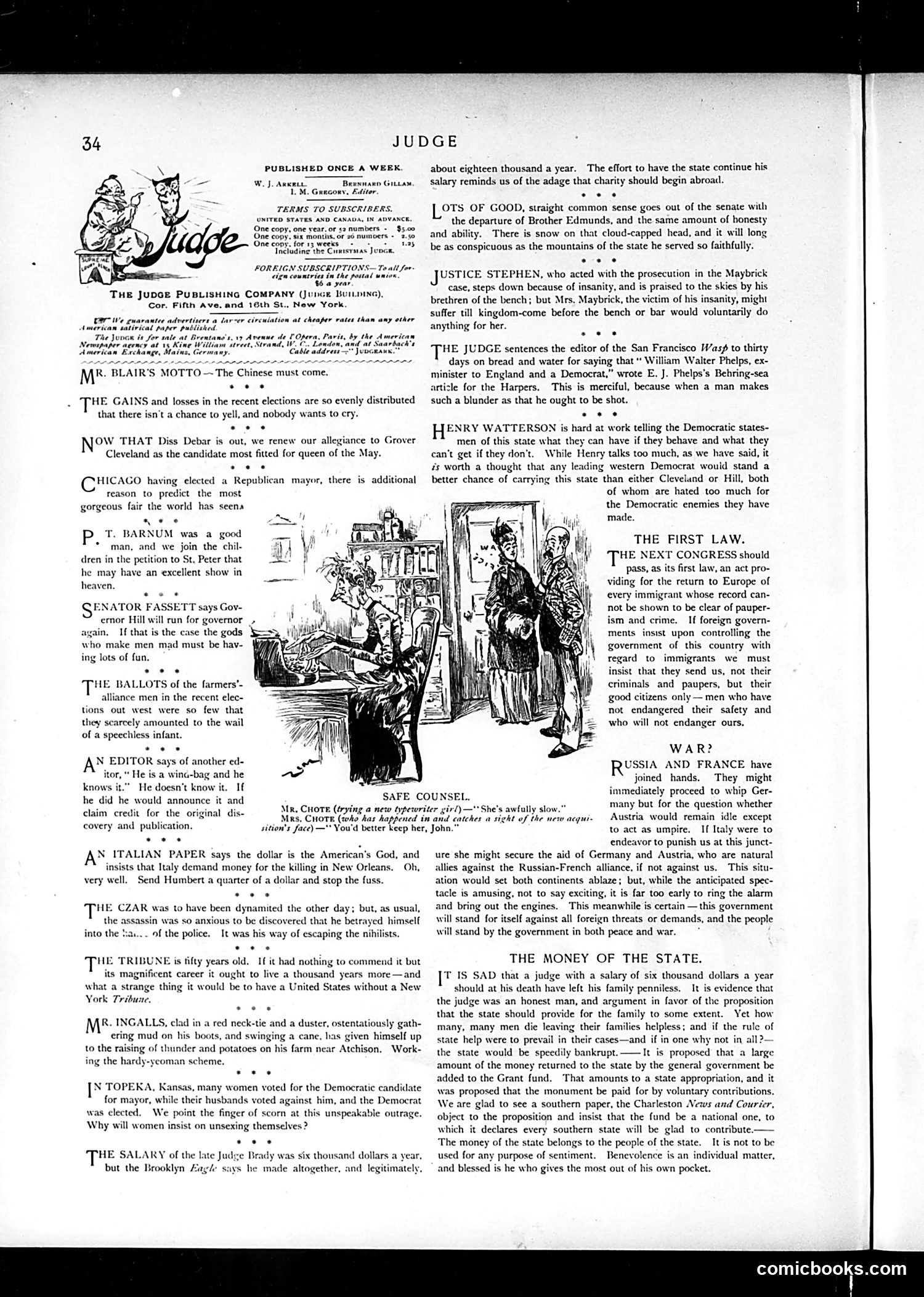
This cartoon depicts **Mrs. Croker** (labeled in the image) offering advice to a woman. The caption reads: "She's awfully slow... would better keep her, John" — suggesting marital counsel about retaining a slow domestic servant. The satire likely critiques **Victorian-era marriage dynamics** and class relations. A wife instructs her husband to keep an inadequate employee, perhaps commenting on how women managed household staff or influenced domestic decisions they didn't directly control. The accompanying text references political figures (Judge Brady, Cleveland, Republican mayors) and policy debates about immigration and state finances, but **this particular cartoon appears isolated from those discussions**, focusing instead on domestic/servant humor typical of Judge's satirical content about American social hierarchies.
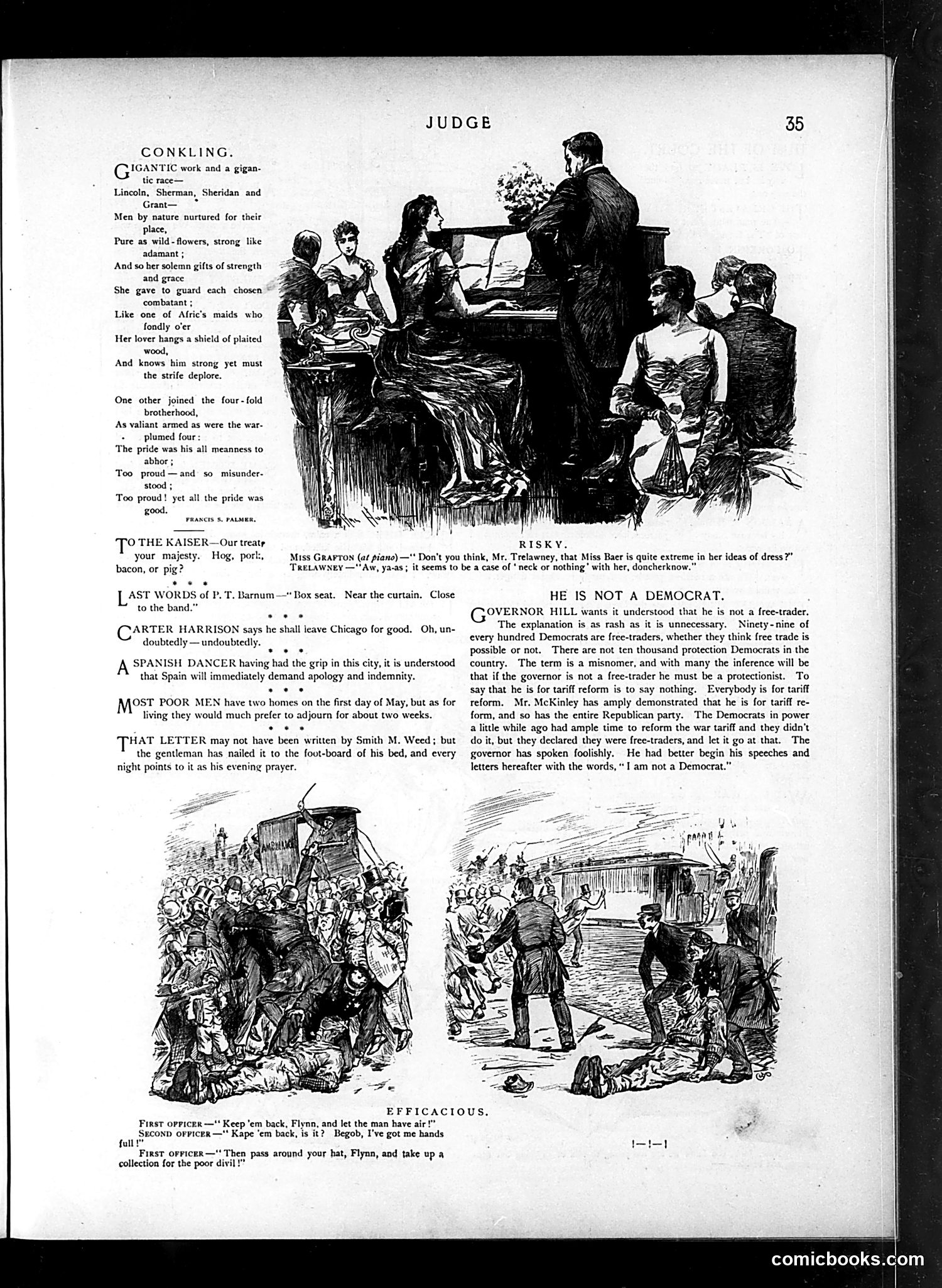
This page contains three distinct satirical pieces: 1. **"Conkling"** (poem): Celebrates Senator Roscoe Conkling as a powerful, strong-willed political figure—likely written during his prominence in post-Civil War Republican politics. 2. **"He Is Not a Democrat"** (article): Critiques Governor Hill for claiming to support tariff reform while actually protecting Democratic interests. The satire suggests his position is hypocritical—he wants protectionist policies despite Democratic free-trade ideology. 3. **"Efficacious"** (cartoon, bottom): Two illustrations showing police officers and crowds. The joke appears satirical about police crowd-control tactics, with officers ordering people around while collecting bribes ("take up a collection for the poor devil"). The page reflects late-19th-century American political debates over tariffs, Democratic vs. Republican positions, and urban corruption concerns.
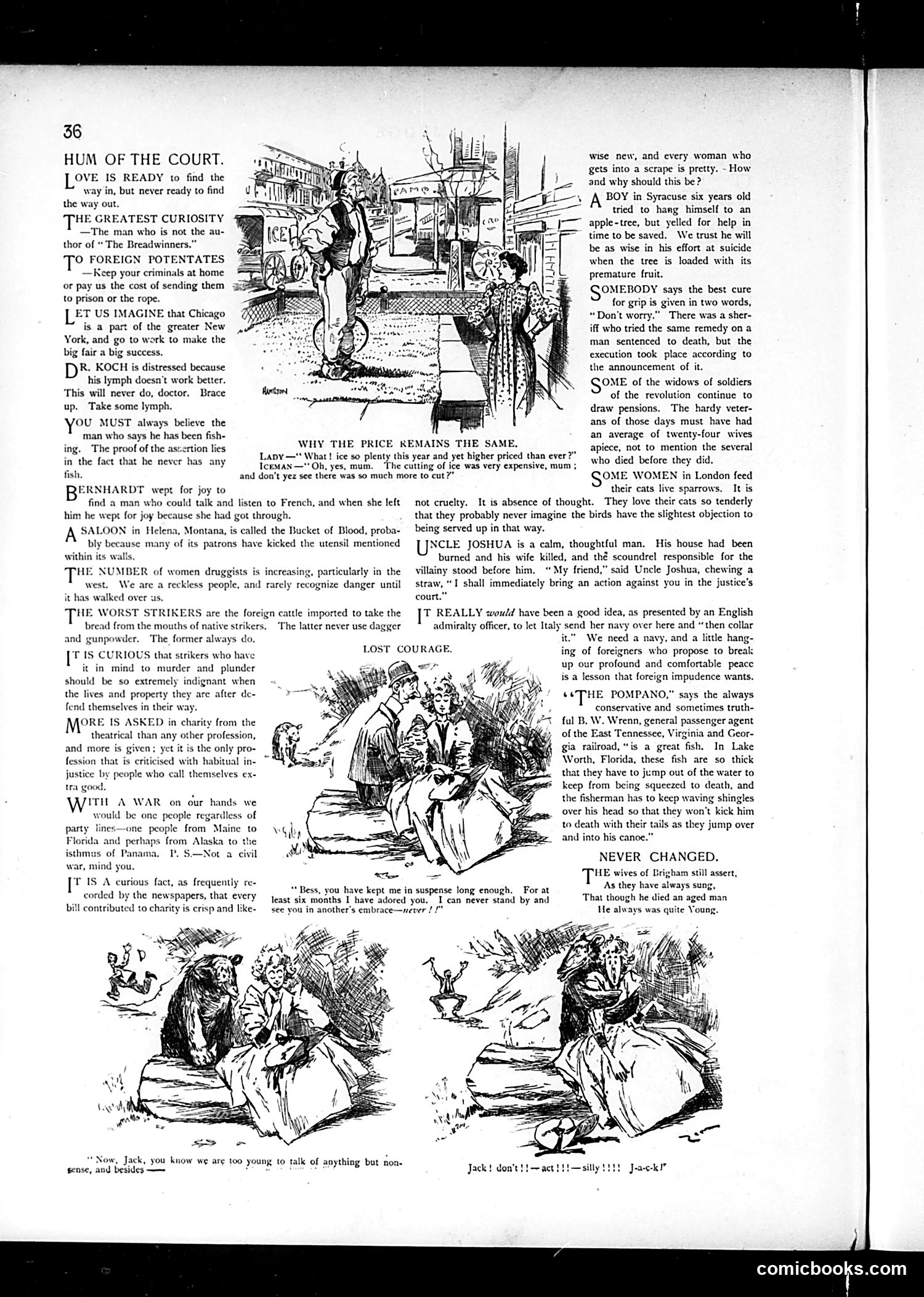
This page from Judge contains satirical commentary on various social and political topics circa the 1880s-1890s. The main cartoon "Why the Price Remains the Same" depicts an iceman and customer discussing ice prices—likely satirizing price-gouging during summer months or labor disputes affecting ice delivery. "Lost Courage" shows what appears to be a domestic dispute or confrontation, though the specific context is unclear from the visible image. The scattered aphorisms mock contemporary issues: Dr. Koch's lymph research, the "Breadwinners" authorship controversy, foreign strikebreakers undercutting native workers, theatrical professionals' charitable hypocrisy, and women entering professions like pharmacy and dentistry. References to Helena's "Bucket of Blood" saloon suggest frontier violence. Bernhardt appears to reference the famous French actress Sarah Bernhardt. The overall tone is typical Judge satire—cynical commentary on American society, class conflict, immigration, professional disputes, and human folly dressed in witty one-liners and illustrated vignettes.
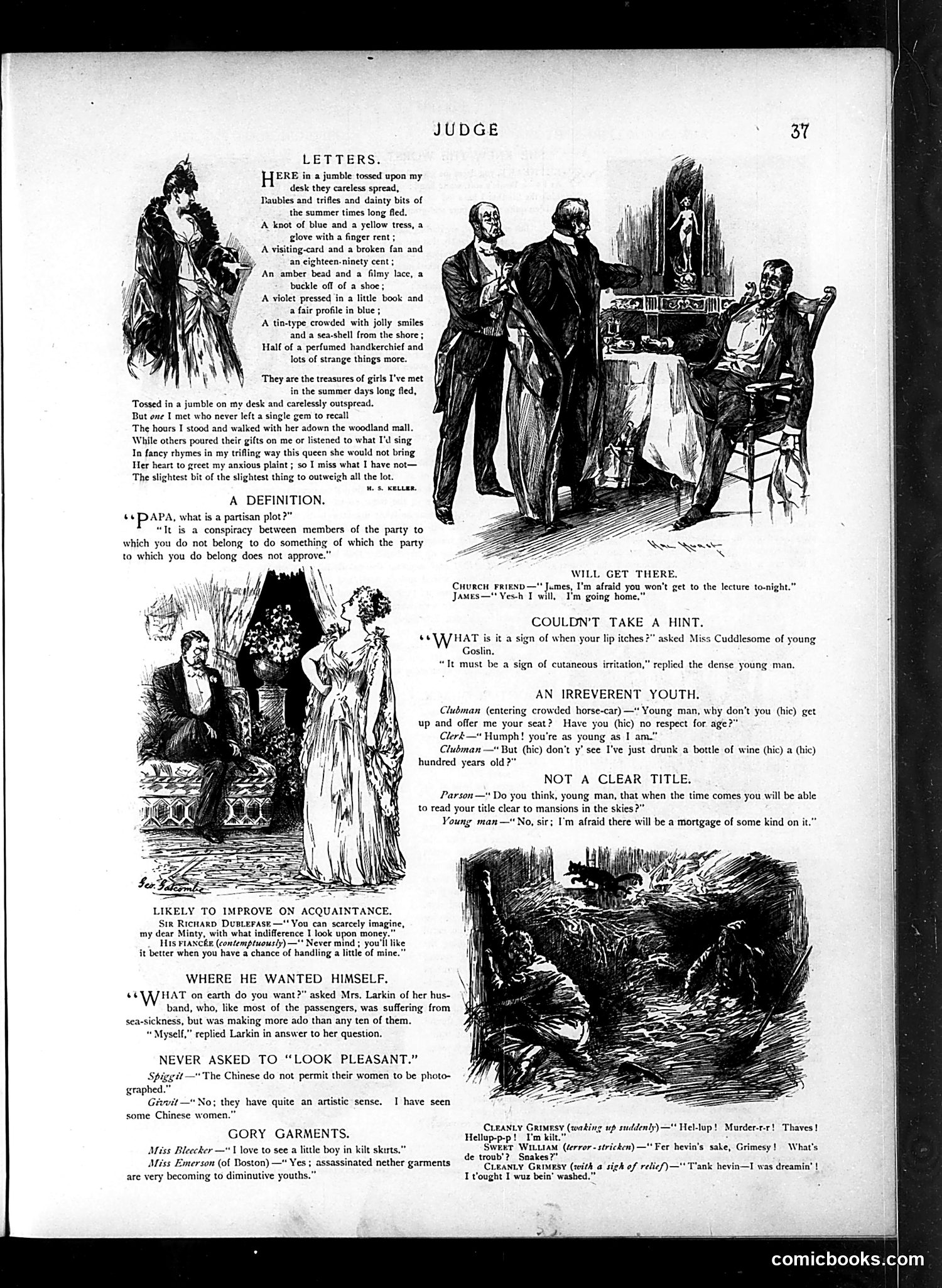
This page from Judge magazine contains primarily **humorous short jokes and witty exchanges** rather than political cartoons. The content reflects turn-of-the-century American humor: **Key items:** - **"A Definition"**: Satirizes partisan politics by defining a "partisan plot" as whatever the opposing party does that your party disapproves of—mocking political hypocrisy. - **Social humor**: Multiple jokes target contemporary manners and courtship (young men being dense around women, respect for age, drunk clubmen). - **"Where He Wanted Himself"**: A domestic humor joke about a seasick husband. - **"Gory Garments"**: An ethnic dialect joke featuring Irish characters (common in period humor), playing on mispronunciations and misunderstandings about children's kilts. The illustrations are generic scene-setters rather than specific caricatures. This represents Judge's typical format: lightweight satirical commentary on everyday social situations, politics, and gender relations, aimed at middle-class readers seeking genteel amusement.
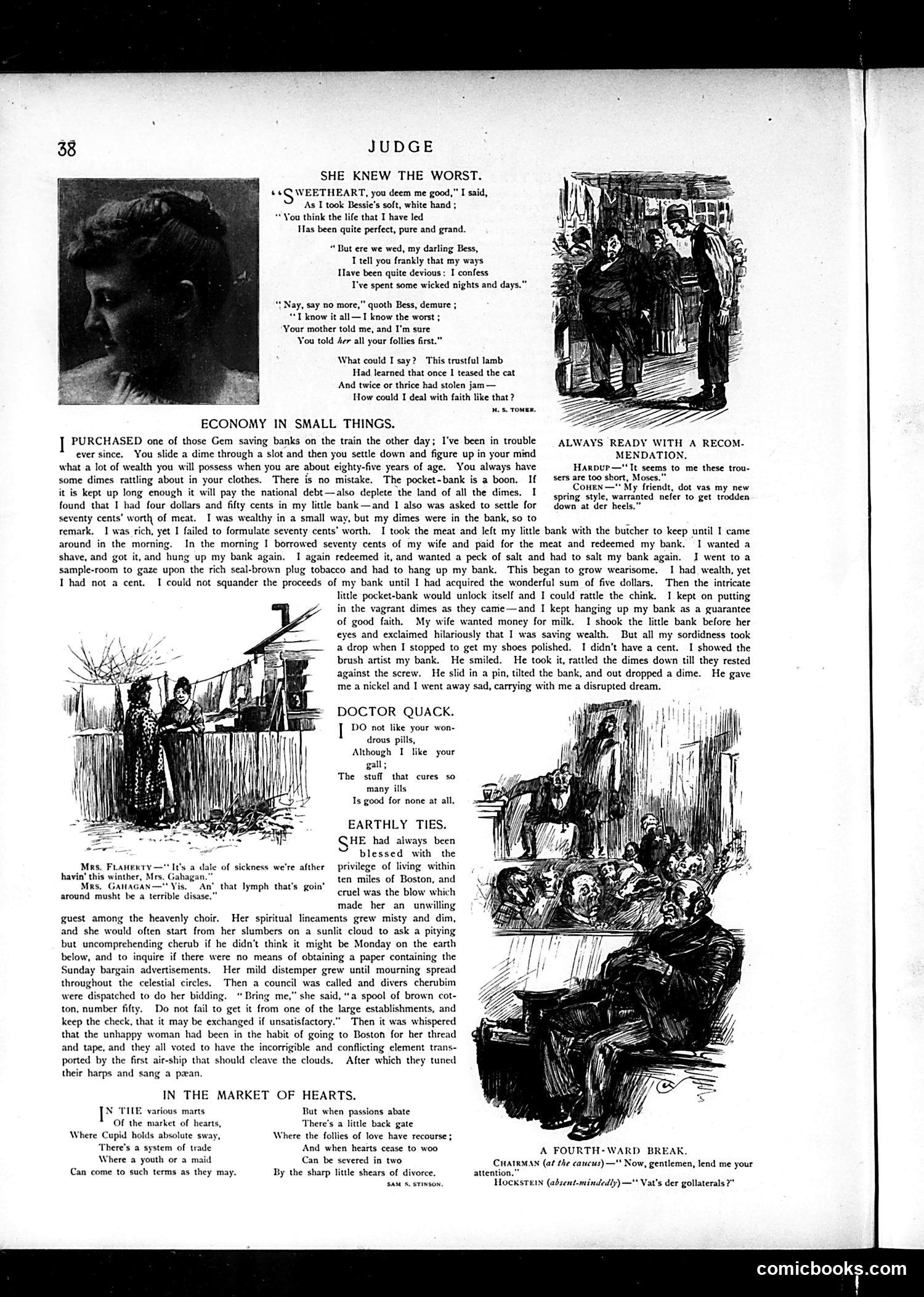
This page from *Judge* contains several satirical pieces mocking middle-class life and social pretension: **"She Knew the Worst"** humorously deflates a suitor's confession. A man admits to past misbehavior, expecting judgment, only to learn his fiancée already knows—from his mother—about trivial childhood transgressions (teasing the cat, stealing jam). The satire mocks both overwrought romantic confessions and how mothers embarrass their sons. **"Economy in Small Things"** ridicules the popular "savings bank" craze. A man buys a mechanical coin bank promising wealth by old age, but constantly must redeem it for immediate expenses (meat, shaves, tobacco), never accumulating the required five dollars to unlock it. The joke exposes the gap between middle-class aspirations for thrift and economic reality. **Other pieces** include light verse and small character sketches typical of *Judge*'s satirical commentary on everyday American life—doctors, Irish servants, romantic mishaps. The tone is gentle mockery rather than biting social critique.
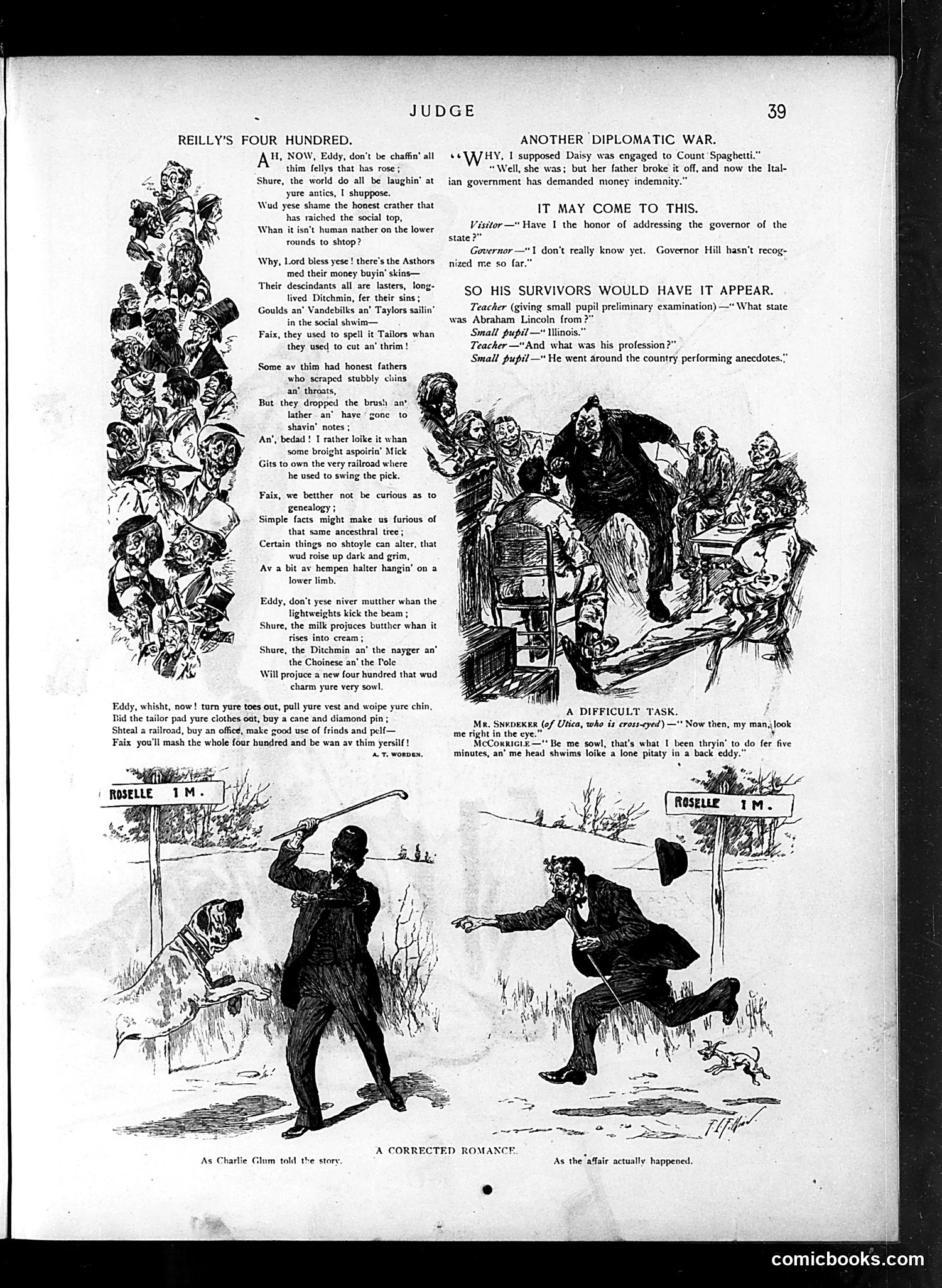
This page contains several satirical pieces mocking American social pretensions and contemporary politics: **"Reilly's Four Hundred"** uses Irish-dialect humor to mock the wealthy "Four Hundred" (New York's elite social circle). The poem argues that modern wealth is built on morally questionable foundations—railroads, department stores—and warns against judging the newly rich harshly, since even immigrants and marginalized groups will eventually "produce a new four hundred." The satire targets class snobbery while cynically suggesting corruption enables social climbing. **"Another Diplomatic War"** jokes about Italian-American tensions, likely referencing contemporary Italian government demands for reparations regarding Italian immigrant treatment in America. **"It May Come to This"** appears to mock Governor Hill's political obscurity or uncertain status. The remaining items—"A Difficult Task" and "A Corrected Romance"—are brief humorous sketches using ethnic dialect humor typical of the era's satirical magazines. Overall, the page reflects Judge's focus on mocking class anxiety and ethnic stereotypes common in Gilded Age America.
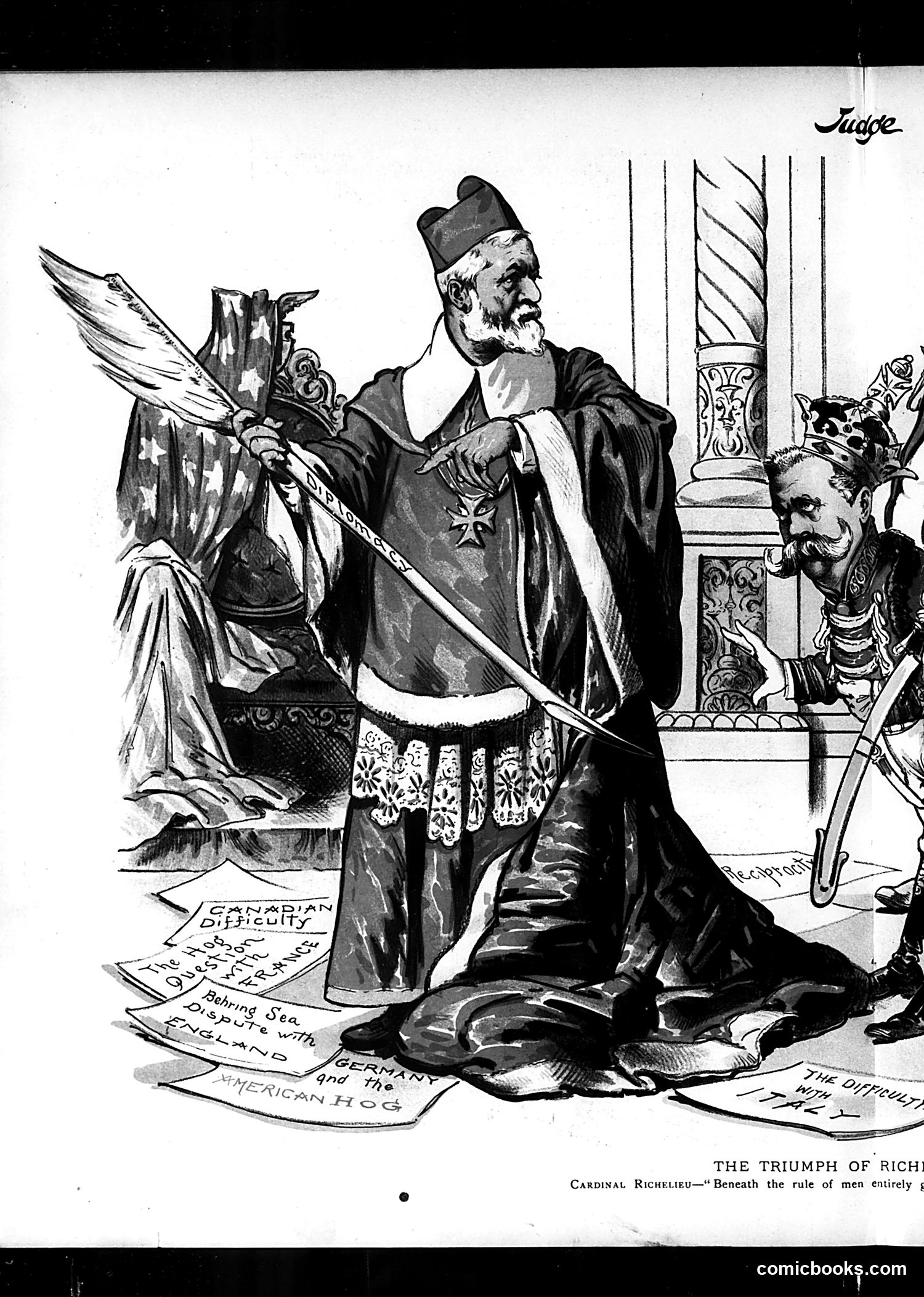
This political cartoon depicts **Cardinal Richelieu**, the historical French cardinal and chief minister under Louis XIII. The figure wears cardinal's robes and holds the French flag, standing triumphantly over documents labeled with various difficulties: "Canadian Difficulty," "Belonging Sea Disputes with Germany," "American Hog," and "The Difficult Uttermost." The satire appears to reference **Richelieu as a metaphor for strong political authority** managing multiple national crises simultaneously. The scattered papers suggest complex diplomatic and trade challenges facing the nation. By invoking the historical cardinal—famous for consolidating power and handling state affairs—the cartoonist likely comments on contemporary political leadership and whether current leaders possess Richelieu's effectiveness in managing competing national interests and international disputes.
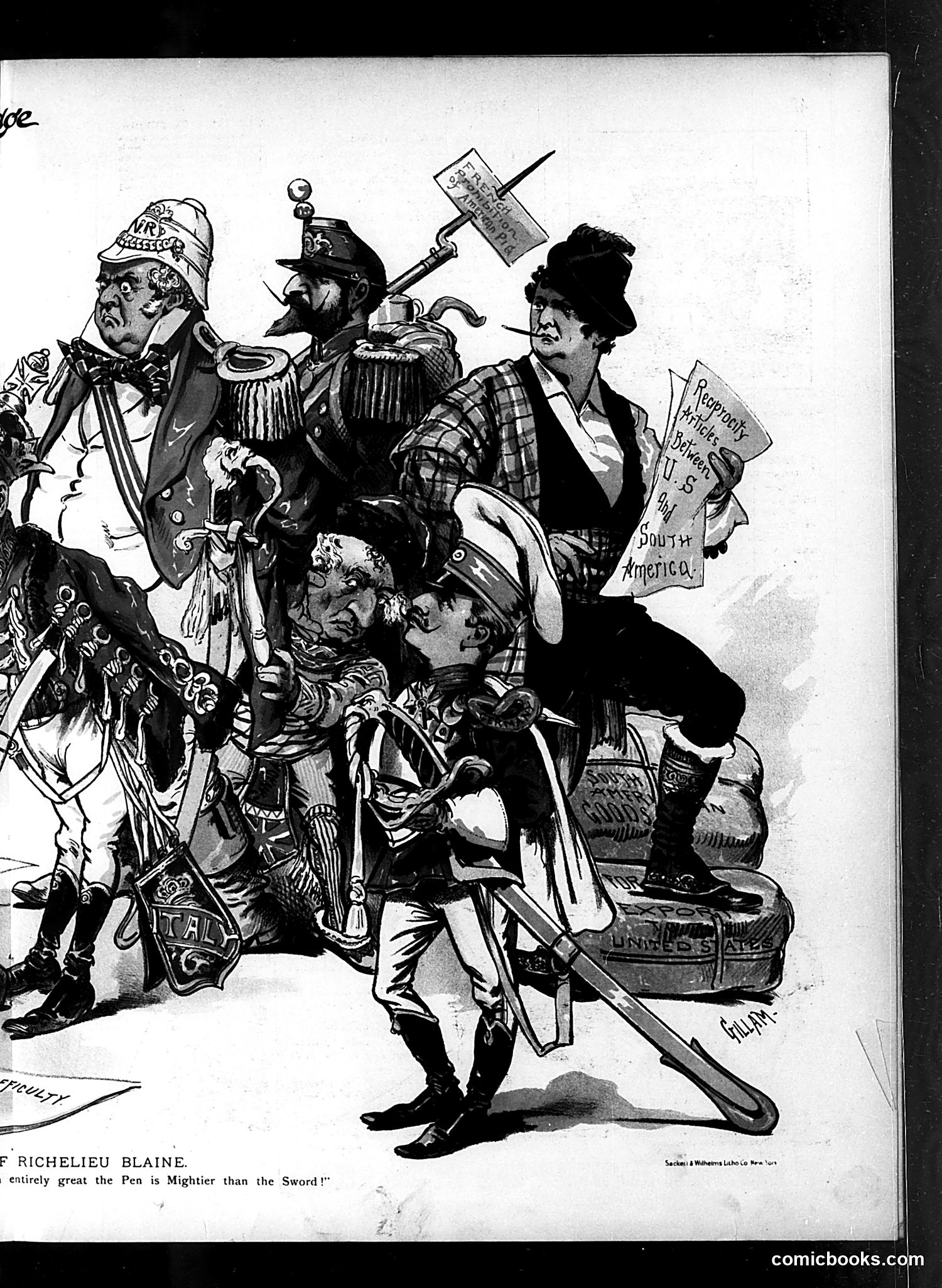
This Judge magazine cartoon satirizes **James G. Blaine** (identified as "Richelieu Blaine" in the caption), a prominent late-19th-century American politician. The composition depicts Blaine as a manipulative cardinal-like figure controlling European military powers—represented by uniformed officers labeled with national symbols (including "Italy"). The caption's phrase "the Pen is Mightier than the Sword" suggests Blaine wielded diplomatic influence over foreign militaries through writing/rhetoric rather than direct force. The kneeling figures at bottom appear to represent nations or interests subordinated to his influence. The cartoon criticizes Blaine's foreign policy approach or his alleged behind-the-scenes political manipulation, presenting him as a scheming puppet-master controlling international affairs—a common satirical device for portraying politicians as dangerously manipulative.
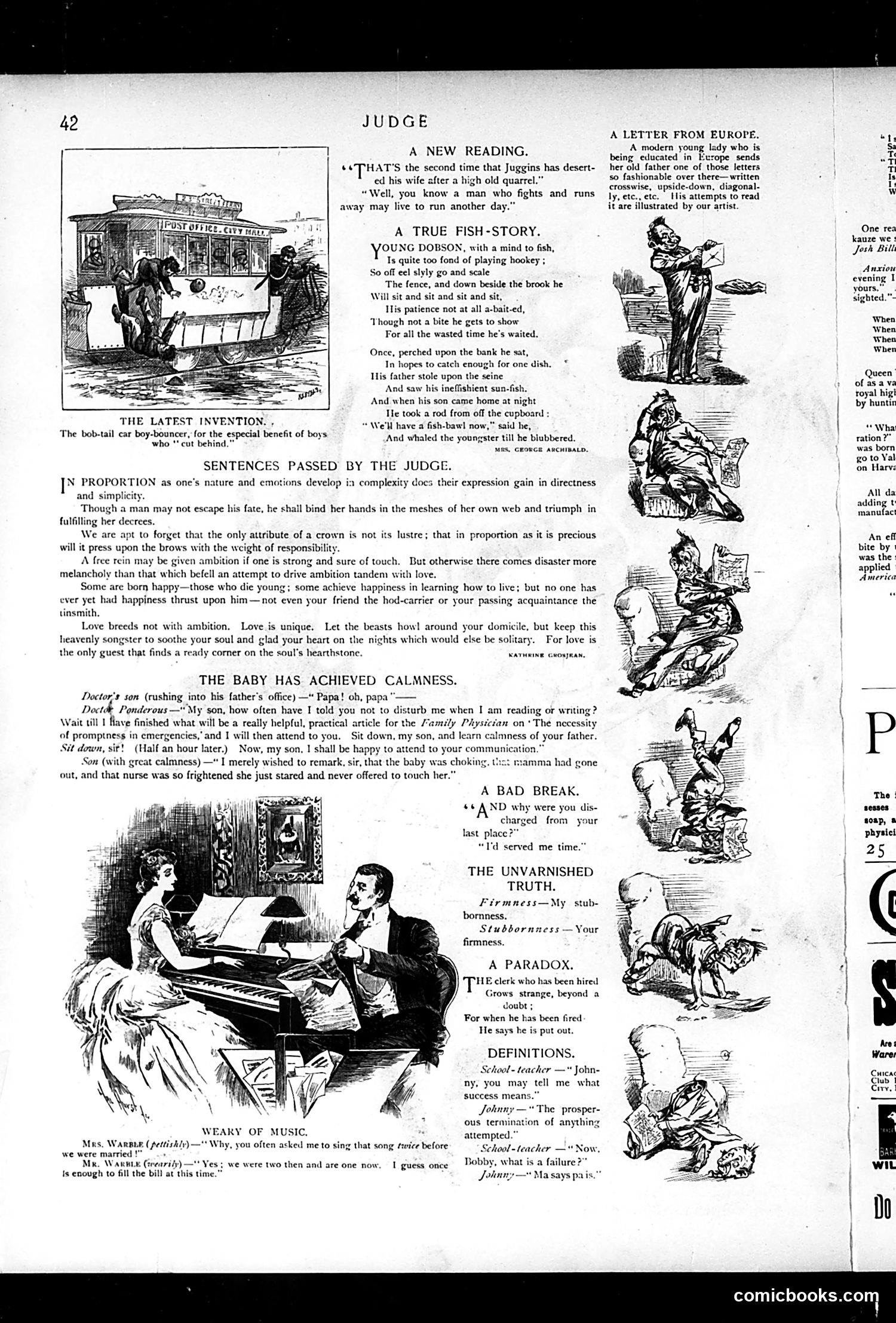
This is a page from *Judge* magazine containing several satirical pieces and humorous anecdotes typical of late 19th-century American humor. **"The Latest Invention"** depicts a streetcar device to prevent boys from "cutting behind" (sneaking rides)—commentary on urban transportation problems and youth misbehavior. **"The Baby Has Achieved Calmness"** satirizes an absent-minded doctor so absorbed in writing a medical article about handling emergencies that he ignores his actual emergency: his baby choking. The irony mocks professional pretentiousness. **"A True Fish-Story"** is a poem about a boy playing hookey to fish unsuccessfully, whom his father punishes severely—reflecting period attitudes about discipline and wasted time. **"Weary of Music"** shows a husband dismissing his wife's singing request because they're now married, implying marriage kills romance. Other sections ("The Unvarnished Truth," "A Paradox," "Definitions") offer wordplay and light philosophical observations common to magazine humor of the era. The illustrations throughout use exaggerated Victorian-style drawings.
This page is primarily **advertisements and filler content** rather than political satire. The main visible elements include: **"Carl Pretzel's Philosophy"** — a humor column featuring a German-accented character offering folksy observations in broken English ("der prains," "wirtuous"). This appears to be ethnic humor typical of the era, playing on German-immigrant speech patterns. **Scattered anecdotes** — brief jokes about relationships, mothers catching couples, and a burglar scared by a camera (kodak) rather than a gun. **Numerous product advertisements** — Castoria (children's medicine), Packer's Tar Soap, Sohmer pianos, Barry's hair product, Armour's Extract of Beef, Crosby's Phosphites (brain food), Rae's Lucca Oil, and corn remedies. The page reflects **late 19th-century commercial magazine culture** where editorial content was minimal and advertising dominated. The "humor" relies on ethnic stereotypes and sentimental domestic scenarios rather than political commentary. This appears to be a filler or back page rather than the magazine's main satirical content.
This page from *Judge* magazine consists primarily of **advertisements**, not political cartoons—a common format for late 19th-century periodicals. The main advertised products include luxury goods and remedies: perfume, cigars, clothing, patent medicines (like Cuticura skin treatments), and transportation (New York Central Railroad). There is **one brief satirical item** at top: a student-teacher exchange mocking British royalty. The teacher asks why Britain supports royalty, and the pupil responds: "Because royalty cannot support itself"—simple political humor about monarchy's financial dependence on the state. The remaining content shows period-typical commercial advertising. The "Isaac Newton Pitts" item appears to be a humorous poem about mistaking a patent-medicine promoter for a famous scientist, mocking the proliferation of dubious medicinal claims in contemporary advertising. The page reflects *Judge*'s character as a magazine blending satirical commentary with heavy advertising revenue.
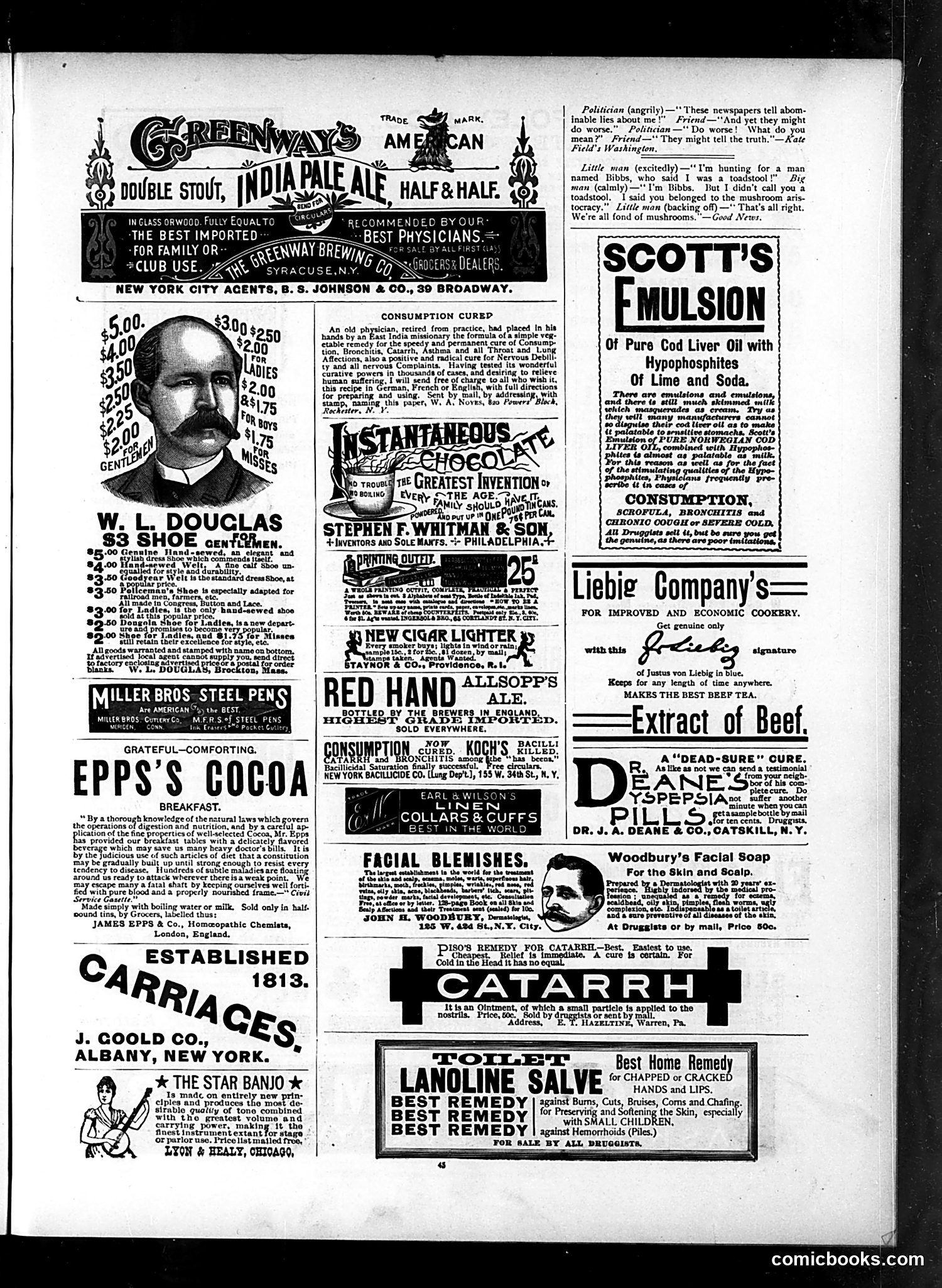
This is primarily an **advertising page** from Judge magazine, not a political cartoon. The page contains numerous product advertisements typical of late 19th-century American periodicals. The only cartoon content visible is a **brief two-panel joke** near the top right, showing a politician complaining that newspapers tell lies about him. The punchline—that newspapers "might tell the truth" instead—is satire of political dishonesty, a common Judge theme mocking politicians' thin-skinned responses to press criticism. The rest of the page advertises patent medicines, shoes, cocoa, beer, and other products with exaggerated health claims typical of the era (consumption cures, nervous debility treatments, etc.). The W.L. Douglas shoe advertisement featuring a bearded man is a straightforward product pitch, not political satire. **For modern readers:** This page illustrates how 19th-century magazines monetized through dubious medical advertising, before FDA regulation of health claims.
This page is primarily **advertising**, not political satire or editorial cartoons. It consists of approximately 40+ different commercial advertisements typical of a late 19th-century publication, spanning: **Product categories:** - Writing instruments (Foley gold pens, fountain pens) - Chocolates and confections - Pianos and musical instruments - Hotels and travel guides - Blank books and stationery - Tea and candy - Medical treatments (varicocele cure) - Playing cards and games - Ink and pencils **Notable elements:** The advertisements use period typography, decorative fonts, and small illustrations (like the German Sweet Chocolate maiden). One large banner at bottom reads "CHOCOLAT MENIER / ASK FOR IT EVERYWHERE." **For modern readers:** This reflects the advertising-heavy nature of 19th-century magazines, where product endorsements subsidized publication. The ads reveal contemporary consumer culture, patent medicines (common then), and luxury goods marketed to urban readers. No political commentary or satirical cartoons are evident on this page.
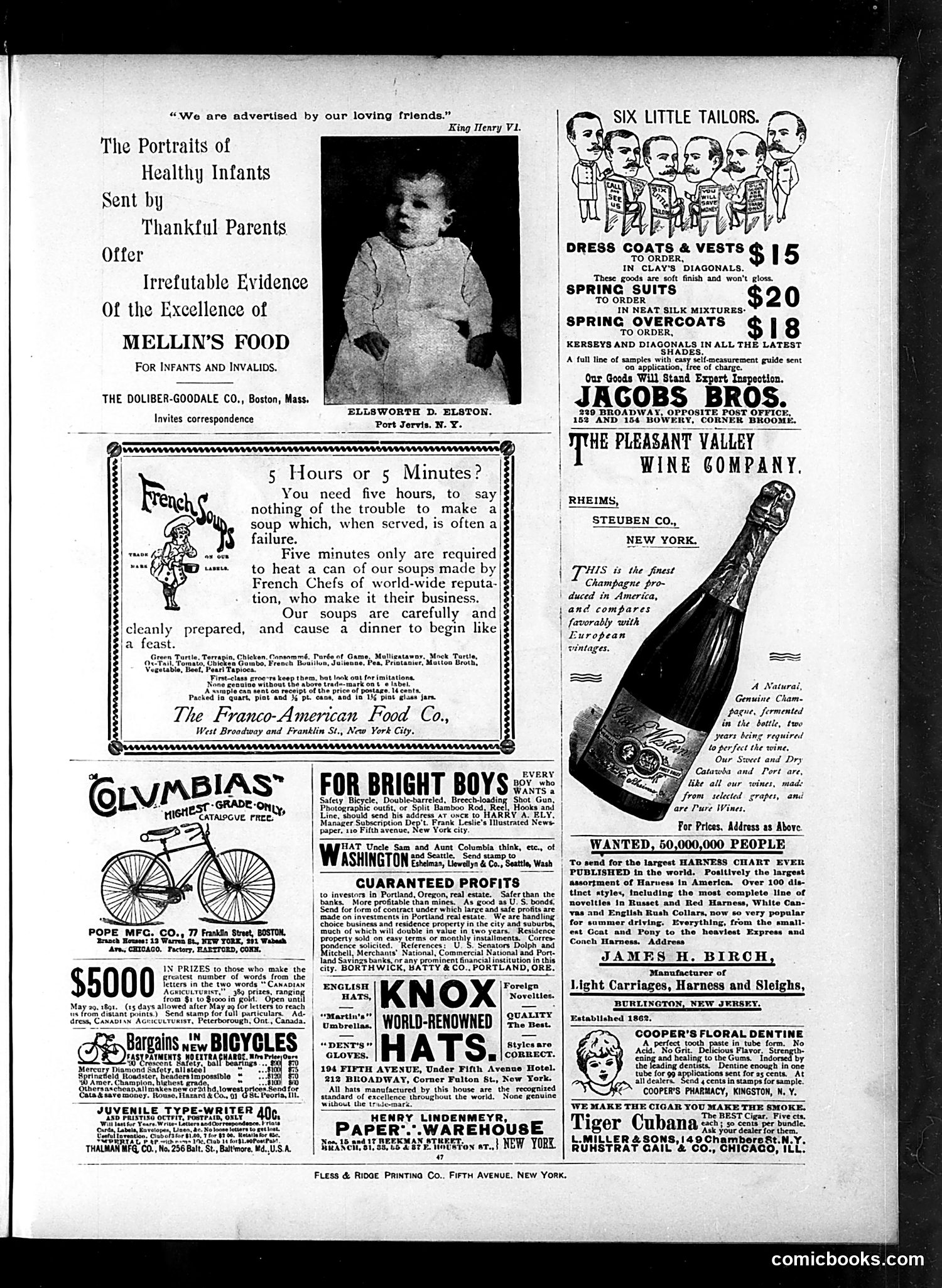
This is primarily an **advertising page**, not a satirical editorial cartoon spread. It features various commercial advertisements from the 1890s aimed at middle-class consumers. Notable ads include: **Mellin's Food**: An infant formula company using testimonials—a common marketing technique of the era. The epigraph from King Henry VI ("We are advertised by our loving friends") wryly suggests people promote products through satisfied use. **Franco-American Soups**: Marketed as convenient time-savers requiring only 5 minutes versus hours for homemade soup—addressing new consumer concerns about domestic labor efficiency. **Columbia Bicycles**, **Knox Hats**, and **Jacobs Bros. Tailors**: Standard product advertisements reflecting the period's growing consumer culture and mass marketing. The page demonstrates how Judge—primarily known for political satire—also served as a commercial platform. The subtle wit appears in ad copy itself rather than in editorial cartoons. The targeted products and messaging reveal late-Victorian anxieties about modern convenience, efficiency, and respectability.
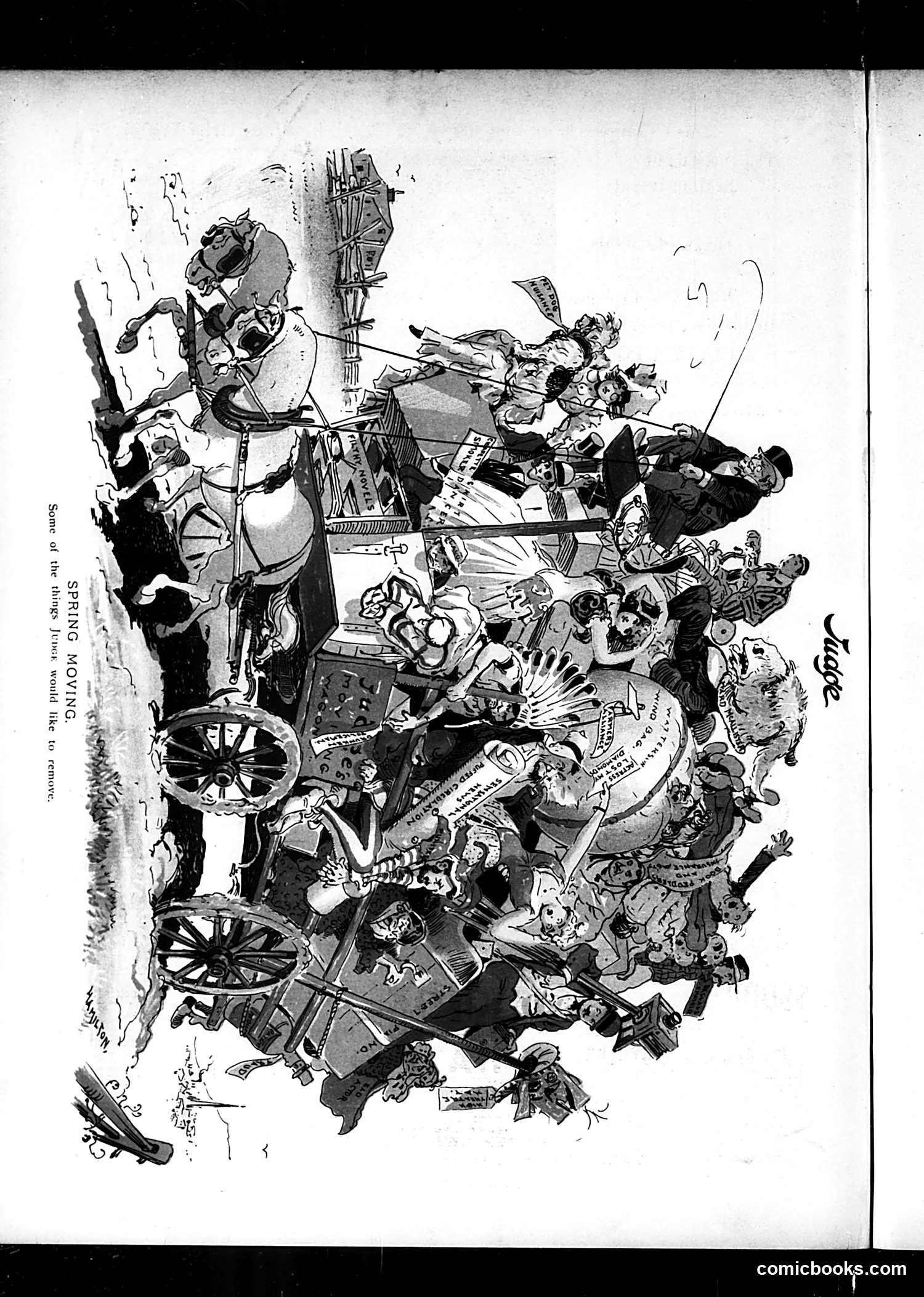
I can see this is a satirical illustration from *Judge* magazine, but the OCR text is largely illegible and appears to be corrupted or inverted. The image itself shows a chaotic, crowded scene with numerous figures in 19th-century dress surrounding what appears to be an ornate carriage or vehicle. The style suggests political satire—likely depicting a procession, political event, or social commentary from that era. However, without readable text identifying the specific figures, politicians, or events being lampooned, I cannot accurately determine the cartoon's precise subject or satirical point. The illustration's intricate detail suggests it addresses a significant contemporary event or political controversy, but claiming specific identities or meanings would require speculation rather than evidence from this page. A clearer OCR transcription or caption would be needed for accurate interpretation.