
A complete issue · 16 pages · 1891
Judge — April 18, 1891
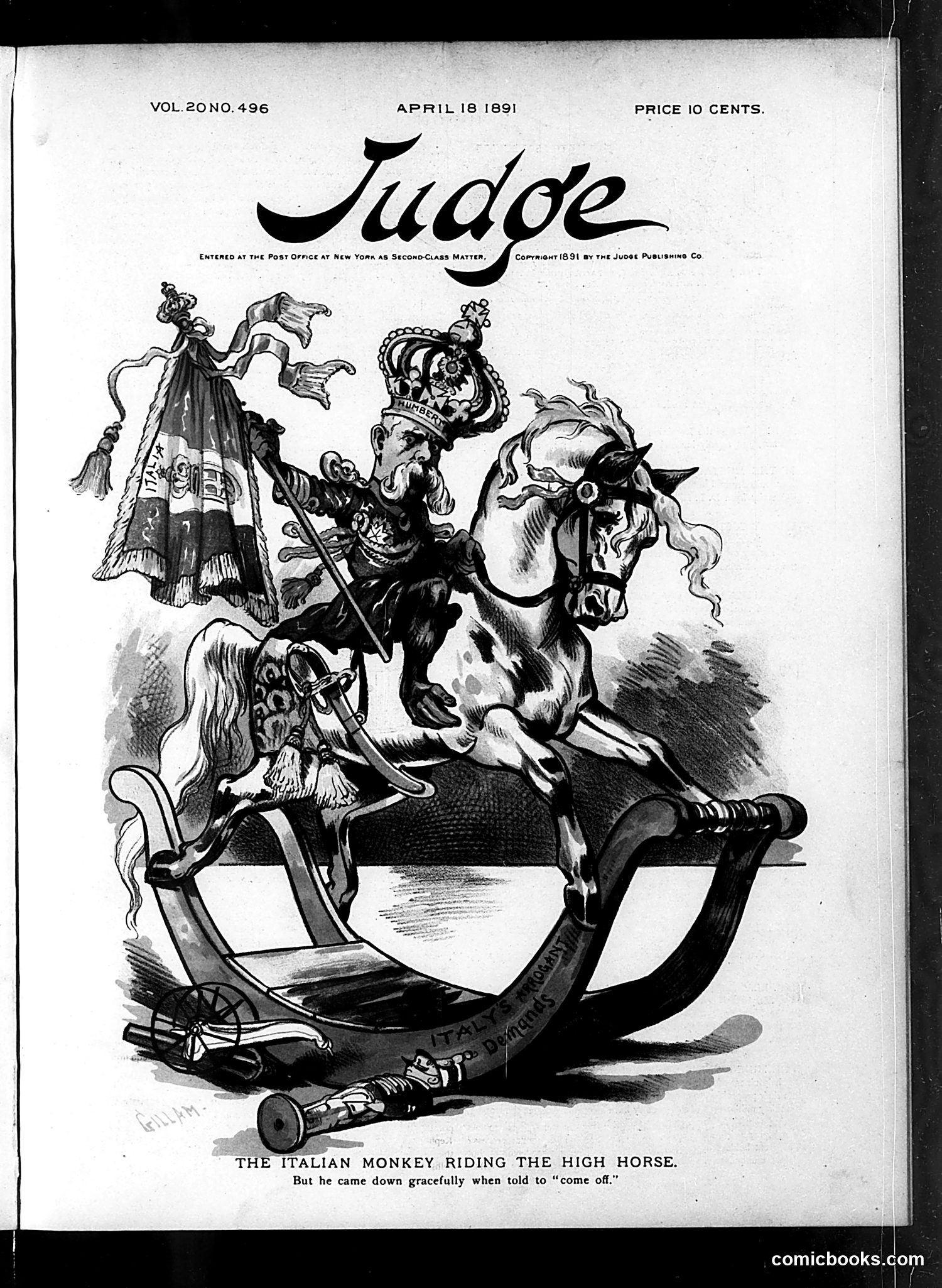
This April 1891 *Judge* cartoon satirizes an Italian political figure—likely related to Italy's international relations or diplomatic posturing of that era. The caricature depicts an exaggerated, monkey-like Italian figure riding a rearing horse, crowned with what appears to be royal regalia, wielding a sword and ornate cape. The subtitle—"But he came down gracefully when told to 'come off'"—suggests the figure was engaged in aggressive or presumptuous behavior that was quickly abandoned when challenged. The "monkey" caricature reflects the era's crude ethnic stereotyping common in American satirical magazines. The "high horse" metaphor indicates the target was acting arrogantly or pretentiously, with the humor derived from the immediate capitulation when confronted. The specific political incident remains unclear without additional context.
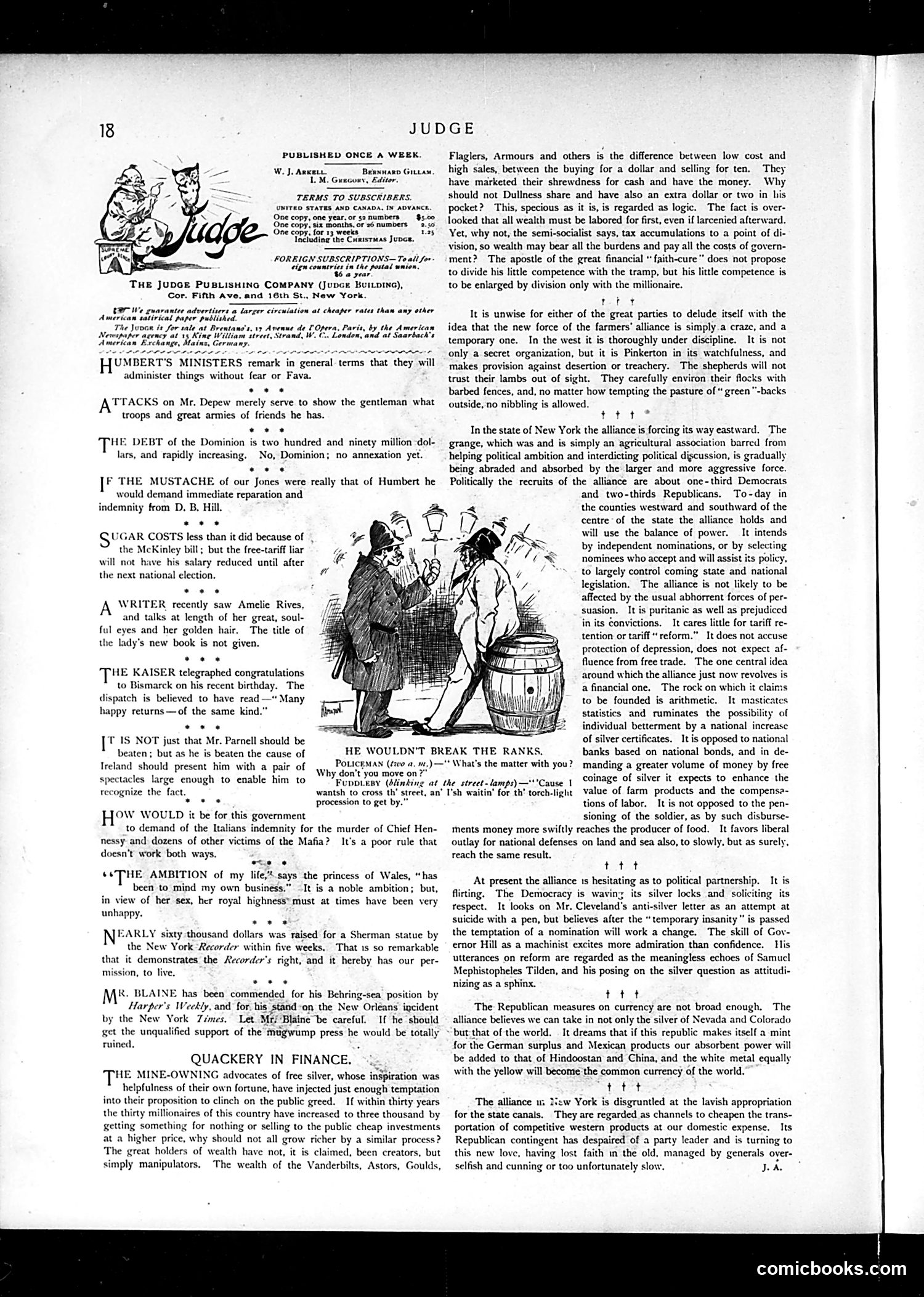
The main cartoon titled "HE WOULDN'T BREAK THE BANKS" depicts a policeman confronting a figure labeled as representing street gambling or financial schemes. The accompanying dialogue references crossing a street and breaking banks—likely satirizing either petty crime or financial manipulation during this era. The surrounding text discusses various political topics including: Dominion debt, mustaches (possibly referencing a political figure), sugar costs, and criticism of the Kaiser's telegraph. There's commentary on Irish independence and references to Sherman statues and "Recorder's right." The specific political figures and events referenced are unclear without additional historical context, but the satire generally targets government policies, wealth inequality, and contemporary political controversies. The exact date would help clarify which events are being mocked.
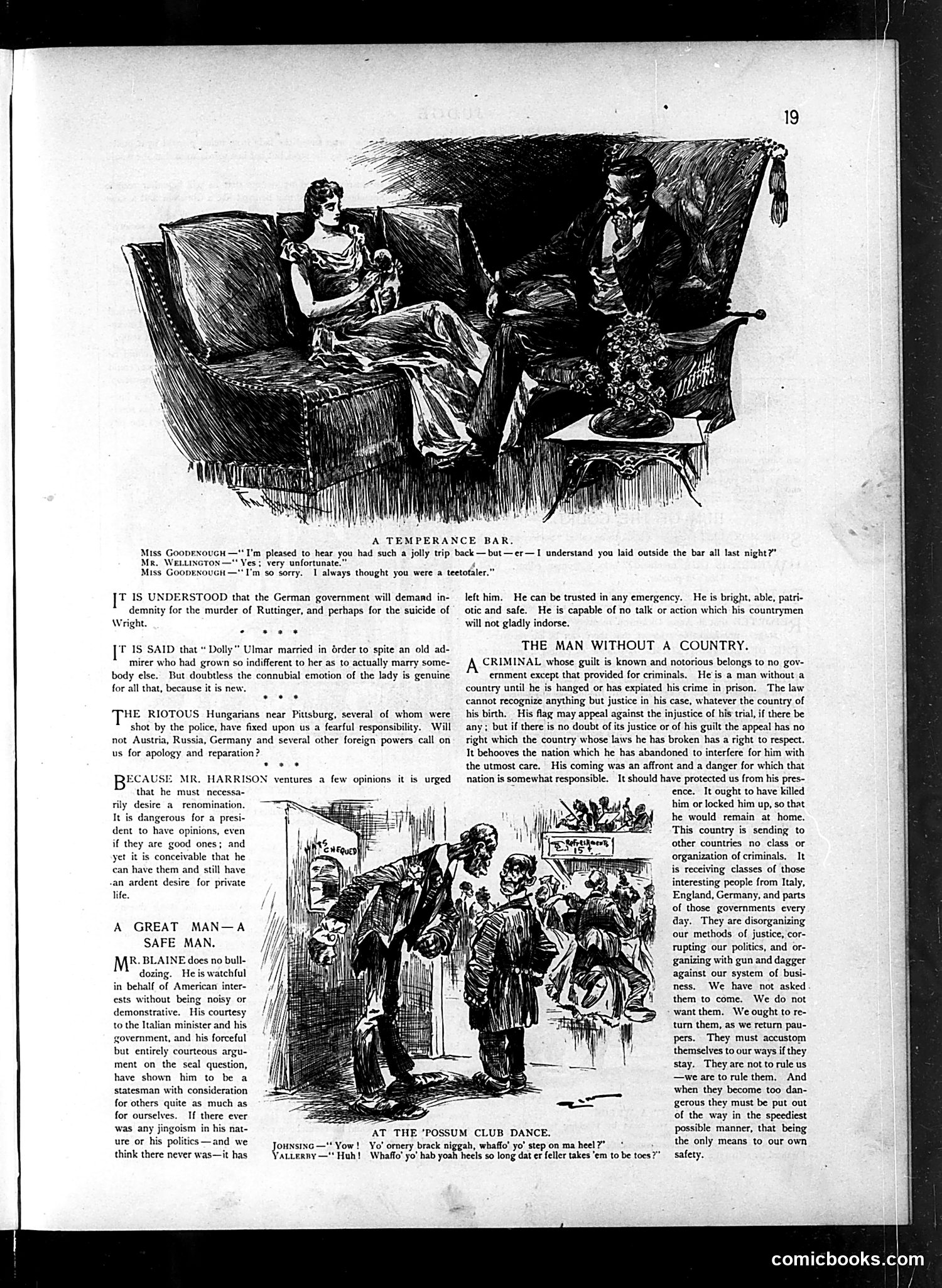
**Top Cartoon - "A Temperance Bar":** This depicts a social scene mocking temperance advocates. Miss Goodenough confronts Mr. Wellington about a "jelly trip" to the bar, expressing surprise he'd visit such a place. The humor satirizes the contradiction between temperance movement rhetoric and actual behavior—suggesting even its proponents secretly indulge in alcohol consumption. **Bottom Cartoon - "At the Possum Club Dance":** Shows what appears to be an upper-class social gathering where characters discuss staying out late. The satire likely targets wealthy social circles and their perceived hypocrisy or frivolous behavior. The page also contains serious editorial content discussing German government demands regarding Erzberger's death, American foreign policy toward criminals, and commentary on political figures like Mr. Blaine.
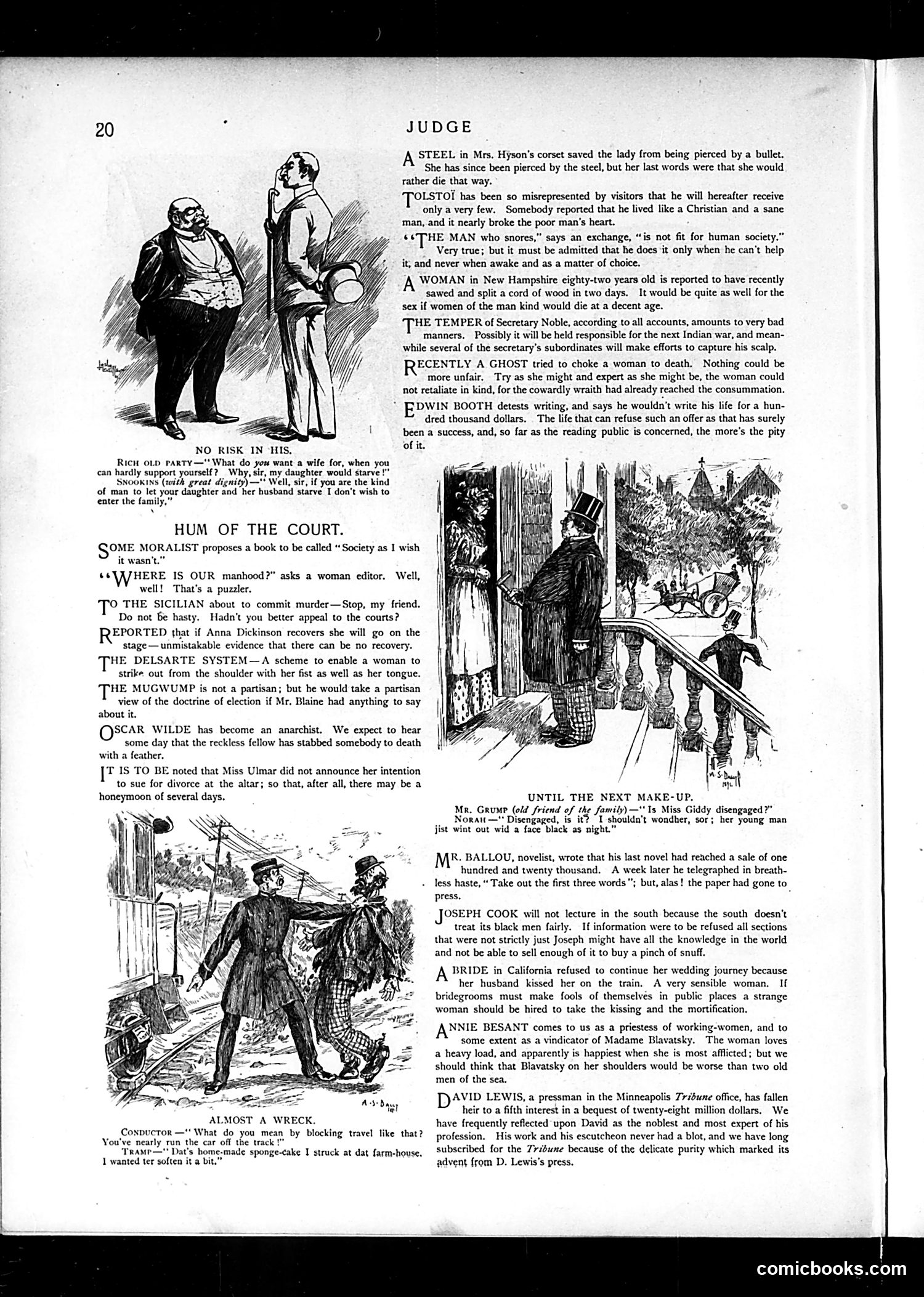
This page combines brief satirical quips with topical commentary typical of 1880s American humor. Key items include: **Top cartoon**: "No Risk in His" mocks a wealthy suitor's presumption—a poor man boldly refuses to marry into a family that would let him starve, inverting class expectations for comedic effect. **Named references** include **Oscar Wilde** (mocked as an anarchist), **Anna Dickinson** (actress/lecturer), **Secretary Noble** (likely Interior Secretary John Noble), and **Edwin Booth** (actor). These jabs target celebrities and public figures. **Social satire** targets women's rights ("Where is our manhood?"), class anxiety, and Victorian propriety. One item ridicules the "Delsarte System" (a body-movement technique for women), implying women shouldn't be physically assertive. **Bottom cartoon**: "Almost a Wreck" shows a streetcar conductor nearly derailing—apparently mocking incompetent transit workers. The cumulative effect satirizes Gilded Age society, celebrity, politics, and gender anxieties through brief, punchy humor meant for quick magazine consumption.
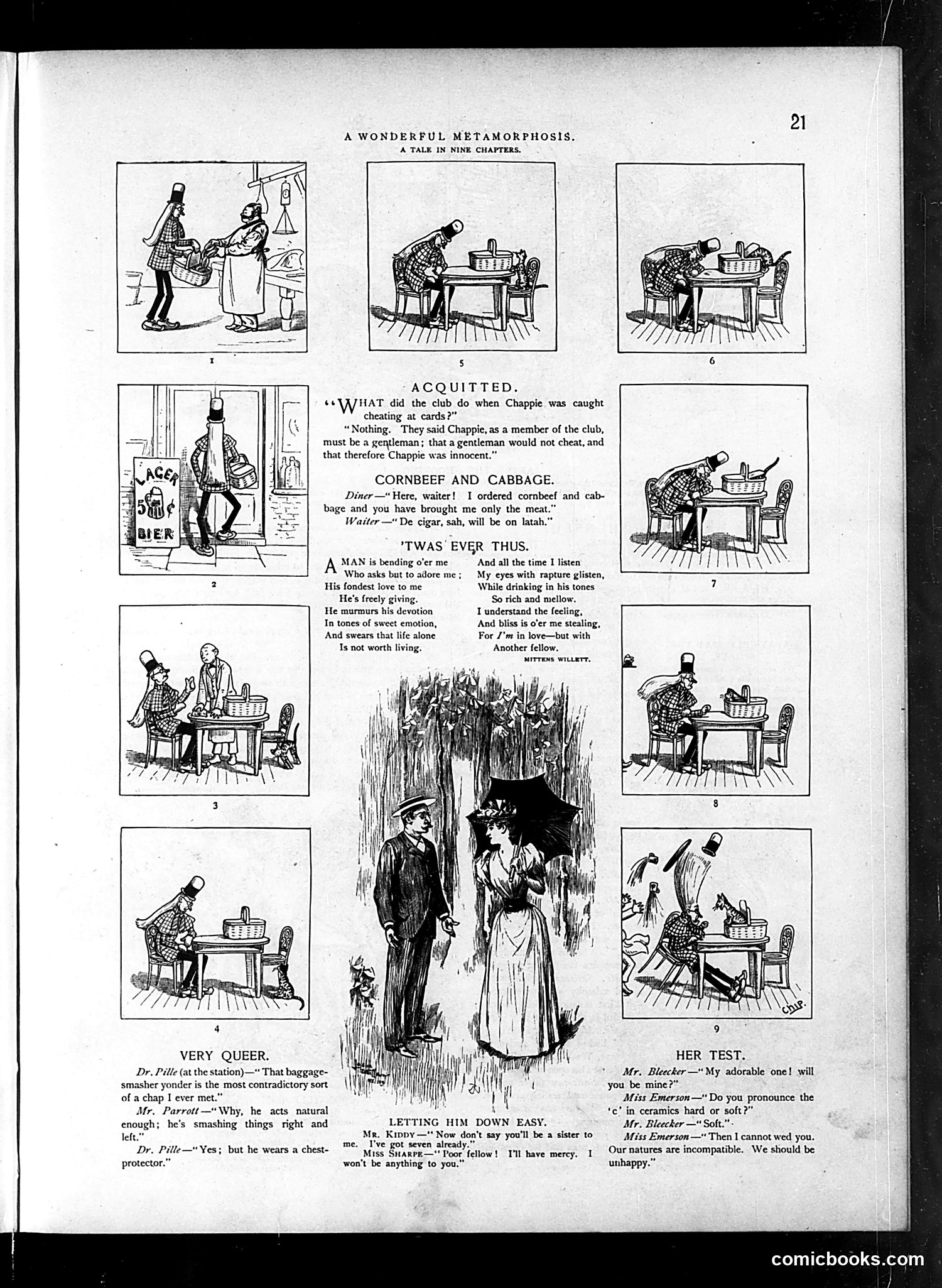
This page contains several unrelated satirical sketches typical of Judge's humor: **"Acquitted"** mocks upper-class hypocrisy: a gentleman caught cheating at cards is automatically declared innocent because "a gentleman would not cheat"—circular logic excusing misconduct based on social status. **"Cornbeef and Cabbage"** jokes about a waiter serving only meat, claiming the cigar (a luxury item) will come later—satirizing either cheap restaurants padding bills or absurd service priorities. **"'Twas Ever Thus"** is a romantic poem about unrequited love—a man courts a woman who loves someone else. **"Very Queer"** depicts a contradiction: a man who "acts natural" while destructively "smashing things right and left." **"Her Test"** shows a woman rejecting a marriage proposal based on a suitor's pronunciation of a word in ceramics—mocking either pretentious women or absurdly trivial relationship dealbreakers. The repeated dinner-table scenes (numbered 4-9) appear to illustrate the "metamorphosis" promised in the title, though the progression's meaning remains unclear.
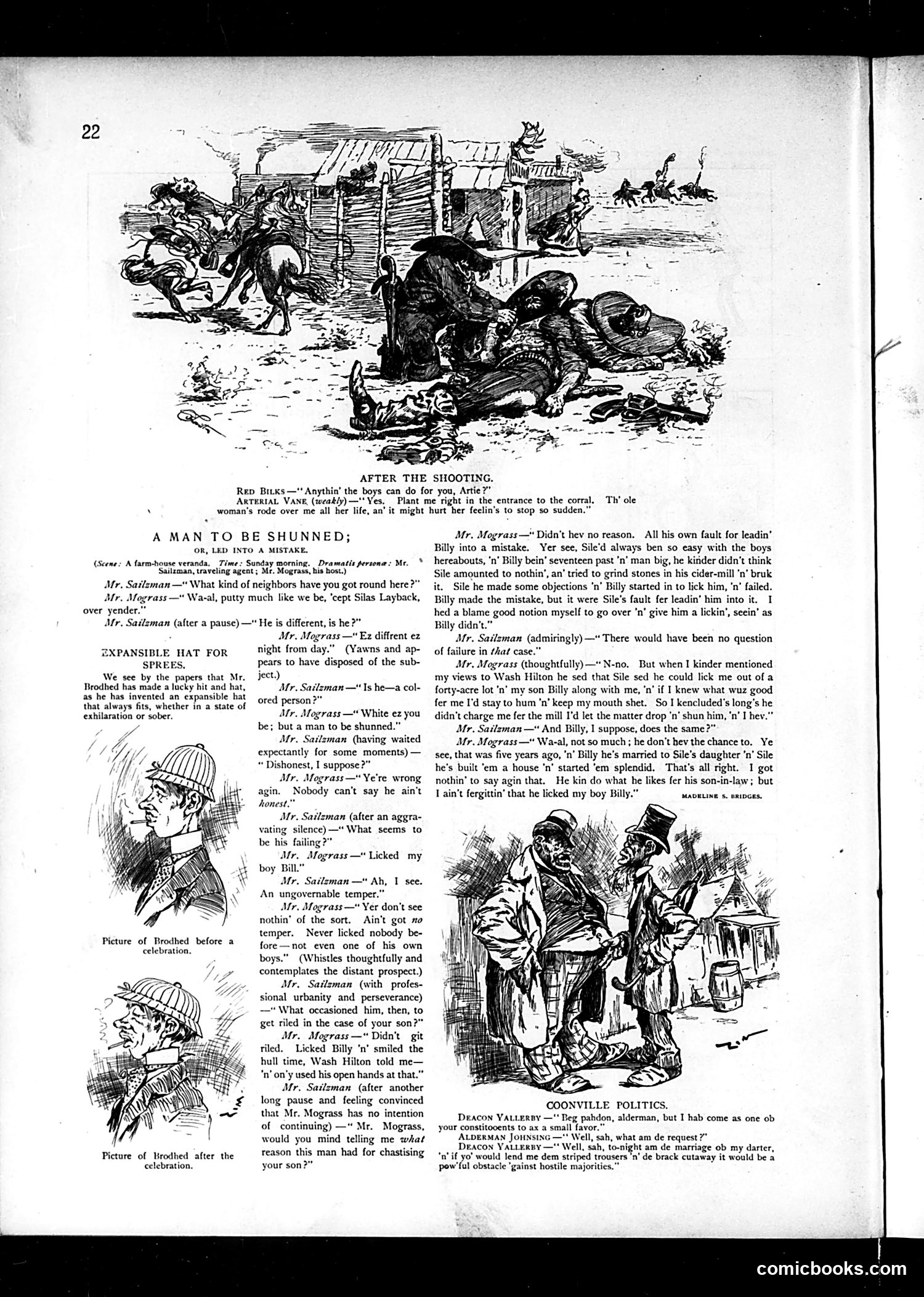
This humorous sketch satirizes rural stubbornness and the logic of frontier grudge-holding. A traveling salesman (Mr. Sailzman) tries to extract from a farmer (Mr. Mograss) why a neighbor, Silas Layback, is universally shunned despite being honest, hardworking, and even-tempered. Through painfully indirect dialogue, it emerges: Silas once beat Mograss's son Billy after Billy broke his cider mill and tried to fight back. Billy lost. Rather than blame his son's transgression, Mograss holds a five-year grudge—even though Silas later married Billy to his daughter and built them a house. The satire targets rural pride and irrational social codes: a man can be "shunned" not for moral failing but for winning a justified fight with someone's son. The absurdity lies in Mograss's inability to forgive despite Silas's subsequent kindness, exemplifying petty frontier honor culture where a past slight outweighs present generosity.
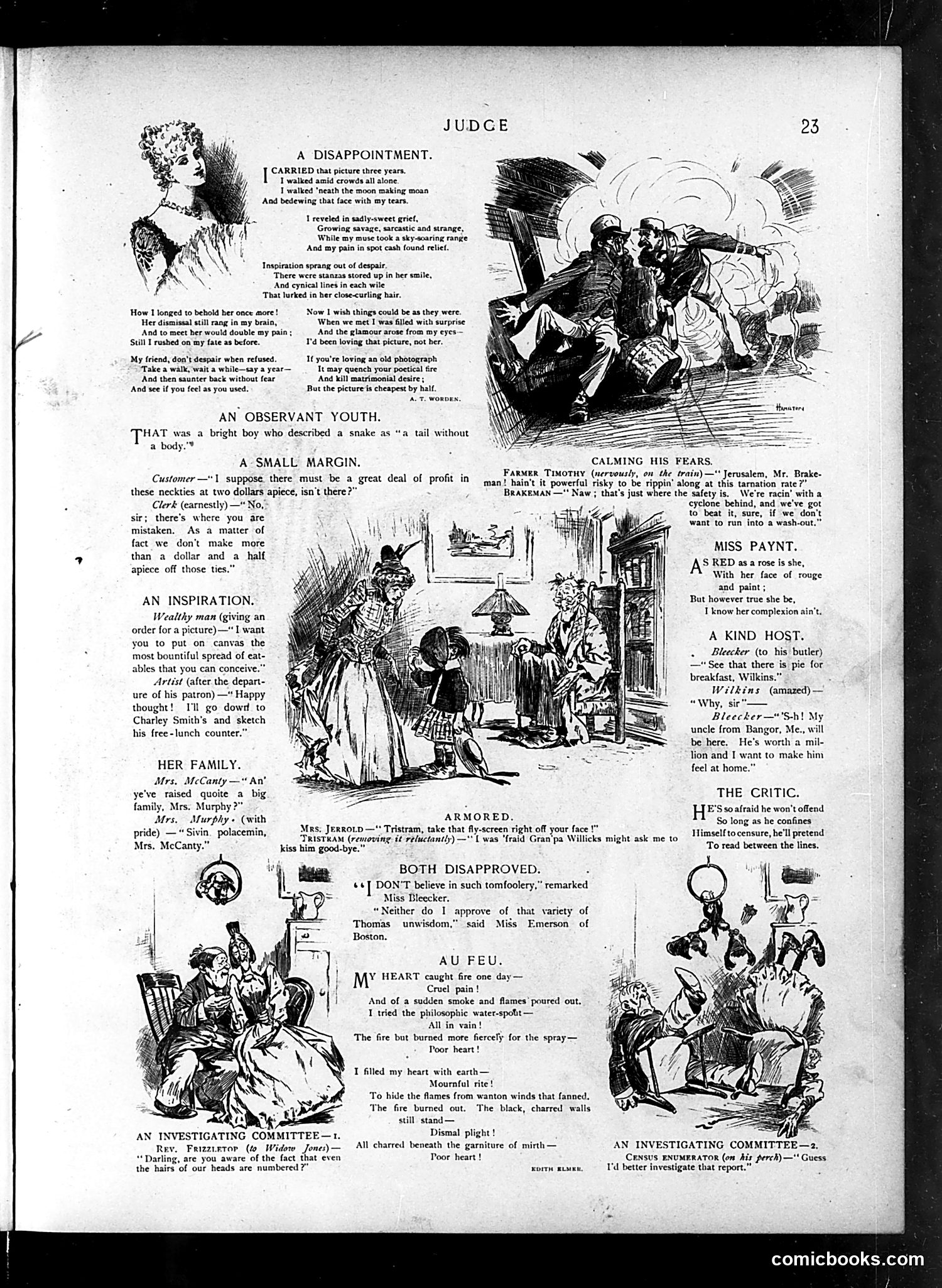
This is a Victorian-era humor page mixing poetry, short comedic sketches, and satirical illustrations typical of *Judge* magazine's format. **Key content:** - **"A Disappointment"** (poem): A jilted man romanticized a woman's photograph for years, only to discover he'd been in love with the *image*, not the actual person—satirizing sentimental male romanticism. - **Short jokes** mock everyday hypocrisy: a neckties clerk claiming no profit while clearly profiting; an artist planning to sketch a wealthy patron's "culinary vision" at a cheap diner; a woman using heavy makeup while denying it. - **Illustrations** show domestic and social scenes: a farmer nervous about train speed, a butler arranging breakfast, a critic pretending depth while reading "between the lines." - **"Au Feu"** (poem): Uses fire metaphorically for heartbreak, suggesting emotional pain cannot be remedied by reason ("philosophic water-spoilt"). The page satirizes Victorian pretense, sentimentality, and social climbing through gentle mockery rather than sharp political commentary. It's primarily entertainment for middle-class readers.
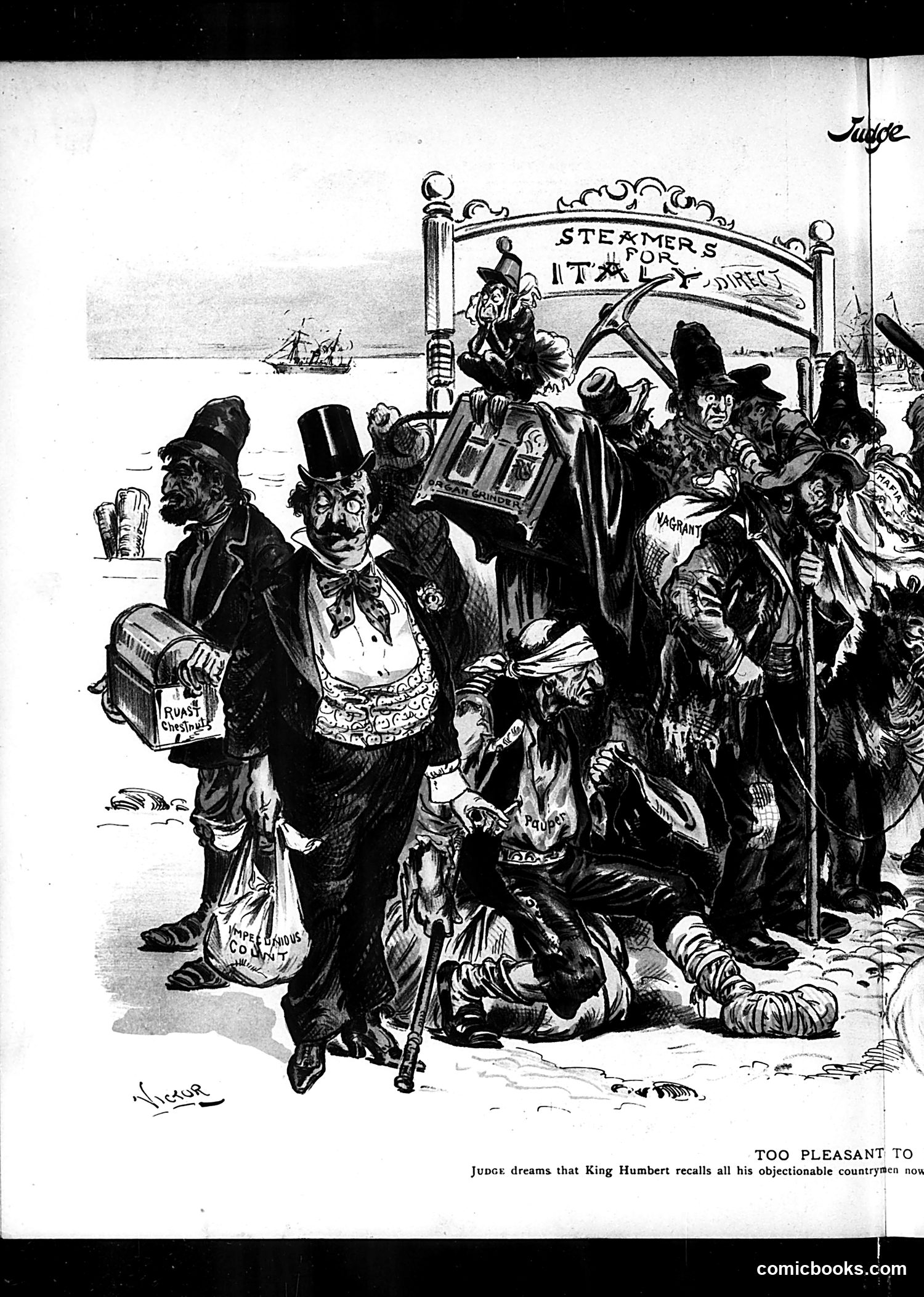
This satirical cartoon depicts a pier scene labeled "Steamers for Italy Direct," showing caricatured immigrants boarding a ship. The figures carry bags labeled "Trust Shipping" and "Pauper," while one holds a "Vagrant" sign. The caption references King Humbert (likely Umberto I of Italy) recalling "objectionable countrymen." The satire targets late 19th-century American anxieties about Italian immigration. It mocks the stereotype of Italian immigrants as poor, criminal, or vagrant elements being sent back to Italy. The "too pleasant" ironic title suggests the cartoonist is criticizing restrictionist sentiment—sarcastically implying deportation is desirable. This reflects Judge magazine's often-xenophobic perspective on immigration policy during the era of mass Italian immigration to America.
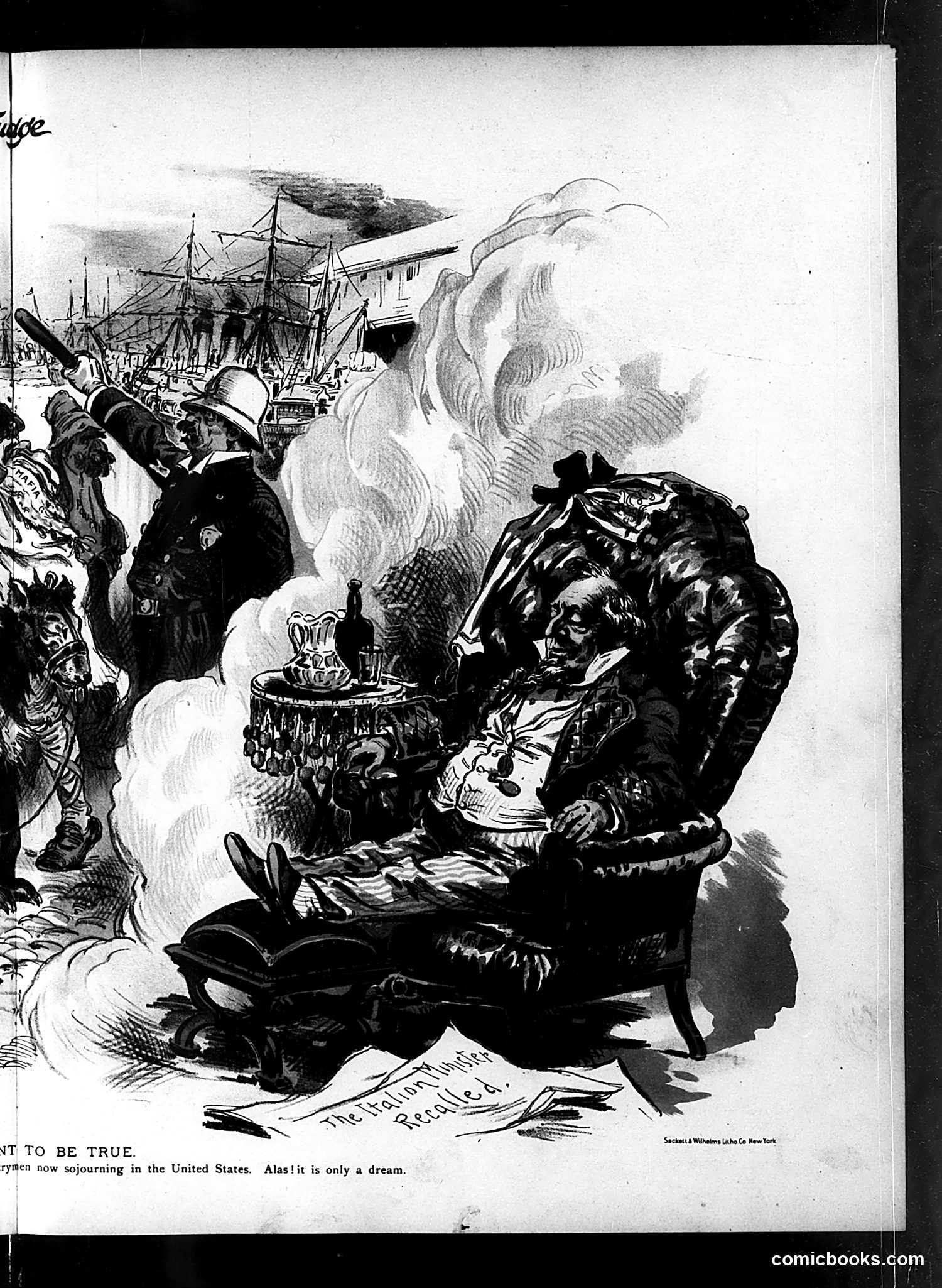
This political cartoon depicts wealthy European aristocrats relaxing luxuriously while ships burn in a harbor behind them. The figures appear to be foreign nobility or diplomats visiting America, indulging in wine and comfort despite apparent naval destruction occurring nearby. The caption—"[something] to be true" and "Foreigners now sojourning in the United States. Alas! it is only a dream"—suggests satirical commentary on American attitudes toward wealthy foreign visitors. The cartoon likely critiques either American deference to European aristocracy or, conversely, Americans' fantasy of seeing such figures brought low by disaster. The specific historical context remains unclear without the complete caption, but the imagery of oblivious luxury amid chaos suggests commentary on class disparity or American-foreign relations during an unspecified period of Judge magazine's publication.
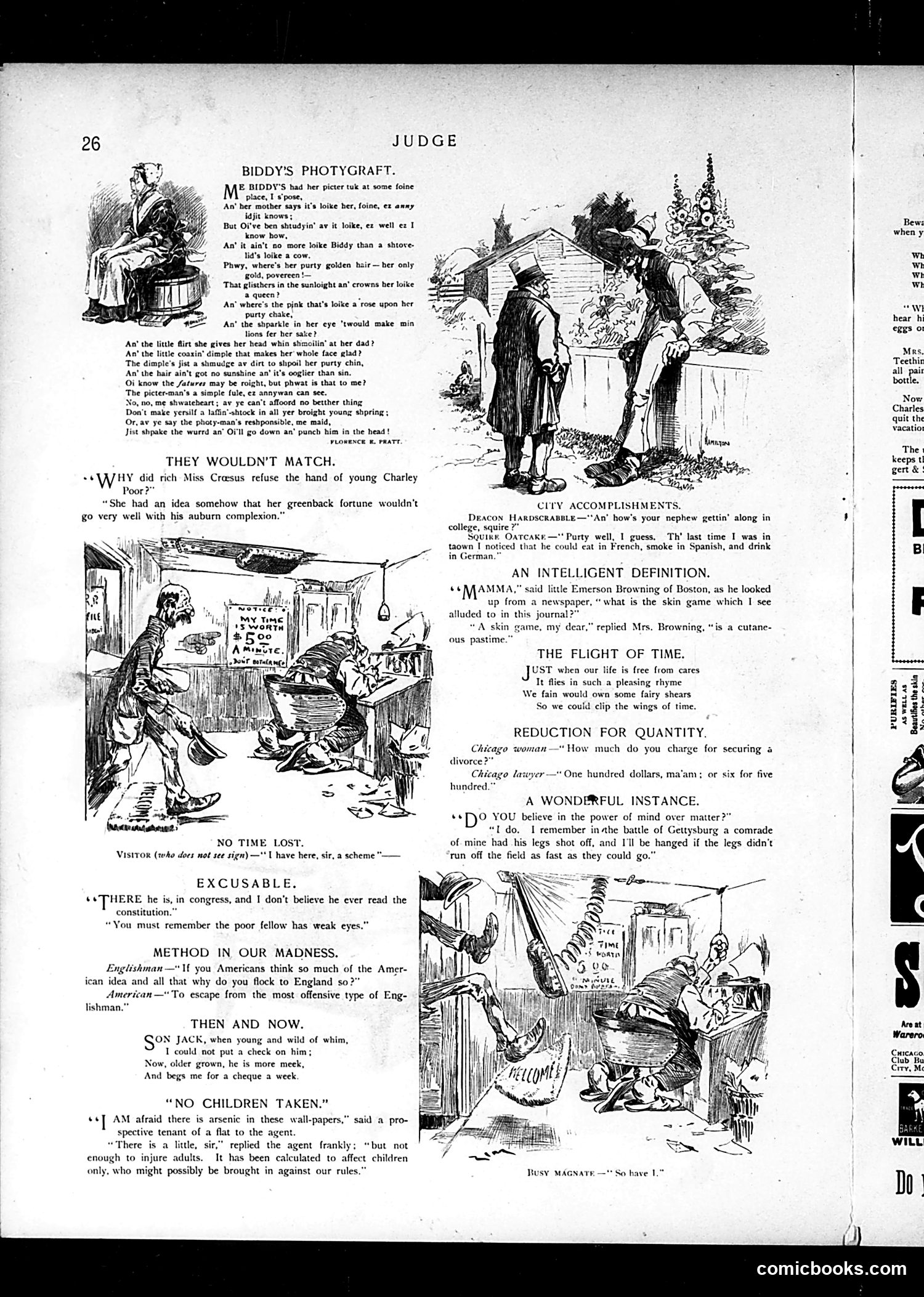
This page collects brief satirical pieces typical of late 19th-century American humor magazines. The lead poem, "Biddy's Photygraft," mocks a Irish-accented woman complaining that a photographer's portrait of her daughter doesn't capture the girl's natural beauty—her golden hair, rosy cheeks, and dimples appear dull or smudged. The satire targets both photography's limitations and the speaker's romantic Irish working-class sentimentality. The remaining items are short jokes on familiar topics: a wealthy woman rejecting a poor suitor ("They Wouldn't Match"), a congressman who never read the Constitution, the contrast between American egalitarianism and British snobbery, and gallows humor about Civil War amputees and arsenic wallpaper. These pieces reflect Judge's formula: gentle mockery of ethnic accents (Irish, rural American), social pretension, marriage and money, and contemporary anxieties—presented without the darker political edge of more serious satire.
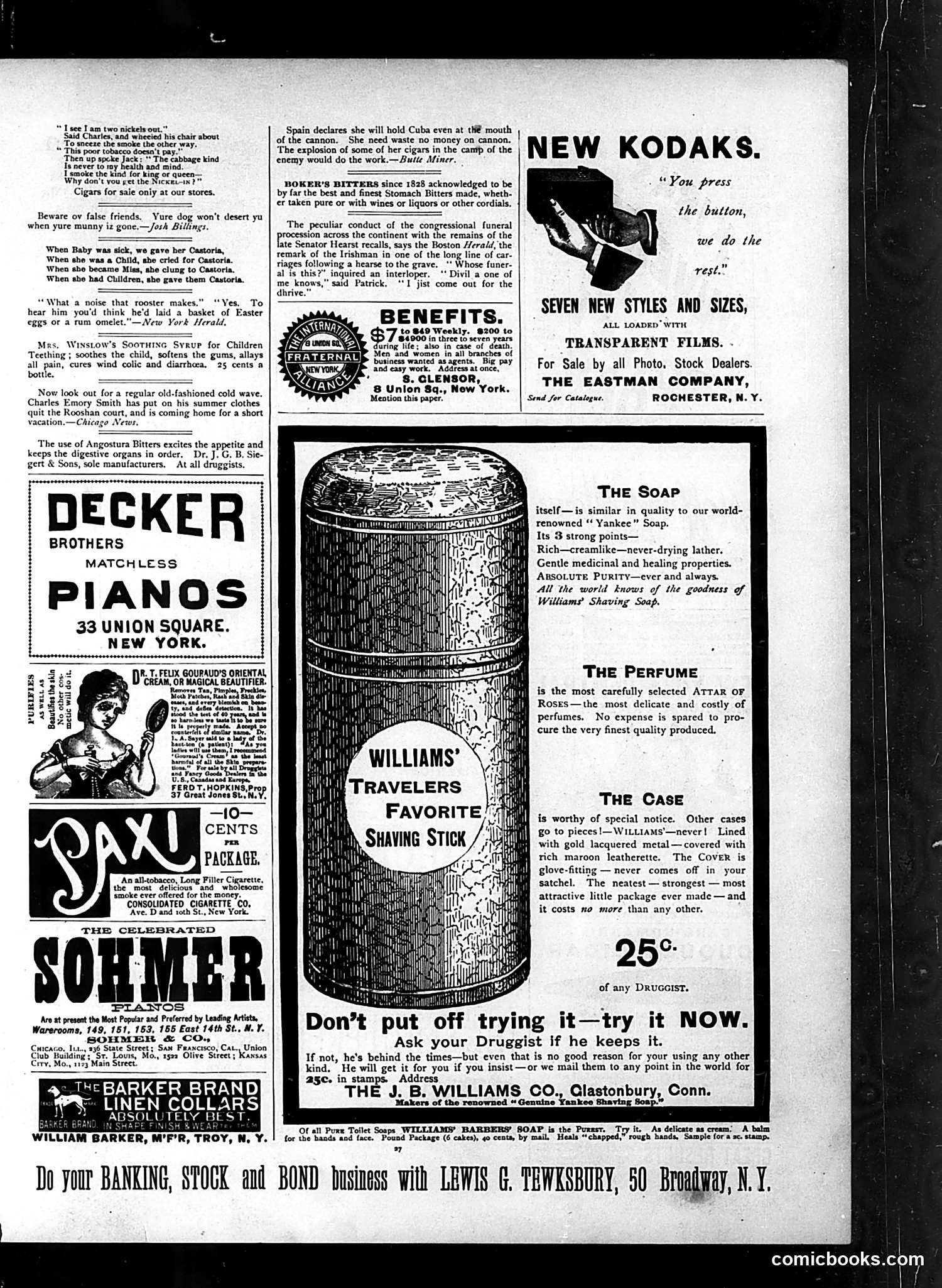
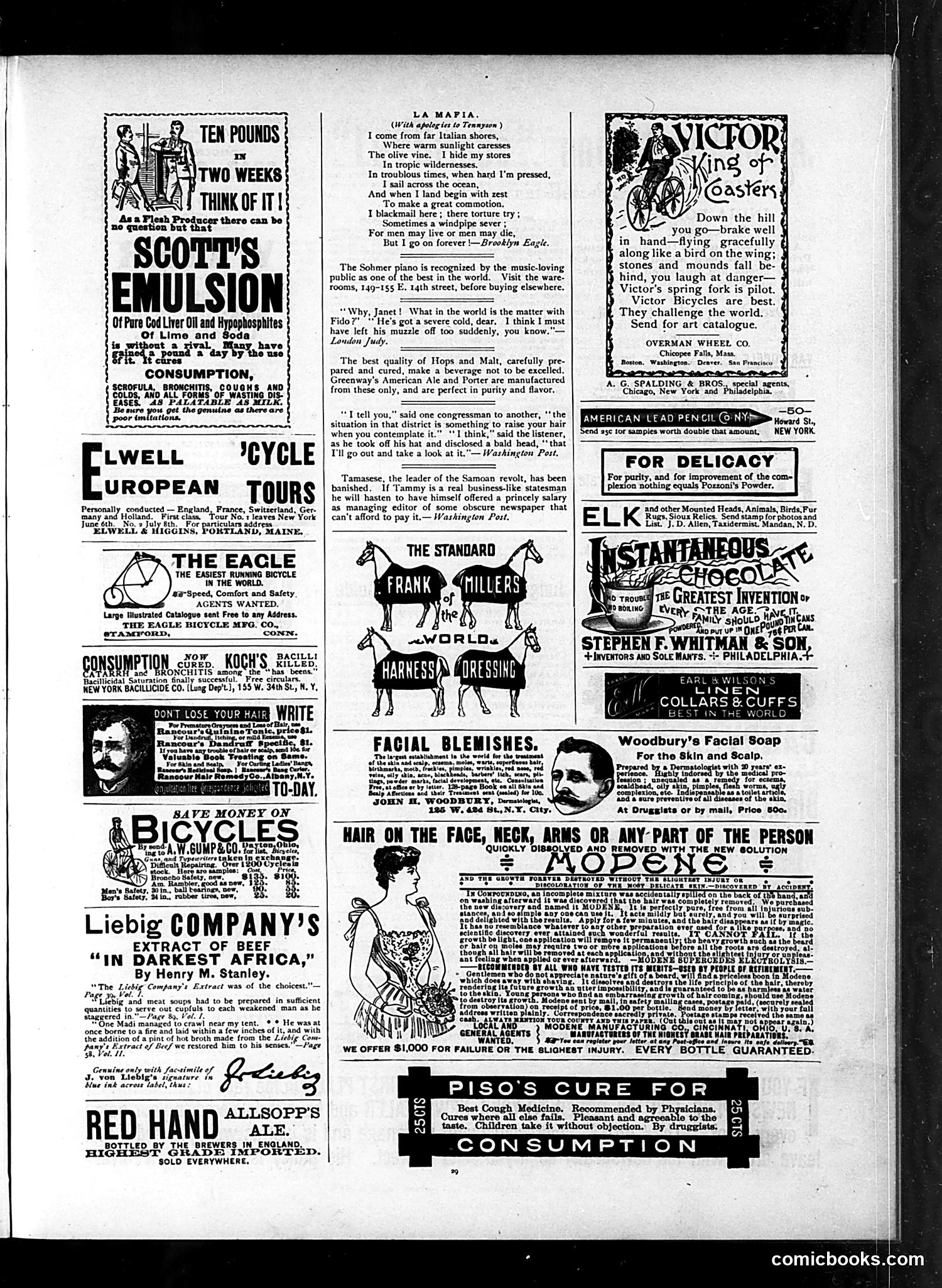
This page is primarily advertising with scattered satirical commentary. The main cartoon/joke compares Spain's military boast about defending Cuba: Spain declares it will hold Cuba even "at the mouth of the cannon," but the Butte Miner quips that the mere explosion of Spanish cigars would do the job instead—a joke about the notoriously poor quality of Spanish cigars. Another brief item mocks Congressional funeral ceremonies traveling cross-country with Senator Hearst's remains, using an Irish character's witty observation. The bulk of the page contains period advertisements (pianos, cigarettes, bitters, hair cream, collars, shaving sticks) typical of Judge magazine's revenue model. Most content is commercial rather than satirical.
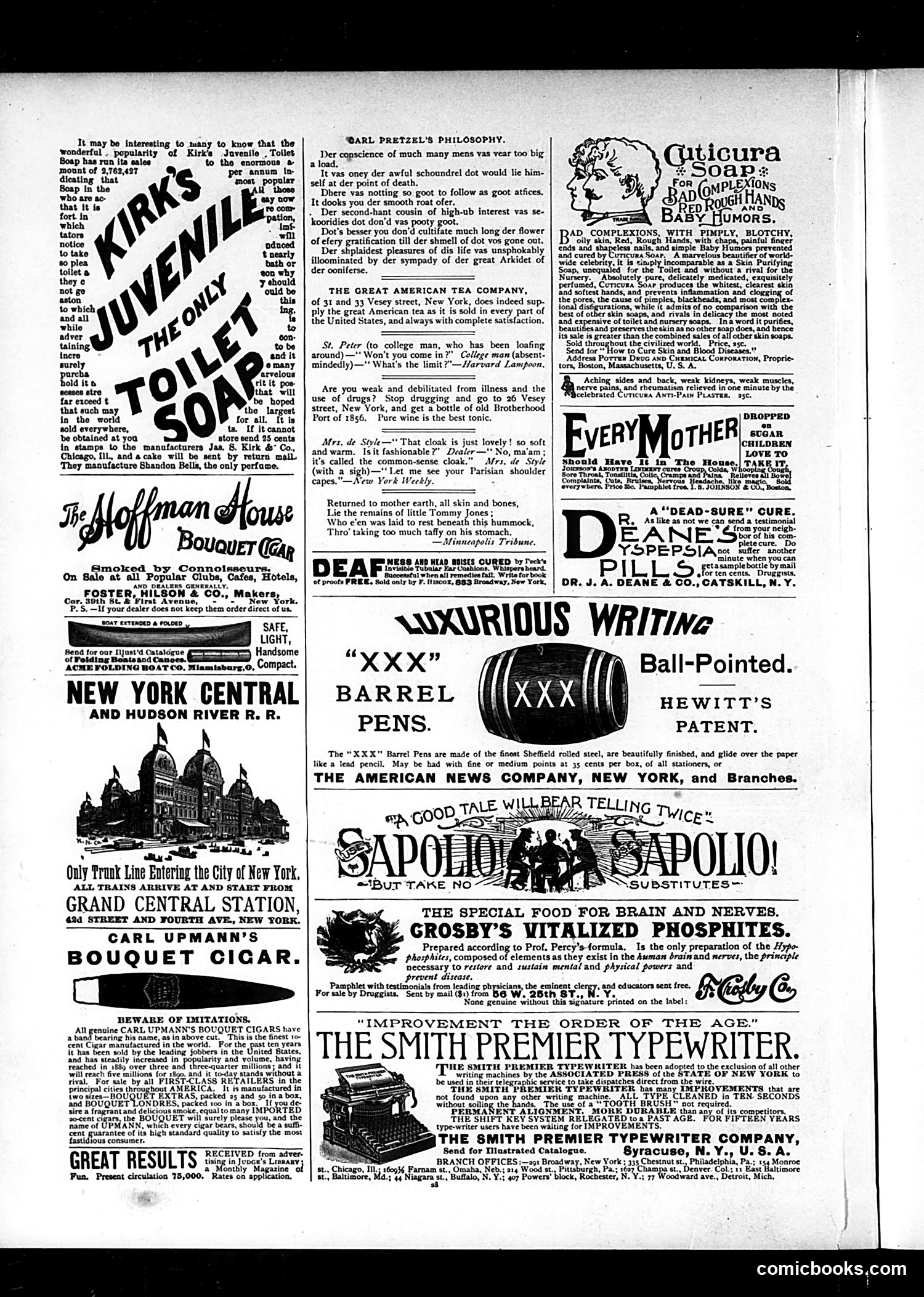
This is primarily an **advertising page** from Judge magazine, with minimal editorial cartoon content. The page consists almost entirely of commercial advertisements for products like soap, cigars, typewriters, and patent medicines. The one identifiable **satirical element** is "Carl Pretzel's Philosophy"—a recurring humor feature using a German-accented character dispensing folksy wisdom ("Der conscience of much many mens vas vear too big a load"). This represents period humor relying on ethnic dialect comedy, common in late 19th-century American publications. The advertisements themselves reveal era-specific concerns: Kirk's Soap claims enormous sales figures, "Dr. Deane's Dead-Sure Pills" promise miracle cures, and Crosby's Vitalized Phosphites marketed as "food for brain and nerves"—typical snake-oil remedies of the Gilded Age. The page contains **no political satire or substantive editorial cartooning**—it's a commercial product designed to generate revenue rather than commentary.
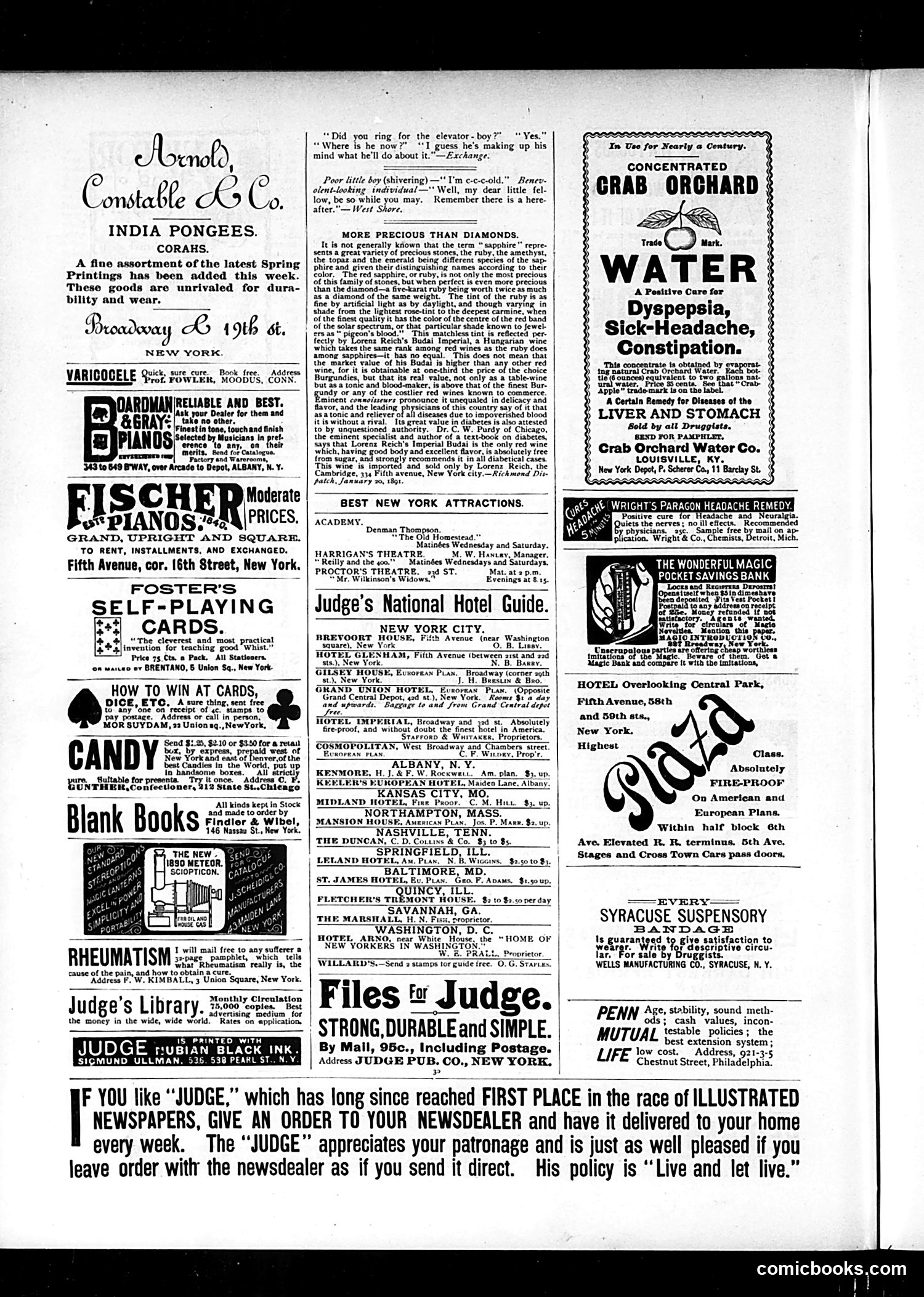
This is primarily an **advertising page** from Judge magazine, with minimal editorial cartooning or political satire visible. The page consists almost entirely of commercial advertisements for consumer goods and services typical of the 1890s: piano dealers, playing cards, candies, blank books, and medical remedies for conditions like rheumatism and varicoceles. There are small hotel and theater guides for New York City attractions. The only apparent humorous content is a brief, captioned exchange between an "intelligent individual" and a "violent-looking individual"—a moralistic joke about enjoying life while young, ending with "Remember there is a hereafter." This is generic moralizing humor rather than political satire. The page demonstrates that Judge relied significantly on advertising revenue. Without clear editorial cartoons or identified political figures visible in the images, we cannot determine specific satirical targets or contemporary political references beyond the overall moralistic tone typical of the era.
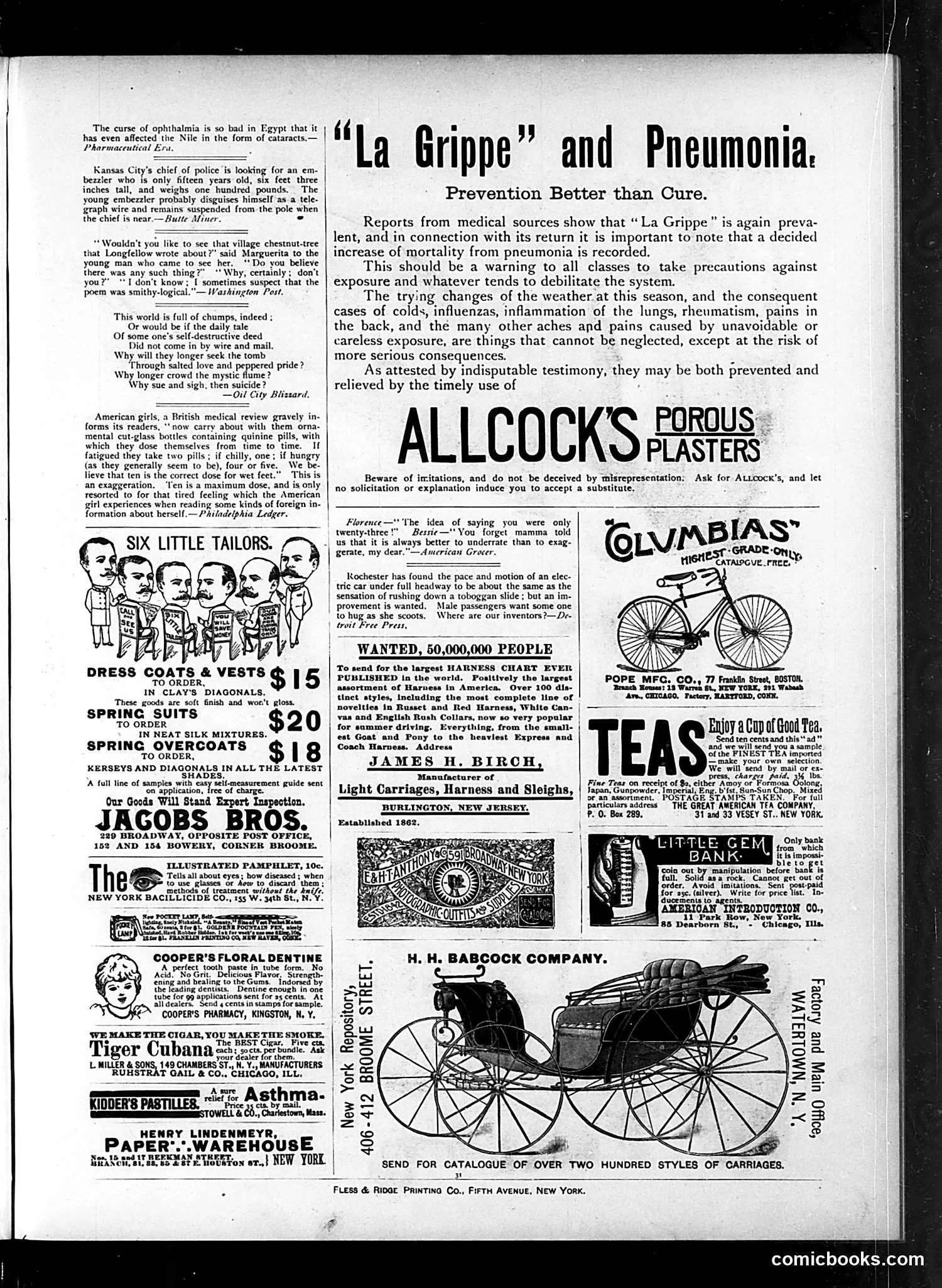
This is primarily an **advertising page** from Judge magazine, dominated by a large public health notice about "La Grippe" (influenza) and pneumonia prevention. The main article warns readers that influenza has returned with increased pneumonia deaths, urging precautions against exposure and system debilitation. The page features multiple **commercial advertisements** for period products: tailored clothing (Jacobs Bros.), eyecare treatments, cigars, dental paste, asthma remedies, carriages, tea, and banking services. At the top are several **brief humorous satirical items** mocking contemporary topics—including jokes about quinine-pill-carrying American girls, Egyptian eye disease, and suicide trends—typical of Judge's witty filler content. The page reflects early 20th-century American consumer culture and health concerns, with the influenza warning underscoring the disease's contemporary relevance to readers.
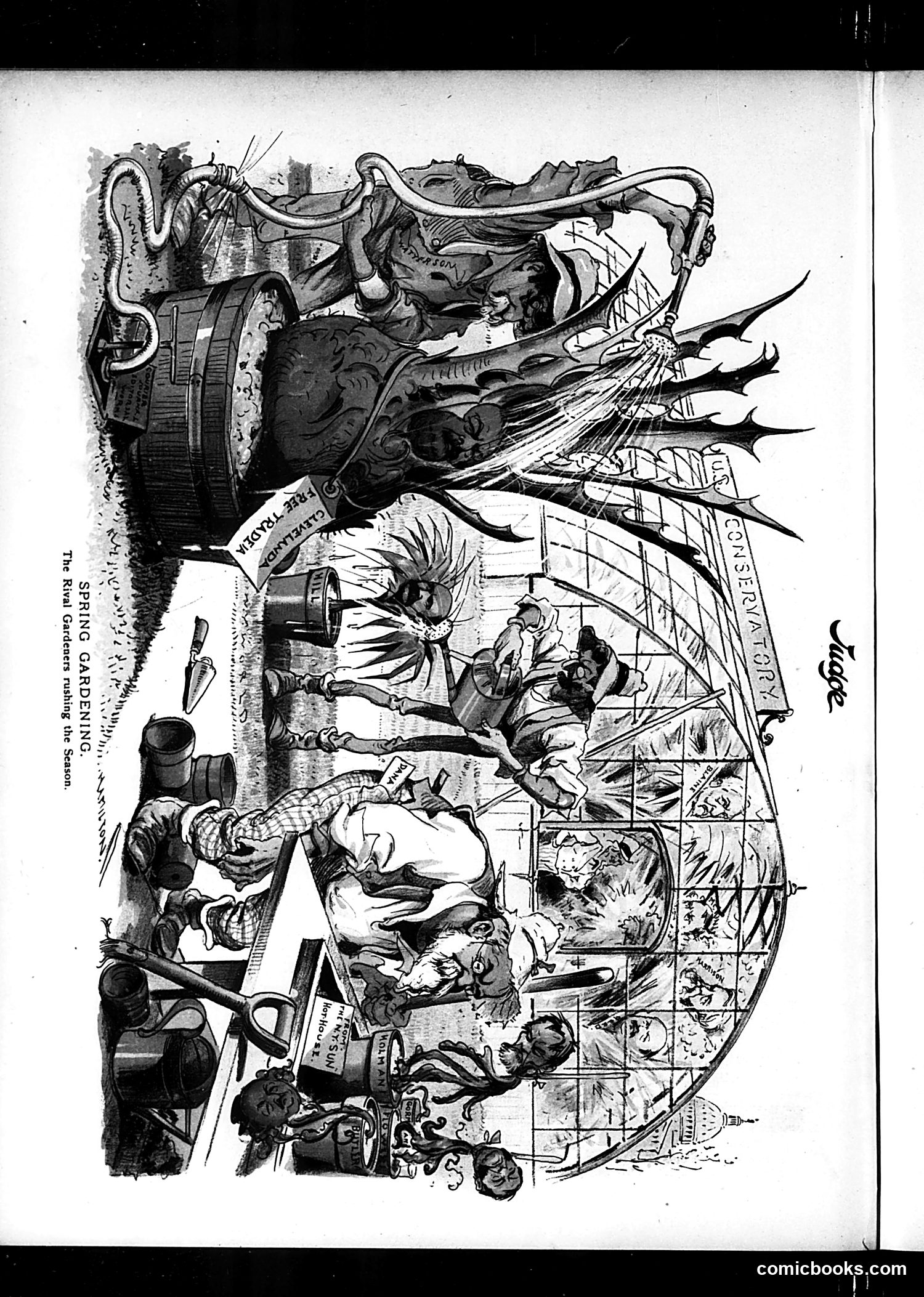
I can see this is a political cartoon from *Judge* magazine, printed upside-down on the page. The image depicts a large dragon or monster at the top, with various human figures below it appearing distressed or in conflict. The composition suggests an allegory—the beast likely represents a political or social evil threatening the figures below. However, the OCR text is almost entirely corrupted numbers and letters, providing no readable context. Without legible text identifying the specific figures, political figures, or the historical moment being satirized, I cannot reliably explain what particular issue or event this cartoon addresses. To properly interpret this satire, I would need either clearer OCR text or additional publication information (date, issue number) to identify the contemporary context and targets of the criticism.